

iWork4Him Podcast Transcripts
Welcome to iWork4Him! Join hosts Jim and Martha Brangenberg as they interview everyday Christ-followers in the workplace. From CEOs and Business Owners to Nurses and A/C technicians, all of us can make a Kingdom impact!
Tune in to hear how Christians, just like you, are integrating their faith and work. Full of practical tips, inspiring testimonies, and biblical truth, the iWork4Him Podcast will encourage and equip you to make your workplace your mission field – a place where ministry can happen all day long! Whether it's a coworker, a vendor, or a customer, you may be the only Jesus they ever get to meet. You have a Kingdom calling, and it starts right where you are!
This page shows the transcripts of each audio recording. To listen to the show, click the button below.
3/11/26 - 2137: Why I'm Running for Mayor... And Why Maybe You Should Too
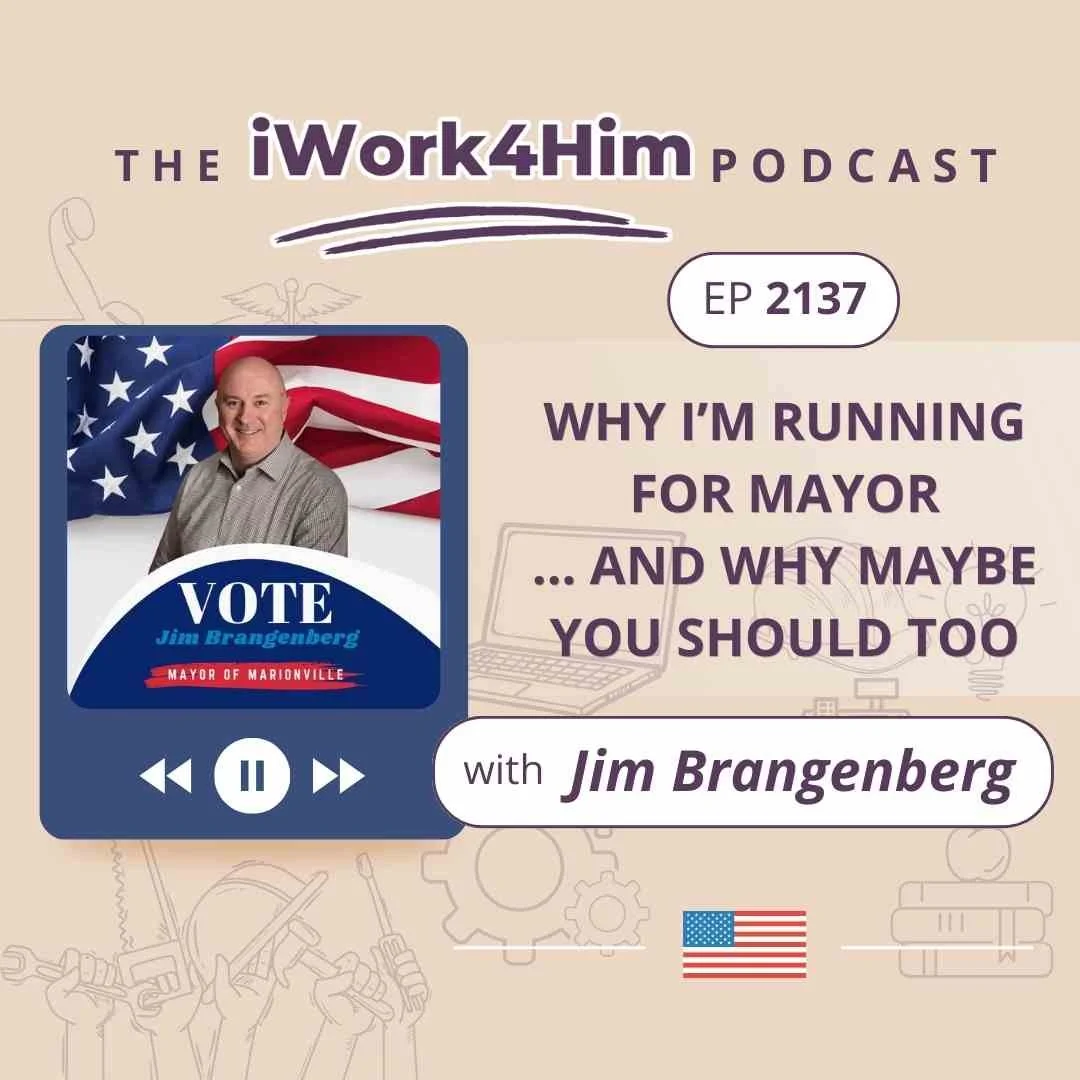
Jim Brangenberg: This is a joint release iWork4Him, iRetire4Him show, where faith meets work and retirement and believers unleash their calling on their community and their workplace. Before I get started today, let me encourage you to talk with our sponsors.
Safernet.com. If you ever wonder who's watching you on your computer, who's trying to invade your computer, you need to check out SafeNet. They've been a sponsor of ours for a number of years now because their VPN, it keeps you safe even when you're using public wifi. But at the same time, they can give you web filters, an internet portal. You could track where your employees are going and where they shouldn't go.
At the same time they give you antivirus and all the things you need to operate a safe internet environment in your office or in your home. Check 'em out online, safernet.com. And also check out the US Christian Chamber. If you're operating in the marketplace, there's a Christian Chamber near you. Check out the US Christian chamber at uschristianchamber.com.
And finally, if you're using a cell phone, where does your cell phone company send their profits? Patriot Mobile's the one that we use. Faith, family, and Freedom. When they're making money and they're giving it away, they're giving it away to people that I like, that support the things that I support. Check 'em out online, patriotmobile.com/iWork4Him.
Like I said, this is a joint iWork4Him, iRetire4Him show, because the topic for today's show applies to everybody listening, whether you're still working or whether you've quote unquote retired, which we've talked about a million times, is not a real thing. It's the American dream of retirement, but it's not a biblical thing. So if you're listening to this show, you've heard me rant and rave about that before.
So let me jump in. For some of you, this podcast has been part of your listening challenge for the last 13 years. We've talked with Jesus followers in so many different places, jobs all across the world and across the country, and sometimes even in their elected offices. We've joked about the fact that growing up I always wanted to run for Senate when my kids were grown and gone.
Then I realized that people in politics, Jesus followers, got changed in the process. They also had to compromise to get things done. Number one, I only wanna change those things in me that aren't like Jesus. And number two, I don't wanna be known for compromise. Jesus got his mission done and never compromised. There was pressure all the time for him to compromise, but he never did. I wanna be like Jesus, therefore get my mission from God and stay on that mission. No compromise. So what's the reason for this rant?
I'm running for mayor of my small town here in Missouri, and it's time to put all of the above to the test. I grew up in an era where Christians were told to stay outta government and stay outta politics. They were dirty places, so all of us did just that and look what we got. A nation that spits in the face of God, denies his very existence through our laws and actions and judicial proclamations, and leaders that not only completely, that are completely compromised, but they celebrate that they're completely compromised, and they're willing to change the minute the wind changes in order to please some lobbyist or to make an extra million dollars here or there.
It is time for followers of Jesus to get into the fray and run for local, county, state, and national office. And don't complain to me about how bad things are if you're not willing to be part of the change. Let's remind everyone that if we're gonna complain, we need to be part of the solution. So let's remind you about something I say on the show all the time. I say on the show all the time: as a Jesus follower, everything about you should be changing and everyone around you should be benefiting from your faith, whether they believe in Jesus or not.
Let's break that down again. As a follower of Jesus, everything about you should be changing. It's the process our heavenly Father uses to shape us, to look and act more like his son Jesus. And secondly, everyone around us should be benefiting from our faith, whether they believe in Jesus or not. So the question you have to ask yourself, is my community benefiting from my faith in Jesus? And if it's not their issue, it's my issue.
I'm running for mayor because my community needs me. They need my leadership skills, my connection skills, my management skills, my sales skills. My community needs to flourish once more like it used to. It needs to be well run, fiduciarily responsible with taxpayer's cash.
I wanna encourage the Jesus follower in his town to be good neighbors, me loving on them to love on others, to be an example. So what led to this decision for me to run for mayor? Let me digress for a minute to tell you a little bit of that story.
We thought we were gonna live the rest of our lives out in Florida. We lived there for 20 years, and then our daughter marries a boy from this town. We end up buying a house in this town next to our daughter, halfway in between our aging parents, between Fort Myers and between Tucson, Arizona. And we decided to buy this house and fix it up. And in the summer of 22, we came here for a sabbatical to give ourselves a break after being on the air for 10 years.
And we were gonna take a summer off sabbatical, build a deck, and just relax. And God says, as my father, I think you're supposed to stay there and settle. If we were gonna settle here in Marionville, Missouri, we needed a place to do iWork4Him, iRetire4Him, and all the other podcasts that we do. So we needed an office, which ended up, we ended up buying what's called the Old Library in downtown Marionville, Missouri. We didn't buy it because everybody was endeared to that building 'cause it was the old library. We bought it because it was a building that was in decent enough shape that could be rehabilitated into good shape and put to use for iWork4Him.
At the same time, we decided to make it available to four other businesses that could have offices in our building. It put us downtown. And in that first year of rehabilitating this building where I'm recording right now - no, doesn't look like my background. I wish I had a really great background that looked like that, but I don't- people came to meet us.
People were so excited to see a building come back to life. People stopped in to talk to us and we got connected with the business community and eventually when the building was done, we started gathering the local business community together. We started getting involved in meetings. I got involved in the Lions Club, the local fire department as a chaplain.
We heard from the public all the time about things that Marionville needed, and they saw that we really cared because we fixed up a building they all loved, the old library, which we now call Central Place. The bottom line, God gave us influence in a small town we didn't deserve. We didn't earn it, but he endowed us with unmerited favor.
With so many people so quickly, it was undeniable that this influence should be used to help our city. Not to put a title on by my name, but to help this great city we live within. So what was I to do? Push back from the shadows or get into the limelight and fight the enemy of this city in broad daylight?
The enemy is not the person I'm running against but the enemy of our souls who loves to see people perish and struggle living in pain without purpose and sometimes even in poverty. I'm running for mayor because Martha and I prayed about it for a whole year and on registration day, God said, yes, you can run.
Now, i'm not running unopposed, but this election isn't about me. It's about the people of this town and as a Jesus follower running for office, I am not to slander or talk down about my opponent. She's a creation of Almighty God, created in his image. I don't have to agree with her, but I must love her, pray for her, and show her proper respect.
I'm running for mayor because people on the streets ask me to lead and to love and to listen and to launch this city back on a trajectory of success. I'm running for mayor because this world needs biblical leadership by Jesus followers who have learned to love God and love their neighbors and their enemies and pray for those who persecute them.
I'm running for mayor because I can't ask you to do something for your city, your school, your county, your state, or your country if I'm not willing to do the same. Am I experienced at running a city? No, but I am an expert at cleaning up messes and I've run a lot of things, a lot of businesses. And cities are like businesses. They generate the revenue from businesses who sell things and from paying property taxes.
I can learn how to be an excellent mayor and I don't have to do it alone, 'cause many in this community have never been asked to help or serve, and I plan on asking 'em. Am I excited to have people criticize me? No. But I'm not likely to get impaled on a cross, so anything less then that is much less than Jesus did for me and my community already. And am I gonna be a perfect leader? I'm sure I'm gonna make mistakes, but I'll admit them and I'll move on and I'll surround myself with people who would keep me on the straight and narrow and also people who pray for me daily.
I'm running for mayor, and now I'm asking you to look at how you can impact your community too. Ministry is messy and this mayoral position will be messy, but Jesus is the king of cleaning up messes. He's cleaning me up every day. He's cleaning you up every day, and he can do it in our communities too.
You have things going on in your community that are driving you nuts. Maybe it's your HOA if you live in Florida. My HOA drove me nuts all the time until Martha became president. What are you gonna do about these things that are driving you nuts? Maybe it's in your community, your county, your city, your state. Are you gonna complain? Are you gonna gossip? Are you gonna post things on Facebook? Or are you gonna respond to the clarion cry of your community for godly based servant leadership?
Whether you're working or whether you're retired, your community needs you to rise up and lead in love. Some of you who are listening today are called to serve on your local school board, your city council, your county commissioners, maybe your state senate, house, or assembly. Some of you are called to be a mayor, a governor, a sheriff. Some of you may be called to run through judicial office. Some of you don't realize that you don't have to be a lawyer to be a judge if it's an elected position.
Some of you are called to our nation's capital to run for the house or the Senate. Some of you may even have a presidential call in your lives. But most of you are going, now that's for them, not for me. But we've been doing that as believers in this country for the last 70 years. And guess what? It doesn't work. Our country needs us. Our country needs the solutions that come from the heart of God, where it puts people first - loving God and loving people. That trickles down to solve the problems of community.
We've thrown billions and trillions at poverty in this country. Guess what? The church has a solution. It's a biblical solution. It just comes down to are you willing and will you be obedient when God calls you to serve the people that you work alongside, live alongside, dwell in a community with? Are you willing to say, okay, Lord, I'm tired of complaining. I'm willing to be part of the solution.
We need to remember that your workplace and my workplace, it's my mission field. What does that workplace look like for you? For me, in 2026 to 2028, I hope to serve as an unpaid mayor of a town of 2,500 people in southwest Missouri. That's right, I said unpaid, but I'm looking forward to it. I'm looking forward to seeing a town rally around itself, putting arms around each other, holding hands, and joining in, making their town great again.
Are you willing to ask God if it's time for you to run for Office too? I hope the answer is yes. I'm Jim Brangenberg. I'm running for mayor and it's because of this work on iWork4Him that I'm running for mayor. I know that I can make a difference 'cause I've learned that no matter where I am, everybody around me should be benefiting from my faith, whether they believe in Jesus or not.
You've been listening to iWork4Him with your host, Jim Brangenberg. I'm a Christ follower. My workplace, it's my mission field, and my workplace might be the mayoral spot in our town, but ultimately, no matter what I'm doing, iWork4Him.
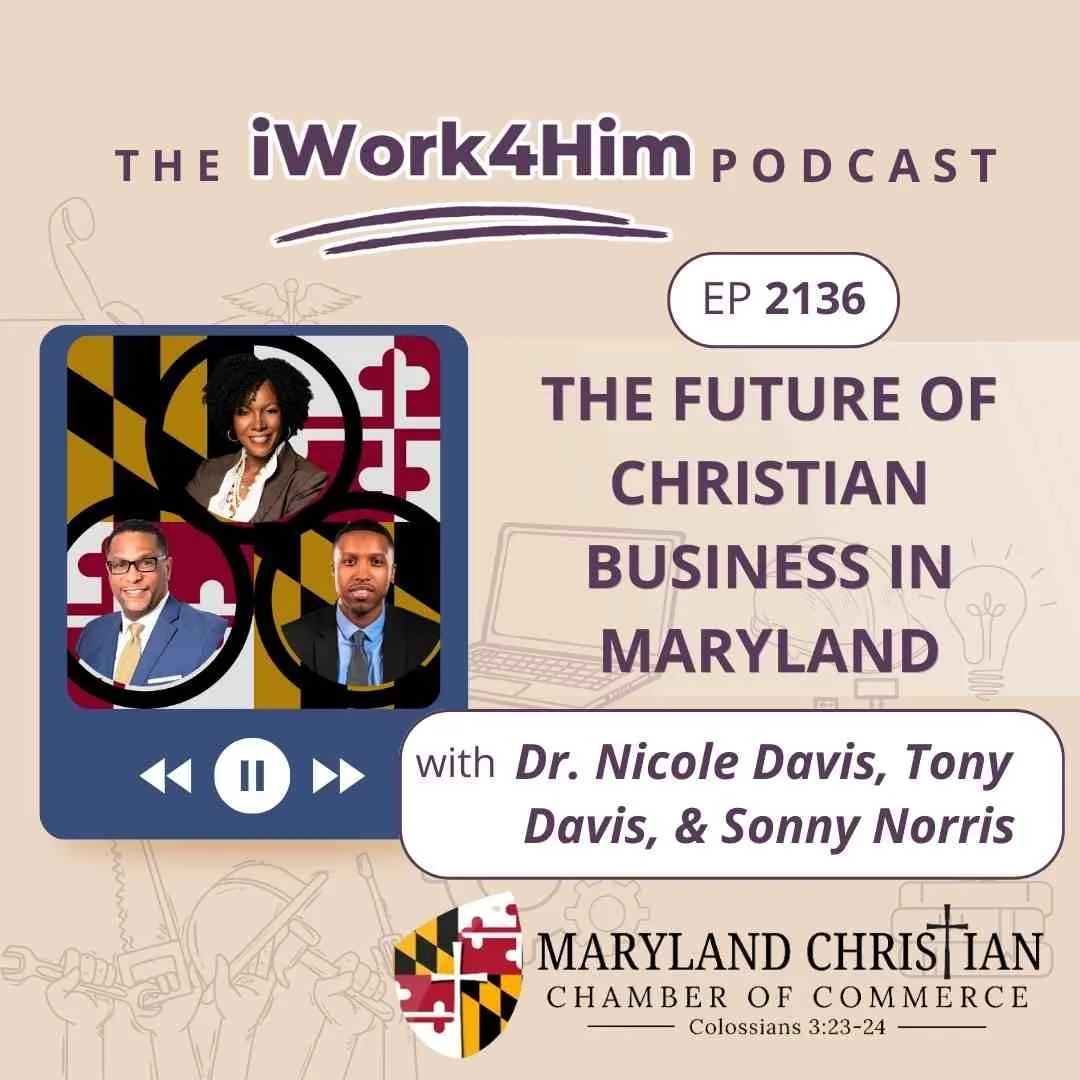
3/4/26 - 2136: The Future of Christian Business in Maryland
Jim: This is iWork4Him.
Martha: Where Faith meets work and believers unleash their calling.
Jim: Maryland is such a great state, such a melting pot of cultures and such a wide variety of businesses and organizations, and of course it's smacked up against Washington DC, so they also have influence over the nation as well.
Maryland is urban, suburban, rural, and farmland and so much more. It's a state that I lived in for just seven years growing up. But it's part of my heritage and part of my story. I first met Jesus in a little church near Ellicott City, but Maryland has been missing one huge thing: a Christian Chamber of Commerce, focused on the unique needs of Christians in the marketplace.
Dr. Nicole Davis saw that need and responded. She's moved forward as the founder of the Maryland Christian Chamber of Commerce and the 19th of March 2026 it will officially launch. Nicole is here today to share the story behind this amazing startup with her husband Tony and Sonny Norris will be joining her as well as one of the next gen founding members to tell his story of why he's involved as well.
Dr. Nicole Davis, Tony Davis, and Sonny Norris, welcome to iWork4Him.
Tony Davis: Thank you.
Dr. Nicole Davis: Thank you. We're so glad and excited to be here.
Jim: We are ecstatic to have you guys here. We've been walking alongside the story with you. I don't even remember the first time we talked, Nicole, but when I heard about Maryland, I was so excited because it is part of my story. It's a small part of my story, but it's part of my story. And I know that on the Eastern seaboard this is a significant thing. But Nicole and Tony and Sonny, before we get started, just really short, we always, for first time guests on the show, we always ask you to share your Jesus story.
So really short 'cause we want to cover a lot of other stuff, but ladies first, Nicole, tell us your Jesus story.
Dr. Nicole Davis: Okay, really quickly, I did not grow up in the church and as soon as I could, once I graduated from high school, I went into the military to give myself a chance at life. It was there in the military in Iceland where I met Jesus. It was not in a church, but it was in a barracks with my dungarees on at a singles fellowship. And someone else there from another branch of the military, I believe.
Tony Davis: No, he's Navy.
Dr. Nicole Davis: He was navy, would see us in the gym quite often. And he attended that fellowship Bible study. And he asked me then, he said, I've always seen you walking around with your friend, but I've been afraid to talk to you - do you know Jesus? And I was at a point in my life where I wanted change, but I didn't know it was Jesus. That was the change I needed.
And while "no" was in my mind, because you always know what you can't do once you become a Christian, "yes" came out of my mouth and I gave my life to Jesus in that instance. And just knowing that Jesus would choose me in the wretched state that I was, I've committed my life ever since then to serve him with everything I have. So that's it. And a real quick story.
Jim: In Iceland?
Dr. Nicole Davis: Yes, in Iceland.
Martha: Wow.
Jim: I think you're the very first person that we've interviewed on iWork4Him in the last 13 years, and over 5,000 people, that got saved in Iceland. That's fantastic. All right. Tony, what about you?
Tony Davis: I'm the complete opposite. I grew up in the church. As a matter of fact, I was the kid who was always in Sunday school. My brother and I, we earned our allowance by learning 40 scriptures, whether like Psalm 13, Psalm 23, the Beatitudes, whatever. That's how I earned a little $2 per week. And my brother earned his $2 and 10 cents per week because he was older. (chuckling)
But as I grew up I saw the ineffectiveness of the church, so when I went into the military, I tried to backslide but it didn't work. I try to go to a club. Other people can go to the club. I go to a club, I get into the fight, right? Just crazy stuff. And I was almost like Jonah. It was like, get him out of here.
But even during that time in Iceland, my grandfather died. And it was something about his death as an adult that made me realize the reality of life and death. So during that time, I got serious with my faith and I said, you know what, Lord? I'm gonna really be sold out and committed to you. And then coming back to Iceland, so while I didn't get saved in there, because like I saved way before that, coming back, I met this woman who met me when I came back telling me that she got saved. And that changed the whole dynamics of our relationship, 'cause I was that friend at the gym that the guy always saw her with. He was just with a squadron that was there visiting.
Jim: You were just friends then.
Tony Davis: We were, Jim, we really were. We worked the same schedule. So we lifted weights together, played racquetball together, played basketball together, but we were really, truly just friends with no intention.
Jim: But that's the best part of it. When you marry your best friend, that's when marriage is easy, when you marry your best friend. Martha and I were friends for years.
Martha: And also duly noted when you were starting that friendship, you were not gonna be equally yoked. And so obviously God's timing was beautiful in all of that.
Dr. Nicole Davis: Perfect. Yes, indeed.
Martha: Alright, Sonny, tell us your Jesus story.
Sonny Norris: Similar to Nicole, it's nothing close to what's on the screen today. I grew up in the uptown streets of Washington, DC, and growing up, being born and raised in DC I was exposed to a lot of street culture and unfortunately I got engaged in some of that as well.
And, the journey that God took me on is so unique and I'm so grateful for it. Just being out there in the streets, just being in involved in so many different things. I had a friend who actually went to church and he would always try to get us to go to the church that was on the same block that we were out there doing bad things on.
And he used to always tell me that once I gave my life to Christ, he said he always saw something in me, that once I gave my life to Christ, God'll use me and my influence to be impactful to the world. It was through more bad decisions where I found myself locked up right in the prison cell and I heard his voice again there, my best friend telling me, once you change your life, God will do something great for you. And I don't know if it was just one of those prayers that I did. When we're in trouble, we say, God, you get me outta this, i'm gonna do whatever is possible to try change my life around. But it was really in that moment that it started to make sense.
And from there it's really not, nothing that I've done. It's not a magical go in a closet and change and I'm saved story. It was literally life event after life event. God was just pulling me along, and he never let go of me. So that's my story. And from there he took me to do Christian hip hop and go back to the same streets that I was saved from and I was robbing on, in the same neighborhoods that I was being locked up in, and preaching the gospel to those people.
So that's been my ministry since the time I've been saved, just going back to the same places I was saved from and preaching the gospel.
Jim: Did you prepare any hip hop for the Maryland Christian Chamber of Commerce launch event? (laughter)
Sonny Norris: No. I'm still catching up on the music that Tony sent me when we were at lunch a couple weeks ago, with the crossover movement, so I don't have time for that. I'm in a different phase of life.
Jim: It would not be the first time on iWork4Him, but, okay. All right, Martha.
Martha: So thank you each for sharing your Jesus story 'cause we know that our listeners can either be encouraged that, where you might have been might be similar to their situation. We often struggle with " my story doesn't sound like theirs" but God works in each of our lives in different ways. So thank you for sharing that.
Okay. So Nicole, we're gonna jump right in here and in our view, looking in, okay, up until now I hope your life's been maybe looking a little more simple than it's gonna look in the next few months. And this last year, as you have, under God's prompting, started this process of launching the Maryland Christian Chamber. So how do you see that God has been preparing you over the years for this new role that you're in now?
Dr. Nicole Davis: Yeah I heard in Jim's opening that I saw the need and then stepped into it. I wish that were the case. (laughter) I was not paying attention to the need. I was living my life with my family and what I believe was the work that I was supposed to do, and that's from social work. My undergrad is in social work, so I've done community work for a very long time. My doctorate is in conflict analysis and resolution, and with my military background and working in the federal government, I've worked with leaders for years, and then I do a lot of work with the court system, so I'm around government stuff all the time.
And it's all of these parts. And in the church I've been a director of women's ministries and I'm an ordained pastor actually. And so all of this has equipped me and prepared me. Even with my family, just the things we've done together and learning to work together and overcome challenges has all been a critical part of preparing me to now lead others as they build what they believe God is calling them to, as well as their families, and leaving none behind as you build or work towards whatever dreams and aspirations you have. All of that has been used to get me here.
Jim: And I imagine you've started to see, "huh? I guess that's why I learned that 20 years ago. Huh. I guess that's why I learned that 10 years ago." I imagine you've seen some of that come into play. When we first started talking, and I should have gone back to look to see when the first day we talked, we talked about the journey that you'd have to go on to set up the Maryland Christian Chamber. By the way, if you're wondering, you're listening, MD christian chamber.com. If you're anywhere in Maryland, this Christian Chamber is for you. We talked about the recruiting of a board. Talk to us about how you saw God working in that journey of recruiting.
Dr. Nicole Davis: Yeah, so in our initial conversation, a lot of what we talked about is that I was not anxious and that I was gonna trust the Lord's leading and prompting for how it is, or was, that I was going to select the different people. And we had conversations about gender. We had conversation about nationality, because I wanted to really be sensitive to what it would take to build a board that would represent all the people that would be coming along to be a part of this.
And so I have been intentional about considering all of those things in the selection process. And there were some people that I thought, yes, but then God would make it so that it wouldn't happen. There were people that would say, yes, and then their lives would fall apart in a way that they then had to walk away. And so I was really listening. Okay, God, I see that, okay, it wasn't that person. And then the next person would come right in and it was like, oh my goodness. Or a position shift. I thought the person was for one position.
So I've really made it my point to listen for God's leading. And that's with the time I spend with him in prayer before I'm making these decisions about these important positions.
Martha: And that's so important. It is often a temptation to just jump in and say, I know these five people, I'm gonna put 'em on. We're gonna be good. And your intentionality is going to be multifaceted in so many different ways. Okay, so one of the other things that you've done is you've been talking to people all over the state in town hall events. Tell us about that.
Dr. Nicole Davis: Oh yes. So we've been doing listening sessions. We just had one this past Monday, and we have our ninth one next Friday. But the whole purpose of the listening sessions is to allow the voices of the people to help shape our strategic plan for what it is that we're going to cover throughout the state, because it's nothing worse than to come and tell people what they need or want without considering what they say.
And with my social science background, I've always cared about people, as you say, what has prepared me for this position. That's always been a part of how I operate, which makes it easy for people to wanna work with me and be a part of what I'm doing. And that has really helped us.
So in these meetings, we're having panel conversations about opportunities and challenges that they're seeing, and trying to work with churches and business and faith-based organizations and communities. And what do they see as the chambers role and ability to help foster these connections and these relationships? So they have been powerful. People love them and they look forward to them. They said, please don't stop doing these after you launch. And they may be different, but we won't stop.
Jim: Yeah. I just love it. And most people are not familiar. They think of Maryland, they think just right on the coast. They don't realize how far inland Maryland goes, all the way to West Virginia. I don't how many miles it is, but it's gotta be 300 miles from Coast or from east to west. Is it?
Tony Davis: I don't know the miles, but I know it takes us about three, yeah, three hours from Owings Mills to get through West Morgantown to go into Pittsburgh. I know that. And then it takes about three hours to go south towards Ocean City.
Martha: Wow.
Tony Davis: So it's a drive.
Jim: Several hundred, on I 95. It depends on which time of day. All right. I know you've had a lot of fun 'cause I've been following you on LinkedIn gathering founding members. Every day it seems like you're posting a new founding member and you're heading towards this launch on March the 19th.
How fun has it been finding these people that said I wanna be a part of founding the Maryland Christian Chamber of Commerce?
Dr. Nicole Davis: Very.
(laughter)
Jim: Oh, that was really good.
Martha: There you go. You said short answer.
Jim: There we go. Tony, give us your perspective. You're not involved in the day-to-day yet you, because this is your bride, you're involved in every bit of this. Talk to us about your perspective from the outside. How have you seen God working in all of this?
Tony Davis: My perspective is really still on the inside 'cause I am the director of legal and legislative affairs with the chamber. But even as Nicole said, with her background and social work and mediation, she's always been trying to connect people and even being, even what you described with being intentional with the board let's put the away all those things that divide us and let's truly have a body that every joint supplies.
We quote this stuff in scripture and we say everybody, every body part is unique and necessary, but now we need to have an organization that really amplifies that and also emphasizes that so that we can see it all come together. So I think the most exciting thing for me is actually watching that come to fruition.
Jim: I love it. John 17 coming alive. Just, yeah, blossoming. Really awesome. Speaking of Christian Chambers, we aren't far away from the upcoming SWC 2026 Expo in Orlando in April of this year. April 22nd to 24th, that's the US Christian Chamber annually, semi-annual event, every other year annual event.
Dr. Nicole Davis: Bi-annual.
Jim: There you go. Thank you very much, Dr. Nicole. It's gonna be an immersive three day experience where Christian leaders unite to break barriers, build bold businesses, and advance the kingdom in the marketplace.
Martha and I have the privilege of MCing once again at this event. We can't wait to see in Orlando. Get signed up today. Go to swc2026.com and register using the code iWork4Him. That's I work the number 4 him. Get 20% off your ticket. How cool is that?
Martha: So we are very excited about that. And so we thank you, to everybody for listening to us talk about the Christian Chamber because this is a new idea to a lot of people. Sonny, I wanna address this to you now. How did you hear about the Maryland Christian Chamber?
Sonny Norris: Yeah I was just searching the internet, right? I talked to a business mentor of myself and, as a young entrepreneur, he pointed me to go look, be a part of some chambers of commerce. And so I was just searching the internet and the Christian chamber found me. It found me. And when I saw it, I said, huh, I didn't even know this existed, honestly. I was still new to what the chambers of commerce even meant to entrepreneurs like myself.
But I felt like there was no better way to be in a place where I can grow as a business owner and also spiritually. So when I seen that it was an opportunity I still didn't know exactly what I was getting myself into. But I'm so grateful that I chose to listen to God in that time. And because by the time I went to the first listening session, met Dr. Nicole and her family, I just knew I was in the right place.
But it came by me searching organically, looking to network and have different resources. When I found it, it was like, this is a match made in Heaven.
Jim: Anybody that says the Google is always the enemy, no, the Google right serves both sides, even if they did it inadvertently, but that's the power of these Christian Chambers. When we first started, when we first launched iWork4Him there were 19 Christian Chambers across the country, and it got down to 7. And now we're back up to, we will be by the end of 2026, there will be 30 and the US Christian Chamber really, well, what's the best word? Not curating, but holding, encouraging, supporting the Christian Chambers that are in all over the country.
It's stewarding. They're there to help lift up. It's incredible. You're a next generation leader. You're a next generational marketplace leader. What value are you gonna bring as a founding member to the Maryland Christian Chamber?
Sonny Norris: I think being the younger - and I told Dr. Nicole this before - I don't mind being like the face or you just use me if you wanna just put my face, my little baby face on everything just to market it. (laughing) And I'm not the youngest one in the chamber, that I just recently found out.
And it is different younger people that's coming about. But I think that, as my generation, we thrive off seeing our peers be successful and seeing what our peers are into as well and don't want to feel left behind. And I feel like this space, me being able to use my influence and my impact in this space as well will help drive and grow the empty chambers of commerce with other young people.
I think for us, when we see our counterparts in these positions, like when we posted that I am a founding member, so many people came and reached out to me because they didn't necessarily know what it was. But what they see is another young person, it looks like they're in a position, in a place where it is intriguing. And so I think that at minimum I'm looking to serve and to be able to grow and connect as many other young entrepreneurs to this as well.
You gotta have a business though. A lot of people wanna be a part of it that businesses aren't necessarily in place just yet or things like that. So when you come, you wanna make sure you come correct, 'cause when you get into the run with these people, you'll see why you want to be.
Dr. Nicole Davis: In business.
Sonny Norris: Yeah, exactly. Exactly.
Martha: Such a great perspective. Okay, so let's look at the opposite side of that then. What do you see as a young entrepreneur that the value of being a member of the Maryland Chamber is going to bring to you? Where do you see that value coming from?
Sonny Norris: Tremendous value. And like I said, I saw it from the moment I went to my first listening party. I always knew that in order to grow, you gotta put yourself in places where you could be challenged. You gotta put yourself in places where some people, a lot of people might know a little bit more than you, right?
And that's biblically, that's in business. And you can't grow if you're stuck in a place and you're not being able to bounce your ideas off of people or bounce your journey off of people and getting poured into, and whether it was through the listening party that I went to, or even just having the lunch date with Dr. Nicole and Tony with my wife and my kids and just the level of leadership and the spiritual side that she was able to pour, I knew I was just in the right place, right?
And so as a young entrepreneur, especially with that, as millennials we feel like we have platforms, we have our voice, but I think that you also gotta be responsible and ground yourself in places where you can. So that's why it was super important for me to be in that space.
Jim: Yeah. A couple things you just said that I gotta highlight on, but what I love that as a young entrepreneur, one of the things you need in your life is an old entrepreneur.
Sonny Norris: Yeah.
Jim: We call them chronologically superior people.
Martha: Instead of old. (laughing)
Jim: That's right. And that's what the Christian Chamber is gonna provide for you too. You're gonna have access to people that it, made all the mistakes that you don't have to. That's fantastic.
But Dr. Nicole, did you catch what Sonny just said? These were not listening sessions. They were listening parties. (laughter)
That's how you rolled this out, Nicole. These were listening parties for the Maryland Christian Chamber, across Maryland. That is fantastic. What a great perspective. Because Sonny, you're so excited. It felt like a party because you're like, this is ministering to my soul. My soul is giddy with excitement. That's why it was party thing. I'm just guessing that's what it was.
Sonny Norris: And maybe it was the music background, the listening parties. Exactly. But all in all, it was a great, it was a great environment. So party, session, we having a good time.
Martha: That is excellent. You also commented and just I wanna highlight this, that you said your wife and your kids came to something as well, and I think that it's really critical as entrepreneurs that we make sure we don't segment our lives so much that our family doesn't know what we're doing and we don't know what our family's doing. And so I love hearing that, whatever it might have looked like, because that is such a critical role for our families to just be aware of how God is moving in our work and what we're doing.
I just wanna talk for a second here that, it's really clear that the current generations are really yearning to live out their core values. You know, about where they spend our hard earned money. So excellence is a core value here at iWork4Him. And we have several supporters of this ministry that are affiliate partners that represent excellence as well.
SaferNet is a cybersecurity software created to protect your data on all of your devices, whether it's your computers, your cell phones, your tablets, so they do that. And Patriot Mobile is a cellular company that's built on the pillars of faith, family, and freedom, while providing excellent US-based service for our cell phones.
So to see all of the wonderful affiliate partners that we have at iWork4Him, go to iWork4Him.com/sponsors and learn the same businesses that align with your values.
Jim: All right, Dr. Nicole. As we, anybody could jump in on this question, as the Maryland Christian Chamber launches on March the 19th, 2026, how is this event gonna impact your founding members, your board of directors, and the visitors that night?
Dr. Nicole Davis: Okay, so this is where I just need to pivot a little bit, being led by the Holy Spirit, because that date is important, but we're already thinking beyond that date. And is what's been going on the past couple of days, which is why I wanted Tony to be here because the Chamber is changing me as a person, and so I know it's going to do that for those who are coming along. Even just listening to Sonny right now, his life is being changed as a person.
But what Tony is going to share, and I'm just setting it up for him so he can talk to you legislatively and why it is that we as Christians need to be educated and involved in the decisions that are being made that impact us is a huge part of what the Chamber is going to provide. So that we are not just spectators, but we're participators in the kind of environment we wanna live in beyond prayer but in our activity. So just tell 'em what you've been doing, babe.
Tony Davis: Yeah, sure. So as Nicole said, that's why here as part of this podcast, and I just came in and for the past couple of days - so I'm, as I said earlier, I'm the legal and legislative chair and then within the chamber we have a committee that's called the advocacy committee and Advocacy regarding your rights.
And one of the things I did with the for the Chamber is showed people how to really just get involved in the process - how to find out who are your representatives? How do you contact them? How do you understand what pieces of legislation are being proposed? And here we call it the general assembly.
And how do you participate in the process as a witness? And then, and there's so much going on that can impact Christian businesses. So for instance, even today we had a piece of legislation where they wanted to make it, they wanted to fine nonprofits or charities and fine 'em like $5,000.
And also maybe even take their licenses if they took a political stance, either positively or negatively, for political candidate. And see, and what's interesting about that is they wanted to, they called it nonpartisan. But even here in Maryland, there's no such thing as nonpartisanship because if you are an independent voter, or we call it unaffiliated, which is what almost 900,000 people are here in this state, you can't even participate in the primary elections.
So they force you into partisanship but yet they wanted all this nonpartisan legislation. But the reality, what it was gonna do was ultimately muzzle Christians from expressing their views in the marketplace. So I spent today testifying against that, but even with that being said, I showed even people in the chamber how you can get involved with issues that are important to you.
Jim: And it was just last year that the IRS ruled saying, Hey, it's okay for political speech to be endorsed from the pulpit. You can actually endorse this from the pulpit. You don't have to stay outta the process 'cause for decades Christians have been lied to saying you can't get no political speech, no endorsements from the pulpit, but they were doing in certain churches, but just not other churches. And no, the IRS said, Nope. It's cool.
Wow. Tony, thank you for doing that. We honestly thought that Nicole wanted you to be there because you were her eye candy (chuckling) but I am super thrilled that you shared that because as you guys know, I'm running for mayor in my small town. In fact we're doing a show about that in a couple of weeks.
But as believers, we need to get involved in the government, in the political process, in the legislative process. For too many decades, it's been over a half a century, Christians have been absent period from local districts, the county, state government. We've been absent and we have, we shouldn't wonder why our country is in the state that it's at. We just checked out. So Tony, thank you for your service. Thank you for being there. Both of you served our country as well. I should have said that first.
Martha: Yes. And I think what you are telling me that you're gonna provide is a safe place where people can actually get truth and help guide them because we are confused. We get half truths, watered down. We can't get the searches with the true answers. There's all kinds of things that then scare people from making any decisions or speaking up in any way because they're not sure of the truth. And so I love that you have that aspect in your Christian Chamber of Commerce so that there is a place where people can get that knowledge.
And even like what Sonny was saying, having somebody that's a little further down the road than you to be able to go to and say, Hey, I'm thinking about this for my business. How's this gonna impact it? What stance do I need to take? And be able to do that in a way that is God honoring and truthful and good for your business because commerce is a part of this equation.
Tony Davis: Absolutely, Jim and Martha, and I can tell you, we even had a business owner who approached me and what she said to me was, look, the current rules in this state are making it hard for me to do business. And it's taxes, it's licenses, it's fees. What do I need to do? But now that business owner has the instructions on how to really become an active part of the process.
Dr. Nicole Davis: So it's education and courage. We're helping people become courageous in standing for what they believe in.
Jim: I can't imagine how terrifying that was to speak in front of the general assembly.
Tony Davis: Oh, not at all. Not at all. Not at all.
Jim: Oh, no. No big deal. (laughter)
Tony Davis: No.
Jim: Everybody else would've been just, okay.
Martha: That's awesome.
Jim: Nicole, dream for me. Actually, just share what God's revealed to you. Maryland five years from now. As a result of the impact of the Maryland Christian Chamber of Commerce on your entire state, what do you see?
Dr. Nicole Davis: Mark these words. I see Kingdom commerce communities. I see churches, businesses, healthcare facilities, grocery stores, people who are disenfranchised, marginalized, reentering from prison or any other area, learning a craft or a skill, a vocation, being a part of a community and seeing their value and their worth, and doing it all with Christ as the center of their lives because the church will be there to help them and businesses will be there to support them.
Jim: Wow. I wanted to end the show right there, but I have one more question, but that's fantastic. I love that and I love the fact that you were ready for that question.
Dr. Nicole Davis: I didn't know you were gonna ask that question, but that's why I said we're already beyond the launch.
Martha: Yeah.
Jim: We know you're beyond. You've been planning this. It's been incredible. I wanna hear from all three of you, though, this final question. The final thing you want our audience to hear about the launch and the furthering of the Maryland Christian Chamber. What's the final thing you wanna make sure the audience hears today, Sonny?
Sonny Norris: Oh, I would say if you're an entrepreneur, you're in business like myself, and especially for me, my business isn't directly faith-based. And so it's super important that from all levels of employment, that we have a kingdom culture inside of it, especially when we are a for-profit business.
Jim: Hang on, Sonny. Sorry. We interrupt this commercial for a corrections solution here. It's trufacilities.com, correct?
Sonny Norris: Yeah.
Jim: So what do you do? Do you clean facilities?
Sonny Norris: Yeah, so we offer our clients one point of contact to get every building service.
Jim: Okay, so wait a minute. So what you're saying you take messes and you clean them up?
Sonny Norris: Absolutely.
Jim: And that's not a kingdom thing?
Sonny Norris: No. I'm saying...
Jim: Stop. No. You don't get to backtrack. No. So here's the deal, Sonny. I wanna help you with this. You run a kingdom company, 'cause you represent an attribute of God every day you enter a company because you bring in, you come in to take what's a mess and clean it up. You put it in order so that people are safe, so people can flourish. You are running a Kingdom company, buddy. Lemme just tell you that. That is what you're doing, and I want to help you with that. I don't want ever hear you say, I don't run a company that's particularly Kingdom focused.
Sonny Norris: No, I understand that. I think that there is sometimes, though, some people in my shoes, we look at, because it's not necessarily something that maybe directly involved with preaching the gospel or anything like that. Although, like I said, throughout culture and throughout customer experience I mean our customer service, we do input those kingdom culture jewels and we train out our staff in that manner. Some people in my shoes could look at it and say, because we're not necessarily preaching the Bible every single day, it's not a...
Jim: That's because they're wrong and it's okay. (laughter)
Sonny Norris: I agree.
Jim: How many families do you impact? On your payroll, how many families are impacted by the payroll?
Sonny Norris: Right now there's 15.
Jim: Wow. 15 families. That's not the gospel? Remember, the gospel is not just the salvation message. It is, Jesus came to restore that which was lost in the kingdom, which was perfect mental health, perfect physical health, and perfect spiritual health. You are doing it every day. Sonny Norris, thank you for being with us today.
All right, Tony, final thing you wanna say, one more thing about the chamber, whatever you wanna say. It's free for all right now 'cause I open it up.
Tony Davis: Yeah, sure. I'm just gonna reiterate what I said before. We are one body. Now let's connect.
Jim: Amen. I wish we could be there. Dr. Nicole Davis, our friendship is precious. I'm so grateful for this. Close us out today. One final thing you wanna say.
Dr. Nicole Davis: That our lives matter. And these past couple of days have shown me that in a way that I didn't realize it. While many people are sitting at their computers, they're at the gym, they're at the grocery store, there are people like Tony and others who have decided to be the voice for our religious rights, our freedoms, and for our ability to serve God unhindered.
And to be a part of an organization that is promoting that for every person, no matter what denomination you are, what race you are, what your vocation is, that is precious in the sight of God. And we want to do something that's eternal and will make a difference in the Kingdom of God and advancing what's important to him, and we're doing that through the Maryland Christian Chamber of Commerce.
Jim: Check 'em out online, mdchristianchamber.com. That's MD christian chamber.com and if you've got a chance, be there at opening night on March the 19th, just outside of Baltimore, if I remember correctly. Where's your headlining event on the 19th?
Dr. Nicole Davis: College Park, University of Maryland, the Samuel Riggs Alumni Center.
Jim: Awesome. There you go. Thank you all for being with us and iWork4Him today. You've been listening to iWork4Him with your hosts, Jim and Martha Brangenberg. We're Christ followers. Our workplace, it's our mission field, but ultimately iWork4Him.
2/25/26 - 2135: God is Writing Stories

Jim: You've tuned into iWork4Him, 13 years of covering the Faith and Work Movement.
Martha: We are your hosts, Jim and Martha Brangenberg, and our mission is to release the testimonies of workplace believers who have learned to unleash their vocational and cultural contributions for the flourishing of the world. What can that look like in your workplace? Well, let's find out right now.
Jim: You know, for the last eight years, 365 Christian Men have released a daily, several minute video, including an inspiring story about a Christian man living out his faith in the 365 of the wildest stories on Earth. Christian women have been crying out for equal treatment and access to the same caliber of encouragement.
Introducing today, 365 Christian Women where this month a new story will release each week. I was gonna ask 365 Christian Stories founder Blake Mattocks, to tell us about it, but what does a man know about great stories of Christian women? Today, Gabrielle Christie, next gen pastor from Landing Place Church in Commerce City, Colorado, joins us to tell us why she decided to be one of the narrators of these incredible stories of great women.
We might have a few more questions for her too, about her job. Gabrielle Christie, welcome to iWork4Him.
Gabrielle Christie: Hi guys. So nice to meet you. Just excited to be part of this opportunity. It's really amazing.
Jim: What a great platform, 365 Christian Women. So excited about it. Gabrielle, all of our first time guests get asked this question: tell us your Jesus story.
Gabrielle Christie: Oh my. Wow. Such a great question. Jim and Martha, so for me, I grew up in the church my whole entire life. And I am adopted, and I was adopted at birth, and my parents really were intentional about having Christ as the foundation of our household. And so for me, falling in love with Jesus looked a little bit differently.
I have an older brother who is biologically theirs, who's 11 years older, has special needs. And my brother Brandon, has taught me how to love people unconditionally with really like the true Jesus love, the raw, unfiltered love. Not the one that's been impacted by culture itself, but just because of who he is, who God has innately made him to be.
And so growing up around that and having a family who really served people well, my dad was really passionate about homeless ministry and my mom currently has been running a nonprofit for homeless ministry for 15 years, my Jesus story is about really reaching the people that Jesus reached - the people who were oppressed, the people who were not seen.
And it just really resonated with me as a person who was chosen as, just as Jesus chose the people who were not the most like shiny people of in the religious leaders. That's how my parents really modeled that beautifully. And so for me, I fell in love with Jesus by watching my parents live on mission, not only on mission trips outside of our country, which is what my mom did, but also for my father, to see him do that and picking up bags and filling 'em up with supplies and taking them out into the streets and having homeless people live in our house to giving them a second chance and giving them jobs.
And so for me, I fell in love with Jesus by seeing what it looks like to serve like Jesus. And so by the time I was in middle school, I went to summer camp like, you know, most Christian goers do when you're part of a church. And I, you know, got that, you know, that Christ High. And I go to camp and they're like, who wants to get baptized? And I'm like, I do. And, they were like, okay, get baptized today. And I said, no, I'm going home to get baptized by the person who showed me what it looks like to live like Jesus.
And so my father baptized me. I was 12. And so that is how I got to know Jesus, was through the actions of my family, seeing them serve in the church and outside the church. And that is truly been my Jesus story, is watching my parents model it really well.
Martha: Wow.
Jim: Give a shout out. Go ahead.
Gabrielle Christie: Yes. Shout out to my mom. My dad passed away 10 years ago from cancer. But he definitely is with our Heavenly Father and I'm extremely thankful for it every day, for all that he did.
Martha: Aww. Very good.
Gabrielle Christie: In my 21 years of living, I'm very blessed for his impact.
Martha: That's so good. So good. Okay, so Jim was talking about in the intro a little bit about 365 Christian Women. How did you get connected to 365 Christian Stories? What's that story?
Gabrielle Christie: So that's actually super crazy. So we talk about it actually like in our church, like in our time of generosity for some seasons, because we also give the church to it because we love the mission that they do and trying to partner with Blake. So Blake Mattocks, like him and his wife, go to our church. And it was actually funny. I like saw him one service and something about it, I was like, man, I need to talk to Blake, but I don't know why.
And then we met out in the lobby, that same service. He says, Hey, can I approach you about something? We're starting 365 Christian Women. And I said, finally! I was like, because I see it all the time, and I'm like, I asked him, I was like, where is it for the women? I hear about this thriving thing for all these guys. And I was like, hello. (laughing) Like there's some ladies, we also would like something to listen to and to be able to experience for ourselves.
And so he approached me with that conversation and I felt instantly, I was like, well, obviously this is what God's asking me to do because I see Blake always at church, but like, I never felt that pull of like, I need to talk to Blake. And then he approached me right after service. And to know that that was the ask.
And you know, I was just like, this is an opportunity. And it really wasn't about like using my voice, it was just being a part of something bigger than that. And to be obedient and to say yes to serving alongside these amazing women and to get to share stories of women throughout generations. I honestly just felt honored and privileged to just continue to talk about God's children past what happened biblically to be able to really continue to just narrate the testimony of what God did in their lives.
Martha: Well, let's talk about that for a minute then. So for those that don't know, and I know on sheWorks4Him, I've been sharing about it with my followers through the email, podcast, or emails that we send out and everything, but what is the whole idea behind 365 Christian Women? And then let's talk about maybe one that you've narrated.
Gabrielle Christie: So the whole idea behind the 365 Christian Women is that women every day really are like looking and seeking for other women in life who have been impacted by the Lord. I think we obviously see how scripture was written, and we see all the amazing stories of what God did through the generations of people that he created, and yet we're always looking for more, right?
And so then you're also looking for that in women. You see all these amazing male pastors, and we see Billy Graham and we see all these inspirational men in our history. And then we're wondering, are there any women who also had that? Because as we've seen in scripture, sometimes women's stories were not told, or they were not allowed in spaces to be able to proclaim the gospel. And so you're still like yearning for that where my voice is, and you see that Jesus used that beautifully and continue to now add women into it.
And so 365 Christian Women is really all about showing the generations of women that were impacted by Christ as God called them to do many miraculous things. Some of them coming out of cults, some of them God called, like inspired the woman who wrote Uncle Tom's cabin for the sake of being that voice of the oppressed. I'm going to talk about Clara Barton. She's one of my favorites. She's the one who created Red Cross and you need to see that God was a part of those things.
I think sometimes when you hear the stories of these women in history, you don't hear about the church part where they're sitting in church and God gave them this revelation. And so that is what the 365 Christian Women stories is all about. It's telling about the God part that's been misplaced outta history where we talk about who these women are in the history books but forget to talk about the reason why they did it is because God had a calling on their heart to do so. And so that is what it's all about.
Jim: That's so great. I love the way you summarized that, and for all of you women listening today, you know, "where are all the women?" As Gabrielle just said. Behind every great Christian man, there's always a powerful woman of God. Because that guy wouldn't be a great Christian man without a powerful woman of God next to him. And so it's unfortunate in culture's past that wasn't celebrated. I love the fact that today we can openly celebrate what God is doing all over the place and love the stories. I mean, the first one for the first week was Bethany Hamilton.
Martha: Mm-hmm.
Jim: What a story! Movies made about her life. And what I also loved about the fact that 365 Christian Women has video. 365 Christian Men is just like, stop gap, just, you know, photos behind it. This is actually videos. It's much more high tech than the men's stuff. So you women should feel very privileged.
(chuckling)
Martha: Okay. So tell us about, so you've already done some recording, and tell us about one that that you've done personally.
Gabrielle Christie: So I was like reviewing them as I was preparing for this and I was like, man, 'cause we did it probably in early October, so it's been a while, before the next set that we have to record.
But one of them that stood out for me was actually Clara Barton. I didn't really know Clara Barton's story about the woman from Red Cross, who created Red Cross. And seeing her valiant effort that God had called her to be really walking alongside, during war, being able to be in the hospital with the wounded, and not only care for them physically, but mentally and emotionally.
And my favorite part about her story was there was a man that she was treating and she's gonna talk about how, like, he was calling out for a woman named Mary, and she was obviously not Mary, but she embodied who Mary was in that moment because he was dying and was shot in the stomach and only had a few like days to live and really advocated for him because God was like, he needs to go home and see his family before he passed. Like, I wanna see my sister, I wanna see my mom.
And you see this valiant woman doing whatever it takes, like pushing back, advocating like as a nurse, which, you know, like nurses were really in that, in that historical piece of time, wasn't really like a big voice and really pushed back on her commanding officers and was like, he has to go home. He has to get on the train. Like talking to doctors, doing whatever it takes for him to have his dying wish because God is like, that is where he needs to, like he needs to be, is with his family.
And he got to be able to with them for two days before he passed. And so seeing that was her like, really her origin story of like Red Cross, not only being able to aid people and their health, but also to be, how do I partner with families to make sure that they get the help that they need? Like she wasn't just thinking about this man who was serving his country, she was thinking about the family who was waiting to hear a response from their loved one. And to see that as the heart of, as a daughter of the king, and knowing how like valuable that is for Christ, I was just really inspired by her love for that.
Because I think for me, like as a woman who's like also lost her father, I can only imagine like not having that advocacy to be able to be like, how can we be able to be walking alongside as a caregiver, as a care worker, as a nurse with the family, to be able to make that connection and to be able to give him a last dying wish? Which wasn't part of her job description.
Like she went above and beyond. Because that was her heart and compassion. It was more than just a job. It was a calling. And I think that's what I really resonated with her, for me, was the calling that she had on her heart. And she didn't just leave it there and she went above and beyond and it's now affected us.
I mean, Red Cross is well known across the world. Like this is a huge thing. And so the thing that's where God called her from, from the very beginning, from something that she didn't expect, something that's absolutely extraordinary and affected medical culture as a whole. I'm looking forward to you guys hearing more about it.
Jim: I can't wait to hear that one. So, speaking of touching people's lives, imagine attending an event in 2026 that just might catapult you spiritually and in your work. We hope you'll prayerfully consider joining Martha and I at a couple of events that are on the calendar. A couple in the weeks ahead, whether you find a local event or a group to get involved with, or a national event like the US Christian Chamber of Commerce swc2026.com event in Orlando in April, or the National Faith and Work Summit in Cincinnati in June, there's something out there that might catapult your year.
Check out our events page for all the details and special promo codes for a discount at iWork4Him.com/events.
Martha: So Gabrielle, it's obvious that God is on the move in the next generation. So I wanna talk about that for a minute. There seems to be a solid wave of new believers that are, that's really sweeping the nation on college campuses and things like that, that we are hearing you know, from all different angles. How did you end up being a pastor to the next gen, which is for you, the 5th through the 12th graders?
Gabrielle Christie: The Lord told me to.
(laughter)
Martha: Alright. And you were obedient, huh?
Gabrielle Christie: Yeah. It took me a while to get here.
Martha: Okay.
Gabrielle Christie: I was like, pushed back a little bit. No. Growing up at the church, I had no idea I was gonna end up here. And I remember I was at a volunteer appreciation back at home. I'm from Virginia Beach, Virginia, so I'm an East coast girly. God had called me into youth ministry and I laughed and I was like, I just don't feel qualified. I was in a really hard place emotionally, still grieving, like the loss of my father.
I grew up in the church, but I was like working with babies because I was like, I don't want no one to talk back to me and be sassy. (laughter) I have no filter. My facial expressions give away way too much. And my youth pastor was great. But we also had, like everybody in the culture, even in ministry now, the turnover for youth ministry is really hard and very real.
So going into this, I had no idea what I was doing. I was mortified and I seek counsel and with my lead pastor and executive pastor and children's pastor at home. And I got into a residency program right as COVID hit, like February of 2020 is when I moved out here to Colorado, moved cross country. My whole family's still at home in Virginia, so I'm here by myself.
And God called me into youth ministry and I said, where do I go and like, who do you want me to serve? And I told the organization that I worked with, I was like, I don't want any limitation on where God wants to lead me so you can put out my information everywhere in the country, I don't care. And that's what led me to here.
And as I've been, you know, now I'm going into year six of youth ministry. There's something about this generation that is indescribable. I think it is vibrant. It is raw, it is hungry. There's a sense of urgency to know and actually understand who Jesus is and what scripture is. They're trying to do more than just go on Sunday and check off a box.
This generation truly wants to understand not only to like understand the Lord for themselves, but how do they go out in there and tell their friends? Because they do not want their friends to not know who Jesus is. And so to see that, for me, it's like really invigorating and it's an opportunity, it's an honor to do that.
And so I do NextGen because I see what God is doing in this age group, and I will always be in all of them. They challenge me, they stretch me. They give me gray hairs, so many gray hairs, (laughing) but they're absolutely worth it. Like they, they are worth it because they are, they are. We always call the next generation, but they are the now generation.
They're the ones who are going to impact the church. They're already impacting the churches, we can see globally, and their voices are louder than any of us, any previous generation, honestly. Like they're not just asking for like, oh, let me just find a church and just check off the box and go into service. These kids are like, no. How can we find clubs and organizations and go out there?
I had a student last week who like asked me, he said, I want a Bible. I said, okay, here's a new Bible. Like this is gonna be really good for you. And then it didn't stop there. He was like, I also wanna start a club. I also wanna give out Bibles at my school. How do I do all those things? And luckily we have like the resources and organizations that we partner with to do those things, for him to start a club legally in Colorado, which is pretty tricky. And also a resource that Life Books, which gives out little mini bibles for kids to give out for free.
And so that is what's different than my generation like. We just went 'cause our parents told us to. We had no choice. We had to get in the car. This is not the same. Like these kids are intentionally even driving, choosing to come and be a part of the church and want to get after it and serve in every area of the church, which is pretty amazing too.
Jim: You're part of the next generation. When I look at life, you're part of the next generation, which also looks at life very differently, the people that are your peers. I understand. People 20 and younger, we're hearing about that, that they're like, no nonsense. Don't gimme religion. I only want things that are real.
But yet the people 20 to 40 also are having a, there's a paradigm shift there. They're not necessarily looking for church as a placebo. They only want real, they wanna see real and genuine. How do people 20 to 35 look at life and faith differently from your perspective?
Gabrielle Christie: I think they look at faith and life differently. Like the church is not the only place to find it. I think the difference is, is like they have a lot of like religion hurt, if I'm being honest. And I think they want the community, they want the realness, they want the support and comfort, but the religious rules and laws and things like that, like especially in different denominations, kind of rubs them the wrong way because they feel like they weren't, it wasn't a choice for them.
And so this deconstruction like is really in my window where a lot of kids like have like my age group is deconstructed. I'm like one of the few people from my youth group that actually still believe and pursue Jesus.
Martha: Hmm.
Gabrielle Christie: And there's probably maybe 40, 50 of us growing up in my youth group.
Jim: Hmm.
Gabrielle Christie: And I'm like one of the, maybe five I can count on my hand. All the rest of them no longer believe in Jesus. Some of 'em actually are agnostic and atheists. So it is like this interesting dynamic of "the church didn't really love me and my family well therefore I gotta go seek it out somewhere else in community" but then they, as they get older and their kids start asking questions and they start having kids, then the question comes back up like, do I want my kids to experience this for themselves? And then we have seen in the church kids bringing their parents back to Christ.
Martha: Wow.
Gabrielle Christie: And there are people my age, because their kids are not asking the God questions, that they felt like they were not equipped to answer. And that is also a way that God is still redeeming his children and coming after his kids. Their kids. And also like that is also a part of it, which is pretty amazing to see.
Martha: So, you know, you talk about the generations between just the parents and the children and on our audience, we actually have the iRetire4Him audience, which is those that are either entering or in what we call in America, retirement, which is really just a stage where you may not be earning an income, you may not be punching a clock, but you're not done. You have a calling.
And I believe that there is a huge gap between those generations and yet such a need. God created us for this generational wisdom to be passed on down. Do you see that the younger generations have a desire to be mentored and discipled by those that are, what you might call your elderly?
Jim: No, we call them chronologically superior.
Martha: That's true. But looking at that, you know, do you see a desire by those younger people that maybe don't have a good mature influence in their life? Are they looking for that?
Gabrielle Christie: I think they're looking for a mixture of both. I think they wanna see people who are a few steps ahead of them, like young adults, but I also have people on my team who are in their seventies. So the youngest volunteer I have on my team is a freshman in high school working with fifth graders, and the oldest person on my team is about 74, maybe 73. Because I do see the value of generations and for people who maybe their grandparents have passed and they miss that like grandmother grandfatherly love. They genuinely, it's something that they desire and also like it's starting to break down barriers for them 'cause they feel like, oh man, like my grandkids, I have a tough time relating to them.
But by working in student and children ministry, they're able to also start building conversations because they're around other kids who are around the same age bracket. And I love it because I'm 30, I'll be 31. And I like people in my team who are younger and older than me. And I find that to be a gift.
Martha: Hmm.
Gabrielle Christie: Because it's all of God's children that we have to work together as the body of Christ to help one another. And you know, you said, "chronically," what'd you say?
Jim: Not chronically! (laughter)
Martha: Chronically older.
Jim: Chronologically superior.
Martha: We'll get her there. We'll get her there.
Jim: Grant Skeldon from Dallas, Texas, wrote a book called The Passion Generation, and he's one that brought that up. That's chronologically superior.
Martha: There you go. While she's recovering from that, I'm gonna talk about one of our core values here at iWork4Him, and that is excellence.
We have several supporters of our ministry that are affiliate partners that really do represent excellence well. SaferNet is a cyber security software created to protect your data on all of your devices, computers, and cell phones. Patriot Mobile is a cellular company built on pillars of faith, family, and freedom while providing excellent US-based service.
To see all of our wonderful affiliate partners, I encourage you to go to iWork4Him.com/sponsors.
Jim: All right. So, let's give you freedom to just speak words of encouragement to everyday Christian women who are under 40 today. Just speak some encouragement to them.
Gabrielle Christie: Oh my. Wow. What an honor. Thank you. Man, I think I would encourage He's not done with your story yet. I think that's something that's been on my heart lately, to be able to come to the altar to remind ourselves that God's not finished with our story. He has so much more to offer and he's continuing to offer, to remind ourselves that God's doing a lot of work behind the scenes that maybe we don't see at the surface or don't understand or comprehend.
But man, like being able to read these stories of these women just really reminds me of what God's doing behind the scenes that we don't even recognize. It reminds me of Esther. You know, you don't see any words of like direction in that book of the Bible from " God says this." And yet you see her obedience because God was innately doing something in her heart.
It might not have been written exactly, but like you see it in her actions. And I think that's such a reminder because sometimes we're looking for that audible voice to tell us direction, but it might be in a story, in a conversation, in an interaction, in a moment of silence or looking outside or just reminding ourselves daily in our walk with the Lord that God is not done with our story.
And that's really what I've really been encouraged by being part of 365 Christian Women stories, is that he's not done with us yet. And there's so much to offer until your very last breath. And also you will always be on mission. Your mission might look like your family. Your mission might look like your coworkers. Your mission might even look like your spouse right now in this season.
But I am encouraging you that you might be like, I'm a stay at home mom. What is my mission field? Your kids are your mission field. It might be the other moms when you're going out and you're going to do play dates, that is your mission field. If you're not working in the workplace, if you are retired and you're like, I'm already retired at like 35, like I already did military, I'm good to go. Well, your friends who are still serving the country, they also still need Christ.
So I think for people who are under 40, I just really encourage them that your mission field, like I tell my students, like their mission field is already their friend groups, their family, their clubs, their neighbors, like we are all called to go and make disciples. That is assignment and until the nets are full, until your very last breath, that is what God has called us to do, first and foremost. Not all the other labels and titles. Those are great and it's amazing, and we have all of those things that God has also gifted us with, but the first and foremost is to be a daughter of the king, and the second is to be on mission.
Martha: Hmm.
Gabrielle Christie: So, if we live like that, it will shape out everything else that we do every single day.
Martha: I love that. So good. You said so many powerful things in that synopsis there. So I wanna just talk logistics here as we close out. How do our listeners get connected to 365 Christian Women and start listening to that? How do they, how do they go about it?
Gabrielle Christie: Oh my gosh. Well this team is amazing by the way, and it's also like a global team. Like it's not just people in the US. The one who's like editing the videos - like a kid here did 'em but then the editing and the video part is from the guys in the Philippines, like super amazing. So there's multiple platforms. So you can find it on YouTube, you can find it on 365 Christian Stories, on their website. You'll find it on there. Also, the Facebook page with 365 Christian Women. It's a tongue twister, that one. They also have it on Instagram and they also have it on every platform possible. Spotify, Apple.
Martha: We'll put all those links in the show notes.
Jim: It's available in the App store for both Google and Apple. I found it the other day. You can get both 365 Christian Men on the app store and 365 Christian Women in the App store.
Martha: I would assume all of those links are on the websites, but we'll make sure and get that on the show notes as well for everybody. I just think it's so important one thing to be inspired, but another thing to start engaging with it and to get the notifications when the new story is out so that you can listen. I am a huge proponent of this and thrilled to share it with the sheWorks4Him audience as well.
Jim: Wow. Gabrielle Christie, that was a lot we packed in, in just a few minutes. We're so grateful for you joining us today to talk about your life, your ministry, 365 Christian Women. Thank you for being with us today.
Gabrielle Christie: Thank you guys for having me. Absolutely appreciate it.
Jim: And if you're in Colorado and you feel like visiting a great church, check out Landing Place Church online at landingplacechurch.com. It's near, what was it again? Commerce City?
Gabrielle Christie: Yes.
Jim: I have no idea where that, is that near Denver?
Gabrielle Christie: No. It's closer to the airports, like closer to DIA. Hence landing place 'cause.
Martha: Landing place. The airport. Got it.
Jim: Ah.
Martha: See we're not from there. We didn't know this.
Jim: Nope. We've been in that airport though. But you know, didn't know there was a church nearby. All right, Gabrielle, thank you.
You've been listening to iWork4Him with your hosts, Jim and Martha Brangenberg. We're Christ followers. Our workplace, it's our mission field, but ultimately iWork4Him.
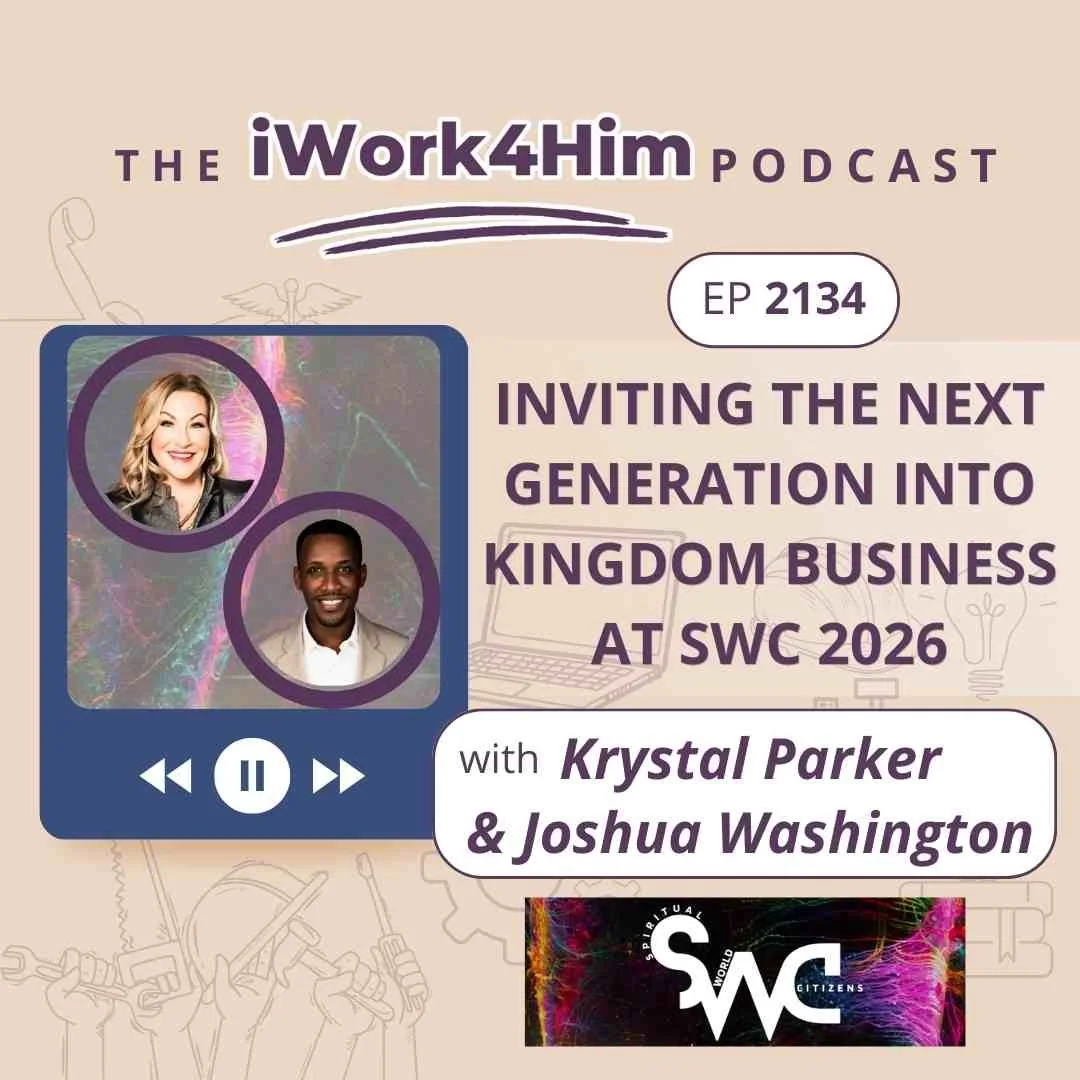
2/18/26 - 2134: Inviting the Next Generation into Kingdom Business at SWC 2026
Jim: You've tuned into iWork4Him, 13 years of covering the Faith and Work Movement.
Martha: We are your hosts, Jim and Martha Brangenberg, and our mission is to release the testimonies of workplace believers who have learned to unleash their vocational and cultural contributions for the flourishing of the world. What can that look like in your workplace? Let's find out right now.
Jim: A little over four years ago, we were part of the launch of the US Christian Chamber of Commerce. The idea spun off of the Central Florida Christian Chamber of Commerce, and if you've been a long time listener of iWork4Him, the Central Florida Christian Chamber also helped launch the Christian Chamber of Commerce in Tampa Bay that we were part of from the very beginning in October of 21. The Central Florida Christian Chamber of Commerce launched the US Christian Chamber of Commerce, and there's no looking back.
In 2024, the US Christian Chamber had a large gathering in Orlando for three days for the very first conference, like a three day worship service. Now two days - two days!? Two YEARS later, the US Christian Chamber will hosts another Spiritual World Citizens Conference, where 800 Christian Chamber of Commerce members from all over the United States are expected to attend - workshops, networking, speakers, fellowship, worship, building relationships that will last a lifetime.
That's what this year's Spiritual World Citizens Conference is all about. Krystal Parker is back to tell us more about this year's event coming up in April. If you remember that when Krystal was last on iWork4Him, she refused to dish on who the speakers were for this year. Now we all know that. They finally released it. They're on their website, but today Krystal's actually gonna roll out details and she promises not to hold anything back - or she'll never be a guest on this show again. (laughter)
This event of the US Christian Chamber will be attended by people of all ages, including Joshua Washington, who's here today, representing the next generation to tell all of you 30 year olds why you should be there too.
Krystal Parker and Joshua Washington, welcome to iWork4Him.
Joshua Washington: Wow. (laughter)
Krystal Parker: Wow is right.
Jim: That's right. That's right.
Joshua Washington: Krystal didn't tell me about this part when she asked me to come on here, so I love it. That's awesome.
Jim: Yeah. That's a whole other story. You, everybody has to watch the last show we did with Krystal back in November where I asked questions about the speakers and she's no, I'm not telling you. I said, what do you mean? I'm not telling you, you gotta wait till Black Friday. Oh. It's one of those things.
Martha: She is really good at building up the suspense.
Jim: She's the only person in all of the planet that can do that to me and get away with it.
Alright, Krystal, are you excited about this year's conference?
Krystal Parker: I am blown away at this conference, what God's doing, how this is shaping up, and we're really doing something different with this conference, with it being immersive and really putting everyone in a seat, 'cause we want to hear from people through the Think Tanks and Apologetics Under Fire. I am just saying this is something I believe that's going to reinvigorate the conference world. I think things are gonna be different as a result of what we kickoff at SWC 2026.
Martha: I know that all the details are developing in great detail that we can't get into, but today, what would you say you're most pumped about?
Krystal Parker: I'll just go with what everyone's pumped about, which is these Think Tanks. We've got five key issues that we're going to really dive into. Our SMEs are set, so our subject matter experts, our facilitators,
Jim: (laughing) I don't think anybody on the planet says "smes".
Martha: Yes, they do. They say sme.
Jim: I know what a schmoo was, but that was back in the fifties.
Martha: You're really aging yourself now, Jim. (laughter)
Jim: Okay, schmee. All right. We're talking about schmee right here on iWork4Him, people.
Martha: And they are set.
Jim: Subject matter experts. Okay, so these subject matter experts, these five breakouts, these five think tanks, give us a few examples.
Krystal Parker: All right, so I'll give you the one that Joshua's one of our facilitators for.
Jim: Sweet.
Krystal Parker: And it's currency. So Currency Lab, we have an incredible group of SMEs and facilitators that are gonna be part of this room, and that room is also as a sponsor. Inside that think tank, they're gonna frame issues around currency. And what are some of those major issues involved with currencies? I think one of the things that we as believers can recognize is, do we have dominion over the mountain of economics in our nation?
Jim: And the answer is no.
Martha: A think tank isn't gonna give the answers, Jim. It's gonna be asking the questions.
Jim: Oh, okay.
Krystal Parker: But I love that. So this is the kind of discussion that's gonna really be had inside of here. But what we want to identify in these labs is what are the key issues around currency, regarding Christians and business? What are the solutions for those issues? And then if we get this right, what is our big opportunity? If over the next 18 to 20 months we look at doing the right things, educating, training, and preparing, can we look back and say, we moved the dial?
And we wanna hear from people. This is what I love too. There's no seats in the front, there's no PowerPoint. Our SMEs, our facilitators, are gonna be on the move. This room is gonna be fluid. And we're gonna get to hear from people about what their experiences are. Then on Friday, the lab results are going to be presented on stage, so people get to pick two labs to be a part of, and then they're gonna get to see their work on stage and also hear maybe some of the labs they didn't get to participate in.
What were those key issues, solutions and opportunities around AI and innovation, currency, as we discussed, faith and work, unity, which is a difficult one for many of us, and then policy?
Jim: Joshua, you're gonna talk about currency. 20 years ago, nobody would've even thought that this was a conversation to be had because we're like, of course the US dollar's gonna rule the world. And now we got so many different choices. But to point to the fact that we don't have Christians having taken the kingdom to currency because we don't have a single Christian on the Fed Board of Governors do we?
Joshua Washington: Wow. I don't believe so.
Jim: No. Not a single one. No, not a single one. And if we're not on the Fed Board of Governors, how are we gonna make an impact? We gotta take that spot. Let's go.
All right, Joshua, why are you going to the US Christian Chamber Event? I'm gonna jump around a little bit on the questions I told you I was gonna ask you, but why are you going, why are you going, why are you involved?
Joshua Washington: Let's go back to that currency piece for a second. When you think about, we all think dollar, when we think currency. I have this mindset that the three greatest currencies in life is number one time. Forget about the dollar. What do you think the Lord is saying about how we're spending our time? 'cause we're not gonna be here forever.
You talk about a administration agenda, but we have a kingdom agenda. And that kingdom agenda is time-based. It's finite. And so it matters how we spend the time, just as much, if not more, than what it matters how we spend the money. The second one is knowledge. I think one of the greatest deficits that's holding back a lot of our believers, both young and old, is that deficit of knowledge when it comes to the economics and how we build a kingdom ecosystem economically.
And then the third is relationship. Those three currencies combined is really the winning formula for how we as believers can have dominion. And I think fourth one on that list will be money, but I think we gotta get the first three. And that's why I'm excited about, one of the reasons, I'm excited about this conference, being in that lab and leading that lab.
Krystal Parker: Can I jump in? Because this is a really cool conversation. So you're gonna have voices like Joshua that are gonna be saying, Hey, you guys are talking currency, you're talking gold, you're talking Bitcoin, you're talking digital, but have we thought about this for currency? And then somebody like Krystal Parker's gonna jump in and say, we have another issue when it is related to currency, and that's the transactions that are taking place in our community.
We have a trillion dollar hole in our boat. Even though Christians own over 50% of the world's wealth, we're handing it to the enemy. How do we fix that? These are the conversations that are gonna have. So somebody's gonna walk in with a limited scope because where you sit determines what you do. And if somebody's looking at it from just one angle, they're only gonna see one piece. They're gonna walk into a room with a hundred, 150 voices, with subject matter experts and facilitators to guide this conversation so it doesn't get outta hand and it really flows.
We wanna really have some great conversations. We wanna hear, what are we missing? What are we not thinking about? Whatever board that is, do we need to be thinking about how do we get somebody to have a seat there so that we are positioned in places we need to be? This is why I'm so excited about the labs.
Martha: Yeah.
Jim: Yeah. I could sense it and I love that. And Joshua, what you just said, those three currencies. I don't want him to ask me how am I doing spending my time? I really don't, I don't wanna know the answer to that question because I'm pretty sure he would have some suggestions for me.
But when you talk about time and knowledge and relationships, when you look at the kinds of things that are going to follow us into eternity, how we spent our time, that's that gold, silver, and precious metals, wood, hay, and stubble. How we spend our time. The knowledge thing. I believe we, our souls will go with us. Our knowledge will go with us, and our relationships are absolutely a currency that spans outside of time. It will be eternal. And that's, I love that conversation.
Ladies and gentlemen, you're talking about the US Christian Chamber of Commerce. You're thinking am I gonna go there and we're gonna network? No. We're talking about raising kingdom warriors.
Martha: Actually, it's " yes and." (chuckling) Not no. "Yes and." The reason I say that is the theme of the conference, if you didn't know that yet, it's just so critical to know that God has so much more for us, so we actually talk about wanting to do things the right way, and it's important that we seek God's will and ask him where we should spend this time that we are discussing and then discern if he is going to lead you to join us for the US Christian Chamber of Commerce Spiritual World Citizens 2026 event in April in Orlando with the theme of "yes and."
Jim and I are excited to be MCs for this event, so let's be sure to get you registered and see you soon. Keep listening to the rest of the show and I can guarantee you're going to want to be in the room in April.
Jim: Still goes down, as Martha and I mc'd the 2024 event, when that event was over, I could tell you it was the absolute most deeply moving spiritual experience ever been to at any conference. Period. End of story. And that's what you get to look forward to, because there's gonna be even more people in the room this year. And Joshua, that's why we wanted to have you on today, because there's gonna be more people there. But we're also trying to, we're inviting in, we wanna get the next generations there because obviously some of us are getting old and we're not the influencers of the world that we need to be. And we need the next generations to be equipped and ready to take over.
Joshua Washington: Yeah and I agree, Jim, and I think if you are a leader, a business owner, anyone watching this, I want to challenge you to invite your young people. I think of, it's almost like the church culture right now. We have a bit of a culture in business where I don't believe there's a lot of young people who see a place for themselves in kingdom business. I think many have overcomplicated it and don't really understand that it's not just for those who are established or more seasoned but it's a spot and a space for everyone.
And I think that comes from those mentors and those leaders saying, Hey, you should come to this. The only reason that I actually became involved in the chamber, right? This is how this happened. I was laying in bed looking for, I decided in 2021 to leave that corporate job and start a business, and then waited till after that decision to say, oh, crap, how am I gonna do this again?
So a part of that "oh crap" moment was pull out my phone, get on Google, let me start looking at some chambers. But I had a sense of discernment to say, I wanna find, is there such thing as a Christian chamber around here? And that was really my question. So I typed in Christian chamber, found the Christian Chamber of Central Florida, which was meeting off of Waterford at that time, walked into my first meeting, heard about the young professional network, and thought, okay, I'm still in that age range. Let me see if there's something for me to get involved here.
Walked up to Krystal Parker and said, Hey Krystal, how can I serve? Because that's what you're learning when you go to church, right? Start serving. So I asked Krystal, this is the exact question: can I come maybe help set up the chairs? She looks at me dead in my face and says, can you lead? And I said, Krystal, that's not what I asked you. I was talking about setting up chairs. I'm not looking to lead. So my point is, it was an invitation.
She didn't even know me. It was almost like Jesus and the disciple, she just said, Hey, here's an invite. Come join. And I want, for leaders who are watching this, that's really all it takes, just in start inviting your young people 'cause that's how they're gonna start to show up at events like this. And they will be the flame that you want to fan. Because they're the ones that are really going to spread this 'cause they have the energy and the opportunity.
Martha: And where else can we all get in a room and have a conversation like the one you were just describing about currency? Because so many times when we're in a position, maybe your responsibility is the P & L, maybe your responsibility is the operations, whatever it might be. That's all you get to focus on. And when you can sit in a room with other believers that want to understand God's bigger picture, you can be that much more confident and empowered to go back into your work with a better kingdom perspective in whatever it is that God has you on assignment to do.
So I love the connection there because there's so much practicality, but it's different that we can get anywhere else. And you setting it up as these think tanks is gonna energize everyone in the conversation. Joshua, at this perspective right now, couple months away from the event, what are you most excited about?
Joshua Washington: Man, that's a hard question. I'm pretty excited about all of it. But I would say I'm really looking forward to this lab, what we've talked about already.
But the networking piece, I wanna see these young professionals really get out here. 'cause I know it, I see it month in and month out. There's a young professional right now who's trying to figure this thing out, who's trying to, who wants to be in business. The Lord has called them to, to business, but they're realizing and figuring it out that it's hard.
It becomes a wilderness very quickly if you're not careful. And that person, that young professional is one relationship away, one conference, walking into an expo floor or walking into a lab and meeting someone who has been there, who's walked through that and can help them out and can help lead them. So that's one of the things I'm really looking forward to.
The stories and the relationships and the, Hey, I was in this position, but then I went to this conference, the Lord led me here, or I decided to clear my schedule and go and look what God did. So I'm really looking to those "look what God did" moments from this conference 'cause I truly believe we're gonna have quite a lot of 'em.
Martha: Awesome.
Jim: All right, so speaking of who you guys are gonna be bringing to the expo, we're gonna talk about that in a second. What we all know is what we're gonna be bringing to the expo. We'll be bringing our cell phones, we'll be bringing our laptops, our iPads, and whatever mobile device you may have.
Imagine if you get a virus on your device or somebody hacks into what you're doing on your device while you're using the free wifi at the conference. And then you can't use your device for its intended purpose and it distracts you from the reason you're attending the expo in the first place. It's not only gonna set you back on time and energy, but potentially compromise the work you're doing.
That's why we partner with SaferNet. SaferNet is a trusted partner of iWork4Him that we have installed on all of our mobile devices and computers. Their virus protection, their VPN, their 84 web filters. They are a kingdom Company, keeping the bad guys out so you can keep doing the kingdom work God's called you to do. Check out safernet.com and let 'em know iWork4Him sent you.
Krystal, you got some speakers speaking at this event. I know there was some question in the last show we did. Name some of the speakers you got coming.
Krystal Parker: We're gonna kick off the event with a ribbon cutting. And I'm really excited that Mike Sharrow, who's the president and leading C12, is going to be one of our opening night speakers. There's so many. I'm excited about every single one of them, having him kick us off and really set us in motion, I think is gonna be a really great beginning.
On Thursday we've got incredible moments on stage. You've got Heather Wilson and her brother Jacob, who are the founders of Give Send Go. If you haven't heard their story and the things that they've run up against, it's incredible. And so we're going to be hearing from them. Sam Sorbo will be with us as one of our keynote speakers. Gosh, Brandon West is gonna be there. We've got so many incredible speakers. I just would do a disjustice to tell you. They're all listed on our website. swc2026.com.
And then every lab, has a subject matter experts pod. There's three of 'em. And those three speakers that are in those rooms, they easily, every single one of 'em, keynote or global speakers, that are right there up close and personal. So when people look at this, they see probably close to 60 different speakers that are pouring their time into making this event a very memorable experience for people that are in attendance.
Jim: And you close it out with a speaker from New Zealand?
Krystal Parker: Yes.
Jim: That's gonna be a lot of fun. Alright, so Joshua, give your perspective, speak to the people that are 40 and under today, why they should be there.
Joshua Washington: Oh man. I think you should be there because it's almost like one of those Esther moments, for those of you who are familiar with that story in the Bible. This is one of those pivotal moments, I believe, not just in your life personally, but I think for our nation, for our communities. The Lord is truly, he's bringing us to be more unified and he's starting it in the marketplace.
I believe this will pour out from the marketplace and into our churches. And as I said before, it is a body of Christ. So if you're not there, we will feel it. Something will be missing. I don't care, I don't care if you think you're too young, Timothy. No, you're not too young. You are part of this body. And you need to be there because you're going to be a part of this movement. I believe we are, we are right at the doorstep. Or maybe even one foot inside of the house of what the Lord is going to do from a revival perspective in the people and in the marketplace.
And so it's an opportunity. I don't think it's even something that I would say I'm gonna try to pull your leg to get there. This is an opportunity to get in on what the Lord is doing and get under the blessing that the Lord is bringing to these kingdom businesses. And I just, I think it would be a foolish decision to miss out on this moment, so don't miss it.
Martha: I was thinking about all of the different gatherings of young people that have been happening lately with this focus on revival and you take all of the thousands of young adults that went to Passion or went to the different conferences maybe at the beginning of the year, and they got their hearts right. This opportunity, as Joshua said it, and I love that, is really that next step to say, okay, what's the practical application of the kingdom in my work and how God is preparing my heart for how I live that out on a daily basis?
And I think that's been a missing piece for the younger generations, especially because we've not seen the the importance of getting that connection so early on in a career. Imagine starting your career already getting the Kingdom impact conversation so that you're like, of course, my job as an accountant is incredibly important for the kingdom because I see my purpose in living that out.
So I really wanna challenge everybody that's listening, not only to look at their calendars and get registered for themselves. Like Joshua said, bring someone alongside of you that you maybe are mentoring or encouraging or works for you and have them come because this could be that life-changing opportunity as well.
Jim: April 22nd to 24th, online at swc2026.com. Krystal, when you launched the US Christian Chamber, there were a smattering, a small smattering of Christian Chambers across the country. Now you've got 25 plus affiliated Christian Chambers of commerce all over the country and it's growing every day it seems. Where are they all located? So people listening today, they know.
Krystal Parker: I would just say from sea to shining sea. And I'm not even joking about that - California to as far over as Pennsylvania. Michigan, obviously down to Florida, Texas, Midwest. Sea to shining sea, truly. It's amazing, this movement of God. This is unique in the nature because you talked about some of those other conferences and other things that are happening, which are very important. But then there's those of us, like the Joshuas in the world, that have that business anointing, and where do we go? Who do we find for mentors?
And I'll tell you, he's talking about who the speakers are that are in the room. Imagine connecting with a Jim and Martha Brangenberg. Imagine connecting with a Ford Taylor. Imagine connecting with Bill Yeargin from Correct Craft or Mark Whitacre or a Sean Kouplen, who's also gonna be their speaking.
Imagine this in your business circle as a young professional or even a seasoned professional to be able to have access to leaders that are not just business anointed, but they're called. They're stewarding their business in a way that brings glory to God and that really honors him in all that they do. My goodness, this is a game changer, a life changer, and this will change our nation as we come together as one and have one voice, one mission, and obviously serve one God. It's gonna be powerful.
Jim: It will be. And we would love to see you all there. SWC2026.com. It's just a few months away. Get your tickets now. Reserve your hotel rooms. It's right next to SeaWorld so you can come early and go see the orcas. Do they still have orcas there? I don't remember, but you could see SeaWorld. It's amazing. You could see all of Orlando. Plus for those of you in the frozen tundra, in April in Orlando, it's beautiful. It's before it gets ridiculously hot.
Krystal Parker, Joshua, Washington, thank you so much for being on iWork4Him today. Thanks for promoting this amazing event. Thank you both.
Krystal Parker: Thank you.
Joshua Washington: Thank you, Jim.
Jim: You've been listening to iWork4Him with your hosts, Jim and Martha Brangenberg. We're Christ followers. Our workplace, it's our mission field, but ultimately iWork4Him.
2/11/26 - 2133: An Entrepreneurial Journey of Faith
Jim: You've tuned into iWork4Him 13 years of covering the Faith and Work Movement.
Martha: And we are your hosts, Jim and Martha Brangenberg. Our mission is to release the testimonies of workplace believers who have learned to unleash their vocational and cultural contributions for the flourishing of the world. What can that look like in your workplace? Let's find out right now.
Jim: 11 years ago we interviewed Brandon Pratt to hear about his adventure with growing his startup Pizza Ranch franchise. With a few stores under his belt, he was learning how to scale without compromising his kingdom focus and positive culture where employees flourishing customers love visiting his restaurants.
Well, a couple years later we checked back with Brandon and his number of stores had grown to eight. He and his bride Jennifer were on the verge of adopting four boys, and he had successfully lured our youngest child, Sarah, from Florida to Iowa to be part of his team. Fast forward to today. Brandon's success has now grown into a full scale development group with Pizza Ranch restaurants, commercial buildings, and so much more.
Because Brandon brought Sarah back into the Midwest, sarah eventually moved to Missouri where she married her husband Caleb, and now we live here too. So you can say that Brandon's success impacted our family too, and the great town of Marionville, Missouri. So let's catch up on the highs and lows of the last decade and see what God has next for Brandon Pratt in the decade ahead. Brandon Pratt, welcome back to iWork4Him.
Brandon Pratt: Hey, it's good to be here. I cannot believe the first time we did this was 11 years ago. That is crazy.
Martha: I know, right?
Jim: 11 years ago, live on the radio, and we did it nine years ago live on the radio too, and I miss the radio stuff a little bit. It is what it is.
Brandon, in the last nine years, you became an instant father of four boys. You celebrated 20 years of marriage and a ton of business success, even through COVID. I know you had some tough times. What have you learned most about her Heavenly Father during those times?
Brandon Pratt: Wow. What a great question to start. First of all, it's great to be back, but he is always faithful and his plan is always his plan. And we can't see how to get from where we're at today to how we're gonna get through tomorrow, the bottom line is he's in control and you just have to trust him. I think you mentioned COVID briefly, and I don't know if that's something we wanna elaborate on, 'cause it was definitely a difficult time in my world, but at the end of the day, we got through it because of his grace and just trusting the process and trusting his plan.
Martha: And just perspective, because Jim set it up, you were in the restaurant world and in a lot of things where people gather. So no matter what business it was, people being together, just the reality of that, and we all had some choices to make about whether we were going to keep pursuing and be persistent and offer what you could. And it's been amazing to see that now you've got that behind you, but I'm sure everything is stronger and shored up in a new way because of that.
So let's talk about your marriage because when you are a businessman and you have so many irons in the fire, it's important that you figure out a way to keep the business from affecting your marriage in a negative way. So you are on the other side of 20 years with Jennifer. Tell us what you have done to help keep that business from affecting the marriage negatively.
Brandon Pratt: Appreciate that. First of all, my wife is my rock. She is everything in the world, everything on this planet earth, that means to me. And we've got a process that works. I work a ton of hours. I'm always working - life of a serial entrepreneur. It doesn't just start at seven in the morning and end at six at night, right?
I am on the phone or at city council meetings until 10, 11 o'clock sometimes. So it is all the time, and she's unbelievable to understand that's what it takes. Now the goal is that I'm doing that now, so that someday hopefully I can have the freedom to travel and enjoy and spend some real, real good quality time with her, hopefully not in the too distant long future.
But we've got a process that works that's different. A couple things that we do that's unique compared to maybe a lot of people is I say she handles 90% of the decisions, and that's real. And I handle 10%. The difference is the 10% that I handle are the big decisions, the financing of a house, the buying of a vehicle, the retirement, what that looks like. She handles the day-to-day stuff and it doesn't work for everybody, but it works for us. We're fortunate that she's a stay-at-home mom. And that job is way harder than anything I do.
Jim: That's for sure. (chuckling)
Brandon Pratt: Especially in our circumstance. I'm sure we're gonna talk a little bit about our adoption process, but yeah, so it's not easy what she does, but we have a routine. Every morning we get the kids off to school and my entire team, executive team, knows that, hey, from that 7 to 7:30 timeframe, my wife and I sit down, we go through our schedule for the day.
Usually on Mondays we go through our schedule for the week, but then we go through our schedule for the day and she says, this is when I need you by. This is where you need to be to pick up kids. This is where you need to go and be here by this time. And she handles all the scheduling. She just tells me where I need to go and that, that seems to work.
But if you asked her the flip side, Hey, how many years do we have left on our mortgage on our house? She's not gonna have any clue. She's not even gonna know where the mortgage is at, which could be its own cause of concerns, but that's just how we operate and it works well.
Martha: Dividing and conquering, and knowing what lane you're in, and like you said, knowing that it works for you guys is really a key factor in that. I love the fact that you sit down and communicate though, because that's where the breakdown can begin in any relationship is if you just, it's on your calendar, or we talked about it two weeks ago on a Friday night at 11:30 when we had two minutes together.
Jim: You never talk about serious things on Friday nights at 11:30. It's a very bad idea.
But Bubba, I gotta believe the prayer fits in there somewhere and you may think it goes without saying, but I know in that time prayer plays a part in your marriage. What part does it play?
Brandon Pratt: Yeah. Everybody has spiritual gifts and everybody has different things that, that God puts on their heart that they do great and that they do bad. My mother, Martha, your sister, is a prayer warrior, and that is something that she instilled in me. So I am one of those guys that, multiple times throughout the day, I'm praying usually little prayers. Some people will say, you get that little, the angel on one shoulder and the devil on the other, and you walk by and you see something and you want to act on it, and then you say, oh, I'm not gonna act on it.
That happens to me so many times throughout the day, and I take that as an opportunity to just maybe see somebody walking down the street that is in a wheelchair, right? Or that's a bad example. Wouldn't be walking down the street, they're in a wheelchair, but maybe they're injured or they're hurt, or they're struggling. Or somebody in my office. I believe in not saying, Hey, I'm gonna pray for you. Instead, I say, let's just pray right now. And prayer is probably my biggest spiritual gift. That's probably the one place that I make a difference in terms of the family world.
Something that we've gotten in the habit of doing with our boys is before we have that quiet time in the morning with my wife and I, we usually pick up a daily devotional and we read that daily devotional as a group, and usually it's tied to a couple Bible verses. We'll talk about that and we'll explain what those mean and then we'll close into prayer as a group.
And if you ask my boys, every day the thing that I say every day to them, and I'll say some version of it, I'll say "follower of Christ." And they'll say, "leader of men," or I'll say "leader of men." And they'll say, "follower of Christ." And it's just our little connection before the family leaves for the day to say, Hey, we wanna be rooted in integrity. We wanna put Jesus first, and we wanna lead people. And so that's our morning routine. That's where I do a lot of my prayer time as a family and then obviously throughout the day a lot of quiet time by myself.
Martha: And I think that's really powerful, Brandon, for our listeners to hear that, because we do need to call out the man in our boys. And that is powerful. I'm just sitting here trying to process that, that they have no idea what that impact is gonna have on their life, but you are calling them to something great for the kingdom and it's a mantle for men to wear that and to lead well in whatever God's given them, whether it is business or whether it's athletics, or whether it is a civic duty, whatever it might be. Leadership from a godly perspective is something that this world can really use.
So let's talk a little bit more about your fatherhood. So you became an instant father of four boys. How many years has it been Now we're coming.
Brandon Pratt: We, yeah we adopted our four boys from Brazil in 2016. So we were nine years in December.
Martha: Okay.
Brandon Pratt: It'll be 10 years this year.
Martha: Which is just amazing to see how these little boys and your family has all changed and grown so much. So how did fatherhood impact your work life? We all think, oh, life's not gonna change. How did it impact you?
Brandon Pratt: Yeah, go back to your opening question on navigating the crazy world that we're in and just you have to have the ultimate trust that God's plan is that plan. And I bring that up because when we adopted our four boys, we had no clue what was gonna take place. We still don't have any clue what's gonna happen tomorrow.
And so we walk in trust every single day, that's the first thing. The second thing is, before we adopted children, I used to work all the time, anywhere, anytime. My wife could travel with us, if I had a project in Des Moines or in Missouri or Minnesota or Florida, we could travel and just go do that.
And obviously now, especially now, 'cause our boys are, we got some birthdays coming up, so I'm just gonna 16, 15. 13 and 11. They're in the heart of youth sports. My staff and everybody who's close to me knows Hey, no meetings after four o'clock right now. Doesn't mean I'm not gonna work. Doesn't mean I might not come back, but don't schedule anything.
Last night we had a game at four and a game at 6:30. So my point with that is it's definitely impacted the way I work, how I work, and is it is affected more than just me. It's affected my team. So one of the things, and I want to maybe I'll end on this point or bring it home here. It's made me actually focus on working more in the community that I live in.
We used to travel a lot. We used to be able to go and work wherever, and I just can't do that anymore. It's tough to do a project three hours away and make sure I'm here at home by four o'clock for a basketball game. So it's brought me back to my roots, which is in North Liberty, Iowa, and that's where the majority of our work is right now. And without my four boys, I'm not sure that's where we'd be doing all of our work. We're blessed to be here. I think it pointed us here for a good reason.
Martha: Okay, so that made me think of something I just wanted to comment on real quick. When you are a businessman and a family man and doing all of that in your own community, what kind of standard does that make you live up to?
Brandon Pratt: High ones for sure. And actually I don't use this for political reasons. I use it for truth, but that's one of the things that I say when I'm at a city council meeting, as an example. We've got a project that we're doing in our town that - not everybody likes growth. We're in one of the fastest growing cities in the state of Iowa and really almost in the country. We've experienced incredible growth here. And there's an old part of town that was the original part of town and we're doing a project right next to that old part of town, and not everybody loves that.
And I stood up at council a few weeks ago and said, Hey the great news is I wear my integrity on my sleeve. We're local, we're based here. You can see the other projects we've done. We're not gonna do anything that's gonna hurt the community. I'm not an out of town developer's gonna come in, do the right project or the wrong project, then leave town and not care what happens.
I'm gonna see you in the shopping centers. I'm gonna see you at Aldi. So at the end of the day, I've gotta do it the right way. Not that we wouldn't anyways, but there's that little extra maybe confirmation, not just for me, but confirmation for the community that, hey, this is the guy we want to do the project because he lives here. This is part of his community.
Jim: But you mentioned politics, and my question is... you've already got, you have a great governor right now in Iowa, but that doesn't mean you can't run for mayor in your own town. Or maybe is there a political future there for you?
Brandon Pratt: Did you run this question by my wife?
Jim: I did not run this. No, I did not. I didn't, there was no questions of Jennifer before the podcast.
Brandon Pratt: Okay. All right. So I have, joking aside, I have told my wife in the past that, given what's taken place in my opinion over the last eight to 10 years, that maybe there's an opportunity someday, not because I want to, but because I feel called to and because I need to. She does not like that idea. At all.
Martha: She and I can talk. (laughter) I get that. I get that full. I get that full.
Jim: And for the audience listening, just what Martha's referring to is that we are running for mayor in our little town in Marionville, Missouri, and it's because of exactly what Brandon's saying. There's stuff that needs to be done and it's time for believers to stand up and do it and get involved.
Martha: And you say we, because you are running, but it is a commitment as a family. And no matter how you're involved in your community, it's important to be a part of the decision making that's happening. And I know you get called to a lot of meetings for different reasons, but I just love the fact that you can go to a soccer game or you can go to a basketball game and still be the father and the businessman because you're being the same person wherever you go, Brandon.
And that really does speak loudly. So you know, as we talk about families, it is a reality that most of our families use our mobile devices and computers for not only listening to music and podcasts, but also for conducting our business and communicating with others. As Brandon says, as he's out on the go and doing all the different things.
Imagine if you get a virus on your device and you can't use it for its intended purpose. It will not only set you back on your time and your energy, but potentially compromise the very work that you are doing. SaferNet is a trusted partner of iWork4Him that we have installed on all of our mobile devices and computers.
Their virus protection, their VPN, and their 84 web filters are just some of the features that help keep the bad guys out so you can keep doing the kingdom work that God has called you to do. Check out safernet.com and let them know that iWork4Him sent you.
Jim: Brandon, like we said at the beginning of the show, nine years since we last checked in with you.
Martha: We've talked to him since nine years, but on the show. (chuckling)
Jim: And I have no idea how it got to be nine years. All right. What's been the highest high of the last nine years? How did you experience God in that high?
Brandon Pratt: I think right the highest highs sometimes come out of the lowest lows. And we talked a little bit about COVID earlier. Martha brought it up. But we were in the restaurant industry and not only were we in the restaurant industry, but we are a buffet concept in the restaurant industry. So we were really the tip of the spear when it came to COVID. We were the first to shut down, the last to come back.
We're still dealing with, five years later, transaction counts being lower than they were in 2019. So we're not back to where we need to be, which is tough to say out loud. However, I'm gonna answer your question by saying we survived. And it really is- I look back, it was only by the grace of God. Specifically Pizza Ranch is a Christian faith-based company. We're in 22, 23 states, something like that. And I can just remember through that whole process, anybody who wanted to, hundreds of people got together on Zoom calls and phone calls where we uplifted each other in prayer and just to protect our brand.
And we shouldn't have survived. A lot of brands didn't survive. If you could hand pick a brand and say they're not gonna make it through COVID, it would've been Pizza Ranch, and, I wouldn't say we're stronger than we were before. I think operationally we're better. We're doing things different and I have faith that we're going to be stronger than we were before. But just the fact that we survived is just a testament to God. It really is.
Martha: That is so powerful and I hope that people hear that and be reminded, it's hard sometimes to look back at those hard lows and what God did in the midst of them, but we've all experienced them in one way or another. And to remember that he is so faithful. And it doesn't always mean that things are better and survive more and but you can see his hand growing you in the midst of it.
Jim: And Brandon, we also have said on the show that God uses adversity in our lives to take us from who we are to who he can use more effectively. How do you see God using you more effectively today because of that high slash low period during the last five years?
Brandon Pratt: It's a follow up from your question that you just asked. It's a good segue. So probably the true high moment that I had, just took place in 2025. I was honored to be named from two different organizations as an entrepreneur of the year, and I was super blessed, super humbled. It was an amazing opportunity and one of them in particular had an opportunity to give a speech in front of I would argue a thousand of the most influential, successful business people in eastern Iowa. It was a banquet.
My whole family got dressed up in tuxedos. They honored us. It was spectacular. But the day before I went up, I had my speech written and the day before I went up, God just put on my heart that was supposed to take that opportunity to do more. And ended up basically telling our story, but really almost did an altar call and really spoke towards why I was there and talked about the good times and the bad times. And I think it really impacted some people. And I talked about Jesus and it was bold. I didn't clear it before I went up, but I did say, Hey, I need to make sure you guys are okay.
You said I can talk about anything I want to talk about. And so I took that opportunity to give the glory to God and praise him and I had people come up afterwards that said, we weren't expecting that and that was as good as I've ever heard at this organization, at this event. And so that was probably the true high.
But to answer your question, I wouldn't have gotten that had we not gone through that low. I wouldn't have, I wouldn't have been able to sit up on that stage in front of a thousand people and not necessarily preach the gospel, but at least tell people about Jesus and, COVID might have happened just for that one reason. And you go back to the, your very first question, it was like you just gotta trust the process and trust the plan.
Martha: So powerful. I was gonna ask you about your kingdom culture and if you've been able to preserve that through all of the growth, but I will tell you just a comment on what you just said, is that I can guarantee you that those organizers were not surprised by you, by what you did, get up and share because you do live it out but what does that look like with all of your employees, with the franchises, the partners you have in different projects and things like that? Are your people feeling the effects of your faith in their daily work?
Brandon Pratt: Yeah. So I talked about Pizza Ranch. And Pizza Ranch is faith-based, right? Our mission statement is to glorify God, period. That's it.
Martha: It doesn't even say through pizza and roasted chicken? (laughing)
Brandon Pratt: No. So it used to be to glorify God while positively impacting the world. That was what it was originally. And then they just short it and said to glorify God. So that's known.
Lion Development side, which is, mostly the real estate side. We do most of the real estate development, construction management, et cetera. Same thing, faith-based company. I dunno if you can tell, the i inside of Lion is the stake that went through Christ. That's the symbol there. I dunno if you can see that, but it is a numbers game, right? So we're at the point now that we employ over 600 people, which is crazy to say that. And not everybody's gonna be a believer. Not everybody's gonna love that they work for a faith-based company. Doesn't mean we hide from it, right?
We are who we are. It's everywhere. It's our mission statement. It's who we are. It's what we talk about. It's, you go to LinkedIn, it's the first thing on LinkedIn. You go to our website, it's the first thing on the website. So we walk and we don't tell people, Hey, listen, you have to be a Christian to work at our company. Exactly the opposite.
Jim: Good. That'd be ridiculous, 'cause how would you ever reach anybody for Christ if you only hired Christians? Come on.
Brandon Pratt: Boom. There you go. We just, we hired somebody not that long ago, and actually in the interview they said, Hey, I just wanna be honest with you, that is not something I believe in, and is that gonna be a problem? And I said, absolutely not. I said, now I know what to pray for. So I'm excited you're gonna be part of that. One thing it does, because we do talk about it all the time, is it allows us to be open and transparent, right?
Yeah. We are who we are. We're not gonna run from it. We're not ashamed of it. And it's okay if you believe in something different, which just means we've got a new mission.
Jim: Wow. When you talk about doing things the right way, it's important to seek God's will. Ask him where you should spend your time and see if he'd lead you to join us this year at a couple of Faith and work events in 2026.
They're all listed on our events page. iwork4him.com/events. But a couple that I wanna highlight today include the US Christian Chamber of Commerce event in April in Orlando, online at swc2026.com with a theme of Yes&. what's God asking you for? He just wants you to be able to say "yes and" whatever else, Lord.
And also the National Faith and Work Summit in Cincinnati in June. Martha and I are MCing both events, so let's be sure you get registered and we can see you soon and experience both of those events together.
Brandon Pratt. You're no longer a rookie entrepreneur. You're a veteran entrepreneur. I know that just makes it so that you sound old. You're not as old as me, so that's okay. But you've got the scars to prove that you're a veteran entrepreneur now. So to those coming up on your heels, what's one thing, a powerful piece of advice that you would say to that budding Christ following entrepreneur of today?
Brandon Pratt: Yeah. Two things. Again, back to the first question. It's God's plan. It's not our plan. It's not by our hands, right? He's gonna, he's gonna set our path and the path's gonna be rocky and you just gotta keep pushing. And that's really the segue to the second part of that answer is it is not easy. People look at what we do and they see a fun vacation or he drives a nice car. He is in a great house.
But what they don't see is that I went to bed last night at 11 and I woke up at 12:30 ready to go to work today. Now I fell back asleep but my point with that is it's all the time. It's hard, it's stress on your family. The amount of stress that I carry is... spectacular is probably the word. And so you're gonna run into hard times and you just gotta trust in God and you gotta trust the process and you gotta keep moving. And when you quit and when you stop is I think truthfully when you go against this plan. I don't think he designed us to give up and I think he gives us the hard time to test us so that when we get to the other side, we can really see the true joy.
Martha: Such good words because I know all of us struggle at different times. I just can't do this anymore. I can't carry this. And I was even thinking this earlier when you were sharing your faith, it sounds beautiful that you got up and gave a speech, but getting to that point was not easy.
And so the reality is it's not you don't have blood, sweat, and tears through all of it. And so I don't want people to see this shiny polished picture and think, oh, that's the way it is. No, there's a lot of trials and errors and things that happen. You work with a whole bunch of humans that are fleshly and we all sin and all of that plays into it.
So let's talk about, we've been looking where have you come in the last nine or 10 years? And if you look to the future, that same amount of time. Okay, all your boys are gonna be outta high school.
Jim: Yeah. Nine years from now. Holy smokes.
Martha: Nine years from now. I imagine all these young men that you have been raising and then you will be in the next decade, fifties, in your fifties. So what is the legacy that you are really hoping will be developed in these next 10 years?
Brandon Pratt: Yeah. Fast forward, I'm hoping in nine years I'm retired. That really is the goal. I don't know that I'll ever fully be retired. I think you guys know me well enough to know it's in our blood. But at the end of the day, the hope is that I've got a sustainable business that I can pass on to the next generation. I think I'll still be involved.
I'll be crystal clear. I don't know that the, when I say the next generation, that means my boys. Just being honest with you. I don't know, for a hosts of reasons, that they're gonna be able to pick up the sword. But I want to be able to develop a team internally that can run with it, whether they become owners, whether we keep ownership and we do some sort of a employee profit sharing pool. I don't know what that looks like, but that's the goal.
To your point, my kids will be outta high school and I am gonna owe my wife some time. I go back to your last question. It's hard. What I do. It is a lot of sacrifices. And sometimes the wife does get the short end of the stick. She's already told me when the kids are outta the high school, that following summer, we're gonna go to Italy for a couple months.
So I already know exactly where I'm going to be eight years from now, and that summer, that's where I'm gonna be.
Jim: Eight years from now. Love that. Brandon Pratt, it's amazing to see. We get to live your journey behind the scenes as well, but it's fun to see how God has used you. When I look at how, when you and I worked alongside each other in '05, '06, '07 and '08, and, beginnings of '09, where you were as an entrepreneur then and where you are today and how God has worked incredibly in your life to be the kingdom entrepreneur that you are today, employing 600 people, impacting 600 families, is a great privilege that God doesn't hand to just anybody. So we're thrilled that you were able to share your story today. Is there any final things you wanna say to the audience today?
Brandon Pratt: You just gotta keep going forward. It's one day at a time. Don't worry about tomorrow's problems and don't look backwards, right? You could easily go back and say, man, I looked at COVID. I looked at the struggles of the adoption process. And that can't define you. What defines you is your faith in Jesus and the focus on today .And tomorrow, we'll worry about tomorrow when it comes. We took take it one day at a time. Root yourself in Jesus. Make sure your family is strong. Have the best wife or husband you can and everything will work out.
Jim: Thank you, Brandon Pratt, for being back on iWork4Him.
Brandon Pratt: Thanks guys. It was great.
Jim: You've been listening to iWork4HIm with your hosts, Jim and Martha Brangenberg. We're Christ followers. Our workplace, it's our mission field, but ultimately iWork4Him.
2/4/26 - 2132: The Great Commission - Making Disciples As You Go
Jim: You've tuned into iWork4Him, 13 years of covering the Faith and Work Movement.
Martha: We are your hosts, Jim and Martha Brangenberg, and our mission is to release the testimonies of workplace believers who have learned to unleash their job related and social contributions for the flourishing of the world.
What can that look like in your workplace? Let's find out right now.
Jim: So many of us have a misunderstanding about the Great Commission, that it says we need to go somewhere, but as I've studied and learned about following Jesus over the last 47 years, I now know that Jesus wasn't telling us to go.
He said, "as you go." As we're about our daily routine and work and we're supposed to be teaching others the things he taught us and is teaching us as you go, not making a choice or trying to determine if we are one of the many who are called to go, but recognizing that we are all called to "as you go." This may be a little confusing, but the reality is this: some people are called to preach and teach on Sunday, and some of us are called to go and teach others in other parts of the world, but every one of us is called to teach others about Jesus, as you go. This is no lesser calling. It is the calling.
The mission field is huge, and all of us are called into ministry as we go. What does that look like, this as we go thing? Victor Dawson wrote a book about his experience, if I could say this, "as we going" in life, and he is here to share about that, about his as we go experience and the amazing experience of how one day his mentee Brett became his mentor. Victor Dawson and Brett Emmeluth, welcome to iWork4Him.
Brett Emmeluth: Thank you.
Victor Dawson: Thank you. It's a pleasure to be with you today.
Jim: All right, so I wanna start off, because you guys are both first timers on, iWork4Him. We always start off with the Jesus story. Victor, why did you become a follower of Jesus?
Victor Dawson: It happened when I was a freshman, 17 years old at Georgia Tech. I went to a couple of Campus Crusade for Christ meetings. Not sure who took me there. But I remember praying the prayer like it was yesterday. And went back to my hometown and was baptized at my now wife's church.
We were high school sweethearts at the time, and it just, I just felt like that was the thing I should be doing at that moment. I had grown up going to church, but didn't really have a serious relationship. And so it just felt right and but then it was 23 years later before I woke up to realize it was about a personal relationship with Jesus.
Jim: Oh, that was a big time difference.
Victor Dawson: Here's the thing, real quick. If somebody had come along and discipled me, I might not have spent that 23 years, but then I wouldn't have the story to tell.
Martha: All in God's timing.
Victor Dawson: That's right.
Jim: So Brent, what about you?
Brett Emmeluth: I actually grew up in Southern California and I did go to an Episcopalian church. So went to church three days a week, or chapel three days a week, for eight years. And that was just through school. My family, outside of school, we didn't, we went to church maybe twice a year. And so I was familiar with God. But I don't think that I really, at the tail end of that eight year period from first through eighth grade, my family went through some really difficult times and I drifted away from God at that time. My brother died and my parents got a divorce.
My mom moved away with my sister, and I went from a family of five to a family of two in about 13 months. And it was really tough. And so I drifted from God for a long time from that, not necessarily being in a situation where, I felt maybe a little angry with God, but also just like, you weren't there for me so I'm not sure if I need to go down this path any further.
So 22 years ago, that's when I really reconnected. I got affiliated with the men's group and then recommitted my life to Christ and then met Victor like a month later. Worked out perfect.
Martha: That is amazing. So we're gonna dig into that just a little bit more, but like Jim said, at the very beginning of the show, Victor, you wrote a book and it is entitled As You Go. Why did you write it and why the title?
Victor Dawson: I wrote it because God told me to, and that's quite a story because I had emergency open heart surgery. I found out that I had over 90% blockage of the left main artery called the widowmaker. Then I was ready to drop dead at any moment. My wife actually saved my life because I went in for a stress test and the cardiologist said it looked fine, looked as good as the one from two years ago, and she said, I don't care. You gotta look further. So they did a heart cath and found out that I was literally ready to drop dead at any moment.
So a week after I had the open heart surgery, to the hour, on a Monday morning, I went out on the back patio and had my quiet time. And I remember thinking, God, even though I was prepared to go home if that was his plan, but I remember thinking, if I'm still here, you must have something left for me to do, and it would be really cool to know what it is.
And only the second time in my life I heard his audible voice speak to me and he said, "I want you to write a book and call it As You Go. And you know those stories I've given you as you've traveled around the world sharing your faith and talking about me? That's what the book's about."
Jim: So many people, Victor, misunderstand that Great Commission. I grew up in a church thinking, man, if I don't go, I guess I'm just here to support those who do. And it wasn't until literally decades later that somebody said, it doesn't say "go" in the original Greek. It says "As you go," which made so much more sense to me and relieved a whole bunch of frustration I had lived with for decades.
So I love this and I loved your stories in there. We're only gonna focus on one of the stories today, but I love that perspective. What does it look like? What did it look like for you, Victor, to live a life from an as you go perspective?
Victor Dawson: I joined a ministry called CBMC, Christian Businessmen's Connection, actually now a little over 30 years ago. And the mission is evangelism and discipleship of business and professional people in the marketplace. And so I had already started to learn and found out before all this took place with the book. My lifetime purpose was to, as you go, or go and make disciples of all nations as an ambassador for Christ.
But I couldn't do that until I was in hospice care and sharing the gospel with the hospice nurse. And so I was beginning to do that more and more as I traveled and was in business and wherever I was, to share the gospel. And then when God told me and I didn't know the difference between go, I was always understanding, go and make disciples 'cause that's the way it's translated.
But then I realized in the Greek, it's actually means as you are going, as you're going along your way every day and everywhere, with your friends, your neighbors, your family, your coworkers, all these different people, you're to share about me. And actually the operative word in that verse is "make."
It's not "go," it's "make disciples." But you gotta go. It's hard to disciple a nonbeliever really. You got a whole different worldview. So you need to go and share the gospel. CH Henry is quoted as saying - American theologian - "the gospel is only good news if it gets there in time."
Jim: Wow. That's a good one. That's true. So true. " The gospel's only good news if it gets there in time." Wow. And you talk about that as we record this show. Literally had a conversation with somebody who's on their way out on Saturday, somebody that had lived a very hard life and felt like he was on his way out and he goes, I need to get right. And I said, yes you do. Let's just talk about Jesus right now. And we had a Jesus conversation. He goes, that's what I want. I wanna do that right now. And he prayed and got reconciled with God and he died this morning.
Victor Dawson: Wow. Oh wow.
Jim: We're talking 36 hours later and I just, and I kept thinking of this guy this morning.
Martha: But the gospel got there in time.
Jim: The gospel got there in time. But I kept thinking about this guy this morning running down the streets of heaven, 'cause he didn't walk any longer, and just running down the streets of heaven thinking, yes, that conversation on Saturday was just so crucial to this guy. Just incredible.
Victor Dawson: Good for you having that conversation.
Jim: No, just the ability to be friends with that guy so that we could have that conversation was powerful. If we're gonna live with that kind of perspective is important that we don't let things distract us and get off track like a problem on our computers, caused by a virus or another intruder.
SaferNet is who we depend on at iWork4Him and at home to protect all of our devices, our cell phones, our laptops, our tablets, everything. Go to SaferNet.com and let them know that iWork4Him sent you because you can get peace of mind and get back to your God-given purpose as you go. And let SaferNet focus on theirs so that you don't get distracted.
Martha: All right, so Brett, I wanna hear from you. What did you learn from Victor about living your life with this as you go way of thinking?
Brett Emmeluth: One of the things I got from Victor, one - I was at a difficult stage. I was a new believer and so trying to make sense of what's important, what's not important when it comes to really going down this path. And it was great to have Victor give me some focus, but one thing I really got from Victor too is that I don't need to be going up to people on the street and grabbing 'em by the collar and calling 'em a sinner and saying, you gotta be saved and just accosting them. It was more, Hey just raise the flag. You know what I'm saying? If you're in a conversation with someone.
I'm a financial advisor. I sometimes have some very in depth conversations with people. Sometimes I'll have a conversation with someone's crying in the call because of their situation. Or a husband might be sick or a wife might be sick or a relative and I feel as though God gives me the opportunity to just raise the flag. I don't need to save this person. I don't need to bring them to the prayer, but being a situation where just that's God's job to save people and it's my job just to raise that flag, make it aware, just just put the situation out there and let God take it from there. You know what I'm saying?
And it might be a situation where I raise the flag now, but that person doesn't have a another engaging conversation for another two or three years, and then maybe that gets 'em over the hump and then they start heading in the right direction again. So that was one thing I got from Victor. Just raise the flag and just let God take it from there.
Jim: You said, Brett, that you know you met Victor in a men's group.
Brett Emmeluth: Yeah.
Jim: How did this mentor mentee relationship come about?
Brett Emmeluth: We were actually met at a men's group. We got paired off together, started talking, and then, shortly thereafter that, Victor had approached me on doing this operation Timothy through the CBMC. And at first I had missed a meeting in between and I was like, what's that? And so we met for coffee and then it just went from there.
And being a new believer and just being in a difficult spot in my life at the time, I was grasping for straws and just grasping for air, and to have someone that to me, he seemed like a successful guy, he was giving me some attention. I could really use the help. I was floundering in my new faith and trying to find my way.
And it was really, it was a blessing from God to have Victor come into my life, and say, Hey, why don't we walk down this path together? And I was like, sure, not knowing what I was getting myself into.
Jim: But I love what you just said: walk down this path together, because Victor, that's what it's really all about, it's not about pounding information to people. Operation Timothy from CBMC is a powerful lesson plan. It's got, it's very logistical, it's strategic. But you invited Brett to live life alongside of you, Victor, didn't you?
Victor Dawson: Yes. It's not about trying to educate even though we get that at church. We get that in men's groups. We get that from reading the Bible, all of that head knowledge. But this is about living life together, doing life together, dealing with each other's struggles and sharing things that really, there's no other place to share. Especially men. Men will not share the deepest, darkest troubles and secrets and so forth until they have this personal connection and relationship with someone that they know that can do that with, and that won't judge them.
And we'll try to help along the way and pray for them and all that sort of thing. And one of the things you mentioned in the beginning, Jim, the number of people that are being discipled, as far as I can tell, and you may have better information, is about 1%. And I mean it's low, single digits of the number of people, believers that are being discipled. And I just can't believe that it, because a man, especially women too, but men especially don't share these kinds of feelings and thoughts and whatever. And they have feelings.
Jim: Men don't have feelings. We don't share.
Victor Dawson: That's true. I forgot about that.
Jim: Yeah. (laughing)
Martha: Okay, I'm just gonna set the record straight. You do have feelings. But a lot of times they don't want to either become vulnerable or they don't feel safe in doing that. So I just wanna ask a quick question. What does that look like in reality for you guys to walk life together, for you? And everybody, it could be different, but just for our listeners who are like, cannot even picture what this might look like, did you meet weekly for coffee? Did you have meals together? How did you facilitate this relationship?
Victor Dawson: In this case, Brett was working. I had flexibility with my schedule. I owned a company and could go pretty much according to whatever my schedule, but I would meet him at an Einstein bagel shop, coffee shop at six in the morning for an hour and a half because he had to go to work and I always went over near where his work was so that he could manage his time best.
And we basically met weekly except one of us might be traveling or something would come up or you might be sick or whatever. I guess for, I want to say about three years we met. Almost every week for that length of time. And then we started going to having lunch together and less frequent meetings.
Martha: But it was very intentional. And I think that's the thing that, it does take some effort, but, my goodness. Just getting a high level vision of this, I see the intentionality really paid off in your lives. That's great.
Jim: And 22 years you guys have been friends, Brett. How old were you when you first met Victor?
Brett Emmeluth: 34. Just turned 34.
Jim: All right. So at 34. Had you ever had a chronologically superior man pour into your life? Had you ever had anybody mentor and disciple you before?
Brett Emmeluth: No.
Jim: And how desperate were you to have that relationship?
Brett Emmeluth: I was probably more desperate than I realized. Once I realized what we were doing and how helpful it was, I realized it squarely that Victor was sent by God to help me. No doubt.
Jim: Did he have to bring the green treated 2x4 like he would in my life? 'Cause with me, I mean, he is like smack upside the head. (chuckles) Discipleship and mentoring looks different for everybody. But God brought somebody perfect for your life as a 34-year-old young man.
Brett Emmeluth: Yeah.
Jim: To just speak truth into you. Victor, let's talk about that day that the mentor became the mentee, and the mentee became the mentor.
Victor Dawson: Okay, so one of the things that, as Brett was talking about, the initial time that we spent together, he was going through a really tough time and one of the things I kept telling him, or a couple things, was that God loves you more than you can imagine, and God has a plan and a purpose for your life, and God wants you to trust him to take care of you. Over and over again.
We kept talking about that and it was a few years later, after we had stopped meeting on a weekly basis, that we had lunch together. And he shared with me something that was rather shocking to me, but looking back, I could understand it. He was totally stressed out, in the bunker dodging bullets kind of thing. And he shared with me that, because as a new financial planner, he's only got about a 10% chance of making it through the first year and he changed careers. And so he was worried that he was about to let his entire family down.
And so he shared with me that he had considered seriously taking one for the team, and he'd figure out a way to end his life to get the insurance for the family. And I was really like, wow, that's incredible. But then he said to me, I think you saved my life, because if you and I had not been meeting, I probably would've gone through with this. Wow. I just couldn't believe how intense. I could sense it at the time, but I had no clue that it was that serious.
So I felt great that God had orchestrated this situation to happen. Fast forward a couple more years, and one Thursday night I was in a lot of tense business situations and all, and I had the worst fight that my wife and I can ever remember. And I spent the night on the sofa in tears and upset.
And when the alarm went off at five o'clock or 5:30, I woke up and remembered that I had a serious commitment 'cause I was, that morning I was on the board of a children's charity and we were having our annual golf fundraising event, and I'd already paid my money and I had invited some people to come and so I had to drag myself out of bed and get to this outing.
I'm driving there and the phone rings and it's Brett. He generally never calls me. I'm usually calling him. He's so busy and all. So that was surprising. And he said to me, how you doing? I said, I'm not doing so good this morning. And he said, let's get together. And I said I can't do that. I'm on my way to this golf event. And he said when will you be through? And I said, not till probably two o'clock. And he said I'll come out there and meet you at the Starbucks.
See, because of his work schedule, I always went to his, near his office. Now he's calling me and he's insisting that he come and he said, God just, I had the sense God wanted me to call you this morning. So I got through this golf tournament and all the other parts of the lunch and everything else totally exhausted, totally wiped out, and honestly, wasn't sure if I was gonna go home that day too. I had entertained some thoughts and it probably wasn't as serious as Brett had, but I was in a really bad place.
So I went to meet with him and got a big hug and we sat down and I explained to him where I was and what was going on, and he said the strangest thing to me, he said. You need to remember that God loves you more than you can imagine, and God has a plan and a purpose for your life, and God wants you to trust him to take care of you.
And I thought for a minute, and I said to him, who in the world told you that crap? (laughter) He said, you did. I knew it, of course. I had told him a hundred times. But I needed to hear it that day. And it was so refreshing, so impactful to have my Timothy, who was much younger than me, and we had spent doing life together, teaching me maybe the most important thing I felt like I had been teaching him. And so it was just absolutely incredible.
Martha: How very powerful. Brett, I would love to hear from you as you spent all of those years walking alongside life with Victor, did you ever anticipate that God would use you to be an asset for him in a time like that?
Brett Emmeluth: No. And just when I looked at Victor, I figured, oh no, he has all the answers. He knows what's going on. You know what I'm saying? And, if you got a question, something spiritual or something he'll be like, oh, go look up this Bible verse or this, and he seemed to be just a plethora of information. And so there's nothing really that I can offer him. It's just a matter of just absorbing as much as I can for as long as he is in my life.
Martha: How powerful. I don't wanna miss the fact that, Brett, you were very obedient to God's prompting that day, and I want our listeners to hear that and be encouraged by that.
There is nothing harder than being on the other side of that prompt and having not walked through it. So I compliment you for that obedience because if that especially wasn't your relationship, right? You had this great relationship, but Victor was always checking in on you and going by your schedule, but you took the time to reach out when you felt prompted.
And that was a very powerful day in Victor's Life and God used you as a result of that. And I know that each and every one of us have those same opportunities and experiences if we will walk in that obedience and listen to his prompting. That alone is a powerful, and it goes back to the as you go. As you're going about your life and God prompts you to do something, that's the activity, and as we talk about that, I just wanna talk a minute, as we look ahead to 2026 and all that God has in store for each one of us, I hope that all of you will consider prayerfully what you might add to your calendar to help you grow in connecting your faith and your work and surrounding yourself with others that are doing exactly the same thing.
Whether you find a local group like CBMC that we were just talking about or involved in something nationally, like the US Christian Chamber of Commerce, their Spiritual World Citizens Conference for 2026 in Orlando in April, or the National Faith and Work Summit in Cincinnati this June, there is something out there that can help catapult each and every one of our years. So check out our events page for all the details, go to iWork4Him.com/events.
Jim: So Brett, let's close this out by talking about the value of a mentor. How has having a mentor impacted your life?
Brett Emmeluth: Oh man. One, it kept me from making some really bad decisions. But also just being an example for me, seeing Victor go through some difficult times and then, realizing, hey, this, this is not the end of the world here. And, I think it's, was it Romans 5:3: " rejoice in our sufferings. 'cause sufferings produce perseverance. Perseverance produces character, and character produces hope." And that was something that Victor said to me for a long time.
And when you're going through a hard time, you're like yeah, I get it. I get it. Okay. But once you really think about that, and then you go through the process and that, that refining process, and you get to the other side. Ah, I can't see the whole picture, but I can see that. I did learn a lot and I did create some perseverance and build some character, and I think that's just gonna allow me to then pass it on to people in my life.
There's already a mentee that I've been engaged in. He doesn't quite know what's going on yet. He's a non-believer, but I gotta tread carefully and everything's lining up. He just doesn't know it yet.
Martha: Awesome.
Jim: Love that.
Martha: Victor, for you, any final thoughts you wanna tell our listeners?
Victor Dawson: There's two things, if I can do it quickly enough. One is your conversation earlier about the Great Commission. I found out that only about 3%, maybe less than 3% of believers are sharing their faith at all. But that was a command that Jesus gave all of us. And the problem is most people are scared to death to share their faith because they're gonna be rejected and all this sort of stuff. And in fact, it can be just fun and easy and wonderful to do that if you just learn a little bit about how to do it.
And I've actually put together a course now. We haven't launched it yet, but a six week small group type curriculum to teach people what's in the book, 'cause 99.9% of the people that read the book may be encouraged, but they're still not gonna know how to go do it. And so it involves some practice and some role playing and some teaching and various things like that.
Jim: But it is true. We need to get comfortable sharing what God's done in our lives.
Victor Dawson: Absolutely.
Jim: And once we're used to sharing that, the gospel message comes out easily once we talk about the amazing work that's happened in us already. Victor, it sounds like you have one more thought.
Victor Dawson: There's a point that I've ran across that I included in the book called My Friend by Chris Wilder, and it basically says, Hey, you've been my one of my best friends all this time. And it is written from the person who's actually died, the perspective of, "I just died" and why didn't you tell me about all this? Basically. I thought you were my friend, and here it is, now it's too late.
And so part of my message is, your friends and your family - okay, it is one thing to be on a train or on a plane or somewhere and start a conversation with a stranger or a neighbor or something. But what about your friends and family? Do you care enough about them? Do you want them to be in heaven with you? Of course you do. When are they gonna die? You don't know. When are you gonna die? You don't know.
Now you can't save 'em, but you ought to be doing everything you can to share what you can and create those opportunities. And many times I've just said, look, the reason I'm talking to you about this is because I love you enough and I want you to be in heaven with me.
Jim: That's so true. Victor Dawson and Brett Emmeluth, thank you guys for joining us today on iWork4Him, for sharing a little bit of your story and for inspiring everybody to "as you go" and to get a mentor too. Thank you, gentlemen. Appreciate it.
Victor Dawson: Thank you, Jim and Martha.
Jim: You've been listening to iWork4Him with your hosts, Jim and Martha Brangenberg. We're Christ followers, and our workplace, it's our mission field, but ultimately iWork4Him.
1/28/26 - 2131: The Ripple Effect of Marriage
Jim: You've tuned into iWork4Him - 13 years of covering the Faith and Work Movement.
Martha: We are your hosts, Jim and Martha Brangenberg. Our mission is to release the testimonies of workplace believers who have learned to unleash their job related and social contributions for the flourishing of the world. What can that look like in your workplace? Let's find out right now.
Jim: One of the greatest ways for the enemy to disrupt our Heavenly Father's plans on Earth is to destroy the institution of marriage. The attack started with screwing up Adam and Eve's paradise based marriage, and marriage has been under attack the entirety of history since. In today's modern world, the next generations look at marriage was skepticism and scorn.
Traditional marriage is denigrated and made to look absolutely ridiculous. But God designed marriage between a man and a woman as the very fabric of society. Without marriage, but still producing children, you get a society with kids who are now adults who have serious daddy issues, and childhood trauma still rocks the minds of many in their sixties, seventies, eighties, and nineties.
Marriage is sacred and it's the answer. It is the answer to so many of society issues like poverty. So why is iWork4Him focusing on marriage when our clear focus is the intersection of faith at work? Because our marriages are a light to those around us. When our marriages are a mess, it impacts us and our witness and it verifies the lies that marriage isn't worth doing.
National Marriage Week is the week leading up to Valentine's Day, and Julia Dezelski is here to tell us about it. And we've talked about it in the past, so we're following up on one of those great conversations. Julia, welcome to iWork4Him.
Julia Dezelski: Thank you, Jim and Martha. So glad to be with you today.
Jim: Julia, as a follower of Jesus, how did you come to be so passionate about marriage?
Julia Dezelski: Yeah, that is a great question and I have to start with a story that starts in my childhood really. I was probably in the fifth grade sitting in the school cafeteria with my friends. It was just a regular old day when out of the blue, a friend of mine, Kate, in my class says, my parents are getting divorced.
My heart I think stopped at that point because I had never heard anyone's parents getting divorced. It was an absolutely new concept to me. And another child at the end of the table says, oh yeah, mine too. And then my heart stopped again. I was in complete shock, and part of that shock might have been because there was nothing casual about the news, and yet they acted so casually about it.
But instinctively I knew that their lives would change forever, and I was beginning to hurt for them, and I continued to hurt for them because I realized that, instinctively, there was something that was going to not be the same for them or for their families, and it would interrupt their existence.
My parents were solidly married. Divorce was not part of their vocabulary. And although I didn't think that would ever be an issue in my family, I continued to ache for all the kids in my life whose parents were getting divorced. And I start with this story because it seems to me that I instinctively knew in the marrow of my bones how existentially significant marriage is for the identity of a child born from the union of a man and a woman.
And Christ, in fact, uses the very same image, right, when speaking of the church. He speaks of that love that he bears for the church in the same way as a spousal love, right? And so our identity, even as Christians, is very akin to that image of marriage because we are all married to Christ in some way.
And if God uses that image of marriage for his church, then it must be a very powerful union that he's talking about. And so early on in my life, I just recognized instinctively really just the significance of marriage between a man and a woman. And I knew I wanted to do something about it later on in my life, and God offered me the opportunity.
Martha: Yeah, so the, it's so great that you can see how God wired you very specially for what he has you doing today. And I think that alone is a message for our listeners to hear, because each one of us, God wires a passion inside of us and tapping into that and utilizing that is so powerful. So just personally, how long have you been married?
Julia Dezelski: I've really only been married for 10 years, almost 10 years. My husband and I just celebrated nine years, and so we're moving into this 10th year together, and I have resolved that we are going to get our wedding pictures printed and framed. (laughter) It's been on my to-do list for nine years.
Martha: There you go.
Jim: That is truly a sign of the next generations, because yeah, our marriage book, our marriage wedding book was done and we've got it leather covered. It's been in a box for 40 years.
(laughter)
Martha: Yeah. So let's talk about maybe some of the things that you have seen as being the secret to keeping marriage strong and healthy. What are some of the things that you know?
Julia Dezelski: I don't think I have any secrets, but there are certainly some practices that my husband and I maintain for our marriage. And one of the essential things, and for your audience, I'm sure they, this resonates with them, and that's prayer. Pray together. Please pray together every single day. My husband and I have had some ideas about what prayer might look like and when you have young children that it doesn't always turn out the way you want.
(laughter)
Jim: Certainly not at bedtime. Never at bedtime, yeah.
Julia Dezelski: Don't attempt it. But we always manage to say at least one Our Father together, even if we're absolutely destroyed by the end of the day, saying one Our Father together hand in hand really makes a difference. So I would really suggest it every single day. Don't let the sun set without saying an Our Father with your spouse.
We also check in regularly with one another throughout the day. We don't always work together from home. If we're in different places, I'll text him and I'll just say outta the blue and just say, how's your day going? How can I pray for you? Is there anything that you know I need to do before I come home this evening? So finding those ways to just touch base.
Then make sure you schedule a date night, continue to date. Even as some married couples, it's important and we haven't been good at this. Especially with small children, it can be hard to find those babysitters when you need them. But once a month we make it a goal.
Jim: And babysitting today's gotta be somewhat of a, you almost need to take out a loan so you can go on a date night. How many kids do you guys have?
Julia Dezelski: We have four girls.
Jim: You have four girls. Oh my word. You guys better start saving now. (laughter)
Martha: I just wanna highlight the fact that you said that the very first thing, without knowing our heart, prayer is what we say, and we actually call it the secret sauce. No, it is not a secret, but so many people ignore it or never have been encouraged to even try it. And for a lot of people it really is a new experience to pray with someone else, and they may not have had it modeled in their home.
They may have never heard from the pulpit or anywhere someone in leadership saying husband and wife, pray together. But we do believe so strongly in that and on a consistent basis. And, for years it was daily for Jim and I, and now it's multiple times a day, every day because we do work together. And so there are stresses that come up or confusion or choices we have to make where we're not clear. And that is the place to go in that moment. So thank you for sharing those things because I love the, just the fresh perspective on it, especially right now when people can say, oh, I could do that.
And I love the fact, I'm just gonna say this, that you said date night is a good, it's a goal, but it doesn't mean all of us are perfect at it, but we need to keep trying. And I know that there were a lot of times in seasons in our life where it just meant after the kids go to bed, let's have a piece of cake or let's just sit.
Jim: And we watched ER. (laughter)
Martha: We did, on Thursday nights. We had date night on the couch on Thursday nights after the kids would go to bed early and it was like, this is our time just to be our by ourselves. And now, whatever it is, that is such a good thing.
Jim: Do you have a special book? So, we've got several marriage books that are our favorites that we love to give couples, especially when they're getting married. Do you have a favorite book you and I believe your husband's name, was it Fran, that I saw on your Zoom thing before you got rid of his name?
Julia Dezelski: Francis.
Jim: Francis. Okay. So you and Francis, do you guys have a book on marriage that you guys love?
Julia Dezelski: Actually, I'm glad you asked this, because my husband is the one who finds them for me.
Jim: Ooh. Very unusual. Most of the time it's the women going, here, honey, I've got a book that we should read. And the guy's going, what? We don't need to read a book. Yeah. That's funny. Okay, go ahead.
Julia Dezelski: Yeah, and it's Love and Respect, I believe, this is an oldie but a goodie. You probably know it well. The Love and Respect series.
Jim: Yes. Emerson and Sarah Eggerich. Yeah, that's right.
Julia Dezelski: That's right. So we're reading that together now. But I have to say, even before we were married, while we were engaged, we started reading together, and one of the books that, again, my husband pulled off the shelf for me was not specifically marriage related, but it has a lot to do with marriage, and that's Seven Habits of Highly Effective Families by Stephen Covey. We found that to be very beneficial for each other as well as for family building.
Jim: Those are awesome.
Julia Dezelski: So that's another one of our favorites. And then, my husband really likes the exceptional 7%. That's by Dr. Greg Popcak. Maybe a little less, lesser known, but we have also benefited from that. So those right now - Love and Respect has gotten my attention, but we go back very frequently to Stephen Covey and any of his books, really.
Jim: What we love about Love and Respect is, we didn't get exposed to Love and Respect till 2008, and so we were, it described why we were arguing. And it helped me understand Martha didn't mean to be disrespectful, but I was interpreting it as disrespect, and I didn't mean to be unloving, but she was interpreting it as unloving, and it put a language for us to be able to work through it, and it gave us the three key sentences that every husband and wife need to understand and memorize and repeat often: "I'm sorry." "I love you." "Please forgive me."
Love and Respect's a great one. We also love the 5 Love Languages. Go ahead, Martha, you were gonna say something.
Martha: No, that's okay. But I'm gonna put the actually the link to the interview that we did with Emerson Eggerich. Actually, didn't we do several in a row for Love and Respect? Very powerful. I'm so glad that you guys have found it for yourself. And there are some things that they're timely no matter when they were written. And I hope that people see that perspective because they're biblical truth. There's nothing new under the sun. God created it that way. But helping us to have understanding is incredibly important.
So speaking of favorite tools, most of us use our mobile devices or computers to not only listen to music and podcasts but also to conduct our business and communicate with other people. So imagine if you get a virus on your device and you can't use it for its intended purpose. It will not only set you back in time and energy, but potentially compromise the very work that you're doing.
SaferNet is a trusted partner of iWork4Him that we've installed on all of our mobile devices and our computers. Their virus protection, VPN and 84 web filters keep the bad guys out so you can keep doing the kingdom work that God has called you to do. Check out SaferNet.com and let them know that iWork4Him sent you.
Jim: All right, so let's talk about National Marriage Week, but I wanna put one more plug for another phenomenal marriage book.
Martha: Oh, you thought of another one? Okay.
Jim: Marriage Mentor. By Rhonda and Steve Stoppy. So Rhonda and Steve Stoppy wrote this book. It came up several years ago, five or six years ago, not too many. And when we read it and then we interviewed them, it had everything in one book that we'd ever said in any marriage mentoring session. So we really loved that one. And really in any marriage retreat that we'd ever done.
Martha: It uses Love and Respect and 5 Love Languages, like lots of things all put together. Good plug, Jim.
Jim: All right. Good plug. All right, Ronda will like that, right? All right. National Marriage Week, which is the seven days leading up, or eight days leading up to Valentine's Day every year. Julia, tell us about it. What's what? This year, your theme is Together with Purpose. Explain this.
Julia Dezelski: That's right. Together with Purpose. This was chosen primarily because it is one of the most powerful yet overlooked aspects of marriage, right? It's the purpose of why we are together, right? It goes beyond the day-to-day life. The day-to-day humdrum. It's about a higher commitment, right?
To walking together, especially towards the Lord. Towards Christ, building a life that is intentional, meaningful, and enduring until death do us part. But marriage is unlike any other relationship. It's a covenant, first and foremost, right? It's a covenant that you've made before God. So it's a sacred bond of trust, of intimacy and of shared vision.
It's not about simply coexisting. It's about choosing to prioritize, to support one another above everything else in our lives. So building that purpose together by dreaming together, by serving together, by creating a life that leaves a legacy for generations.
That's all what we mean by Together with Purpose. And we're trying in this week to encourage couples to really dig a little deeper into what the purpose is that drives them and to recognize that it's a vocation. They've really been called to it. And how do they live it out distinctly? Man and woman, husband and wife, and yet a marriage takes two. It wouldn't be complete without either one.
And ultimately we hope that they grow towards God in their marriage. That's what they're called to do, to bring each other to the Lord.
Jim: Yeah, it is graded as one of the worst movies ever, but great, is the Christian thing called Marriage Retreat. And they draw triangles on the back of people's hands and they say that's the secret of marriage. But they have to spend the whole weekend figuring out what the triangle's all about. We'll put that on the notes as well.
Martha: We won't give the answer, right? So they have to watch the movie.
Jim: No, I'm not gonna make you watch the movie, because it was just horrible. (laughter) It was like totally C minus class Christian video.
Martha: It wasn't the greatest acting. It was a fabulous story.
Jim: You have a husband and wife at the corners of the bottom, part of the, it's an isosceles triangle, so an equilateral triangle. Excuse me. Equilateral triangle, not isosceles. I guess it doesn't really matter. Triangle. Husband and wife at the bottom corners. And as they're seeking God, they're also drawing each other together to where to every time they draw closer, they're getting closer to God.
Martha: So let's talk about just some of the logistics of National Marriage Week. How long has it been around?
Julia Dezelski: I just discovered that it's been around 30 years exactly. It was started in 96, 1996. It was started in the UK, so not in the US, surprisingly. We tend to be such trendsetters, but instead it started in the UK, but it's really taken off well in the US. We have National Marriage Week USA. That's a strong, thriving organization.
And my job, one of my jobs, is to partner with them in ensuring that National Marriage Week really thrives during the week that it's scheduled for, from February 7th to the 14th every year. And so specifically, I'm working for the Catholic church in this area. But it's a wonderful movement that's spread across the world already.
Martha: So how do people actually get involved? I know you have a lot of resources, but what does that actually look like for the individuals and or organizations or groups, whatever it might be?
Julia Dezelski: Sure. One of the goals of National Marriage Week is also advocacy, right? So we have lots of resources on our website for the couples themselves, enrichment opportunities, courses. There's a calendar feature on the National Marriage Week website that relinks you to US marriage, which is a great interactive map of all of the opportunities to enrich your marriage, throughout the country. So you can search by address, locality, all that.
But one of the other things is that we really hope that people will get the word out about National Marriage Week by encouraging their pastors to preach on marriage from the pulpit, especially on World Marriage Sunday. What a great opportunity!
Jim: What a great idea. What an idea. Talk about marriage. I would love to, if you know a pastor that is gonna preach on marriage on the Sunday before Valentine's Day, 'cause I think it's this year, it's like in the middle of the week or something, if you do, you let us know and iWork4Him - just go to the Contact us page - and we'll make sure that we put it out there so people know, Hey, go to this church. And so you can hear about marriage, 'cause it's not talked about enough in our churches, all over the country. It doesn't matter what denomination, it's not being talked about enough.
All right. I interrupted you, but you got me excited when you said, wow, pastors are gonna do this.
Julia Dezelski: Yeah. Yeah. Exactly. And it's hard to gauge exactly who is doing it, but if I find out who is, I will let you know. I will do that for you. But also listeners can get involved. Almost everyone has a social media channel of some kind, instagram or Facebook. We've got lots of social media graphics that they can download and they can start hashtagging, whatever they wanna do to get the message out to the friends and family members that this is happening.
Also, why not reach out to your local representatives, your mayor, your governor? There's a great marriage proclamation that a lot of different places have produced. You can see the proclamations on the Marriage Week website. And there are sample templates there. So if you wanna share that with your local municipality, it's great to also hear the national voices on this to hear that a local community supports marriage.
And of course, like I said, we've got lots of other resources to enrich your own marriages. We produce an at-home couple retreat. So each day of the week there is a prayer, a reflection, and it's so easy to do for that couple. All you do is just download it, just print it out, and you can do it each day of the week with your spouse.
Jim: I love that. So lots of ideas. So Martha and I are taking National Marriage Week USA to a whole new level this year. Oh, we are.
(laughing)
Martha: Tell me.
Jim: Here's what we're doing. So this year in June, Martha and I will both have a significant birthday and we're also celebrate 40 years of marriage. And so during National Marriage Week, we're going on a cruise to celebrate our marriage. That's right. No social media. Nobody else is invited. We're getting away. We've been caregiving for many years. It's time to just celebrate marriage during National Marriage Week on a cruise ship near you.
That's right. Okay. And maybe it's too late to try for this year for many of you listening, but you can work on it for next year. A cruise is a great place to get away. And I'm not endorsing any cruise line. I'm just saying when you can't get your internet and nobody can get ahold of you by phone and you could sleep in and it's incredible.
All right, Julia, that's for you and Francis. When you need break away from your four daughters, cruising is a good idea.
Julia Dezelski: We've thought about it. We have, we really considered it.
Martha: Just a little aside: our listeners, many of them know that for years we did marriage cruises where we would take 20 couples out to sea and focus on their marriages because we'll go to the gym and work on our bodies to keep them strong, but we don't do things intentionally to keep our marriage strong. We just expect it to happen, and it's such a broken mentality around that. So we really wanna encourage people, and that's why we're talking about this today, is to encourage people that investing in your marriage is an ongoing process and to keep making it stronger and stronger so that it can reflect Christ. And I love that your Together with Purpose is a wonderful theme.
Jim: And it also just goes to the fact, Julia, that our marriages are to be a light to the community, aren't they? When you've got friends, I'm imagining you've got friends now that are your age that are getting divorced and you're like, ah, it still breaks your heart today, doesn't it, Julia?
Julia Dezelski: Absolutely. Absolutely.
Jim: But when people can look to you and Francis and go, that's a marriage I wanna reproduce. That's a marriage, I'd like my marriage to look like Julia and Francis, their marriage. That's what the purpose of marriage was. It was meant to be an encouragement to others. Talk to us about that.
Julia Dezelski: Oh, absolutely. Actually, we recognize more and more that by surrounding ourselves with friends who are also working on their marriage, then we're encouraged by that. And there's a certain amount of accountability that comes with that when you know that our marriage is not perfect, but we're trying our best.
But we also know that our good friends next door are also really trying to work on their marriage. And so we can encourage each other in that way. So rather than having my friend over and griping about my husband or complaining about how the garage is still a mess with all of those tools that I've been asking him to clean up.
(Jim laughing)
Jim: Just as an example, just saying, Francis, clean the garage for Valentine's Day.
Julia Dezelski: He knows. He knows, God bless him, he knows. And he's working on it. But rather than doing that, my friend will encourage me to just keep striving to just be the good wife that I am also called to be and like, we talked about the respect issue, right? Just respect him and recognize that he has his own time and place for getting things done, and he knows that it's a desire of mine and out of love for me, he will eventually fulfill it. It'll just come at a later time.
Jim: But it may be that he's not sure 'cause it's so overwhelming, he's not sure how to get started and he may need his best friend's help to just get started. So instead of it just being Francis' job, 'cause I'm guessing some of that junk in the garage is yours as well. So I would encourage you to work on that project. And then you have four girls, so you got some of their junk in there too. I would say work on it together, 'cause sometimes people can't see the marathon.
They're not, they don't understand the whole elephant thing, how to eat the elephant one bite at a time. Sometimes it gets a little overwhelming. That's just my encouragement to you guys. And if you've got a garage that's messy, clean it together as well. Donate the stuff you're not using. Give it to somebody who could use it. So you could put your a hundred thousand dollar cars back in the garage and protect them. That's what that's all about.
All right. As founding members of the US Christian Chamber of Commerce, we find that values and goals of iWork4Him, they align with those of the Christian Chamber. With that in mind, the US Christian Chamber of Commerce, Spiritual World Citizens Expos coming up April 22nd to 24th this year, and we would love to invite you to get registered now and join us in Orlando for an immersive three day experience where Christian leaders unite to break barriers, build bold businesses, and advance the kingdom.
We're your MCs once again, and we can't wait to see you in Orlando. Register on swc2026.com using the code iWork4Him and get 20%, 20%, 20% off on your ticket!
Martha: That's right.
Jim: Okay. I'm not gonna give you garbage anymore about your garage, but.
Martha: It is a sensitive spot for you.
Jim: So we lived in Florida for 20 years and we talked to people about their cars, and cars today, it's nothing to have two cars worth a hundred grand sitting in your driveway. And people like, those are sitting outside in a hundred degrees sun every day, all year long, while there's a bunch of stuff in the garage that you don't even need that you could give away. So it's one of those, we've had a few of those.
Martha: Not saying that's their situation.
Jim: Not saying that's your situation. I'm just saying.
Martha: But you can invite us over to help.
Jim: That's right. We could be over. We love to clean up messes.
All right. You spent a decade in Rome, so you've seen marriage on different continents, including my own country of Italy. My great-grandmother was from Sicily. So what do we need to do in this country to firm up the foundation of marriage and speak the truth about its significance in our culture?
Julia Dezelski: I think the first thing we have to do is recognize that there are challenges, but to not be afraid of those challenges, not be afraid to speak the truth about the beauty of marriage.
Speak the truth about how Eve was taken from the side of Adam and was made as a suitable helper to him, and that is the image that we have for loving one another. We are all made for communion. That's how God intended it. I think we just have to recognize too that stronger marriages is really key to the building of a strong nation.
We're celebrating the 250th anniversary of the country right now. So what better time than to really focus on that significance of strong marriages, which lead to strong families, which leads to a strong society and just strong communities, neighborhoods, states, country? I think that's really important to not be afraid to share that message, that message of how significant marriage is, really, for the building block of society and for the good for all of our wellbeing in so many ways.
Martha: So tie it in all together with the iWork4Him audience. How do you see a healthy marriage really impacting the workplace?
Julia Dezelski: Gosh, I think that my marriage does affect the way I work because I know that when we're having a bad day or if we just started the day off wrong, with my husband, didn't quite start on the right foot, I know that very easily things begin to spiral and I'm not doing my best work in the workplace.
I also realized that maybe situations might have changed during COVID when so many couples were beginning to work in home together, right? And that's created certain dynamics that really probably also helped distinguish between what was going right in their marriage and what was going wrong, right? It was a great opportunity for my husband and I to also recognize that home and life and, personal life and professional life do permeate one another. There is an interpermeability there that you can't really overlook.
But I'm particularly blessed though because I do work in what I love. I work in my faith, right? What I do is also fueled by the faith I have. So I'm really blessed that way. My husband works for the government, a little bit of a different relationship there (chuckling) but regardless of what we do, the people we do it for also really matters. And a lot of the work that I do, obviously, it's for God, but it's also because I love my husband, I love my children, and I want to be able to provide for them.
So yes, I would say our personal and professional lives, there is a need to ensure that they're protected from one another, if things get a little awry, but there's a lot of interpermeability there, and we have to be aware of that.
Jim: It is so true because on the opposite side of that, when you've got an unhealthy marriage, it really impacts your work. And people going through divorce, it really impacts your work. And so we encourage every one of you out there that is a business owner or a leader of an organization to also talk about marriage during National Marriage Week. Because if your employees have healthy marriages, it makes your company more productive.
It not only blesses their home lives, but when you start to recognize it, people can't just leave their garbage at home when they come to work. When marriage garbage is piling up, it really impacts, it not only impacts worker productivity, but also worker safety. Somebody going through a divorce is almost guaranteed to have a car accident 'cause I was an insurance agent for decades.
So understanding all those things, and as believers, we can encourage others to recognize that there is hope for their marriage. We have seen marriages on the rocks being slammed by a hundred foot waves and they can be saved. There is no marriage that cannot be saved if both a husband and wife are willing to work on it.
Julia, you get the last word. Anything else you'd love to say about National Marriage Week?
Julia Dezelski: Yeah. I would say that just to remember that marriage affects everything. It really does. It affects all of our lives. It affects our workplace, it affects our professional lives, it affects our families, especially. And I think that if, especially considering that we're at a milestone anniversary of our nation this year, I think it would be behoove us all to really think in our parishes and our communities, our churches, our neighborhoods.
Just imagine what it would look like in our nation if everyone focused on building strong and healthy environments at home, starting with their marriages. When children can look up to their mom and dad and recognize just how much love they have for one another, and that from that love flows their own existence and flows their own identity as children of God, but children of their parents too, and of their love for one another, it would have a ripple effect, right?
That would just multiply over and over again into our schools, our communities. And so I think that it's really important to reflect on that and encourage anyone that you might know who is struggling in their marriages, but also struggling to even make the commitment to marriage. There's a lot of young couples that I know that are worried, that are fearful about what marriage means. And I think that, I actually, to give you a, just a short story, just yesterday we had one of my colleagues from Workover, she just got engaged and we had her fiance and her over for dinner with my family, and we were just so happy and they were so happy to just spend time together, a married couple and an engaged couple.
And we were able to just encourage them in this calling and in this journey that they're taking, that they're about to embark on. And so if you know another, a couple that's dating or just engaged, invite them over to learn from you a little bit and to share in that mutual exchange of happiness that God gives us through marriage.
Jim: Did you tell 'em to pray together?
Julia Dezelski: Oh, absolutely.
Jim: Absolutely. Julia Dezelski with National Marriage Week, thanks so much for being on iWork4Him today. Thanks for bringing National Marriage Week back to our iWork4Him audience.
Julia Dezelski: Thank you. Thank you both.
Jim: You've been listening to iWork4Him with your hosts, Jim and Martha Brangenberg. We're Christ followers. Our workplace, it's our mission field, but ultimately, iWork4Him.
1/21/26 - 2130: Reorienting the Faith and Work Movement
Jim: You've tuned into iWork4Him, 13 years of covering the Faith and Work movement.
Martha: We are your hosts, Jim and Martha Brangenberg. Our mission is to release the testimonies of workplace believers who have learned to unleash their vocational and cultural contributions for the flourishing of the world. What can that look like in your workplace? Let's find out right now.
Jim: So how many nonprofits and churches and organizations operate in your town or city that are formed to meet the needs of the people of that town? Do they overlap in their mission? Do they coordinate in their mission in general? Is there a collaborative effort going on within all of those involved in meeting the needs of your community?
From what I can tell, in the book of Acts, believers, in bringing the Kingdom to Earth, are to be focused on meeting the needs of the people living in their community. And they should lead in unity because Jesus said that would show everyone that he came from our Heavenly Father. But where is this actually happening?
Oh, one such city is Dayton, Ohio. Paul Hemminger is one of the founders of Unified Dayton and is here to tell us the God story in all of it and join me in talking about the upcoming Faith and Work Summit in June of 2026 in Cincinnati, Ohio. The three of us will be heavily involved in that.
Paul Hemminger, welcome to iWork4Him.
Paul Hemminger: Thanks, Jim and Martha. This will be fun.
Jim: That's what you think now. We have no idea. (laughter) So Paul, why are you allowing your faith in Jesus to impact your whole community?
Paul Hemminger: I started following Christ when I was 24 and I read the Bible and I saw this ecosystem of people all working together that would transform wherever they live. And I saw God's will transforming people individually, organizations, neighborhoods, and I thought that I was joining this rich enmeshment of people just constantly connecting and collaborating. And then when I entered the Christian world and worldview and sets of relationships, it was so disorienting and I think that I've been trying to reorient to that with my work and trying to help the body of Christ work together.
I've heard that the definition of a healthy body is not how you feel, but your body's ability to heal. So I think that the body of Christ of any geography requires us to be loving one another, connected, interconnected, there's an open flow of information and partnership and collaboration.
The way that we're wired, all of our strengths are working in tandem, and I just didn't see the people who were actively trying to do that within a certain city or county until I found this rich and deep community of people who were.
Martha: Okay, so I'm gonna just camp there for a minute. 'cause you said a couple of pretty powerful things. Basically what I heard you say is that I read the Bible and I saw how it worked, quote unquote, and that's not what I was seeing when I was interacting with people. Is that a fair summary of some of what you just said?
Paul Hemminger: Yes.
Martha: Okay. So we've had one other guest, Jim, that I can think of in 13 years...
Jim: oh no, I was thinking the same thing.
Martha: ...who had a very similar comment about their growth in Christ very early on where they had said, I read the Bible and I just thought this is the way it should be. And I'm not seeing that in real life. And so I think number one, okay, this is a huge wake up call for everybody listening, that when we read our Bibles, and believe it to be true, we really need to live that out. Don't keep that a secret, whatever you're learning in your walk with the Lord that is in scripture, to really pursue living that out.
So that, I know we have so much to cover, but I just had to camp there for a minute because that is such an eye-opening, boy, guilt trip, whatever you wanna call it for believers that if you're not living out what the scripture, is modeled, then we've got some new focus to do.
Jim: And if you wanna go back and listen to that episode, the title episode Bikes for Christ. Oh, that was a great one, opened up with Queen that day. (chuckling)
Okay. All right. Paul, we were with you in 2021 where you were really launching in Dayton, where things were really starting to pick up. We met in the church in Dayton, if I remember correctly, and pulling people together. Was that the beginning when you were really trying to get traction that day we met up in Dayton?
Paul Hemminger: I was a guest that day. I came in and said, ah, here it is. There were other stewards, other elders, and another millennial that was paving the way for what would become Unified Dayton.
Jim: Alright. So you've now are multiple years down the road on this, and if you go to the Unified Dayton website, you can see there's significant membership collaboration going on.
This is a need in every city across the country. And we've said on this show many times, one of the most collaborative cities in the nation was Cincinnati, and now Dayton. There's a couple of other cities that are coming together, but very few really represent what's going on in Cincinnati over the last 20 years, what's going on Dayton, over the last five. So people are going, how do I get this happen in my own city? I'm gonna let you describe it in a minute, but how do you attract others to join you in this?
Paul Hemminger: So if we were trying to get every Christ follower to collaborate in the city, it wouldn't work. There's no way that you can say, Hey, a hundred thousand people, let's all work together. There's not a communication platform, a way to organize that would ever actually do that. So the big aspirational idea of unity has to be like really logistically sound into operational unity.
So what we say operational unity is are networks. Networks are not organizations and it's a hard thing for us to think about networks. If you were to live in the city of Corinth, Thessalonica, Galacia, any of the places where Paul sent a letter, you would feel a network. You would be reading that letter with all of those other leaders within the city, in friendship, love, and care.
And you would look at that and you'd be like, is that an organization? No, that's the body of Christ. It's a network. And so Unified Dayton itself isn't an organization. It's not a 5 0 1 C3, it's a network of networks. It's a relationships that steward more relationships. So a network is people that care about the same thing - working together for Kingdom come for that focus area.
We have three big like kinds of networks that we focus on, cause, geography, and workplace. So geography is taking a city and making it into smaller parts. Causes are like human trafficking, at risk youth, single parents, and then work, Faith at work, is taking all the different industries and parsing them down into the lived experience of that industry. Public school educators, business, creatives, et cetera.
And so if we were to operationalize unity in the city, we would have all the Christian creatives say, it is God's will to work through me to show beauty in the world, in the way that God's asking me to do it. How can we do that in community together? How can we do that in the world of business? How can we do that as technologists or public school educators? How can God's will flow through me in my classroom amongst other peers that are also educators?
So it's highly complex and logistical, but we're trying to make it simple and digestible where the people that we focus on the most are these network leaders that steward that vision for that context. Does that - what are you hearing in that?
Jim: I was impressed. You did a seven syllable word, and I didn't even stop you. Operationalize as a seven syllable word. (laughing) I'm like, I didn't realize you had a doctorate. Let's talk about this network of networks.
In the network of networks, if you go to Unified Dayton, it seems like there's a lot of organizations involved. How many organizations are involved right now in Unified Dayton, about?
Paul Hemminger: We would say that there's 55 ish identified networks. And if we were to say on average,
Jim: wait, 55 networks? Wow. Okay. All right.
Paul Hemminger: And that's not just ones that we've started. People have their own heart in doing this collaborative work. So if there's 55 networks, then on average, let's say that there's 10, who knows what that actual number is, then there would be like 500 organizations that are all working in their own pockets to make their thing better.
Jim: All right. So give an example of some of these networks , because I was impressed by wow, there's a network for that, for that, but what are some of these networks focused on?
Paul Hemminger: Let's see. So I would like to give a couple of examples. The first one is, so Women in Christian Leadership is a organization that stewards a network where their mission is every woman, not just every Christian woman, because it's evangelistic in nature, tries to connect all of the different women's ministry leaders, network leaders, women who are in business, education, leadership, and network them together to help them live out their faith wherever they are, whether that's paid or unpaid work, paid unpaid leadership.
So we just recognize how valuable that is. That started outside of Unified Dayton. It didn't do anything to make it happen, but when the leader of Women in Christian Leadership came to the Unified Dayton Summit, she goes, ah, I'm home. She found herself in a sense of, oh, this is where we can take this vision and make it happen through all these connections all throughout the city. So that's one that we didn't do. Anything to help make happen.
Jim: You just brought 'em into the fold. You just invited them in to be with you.
Paul Hemminger: Most of the things that we're doing is just affirming and validating and connecting what God is already doing. I would say that the measure of success of any city is the degree of faithfulness of every Christian. If somebody is saying yes to God, wherever they live, work, worship, play, and serve, and God's will is flowing through them, kingdom come is happening, and heaven on earth is happening.
The way that we're trying to help that happen is through networks of collaboration, which means that any good thing that's happening within a congregation, a small group, not for profit ministry, we're saying yes and yes. How can we build collective power so that God's vision for that can come to pass? Because not one person or organization can ever fulfill God's vision for at risk youth or any other thing.
Jim: So really, you're not a coordinator, you're bringing, you're recognizing what God's already done. I love those words because that's what, when Martha and I launched iWork4Him 13 years ago, we had this conversation like, we're not gonna reproduce the wheel. We've seen God raise up, and there are literally hundreds, if not thousands, of faith and work related organizations across the country.
We didn't have anything to do with that. We're just collating that information and making it more easily available for other people. And you're trying to do that in Dayton. I love that. It's just simple. And I understand you've used broad brush terms, but what's incredible, we're gonna talk about in a second, is it's really making an impact on Dayton.
But Martha, you wanna say something first?
Martha: I did. So two things I wanna say. One is that I hear the word cheerleader and I see that everybody needs a cheerleader for what God has spurred in them to do. And I wanna talk more about that in a little bit. But, as we speak of networks, our computers and our cell phones are part of a different kind of a network that is critical to our daily work and to our purpose.
So most of us use our cell phone devices or computers to not only listen to music and podcasts like this, but also to conduct our business and to communicate with other people. So imagine if you get a virus on your device and you can't use it for its intended purpose. It will not only set you back in time and energy, but potentially compromise the work that you are doing.
SaferNet is a trusted partner of iWork4Him that we have installed on all of our mobile devices and our computers. The virus protection, the VPN, the 84 web filters, all of the things that they have in place, help to keep the bad guys out so that you can keep doing the kingdom work that God has called you to do on a day-to-day basis. Go to SaferNet.com and let them know that iWork4Him sent you.
Jim: Paul, as a result of the work going on in Unified Dayton, in Dayton proper, and I'm sure it's Dayton, it's all suburbs, and understand this: I know you don't know everything that God's doing, and I also know that you're holding everything loosely, but as a result of the work of Unified Dayton, how is Dayton demonstrating Kingdom on Earth?
Paul Hemminger: Ah, this is always the rub with city networks is that often we create metrics for not-for-profits.
Jim: I don't want metrics. I wanna know what your gut feel. Is Dayton changing for the better?
Paul Hemminger: Yes.
Jim: Okay. Yes. Good. There you go. (chuckling)
Paul Hemminger: It's hard to borrow God's eyes and know soul level transformation is happening across the city because people are finding rest and comfort and connection and activation and growth through each other. There's not like a, we're not technically sophisticated enough yet. We're like, we can get there, where we can take all of those things that try to say, oh yes, I'm maturing as a person. Yes, our organization is maturing. Yes, there's more people that are finding Christ's love and transforming.
Like we know, and I think that's why metaphor is important, and even your sponsor who is important to this work, is like a virus - lies that inflame the body need healed on the inside through the body of Christ healing each other. If the neurocircuitry is snipped in a thousand ways, then communication can't flow through the body and it can't heal itself. That's what the body's designed to do. I'm really excited for the technology to catch up so that it can affirm and validate how important this work is for a city.
Martha: But are you hearing testimonies? Are you seeing lives that are changed by the work that God is doing?
Paul Hemminger: Yes. So I'll use a network as an example. So we have a kingdom business network, which we want the king to reign in every person who works in business, in every organization, and that network is trying to transform the work life of every working business person who's a Christian in Dayton.
The level of transformation that's happened in the individual people at the core team level, those who lead separate ministries, different pastors, has already created a sense of openness that has led to business growth, even business decline for some people that God's willing, but they're not catastrophizing because they're using that as a way to innovate for what God wants to do through them.
There's just, there's so many stories and I'm doing a bad job at trying to isolate one of 'em that exemplifies.
Jim: No, but that's really, was the point of it is yes, you are starting to see. It bubbled to the top. You're already, even in just a short period of time, you're starting to hear the impact because when one life is impacted, everybody around that one life has also been impacted.
And pretty soon you start to gain a tidal wave of momentum because so many people's lives have been impacted. A whole city. All of a sudden now you start electing mayors and alderman or city council and fire chiefs and police chiefs and people that are in the school board. And you start to see local community, you start to see a rising up of believers who have made an impact on their community.
What is the next step in this movement for Dayton?
Paul Hemminger: Yeah, I mean it's a critical - it's not actually a critical juncture, I was gonna say it was. Because when people say that they have a level of anxiety of, oh, are we maturing fast enough? Ugh, are we doing the right thing? I think that God wants to lower the temperature of all of our initiatives and efforts.
Jim: What do you mean by that? Lower the temperature. 'cause we are all thinking we, we gotta be hot.(laughter)
Paul Hemminger: We were invited into light yolk life and so many of us...
Jim: You been reading your Bible again? What is wrong? Light yolk life. I love that. (chuckling)
Paul Hemminger: What does that mean? It means that if you trust God and you have a degree of faithfulness enough, then what you're doing and you're listening to God's will and obeying it, then you're exactly where you're supposed to be. And so if the city network, and what Unified Dayton is trying to do is moving at the pace of communal discernment of what God is asking us to do, then we're right where we're supposed to be.
And so that's why I caught myself saying critical juncture 'cause we have a four hour, gathering team meeting of the core team next week, and we're just going to reflect and press forward into better serving network leaders, looking at our summit, caring for the souls and the systems of our network leaders.
And you all know better than most people that we overcome through the word of the testimony. We need this amount of communication to go everywhere. So that's what we're taking small steps in collaboratively based on the capacity and the actors that say, yes, I care about the flourishing of the city and the city church.
Jim: How many people are in Dayton? Like Dayton and its surroundings. How big of a area is, how many population?
Paul Hemminger: Yeah, I think it's about like 800,000.
Jim: Okay. So it's under a million. All right.
Paul Hemminger: Yeah. Like a small metro. Like large metro is like 1.1 million.
Jim: Have you gotten a phone call from any other of those small metros or smaller metros or really small metros or like we do wicked small towns- are you getting phone calls going, whatcha guys doing? How do we do this in our town?
Paul Hemminger: We're lucky that soil has been cultivated in a neighboring county of ours for over 30 years. So there's this amazing organization called the Nehemiah Foundation that was doing city network work in the town of Springfield, Clark County for 30 years. And there's others. Love Akron has been around for 20 plus years. That person we know really well, Mark Ford.
And so we have enough relational connections to those who have done this for a good chunk of their life to feel settled in that this is a real thing. So there's other surrounding counties that come to our summit and we're always trying, so we say Greater Dayton, and if we're talking about any surrounding place, we're always saying, oh yeah, you're the greater part of Greater Dayton, because it's probably true. So I live in the county north of our city center too and we're doing similar network work here.
Jim: When you really look at the struggle in large metro and almost large metro, like you just described, this is the solution to bringing flourishing back to those communities is getting people to work together outside of denominational bounds, inside of denominational bounds, but really just loving on each other and supporting each other and the work that you've been called to do. It's incredible.
And that's really what these gatherings are about, that we're gonna participate in June this year. Paul, you are joining Martha and I at the Faith at Work Summit in Cincinnati, in June, 17th through the 19th. And it's a gathering of people really feeding into the faith and work movement across the country.
Practitioners - that's another one of those big words - but people that are actually doing it. They're getting their knees dirty from walking alongside the ground and praying, and they're getting their shoes worn out from walking the streets and really doing the work of ministry. We'd like to invite everybody listening today, if you find yourself in one of those positions, you should check out the Faith At Work Summit coming up in June.
FaithatWorkSummit2026.com. Of course, you can go to our website iwork4him.com/events and hear about it, because one of the other big events we're involved in is a US Christian Chamber event in April, coming up three months from now, April 22nd through 24th. Also heavily involved, really focused on business people, transforming their world in the marketplace.
Paul, let's talk about that summit because we're all on the steering committee, but you look at it from a different perspective. We're 20 years age apart. We look at life differently. You grew up in a digital age.
I got exposed to computers as a 13-year-old and they had 14 K on them. (laughing) That's right. And then we got a screen. At first we started with computers with no screen, just a teletype. So I've been there, done that, and can't write the book because those computers couldn't handle that. It's outdated. Wasn't enough Hard drive space to put a book on it.
Alright, so what's the purpose, first of all, why are you involved? Why are you involved in the Faith at Work Summit in 2026?
Paul Hemminger: Yeah, this is a good overlap. The city network of Unified Dayton has a hope or a driving vision that every Christian is faith active at work, that during their working hours, God's will is flowing to them and through them in Christian community with others to transform their work environment and the people that are there.
That's an audacious goal, and that's why we organize via networks. As we've done that work, we've looked up and seen all these other people that are doing it. So how does that help our city? It's by interconnecting with all those other actors. Me being a part of the Global Faith at Work Summit is putting on my other hat of saying if I wanna transform my city, I want to be a part of helping every Christian globally, the global Faith at Work Summit, do the same.
Every person, God's will flowing in them, to them, and through them in Christian community, transforming where they work and the people there. And so I'm a part of it because Chuck Proudfit who helped to catalyze Unified Dayton through a couple of events and has always been a friend, and as I have catalyzed these faith at work networks in the city, saw something in me that wanted to interconnect the global faith at work ecosystem for that end goal.
Martha: So I would guess just by listening to you, I don't know if you've done strength finders or not, but I would guess responsibility is very high on your strength finders because you sound like someone - Jim and I both are high in responsibility and it's if I learn something or if I get convicted about something, I have a responsibility to share that with other people so that they can know this truth as well. And I don't pretend to know that I know enough about you to guess that, I'm hearing that in what you're saying. So let's talk about the actual purpose of the upcoming summit.
Jim: Yep. Let's talk about it.
Martha: Okay.
Jim: So the three categories that we're talking about: collaboration, creativity, and continuity. Why are we talking about those things, Paul?
Paul Hemminger: So to help more people be faith active at work, we have to do those things. We have to be creative in how God is asking us to do it with others. We need to do it with others collaboratively, and then we need to keep doing it and we need to figure out - if people are meant to equip the saints to do that work, then we need to bring together the equippers and the people who are doing it to constantly learn from each other so that more people do it. So I think that's, I don't know. That's how I conceptualize.
Jim: And that continuity to me means, okay, how do we pass on what we've been doing? We've been covering the stories of people living out their faith through their work for 13 years. How do we pass that on to the next generation and get somebody who's 40 to take on the iWork4Him podcast? So maybe iWork4Him next gen, 20 year olds covering what's going on the college campuses and just outside of college.
We wanna continue. Continuity. We want to continue what's going on because a lot of the founders or the people involved in this latest move of God- 'cause really the faith and move work movement started with Martin Luther in 1500 and it died out for a little bit, but it really resurrected in the 1970s during the Jesus movement. And so it's, those guys are 50 years older now. They're all in their seventies and eighties.
Martha: Hang on, before you ask that question, I just wanna say, but if you read your Bible,
Jim: oh, they're really old people.
Martha: That once people understood the saving grace of Jesus Christ, your life should be fully integrated. Jesus should affect everything about us. And so I think when we think about the future, wouldn't it be great if all believers actually understand that every decision that they make, every intention, every action, all of that in our work, in our play, at our home, at our church, no matter where we are, is influenced by our relationship with Jesus Christ?
And we don't have this division any longer. And that's our, that's my hope is that this conversation doesn't even need to exist because it's just natural for believers to live in unity and to be collaborative and to be creative and to have that continuity going forward.
Paul Hemminger: Amen.
Martha: But in the meantime, we have things like the Faith at Work Summit, where people can come together and be encouraged and get that cheerleading or get that challenge and get that inspiration to say, you know what, now's the time I can level up what I've learned, take it back home and ask God, what am I supposed to do with this? And see where he leads us.
So Paul, why don't you talk about that? Who do you think should be at the summit? Think of the listening audience right now, people that are trying to learn how to better live out their faith in work. Who would you be inviting to come and join us?
Paul Hemminger: Yeah, when I think about all of the, and you all have done a great job at cataloging so many different equippers, so many different people, they have that passion, that sense of responsibility. " I know what would happen to you, your life, your family, your friendships, if you brought your faith to work." And so they focused on that. And I would love for all of those people who deeply care about faith at work and actively helping others to do it, those who are doing it, and even those who are curious to say, I sense at 9:17 AM on Tuesday that like, I probably should be like fully abiding, connecting with God and something God wants to do in my workplace, and actually that should be all my work hours could be like that if I was in Christian community. The secret is abiding and how do I do that?
I think that those people should come to the summit because God uses those people who are called to equip them to love and disciple and equip others. I personally have a directory of these national and international ministries in all the different industries that I think have yet to connect in friendship and learn from each other. And that would be another clear invitation that I would want to make to some of those folks.
Jim: Very good. Get it done. Whatcha are waiting for? It doesn't cost you a postage stamp. Email's free.
(laughter)
Martha: Hey, how about this simple message?
You are invited.
Come to the table, see what God has in store for you and realize that you're not alone in this journey, that there are other people trying to live it out as well. And there's something very, I don't know, powerful and giving you just that ability to say, okay, God, you can use me. If you can use Jim, if you can use Martha, if you can use Paul, then God, you can use me and I wanna make myself available.
So I am very excited about the conversations that are gonna be had and the relationships that are gonna form and here's your personal invitation from all of us to come and see what it's about, and we'll put all the links in the show notes for you to get the information that you need.
Jim: When you're watching YouTube on your phone, I can never find those show notes. They're not easy to find. So what I'm gonna tell you right now, faithatworksummit2026.com. Alright, three answers. What are you hoping to see God do that week that'll change the world, Paul?
Paul Hemminger: Oh man. I, and you all believe this too, 'cause I've heard you talk about it, is that the intergenerational, a level of collaboration from 99 to 17, like that whole spectrum finding each other and aligning, I think is something that I really hope happens. And then I really hope again that the culture of the summit helps people's internal temperature of competition go way down and the vision, opportunity, excitement, joy - it's not easy - of collaboration because if the Global Faith at Work Summit is meant in some ways to look at the ecosystem and the network of faith at work, which we're all a part of, and networks are a place where you get to learn to like and grow to love one another, then that's how the whole world knows Jesus, right?
Because Jesus said that the world will know that I have come and that I love them when they love each other. Who? Us, we have priority number one for evangelism is to love one another and collaborate well. So I hope that there's a ton of useful gasoline that gets put into that engine at the summit.
Jim: You, Martha?
Martha: I am always about relationships and I know that sometimes people feel alone or they feel like they're this odd man out that doesn't have community around how to live out their faith and work. And I know that this is a place where you will not only be welcomed and challenged, but also find people that can encourage and challenge you on a personal basis. And so I always look forward to that, when we have this discussion. How about you, Jim?
Jim: For me, I'm hoping that this will be the event that cracks open the wall between the four walls church and the ministries out there outside of the four walls church, that there will be a coming together and a recognition that no one entity can get it done and that the four walls church is struggling and we're here to help. Let's do it together. Just keep it simple like that. Let's do it together.
Paul Hemminger from Unified Dayton, thank you so much for being on iWork4Him today.
Paul Hemminger: Before we end, I just wanted to, I just wanted to say that Unified Dayton, again, is a collaboration. My not-for-profit that I started as secular facing called Story Connect, storyconnect.love. The Christian facing is Kingdom Connect, kingdomconnect.love. And this hope for all of this work includes all of us. So when we're looking at the collaboration of everyone with what you said, Martha, that God's will works in us every moment of every day. That's the invocation and the prayer for the listener. Sorry and thank you.
Jim: Oh, it's fine. Story connect.love and kingdomconnect.love. You've been listening to iWork4Him with your hosts, Jim and Martha Brangenberg. We're Christ followers, and our workplace - it's our mission field, but ultimately iWork4H im.
1/14/26 - 2129: Is There a Wrong Way to Live Out Your Faith at Work?
Jim: You've tuned into iWork4Him, 13 years of covering the Faith and Work movement. I'm your host, Jim Brangenberg. Our mission is to release the testimonies of workplace believers who have learned to unleash their vocational and cultural contributions for the flourishing of the world. What's that look like in your workplace? Let's find out right now.
So what's really the deal? What's the deal? Why is it that millions of believers go to work six or seven days a week and nobody around them knows they're Christians. There are some who bring their faith to work, but they throw it in people's faces and plaster it in the cubicle or office walls, but nothing about their behavior points to Jesus.
So what is the best way to live out your faith at work? If you aren't the boss, therefore setting the culture, how do you infiltrate your workplace with the peace, joy, and love of the spirit without alienating everyone? Is there a best way? Our guest today, Michael Cafferky, recently released his latest book, On the Brink, a story about a late thirties, early forties, mid-level executive who wrestles with this whole living out my faith at work conundrum. Let's hash this out together.
Michael Cafferky, welcome to iWork4Him.
Michael Cafferky: Thank you so much. Glad to be here. You've described it perfectly.
Jim: What's amazing about this book, and we'll get into it in a second, is that I recognize this struggle. I have asked this question but your book is brilliant and I wanna talk about it, but before we get into your book, as we do with every first time guest on this show, how did you become a follower of Jesus?
Michael Cafferky: I was raised in a Christian home, but it wasn't until about the age 20 that I was floating along and then suddenly over the space of a few days, I had a very intense conversion experience at college, as often happens at that age for people.
And from then that set me on a course. I knew right then, at least I thought I knew it, that God had called me to be a preacher. Silly me. It turns out that also fueled the start of a bunch of questions that have continued on through life. But I changed my college major, my course of study, from engineering to theology and actually after graduation went to seminary. But that's what started it, the college experience with a small group of friends in a prayer group.
Jim: Let me ask this question. How many times have you - now that you understand what you understand - how many times have you thought to yourself, I wish I'd gotten that engineering degree? I could have done a whole lot more ministry with engineers if I'd had my engineering degree, and I'd have made a ton more cash to be able to donate to people. How many times have you ever thought back? Was that right? Was that the right decision?
Michael Cafferky: Yeah, I've thought about it a few times. Not a lot. But sure. I don't think that there's one pathway in life that God has set for me or for other people. There's not just one way to follow the journey of faith. And little did I know at the time, that probably my biggest contribution to other people, would come later in life as I started really digging into these questions that I had for so many years.
Jim: I love that.
Michael Cafferky: I may not have had those, I may not have had those questions answered had I stayed as an electrical engineer inventing stuff.
Jim: I don't know. God has a way of working. I just wanna, if anybody listening today, as you're listening to the show and you are in engineering school, or you're an electrical engineer, a civil engineer, any other kind of engineer, you do not need to quit your job in order to go into full-time ministry. You just need to shift your paradigm, which we're gonna talk about today.
Michael Cafferky: I should also say that some of the things that drew me to engineering were also the things that I found so fulfilling in a career in management, and I'm still attracted to those dimensions of work life. And so it wasn't lost on me, but I didn't realize that until years later.
Jim: One of the reasons why I wanted to bring you on today, because in 2026, iWork4Him's gonna focus on next generation, what's going on in the 20 to 45 year olds in their faith at work. You wrote a book about those people called On the Brink, it's a story of Gabriel and how he was dealing with this whole thing.
And so I wanted to talk about, why did you write this book? What was the motivation behind writing the book On the Brink? And by the way, we'll have the link to how you can purchase this book on Amazon in the show notes as well. So why'd you write the book On the Brink?
Michael Cafferky: Sure. In 2007, I was at a conference and I heard a business executive stand up and tell his story that one morning he woke up at home and heading to work. He realized he wasn't that much different, even though he was a Christian, and that set him on a course to figure out what do I need to do differently in my work in my particular organization? And I thought at the time, wow, somebody needs to write that up. If he doesn't write it, somebody needs to. But I didn't.
And so fast forward 10 years and I read a story about another executive who had a major health crisis, and out of that health crisis, he realized the same thing. He wasn't that much different at work, but now he needs to be. He must be, if he's gonna be a Christian, he's gonna follow the great commission to share the gospel. He has to, he there's, it is not an option.
And when I read that story, I said, okay, time to write the story. And so, it was an amalgamation but I have to add into that a period of about 10 years of struggling with this central dilemma that Christians face at the work site. We know it's not optional to share the gospel, right? But you don't go very far down the sidewalk of sharing the gospel until you must use some heavily loaded religious terms. And that's the religious language at work that causes difficulties.
People get offended, they're worried, they're, it is divisive. And so that's the dilemma. If we're gonna be vocal ambassadors, what do we talk about? And that I said, this is what the story has to be about. My protagonist cannot be a silent witness. It won't be a story if he's a silent witness.
Jim: And Gabriel Oliver is that protagonist and he's got a great story. He's got a great backstory. He's got a great reputation for seeking truth. He's got a reputation for doing excellent work. But then, why don't you tell the story? Just do a short snippet, but take a couple minutes and tell the story what you are willing to release. I'm not gonna give away the end of the book or anything like that. Because lemme just tell you listening audience, I read 40, 50 books a year and I read half fiction, half books for the show.
Very rarely do I get to read a fiction book for this show. This was a page burner. This was a phenomenal book. I could not wait to read this book. I read it over New Year's weekend and I loved it. I could not wait to talk to Michael after the new year started. So this is a great book, On the Brink. What's the storyline?
Michael Cafferky: Sure. He is successful. He's happily married. Early in the story, we know that he and his wife are very affectionate. It's a strong marriage, right? And then he has this crisis that he encounters. He ends up in the hospital. Outta that hospital experience, actually with his hospital roommates, he realizes that God has changed him and he must now speak for God when he returns.
He does have some ambivalence about going back to work, partly because of this change, partly because he's been so depressed and isolated in the hospital for so long. But he must speak when he goes back. And so this is what he does. He's gotta speak for God and he encounters some resistance. It's not gonna be a story if there's no issues that arise, right?
Jim: But he did a natural swing thing. I wanna get that in a second.
In the new year, it could be so hard to stay focused. One thing that can really get us off track from our purposes? A problem on our computers that's caused by a virus or an intruder. SaferNet- it's who we depend on at iWork4Him and at home to protect all of our devices, our cell phones, laptops, our tablets, and more.
We recommend here at iWork4Him that you go to SaferNet.com and let them know that iWork4Him sent you. They are a kingdom focused company on your IT security. With this peace of mind, you can go back to your God-given purpose and let SaferNet focus on theirs. SaferNet.com.
All right, so Michael, in your book On the Brink, you create tension. Like you said, you got tension between husband and wife, manager and direct reports, employee and owner, and this tension is caused by someone being - what he thinks - bold in his faith. Why does being bold in your faith cause tension?
Michael Cafferky: Sure. People are uncomfortable because they don't know where you're gonna take this. Are you gonna invite me to church? Are you going to lay on me this requirement that I need to believe exactly the way you believe? And it's divides people. As we see in the story, people take sides. Even Christians get worried because they're concerned about their own reputation, about the stability at work. And so just, people are uncomfortable, especially if you come on pretty strong, which I'll let the reader decide how strong Gabriel is, but people get concerned about it.
Jim: Gabriel does the very typical knee jerk kind of response when somebody says, huh, I need to be Jesus at work. I need to be talking about my faith. And just like Gabriel, many of us do this. He goes back, when he finally gets to go back to work, he goes full hog, Jesus, t-shirts, coffee mugs, pencil, wall hangings, the whole deal, screensavers with Bible verses on it, and the Bible on his desk. He does the whole thing.
And it was a lot. Oh, and praying in meetings. Does that ever work to do whole hog like that? It's it seems like that was a little bit much for Gabriel, but does it work for anybody?
Michael Cafferky: I don't want to be categorical in that answer for that.
Jim: It's okay. On this show, there's nobody to argue with that, but you and I.
(chuckles)
Michael Cafferky: But I'm a little bit uncomfortable with going that strong because of the reasons I mentioned. We might end up doing far more harm than good, and we don't even realize it 'cause we're so interested, so eager to share our faith. In many organizations, not in every organization, but in many organizations, even some nonprofit and government organizations, it's just not allowed.
Jim: What I've found is that in the stories we've covered here on iWork4Him over the last 13 years, is that people get ridiculed for sharing their faith, whether they're working in a Christian nonprofit or a business or any other kind of organization. Gabriel, his bold faith moves eventually gets him demoted. He just gets him demoted. Demoted. He keeps his job, but he goes back to a career that he had before. He was a marketing genius, but he gets a chance to try it differently the second time. And this different approach, what does his try number two look like?
Michael Cafferky: Yeah, he realizes he must speak, but he can't use religious language. And so with his wife's question to him, he has an epiphany that he can use the language of business itself to point people to Christ without using the name Jesus Christ ever, but he can still point people using the language of business. It turns out that the chief characteristics and identifying marks of Jesus are some of the fundamental ways or supplemental reasons or foundational ideas of business. And we talk about these things a lot in business and he realizes I can talk about some of those things and he settles on one particular character trait of God and that's what he focuses on.
Jim: And we're gonna talk about that in a minute, but let's go back to the wife. Gabriel's married, you say he is happily married, yet when Gabriel almost has a serious hospital incident, which we won't go into details 'cause I don't wanna spoil the story, and he tells his wife before he goes back to work that he plans on changing and making sure that everybody knows that he's had a really, an epiphany with God. He had a face-to-face, serious, significant change in his life.
Michael Cafferky: Yeah.
Jim: And she's a little freaked out. She's a successful business person as well, but she's worried that Gabriel's gonna lose his job. She's ragging on him a little bit. Gabriel doesn't seem to listen. Michael, I don't know the answer to this question. I apologize. Normally before I ask this question, are you a married man?
Michael Cafferky: I am.
Jim: How many years you been married?
Michael Cafferky: Actually, I'm in my second marriage. My first wife passed away last year.
Jim: Oh my. So how many years were you married to your first wife?
Michael Cafferky: 50.
Jim: 50 years. Congratulations, by the way. That's fantastic. I'm sorry about your wife. I imagine she's with Jesus and a whole lot better off than being here on this planet, but 50 years is such an accomplishment. That is so awesome. But I imagine you didn't stay married 50 years by ignoring what your wife told you to do.
Michael Cafferky: Oh yeah. That's right. This theme of listening to your spouse comes up in the very first chapter of the story On the Brink, by the way.
Jim: Yeah. So we, I wanted to take that sideline for a second because I have learned - I don't think my father really ever learned this - but I learned very early in marriage, 'cause my father-in-law was a great example that when my wife comments about things that she doesn't really know a lot about, but she comments about it with some fervor, I better listen because women are given intuition and women are given insights into things that they don't necessarily know about, but they got a feeling.
And if you ignore, when your wife says, I got a bad feeling about this. If you ignore it, number one, that's what Solomon writes about, the guy who's a fool. And second of all, you're gonna pay. You're gonna pay. 'cause when you ignore your wife and you go ahead and do it, when she said, I got a bad feeling, you're gonna pay, there will be circumstances. And it's not a punish from God. He's trying to save you from yourself. That's why he gave you a spouse in the first place.
So anyway, I love that Gabriel, his wife had that tension. I feel bad that he didn't listen to her, but I just, I thought you resolved that tension a little easily though, when he gets this second job. So I wanna talk about that in a second. But everyone listening to this show would love to learn how to avoid some of the situations that Gabriel got himself into.
And one way is this, surround yourself with others who are on the same journey. At iWork4Him, we're constantly, we love the fact that we are joining forces with the US Christian Chamber of Commerce, and we invite each one of you to attend the expo, the US Christian Chamber of Commerce Expo in April of 2026 in Orlando called Yes&. Visit the website swc2026.com. s WC 2020 six.com. Use the code iWork4Him for 20% off your tickets.
Martha and I'll see you there as we're MCing the entire event. It will blow your mind to be in a room with hundreds and hundreds of Christian business people all worshiping together for the transformation of our world in the marketplace. US christian chamber.com, the April, 2026 Expo.
All right, so Michael, you have Gabriel swing pretty far to talking about from being bold and I would say obnoxious in his faith to not talking about God at all. He's not bringing up Jesus or God at all. But he's focusing - i'm just, I'm, maybe I'm gonna create a little tension here, but he does focus on this word vulnerable. Explain to me how that's still living out your faith in your work. 'cause instead of him preaching the gospel, now he's living the gospel.
Michael Cafferky: And he's talking about it. See, he knows he must speak. So he becomes a vocal leader, an advocate. This is his role as an ambassador for Christ to become a vocal ambassador. He could vocalize lots of things related to the character of God. He settles on this one of vulnerability. He went through vulnerability himself, physically, from his career point of view. He's very vulnerable because he got himself into this difficulty at work, and so this is what he focuses on.
But he's not just suggesting to people that we should help people that are disabled or other vulnerability issues in life. He's really focusing on the character of God because the whole story of redemption is about vulnerability and God's action. God takes up an active leadership role in reaching out to the vulnerable and doing something.
So it's not just being ethical at work. Now he is intentionally talking about this issue of vulnerability. What can we do to redeem the vulnerable in our roles? And more than that, it makes good business sense. And so this is what he really starts to learn and practice talking about. What's the business rationale for doing this, for following the character of God? Even though he doesn't use the word God, he focuses so much on this. People start to wonder, why are you doing this? Why are you saying all this so much? So he is talking about God, but not in religious terms.
Jim: Which religious terms, if somebody comes up to me and says, Jim, you're just one of those religious people in life. Oh no, I'm not. Religious People are the ones who killed Jesus. I'm not interested in religion at all. The religious people, it's about money, power, and control. That's not at all what I'm about. 'cause if it was, I wouldn't be running a Christian nonprofit if I was about money, power, and control.
Michael, what I love about Gabriel is when he gets his second job, still within the same company, but he gets demoted. He learned to love people a little differently. I think he loved his employees before, but he learned to love people to a different level. The vulnerable, which was everybody around him, including the vendors that service his organization, including the customers. He was focused on the vulnerable and asking those questions. That's a pretty powerful way to make an impact on your workplace. So you start loving on people. Was that on purpose that you had Gabriel loving people?
Michael Cafferky: Yeah. Everything in the book is by design.
Jim: Everything, even the evil guy you got, 'cause there's this good versus evil going on in the story, which I'm not gonna talk about at all because that makes this story so awesome, but yet he still was trying to love on that guy too. The evil guy.
Michael Cafferky: Yeah. Although as a reader, me as the reader, I thought, why is, why does he just let this guy go? No, he's allowing him some grace, some space, at the very end.
Jim: Yeah.
Michael Cafferky: And so I'm probably giving too much away.
Jim: No, you're not. Because the guy should fry, totally fry. But he doesn't. What I also love is that Gabriel's actions, his living out the gospel, impact not only his employees that he no longer had because he got demoted, the new people he is working with in his second job, but also eventually gets a chance to make an impact on the owner because of his consistent testimony.
And that's really the, that's the reason why we're even talking about this stuff. Gabriel is a guy in his late thirties or early forties, is at the pinnacle of his career, and he put it all on the line. But by shifting from being bold and ridiculous with the Jesus t-shirt and coffee cup to just loving God and loving people, it really transformed his workplace, didn't it?
Michael Cafferky: He was bold though, about talking about what they could do to help the vulnerable, even with his boss after his demotion. He was very bold about it, but he was showing the boss that there are good business reasons to do this. So it had to make sense for the organization. And I think one of the things we're called to do is to mingle with people and to desire the good, not just for them personally, but for the organization that we work for as well. But in terms that point to Jesus Christ, even if we don't use his name.
Jim: I love that. And I encourage everybody listening, and Michael's gonna share this with all people he knows, and we're gonna share with all people, get a copy of On the Brink. Michael, I didn't ask you this question either, but I'm gonna ask it now. Are you willing to give away one copy of this as somebody who reaches out to us on our website about today's show?
So the first person that sends Martha an email, Martha at iWork4Him.com. That's I work the number four him.com or you contact us on the Contacts us page on our website. I work the number four him.com. We'll get you a copy. Michael will send you a copy.
Michael Cafferky: Okay. I'll let you find out who that is.
Jim: I will, that magical person. So Michael, I wanna close out the conversation because we've got some other ideas here at iWork4Him, some ways to make it practical. 'Cause I think people, when they wanna live out their faith at work and they are totally freaked out about doing it and they don't wanna quit their jobs and start over again, I wanna present that I believe that there's a very simple solution and it goes along with what Jesus sums up.
Remember Jesus summarized the Old Testament two sentences: love God, love people. Love your neighbor as yourself and of course he also said to love your enemies and pray for those who persecute you. We've got this thing with iWork4Him called the iWork4Him Nation Pledge, which is a covenant that you're making with God on how to shift the paradigm of how you look at your workplace from a job to a place of ministry, and it starts with just praying for the people that you work alongside each and every day by name.
Because when you pray for people, you start to see them differently, and you start to see them the way that God does. Then you'll look for ways to serve them over and above what your job requires you to do, whatever that may be. You just look, you don't just do what you gotta do, you try to help others. Then you look for ways to befriend people outside of the workplace, invite 'em into your home, after work or whatever it may be.
I didn't say a beer. I don't encourage that. Some of you may do that, and there's beer and bible places all over the place, but the encouragement is to develop a real relationship with people outside of work. They're not just a work friend. They're actually a friend. Then look for ways to pray with people when they're having a rough day. Because as Gabriel noted in the book, when people come in and he noticed that they weren't doing so good, he'd say, how you doing? What I find, Michael, is that people often say, I'm fine.
And I say - because I watched the Italian job way too many times - really? Freaked out, insecure, neurotic, and emotional. Really, how are you doing? And when I shut up and listen, they tell me what's going on. And it was something from their heart because I could already tell something was wrong because I saw the look on their face and I say, can I pray with you about that right now? And they say, sure. Never had anybody tell me no, never. Atheist, Buddhist, Muslim, Jew. Agnostic. Nobody's ever told me no.
And I pray for 'em and it opens up a door because then now they see you differently because you actually caught them at a time when they were vulnerable and everybody always reaches out to God when they're vulnerable. Even the atheists. But all along, none of those things really matter if your work isn't defined by excellence. We've gotta be the best, the brightest in our job position, no matter what our work is, so that those other things really make a difference. That's called the iWork4Him Nation Pledge. We encourage you to go onto iWork4Him.com and join the iWork4Him Nation.
Michael, final thoughts? You've written a book that absolutely jazzed me up about a 30 to 40-year-old who was really trying to figure out, how do I do this? I was 40 years old when I finally found out that God actually cared about my work. I had no idea. I thought I needed to quit my job and go work in a church, but that wasn't the case. I just needed to shift my paradigm. Final thoughts from you, Dr. Michael Cafferky?
Michael Cafferky: Sure. I think some of the things you mentioned are great ideas. I had enrolled as an upper level healthcare manager, and so some of my thinking and those experiences went into the creation of this book, of course, the story.
And so I tend to look at some of the bigger questions and issues that organizations and their top level leaders have to deal with. And I look at the character traits of Christ, and I say, now it's easy for me to memorize a 60 second testimony about faith, and I can have that down. I can just deliver that at any moment, any time, anywhere, any of the elevator speech.
It's far more difficult to think about now, today in our committee meeting, we're gonna talk about strategic decision, make strategic plans. How can I bring God's character into this conversation? It's far more difficult to do that, but I think that's where the real power comes, as Gabriel experienced in his story. For example, we might say what are the strengths and weaknesses of our organization?
What are the opportunities outside of our organization, that typical SWOT analysis in strategic planning? They're great questions to ask. What about asking the question such as, what will this strategic choice we're making, given all the trade offs, all the things we're not gonna be able to do, what will this particular strategic action do in terms of our faithfulness to our current and future commitments to customers, to suppliers, to strategic partners? How will it impact our faithfulness? See, that's one of the central character traits of God faithfulness to covenants. Who is asking that question in the boardroom or in the top level manager meeting? How strategic plans will affect our faithfulness.
We want the bottom line. We want the economic profits. Are we willing to ask that question? And I think a top level leader, with confidence, can boldly ask that kind of question. How will it affect our commitment, our ability to be faithful in our commitments going forward from here?
That's a religious kind of issue, but there's a lot of business reasons to ask that kind of a question. And so I just challenge Christians to start thinking about, what are the conversations at work that are normal? That at work, you don't have to mention Jesus' name, but to begin thinking about, okay, what character trait is at stake in these conversations, at least in my world at work? And how can I frame questions and statements that draw attention to people, to the central character traits of God and then become a champion for that so much that people start to wonder, why is this so big for you? It creates a permission and openness to say far more.
Jim: Yeah, getting people to ask the questions is huge, no question. And every office is different. Every workplace is different, whether it's in an office or not, but there's people involved everywhere, and you are a missionary where you are on your workplace. You're a missionary because there are lost and hopeless people everywhere you go.
Michael Cafferky, your book On the Brink helps bridge that question, give some ideas, and also bring some enjoyment. Thanks for bringing this book to the public, and we'll make sure that everybody knows about it out there online.
Michael Cafferky: Yeah, we should also say that at the very end of the story when you turned the page what did you find when you turned the page at the end of the story? There's some questions there.
Jim: Oh, I didn't never, I didn't wanna ask the questions. I didn't look at the questions. I honestly, I never looked at... that's embarrassing. (laughing)
Michael Cafferky: You'll never find this in another novel, I think.
Jim: Yeah. No. Probably not. Listen, there's 30, 45 questions for small groups, small group discussion. That's - I totally missed that. Sorry. I read the story, I'm like, whoop, I'm done. Love this thing. I gotta get ahold of Michael. Sorry.
Michael Cafferky: This is designed for use in congregations, in workplace affinity groups, and faith at work groups, business school, Christian business schools as well, of course, to help people think about what is it that we have to do. If we're gonna speak for God, and what does it mean to speak for God? Is a silent witness enough? Is focusing on the character traits, even if you don't mention Jesus' name - is that enough? It's a debatable kind of question.
Jim: Oh, I just love this. I'm just looking at this and again, I apologize, but we're recording live and we don't, I don't have a problem if I'm wrong.
Your question number 40, I had forgotten about the pastor, because if you had been Gabriel's pastor, how would you have counseled him regarding his desire to be an ambassador for Christ at work when you know, using religious language is taboo? Yeah, the most pastors think that what Gabriel did was the right thing.
But what Gabriel did the second time was the right thing. Being an ambassador means a lot of things. But it's not about what we look like. It's about how we act. And it's that mindset that our workplace is a ministry place. We'll give it away if we talk about too much more.\
On the Brink by Dr. Michael Cafferky. He doesn't have doctor on the front. I put it on there. 'cause if you get a PhD, dog on it, you should get credit 'cause holy smokes. That's a lot of work. Michael, thanks for being with us today.
Michael Cafferky: Pleasure being here. Thank you so much, Jim.
Jim: You've been listening to iWork4Him with your host, Jim Brangenberg. I'm a Christ follower. My workplace, it's my mission field, but ultimately iWork4Him.
1/7/26 - 2128: The Formula for Living with Purpose

Jim: You've tuned into iWork4Him, 13 years of covering the Faith and Work movement.
Martha: We are your hosts, Jim and Martha Brangenberg, and our mission is to release the testimonies of workplace believers who have learned to unleash their vocational and cultural contributions for the flourishing of the world. What can that look like in your workplace? Let's find out right now.
Jim: Do you have purpose in your life? Where does the purpose come from? How does that purpose play out in your daily job? How do you find out what your purpose is and how does our understanding of our purpose help the world around us to flourish?
Our guest today is Dr. Jessica Rimmer, who's just released a book called The Purpose Formula. This is a power packed, hard hitting book focused on helping you to unleash your understanding of your purpose so that God can use you more effectively. Jessica Rimmer, welcome back to iWork4Him.
Jessica Rimmer: Thank you. So good to see you both.
Jim: Alright, so Jessica, you open your book by saying, God proclaimed that human beings had inherent value because of what he had done, not because of what they had done. Why is this understanding so important to our conversation today and the pursuit of purpose?
Jessica Rimmer: So interestingly, you're referring to the preface of the book, and I wrote that as the very last thing. I had been working on the book and I was visiting with my office neighbor about the book and he was giving me feedback and I had this in the middle of the night insight. I was like, oh, one more thing. I think it's really important for people to know that your purpose, that's a gift that God gives you.
It's something that he flows through you to other people. You get the participatory joy of having a purpose, but even if you never do anything, because God made you and he has declared you to be valuable, you, your identity is secure. And so the reason that I wanted to put that in the very beginning of the book - your purpose is not your identity and your purpose is not your job; those are the two points that I make very first thing. It's something you bring to your job, but it's not your job - it's because I think that if we put pressure on purpose to tell us that we're okay, then we don't actually get the joy of living it out fully. We're asking something from it that it's not supposed to give.
So I think we have to just sit with the knowledge that we are loved and we are chosen, we are dearly loved, as the scriptures say, and that sets us free to live our lives with purpose.
Jim: So you're saying the purpose doesn't give us life, but God gives us life. So we can experience life in its fullest and then through that comes naturally purpose that he has assigned to us. It has nothing to do with us. The purpose that really matters comes from God.
Jessica Rimmer: That's right.
Martha: This is such a interesting conversation because most people, beginning of the year, they're looking at themselves and going, okay, what am I gonna do this year? What am I gonna accomplish? And you're saying, okay, we, we have this focus in the wrong spot. And I love that we're gonna dig into that a little bit more. So one of the things that we talk about a lot on iRetire4Him is how often our purpose is tied to our work and that we get our identity from that.
And it's actually threatened when we retire because we're like, now what? Who am I gonna be? What is my purpose? So you state that if we fail in our work, it could also threaten our purpose. So if purpose isn't tied to the work, then what is it really tied to?
Jessica Rimmer: So this is really why I think it's important for us to understand that our purpose is not our job. It's how we do what we do. So our purpose is something that lives above everything that we do. It's the type of friend that we are, the type of mom that we are. It's the type of worker that we are. And when we understand that God is purposefully working through us, he has the strategic plan.
I'm very type A, so I don't mind that God is a planner, but it's his plan. And so I get to play a part in that plan. And so the various jobs that I have, those are what my friend Kat Armstrong would refer to as, those are my assignments. So the purpose of the military is above the deployment assignment of each individual mission.
And so our jobs are that way. I served that university, I served that church, I served that business for those seasons of time. Those were assignments, but above it was the purpose for which God has deployed me onto the planet. And so for me, as you guys know, I talk about my purpose being binding up broken hearts and setting people free.
That's not a particular job description that you could find in any business or any, maybe you could find it in a church ministry description somewhere, but it's the way that I approach life and it is the way I show up at work. So it's not something that, oh, I find my purpose outside of work. I hear people say that. Oh I volunteer with the homeless and that gives me a lot of purpose. That's awesome. I just think that there's a way to find it inside of your work as well, but you bring it. The job doesn't give it back to you.
Jim: But so many believers have been told that if they really want their life to count, they need to quit their job and go to work in a church, which is where they get the idea that their purpose is found in their volunteer work and not in their everyday work.
And a lot of that is, it's just false theology that's presented or fermented or perpetuated within the local church. And that's why we're trying to turn it right side up. That's why you need to get a copy of Jessica's latest book, The Purpose Formula. If you're watching this out here on YouTube, you can see a copy of the book.
Jessica, I'm gonna put you on the spot right now. Let's just say somebody's listening today and they're like, I wanna get a copy of that book. Are you willing to give away a copy of your book to our audience today?
Jessica Rimmer: Absolutely. I would give away five.
Jim: Oh!
Jessica Rimmer: If five people are interested, you can send me their addresses. I will mail them books.
Jim: Perfect. If you would like to get a copy of Jessica's brand new book, The Purpose Formula, just send me an email Jim at I work for him.com. Jim, at. I work the number four him.com, or you can also call our 800 number, which is not an 800 number anymore. It's an 8 6 6 number, 8 6 6 7 1 3 96 75, 8 6 6 7 1 3, 96 75.
Martha: And 96 75 spells the word work. So it's easy to remember, but I'll put it in the show notes.
I wanna hang on to that thought as we go through this, that it's the way we go to - you said it way more succinctly, but you know this, the overall arching why we do what we do and how we bring it to our work. I was thinking about how Jim's mom was that person who, no matter where she was - sitting on a airplane, sitting at the doctor's office, people would pour out their heart to her.
There was something that God created in her that attracted people to her. And so she already was bringing that in her life. But then she went and got training and got her master's in Christian counseling. I think of that because she was carrying that already. She didn't have to go get her master's in order to do that work. It gave her an office and an ability to do it differently, but she was carrying that with her. And I think a lot of people don't necessarily see that in their day. So I'm excited to talk about this a little bit more.
Jessica, did you ever struggle knowing what your purpose was?
Jessica Rimmer: Yes. There was a distinct point in time where I could articulate my purpose and I recognize now how fortunate I was to be so young when I was able to articulate that. But I talk about purpose as design, desires, and disappointment. It's that third bucket, disappointment, that I think has been so surprising to people to think back about how God has used disappointments to shape them.
It was through a season - I tell this story in the book - it was through a season of really deep disappointment and heartache in my own life. I know what it feels like to be broken hearted. And so that, I would say, is the that journey of pain was the North Star to really help me declare this is my purpose and this is what it looks like for me to live my life on purpose.
Jim: This conversation, it's such a great conversation talking about purpose and the one thing we that can really get us off track from our purpose is a problem on our computers that's caused by a virus or another intruder.
SaferNet is who we depend on at iWork4Him and at home to protect all of our devices, our cell phones, our laptops or desktops and more. Go to SaferNet.com and let them know that iWork4Him sent you. With this peace of mind, you can get back to your God-given purpose and let SaferNet focus on theirs.
Martha: Alright, Jessica, so tell us the actual purpose formula. You alluded to it a little bit earlier, but tell us that actual formula. People went to math class, they had formulas they had to memorize. Tell us about this one.
Jessica Rimmer: I talk about it as purpose equals design plus desires plus disappointments times the vision for impact, which is really, and when you get to that section of the book, I talked about that as a surrendered vision for impact. You really have to allow God to be the one to decide. What is the vision? How big is it? I think when we chase impact, we lose purpose.
Jim: Is that because it gets self-centered then when we chase impact, does it become more self-focused? Is that why you think that is?
Jessica Rimmer: I think so. And I think I can be just as oriented that way as anybody else. I remember the day I was throwing the party for this book launch, I had a friend come and he was like, how does it feel? And I was like, it feels like nothing. And he was like, what do you mean? And I said, I don't think the book has made a difference yet.
So like I am easily tempted to be like, man, it doesn't matter and I can't celebrate until I see an impact. But we all know, as people who are serving an eternal, invisible God, that he is doing things, he is doing things that we cannot see. And so I think that when we chase impact we go into our human sight and we lose sight of the fact that God is at work in ways that we can't possibly understand or imagine.
What is it? He does exceedingly, abundantly more than we could ask or imagine. And so even chasing impact, we are maybe Ill-equipped to chase the impact that God would have if we would trust him. And so I think we go out of faith when we go after the human impact as our primary metric for success.
Jim: So purpose = design + desires + disappointments x by God's vision for impact.
It's just, there's so much, which is why you gotta read the book because it just peels back the layers a little bit of time. And some of 'em are painful layers too when you really look at it, because a lot of us, you shared some painful stories right in the book, which was, I love that, when an author can get transparent.
One of the things, Jessica, that we talk about all the time it is flourishing, because in the garden, Adam and Eve had mental flourishing, had physical flourishing, and spiritual flourishing, and when they sinned, they broke all of that. And Jesus said he came to restore all things, all that was lost in the garden. So flourishing is what God wants us to. It's what Jesus talked about, that living life to its fullest, abundant life. How are purpose or understanding our purpose and flourishing tied together as you see it?
Jessica Rimmer: Sure. I think that really is when Jesus says, I have come that you might have life and you might have it to the full, right before that, he says the enemy comes to steal, kill, and destroy. And so I think that God ties purpose to flourishing himself by saying I've come with something unique for you that you know is in your DNA.
We know in the Psalms, he has knit us together in our mother's womb, that he has numbered the days of our lives. And so I think when we are tuned in to the way that God has made us and the way that he desires to see our lives lived in glorious display of him and his creative abilities, when we understand that, we are fully alive. And that's the promise. That's what we're supposed to be experiencing. And I think it's why we're so disappointed and why we're so apt to go, man, this is all there is. Because we know that there's something that God has for us. We know we're supposed to be flourishing.
There's like a remnant of the garden in our minds. And it's why we get so disappointed when life isn't what it could be. When God is there to redeem our disappointments and to make them purposeful and to make them beautiful and to switch it all out. But we look at life and the enemy is at work stealing, killing, destroying.
And we're like, yep, that's about right. Life is life. And it's ah, Jesus promised us something different and something more. And that is a life lived on purpose, flourishing as in the garden, but on earth.
Martha: We have a church in our little town that has a marquee right on the highway, and they don't change it. I really am glad that they don't, because it's a constant reminder to me because it says, " God makes messages out of messes and mistakes." And that's part of that learning process. There are things that come into our life that we can learn from to become more like him. And it's a constant reminder for me 'cause I'm like, okay, today is a messy day, whatever it is. But I still have a purpose to do and I just see how that all fits together, and I appreciate the constant reminder out there on that church sign.
Jim: It is, and it's so hard, Jessica, to stay on track, to not follow the world's ways because the world says that our purpose comes from what we do and what we accomplish, our purpose comes from - it's tangible stuff. But really that's not it. God really brings our purpose. It's that emptiness we're always constantly trying to fill. People are constantly trying to fill the emptiness in their souls.
Martha: Absolutely. Okay, so if I understand this correctly, when we are living out our purpose, when we understand our purpose and we execute that, then everyone around us benefits from it, right?
Jessica Rimmer: That's right. Your purpose is not for you. It flows through you. And so it is fundamentally going to compel us toward other people. That doesn't mean that you have to be an extrovert to live a life of purpose. This is really a message for every personality type. It's going to fundamentally tie us toward, tie us into the community that we are around. Purpose is something that happens on the other side of us when we are fully alive.
Jim: Wait, say that again. Say that again.
Martha: Purpose is something that happens on the other side of us when we're fully alive. Is that what you said?
Jessica Rimmer: Yeah. Okay. Yeah. So you know, you guys know this, but one of the questions we ask in the work that we do is, what's it like on the other side of me? And it's a question of self-awareness. Am I paying attention? What's it like on the other side of me? And so when we are really living out our purpose, and we know our superpowers and we understand the way that God is compelling our hearts and we're allowing him to heal up our broken heartedness and we're like living dynamically with Jesus in that way, on the other side of that, people can't help but reap the benefits of that overflow, of that purpose.
Jim: It's like becoming a 100x leader. Just, if you become a hundred percent, then you can multiply yourself. I just, I love that. If you wanna find out more, you can go on to online at giant.tv. You can find out more about becoming a 100x leader or get that book. What a great book by some friends of Jessica's. Okay, go ahead.
Martha: That's right. All right, so you know, I love that we're having this conversation at the beginning of the new year and I know a lot of people either love or hate looking at the new year and what God has in store for them. You shouldn't hate that though. You should anticipate what God is gonna do.
But speaking of getting things right and doing things in the new year, to start off on the right foot, I just wanna encourage our listeners to seek God's will. Ask him where you should spend your time and see if he is leading you to join us at any of the faith and work events that we're gonna be participating in in 2026. They're all listed on our events page at iWork4Him.com/events, and I hope to see you there.
Jim: That's right. April, the US Christian Chamber event and in June, the Faith and Work Summit in Cincinnati.
Jessica, one of the things - I'm a little older than you, but one of the things I saw throughout your book, you did a really good job of catching this, is that purpose hardly ever raises somebody to a place of prominence, but often puts 'em in a place of great service. Why do you think the understanding of our purpose makes it so that it's not about us?
Jessica Rimmer: That is such a good question, Jim, and I'm sure you sent that to me ahead of time, but you've stumped me a little bit. Will you say the question one more time?
Jim: Why do you think understanding our purpose makes it so that our position is not about us?
Jessica Rimmer: Yeah, that's so interesting. I think it's because we really do live in the upside down kingdom. And as much as the world would want to create an exaltation gospel, those of us who are believers, we know that the direction of true greatness is downward. And I was just listening to a sermon last week about that, of the disciples had spent so much time with Jesus and they still ask the question, which of us is gonna be - can we sit on your right and left? Which of us is gonna be the greatest?
And so like that whole conversation about being great, it's very easy to get caught up in it, regardless of how close you are to Jesus. And so I think that like experience changes belief. And so when we experience freedom, when we experience freedom, then we believe that's the worthy path to pursue.
And so I think that purpose gives us this experience of oh my gosh, that's the real life I was looking for. I thought that it was at the top of this ladder, but in fact - and listen, the answer to your purpose isn't quit your high power job and go low. It's in the interior space posture of our heart. Are we surrendered? Are we bowed? Are we serving? And have we said, the greatest among us will serve?
And so I think this is why servant leadership as a whole conversation caught fire, is people, regardless of their relationship to faith, they experienced true freedom. And then it began to change their beliefs and thereby their behavior. So experience, belief, behavior, right? That's actually the direction it goes. This is why we have to experience God, really, that we can't just convince ourselves in our mind. We have to experience him to hold fast to our beliefs so that our behavior will outflow. And so that's a very complicated answer to your question, but I think that's maybe an answer.
Jim: But it's so true because what you just, you said in the middle of all that "experience true freedom." You can't experience true freedom unless you're serving others. Because if you think it's all about you, you're not gonna be free. You're gonna be enslaved to that mentality, and that's why this book on purpose is so powerful, because it's not about you. If you're going to follow Jesus, your purpose is gonna never be about you. It's gonna be about what he has and the designs he has for bringing the kingdom to the earth and then it's not about you, which is really a concept that we don't see that lived out a lot.
You, the three of us, have met leaders who don't get this, and we've met leaders that do get this, leaders that truly are transforming organizations, communities that they operate within, because they understand it's not about them. They're just fulfilling the purpose that God gave them to fulfill. And then we've met other leaders who are like, it's all about them. And everybody around them can't stand being around them, but they wanna ride the money train all the way up. It's about the money. It's not about the impact it's made. I think it's so important to recognize the enemy's hand in this. Jessica, why do you think the enemy does not want us to discover and live out our purpose?
Jessica Rimmer: I think you all would understand this uniquely. And so anybody who maybe hasn't really experienced freedom in Christ, I would hope they're listening to this. Once you experience Jesus and you experience the zest in your soul, the joy in your soul, when you experience, oh wow, God is using me. God is using me, and this is in your regular normal job, doing your job well, you know your work as worship.
When you see and you're tuned into that, like there is no deeper sense of satisfaction than to know the God of the universe used me to help that person, to change their day, to change their world, to change their business strategy, whatever your job is. And I think the enemy is against it because he wants us addicted to false highs. He wants us going for the counterfeit and knows that if we live out our God-given purpose, and if we're totally convinced he doesn't have any power over our lives, he doesn't have any power over the impact that we can make on the planet when we are fully surrendered to Jesus.
Martha: So good. And again, I just wanna remind everybody, we're just touching the surface here, but Jessica has offered to give away up to five copies of her book. If you will just email us, I'll put the email in the show notes, but just Martha at iWork4Him.com and we'll make sure that you get that copy so you can start reading it or support her, go out and buy it directly.
But Jessica, Jim mentioned earlier that you're very transparent in the book about your own journey and your struggles with understanding your purpose, especially in light of appreciating what you said: your design. Unbearing your desires, and tackling your disappointments. So what is your purpose, Dr. Jessica Rimmer?
Jessica Rimmer: So I talk about it like this. My purpose is to bind up broken hearts and to set people free. And even as I've been doing this, I sense that God is stirring me to maybe add something in the language, but I've been talking about that purpose since I was a junior in college. And that was maybe the first time that I saw God really take my brokenheartedness, heal it, and then really allow my life to matter for the sake of other people.
And my first kind of world of work was college students. And so man, I got a lot of joy helping students figure out how to live wholeheartedly and how to be free in who they are in Christ, and find their pathway into the workforce. And now God has me doing that in the marketplace, working with business leaders, and it doesn't always look like, that sounds like I'm sitting with people who are crying. That's not the case. When we think about setting people free, it can be setting them free through clarity, helping them find a pathway forward when they've got a really sticky executive team or they can't figure out what the pathway to the future looks like in their business.
When you get that light bulb in a coaching session, there is a lot of freedom that comes and that always feels like a blowback of purpose to me. I'm like, ah, there it is. When someone gets the light bulb of clarity, that feels like setting people free. That, that is my purpose, and that's somewhat what it looks like in a regular workday.
Jim: That's so good. Setting people free. There's so many places in our lives where we are still enslaved and getting people set free.
I wanna close out the show, Jessica, with a quote from near the beginning of your book. 'cause I just loved it, but I wanted to close out, so that's the last thing people hear. You say, "purposes are unique design working in harmony with the needs of the world." When we understand our purpose, the world around us becomes a better place, doesn't it, Jessica?
Jessica Rimmer: Absolutely. And I think we wake up wanting that kind of significance. And through life's experience, we don't find it. And that's what I hope people find as they read the book, is a renewed desire to go on the journey to discover their purpose so that the world around them really can improve, because it will.
Jim: Yeah. We often say on the show that as a Jesus follower, everything about you should be changing and everyone around you should be benefiting from your faith whether they believe in Jesus or not. That's the kingdom. And when somebody understands their purpose the way God intended, that's exactly what will happen. Just, everybody around 'em starts to just benefit.
Jessica, thank you for writing this book. Thanks for coming on iWork4Him to start off our year 2026. We're grateful. Dr. Jessica Rimmer, thanks for being on iWork4Him today.
Jessica Rimmer: Thank you both so much.
Jim: You've been listening to iWork4Him with your hosts, Jim and Martha Brangenberg. We're Christ followers. Our workplace, it's our mission field, but ultimately iWork4Him.