

iWork4Him Podcast Transcripts
Welcome to iWork4Him! Join hosts Jim and Martha Brangenberg as they interview everyday Christ-followers in the workplace. From CEOs and Business Owners to Nurses and A/C technicians, all of us can make a Kingdom impact!
Tune in to hear how Christians, just like you, are integrating their faith and work. Full of practical tips, inspiring testimonies, and biblical truth, the iWork4Him Podcast will encourage and equip you to make your workplace your mission field – a place where ministry can happen all day long! Whether it's a coworker, a vendor, or a customer, you may be the only Jesus they ever get to meet. You have a Kingdom calling, and it starts right where you are!
This page shows the transcripts of each audio recording. To listen to the show, click the button below.
12/31/25 - 2127: Why Your Living Room Might Be Your Greatest Ministry This Year
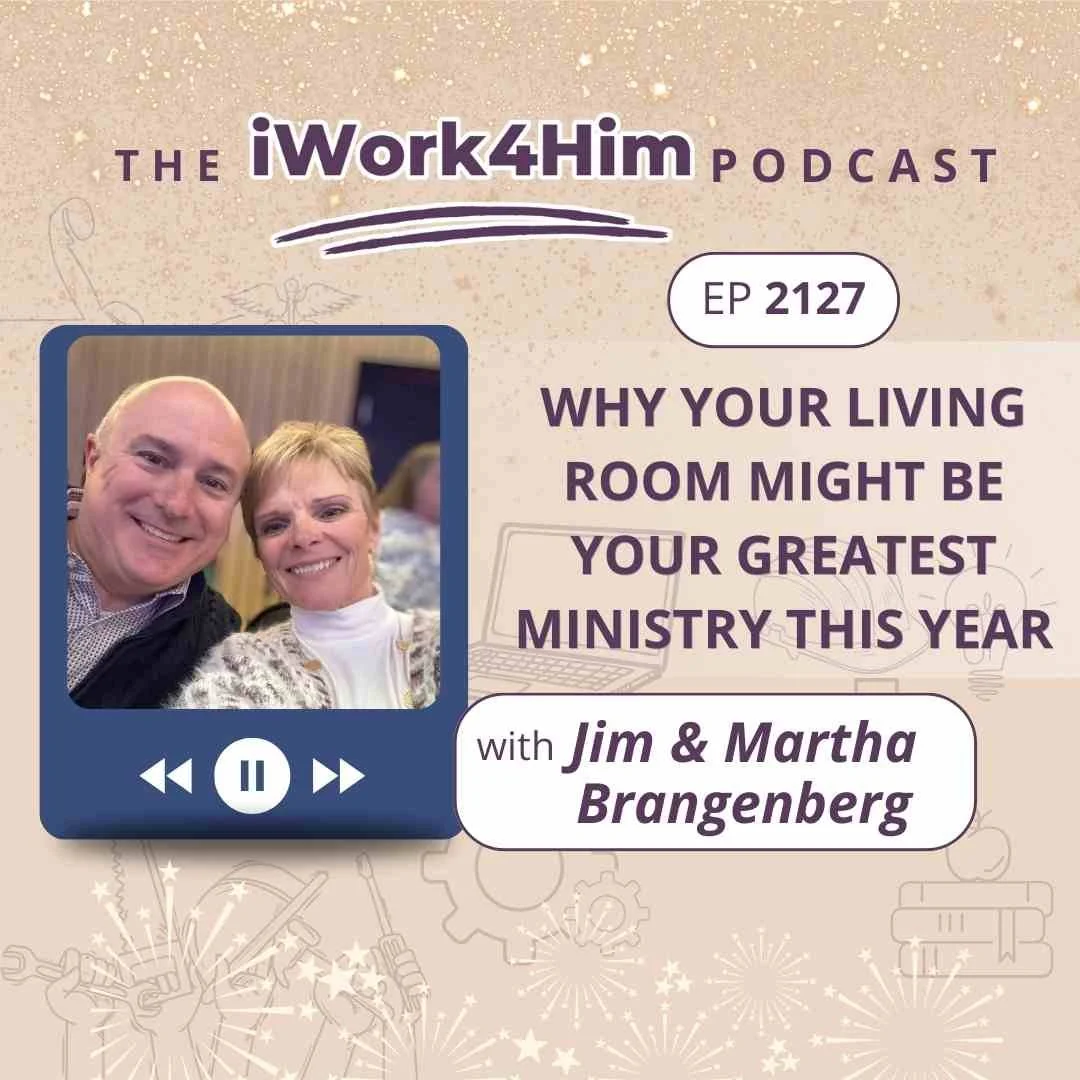
Jim Brangenberg: You've tuned into iWork4Him.
Martha Brangenberg: Wait a minute, you've tuned into iRetire4Him.
Jim Brangenberg: Okay. Okay. Okay. No fighting here.
Martha Brangenberg: You've tuned into a joint iWork4Him/ iRetire4Him New Year's special. We are your hosts, Jim and Martha Brangenberg, and our mission is to inspire every believer in the workplace - and retired - to recognize God's work in their lives, whether they're getting paid or not.
Jim Brangenberg: Happy New Year. There's power in gathering when people gather together outside of their workplace and in a home. There's an amazing transformation that takes place. Hairs let down and ties are loosened and comfy sweatshirts are dawned, or that ugly New Year's sweater comes out of the closet. We encourage every one of you to listen to the challenge of today's show, a short one for sure, and let God transform your New Year's celebration into something that is a little more iWork4Him style.
Martha, even though it's just another day, a New Year's celebration is something special, isn't it?
Martha Brangenberg: Oh, it most definitely is. I think so many people look forward to all that comes with saying goodbye to one year and hello to a new year and new opportunities. And to do that together with people that you love and care about is powerful.
Jim Brangenberg: Yeah, we've had quite a few New Year's type celebrations over the years. And Super Bowl parties, by the way. Yes. But that's a topic for another show... but we had quite a few New Year's celebrations in our homes in New Years past. Why do we do it?
Martha Brangenberg: I think what I just said, Jim, is that we look at New Year's Eve as this time to reminisce, look at the last year things, highs and lows, things that you've accomplished or things that have happened in our lives, and then turning that calendar over to the new year and anticipating all that might be ahead and doing that with friends and family and neighbors, or coworkers, whatever we're gonna talk about today, is so powerful because you have experiences that you've lived together and you're anticipating, and it's just one way, one of many ways really, to celebrate that together and to recognize it.
Jim Brangenberg: Heck, I just like to do it because I like to have a potluck.
Martha Brangenberg: You like the food.
Jim Brangenberg: I love the food. I love the punch. Martha makes this chocolate mocha ice cream punchy thing and I love hanging out with friends and I love bringing people in our home that otherwise would be at home alone. I hate the thought of people being home alone.
Martha Brangenberg: Yeah. It's really not celebrating when you're sitting at home instead of ringing in the new year as people say. And for Jim - and Jim, for you and I, it hasn't always been at midnight that we've rung in the new year. We're like. It's 12 o'clock somewhere. (chuckling) You don't have to stay up and get all tired to start off your new year in order to celebrate together.
Jim Brangenberg: But I disagree with Martha. I do think you need to stay up till midnight. Because it's just a thing. It just is a thing.
Martha Brangenberg: Oh. But sometimes people would use as an excuse not to come.
Jim Brangenberg: Yeah. We start the party early enough. Like when we were at the beach in Florida, we invited all of our neighbors over and sometimes 10, 15, 20 of 'em would come. And most of them would peter out before midnight ever got to be anywhere close to happening.
Martha Brangenberg: Which really wasn't a good idea on the beach anyway, 'cause fireworks were gonna go off at midnight whether you were in bed or whether you were awake and they were gonna wake you up.
Jim Brangenberg: There was no absolutely no point in going to bed early in florida. Absolutely not. They were doing explosions way off into into the new year. We had, and I think really, if I remember, our friends, Mike and Kathy were the only ones that really made it up to midnight with us pretty consistently.
Martha Brangenberg: Yeah.
Jim Brangenberg: And by the way, New Year's in Florida, pretty nice. Sixties for a low, windows are open, seventies for high. Pretty nice. Pretty nice. Yeah. But Martha, for some New Year's is about that special bottle of bubbly, and we don't drink, but when we've invited others in, we just let 'em know that they could bring alcohol if that's what they choose. Why is that? Why did we decide that was okay?
Martha Brangenberg: For us, it was like we're gonna be who we are and who we have decided and what we've decided to do in our lives, but we really didn't want to hinder other people from coming because for some people it is about popping that cork and tinking the glasses and we would do that with our sparkly apple cider. But, just wanted, again, to make our home feel comfortable for people and let them choose how they do that. Another thing that we loved about having especially neighbors over, Jim, on New Year's Eve, is nobody had to drive home.
So it was a safe environment for just keeping people off the road, not only for their own 'cause we didn't end up with people being drunk at our parties at all.
Jim Brangenberg: No, because people came to our house and they weren't being encouraged to drink by other people.
Martha Brangenberg: But they would have their beverages or whatever. But we don't like the idea of driving in traffic after midnight on New Year's, because other people don't make good choices and it could be dangerous out there. So having people in our home that live nearby in our neighborhood and coworkers that could stay close by, that was another reason that we like to do that.
Jim Brangenberg: And you could always be a designated driver and drive people home if they've had too much. But like I said, if you do it in your neighborhood, they can walk home or wander home or wobble home or whatever it may be.
Martha Brangenberg: Jim, what do you think it is about having a party in our home that helps to break down those barriers and actually let real conversations happen?
Jim Brangenberg: First of all, it's really cool because if you're having food, you get to pray over the food, 'cause if it in your home, you can do what you wanna do. And we like to pray over our food. It just, we get a chance to love on people.
It's our space. It's our space that's always bathed in prayer. So people come in to our home. It's a place that the Holy Spirit's already living and breathing and it impacts people, it impacts the conversation. But when somebody comes into your home, it's your domain and you get a chance to really just make them feel comfortable and loved on. And it's different than them being in their home. And because our home is different, it feels different and we just love having people come into our house.
Martha Brangenberg: I was also thinking sometimes at work people put up a fake front. And one of the things we've really tried to do in our home -
Jim Brangenberg: not like a false wall.
Martha Brangenberg: No. Like a mask. Wearing mask. When they come in our home, one of our biggest focuses is on making people feel comfortable and relaxed and be themselves. And so I think when you do that in an environment that's homey, people are more likely to take a deep breath and to relax a little bit and to enjoy the environment that's been set around them.
I always have made it a point to make sure that the decorations are something that people can look in and admire and pay attention to, and that it goes throughout the home and they feel free to go in different rooms and nothing was off limits. And all of that is intentional to just help people feel like it's not a mystery to be in our home and it's not something they should be afraid of.
Speaking of great conversations. You gonna interrupt this conversation?
Jim Brangenberg: No, I'm not, but I wanted to say some other things. I just, when we invited people in and made them feel comfortable and the inviting environment, but being able to greet people with a hug. People you don't always get to hug or shake their hands. It just, when you're sitting in your own home and people know that it's your own home, and they may, because we were believers and most of 'em were not. They just were kinda curious 'cause they're used to religious freak kind of people, but we were different than that and it was just nice to be able to share time with them.
It was something that was cherished and it was something that wasn't done in our neighborhood. And what I'm trying to figure out is how do we do it in our new little Missouri house? We may have to do it in the office.
Martha Brangenberg: We do have other spaces that we can use. So I know, I was just gonna say, you're talking in past tense because it's been a little bit of a challenge to get into that role here in a new location. And I think that's a good challenge for everybody is to say, you know what, maybe this is the year, maybe this is the year that you bite the bullet and you just say, you know what, there might just be a few people that attend, but we're gonna invite you over.
Jim Brangenberg: At the beach, we would put the fireplace video on the television. And we would turn music on very softly so as not to hamper conversation. A lot of times people have music really loud, then you have to yell and nobody wants to yell.
Martha Brangenberg: No, but it's nice to have a little filler.
Jim Brangenberg: It is nice to have a little filler.
Martha Brangenberg: Okay. Okay, so now can I talk of great conversations? Okay. So we wanna have great conversations in our homes when we invite people in. Jim, you and I are participating in some amazing location events this year in 2026, and we'd really love for you all to be a part of them.
And when we are there, we can have a great conversation together because I know that there will be many. Check out our events page for all of the details. Go to iWork4Him.com/events, but you just might see us in places like Maryland, North Carolina, Orlando, or Cincinnati this year just to name a few. So each event is unique and kingdom focused. We look forward to great conversations.
Jim Brangenberg: And if you're listening to the show and we've not met face to face, when you get to those events, make sure you come up and introduce yourselves. We'd love to hear from you.
Martha Brangenberg: Or even if we've met you before face to face please do so.
Jim Brangenberg: Well, but bring a gift.
Martha Brangenberg: Okay. (laughter)
Jim Brangenberg: Sorry.
Martha Brangenberg: Jim likes chocolate.
Jim Brangenberg: I really like Mountain Dew better. I like dark chocolate, but that's not really, it's, I'm not looking for that kind of gift.
Martha Brangenberg: It's awkward to bring a case of Mountain Dew, Jim.
Jim Brangenberg: It is. A bottle's fine. Okay. All right, so let's talk about really the practicality, what we're suggesting. What we're suggesting is that you open up your home to guests, that you clean your home and prepare it for guests, and that you dedicate - you're just a steward of your home. You don't really own your own home anyway, and you're a steward of it. So steward it well and bring people in, whether you're working and you bring people in from the office.
Or you're retired and you bring people in from the neighborhood, or whether you're working, you bring people in from the neighborhood and you're retired to bring people in from your old office, however you wanna do it, but to invite people into your environment.
Martha Brangenberg: That was really confusing, by the way. (laughter)
Jim Brangenberg: Just bring people into your house and don't just - here's my challenge. Don't just invite a bunch of church people to your house. Invite the people that don't know Jesus to your house and maybe intersperse a couple of church people so they can interact, you can intermix your groups. Mix it up a little.
Martha Brangenberg: Just say you're having friends over, and then that can be whatever you want it to be.
Jim Brangenberg: It's not Friendsgiving, its Friends...ynewyear.
Martha Brangenberg: Yeah. So let's talk about some things that can make it simple, because I think another thing that's an obstacle is people think it has to be complex. It has to be pinterest worthy.
Jim Brangenberg: My mom hated having parties. She was always worried about all the details. She's freaked out about the details.
Martha Brangenberg: Yeah. But if you have, say, okay, we're gonna do hor d'oeuvres or finger foods, or we're gonna do appetizers, or we're gonna do just desserts. Just say, Hey, just bring something to share and make it simple. Let them bring it, right, on their own platter.
And if they, if you need to get out some dishes, get out some dishes, but don't make a big deal out of it. Just try to be as graceful as possible, but allow people to carry the load with you. Don't make it so difficult that you're like I'm never doing this again. So I just wanna say, start off simple.
Make it a potluck of whatever sort. Like I just gave you all those ideas. Even have somebody bring - we had that for Thanksgiving, Jim, we had Sprite with cranberry in it. Or you know you can make the punch.
Jim Brangenberg: My son-in-law bit into one of the cranberries. That was the first time he'd ever bitten into a cranberry.
Martha Brangenberg: I don't think you're supposed to do that.
Jim Brangenberg: I don't think you're supposed to do that either. No, but so potluck is great. Besides potluck, everybody always brings your best recipes to a potluck.
Martha Brangenberg: Yeah.
Jim Brangenberg: It is the delicacy of grazing. Unbelievable. And make sure somebody brings those little weenies that you put toothpicks in, 'cause those are always a good New Year's Eve party. All right. So but you could have a theme. Could you have a theme?
Martha Brangenberg: It is a theme.
Jim Brangenberg: Wow.
Martha Brangenberg: Okay. Yes. You could say, come with like your word of the year, or maybe come with a something that you want, a poem you wanna share, or you could do some things too that can spark conversation.
So I know over the years, Jim, we have done different things where we've had. There are a lot of games out there: would you rather? Or I can't think of all of 'em off the top of my head, but they're conversation games.
Jim Brangenberg: Or a puzzle.
Martha Brangenberg: Or...
Jim Brangenberg: oh, no puzzles. Wow. That's funny. Did you hear that? Just live on the air. No puzzles. We didn't. Yeah, we don't rehearse this.
Martha Brangenberg: I don't think puzzles is really good for a New Year's party, but, hey, there might be a, somebody that's an introvert that would like to.
Jim Brangenberg: In your family puzzles work. It's like an all out sport, full contact.
Martha Brangenberg: Yep. But we wanna show the best of ourselves that day. Okay. And that may not be doing possible.
Jim Brangenberg: So because you're not providing alcoholic beverages, and I'm just telling you, if you listen to the show, please don't provide alcoholic beverages. The Bible doesn't say don't drink. It doesn't, but I'm telling you, it provides the wrong message. So just be alcohol free. If people wanna bring alcohol, it's okay, but be alcohol free. And provide alcohol free phenomenal beverages. If you want it, email Martha at I work the number four him.com, she'll give you the mocha punch recipe. It's fabulous.
It is. It's also, so the Sherbert Punch recipe easy, the Rainbow Sherbert punch recipe. Which is really rainbow sherbert and some Sprite and some Pineapple juice. All right. But provide, and of course, bring water. If you're a friend of mine, mountain Dew or Coke or some diet drinks, that kind thing.
Martha Brangenberg: So you'll drink Mountain Dew on New Year's Eve because it's late at night and you wanna stay up, right?
Jim Brangenberg: That's right. But provide an option of drinks and always have something diet, 'cause there's people that wanna drink chemicals.
Martha Brangenberg: You're so good at party planning, Jim.
Jim Brangenberg: And make sure you have, for party planning, you gotta have those blow whistle things that go, like a kazoo with the thing that flies up. You gotta have that and Party hats for New Year's Eve. Absolutely. Not to wear the whole night, 'cause that's ridiculous, but to put on right when the ball starts dropping in New York City.
Martha Brangenberg: Speaking of that, you think it's important to watch the ball drop?
Jim Brangenberg: It is important. Put it on your television - because it's fun!
Martha Brangenberg: It is.
Jim Brangenberg: And it does a whole minute countdown. And it's just the longest minute of the year. And besides they spend like a million dollars building that thing every cotton picking year. You might as well let 'em get some benefit by having you see it in your part of the country. And the good news is if you're in California, it's only nine o'clock when it's dropping.
Martha Brangenberg: Yeah. You can watch it early.
Jim Brangenberg: That's right. Alright.
Martha Brangenberg: Or rerun it every hour.
Jim Brangenberg: So a game, you could do a game.
Martha Brangenberg: Yep.
Jim Brangenberg: You can do all kinds of things. If you have a well lit backyard.
Martha Brangenberg: The big thing is to take the initiative and make something happen because you might just open the door for future relationship with the people that you invite. They're gonna feel more comfortable with you, and then you never know what they're gonna experience in the new year where they may need to lean on your shoulder or talk to you, and they're gonna feel more comfortable and more familiar in a good way because they have had that time with you and you've shown that you just care about them and want them to have a enjoyable evening, which just builds on your relationship. And that's really why we do it, Jim. It's all about relationship.
Jim Brangenberg: Absolutely.
Martha Brangenberg: Love God, love others. That is what the Bible summarizes.
Jim Brangenberg: Wow. Somebody said that. Oh yeah, Jesus did.
Martha Brangenberg: Yeah, he did. He did.
Jim Brangenberg: He summarized the entirety of the law and the prophets in two sentences.
Martha Brangenberg: And it's really not that it's about the new year, but it's a great excuse - there are certain times of the year that we have great excuses for having parties, getting people together for fun, Super Bowl, you mentioned it. That's another great one. So if you can't make it happen for New Year's this year, maybe think ahead. Think ahead, think about the Super Bowl and how much fun you could have, just having everybody together.
Jim Brangenberg: And praise God, this year there'll be an alternative halftime show.
Martha Brangenberg: That's right.
Jim Brangenberg: All right, so for more ideas and how you can do this kind of thing all year long, get a copy of one of our books for the cost of shipping only during the month of January. You can in fact call our one 800 number, which is not an 800 number. It's an 8 6 6 number 7 1 3 96 75, and put it in an order for one of our books or multiple books.
Maybe you'd like to give them away for New Year's presents to a whole bunch of your friends just for the cost of shipping. 8 6 6 7 1 3 96 75, or you could always email Martha while you're getting that recipe for that Mocha punch, email at Martha at iWork4Him.com. Martha at I work the number for him.com.
Martha Brangenberg: And we'll have all that in the show notes as well.
Jim Brangenberg: Oh yes, the show notes. Love that.
Before we go we want to make sure we thank each one of you and to make sure you know how much you all mean to us. Our audience is amazing and it's exciting every week, or if you listen to iRetire4Him, every other week, to share news stories of how God is using people right where they are to make an impact on the kingdom. You can help keep this message going through a simple program where you round up your purchases on your credit card. Just listen to the commercial at the end of the show today, or also go to iWork4Him.com/donate for all the details on our Swipe program.
So happy New Year from all of us at iWork4Him!
12/24/25 - 2126: iWork4Him's 'Night Before Christmas'
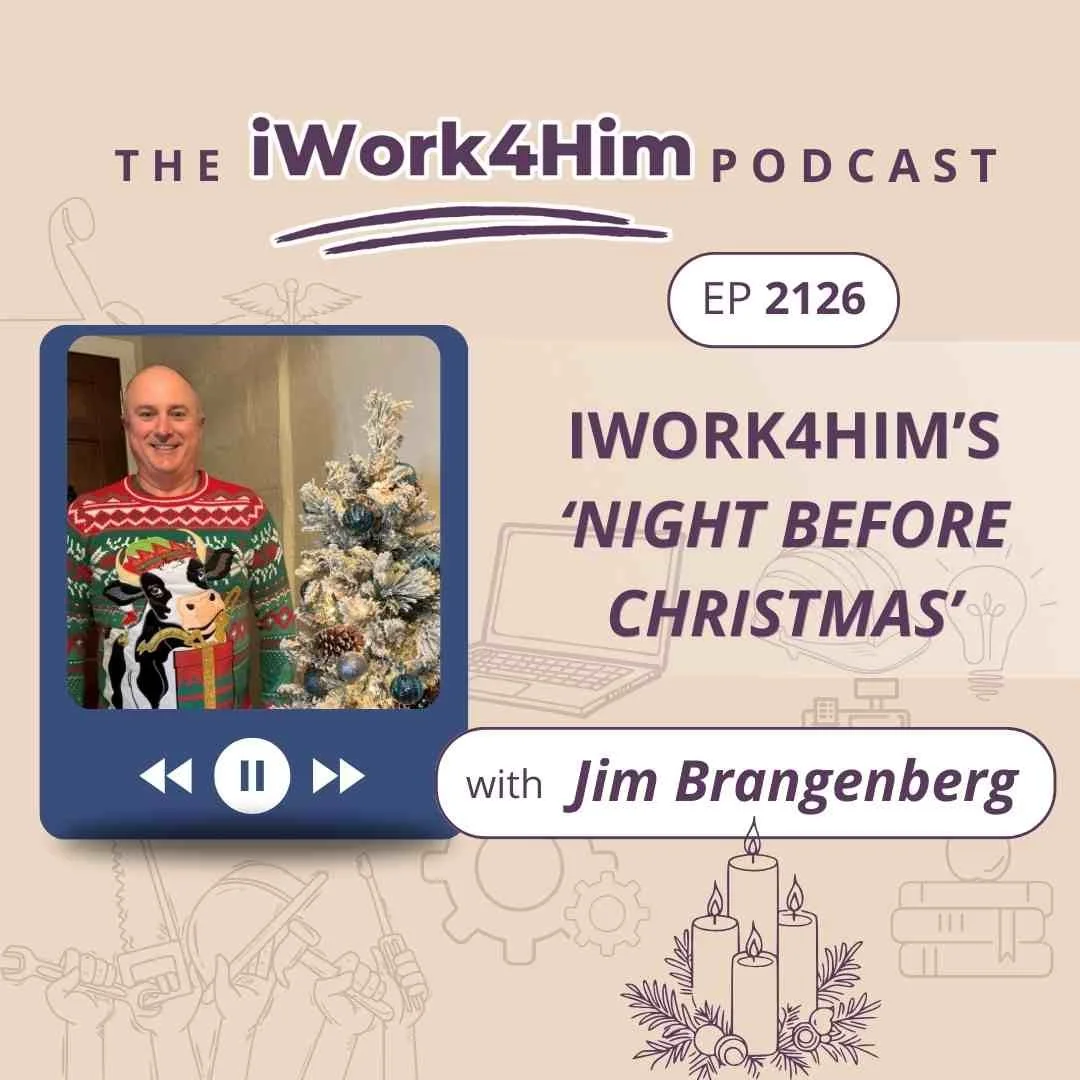
An iWork4Him Nation Christmas Poem by Jim Brangenberg
‘Twas the night before Christmas and all through the workplace
Not a person was working, Celebration filling the air space.
The reports were all done, finished for the year
All in hopes that a week of vacation was near.
The projects completed all wrapped up and snug,
Preparing to leave work, got some crumbs on the rug.
Christmas season brings great conversations at work.
Real life becomes realer as the holidays often bring hurt.
Swapping of presents, and drinking of eggnog,
Hoping for a Christmas bonus for the year’s long work slog.
Thought my life was destined for ministry, found out my workplace was more of my destiny,
Full of great people I work with each day
Needing some love, and a point to the Way.
Learned to pray for my coworkers, bosses, and employees all during the day.
Found out the real change came to me and changing my way.
Learned to help out when others were too busy.
Saw that my effort brought a smile instead of a hizzy.
This year, brought work friends into my home to feel God’s love,
Best way to introduce Him in a way that models kids’ gloves.
Working with excellence creates a great platform,
For listening to someone hurting makes them feel warm.
I’m in full-time ministry – my workplace, my destination,
Mission field of lost and hopeless looking for truth among the frustration.
The new year will bring more ministry opportunities at work.
What a blessing to be paid fulfilling my calling – quite a perk!
So, as the stockings are hung, you sit down in your chair,
You realize instead of St Nicholas, God chose to put YOU there.
Merry Christmas from iWork4Him!
12/17/25 - 2125: Shalom as a Career Path
Jim: You've tuned into iWork4Him, the Voice of Collaboration for the Faith and Work Movement.
Martha: We are your hosts, Jim and Martha Brangenberg, and our mission is to inspire every workplace believer to recognize their workplace as their ministry place, where they work with God every day. What can that look like in your workplace? Let's find out right now.
Jim: When you look at the over 2000 interviews we've done over the years, very few have involved institutions of higher learning. One reason for that is I have a rule: anyone with a doctor in front of their name or a PhD after is prohibited from using any five syllable words on the show. And secondly, most institutions of higher learning do not see the significance of whole life discipleship yet and living out our faith in our work yet.
Even if it isn't a ministry degree, they're still learning this stuff, but today's gonna be very different. Very different. While our guest has a doctor in front of her name, she's easy to talk with, and her university, Seattle Pacific University, is dedicated to making sure every one of their students gets the idea behind iWork4Him. JoAnn Flett joins us from Seattle Pacific as she is the executive director of the Center for Faithful Business. The no five syllable word rule still applies, JoAnn, but welcome to iWork4Him.
JoAnn Flett: Thank you so much, Jim and Martha, for having me on the show. I'm so excited to spend time with you.
Jim: Joanna, as we do with every first time guest on the show, we always ask people to share their Jesus story. How did you come to be a follower Jesus?
JoAnn Flett: Oh yeah. No, that's great. I started early. Thankfully God had me in a family of faith, and I saw that faith lived out with my mom and her sisters. And so by the time I was probably seven or eight, I had come to know the Lord, but was actually baptized at age 12 just to get into that real sense of knowing, and it was a childhood following of Jesus, but it was all along the way an accompanying of a God who reached down and has drawn me into a relationship with himself and sustains that relationship. But it's that's how I came to know Jesus - in a family setting.
Jim: Very cool. That's very neat.
Martha: That is. What a blessing it is to have that as part of your legacy. You talk about God accompanying you. Let's talk about how. At what point in your life did you understand or realize that God loved the work that you were doing and wanted to walk with you in that?
JoAnn Flett: That's a great question. So I started off wanting to go to Bible college. I'd actually been recruited to, to be an accountant at McGill and to study accounting and wanted really badly to be a missionary and so decided to go to study at Prairie Bible College in Alberta, Canada. It's interesting because I had this one older missionary person said to me, JoAnn, God is really more interested in the worker than the work.
I think as I get out of 2025, the word "and" is really become the beautiful word for if I have to have a word of the year for 2025, it's "and." I would say now, yes, God is interested in the worker and the work. In the context of our work, we live out our faith. And somewhere in Bible college, I came to this realization that I want to work for him, not in formal ministry per se, like going overseas as a missionary, but in everything that I do. That is ministry.
And I think of ministry as being that role of drawing people into relationships with Jesus and actually in the workplace, I have way more opportunity to do that than I would if I had gone overseas as a missionary, to tell you the truth.
Jim: How significant was that conversation though, for you to be able to grasp that I could still be an accountant and be in full-time ministry.? I could still be in the industry working at McGill, as you said, and still be in full-time ministry. In fact, I've had great arguments on the air with missionaries who've gone overseas and I say, and these people are going to their mission field. " That's not a mission field." I'm like, oh, yeah, it is. There's lost and hopeless people in every workplace. That makes it a mission field because there's people there that need to meet Jesus.
When you got vaulted into your accounting career, you spent a lot of time there, didn't you?
JoAnn Flett: Yes, I did. And so I finished Bible college. I had a year of before I went to college, a really substantive year, working with a CFO, restructuring an oil company. They were in bankruptcy. And they were restructuring selling off parts of it. And my dad knew this person and so I worked very closely with that person. And so when I finished with a bachelor's in biblical studies, the most work I had done was accounting. And so I was one of Costco wholesales first accountants.
Martha: Wow.
JoAnn Flett: And I left it to go work for a local city because in 1990, Costco was not a household name. (chuckling) But accounting, in both of those places, whether it was Costco or the local city or as life would go on, globally in London, working for the Queensland government, there was an opportunity to be friends and befriend people who would never be in church. And they get a bird's eye view of your actions and your person and everything.
And frequently people would stop by my desk and say to me when they were going through whether a life crisis or like anything from even an accident, like someone driving into work had an accident. They'd come by my desk and they had this sense that you have a direct line to God. Literally this is what they would say. And I'm like, what? Because I pray? You do too, if you would. But the context of the workplace allowed for a relationship to form. And as I went through seminary, after Bible college, the idea of ministry was anything I do to draw people into relationship with Christ.
And that can happen on a mission field with missionaries in the pastorate, but it also can happen in the workplace. And so here came my ministry coming alive in the context of accounting. Who knew? To be able to meet and work alongside people, my craft itself would speak volumes to them and the excellence that I had there. But my care for them as people would then offer us conversations. They'd look at how we lived our lives as a family, the decisions we were making to go one place or not another place, and all of that spoke volumes and had them at a minimum, curious about our faith life. And in some instances, overtly asking about it.
So it's a great opportunity that people in the workforce get to have is people can actually come to you and ask you about faith.
Martha: And the story that you tell is exactly why iWork4Him is in existence because God has shown us there are stories all across this country and around the world, where people are seeing how they can minister to their cubicle buddies, to the people around the boardroom, wherever they may be working. They're on business as mission, truly, and getting paid to do that. So tell us briefly how then did the shift happen that got you into academics?
JoAnn Flett: Yeah. No, that's very much a God thing. All of life is at this point. So I had moved to, my husband and I had moved to Eastern University. Eric was teaching theology, still teaching theology, and I was working as an accountant and they put me in to teach a 400 level cost accounting class in the evening.
Jim: Ew. Cost accounting.
Martha: Oh, I love cost accounting. I love it. (laughing)
Jim: We don't agree on this. It's one of those classes they use to weed out the people that just aren't gonna be able to make it.
JoAnn Flett: Yeah, this was a 400 level from 4:30 to seven o'clock one night a week. I spent more hours prepping for that thing than my day job. It was really something, but I absolutely, I had 22 students in the class. I loved it. Absolutely loved it. And the student said, what else are you teaching? If there's anything else you're teaching, we'll sign up for it. And the chair of the department came to me and he said, do you want to teach more? Would you like to teach more?
I said, no, I have a day job. Long story short, the provost then said, we'll create a visiting lecturer position for you, and you can come into this visiting lecturer role. It had me in the classroom half the time and the other half out in industry to stand up and work with internships and working with students to kinda help them through initially accounting and finance. But then we then went out into everything. And it was a - I like to say Eastern University grew me up.
Yes, I took a massive pay cut leaving industry to go into the academy. But my goodness, they unleashed gifts about networking, caring for students. I trained in Bible college and in seminary and never took a pastoral role. But in that professor role, I could really come alongside students. I could develop relationships with local businesses. And so yeah, that was the moment I stepped out of industry and into the classroom. And that was 20 years ago and I haven't looked back.
Martha: Wow. It's so neat when we get to hear stories like this where we can see how God was building this timeline of skills and talents and abilities for a purpose.
For many of us, our trajectory may change several times during our career, but changing our cell phone provider to match our values is something we only need to do once. Patriot Mobile is built on the pillars of faith, family, and freedom. And if you make the change before the end of the year, you get two free months of service.
Just remember to tell them that iWork4Him sent you. And this is a good change to make as you head into 2026. Use the promo code Holiday25. The offer is you'll get two free months of service, which ends at the end of the year. So look at the link that I'll have in the show notes for all of those details.
Jim: So how did your time, JoAnn, at Eastern University solidify your understanding of that intersection of faith and work?
JoAnn Flett: That's really good. So I started in the business department. Remember, I'd come through theology.
Jim: You mean you survived. You survived. But you went to Fuller though. And Fuller's one of the only seminaries in the country that really gets this. They really get it.
JoAnn Flett: Yeah. Yeah. They're few. Regent in Vancouver. Paul Stevens. But yes, Fuller really gets this at a whole different level. I had Rob Banks for a professor, and so I'd come through the theology piece. I had gone back into business and I was trying to put those two pieces together.
What I had taken from Fuller was this definition of ministry that Julie Gorman, one of our professors there, had us work out our own private conversation around ministry, and that was anything we do to draw people into relationships with God. Understanding that God is, in God's self, is a trinity of beings, father, son, and Holy Spirit. And that is relationships writ large. I won't use the five syllable word, but there you go. Just because then I'll be barred from the show.
(laughter)
Jim: You just have to give the definition. That's what you have to do. Yeah.
JoAnn Flett: Yeah. There you go. The mutual indwelling between Father, son and Holy Spirit. The dance between the Trinity is known as this idea of perichoresis, and it's the three in one and that relationality and in God's created us to be in God's image. And that image is relational. And then business is relational. Just think of the myriad of relationships we reach out into business, into the stockholder, from the stockholder to the employee, to the customer, to the supplier, to the local government, to larger federal governments. It's a myriad of relationships. My goodness.
So relational God, relational humans, and a medium of relationships. That's not by coincidence. And so I was working out that conversation at Eastern in the business department and landed on this idea of Shalom. Shalom had always been out there, but Shalom is rightness of relationship with God, self, others, and creation. And so this idea that business could pursue Shalom and that we could equip people to think theologically in business and to think about it as working, joining God's work, to restore Shalom.
Jim: And when Shalom is missing, you realize that you're not walking alongside God where he wants you to be. Because his intent is for us to walk in Shalom wherever we are. Yeah, so we're feeling like crazed lunatics, like accountants typically are at year end, quarter end, month end. If you're not feeling shalom in that - and I have a sister who's a CFO, so I can speak to this.
JoAnn Flett: Yeah.
Jim: Then we understand there's something outta whack 'cause God is not there in the chaos. God brought order to everything, which is why accountants love Jesus.
(laughter)
JoAnn Flett: And Cornelius Plantinga in his This is Not the Way Things Used to Be, would tell us that what was broken in the garden was shalom. That relationship with God was broken and with self and with creation, it was all, it all just went out the window in the garden.
And what Jesus came to do is to restore shalom. And so our work in the world is to join God's work in the world to restore shalom. And here I was working that out at Eastern with their MBA students, where we would like to say the MBA students who graduated from Eastern had the head of a business person, the heart of a missionary, and the soul of a development worker.
And they were attracted to Eastern for that reason. They literally would give up top rate schools, other schools, Ivy League schools, to come to Eastern because they wanted this idea of development practice, the theology and strong business acumen. And needless to say, one of the big joys of my career was the program direction for that group of students and that work. So yeah really blessed by it.
Jim: So if you've got students and you're listening to the show today and you, students that you're going, where should I send my students? Sounds like Eastern University's somewhere you should absolutely check out. Of course, Seattle Pacific's also one of those places you should check out.
Martha: And let's talk about this. So in 2021, God moved you to Seattle Pacific University and to the Center for Faithful Business, right? So why did you decide to take on that challenge?
JoAnn Flett: That's great. That's a great question. So I moved from Eastern to SPU, but while even at Eastern, I longingly looked at my colleagues at SPU Jeff Van Dozer, Kenman Wong, Denise Daniels, they were doing something in business. They were scripting this out in the classroom.
I was trying to put it into a specific program with the MBA and they were scripting it out larger for the faith community in North America. And Jeff's book, Why Business Matters to God and What Still Needs to Be Fixed is a critical book taking you through the grand narrative of scripture - creation, fall redemption, consummation - and showing you how businesses at work, how God's at work in the context of business to facilitate that.
So this group of friends, when Eastern closed the program I was just talking about, this group of friends reached out and said, Hey we are hiring for a new executive director and you've been aware of this work and you've also been trying to do this work. You should throw your name in the hat. And I did. I threw my name in the hat and to God's goodness, they gave, they extended the call. I think there were like 21 other people, really notable good people, but they they were kind enough to extend an offer to me.
And so in 2021, I moved out here from Philadelphia and I took on this challenge of stewarding this incredible work, 'cause it's work that they had been doing. This work didn't start when I came. It had been happening since 2004 in the Center for Integrity in Business under Al Airman and John Terrell. And then they hit pause, and Gene Kim, then they hit pause, and then they renamed it the Center for Faithful Business and hired me as the new executive director. So yeah, I get to steward great work. I stand on the shoulders of my colleagues.
Jim: Wow. And it is some great work. And we're gonna talk about that in a second.
It's almost time to flip the calendar to 2026, and that means looking ahead to what God has in store. We hope you will prayerfully consider what you might add to your calendar to help you grow in connecting your faith at work and surrounding yourselves with others that are doing the same.
Whether you find a local event or a group to get involved with, or a national event like the US Christian Chamber of Commerce event in Orlando in April, or the National Faith at Work Summit in Cincinnati in June, there's something out there that might catapult your year. Check out our events page for all the details. iWork4Him.com/events.
So JoAnn, the Center for Faithful Business. What's the aim?
JoAnn Flett: That's great. It fits exactly with iWork4Him. The work of the Center for Faithful Business is to promote a Christian understanding of business, and we do that through the academy business and the church. I call that the ABCs. So if you're a business professor and you're listening to this, we have resources for you. If you're a business practitioner and you're listening to this, we have resources for you. You wanna promote a Christian understanding of business. If you're a church leader, I'm working with pastors and with pastors of discipleship and executive pastors- we have things that can help you train and work in discipling your congregants. So yeah, we are here to promote a Christian understanding of business, and we have several ways in which we can do that.
Martha: That's so good. So something that I think you're most famous for, that Jim and I were aware of, were the 44 documentaries through Faith and Co. Tell us about that. And I'll share a link so people can go and maybe watch some of them because they're so well done. But tell us what the idea is behind that.
JoAnn Flett: Thanks for that. Yes, we're well known for our Faith and Co. video series. Five Seasons. So please go binge watch them. They are eight to 12 minute long videos. They are separated into five seasons. Business on Purpose is season one and has 14 of the documentaries in there. And then we have serving customers, serving employees, serving the world and then faithful investing. So across five seasons you'll find films of people of faith who brought their faith to work. They lead companies and how the, how that mattered in their work. And so if you wanna see live examples of that, these are the exemplars.
Jim: Yeah. And everybody listening, these are phenomenal videos and they are top topnotch. This is not a documentary by a guy with a cell phone. This is real stuff. Shot on location. Super well done. Do you have your own Roku channel yet?
JoAnn Flett: No, but we should.
Jim: You should have your own Roku channel!
Martha: So let me ask just a couple real quick questions regarding faith and Co. 'cause I think this is, it piques my curiosity. I would love to know if students helped to develop it and where this idea came from to really share these stories with the world.
JoAnn Flett: Yeah. That's great. So students are the aim for it. They're the target market, so we created them to be used in the classroom. But the people behind it were pastors again, across that A, B, C. They were academics. They were business practitioners and they were church leaders, and so they reviewed these videos that were brought to us, so they'd get a rough cut, they'd speak into it, and then we'd tailor it to the specific story.
But the idea was to use it just in eight and 10 minute increments in the classroom to spur conversations on faith. And we wanted students to be able to, because often I don't, if you've been in a higher institution and you've been in the classroom, you ask a question and there's crickets.
But if you hold up exemplars, we know that helps students to get even more interactive, and you can say what did you like about this? Or can you believe that there are people like Don Flow of Flow Automotives who are so faithful in car dealership? And people of integrity that you could trust them. That's not car salesman and integrity or not. We just use those in the same sentence. But his faith influenced that, right?
So yeah so it was intended to, to bring it to this group of students. And it was done in community and the vision behind it was always to help people nurture their faith, to see that they too, whether you're in a hospital, as in our film, Remarkable Always, where she's a hospital administrator. Or you're in the car dealership or you're in the restaurant business, like every business across the industry, you can be a person of faith and that faith matters to God and how you show up, how you do that work.
Jim: For the record, for our audience, we were used car dealers for 15 years.
Martha: And our tagline was what, Jim? (chuckling)
Jim: "Where integrity is just a way of doing business." And it can be done. It can be done. And that's before we understood the faith and work connection. That was just because we felt led by our faith.
Alright, the Center for Faithful Business, known for these incredible videos available to anybody out there to really to learn, to inspire, just like our iWork4Him podcast. We're covering stories of people living out their faith and their work and of people that have got great resources. This is one of those great resources. But in addition to these 44 documentaries at Faith and Co, which they can access online, the Center for Faithful Business is also known for having the largest library of books related to the faith and work movement. Is this list publicized for reference? How do we get access to this list?
JoAnn Flett: Yeah, it is. It's on our spu.edu/library. It's right there. It's on our ccfb@spu.edu. I'll provide the link so you can have it for the notes. There's a downloadable PDF of the 2,400 books and articles in faith and work. And so you can have access to that.
I'll just quickly swing back to faith and co really quickly. One way people have been using this is they've been having watch clubs. So they actually, like you have a book club, they have a movie club, and so they go through a season, they watch all the films. An entire season will be 48 minutes of film watching. So you can easily do that and then you show up, you have a meal and you discuss the films. And they're finding all kinds of great things happening.
I also have a group in rockingham, Virginia, who are, she started this group with season one and it's a lunch and learn. So on Thursday they show the first, they show the film while people bring their brown bag lunch and they're eating their lunch. And then based on the themes on the film, they have local business people responding in a panel to conversations. And so she's gone through season one and through season two and now there are 60 business people who renamed themselves- she was gonna try to be like an outpost for the Center for Faithful Business, but they renamed themselves Rockingham Business Associates, and they're just doing this now to build community around faith and business in that part of Virginia. How cool is that?
Martha: That is so powerful. That's very cool. And it, it just goes to show you, when you hear what God is doing in someone else's life it sparks something that says, wow, what could God use me for? Or what could I do in my work that would make a difference for the kingdom? And so it's very inspiring and I love that people are using it in such practical ways.
In conclusion, as we close this all out, what else is happening at the Center for Faithful Business that we need to know about?
JoAnn Flett: Yeah, there is so much, so locally here, we have a Faithful Work conference in April 18th. We have the guys from Barna Group, we have local business panel, and this is to just feed and nurture and support our local business community. We celebrate local leaders in business who've been faithful. And so we give a Frank Haas integrity and Business award every year, and we use that as an opportunity to talk about this person's testimony locally. It's really great.
We also have the Bruce Kennedy Ethical Leadership lecture. He, Bruce Kennedy, was the former CEO of Alaska Airlines. And upon his death, we received some money for an endowment that kind of keeps moving in this direction. So we keep the conversation on integrity and faith in business really well aligned. But perhaps the most significant work that we're undertaking right now is to start to provide resources for the Christian middle manager.
And so if there are any Christian middle managers out there, and we define middle management as you have three or more direct reports but you do not talk to the C level. You have a in-between level that you're reporting to, so you're very much in the middle, we wanna provide resources for that group of people.
And so our work in the center is starting to think about who these people are, what might they need to nurture their faith and to support them in their discipleship and their walk with Christ. So those are some of the things we have going on.
Jim: What better way to influence an organization than be in the middle? Because that means you can explode down and explode up when you start praying for those people that are working for you and the person you're working for. You start to have amazing influence and it starts to trickle up and down at the same time. If you're a CEO, you only have one direction you can go. And if you're at the bottom, you can only have one direction, but when you're in the middle, you can go both ways. It's incredible.
JoAnn, people really need to check out The Center for Faithful Business. You got a lot of great resources out there. We've got the link in there, but it is ccfb.sp.edu.
JoAnn Flett: Yeah. cfb@spu.edu.
Jim: C ccfb@spu.edu. I know you're gonna look in the show notes anyway, but I wanna make sure we said it because the Center for Faithful Business has been cutting edge for a very long time. JoAnn Flett, thank you so much for being with us today.
JoAnn Flett: Thank you so much, Jim and Martha for having me on.
Jim: You bet. You've been listening to iWork4Him with your hosts, Jim and Martha Brangenberg. We're Christ followers, and our workplace, it's our mission field, but ultimately iWork4Him.
12/10/25 - 2124: A Better Way to Do Christmas at Work

Jim: You've tuned into iWork4Him, the Voice of Collaboration for the Faith and Work Movement.
Martha: We are your hosts, Jim and Martha Brangenberg, and our mission is to inspire every workplace believer to recognize their workplace as their ministry place where they work with God every day. What can that look like in your workplace? Let's find out right now.
Jim: Christmas time is almost magical. The general spirit around the office is more genial and everyone is looking forward to time off, the Christmas party, and time away, and time with family. Almost everyone, whether you're a business owner, organizational leader, office manager, or someone moving up the ladder at work, Christmas time is a great time to love on your neighbors at work and to put your faith into action.
Martha and I today are going to talk about some ways you can let Christmas and Jesus invade your workplace. Martha, you love Christmas, don't you?
Martha: Yes, I do. I love all things about Christmas, especially recognizing the real reason for the season.
Jim: And you grew up with your mom and dad owning a business, which was a photography studio. How did they handle Christmas time?
Martha: It was a lot of fun actually, and I think, as I look back on this, I realize that one of the reasons I don't have a problem decorating early for Christmas is that as a photographer, my dad was taking pictures for Christmas long before it was Christmastime, right?
So if you want pictures to give to your family or to send in Christmas cards at Christmas time, you need to get those pictures, the sitting scheduled and done. And that might mean that you're sitting around a Christmas tree in October for a picture that's gonna be given out at Christmas time.
Jim: That's where Christmas in July sales came from, because your dad started working on that early.
Martha: Oh, probably. At least they were designing things that early, but they handled Christmas in several ways with their industry. They had to be thinking about it way before it was actually happening.
But actually handling Christmas, they were all about loving on their employees, spending time with them, planning something special, making them know that it was a very special time of year. There were times where my mom would do Christmas teas where she would invite people to come and have a special tea and read a Christmas story that pointed to Jesus, not to just presents.
And so a lot of intentionality went into Christmas in my home. Home and business, I should say.
Jim: Yeah, which were one and the same when you moved to Minnesota, that's right. Your parents had their photography studio in their home. It was a large home, they had added an edition on that was specifically for the studio and the family, and I got to be a part of these Christmas traditions where they had dinner with their employees and invited them into their home. Talk to us about that.
Martha: It was again, just a very intentional time where my parents made sure that their employees were loved on, that they showed him that they cared for them. It would probably be the only time of the year where they would take, we would all go to dinner somewhere together and reserve a special room where we could all just be in a quiet space and be enjoyable, give a memorable gift.
My parents were always very intentional with things like that to make people feel special. And sometimes that would be dinner in the home and my mom would orchestrate an elaborate meal or have people bring things. It really, it had a lot of different phases over all of my life, but always with that intentionality and with pointing the reason that we were gathering not only to love on all the employees and make them feel special, but then to point to the real reason for Christmas and to talk about Jesus.
Jim: Now Christmas around my household was a little different. My parents didn't own a business, but my dad was a manager of many salespeople, and mom and dad would wrap up Christmas presents and bring 'em to the office and give everybody that worked for my dad a present for Christmas, and they'd have a little party and it stressed my mom out a little bit, but it's what they like to do.
And it is something, after our Christmas tree caught on fire, by the way, we did have one of those Christmas vacation kind of things in our household in Maryland before we moved to Minnesota. I think our cat - again, it was involving a cat, fire on the Christmas tree, A real Christmas tree. That's where Chevy Chase got the idea.
Martha: Maybe, from your family.
Jim: Alright. What about neighbors? As you grew up celebrating Christmas, did you guys do anything in your neighborhood celebrating Christmas?
Martha: Definitely. I would say neighbors and extended behind that would be like people that my mom was in the choir with or we did the Christmas cantata at church, but for the neighbors I can remember cookie exchanges. I can remember big pots of chili, 'cause you don't have to know exactly how many people are coming to make chili, right? You just make a really big pot.
Jim: It sounds good right now.
Martha: Now have cheese and crackers and all the goodies that go with that.
Jim: And sour cream if you really wanna do it right.
Martha: Oh yeah, absolutely. And just, live it up. But have the neighbors over. Have a hot cider, hot chocolate. Mom was really good about making people feel welcome, keeping it casual enough that people didn't feel like they couldn't come or they couldn't have their family there. It was all about being welcome because that is the first step in hospitality, to really get people to open up to you and be real.
And again, that was the bottom line in our home and in all that my mom and dad did. So with the neighbors, definitely gatherings. I can't remember if we would do it every year, but we would always have, as a family, a weekend where we would frost cookies. It was like a big deal to make all the cookies.
And then, we could have a cookie exchange with the neighbors and go from there. And the more parties in a season, the better, in my home.
Jim: Yes, because you need have a bigger variety of cookies. (laughter)
Martha: Oh, there you go.
Jim: Absolutely.
Martha: And getting to really have lots of different people involved in your lives.
Jim: Christmas is something truly that Martha thinks about all year long, but we have to have a rule in order to control the Christmas spirit in our household. But we've unleashed it. But really it was: until the eggnog is on the shelves, there's no Christmas music in the house. I think Martha snuck it earlier this year.
Martha: No, you have eggnog in the fridge.
Jim: All right. That's it. There's no worries. There are many people that we consider neighbors with technology, we get connected to people all over the world and in our neighborhood too. Even through our neighborhood apps. The people we work near are our neighbors too. The people we connect with on Zoom calls, they're our neighbors, and there's so many more.
If you're hoping to build relationships and be more intentional, our book iWork4Him might be helpful for you to connect with and to love on and become a neighbor with those around you, it's not too late to order several iWork4Him Books to get them shipping out to you right away for Christmas. Go to iwork4him.com/bookstore to get a copy.
Are we running a special for this Christmas?
Martha: If you want to get a bulk or anything like that or have several sent to you, just email me, martha@iwork4him.com, I'll put that all in the show notes and we'll figure out what we can do.
Jim: Alright. Deal. iWork4Him the book, it will change how you look at your living out your faith in your work.
Martha: I don't know if you remember Jim, but last year we offered gift wrapping and we did a video of you trying to wrap a book and it was not pretty. So...
Jim: not my gift.
Martha: I'm thinking that's important, we'll figure it out for everybody.
Jim: Oh, I got an idea. I got idea. We're doing this on the fly right now. If you send us a video singing a Christmas Carol and celebrating iWork4Him somewhere in that Christmas carol, we will send you a book for free. You just gotta cover the shipping and handling, not the handling, just the shipping. We'll do the handling for free even. (laughter)
Martha: I think Jim's looking for some entertainment, everybody.
Jim: Absolutely. All right. So Martha, we have found some amazing power in celebrating Christmas with our employees over the years. What are some of the things that we've done?
Martha: I think we've taken a lot of ideas from what we talked about with my parents - having a special meal, spending time with the employees away from work, giving them gifts, being intentional in that way were all things that we've done to really celebrate the season and get people away from the workspace so that they can enjoy the relationships that we've been building over the years.
What else do you think of?
Jim: Yeah, it's a tough - we ran an insurance agency, which you know, between Thanksgiving and New Year's, 50% less business was done during those times of year 'cause people are busy. But we enjoyed celebrating Christmas by getting people into our home, our closest employees into our home.
And that has always been a fun time because when you get people in your home, it totally breaks down barriers. I'm just going right back to the eighties. "Totally. For sure. You betcha." Oh, that was a Minnesota eighties. When you bring people into your home, it breaks down those barriers that allows them to just feel the love that you really have for them without the pressure of phone calls and without the pressure of quotas or whatever.
It's been fun. And because you love to decorate for Christmas, the house always looks so amazing. We've done office parties, we've done home parties. I don't know that we ever figured it out, what was the perfect way to do it, but we love to celebrate christmas. I know on our New Year's show, we're gonna let you guys know what we've done for New Year's. That's been a really powerful thing too.
Martha: Yeah. I think that, now our team is virtual and so we have done even like just Zoom calls and had special time to just be like, Hey, let's enjoy each other. We've done a video for Christmas for all of our listeners. And that's been really fun as a team to put together and just to celebrate. It's really about being creative. It's really about just sharing that we love them and that we see that there's more to this time of year than gift giving and bonuses and things like that.
But Jim, are those things important?
Jim: Yes. Yes. Everybody loves gifts. Okay but again, going back to something we talked about in our Thanksgiving special, you need to know the love languages of your people or according to Dr. Paul White, the five languages of appreciation. Sometimes you can't talk about love at work. I don't know why you can't, but you can talk about appreciation.
Martha: It's not that you can't, you just have to be cautious. That's all.
Jim: Yes. So you have to figure out how do people receive love and whether it's through words of affirmation or whether it's through gifts, or whether it's through quality time, or whether it's through acts of service or whether it's through touch, physical touch, which in an office would be no more appropriate than maybe a Christmas hug maybe, but maybe a pat on the back, a handshake, whatever it might be.
But so when you're giving out gifts, they should be specific to the people that you get. Everybody loves getting bonuses. Now remember though, when you give people a cash bonus. They get taxed on it. So you can give Christmas gifts that don't have additional taxation on them. Be creative.
Martha: It's very easy for something like a gift or a bonus to turn into something negative and so I just caution you...
Jim: like the jelly of the month Club.
Martha: Okay. Going to the Griswolds again, but just the idea that, if you are going to set a standard, make sure you can always reach that standard or change it up so that they're not expecting this and then when they get something else, they're disappointed. Because you're intentionally giving them something out of the generosity of your heart, but the worst thing would be is if they were disappointed because it wasn't better than last year, or it wasn't the same as last year, or it wasn't whatever.
So I just, I caution you to really think about that and think about the future so that when you're making a decision for this year, that you're not setting up something that will just disappoint people in the future. Kinda like what you were saying with the taxes, Jim, people say, oh, I wanna give 'em a hundred dollars. If you take out all the taxes on a gift, it ends up being what? $55 or something that they get.
Jim: And that's what's so important. So if you're gonna have a bonus, it should be based on activity and productivity. A lot of times people set up bonus programs for all year long, right?
So it shouldn't be a Christmas bonus. It should be a Christmas gift. There you go. And it's different. And it shouldn't be contingent on their productivity. It should be contingent on the generosity of your heart.
Martha: Yeah. Truly a gift.
Jim: Right. And so think about it, plan about it, build it into your budget, so when you get to the end of the year, you're not like, wow, we had a tough year. Plan it ahead, set aside money all year long. Now it's too late 'cause you listen to the show, you got just a couple weeks till Christmas. But when you give generously, because we have a generous heavenly father who's given us everything and everything you have came from him, and you got people that work for you.
Hopefully you already pay them a generous wage. You got people that work for you that have had unexpected things happen this year. The economy's not been phenomenal.
Martha: I was just gonna say, this might be the year to give a ham or a turkey or something like that, because it's something tangible that they may need, that they may not splurge on in the way that they could, if you helped them in that way.
Jim: Or a prime rib.
Martha: I was thinking the same thing.
Jim: If you're gonna go all out and spend a hundred bucks, buy 'em Prime rib, because that's really awesome. Are we gonna do prime rib this year at Christmas? Martha started this Christmas tradition when we lived in Fort Myers and I've loved it. She's carried it forward into Missouri.
Alright, but be creative. Involve your spouse in trying to do this - whether you're the woman running the business and get your guy's perspective, you're the guy running the business. Get your wife's perspective, but just be generous. And maybe you're not the boss in your workplace, but you could still make an impact at your workplace. You can still have a party. You can get your boss's permission to have a party. You can have a party for just the people that you work with, but getting people into your home.
A way to welcome them not only into your home, but to introduce them to Jesus who lives in your home and lives in your heart. And it gives a chance for you to be a great example to them by hosting them. We recommend no alcohol. Not because alcohol is evil, obviously too much alcohol can cause all kinds of trouble, but sometimes when you have alcohol, people dunno when to stop. So no alcohol. You could have that bubbly grape juice stuff.
Martha: You don't wanna make a situation where people are later apologizing for how they acted or anything. You wanna make it a safe environment for everybody.
Speaking of planning parties and events, we have several exciting events that we will be participating in in 2026. So I just wanna encourage you to check out our events page, iwork4him.com/events, and you can get all the details and the discount codes for registering. We really do hope to see you face to face in 2026, so let us know that you'll be there so we can plan to connect.
Jim: And when you do show up to these events, please walk up and introduce yourself to us, 'cause we've met thousands and thousands of people over the years. Sometimes we forget names and we would love to be able to remember your name.
But the whole point of today's show - Martha, Christmas time is a joyous time. It is the thing that makes you most happy, really... I hope... just slightly less than me (chuckling) , but Christmas time can also really hard for people. There's a lot of emotions tied to it. Some people didn't have great Christmases growing up, or they were a negative experience growing up. There's some other reasons. What are some of the other reasons why Christmas time might just be hard?
Martha: If people have experienced a loss of a family member this year or in recent past, or there's been a divorce or something else has happened, it can be, like you said, just sad or scary or the unknown because you're gonna miss - you can feel lonely even when you're around a lot of people. So being aware of that, that it may be a really tough time for some people. Also just because of the financial burden that we put on ourselves. Our culture is terrible about that, about pressuring people to spend money that they don't have.
But all of those things can weigh it down on people and be a burden. So I think it's important to pay attention to the people that you work with. Just like we talk about on the iWork4Him Nation Covenant all the time is being aware of how people are and what they're dealing with personally, so that you can meet them where they're at, that you can be sensitive to that and love on them in a way that's gonna minister to them.
Just a couple ways that I think that you can do that is just acknowledging that, pulling them aside and saying, Hey, is there anything this year that you would like to see or not see, or how can I help you? Because if you know what they've experienced during the year, you can directly address that and say, Hey, I know your best friend passed away this year, and I can imagine that this is gonna be a different season for you. Is there anything I can do to help you through that?
Or just being real with people and acknowledging that you pay attention to their life and that you care about those details. I think that is such a huge thing. But especially this time of year as they may feel like they can't bring it up. They don't wanna be a Debbie Downer. They don't wanna dampen everybody else's mood. So those are just some things I can think of. Can you think of anything else, Jim? How we can minister to people?
Jim: David Downer. Not just Debbie Downer. But David.
I think it's also important to be sensitive. There are some people that don't celebrate Christmas. If you've got people that practice the Jewish faith that you work with, they celebrate Hanukkah and it's before Christmas. And so it is a festival of lights. So to be familiar with what they are and just to say, Hey, we're having a Christmas party. Does that offend you or not? Tell us how you feel about it. We'd still love to have you participate.
But just ask questions. And you may have some people of other faiths that you work with. Almost everybody celebrates the spirit of Christmas, 'cause people love getting gifts and people love lights and Christmas trees. It's just a, it's a fun time. We've run into one person in our life who is offended by Christmas lights. That's not most people. Most people love Christmas time because it's encouraging.
But some people don't get to go home for the holidays. And so my encouragement is if you know somebody's gonna be alone because they're not from your area, invite 'em to your family celebration. It's okay. It'll be different, but it'll still be fun. And it'll add some new conversations. You won't have to hear grandpa tell the same story the 77th time. You'll have other stories to tell.
Martha: Grandpa has new audience. (laughing)
Jim: That's right. Yeah. Yeah. Sit 'em next to grandpa so they can tell the stories. But minister to people in a healthy way and just ask them.
If you notice people are struggling just say, "Hey, what's going on?" And "thank you for sharing that" and pray with 'em if they're struggling.
Martha: And also to celebrate the positive things too. Somebody might've had a baby this year or might've gotten married and acknowledging that, hey, this is a new time for you, baby's first Christmas. You have new memories to be making, and so we can help with that.
Jim: Our first Christmas together, remember? I remember we had a Christmas tree in our apartment in Mankato, Minnesota, on top of the gold carpet. And we put another rug up. I don't remember much about that. I remember the next year at christmas in our first home, where we went and bought a Christmas tree at a local Christmas tree lot, and we had a little Ford escort wagon, going way back to the mid eighties and we bought this Christmas tree. It was just beautiful. And we had a vaulted ceiling, so we wanted the tall Christmas tree.
What we hadn't paid attention to was the width of the Christmas tree, and we brought this Christmas tree, threw on the top of the roof of the car, and we had a hard time getting up to speed on the way home, and so we didn't know what the real deal was, but we had some trouble.
Martha: Yeah, we did. We knew we got a big tree.
Jim: We got a big tree. We're like, maybe it's bigger than we thought. And then we got home. And we unleashed it in our living room. And it was again, just like Christmas vacation. And it went (makes explosion noise) and the piano had to move and the couch had to move and the chairs had to move and it filled up the whole living room.
Martha: But it made a good memory, didn't it, Jim? (chuckling)
Jim: And when we pulled it out of the house, it left five feet of Christmas tree needles everywhere. A pile high. It was unbelievable.
Martha: You're good at exaggeration. (laughter)
Jim: It was great Christmas. It was a great Christmas. Alright, but for all of you listening, look around to the people around you to minister them. Help them have good memories. Light up your house to encourage other people. Don't have a competition. If other people, if there's an old person in your neighborhood, somebody chronologically superior and they want lights up, then maybe they're not so great on a ladder anymore, offer to help 'em put lights up.
In your neighborhood, in your workplace, there's people around you that need Jesus. Christmas is the introduction of Jesus to the world. You can't make it any more important, so take some time. Be intentional. You got a couple of weeks from when this show releases to be intentional on how you live out your faith at work during Christmas time to encourage people, to love on people.
Martha: Yeah. So if you're looking for a simple way to do those things for others, remember, you can Google, you can get ideas for keeping it simple, but making it really special. And if you're looking for a simple way to support iWork4Him in 2026, you can just round up. We have a program through Project World Impact that allows all your purchases to be rounded up on your credit card and then donated to our ministry. I'm gonna put the link in the show notes for you to find that and you can get signed up and start off for the new year.
Jim: So I work for him.com/donate. You've been listening to iWork4Him with your hosts, Jim and Martha Brangenberg. We're Christ followers. Our workplace, it's our mission field, but ultimately iWork4Him. Merry Christmas!
12/3/25 - 2123: Why Israel is Thriving (and Why It Matters)
Jim: You've tuned into iWork4Him, the Voice of Collaboration for the Faith and Work Movement.
Martha: And we are your hosts, Jim and Martha Brangenberg. Our mission is to inspire every workplace believer to recognize their workplace as their ministry place where they work with God every day. What can that look like in your workplace? Let's find out right now.
Jim: On a rare occasion, we get a glimpse into how Jesus followers are making an impact with their faith at work from around the world. Today we have the privilege to venture off to Israel to have a conversation with Evan Lieberman from Wise Money Israel. Evan has been married to Sarah for 28 years and they have three kids. Evan and Sarah are on the ground in Israel and can tell us the truth about the great things happening there and how business leaders and Jesus followers in Israel are impacting the marketplace and how believers in the US can get involved and invested there as well. Evan Lieberman, welcome to iWork4Him.
Evan Liberman: Great to be with you, Jim and Martha.
Jim: Evan, we always start off the show with our new guests is by asking this question, how did you come to be a follower of Jesus?
Evan Liberman: That's a good question. I'm 57 now. Actually, harken back to age four, if you can believe it. I don't have this great conversion story, how I became a believer in the Messiah. Simply my parents, Jewish non-believers in the United States, were confronted. My dad worked for the department of Commerce in the United States, and he'd be on a shuttle every day going into work with all these other professionals in the government. And one would be a Christian reading his Bible, and people would make fun of him even at age 30.
And so my dad, after feeling sorry for him, sits down and says, I'm Jewish. I understand why you're reading that book. And so they developed a friendship. He started telling him after a few weeks, so you're Jewish. What are you doing about the sacrifices about sin? And he's, what are you talking about, sin? Jewish people don't know from sin and sacrifice nowadays.
And so he started explaining to him the gospel and it really freaked my dad out, being Jewish non-believers, it's the farthest thing that you want is to hear about this Jesus, who you don't recognize as the Jewish Messiah or as Jewish at all. And so my dad promptly gets off the shuttle, after a few weeks just said, I don't wanna ever talk to that person again. It's too threatening. But after a while, God worked on his heart and he spent the next year at the Library of Commerce reading about all the religions. He says, if I'm gonna entertain this one, is the farthest that Jewish people ever want to go, let's look at Buddha. Let's look at the Koran.
And he came to conclusion, this is the God of Israel. And if I'm the only Jewish person who believes this back in the seventies, then that's just what's gonna have to be. And my mom, of course, is Jewish nonbeliever freaking out. What's happening here? And where are my kids being taken? We're reading this Illustrated Bible, not only now of the Old Covenant, but the new Covenant. And who's this Yeshua person? We become believers, my brother and I at age four and six. And my mom eventually, after a year, became a believer and the rest is history.
Not a great conversion story for me, for my dad is really exciting. And he was instrumental and still is in the Messianic Jewish movement for the last 50 years in the States. So it was quite a watershed moment for all of us.
Jim: I don't know why you don't think it's not a great conversion story. It's phenomenal. Anytime a Jewish family realizes that Jesus is their savior, the Messiah that they've been waiting for, that's a phenomenal story.
Martha: You just didn't have to struggle with it like your dad because you were raised exactly into that knowing - which is fabulous.
Evan Liberman: There comes a time when you have to own it yourself. And I think that time was when I was 12, 13 and going off to college for sure. You have to know that this is yours and really own it. So that I did.
Jim: Evan, we've been told by others that the Jews have been told that the New Testament is an anti Jew book that, and that they should avoid reading at all costs. Is that something you've heard before?
Evan Liberman: You do hear that from a lot of Jewish people. It's simply 'cause that's what the rabbis tell them. It's not, of course, based in anything historical and all it takes is a few minutes to research and even Israeli Jewish people are coming to the understanding that Yeshua, Jesus, was a very Jewish person.
The writers of the New Covenant, of course, are all Jewish. Potentially one exception, and talks about and is based on old Covenant ideas such as worshiping God, Shabbat, salvation through sacrifice, through blood covenants, all the concepts are all there.
And so the fact that numerically it was taken over the faith in the first few centuries by people that weren't from Jewish background, didn't know and wanna connect it to the Jewish backgrounds, of course, has a 2000 year history of being detached. But that is the point of Messianic Judaism, honestly, is to bring back the understanding that this is one book, not two, it's a continuation of God's story with the Jewish people that's now open to everyone in the world through salvation, through the Jewish Messiah, the Jewish lamb, the Jewish sacrifice.
Martha: My goodness, there's so many things that I wanna comment on. And then one thing, the one thing I'm gonna ask is to clarify. You said that your, that there was a understanding that you, that the Jewish people, don't even believe that Jesus was Jewish?
Evan Liberman: No, they're actually coming to the understanding much more nowadays 'cause they're looking at it historically, especially secular Jews who aren't just gonna go blindly with what the rabbis say, is their understanding historically and archeologically. There's no doubt Jesus was as Jewish and more and his worldview and conception all came from our people's history.
The stories, the parables, these are all very Jewish things of the time back 2000 years ago in Israel. So it's the fact that going from, he was a Jewish person, a great leader, maybe a prophet, jumping into, okay, he's the Messiah, the Son of God himself. That's where most Jewish people get stuck. But knowing that he was Jewish is starting to become more of a reality to the Jewish, non-believing world.
Martha: This is such a relevant conversation and I am guessing that already our listeners are like, I wanna hear more because, we only get bits and pieces of true understanding of the Jewish culture, let alone Jewish Messianic believers. So you alluded to the fact that you didn't grow up in Israel. I think you were here in the States, at least when your dad was on this exploration. How did you end up in Israel? Are you part of the Aliyah of the Jews returning to Israel?
Evan Liberman: I definitely am. I grew up in the United States, went to University of California and started working in San Diego. But at age 25 I realized, okay, I wanna do something with my life in the Messianic world to put my shoulders to the plow. But in a place where I feel like, this is where Messian Judaism is going.
Ultimately, the Jewish people are coming home to live in the land. A Zionism that started a hundred years ago, 150 years ago, is so much what I think God is doing in our generation. And I can be a part of it. So we have people coming back, the rebuilding of the second temple, and they're called out in Ezra and other books.
And I'm like, this is what I can do in my generation. I was bar mitzvahed here actually in Israel on a trip that my dad decided to do my bar mitzvah here at the Western Wall in Israel. And that started a desire in my heart to be part of my people, not just culturally in the United States as a Jewish person but speaking the language, eating the foods, and being part of our people.
Because I think that's what the end times talk about it, that all Jews not only will be saved, that's in the book of Romans, but also Jewish people will be here. If they're Jewish at all, God is regathering our nation, to never scatter us again, and we're just the beginning portions of that.
Jim: Evan, the mainstream media news always makes Israel look like, look bad. It's what they're focused on, and looks like a scene from the moon landing - barren and desolate. They're always focused on the spots of Israel that, it just looks terrible. What's the truth about Israel today?
Evan Liberman: That's a great question. You're right. Mainstream media is not a fan of Israel, especially in the last two years. But Israel actually is so much opposite than the barren desert that you would think. And there's actually a cool website about innovative companies in Israel called nocamels. com, I think it is.
And basically, we've transformed the desert into a blossoming rose as the book of Isaiah talks about in the latter days. Israel today is very much thriving. It's one of the most advanced, innovative countries in the world. Economically, it's got a lot of enviable data. It's the startup nation you've probably heard of.
So there's more startups per capita here than anywhere in the world. In fact, even on an absolute basis, us being the size of New Jersey, population of 10 million, actually have more startups here than most countries in the world. We've got R&D centers from some of the biggest tech companies, from Google to Intel, Apple, Nvidia, Microsoft.
Our GDP is the envy of the world. We're we have gross domestic product twice as high as the other OECD nations like the United States and Japan. Our gDP per capita is $55,000. That's double many nations like the UK and Japan. We've got a thriving ecosystem of capital market and the Tel Aviv stock exchange, which we can talk about if you want.
Our tech sectors driving a lot of innovation and AI and biomed and technologies and military of course that we need, and cybersecurity. There's just a lot of things going on that are really exciting here. We're leading the world in some discoveries - drip irrigation, desalination, the memory sticks that everyone uses today. Voiceover IP that's backing zoom calls that we're doing today come from Israeli innovation. Firewalls. The first firewall invented was in Israel.
And so there's just a lot of thriving going on here. It's a miracle, essentially in the desert, of resilience and innovation, and some people call it a light to the nations already and imagine what that light will be when the Jewish people actually do understand who their Savior is. I can imagine that would be what the Bible says, life from the dead.
Martha: That's so encouraging and I hope people can absorb - and that's high level summary of what going on there. And we're gonna dig in a little deeper into what God has you doing there.
When you talk about innovation, most of us are using mobile devices or computers to not only listen to music and podcasts like this, but to also conduct our business and communicate with other people. Imagine if you get a virus on your device and can't use it for its intended purpose. It will not only set you back in time and energy, but to potentially compromise the very work that you're doing.
SaferNet is a trusted partner of iWork4Him that we have installed on all of our mobile devices and our computers because their virus protection, their VPN, and their 84 web filters keep the bad guys out so that we can keep doing the kingdom work that God has called us to do. Check out safernet.com and let them know that iWork4Him sent you.
Jim: Evan, it's well known that the people of Israel carry a blessing whether they're following Jesus or not. Jewish business people have solved many of the world's problems, the list is super long, and have run many of the world's most powerful organizations, some good and some bad, unfortunately. You are focused on marketplace investments in organizations and businesses that are run by the people of Israel. Why is that?
Evan Liberman: It's coming from a zionistic perspective. It's saying basically God is doing something in our generation, as I talked about before, and our economy is, is one of the better economies, even though we just became a developed nation maybe 15 years ago.
But statistics economically, financially, that are way beyond what we would see in a nation that's under 80 years old. And we see that this is a powerhouse that's just getting better and better. And therefore we want people to participate with us. We feel like the concept of supporting Israel is biblical.
We feel that God's in it. God is blessing people. A lot of our clients are coming to us from a conviction of, this is what God's doing. I wanna partner with Israel. How can I do it? A lot of people, of course, partner through ministry, through contributions, and that's great and we encourage that. But it is one directional. Whereas if you're partnering with someone, you're having a two-way street, essentially. You're able to bless and be blessed in return.
And so that's why we feel like to focus on Israeli companies is really our, while we're licensed both in the Israel and the United States for general investment management, we're actually excited about directing people toward our land, toward building up the state, building up the companies, building up the people, creating and facilitating those innovations that are really changing the world and helping the world. And we've seen somewhat just already, but imagine what it's gonna be, 10 years from now.
Jim: I can't imagine, 10 years from now, the world changes at such a fast, ridiculously fast pace. I just can't even imagine what the world's 10 years from now or whether it still exists. I don't know. AI kinda scares me a little bit.
Alright, so when we first interviewed someone from Israel about eight years ago, they stated that there was about 20,000 Jewish followers of Jesus living in Israel. What's that estimate today?
Evan Liberman: Great question. There are various estimates. There's no real counting going on here. We're not focused as much on growth as the other communities in the world, but most estimates put us around 25, 30,000. It's grown pretty quickly. My wife grew up here. And in her generation, she knew all the believers.
There were 600 Jewish believers here. And now there's about 30,000, so about three times growth in the last 25 years. So it's growing quickly. There's about 180 congregations here, so there's smaller but it's much more a grassroots scenario that's going on here, but it's definitely expanding.
The kingdom of God is expanding. We're only 0.3 numbers guys, so 0.3% of the population are Jewish believers. But that's much more than it used to be. We're still very much of a small minority, but being more and more integrated into society as people venture out into being lawyers, doctors, in our case financial professionals, serving in the army. Most believers send their children, like my own, to the Army.
And so they're integrating well into society now. And so that's helping, I think as yeast in the dough, so to speak, to leaven the, maybe in a good way, the people of Israel so that they know, okay, the Jewish Messiah is in fact someone you already know. You wouldn't consider him the Jewish Messiah. Let me tell you about him. And I'm a normal person, and that's helpful of course, to witness.
Martha: A normal person, and actually from what we've experienced when we've talked to Jesus believing Jewish people, is you actually better understand all of scripture because of the context of your lineage. So you, a little side note, you said your wife was raised in Israel. Did you meet her there?
Evan Liberman: I did. I met her here in Israel. In fact, I was looking for a wife since age 19 and I came to Israel age 25 and within two months I think it was, God had me meet her. Didn't know that was gonna be my future wife. Took five years for that to happen. She's a Messianic Jewish believer as well, but she would never have come to the United States. So God had a plan that was beyond just my zionistic aspirations to serve as kingdom in a different way among my people. But that's the only way I was gonna get married, evidently.
Martha: That's right. That's awesome. That worked out really well. I just, I love that. That's so great. Okay, so God has called you to be a steward and an ambassador of Israeli owned businesses. Tell us about that. And bring the BRII into the conversation because our listeners are gonna love to hear that.
Evan Liberman: Great. So about 15 years ago I recognized that there was a lack of understanding about the Israeli stock and bond market. I was an avid amateur investor at the time, and I realized people don't know. So we started a website to just get people understanding how, in fact, can you invest in Israel. What's the economy looking like? Why is it such a good economy? And no one knows about it. There was not much information in English at the time. It was more built for the local community, the local 10 million Israelis and not for outside investors.
So we basically have developed and pioneered the area of helping people around the world- we have about a quarter of our clients are Israeli clients, but about three quarters are from about 30 different nations around the world. We're helping them invest in Israeli stocks, Israeli bonds. We are Messianic Jewish believers, my staff and myself. And a lot of our clients, not exclusively, are believers of various types - meaning evangelical Christians to messianic Jews to non-affiliated, and they're coming to Israel for many different reasons.
Some are spiritual reasons. They want to connect with the people of Israel on this level. They wanna partner. Some want just a great return, and we've seen tremendous returns even during the last two years of this war. The market has doubled here, if you can believe it, during this time. And so we essentially help people to not only invest funds in fundamentally good Israeli companies from about the 700 different companies that exist here, but we also apply what's called a biblical responsible investing screen.
We call it BRII for Biblically Responsible Investing in Israel. And so not only are we keeping out companies that no matter how fundamentally sound they are, if they're involved in one of the vice that the scriptures would speak against, we don't wanna have our clients investing and taking part in that from an equity share perspective. So we won't invest in those companies. But also biblical responsible investing doesn't say just what we won't invest in. It says what we want to invest in, and I think the scriptures are clear about those that bless Israel will be blessed.
Those that partner with us, those that support us, God is going to work things out for them, whether that works out financially or otherwise. It's just a biblically sound principle to be favorable toward the Jewish people. And Israel, of course, is where most of the Jewish people are today.
Jim: So have you guys created ETFs or mutual funds bringing all these things together? How is it that these funds get accessed by people in 30 countries?
Evan Liberman: That's a great question. We're thinking in the future about an ETF or a mutual fund, but currently we're managing separately managed accounts, SMAs, for whether it be an individual, joint, a company, a nonprofit, an IRA account and we establish them on various brokerage platforms.
We're, as a financial advisor, as a fiduciary of clients in the 30 different nations, there are many brokerages locally and internationally that can access the Tel Aviv stock Exchange. So the reason we're licensed, for example, with the SEC in the United States is to be able to offer American residents a US broker dealer firm but yet invest in Israeli securities, Israeli stocks, Israeli bonds that we can manage for 'em in the shekels.
So there are a lot of clients that come to us. They wanna have a little bit of their funds diversified outside the US dollar. They don't necessarily know if that's gonna be a place to have a hundred percent of their assets. And so they want that diversification. They want that market diversification, currency diversification. They wanna know that they're biblically responsible investing in a land that they believe in.
So there's a lot of resonance with people. Getting the word out is usually our problem because once people hear about the possibility, they're sold already. Now they just have to dot their i's and cross their T's. Opening investment account can be done about 30 minutes online and doesn't require the investor to be accredited at all. And so most clients can start at $50,000 or more.
Jim: That's what I was gonna ask about the accredited investment thing. So it, that's not a case. And for those of you listening, an accredited investor has a million dollars of investible assets and that eliminates a lot of people. So if somebody's listening today, you're saying right now they have to invest in specific stocks within Israel. There's no, there's not a mutual fund, a gathering of these stocks into one place.
Evan Liberman: Correct. So we have about 25, 30 stocks we're tracking to and bonds at all given times. We do fundamental research every week. And so we generally have what would be considered a mutual fund. We just haven't marketed it as a mutual fund. Generally most clients choose from those companies. Some have different opinions on this sector versus that. We've got real estate and energy and banks and finance and technology and some might say, look, I really want to overweight my technology in Israel because that's the innovation hub, or I really like the real estate boom that's going on in Israel.
And you've got a built-in demand coming with another 6 million Jews that need to make Aliyah at some point in the next few decades. And so people have their particular preferences we can tailor to but ultimately most clients come to us and say, you're the expert, you're the Hebrew speaker on the ground. Put me in a diversified portfolio across different sectors in the Israeli market, and I trust you. And that's usually how we end up effectively having very similar investment portfolios for various clients. Some want more bonds, some want more stocks, that sort of thing.
Jim: I don't know if you had a question. I have one more question. I love investments. I've been studying it since I was in high school.
So if somebody wants to get involved with investing in Israel and they've already got a relationship with an RIA or, they've got an advisor here in the United States, or listening, if they may, some may be listening around the world. How do they get access to the Tel Aviv stock market? How do they get their advisor to say... are they gonna get passed? There may be some resistance. How do they get involved?
Evan Liberman: That's a great question. As far as physically, technically, how they get involved, they just go to wisemoneyisrael.com and either do a free consultation with me through Zoom or phone call or click on the open account button and then we will walk them through. It's like I said, an online process, just like you would open an account at Charles Schwab or Fidelity. It's very simple. US broker dealer. Some of our clients, of course, have their own RIA firms like us. Whether they're a believer, RIA firm or not, usually don't have any idea about what's going on in Israel.
It's a small economy, so it's not in the radar of international investing necessarily. Although most RIA Firms understand the need for international diversification, but wouldn't necessarily pick Israel over China or Venezuela. And so to them, that's just another country. Those that are believer RIA firms understand the rationale, the conviction of the client, may want to do it themselves, but most RIAs don't know even how to get involved.
And that's what we perfected essentially over the last 15 years, is making that as smooth as possible, simply opening an investment account with a particular broker dealer. One of the largest by volume in the world that does have access to the foreign markets that we needed here, in this case, Israel.
Jim: So if somebody's listening and they've got an advisor, we just need to get their advisor to talk to your advisory firm to get things worked out.
Evan Liberman: We can definitely do that. We have a number of clients that bring on the first initial Zoom call or the second call their own advisor. And then the advisor, we talk shop, whether it be licensing or diversification or strategies or fundamental analysis or the economy.
And once the advisor understands this is a safe economy, this is one of the better booming economies and the market is very resilient, and we can see that just in our last two year war that the blips that you would think would cause, some major issues on the stock market just don't happen here, there's a lot of forward momentum in a good economy and so it's hard to derail this country.
Martha: And I think for our listeners, they're just going to hear the intentionality in this decision. And that's something that is very consistent in our conversations that we have on iWork4Him with the idea that not only investing in companies that don't go against our biblical principles, but doing it in support of Israel. And so it's just a double intentional decision, and that's why we're bringing it to the table for our listeners. So I just love this conversation, so thank you.
Jim: Yeah. Everybody listening, just remember, if you're a believer, you're gonna live in the new Jerusalem, you might as well support the existing Jerusalem right now. Just the new Jerusalem's gonna be a little larger. In the meantime, get invested today.
All right. Martha and I absolutely believe that we should not only invest our money wisely, but also our time. We're so blessed to invest our time by being involved in the US Christian Chamber of Commerce. As members and on the board of directors, today I feel it's so important to invite everyone listening to invest some other time into the US Christian Chamber of Commerce, and join us in April in Orlando, Florida, April 22nd through 24th.
You can find out all the details at swc2026.com. Register with code iWork4Him for a 10% discount. This is gonna be an immersive three day marketplace experience that will help Christian leaders unite to break barriers, build bold businesses, and advance the kingdom of God. We'll see you in Orlando. swc2026.com.
So what is the hope and the aim, Evan, of Wise Money Israel?
Evan Liberman: The first thing is the wealth of the nations will come back to Israel. It's biblically promised when that will happen. How fast? Will it be in our generation, in our lifetime? We don't know. But we are trying to be a bridge and I think God is using us. And some of the success we've had, I think, is way beyond what we can do as individuals to cause that to happen.
And so I think each individual person is a brick in that wall, so to speak, of creating support for the state of Israel from around the world. So our job is to help people get involved, offer the bridge in which they can biblically, in a biblical responsible way, invest in a country that they love.
I would say another goal that we have, and this is more of a long-term vision is currently the Israeli body has very little amount of financial professionals, those that are investing and interested in investment as a profession. And so we're offering and have individuals that are doing internships and various positions in the firm. And so that's what we're looking to get the next generation of financial professionals working in the field and being able to offer this in much larger scale to the rest of the world.
Jim: Put an office in southwest Missouri. What an incredible thing. In the center of the country. (laughter) Okay. All right. All right. Sorry.
Martha: Okay. Jim's full of ideas. He shared earlier that we did an interview eight years ago with a couple that was on the ground there in Israel, and one of the things that really struck us was their use of the power of Isaiah 53 in reaching the Jews for Jesus. What have you found to be an a good avenue for you that God is using to share the truth about the Messiah Jesus in your work?
Evan Liberman: That's a great question. I would say that Israelis do not warm up too much to the frontal evangelical evangelism approach. Tracts and things like that used to work maybe in the United States are less effective here simply because there's a major barrier, a wall of resistance that's been built up for 2000 years based on the rabbis rejecting Yeshua, rejecting Jesus, and now coming up with reasons why we don't wanna have anything to do with Him.
And it's a them versus us. So Jewish people see anything as someone trying to convert them as taking away from their culture, their heritage, their legacy, and God has built into the DNA of the Jewish person " I will never leave Judaism." I remember my mom said I was born jewish, will be buried Jewish, and that's it.
And so that helps start a Messianic congregation in our area, in Washington DC, simply because while we believe the same as the Gentile church, the cultural context of it doesn't work really well for a Jewish person's DNA. But what does resonate with the Jewish person, Israeli person specifically, is if you are normal and you're not trying to convert me, but you're just showing your life as the fruit, as the witness of who Yeshua is in your life over a long period of time, in relationship, in regular work environments, and showing that light in just the way you work, it's really marketplace ministry in that sense.
If you're not cutting corners, if you're doing the right thing by your clients, if you are being generous to your vendors and your employees, this is sort, these are things that speak to Israelis. Just like I said in the Army, we're beginning to be much more officers in the Army, showing we've got a good work ethic, are showing God's compassion, love, honesty, righteousness, that sort of thing through who we are as people. So relationship evangelism is really what works here.
Isaiah 53, of course, is the classic scripture that talks about the Jewish sacrifice for sin. And it couldn't be anyone else other than Yeshua. And the person you probably talked to has a book about Isaiah 53 and how he shares that effectively on the streets in Israel. I used to go to our congregation as well, and basically most people when they read it find that you just gave me a scripture from the New Testament. That's your book. And then you reveal to them, that's really our book. That's really our prophet from 700 years before Yeshua even lived. This could only be a forward-looking thing about a particular Jewish Messiah.
And so it is very convincing, but of course you need the relationship backdrop and the openness to explore. And that probably won't come from a tract on a one-time basis. It'll come from working with people for months and years. And now they're willing to say, okay you're normal. Maybe this got some legs. Now I hear Isaiah 53. Now I get a Bible in Hebrew and I can, without the rabbis, study it myself and come to my own conclusions. And that usually is effective. And that's how the body's grown for the most part here in Israel.
Martha: You know what? And I would challenge everybody listening. That's really how the body of Christ grows everywhere. Yes, there have been people that have been given a tract and God has opened their eyes in that moment. Therefore, you who had ears let him hear right in that moment. It was their moment of truth. But I would say most of the time it is the relationship showing that you care, showing that you understand the scriptures and how they apply in our daily life, in our work, in our home, in our neighborhood, in all aspects of our life. God is intimately concerned about all of those and gives us guidelines and helps to get us through those.
So I would say for everybody listening anywhere else in the world, we need to take you as an example in the way that we relate to those around us, because that is how the body of Christ is gonna grow. And really that's even like the conversation of business as mission and the many different ways, it's doing good business and intriguing people to say, why are you different? Why do you choose to, it costs a little bit more to do it your way, but you're doing it the right way. You're not cutting that corner, whatever that might be, that intrigues the person to ask the question of what sets you apart?
And we can all take that challenge today with us whether we are in Israel or any other part of the world, but what a great thing that's happening on the grounds there. Do you have any final thoughts, Evan, before we go?
Evan Liberman: I would just say that when people are considering Israel, as you talked about, Jim, before the mainstream media and even some of the online media really has a unfortunate picture of what Israel is, who its people are, what its policies are and how it needs to defend itself from its enemies.
And so I would say whether people want to invest in Israel or people wanna contribute to Israel, or people just wanna know about Israel better is to try to look past what the media says about what's actually going on and think, what does the scripture say about Israel? What does the scripture say about what God is doing in Israel and has God given up on his people?
Romans says that there's no way that God has given up on his people and so God is still involved in what's going on here. And so to live and thrive, we have certain needs that we have to not die. And so we're effectively trying to defend ourselves. So I think it's very important for people, especially in the last two years, around the world there's a rise in antisemitism and people just need to know what the facts are, what's actually happening.
Get involved in just hearing about Israel, whether you get involved financially or not, so that you can be a spokesperson. You can be someone who is positive on what God is doing. 'cause I think as Jim said before, the call, it's the goat and the sheep moment that the nations and the people in the nations that are standing with Israel, those are the people that God is bringing favor on.
And I think those people that stand against Israel, there's a curse on them and they don't even realize it. And especially for the believers that know better, can read their Bible, can understand what God's place is for Israel and the Jewish people, to roll with that and not what the media says.
Jim: Is there a website that people could go to get the good news that's going on? The true news of what's going on in Israel? Is there? I don't know. Is there an ABC? Oh, that wouldn't be right. (chuckling)
Martha: IBC.
Jim: A non-mainstream media that tells the truth about what's going on in Israel.
Evan Liberman: I would say Joel Rosenberg has a good news site called AllIsrael.com. That one, I think, is good. I know TBN Israel has a great program called Boots in the Ground and they're daily putting on YouTube videos. Also the Israel Guys as well. They really talk about Israel from what's actually going on here because they're here and they know not just the internal politics of what's causing things to happen, but they'll put the mirror up to the mainstream media and say, these are lies. We need to confront these. And they'll do that in a daily basis. So those are a few sources that I turn to sometimes to take a look at what's Israel's view on things versus what the world's media view is.
Martha: Yeah, and I hope our listeners will research that a little further because I know that there are people in all of our lives that feel very anti Israel, but they don't really know why. They've heard it. They've been influenced by it. They're being educated by somebody in that direction without really understanding for themselves. But it is really hard to get the truth. And so we're gonna put those links out there for people to research because again, just like you said, they're the boots on the ground. They're there. They see it in real time and we can all learn from that. So thank you for sharing all that with us.
Evan Liberman: Absolutely. Sure. Obviously you can go to our website as well.
Martha: Yes.
Evan Liberman: WiseMoneyIsrael.com to hear about the economic side of Israel.
Martha: Thank you.
Evan Liberman: But those other sites are great for the news of Israel as well.
Jim: And in a lot of ways, Evan, you're like King Solomon who invited dignitaries from all over the globe to come and hear his wisdom and to see what God is doing in the miraculous in Israel. Because at that point in time, there was so much silver, they didn't even count it. And the gold was measured in tons. I know it was in tons, whatever Hebrew word that is for tons and big numbers - talents, wasn't it? It was just lots of money. So really that's what you're doing with Wise Money Israel. You're asking people to make those investments because what God is doing there is truly miraculous.
People, everybody listening, do your history. It was a miracle of God that people of the world came together and said, let's let Israel go back to where Israel is from. And this happened before our lifetime, but it happened within the last 80 years. And that world body would no sooner today do that than anything else. There's no way they would do it today, but God did it. And the desert is coming back to bloom. And the technology and all the stuff going on in Israel is being invested all across the world. The technology innovations are impacting the world.
Martha: Amen.
Jim: If you've got an investment advisor, we recommend that you have them connect up with Wise Money Israel and Evan Liberman. Evan, thanks for sharing a little of the story. I know we're just capturing a little piece of this, but thanks for sharing what God's doing right there.
We're so excited to see the work that he's called you to do. Hopefully the next time we talk, there'll be five of you and you'll have that ETF and the mutual fund all put together and make it even easier for us to say to our investor advisors, that's the one we want.
Evan Liberman: Sounds good.
Jim: Evan Liberman, thank you very much for being on iWork4Him today.
Evan Liberman: Thank you .
Jim: You've been listening to iWork4Him with your hosts, Jim and Martha Brangenberg. We're Christ followers in our workplace. It's our mission field, but ultimately iWork4Him.
11/26/25 - 2122: 3 Ways to Practice Thankfulness This Thanksgiving - and All Year Long
Jim: Welcome to a special Thanksgiving edition of iWork4Him. Thanksgiving is a great time to make sure that everyone around you knows so much you appreciate them and are thankful for them. This includes people at work, at home, and of course, the Lord of Heaven and earth, who created all of us. So let's be thankful people this time of year and learn to be thankful all year long.
Martha, I thought today we could talk about just three things: being thankful at work, being thankful at home, and being thankful to the Lord.
Martha: Okay. So let's talk about, you said it in your intro, you said, let's be thankful people. What if we could be known for that? I wish I'd have worn my sweater today that says "thankful" on it because it is a good reminder when I wear that to be thankful. I know that to be thankful people, it takes a mind shift, 'cause sometimes that's not our go-to attitude or our go-to posture maybe is a better way to say that.
So you wanna talk about some ways to do that?
Jim: I think saying the words "thank you" is a good way. A lot of us treat work like a drudgery. Like it's just something we gotta get done. And I'm not sure we always appreciate the fact that we have a job, that it pays the bills, that it gives us purpose, that a lot of us have jobs where we are causing the flourishing of other people- whether it's through things we create or things that we do, or projects we complete, but being thankful to the people that write the checks. That's a great start. Being thankful to the people that work for us is another great place to start. Being thankful to the boss that sometimes is great to work for is a great thing.
Martha: But we take that for granted. And we don't say thank you until there's something you know that maybe either causes you to stop and pause about it or something that you're not thankful for makes you realize, man, there's a lot here I really should be thankful for. As we think about that, Jim, I guess we could just list off some things, some practical ways to incorporate that into our daily posture, not just this time of year, but we can use this time of year as a good starting point.
When you think about the places that you go and you hear people say, thank you for visiting, thank you for coming. Thank you for choosing our place over another place, whether it was to rent a hotel, or whatever it might be, we can use that same attitude in, you know what? I am thankful that you got this report to me on time or maybe even ahead of time. Thank you for doing that. That kind of conversation can go a long ways in just making people feel seen and heard and appreciated for what they do, what they're called to do.
A lot of times people say why should I thank 'em? That's their job. That's what they're getting paid for. Yes, but we're all humans, right? And we all still want to be affirmed.
Jim: "They're just doing their job. I don't have to be thankful for it."
Martha: You and I both - words of affirmation. If somebody says something affirming to us , it makes you wanna go the extra mile.
Jim: So I'm glad you brought that up because I was thinking that really, if we recognize people's love languages or language of appreciation, as Dr. Paul White would say, yes, the five languages of appreciation in the workplace, or just regular love languages by Gary Chapman, right?
Martha: Yes. And Paul White.
Jim: And Paul White. All right. If we recognize what somebody's love language is, that's a great way to express thanks. So if words of affirmation are one of those things, speak it. If quality time is one of those things, spend it. If gifts are one of those things, buy it. Get it. If a hug is what they need- be careful, but give a hug. In the workplace, a pat on the back might be more appropriate.
Martha: We just recently watched a TV show, Jim, where they were talking about the open-handed pat on the shoulder is very affirming in the workplace. Now they were going ridiculously like robotic. It was funny in the show, but the point was that, that's noticed and it's appreciated and it can go a long way.
So you're exactly right, knowing the people we work for and knowing what their love language is so that you actually feed into that appreciation in the right way.
Jim: The fifth one is if their language love language is acts of service, do something for them.
Martha: Exactly.
Jim: Wash their car. How random would it be? Now, I like to wash cars. If you went out and washed the cars of your people in the parking lot.
Martha: If they did it today, you would think they were crazy, 'cause it's freezing.
Jim: Might be a little chilly out there today, it's november. What do you expect?
Martha: But you're right, not just doing the things you're expected to do, but going above and beyond, whether that's bringing in pumpkin bread that you've made or saying, Hey, let's have a lunch together to just really enjoy each other's company and set work aside and just tell each other how much you appreciate 'em and being intentional about it.
Jim: And a hint, hint. These things work all year long.
Martha: They do, but it's a good launching point, if you've never done it before. It's nice when you have an excuse to say I'm doing this because of Thanksgiving, but now I have an opportunity now in the future you can, it can be more natural because you've done it. Sometimes we need that good excuse.
Jim: It's sets a standard. Yep. And speaking of being really thankful, we're thankful for Krystal Parker and the US Christian Chamber of Commerce as they're making an influence across the country for Christ followers who are active in business, active in the marketplace.
And we invite all of you to join Martha and I next April in Orlando, the 22nd through the 24th at SWC2026.com, which is Spiritual World Citizens 2026.com. It's the expo for the - annual expo or the biannual expo - for the US Christian Chamber, and we'll be MCing the event. It'll be incredible. But we're thankful for what Krystal Parker and all of her team does every day, making it easier for us to live out our faith while doing business with other believers across the country.
Martha: And I would just say, you don't have to wait until April to get engaged with the US Christian Chamber of Commerce. You can join today, become a member, and start participating in some of the virtual events that happen on a weekly basis. There's something for everyone.
Jim: Absolutely. So let's talk about being thankful at home. I think all of us, yep, all of us - and me I think, yep. Everyone doesn't really appreciate the people at home. So often we just take people for granted. Now, I'm really good about thanking the Lord every morning for my wife, but I don't always thank her for doing the dishes or when she does the laundry and when she makes the pumpkin spice cake, which we have one right now on the kitchen counter, which I had delightfully for breakfast today.
Being thankful for how much Martha takes care, in taking care of herself and in decorating our house and in making it a great place. And she's also a phenomenal cook. But to be thankful and we don't have kids at home anymore, but to be thankful for - we're in the caregiving stage with my parents. To be thankful for my parents, who for 91 and 92 years have given of themselves to us. And so to be able to give back to them and express thanks to them.
Martha: And I think even just being thankful that we have a home and not taking for granted, like you said, the things that we're surrounded by and the people that we're surrounded by. And the same goes for you, Jim.
Every time you mow the lawn and every time you blow the leaves, which I know you love to do because you have this new powerful leaf blower.
Jim: My brother-in-law gave me a Husqvarna. Super powerful. 400 mile per hour. It's okay to have fun. Just so you know the background, this is literally across the street from where we, if you're watching the YouTube video, if you're watching the YouTube video. This is literally the leaves in Marionville where we live today. But by the end of the day, most of those will be gone, and then I'll be using that Husqvarna power blower to move those leaves into a pile.
Martha: And munch 'em up with your lawnmower. That's the thing. Just being grateful for each other, being grateful for the things around us, being grateful for what we do have, not necessarily focusing all the time - it's really easy for people to get in that pit where they focus on what we don't have and what we wish we had, or how we wish things were different.
But in this season right now, what can you be thankful for? There is a practice that people do where every day they write down three things that they're thankful for and they can't repeat them in the future days. But I have heard that the longer that you do this, the more you actually find to appreciate.
You think you're gonna run out of things. You don't, because, my goodness, you can appreciate and be like, wow. I am thankful that God created leaves to change colors in the fall because it makes it so beautiful on our eyes and something that we can just, I actually, with this background, will refer to it again. I stopped my car and took this picture because it just was, the tree was just perfect. And it just made me my heart so happy. I'm like, I need to take a picture of this and record it.
And little did I know we would use it for today, but things like that. Being thankful that God gave me eyes to see the colors of what he has done in our creation, 'cause he does it all for a purpose and with a purpose and we get to enjoy it. So what else can we do to be thankful at home?
Jim: Again, in context of love languages, express your thanks to those people that you hang out with, your friends, your family, your neighbors, in a way that they can receive it, in a way that they recognize that's love. Because Thanksgiving is an expression of love. So find out what your love languages are, the people that you'd live with, the people that - and if you don't know, go to five love languages.com. Take the test. Or you get your neighbors to take the test too.
Martha: It's actually something you could do after your Thanksgiving dinner. Ooh, sit around the table. Everybody could get their phones, their tablets, whatever. It doesn't take very long and it could actually spark a huge conversation and maybe some goal setting that you could have for 2026 as a family or as a group of friends to say, I really wanna, I wanna be more intentional about how I show my love and appreciation to you. So there you go. Special extra little tip and plug right there.
Jim: That's right. So not only being thankful at home, we're thankful for the ministries and the businesses that support iWork4Him on an annual basis. Our biggest supporter is SaferNet online at SaferNet.com. They provide a phenomenal service for businesses and organizations and families across the globe.
A VPN based, internet filter, website filter, antivirus, everything you need to protect yourself while operating online, including programmable controls, things to block, things to unblock. It's a phenomenal service and we're thankful to Brad Hawkins and his entire team at SaferNet as we head into this year. They are a phenomenal ministry partner of iWork4Him, and we're very grateful for them.
And just a little free plug right here. Brad and I just launched a brand new podcast, the Power of Or on Apple Podcasts and all your podcast platforms and on YouTube as well, the Power of Or Podcast with Brad Hawkins and Jim Brangenberg. Thankful for you, Brad.
Martha: All right. So being thankful for the Lord and to the Lord is a huge thing. We talk a lot about Thanksgiving being in the physical. We're thinking about the people around us what we have and all that we're thankful for, but who are we thankful to? And it's really, all things belong to the Lord and he's given us all things. So it's him that we should be focusing on.
Jim: You know what I think is amazing, Martha, as I thank the Lord for you every morning, as I sit and watch you sleep while I'm waiting for you to wake up, is I'm just amazed at and thankful to the Lord that he started weaving our lives together as 13 year olds.
And then when we met at 16 and started weaving our lives together as friends and then as 17 as more than friends, dating, and at 19 getting married and now almost 40 years later, 40 years of incredible marriage, I am thankful to the Lord that he orchestrated all of that. He paired us together as an incredible ministry team, and that never could happen without our faith in Jesus made possible because of our Heavenly Father' s sacrifice to let his son die for us so that we could have life.
Martha: Yeah. And I think that's so critical to actually articulate and to find time to make sure that we're expressing that to our heavenly father because he has done so much, and to the people. You just said a whole lot of very affirming things to me that you're thankful for, but it's really, God orchestrated it and we recognize that, and we acknowledge that without him, each day would be purposeless.
Jim: Every day we thank the Lord for our kids and our grandkids and we thank the Lord for the challenges that come. And we're just so thankful to be able to talk with you today as we share some of the things we're thankful for. But the Lord is at the center of all that. We wouldn't do any of what we did or what we do, or what we're gonna do, without our heavenly Father being over all of that.
Martha: So as we think about these three things, being thankful at work and for our work, at home and for our home, to the Lord and for the Lord, those are powerful things for us to be focusing on, especially this week as we really focus on Thanksgiving as a whole and our country, which we didn't even, really talk about. But that's really what this comes down to is the freedoms that we have and our ability to be able to worship our heavenly Father. Boy, we need to be thankful for that.
Jim: Absolutely. We will say goodbye for today's show. We wish you a very happy Thanksgiving. Don't spend it alone. Make sure you find somebody you can share a piece of turkey with or ham, as our daughter and her husband have with his family on Thanksgiving. Traditions are traditions. It's what you do.
But whatever you do, make sure you take some time to be thankful. Let everybody know that's around you, how much, how thankful you are for them, even if sometimes they drive you crazy.
(to Martha)
Jim: That's when you're supposed to say, I'm thankful for you, Jim, even when you drive me crazy.
Martha: Oh, okay. (laughing)
Jim: So from Martha and I to all of you, Happy Thanksgiving from iWork4Him and us.
11/19/25 - 2121: Cincinnati 2026 - Three (or More) Reasons You'll Want to Be There
Jim: You've tuned into iWork4Him, the Voice of Collaboration for the Faith and Work Movement.
Martha: And we are your hosts, Jim and Martha Brangenberg. And our mission is to inspire every workplace believer to recognize their workplace as their ministry place, where they work with God every day. What can that look like in your workplace? Let's find out right now.
Jim: For about 10 years now, we've known that Cincinnati, Ohio, is one of the most collaborative cities in the United States portion of the Kingdom on Earth. For over two decades, hundreds of churches and ministries have partnered to reach the vast Cincinnati area for Christ on Sunday at church and Monday through Friday in the marketplace.
I dunno what happens on Saturday. We'll talk about that with our guest. (chuckling)
Back in 2015, we first interviewed Chuck Proudfit. Then in 2017 we finally met Chuck face to face. Our friendship has grown ever since. We thought it was time to get an update from Chuck on his leading the At Work on Purpose Movement in Cincinnati, as well as its leadership on the upcoming National Faith and Work Summit in June of 2026. Chuck Profit, welcome back to iWork4Him.
Chuck Proudfit: It's a pleasure to be back. Thank you for having me.
Jim: Chuck, let's start off with talking about Jesus. What kind of miracles have you seen in the marketplace movement in Cincinnati recently?
Chuck Proudfit: We've spent a good deal of time just training people to see God's supernatural movement in everyday work. And I could tell you all kinds of stories, but the biggest story that's coming to mind as you ask that question was actually a large city scale miracle. You'd mentioned collaboration in Cincinnati, and we've come a long way with that. And having said that, as you guys know, the Big C Church really struggles to collaborate with itself.
And in Cincinnati, even though we had local churches learning to work better with each other and para churches to do the same, we discovered that there were breaches between local church and parachurch, between Parachurch and local church and the workplace at large. And all of this led to a couple decades where there were a series of city reaching or city transformation initiatives, all of which were operating simultaneously in our city, all of which were preaching unity to work together, and none of which were working with each other.
And the huge miracle that has happened this year is that for the first time in over 20 years, we finally got the leaders of all of those initiatives together around one table and have launched something that together we are calling For Cincinnati. This is a breakthrough for our city.
Martha: That's so powerful and I hope that people really sit on that for a minute because you said a lot and this doesn't come without sweat and tears and turmoil and probably some trials, and victories all along the way.
But the end, where you're seeing yourself now is such a thing to celebrate and that truly is a miracle of God. A lot of people might say, yeah, our hard work, God is there. No, you're giving the right credit to where credit is due.
Jim: And when you say it's a miracle, it's because Jesus said this almost 2000 years ago. They'll know you're my followers when you walk in Unity. That's a Jim paraphrase.
Chuck Proudfit: That's a great paraphrase.
Jim: John 17:20.
Chuck Proudfit: That's exactly what we're talking about, Jim.
Martha: That's so good. So tell us how Cincinnati is being impacted by the believers that are actually living out their faith at work.
Chuck Proudfit: What we're finding in Cincinnati is that there are several levels of development that are taking place, and we're getting better and better at understanding each one of them and how they connect with each other. The first part of that answer, Martha, would be that we are seeing more and more working Christians connecting the dots between their everyday work and their ongoing faith. Most Christians don't.
They go to church on Sunday, work on Monday, but when you start to understand that your work is a form of worship, that your job is actually a platform for ministry, and that the workplace at large is one of the most amazing arenas for spiritual formation and contribution, it changes everything.
So we are seeing more and more of what we call the purposefully employed. And I would even suggest to you deployed instead of employed. Deployed for the Kingdom using the platform of our work to advance God's kingdom. So that's the first part of the answer. The second part is that we're getting better and better at what we like to call contextualized discipleship.
What I mean by that is understanding that the best way to learn about our faith at work and live out our faith at work is to contextualize it to the place where we work. If we're working in a public school system that looks a lot different than if I'm the owner of a privately held business.
Faith expression has to be learned and lived in a contextual way, in a very pluralistic workplace. We're getting much better at that. The third thing I would say, just to finish answering your question, is that when we get really good in relationship with each other, we start sharing our ideas, our best practices, our encouragement, and we start creating what we like to call replicable ministry. People learn what works and they do more of it, and they share it with others.
Jim: Replicable ministry. Yeah. That's why we do what we do on iWork4Him for the last 12 and a half years. We cover the stories of people living out their faith at work so that we can all be inspired. Somebody's been inspired by every one of the stories that we've covered.
We've had people from around the world make comments and has nothing to do with us. It has to do with replicable - people's, " if that works for Chuck and Cincinnati, it took them 20 years. But that means it'll work in iowa City, that means it'll work in Atlanta. That means it could work in springfield, Missouri."
Martha: Or even asking yourself the question, if God can do that, what can he do where I am? Just taking that and seeing, being inspired by the miracles that God is doing, the way he's working in people's lives and truly living that out, which I think is such a, such an inspiration to hear that you're seeing that goal, moving closer to that goal.
And we can never reach that goal 'cause there's still gonna be people that need to know about Jesus. I just am curious, I love that you are such a visionary. Chuck, one of the things that I love the most about you is the way that you can see what God might be doing and head that way and formulate and ask the Lord for that direction.
So what is your vision for the next 10 years for Greater Cincinnati, as the Lord moves in that super great area that you live in?
Chuck Proudfit: I'm encouraged by the progress that we're making, but I'm more inspired by the big, holy, audacious goal that we set a long time ago, which was that a day would come when every working Christian in Greater Cincinnati would be faith active at work because we knew when that day comes, we won't just transform the work lives of those individuals. We will transform the entire city where those people are working and living.
Now, for context here, greater Cincinnati is a metropolitan area with about 2 million people, so think of it as a midsize Midwestern city. And of those, about 350,000 are self-identified as working Christians. Here we are as a citywide model for workplace ministry after 22 years, and we have reached about 15,000 of those 350,000 in our connected network.
So one way to look at it is to say 15,000 people is a lot. Another way to look at it. Over the next 10 years, we would like to go from 15,000 to 350,000.
Jim: Amen. And Chuck, I'm gonna quote you, I heard you say these words in July, I think it was July the ninth or 10th. It was the 10th. It was July 10th. You said that the purpose of the faith and work movement, which we're a part of, which this podcast is part of, getting people to live out their faith at work - the purpose is to unleash the complete vocational and cultural contribution of working Christians for the flourishing of the world. And when you said that from the stage that day, I couldn't get my mouth to shut. I'm like, (mimicks open mouth, others chuckling) it was stuck open hanging my jaw.
I'm like, yep, that summarizes everything that I have studied for the last 20 years. Because when you can do that for every working believer to unleash their complete vocational and cultural contribution as a working believer for the flourishing of the world so that everybody around them is benefiting from their faith, whether they believe in Jesus or not, that's the kingdom. I just, I love that. That was so powerful. I wanna make sure I got that on recording with you today. Do you want to comment?
Chuck Proudfit: You did awesome. Yeah, you gave me goosebumps. It's so wonderful to hear that restated by somebody else. Those words were all selected so intentionally, Jim, that first word, unleash. The reality is that only one out of every 20 working Christians consistently brings a Sunday faith to Monday work.
The rest of us feel leashed, constrained, inhibited from faith expression, and the complete contribution. Imagine if we looked in the 21st century, like the first century church, where they were all in. They integrated faith with all of their lives, including their work, and as they were going along, they were making disciples and adding every day to their numbers. I get so inspired by rediscovering the fruits and the roots of our own faith.
Martha: There's so much good, and we'll make sure we put that statement in the show notes for everybody because it's really something to ponder on because you're exactly right. Every word is profound and can give each of us the courage for each day as we work and as we go about.
Chuck, as I said a little bit ago, you are such a great visionary, but even the best of dreams and ideas can become compromised if we get a virus or an intruder on our computers or our phones. So being proactive to protect our data and our work is really critical to staying on mission. So at home and for all of our businesses. We rely on SaferNet to protect us. You can go to safenet.com and learn more about their antivirus protection, their VPN and the 84 filters that help keep the bad guys out and keep us on mission. Let them know that iWork4Him sent you.
Jim: Chuck, At Work on Purpose was founded in Cincinnati over 20 years ago, but people from all over the country can benefit from what you're doing. What are some of the things everyone listening in the United States can benefit from AWOP, as you call it, but At Work on Purpose?
Chuck Proudfit: Few things that I would describe, Jim, as low hanging fruit. The first one is for people in other cities to imagine the idea of a citywide community of working Christians. It doesn't have to be called At Work on Purpose. It doesn't need to look like the model we have. But when we look at the first century church, this is how the church understood itself.
It was the church organized across cities. We see that in the names of the books in the New Testament - Corinthians for Corinth, Ephesians for Ephesus, and so forth. And I just encourage working Christians to think about community in their cities across working Christian constituencies. The hard truth is most of the people that are faith active at work are organized either individually or they're in small communities of a few, or they're operating in silos as workplace ministries in a city, but disconnected from each other across the city. We need to change that. So that's the first thing that I would share.
The second thing is that over the years, one of our most significant initiatives has been what we've come to call collaboratories, Collaborative laboratories for Christian workplace leaders. What we have learned is when we bring together Christian leaders that God has deployed across the private, public, and social sectors, where we gather together and we go through a discipleship experience together, God moves powerfully in that, and these leaders don't just build relationships in a relational network. They start dreaming and scheming - I call it holy mischief - about what we could do together for the city.
And here we are coming up on the holidays. For those who are listening, if you go to gocaroling.com, you'll see just one small example of what I'm talking about, where these leaders came together and they built a citywide initiative and then designed it to scale across cities because they were in an environment that is akin to a collaborative laboratory where we're envisioning new ideas. So that would be the second thing.
The third thing is to encourage people to understand the basic idea that your work really does matter for God no matter where you're working. And in the spirit of Jeremiah 29, to seek the peace and prosperity of the city. Many times, I think just the everyday working Christian can feel like their work isn't substantial enough to make a difference, but God doesn't operate on that kind of a scale, the way the workplace usually thinks about it. You're important if you're a CEO or you're a judge or something like that.
I am staggered over and over again by what I like to call everyday working Christians who take their faith seriously at work, and they make a huge difference in the work environment. So for those listening who may feel like that's you, let me just encourage you that God can work through you in a powerful way if you have the faith of a mustard seed.
Jim: That's right. Wow. Love it. Chuck, usually you have an annual conference called the XL Summit in July of every year where you gather together marketplace believers and ministries together to celebrate Cincinnati, all that God's doing in Cincinnati. The next year's gonna be different. What's gonna take place in Cincinnati in 2026?
Chuck Proudfit: We were blessed with the opportunity in 2026 to host the Faith at Work Summit. This is a summit originally launched in 2014, and every couple years has been held in a different city to bring together all kinds of people from the Faith at Work space, so that together we could imagine what better could look like with faith expression in the workplace.
In very simple terms, I would almost describe it like a trade show for the faith at work industry. Everybody who cares about Faith at Work has an opportunity to convene and to rub shoulders with so many other people that are passionate and fruitful in this space. In 2026, that community will gather in Cincinnati and we're privileged to host it.
Martha: That's awesome. So talk right now to the listeners and telling them who this is for, because I think it's really critical because a lot of times we get into a niche, but we have some dreams regarding that. Who is this summit for?
Chuck Proudfit: This is such an important question because we all, without realizing and often get tribal, and we tend to self-identify with the people that are the closest fit to who we are or how we work. What we've found though with the Faith at Work Summit is that there are four separate constituencies that all matter, and we're designing the summit to speak to all four of them.
The first is the practitioner. This would be the everyday working Christian who is simply passionate to bring faith to work and wants to learn about how others are doing the same and to grow from other people. The second is Workplace Ministries - At Work on Purpose here in Cincinnati is just one example. There are many of them, but these are initiatives that are collectively organized to serve and support faith at work.
The third constituency is local churches that care about faith at work and recognize it as an area of ministry programming in and through the local church. The fourth constituency is the academy. That would be seminaries, Christian universities, all of the entities that are charged with educating, equipping, raising up a next generation of leaders who recognize the spiritual significance of the workplace.
Jim: And boy can the academy use some help today. Think about your alma mater and how it's slid a little sideways. And just everywhere you go, the colleges and universities, even the Christian ones, are really struggling with, they're just struggling with the reality of faith period. And so many compromises. I'm not sure that 90% of the universities in this country are even safe to send your kids to anymore.
Martha: But one of the encouraging things about this conversation is the fact that those that will be there see the light, they see the need, or they are encouraged by "ah, that college, that university, that institution sees the value of teaching our students and our faculty about our faith being an integral part of everyday life."
Jim: Well said. I'm sorry.
(laughter)
Martha: So the purpose of the summit, part of that is to really help each other go forward and see what more can be done for the kingdom, because we are in a dark world and God has given us the ability to be that light. And sometimes we just need a cheerleader. And it may be one story, one person that you meet. I can tell you somebody I met at a round table at the Faith and Work Summit in 20 18 when we were in Dallas, that he probably doesn't remember meeting me, but I was impacted by the conversation of meeting a pastor who brought a bunch of his congregation and leaders with him for this very purpose. And that was profound for me.
And so I, I get a little excited and we're gonna keep talking about the summit, that's just a little bit about the, who it's for. What should we talk quick about what the listeners could expect if they were to come?
Chuck Proudfit: Sure. In my way of thinking, there are three really important aspects of the experience for somebody who chooses to come. The first one is inspiration. It's the path of more resistance to bring faith to work. The world at large and to be honest, through its absent voice, the church at large, often communicates that work is secular and off limits to faith. And so for most of us when we go to work, our work environments are at best indifferent to faith expression, but often they're hostile.
This is an environment to inspire and encourage each other. That this is not just a responsibility but this is an opportunity to build a better world and to do it together as the big C Church. The second thing from my vantage point is connection. There are gonna be so many people here that are fantastic connections for those who care about the Faith at Work space, and there are across all four of those constituencies I just mentioned.
The third thing is about multiplication. If we can multiply the impact of those connections so that we start sharing ideas and best practices, instead of just having a summit every two years, if we get better organized to share with each other on an ongoing basis and take the good ideas that are already out there and multiply them.
Jim: Because when we hear other people share what God has been doing through them on a day-to-day basis, it is so inspiring. And again, like I said, if God can use Chuck to do that in Cincinnati, he can use Jim to do that and Martha to do that in Marionville, Missouri. Martha and I are super excited to work with you, Chuck, on the Faith and Work Summit for 2026.
And to everybody listening, this is your personal invitation to join us all in Cincinnati next June. I believe today show's gonna pique the interest of a lot of people about what is this summit all about. All the details can be found at the website faithatworksummit2026.com.
Yes, Martha will have that link in the notes, but we'd love to have you join us in Cincinnati in June of next year, the 17th through the 19th of June. It's gonna be gorgeous. What a great time to be in Ohio. It's all always beautiful, right? It'll be 80, 75 and 80 in June, right, Chuck?
Chuck Proudfit: That's right. And as we say in the Buckeye state, it's the heart of it all.
Martha: It's the heart of it all. That's awesome.
Jim: I don't get it.
Martha: That's all right. Chuck will explain it to you later.
So this gathering, we're hoping there's gonna be people from all across the country and all the different spheres of influence like you talked about, and that's really significant. How is this gathering gonna be different than maybe other more churchy summits that some of our listeners have attended in the past?
Chuck Proudfit: There's gonna be a strong emphasis on practicality. Although it's important to understand the theology behind Faith at Work, what's most important for those of us who are out in the workaday world is how do we actually do something? And this summit is going to be very geared for practical application.
The people from whom we'll hear are doing things that have great merit and are ripe for multiplication, like I mentioned a minute ago, and they're all expressing that heart from God in, in the Book of John. For God so loved the world. So to take that heart, that passion, and then latch it onto the practicality of initiatives that can be shared and distributed broadly.
Jim: I don't know what your comment about the theology is difficult to grasp because in simplest terms, the simplest Jim Brangenberg terms, when Jesus saved you, he saved you for all of life. When the Holy Spirit invaded your life at your invitation, he invaded it for all of everything you do, especially your work, where you interact with people who need to meet him. There's the theology for the day, without a single five syllable word.
Martha: It just goes back to full circle where we talked about earlier being unleashed. For some reason, we have felt very constricted in who we are as believers, and that's why I think a lot of people have compartmentalized it. So imagine going to a place, being challenged and encouraged to be then unleashed to do what it is that God has called you to do.
That is why we want y'all to be there. That's why we're having this conversation today. That's why Chuck is sharing from his heart, all of these great perspectives, so that you can join us next June and get more of that opportunity face to face, which is so valuable. And we encourage everybody to do it.
Jim: Chuck, do you expect there to be something practical that people can learn, for everyone in attendance?
Chuck Proudfit: Yes, absolutely I do. I think for several reasons, Jim. The first one is that we've identified people bringing great insights and initiatives across all four of those constituencies. Which means that whether you're a practitioner or a workplace ministry or a local church or part of the academy, you're going to hear voices from your area of specialization that you could understand and apply where you work.
That's the first reason. The second one is we're intentional in this summit, not just about sharing content, but building connections. There's going to be a great deal of effort to make sure that when you leave, there's a pile of people that you will have met for the first time that hopefully will become fast friends for the kingdom in years to come.
I think that's going to be huge in terms of practical application. And the third thing is that we're in the midst of developing some additional programming so that it won't anymore just be a summit every two years, but there will be activity happening in between those two years so that people are better connected and contributing to each other and to the world through their work.
Jim: Yeah. A lot of times people go to summits and they're like I'm gonna listen to speaker after speaker. This is not gonna be like that. You're gonna open up with some short ted talk style kind of speeches on Wednesday night after a gathering of just of community.
But during the day on Thursday, we're gonna have lots of people sharing their stories. It's not gonna be a droning on. It is gonna be a celebration of everything that God's been doing and then breakouts, breakout workshops where people can go even deeper. And all of the conversations, it's gonna be exciting.
And the location in Mason, Ohio, which is just outside of Cincinnati, on a big, great big church campus will be phenomenal. Chuck, we're so excited. Is there anything else we need to know?
Chuck Proudfit: Last thing I would share, Jim, is that the theme of the Summit, Frontiers, is very strategically designed to speak to best practices now for a better future tomorrow. It's going to be organized around what I think of as a trinity of opportunity. So you think about creativity. What does it look like for us to be much more creative in the future about the way that we express faith at work? And you can think of that as God the father, right? In Genesis, creating the world, and how do we take on that spirit of co-creation for the kingdom?
Second is the idea of collaboration. There are gonna be some really practical examples of what that looks like in a workplace that often doesn't model collaboration among Christians in the workplace. And you know that echoes, like you said earlier, Jim, the spirit of John 17 and Jesus trying to build a church community, a bride that really reflects one body united in common cause.
The third thing is going to be continuity. What does it look like for us, through the Holy Spirit, through discipleship from one generation to the next, to get much better at avoiding what a friend of mine likes to call sizzle the fizzle. How do we go from one milestone to the next and building momentum, not losing it?
Martha: As you can tell, we are super excited about this opportunity to let our listeners know about the summit to get it on your calendars. We'll put the link in the show notes and hopefully this has intrigued a lot of people.
I think the final thing that I would say is that, because we are, like you said, the four different types of constituents that we're gonna have. We get an opportunity to hear from people that are outside of where we work every day. And so the opportunity there is to see that vantage point and to also be inspired that, there's a lot going on in the universities maybe that we don't know about or in the church. I'm just excited about that and the intentionality behind that.
Jim: It'll be an action packed, three days, June of 2026. Faith at Work Summit 2020 six.com. Chuck Profit, you get the last word.
Chuck Proudfit: Last word is just a word of encouragement to everyone who's listening to this. I have found that when we come together in community, the things that can sometimes seem so difficult become more possible.
Jim and Martha, I think about the work that the two of you have done together where you live, some of it inspired by some projects that you saw here in Cincinnati, but the two of you have been encouraging an entire community first because you were able to hear from the Lord about a vision and build into it, and then you attracted others.
And I, I think at the end of the day when we recognize the power of two or three gathered together, it's that echo of Matthew where the Jesus basically says, where two or three are gathered, there I am in their midst, and that spirit of community is going to be so present in this summit, and I see it so present in your lives with iWork4Him.
Jim: Chuck Profit, thanks for being on iWork4Him today. Thanks for sharing all about the Faith at Work Summit in 2026. We were excited to be a part of it. And everybody listening, please check out the website, get signed up. Come be a part of something amazing. Your life will be transformed by the conversations you have at the Faith at Work Summit in 2026 in Cincinnati. Thank you, Chuck.
Chuck Proudfit: My pleasure.
Jim: You've been listening to iWork4Him with your hosts, Jim and Martha Brangenberg. We're Christ followers. Our workplace, it's our mission field, but ultimately iWork4Him.
11/12/25 - 2120: Why 2026 Could Be the Biggest Year Yet for Kingdom Collaboration

Jim: You've tuned into iWork4Him, the Voice of Collaboration for the Faith and Work Movement.
Martha: And we are your hosts, Jim and Martha Brangenberg. And our mission is to inspire every workplace believer to recognize their workplace as their ministry place where they work with God every day. What can that look like in your workplace? Let's find out right now.
Jim: 2026 will be a momentous year for many reasons. One of the biggest for us will be our participation in the US Christian Chambers Biannual Expo in Orlando, Florida, in April of 2026.
700 to a thousand business people from Christian Chambers all over the country will gather to worship, learn, network, pray and develop deep and strategic relationships with other marketplace believers. Krystal Parker, the founder and CEO of the US Christian Chamber, is here today to talk all things Chamber and to roll out the Black Friday registration deal for swc2026.com. Krystal Parker, welcome back to iWork4Him.
Krystal Parker: Thank you so much. I'm excited to be here.
Jim: All right, Krystal, you have a storied role in the marketplace side of the kingdom here in the US. What is one thing you've seen God do in the last few months here in the US?
Krystal Parker: Let's just reflect on what we've actually seen happened. We've seen the assassination of Charlie Kirk, and we've seen a whole generation rising up in a new way, under new light. So we're seeing new leaders emerge in the marketplace. We're seeing an awareness of some of this maltreatment towards believers and freedom of speech for Christ. And so I think what we've seen in the past, which was really in part why I believe US Christian Chamber of Commerce accelerated our growth, was because we were seeing Christians be debanked, defunded.
They were being fired for praying, they were being thrown in jail, and we hadn't seen the level of anti-Christian discrimination or even, this situation, assassination. So we're seeing a world that is evolving significantly. The voices of the believers, I believe, are louder. People are seeking that light, and we're seeing God strategically position organizations to lead in a time of crisis.
And so I'm feeling - while we're seeing the world spinning in ways that's different - I feel encouraged because I know God is on the throne. I see so much light that is taking place, and I'm very excited about this movement that we get to be a part of through the US Christian Chamber, the growth of the local Christian Chambers and our conference SWC 2026.
Jim: Wait a minute, just one thing. The world is still spinning in its normal direction, in case everybody's worrying, because that's gonna happen. Gravity is still working. (laughter)
A little concerned because when the world starts to spin differently... that's right.
Krystal Parker: Yeah. I'm so glad for Gravity because there was a time, several years ago, the gravity pulled me down on my knees and on my face, and I'm so grateful for that because that was a real time, a real change in my life for me was because of gravity. And God has a way of getting us on her knees so that we can put him on the throne.
Martha: He sure does. So Krystal, let's talk about that growth for a minute that you just alluded to. Let's talk about what is happening as far as the expansion of the US Christian Chamber and things that are happening regionally and locally regarding Christian Chambers all across our country.
Krystal Parker: We just actually brought in a new Christian chamber in the Arizona community, the greater Tucson area Christian Chamber of Commerce. We're seeing a north and south California working together in that region. We also have a incredible business leader team, husband and wife team, that's launching in Pennsylvania as well. And so we're just seeing God move all over the US very strategically in some of these places. Our strategy for this has never been outbound.
We've never went to seek people to do this work. We have only grown from an inbound growth, and I wouldn't even call it a strategy. I would just call that a growth alignment with the Lord. God is sending people, the right leaders, in to say, Hey, I want to see it change. I wanna see a difference in my community and my state, and I believe that I can use my gifts, talents, and abilities to do my part to advance the kingdom through this model.
People understand that seven of 10 people are not in church. People understand that our greatest opportunity to advance and accelerate kingdom of God is through the marketplace. People also understand that there is a fight for business owners around money and around power and true surrender and using their business as a force for good. And when we do that, we see cities transformed.
And so I do believe that this model, the Christian Chamber model, is a powerful vehicle for kingdom advancement. People are seeing that they want it in their communities, they want it in their states, and we're seeing the fruit of that to now. At this point, we're reaching nearly, if not over 1500 Christian business leaders that are members either with US Christian Chamber or one of the Christian Chambers in our coalition.
Jim: When you launched this officially in 2022 and it rolled out in 2023, what has surprised you most about how the US Christian Chamber has - really it's gone California to Maryland , you're from sea to shining sea. What has surprised you most?
Krystal Parker: Actually the biggest surprise came when I started Central Florida Christian Chamber, started as the president. I didn't start Central Florida. I started as the president there. And when I came in, of course I was a bit Pollyanna because I hadn't really spent a lot of time in this faith and work world. I was still so excited. I was just like just thrilled that there was such a thing, like you didn't have to be one or the other. And so that was just a real thrill to my heart, my spirit.
And so I started in central Florida and I remember doing a study to find out how many churches are in central Florida because- I can't believe it. Like at the time we had maybe one church that was a member. " Every church is gonna wanna be a part of this. Every church has business leaders and people in their pews that are going to want to know about this. And we're all one family and we're all working together." And so I thought for sure that we were going to grow by over 1200 members very quickly, just by serving churches so that we could reach and help their staff and help their business leaders.
And what surprised me was that wasn't the design that God had planned for the work that we're doing. We love our churches. And actually what happens when people come into a Christian chamber meeting, maybe they haven't been to church in some time. They come in, the spirit wakes up and they realize, oh, I'm missing community, I'm missing something. And oftentimes we see people get plugged back into their local church.
And we never want to take the place of a church. That's not our mission. That's not what we do. We wanna work hand in hand, body of Christ, every joint supplies. It's biblical. That's what is written. But what I learned and what surprised me was that we're all gonna do different parts to reach the kingdom.
And so God tells us in his word, some plant, some water, and he's the God of the harvest. And so I had to realize, what is our lane? How do we serve in that lane? And how can we partner and work with others and not necessarily have to become a member so that we can work with them?
Martha: Such a good word. So you talk about membership though, and of course people are listening to this podcast or watching the YouTube and they are maybe even hearing for the first time that there is such a thing as a Christian Chamber. Maybe they all belong to Chambers wherever they live, but they did not know that there could be a Christian Chamber. Talk to our listeners about why they should become a member. Of the US Christian Chamber.
Jim: People may also be watching on Rumble.
Martha: Yes. I realize there's lot of formats.
Jim: I just wanna make sure people know.
Krystal Parker: Yes, I like it.
Martha: We're out there.
Krystal Parker: Hey, we're gonna reach, we're gonna reach people wherever they are. I like that.
Martha: That's right.
Krystal Parker: That's right. Okay, so here's the deal. Chamber of Commerce - is it anything new? It's been around for four plus hundred years, and so the concept of a chamber works. It really does. However, what happened? Chambers begin to look more like the world, and unfortunately, in the world that we're in, we're a post-Christian society. So what used to be founded on biblical principles, with a heart for Christ, which was our nation, all of this was all founded on biblical principles became more worldly in nature, and therefore Christians got pushed out into the shadows.
And I'll give you a perfect example of this. The very first Christian chamber we helped to launch was Pastor Russ in West Ohio, in Lima, Ohio. And he found us, he was a very successful thrift store business owner. He had a great philanthropic arm. He drove around with a mobile baptism, but his store was very successful and he had been a member of his chamber of commerce for more years than he could count, and he was a very big part of that community.
He noticed and he started to feel more alienated from his chamber because his chamber, which began to look like the world, started to do more and more activities that had evening alcohol, things of that nature, that weren't in alignment with his values. He didn't feel comfortable going to those events, and so there was less and less for him to be involved in. His annual meeting for that chamber was a casino night. He didn't feel comfortable with that. He didn't believe in that.
And one day when he went to his business listing to update his listing, next to his business was a brand new business in town and the business was Adam and Eve's Porn Shop. So Pastor Russ was troubled by seeing that, but then he became even more troubled when he looked to see what did his chamber, who he had paid membership dues and even sponsored a number of things, they did ribbon cutting, they advertised for this business. They really rolled out the red carpet to bring awareness for this new business in town.
So Pastor Russ took a biblical approach and called his chamber leadership and said, is this the kind of business that we want to bring into our city and really promote and bring awareness to? And they said, they paid the dues we're just doing our job. He was bothered by that in a deep way. He knew at that point that this was no longer a place that he could call his tribe. This was no longer a place that he would feel comfortable doing business. And so the Lord led him to the central Florida Christian Chamber and he launched the Christian Chamber.
We have over 22 stories of people that have launched Christian Chambers around the US. Or that are a part of that leadership because they're bothered by what's offered in this world. And we wanna give Christian business owners a place to do business together. People do business with people they know and trust.
The chamber model is social capital, relational marketing. And what it helps you do is think about the funnel, the marketing funnel. You get right to, I know you, I like you, I trust you, I wanna do business, because you're in the same sphere of influence. And that's what's happened to our Christian business owners is they've been pushed out of these models.
They're in the silos, they're in this broken infrastructure, and what we're doing is we're shifting the world's economy for kingdom commerce. We're rebuilding an infrastructure for Christians to come together, to do business together, and to really iron sharpening iron for business excellence and integrity for Christian business.
Martha: Okay. So everybody listening has now been intrigued to know that there is a reason for them to be involved with a US Christian Chamber and then possibly, what is God stirring locally or regionally or statewide for each and everyone listening ?
Jim and I are really blessed to be involved in the US Christian Chamber and to talk about it with our audience today. That's our biggest thrill. This episode will just barely touch the surface of some of the things that are being offered through the U-S-C-C-C, but today I feel it's really important to invite everyone listening to join us in April, the 22nd through the 24th, in Orlando, florida.
You can find all the details at the link i'll put in the show notes, but it's swc2026.com and register with code iWork4Him to get 10% discount. This immersive three day experience will help Christian leaders unite in order to break barriers to build bold businesses and advance the kingdom. So we hope to see each and every one of you listening in Orlando this spring, in 2026.
Jim: Krystal, we're gonna gather at the Sea World doubleTree in Orlando. What's our theme?
Krystal Parker: Oh gosh. Our theme is called Yes&. that's the theme.
Jim: I see that recently Sam's Club adopted your theme.
(laughter)
Krystal Parker: I saw that.
Jim: Very exciting. You are making a worldwide influence now. I love that. What does that mean? "Yes&"
Krystal Parker: It's interesting that you would ask that because when people hear Yes& and they don't have a spiritual or biblical lens, they might not fully understand it. For followers of Christ, we know that it's not either or, it's yes and. When I first, the Lord showed this to me, and when I first saw it, I thought instantly, oh, okay, God, he's talking about faith and work. Not either or, it's yes and. I don't have to leave my faith at home. I can show up in my business with my faith.
And as I've prayed into this and leaned into this, I realize that is true. That's the milk. And that's fine. There's gonna be some people that have never experienced what it means to operate their business from a faith perspective. Those individuals that show up for the conference, they will grow and they will walk out of there emboldened and empowered to do the work that God's called them to do without living separate lives or leaving it on Sunday in the church.
The meat side of this is totally different. What I believe is that many people have been called beyond the work that they're doing today. Many times people are called and they say yes to God, but then there's this very scary place. It's the "and." It's the step in faith. It's stepping out so that you can see God's hand move. And oftentimes people are in fear. They say yes, and they don't do it. And think about Peter stepping out of the boat.
A perfect example. "Is that you, Lord?" "Yes, come to me." He steps out. That took great faith. And there's so many businesses I believe that are gonna be birthed and movements that are going to come out of this because now we're gonna catalyze 750 to a thousand Christian business owners that are no longer going to allow fear to hold them back from the life and purpose that God's called them to.
And we want to inspire, equip, and prepare people to step out of that boat, step out into the "and" because it says, "in him is the amen." If we all go out of that conference and realize that we're not called to know the outcome, but we are called to step out in faith and trust our Lord and be obedient in that and candidly, that was what this launching of the US Christian Chamber was for me. God shared with me, showed me, that this launching US Christian Chamber in leaving central Florida Christian Chamber, that was a very scary place. And I could have stayed in central Florida and just brushed off what God was calling me to do and so many of us do it.
But what we're believing through this conference is that Yes& is gonna take on a whole new life and a whole new meaning and a whole new purpose. Because what I've also learned in the kingdom of God and working in this world is it's not profit or purpose, it's profit and purpose. It's not strategy or surrender. It's surrender and strategy.
And there's so many Yes&s in this framework that we're gonna unpack, deliver for people that they're gonna walk into a kingdom foundation for doing business, which in some cases may seem upside down without gravity for the rest of the world, but we will walk out boldly as followers of Jesus and see amazing things happen as a result of people attending this conference.
Martha: I love that, and you have cast this idea and this vision and this topic so well, but I know you're not gonna be the only one on the stage. So can you share with us any of the names or speakers yet, or do we have to wait a little longer?
Krystal Parker: I have held this like tight bark on a tree, and I am busting at the seams to share about our incredible speakers. But I will tell you this - coming very soon after this is released, I can't wait, because you won't have to wait long, just a few more days and you'll get the speakers and we want to shine a light on all of the speakers.
We do have some incredible MCs that I feel are the glue of this conference, and provide levity and provide information and keep it all together. And these two amazing leaders and board members and champions for this movement are part of this conference. And I'm so excited about that. So we'll share.
Martha: Okay. And we are excited about that too because really Krystal, you give us a front row seat to see what God does and is doing in people's lives in real time when we are there. So yes, we will be there and we're looking forward to it. And the release of the speakers is gonna be is wonderful.
Jim: But if there was ever an example of Christian word salad, that's what that was.
Martha: Word salad. (laughter)
Jim: I wanna know!
Martha: It's be a big release.
Jim: What date are you going to release the names of the speakers?
Krystal Parker: What, when, what date?
We will release these on November the 20th.
Martha: Okay.
Jim: Okay. Okay.
Martha: So everybody needs to get subscribed to, to really following US Christian Chamber on LinkedIn, reaching out and getting on the email list so that they can get notifications.
Krystal, those are all the things people need to do?
Krystal Parker: Absolutely. Yes. Get involved. There's a place you can subscribe. Be first to know, but here's what I would say.
Jim: This is just, I thought, wait, I just, I,
(laughter)
Martha: She's really smart.
Jim: I can, I just cannot believe... I thought we had the scoop on iWork4Him. Apparently some other podcasts across the nations, can we get those names?
Krystal Parker: Nobody's getting those names. Tight as bark on this thing.
Jim: Okay. Who's leading worship? Can you tell us who's singing?
Krystal Parker: Nope. Oh, I can't. And here's what's really cool about this, is that the Lord has so much favor over what we're doing. We have been so blessed, our ticket sales- people believe in this so much. They don't even care who. They wanna know, of course. It's exciting.
Martha: Yeah.
Krystal Parker: But they don't care who's gonna speak because they know God's gonna move. If you attended last year's conference, and I know you guys got that front row seat and many people that listened did as well, there was one comment in the survey and I read every survey comment, and we will ask for that again, but one comment someone said, when I step out of my hotel into the courtyard, I feel met with the presence of God before I even walk into the conference. And that right there was everything to me.
And so we know that if we have the covering of the Lord for this conference, it doesn't matter who's anointed or who will be speaking on that stage, we know that the Lord, his will be done. And it will be an incredible experience.
Jim: Amen. It was like a three day marketplace worship event in 2024. So 2026 will be even better 'cause there's gonna be hundreds of more people there.
Most of us use our mobile devices or our computers to listen to music and podcasts as well as conduct business and communicate with other people. Imagine if you get a virus on your device and you can't use it for what you need to be using it for, like making phone calls or texting or saving your data or send an email, whatever.
It can not only set you back time and energy, but potentially compromise the work you're doing, like leaking the list for the speakers. (laughter) What if somebody breaks into Krystal Parker's computer? SaferNet is a trusted partner of iWork4Him. And we're gonna make sure they're not a trusted partner of the US Christian Chambers so we can hack their computers and get the names of these people, (laughter)and then we'll sell 'em on SaferNet right after we get them. All right? I don't think so. We've got it on all of our mobile devices, all of our computers. We totally recommend you check out SaferNet.com. Let him know that iWork4Him sent you.
Alright, here's one thing I think you could tell me - and off the air we're gonna have another conversation (laughter) - but registration's already underway, as you've said, hundreds of people have already signed up. But you mentioned to me off the air that there's a Black Friday deal, which means that people will know who the speakers are before they get the Black Friday deal. What's the Black Friday deal? What is it?
Krystal Parker: I can't tell you that either. And the only reason I can't tell you that one -
Jim: People! I gotta tell you, we've never scheduled a show like this. We've never scheduled a show like this where somebody totally stonewalls us on information.
Martha: But Jim, the whole idea behind a Black Friday deal is that they find out - if they knew now that the TV, the biggest TV that they could buy was only gonna be $200, they wouldn't buy it now.
Jim: Nobody needs a big TV anymore. Nobody needs a bigger TV.
Martha: You anticipate. It's anticipation.
Krystal Parker: Maybe when we roll out the speakers, we'll give a hint or two what that Black Friday deal is, but it will be Black Friday, cyber Monday. You'll have the weekend to participate with us in that , unless whatever that Black Friday sells out, and so be ready.
Martha: It's like lining up around the store, those first people to get a hold of it.
Krystal Parker: Martha, can I ask you a question about Jim?
Martha: Yes.
Krystal Parker: Was he one of the, is he one of those people that likes to open the present and peek in there or acts like he has to know every one of his gifts under the tree?
(laughter)
Martha: Yeah.
Jim: No, he is not.
Martha: I don't even, I was gonna say, I don't even know how to explain him, but he does like to be the one to share the news. He's a newscaster through and through in that way. But it's okay because this is all about anticipation, looking forward.
Jim: So this is a Heinz ketchup commercial right here.
Martha: It is.
Jim: It's making me wait. All right. So who should be coming to the US Christian Chamber event in April 22 to 24 of 2026 at the DoubleTree SeaWorld Orlando? Who should be coming, Krystal?
Krystal Parker: Yep. Every single person that runs a business, is in business leadership, entrepreneurs, anyone that needs encouragement in their spirit, people that are global are coming. We've been sending and working with some people to help them get their visas. We did just hear one person got denied on their visa and he's crushed. And that really spoke to my heart because we have this right in our backyard here in the United States. We have the freedom to go and openly express and worship Christ through our businesses, our lives, and don't take that freedom for granted.
Come on. Be present. If you're not even running a business but you want to be in the company of business owners, leaders, people following Christ that are at this conference, join us. There's no one that cannot come to this conference. We even accept Sunday Christians. We love those. So if you're just operating separate, and you're going to church but you don't incorporate Christ in the rest of your life, we'd love to have you come and see what it looks like to be around other people.
Those are gonna be such a mix. There's preachers that'll be in that room as well, and yeah, it's a little bit of everyone. You'll see and experience. That's who should come - everyone.
Jim: You won't be disappointed, guaranteed.
Martha: That's awesome. So Krystal, I know you well enough to know that you really are, you want God to control the outcomes of whatever everyone experiences while they're there. But in your heart, what does it look like? What do you hope for the outcomes for this event?
Krystal Parker: Yeah, I truly hope that we're able to catalyze people in a way they've never stepped out in faith before. My hope is that the stories that come in, the new businesses, the new movements, are birthed as a result of that. I always pray for divine connections to come out of these conferences. Afterwards I'll hear about business deals that are going on still as a result of people meeting in these conferences. So even though we talk about "we serve, we don't sell," that's the sort of our motto, how we walk into relationship. It's not transactional. And as we build those relationships and serve one another in an environment like this, there will be millions of dollars of business conducted as a result of people showing up and being in the room.
We do a lot of virtual events throughout the year. Micro learnings and networking. This is the one time a year that we do in person, and there's just something about being in the room that you cannot get from a screen. And so if somebody's looking to be a part of something bigger, then you've got to get in the room. And that takes courage to be able to do that. And so I designed this conference, this immersive experience, this one is designed for the introvert to be able to help them step out in networking situations and grow.
And I am an introvert. I will go into a conference like this and stay in one place if you've ever noticed for me, and I'll just stay in one place. Because I just feel comfortable right there. So we designed this so that people would be able to naturally flow through the networking experiences and grow in that aspect as well.
Martha: Awesome.
Jim: We encourage all of you to check out the US Christian Chamber online, US christian chamber.com, and also the event that we will be part of next year, the swc2026.com. SWC - Spiritual World Citizens - 2026.com.
Krystal Parker, thanks for being on iWork4Him today. Thanks for disappointing me. I'll cry myself to sleep.
(laughter)
Krystal Parker: Thanks for the laughs.
Jim: You've been listening to iWork4Him with your hosts, Jim and Martha Brangenberg. We're Christ followers and our workplace, It's our mission field, but ultimately, iWork4Him.
11/3/25 - 2119: The Global Kingdom Impact of Business

Jim: You've tuned into iWork4Him, the Voice of Collaboration for the Faith and Work Movement.
Martha: We are your hosts, Jim and Martha Brangenberg. Our mission is to inspire every workplace believer to recognize their workplace as their ministry place, where they work with God every day. What can that look like in your workplace? Let's find out right now.
Jim: So is God pro business? Did God create business? Is running a business a kingdom idea? Can business be used to be a blessing to others all over the world? Yes. Yes. And yes. Business is a vehicle for flourishing around the world and fulfills the cultural mandate from Genesis 3.
Being in business is being on a mission from God. A mission for being a blessing to yourself, your family, your employees, your vendors, your customers, and your community. Being in business is being on mission. Speaking of being on mission, Steve Adams joins us today to talk about his organization, International Business as Mission, and about a summit that starts this Wednesday with over 37 incredible speakers and contributors. Steve Adams, welcome to iWork4Him.
Steve Adams: Thank you Jim and Martha. It's an honor to be here.
Jim: Hey, before we start talking about the IBAM Conference and IBAM, your organization, how did you come to be a follower of Jesus?
Steve Adams: We lived in Lansing, Michigan. My dad was an auto worker at General Motors, and no one in our family was a believer. I was at a big high school. I was like the top athlete in this big high school - basketball and football. I'll never forget it. My dad said we're moving to this small town and it's at end of eighth grade. I have to leave all my friends from kindergarten. We gotta move to this small farm town called Dansville, Michigan.
And we moved there. And that summer - our next door neighbor was a bivocational pastor. He was a master plumber and a pastor, and his kids, three boys, and we had three boys, and our ages lined up perfectly - and they invited me to vacation Bible school that summer in 1978. I was 14 years old. And at the end of the week, Dennis Quarters, his name, he just, he laid out the gospel and I was convicted that I was a sinner and needed to repent and follow Christ.
And I did. And that was on a friday and on Sunday, me and three of my friends all got baptized in church there that weekend, and I was the first Christian in my family. So I'm G1 as we say in our family. And then my mom and dad a few years later, who, my uncle died prematurely at a very young age, they became believers as well, and then one of my brothers did as well.
Martha: Wow. That's awesome. That is such a great legacy that God started writing in your family. So I'm sure there's a lot that can be filled in between to go from a young athlete getting to know Jesus and then becoming very passionate about business. How did business become your passion?
Steve Adams: That's a great question. I went on and played football in college on a scholarship and really wasn't discipled in high school, so I floundered. First couple years of college, same way. And then I met my wife, and my girlfriend then, and she was a cheerleader - the football player cheerleader thing. And she just had a godly, no compromise faith in the midst of all of this secularism around her. And I was drawn to that. And so the last two years of my undergrad degree I got a 4.0, got serious about what I was doing, cleaned up my life and then when I got outta school, we got married and I got in a really great church where I was discipled finally.
And I chose business as an undergrad degree. And when I was ready to graduate, I had four job offers in various fields, and I went into corporate banking because I had an inkling then I wanted to be an entrepreneur and I thought that I could learn the most about it, as a corporate banker. So I did that, got my MBA in finance at night while I was being a credit analyst, which is brutal, yeah, the late eighties were brutal for me. And and that's how it happened.
And then - I'm gonna try to shorten the story - over that, over the 14 years I was a corporate lender and loan manager. I was a regional bank president in my thirties. I just saw how many entrepreneurs were destroying their families. Like you, you talked about it, Jim, when we had you on the summit, about your business destroying your marriage. And I saw that, and God just put a burden on my heart for that and more and more thinking that.
And then I remember I had a big closing, the biggest deal I'd ever done in my life. On the way home, it was like - and I'm pretty conservative, orthodox theology kind of guy - it was like God reached through the windshield and said, I want you to quit and leave this. And over time I just sensed him calling me out of banking to be an entrepreneur, for ministry to entrepreneurs.
I didn't know what it looked like. So that's how that happened. And we left our, I left the bank. We moved two little kids to another state. We got into a franchise pet business. Eight years into that, I'm on a mission trip to Thailand and God just breaks me, and my pastor said, I think God's calling you to missions. And that's where it all started.
Jim: So you now run an organization called IBAM.org. What does IBAM stand for?
Steve Adams: International Business as Mission and the fundamental core concept is we believe that business is ministry and that God can work through a Christ follower, apprentice, Jesus follower, in a business setting and have a gospel impact in their community.
And how it originally started was I would interact with missionaries. I won't say how and why and all that, but saying here, we have such a need. We have these believers. We start these house churches and they have no economic sustainability at all. And so they said, could you help us? And so I went to Southern Russia. And before I went, I met a guy named Michael Bayer, his organization in Atlanta. They did business as mission, learned their process. I went, and I went, God, I know this is what you called me to do as I left Krasnodar, Russia, by Sochi, in 2007.
And that organization ended up giving me their curriculum 'cause they were gonna do other things. And it was out of that first trip where I realized what IBAM could become. And so basically what we are today is an accelerator ministry to church planning movements. So we help accelerate these church planning movements.
Jim: So why do you think business is a mission from God?
Steve Adams: Wow. Really pointed question. I love it. Business puts you in a position to impact a lot of people. You have people who supply you. You have people who work for you, and you have people who buy from you. And that's what we see in like the developing nation context that we've worked.
We've worked in Western China. We've worked in Indonesia, we've worked in Southeast Asia, we've worked in Latin America, we've worked all over the world. Those are three common things that you see everywhere. You get in the US. It's a little more developed. You might have investors and banks and things like that, but one of my mentors from Australia in ministry said, really, who is your neighbor?
When you're in business. You have a lot of neighbors. A lot of people. And it's an opportunity for you to show up and be Jesus in multiple settings. And I, we've talked before about business discipling you, you have an opportunity every day to not represent Jesus well with all the pressures of business. So I believe being in a business gives you a massive opportunity to influence people into the kingdom.
Martha: Such a good word. When we talk about mission, it is really a critical word and one that each of us really needs to better understand in our own lives. Jim and I serve on the board of directors for the US Christian Chamber of Commerce because they help its members see how their work is their mission, and how to best live that out every day.
The US Christian Chamber has ongoing virtual events to help reinforce our mission and in 2026 is hosting an in-person event in Orlando. For details, go to swc2026.com, code iWork4Him to save 10% and we will see you there. Jim and I are gonna be the MCs.
Jim: Yeah. Steve, you gotta get registered. There's gonna be a Black Friday deal coming up. All right, so this week you launch your first summit, your first IBAM summit, with all the details online at ibam.org/summit. Whatcha trying to accomplish?
Steve Adams: Great question. There's two things.
One, clearly we're trying to expand our influence among believers globally to consider business as mission as a viable mission strategy. And part of that, one of the big challenges we have is we raise money for helping launch new businesses in places like Uzbekistan and Tajikistan and Indonesia and China and wherever, Zambia, Africa, wherever we are.
So it's a way to engage people at a very small commitment level and build a broader donor base. So that's one reason we do that. But the second reason, and equally and maybe even more important, is we wanna be a blessing to others to help them understand that there is no false dichotomy between what you do on Sunday in church and what you do on Monday at work.
I've heard you say it should be TGIM. Thank God it's Monday because that's where we spend the vast majority of our time and it's something like over 40 years, 88,000 hours. There's no way God made a mistake and that's just in the trash dumpster in terms of time investment.
Jim: And that's only if you believe that retirement is biblical, Steve. We have that conversation
Martha: (laughing) .I
Jim: That 88,000 hours is only until you're 65 and that's when the world is just opened up in front of you to do so many incredible things.
Steve Adams: Oh, no. I agree. I got four more years and then I got a whole more...
Martha: that's right. Another chapter. Okay, so as we talk about the summit, you have over 37 speakers that are going to be a part of that from all over the world. What are some of the high level things that they're gonna be speaking about?
Steve Adams: It's different people talking about similar things but their ages and their cultures are different. I had a lady named Buki from London, who's Nigerian, talk about the business she started in London and just the challenges of overcoming all the difficulties in establishing a business and walking her faith out in the midst of that.
I had a guy named Kerry Summers who started the Museum of the Bible, raised the money, worked with the Greens, talk about the wisdom of the book of Nehemiah in business. But a lot of people, I'm asking 'em a core question is, how does business disciple them? Why do they believe that business is mission? And how do they integrate their faith? The older folks, looking back, how did they manage their family and their children and how are they becoming legacy building grandparents?
And then for the young folks, they're looking for encouragement and models from others, like how did they do it? That's really the goal. We want people to come away and say, wow, I wanna watch all 37 of these and I wanna have the time to do it. And that's where the fundraising comes in, 'cause you buy it for $27 and you get all this wisdom.
Jim: And we're talking with Steve Adams today about a summit that starts this week. It launches at ibam.org/summit. I believe you're releasing stuff on the fourth, fifth, and sixth, right?
Martha: Yep. And we have a special link, Jim, that we'll put in the show notes that will help people get there.
Jim: Yes. And we're releasing the show early this week 'cause we wanted everybody that listens to our podcast to get onto the summit, some of the speakers, 37 speakers, are phenomenal. A lot of people we've interviewed right here, but it's been years since we've heard from 'em. I can't wait to hear from 'em again. You're talking, this is an international summit. How many countries do you think will get to be involved?
Steve Adams: I don't know. I don't have the statistics on yet.
Jim: What are you hoping for? What are you hoping for?
Steve Adams: I'm hoping at least a couple dozen because our partners around the world have been interviewed. I'm actually, after we do this, I'm interviewing our partner in Indonesia, tomorrow, half around the world. And these guys are sharing these with their networks. So maybe I'm not thinking big enough, maybe it's 60, 70 countries.
Jim: Now you're talking. That's right. Yeah.
Steve Adams: Yeah. Yeah. And we hope, in one week we went from 400 to like 2,800 registered for it. We're hoping for at least 10,000 registration.
Jim: That's fantastic. ibam.org/summit.
Speaking of international, no matter where Martha and I travel, we bring SaferNet with us to protect all of our computers, all of our devices, like our phones. SaferNet's Cybersecurity app provides a VPN so that people can't see you on their actual internet, on their networks.
They got internet controls, virus protection, work and family life all in harmony with 84 web filters to keep distractions away. We recommend SaferNet for every business and every family because it will protect you. SaferNet.com. That's SaferNet.com.
Martha: All righty. So Steve, when you get up in the morning and you start working on teaching business owners and leaders about the business being a mission assignment from God, what is your inspiration? Do you have some stories that you can share with us?
Steve Adams: Yeah. You mean, some of the people we've worked with over the years or? Yeah. Yeah. One of them is Aziza. And that's all I'm gonna say. I can't say what country she's in, because she's in a part of the world where the old version of KGB is pursuing her and everybody in their network. Pretty difficult. So our partner in that part of the world is planting churches all across this region and major capitals and sending college graduates out into the mission field.
And they're starting businesses with IBAM to do that. And this young lady has gone from one city in one country to five countries, six cities, with an online business that helps professionals who forget to get gifts for their wives. That's what she provides. And so it's chocolates and flowers and things like that, and it's been so exciting to watch her over the last three years just blossom from a young, not confident woman, not sure how business works in ministry, to, she has people in five or six countries now and she has so many God stories where she was able to share her faith, lead people to Christ.
So Aziza is one, and I got one other one. His name is Soiron. He lives in Indonesia and he started a helmet and shoe cleaning business across the street from a university. And in Indonesia, they have a lot of these scooters and he said his big focus is, I'm gonna do excellent work. I'm gonna treat people well. I'm gonna build relationships with them. And when he said his whole strategy is, they get to know him, they trust him, and they start to tell him their problems.
And all he does is he, it's a very subtle thing, he turns the phrase and says, would you like me to tell you how God's helped me solve my problems? And he's got an incredibly productive ministry through that business. And I remember going and having him share that story, and me and two other guys who were in our sixties just sat back and said, we flew halfway around the world to have a 25-year-old teach us more about evangelism than we've learned our whole life. So every day I wake up, that stuff motivates me. Those stories.
Jim: What's cool about that, not only are they getting to share the gospel, but they're providing quality service. They're blessing their employees that they've got, they're blessing their families, they're blessing their community. They're blessing the vendors that they buy stuff from, their customers that they do stuff for, and they're making money that they spend in their community. So that's the kingdom. Absolutely. That's the kingdom in action.
And that's really what the IBAM summit is all about. IBAM.org/summit. That's what it's all about. For those listening, Steve, and they may be listening after the summit is over, will there be access to those incredible speaking sessions after the summit's over?
Steve Adams: Yes. Yes. So there's gonna be a period of time where it's open and I think it's it's only $27, which is the cost of a good quality book. You're basically going to get 37 books. That's how I would argue, because you're gonna get 37, 20 to 40 minute interviews, people giving you their best wisdom.
Jim: Wow. Anything else that anybody needs to know about the upcoming summit this week?
Steve Adams: No, I would say it's free. Register. And if you listen to one video, it might change your life.
Martha: And we'll put that special link in the show notes for everybody to help you to find this summit. We're really excited to be able to participate in it and again, just a another way that God is showing us to lift up what he's doing and to hear the messages that have been prepared for each and every one of us, and we will never be the same. Thank you Steve.
Jim: Steve Adams with IBAM.org. Thanks for being on iWork4Him today. Thanks for sharing the summit. Thanks for letting us be a part of the summit. We encourage all of you to check out the summit online ibam.org/summit. You got a couple of days to get registered if you're listening to this when we release it the week of November the fourth.
Thank you, Steve. You've been listening to iWork4Him with your hosts, Jim and Martha Brangenberg. We're Christ followers. Our workplace, it's our mission field, but ultimately iWork4Him.
10/29/25 - 2118: The ESOP Solution for Christian Business Owners

Jim: You've tuned into a special edition of iWork4Him. I'm Jim Brangenberg. It's every business owner's dream to grow their company from a startup to a successful, thriving business that's worth millions and millions of dollars, and then to sell and retire and buy a sailboat and sail off into the future.
The problem with that dream is for a Jesus following business owner, it's actually a nightmare, because if you do grow your business into a multimillion dollar venture and have shaped your culture to reflect the God you serve, there are very few companies that wanna buy you out and preserve your culture.
We have witnessed over the years dozens of Christian run companies destroyed by selling out to private equity groups. Can we stop this madness? Is there a solution to this problem? What do you do if you're ready to sell your business and you have no good plan to fund your retirement without selling your business?
How do you take care of yourself, provide for your employees, and protect the culture of your business you've so painstakingly grown over the years? Today we hear the story of successful entrepreneur, Steve Bock, and his company Subsentio. Steve got his wish and grew a company to a large success, but that isn't the rest of the story. That's only the beginning of some punishing years and the ultimate God resolution to the story.
Today on iWork4Him we cover Steve's story and how God provided the solution to perpetuate the kingdom culture at Subsentio. Steve Bock, welcome to iWork4Him.
Steve Bock: Thank you. Good to be here.
Jim: Steve, we usually start the show with your story of becoming a Jesus follower, but since that's part of today's show, let's start with why did you start Subsentio?
Steve Bock: The genesis of the company goes back to 9/11. I was actually working at a firm that had me run all the major account teams so Verizon, AT&T, and Sprint and so on. I took that job on September 1st, 2001. And I had flown into LaGuardia on the 9th of September to go up to the Shelton, Connecticut office.
And I was planning to spend the day on that Monday at the office, which I did. And then on Tuesday I was driving, planning to drive down into the city to be with my team, which, it was in the Rockefeller Center and so when the planes hit the towers, which I watched on tv, I went back to my hotel room and paced and decided to go ahead and go to the city the following day on the 12th, and I spent the week there.
And it was really impactful for me. I saw people pouring out of buildings. I seemed like every block there were bomb scares. The fear in people's eyes was just amazing to witness. I spent time at the Fifth Avenue Presbyterian Church to be there for the National Day of Prayer. And I sat next to people that had lost loved ones in those buildings, in those towers.
That night I went out to dinner and there were some army guys at dinner and they were gung-ho, let's go get 'em. In other words, let's go get Bin Laden. All that led up to leaving on that Saturday, if you remember, there was nobody flying that week.
Jim: Yeah.
Steve Bock: And literally the first flight outta LaGuardia was a United Airlines flight back to Denver, and there was nobody on the plane. It was just me and two United Airlines stewardesses that couldn't stop crying. I figured I was too old to join the army. The FBI probably wouldn't take me, but I wanted to do something to prevent that from happening again. So I formed Subsentio, which is a Latin word, it means to notice secretly, to make sure that we kept watch on our networks, for crime and terrorism.
Jim: So was Subsentio an instant success?
Steve Bock: Oh no. When I started the company, I immediately drove it into the ground, and after a couple years, I was a million dollars in debt and the prospects weren't very good.
Jim: So that makes you wonder, was I supposed to go into business or not? That makes it kinda scary. So what broke the ice dam that was holding you back and holding your company back?
Steve Bock: This is where God comes in because the reason that I drove it into the ground was I was trying to control everything myself. My stubborn pride resulted in really poor business decisions and ignoring the hard truths. And I decided to read my great-grandfather's Bible. I come from a line of ministers, and my grandpa Jordan had given me his King James Bible, and I figured there's gotta be an answer here. And so I read the Bible from beginning to end and did not find an answer.
Things got progressively worse, so I decided to start over again and began reading this from the beginning, until I got to John and the story of Lazarus. So that second time through I knew that story very well. But I read something I never realized, and that is that Jesus waited. He was told that Lazarus was dying. He could have gone and saved Lazarus' life. He'd done that in his ministry with other people, but he decided to wait, wait for Lazarus to die and then perform his greatest miracle.
And that's when it hit me. It was like literally the Holy Spirit just came into my body and I realized I had to die. I had to die to my old self and stop trying to be in control and turn my life over to Christ. I laid down on the floor, I wept, and when I got up, I was new man. I was born again.
Jim: What year was that?
Steve Bock: That was in 2006. So we started the company in 2004. So it was a two year process to get to that point.
Jim: But what's amazing about that, often we have to get to the end of our story, the end of our rope, before we realize that God's been holding out his rope all along. And that's really what happened in your life. And for the disciples, that's what happened to their lives when Lazarus died. They just didn't understand who Jesus really is until that day, and that was pretty impressive. The bad part was Lazarus, supposedly one of Jesus' best friends, had to die.
But imagine that conversation after he raised him from the dead and they're having dinner afterwards. And I always wondered about that, like what did they talk about? I thought that would be interesting. So after that point happened, God brought you somebody to partner with you in your business, and Subsentio started to grow.
Talk to me about that.
Steve Bock: Yeah, there was a couple events, but once I turned everything over to the Lord, then suddenly he opened up his kingdom to me, and it started with a former FBI agent who's a believer. And his name is Ward Jackson. His moniker in the bureau was Action Jackson. So you get an idea of this guy's personality.
He was the kind of guy that if you went and talked to cops, which happened to me once, there was a bunch of cops at a trade show talking and I asked, what are you guys talking about? And he said we were trying to decide who we wanted to be our partner in a firefight. And we all chose Ward. So that's the kind of guy he is.
And I told him everything that had happened. I was completely transparent with him and he said, I wanna walk with you. And once he came into the company, now we had credibility that we had a former FBI guy that was very well respected in the industry and that it was like the good housekeeping seal of approval.
Jim: So Subsentio starts to grow. But you decided that you wanted it to grow even faster, and you had an opportunity to buy out another company or do an acquisition. In order to grow the notoriety, all that, how did that acquisition set Subsentio up for success?
Steve Bock: My strategy was to go and sell into the rural telephone spaces because they couldn't afford the cost of being compliant with the wiretap laws. But then I had this crazy idea and it came about, I was talking to a friend of mine, Scott Chandler, at church one day. We had known each other for a couple years, but we didn't know what we did. And so we got to talking about, so what is it you do? And we both realized we're both in telecommunications and we joked that's why we go to church, 'cause you need a lot of forgiveness to be in that industry.
And so over time I said, Scott, I got a crazy idea. I think we could buy our largest competitor. And he helped me put together debt and equity to do that, and it transformed the company because up until then, most of my, as I said, most of my customers were small, rural telephone companies. Now, by purchasing the news to our legal compliance division, we were into tier one, tier two accounts, and it transformed the company.
Jim: So the company grew, but with that acquisition also came investors and a board of directors. Was that a blessing or was that not a blessing?
Steve Bock: Initially it was, it was great to have investors, have a board, the discipline around all that. And we continued to grow the company. So initially it was a good thing. And then after about three or four years - by the way, I'd given up my senior position in the stock. So I didn't have control of the company anymore. The board did, and the board decided that they wanted to sell. And so this was around 2019, and we went out to the marketplace and it didn't sell. The reasons for that, no one really knows.
Jim: Oh, yes, we do. For the rest of the story. We know that. We know why, but yes.
Steve Bock: Yeah I think they were asking too much and a lot of the companies that were looking at us didn't want the liability. We will process 20,000 subpoenas and emergency calls this year. So they didn't, these companies that were looking at us didn't want to handle the two o'clock in the morning call when there's been a kidnapping or a murder for hire or something like that, terrorist with a bomb.
Jim: The private equity guys, which when private equity guys come in, their goal is to grow up a company and then sell it. But often when private equity guys come into a business, they want majority ownership, which forced you to have a minority position, which means you didn't really have control. Maybe you were running the company, but you didn't have total control. And then when they couldn't sell it, what happened to you?
Steve Bock: After they threw in the towel on selling the company, one of the board members came to me and over dinner told me that the board had made a decision to have me step down as CEO and he was gonna take over 'cause he said he knew how to grow the business and he asked me to stay on in the position of sales and to run sales.
Jim: So they wanted you to quit running your own company that you've been running for almost 20 years at that point in time? Yeah, that must've been really hard.
Steve Bock: Yeah, it was a punch to the solar plexus, for sure. The timing of that was we were on a retreat with the executive staff and they were pretty upset as well. And we all decided to give it a try. But it only took about 30 days for me to realize that the whole thing was just a train wreck. For example, one of the benefits that we have at the company is we give everybody a $100 gift card on their birthday, and the new CEO decided to cut that expense.
Now, a company of 30 people, that's $3,000 on a company that's doing six or 7 million. I had one employee call me in tears saying, that's the only gift I ever get on my birthday. You know, that's when, after being on my knees one day in prayer, I realized that if we didn't try to get control of the company back from these investors - and by the way, they're not all bad. They were good people on the board. They weren't all bad, but on my knees, I decided to try to get the company back.
Jim: So let's talk about that, because you'd been forced out, they've already started dismantling the company, but let's go back to you had created. You had created a culture where employees were valued, where people were like family, because you guys dealt with a lot of trauma. You were in the trenches all the time. There was a culture there worth saving, employees worth honoring.
Talk to us about how you developed that culture, because that's really the, there wouldn't be a story here if that hadn't happened over the years from '04 when you started and '19, when they forced you out. There was 15 plus years of investing in people and creating a culture that made people wanna stay. Talk to us about what had you done? A hundred dollars gift cards, that's not what this is all about. It's way deeper than that.
Steve Bock: No it's not. I had always first of all, everybody that works here, back then and now, are here for the mission. Our tagline is "together, we're saving lives." So it's all about helping law enforcement keep people safe. But beyond that, there's a culture that the priorities are God first, then family, then work.
It doesn't always work that way because we work really hard and some people probably work too long or too many hours. But that was the culture that, that we had, was trying to make sure we had our priorities in place to put God first and then family before work. We developed that with a variety of different things.
We give special holidays. I think we have more holidays than anybody else, not only all the federal ones, but a special day just to be with family. I love Italy. And so we have a day called La Dolce Vita Day, which means a sweet life. And the idea is just to be like the Italians. They know how to live well, and that means spending time with family, spending time with your friends, and not working so hard.
Jim: So that culture that you'd invested your life in, his blood, sweat and tears at this point in time in, in 2019, you get moved out. They bring in a guy who doesn't really know anything about your mission to run it, or he thinks he knows what you know, but he doesn't clearly know it.
What did you see happen? You said in the first 30 days you knew that this was a disaster. What did you see start happening? Did you start losing employees or what? What was going on under this new person's leadership?
Steve Bock: The employees, nearly every one of them wanted to quit. The way we treated our clients changed and they were getting upset. Most disturbing was the way we were cheating law enforcement. They were getting upset and it was all about how to enrich the pockets of the investors over the mission of the company. So things like going on a business trip and the whole reason for that was really to spend time with family so that they could write that business trip off. Just those little things that just... we trust each other as a group, and if you don't have that trust with your leader, then the mission's gonna fail.
Jim: So God orchestrated a miracle in that your private equity guys weren't able to sell the business on the open market. And so it's sitting out there. They've demoted you. They're saying, we could do this better than you can, and God, in your prayer time said, Steve, I got an idea. What was that idea?
Steve Bock: The idea was to first call a good friend of mine from about 20 years ago. His name is Tom and I called him up and I told him what was going on. And I said, Tom, would you like to buy my company? And he said, no, but I'll help you get it back. Tom's an attorney. And so we came up with the idea of doing a leverage buyout and loading up the debt to buy out the investors. We called it Project Narnia because we wanted to put Christ back on the throne. So that was our internal code name for the project.
And with Tom's help, we were able to present to the investors a proposal that I thought was fair. Everybody wants to hit a home run in their investments. I gave 'em a solid double. I basically doubled their investment, and they accepted that offer. And so we were able to get an SBA loan to take out the investors.
Jim: That's huge. So you get it back and everybody collectively at Subsentio takes a collective sigh. You regain control. Then you had to keep growing the company, 'cause now you have leverage, now you've got debt that you didn't have before, 'cause you had to pay out those other guys. How did you keep the company growing and move into a forward path when you knew you had promised your wife that you'd retire in 2026? That's a pretty quick deadline in, 2019 to 2026, 7 years. So what did God do then?
Steve Bock: By then I was involved with C12 and I'm sure we'll talk about that a little more later.
Jim: Let's just stop right now and talk. You brought it up, C12. Talk about C12. What's C12 all about?
Steve Bock: C12 is a a Christian organization for CEOs and key players, which really gave me purpose for the company in ways that I had never envisioned before. I'm a preacher's kid and preachers are always looking at how many people can I witness for and for the Lord, and they may have a congregation of 500 people, and that's the limit of who they're witnessing to.
C12 taught me that Billy Graham was right. The next great way to evangelize is through a business. In my business, even though we only have 30 employees, 36 now, we have 300 customers and we deal with thousands of law enforcement agencies. The impact that we can have on the kingdom through the business is far beyond what a congregation of 2000 people would have, and so that's what gave me the inspiration to join C12, was the idea that I could use Subsentio as a platform for the Lord.
It's also a refuge for me. No one really understands the pressures of sitting in the corner office, like the people around that table and the friendships that I developed that will be lifelong. Friendships are just incredible. The curriculum is fantastic, but ultimately it's the relationships and the people that I can call at any time to ask for prayer, or them calling me for support, that really is the value of C12.
Jim: So is it fair to say that C12 group online at c12group.com, that's a free commercial for C12, by the way, taught you how to be a kingdom business owner?
Steve Bock: Yes, absolutely.
Jim: And that comradery around that group, 12 people in the room, that comradery to be able to learn from each other. But that was something else that you learned as well, wasn't it? You watched some other Christian business owners from your C12 group sell out to private equity guys. What'd you learn from them?
Steve Bock: I learned what I didn't wanna do. At least in most cases, what I observed was that despite all the good intentions when you're at the negotiating table, that every CEO I know of asks for the same thing. I wanna make sure the mission and vision of the company continue and I want to get a fair value for the sale of the company, and I want to take care of my employees.
And so all these promises were made to people that I saw selling their companies. But then once the sale took place, even though they did profit from that sale, one guy in particular was just came to me in tears and said, they've destroyed my company. The company that I steward, that the Lord allowed me to build, doesn't exist anymore. The culture is trashed. The executive staff that I personally trained and they promised they would keep all got fired.
And I'm like, the Lord has more plans for Subsentio and it's not about making money. That's not the reason I started the company in the first place. I really wanted to learn from that and realize that I didn't have a lot of good options. I did look at selling to my family. I have a couple boys that could have probably taken the company, but after talking to them we realized that it would've been difficult for them as well. They would've had the issue of you only got the job because of dad. And there was always that uncertainty about whether or not they could be good leaders or if they just got that because of the relationship with me.
Jim: So what I love about that story is that you learned something. Unfortunately, it's something that, and iWork4Him, we've covered a thousand times maybe, but for sure well over 500, christian guys who the only way they can get any retirement recurring income is to sell their business because all of everything they've got is in their business.
So they need to sell, they need to liquidate in some way, and private equity is an easy route. So they think. But in doing so, the private equity groups that - we've heard this story over and over again - they promised the world, they give you your cash, but after you've turned over the keys, they get to rebuild the engine, however they wanna do it. They could change the paint color. They can do whatever they want because it's theirs.
And so that changed your perspective, but because of C12, you were then introduced to Perpetuate Capital. What did Perpetuate Capital bring to the table for helping you to sell your business but retain the kingdom culture?
Steve Bock: I was fortunate to be introduced to Brandt Brereton at Perpetuate through John Price. And I love Brandt from the very opening line. He said, I made a ton of money in the Silicon Valley as an investment banker, and then the Lord told me to get my hat out of my butt. (chuckling) And so once he said that, I thought I'm gonna get along with this guy really well.
And he walked me through, and he recorded all this on a Zoom video. He walked me through how an ESOP works, an employee stock ownership plan, and it was like manna from heaven for me because not only would I get a good valuation out of that and get the financial rewards, but I would be able to retain the culture. And most importantly, I would be able to turn the company over to the employees so they can continue the mission and the vision of the company.
Jim: I read Brandt's book in order to understand, a lot of people have a bad idea be behind ESOPs. They think that it's too complicated, it's too hard to do. But describe it. How does that ESOP work? Because the employees that are working for you probably didn't have the money to buy out the company. How did they buy? How did you create that? What does it look like? How does it work?
Steve Bock: Yeah, for us it was a complicated transaction because I had given all of my employees options in the company. So in order for the transaction to take place, all the stock needed to be purchased. Not just my stock, but the options holders' as well. But with Brandt's help, and by the way, he has a great team of folks, really solid people, we were able to put together a deal where all the stock was purchased and put in a trust.
So I'm no longer the owner of the company. The employees are, and then over time, the employees are able to, as they retire, cash out and get the benefits of being owners of the company. We were also able to take a portion of my stock and gift it to the National Christian Foundation. So we created a charitable contribution through NCF out of the sale of the stock as well.
Jim: So was it a difficult conversation to explain to your employees how they're gonna become owners as opposed to just being employees? Was that a big shift for them? They had stock options in Subsentio before you created this, but was that a mindset shift for them? Or were they ready for it?
Steve Bock: I think overall it was a pretty easy sale, if I can put it that way. There were folks in the executive staff that had been with me for years that had a pretty large stake in the company. And once they understood what I was trying to do, they were completely behind it. The board that I had at the time, of course, was behind it as well. And then there's my wife, Sonny.
I ended up taking that video that Brandt had made of that first meeting and I said, I really want you to see what this opportunity is. And she stopped me after about 10 minutes, and this is where I get choked up, because I love her so much. Without her, I could not have pulled this off. It was really a godsend for Sonny to come into my life. But she stopped me after about 10 minutes of watching this video and she said, does this mean that I can gift money to Maria?
Now Maria is a missionary that we know in our church. She was raised a Muslim. She converted in India to Christianity and began opening up orphanages and still to this day, goes to India and walks into leper colonies. She's just an amazing woman. Sonny was like, Hey, if we can take the benefits of what the Lord has provided us and gift money to different charities, I'm all in.
Jim: I love that. And I bet your employees were loving that too because they're having an opportunity to say, Hey, we get to perpetuate. We don't have to go find new jobs. We can just make the company that we already love, make it even better and know that it can be there for us and maybe even our kids. Because you had young people on staff as well as people that have been with you for a lot of years, right? You had a whole range of ages.
Steve Bock: I did. Yeah. We have I call 'em kids at my age. (chuckling) But they weren't, when I tell them my 9/11 story there, there's this blank look on their face 'cause they weren't even born yet. So we have everybody from that age group up to people in their sixties. I challenged them and I said, by doing this, in an all hands meeting, I was explaining the benefits of this, one of them is we don't have to pay federal taxes. And so I challenged them and said, what I'd like to do is have set a goal of $10 million in charitable giving in 10 years.
And I don't want that to be just Steve deciding who these charities are. I would love for you guys to set up a committee and decide where we're gonna contribute to. So as I'm talking, I said, just put in the chat. We're on a teams call, put in the chat if you'd like to volunteer. And all of a sudden like everybody's trying to volunteer and get on the committee. And that just thrilled me because we had our first meeting a month ago and I went around the room and told them again, this is your, decision to figure out who to help out.
The chair of the committee said, I would like to contribute to prison ministries. And I'm like, now you're getting the whole story. Because the tagline of "together we're saving lives" is not just saving physical lives. For me and for others that are believers, it also means redemption. For those people that we put away, there's more to their story. And so we're not only saving the physical lives of folks, but we're saving lives for the kingdom.
Jim: There's so much of the story is hardly ever known. So because it was an employee trust and because it's owned by an employee trust, that trust is a nonprofit organization and doesn't have to pay federal taxes. Is that what you mean by that?
Steve Bock: We're still a for-profit company, but because of the laws around ESOPs we don't have to pay federal income taxes. The tax savings that was projected is pretty substantial. It's in the millions of dollars and I'd much rather use that money for Kingdom building rather than giving it to the federal government to kill babies.
Jim: It sounds like Perpetuate Capital did such a great job for you. And I remember reading Brandt's book, wasn't there also a tax advantage to you by selling to a trust or an ESOP as opposed to selling to private equity? 'Cause if you sell to private equity, you get a big check, tons of that percentages are gonna go immediately to taxes. When you putting it into an ESOP, was there a tax advantage to you as well?
Steve Bock: There was. There was something called a 1042 election. Because of how everything shook out, I was on the hook for paying $1.8 million in taxes. But with 1042 election, you're able to reinvest a portion of the proceeds. I did get some cash at close, not 1.8 million, but some cash at close, and I was able to, or I'm in the process, I should say, of reinvesting some of that cash in order to avoid paying any federal income tax on the proceeds.
Jim: Again, things that Perpetuate Capital put in front of you and it orchestrated for you, but it just sounds like... do you feel like it compromised by putting in an ESOP as opposed to selling to private equity? Did you compromise your future and Sonny's future to do it this way?
Steve Bock: No, not at all. I keep playing the song Gratitude over and over, from Brandon Lake, because I don't have the words to express my gratitude to the Lord for what he's done. In the debt stack, it seems like I'm always loading up the truck with debt. We have senior debt. There was a bank that took out the SBA loans. There's junior debt, which is Perpetuate stepped in with some partners. And then i'm carrying a seller note for 12 years, interest bearing note, along with some of the other executives that had a substantial stake in the company. I am so blessed, Jim. I can't - words fail me.
Jim: Wow. I love that. So there's business owners listening today. They're listening to your story and they're fascinated by some of the similarities, some of the things they've heard, some of the things they're experiencing. What's your advice to them as they contemplate their exit strategy. They know they need cash in order to be able to live without running a day-to-day operation, but they also wanna perpetuate their kingdom culture. What's your advice to them today?
Steve Bock: For those of you that are listening that are part of C12, ask yourself this question: if I sell, will the company retain their C12 membership? In most cases, the companies that sell to private equity firms don't. The companies that sell to ESOPs do. And so if you want that culture to continue, which is Kingdom building, using your business as a ministry and all the things that you've done in your company to, honor the Lord, the ESOP is, in my opinion, one of the best ways, if not the best way, to protect that for the kingdom.
It's not about me, it's not about the employees. It's about what God wants to do with Subsentio moving forward. And I don't think he's done with the story yet, because I gave up control. He's calling the shots and he put all the pieces in place for this to happen.
Jim: And there's a lot of Christian business owners out there that haven't had the privilege of being part of a C12 group. We encourage you to go out to C12 group.com, find a group near you. There's hundreds and hundreds of groups and thousands of members across the country. But that comradery really changed your life.
Steve, when you look back at where you were in late 2019 versus where you're today in late 2025, could you ever have imagined the miracle that God did by protecting your culture, your employees, your family, and your mission?
Steve Bock: No, the vision was pretty limited. And someday I'll tell the rest of the story because it's so remarkable. I am the most unlikely person to be running this company. There is just no way. It's a story that only God could come up with. And by the way, he has a pretty good sense of humor. So someday I'll write a book and you'll hear the rest of the story. But when we started, like I said, it was just trying to help cops do their job. And we've done that over and over again.
I think, I was talking to an FBI guy the other day because I'm retiring now that we've got this ESOP done, and I just wanted to thank him and he said that some of the best things I could have ever heard. He said, Steve, Subsentio is a godsend to the FBI, what you guys do.
Jim: That's gotta be cool. So you said you're retiring, but we've had previous conversations, and we both know retirement's not biblical. It just means you're headed into a next phase of life. What's next? Let's give a peek into the future for you and Sonny.
Steve Bock: First of all, I've turned over the company to another guy that I met at C12 Jonathan Litwither. And he's in our prayers as he takes the company moving forward. And then for Sonny and I we are looking forward to whatever's next. I think, being a missionary kid, that's where my heart is, to support missions both locally and overseas. We have a home in Italy and so that can be a base camp to expand to other missions in Europe and in Africa and so on. Much easier to fly out from there.
I kept telling everybody I wanted to, when I retired, to go sit on a rock. And so I did the other day. I walked up, I'm in Colorado, so I walked up to a new trail I hadn't been on, and I found this great rock and I sat on there and what should I read out of this Bible? And I was led to read of all things Ecclesiastes. And chapter three really struck home with me because Solomon talks about the seasons in life. And it was just so appropriate to read that. But then later on in that chapter, he talks about it's okay to eat and drink and be merry and enjoy the fruits of your labor.
This is God's gift to my wife and me to be able to enjoy what we've been provided and then to in turn, give back. We're looking forward to more missions work, more charitable work, and continuing to grow the kingdom in whatever God has in store.
Jim: And my personal hope for you is that you get a chance to share this story personally in front of thousands of Christian business owners to help them make the right decision. How cool would it be before you go to meet the Lord face to face one day that you've helped launch 2000 ESOPs because of your story? How cool would that be? Let's just set that as a goal. 2000 - i'm writing it down right now - ESOPs. I think that would be fantastic. Steve Bock, thanks for sharing your story today.
Steve Bock: Thanks so much, Jim. It's been a pleasure.
Jim: As I close out today's show, I wanna make sure you know how to get ahold of Perpetuate Capital, Perpetuate Capital.com. Pay attention. Your life's work is reflected in the spiritual legacy you leave behind when you sell your business. Why would you let that spiritual legacy get destroyed in weeks or months? Perpetuate Capital can help. Perpetuate Capital.com.
You've been listening to iWork4Him with your host, Jim Brangenberg. I'm a Christ follower. My workplace, it's my mission field, but ultimately iWork4Him.