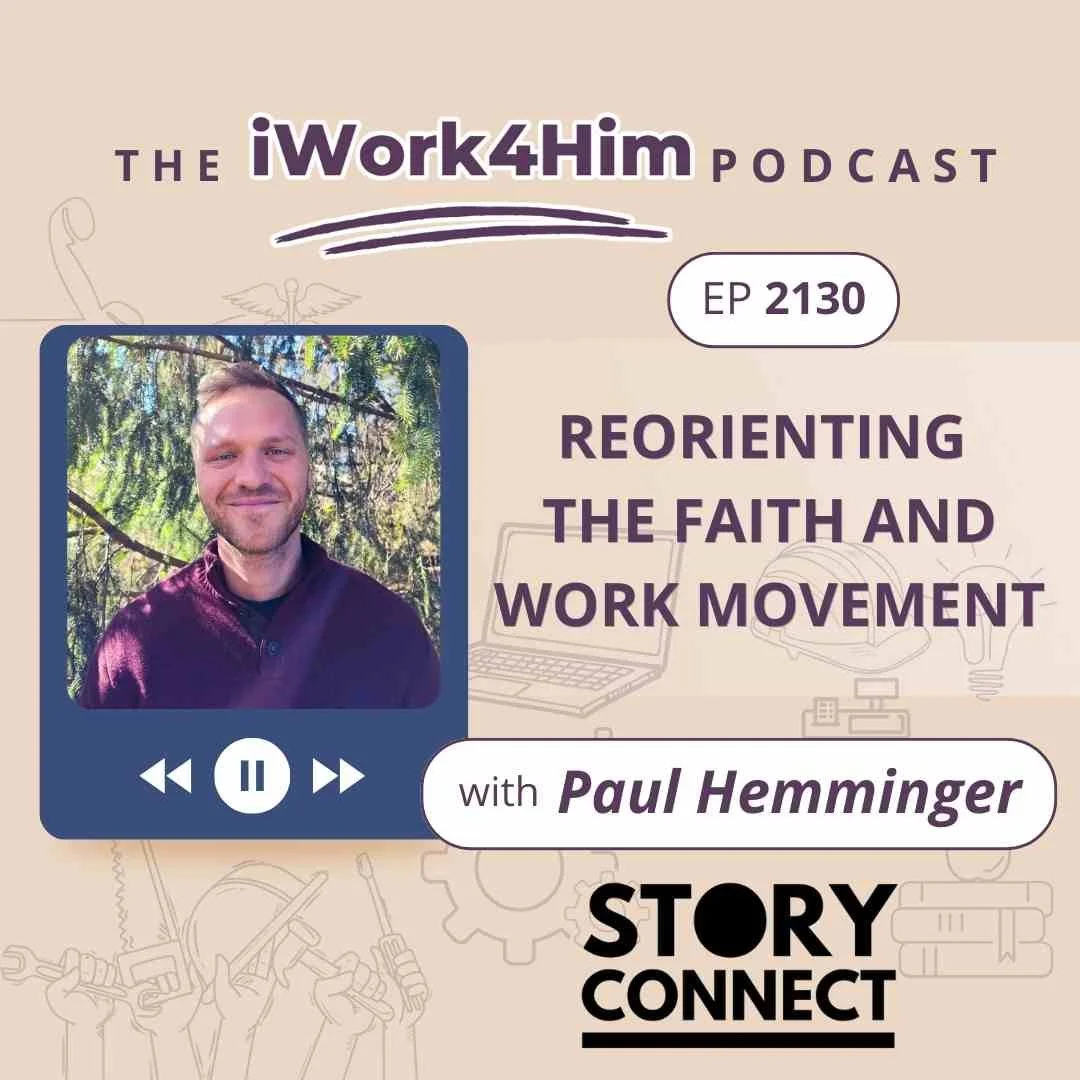
1/21/26 - 2130: Reorienting the Faith and Work Movement
Jim: You've tuned into iWork4Him, 13 years of covering the Faith and Work movement.
Martha: We are your hosts, Jim and Martha Brangenberg. Our mission is to release the testimonies of workplace believers who have learned to unleash their vocational and cultural contributions for the flourishing of the world. What can that look like in your workplace? Let's find out right now.
Jim: So how many nonprofits and churches and organizations operate in your town or city that are formed to meet the needs of the people of that town? Do they overlap in their mission? Do they coordinate in their mission in general? Is there a collaborative effort going on within all of those involved in meeting the needs of your community?
From what I can tell, in the book of Acts, believers, in bringing the Kingdom to Earth, are to be focused on meeting the needs of the people living in their community. And they should lead in unity because Jesus said that would show everyone that he came from our Heavenly Father. But where is this actually happening?
Oh, one such city is Dayton, Ohio. Paul Hemminger is one of the founders of Unified Dayton and is here to tell us the God story in all of it and join me in talking about the upcoming Faith and Work Summit in June of 2026 in Cincinnati, Ohio. The three of us will be heavily involved in that.
Paul Hemminger, welcome to iWork4Him.
Paul Hemminger: Thanks, Jim and Martha. This will be fun.
Jim: That's what you think now. We have no idea. (laughter) So Paul, why are you allowing your faith in Jesus to impact your whole community?
Paul Hemminger: I started following Christ when I was 24 and I read the Bible and I saw this ecosystem of people all working together that would transform wherever they live. And I saw God's will transforming people individually, organizations, neighborhoods, and I thought that I was joining this rich enmeshment of people just constantly connecting and collaborating. And then when I entered the Christian world and worldview and sets of relationships, it was so disorienting and I think that I've been trying to reorient to that with my work and trying to help the body of Christ work together.
I've heard that the definition of a healthy body is not how you feel, but your body's ability to heal. So I think that the body of Christ of any geography requires us to be loving one another, connected, interconnected, there's an open flow of information and partnership and collaboration.
The way that we're wired, all of our strengths are working in tandem, and I just didn't see the people who were actively trying to do that within a certain city or county until I found this rich and deep community of people who were.
Martha: Okay, so I'm gonna just camp there for a minute. 'cause you said a couple of pretty powerful things. Basically what I heard you say is that I read the Bible and I saw how it worked, quote unquote, and that's not what I was seeing when I was interacting with people. Is that a fair summary of some of what you just said?
Paul Hemminger: Yes.
Martha: Okay. So we've had one other guest, Jim, that I can think of in 13 years...
Jim: oh no, I was thinking the same thing.
Martha: ...who had a very similar comment about their growth in Christ very early on where they had said, I read the Bible and I just thought this is the way it should be. And I'm not seeing that in real life. And so I think number one, okay, this is a huge wake up call for everybody listening, that when we read our Bibles, and believe it to be true, we really need to live that out. Don't keep that a secret, whatever you're learning in your walk with the Lord that is in scripture, to really pursue living that out.
So that, I know we have so much to cover, but I just had to camp there for a minute because that is such an eye-opening, boy, guilt trip, whatever you wanna call it for believers that if you're not living out what the scripture, is modeled, then we've got some new focus to do.
Jim: And if you wanna go back and listen to that episode, the title episode Bikes for Christ. Oh, that was a great one, opened up with Queen that day. (chuckling)
Okay. All right. Paul, we were with you in 2021 where you were really launching in Dayton, where things were really starting to pick up. We met in the church in Dayton, if I remember correctly, and pulling people together. Was that the beginning when you were really trying to get traction that day we met up in Dayton?
Paul Hemminger: I was a guest that day. I came in and said, ah, here it is. There were other stewards, other elders, and another millennial that was paving the way for what would become Unified Dayton.
Jim: Alright. So you've now are multiple years down the road on this, and if you go to the Unified Dayton website, you can see there's significant membership collaboration going on.
This is a need in every city across the country. And we've said on this show many times, one of the most collaborative cities in the nation was Cincinnati, and now Dayton. There's a couple of other cities that are coming together, but very few really represent what's going on in Cincinnati over the last 20 years, what's going on Dayton, over the last five. So people are going, how do I get this happen in my own city? I'm gonna let you describe it in a minute, but how do you attract others to join you in this?
Paul Hemminger: So if we were trying to get every Christ follower to collaborate in the city, it wouldn't work. There's no way that you can say, Hey, a hundred thousand people, let's all work together. There's not a communication platform, a way to organize that would ever actually do that. So the big aspirational idea of unity has to be like really logistically sound into operational unity.
So what we say operational unity is are networks. Networks are not organizations and it's a hard thing for us to think about networks. If you were to live in the city of Corinth, Thessalonica, Galacia, any of the places where Paul sent a letter, you would feel a network. You would be reading that letter with all of those other leaders within the city, in friendship, love, and care.
And you would look at that and you'd be like, is that an organization? No, that's the body of Christ. It's a network. And so Unified Dayton itself isn't an organization. It's not a 5 0 1 C3, it's a network of networks. It's a relationships that steward more relationships. So a network is people that care about the same thing - working together for Kingdom come for that focus area.
We have three big like kinds of networks that we focus on, cause, geography, and workplace. So geography is taking a city and making it into smaller parts. Causes are like human trafficking, at risk youth, single parents, and then work, Faith at work, is taking all the different industries and parsing them down into the lived experience of that industry. Public school educators, business, creatives, et cetera.
And so if we were to operationalize unity in the city, we would have all the Christian creatives say, it is God's will to work through me to show beauty in the world, in the way that God's asking me to do it. How can we do that in community together? How can we do that in the world of business? How can we do that as technologists or public school educators? How can God's will flow through me in my classroom amongst other peers that are also educators?
So it's highly complex and logistical, but we're trying to make it simple and digestible where the people that we focus on the most are these network leaders that steward that vision for that context. Does that - what are you hearing in that?
Jim: I was impressed. You did a seven syllable word, and I didn't even stop you. Operationalize as a seven syllable word. (laughing) I'm like, I didn't realize you had a doctorate. Let's talk about this network of networks.
In the network of networks, if you go to Unified Dayton, it seems like there's a lot of organizations involved. How many organizations are involved right now in Unified Dayton, about?
Paul Hemminger: We would say that there's 55 ish identified networks. And if we were to say on average,
Jim: wait, 55 networks? Wow. Okay. All right.
Paul Hemminger: And that's not just ones that we've started. People have their own heart in doing this collaborative work. So if there's 55 networks, then on average, let's say that there's 10, who knows what that actual number is, then there would be like 500 organizations that are all working in their own pockets to make their thing better.
Jim: All right. So give an example of some of these networks , because I was impressed by wow, there's a network for that, for that, but what are some of these networks focused on?
Paul Hemminger: Let's see. So I would like to give a couple of examples. The first one is, so Women in Christian Leadership is a organization that stewards a network where their mission is every woman, not just every Christian woman, because it's evangelistic in nature, tries to connect all of the different women's ministry leaders, network leaders, women who are in business, education, leadership, and network them together to help them live out their faith wherever they are, whether that's paid or unpaid work, paid unpaid leadership.
So we just recognize how valuable that is. That started outside of Unified Dayton. It didn't do anything to make it happen, but when the leader of Women in Christian Leadership came to the Unified Dayton Summit, she goes, ah, I'm home. She found herself in a sense of, oh, this is where we can take this vision and make it happen through all these connections all throughout the city. So that's one that we didn't do. Anything to help make happen.
Jim: You just brought 'em into the fold. You just invited them in to be with you.
Paul Hemminger: Most of the things that we're doing is just affirming and validating and connecting what God is already doing. I would say that the measure of success of any city is the degree of faithfulness of every Christian. If somebody is saying yes to God, wherever they live, work, worship, play, and serve, and God's will is flowing through them, kingdom come is happening, and heaven on earth is happening.
The way that we're trying to help that happen is through networks of collaboration, which means that any good thing that's happening within a congregation, a small group, not for profit ministry, we're saying yes and yes. How can we build collective power so that God's vision for that can come to pass? Because not one person or organization can ever fulfill God's vision for at risk youth or any other thing.
Jim: So really, you're not a coordinator, you're bringing, you're recognizing what God's already done. I love those words because that's what, when Martha and I launched iWork4Him 13 years ago, we had this conversation like, we're not gonna reproduce the wheel. We've seen God raise up, and there are literally hundreds, if not thousands, of faith and work related organizations across the country.
We didn't have anything to do with that. We're just collating that information and making it more easily available for other people. And you're trying to do that in Dayton. I love that. It's just simple. And I understand you've used broad brush terms, but what's incredible, we're gonna talk about in a second, is it's really making an impact on Dayton.
But Martha, you wanna say something first?
Martha: I did. So two things I wanna say. One is that I hear the word cheerleader and I see that everybody needs a cheerleader for what God has spurred in them to do. And I wanna talk more about that in a little bit. But, as we speak of networks, our computers and our cell phones are part of a different kind of a network that is critical to our daily work and to our purpose.
So most of us use our cell phone devices or computers to not only listen to music and podcasts like this, but also to conduct our business and to communicate with other people. So imagine if you get a virus on your device and you can't use it for its intended purpose. It will not only set you back in time and energy, but potentially compromise the work that you are doing.
SaferNet is a trusted partner of iWork4Him that we have installed on all of our mobile devices and our computers. The virus protection, the VPN, the 84 web filters, all of the things that they have in place, help to keep the bad guys out so that you can keep doing the kingdom work that God has called you to do on a day-to-day basis. Go to SaferNet.com and let them know that iWork4Him sent you.
Jim: Paul, as a result of the work going on in Unified Dayton, in Dayton proper, and I'm sure it's Dayton, it's all suburbs, and understand this: I know you don't know everything that God's doing, and I also know that you're holding everything loosely, but as a result of the work of Unified Dayton, how is Dayton demonstrating Kingdom on Earth?
Paul Hemminger: Ah, this is always the rub with city networks is that often we create metrics for not-for-profits.
Jim: I don't want metrics. I wanna know what your gut feel. Is Dayton changing for the better?
Paul Hemminger: Yes.
Jim: Okay. Yes. Good. There you go. (chuckling)
Paul Hemminger: It's hard to borrow God's eyes and know soul level transformation is happening across the city because people are finding rest and comfort and connection and activation and growth through each other. There's not like a, we're not technically sophisticated enough yet. We're like, we can get there, where we can take all of those things that try to say, oh yes, I'm maturing as a person. Yes, our organization is maturing. Yes, there's more people that are finding Christ's love and transforming.
Like we know, and I think that's why metaphor is important, and even your sponsor who is important to this work, is like a virus - lies that inflame the body need healed on the inside through the body of Christ healing each other. If the neurocircuitry is snipped in a thousand ways, then communication can't flow through the body and it can't heal itself. That's what the body's designed to do. I'm really excited for the technology to catch up so that it can affirm and validate how important this work is for a city.
Martha: But are you hearing testimonies? Are you seeing lives that are changed by the work that God is doing?
Paul Hemminger: Yes. So I'll use a network as an example. So we have a kingdom business network, which we want the king to reign in every person who works in business, in every organization, and that network is trying to transform the work life of every working business person who's a Christian in Dayton.
The level of transformation that's happened in the individual people at the core team level, those who lead separate ministries, different pastors, has already created a sense of openness that has led to business growth, even business decline for some people that God's willing, but they're not catastrophizing because they're using that as a way to innovate for what God wants to do through them.
There's just, there's so many stories and I'm doing a bad job at trying to isolate one of 'em that exemplifies.
Jim: No, but that's really, was the point of it is yes, you are starting to see. It bubbled to the top. You're already, even in just a short period of time, you're starting to hear the impact because when one life is impacted, everybody around that one life has also been impacted.
And pretty soon you start to gain a tidal wave of momentum because so many people's lives have been impacted. A whole city. All of a sudden now you start electing mayors and alderman or city council and fire chiefs and police chiefs and people that are in the school board. And you start to see local community, you start to see a rising up of believers who have made an impact on their community.
What is the next step in this movement for Dayton?
Paul Hemminger: Yeah, I mean it's a critical - it's not actually a critical juncture, I was gonna say it was. Because when people say that they have a level of anxiety of, oh, are we maturing fast enough? Ugh, are we doing the right thing? I think that God wants to lower the temperature of all of our initiatives and efforts.
Jim: What do you mean by that? Lower the temperature. 'cause we are all thinking we, we gotta be hot.(laughter)
Paul Hemminger: We were invited into light yolk life and so many of us...
Jim: You been reading your Bible again? What is wrong? Light yolk life. I love that. (chuckling)
Paul Hemminger: What does that mean? It means that if you trust God and you have a degree of faithfulness enough, then what you're doing and you're listening to God's will and obeying it, then you're exactly where you're supposed to be. And so if the city network, and what Unified Dayton is trying to do is moving at the pace of communal discernment of what God is asking us to do, then we're right where we're supposed to be.
And so that's why I caught myself saying critical juncture 'cause we have a four hour, gathering team meeting of the core team next week, and we're just going to reflect and press forward into better serving network leaders, looking at our summit, caring for the souls and the systems of our network leaders.
And you all know better than most people that we overcome through the word of the testimony. We need this amount of communication to go everywhere. So that's what we're taking small steps in collaboratively based on the capacity and the actors that say, yes, I care about the flourishing of the city and the city church.
Jim: How many people are in Dayton? Like Dayton and its surroundings. How big of a area is, how many population?
Paul Hemminger: Yeah, I think it's about like 800,000.
Jim: Okay. So it's under a million. All right.
Paul Hemminger: Yeah. Like a small metro. Like large metro is like 1.1 million.
Jim: Have you gotten a phone call from any other of those small metros or smaller metros or really small metros or like we do wicked small towns- are you getting phone calls going, whatcha guys doing? How do we do this in our town?
Paul Hemminger: We're lucky that soil has been cultivated in a neighboring county of ours for over 30 years. So there's this amazing organization called the Nehemiah Foundation that was doing city network work in the town of Springfield, Clark County for 30 years. And there's others. Love Akron has been around for 20 plus years. That person we know really well, Mark Ford.
And so we have enough relational connections to those who have done this for a good chunk of their life to feel settled in that this is a real thing. So there's other surrounding counties that come to our summit and we're always trying, so we say Greater Dayton, and if we're talking about any surrounding place, we're always saying, oh yeah, you're the greater part of Greater Dayton, because it's probably true. So I live in the county north of our city center too and we're doing similar network work here.
Jim: When you really look at the struggle in large metro and almost large metro, like you just described, this is the solution to bringing flourishing back to those communities is getting people to work together outside of denominational bounds, inside of denominational bounds, but really just loving on each other and supporting each other and the work that you've been called to do. It's incredible.
And that's really what these gatherings are about, that we're gonna participate in June this year. Paul, you are joining Martha and I at the Faith at Work Summit in Cincinnati, in June, 17th through the 19th. And it's a gathering of people really feeding into the faith and work movement across the country.
Practitioners - that's another one of those big words - but people that are actually doing it. They're getting their knees dirty from walking alongside the ground and praying, and they're getting their shoes worn out from walking the streets and really doing the work of ministry. We'd like to invite everybody listening today, if you find yourself in one of those positions, you should check out the Faith At Work Summit coming up in June.
FaithatWorkSummit2026.com. Of course, you can go to our website iwork4him.com/events and hear about it, because one of the other big events we're involved in is a US Christian Chamber event in April, coming up three months from now, April 22nd through 24th. Also heavily involved, really focused on business people, transforming their world in the marketplace.
Paul, let's talk about that summit because we're all on the steering committee, but you look at it from a different perspective. We're 20 years age apart. We look at life differently. You grew up in a digital age.
I got exposed to computers as a 13-year-old and they had 14 K on them. (laughing) That's right. And then we got a screen. At first we started with computers with no screen, just a teletype. So I've been there, done that, and can't write the book because those computers couldn't handle that. It's outdated. Wasn't enough Hard drive space to put a book on it.
Alright, so what's the purpose, first of all, why are you involved? Why are you involved in the Faith at Work Summit in 2026?
Paul Hemminger: Yeah, this is a good overlap. The city network of Unified Dayton has a hope or a driving vision that every Christian is faith active at work, that during their working hours, God's will is flowing to them and through them in Christian community with others to transform their work environment and the people that are there.
That's an audacious goal, and that's why we organize via networks. As we've done that work, we've looked up and seen all these other people that are doing it. So how does that help our city? It's by interconnecting with all those other actors. Me being a part of the Global Faith at Work Summit is putting on my other hat of saying if I wanna transform my city, I want to be a part of helping every Christian globally, the global Faith at Work Summit, do the same.
Every person, God's will flowing in them, to them, and through them in Christian community, transforming where they work and the people there. And so I'm a part of it because Chuck Proudfit who helped to catalyze Unified Dayton through a couple of events and has always been a friend, and as I have catalyzed these faith at work networks in the city, saw something in me that wanted to interconnect the global faith at work ecosystem for that end goal.
Martha: So I would guess just by listening to you, I don't know if you've done strength finders or not, but I would guess responsibility is very high on your strength finders because you sound like someone - Jim and I both are high in responsibility and it's if I learn something or if I get convicted about something, I have a responsibility to share that with other people so that they can know this truth as well. And I don't pretend to know that I know enough about you to guess that, I'm hearing that in what you're saying. So let's talk about the actual purpose of the upcoming summit.
Jim: Yep. Let's talk about it.
Martha: Okay.
Jim: So the three categories that we're talking about: collaboration, creativity, and continuity. Why are we talking about those things, Paul?
Paul Hemminger: So to help more people be faith active at work, we have to do those things. We have to be creative in how God is asking us to do it with others. We need to do it with others collaboratively, and then we need to keep doing it and we need to figure out - if people are meant to equip the saints to do that work, then we need to bring together the equippers and the people who are doing it to constantly learn from each other so that more people do it. So I think that's, I don't know. That's how I conceptualize.
Jim: And that continuity to me means, okay, how do we pass on what we've been doing? We've been covering the stories of people living out their faith through their work for 13 years. How do we pass that on to the next generation and get somebody who's 40 to take on the iWork4Him podcast? So maybe iWork4Him next gen, 20 year olds covering what's going on the college campuses and just outside of college.
We wanna continue. Continuity. We want to continue what's going on because a lot of the founders or the people involved in this latest move of God- 'cause really the faith and move work movement started with Martin Luther in 1500 and it died out for a little bit, but it really resurrected in the 1970s during the Jesus movement. And so it's, those guys are 50 years older now. They're all in their seventies and eighties.
Martha: Hang on, before you ask that question, I just wanna say, but if you read your Bible,
Jim: oh, they're really old people.
Martha: That once people understood the saving grace of Jesus Christ, your life should be fully integrated. Jesus should affect everything about us. And so I think when we think about the future, wouldn't it be great if all believers actually understand that every decision that they make, every intention, every action, all of that in our work, in our play, at our home, at our church, no matter where we are, is influenced by our relationship with Jesus Christ?
And we don't have this division any longer. And that's our, that's my hope is that this conversation doesn't even need to exist because it's just natural for believers to live in unity and to be collaborative and to be creative and to have that continuity going forward.
Paul Hemminger: Amen.
Martha: But in the meantime, we have things like the Faith at Work Summit, where people can come together and be encouraged and get that cheerleading or get that challenge and get that inspiration to say, you know what, now's the time I can level up what I've learned, take it back home and ask God, what am I supposed to do with this? And see where he leads us.
So Paul, why don't you talk about that? Who do you think should be at the summit? Think of the listening audience right now, people that are trying to learn how to better live out their faith in work. Who would you be inviting to come and join us?
Paul Hemminger: Yeah, when I think about all of the, and you all have done a great job at cataloging so many different equippers, so many different people, they have that passion, that sense of responsibility. " I know what would happen to you, your life, your family, your friendships, if you brought your faith to work." And so they focused on that. And I would love for all of those people who deeply care about faith at work and actively helping others to do it, those who are doing it, and even those who are curious to say, I sense at 9:17 AM on Tuesday that like, I probably should be like fully abiding, connecting with God and something God wants to do in my workplace, and actually that should be all my work hours could be like that if I was in Christian community. The secret is abiding and how do I do that?
I think that those people should come to the summit because God uses those people who are called to equip them to love and disciple and equip others. I personally have a directory of these national and international ministries in all the different industries that I think have yet to connect in friendship and learn from each other. And that would be another clear invitation that I would want to make to some of those folks.
Jim: Very good. Get it done. Whatcha are waiting for? It doesn't cost you a postage stamp. Email's free.
(laughter)
Martha: Hey, how about this simple message?
You are invited.
Come to the table, see what God has in store for you and realize that you're not alone in this journey, that there are other people trying to live it out as well. And there's something very, I don't know, powerful and giving you just that ability to say, okay, God, you can use me. If you can use Jim, if you can use Martha, if you can use Paul, then God, you can use me and I wanna make myself available.
So I am very excited about the conversations that are gonna be had and the relationships that are gonna form and here's your personal invitation from all of us to come and see what it's about, and we'll put all the links in the show notes for you to get the information that you need.
Jim: When you're watching YouTube on your phone, I can never find those show notes. They're not easy to find. So what I'm gonna tell you right now, faithatworksummit2026.com. Alright, three answers. What are you hoping to see God do that week that'll change the world, Paul?
Paul Hemminger: Oh man. I, and you all believe this too, 'cause I've heard you talk about it, is that the intergenerational, a level of collaboration from 99 to 17, like that whole spectrum finding each other and aligning, I think is something that I really hope happens. And then I really hope again that the culture of the summit helps people's internal temperature of competition go way down and the vision, opportunity, excitement, joy - it's not easy - of collaboration because if the Global Faith at Work Summit is meant in some ways to look at the ecosystem and the network of faith at work, which we're all a part of, and networks are a place where you get to learn to like and grow to love one another, then that's how the whole world knows Jesus, right?
Because Jesus said that the world will know that I have come and that I love them when they love each other. Who? Us, we have priority number one for evangelism is to love one another and collaborate well. So I hope that there's a ton of useful gasoline that gets put into that engine at the summit.
Jim: You, Martha?
Martha: I am always about relationships and I know that sometimes people feel alone or they feel like they're this odd man out that doesn't have community around how to live out their faith and work. And I know that this is a place where you will not only be welcomed and challenged, but also find people that can encourage and challenge you on a personal basis. And so I always look forward to that, when we have this discussion. How about you, Jim?
Jim: For me, I'm hoping that this will be the event that cracks open the wall between the four walls church and the ministries out there outside of the four walls church, that there will be a coming together and a recognition that no one entity can get it done and that the four walls church is struggling and we're here to help. Let's do it together. Just keep it simple like that. Let's do it together.
Paul Hemminger from Unified Dayton, thank you so much for being on iWork4Him today.
Paul Hemminger: Before we end, I just wanted to, I just wanted to say that Unified Dayton, again, is a collaboration. My not-for-profit that I started as secular facing called Story Connect, storyconnect.love. The Christian facing is Kingdom Connect, kingdomconnect.love. And this hope for all of this work includes all of us. So when we're looking at the collaboration of everyone with what you said, Martha, that God's will works in us every moment of every day. That's the invocation and the prayer for the listener. Sorry and thank you.
Jim: Oh, it's fine. Story connect.love and kingdomconnect.love. You've been listening to iWork4Him with your hosts, Jim and Martha Brangenberg. We're Christ followers, and our workplace - it's our mission field, but ultimately iWork4H im.