
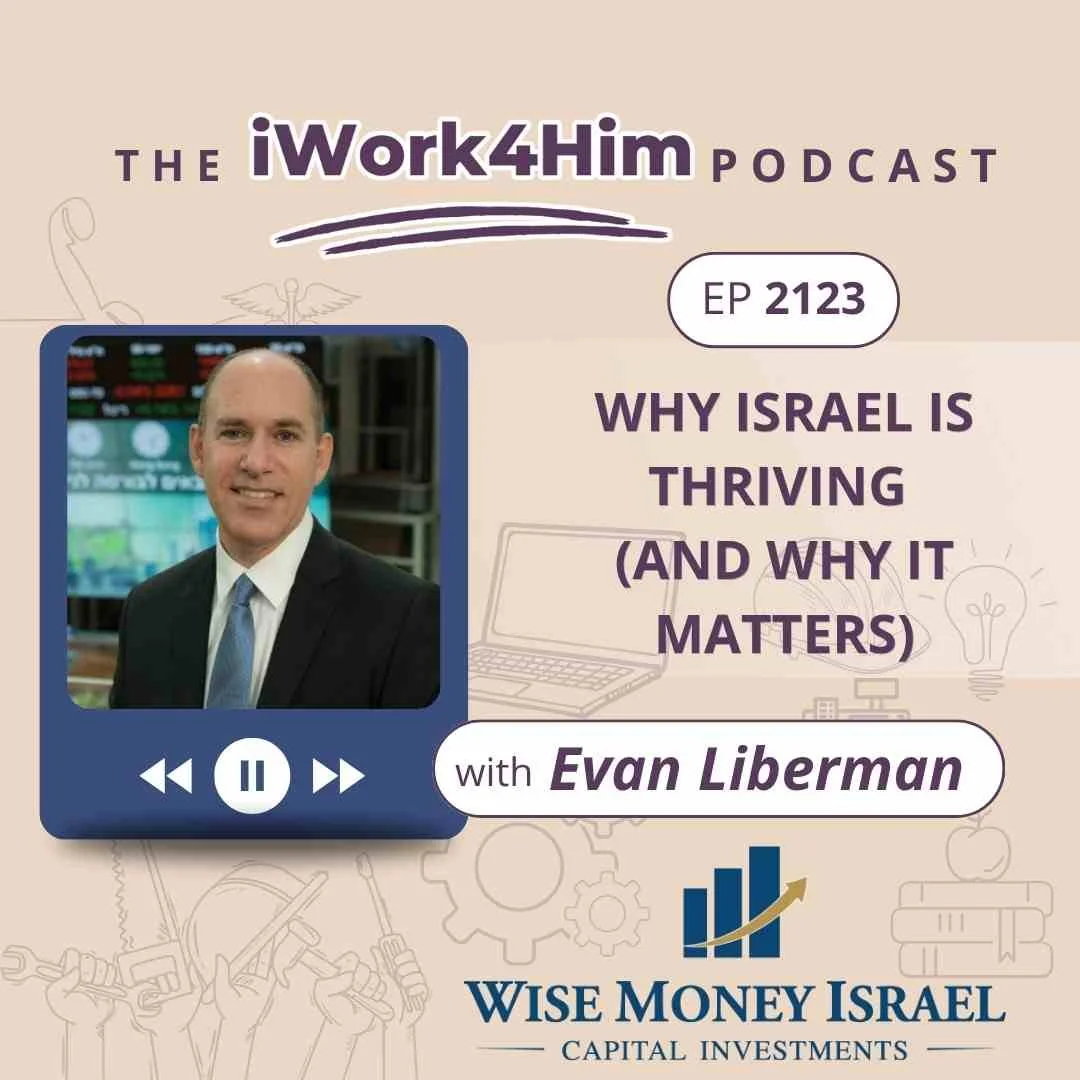
12/3/25 - 2123: Why Israel is Thriving (and Why It Matters)
Jim: You've tuned into iWork4Him, the Voice of Collaboration for the Faith and Work Movement.
Martha: And we are your hosts, Jim and Martha Brangenberg. Our mission is to inspire every workplace believer to recognize their workplace as their ministry place where they work with God every day. What can that look like in your workplace? Let's find out right now.
Jim: On a rare occasion, we get a glimpse into how Jesus followers are making an impact with their faith at work from around the world. Today we have the privilege to venture off to Israel to have a conversation with Evan Lieberman from Wise Money Israel. Evan has been married to Sarah for 28 years and they have three kids. Evan and Sarah are on the ground in Israel and can tell us the truth about the great things happening there and how business leaders and Jesus followers in Israel are impacting the marketplace and how believers in the US can get involved and invested there as well. Evan Lieberman, welcome to iWork4Him.
Evan Liberman: Great to be with you, Jim and Martha.
Jim: Evan, we always start off the show with our new guests is by asking this question, how did you come to be a follower of Jesus?
Evan Liberman: That's a good question. I'm 57 now. Actually, harken back to age four, if you can believe it. I don't have this great conversion story, how I became a believer in the Messiah. Simply my parents, Jewish non-believers in the United States, were confronted. My dad worked for the department of Commerce in the United States, and he'd be on a shuttle every day going into work with all these other professionals in the government. And one would be a Christian reading his Bible, and people would make fun of him even at age 30.
And so my dad, after feeling sorry for him, sits down and says, I'm Jewish. I understand why you're reading that book. And so they developed a friendship. He started telling him after a few weeks, so you're Jewish. What are you doing about the sacrifices about sin? And he's, what are you talking about, sin? Jewish people don't know from sin and sacrifice nowadays.
And so he started explaining to him the gospel and it really freaked my dad out, being Jewish non-believers, it's the farthest thing that you want is to hear about this Jesus, who you don't recognize as the Jewish Messiah or as Jewish at all. And so my dad promptly gets off the shuttle, after a few weeks just said, I don't wanna ever talk to that person again. It's too threatening. But after a while, God worked on his heart and he spent the next year at the Library of Commerce reading about all the religions. He says, if I'm gonna entertain this one, is the farthest that Jewish people ever want to go, let's look at Buddha. Let's look at the Koran.
And he came to conclusion, this is the God of Israel. And if I'm the only Jewish person who believes this back in the seventies, then that's just what's gonna have to be. And my mom, of course, is Jewish nonbeliever freaking out. What's happening here? And where are my kids being taken? We're reading this Illustrated Bible, not only now of the Old Covenant, but the new Covenant. And who's this Yeshua person? We become believers, my brother and I at age four and six. And my mom eventually, after a year, became a believer and the rest is history.
Not a great conversion story for me, for my dad is really exciting. And he was instrumental and still is in the Messianic Jewish movement for the last 50 years in the States. So it was quite a watershed moment for all of us.
Jim: I don't know why you don't think it's not a great conversion story. It's phenomenal. Anytime a Jewish family realizes that Jesus is their savior, the Messiah that they've been waiting for, that's a phenomenal story.
Martha: You just didn't have to struggle with it like your dad because you were raised exactly into that knowing - which is fabulous.
Evan Liberman: There comes a time when you have to own it yourself. And I think that time was when I was 12, 13 and going off to college for sure. You have to know that this is yours and really own it. So that I did.
Jim: Evan, we've been told by others that the Jews have been told that the New Testament is an anti Jew book that, and that they should avoid reading at all costs. Is that something you've heard before?
Evan Liberman: You do hear that from a lot of Jewish people. It's simply 'cause that's what the rabbis tell them. It's not, of course, based in anything historical and all it takes is a few minutes to research and even Israeli Jewish people are coming to the understanding that Yeshua, Jesus, was a very Jewish person.
The writers of the New Covenant, of course, are all Jewish. Potentially one exception, and talks about and is based on old Covenant ideas such as worshiping God, Shabbat, salvation through sacrifice, through blood covenants, all the concepts are all there.
And so the fact that numerically it was taken over the faith in the first few centuries by people that weren't from Jewish background, didn't know and wanna connect it to the Jewish backgrounds, of course, has a 2000 year history of being detached. But that is the point of Messianic Judaism, honestly, is to bring back the understanding that this is one book, not two, it's a continuation of God's story with the Jewish people that's now open to everyone in the world through salvation, through the Jewish Messiah, the Jewish lamb, the Jewish sacrifice.
Martha: My goodness, there's so many things that I wanna comment on. And then one thing, the one thing I'm gonna ask is to clarify. You said that your, that there was a understanding that you, that the Jewish people, don't even believe that Jesus was Jewish?
Evan Liberman: No, they're actually coming to the understanding much more nowadays 'cause they're looking at it historically, especially secular Jews who aren't just gonna go blindly with what the rabbis say, is their understanding historically and archeologically. There's no doubt Jesus was as Jewish and more and his worldview and conception all came from our people's history.
The stories, the parables, these are all very Jewish things of the time back 2000 years ago in Israel. So it's the fact that going from, he was a Jewish person, a great leader, maybe a prophet, jumping into, okay, he's the Messiah, the Son of God himself. That's where most Jewish people get stuck. But knowing that he was Jewish is starting to become more of a reality to the Jewish, non-believing world.
Martha: This is such a relevant conversation and I am guessing that already our listeners are like, I wanna hear more because, we only get bits and pieces of true understanding of the Jewish culture, let alone Jewish Messianic believers. So you alluded to the fact that you didn't grow up in Israel. I think you were here in the States, at least when your dad was on this exploration. How did you end up in Israel? Are you part of the Aliyah of the Jews returning to Israel?
Evan Liberman: I definitely am. I grew up in the United States, went to University of California and started working in San Diego. But at age 25 I realized, okay, I wanna do something with my life in the Messianic world to put my shoulders to the plow. But in a place where I feel like, this is where Messian Judaism is going.
Ultimately, the Jewish people are coming home to live in the land. A Zionism that started a hundred years ago, 150 years ago, is so much what I think God is doing in our generation. And I can be a part of it. So we have people coming back, the rebuilding of the second temple, and they're called out in Ezra and other books.
And I'm like, this is what I can do in my generation. I was bar mitzvahed here actually in Israel on a trip that my dad decided to do my bar mitzvah here at the Western Wall in Israel. And that started a desire in my heart to be part of my people, not just culturally in the United States as a Jewish person but speaking the language, eating the foods, and being part of our people.
Because I think that's what the end times talk about it, that all Jews not only will be saved, that's in the book of Romans, but also Jewish people will be here. If they're Jewish at all, God is regathering our nation, to never scatter us again, and we're just the beginning portions of that.
Jim: Evan, the mainstream media news always makes Israel look like, look bad. It's what they're focused on, and looks like a scene from the moon landing - barren and desolate. They're always focused on the spots of Israel that, it just looks terrible. What's the truth about Israel today?
Evan Liberman: That's a great question. You're right. Mainstream media is not a fan of Israel, especially in the last two years. But Israel actually is so much opposite than the barren desert that you would think. And there's actually a cool website about innovative companies in Israel called nocamels. com, I think it is.
And basically, we've transformed the desert into a blossoming rose as the book of Isaiah talks about in the latter days. Israel today is very much thriving. It's one of the most advanced, innovative countries in the world. Economically, it's got a lot of enviable data. It's the startup nation you've probably heard of.
So there's more startups per capita here than anywhere in the world. In fact, even on an absolute basis, us being the size of New Jersey, population of 10 million, actually have more startups here than most countries in the world. We've got R&D centers from some of the biggest tech companies, from Google to Intel, Apple, Nvidia, Microsoft.
Our GDP is the envy of the world. We're we have gross domestic product twice as high as the other OECD nations like the United States and Japan. Our gDP per capita is $55,000. That's double many nations like the UK and Japan. We've got a thriving ecosystem of capital market and the Tel Aviv stock exchange, which we can talk about if you want.
Our tech sectors driving a lot of innovation and AI and biomed and technologies and military of course that we need, and cybersecurity. There's just a lot of things going on that are really exciting here. We're leading the world in some discoveries - drip irrigation, desalination, the memory sticks that everyone uses today. Voiceover IP that's backing zoom calls that we're doing today come from Israeli innovation. Firewalls. The first firewall invented was in Israel.
And so there's just a lot of thriving going on here. It's a miracle, essentially in the desert, of resilience and innovation, and some people call it a light to the nations already and imagine what that light will be when the Jewish people actually do understand who their Savior is. I can imagine that would be what the Bible says, life from the dead.
Martha: That's so encouraging and I hope people can absorb - and that's high level summary of what going on there. And we're gonna dig in a little deeper into what God has you doing there.
When you talk about innovation, most of us are using mobile devices or computers to not only listen to music and podcasts like this, but to also conduct our business and communicate with other people. Imagine if you get a virus on your device and can't use it for its intended purpose. It will not only set you back in time and energy, but to potentially compromise the very work that you're doing.
SaferNet is a trusted partner of iWork4Him that we have installed on all of our mobile devices and our computers because their virus protection, their VPN, and their 84 web filters keep the bad guys out so that we can keep doing the kingdom work that God has called us to do. Check out safernet.com and let them know that iWork4Him sent you.
Jim: Evan, it's well known that the people of Israel carry a blessing whether they're following Jesus or not. Jewish business people have solved many of the world's problems, the list is super long, and have run many of the world's most powerful organizations, some good and some bad, unfortunately. You are focused on marketplace investments in organizations and businesses that are run by the people of Israel. Why is that?
Evan Liberman: It's coming from a zionistic perspective. It's saying basically God is doing something in our generation, as I talked about before, and our economy is, is one of the better economies, even though we just became a developed nation maybe 15 years ago.
But statistics economically, financially, that are way beyond what we would see in a nation that's under 80 years old. And we see that this is a powerhouse that's just getting better and better. And therefore we want people to participate with us. We feel like the concept of supporting Israel is biblical.
We feel that God's in it. God is blessing people. A lot of our clients are coming to us from a conviction of, this is what God's doing. I wanna partner with Israel. How can I do it? A lot of people, of course, partner through ministry, through contributions, and that's great and we encourage that. But it is one directional. Whereas if you're partnering with someone, you're having a two-way street, essentially. You're able to bless and be blessed in return.
And so that's why we feel like to focus on Israeli companies is really our, while we're licensed both in the Israel and the United States for general investment management, we're actually excited about directing people toward our land, toward building up the state, building up the companies, building up the people, creating and facilitating those innovations that are really changing the world and helping the world. And we've seen somewhat just already, but imagine what it's gonna be, 10 years from now.
Jim: I can't imagine, 10 years from now, the world changes at such a fast, ridiculously fast pace. I just can't even imagine what the world's 10 years from now or whether it still exists. I don't know. AI kinda scares me a little bit.
Alright, so when we first interviewed someone from Israel about eight years ago, they stated that there was about 20,000 Jewish followers of Jesus living in Israel. What's that estimate today?
Evan Liberman: Great question. There are various estimates. There's no real counting going on here. We're not focused as much on growth as the other communities in the world, but most estimates put us around 25, 30,000. It's grown pretty quickly. My wife grew up here. And in her generation, she knew all the believers.
There were 600 Jewish believers here. And now there's about 30,000, so about three times growth in the last 25 years. So it's growing quickly. There's about 180 congregations here, so there's smaller but it's much more a grassroots scenario that's going on here, but it's definitely expanding.
The kingdom of God is expanding. We're only 0.3 numbers guys, so 0.3% of the population are Jewish believers. But that's much more than it used to be. We're still very much of a small minority, but being more and more integrated into society as people venture out into being lawyers, doctors, in our case financial professionals, serving in the army. Most believers send their children, like my own, to the Army.
And so they're integrating well into society now. And so that's helping, I think as yeast in the dough, so to speak, to leaven the, maybe in a good way, the people of Israel so that they know, okay, the Jewish Messiah is in fact someone you already know. You wouldn't consider him the Jewish Messiah. Let me tell you about him. And I'm a normal person, and that's helpful of course, to witness.
Martha: A normal person, and actually from what we've experienced when we've talked to Jesus believing Jewish people, is you actually better understand all of scripture because of the context of your lineage. So you, a little side note, you said your wife was raised in Israel. Did you meet her there?
Evan Liberman: I did. I met her here in Israel. In fact, I was looking for a wife since age 19 and I came to Israel age 25 and within two months I think it was, God had me meet her. Didn't know that was gonna be my future wife. Took five years for that to happen. She's a Messianic Jewish believer as well, but she would never have come to the United States. So God had a plan that was beyond just my zionistic aspirations to serve as kingdom in a different way among my people. But that's the only way I was gonna get married, evidently.
Martha: That's right. That's awesome. That worked out really well. I just, I love that. That's so great. Okay, so God has called you to be a steward and an ambassador of Israeli owned businesses. Tell us about that. And bring the BRII into the conversation because our listeners are gonna love to hear that.
Evan Liberman: Great. So about 15 years ago I recognized that there was a lack of understanding about the Israeli stock and bond market. I was an avid amateur investor at the time, and I realized people don't know. So we started a website to just get people understanding how, in fact, can you invest in Israel. What's the economy looking like? Why is it such a good economy? And no one knows about it. There was not much information in English at the time. It was more built for the local community, the local 10 million Israelis and not for outside investors.
So we basically have developed and pioneered the area of helping people around the world- we have about a quarter of our clients are Israeli clients, but about three quarters are from about 30 different nations around the world. We're helping them invest in Israeli stocks, Israeli bonds. We are Messianic Jewish believers, my staff and myself. And a lot of our clients, not exclusively, are believers of various types - meaning evangelical Christians to messianic Jews to non-affiliated, and they're coming to Israel for many different reasons.
Some are spiritual reasons. They want to connect with the people of Israel on this level. They wanna partner. Some want just a great return, and we've seen tremendous returns even during the last two years of this war. The market has doubled here, if you can believe it, during this time. And so we essentially help people to not only invest funds in fundamentally good Israeli companies from about the 700 different companies that exist here, but we also apply what's called a biblical responsible investing screen.
We call it BRII for Biblically Responsible Investing in Israel. And so not only are we keeping out companies that no matter how fundamentally sound they are, if they're involved in one of the vice that the scriptures would speak against, we don't wanna have our clients investing and taking part in that from an equity share perspective. So we won't invest in those companies. But also biblical responsible investing doesn't say just what we won't invest in. It says what we want to invest in, and I think the scriptures are clear about those that bless Israel will be blessed.
Those that partner with us, those that support us, God is going to work things out for them, whether that works out financially or otherwise. It's just a biblically sound principle to be favorable toward the Jewish people. And Israel, of course, is where most of the Jewish people are today.
Jim: So have you guys created ETFs or mutual funds bringing all these things together? How is it that these funds get accessed by people in 30 countries?
Evan Liberman: That's a great question. We're thinking in the future about an ETF or a mutual fund, but currently we're managing separately managed accounts, SMAs, for whether it be an individual, joint, a company, a nonprofit, an IRA account and we establish them on various brokerage platforms.
We're, as a financial advisor, as a fiduciary of clients in the 30 different nations, there are many brokerages locally and internationally that can access the Tel Aviv stock Exchange. So the reason we're licensed, for example, with the SEC in the United States is to be able to offer American residents a US broker dealer firm but yet invest in Israeli securities, Israeli stocks, Israeli bonds that we can manage for 'em in the shekels.
So there are a lot of clients that come to us. They wanna have a little bit of their funds diversified outside the US dollar. They don't necessarily know if that's gonna be a place to have a hundred percent of their assets. And so they want that diversification. They want that market diversification, currency diversification. They wanna know that they're biblically responsible investing in a land that they believe in.
So there's a lot of resonance with people. Getting the word out is usually our problem because once people hear about the possibility, they're sold already. Now they just have to dot their i's and cross their T's. Opening investment account can be done about 30 minutes online and doesn't require the investor to be accredited at all. And so most clients can start at $50,000 or more.
Jim: That's what I was gonna ask about the accredited investment thing. So it, that's not a case. And for those of you listening, an accredited investor has a million dollars of investible assets and that eliminates a lot of people. So if somebody's listening today, you're saying right now they have to invest in specific stocks within Israel. There's no, there's not a mutual fund, a gathering of these stocks into one place.
Evan Liberman: Correct. So we have about 25, 30 stocks we're tracking to and bonds at all given times. We do fundamental research every week. And so we generally have what would be considered a mutual fund. We just haven't marketed it as a mutual fund. Generally most clients choose from those companies. Some have different opinions on this sector versus that. We've got real estate and energy and banks and finance and technology and some might say, look, I really want to overweight my technology in Israel because that's the innovation hub, or I really like the real estate boom that's going on in Israel.
And you've got a built-in demand coming with another 6 million Jews that need to make Aliyah at some point in the next few decades. And so people have their particular preferences we can tailor to but ultimately most clients come to us and say, you're the expert, you're the Hebrew speaker on the ground. Put me in a diversified portfolio across different sectors in the Israeli market, and I trust you. And that's usually how we end up effectively having very similar investment portfolios for various clients. Some want more bonds, some want more stocks, that sort of thing.
Jim: I don't know if you had a question. I have one more question. I love investments. I've been studying it since I was in high school.
So if somebody wants to get involved with investing in Israel and they've already got a relationship with an RIA or, they've got an advisor here in the United States, or listening, if they may, some may be listening around the world. How do they get access to the Tel Aviv stock market? How do they get their advisor to say... are they gonna get passed? There may be some resistance. How do they get involved?
Evan Liberman: That's a great question. As far as physically, technically, how they get involved, they just go to wisemoneyisrael.com and either do a free consultation with me through Zoom or phone call or click on the open account button and then we will walk them through. It's like I said, an online process, just like you would open an account at Charles Schwab or Fidelity. It's very simple. US broker dealer. Some of our clients, of course, have their own RIA firms like us. Whether they're a believer, RIA firm or not, usually don't have any idea about what's going on in Israel.
It's a small economy, so it's not in the radar of international investing necessarily. Although most RIA Firms understand the need for international diversification, but wouldn't necessarily pick Israel over China or Venezuela. And so to them, that's just another country. Those that are believer RIA firms understand the rationale, the conviction of the client, may want to do it themselves, but most RIAs don't know even how to get involved.
And that's what we perfected essentially over the last 15 years, is making that as smooth as possible, simply opening an investment account with a particular broker dealer. One of the largest by volume in the world that does have access to the foreign markets that we needed here, in this case, Israel.
Jim: So if somebody's listening and they've got an advisor, we just need to get their advisor to talk to your advisory firm to get things worked out.
Evan Liberman: We can definitely do that. We have a number of clients that bring on the first initial Zoom call or the second call their own advisor. And then the advisor, we talk shop, whether it be licensing or diversification or strategies or fundamental analysis or the economy.
And once the advisor understands this is a safe economy, this is one of the better booming economies and the market is very resilient, and we can see that just in our last two year war that the blips that you would think would cause, some major issues on the stock market just don't happen here, there's a lot of forward momentum in a good economy and so it's hard to derail this country.
Martha: And I think for our listeners, they're just going to hear the intentionality in this decision. And that's something that is very consistent in our conversations that we have on iWork4Him with the idea that not only investing in companies that don't go against our biblical principles, but doing it in support of Israel. And so it's just a double intentional decision, and that's why we're bringing it to the table for our listeners. So I just love this conversation, so thank you.
Jim: Yeah. Everybody listening, just remember, if you're a believer, you're gonna live in the new Jerusalem, you might as well support the existing Jerusalem right now. Just the new Jerusalem's gonna be a little larger. In the meantime, get invested today.
All right. Martha and I absolutely believe that we should not only invest our money wisely, but also our time. We're so blessed to invest our time by being involved in the US Christian Chamber of Commerce. As members and on the board of directors, today I feel it's so important to invite everyone listening to invest some other time into the US Christian Chamber of Commerce, and join us in April in Orlando, Florida, April 22nd through 24th.
You can find out all the details at swc2026.com. Register with code iWork4Him for a 10% discount. This is gonna be an immersive three day marketplace experience that will help Christian leaders unite to break barriers, build bold businesses, and advance the kingdom of God. We'll see you in Orlando. swc2026.com.
So what is the hope and the aim, Evan, of Wise Money Israel?
Evan Liberman: The first thing is the wealth of the nations will come back to Israel. It's biblically promised when that will happen. How fast? Will it be in our generation, in our lifetime? We don't know. But we are trying to be a bridge and I think God is using us. And some of the success we've had, I think, is way beyond what we can do as individuals to cause that to happen.
And so I think each individual person is a brick in that wall, so to speak, of creating support for the state of Israel from around the world. So our job is to help people get involved, offer the bridge in which they can biblically, in a biblical responsible way, invest in a country that they love.
I would say another goal that we have, and this is more of a long-term vision is currently the Israeli body has very little amount of financial professionals, those that are investing and interested in investment as a profession. And so we're offering and have individuals that are doing internships and various positions in the firm. And so that's what we're looking to get the next generation of financial professionals working in the field and being able to offer this in much larger scale to the rest of the world.
Jim: Put an office in southwest Missouri. What an incredible thing. In the center of the country. (laughter) Okay. All right. All right. Sorry.
Martha: Okay. Jim's full of ideas. He shared earlier that we did an interview eight years ago with a couple that was on the ground there in Israel, and one of the things that really struck us was their use of the power of Isaiah 53 in reaching the Jews for Jesus. What have you found to be an a good avenue for you that God is using to share the truth about the Messiah Jesus in your work?
Evan Liberman: That's a great question. I would say that Israelis do not warm up too much to the frontal evangelical evangelism approach. Tracts and things like that used to work maybe in the United States are less effective here simply because there's a major barrier, a wall of resistance that's been built up for 2000 years based on the rabbis rejecting Yeshua, rejecting Jesus, and now coming up with reasons why we don't wanna have anything to do with Him.
And it's a them versus us. So Jewish people see anything as someone trying to convert them as taking away from their culture, their heritage, their legacy, and God has built into the DNA of the Jewish person " I will never leave Judaism." I remember my mom said I was born jewish, will be buried Jewish, and that's it.
And so that helps start a Messianic congregation in our area, in Washington DC, simply because while we believe the same as the Gentile church, the cultural context of it doesn't work really well for a Jewish person's DNA. But what does resonate with the Jewish person, Israeli person specifically, is if you are normal and you're not trying to convert me, but you're just showing your life as the fruit, as the witness of who Yeshua is in your life over a long period of time, in relationship, in regular work environments, and showing that light in just the way you work, it's really marketplace ministry in that sense.
If you're not cutting corners, if you're doing the right thing by your clients, if you are being generous to your vendors and your employees, this is sort, these are things that speak to Israelis. Just like I said in the Army, we're beginning to be much more officers in the Army, showing we've got a good work ethic, are showing God's compassion, love, honesty, righteousness, that sort of thing through who we are as people. So relationship evangelism is really what works here.
Isaiah 53, of course, is the classic scripture that talks about the Jewish sacrifice for sin. And it couldn't be anyone else other than Yeshua. And the person you probably talked to has a book about Isaiah 53 and how he shares that effectively on the streets in Israel. I used to go to our congregation as well, and basically most people when they read it find that you just gave me a scripture from the New Testament. That's your book. And then you reveal to them, that's really our book. That's really our prophet from 700 years before Yeshua even lived. This could only be a forward-looking thing about a particular Jewish Messiah.
And so it is very convincing, but of course you need the relationship backdrop and the openness to explore. And that probably won't come from a tract on a one-time basis. It'll come from working with people for months and years. And now they're willing to say, okay you're normal. Maybe this got some legs. Now I hear Isaiah 53. Now I get a Bible in Hebrew and I can, without the rabbis, study it myself and come to my own conclusions. And that usually is effective. And that's how the body's grown for the most part here in Israel.
Martha: You know what? And I would challenge everybody listening. That's really how the body of Christ grows everywhere. Yes, there have been people that have been given a tract and God has opened their eyes in that moment. Therefore, you who had ears let him hear right in that moment. It was their moment of truth. But I would say most of the time it is the relationship showing that you care, showing that you understand the scriptures and how they apply in our daily life, in our work, in our home, in our neighborhood, in all aspects of our life. God is intimately concerned about all of those and gives us guidelines and helps to get us through those.
So I would say for everybody listening anywhere else in the world, we need to take you as an example in the way that we relate to those around us, because that is how the body of Christ is gonna grow. And really that's even like the conversation of business as mission and the many different ways, it's doing good business and intriguing people to say, why are you different? Why do you choose to, it costs a little bit more to do it your way, but you're doing it the right way. You're not cutting that corner, whatever that might be, that intrigues the person to ask the question of what sets you apart?
And we can all take that challenge today with us whether we are in Israel or any other part of the world, but what a great thing that's happening on the grounds there. Do you have any final thoughts, Evan, before we go?
Evan Liberman: I would just say that when people are considering Israel, as you talked about, Jim, before the mainstream media and even some of the online media really has a unfortunate picture of what Israel is, who its people are, what its policies are and how it needs to defend itself from its enemies.
And so I would say whether people want to invest in Israel or people wanna contribute to Israel, or people just wanna know about Israel better is to try to look past what the media says about what's actually going on and think, what does the scripture say about Israel? What does the scripture say about what God is doing in Israel and has God given up on his people?
Romans says that there's no way that God has given up on his people and so God is still involved in what's going on here. And so to live and thrive, we have certain needs that we have to not die. And so we're effectively trying to defend ourselves. So I think it's very important for people, especially in the last two years, around the world there's a rise in antisemitism and people just need to know what the facts are, what's actually happening.
Get involved in just hearing about Israel, whether you get involved financially or not, so that you can be a spokesperson. You can be someone who is positive on what God is doing. 'cause I think as Jim said before, the call, it's the goat and the sheep moment that the nations and the people in the nations that are standing with Israel, those are the people that God is bringing favor on.
And I think those people that stand against Israel, there's a curse on them and they don't even realize it. And especially for the believers that know better, can read their Bible, can understand what God's place is for Israel and the Jewish people, to roll with that and not what the media says.
Jim: Is there a website that people could go to get the good news that's going on? The true news of what's going on in Israel? Is there? I don't know. Is there an ABC? Oh, that wouldn't be right. (chuckling)
Martha: IBC.
Jim: A non-mainstream media that tells the truth about what's going on in Israel.
Evan Liberman: I would say Joel Rosenberg has a good news site called AllIsrael.com. That one, I think, is good. I know TBN Israel has a great program called Boots in the Ground and they're daily putting on YouTube videos. Also the Israel Guys as well. They really talk about Israel from what's actually going on here because they're here and they know not just the internal politics of what's causing things to happen, but they'll put the mirror up to the mainstream media and say, these are lies. We need to confront these. And they'll do that in a daily basis. So those are a few sources that I turn to sometimes to take a look at what's Israel's view on things versus what the world's media view is.
Martha: Yeah, and I hope our listeners will research that a little further because I know that there are people in all of our lives that feel very anti Israel, but they don't really know why. They've heard it. They've been influenced by it. They're being educated by somebody in that direction without really understanding for themselves. But it is really hard to get the truth. And so we're gonna put those links out there for people to research because again, just like you said, they're the boots on the ground. They're there. They see it in real time and we can all learn from that. So thank you for sharing all that with us.
Evan Liberman: Absolutely. Sure. Obviously you can go to our website as well.
Martha: Yes.
Evan Liberman: WiseMoneyIsrael.com to hear about the economic side of Israel.
Martha: Thank you.
Evan Liberman: But those other sites are great for the news of Israel as well.
Jim: And in a lot of ways, Evan, you're like King Solomon who invited dignitaries from all over the globe to come and hear his wisdom and to see what God is doing in the miraculous in Israel. Because at that point in time, there was so much silver, they didn't even count it. And the gold was measured in tons. I know it was in tons, whatever Hebrew word that is for tons and big numbers - talents, wasn't it? It was just lots of money. So really that's what you're doing with Wise Money Israel. You're asking people to make those investments because what God is doing there is truly miraculous.
People, everybody listening, do your history. It was a miracle of God that people of the world came together and said, let's let Israel go back to where Israel is from. And this happened before our lifetime, but it happened within the last 80 years. And that world body would no sooner today do that than anything else. There's no way they would do it today, but God did it. And the desert is coming back to bloom. And the technology and all the stuff going on in Israel is being invested all across the world. The technology innovations are impacting the world.
Martha: Amen.
Jim: If you've got an investment advisor, we recommend that you have them connect up with Wise Money Israel and Evan Liberman. Evan, thanks for sharing a little of the story. I know we're just capturing a little piece of this, but thanks for sharing what God's doing right there.
We're so excited to see the work that he's called you to do. Hopefully the next time we talk, there'll be five of you and you'll have that ETF and the mutual fund all put together and make it even easier for us to say to our investor advisors, that's the one we want.
Evan Liberman: Sounds good.
Jim: Evan Liberman, thank you very much for being on iWork4Him today.
Evan Liberman: Thank you .
Jim: You've been listening to iWork4Him with your hosts, Jim and Martha Brangenberg. We're Christ followers in our workplace. It's our mission field, but ultimately iWork4Him.