

iRetire4Him Podcast Transcripts
Welcome to the iRetire4Him Podcast. You get the practical, tactical, factual and biblical challenge about the way you think about your faith and retirement delivered here for you by your hosts Jim Brangenberg and Bruce Bruinsma. We help you make the journey from Retirement to Reformation so you can say, “I retire 4 Him.”
THIS PAGE SHOWS THE TRANSCRIPTS OF EACH AUDIO RECORDING. TO LISTEN TO THE SHOW, CLICK THE BUTTON BELOW.
iRetire4Him Show 151: Full Surrender for Full Satisfaction
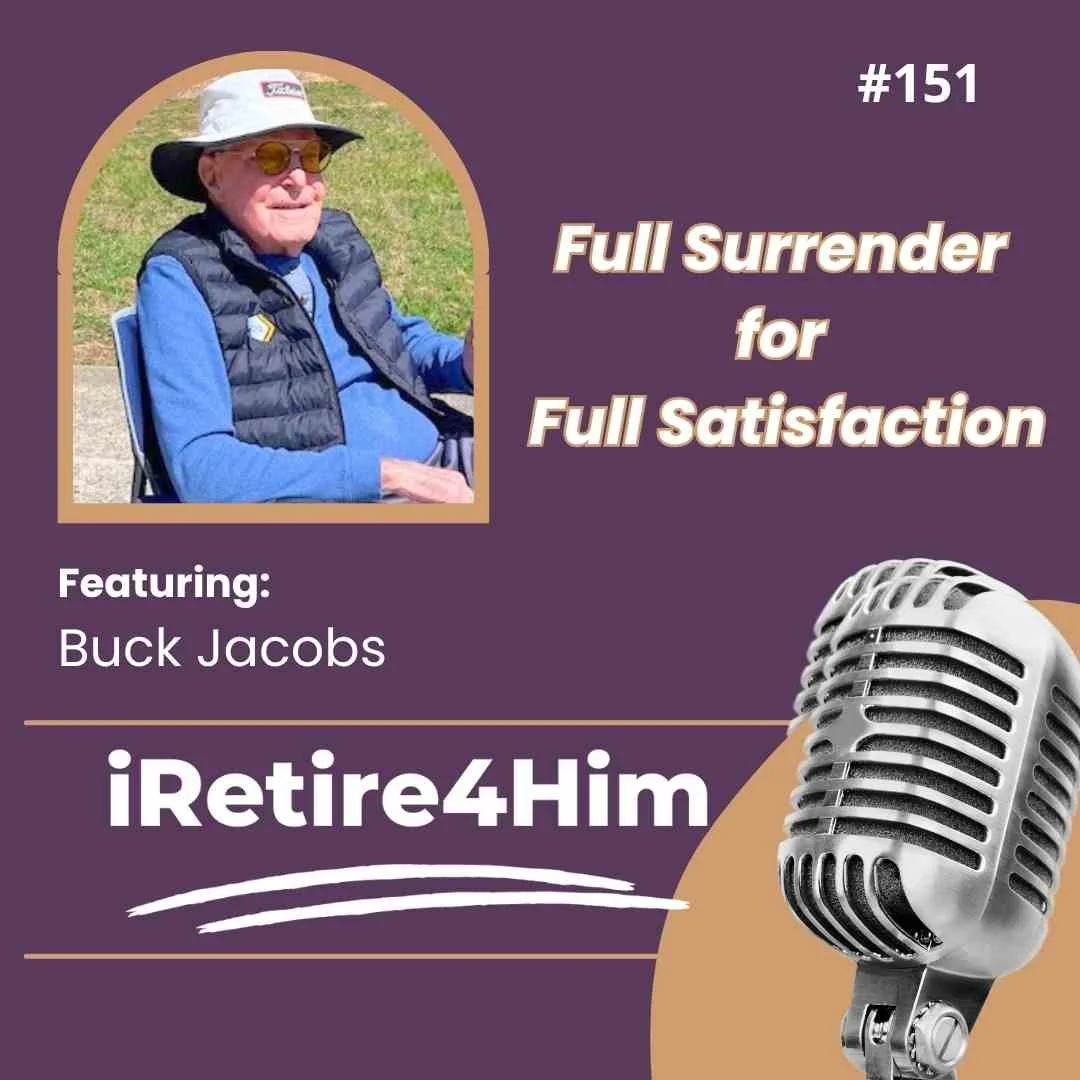
Jim Brangenberg: Your retirement years can be 30 years filled with meaning and purpose as long as you connect your faith and your retirement years. That's why I'm welcoming you to iRetire4Him. I'm your host for the day, Jim Brangenberg. Hey, check us out online, iRetire4Him.com. That's iRetire4Him.com.
You know, when you start a job or a business or an organization in your late forties or early fifties, can you imagine it still being a major part of your life in your eighties? Founders start businesses with a dream of leaving a legacy and making a lot of money. But our guest today has done so much more than that.
Buck Jacobs started the C12 Group in 1992 with the dream of mentoring and discipling business owners and leaders to let their faith impact their work and to teach business people how to run a kingdom company. At first, it was a small venture, but today C12 has over 5,000 members in cities across the country and has caused other organizations to explode as well through strategic alliances.
Buck Jacobs turned over the reins of the day-to-day operations 20 years ago, and in that time, two other leaders have taken his place, but this is Buck Jacobs and his c12. So his legacy is C12, and his involvement in this country and around the world is always C12 related.
Buck may be well in his retirement years, but his energy, enthusiasm, and encouragement are contagious and he's an inspiration to many that retirement isn't just another phase of life, but an opportunity to live out our faith unfettered by schedules and lived out in obedience. I'll let Buck tell the rest of the story. Buck Jacobs, welcome to iRetire4Him.
Buck Jacobs: Thank you, Jim. It's my pleasure to be here. I'm excited. I have to, I gotta straighten you out on something. I have not retired. I have only been repurposed.
Jim Brangenberg: I just said your retirement years. I didn't say that you actually retired. You turned over the reins 20 years ago, but really you've been repurposed. You started in 1992, you turned over the reins 20 years ago.
Buck Jacobs: I didn't really give it up for two years ago. I really gave it up about a little over three years ago in terms of my technical relationship with C12. I have no position with C12, no responsibility to C12. Of course, occasionally they ask me some advice or I might speak to some new employees, but that's just what I do. But what I've always taught and believed, there is no such thing as retiring from serving Christ. You just do it in a different way.
So here's what happened to me, and I'll get to your question. When COVID hit, C12 had to back away from our normal format of meeting around the conference table and we had to do it quickly. And fortunately we had some young smart guys on our staff that knew about Zoom. And so we began zooming all of our meetings and our one-on-ones.
I learned to zoom and it was wonderful for me because I didn't like to travel long distances. But with Zoom, I could be everywhere. I could zoom into the C12 in Brazil and pray with and encourage the guys there or the people in Malaysia or anywhere in the country. And in that process, I met a lot of new people that I just didn't know and not necessarily as a part of C12, but they would hear about C12.
I'd get guys calling me up and say, how did you do it? How did you put together a board of directors that has taken the company from where you left it with some semblance of continuity to what you left? And I have a opportunity to build a relationship with somebody in Michigan or Ohio or wherever. I said, this is what we do and the way we do it. So it really didn't change what I was doing before. It was just done in a different way, primarily by Zoom and telephone.
And I developed a group of guys that I would talk to, sometimes once a week, sometimes once a month, but on a regular basis with situations that they had. I found that there's a lot of younger guys out there in the world that don't have an older voice in their life.
Jim Brangenberg: That's for sure.
Buck Jacobs: And they love it. They love to have somebody, so of course I don't charge for what I do now. It's a relationship, and I tell 'em, I'll talk to you as long as you feel it's worthwhile. When you feel it's not worthwhile anymore, you'll move on and someone else will fill your place. But we'll be still friends and it's been great. I got a lot of stories about that you may not want to hear today, but you probably will sometime.
Jim Brangenberg: You never know. You never know, but - just a basic question. I understand that you never planned on retiring. I only met you when you were in your seventies, so you're already still going pretty hard, but did you ever expect your quote unquote retirement years to be so full?
Buck Jacobs: No. In the first place, I didn't have any vision for being this old. Nobody in my family ever lived past 56. So I didn't have any models, but I never really wanted to be old. I never wanted to do nothing. And when Bob Mack and I sold the business to Mac Company, which was my introduction to Christ centered Workplace. In about 1993 and we moved to Florida to start the golf ministry, we moved right alongside one of the Dell Webb retirement centers and started meeting a lot of people that were retired. And I didn't wanna be like them.
Jim Brangenberg: Yeah. I call that purgatory on earth, Buck, since I lived in Florida for 20 years in two different homeowners associations. I call that purgatory on earth. (laughter) People pay money to go be miserable, be surrounded by other miserable people.
Buck Jacobs: Yes. And they're miserable to everybody. We were doing some work, doing devotions with a nursing home down there and taking our kids to see the older people there once a week, and it was just great. But when we'd leave there and go to a restaurant or snap into Publix, all people in there look at us like, you're scum.
What are you doing here? You're not old enough. I was 48, just a kid. So I never wanted to be that. I never looked at that life as something that I wanted. I've always gotten my thrills from making a difference and you just sit and watch TV all day, you're not making much of a difference.
God in his kindness just moved me from a relationship in C12 where I had obligations to a relationship with him, where I only have his obligation. He's my accountability partner and and this way of doing it with Zoom and phone calls, a few in person things, but for instance, yesterday we got back from a trip to Michigan, Grand Rapids, Michigan. About five years ago, Mike was up there getting the group started up there and a young guy that wasn't gonna be able to be in the group came up to Mike with a question and Mike told him, I don't have time to really deal with that question with you, but you need to talk to a zaken.
He says, what's a zaken? He said zaken is this Hebrew word for elder, and one of our founders, the founder of our company, become a zaken after he left the company. A zaken in the old olden days was an older man who was too old and tired to fight or farm, which is all they did, and he couldn't go out anymore, so he just stayed home. That's the only option they had for their later years.
But they would gather together by the gates of the village, by the city gate, and the young guys are going in and out. And zaken were more than happy to talk with them, share with them, sometimes even adjudicate minor issues with them.
And I said, what a way to end your career. Just, I can do it by phone or Zoom. I don't even have to leave my home to do this. And it can be anybody anywhere. I talked to our guy in Brazil every week for five years. I talked to this guy in Michigan, his wife was in a horrible car accident a year and a half ago. Guy could show you a picture of the car. It looks like somebody took a piece of aluminum and just wound it all up. And when the paramedics got there that at the scene of the accident, they said, no sense looking in there, nobody could survive that.
She'd been parked behind a semi and another one had come full speed and driven her into the one in front of her, and blew her up in the air. And she spun around and she landed in the only place in that car where she could have survived. She's about five foot two or three. She landed underneath the steering wheel in front of the front seat.
And there was like a little coffin place there, just about that big. Now, she was badly hurt. She had a tore, horribly broken left leg that they had to bolt back together and she had that done twice. Her husband and I praying with them through this rehab.
This last weekend we got to go up to Grand Rapids. Her husband has a ministry called The Movement and he has six or seven Christian leaders come once a day to Grand Rapids and speak to the people that he invites to the meeting. Yesterday he had about 180 people there. They had some great speakers. Alan Barnhart was one of them. Illinois.
Jim Brangenberg: Nice. There's one guy I never got a chance to interview. But did you grow up understanding that God loved business, that your work mattered to God, that you didn't have to quit your job to going in full-time ministry?
Buck Jacobs: No, I didn't. Our family did not believe in God. Our family was an agnostic family as far as God was concerned. My dad was in World War II for three years and when he came home, what he experienced made him question whether there was a God. So we were respectful towards God, but we didn't have a relationship. I didn't have a relationship with God until I was 35 years old.
God did a whole series of maneuvers to get me to a place where I received Him, and he absolutely reached down and pulled me out of the muck and sent me, I did a 180. I was all worldly, all for money, sex, and power, living a very dissolute life. And then one day it all changed. And then the next day, my best buddy called me from Chicago- I was living in Los Angeles - and invited me to join his business, which he had committed to Christ because he wanted to show the world that he could be a Christian and a business success at the same time.
I had no idea what that might mean, but timing was good. I would've gone and swept the floors because we were that tight and I was that broken over what had happened in my life. So I joined him, and we spent 10 years together with a, with the mission statement that said this business exists to bring honor and glory to God and to do business in a way that his son will be able to say, well done, good and faithful servant. So we did 10 years worth of business, multiplied seven times in the 10 years.
And it was great. We had a wonderful experience and then we decided to sell, which was a mistake. Should never have done that. Should have gotten some people who had the same vision and heart that we did to keep running it 'cause - anyway, but we did.
Jim Brangenberg: No, I'm gonna hang there for a second because that's an issue still today. You're talking 40 years ago, but that's still an issue today. Great christian companies run by great believers that have a great kingdom culture and in the end, they sell to the highest bidder and in six months or less, everything they worked for gets destroyed.
Buck Jacobs: Which is exactly what happened to us. And that's what I learned. That's where I learned that you can't do that.
Jim Brangenberg: And there's great companies out there now like Perpetuate Capital outta Reno, Nevada, that are saving those kingdom companies. There's groups popping up across the country trying to perpetuate that stuff, but that's an issue. Christians need to understand that. Believers who own businesses need to understand.
Buck Jacobs: The whole problem is they're poorly taught, Jim.
Jim Brangenberg: I understand.
Buck Jacobs: And the seminaries teach pastors poorly and the pastors go into their career and they do a poor job of explaining what life is really all about for a Christian. And consequently, that kinda stuff goes on. Consequently, divorce happens. Consequently, nothing good comes out of it. What's being normally experienced in the Christian world today, because it's like we're given the wrong model. If they don't understand that everything is God's, everything is a gift, we're to use it to his glory, to build his kingdom. And that includes the talents and the gifts that we have internally and naturally, and the education that gets provided to us by whatever, and on. Resources and opportunities. It's all God's.
Jim Brangenberg: So what do we do, Buck, though, to take the wisdom that you've gotten in your eighties and get it to the people that are about ready to retire? To let them know, Hey, retirement's just a different phase in life. It may mean that you're a full-time, fully funded missionary to do whatever you wanted, whatever God's calling you to do. You don't maybe need a paycheck, but Buck, this is an issue. There's almost a hundred million retired believers in this country.
No, they're not a hundred million. There's 50 million retired believers. A hundred million working believers.
Buck Jacobs: Yeah. I know. It's a very frustrating, the only thing I say is, oh you know the old story about the guy that's throwing the starfish back in the ocean? And guy comes up to him and says, what are you doing? He says it's one starfish. How could that be important? Said, it is to that one.
So that's what I'm doing right now. I'm looking for ways to expand the message. That's what Youversion, this thing that you're seeing in Youversion, in my heart, is a way to open the door to really solidly teaching the work of the Holy Spirit and the responsibility of the Christian to God to use the gifts and talents that he's got to build the kingdom. Now, he may do it as CEO of a publicly traded company, but his main purpose, his vision is Kingdom, Kingdom business.
Jim Brangenberg: Right. And Buck's referencing the Youversion Bible app. He just released a 30 day study on Romans 8 I highly recommend. I've been going through it because I know Buck's been a friend and it has been very impactful, very impactful.
Buck, let me ask you a question. I didn't tell you I was gonna ask, but I warned you at the last minute I was gonna ask you. Alright, you spent all these years in business. You've got all this experience and as we understand it now, our years on Earth are preparing us for the work that we will do in heaven. Yes, we will work in heaven. A lot of times that's a part of theology that's missed out.
Everybody's got this vision of we're floating around on clouds playing harps. In no way. What? How horrible would that be? I'm sure it would still be cool because it's in heaven, but still... have you thought about all the experience and the giftings and the wisdom, the knowledge, all that you've been given all these years, how God may be planning to use that when you hit the streets of gold one day?
Buck Jacobs: I've never really given that much thought, and I don't really care. I'm gonna be very happy just to be there. For somebody that started where I did, end up in heaven, hearing the Heavenly choir, seeing Jesus, seeing Paul, seeing a bunch of people that are there ahead of me, I don't care if God wants me to sweep the floors.
I don't care how he uses what he built into me, that's totally up to him. In fact, I feel that way already. I'm not looking for the next deal. I'm not looking to make more money or to gain more reputation and so forth. I'm just striving to be obedient to God's spirit, day by day, minute by minute, and run out the clock.
I'm running a race that was set before me - Hebrews 12: "run with endurance the race that has been set before you, looking unto Jesus, the author and finisher of your faith," and so forth. So that's my thing. It has been for the last, probably the last 10 years. I don't give a rip what the world thinks or what they say. I know where I'm founded and I know where I'm going. So when I get there, if he says, Buck, I want you to go dust off Mars. I'd say, Okay.
(chuckling)
Jim Brangenberg: That would be a task now, wouldn't it? Dust off Mars. I like that. That's a good one.
So when you look at your friends, your peers you hang out with, you've had guys go through C12 now for 33 years, there's a lot of those guys who are quote unquote in their retirement years who've become friends of yours, I am sure. How have you been able to speak wisdom into them about retirement and the fruitlessness of checking out, going on vacation for 30 years and the fruitfulness of seeing those retirement years as years for meaning and purpose?
Buck Jacobs: It's one-on-one with a lot of them. That's just, I don't have a real business reason or some ministry opportunity to speak with them, but that's what I'm doing on Youversion
Jim Brangenberg: Okay.
Buck Jacobs: By teaching them the Holy Spirit, leading into full submission, full commitment to God, not using my wisdom and my strength and my cool to do things, but trusting in him, believing that he doesn't give a rip about how big something I build unless I'm building it for the kingdom and his direction. I can build it for the kingdom in my own strength, and it doesn't mean anything for him, to him.
And it's not going to gain me any rewards in heaven, but I can be obedient to him, listening to his leading for what he wants me to do - I don't see that changing much when we get to heaven. I just - in that study today, and I don't know if you read it or not - my comment was really, it's all about him. I'm content. As the sharing rolled out today, the guys in this study and there's 40, there's 50 of them, they're being touched. The comments they're making are telling me they're being touched by the Holy Ghost. And my comment was, I'm listening to you guys, I'm reading your comments today, and in my mind, I go back to hearing Andrae Crouch sing My Tribute in 1983.
"How can I say thanks for the things that you've done for me?" And so forth. And so that's my thing now, I just... anxious to be obedient. I'm learning to hear the spirit more clearly. I don't have it all together, but what I have, I want to share with people. That guy up in Michigan, his life has been changed forever because we met and his wife's life has been changed forever because we met and their girls are gonna be changed forever because we met.
He's been transformed from an everyday Christian to a disciple of Christ, and it shows. He's got a big job. He is a regional manager for medical equipment with... I can't think of the thing. They're like rays, they shoot, they do it with rays. Anyway, and he makes big money. His wife, before she was injured, she was one of the best known personal injury attorneys in western Michigan. She lost that business because she did recover, but not quick enough to hang on to the clients. She had, I think she had four other attorneys and nine paralegals working for, and I got to see her this last weekend.
I went, primarily I wanted to see her. Her husband was telling me about it. I've walked through the whole thing with them, but maybe three or four months ago, he said, Hey man, Tara's really feeling bad because she thinks she'll never be able to run again, 'cause she was a runner before she was injured and run marathons. And I said, she's gonna run again. He said what? Tell her that I said she will run again.
I've got a picture in my phone of her finishing her first 5K about six weeks ago. It's like seeing chariots on fire all over again. Glow on her face and her kids. Those are the things that I wanna work for now. And you have to just let God provide him because you can't tell who is going to be really open to more of God or not, especially if there's a cost and there's always a cost.
Jim Brangenberg: But what's the cost to you? You're having fun. You're talking to people all across the world. You're getting to pour your life and wisdom and knowledge into them. What's the cost to you at this point in time?
Buck Jacobs: The cost is to yourself. You gotta give yourself up completely, surrender to be used by God in any real significant way. If any of the old self is hanging around, that part is painful. The part that's submitted to God, realizing that God works everything together for good, so everything that I receive either is sent by or permitted by God. It's good. Doesn't look good to me, but to him it's good. That's good for me. The hard thing is not to do anything.
The hard thing is get up in the morning and I look at my calendar. I don't have anything. I don't have meetings, I don't have calls I have to make, I don't have stories I have to write or, today, the only thing I had on my calendar today was talk to you, which is wonderful. I love that.
But without that, my day is what are you here for? And why are you leaving me here, Lord? But he's teaching me brokenness. He's teaching me humility. He's teaching me to do and think ways that, that I didn't before. I was a good Christian. In the eyes of the world, they would say, Buck's a really good Christian. He's raising his kids God's way. He's going to church every week. He's leading his company for Christ. But there was still parts of me that was not sold out to God, that was still wanted my way of some things, and there was still some temptations that would grab me every once in a while.
So to tell you, I had a experience down in Texas. I was speaking at a conference down there not too long ago. And they had a group of us speakers up on stage for a q and a session, and one guy raises his hand and he said Mr. Jacobs, you're, I think you're 78 now. And he said how old did you have to be before you didn't sin anymore? I said I can't tell you, but I know it's older than 78.
(chuckling)
Jim Brangenberg: Yeah. Yeah. That answer I knew already.
So Buck, you and Bonnie been married a lot of years already. What do you guys do for fun as you've started to slow down a little bit, but you've also stopped working as much as you used to? What do you guys doing for fun?
Buck Jacobs: We still date, we still do things. We've just sold our house this last year and moved into a retirement apartment, which is a new experience, and that required some adjustments. We're still committed to having the marriage that God wants us to have, so we still stay the way, stay the course. See, the things that the world would say was fun, like going to play golf or go fishing or what, those aren't fun to me anymore.
Those are, those mean nothing unless they connect with leading somebody to Christ or helping somebody through a problem in Christ, or there's some Christ reason for doing them. So we've traveled, we've been to, India and we've been all over the world, right? I don't wanna do that anymore. Those long flights kill me. We just focus on our relationship. We got three lovely girls and six lovely grandkids that are now all in college. And yeah, and doing wonderfully well. And not necessarily in the world sense, but they're good people. They're good kids going straight so far, no stumbles, no drugs. No booze and so forth. So we're blessed to be with them. They, fortunately, love to be with us.
Jim Brangenberg: So Buck, as we close this time out, because I would love for you to speak to the retired audience that we've got. This goes out to hundreds, about a thousand people, every other week. So it's not a huge audience, but everybody who's listening, of course, they're important.
But the whole intent behind this podcast was we need to start talking about how retirement shouldn't exist within the biblical community. That we should look at it as just a different phase of life, fully funded missionaries, a time of meaning and purpose. But there's a lot of people struggling with the reality 'cause they've been told all their lives to prepare for retirement as a part of the American dream. They've also been taught that the America dream of retirement is biblical.
Buck Jacobs: Yeah.
Jim Brangenberg: Most people have been taught what they're retiring from and they know what they're retiring from, but they very rarely know what they're retiring to. So speak to those people. Share some wisdom, 'cause you're well into those quote unquote retirement years. Speak to them.
Buck Jacobs: You know what I've learned, Jim, my life really got shaken up when I first was challenged to read 2 Corinthians 5:12. And that says, "for we must all appear before the judgment seat of Christ, that each one may receive what he's done in the body, whether good or bad." And I started to press into that and to study it and it really became very clear. Salvation is free. It doesn't come without responsibility.
Every Christian has a responsibility to minister, to share God's love. That's what they're here for. They didn't get sent here so they can just experience the temporary pleasures of earth. Which a lot of 'em are confused of that, and they think if they get enough money, they can do this and they can do that and they'll be happy and they're not right. They're never supposed to be that way. We are here to become ambassadors for Christ, and we can be an ambassador for Christ at any age, any sex, any race. If you're a human Christian person, you are an ambassador for Christ. You don't have to enroll and enlist. You are there.
So when we come to the judgment seat of Christ, what's that judgment gonna be about? It's gonna be about, what did we do for Christ? What do we do with the opportunity to be an ambassador for the kingdom of God to the world at large, wherever we are. Did we promote God's values? Did we promote our values? Did we express the love and kindness of God to people that we didn't necessarily like and so forth? That's gonna be the judgment. That's what Jesus is gonna ask every single Christian.
It's not something that's an option, it's part of the deal of being saved, right? We're saved to work. We're not saved by works, but we're saved to work. Retired people have tremendous opportunities because of their experience and because of what they've lived through, like being a zaken. They go sit in the village gates somewhere and share wisdom with younger people that are having problems. They don't know what to do, 'cause they haven't been through 'em yet.
And so I say that those decisions that we make are eternal. You can live your whole life here as a Christian and never get one single kudo from Jesus. Bill Gates could die and go to heaven tomorrow, and God's gonna say, I don't know you. It's not how much money he has. It's what's in his heart. And so everybody, every single Christian, if I could, I just wanna blast from that message into the audience that it's not an option to serve Christ. That's what you're born for and that's what you'll be judged for.
The judgment seat of Christ is promised to every believer. Every one of us is going to go through it, and we're gonna have to explain how we made the decisions that we made to do the things that we did to Jesus. And for some of them he's gonna say, that's wonderful. I've been waiting to give you this, and he's gonna hand us a precious gem or something like that.
And for some, he's gonna say, I didn't tell you to do that. Where did you get the idea that's what you should do? Did you see it in my Bible? No, but it was a great opportunity. Lord. I've got 48 stores and I've got my, I'm worth $12 million. And, I worked, I honored, I was nice to my employees. I paid my bills on time. I tithed in church and he's gonna say, that wasn't what I sent you to Earth for. You missed. You got the good, you missed the best. And my heart breaks for people, like some of the guys that have come into C12 and walked away before they really got it.
And some do, because it's gonna be this awesome thing when they come before the King of Kings. And he said, what did you do with what I died to give you? I died so that you could be a part of the kingdom, you could serve father in extending his kingdom. What did you do to do that? And that's so sad, because it's all there in scripture. It's not hidden. You gotta dig it out a little bit, but it's not hidden.
Jim Brangenberg: Buck Jacobs, thanks for sharing a little bit of your story, but thanks for being on iRetire4Him today.
Buck Jacobs: My pleasure, Jim. God bless you and Martha.
Jim Brangenberg: And if you've got anybody in your family that's running a business, they're a believer, they're running a business, or maybe they're running a business and they're not a believer, but they know that there's something more, I highly encourage that you check out C12 , online at joinc12.com. joinc12.com.
And there is guaranteed a local C12 Group near you. Couldn't recommend it more. You've been listening to iRetire4Him with your host, Jim Brangenberg. In this retirement phase of life, we all want our lives to be full of meaning and purpose, so we can say with our final breath, iRetire4Him.
iRetire4Him Show 150: Lessons from Downton Abbey

Jim Brangenberg: Hey, welcome to iRetire4Him, a podcast dedicated to you, the retired believers in America. But we go today to England, Downton Abbey, for a special episode talking about the grand finale. Martha, we've never done a show about a movie before, have we?
Martha Brangenberg: Not that I can remember, but this is fun, Jim. We took a date night -
Jim Brangenberg: which has been a rare thing 'cause we've been doing construction, which we could tell you about that in a minute.
Martha Brangenberg: Yes. And we went and saw a movie.
Jim Brangenberg: Not any movie.
Martha Brangenberg: Not just any movie. We went and saw the grand finale of Downton Abbey. And we don't know whether you have had the opportunity to watch any of their shows. But there's a really strong message in the grand finale that we really thought was appropriate for this audience.
Jim Brangenberg: So Martha and I love watching movies and we love this series, the Downton Abbey series, which was six or seven years of shows, which I think we binged in less than a year, probably less than six months. I'm just saying - don't judge. It's not like you haven't binged anything.
Martha Brangenberg: It's not like we're endorsing any one show or anything like that, but we love to be able to find messages and things that we can take from scripts. People write things on purpose, they write things with intentionality. So whether you've watched the shows or not, this show today with us has some great life lessons, so we hope you'll hang tight till the very end.
Jim Brangenberg: And we recommend you watch Downton Abbey, the grand finale, because it has so many retirement messages in it. The whole Crawley family, it's just a normal family. They just happened to live in a big house in the twenties and the thirties in England, in between World War I and World War II, and it is, that's what it's all surrounding, but it's interesting. The British culture obviously had a lot of influence on American culture, because we left there and came here.
Martha Brangenberg: But the dynamics of this kind of a household are something very new to us.
Jim Brangenberg: It's lost on American culture 'cause we don't have servants, that kind of thing.
Martha Brangenberg: We don't have lords.
Jim Brangenberg: Lords and ladies.
Martha Brangenberg: And we don't have this very specific hierarchy, yet we have elements of it that we can learn from in our jobs. So really what they've taken, in their environment, we can apply so much in our jobs and in our own household. So this is a stretch for me. I'm just gonna warn everybody. I am a great movie watcher, but I don't retain all of the details. I enjoy the moment. So Jim and I are gonna do a little bit of, a highlight reel, not to give away all of this story.
Jim Brangenberg: That's right. We will not.
Martha Brangenberg: But it's really about the lessons and some of the things they really did well as people of transition.
Jim Brangenberg: So first of all, if you appreciate film, the cinematography and the soundtrack,
Martha Brangenberg: the music
Jim Brangenberg: the soundtrack, phenomenal soundtrack.
Anyway, iRetire4Him is all about the fact that retirement isn't a 30 year vacation. It's not, "Hey, I've done my time. I'm done and I'm checking out for the rest of my life." That's not the - God did not design us for that. There's nowhere in scripture that endorses that kind of behavior or attitude or actions.
Retirement's a different phase of life. It may look different than the first couple of phases of life, childhood and adulthood. Retirement may look different than that, but it's important to understand that retirement isn't when you're done. It's just a shift in your paradigm. It's a shift in your thinking, and iRetire4Him is all about that shift in your thinking.
The shift to our understanding that I'm now retired. I'm a fully funded missionary 'cause I get social security, maybe a pension, maybe a 401k. I'm fully funded to go do whatever the Lord has for me, unfettered and untethered by a regular daily job. But there's always transitions and that transition is difficult, and how you handle that transition makes or breaks relationships.
And that's what this episode was all about for Downton Abbey, the final episode, the grand finale, as they say, because everybody was transitioning into a different role. Because it was the end of an era, of a ruling family in this area of England. And the servants were transitioning, the leaders were transitioning, and the even the cook was transitioning. And it was people that you've, if you've watched the entire series, is people that you've gotten to know really well. Some sorted details, of course. That's what makes it fun. Does it make it fun?
Martha Brangenberg: It makes it interesting and I think one of the things, Jim, that we enjoy about this element of it being in a different country, in a different era, and a different societal structure is that we can see a different way that people have lived and, you get to remove yourself from reality. Yet it was someone's reality in a sense because there, this truly is a good representation of the kinds of lives that people were living during that time. So it's fun to look at it as an outsider without any personal attachments at all. But yet there's so much that we can learn from these transitions that they went through. So who are we going to dive into first? I'm curious.
Jim Brangenberg: So let's talk with Mr. Carson. Mr. Carson was the butler. And he ends up marrying in the last episode or the last movie of Downton Abbey he ends up marrying basically the head maid, right? But the lady in charge of the entire house on the lady side, Mr. Carson was in charge of the Butler stuff that goes on.
Martha Brangenberg: Wait, let's just talk right there. Isn't it true that the more you work with people, the more you get to know them, whether they End up being married together or not, these friendships grow and that's what we see behind the scenes happening with so many of the elements is you know that you're doing life together with the people that you work with every day.
Jim Brangenberg: And why not marry your best friend?
Martha Brangenberg: There you go.
Jim Brangenberg: If you're already married and then you go to work, it's not a good idea to get a best friend at work That's a trouble point. Yes. And we need to protect our marriages from our businesses, from our work. But we're talking about retirement now, and Mr. Carson and Mrs. Hughes, they get married and Mr. Carson needs to retire as Butler. And he has been training up Andy Parker - Andy Parker, who also is married to Daisy, the cook, the assistant cook.
And Mr. Carson has only known being a Butler. For 40 plus years, that's what he's known. He's always been in service and he's worried about, he says in the movie, "I feel as if I'm turning my life's blood into water," which is saying like I'm turning into nothing. It's like everything I've done is going away and I'm no longer significant.
That's a lie of the world today, that when we retire we're no longer important, that none of that wisdom is important, all the stuff that we've gained. That's not true at all, is it, Martha?
Martha Brangenberg: No, it's not. In fact, to watch, he has a hard time with this transition. So Mr. Carson goes home and he starts polishing all of their silverware, and he starts figuring out, sitting in the room, standing up, and he's uncomfortable and he doesn't know what to do. And then he ends up showing back up at his old workplace quite a bit.
And they joke about it like, 'cause he doesn't really know what to do other than his work. Now, again, a little different era than we were in where it truly was their life's service in that role. And so they worked very long days and did very little outside. We talk about a lot on retirement, Jim, is investing in your hobbies and finding creative ways to use your skills outside of the workplace, so you aren't surprised by this season where you don't have a schedule and you don't have things to do. But Mr. Carson struggled with that.
Jim Brangenberg: He did. He also struggled with the fact that he'd been a servant, somebody in the quiet behind the scenes job, for all of his life ,and he didn't think anybody wanted to hear the wisdom that God had given him and that he'd accumulated, and he got involved at a local festival and he found out that what he had learned actually applied, that people could accept the wisdom that he's given - just because he was a servant.
There's so many people today in our society that think nobody wants to hear what I gotta say, but you know what? If you've lived 60 or 70 years, you got a lot of experience. You've got things that people want to hear and God will bring people into your life that need to hear specifically what you know, and that's really important.
Martha Brangenberg: And he proved himself worthy of that wisdom, as well, even to the point where Lord Grantham came and visited with him.
Jim Brangenberg: And asked him advice. Oh, don't give it away.
Martha Brangenberg: No, I won't give it away. But, that's a role reversal. But that's based on relationship and him showing himself worthy of all of those years of relationship and trusted wisdom, because he gave a lot of wisdom.
Jim Brangenberg: And as Mr. Carson knew he was on the way out, he spent time training up Mr. Parker on how to be the butler. He mentored and discipled him in all of the ways that he needed to know to run a household from the Butler side of things.
Martha Brangenberg: But did he trust Parker to actually be able to pull it all off?
Jim Brangenberg: No, he was really worried that Parker couldn't pull it off 'cause Parker was a kid like Carson was when he first took the job. And so it's so important though that we do invest our lives in those that are gonna take our place and have a perpetuation plan when you're leaving your job. But after you're out of the job, it's okay to still see yourself as somebody that has wisdom and value to input into other people.
What's interesting is Mr. Parker ends up marrying the assistant cook, who ends up transitioning to be the head cook. Mrs. Patmore has been the cook at Downton Abbey for decades, and Daisy joins the show early on in the series and is trained and discipled. Daisy couldn't barely even sift flour when she first walked into that kitchen.
And Daisy said, I'm not gonna be a servant all of my life. That's what she says many times. But she ends up being the head Cook and during the whole grand finale movie, Mrs. Patmore and Daisy are transitioning for the final event that Mrs. Patmore does and the first event that Daisy will do.
Martha Brangenberg: Yeah, so that was really a beautiful thing because a lot of people think about going out on top and saying, this is gonna be my final grand event that I'm in charge of, or project that I do or whatever, but Mrs. Patmore very graciously asked for Daisy to be the one in charge.
So instead of it being. Mrs. Patmore's last event, it was Daisy's first event, and so it gave it this beautiful opportunity for Daisy to shine. Mrs. Patmore got to be there to watch it happen and participate in it, but with a different role. That takes a very good leader that can stand back and allow the next person to rise up and show off everything that you've taught them. But to see her shine and to see her do it so well, it really is a beautiful thing.
And passing the baton can be very hard, but it's so powerful when it's done well, and she really set Daisy up for success. She set Daisy up to do a good job. She taught her everything and let her fly. It's like letting that little bird out of the bird's nest and letting them fly and trusting that they will do all the things. Yes, we're gonna fail. We're gonna have mistakes, we're gonna mess things up, even to the point, and I don't remember if this was in the last dinner, but at some point someone questioned what dishes were being used. Wasn't that the case?
Jim Brangenberg: Oh yeah, that was Mr. Carson. He's, " are you sure Mr. Parker? You've chosen this, and I can't believe you chose these dishes instead of these dishes."
Martha Brangenberg: And in fact, it was requested by Lady Mary or someone that these dishes be used. So he was following instructions. So there was questioning of whether they were making good decisions, but having the authority to say, we are doing this because it was requested of me. So again, beautiful leadership and beautiful - when you give someone authority, allowing them to actually live in that authority is a huge thing. So you can tell we were so impressed.
Jim Brangenberg: Yeah. That's what's really cool though, is Mrs. Patmore and Daisy had spent so many hours together in the kitchen, years together in the kitchen. And Mrs. Patmore had never gotten married 'cause she was the head cook. There was no time for her to get married. She never got outta the house. She says to Daisy, "you're the daughter i've never had." Just a powerful moment. And I don't believe the Daisy was close to her mother, so Mrs. Patmore had taken that role on. So it's just really a cool thing.
But again, a transitioning where somebody underneath Mrs. Patmore was risen up in the leadership and Mrs. Patmore was able to pass a baton and pat her on the back as she celebrated the last event that she was a part of before Daisy took over. Again passing on, changing, transitions. And Mrs. Patmore is then gonna be moving in with her new husband, and that was a whole new thing for her, and Mrs. Hughes and Mrs. Patmore have a hilarious exchange. We won't talk about that today on the show.
Martha Brangenberg: You can watch the movie. (laughter)
Jim Brangenberg: You can watch the movie, but it is actually pretty funny. Yeah, but probably the biggest thing in this whole grand finale of Downton Abbey is a transition from Lord Grantham to Lady Mary.
Martha Brangenberg: Yeah.
Jim Brangenberg: Lady Mary, the eldest daughter of the Crawleys, but in the middle of this, there's a great scandal, which we won't talk about, but there's this transition and Lady Mary's been being trained for years on taking care of the Downton estate.
Martha Brangenberg: Because that is more than a full-time job. It's a big place. You can see it behind us on the video. We have a picture of it.
Jim Brangenberg: That's right. You can't hear the lawnmowers in the background around. We have that muted, but as being on location it just, it is a beautiful place. But Lady Mary has learned all about the estate and has been transitioned, but Lord Grantham is having a hard time letting go, and partly because Mary's a woman. But partly because it's his little girl who's growing up to take over the estate.
Martha Brangenberg: And it's all he's done for many years. So let's talk about that. So he's referred to as Lord Grantham, because it's the Grantham Abbey. Or the Downton Abbey is the Grantham family. But his name is Robert Crawley. And I think that it's important to just talk about the fact that he had to really come to terms with the timing, that it was time for the next season of their life.
Jim Brangenberg: And it wasn't end of life. They were both perfectly healthy.
Martha Brangenberg: Yes.
Jim Brangenberg: But Robert and Isabelle were perfectly healthy. Is it Isabel? Is that right? No, Robert and Mrs. Crawley.
Martha Brangenberg: There you go. But yes they were perfectly healthy and ready for this next season in a lot of ways, but they knew that it meant they had to make some verbal announcements, that they had to literally pass the baton.
So I think it's very interesting, Jim, at this point where they get to the end and the house was very full. There were a lot of people in it. And then slowly, everybody was saying their goodbyes and transitioning to their new roles until we were just left with Mary.
Jim Brangenberg: Yeah, and Mary's sitting there remembering all of the things that have gone on in Downton, and it's just a great lesson for all of us as we look at retirement, not as an ending, but as a beginning of a new phase, as a beginning of a really, a paradigm shifting in our thoughts and our minds. And the Lord has so much more for us.
He spent all of your life feeding you full of wisdom and knowledge and relationships and feeding himself into you, depending on how long you've been a believer. And retirement is the opportunity to start to let those go, all of that stuff, and let it fill your life. There's so much more for you then moving into a retirement village and being surrounded by people who are unhappy 'cause they gave up everything.
Move into a neighborhood with families that you can pour your life into. Families today desperately need chronologically superior people in their lives. Look for ways to feed into your community by volunteering or maybe even getting a job where you can be a mentor to other people. But look for ways to take everything that God has put into your life, to feed it into others. Y'all, we just recorded a show recently for iWork4Him and it's just a known fact, if you were a business person in your life, most pastors don't know how to deal with business people, 'cause they weren't business people. They don't understand the business world.
If you're a business people, you could help your pastor understand business people. There's just so many opportunities. But Downton Abbey just gave us a great platform for sharing about, hey, everybody's gonna go through these transitions. You could do it with grace or you could do it with a nuclear bomb. Which one would you rather do?
And Downton Abbey, 'cause they're British people, they did it with grace and did it with pageantry and they did it with a little drama, which we won't disclose. But all in all, an opportunity for us all to just be reminded - retirement's not "done." It's, if you've got a pulse, you've got a purpose. There's a future for you.
Martha Brangenberg: There's a quote at the very end of the movie when they're toasting and it says, "what else would we drink to? We're going forward into the future, not back into the past." And I think a lot of us really struggle with that, looking forward to the future when it might be uncertain, when we might not know what it's gonna hold or how we're gonna spend our days.
It's beautiful to reflect on the past, but we're living in what God has given us for the future. So to do that well and to anticipate that, with new opportunities that come and really seeing how they exemplified that was just a beautiful reminder and Jim and I knew that we wanted this opportunity to reflect on it a little bit.
There are so many other lessons, pretty sure we're gonna need to watch it again.
Jim Brangenberg: There's some great lines in there.
Martha Brangenberg: There really were. When you get the opportunity to script something in beautiful English, you always say, oh man, I wish I could say it so beautifully as what they said, but very profound, very impactful, and just a fun way for us to look at what kind of transitions does God have us in, and are we handling it in a way that would give him glory and honor? Are we leading well? Are we passing the baton? Are we mentoring well? Are we discipling others well so that they're ready to pick up that torch or that baton and carry it forward into the future as well? So really great challenges, really great encouragement, and we hope that it's been a little bit of fun too.
Jim Brangenberg: Downton Abbey. The grand finale. Now, before we go today, we wanna encourage you to check out our sponsors. People that help keep iWork4Him, the ministry of iWork4Him and iRetire4Him, going on a day-to-day basis. Two of our big sponsors we wanna draw attention to today would be Patriot Mobile, providing cell phone service, just like the cell phone service you have for one of the big three, but when they make money, they support faith, family, and freedom.
Martha Brangenberg: That's right.
Jim Brangenberg: And if you've got a computer or a cell phone, you need SaferNet on those devices to keep the bad people out and to keep you safe while you're searching and scrolling all over the internet. SaferNet.com.
You've been listening to iRetire4Him with Jim and Martha Brangenberg. We're not retired yet, but we're really close, but we know that it's a transition into the next phase of our lives, and we invite you into it. Check us out online at iRetire4Him.
iRetire4Him Show 149: "Refiring" as the Body of Christ
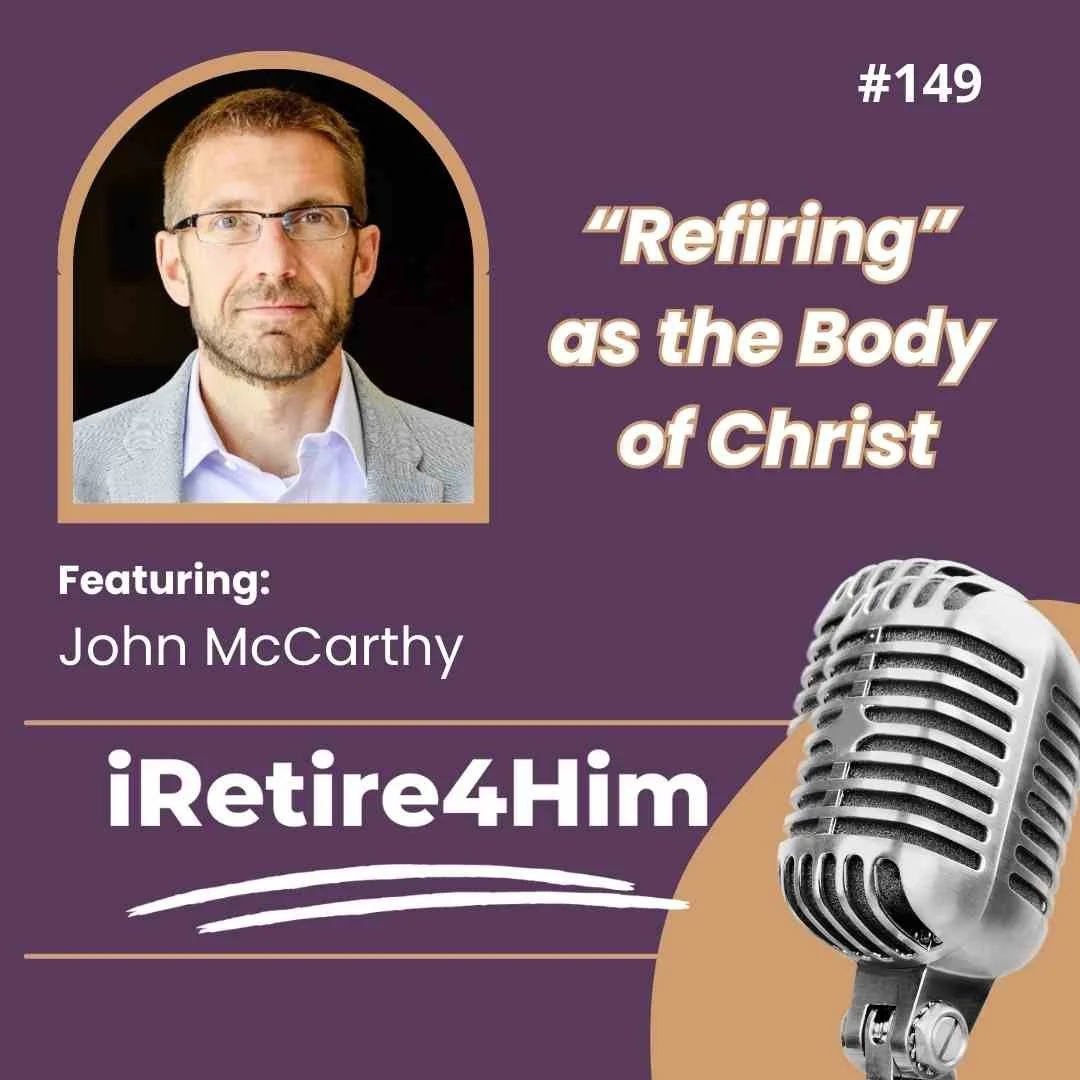
Jim Brangenberg: Your retirement years could be 30 years of purpose-driven, fully funded ministry, years of making impact in ways and places you never imagined. Welcome to iRetire4Him, and I'm your host, Jim Brangenberg. Please check us out online at iRetire4Him.com. That's I retire the number four him.com.
It's starting to happen... something Martha's dad dreamed about when he launched iRetire4Him within iWork4Him almost 12 years ago. People in their forties and their fifties are realizing that the American dream of retirement doesn't apply to believers. That dream is actually a nightmare and it actively holds millions of retired believers in retirement prison all across our country.
We were made to live with purpose, our faith impacting all of our days. We were given a promise that the Lord numbered our days from before we were born. When did that promise get changed to "the last 30 years of that time, we will be on perpetual vacation letting the kids do all the ministry work?"
We need to live on purpose based on the promises God has given us all over scripture, and that applies especially in our years after 55. When we turn 55 or 65, nothing magical happens except that we are older and wiser - hopefully - and have a lot of experience to share. Today. John McCarthy joins us from the Cincinnati, Ohio, area to talk about the ministry he leads, purposepromise.org. John, you're only 45 years old. Why do you care what 65 plus age people do with their time? You're a long way from there.
John McCarthy: Yeah, Jim. Thanks for having me. It's been a highlighted component of what we do on a larger scale, which is helping people discern their vocation, really creating an intentional life plan that they can then integrate with their work plan and loving work, and through that work at the Purpose Promise that we've just had the joy to get to do with the Lord and with the community, I just, my eyes were open to the problem around, as you talked about, the shaping of retirement and how unbiblical it is and how really the body of Christ has a unique opportunity to lead well in the formation of discernment, in the formation of vocation in the last season of life. And I'm fired up about what God's doing and being a part of this.
Jim Brangenberg: So did you grow up in church?
John McCarthy: I did.
Jim Brangenberg: So when did you decide to become a follower of Jesus?
John McCarthy: Yeah, it was really in my early twenties. I had some great experiences throughout my teen years, leaning into retreats and had many kairos moments in those seasons where I got to experience Jesus just through what I'd now say is the starting of the formation of the contemplative muscle.
And that was awesome through my high school journey. Then I really met Jesus in understanding what a surrendered life would look like during my college years as I was then leading some of those retreats, ironically, is where I met him and developed a deeper passion for him.
Jim Brangenberg: That's fantastic. I love that. And I love the fact that even though you grew up in the church, it was still, you were in your twenties before you went all in and said, yeah, this is what I'm gonna do. So growing up though, weren't you always... the shift of the conversation on retirement, weren't you always told that the American dream of retirement was actually biblical?
Isn't that what you've been taught? You're only 45, but you've been listening to, you've been working for 25 years already. Is that your perspective?
John McCarthy: Early in my life, it was baked into what I was experiencing and I'm a big believer in the creation of retreats and helping people discern vocation and other things that really looking through our memories and really crafting our own unique beliefs on what we believe as opposed to adopting what the world will tell us. This is a continuation, I believe, the reality of Romans 12:2, you know that we're not conformed, but transformed by the renewal of our mind, that by testing we can discern what is perfect, pleasing, and acceptable in God's will.
And there's just so many things that we're taught mostly environmentally, Jim, about a lot of components of our life that we then craft our life towards. But I don't think there's any bigger one than this misnomer that's not biblical at all around vocation being in three different chapters: our pre-work, preparation for vocation launching, and then our work in it, and then our retirement.
And it's just part of the American realities that we've created our education system up around and that many families actually drive towards. And now I can look back and say, wow, that conforming belief is driving so many people into a lackluster vocation when they're in their career and also a lackluster retirement.
Jim Brangenberg: And misery. I'm gonna say misery. I lived in Florida for 20 years. I've seen a lot of people who lived all their lives through their retirement years, and they get there and they're miserable because all of a sudden they have no meaning and purpose. So what is, without using big five syllable words, 'cause you've got a tendency for really fancy words- I love that. But just for the sake of your host being extremely simple, what do you feel is the actual biblical theology on retirement?
John McCarthy: Yeah, I'm gonna point to an early reference, maybe not a direct reference, but the reality of what we experience is when Israel is in its early ages, in the Old Testament, God's chosen people literally rise and fall based on the transfer of wisdom.
You can go back through the Old Testament, you can see where there was a good king that set up a successor and transferred wisdom, then we saw Israel thrive. And then on the other side of it, we would see that when there was a poor king, Israel would just go down in the dumps and really have a hard season.
And so that, that model of transfer of wisdom is so key, so catalytic. And you know what we don't see if we believe that the last season of our life is about sitting on a beach somewhere? Wisdom transfer. And God's graced us with these gifts to grace the body, right? To, to build up the fellow believer.
And I believe that the conforming view of retirement is nowhere near what God says, which is great pleasure, and that is about transfer of wisdom. And we know that obviously wisdom is richest in those latter days of life.
Jim Brangenberg: And why is that? Why is wisdom richer in our latter days of life?
John McCarthy: I love teaching this in earlier generations because we live in the age of information, Jim. It's wild, but today, statistics would tell us today, wherever you're listening to this, today, you will take in more information than somebody that lived and was born in the 1920s would take in in their whole life. Crazy.
So we have all this information coming at us, but we're losing the muscle memory of taking information and criticizing it, being able to think through information to take it to knowledge, and then taking knowledge and saying, where does that apply in my life? Or does that not apply to my life in making it wisdom?
And so it's the application of knowledge into life and experience that actually turns it into wisdom. Obviously the individuals that have had more experience in life have the more opportunity of taking knowledge into wisdom. That's the discernment process. So there's this great gift in your latter years of life and your latter years of what we call is "refirement" as opposed to retirement, of having a lot more wisdom just simply because of the reps you've had in life, right?
Jim Brangenberg: It just comes - you've experienced life, you've screwed up a lot. I say a lot of my wisdom comes from I screwed up. Hopefully a little bit of it came from me seeing other people screw up and learning from their mistakes, but most of the wisdom I've got is... yeah, been there, done that. I can write the book.
In fact, I have written a book and I'm glad you brought that up, John, because I wrote a book about retirement. And I'm not retired, but I wrote it alongside my father-in-law who at the time was 88 years old. He wrote his stories of living out his faith in retirement. I wanna tell everybody listening today for any donation made to iWork4Him, I'll give you a free copy of iRetire4Him and I'll sign it and we'll get it sent off to you. Go to iWork4Him.com. That's I work the number four him.com/donate. Make any kind of donation and we'll send you a copy of iRetire4Him.
Just put it in the notes when you make the donation, love to get a copy in your hands. I'd love to get you a set of copies for you to go through it in your small group or in your Sunday school class because in here, inside iRetire4Him, a ton of ideas on how you can practically live out your faith in retirement, whether you continue to work, go back to work, move intentionally into a neighborhood that isn't a retirement neighborhood. And I got a lot to say about that.
John, you know, there's a move across the country of people realizing that retiring and moving to Florida or Arizona or Texas is a lousy long-term solution because of all the drawbacks, like missing your family, being surrounded by a bunch of cranky old people who also lack purpose, and living in a homeowner's association, which is like purgatory on earth. What are you seeing out there in the ministry work that you're doing?
John McCarthy: Yeah, I think it's a reshaping of what wealth is and what wealth transfer is. We've heard this terminology of wealth transfer and wealth comes in a lot of different ways. First we obviously think about our daily bread, and I think interestingly enough, the Lord really addressed the different versions of wealth in his prayer that he teaches to his disciples, and that we now recite as the Lord's Prayer.
He talks about daily bread, but then he talks about motivation: lead us not into temptation, right? So what are we motivated to pass on? What is actually our motivation each and every day in retirement or in different seasons? Then he talks about relational wealth. The whole "our Father" Lord's Prayer is "our father," it's not "my father." And it's about community. It's about making sure that you're creating legacy in the most important relationships that you have.
And quite frankly, just moving off to Florida or Arizona, as you've mentioned, that doesn't necessarily always do it because it takes a lot of quality and quantity of investment of time in order to have relational impact and wealth. And then obviously the spiritual wealth component. And we know that because of what we believe in our worldview, but there's new habits and new rhythms that can be taken on in a season where you've got more time, maybe even a little bit more money, to be able to build into what the Lord's speaking into your life in order to "refire" well, and that kind of regrouping on what wealth is and thinking about wealth transfer, I think is a really good component of what a healthy "refire" can look like.
Jim Brangenberg: I just was having this thought and I just - is it any wonder in this country today, John, that our northern cities are struggling? When you look at the majority of cities in our country that are really struggling, they're struggling with all different kinds of things, that's where the most people have moved away from when they retired and moved to the south.
All of that aged wisdom leaving instead of people getting involved in the political process and helping improve the city they're living in, they're moving away and abandoning those northern cities. You could list 10 northern cities and go, wow, how many of the wisdom transfer of Christ followers to the South impacted each of those cities?
It'd be interesting to see in Detroit, Minneapolis, New York City, you just keep going and going. I understand. I grew up in Minneapolis. The weather's not great in the middle of January. It's just not a nice place to live, but it's an amazing place. But how can we fix that? John, you keep saying "refiring." What do you mean when you say people should be refiring not retiring? What do you mean?
John McCarthy: Yeah, as the Lord often does, when you're in one lane and you feel called into it, he often co-opts you and moves you into another lane. And that was the case for me, Jim, is I was really focused and really excited about answering the call to help people recraft how to intentionally look at work as a form of worship and discern vocation, finding careers that they love, finding jobs that they love. And we were going along doing that.
And I kinda created with a couple others this Purpose Promise, which is a retreat mechanism to help people really distill the most important components of their life on impact and then bake that into their vocational planning. We were certifying a number of guides on this process. It's a discipleship business. And a few of 'em were in this season of "refirement" as opposed to retirement. They were on mission, they were looking to transfer their wisdom, have legacy, and you'd leverage their gifts in new and fresh ways. So they were fired up about this process, but like three of 'em came to me in corresponding months and were like, you know what we need to do?
We need to create a retreat mechanism, a vocational discernment tool, for the age group that we're in. Because what happens is you go from your vocation identity into this retirement philosophy and you lose a lot of yourself. A lot of your identity that was baked in the previous season of vocation and work is now totally shifted. And they said, and these are highly aware, God-fearing, rooted Christians, they said it was a huge struggle. And so they prompted my heart on this and I started doing research and I couldn't believe, Jim, what I was finding out of what you document on, iRetire4Him so well, is that there's all this gray divorce.
'Cause all of a sudden you got a husband and a wife who don't know each other coming back together. They're trying to have purpose, but they don't even know how to find it. You've got all this mental health issue, depression, anxiety, 'cause of the identity loss. You've got all these real, real issues, health issues. And I had no idea. And I thought, man, what if the body of Christ could be a catalyst in this? And that's when we launched this "refirement" ministry.
Jim Brangenberg: And it's not, what if the body of Christ could help here? The body of Christ was designed to fix this stuff. The body of Christ was designed to impact culture. As believers, everything about us should be changing that, that sanctification process and everybody around us should be benefiting from our faith, whether they believe in Jesus or not. That's the kingdom of God. That's that fragrance from our lives that impacts other people.
And the decisions we make in retirement impact so many and I keep going back to I just hadn't even thought about the fact that our northern cities are struggling. But I also see that, when we move away - so my parents did it. I lived in Minnesota. My parents moved to Arizona when they retired, and for 28 years, I had interacted with my parents a week, a year. Because they were literally couple thousand miles away. How sad is that for the grandkids?
My nieces and nephews don't know their grandparents very well. My kids didn't know their grandparents very well, and now my parents are 91 and 92, and my parents don't know my kids very well. They don't know my grandkids very well because they moved away. But one thing I do know, John, is that our money matters and our money talks, and that's why when we buy our cell phone service, it shouldn't be with one of these name brand companies that are the big names, because their monies, their investment dollars that they put in are invested in things that are the opposite of what we talk about in following Jesus.
You need to find a cell phone carrier, John, that believes in Jesus, that actually wants to support faith, family, and freedom. Patriot Mobile would be a great place to do that, John McCarthy. patriotmobile.com/iWork4Him, they got all the same towers. They use all the same equipment, but when they make money, it goes to support faith, family, and freedom.
John, I can tell you this: there's a lot of peer pressure out there for people 55 plus. Literally every time you go into a room, they're going, Hey, when are you gonna retire? What are you gonna do when you retire? What are your retirement plans? How are things getting up? How do we get retirees or pre-retirees to fight back against the peer pressure, 'cause there's a lot of peer pressure.
We all thought peer pressure would end when we got outta high school, and honestly there was a lot less peer pressure in college, at least for me than there was in high school. But how do we eliminate the peer pressure of retiring and the constant thought of vacation for 30 years and retiring and shift it to what's your plan for living a life full of purpose and meaning?
John McCarthy: Yeah. I think this is a cliche answer, but it starts earlier on. We need to teach people that they are uniquely made by God for a unique purpose that doesn't have to look like their neighbor or the rest of the world. That's exactly what Romans 12:2 is talking about, but we live in this environment that's just like the Joneses. It is really pervasive and it's getting worse and worse every day because of social media realities. And this is the way to to reformat that, Jim, is by changing the conversation, so that people will say, you know what, I'd rather look like that, somebody that's on impact in every season of their career, right?
It's not like you just hit 55, 60, 65, and then you're thinking about impact. You should be thinking about that from day one when you start discerning vocation. And so my hope is that the Lord is really fueling a movement right now in the body of Christ that says, no, listen, your worth is in me, and your identity is unique, and when you call on me and when you learn how to hear my voice about how I uniquely made you and you walk in that place, you will not toil, and you will be provided for.
And that's been, I'm a student of that, Jim, I'm not just, I have not arrived at any destination and it's hard work, but it's beautiful work to be able to discern that with the Lord's voice. And my hope is the body can be catalytic and is just because of things we're doing like this today.
Jim Brangenberg: When you look at purposepromise.org and the mission of Purpose Promise, specifically with people 55 plus, what do you have for them specifically as you're developing your website, as you're, as this ministry is growing and expanding? If somebody's 55 plus, they're like, I wanna pursue meaning and purpose in my retirement years, when they go to purpose promise.org, what kinda resources are you gonna have out there for them?
John McCarthy: Yeah, ways for them to remap some of those norms that are so conforming. So most of these are packaged retreat mechanisms, usually with a low barrier to entry. A lot of people can't just go away for days, so they're mostly 30 to 45 minute per day retreat mechanisms that are best done with a certified guide, somebody that is living in that space that has learned the discipleship tools to walk with them.
The retreat mechanisms, there's not rocket science here, Jim. It's based on the theology of who God says we are, our unique identity and the psychology, which is very similar to what you'll get in therapy, it's cognitive behavioral therapy, right? It's based on: our memories create our beliefs, our beliefs create our thoughts and our feelings, and our thoughts and feelings become our attitudes and our behaviors and our decisions in life.
And so you mesh that with theology and the beauty of our mind and the way it actually operates in our cognition and then just reframe it, and look at the truth of what God says. Then what happens is habits come about, Jim. And that's the beauty of all of these retreat mechanisms is people develop new habits of looking at themselves, of looking at the world, of developing self-care, of, we call it refired with the spouse. How do I want to care for my spouse, if you're married? And really just create an intentional life plan and refirement that will guide your attitudes and beliefs and behaviors on how you actually spend it.
Jim Brangenberg: And you kept saying retreat and I'm thinking we get to go away, you're leading retreats. And you're like, you're talking a daily personal retreat, which is, it's great because getting away for weekend is tough at times. Plus it costs sometimes, can cost a lot of money. I love the fact that you're encouraging people to just get away a little bit every day and that's what your materials get.
I know that as this podcast comes out, you're continuing to refine things, but we encourage all of you to go out there and check out the website purposepromise.org and see the resources as they develop and get in touch with them, and maybe you could become one of those certified people to help others go through the same program.
Because if we're going to transform our country and change the way we think about retirement, that's the NLT version of Romans 12:2, it's gonna take a tidal wave of people from one coast to the next in order to be able to shift that thinking. So John McCarthy, thanks so much for appearing here on iRetire4Him, thanks so much for your work. I can't wait to interview you 20 years from now to figure out all the things you've learned between 45 and 65.
John McCarthy: Thank you, brother. I know I'll have more wisdom. And I'm excited about that day. But until then, I just really appreciate gleaning from great folks like you that are living it out.
Jim Brangenberg: Wow. Thanks, John. You've been listening to iRetire4Him with your host, Jim Brangenberg. In this retirement phase of life, I want my life to be full of meaning and purpose, so I say iRetire4Him.
iRetire4Him Show 148: Grace and Grit in Retirement

Jim Brangenberg: Your retirement years could be 30 years of purpose-driven, fully funded ministry, years of making impact in ways and places you never imagined. Welcome to iRetire4Him. I'm your host, Jim Brangenberg. Please check us out online at iRetire4Him.com. That's I retire the number four him.com.
Once a teacher, always a teacher, our guest today grew up teaching in the public schools of St. Paul, Minnesota. For those of you don't know, I also grew up near St. Paul. So let's be clear, growing up in Minnesota is no cakewalk. It's cold, it's really cold, and it's hot and miserable too. But the cold gets you after the years, so that's why so many Minnesotans migrate to Arizona, Florida, Texas, and other destinations. After all, Martha and I are in Missouri after living in Florida for 20 years, but I digress.
Sheila retired to sunny Arizona and I say retired, quote unquote, retired to sunny Arizona and I may add hot as a convection oven, Arizona. That's what it is, and that's where this story picks up. Was Sheila satisfied with Arizona living as a retired person or was God prompting her to do something more? Was there purpose and meaning to be found in Sheila's retirement years? Let's find out. Sheila Arrington, welcome back to iRetire4Him for more of the story.
Sheila Arrington: Thank you, Jim, for having me. I'm so excited to be here and just share a little bit what God has been doing in my life and however I can just share the word of God and the love of God.
Jim Brangenberg: When you were growing up, what did you think retirement is all about?
Sheila Arrington: When I was growing up I probably looked at it as how I looked at my grandparents. They lived on a farm and my mother's parents in Topeka, Kansas, and, just thought it was just gonna be, you're gonna have coffee with the neighbors and you're gonna just do a little church stuff and just have good time. That's what I thought it was gonna be like.
I did not really put a lot of thought, and where I grew up, the conversation was really not about retirement, but you saw people who were retired and they did, they were just doing daily things, nothing spectacular. So you didn't put a whole lot of thought into it at that time.
Jim Brangenberg: Sheila, how many years were you a public school teacher?
Sheila Arrington: I was a public school teacher for over 37 years.
Jim Brangenberg: Everybody's going, praise God for Sheila. We need people like Sheila, and just so you know, audience, there are millions of Christ following public school teachers all over America. You need to pray for them because it's not an easy job . Sheila, was it a job that you love? Was it an easy job that you had?
Sheila Arrington: It was not an easy job, but I believe just for me, I knew that I wanted to be a teacher from the beginning, when I was five years old. I was a kid that in the summer, as soon as school was out for the summer, I ran home and with my friends and we played school. So for me it was challenging at times, but I knew that I was called to do it. It's a calling.
Jim Brangenberg: Oh yeah.
Sheila Arrington: And so throughout, I was able to, you have your trials and you have your tribulation and you have those kids that can push your very last button. Oh, I'm telling you, you're mad.
Jim Brangenberg: (laughing) I might have been, I might've been one of those kids at times with Mrs. Connie Johnson, my eighth grade English teacher. I'm pretty sure I pushed her to the edge. Sorry. And if I could find... now, Mrs. Johnson, growing up in Burnsville, Minnesota, you think I could find her? Connie Johnson. How do you find a Connie Johnson in Minneapolis area? You can't . (laughter)
So how old were you re when you retired from teaching?
Sheila Arrington: 64.
Jim Brangenberg: Okay, so 64. And then, how long did you stay around St. Paul before you and your hubby decided to go arizona winters are a whole lot nicer than Minnesota winners? How long did it take for you to say we're checking out?
Sheila Arrington: I had no idea. It was a surprise to me, let me tell you. Steven, my husband, is an avid golfer. He loves golfing. He always came out here to golf. He either went to Florida or he came to Arizona to golf. And the last time he came before we moved, years before we moved, he said, Sheila, there's something about arizona. It's different from the last time when we were in the nineties and we visited and neither one of us really cared that much for it.
He said, but it's different. And he said, so after this tournament, I want you to just come on out. And we'll stay here for a few extra days and just look around and just see how you feel. I thought, oh, okay. Okay. So we get there. I come out and those of you who know the Lord, when he starts stirring you, I was like, what is this? And Steven really said, Sheila, I always wanted to, he's always wanted to not retire in Minnesota. I am, on my father's side, I am four generation Minnesota. I am lock, stock, and barrel.
Jim Brangenberg: That's saying something. That's saying something.
Sheila Arrington: Yeah and my sister was the first African American mayor of Minneapolis. And we have roots deep in Minnesota, so it was like leaving? And I remember the Lord spoke to my heart. He said this: do this for your husband. And that was a wrap. Within a year and a half, our house sold. On the first day in Woodbury, we lived in Woodbury, we had four offers.
Jim Brangenberg: Wow. I guess it was time for you to go .
Sheila Arrington: Yes. And came out here, got a beautiful home and all of that, but little did I know... I did not know what I was going to do. God did.
Jim Brangenberg: Well, and let's save that for a minute, but I love the fact that you - I get it. When you're from Minnesota, even sometimes people think Minnesota, really? That's a crazy place, but it's a place... when you're from there, it's my home. Some days I have a hard time admitting that when it gets the crazy things in the news.
But you were there, you got generations there. I moved there as a little kid. What a great place it was to raise a family back then. Your sister, so your sister was a mayor of Minneapolis? I'm trying to remember her name 'cause it would've been when I was - Sharon Sales Belton- so that was the nineties, right? Wow. I remember that. That's hilarious. That's the first time I heard that.
Okay. So I wanna give a little shout out to our iRetire4Him book. Martha and I wrote iRetire4Him for everybody listening to give you a perspective on if maybe you're just like Sheila, like I never thought about what retirement would be like. And so you've done what many people have done. They've just checked out. iRetire4Him is all about how do you find meaning and purpose in your retirement years, but through stories and through encouragement, 'cause some people in retirement need to go back to work. So if you're gonna go back to work, choosing a place where you can make the biggest impact on the people that are younger than you.
Or maybe you don't need to go back to work, so move your household into a neighborhood full of young families because those young families desperately need to know what does it look like to, what's marriage look like? What does cleaning a house look like? What does fixing things on your own look like? What does a budget look like? All those things they can learn from you.
iRetire4Him has written for you and it's filled with stories from Martha's dad of what did it look like to live out retirement on purpose with a purpose. Get a copy today, online at our iWork4Him Bookstore. iWork4HIm.com/bookstore. And if you make any donation to iWork4Him, we'll give you the book for free and we'll sign it as well. That's iRetire4Him. It's the book. You gotta have a copy.
Sheila, talk to me about this. You've experienced a few years of the American dream of retirement, still living in Woodbury before you decided to go to Arizona, and I know life changed then. Did you find the America dream of retirement fulfilling, satisfying?
Sheila Arrington: You know what? I am just a different, I didn't ever get a chance to really retire like that, Jim. See, because of couple of things. When I retired, of course, and I was with St. Paul Public Schools. I was in their professional development department. So immediately when I had retired they said, would you be a consultant?
So literally I retired in June, had the big party, but in September I was working with new teachers. Now when you look back 2020, and you say I had always told the Lord when I retire, this was my conversation to God, I'm all in ministry. He comes for those words.
Jim Brangenberg: Even though you were already in ministry 37 years as a public school teacher.
Sheila Arrington: I was already doing ministry, but full time, you got me. I went right back as a consultant to a consulting position and he's she will stay there. So I think, it was another thing of I'm moving her out of here, minnesota, away from public education, because she's going to keep saying yes to these people as they ask her to do.
Jim Brangenberg: But even so, mentoring the next generation of teachers, what a privilege that was. That's really that's the most biblical thing I've ever heard because the Levitical priests were required to start at 25 and retire at 50, but then their next stage in life was training up the next Levitical priests.
You were doing the same thing. That was the true, that's the only biblical sense of retirement that really makes sense is okay, you can stop doing your regular day job, but start training everybody else, pouring the years of wisdom that you have. Oh my word, classroom. I don't know if you know this, but I taught seventh and eighth grade math for one year.
(chuckles)
Jim Brangenberg: No training. I was substitute teaching for fun. And they recruited me because in Florida you only have to have a degree in order to be able to teach the first two years. You don't have to have a teaching degree. So you just have to have a four year degree. And you could teach in your discipline.
And I had a computer science business degree, and that was the worst job I ever had in my entire life. And it wasn't the kids. It was the parents. The parents were the worst part of that whole deal. So I understand just a little bit of how hard this is. If I'd had a mentor in my life, I might've been a teacher forever, but I didn't have anybody mentor me. I literally was thrown in a classroom that was three weeks old because the teacher didn't know how to add and subtract and she was teaching math.
Okay, so God shifts you from Woodbury, Minnesota, to Arizona, and he's got a plan. How did God reveal to you what was next? Because your teaching, your mentoring, that's built into your DNA, that's what Sheila Arrington's all about. What is next? What does he have you doing today?
Sheila Arrington: What He has me doing today is a variety of things. I do a conference, a yearly conference called Purposely Design Conference. We do it every April. It is a conference where we bring women in and we talk about equipping, we talk about maybe finding purpose. We talk about building relationship with God, helping you in maybe God's put a business or you have entrepreneurship on your heart. So we have a variety of things. Purposely Design Conference has grown over the years. Next year will be our sixth year of doing it, and I've been in Arizona, in September, seven years. So God got busy really quickly.
The end of 2024 we did our first online fundraiser, Gifts of Purpose to help fund our Breaking Free to Soar class for women who have had some challenges and need some extra strategies and support. We're putting some new things in place for 2026, where we're going to have our first Women Who Brunch with Purpose, where we're going to help and partner with organizations that help women get back to work and they maybe need some new clothing or new clothing to them. So we will, through that brunch, have a fun fashion show. People will bring their beautifully, beautifully gently used clothing to donate to these organizations so women can go back to work feeling good.
Jim Brangenberg: Living in Arizona, there are closets and closets full of clothing that should be donated there, because you know that women don't let go of their clothing very easily, and so they die with closets full of clothing. That's just my perspective. Don't judge me. I've been married almost 40 years, so I have perspective.
Sheila, what I love is your conferences, you're dealing with the heart of issues. You're not just trying to teach people how to sell something or trying to teach people how to manage people. You're dealing with the heart. Like your event that you just had in 2025 in April of 2025, talk to me about what was the theme this year.
Sheila Arrington: The theme was Grace and Grit, and we talked about the grace of God and how layered the grace of God is. The grace of God for salvation, the grace of God for empowerment, the grace of God for equipping, the grace of God just to live daily, and then grit, because sometimes that piece is missed. Sometimes people forget. The people that we study in the Bible, I don't think any of them had an easy life.
So we, sometimes the Christian message gets skewed that if things are happening and they're not going very well for me, what's wrong with me? No, you're just fine. And God wants you to get some grit in your life. Because this life is pretty gritty and you need resilience to do the things that God has called you to do. And I was able to really go back to one of my favorite stories to just talk about scripture, really, the Lord dropped on my heart: " if you cannot run with the footman, how are you going to contend with the horses?"
So that was my scripture that I shared, and that really is about in the everyday bumps, trials and tribulations of life, we can't let them take us out because for those of us who are really called to do and be part of the army, to be part of that remnant of God, there's coming days where we are gonna have to contend with horses. And really what that means is there's gonna be some trials ahead that are going to be steep and they're going to be heavy. And we got to be able to be in relationship with God. We have to be close to him. We have to know him intimately to be able to contend with the horses that are going to be in our lives.
That was really the focus of let's understand what God's grace will keep us and hold us. But we have to get in there with the resilience and the grit of life and to push forward into the things that we are called to do.
Jim Brangenberg: When you say grit... often on iWork4Him, I say that God uses adversity in our lives to take us from who we are to who He can use more effectively. Are you talking about the kind of grit that wears off our rough edges?
Sheila Arrington: Talking about two things really that will happen in Christ, but I'm talking the grit of resilience.
Jim Brangenberg: So determination, resilience. Okay, got it. Okay.
Sheila Arrington: Yes, to be able to, just like 1 Peter 5: 10 where he talks about that through suffering, you will what? Be perfected, established, and become firm.
Jim Brangenberg: But Sheila, we're talking about retirement. We're in a retirement show. People who are retiring don't want, they don't think they need grit anymore. They don't expect any adversity. They don't expect, they expect to be on a life of pleasure. They're expecting life to be perfect. Yet, if we're gonna continue to follow Jesus, in the dust of his steps, we should expect that, shouldn't we? Because God's not done with this. Just 'cause we quote unquote retire.
Sheila Arrington: First of all, Jim, you know we talked about this a long time ago. Do you retire in God?
Jim Brangenberg: If you do, I'm pretty if sure you're follower Jesus and you quote unquote retire in God, the adversity's gonna come fast and furious because he doesn't let us just sit there and get moldy. He does not.
Sheila Arrington: My thought is if you retire in God, you're not here. (laughter)
Jim Brangenberg: Okay. Good point. He's gonna take you out?
Sheila Arrington: Yes, you've lived your days and that's it. God has plans for us all the way until he brings us home and unfortunately, that is why we get all that beauty on the other side. But here we get some beauty, we get some great things, there's beautiful things that happen in our lives, but literally we are here to glorify God.
That is why we are here. The other day the Holy Spirit put on my heart the intricate pattern of a butterfly and just how that glorifies God. The intricacies of our life are to glorify him, and that's why we're here. We're here because of him. Sometimes man gets it twisted. It's about us. No, it's about him. We are here to glorify him. Everything that he created is to glorify him, and so we have to keep our eyes, if you would say, on the prize. And the prize is Jesus Christ.
Jim Brangenberg: Okay. But lemme just, I'm just gonna, I'm gonna be devil's advocate for a second.
Sheila Arrington: I love that. Okay. Come on.
Jim Brangenberg: Because most people, when they think of glorifying God, they think they're doing things. You know, that there are human doings. Yet after your conference in April, the Lord called you into sabbatical to do nothing. That's what people think - to do nothing. But yet God had you doing something very specific. What was the specific thing God had you doing in sabbatical that you believe He's calling us all to do?
Sheila Arrington: To sit at his feet, to rest, to love on him, to just love on him, to build your relationship with him. I said it before and I'll say it again: it is not about assignment. The assignments come out of relationship with him, outta sitting next to him.
God will tell you, you know, what he wants you to do. And it's a daily walk. We wanna get our calendars full. We want to have all of our ducks in a row. And sometimes God just wants to say, you know what? When your calendar's so full, you don't see Mrs. Jones across the street that is hurting.
Jim Brangenberg: It's so true.
Sheila Arrington: Because your calendar is so full. Sit at my feet. Let me tell you who to call today. And he will do it. I wanna talk if I can, to the person who is saying, I don't know how that can operate in my life. That sounds really for someone who really is walking with the Lord. But I wanna say this to you, just start with the sitting down quiet one day. You don't have to have an agenda to come to God. You just sit down and if you have some questions, you can write 'em down or you can just ask them.
Just talk to him like you would talk to a person that you could see sitting next to you. It's really just that easy, sometimes we get so caught up. Oh, I can't hear. I can't hear. What do I say? What do I say? Say what's on your mind.
Jim Brangenberg: Yes. God's not afraid. God's not afraid to hear what's on our minds. Sheila, when you say these things in front of other fellow retirees - because listen, I could sit and listen to you forever 'cause I agree. And Martha and I are both one of those, we're so busy doing, we need to learn. It's a skill we all need to learn, the being with God, the abiding, just being quiet.
When you explain this to your fellow retirees, because you live in Retirement Village now. You're in Arizona, the whole state, okay, 80% of the state, they're retired and on a permanent vacation. When you start to speak to retirees that there's meaning and purpose in their retirement years to come, that they're not endorsed, certainly the ones that are Jesus followers, not endorsed to check out and be done for life, but that they should start with being with God so they can get their assignment out of relationship, what kinda responses do you get?
Sheila Arrington: A lot of it is that, I never thought of it like that. It's just, I never thought to just sit with him. I never thought to just write down some questions. I never thought - and the hesitancy comes from, what if I don't hear back? Then we talk about trust and then there's some other things of teaching that has to come in. And it's not, it's not a roadmap. Everyone is different, and it's just getting out there really exploring.
Jim Brangenberg: That's so true. It's not a roadmap. I love that.
Sheila Arrington: And purpose has never been a destination. It's always been a journey. Your destination is on the other side. It's not here. And that is why it is so important for me, I have to tell you, I'm gonna just tell on myself, okay? The Lord, as I've been in the sabbatical, one morning he's telling me, I want you to get out your journals. Go get your journals. And I said, okay, I am going through my journals. I said, I'm not finding anything that's just touching me. All of a sudden, Jim, I find a journal that I wrote, 2023. You know what it said?
Sit with me, refocus, be present with me. All of the things that I was thinking this, he had been telling me that. How many out there has God been saying something like that to you?
Jim Brangenberg: Phew. For two years, me. He's been saying that to me. Sheila, I love the example, and I love how you're pouring your life into other women. Sheila arrington ministries.com, I believe. Is it.com or.org? I should've known.
Sheila Arrington: Oh, sheila arrington's ministries.com is the get to my website.
Jim Brangenberg: And we'll have all the connections in the show notes so you can get ahold of Sheila. Maybe you wanna spend some time with Sheila and she's got a conference coming up next April, 2026. You're gonna wanna be there.
But Sheila, you're a great encouragement because you are in the middle of retirement world in Arizona and you can be a great encouragement to let people know, Hey, we're not done yet. Sheila, thanks for being back on iRetire4Him, for sharing more of your story. The last time we only had nine minutes of it. Today we got a lot of it. Thank you Sheila, for coming back on.
Sheila Arrington: Thank you for having me. It's always a pleasure.
Jim Brangenberg: You've been listening to iRetire4Him with your host Jim Brangenberg. In this retirement phase of life, I want my life to be full of meaning and purpose so that I could say iRetire4Him.
iRetire4Him Show 147: Living Your Legacy NOW

Jim Brangenberg: Your retirement years could be 30 years filled with meaning and purpose as long as you connect your faith and your retirement days. Welcome to iRetire4Him. I'm your host, Jim Brangenberg. Please check us out online at I retire the number four him.com.
We've all been told that when we turn 65, the job world should be dead to us and we should be going on a perpetual vacation for the next 30 years until we die. And if our career is with the airlines, and we can fly there virtually free as well.
But what if you love your job? Do you have to quit at 65? Can you work longer? The world has it all wrong. We find meaning and purpose in our work as it was a gift from God. Vacationing is nice, but it doesn't fulfill our dreams. If you found a job you love, then you finally realize the epitome of the work experience.
As my father-in-law was famous for saying, if you find a job that you love, you'll never go to work another day in your life. So why would you quit? Greg McBrayer, he could be retired and on vacation, but he loves his work within American Airlines, and believe me, he could fly there for free. Greg's here to tell us about the mission God has him on, and that mission didn't expire when he turned 65. Greg, welcome to iRetire4Him.
Greg McBrayer: Glad to be here.
Jim Brangenberg: Now, some of you watching on YouTube may notice that Greg's got a collar on - a priestly collar. Greg is a priest within the Anglican church, and it's a part-time job for him 'cause he is got about 17 different things that he does. So he, he has the words father in front of Greg McBrayer. I'm gonna call him Greg 'cause he's not my father, but he does pastor a whole bunch of people at his local church.
Alright, so Greg, for 46 years plus, you've worked in flight operations in the chaplaincy program with American Airlines and their predecessors that worked into American Airlines. You have a leading role at a local Anglican church, and you also lead the chaplains program at DFW, one of the world's largest airports. Doesn't retirement, slowing down, checking out, taking advantage of all those free available flight miles that you've got - doesn't that sound like a good idea?
Greg McBrayer: I would say that, to me, I don't feel like I'm working. I feel like I'm serving and I feel like I've been called to serve and I've been placed where I can be most effective in that service for the Lord. And so to me, I don't look at it as work. I really enjoy still what I'm doing and I think that this season in life, I'm probably have more to give back than I did 40 years ago when I started in it.
I think that now I'm probably in my most useful years for God at this season in life, and I don't really look at retirement as something on the planner. I think that as servants of God, we never retire, we expire. And when we expire, we go to worship the Lord forever.
Jim Brangenberg: Amen. Amen.
Greg McBrayer: I'm not ready to go do that yet. I'm still enjoying what I do m and I look at every day as a new opportunity to serve and to glorify God and where he's placed me to be most effective.
Jim Brangenberg: What do you mean when you say you probably have more to offer now than ever before?
Greg McBrayer: If you think about it, and if you open your Bible, you're not gonna find the word retirement anywhere. And you'll notice that probably the most used servants of God served later into their lives. The longer we've been on this earth and the longer we've been serving God and the more life we've lived, the more opportunity we have to give back. And I think that we live in a world today that has a younger generation that is desperately seeking that.
I think that there's a lot of seekers out there in this world that are searching for that longing, for belonging and people to encourage them in that. And I think that the longer we have served and the capacity where we're most useful makes us a more usable instrument in God's hands for this season of life. And I think giving back now is much more rewarding when I look at it from that perspective than I was looking at it as gleaning an income or something like that, that I think that there's a season in life where you find more joy in the giving than you're really doing in receiving.
Jim Brangenberg: By the time you're 65 plus, you've bought just about everything you ever wanted to buy, but you've had so much wisdom that you've gathered through experiences over the years, and you've gotten it from your parents, but now you've gotten it from yourself and you've seen it in the next generations, and you've got knowledge as well. I agree that you've got so much to offer, but how do you deal with the peer pressure? You work in the airline industry where they make pilots retire - do they still make pilots retire 55?
Greg McBrayer: They make 'em retire at 65, and the truth of the matter is there's FA regulations that make that part of what is, part of the job requirement. But the fact of the matter is a lot of guys that are in aviation that have to retire from flying still continue to give back into the aviation community. There's all kinds of ways you can continue to, just not flying. You can teach, you can do all kinds of other things that, that you can still stay engaged in aviation.
And I think that's the way a lot of 'em give back. A lot of 'em, have servant hearts for the Lord, too, are working - I've got a lot of friends that are pilots that are retired now, the cause of mandatory retirement, but they're serving churches and blessing lives in numerous ways, they're still giving back. They're just forced.
Jim Brangenberg: But how are you dealing with the peer pressure? 'cause I'll guarantee you, people ask you all the time, Greg, when are you gonna retire? When are you gonna retire? How often, how many times a week do people say, Greg, when are you gonna retire?
Greg McBrayer: I think the younger people, they ask me that a lot because they want my position,(laughter) in my profession. But the fact of the matter is, I would retire if I felt like I was working. I don't feel like I'm working. I'm not laboring at something. I'm loving something that I labor into every day. And so I don't look at it as something that, I don't have a times stamp in front of me. I think that the truth of the matter is I've got multiple things that I'm way more involved in more things in my life right now than I was 15 years ago, 30 years ago, or even further back than that.
And all of it makes a very full day, but it also makes a very full life of serving and giving back, which is very gratifying. It's more gratifying than trying to, build bigger barns in your life. It fills your soul is what it does, and that gratifies us internally more so than building bigger barns.
Jim Brangenberg: So you're saying you don't feel the peer pressure, that's what you're saying to me?
Greg McBrayer: No, I really don't feel the peer pressure at all. I really don't.
Jim Brangenberg: That's fantastic.
Greg McBrayer: I guess I work with a lot of people in ministry, and so we know that there's not really a retirement stamp date in front of us, so at some point you even stop looking and thinking like that.
Jim Brangenberg: Yeah, I don't know what kinda ministry people you working alongside, but I've seen a lot of pastors, like they're 65, they check out, they're done - or earlier. I'm like, what do you mean you're done? You're just getting good.
Greg McBrayer: The bible's not a good example of that. When you got people like Caleb coming into their most effective ministry at 85, I wanna be serving God the day I die. And I just, I can't find where there's a blueprint that says that's probably the prescribed service limitation on your most effective work. I think you get better as you get older and you have much more to give back. And if you're being gratified in some other way, maybe serving God, that's fine.
But for me, I want to continue to give back where I'm most effective. I'm most effective in the aviation. I've been doing it all my life, so I know that field better in anything. I love serving church full time. I pastor a church full time. I run a large ministry at DFW Airport, but aviation has been in my life my entire life, and those, I know those people. We talk the same language. We know how that work goes, and I know how I can best minister into that world.
Jim Brangenberg: There is nothing like the smell of Avjet in the morning. I can tell you that much. (laughter) I worked for an airport services company. That's a great smell in the morning. I worked in an airport services company in the late eighties and you walk out across the tarmac and you're like, yeah, the smell of a fresh jet just being started up.
Alright, so we are talking to a more mature audience today, and one thing that I have experienced a lot with my own parents who are 91 and 92, is how easy they can click on click bait on their computer, and within just a few minutes, they could be compromised. That's why we endorse SaferNet.
For all of our listening audience, it's an amazing safety net for all of your computers, your phones, your tablets. It's simple to install and to run, and a price that makes it an easy decision, and it'll keep you protected from all the nasty people online. If you click on a link you shouldn't, it'll keep you from going there. Check out SaferNet online at safernet.com. SaferNet.com, and tell em iWork4HIm sent you.
Greg, there's a bunch of folks listening today that never had a job that they love so much like you do. Would you encourage retired believers today to get back in the workforce, but to search out a workplace that it becomes a work that they love? Because we've got so many of 'em, they've just checked out, and they've gone to purgatory on Earth, which is living in a homeowner's association in Florida.
(laughter)
Jim Brangenberg: So we wanna get 'em back near their family and get out of purgatory, which is the homeowners association world, and if you haven't lived in one - do you live in an association now in Dallas?
Greg McBrayer: I do not.
Jim Brangenberg: So see, you don't even know what I'm talking about. You ve heard your friends talk about 'em. Alright, but would you encourage people who are retired to get back to work and start feeding into the people that they work alongside?
Greg McBrayer: Absolutely. I think that it's gonna nourish them. It's gonna gratify them. There's nothing more gratifying than to be appreciated at this season in life because obviously in our professions, the people are younger. They're obviously really bright and sharp, and they're valued corporately. But what we have at this season in life is we have a season in life where we can mentor people and we can coach people, and there's nothing more enjoyable for me to have a young person as a flight controller or someone who's coming up in ministry and be able to coach and mentor them, knowing that the baton will pass to someone that I have shared the wisdom I have been given from people who have been in front of me on the path to share that wisdom with me, and it is just extremely gratifying.
I can't imagine not having that joy to feel like that I'm doing that and have colleagues that would not be appreciative of having that same opportunity. I just think a lot of 'em oftentimes don't seek it out, and they're missing something that's extremely gratifying.
Jim Brangenberg: Have you had any of your friends retire and go, I am so miserable! Have you had friends like that and you've encouraged 'em to get back to work, but to find a job they love? Have you had those conversations yet?
Greg McBrayer: I don't think they're miserable, but I have known a lot of friends that have retired and they have, they found their identity in their work. So they retired because it was the thing you do when you get to retirement age and all of a sudden they found a big void in their life and they're thinking gosh, man, what am I gonna do now?
I think it's extremely important for my brothers and sisters that are my age, that are at retirement age, please always know to have something beyond what you're doing that's gratifying, where you maybe are finding your purpose and identity right now to be able to do beyond that date. Because if you don't, i've seen a lot of people unfortunately spiral into depression and other things when they don't have that purpose in their day.
I have a purpose of serving God every day, and and so if you don't have that purpose, you need to remain on the workforce, even if it's something you don't like doing and you like complaining about it, if that's your only purpose in life, I would prescribe that as opposed to walking away into nothing. If you don't have something beyond what you're doing right now that's gonna gratify you and give you purpose in your day, we have to have that as human beings.
Jim Brangenberg: Greg, I wrote about that in my book, iRetire4Him. I'm not a retired guy. I've not gotten to retirement age yet, but I lived in retirement neighborhoods in Florida for 20 years, and I saw not only the discontentment, the lack of meaning and purpose, but I saw misery. I literally saw people who were 70 miserable because they lacked meaning and purpose. And so I wrote a book to Christian retirees, to Christ following retirees to say, here's what you can do. You've got lots of options. You can go back to work and start feeding into the next generations.
You don't have to go to work. You could go volunteer or you could, instead of moving into an old people neighborhood, move into a young people neighborhood and teach these young people what it looks like to be married, what it looks like to cook and to clean, what it looks like to have a budget and be the babysitters in the neighborhood.
Way too often, like in our local churches, I don't know what your church is, but we segregate the ages instead of intermingling the ages. There's nothing I want in my life more than old guys. I want old guys in my life. I want guys that are 80 and 90 in my life, guys that have been there, they've sweat through it, they're wearing out. Those are the kind of guys I want in my life. And growing up, I needed to see that marriage could work. And Martha's parents were always really great examples and Martha's grandparents were phenomenal examples for us of what that looks like.
You work with a lot of young people, Greg, at American Airlines and interacting with them at DFW. A lot of these people that you work with, that you have influence over, whether they're a DFW or within American Airlines, they're younger than you. How do you see your role in their life? Do you see them seeking you out? What role do you play?
Greg McBrayer: I think that I'm used probably more as a coach and someone that mentors them on their life trajectory in aviation. And of course in my life I integrate faith into that. I'm still in this industry and I'm still doing it because I've been able to bring God to work and it be valued where I work and what I do, and so I integrate that into every encounter I have. That's what a chaplain does. I feel like I'm a frontline spiritual first responder, and so I meet those people in their journey in life where they're at.
And I'm not there to fill my pews up or anything like that. I'm there to care for them on life's journey and just model the gospel for people. And then when those opportunities to talk about it come up, I'm certainly willing and always eager to share, but just to model that out. And I think that they see a value in that. I think that they recognize the fact that they can learn from a generation that's in front of them on the path. And that in doing so, they, the ones that are wise, that are wanting to grow, will see the wisdom in that and those opportunities, and they'll embrace it.
Jim Brangenberg: How many young guys specifically do you see yourself intentionally feeding your life into? How many do you have room for? Because a lot of times as older guys, younger guys are attracted to us specifically because of our spiritual wisdom. How many guys do you have in your life that are like Greg, can I get a minute... or 30?
Greg McBrayer: Yep. I have probably about a half a dozen to maybe 10 guys that I'm actively working with and some are even older. Some are further in their career trajectory, but they're trying to bring a little bit more of a spiritual component into their lives because they've hit the wall on where they're at and they realize, you know what? Something's still missing. And I'm working with them in the direction of, as a spiritual coach as well, to try to integrate that into their professional development as a leader. And they're seeing value in that.
And some of the young guys are brand new as controllers. They're working into their lives and I'm working with them both professionally and spiritually.
Jim Brangenberg: Wow. And there's no more stressful job in the world than a flight tower controller guy. Alright, speaking of younger people that you work with, Martha and I are part of the US Christian Chamber of Commerce, and in April 2026, we'll be gathering in Orlando for the SWC Spiritual World Commerce 2026 World Expo. I can't remember. It's SWC 2026 Expo.
Listeners, why don't you grab a few of the next gen that you work with every day and register to attend this event? It's for business people. It's for all of you who operate out there in the marketplace. All of your work lives will be changed guaranteed because the US Christian Chamber is out there to change lives while we change how Christ followers operate in the marketplace.
And today you have an opportunity to grow together as a team in Orlando. Go to swc2026.com and use IWORK4HIM for 10% off your ticket. Look for us there. Martha and I'll be the MCs of that event. swc2026.com. Alright, Greg, as we close out today, let's talk about chaplaincy because one thing I've realized as a local first responder chaplain in my small town, which is 2000 people compared to your 80,000 that go through Dallas every day. There's more people that live in one parking lot at Dallas Fort Worth airport than live in my entire town.
What is the role of a chaplain? 'cause not everybody understands chaplain. The only chaplain they ever heard about was on M.A.S.H., Father Mulcahy. (chuckling)
Greg McBrayer: I've been referred to as Father Mulcahy from time to time.
Jim Brangenberg: Yeah. There you go. At least he laughed. He was actually joyful. But what is the role of a chaplain and why should other people consider - they don't have to be an ordained minister to be a chaplain. What is that role of a chaplain in people's lives?
Greg McBrayer: A chaplain truly is a care provider. Like I said, we meet people in life on their journey. And it doesn't matter if it's a hospital chaplain or a hospice chaplain or a chaplain at a university or in an airport or a corporate chaplain.
And there are corporate chaplain jobs all around this country today because corporations have seen a value in this. And there are large organizations out there that hire chaplains. We're looking for certified chaplains. There was a time when all you could get was just a master's in divinity or getting other kind of ministry degrees in college for your masters, but now there are chaplains master programs. There's also certificate programs that can better train you how to do ministry in the world, which is uniquely different than church and parish type ministry.
We live in a very secular world today, so we need to know how to better do ministry in that environment, and that's where chaplains come in. They've got that skillset. It does require a skillset of being able to be a good communicator with people. Not everybody in ministry is cut out for chaplaincy work. I would be the first to admit that and would say that among my colleagues, some are better in the walls of the church or the parish life or in universities.
But some are gifted with working people where they find 'em in the world. And that's where I find the gratification. I think that the joy every day is knowing every day is gonna be a little bit different and I'm gonna have the opportunity to engage people on life's journey that God is gonna bring before me. And I'm gonna have the opportunity to meet them in that journey and to provide a level of care for them. They won't ever remember what you did or what you said, but they will remember how you made 'em feel. And if you make 'em feel cared for, and people are desperate for that.\, We have a world that hungers for someone just to, to listen to their story, to minister for 'em in the moment.
And not everybody in an airport or in your corporation is having a great day. You can't compartmentalize your life from whatever happened at home. If you've got a problem at home, it comes to work with you. A Chaplain can intervene in that place. In an airport, not everybody's going to Disney World. People are doing life in their journey through an airport to do that. They're going to bury loved ones. They're going to the most important meeting in their lives, and they can't control what happens in an airport. So it creates a very stressful environment for people who are used to being in control.
That's where a chaplain can intervene at that moment and bring a level of care, bring the ministry of presence, is what we call it. Oftentimes no words are needed, just being there. The ministry of presence for someone who's struggling, whether it's in your office space, whether it's in an airport, whether it's in a hospital waiting room, is just being there with them and to bring the ministry of presence into the moment, which is priceless at that moment, and that's really what a frontline spiritual first responder provides.
Jim Brangenberg: Greg mentioned there are lots of different roles for chaplains. There's chaplains obviously within the armed services, within the first responders, and fire departments and police departments, Corporate Chaplains of America, Marketplace Chaplains, two of the largest chaplain organizations. They have 20,000, I think, now combined chaplains across America, inside businesses or inside organizations. There's lots of great opportunities. If you find yourself pastoring a lot of people out there in the marketplace, a chaplaincy position may be right for you. And there are lots of different certification programs out there. I got one online, it was 27 classes, and I got an Emergency Services Master's certification.
Greg, as we close, because we've covered a lot of stuff and it's always fun having a conversation with you, any final advice for those people facing those elusive retirement years?
Greg McBrayer: Don't give up. The fact of the matter is when you get into retirement age, you are at the most effective years of your life to give back. And look at it, look at it backwards. Look behind you. Look at the people that gave into your life maybe 20 years ago, 40 years ago, 40 days ago, it doesn't matter.
You are at a season in your life where you have got more to give back than you've ever had. You've got a whole life of experience that someone needs those little nuggets of life help on their journey. So give back. There's nothing more rewarding than to lay down at the end of your day and thank God, thank you, God, for letting me engage with someone today that may have made their day a little bit better or help them on their journey.
And that's what we're all here to do. Nowhere in the Bible does it tell us that we retire from serving God. We serve God every day of our lives until we are finished serving. And we don't retire at that moment. Like I said, we expire at that moment and we go to full-time worship.
Jim Brangenberg: Work. Work is worship work and worship. Heaven is full of work and worship. It's not, we're not just gonna be worshiping, sitting on a cloud, playing a the harp. (chuckles) Heaven has got work. Work is one of those things, we're gonna get to do it. How cool. It'll be perfect work. Imagine that. That's gonna be great work. Greg McBrayer, thank you so much for being on iRetire4Him today.
Greg McBrayer: Thank you Jim, and thank you for the opportunity and thank you for your ministry that continues to give back and serves a great purpose and thank you. God bless y'all.
You bet. You've been listen to iRetire4Him with your host, Jim Brangenberg. In this retirement phase of life, we all want our lives to be full of meaning and purpose so we can say, iRetire4Him.
iRetire4Him Show 146: This Retirement Lie is Stealing Your Purpose

Jim Brangenberg: Your retirement years can be 30 years of purpose-driven, fully funded ministry, years of making impact in ways and places you've never imagined.
Martha Brangenberg: Welcome to iRetire4Him. We are your hosts, Jim and Martha Brangenberg. Check us out online at iretire4him.com.
Jim Brangenberg: Did you know that 65 was a magical number? Yes, this one number, 65, has the power to change everything in your life. It has the power to end your job and send you on a permanent vacation. It has the power to kick in basically free healthcare for life. The number 65 is the magical yet made up number that everyone tracks their life by. When someone starts work at age 20, they only have 45 years to work, and then they'll get a well-deserved lifelong rest.
65 is magical, or is it? Since almost every movie has a villain and a hero, I'm here to introduce the truth about 65. It could be a villain and a hero - terrifying and terrific. It just depends on your perspective. Our guest today has a perspective on this magical 65 number thing, and she's here to debunk the magic all the way til the cows come home out there in Stanley, North Dakota. Danita Bye is from North Dakota. She's 65, and she has a story to tell. And maybe a small sermon to preach. Danita Bye, welcome to the show.
Danita Bye: I'm delighted to be here. Thank you for the invitation.
Jim Brangenberg: I hope you feel that way when we're done. Danita, this is what you say. You say, traditional retirement is dangerous in this epic moment because it silences our sages, benches our mentors, and vacates the gates of influence just when the world most needs wisdom, courage, and truth. In fact, you summarize this by saying the church's view on retirement is terrifying. That's a strong statement.
Why do you say that?
Danita Bye: It was Elon Musk who used the word terrifying when he introduced Grok 4, and he introduced it last week, and he said that it's smarter than all graduate students in all disciplines performing at a PhD level, across the board. And when he introduced it to the global media, he used the word terrifying and unnerving.
So he used that word, and I wanna say dangerous, but you're right, it could be terrifying that during this time of just incredible shifting and changing, I believe it is that our spiritual sages have been silenced and our mature spiritual mentors have been set on the bench because of this 65 number, and that is dangerous for the world. That's what I think, Jim.
Jim Brangenberg: 10 years ago, maybe even longer, I said that for so long we've been sticking our retirees back in the grandstand, out in the grandstand. And I say, no, let's get 'em back in the field. Maybe they don't need to run the plays anymore, but they need to get on the field as coaches, as mentors, to pour into the next generations.
Maybe they don't have the ability to maneuver like the current generations, young generations, certainly on the internet with AI, which is exploding. Even just this year, in six months, it has exploded. Explains everything John ever said in Revelation. It explains it all. But why do you think... is this something when you, 20 years ago, you were 45, at the peak. You were vaulting into success all over the place.
Minneapolis, I believe you're still back then, working in Minneapolis. Did you imagine that at 65, you'd be sent off to the pastures and people wanna set you off to the side, stick you in a small group with a bunch of other old people and say, Hey, us young people, we got it. Is this current observation this terrifying thing or have you always known 65 was terrifying?
Danita Bye: I don't think I've known that 65 was terrifying, but there are three things that come together to make this season so terrifying. One is the AI revolution. You may have heard last week President Trump had the speech of a lifetime: "winning the race, America's AI action plan."
And he talks about that all this scientific and technology that we're having is going to change the world, the way we live and work. It's couched with breakthrough technologies, but when you have robots like they are in Revelations, when you have some organizations that are trying to create God, that's terrifying. And then you combine with that these 85 million retirees who have so much wisdom and insight and knowledge and discernment that, that they've gathered over the years, especially our biblical followers of Jesus, those are the ones that they cannot be set on the bench.
We have got to activate them. And then the third factor that comes in here is across the nation is this incredible loss of purpose. Statistics are that at least 30% of retirees feel a lack of belonging, a lack of meaning. Over 50% of millennials and Gen Z have a lack of belonging, a lack of meaning. So we have this massive crisis in purpose. So we have this AI, where the world is speeding up at unimaginable paces, and then we bring that together with our wisdom, which is slowing down, sitting on the bench, taking it easy...
Jim Brangenberg: playing pickleball
(laughter)
Danita Bye: Playing pickleball. (laughing) And then we have, even the young people have this restlessness that they're looking for or that they're feeling, and it sparks me to wonder about what will happen if we as leaders, as spiritual leaders, don't step up to the plate.
Jim Brangenberg: I think I could tell you what happens, and we'll let Martha jump in here anytime she wants.
I think that's where euthanasia fits in, because they've already said, Hey, you chronologically superior folks, you folks 65 and older, stay off to the side. Eventually you say, Hey, you're in the way, so let's just get rid of you. Hey, you can end your purposeless life on your own. They do it in Canada already. They're doing it all over Europe already.
Yeah, they're just gonna say, Hey, if you have a purposeless life, go ahead and end it so you're not in the way and wasting money, 'cause the boomers are almost done retiring. So in another three, four years, the boomers will be done hitting age 65. And I know that because we're not boomers, we're Xers, but we're at the very beginning. We're right at that little tip there. But that's where this heads to " my life is, has no purpose. Therefore, I don't wanna have a pulse."
But we say if you've got a pulse, you do have a purpose! If you are not dead, you're not done! When you retired, your calling didn't retire! Martha?
Martha Brangenberg: Okay, so Danita, I knew that this would be hard for me to get a word in edgewise with the two of you. (laughter) But I love it. And I believe our listeners love it too, if they're really paying attention to where this conversation is gonna go.
Because these are ideas that we're just chipping away at a little bit and saying, what does God really want for us as believers in every stage of our life? You talk about the younger ones that feel purposeless or restless and not sure what the future's gonna hold, and yet we have been told all of our lives that, of course retirement is at the end of our long career.
And we have a different perspective on that and I hope that the listeners will be challenged to do some introspective work and to really pray with the Lord and say, what is that stage of life supposed to look like for me? And really believe in the calling that God has placed on each individual person's life, that does have purpose.
So Danita, unpack this a little bit more. What do you think it is about retirement that you don't agree with as a word or as a concept? Talk about retirement.
Danita Bye: Two things come to mind. The first one is the scripture. Psalms 90:12, I believe, "teach me to number my days that I may be wise." Now it was irritating to the max that the Holy Spirit brought that to my attention when I was like 26 years old. All my friends are out, American Dream, making it happen, and the Holy Spirit is inviting me: "Teach me to number my days." What does that mean, spiritually and relationally and physically and intellectually and financially?
The Holy Spirit has been haunting me with that. Quite irritating. (laughing) People are out like having fun. They're playing pickleball, they're golfing, they're doing, they're, taking the trip of their lifetime.
Jim Brangenberg: Have you ever been golfing? People that are golfing are not having fun. Mark Twain said it 200 years ago almost: "golf is a good walk spoiled." The pickleball, we've done pickleball. Pickleball is actually pretty fun.
Danita Bye: No, I've done pickleball too. It is fun.
Jim Brangenberg: It is fun.
Danita Bye: But I had another one that connects with that.
Martha Brangenberg: Yeah.
Danita Bye: I was hosting a friend of mine from Tanzania. Her name is Chilwah. She had been a governmental official, had been Muslim most of her life, had recently come to the Lord. I was hostsing her in Minneapolis and I was so excited for her to meet one of my spiritual mentors, Priscilla, and Priscilla was in a retirement community in Minneapolis.
It was the nicest retirement community, and as we entered the door to this beautiful plush facility that's filled with spiritual leaders, I notice outta the corner of my eye that Chilwah has tears streaming down her face. And I'm like, my first thought is, did I offend her? Was there a cultural faux pax that I made?
And I leaned over and asked, what's wrong? And she said, I cannot believe what you do to your elderly. And I'm like going, what in the world is she talking about? This is a beautiful place. She said, in our country, it is a deep honor to take care of our elderly and what we get in return is all their wisdom.
Wow. Now that rattled me. And I begin to think about what are the consequences of silencing the very leaders that we should be listening to? And what if the exact wisdom, insight, knowledge, and discernment that we need for these increasingly crazy times, what if it lies with our spiritual elders?
And so those are some of the questions that I raise as the Holy Spirit challenges me to think about how I do my life. Even though, or considering I'm 65, how am I called to continue to live out what God has laid out before me?
Martha Brangenberg: Yeah. Such powerful concepts. Such a different way of looking at life. Specifically here in America, we think they've reached the ultimate if they can be in a place of luxury and have everything taken care of for them. And yet we've disconnected the spiritual leaders with those that need the influence, not even purposefully, thinking that we're maybe doing a good thing, but yet it's made such a separation between where the wisdom can be flowing into the next generations.
Danita Bye: I have to add one other thing. I grew up in North Dakota. This is a homestead territory. People who moved here at all times in life, we have had to accept grit and determination from the moment we wake up until our last breath. So built into the culture, the ranching and farming culture, is this innate DNA to give and to contribute. So that's another gift I bring, which is actually a little irritating to my husband who would prefer that we would play pickleball a little bit more often.
(laughing)
Jim Brangenberg: And go to Florida probably. If you've ever spent a winter day during a blizzard in North Dakota, you know that when the wind starts in Montana, it doesn't stop till it gets to Duluth. It's just unbelievable.
But what you just said about your friend from Tanzania is so powerful because I have often said that we have convinced all of the elders of our country to move to Florida and Texas, and used to be California, now it's Arizona. But move to the south away from everybody that you know and away from everybody that you care about, including your grandkids, so you can live in 55 plus purgatory. Because that's what it's all about. You live in a homeowner's association, run by formerly militant individuals who are now militant as a homeowner's association.
And you lose your freedom, but you're hanging out with a bunch of people who are in the same spot and you don't get to influence your grandkids. You get to see 'em a week a year maybe, unless you go home, and you're a snowbird.
And it's so true. We, our society has been designed around pushing chronologically superior folks off to the side because it's inconvenient. They're a little bit frustrating, or they move at a different pace than we do. They wanna tell us stories. Oh yeah, I like telling stories. I'm not quite 65 yet, I like telling stories. But it's so dangerous. It's just dangerous what we've done, and she's hit the nail on the head that a lot of other cultures that are honor cultures would never think about doing that.
But we are not in an honor culture here as many Asian and Middle Eastern cultures are. Talk about something else that's dangerous? When we allow most of our input to come from society at large without putting it through a biblical filter. That's why we love the US Christian Chamber of Commerce. We surround ourselves with people who love business, love Jesus, and love the truth. The US Christian Chamber of Commerce has many different opportunities for members to connect and learn. And in 2026, you can attend a huge event in Orlando, swc2026.com. Use code iWork4Him. Get signed up, be there. We'll be there, and you'll be surrounded by people from all over the country who wanna see business impacted by the kingdom.
All right, Danita, let's talk about consequences. Consequences of our actions. We've already talked... your friend's example is fantastic. Why do you do this to your people? Let's talk about the wide ranging consequences on our American economy and on the church in America. Let's talk about that because the church in America should be influencing the American economy. We have $29 trillion of assets in Christian control that are in our 401Ks. And we're spending it on houses on the water in Florida that get blown over by hurricanes. What are the, what do you see as those wide ranging consequences of traditional retirement?
Danita Bye: The area that I think about is AI, and I think of the consequences to our grandchildren and our great-grandchildren. Excuse me, if we're even around for our great-grandchildren and how are they going to discern? How are they going to navigate? There's historians say once every 500 years that there's such a revolution in how we live and how we think they call that time "epoch." E-P-O-C-H.
So think of like the industrial revolution, and we are in the middle of that type of change happening. Personally, I think this is more than a once every 500 years change. I think this may be once in a history of the world change and I think of, there was a book I read called The Coming Wave by an AI expert, Sulliman, and listen to this quote, he says, "this coming wave of technology is bringing human history to a turning point. The consequences for our species are dramatic, potentially dire."
Jim Brangenberg: But we know it's not dire. Sorry to interrupt you, but we know it's not dire because the Bible talk doesn't talk about the elimination of the human species until the end. So we know that part. This guy doesn't have a biblical perspective.
Danita Bye: But we have, there are people around the world, so I just think through how in the world does my grandson, Evan, who's currently 10 years old, how is he going to navigate this? How is he going to balance this? How is he gonna discern? And there's a part of me that says, oh, I should be and I am concerned about the economy for the United States. I am concerned about my grandchildren. And how in the world are they gonna navigate this? How are we gonna help them? What kind of tools, what kind of resources?
And so for me that is the biggest consequence is our children. And I guess as I think about it, the people in America have not necessarily made decisions that prioritize children and prioritize the future. I think of abortion. I think of euthanasia. That those are issues that we as a culture have had to wrestle with. My biggest concern is our grandchildren and how are they going to navigate this with a biblical framework.
As an aside, and I'm interested in the the Christian Chamber Organization, a friend of mine, you may know him, Jim Garlow, he has a number of time mentioned to me that with the America 250 celebration that we're doing, that it's so important that the people of God understand the difference between the biblical foundations of our country and the enlightenment foundations of our country.
I thought that was interesting 'cause I didn't know the difference. So I go to my friend chat GPT and ask what are the differences? And I'm like going oh, Danita, there are some things that are clearly biblical, but there's a couple of other things that I've bought into the Enlightenment agenda. So I need to challenge myself. We'll have that one as a next discussion.
Martha Brangenberg: There you go. Okay, but you bring up a great point because without true biblical discernment, it is hard to know what things we've accepted as being biblical or some other agenda. And we often talk about, and we said it earlier in the show, a lot of people believe that the American way of retirement and the American dream is biblical, yet the Bible does not discuss retirement unless you are a Levitical priest. And even then you continue to mentor. So you give up the cutting, but you teach others how to do the trade.
So you know, I was sitting here thinking about what you were saying, and it drew me back to conversations where Jim, you and I would sit with my grandparents and actually sit in the living room and have conversations about things they've learned in life that they wanted to pass on to us. It brings me to tears to even think about it because we don't do that anymore. Yes, there may be families that have pockets of time where they do things like that, but the level of intentionality that my grandparents generation had towards us was so powerful. And yet we took it for granted. Because we just thought that's the way it was.
Jim Brangenberg: We still drove 350 miles to go see 'em.
Martha Brangenberg: We drove a long ways to go see them, and they were very intentional, and grandpa was a very good storyteller. So it was enjoyable to sit and hear about the past and the things that God has taught them. But the lessons that we learned in those conversations are priceless.
And I think what I'm hearing you say is that if we resort to learning everything by AI, that one of the dangers is gonna be the personal touch. The trial and error that came from other generations saying, I did this and it failed and this is what I learned and this is how I changed and God taught me this lesson. You don't get that with a straight line of fact that might be proposed to you. Those are some of the dangers of taking the personal out of relationships as people look at how they retire and what they do with their futures.
Jim Brangenberg: And you can understand why people used to say, let's go get a cave. Let's go buy a cave. We'll go live in a cave and protect our families from all the stupid that's coming, right? 'cause for the last a hundred years, a lot really for the last 150 years, a lot of stupid has come in waves. And people are like, let's get outta here. Let's go wait until Jesus comes back and hide in a cave.
And maybe Jesus is around the corner 'cause this AI thing is cutting edge, but I know that's not what we're called to do. We're called to engage the world, we're called to bring the kingdom to earth. And I wanna finish up a conversation talking about what are you saying to yourself about your next 25 years?
But whether you're new to the workforce or headed towards 65 or already in your fourth quarter of life, it's important to protect your devices because AI is coming. You gotta protect it from the enemy. That's right. With SaferNet.com you could protect your phones, your PCs, your iPads, your laptops, and everything else that's a data device that you're using, from viruses, internet exposure.
They got internet filters, VPN, web filters, a dashboard to control what your whole family's looking at. Go to SaferNet.com, start protecting yourself today. It's amazing. We use it at iWork4Him, use it on all our personal stuff. It is really changing the way we surf the web.
All right, Danita, this conversation's amazing and I think we could probably go on for three or four hours, but we can't, 'cause people maybe stop listening, but maybe we'll come back. You never know.
I wanna know, based on everything you've talked about, the terrifying things we've talked about, the scary things we've talked about, the frustrating things we've talked about... you are 65. Knowing you, you've got at least 25 years of running outta you. Maybe just 20, but maybe till your mid eighties, maybe till 90. What are you saying to yourself today about how you're gonna handle your retirement years? Because the world is telling you, check out. Sit on your cash, enjoy the good life, go play some pickleball with Gordon, but what are you saying to yourself?
Danita Bye: So there's a couple of things the Holy Spirit's been working with me on during this season that, I call it the "Moses speaking strategy." Moses was effective because he heard what the Lord said and spoke it. So I have to tell you what the Holy Spirit's working with me on.
Jim Brangenberg: Okay, fair enough.
Danita Bye: First is prayer. So my friend Jim Garlow, recommended a book he said changed his life. I'm going wow, changed his life? I better read it. It's a book called Destined for the Throne, how Spiritual Warfare Prepares The Bride of Christ for Her Eternal Destiny.
Jim Brangenberg: Show a picture of it on the screen so people can see. Okay. All right. If you're watching this on YouTube, you can see a picture of the book, Destined For the Throne by Paul Billheimer.
Danita Bye: Paul Bilheimer.
Jim Brangenberg: Bilheimer. Okay.
Danita Bye: This is not a normal book on prayer. I've had to stop and I've spent a couple weeks on page 46. John Wesley says, " God does nothing but in answer to prayer." And then E M Bounds says, "prayer should be the main business of our day."
I ask myself, if God does nothing but an answer to prayer, how am I praying for my grandkids? Not just God bless them, but how am I really praying for my grandchildren? How am I praying for my kids as they parent and their marriages, not just bless the marriage? How am I really praying for them? What about my work on the state board of higher ed?
I believe that God has called me as their assignment. Am I really praying about it? And we're starting a classical Christian school. We believe this is a God thing, but if God does nothing but in answer to prayer, do I really believe that? And so that's one of the places where the Holy Spirit is challenging me.
And I think that's a place to challenge all of us that are over 65. Many of us have extra time. We at least have control of our schedule, and I'm sure we all know that prayer is not just sitting down. We can be praying all over the place, but is prayer one of the ways that we stay engaged, that we be intentional, that we be strategic? Is prayer one of the ways that we lead during this time when the world is nuts and becoming increasingly dangerous for all of us?
That's a place. The second place that the Holy Spirit has me working is going back and looking at revisiting vision, mission, and values. And Gordon and I participated in a one day workshop where we worked through this together and Gordon and I had to talk through different, you know, whenever you work with it together as a team that's always a challenging experience, but so valuable.
Because it helps us, it gives us some common language to say are we focused, are we on target? Are we involved in things that God has graced him with? What about me? How are we doing this together? So that's another exercise that we've done recently is to revisit our vision, mission, and values together.
Jim Brangenberg: That's good. Okay. So in the answer to the question then, how do you see God laying out your next 20 years? Has he given you a vision for it? Has he given you a vision for the next five? And I take it none of it involves a lifetime of pickleball, tennis, golf, and the beach.
Martha Brangenberg: No, but knowing Danita, there's probably a little four-wheeling involved or hiking or something.
Danita Bye: Maybe some hiking and some walks and some of those types of things. There's a couple of things, when I look at my own priorities, obviously grandchildren, you can tell grandchildren, whatever we need, I'm going to be there.
Like you, parents. We are called to honor our parents. And so what does honoring look like? And that's gonna be very different for each of us. For me, i'm healthy. Some people aren't, and that's going to shift what they're working with. But I'm healthy and my intent is to be like Moses and Joshua and the people in the Bible to finish strong. And to keep going and to keep challenging myself and to challenge other people.
As I was thinking about our time, I remembered a conversation. I was 14 years old and I was in an adult bible study and I was the only teenager in that adult bible study, and we were looking at Mark 10. And it seemed to me that we skipped over Mark 10:27 completely: "with man this is impossible, but with God, all things are possible." So as any 14-year-old would do in an adult Bible setting, I said I think this is really an amazing verse. All things are possible with God. And the pastor not only looked but locked eyes with me and says, Danita, it says that, but it doesn't mean that.
Jim Brangenberg: How sad.
Danita Bye: How sad. And in the world of leadership studies I had what was called a word test. Whose word am I going to believe? And I see that as impacting this next season that I have. There are things that are bubbling up within me. We're starting this Christian school in Stanley, in the Northwestern corner of North Dakota, 80 miles from the Canadian border, 80 miles from the Montana border. And I mentioned to someone we were doing this and he said, that's impossible to do.
Jim Brangenberg: Ah, that's exactly why you should be doing it 'cause it's impossible.
Danita Bye: That's exactly why we should be doing it. So it's almost like the challenge, one of the places where I'm challenging myself is, what are some of those things that God has placed in my heart that look and sound impossible? Let's start praying about them.
Jim Brangenberg: Amen. Danita, what an incredible conversation. I loved it. I'm so grateful that you just poured your heart out, and it's exactly how we feel. That's where iRetire4Him came from, as a side ministry to iWork4Him, is that we cannot afford as a country, as a church, as a body of Christ, to allow the brain drain, the wisdom walk.
I just thought of that, wasn't even written down.
Danita Bye: That was good.
Jim Brangenberg: Can I keep going? That's good. Yeah. Is there a rap there?
(laughter)
Danita Bye: That was good.
Jim Brangenberg: We can't afford for this to happen. And yet it is "impossible" to change the tide of this in the church in America. It's impossible to change it in the tide of the economy of America. So it's impossible. That's why we should be doing it.
Martha Brangenberg: With God all things are possible.
Jim Brangenberg: Exactly. And it's a Romans 12:2 paradigm shift. We have to change the way we think. Danita, I would love to pick up this conversation again one day in the near future to hear what God has revealed to you even further about retirement.
And for all of you listening, you know, we're releasing this as an iWork4Him and iRetire4Him podcast for one reason only: I want everybody to have this perspective. If you're working, you're not done at 65, and if you're retired, you're not done either. People seriously - get off the pickleball court, get in the word and get out in the community. 'Cause the community that you live in desperately needs you.
Martha Brangenberg: Actually stay on the pickleball court, get in good shape so that you have the energy to do everything that God has called you to do.
Jim Brangenberg: Because motion is lotion, that's what they say. When we get older, motion is lotion. (chuckling) Danita Bye, thank you so much for being with us today.
Danita Bye: Thank you. It's an honor.
Jim Brangenberg: You've been listening to iRetire4Him with your hosts, Jim and Martha Brangenberg. In this retirement phase of life, I want my life to be full of meaning and purpose so I can say iRetire4Him.
iRetire4Him Show 145: "The First Time I Retired..."

Jim Brangenberg: Your retirement years can be 30 years of purpose driven, fully funded ministry. Years of making impact in ways and places you've never imagined.
Martha Brangenberg: Welcome to iRetire4Him. We are your hosts, Jim and Martha Brangenberg. Check us out online at iRetire4Him.com.
Jim Brangenberg: Julé Colvin is ready to retire, at least she thinks she is. Last year she tried to work out a business ownership operation transition so she could retire and God said no. Julé stayed in the saddle and could see the hand of God in the delay. And what's next? Why did God say wait? What does God have in mind for what is next for Julé Colvin?
And I think we should all be asking this one question: I spent my entire life learning to iWork4Him? What does it look like when I say iRetire4Him? Julé Colvin is here to share her faith work and maybe soon retirement story. Julé, welcome to the show.
Julé Colvin: Thank you so much. It is just, I'm thrilled to be here. Great to be with you both.
Jim Brangenberg: Alright, before we get started, we always ask this question of every guest on our show. How did you become a Jesus follower?
Julé Colvin: I love starting with that, thank you. While I did not grow up in a Christian home, along the years, of course I could see all the seeds that were planted and then really related to iWork4Him. The actual time that it was harvested was by someone that I worked with. And that was when I was in my early twenties.
And there was a young man by the name of Randy Federers, and I always like to say his name. He was 25 years old. He was full of life, so fun, always joking and loved Jesus. And I knew that, I at that point would go to church occasionally, but I really was not sold out for the Lord. And there was a particular Friday that I had just purchased a Trans Am. It was lovely with the T tops and all of that out. And of course he thought it was awesome, and so I said at lunch, let's go take a ride at lunch and we'll get some burgers or something and I'll take you a ride in it.
And so we did that. And that was on a Friday. And on Sunday evening, I received a phone call that he'd been tragically killed in a car accident by a drunk driver. And of course I was heartbroken, but then I went to his funeral. At his funeral, I learned so many more things about him than I knew, and I started to really question my life. I knew where Randy was going, but I sure didn't know where I was going.
And so I started me on a journey of seeking the Lord and I found him. And so that was 40 years ago in my early twenties, and I've been following him ever since. The working for him in work really touches a deep part of me as that's what led me to the Lord.
Martha Brangenberg: And we never know what that's gonna look like. And your friend, being your friend and being close enough at work that you wanted to go to his funeral, who could have ever imagined that was, would be the open door?
But I think that's so critical for everyone to hear on our show that we are a billboard no matter what we're doing, and doing that for the Lord is so critically important. Okay, so Julé, for the last 20 plus years, you have been running a company that is called Pathways to Growth. Why don't you tell everybody what you guys do?
Julé Colvin: Thank you. Yes, it has been 20 years and in some ways just feels turned around in a circle. So we work with nonprofits, started out just serving nonprofits in the Tampa Bay area, but since we've spread across the country. And we also do international work with some international ministries.
And we have two sides of the company. One is focused on grant research and grant writing, and then the other is on capacity building. And with that we do strategic planning, board development, leadership development, all the nonprofit management training. So that is our focus. We have a team of about 20 to 25, typically all work remotely across the country, grant writers and trainers and consultants.
Jim Brangenberg: You've got a specialty though. You really love working with Christian nonprofits, don't you?
Julé Colvin: Yes. So when I started out, that was my sole focus. I had moved to the Tampa Bay area at that time and was working as a director of development for a ministry and started meeting other ministries. So when I started the Pathways to Growth, it really focused just in that area. Now we have, as I said, clients, faith-based clients across the country, really Judeo Christian because we also have some Jewish organizations that we work with.
But also over the years it has grown to secular organizations, obviously aligned with our principles and beliefs. But that's where focus is still, been on Christian organizations.
Martha Brangenberg: So a lot of people would think that, okay, you're serving Christian organizations, therefore you're a ministry. But take that a little bit deeper because for you, your business is a ministry, not just because you're serving Christian nonprofits.
Julé Colvin: So it takes me back and I know, I remember having conversation with the two of you about this years ago. It's been like five years already, where I was at a point where I started to feel dissatisfied with the work and thinking, because I felt like I was so focused on how am I going to make payroll? All of those things when you're in a for-profit business and we were working, had more secular organizations coming on, and we weren't just Christian focused.
So I started to lose my way and fortunately I had the wisdom years before to hire some great advisors, Christian advisors. And one of them said to me, Julé, why don't you take some time and study the Word about what it means to really own and operate a Christian focused business.? Kingdom focused, not just Christian, but kingdom focused business. And so I took that assignment very seriously and I took about a year to really go through every single part of the business from sales and marketing to quality control, hiring, hr, all of that, and spend time in the Word finding scriptures that align with how do you do that in a way that, that we believe Jesus would do that?
So worked on all of that, ended up developing it into a handbook. So all of that kind of background to say now it's really about how are we with our systems, with our processes, with our relationships, working to be Jesus in our in our business? How are we working to disciple others, to pray for others, and have an impact?
Aside from that, our impact is really awesome in that we're raising millions of dollars for wonderful causes across the country. But it's in that day to day working with our team members and working with our clients that really, we want to be able to reflect the kingdom of God.
Jim Brangenberg: Perhaps the Lord is saying you should publish that handbook thing you put together. Did you ever think about publishing that?
Julé Colvin: It's, Jim, we had talked about this.
Jim Brangenberg: Oh yes, we did.
Julé Colvin: And of course, of course it got in the way. As I was preparing for this time with the two of you, I brought it back out. And it started to relate to one of the other questions I know we're going to talk about today is like, what does God still have for me to do?
I do think that publishing is in that, but I also think that I'm going to need to do a better job. Perhaps part of the waiting part that God has for me is to really delve back into that deeper and make sure that we're really walking out. We're not just have it on paper, but that we're really walking it out.
Jim Brangenberg: I love that. I love it, love it. All right, so if you're listening today and you wanna see your business as a ministry like Julé, then we have a great place for you to be supported and encouraged. The US Christian Chamber helps Christian business owners grow their businesses and impact through expert resources, powerful collaborations, and a national directory for greater exposure.
Grow your busines at uschristianchamber.com. And now you can gather with other members at the US Christian Chamber at an expo in April of 2026, visit SWC2026.com to learn more and use code IWORK4HIM when you register. We'll see you there.
Martha Brangenberg: Okay, so Julé, you are technically able... retirement age, let's just say that, like this is coming. And you have contemplated retirement. Your husband Alan has been retired already. And Jim said in the intro, you tried to retire last year, but God said, wait. So again, why do you think that is?
Julé Colvin: I think... I'm still learning all of the reasons. It's still, that happened at the end of December and I really was reeling for a little while from it, saying, God where are you taking me?
I thought I was heading this direction and now I'm going this other direction. But over these months, these past six months, I've just really gotten a better understanding of where he wants to lead me, and I'm definitely at peace with it. I'm like no longer feeling upset. Why? I'm not asking the questions anymore, but I believe he's just overall, he's not done with me yet in this business. And actually, we talk about kind of key takeaways. All along there have been times where I've just wanted to walk away because it was hard.
Jim Brangenberg: Amen.
Julé Colvin: And God always said, no, here. Going to do this, have this client come in, whatever the issue was. So I really am fully trusting that he has more for me to do at this point.
Jim Brangenberg: We like to say on iRetire4Him, that if you've got a pulse, you've got a purpose. If you're not dead, you're not done. When you retire, your calling doesn't retire. You've gotta keep all those things in perspective. All right, but we've been friends for a long time. Now, when you do actually get to retire, when God says, okay, now's okay. What do you think God has in store for you and Alan?
Julé Colvin: Yeah, so we've spent a lot of time talking about that, writing it down, talking to others. I've spent a lot of time reading. What I see it is still, and I think you in your intro you talked about this, it's really about adventure.
I don't really wanna know all that he has in store for us. I know we have some frameworks of skills and abilities that we have. One of them being, and I know I believe this is the way we connected with you many years ago, is that we are trained as marriage mentors through Dare to Be Different. And so we love that and those, the relationships we've built with young couples over the years have led to long-term relationships and having goddaughters, we now have three goddaughters.
We still want to be very actively doing that. We also love spending time with our adult children and now our grandchildren. We're hoping for more grandchildren to come in the years, so we love to be able to speak into their lives and be able to help support them. And in the new community that we moved to, I think I mentioned to you that we have a Bible fellowship here and we've already become very active in that. And we were privileged a few weeks ago to lead one of the sessions that we do on a Tuesday night, so we see us really being involved in that.
And we live in an active adult over 55 community and there are many people here who don't know Jesus. So for us to be planted here with this other group of Christians and be able to speak into others' lives and be able to serve them is a really exciting part. Also and the last thing is part of the reason we moved here is we really wanna be taking good care of ourselves physically. So that, and exercising regularly and all of that so that we can be used as long as possible by the Lord.
Martha Brangenberg: Wow. There's so many nuggets there that we could unpack, and I love the example that you're setting and being intentional. And I just wanna remind everybody, when we talk about retirement, we're talking about the financial part of it, right? Saying, I'm gonna be done with this. You're not punching a clock, but you have obligations and responsibilities tied to a company where people's livelihoods are at stake. And so sometimes, retirement may just mean I no longer have that responsibility, but that doesn't mean I'm gonna sit on the couch and eat bon bons all day. So that's what I hear you saying, Julé. Although one day, once in a while, that might sound really good.
Jim Brangenberg: But where in Tampa Bay would you go to get a Bon Bon?
Julé Colvin: Carrot cake. Remember for me it's carrot cake.
Jim Brangenberg: Yes. I'm all about carrot cake. That's like eating a vegetable. (laughter)
Martha Brangenberg: Okay, so we're talking so much about the intentionality. You guys are doing a great job of having conversations in your home and saying, what is the future gonna look like for us? But one of the things that, a couple things that you've hit on, God gave you very intentional instructions regarding your company and your employees and how to steward that well.
As you look at how God has helped you to build this Kingdom culture that you've set up at Pathways to Growth, how will that, how do you know that it will be perpetuated? That it will continue long after it's not being led by Julé?
Julé Colvin: Yeah, and therein lies really that wait answer, that I needed to, I believe I needed to slow down and spend more time looking at that and preparing for that.
So part of that is, right now I have some leaders on the team who are very interested in being a part of whatever that exchange looks like, and obviously I'm not going to go into detail about that. So spending more time with them deliberately in this handbook that we've developed, looking at what are the principles.
We've been doing some leadership study. We also even did some leadership study with the two of you virtually, looking at discipling the leadership and putting in place those key components. Also, I do see myself... i've thought about... i've done this with the Lord. I'm not saying here's the date, Lord, that I need to be done. I've got some ideas of how I wanna continue to reduce my schedule but, I wanted to just be able to stay on and the people on the team are open for me staying as long as I would like. And maybe I'm just there as the spiritual advisor to the team through that side and to help them to be keeping track of how are we doing with all the things that we've said are our priorities.
How are we doing in helping others to grow in Christ in our work? So I think those will be the main things, focusing on the things we already have in place, more intentional type of discipling and probably staying on for longer than what I originally thought.
Jim Brangenberg: But not a surprise to God, though.
Martha Brangenberg: Yeah, not a surprise to God. And with a very intentional purpose. I think a lot of business owners stay on too long in their role. And I love your heart that you're like, I'm not necessarily saying I need to lead everything forever but to care about the heart and the intentionality that can go with that in leadership, because you've already been modeling it.
That's not all the sudden you're deciding to be a different person. I know have been an incredible leader to your organization and all of the people that work for you. So I love the willingness and for those that were listening and not watching the video, Julé was holding open her hands when she said, I'm just saying, Lord, this is yours. I'm holding it, my palms up and open for your calling.
As we talk about perpetuating the culture, it's important to remember that we won't have a culture to perpetuate if we don't protect our data. Our computers and all our devices are at risk of being compromised by digital desperados that are out there. So at iWork4Him and in our home, we trust SaferNet to protect all of our devices. Their internet controls, VPN, Virus Protection, and their dashboard are all created to keep the bad guys out so that we can keep everything running smoothly. Check out safenet.com today.
Jim Brangenberg: All right, Julé, as you talk about how you really had to contemplate why did God say wait? And you've talked about the opportunity for you to be able to do ongoing discipleship and mentoring to your leadership team even after you've turned over the reins of leadership to them, what a great opportunity that is. And you've talked about how you intentionally, you and Alan intentionally moved into a neighborhood full of ministry opportunities because as we also have lived in a 55 plus neighborhood in Florida for 20 years, we know that there's so many people that are lost and hopeless because they've moved there thinking, if this is the American dream, I could do anything I wanna do and play tennis and pickleball and get seashells and blah, blah, blah, blah, blah. And they're miserable because there's no purpose.
And you and Alan have been brought there to teach them that purpose. As you guys, as you contemplate and look back - how many years have you and Alan been married now?
Julé Colvin: 35.
Jim Brangenberg: 35 years. So 35 years you've been heading towards retirement. Besides preparing financially and moving, so that it's a little bit better place for you guys to be, how else have you prepared mentally for retirement and what that may or may not look like?
Because obviously the first years that you were married, you still thought the American dream of retirement was biblical. But now, after being friends with us all these years, you know that's not true. So how have you guys prepared mentally for what God's got next?
Julé Colvin: Yeah. Yeah, great question. And I wrote this down. There were I key points along the way. One was years ago, I probably, one of the only times in my life I paid full price for a book, I was in a bookstore and I saw this book called Business Secrets of the Bible or from the Bible, and it's by Rabbi Levin. And I picked it up, and I have it sitting here on my desk actually.
I had it marked at all up and dogeared all the pages, but I got into the middle of the book and he started having these chapters on how retirement wasn't biblical. So it was the first time I had heard that and he gave all of these reasons and said all of these different things. I was very challenged by it and I didn't know if I believed that honestly in the beginning.
Then I ended up sometime shortly thereafter meeting the two of you and hearing more about iWork4Him and iRetire4Him, and I read the iRetire4Him book and we, of course, the four of us have had these conversations. Then most recently, about a year ago, I was introduced to this book by Arthur Brooks called From Strength to Strength, and it actually is about the process of going from what your typical intelligence is to what he calls crystallized intelligence, which I think is more like a another way of saying wisdom that we have and about the process of moving into retirement but also knowing that you have other things that God has for you to do in that time.
So it's not as strongly a Christian book as iRetire4Him is, but certainly there's some really great spiritual principles in there also. The other thing was that along the way over the last couple of years, I'd be at different places and out of the blue without me even talking about it, people would say "the first time I retired," oh, and then somebody else said a few days later "the first time I retired" and I thought, this is very interesting. God's wanting me to be open. And I don't know whether it's work that's coming next or not, but I know there's still a lot to be done.
Jim Brangenberg: I think you should go back though and explain what did those people mean by the first time they retired.
Julé Colvin: These weren't necessarily folks that were kingdom driven, let me just say that. But they finished their job that they'd been doing for years and years, and then something else came along that interested them and they decided they wanted to get into something else and start something new.
So that, to me, it was like, also helped me to say Julé, you don't have to think you've gotta hold onto to this business so tightly and that this is the only thing, if financially, let's say I needed to do something else, or if God was calling me to something else, who knows what that could be. Hey, I just had an aunt that I just went to her 100th birthday party.
Martha Brangenberg: Awesome. You might have a lot of the time left, right? That's exactly right. It reminds me, as you talk about our iRetire4Him book, there's a chapter in there where we discuss, it may mean going back to work and it may not. It may or may not be because you need to financially.
My dad, I think that's the story in the book is my dad, my mom said, Hey, Ted, you're getting boring. Maybe you should go get a job. And he had done his hobbies and was doing his things, and he went and got a job at a woodworking store where he could interact with people every day and love on them and love them like Jesus would love them.
And it was more just to fill some time, and then he got money to buy his hobby tools, his woodworking tools, but that's exactly the point is that it, whether or not it's for financial reasons, there is other work that we can be doing to just fill that calling that God has on our lives. So I love that when people said "the first time I retired."
Julé Colvin: Yes. Yes. Oh, one other thing I wanted to bring up in that, in terms of our preparation is I'm just, I'm a big believer in writing down the vision. And when the scripture talks about writing it down so that the runner may run with it, so I have over here in the corner of my office, a very large whiteboard and on it, the visions and the steps of what I need to do to get to whatever that next part of life, what we need to do.
And of course, certainly part of it's like all the things we've been talking about. It's the discipling, it's the financially preparing it, all of it. Part of it was moving to a community like this. So it felt great to have that in writing, and we were able to do that. Now, we know that God's leading us along that path. So for us, we took that part very seriously. It's something that I look at pretty much every day.
Martha Brangenberg: And I just, I feel like it's important to touch on the point that you weren't set up in your twenties with this mindset and this heart. It's a thing that grew over time and you activated on it. You acted on it and allowed God to prompt you, to convict you, to say very intentionally, what does the future look like? I know we have, as friends, have had a lot of those conversations, the four of us. And sometimes that can be very daunting, but it's never too late to learn God's future for you.
And it may not be that it's written out like, this is what you're going to do next, but this is your heart and this is your, this is how I want you to be willing and to realize that God has so much more for us in the frame of life where we may not have to show up at a certain time every day to a certain place to do a certain task. But that there's plenty of kingdom tasks for us to do.
And I just, I wanna encourage people 'cause I think it can often feel like I didn't have this mindset 30 years ago, and so now how could I ever get there now? But God works on us every day, and I just wanna encourage the listeners to take this as an encouragement and not a discouragement for what the future may hold.
Jim Brangenberg: Amen. Any final words of wisdom, Julé, before we say goodbye?
Julé Colvin: Yes. I would say for the listeners, really just, we often quote Romans 8:28, trusting that God works all things together for good for us. It's really - and I know there's remaining part of that, but I'm paraphrasing. It's something different to look at that when you're going into your older years and to really believe that because we watch our parents. There're others in our lives, we see their physical capacities or maybe even their mental capacities start to to go down. We're not holding down a job where we're earning money.
There's volatility in the market, like what's going to happen to the money, right? There's a whole new level of trusting the Lord that comes from that time in your life. So I'm just, I feel like I'm on a journey with that every day of just being free to know that whatever the retirement quote unquote looks like, that he is going to be there and provide for our every need, whether it's financial, physical, whatever it is.
And I have many stories, if we had time, especially a story to tell about my mom and dad and how God has provided for them financially in their eighties, that's just, it inspires me so much to see how much he cares about that. And then also just encouraging people to write down the vision and start really putting it out there. What are the things that you would like to be able to do?
For many people, it's traveling. For us, we've got a couple of places we might like to go, but we're not really big at looking into travel. So for us it really became what does the all of this look like for the relationships in our lives, whether it's with our family or friends or people we haven't met yet. And then I did wanna share from Psalm 92 and, oh, I'm sorry I didn't write down the exact verses these are, but I have this on my phone. And this is our ultimate goal. It says: The righteous will flourish like a palm tree. They will grow like a cedar of Lebanon planted in the house of the Lord. They will flourish in the courts of our God. They will still bear fruit in old age. They will stay fresh and green, proclaiming the Lord is upright. He is my rock, and there is no wickedness in him. That encourages me so much. I'm looking forward to those days.
Martha Brangenberg: Amen.
Jim Brangenberg: Julé Colvin, thanks for being on our show today, for just sharing your story, your work, and your retirement story all at the same time. Thank you, Julé.
Julé Colvin: Thank you.
Jim Brangenberg: You've been listening to I iRetire4Him with your hosts, Jim and Martha Brangenberg. In this retirement phase of life, I want my life to be full of meaning and purpose, so I say iRetire4Him.
iRetire4Him Show 144: The Two Shall Retire As One

Jim Brangenberg: Your retirement years can be 30 years of purpose driven, fully funded ministry, years of making impact in ways and places you never imagined.
Martha Brangenberg: Welcome to iRetire4Him. We are your hosts, Jim and Martha Brangenberg.
Jim Brangenberg: Hey, check us out online, iRetire4Him.com. That's I retire the number four him.com. If you're tuning in today and you've missed our last couple of podcasts, I think you should stop right now, go back and listen to what our two guests from today shared when they were alone, and they could say whatever they wanted to about their spouse.
Hey, we're talking about the man versus woman perspective on retirement. That's what we've learned so far. When a woman retires, much of her life remains the same, but when a man retires, most of his life is totally turned upside down or so he thinks. And in this case, the wife thinks her life was turned upside down when her husband decided to retire.
So what will we find out today as both Rodney and Donna Smith are back to share their perspective as a retired couple? Ever seen The Newlywed Game? This is gonna be better. Rodney and Donna Smith, welcome together to iRetire4Him.
Donna Smith: Thank you.
Rodney Smith: Thank you.
Jim Brangenberg: You guys both behaved very nicely when you're alone and even though I know that you were in the background when we were recording those other episodes, I never saw any tomatoes get thrown across the kitchen, so that was very nice.
Martha Brangenberg: You're just trying to egg em on, Jim.
Jim Brangenberg: Yeah, because listen to this first question. So Donna, how did you meet Rodney? I'm giving you a chance for you to tell your side of the story, not the one I made up.
Donna Smith: Okay. So we were, our parents were neighbors when we were growing up, and I'm a little bit older than Rodney.
Martha Brangenberg: (laughter) For the video watchers, they know what the number is now. Rodney held up his fingers.
Donna Smith: I saw that. (chuckling)
I had bought the house beside my parents, and so I was mowing the yard one day, and Rodney came home from work and parked across the road and stopped and started talking about maybe going bowling sometime. And that's what we did.
Jim Brangenberg: And that was when he was in seventh grade and you were in college? Is that what that was?
Donna Smith: I was not in college, but I was working, I was outta school. I graduated high school and he was..
Jim Brangenberg: She missed that one. It's okay. I was being funny.
I love the fact that you guys grew up in the neighborhood and married. That's just like everybody in the whole neighborhood's yeah, Donna and Rodney, they're getting married. What a great deal.
Martha Brangenberg: So how many years have you guys been married now?
Donna Smith: 34.
Jim Brangenberg: Still rookies, in our perspective, a little rookies. But that's good.
Martha Brangenberg: That's awesome.
Jim Brangenberg: It is. Congratulations. You got two great kids. We know one of your kids very well. We're gonna get meet the other one, hopefully next year.
So when you got married - Rodney, this is for you first and then Donna, we'll get your perspective. When you got married, did you ever imagine being retired together?
Rodney Smith: Not at the time. That was so far away. And we went directly into life full bore. In our first two years of marriage, with her being a handful of years older than me, we decided to go ahead and start a family. So within our first two years of marriage we had the home, we had two kids. We had two vehicles. So it blew up, in a good way. So retirement was not even a thought. It was like, I gotta go back to work. I got diapers to buy. There you go.
Jim Brangenberg: So that wasn't one of those things. When we grow old, Donna, this is what we'll do when we retire and get old together.
Rodney Smith: That conversation started probably 10 years ago.
Donna Smith: Maybe, yeah.
Rodney Smith: That we did start some more active discussion.
Jim Brangenberg: Donna, talk about it from your perspective about how you imagined being retired together, what it would look like.
Donna Smith: Okay, I agree with Rodney that when we first got married and had the family and all, we didn't think retirement really, but we actually worked with a youth group in our church and we would go to a camp every year with the youth group, which was down on the coast of North Carolina, is Camp Caswell, is the name of it.
And the last, I think three years that we went down there with them, me and Rodney went as the cooks, we would get a big house and so we would have breakfast and lunch and so we would have to go to the store every day to buy food. And so we would go kinda ride around the island and whatnot and we actually found out some prices on some homes and we were like, we could possibly do this one day. And I think that's really when we started thinking retirement. And we would still love to maybe retire, live maybe one day down at the coast.
Jim Brangenberg: Sure. The coast is a great place to live, except when there's a hurricane. (laughter)
It's really a great place to visit. We've done the coast living. We did our thirties, our forties, and our fifties living on the coast in Florida. It is awesome, except in September.
Martha Brangenberg: Yeah, so I agree with you guys. I think when we're thinking wedding bells, the last thing we're thinking about is really the reality growing old together. Yes, we are thinking about doing life together and family together and all those things, but where you guys are finding yourself now seems so far off, in the distance when you first were hearing wedding bells and all of that.
Rodney, back to you. Now what did you think retired life was gonna look like when you guys started having the conversations about, especially because you had a job that was gonna have an end game, not everybody has that same privilege or that benefit that you had of saying, okay, I know this is gonna come to an end at this time. What did you start dreaming about retirement looking like for you guys?
Rodney Smith: Relaxed more... I typically got up at four o'clock every morning. So I didn't have to do that anymore.
Martha Brangenberg: Yeah.
Jim Brangenberg: Wait, I gotta stop. You worked with trees. Why you gotta get up at four o'clock at morning to work with trees? (laughter) They're just fine at 6:00 AM. They're fine actually at 8:00 AM. They don't even care what time you come out and see 'em. Why did you have to get up at 4:00 AM?
Rodney Smith: We had a wellness program. I did a lot of walking, and we had a wellness program walk around the region and it was a challenge to see who could walk the mileage distances between all the 13 states and counting Puerto Rico, and so I did a lot of walking. So I would go into work and usually walk for an hour before actual work started. And we have to, we had physical fitness requirements as part of our job. And so that helped me stay in shape.
Jim Brangenberg: Sorry, I just had to ask cause you're working with trees. (laughter) I don't understand why get up four o'clock. It's just a terrible thing.
Martha Brangenberg: This explains a lot though, even just right there about your schedule. 'Cause we talked a little bit in both of your separate episodes about just the, the reality that, scheduling when you're both in the home, both retired, can look different and have different expectations.
If you were getting up at four in the morning for any period of time, let alone possibly up to 33 years, that also meant you were probably going to bed much earlier than the average person might go to bed so you had some adjustments there.
Jim Brangenberg: That means you guys never got to watch Cheers together or ER, or any of those really cool shows in the eighties and the nineties.
Rodney Smith: Yeah she likes more of the television shows and stuff. And I'm not a big TV watcher.
Jim Brangenberg: That's because you couldn't, you had to go to bed when the sun was going down.
Rodney Smith: Yeah, that's very true.
Donna Smith: That's true. He went to bed early and got up early.
Rodney Smith: I like my mornings. It took me, I started probably I really don't know how many times I started reading the Bible whole, through. But I would do that. I finally did do that. It's been a few years back now, but with my early morning I learned to appreciate the peace and quiet a little bit more. And so even now I make it a point to get up before she does - because it's not a great length of time and that differs. Some days it's oh, 15, 20 minutes. Some days it's an hour. But I'm up before she's up, but I like my morning to start off... that's my quiet. That's my quiet time before she turns the music on and everything else.
Jim Brangenberg: So you're saying it Donna's noisy?
Rodney Smith: Her, yeah.
Donna Smith: I like noise. I'm not noisy. I just like noise.
Rodney Smith: She likes her background music.
Martha Brangenberg: I'm guessing maybe she needs some air pods for her birthday or something like that. I bet you the kids could help with that. (laughing)
Jim Brangenberg: That's right. If your kids are listening, buy your mom some air pods, but just... you and Martha should have some time together, this early morning loud thing that you do. (laughing)Mornings we're meant to be quiet.
Martha Brangenberg: Oh. It just depends on who you are.
Rodney Smith: I'll tell her that on occasion she'll have her background music and she'll say something and I said, I'm sorry, I can't hear you. What? (laughing)
Martha Brangenberg: Wow. Wow. I'm guessing we're not the only two couples that deal with this.
Jim Brangenberg: I can't hear the music too loud.
Martha Brangenberg: I think these men need some counseling.
Jim Brangenberg: We might need some counseling. Hey, and maybe you, our listeners need some counseling too, or maybe just wanna talk about retiring or pre retiring. Like how do you get ready for all this stuff and what should it really look like and what does God have for an idea of retirement?
Martha and I would love to come speak to your retiree group, your pre-retiree group, your church, have a retreat. Do whatever you wanna do. Bring us out. We can have a good time just like we're doing on this podcast. We can do it live and in person. Email me Jim at iwork4him.com and let's chat about making this happen. Jim, at I work the number four him.com. We'd love to come and see you.
Martha Brangenberg: All right, Donna, so you know, I don't want to, I don't want this to be a, we're not trying to make dissension. We're not trying to, but the reality...
Jim Brangenberg: who's making dissension? We're just drawing parallel comparisons. That's all. No dissension, this is, everything's fine. These guys are fine.
Rodney's moving farther away from Donna right now, but it's okay. (laughter)
Martha Brangenberg: Donna, as you knew the time was approaching when Rodney was going to hit that retirement day and be home full time, did you think about what it was gonna look like in the house to have him there all the time and how that might make for some adjustments?
Donna Smith: I really didn't, to tell you the truth. I've probably had the honey do list ready for him. I was thinking things would be getting done that we have had to put off or whatever. But we did, we actually, when he retired, we did some traveling the very first day. For the first, what, probably five weeks? We were probably gone three, three of those weeks. But no, I've never really thought about it, tell you the truth.
Jim Brangenberg: Did it feel like he invaded your space?
Donna Smith: It did. It did. And not terrible. It wasn't terrible or anything. It was good to have him here, and I enjoyed having him here and cooking him breakfast and stuff like that but now it's not cooking breakfast every morning. It's okay, we'll be on our own this morning.
Martha Brangenberg: So there you go.
Donna Smith: But no, I think in my mind we were gonna just kinda redo the whole house and get everything in place and situated. And that's not coming near as fast as what I thought.
Jim Brangenberg: It's been three and a half months. You have to take a deep breath and it's summertime, so it's hot. Come on down to Southwest Missouri. We can help you learn how to do those projects together. 'cause Martha and I have lots of experience. All right, so Donna, you first. What do you think God's telling you about how the two of you should spend your retirement time together?
Donna Smith: Okay. I think God is saying, and actually it kinda came out in the sermon at church this past Sunday. Because we keep talking about doing some volunteer stuff, meals on wheels - taking elderly people meals, the soup kitchen, do different things. But we just keep talking about it and I think why don't we just do it? What are we waiting on? And it's always, we're getting ready to maybe go here or go there, but volunteer opportunities, you can make your own schedule pretty much, for the most part. But yeah, I think we need to just pull the trigger.
Jim Brangenberg: There's a song like that. "What are you waiting for?" I think it's something like that. Yeah. (laughter)
Martha Brangenberg: That's great. Okay, so as you look at how you spend your time together, just give us a little background. Do you guys have hobbies and things like that you like to do together, and then some that you do separately, or what does that look like in your home? In the hobby category.
Jim Brangenberg: Oh, Rodney's got a funny look on his face. Rodney, you answer first one.
Rodney Smith: The one hobby we do great together, as we do spend as much time as possible at the beach, and as I, I jokingly say with everyone, I love to fish. I can fish all day long. If they're biting, that's great, but I can fish all day long and she does a great job of holding sand still.
And she loves that. She can do that for hours upon end. And she'll have her music so that the majority of the beach can hear it, but she'll have her speaker playing and she likes to listen to her music and just enjoy the beach. And like I said, I have found out, that I can walk as much as five miles from my chair back to the pole and back to the chair and back to the pole.
Martha Brangenberg: Wow.
Donna Smith: I help watch his poles. So I'll say Rodney, you got one.
Rodney Smith: She actually, I got a brand new fishing pole given to me at a retirement party, and I had it out the very first time out. And lo and behold, I was down the beach looking at jellyfish or something, and it caught a fish and she reeled in the first fish on my brand new pole.
Martha Brangenberg: Very nice.
Rodney Smith: Yeah.
Jim Brangenberg: A true retiree, though, wouldn't be counting his steps.
Rodney Smith: I let the watch do it.
Jim Brangenberg: Yeah. I understand. Take the watch off. You're not on the clock anymore. (laughter)
Martha Brangenberg: He's still got his challenge in his head probably from all those years of work.
Rodney Smith: Actually they're allowing me to continue that. I didn't get finished. I'm on my way to Puerto Rico and then I gotta make it back to Atlanta and I'm done.
Martha Brangenberg: Wow.
Rodney Smith: But I'm still tabulating my mileage each month.
Donna Smith: And talking about, we actually... what day was it? Maybe three days ago. What's today?
(laughter)
Donna Smith: We just rejoined the senior center gym here in town. So we're getting more steps now.
Martha Brangenberg: Very good. And is that something you're hoping to do together?
Donna Smith: Yeah, we do that usually together.
Jim Brangenberg: How hard was that to join the "senior" center? (laughter)
Donna Smith: Nobody's ever there.
Jim Brangenberg: Yeah. But they call it the "senior" center.
Donna Smith: It is the senior center.
Jim Brangenberg: But do you feel like you're a senior citizen?
Donna Smith: Yesterday I took him for his first time to the senior center to play bingo.
Jim Brangenberg: Oh, wow. And how did we do?
Rodney Smith: I was the youngest participant by decades, probably a 135 people playing bingo. It's actually, yeah I've told her I didn't mind going, 'cause we were going to exercise after that and I'm a little bit more in the exercise world 'cause my job required it of me.
And so we're slowly turning the curb on getting a little more involved in exercise together. And she said, Hey, we can go to the bingo and then we can go work out after 'cause it's right there beside each other. And I said, oh, that sounds good. Enjoyed the bingo a lot more than I thought I would've.
Donna Smith: And we have a daughter that stresses to us that we need to work out.
Martha Brangenberg: There you go. You know what? And let's just talk about that for a minute, because I do believe that there's so many benefits to doing that and staying active and active can look different for everyone.
Jim Brangenberg: For us, it's construction.
Martha Brangenberg: It is construction. And just staying active, keeping our muscles going so that we can enjoy all of those years that God gives us. You know we, our doctors told Jim's parents motion is lotion and just keeping things moving is what keeps you to be able to keep moving.
It is a great goal to have that and to be able to do it together. And if your adrenaline is up from playing bingo, then you're going to do a better job exercising. (laughter)
Jim Brangenberg: There are other things that get your adrenaline up, but if motion is lotion, what is lotion? Bengay, when you're older. That's right. That's what that is. (laughter) Okay. All right. So have either of you thought about going back to work yet?
Donna Smith: Nope. No.
Rodney Smith: No.
Jim Brangenberg: That's awesome.
Rodney Smith: I play "work" with my brother. That's another thing I intended to do. I didn't mention that earlier, is my younger brother is a surveyor and so he has his own business. He works for a company, but then also surveys on the side. And he and my dad and myself we work together every Friday that I'm home. So I still, that's as close to work as I get. And actually it's a blast. We have a great time. It's, it really is fun. And make a dollar.
Martha Brangenberg: There you go.
Jim Brangenberg: It takes you to Brewsky's to have "coffee," I'm sure. (laughter)
Martha Brangenberg: And like you said, having a dollar, you're making some resources for yourself and just like that. We love having resources that can change perspective on retirement, and that can be so very valuable.
IRetire4Him is a valuable resource in the form of this podcast, both the one you can listen to or watch on YouTube, email that has resources listed in it, and the book iRetire4Him. You can order your copy today at iwork4him.com/bookstore.
Jim Brangenberg: Alright, we've covered this, but now that it's been a reality for three and a half months, were you really prepared for retirement as a couple? Donna?
Donna Smith: Like I say, we never really thought about it that much, but we've done very good with it. So that answer the question?
Jim Brangenberg: It's vague, but sure. If that's what you wanna be. Vague, that's fine. It's just airtime. Don't worry about it. (laughter)
Rodney Smith: I tell her, I said context. (laughing)
Jim Brangenberg: I know that you guys prepared financially. I know that you prepared financially and Rodney's got a government pension, which is phenomenal and he was able to tolerate working for the government for 33 years. Praise God and bless you and bless your heart, really. (laughter)
Martha Brangenberg: In full Southern style.
Jim Brangenberg: Were you prepared Rodney, for retirement as a couple, or you just kinda have to figure it out as it goes?
Rodney Smith: Yes. I think we're prepared. While we do not have the specifics we might thought we would've had, we actually work well together and we're enjoying figuring it out as we move forward. We have the same intentions and thoughts and desires, I think. And I think that we, again, I spoke that I think we've been, some valuable connections have been made through the past few years, several years now that will make it very easy for us to reach out into the community and say how can we help? What can we do? And then, yeah, I think we're doing well. Donna mentioned it earlier. It's been a little bit of a slower process than we thought.
We we re gonna retire, go do, see our daughter, go visit our son, and then buddy, we was coming back and we're hitting the road and let's do this. And it's not happening that way. And things that are requiring our attention and time necessarily, so that's been great, but at the same time, we are slowly getting more involved in things with our own church and our community. So I think we're doing well.
Donna Smith: We're taking a lot of fun time too, though.
Jim Brangenberg: Isn't that okay? Don't you imagine Adam and Eve in the garden, they were having fun, I mean back then they weren't talking about retirement. And just think about that. They lived to be 950 years old. They weren't talking about retirement. They were just like, how can we have fun together? God created work to be fun. He gave us husbands and wives to be fun, that's our best friend, to hang out with. It's okay to have fun. You don't, your to-do list doesn't have to always get done.
Martha Brangenberg: Okay. I'm gonna make a presumption here, and you can correct me if I'm wrong, but just by listening to the two of you talk, you before retirement were enjoying spending time together. Is that a fair statement?
Jim Brangenberg: You put him on the spot. (laughter)
Rodney Smith: Yes.
Martha Brangenberg: But I see that the two of you enjoy life, each other. Maybe you had separate schedules in some sense because of work, but I think that you've had a better transition because you enjoy being together. And I will say that there are some couples that haven't practiced being together prior to retirement.
Jim Brangenberg: See, that's why it's so good we spend so much time together. We're practicing.
Martha Brangenberg: Okay, I'm gonna just say, people will say things to us like, I can't imagine working with my husband all day. It's, I married him. I love him. I wanna be with him. And so one of the realities of being retired is that you're with each other, and sometimes that means you gotta re-get to know each other, re-get to figure out how can we do things together? Whether it's sitting on the porch and enjoying each other or going and playing bingo or working out, whatever it is, but being intentional about those things so that you can rebuild up that commonality, that relationship.
You used to have work as part of your schedule every day, and now you don't have that. And so speak to the people that are listening that are either preparing for retirement or they find themselves in retirement and they're just really struggling with how to do this and make it work and enjoy each other as a couple,
Jim Brangenberg: and finding meaning and purpose along the way.
Martha Brangenberg: There you go. If you have a pulse, you have a purpose. If you're not dead, you're not done. And speak to the retirees right now, Donna, you go first.
Donna Smith: Okay. Oh my goodness, I'm drawing a blank.
Jim Brangenberg: Okay as a couple perspective as a couple, speak to the retiring couples out there and encourage them as they prepare.
Donna Smith: The together time - and you were correct that we've always pretty much done things together, but having that separate time is very important too. Like now with him working on Fridays with his brother, it is just, I think it's a good thing. Because that gives me a whole day here at the house to do what I want, when I want but yeah, spending time together and whether it's volunteering or, like you say, sitting on the porch or working, cleaning out the basement, it is, it just works for us. We just enjoy being together. I think we're best friends, yeah.
Martha Brangenberg: Aren't we? (laughter) Rodney, what would you like to add to that for the listeners?
Jim Brangenberg: Another awkward moment right here on iRetire4Him. (laughter)
Rodney Smith: She's right. When we discuss things and I prepare her more for some of my outings 'cause I am the more adventurous, go do things, and I'll tell her that I'm going here and there'll be a change in the gearing.
What is it you told me? What's my first love?
Jim Brangenberg: Trees. (laughter)
Rodney Smith: No. I had to do, we met in November.
Donna Smith: Oh, hunting.
Rodney Smith: Yeah. Deer hunting, I love to hunt. And so come August, things will gear up for preparation for going to the woods and doing things. So she will see a little bit less of me then. But my job prepared me for this. Again, you don't realize hindsight with what God does for you, with you, through the years. My job took me away a lot. And I'd be gone for 16 to 25 days at a time and be home sometimes two or three days and gone again depending on what the season was going.
But whenever I'd come home, we always intentionally, the four of us, especially when the kids were here, we spent time together. And I would show them that, yeah, Deddy's gotta go do this, but it's for y'all, because of y'all. And I didn't come home and oh, I've been out, so I'm going to go golfing, or I'm going to go do this.
It was always the four of us. And even in the last 10, 15 years of it with our children grown and gone now, that still, I would come back off of it. I'd call her, from the convenience now, cell phones and everything, alright, I got my flight, I'm coming in here, I'm landing here. You have the bags packed to be ready to go. We're going somewhere else. And it'd just be she and I. And typically another good thing about my job is I would always get R&R time when I got home. And so I'd have a day or three off, and so we would spend it together, and that became a routine. And that's helped now that we enjoy going and doing things, having a good time.
But then, we do separate. She spends a lot more time over at her mom and dad's than I do. And it gives me an opportunity to do things around the house. I've got a garden this year. I've not had a garden in... I don't know. Yeah, it's actually just good open conversation.
Don't surprise the morning of as you walk out the door, I'll see you later. I'm going to do this. It is something that, especially for the scheduler here, it's good to have it on her calendar.
Jim Brangenberg: Now, is that a digital calendar? A paper calendar?
Donna Smith: It's paper. For me, it is paper.
Martha Brangenberg: Yeah. That's okay. That's good. But knowing, those are just little tips that can make a huge difference. And keeping the other informed, keeping in communication. I was thinking about it. It's a lot like when we go through the empty nester stage and having to readjust.
Then retirement is another readjustment stage at home and it sounds like you guys are handling it very well and you've given us some great perspective and some great advice. So thank you so much.
Jim Brangenberg: Rodney and Donna Smith, thanks for being on iRetire4Him today.. Thanks for sharing on these last three episodes, just your retirement journey. We're gonna check back in a decade and see how things are going.
Donna Smith: We look forward to that.
Jim Brangenberg: Next time we'll do a show together right here in southwest Missouri, or maybe on the beach in North Carolina. I like that idea way better.
Martha Brangenberg: There you go.
Jim Brangenberg: We could do that fishing. Yeah, that'd be good.
Martha Brangenberg: I'll help hold the sand down. (laughter)
Jim Brangenberg: That's right. You've been listening to iRetire4Him with your hosts, Jim and Martha Brangenberg. Retirement, it's a state of mind and a stage of life. So say it with us and mean it - iRetire4Him.
iRetire4Him Show 143: Retirement - His Side of the Story

Jim Brangenberg: Your retirement years can be 30 years of purpose driven, fully funded ministry, years of making impact in ways and places you never imagined.
Martha Brangenberg: Welcome to iRetire4Him. We are your hosts, Jim and Martha Brangenberg.
Jim Brangenberg: When a man retires, his whole life really changes. Everything that is defined his being has been stripped away and all he is left with is himself and a whole lot of time. So do men and women look at retirement differently?
I think we do! For three shows in a row we're gonna interview a newly retired couple. Last show we sat down with Donna Smith from North Carolina. This week we talk with Donna's husband, Rodney, about his perspective on retirement. Then on the next episode, both Rodney and Donna will be back to share their perspective, share a little dirt, I'm sure too, and really give their perspective as a retired couple.
So what will we learn today from Rodney that will differ from Donna's perspective shared in the last episode? And how will it help all of us as we approach or live out our years in retirement? I have no idea what this is gonna be like, but Rodney Smith, welcome to iRetire4Him.
Rodney Smith: Thank you very much. Pleasure to be here.
Jim Brangenberg: So Rodney, we always like to do this with every first time guest on any of our shows. Tell us your Jesus story. Where did Jesus first intersect your life?
Rodney Smith: Junior high school, seventh grade, youth group. My oldest brother actually professed his faith and it was like, that's a good idea kind of thing. And for me, it wasn't as immediate. It was like a six month process that I guess you'd say I said the prayer, spoke the words, and then that continued to turn in me for months and months until then, it was like six months later and actually one night in a youth group that I was like, I get it. And that was, yeah, that was when I accepted Christ and had the full understanding what he did for me.
Jim Brangenberg: That's right about the time your wife started to check you out. You were seventh grader. She was in the college and career group. (laughter)
Okay. All right. Okay.
Martha Brangenberg: No, she wasn't paying attention to the neighbor boy that to what not come. All right.
Jim Brangenberg: Okay. Okay. I am forever going to give her a hard time about that. Okay. Alright.
Martha Brangenberg: So we asked Donna this question and we wanna ask it of you too. What do you believe is your calling on your life? Separate from your, necessarily your career, but God probably used your calling in your career. What has God gifted you to be as a person?
Rodney Smith: I've always been easy to talk, communicate. So I just speak to people. I like giving a smile, opening opportunities for conversation. Felt like I did that pretty good at work through my career. And now a little more involvement in the local community, doing some stuff.
Jim Brangenberg: But wait. Wasn't your career in forestry? So you're saying these conversations you were having were with trees? (laughter)
Rodney Smith: When I wanted a sane conversation, it was with a tree sometimes, (laughter) but yeah, I traveled all over the country in my career. I did what was called wildland firefighting.
And I started out immediately, I missed my first three anniversaries after taking it, 'cause we got married and I took this position before we had our first anniversary. And the Forest Service already had me on the road, my very first anniversary. And that was only a what? Two months after I think we got married.
No, it was only three weeks after we got married. Anyway yeah, and I was already on the road with my job. But traveling, the different people all across the, like I say, the country. I don't know. It is just like I said I just tried to be a good person and have, what I call wholesome conversations, 'cause trust me, I've heard plenty of non.
Martha Brangenberg: So in your working years then you had opportunity, God probably used that ability to talk with people when you would just show up somewhere and you wouldn't know anybody, but you needed to work with them and be able to relate to them. Is that kind of what you're saying?
Rodney Smith: Yes.
Martha Brangenberg: Okay. All right. So tell us, because we should have done this with Donna and we'll have to do it when they're both on there, so tell us exactly what your career path kind of was like. You started out in forestry, you're fighting fires all over the country. Is that what you were doing?
Rodney Smith: I started out of college. I worked at a local mill, as their forester.
Jim Brangenberg: For the rest of the country, mill is what he was trying to say.
Martha Brangenberg: With an accent. (laughter)
Jim Brangenberg: Mill is what he was actually trying to say. Okay. Now he wasn't eating all of that. His first thing he described was a meal.
Rodney Smith: Lumber mill, yeah. But I actually found a opening when I was looking at government timber for sale on the local national forest here, and I had never really paid that much of a attention to it. Although I was born and raised in this area I had the benefit of having private land to always hunt and fish and recreate on. And so we never utilized the public lands.
And so I found this position and or found out about the position and I thought we'd come home, talk to Donna, thought well, let's throw my name in the hat. And a long time it takes, the wheels turn very slow. But yeah, it ended up with the job in 1992 and up until three and a half months ago.
Martha Brangenberg: Wow. That's amazing. Okay, so a fun fact for everybody. You had quite a highlight towards the end of your career. What did you get to do at Christmas a couple years ago?
Rodney Smith: Yeah, I considered it a great honor that I was chosen to be the actual Sawyer for the capitol Christmas tree in 2022, where I got to actually cut the tree up. Typically you cut a tree down, but this was the only tree I've ever cut and it went that way. (points up) So they have a crane attached to it.
Martha Brangenberg: Oh my . So it doesn't smash.
Rodney Smith: Yeah. They pick it straight up. They had the tension on it. We had a crane operator on radio direct, close by. And we were in communication as far as how my progress and what they were doing and everything. So they had put a certain tonnage lift on the tree itself and a 10% pull away from me. For my safety, the tree would go up and go away from me.
Martha Brangenberg: Wow.
Rodney Smith: And it did.
Martha Brangenberg: So once you accomplished that, then you were like, okay, I'm good, I can retire now? Or how did you prepare for your retirement?
Rodney Smith: We have a date, being that it was a federal position, so you have a date, you have to be so many years of service with a certain birth date. And for me, I had to have at least 30 years of service and had to be 56 and eight months old, was my date. And so I met that date. And being the good employee I was, I gave them one more day and worked past.
Jim Brangenberg: You're so generous. So generous. 56, 8 months and one day.
Rodney Smith: Yes. Anyway I had 33 years in exactly.
Martha Brangenberg: Well, that's pretty exciting. So how did you then, so that prepared you for what you were retiring from. You wanna talk about that after we do a mention, Jim? Okay. So hang on to that thought for just a moment.
Having resources to change your perspective on retirement can be very valuable. IRetire4Him is a valuable resource, as a podcast, an email, and as a book. So you can order your copy of the book today at iwork4him.com/bookstore.
Jim Brangenberg: And you can get it as an ebook. You can get it as an audiobook. You can get it with the cool ink and cover and sniff the pages book - any way you want. IRetire4Him. And you get it at iwork4him.com/bookstore.
Alright, Rodney, everybody knows what they're retiring from. You retired from 33 years of working for the government in the forestry division. But how did you prepare yourself for what came after that last day, after 56 years, eight months and one day?
Rodney Smith: We, Donna had retired already, had been retired for a period of time, and so we had plans of things to do. I had a short list of catch up, I guess you might say. Around the house, things to do. And I've continued to work on those. But we talked about getting involved in our local community and working with both - we have the pleasure of having both of our parents, all four parents are still alive. And so we've been greatly involved more so with her parents than mine, but still with mine as well, just doing for them too.
Martha Brangenberg: So what are we at now? Like three months? Has it been three months since you retired?
Rodney Smith: Three and a half. Almost three and a half months.
Martha Brangenberg: Not that he's counting, but he knows - almost three and a half months. What has surprised you so far about retirement?
Rodney Smith: My wife is very routined and a scheduler and she does very well and I've used this line for many years, is that she's the reason I show up on time to places and I'm the reason she has fun. And it works. It has worked very well. And she is my scheduler. Even when working and now, she will receive a text with a date, what's going on?
And she'll have it back to me usually in a matter of seconds and everything. But inside of that routine, her being retired a couple of years before I came home, I've heard that a few times and that surprised me a little more than I thought it would.
Jim Brangenberg: Was you screwing up her schedule?
Rodney Smith: I'm getting in the way a little bit, yeah. And not bad. And it's been more of a little bit of a joke thing. There's no animosities or anything.
Jim Brangenberg: She told us off the air that she's going through counseling because it's been so traumatic for her. (laughter)
Martha Brangenberg: You're terrible. It's a real reality that you're dealing with, because you probably had a very strict schedule in a lot of ways within your work environment, and there's a part of me that thinks that, okay, I wanna experience what life will be like to not have to set an alarm and to not have to show up somewhere when I have to and see what that feels like.
And so that balancing that, trying to figure out how to dance in a new way is a reality that I would imagine a lot of our listeners either have already experienced or they have it to look forward to. So just figuring that out. But I think it's good to draw that out because it's a reality, is that you're just living life in a new way and trying to figure out what that looks like.
Jim Brangenberg: All right. So talk to us about God and your retirement. So it's only been three and a half months, as you say, but how do you envision how God's going to use you in your retirement that's different than maybe what you expected?
Rodney Smith: God's always out there ahead of us. In all of my plans I've had through the years and thought I was pulling things together, I get to my personal little finish line and he's standing there waiting on me and and he was there. So through many years, we love our community and we've been involved with little things, minor things, but did not realize the contacts we were making with some of the local organizers of the soup kitchen and some other assist programs for homeless and the needy in the community. And actually the contacts have turned into friendships that we have now that we're on first name basis with a lot of these people, or mainly two that we are gonna have the opportunity to be even more involved in.
And I'm looking forward to that, again, being the individual that does not mind to talk to people. I'm really looking forward to getting into the community a little bit more and helping out. And as I think Donna said in her segment that she'll have it well organized. And so that's the thing is I show up, I'm the mouthpiece and she's, I'm ready to go.
Jim Brangenberg: It's a good dance partner.
Rodney Smith: Yeah, that's it. I'm more of the heavy lift is the way I refer to it a little bit.
Jim Brangenberg: She mentioned that, kinda like the lead weight or something. (laughter) heavy lift, that was something like that was like, yeah. Okay. All right.
So what have you learned about who God created you to be in retirement? It's only been three and a half months. It's still very fresh. But what have you learned about who God created you to be? It's a whole different world. You had 33 years at the Forest Service. You got, you have between 30 and 40 years left of your life. What do you think? Who did God create you to be and how's it look different in this next phase?
Rodney Smith: One thing that has been a continual thought process of late, and actually focusing on it a little bit more, of what am I supposed to be doing, prayerful thought, is involvement and not being reserved, being a little more available, even more so than I typically am. And I don't know, just increase my accessibility to people that have a need or just a conversation. A lot of people just like to get things off their chest. And so try and be a better listener. I've got talking down pretty good, but I could do better job of listening. (chuckling)
Jim Brangenberg: Hey, you might wanna consider becoming a chaplain at your local fire department. That is a great place to learn to listen. It's phenomenal. Speaking of listening, we'd love for you guys, everybody listening to this podcast, to invite us to your local retirement group. Whether you're in a retirement community, somewhere around the country, or you're got a small group, or even a large group at your church, Martha and I love to talk to retirees or those people preparing for retirement to talk about truly retirement planning, not financial planning, but what are you retiring to?
We'd love to have the opportunity to come to speak to your retiree group. We try to make it as reasonable as possible for you to get us there. Email me, Jim@iwork4him.com, and let's chat about making this happen.
Martha Brangenberg: Okay, Rodney, so the moment we've been waiting for, to have this conversation and wonder how you feel retirement is different for a man than for a woman. What's your perspective on that?
Jim Brangenberg: Careful! She's in the room. (laughter)
Rodney Smith: That, I haven't really thought about that a lot, to be honest with you, as far as the difference. Again, I'm a little more active, out there, willing to go do and whatnot. I think that will be, and maybe that's more for Donna and I than just male female kind of thing. But right now we stay very busy with her folks primarily, but as well, mine. I don't know if she mentioned, I went as recently as earlier today to clean the gutters out for my parents. And so there's certain things that were catching up on and doing for them that I have the time to do now.
And that's, I don't know. I guess the only difference is like I said, for me it would be a little bit more looking forward to it, especially more involvement. Some of our men's groups in our church where we attend I'm looking at being a little more involved in that as well.
Jim Brangenberg: Yeah. The problem is those men's groups, they meet at 6:00 AM. What is wrong - with who wants to get up at 6:00 AM? (laughter)
Rodney Smith: And I remember this from you, you brought this out in Donna's, but they also meet at Brewsky's. A good cup of coffee. (Jim laughing)
Jim Brangenberg: Drinking "coffee." A good coffee at Brewsky's.
Martha Brangenberg: Okay, so I wanna know, how are you doing on - you had an expectation probably of your to-do list that you said, catch up things. Do you feel like you're making progress or is it just keep getting longer?
Rodney Smith: Yes! (laughter) i'm getting things done. I'm actually happy with that. But at the same time, as my son pointed out, you got the rest of your life to do it. So, I'm also taking that easy. We have set more on the front porch and intentionally - beforehand you did things when you had a chance. Now there is a conversation of, Hey, let's go sit on the front porch together. And we sit out there and we catch up on things. We may be on our phones independently, but we're together and we just enjoy it. And so I really like that.
But I'm slowly turning the curve on the to-do list. Some of it was, I retired in late winter so I didn't check everything off my list that requires a little bit of colder weather. I don't wanna disturb the snakes or have them disturb me, either one. I'm wanting to go back to some stuff come November.
Martha Brangenberg: Yes, you're smart man. That's why he's had this career of preparations, how to handle things and when to handle them.
Jim Brangenberg: It wasn't just the trees you were talking to, it was the snakes you were talking to as well.
Martha Brangenberg: He doesn't wanna be a snake whisperer.
Jim Brangenberg: That's right. So for those listening and they're preparing for retirement, what kind of words of wisdom do you have for them or encouragement do you have for them?
Rodney Smith: Take advantage of it as soon as you can. I've thoroughly enjoyed it thus far. We had a lot of discussion. Again, Donna's retirement was a little more abrupt the way it happened, but at the same time, we were ready for it. And she had semi-retired anyway, so she was home a lot. But we had a lot of conversations about things and ready for this and be prepared for that and be thinking about this. And so make sure you keep a good, open dialogue of what's going on and the expectations. But if you can financially retire and take care of yourself, i'm all for it. I'm lucky. I feel blessed, extremely blessed to be retired at my age already and so far I'm having a blast.
Jim Brangenberg: That's awesome. Rodney Smith, thanks for sharing a little bit of your story. We look forward to hearing you and Donna together on our next episode. But thanks for taking time to be with us today.
Rodney Smith: Thank you so much. It was a pleasure.
Jim Brangenberg: You've been listening to iRetire4Him with your hosts, Jim and Martha Brangenberg. Remember that retirement's a state of mind and it's a stage of life. So say it with us and mean it: iRetire4Him.
iRetire4Him Show 142: A Woman's Work is Never Done!

Jim Brangenberg: Your retirement years could be 30 years of purpose-driven, fully funded ministry, yeaars of making impact in ways and places you never imagined.
Martha Brangenberg: Welcome to iRetire4Him. We are your hosts, Jim and Martha Brangenberg.
Jim Brangenberg: When a woman retires, does her life really change? Doesn't she keep doing all the things she was doing before? Is the perspective of a retiring woman the same as that of a retiring man? I'm a man. How would I know? Over the next three shows, we're gonna interview a newly retired couple. This week we sit down with Donna Smith from North Carolina.
She's gonna share her female perspective on retirement. Then the next episode, Donna's husband Rodney's gonna share his perspective on retirement. Then in the final episode, both Rodney and Donna will be back to share their perspective as a retired couple. What will we learn from Donna and Rodney and how will it help all of us as we approach or live out our years in retirement?
Hold on! I think this is gonna be fascinating. Donna Smith, welcome to iRetire4Him.
Donna Smith: Thank you so much.
Jim Brangenberg: All right. So Donna, where did Jesus first intersect with your life? Tell us a little bit of your Jesus story.
Donna Smith: Okay, so I grew up here in Asheboro, North Carolina, which is a fairly small town. And I was just always in church, grew up going to church with my family. And it was Southern Baptist, of course. And anyway, so when I was 16 and I got my license, I decided I couldn't get up on Sunday morning and go to church anymore because I stayed out a little later on Saturday night.
So I was actually out of church for several years, and I was outta church until actually I met Rodney, who was a neighbor. He lived catty-cornered across from my parents, and in the meantime, I had bought the house beside my parents. And so we lived across the road from each other.
Rodney's a little bit younger than I am. And he came home from work one day and I was out mowing the yard and he just came over and started talking or whatever, and asked if I'd like to go bowling. And we went to eat barbecue and went bowling. And we've been eating barbecue and bowling ever since. So it's been 34 years now.
Jim Brangenberg: Awesome.
Martha Brangenberg: Awesome. So as a part of meeting Rodney then, is that what kind of got you back into going to church and solidifying your faith?
Donna Smith: Yes, absolutely. He grew up going to church. And he'll tell you his story, but he never got out of church. And so that was, I'm assuming part of his, if you would call it requirement, of somebody that he was gonna date and be with, and actually through him, and then myself going with him, my parents who had got out of going to church began going back to church also. So yeah, I contribute a lot of my faith to to my husband.
Martha Brangenberg: So it's bowling, barbecue, and Bible right there. (laughter) You add that one in.
Okay. So what do you believe the calling is on your life?
Donna Smith: My parents are now 88 and 89. They still live at their home that we grew up in. And of course, they're not as spry, they don't drive and they don't get out a whole lot other than doctor appointments and things like that. So pretty much I retired at the perfect time. And COVID, I went to work in shorter hours, and then I went to working the shorter hours from home. And then at that point they said they were letting all of us people that had went to all the shorter hours pretty much go. So anyway, they retired me really. But it was just the perfect time.
Jim Brangenberg: So that's your job history. But the call on your life, God placed a unique set of gifts, talents, and abilities inside Donna Smith. What - a place to plug those in. So when you look at your perspective of your life, where has God plugged you in most often?
Donna Smith: Okay. All right. I'm a very detail oriented type person. My job was administrative. So, even like right now, I do some administrative work for our church. And we have a church that we just absolutely love. I spend a lot of time right now with my parents. Yeah, the caregiver has come out.
Martha Brangenberg: But the details to make that happen and keep it all straight is probably using your gifting as well 'cause I know that it's a lot to juggle and manage.
Donna Smith: Yes. It's really taking two households. And pretty much taking care of two households, running both of them, which I'm not complaining. Very blessed. Very blessed.
Jim Brangenberg: And we're all in the same place. We've got my parents living right next door to us. It's, it is a lot. And my parents are 91 and 92.
Martha Brangenberg: So I'm curious. I'm the detail person on this. So do you live in, when you guys got married then, are you still in the neighborhood where your parents are in your house or Rodney's house, or did you buy a different one?
Donna Smith: We stayed there I think two, maybe three years, which was right beside my parents. And then we ended up, we moved a couple of times and then ended up here. We've been here in this house since 99, so 26 years. We're like seven minutes from my parents.
Jim Brangenberg: So I'm just curious 'cause I know that you're a little older than Rodney, so when Rodney was a neighbor kid and you're living next door or kitty corner, had Rodney been a neighbor kid for a long time?
Donna Smith: You know what? All I knew was there was a family down there, Jay and Doris, that had four boys and growing up or whenever he was much younger... (laughter) anyway, I'm not gonna tell you what he said.
Martha Brangenberg: She didn't pay attention to him back then. You didn't pay attention.
Jim Brangenberg: I just say, when you turn 20 and he turned (coughs number) , I just figured someday when that boy grows up, I'm gonna... okay. Okay. (laughter)
Martha Brangenberg: So in your job, you said they retired you, but had you at all been thinking about retirement and preparing yourself for what that might look like?
Donna Smith: Not really. I don't think I had. We had been preparing financially through our jobs or whatever, but I don't think really I had thought that much about full-time retirement.
Jim Brangenberg: And we find that's very true, that a lot of people know what they're retiring from and they have done some financial planning to the best of their abilities, but most people have no idea what they're retiring to.
And that's why Martha and I love talking to retirees and not to talk about retirement planning, but to plan on what you're gonna do in your retirement. We'd love the opportunity to come speak to any of our listeners out there, any of your retiree groups, we'd love to come. Pay for our travel, give us a place to stay, give us some food, and let us speak to your retiree group. Give us a weekend, give us a Saturday, and we'd love to talk to you about finding purpose in your retirement.
In fact Donna and Rodney took iRetire4Him to their small group, and we're gonna hear about that in a second.
Donna Smith: No, that was just Donna. That was just retired ladies.
Jim Brangenberg: Oh, that's right. And they're all recovering from their husbands are getting ready to retire, and they're like, what am I gonna do? (laughter) But if you're interested in having Martha and I come speak to your group, just email me, Jim@iwork4him.com.
Let's talk about that, Donna. Let's take it a little sideways on that. You brought iRetire4Him to your ladies group. How did that go? What was that like?
Donna Smith: I wanna tell you what, it was a wonderful study. And I did not teach it. I'm not a teacher. So I got the idea because I had the book or whatever, and then I found somebody that I knew would be a good leader of the life group, and so we put it out there and I think we ended up with about 16 ladies in the group. And we met every Wednesday morning at a coffee shop here in town Brewski's.
Jim Brangenberg: Sure. Coffee. Brewski's... coffee. Yeah. (laughing)
Donna Smith: Yeah. It was coffee. (laughing) And anyway, but it was a wonderful study. It sure was.
Martha Brangenberg: So of course, what I'm hearing, first of all is that, again, God was using your calling because you're detail oriented. You organized it, you got the books, you helped put it together and found somebody that could lead it. What do you think were some of the biggest takeaways for the people in your class?
Donna Smith: I've got the two quotes that I know are in my mind at all times, and I don't know if I say that because it is in the book and you want people to read the book.
Martha Brangenberg: Go ahead. That's okay. Go ahead. Go ahead.
Donna Smith: Okay so the first one, because I tell people these quotes all the time, if it's an appropriate time. " If you have a pulse, you have a purpose." And I even use this with my parents, and "if you're not dead, you're not done."
Jim Brangenberg: Amen.
Donna Smith: I really just said this to somebody like two days ago. It makes so much sense that if we're breathing and we're up, we need to be doing something and not just sitting.
Jim Brangenberg: So how long have you been retired actually?
Donna Smith: Okay. Since December, I think December of 23, full retirement.
Jim Brangenberg: Okay. So just a couple of years. All right. So you've been caregiving a lot in your retirement years. And you led this, you helped, you organized the iRetire4Him Group at your church. How else has God been using you during your retirement years so far?
Donna Smith: Other than the caregiving, I have had opportunity to do some volunteering here in the community. We have a soup kitchen and you can go there and help cook food, help serve food, whatnot. I do that mainly through our church. We do that once a month. I really haven't volunteered as much as I thought I would have. Because I really stay busy.
Jim Brangenberg: Oh yeah. Mom and dad keep you busy. Absolutely.
Donna Smith: Yeah. And I'll talk to my kids every day, and I'm like, I've been busy today, or I'm busy and I'm like, great day, I'm busier now. You always hear people say they're busier in retirement than they were, and it's the truth.
Martha Brangenberg: Yeah. How did you ever have time to work?
So a couple of things that I just wanna like point out in what you just said, is that maybe you haven't added a ton of volunteering to your time, but you intentionally are having conversations. Because if you just said to somebody the other day, if you have a pulse, you have a purpose, and if you're not dead, you're not done.
Jim Brangenberg: Let's give it the third line. And "when you retired, your calling didn't retire."
Martha Brangenberg: Yes. If you are having those kind of conversations, it doesn't take volunteering in order to have those conversations. That's part of your normal day. And I love that. And I wanna point that out to the listeners because it doesn't mean the only place to have that conversation is when you're serving soup at a soup kitchen or when you are caregiving for your parents, although those are great times to have intentional conversations.
You could be having a conversation with somebody at the grocery store or checking out at wherever you are. And so I think that's something really important because I think a lot of people think it's gotta be a program. It's gotta be, I'm at this place doing this thing. But what I see in you, Donna, is that it's really been a shift in the way you think and therefore it comes out in probably many conversations you have with people throughout the day and throughout the week. So what have, what has surprised you about retirement so far, other than being so busy?
Donna Smith: What has surprised me? There again, I'm surprised that I'm not doing the volunteer work like I thought I would. And you just never get everything done. (laughter) Like I say, I never really thought that much about retirement.
Martha Brangenberg: Yeah. But I think, don't you think that we have this kind of like when we're little girls and we dream about our wedding, we don't really necessarily have a sketchbook and everything, but we think about it. Same with retirement. I know in my mind, I think about things like, I'm gonna get all my scrapbooks done and I'm gonna organize my material, and I'm gonna catch up on all these...
Jim Brangenberg: I'm gonna finish those baby books. (laughter)
Martha Brangenberg: Those baby books that I've never finished, yeah. And so we have these things that we think maybe that's what we're gonna do in our retirement. God has a different plan and we can have different priorities at different points in time.
I just wanna make a mention here that having resources to change your perspective on retirement can be so very valuable. And Donna referred to that iRetire4Him book, is one of those valuable resources. We also have this podcast and we also have an email where this podcast gets emailed out when it releases, that has more resources for you as a retiree. So you can order your copy of the book today at iwork4him.com/bookstore.
Jim Brangenberg: I figured it out, Donna, you had Rodney the neighbor boy mowing your lawn, and look at the legs on that kid. When he grows up. I'm gonna marry him. I just, it's the neighbor, but that's how Rodney... (laughter)
Donna Smith: You've got that backwards! I was mowing the yard.
Martha Brangenberg: Oh. And he noticed her.
Donna Smith: Yes.
Martha Brangenberg: Jim's gonna make up his own stories. (laughing)
Jim Brangenberg: I am. We could do a soap opera about this one. I love this.
All right so you've had some time to think about this 'cause I prepped you on this question. How do you feel retirement's different for a woman than for a man?
Donna Smith: You've heard the saying a woman's work is never done? A woman's work is never done, and so I think women stayed busier and with us, because I had retired a couple of years before he did, when he retired, I have a schedule that I go by and he wasn't in that schedule.
(laughter)
Jim Brangenberg: And just for our listeners, there's an incredible book about this scenario, for a woman who retires before her husband and then all of a sudden a husband retires: Spouse in the House is a phenomenal book. We actually covered that author on an episode.
Martha Brangenberg: We should, we'll put that link in the show notes for this show because it's actually a pretty funny book, and with Cynthia Ruchti is the author and you know exactly that, you have your routine and then the spouse is around more than you were expecting.
Jim Brangenberg: That's my space. Could you gimme my space?
Martha Brangenberg: I just wanna say for people that are watching the video, Rodney is over there, so Donna, she's, I'm going to answer this carefully.
Jim Brangenberg: No, I told him to leave the room so you could talk about him.
Martha Brangenberg: Oh, but you're right.
Jim Brangenberg: How do you know she's right? You're not retired yet! (laughing)
Martha Brangenberg: No, but I am a woman, so I can speak to this probably more. There are times, so Jim, quality time is one of his love languages, so he doesn't ever need to be alone. And there are times when I just wanna be in my house by myself, even if I'm mopping the floor and cleaning the bathroom.
Jim Brangenberg: But we live in a 700 square foot house now. So there's nowhere to go to get away. (laughter)
Martha Brangenberg: It's can you go mow the lawn again or something? (laughter)
Donna Smith: And another thing I like to have like worship music playing. Rodney's okay with it if it's on like volume one where we can't hear it. (laughter)
Martha Brangenberg: And you want a dance party, right?
Donna Smith: I want it on volume six.
Jim Brangenberg: But the issue is when us guys get older, we can't hear as well, especially our spouse's voice. And so the music is up, then we can't hear you and we wanna be able to hear you and respect you and love you and be able to talk with you. So the music has to be down or off.
Donna Smith: Rodney never said that.
(laughing)
Jim Brangenberg: I was helping him out. I'm helping him out.
Martha Brangenberg: Trying to help. Okay. So let's talk about this. Looking ahead, because you probably have a lot of years left on this beautiful earth - we never know, right? We never know what our numbers are but likely you have a lot of time left on this earth. What are some of the things that you're looking forward to most in the freedom of getting to choose how you spend these retirement years?
Donna Smith: I think... we like to travel. And. It is limited. We travel quite a bit still, but we're not gone for weeks at a time because of our parents and whatnot. I don't know. That's a hard question.
Jim Brangenberg: It is 'cause you don't know when it's gonna be.
Donna Smith: Because I don't want to make it sound like my parents are a burden.
Martha Brangenberg: Nope. But I think there are a lot of listeners, early retirees or people that are at the end of their working time before they retire, like ourselves, that find ourselves in that situation. Because we have a lot of parents that are living a lot longer than ever before.
Jim Brangenberg: That's right. Our parents didn't have to take care of their parents, but we're getting the opportunity to walk alongside them in their final years of life. That's different for our generation than for their generation.
Donna Smith: That's right. I haven't thought about that. That's right.
Martha Brangenberg: It is such a blessing to be able to have the freedom even to do that, to be able to be the person - if it works, it's not for everyone. It's not everybody's scenario.
Jim Brangenberg: I told my dad yesterday that he drives me crazy at times. (laughter)
Martha Brangenberg: You have that kind of relationship. So, you know, it is a place where for a season that's what we'll be in. And, Jim, i'm going to also put in the show notes, there is a ministry that I've interviewed before called the Season of Caring and for our generation, again, caring for parents, it's an encouragement and a challenge and a resource to help us in that stage of life because God's given us the ability to do it. Let's do it in a way that is honoring and also gives us some strength.
So let's talk about this last thing. For those that are listening and preparing for retirement, what kind of encouragement do you have for them?
Donna Smith: Do it when you can, financially I guess, because you have to be able to live and pay your bills and whatnot. Do it. Because as you said earlier, you don't have the promise of another day. We do a lot of sitting on the porch anymore, just kind of peace and quiet. We try to do things that make both of us happy. Just do it. And it does take some patience at times.
Jim Brangenberg: Why is she looking at Rodney when she says that? It does take some patience. (laughter) He's out there to defend himself.
But I would encourage the audience, listen, sit with your spouse on the front porch. You don't have to retire to do that. You can do that. Just shut the TV off and go sit with your spouse before you're retired. You don't have to wait to retire to do that.
Martha Brangenberg: Are you speaking to us? We do it all the time.
Donna Smith: I guess what it was, we do it a lot now through the day where he was working and he's no longer working now, so we can go out through the day if we want to. We can go out in the morning and drink coffee.
Jim Brangenberg: Go to Brewsky's again and "have coffee." (laughter)
Donna Smith: Haven't been to Brewsky's yet, but we need to go.
Jim Brangenberg: Donna Smith, such an honor to be able to spend time with you. Thanks for sharing a little bit of your story. We look forward to hearing your perspective alongside of Rodney after he gets a chance to share his perspective. But Donna Smith, thanks for being...
Donna Smith: And I'll be standing over there when he shares his. (laughing)
Jim Brangenberg: No, you won't. No you won't. But that's okay. All right. Thank you, Donna. Appreciate it.
Martha Brangenberg: Yes.
Donna Smith: Thank you. It is a joy to be with y'all.
Jim Brangenberg: Retirement is a state of mind and a stage of life. So say it with us and mean it: iRetire4Him!
iRetire4Him Show 141: A Mission Trip You Can Take From Home

Jim: You've tuned into iRetire4Him, a podcast dedicated to Christ followers all over the country, seeking purpose in the retirement years. Your retirement years, they may be 30 years of purpose driven, fully funded ministry, years of making impact in ways and places you never imagined.
And we're your hosts, Jim and Martha Brangenberg. Check us out online, iRetire4Him.com. It's, I retire the number 4 him. Dot com. So what does it look like to be a fully funded missionary in your retirement years? Does it mean you have to go overseas or to an impoverished part of our country, or is it just a paradigm, mindset shift that involves looking at our neighborhood and time and seeing what God really wants to do with it all?
Could it still involve golf, tennis, pickleball, seashell hunting, camping, vacations, et cetera? Sure it could, as long as you're working with God and serving at the pleasure of the king. Retirement could be some of the most fulfilling years of our life, and with the proper mindset every day can have meaning and impact. But how do you get started with this paradigm shift? Our friend Mike Henry, with Follower of One, is here today to tell us about his plan to build purpose and meaning into every day.
Mike Henry, welcome to iRetire4Him. All right, Mike, you're in your sixties now. Shouldn't you be retiring?
Mike Henry: I probably should be retiring, but I can't not do things. I just don't wanna play golf. I actually spoke to a couple of friends recently. One of 'em was playing golf all the time. The other one's hunting all the time. I'm sorry, I can't do that. So I started asking God what he wanted me to do and got into a bunch of other things.
Jim: So you were facing retirement - I remember, like when you finally get social security and you're like, but the Lord said now you're not done. And that's about when we first met, which was nine years ago already. God laid Follower of One on your heart. What is Follower of One all about?
Mike Henry: So Follower of One is an online community for people that want their faith to matter every day. And so we just connect people, online mostly because it is easier oftentimes, for me anyway, to find people that want to do something with their faith. I can find them online easier than I can find them at most churches.
Most of us at church, I get the impression that we're somewhat content, or we believe that we can't do much more than what we're doing. And so even before I was retirement age, I was getting late in my career and questioning how I could do more with my faith in the workplace. And that's what prompted me to start Follower of One, was just I wanted to be in a community with people that wanted to do something else with their faith.
Martha: So talk about that community. What does that really mean to be in the Follower of One community?
Mike Henry: We have a private, kind of an app that we use, that we pay for, and people create a profile in this app. It's like a private Facebook. But it's not on Facebook. It's at FollowerofOne.org. And if you click on community, it will tell you a little bit more about it, but you can join in that community and in there we have conversations and we do different activities designed to help believers live out their faith right where they are.
One of those activities is an idea that we created called the Marketplace Mission Trip, where we challenge people to go to their own job like they're going on an overseas mission trip. And we just, we encourage people who are retired, people who are still employed, even people who're working on a student version of the Marketplace Mission Trip to help people realize that if we get up every morning looking for who Jesus would have us interact with, we're on a mission trip.
And he puts us to work and he give us - in whatever I'm doing today, I get opportunities to interact with people and try and help them live out their faith.
Jim: Well, and that's really why I wanted to bring on iRetire4Him 'cause I think we need to do that for our retired friends because there's an intentionality that needs to be interwoven in our retirement years that is just as significant as that intentionality at work or even in school. I wanna get back to that in just a second because if we're truly followers of one, of the one and only, then it's important that we examine all areas of our lives and make decisions that honor him as well.
Do your purchases honor him? Can you believe that even your decisions to which cell phone company you sign a contract with can matter in the Kingdom? Patriot Mobile aligns with their values of faith, family, and freedom, and uses the three main networks to give you the best coverage while using American Base customer service.
Now, that's a lot to offer. We use Patriot Mobile. We encourage you to use Patriot Mobile as well. Go to patriotmobile.com/iWork4him and make the switch. It's easy and makes a difference every day.
Alright, you spent the last several years guiding workplace believers to a paradigm shift in their minds. You just mentioned students to a paradigm shift in their minds. Talk about the paradigm shift you're looking for because I wanna talk about this paradigm shift to retired folks.
Mike Henry: So retirement is just choosing what we do. For the first 40 years of my career, I pretty much agreed to do things. Many of them weren't even wise decisions on my part. Some times I got laid off. I got asked to leave a couple of times. A couple of times I couldn't wait to leave because I was bad at choosing what I did, but I still did them. I did the work that was given to me. Now I'm choosing a different work and I get to choose to use those gifts and abilities that I enjoy more and they give me energy.
And so I started Follower of One as a side hustle while I was still employed full-time as vice president of a technology company. And right after we got approved with our 5 0 1 C3, the music stopped and there was no chair for me at my former employer. And so I started doing contract work with some friends and working on Follower of One because that was my choice.
And I'd get up every morning now and work on Follower of One and I get to do that. And so I just feel blessed in that regard. But now I'm using all my experience to make a difference in the lives of other people that want that. We create content that we share on social media. We've created reading plans for the YouVersion Bible app, and we've created this marketplace mission trip and several other things that we're doing to try and help believers realize that they can enjoy their faith in the middle of a regular paying job.
You don't have to wait until you get to church to do something with your faith. You can start doing something with your faith right where you are.
Martha: Okay, so I'm gonna say a couple of housekeeping things just so that the listeners know. I'm gonna put in the show notes some links so they know how to find Follower of One, find this community you're talking about.
And I love your perspective, Mike, on this idea that retirement is really just a season where you really get to make some choices that you haven't gotten to make for quite a while. And I don't know if you're like me, but like when we wake up on Saturdays, sometimes we wake up earlier than a workday because we are getting to make a choice of how we're gonna spend the day and we're eager about it.
And so as I think about our listeners of the iRetire4Him Crowd, this is an opportunity for you to really find a community where you can invest in others. The platform is such a great place to be able to encourage other people and to challenge them to respond, and I see such an opportunity for people to spend time there, choosing to spend time there and speaking to others that may still be in the workforce earning a paycheck.
That you as a retiree have wisdom and good counsel and wise words that you can share to other people that really wanna hear it. You knoq, there's nothing worse than trying to share wisdom where it's not wanting to be heard. But this is a format where people are looking for people to speak into their lives. And so I just, I feel like that's really important for the listeners to hear, that this is a place where you are welcome and needed.
Jim: Online at FollowerofOne.org.
Martha: That's right.
Jim: Sorry, Mike.
Mike Henry: Yes. Thank you. And I agree, I think that we're called to walk in the joy that we have following Jesus so that other people are interested in that. They won't hear us preaching to them about, if you did this, you would experience more joy. What we need to do instead is go live that joy so that other people are curious and they want to see that. Many of the people, many of the younger people that I attend church with believe that they can't experience this kind of joy in their regular daily job, but they can.
Once we punch in with Jesus, I talk about how "here I am, send me" is like clocking in. And if I punch in and go to work today and I ask Jesus to direct me, he will give me more joy and I will see him working in the lives of the people that I interact with, even in difficult situations. And I wish I'd have had that more of that joy when I was younger in the workplace.
So now that's what I want to communicate. And in retirement, if you will, is to help other people realize that you don't have to wait until you're old to do this.
Jim: You know what I love? Martha and I've been on multiple marketplace mission trips and those times where we gather together, we prepare for a week on really shifting our mindset to being intentional, with living out our faith in specific ways that you lay out for each of the trips, then you have a whole week of putting those things into practice and then sharing them at night with other people that are on the quote unquote missions trip.
Now, you're not going anywhere except back to work but what you say, Mike, it's just hilarious, is that a lot of people spend a whole year getting ready to go on a one week long short-term missions trip. Most of us spend zero time preparing to go on a lifelong missions trip to our workplace, and so the idea is preparing.
Now what Martha and I've loved is the community, the people that we've gotten to know on those trips. I think we've done three each, and I know on some of those trips there were some retired people that joined us. You've had people that are no longer working join the trips, haven't you, Mike?
Mike Henry: Yes.
Jim: Why? Why would they do that? It's not a marketplace mission trip then.
Mike Henry: In, even people tell me I'm retired, I don't work. And I say, what? When you go to breakfast, you're at somebody else's workplace. Or when you go to lunch, you're at somebody else's workplace.
It's just paying attention to the people around us. And so well, I think I, I get this opportunity and this joy of paying attention to the people that I interact with. And to me, those retired people, they enjoy it as well. We're free to be available, to be interrupted by somebody and to be helpful to someone.
And so it's just exciting to me. To live out what Jesus has for me. When you, once we realize that the person we might be in line behind at the coffee shop is somebody that Jesus might have us interact with today it becomes this adventure we get to live. It's not boring. We're not dying to get through it.
I'm excited about what happens next. Yeah, and I, we practice, we call 'em the five Daily Habits, but it's just being intentional with the people that we interact with, praying, appreciating them, being prepared to answer and then doing whatever God calls us to do. And to me, that's just, it's the way I should have been living my whole life.
I didn't become a Christian until I was 30, so I had a lot of bad habits to unscrew, but. We get this, we're called to be here to make a difference in the lives of people, not to just get through it with a lot of stuff. And so that's my job is to try and figure out how to do that. And as a retire, people have this, we have this extra advantage of the experience that we've lived through.
To be able to put that to work for other people and to me. This is a great opportunity because I have the freedom to do it. I just feel blessed in that regard.
Martha: It reminds me of a book that as parents we went through that was called Age of Opportunity, and Paul David Tripp talks about, using opportunities to teach your children gospel lessons, right?
The same thing is true in all of life. When we talk about the retirement years, you have different opportunities than you've never had before. It could be. That you have a little bit more time when you are out to lunch with a friend to ask the waitress how they're doing, or to ask them what you could pray for them about, because you don't have to necessarily be outta there and back to work at the end of lunch.
I know we keep talking about food and going out to. Eat a lot, but apparently you're hungry. Apparently we think that's what all retirees are doing, I just, I think that using the opportunities that are around you and being intentional is really the bottom line of what we talk about on iRetire4Him is using all of the life experience and all the wisdom that God has given you for a bigger.
Purpose. So today we're talking with a retirement crowd and one of the things that I know Jim and I have experienced with our own parents is how easy it is to click on the click bait on the computer. And within just a couple of minutes, you can be so compromised by the things that are put in front of you.
So mom.
Jim: We're talking about you.
Martha: I wasn't gonna, be that specific Jim, but
Jim: we can't pick on your dad anymore. He iss with Jesus. But
Martha: that's true. But we've experienced Ted, we were
Jim: also thinking about you. Okay. We
Martha: experienced a lot of that danger that comes from clicking on things where there's an ad that can take information from you or whatever.
But Safer net.com is an amazing safety net. For all of your computers and devices, it's simple to install whether you do it yourself or have your grandkids help you, or SafeNet can walk you through it and it's really at a price that makes it an easy decision. So check out safenet.com today and tell them that I work for him, sent you and we will put those links in the show notes as well for you to find it easily.
Jim: Mike I want you to talk to the, iRetire4Him Crowd today 'cause there's a couple of ways you can get involved with follower. One. One is go on a trip and learn to start developing that mind shift set. And really, we talk a lot about that in the book iRetire4Him. How do because a lot of people don't have a lot of money and can't afford to go on trips.
In order to get a ministry mindset, but a lot of us live in neighborhoods. Oh yeah. We all live in neighborhoods of some sort. How do we learn to turn on that mission mindset in our neighborhood to be loving our neighbor like Jesus talked about? But that's just one way they could go on a trip with you guys, and we recommend everybody listening.
Go on a Marketplace Mission Trip with Follower of One do org. But Mike, there's other ways people can get involved. What would some of those ways be?
Mike Henry: Just praying for our ministry or being involved in the community. There are other ways we're inviting. One of the things that we do is we do the marketplace mission trip. We do them now customized for churches. And so we're inviting more and more churches to consider adding a marketplace mission trip to their standard annual missions calendar. And so you might go to whatever countries your church goes to. But also adding a marketplace mission trip and inviting the rest of your congregation to also take a mission trip every year without going anywhere.
And so we do that as well. I really believe the next great move in the church are people who are living their faith every day, inviting other people into that mode. That we need to help make it very attainable. I've always felt like that the standard answer was that I was just supposed to stay out of trouble until I could get back to the church and do whatever the church was doing. But when we start ministering to the people that we interact with every day, we're always in ministry. And we don't have to just stay out of trouble. We can cause trouble.
Jim: I don't have to stay outta trouble anymore? Wow. (laughter)
Martha: That's so great. So for our retirees that are listening, this is what Mike is really saying, is like you can think about even leading a marketplace mission trip within your church and they make it incredibly easy. Everything is set up and you don't have to understand all the technology. They'll help you with that. But what an amazing way to have a purpose, something to look forward to that you know is intentional, that is gonna help a lot of people, not just prepare for one week, but prepare them for the rest of their lives and to not live in regret saying, man, I wish I'd have been more intentional.
Mike, you were saying earlier, I felt like I had to make up for lost time and I should've been living like this. And those are the kinds of things that we wanna give an opportunity to say, from here forward, let's be more intentional. Let's do things for the kingdom and the marketplace mission trip is one of those things that experiencing it will really help you to understand it for yourself. So, maybe the best next step would be for anybody listening to go to the website, FollowerofOne.org and join an upcoming mission trip so you don't have to know anybody on it.
Join that trip. Experience it for yourself, and then tell your friends at church about it and maybe get a group of people from your church to go on mission together and experience it even deeper. It's very doable. It's very worthwhile, and you don't have to raise money for a year in order to do it.
Jim: I got a question for you, Mike, but I wanna say something first. Everybody listening that's a retiree, pre-retirees, 50 and older, we have so much wisdom we've gathered from our screw ups and from the successes that we've had. The Marketplace Mission Trip is a phenomenal platform for sharing that wisdom in a community of people that are truly seeking to be a better Jesus follower, a follower of the one.
It's Follower of One, but you just eliminate the the, because we know who the one is. And if you've been looking for a place, maybe you're 75, maybe you're 80, and you're like, I just wanna be able to pour my life into others. I don't know what platform to do that in. Everybody under 90 - even 91, my mom uses Zoom - knows how to use Zoom because of COVID. That's all we do is you use Zoom and you connect with people and you can pour your life into somebody and they may be all over the world. That's why Follower of One is so important. It is a place for you to use what God has given you and poured into others.
Mike, what do you think about that?
Mike Henry: I agree. In fact, a couple of other things too, I'm wholeheartedly behind what you're saying. There are all kinds of ways to get involved. We've also created a six week small group kind of discussion guide version of this. If you want to do this like a small group, just get a few copies of our workbook and do them together just like you would do anything else at your local coffee shop.
We're also totally donor supported. Maybe somebody wants to invest in a ministry or helping do that. Everything that we bring in goes towards mobilizing Christians, and that's our goal is to help every Christian realize that we're a minister to the people that we interact with. And I'm not, my church might get a little irritated with me, but I'm not trying to drag people to my church to hear about Jesus.
I wanna live in such a way to where if they want to know more about him, they're asking me. And that I believe is what we're challenging believers to do, and so people who are interested in being a part of that, check it out.
Jim: Mike Henry with FollowerofOne.org. Thanks for being on iRetire4Him today. Appreciate it, Mike.
Mike Henry: Thanks for having me.
Jim: Check 'em out online, FollowerofOne.org. Thanks for tuning in to iRetire4Him. Martha and I are super excited, we wanna see you live out your retirement to its fullest, so when you get to the end of your work, you can say iRetire4Him.
iRetire4Him Show 140: You Only Have Today

Jim Brangenberg: [00:00:00] You've tuned into iRetire4Him, a podcast dedicated to Christ followers all over the country seeking purpose in the retirement years, because your retirement years can be 30 years of purpose driven, fully funded ministry, making impact in ways and places you never imagined.
I'm your host, Jim Brangenberg. Please check us out online at I retire the number 4 him.com. iRetire4Him.com. You may think you know what God has in store for you when you retire, but usually our heavenly Father isn't interested in what we think is best for us. He knows what's best for us.
Joan Lovesstrand Farley has a fascinating life story, and her retirement years have already had some twists and turns, including writing a powerful fiction book on mentoring. She's here today to tell us her story. Joan Farley, welcome to iRetire4Him.
Joan Farley: It's great to be here. Thank you for having me.
Jim Brangenberg: So Joan, you have had an around the world life while growing up. How did that shape who [00:01:00] you are today? What's some of your story?
Joan Farley: My parents were missionaries in Indonesia and because of political turmoil and upheaval, my dad was accused of being a spy. And we got shipped out of the country after he spent some time in prison. And so we had to go somewhere else.
So the mission sent us the Trinidad. That meant that I needed to go to boarding school 'cause Trinidad was under the british school system. So I went to boarding school in Venezuela, so that's country number three. And of course the US made four countries when I was growing up.
Jim Brangenberg: So your parents had to suffer for the Lord in Trinidad and Tobago, surrounded by those incredible blue waters. And then you had to suffer at a boarding school in Venezuela back when Venezuela was a pretty cool place, full of money, and as I hear, oil running over the roads, there was so much oil. Unbelievable.
So how did that shape you? Because you've got an interesting life story as an adult. You didn't get married until pretty late [00:02:00] on in life. How did all of that shape your story?
Joan Farley: A lot of it was that I knew that there was a big world out there. So unlike a lot of people, I was not going to just stay put in one location for the rest of my life. Even though that is the way God leads many people to live their lives. But for me it meant, now God, where? And that's what I asked at every juncture in my life. Where do you want me to go next?
And I just walked through the first open door, wherever it was, whether that was Mexico, which was first, then Guatemala, then the Philippines, then back to the States, then I got married.
When I got married, my husband really thought that we would end up somewhere south or abroad, but we ended up in Maine and that when we joined a mission, [00:03:00] he had always told me when I retire, we're gonna become missionaries because he figured why not have the government fund your missionary endeavors?
Jim Brangenberg: I agree. Fully funded missionary. Absolutely. Now your husband's name is Charles, right? All right, so Maine, that was quite - you look at all the different places you've lived and then you get sent to Maine. That was quite a difference.
Joan Farley: It was. Fortunately, he was born and raised in Connecticut, and so he was able to say to everybody up here, I am a true Yankee, which mattered to some people, and so it was good. I'm a I don't know what I am person.
Jim Brangenberg: You're a mutt. You've been everywhere. You don't have one place you call home yet. You called our fellow place of Minneapolis was a home for some time, and you had an interesting time where you actually worked at Bethlehem Baptist Church with John [00:04:00] Piper. That must have been an interesting experience. Talk to us about that a little bit.
Joan Farley: It was. Those were good years. I was still single and able to invest all of my time. In fact, I figured I was probably working at least 80 hours a week. And why not? You're single. Why not give it all? And so I had the former minister for children, children's discipleship, that was the title they gave it, was still in the church. And she, in some ways became a mentor to me.
And one of the things I really appreciated about her is she never seemed old, even though she was old enough to be my mom, because she was so active and involved and willing to listen. And she was a great mentor. And then of course, sitting under the ministry of Piper was also good for my soul and that was, it really helped [00:05:00] ground me and stabilized me as far as my theological mindset.
Jim Brangenberg: I was gonna say, would've given you heavy duty. No light conversations with John Piper. I mean his books make my head start to smoke. (laughter) yeah, it's good stuff. What an incredible journey.
So when you and Charles got married and then moved to Maine, and you guys were talking about retirement being missionaries, what did you actually think retirement would look like for you?
Joan Farley: I had no idea. I had been a missionary, so I knew what that looked like, but he is very much a teacher. So I knew that was going to be part of the picture. While we were there, we went on a missions trip with the organization that we are now with to the Dominican Republic. And in the Dominican Republic, it was nonstop ministry.
He preached three times on Sunday. Every night of the week it was six o'clock [00:06:00] to 10 o'clock teaching, and so two Sundays and that all week. And then Saturday he was speaking at a youth rally and they got him on local television and so when we flew out of there, went back home, he said, that's the best vacation I've ever had.
Jim Brangenberg: Wow. Now, is Charles pretty good in Spanish then, or?
Joan Farley: No, he had to use the translator and there are some very good interpreters there in the Dominican Republic.
Jim Brangenberg: Wow. Yeah. That's incredible. So that's what you experienced while you were still working in Maine and now you, so you decided to get sent from that same organization?
Joan Farley: Yes. And so when we had another missionary from them come in and I leaned over and I said, that sounds like your kind of ministry, because it's basically going where you're asked to go and teach. [00:07:00] And I knew that he is not one that thrives unless there's some new challenge. So this would be a constant, pretty much new challenge every time.
And so it's been really good to watch him. He had a stroke five years ago, very debilitating, paralyzed on one side, and I didn't know at the time if that was going to be the rest of my life, was caring for him. But God in his supreme ability allowed him to have an almost complete recovery. And so he is back to teaching again, but it takes him two or three times as long to prepare.
Jim Brangenberg: Oh, sure.
Joan Farley: He said to a pastor after, it was probably several months after the stroke, I'm back to doing everything I can, that I used to do, except I can't talk, and I can't write and I can't read.
Jim Brangenberg: Wow.
Joan Farley: Pastor, that's everything.
Jim Brangenberg: Yeah. [00:08:00] So your life has looked different than what you expected it to look in retirement, yet it sounds like you're having a good time.
Joan Farley: We're there are times when of course, you get weary and you have to remind yourself to keep pressing on. One of the stories that you probably heard Piper tell is the story of the sea shells. Anyway he read this article in reader's Digest I think about this couple who had retired to Florida and the article asked her what she was doing with her retirement, and she went in and showed him her collection of seashells.
And Piper basically got angry and told the church, can you imagine gonna God at the end of your life? And he says, what did you do with your retirement? And you say, look God, see my sea shells!
And [00:09:00] that made a profound impact on me too, to say I don't wanna just coast, and yeah, life has gotten harder, especially for my husband. And we're now caring for my 99-year-old mother, which also adds the complication because every time we are asked to go on a trip, we have to figure out who's gonna come and stay with her.
And yeah, it's not easy, but I don't wanna get to heaven and say, look God, at my collection of books I've read or whatever, or your sea shell collection.
Jim Brangenberg: You did spend some time along the beaches in Trinidad and Tobago. Now, and we lived in Florida. Martha and I lived in Florida for 20 years in a couple of different retirement neighborhoods, and we were in our thirties and forties and early fifties.
And I will tell you, those people that collected seashells are miserable. They're lacking purpose. Not only do they live in purgatory on earth, in a homeowner's association, because that is exactly what that is, they're just miserable. Because they [00:10:00] have no purpose and the life that you and Charles are leading with the crazy travel and doing all the teaching, it's fantastic.
What I love is that God has taken your love for ministry and discipleship and children's discipleship that you were involved in. And God said, hey Joan. I want you to write a book. I want you to write a book, and the book is entitled, Letters to Cassie. How did that come about? Because you've done writing, you've done curriculum, as you told me off the air.
You've done a lot of curriculum, you've done a lot of stuff like that, but a fiction book - that probably wasn't what you expected to be writing in your retirement years.
Joan Farley: It was not. When I was in high school and boarding school in Venezuela, I ran across a book in the library that was a fiction book. And it was a book about, it was mostly conversations between a mother and her daughter, if I remember correctly, and I was missing my mom. So these were good. This was a good book to read. [00:11:00] And in that book was a Bible study method that basically helped me in my spiritual growth, probably more than any single thing.
And so I ran across the same book years later. I found it in a church library and put it back and said, okay, this book doesn't work anymore because it was outdated. It was written in the fifties and didn't face the challenges that teens have today.
Jim Brangenberg: That's for sure.
Joan Farley: I was thinking about that one day after we were living in Georgia, after we had started with our current ministry, and I said to myself, could I write a book that had an impact spiritually on teens the way that book had on me?
And so I said lemme just sit down and see what it's like. Charlie was gone on a trip somewhere, [00:12:00] see what it's like to just write a little bit of fiction, so I sat down probably about nine o'clock in the morning and about four o'clock in the afternoon got up and said, that was fun. I guess I could do this. But of course, that was nine years ago I started that. It took a long time for the book to come to fruition.
Jim Brangenberg: This book, Letters to Cassie, you sent me a copy. I said send me a copy. I'd like to read it. What I loved about it is this is a story of Cassie, whose mom was dying for an entire year of, I don't even remember the disease now, but cancer, I believe it was.
And she was dying and her mom knew that Cassie was heading into her most formative years, the last years of high school. And so she wrote her challenging letters that would be released after she died, of things that she needed to really work on in her life. And they were released to her one letter at a time from her dad and, it was [00:13:00] the heart in those letters that Cassie's mom wrote to her was amazing.
And it is really, in real life, it's the things that most of us need to work on and overcome. Certainly people that are shy, but you captured that relationship, mother -daughter, incredibly well. And it did deal with current issues because kids today deal with issues that are so different than what we dealt with in high school. Just the cell phone thing is so ridiculous. But that you had Cassie lead a small group in her high school youth group and minister and disciple to those girls that were underneath her, it's a great story.
I totally recommend that everybody buy a copy for their granddaughters for Christmas coming up this year or for their birthday this year. Where can people get a copy of Letters to Cassie? Where can they get a copy?
Joan Farley: It's available on Amazon. That's the easiest way to get it.
Jim Brangenberg: And it is a book I highly recommend. When [00:14:00] you wrote that book - I don't know, do you have daughters? Did you ever get to have kids? You and Charlie?
Joan Farley: We did not.
Jim Brangenberg: Okay. When you get married at 43. I didn't know if there was any miracle children. That's all.
Joan Farley: Yeah. And we tried to adopt and birth mothers tended to look at us as grandparent age rather than parent age. So that didn't work either. But I've always enjoyed teenagers. There's just so much energy there and they are under appreciated, I think, in a lot of churches today. And so I just wanted to encourage them and not just teens, but young adults, college age. I get a lot of college age readers reading.
Jim Brangenberg: Oh I highly recommend it. I hope that people will grab it. I hope you sell a million copies because it really will touch people. And it'll help fully fund your ministry years, the remaining years that you've got. If your mom's 99 means you got a lot more years ahead of you. If Mom's 99, it means you're heading, you [00:15:00] got quite a few ahead of you.
Joan Farley: Yeah, she reminds me of that. And I've said, oh, I don't wanna live to be that age because I don't have children and grandchildren to
Jim Brangenberg: take care of you. You better start working on adopting some now. You can always adopt some adult children.
So let's just get personal for a minute before we close out today's interview. What have you learned about how God created you during these, in the beginning, you're still in the beginning of your retirement years, so what have you learned about how God created you?
Joan Farley: I think one of the things that retirement especially has shown me is that God is not done with developing new skills. And so when I was in high school, I was asked to write an ongoing story for the school newspaper, but that was the last time I touched fiction. And to realize that [00:16:00] God can use something and bring it back and bring it back to life is an amazing thing. I think the other thing that God has shown me is that there's still more.
Jim Brangenberg: What do you mean there's still more? What do you mean?
Joan Farley: There's still more that he might want to develop. It was funny. This tends to happen when my husband's gone for a while. One day I decided to make my mother a present for her birthday, and so I got an easel and some paints and went to town and made a sign for her bedroom, which shortly after my father had passed away, that says mercies are new every morning.
My sister took a look at it and said, I didn't know you knew how to paint. It was my first attempt.
Jim Brangenberg: You said, I didn't know I could paint either. Do you remember those the buttons that we had back in the seventies? It, it was all initials and it was, please be patient. God's not finished with me yet.
Do you remember that button? Yep. Yep. And that's really, to be able to say that, you've entered into your seventh decade [00:17:00] or going in, you're in your seventies. And to say that, Hey, God's not done yet. He's still working on stuff in me. That's incredible. Is that encouraging to you that God's not done shaping you?
Joan Farley: It is. It is very encouraging. Yeah. Sometimes I run into people who look back and are sorrowful for the things that go right, but I tend to not wanna be there. I wanna keep looking forward because yeah, there are things that we might regret and things that didn't happen, but there's still the future and we only have today.
Jim Brangenberg: That's right. We only have today. Alright, so for those of you, for those that are listening today to you, Joan, and they're encouraged that, hey, you've learned that you can paint and you can write fiction, which I encourage everybody, there's a lot of great Christian fiction out there that you can learn from that can also take you to far away places, which is fun.
There's a lot of great Christian fiction authors out there. I highly recommend that you check out that genre. For those listening today, Joan, speak a word of [00:18:00] encouragement to them as they're facing retirement or they're in retirement and they haven't found that purpose yet.
Joan Farley: One of the things I keep reminding myself of is that the only things we take to heaven with us are people. And so regardless of how we do it, we need to be investing in people. Because whether it's people who don't even know about him yet, so we wanna reach out in friendships so that they can learn about him, or it's people who do know him and just need an older person to pour into them and to mentor them and encourage them.
Jim Brangenberg: That's the key. And the next generations are desperately in need of getting fed into from somebody who's got a lot of wisdom, who's been down the road further, certainly in their spiritual walk. And if you go to a church that puts all the old people in one wing and all the young people in another wing, change churches or change your church because we need to be in Sunday school classes with 20 [00:19:00] year olds, 30 year olds, 40 year olds, 50, 60, 70, and 80 year olds all in one same class because we can all learn from each other.
That's what I would say. That's so incredible. Joan Farley, thanks for being on iRetire4Him today, for sharing a little bit of your story. I recommend to everybody, get a copy of Letters to Cassie. It's a story you will love reading, and it's a story you'll love giving to your kids, your grandkids, maybe a teenager you meet at the local restaurant that you eat at.
But Joan, thanks for being with us today.
Joan Farley: Thank you for having me. I appreciate it.
Jim Brangenberg: Alright, you've been listening to iRetire4Him, with your host, Jim Brangenberg. I'm a Christ follower planning my retirement journey because I wanna say when I get to the end that, iRetire4Him.
iRetire4Him Show 139: "You're Free"

Jim: You've tuned into iRetire4Him, a podcast dedicated to Christ followers all over the country seeking purpose in the retirement years, because your retirement years can be 30 years of purpose-driven, fully funded ministry, years of making impact in ways and places you never imagined. And I'm your host, Jim Brangenberg. Please check us out online at iRetire4Him.com. That's I retire the number 4 him.com.
When you retire, do you always have to have a plan? Or is planning on being obedient to the call of the Lord plan enough? Today we head off to outside of Tulsa, Oklahoma, to talk with Paul Nichols about following the Lord in retirement, day by day. Paul Nichols, welcome to iRetire4Him.
Paul Nichols: Amen. My biggest thing was that God let me know when I asked about this retirement. With the United Auto Workers, you have a 30 and out that you can retire, and so I had put my 30 in. I said to the Lord about what should I do? And he give me two words. [00:01:00] He said, you're free.
Jim: Nice. So how long have you been retired?
Paul Nichols: I've been over 20 years now.
Jim: 20 years. Oh my word. Alright, so you just said it, you retired from the United Auto Workers, so you did 30 years at United Auto Workers. Now, which assembly plant were you working in?
Paul Nichols: I was working at the glass plant, a Tulsa Ford glass plant in Tulsa. They had, I think it's half broken air and half Tulsa.
Jim: Okay, so you're working for Ford, so I'm assuming you're driving a Ford today then?
Paul Nichols: Oh, I've got a Ford truck that's got 328,000 miles on it.
Jim: Wow. Just barely broken in. Alright, so let's talk about, so when you were looking at retirement, you said 30 and out. So you knew that when you started at 18 you were gonna be 30. You're only gonna be 48 years old when you got outta work. Was it something like that? Did you start right outta high school?
Paul Nichols: No, I moved out here to Oklahoma in 75, so I didn't start there till I was 28.
Jim: Okay.
Paul Nichols: And and then I retired [00:02:00] at 58.
Jim: All right. So at 58 years old, when you were heading into retirement, you knew what you were retiring from all those years at the Ford plant. Did you know what you were retiring to?
Paul Nichols: I just knew that it was an option that I could, and when God told me, you're free, that was good enough for me. So I put in my resignation that I was retiring and another fellow right alongside of me, that we worked closely together for 21 years, he said, I'm retiring too. So both of us retired together and I was doing chaplaincy. I did funerals and weddings for all the people that worked and been to the prisons and whatever else. I did that for 15 years while I was working.
Jim: Wait, so while you were working, were you an official chaplain within the, within Ford?
Paul Nichols: Within the UAW. Within the UAW.
Jim: Okay. All right.
Paul Nichols: And the company honored me, so I appreciate that. I was [00:03:00] considered one of their spiritual leaders. I just, that was very humbling.
Jim: That's awesome. So how did you get into chaplaincy? So you're saying you started chaplaincy 15 years before you retired, right?
Paul Nichols: My president come to me and ask me if I would go up north, me and my wife, and see what this chaplaincy thing was all about. So I said I'd be honored. So I flew up there, him and my wife, that was all paid for. They were meeting in a hotel. So I got there and found out these were chaplains in the United Auto Workers all over the nation.
Jim: Wow. I didn't even know they had chaplains in the United Auto Workers Union. That's fantastic.
Paul Nichols: Yeah. So I got there and I come back and my union president said, Paul, you're our new chaplain. I said who else? He said, there was no one else. I said, oh my goodness. What an honor. And so I'm pastoring a church at the time.
Jim: You were pastoring a church, working a line at the Glass [00:04:00] plant for Ford and being a chaplain within United Auto Workers, the local one there outside of Tulsa, Oklahoma? That sounds like a lot of things going on in your life before you retired.
Paul Nichols: Yeah, in one year's time. I realized - that was in 1990 when they, when I became their chaplain - and in one year's time, I was overloaded. So God said, the church and the money and the building and all the labor, he said, you said it was mine. And I said, yes, Lord. And I resigned from pastoring and been doing chaplaincy ever since.
Jim: Wait a minute. Ever since you said you retired 20 years ago, didn't you retire from being a chaplain?
Paul Nichols: I worked alongside the retiree chaplain and then he passed away, and so then I became it to all the retirees and for about six months I didn't go to the plant. And there was a little Bible study that had been started in [00:05:00] 93, and we would have prayer together and have requests. And then the one fellow said, would you meet with the union officials over at the office after you all? So after six months, God said, you can go to that Bible study.
So I hooked back up and started going to the plant six o'clock every Tuesday morning and had a little Bible study and request and had prayer together. And we were praying for our plant. They wanted to close that plant back in 1992. And so this went on for quite some time.
Jim: How many local UAW workers are there in your area of the country?
Paul Nichols: There's the spirit, which is local 9 52, which has to do with air aircraft. And then there's a bus plant there and there is a retiree group that is, they're just all retired. They closed that plant down. And then there's a [00:06:00] retiree group in Oklahoma City. And so I, I'm in contact with all of them.
Jim: So it's a lot of people then, what you're saying. So when you retired almost 20 years ago, did you ever imagine you'd be so busy in retirement? Or were you anticipating that life was gonna be one long vacation?
Paul Nichols: Yeah I guess that's what you'd think, but my heart was tied to chaplaincy. There's no doubt about it. I love the people and so many had given their heart and life to God. It's a humbling experience when you work among people and they change their life and tell you that I had something that they needed and they wanted. Even our plant manager give his heart and life to God, our union president give his heart and life to God.
I can't explain from pastoring to chaplaincy was so rewarding. And I fell in love with the people and they fell in love with [00:07:00] me. And you're in their home. Sometimes I felt like I smoked a couple packs of cigarettes (laugter) because you can't walk in somebody's home to tell 'em not to smoke. But I told God he'd have to take care of that.
Jim: I get it. I get it. I literally just got off a fire department call that I was in a house where I felt like I smoked a half a pack of cigarettes, not the whole pack today. And so I get that. Chaplaincy - you get thrown in a bunch of places where you never expected to. It's not all clean and neat, like the front pew at the church on Sunday. Talk to us about chaplaincy. What is it, when you're as a chaplain to retired UAW workers, and I'm assuming you get to interact with people that are still working too. Isn't that true?
Paul Nichols: Oh, yes.
Jim: Yes. So what does it look like to be a chaplain?
Paul Nichols: You've got, your talons were in the people that you work with, so you naturally have younger ones that are still there that haven't retired. So they know who you are so they call you.
Jim: What are they calling you for though? They calling you to catch up on baseball scores or they got something else in [00:08:00] mind?
Paul Nichols: No, they call me to do a funeral or to do a wedding or to be able to go to the hospital to see their relative or their grandma, grandpa, all the family, and then let you know that their son is in prison. And so I went and took care of those things and stayed in contact with them. And I played on a softball team from the time. I did in the church leagues when I was in my thirties.
Jim: Woah, nothing more brutal than softball church leagues, they get more brutal than most secular leagues sometimes. So the softball, that gives you an opportunity for some chaplaincy there too. Did you ever imagine - and just everybody listening, if you haven't been a chaplain before, understand the word chaplain and the word pastor, those are the same word, because that's what you're doing. You're pastoring people, you're being there for people in the time of crisis. Paul, what kind of crises have you seen as a chaplain?
Paul Nichols: I've been there when death has happened. I've been there with [00:09:00] suicide. I've been there when their hearts were broken and divorces and things of that sort and been able to help some of 'em to get through and to keep it together. And those were the people I worked with.
So had others that I was gonna do a wedding for and told 'em about the love of God and counseled them through, and then I've had 'em drop their head on the table and give their heart and life to God before marriage. So I've had great privileges, just more than I ever dreamed or ever thought of.
Jim: What was your toughest, what was your toughest day as a chaplain?
Your son gave me a little hint, because he was proud of, he's proud of all the work. I'm friends with Paul's son, Jerry, and Paul and Jerry and I are in a Bible study, a weekly Bible study that we call the band of brothers from around the country. And his son Jerry said that one day you came home from a man's house and you looked a little down because his wife had died from cancer and then some other things happened.
Why don't you tell that [00:10:00] story?
Paul Nichols: The last one that I'd done, and maybe that's what Jerry is referring to - me and him worked together. We retired together. And then he called me and said his wife had took her life. And so he wanted to know if I would do that service. And that was probably one of the toughest because me and him were just like brothers on the job.
I knew what he was doing, he knew what I was doing. And we just knew each other and could work side by side and get the furnace and everything working. We've been on trips together to take care of problems with the glass that went to other places and then they called us back 'cause they couldn't get the furnace started and me and Bill were in Paducah, Kentucky.
And they called and said, you've got to get back here. We had already worked 12 hours and so we got back and then got into a storm so we couldn't get in at the time, and we got [00:11:00] there, I don't know, probably got home at 3:30, laid down for an hour and a half and got up and went back to work at 5:30, knowing that the furnace, we had an obligation to get that glass to the assembly line.
So me and Bill got back there and got the furnace running and got it back together. And then the one fellow, he paid us 24 hours straight time and a half. You know what I mean? Because he knew what me and Bill had been through. So that was a blessing.
Jim: You've been retired for 20 years. Have you had any health issues that have gotten in the way of you being able to be a chaplain?
Paul Nichols: I really haven't, so I'm very thankful. I passed out at the gym and Jerry was with me, but after they checked everything out, I was dehydrated. I wasn't drinking until I got done my hour workout, then I'd go drink. But I have learned since then to drink in between.
Jim: Now we're talking drinking water of course. That's right. All right. So have you ever had a time where, is all of your chaplaincy work right [00:12:00] there in the Tulsa area? Or have you sometimes had to go to other cities?
Paul Nichols: Oh I've had to go to other cities, 186 miles away. So that's two times that or whatever else. And then sometimes in Oklahoma you do a funeral and then they've got a graveside a hundred miles away, so you can spend all day taking care of a funeral. And I've done that so.
Jim: Well in Oklahoma, that's like next door. Some guy owns that, a hundred miles. And then there's another guy that owns the next a hundred miles. So what have you learned about God during retirement? What is the biggest thing that you've learned about God in retirement that you hadn't had a chance to learn while you're still working?
Paul Nichols: To meet everyone right where they're at. Not as much as preaching the gospel to 'em, but just finding out what their need was and trying to be there to be able to help them. If they open a door, that's [00:13:00] one thing. But I learned as a chaplain to just be where they're at, say what needs to be said, and just meet 'em where they're at and love them. And they just love you. And I haven't preached any one church or any one doctrine, but I've just been there and been able to live the life before 'em. So they have trusted me.
Jim: So what have you learned about yourself?
Paul Nichols: Oh man. I've learned to love the unlovely, those that I told about two men when I went to that plant. I told God I could care less if they split hell wide open. And God saved both of those men. So I found out that God was bigger than I was and he could change a heart. Just amazing. Myself included, I [00:14:00] never dreamed I would be in these positions or have this honor, 'cause I ended up becoming the chairman for all the chaplains across the nation. So within the UAW.
Jim: Across the nation you're the chairman of all the chaplains?
Paul Nichols: I was. When I retired, I resigned.
Jim: Okay.
Paul Nichols: They closed our plant in 2011, so I've been their retirees chaplain to just reach out to them. Our union hall's not there. They sold it out. So I just take care of the people. We have a luncheon at the last Tuesday of the month. We go to a breakfast usually on the, on a Thursday morning with a lot of the employees. They give me money to be able to buy Bibles so that when someone passes, we can still provide the Bibles that used to be provided by the union. But since we're no longer operable and the plant's been [00:15:00] closed, the people just still give me money, and I buy Bibles every so often.
Jim: And so if somebody is listening today and they're a retired member of the UAW or maybe they're still working in the UAW and they're thinking about retiring, is there a website they can go to find out about chaplaincy? Like, how they can get ahold of a chaplain? Is it right on the UAW website? Or how do, how can they find out?
Paul Nichols: Yeah, right on the UAW website.
Jim: Okay. All right, so closing out the podcast. It's great to hear your story. What's really fun is to see, you had no idea what was ahead of you when you retired, but God's kept you busy, hasn't he, Paul?
Paul Nichols: Absolutely. I played softball till I was 70, and I've been a chaplain on the softball field where people have, I remember one fellow that was down in his back, he went to get a ball and collapsed on the field. I run out there to him and had prayer with him. And when we got back to the dugout, [00:16:00] he said, who prayed for me? And I finally confessed up and he said, God healed me instantly. He played the rest of the game, just amazing what God can do if you're available.
(Jim laughing)
Jim: That's awesome. Alright, so the people listening today, some of them are pre-retirees and some of 'em are retirees. Speak some words of encouragement to those that are looking for purpose in their retirement. Maybe they've had some purposeless days and maybe they're looking to retirement and they're freaked out because they don't know what God's gonna have 'em doing. Speak some encouragement, Paul.
Paul Nichols: I would say that. I never missed a beat when I retired, and that was because of chaplaincy and playing softball. My wife will tell you it was no change for me, but I realized that some workers, when they retire, they just go sit in a chair. Please don't do that. Just keep busy with your church or with your community. I'm part of a ministerial alliance and I'm also on the water board in our district.
So [00:17:00] there's things you can do in retirement that you're more equipped and more available than ever. Man, don't just sit down and quit. Enjoy your family too, man. I've got three boys and my wife. We're on our 60th this year. In December will be 60 years we've been married.
Jim: Wow. Congratulations. What's your wife's name? Dorothy. Wow. So you're saying shout out to Dorothy then, is what you're saying? Because she's been putting up with you for 60 plus years. That's incredible.
Paul Nichols: Yeah. I've known her for 64 years.
Jim: So you guys met in high school?
Paul Nichols: I was 19 and she graduated in 65 and I married her in December of that year. She was supposed to go as a missionary to Cuba, and then that door was closed in Cuba, so I snatched her up.
Jim: So you have Fidel Castro to thank for your marriage. (laughter)
That's not a story that many people could tell, that you have [00:18:00] fidel Castro to thank for Dorothy. I like that. That's good. Paul Nichols, I love your story. I love that God is using you in incredible ways and I have no doubt that you'll run that race to the very last breath of your life. Thanks for sharing your story today on iRetire4Him, Paul.
Paul Nichols: God bless. Amen.
Jim: You've been listening to iRetire4Him with your host, Jim Brangenberg. I'm a Christ follower and I'm planning my retirement journey so that at the end I can say iRetire4Him.
iRetire4Him Show 138: Shifting Gears, Not Goals

Jim Brangenberg: You've tuned into iRetire4Him, a podcast dedicated to Christ followers all over the country, seeking purpose in their retirement years. I'm Jim Brangrnberg, your host for today. The facts are clear. Most Christians plan on retiring and they do not know what they're retiring to. They always know what they're retiring from, but they don't know what they're retiring to do.
Your retirement years could be 30 years of purpose driven, fully funded ministry, years of making impact in ways and places you never imagined. But you gotta think about it. Check us out online at iRetire4Him.com. We've talked a ton on iRetire4Him about the fact that retirement isn't biblical, so we won't waste any more breath on that.
But wait, there's still about 40 million retired believers who think that retirement is biblical and they're desperately in search of meaning and purpose in their retirement years. Jeff Wilson joins us today. Jeff has served on our iWork4Him board of directors for many years, and just moved out of the chairman position in March.
Jeff quote unquote retired from his day job about a year ago, but has been searching for a new job that will be [00:01:00] fun, enjoyable, bring meaning and purpose without all the nonsense and stress of his former position. Doesn't that sound amazing? The journey hasn't been easy, but Jeff Wilson is here to share a little of his journey with all of us.
Jeff Wilson, welcome back to iRetire4Him. So how long have you been retired? Do I have it right? Is it almost a year already?
Jeff Wilson: It's a little over. It was July 30th of 23.
Jim Brangenberg: Wow. It really went fast for me. All right, so how has God been using you so far during your retirement?
Jeff Wilson: Yeah, primarily I have time to take care of the kids - the grandkids, take care of the grandkids. Five ranging in age from six months, just the other day to ninth grade. But anyway, it's just so much fun to watch them. Choir concerts, there's band concerts. Those are fun. And then all the sports that they're involved in. So it's a lot of fun to tag along with them and be there for 'em.
Jim Brangenberg: So you've taken this last little over a year and a half [00:02:00] resting, recouping from a pretty stressful last job, as I remember you talking about it. Are you ready for a new adventure?
Jeff Wilson: Think I am. I needed some time to heal. I had an injury from work and it's taken quite a bit of time to take care of. That is better. But I think I'm going to start driving for a transit company, a bus that's I don't know how many capacity, I'm just in the initial stages of it but a smaller bus, probably a Ford van.
I was school bus driver 40 plus years ago, back when the buses were manual transmissions and no air brakes and no air conditioning back then. So was that something I enjoyed back then and I'm thinking I could do that again now and it'd be fun.
I think I probably am tapping into some of my recent experience. One of the duties that I had was covering for my route drivers and taking over when they had vacation or sick time. So I had lots of time in [00:03:00] various vehicles to take over for them.
Jim Brangenberg: What are some of the things you did after you quote unquote retired to get refreshed so that you're ready for God's next adventure for you?
Jeff Wilson: The primary thing that I did was to get involved at church and run a house group, which is a small group Bible study. And I am the leader of that. So I research that, prepare, and then conduct that study. We meet a couple of times a month. So not real high pressure, but it's some way that I can contribute back.
Jim Brangenberg: I noticed that you didn't say that part of your refreshing process was being the chairman of iWork4Him. So are you saying that I'm high stress? Is that what you're saying?
Jeff Wilson: I didn't say that.
Jim Brangenberg: Okay. All right. So what have you learned about yourself? Who God created you to be so far in your retirement?
Jeff Wilson: So far in my retirement, I have found that I am a servant. I enjoy doing things for other people. And that's the role that I'm taking on as I visit you here in Missouri. And [00:04:00] just to be a servant to your parents in their time of need.
Jim Brangenberg: Oh, so Jeff just dropped the big bomb. Big bomb. Jeff is my brother-in-law. Jeff has known me since I was 11. Can you imagine how painful that was for him when he started dating my sister? I'm not sure it's gotten any better for him in almost 50 years. It's only 48 years really, but it still probably seems like 50 to him.
All right, just a reminder for everybody. iWork4Him, the parent company of iRetire4Him, celebrating 12 years right now. 12 years of being on the air, over almost 3000 podcasts under multiple different names. So now through the end of the month, you'll have a chance to win a copy of the iRetire4Him Book by just subscribing to the iRetire4Him YouTube channel.
So here's how to enter the giveaway. Go to iRetire4Him. That's I retire. The number 4 him YouTube channel. So I retire4him, the number 4, him. Click on that in YouTube. Click on the subscribe button, then email me. [00:05:00] Jim@iWork4Him.com. That's I work the number 4 him.com with your username so that I know that you've done the subscribing thing. And then you'll get entered into a contest to get a free book and we'll autograph it and send it out to you. And you know that's not cheap anymore 'cause the post office cost you a billion dollars to send a book. But we're happy to send you a book if you subscribe to the YouTube channel.
Just look for that subscribe button on the YouTube page for iRetire4Him, click the small circle at the top right to view your username and make sure you send that to us. That's all there is to it. Be one of three lucky winners to get a copy, a free copy of iRetire4Him: Unlock God's Purpose for Your Retirement. I can't wait to see you all over the YouTube channel.
Alright, so in a month or so, Jeff, you're going back to work an entirely new job that you haven't had, well, in 40 years. Why are you going back to work?
Jeff Wilson: Just to have some purpose in my life. I really enjoy people, meeting people, serving people, just to be in, in fellowship with [00:06:00] people and then I can have my positive influence on them as opposed to whatever's going on in their life.
Jim Brangenberg: But by going back to work, you're giving up a little bit of your freedom. Does that freak you out at all?
Jeff Wilson: No. No. I've had plenty of freedom. I don't, I'm only going back part-time, so I'll still have plenty of freedom. Plenty of time.
Jim Brangenberg: Yep. So you said 20 or 30 hours a week, that still leaves you between 138 and 148 hours just for yourself. And to serve my high maintenance sister.
Alright, so I know you in your career- this is my perspective -you loved working for a body parts manufacturer, where they made parts for replacement knees and arms and legs and heads, whatever. You loved being a service writer at a Mercedes dealership. You did that for so many years and you had so much fun meeting all the customers. When you went, when you were looking for work, did you go back into either of those places to look for work or did you go all the way back to college and say, I really liked driving a bus then?
Jeff Wilson: Nah, I've been there. Did that. And don't care to do it again.
Jim Brangenberg: You're not gonna drive a school bus?
Jeff Wilson: No. But some of the [00:07:00] stops might be to daycare or to school. I just don't know yet. It depends on what the customer needs and that's what we give 'em.
Jim Brangenberg: So you're gonna be driving around, which gives you lots of opportunities to talk with people. What do you see as your primary purpose of the job? Besides getting 'em from A to B safely.
Jeff Wilson: Just to be that positive influence that they can count on.
Jim Brangenberg: That's fantastic. I love that. And it's likely, 'cause you're gonna be driving around the Minneapolis area, I'm sure there'll be days where there'll be some traffic, maybe a little snow to plow through. That'd be fun. I remember you used to like to drift bust. Do you think you'd be doing a drift busting? No, probably not. Okay. Alright. Do you think back in Gaylord, Minnesota on 10th Street where the snow drifts were very tall and - we both liked it, drift busting.
All right. Do you think everyone, so you've got a lot of friends that are retiring now. Do you think everyone understands the bleakness and purposelessness of retirement, or do you think people are starting to get the idea that, hey, my retirement could be better?
Jeff Wilson: I think there's a generation thing going on. I do [00:08:00] believe firmly that in my age, I'm 65 now, or almost in July, I'll be 65. There's friends that I have are all doing things with their faith walk whether it be repair cars or rebuild cars to taking care of family. It's just a lot of purposeful people that are using their free time to take care of other people.
Jim Brangenberg: I know for my parents, your in-laws, and for your parents when they retired, I mean your parents were involved in, or your dad was involved in the choir. He loved singing in that big community choir in Minneapolis. Do you think that our parents have experienced all there was to truly experience in retirement? Or do you think they missed out on some things?
Jeff Wilson: I know my dad was very involved in maintenance and projects at church. He built altar pieces for the church that they were involved in. They built all kinds of different things - communion rails, kneeling [00:09:00] pads. There were just a ton of things that he did - remodeling, very involved. My mom was involved with the food shelf that the church had. So they really - and the prayer team, yeah. And they were very involved in the church. I think it's different for some other people with my age parents. But that was the role model that I had.
Jim Brangenberg: I always feel like my parents missed out on some things. My mom went and went back and got her master's degree in retirement. And spent the next 20 years doing Christian counseling, which I think that was fantastic for her. But my dad played golf for 25 years.
I'm not sure that his handicap ever really improved, but I'm not sure that he ever really found a lot of purpose in it. There's nothing wrong with playing golf. But I think you miss out when that's your main goal. All right. So you've heard us talk about, iRetire4Him for years. Martha's dad, who you were good friends with, talked about this for years. And he just went to be with the Lord a couple years ago. Do you think retired Christ followers are ready to embrace [00:10:00] iRetire4Him instead of being on vacation?
Jeff Wilson: I would like to say that some are, many are not.
Jim Brangenberg: Many are Called, fewer chosen, but all of you are called to retire for him, and there's no such thing as biblical retirement unless you're a Levitical priest, and even they were called to then do mentoring after they stopped operating as a Levite.
Hey, just wanna remind you, go out to our YouTube channel and search for I retire the number 4 him and subscribe to our YouTube channel and get a chance to win an iRetire4Him book signed by myself, and we would love to get that out to you. I was gonna say it's signed by Martha's dad, but that's not possible anymore.
But Martha can sign her dad's name, but I don't know if that's the same. Alright, so then just make sure you email me, Jim @ iWork4Him.com to let me know that you've done that with your username on YouTube.
Alright, Jeff, for those listening who are preparing for retirement, they're not there yet, but they're like you going, I think I'm done with this nonsense I'm dealing with every day, 'cause I think you got [00:11:00] really tired of the nonsense at your last job. What kind of encouragement do you have for those people contemplating retirement?
Jeff Wilson: I think it's super important to get involved in your church one way or the other, whether it's to help sweep floors, whether it's to help with purchasing, whether it's to help leading a small group, but get in involved with your local church and tell them that you are ready. I've got some free time. I'm willing to plug in, and here I am. Give me a call.
Jim Brangenberg: And I would add your community. We live right here in Missouri in a community of a couple thousand people. Today is community cleanup day where you can bring any of your junk and shove it in a dumpster and no questions asked.
There's not enough people volunteering today and literally we filled nine dumpsters, nine 40 yard dumpsters, which by the way, that's a lot of garbage. That's a lot of stuff. That's a lot of garbage. But we need more help. In your community, in your neighborhood, are there some people that could use your help?
Yes, you could volunteer at your church, but part of your church is also go out to your - do your neighbors need some help? I ran into a lady today, she's [00:12:00] a widow taking care of her grandchild, and she desperately needed a lot more help than I could give her today in just an hour. Look for those people in your neighborhood.
Jeff, any final words of encouragement for our listeners today?
Jeff Wilson: Just seek and God will provide for you on what to do.
Jim Brangenberg: Many are called and all of you are chosen. You listen to iRetire4Him with your host, Jim Brangrnberg. Thanks for tuning in today. Just remember, our ultimate goal for all of this is to be able to say, when we get to the end of the road of our job, our work life is to say, iRetire4Him.
iRetire4Him Show 137: Jim's Plea to Retirees

Hi, this is Jim Brangenberg with iWork4Him Ministries today on the iRetire4Him Podcast. This is just a short, unscripted moment that I'd like to have with each of you, our listeners. For the last five years on iRetire4Him we've talked about the epidemic, the plague, that's really impacting 45 million plus people in our country, those faith-based Christ following retirees who've been lied to for their entire lives, lied to that their time after they retire from their daily work somewhere around 65, that their life no longer has purpose, that the only purpose is pleasure. And that pleasure will bring purpose. But the truth is that wasn't the truth.
The truth is that retirement really was a lie of the enemy to get all of the best workers in the kingdom on the sidelines sipping lemonade and eating chocolate chip cookies. Here's the reality: [00:01:00] 45 million Christ following retirees have the wisdom of the world in their heads, they know the Lord better than anybody because they've been walking with Him for the majority of their lives. You, as a retired believer, are desperately needed to not only bring about flourishing and a healthy culture in the United States of America, but also influencing around the globe. As a Jesus follower, everyone around you should be benefiting from your faith whether they believe in Jesus or not. That's the kingdom.
But everything inside of you is still changing. My father-in-law, who was 90, almost 92 when he died, told me that the Lord's still working on him every day. So here's the situation: our country's a hot mess. And mostly because believers have disconnected from the culture. We've forgotten how to love our neighbors, [00:02:00] love our enemies, and pray for those who persecute you. We've forgotten that our faith needs to be out there amongst those who don't have faith so that they can meet Jesus. We've forgotten that the church wasn't supposed to be about a building, that the church was supposed to be people in every sector of society loving and impacting and doing good all over the place so that God can be known.
We've gotta remember the simplicity of the gospel was that Adam and Eve screwed up a perfect relationship with our Heavenly Father, and the only way to fix that was through God's rescue plan involving Jesus who came to this planet in order to restore that which was lost in the garden. What was lost? Who lost it, and where did they lose it? That perfect relationship was lost and they lost it in the garden, and Adam and Eve are to blame, but we've forgiven them and we move on.
The bottom line is there are eight plus billion people on this planet. A couple [00:03:00] of billion know Jesus. The other 6 billion do not. How are they gonna find out about Jesus? They're gonna find out through the compelling nature of our personalities, the compelling nature of our love, the compelling nature of our relationships. Sit with them. You and me have something inside of us, that very Holy Spirit of God that is meant to be there to influence and impact others, not for our own personal gain, but for them to gain relationship with our father, our heavenly Father, who loves us so much that he was willing to sacrifice his own son so that you and me could have one-on-one with him.
So here's the problem. The problem is you've been told all your life that retirement is all about you. That retirement is, those years are your years because you've paid your dues. And honestly, I understand many of you listening to this podcast worked really hard. I don't doubt that. But you're not done. How do I know? 'cause you're not dead. If you've got a [00:04:00] pulse, you've got a purpose. When you retired, your calling didn't retire.
And the reality is this country needs you. This country needs you to start loving your neighbors, especially the ones that aren't nice to you. This country needs you to start being loving and giving, especially when you're in the grocery store checkout line. When you're searching for the best parking spot in the parking lot, this country needs you to be an example of what does it mean to be Jesus no matter what the situation, whether you're the homeowner's association president, or whether you're somebody that is working at Walmart 'cause you need to make some extra money to pay your Medicare supplement bill.
This country needs you and your faith, what you know about God that they don't know. This country needs you to find a place to plug in to make a difference That may just be in your neighborhood where there's other young families around that just need you to watch their kids. They need you to teach 'em how to cook. They need [00:05:00] you to be involved in their lives because they're not connected to their parents or their grandparents because of divorce. This country is in desperate shape and it's because the church is disconnected from culture. And what do I mean by that?
We built big buildings. We invite people in to be part of our church culture, but that wasn't what it was supposed to be. Jesus never called us to, he didn't say, go you therefore, and build big buildings. No, he said go to Jerusalem and Judea and Samaria and the ends of the earth teaching them the things that I taught you. Those things are about love.
Jesus said, we're supposed to love our neighbors. Love God, love our neighbors. Summarized the entire Old Testament in two sentences. By doing that, we transform culture. We need to do that while we're doing great work. Okay, but many of you have retired. You're no longer working full-time, or you no longer get reimbursed for your work. That's okay. You still need to work with excellence. Everything you do should define and should be defined by your very [00:06:00] relationship with your Heavenly Father.
My appeal to you as somebody who's 58 going on 59, so I'm not there yet, but my appeal to you is: your Heavenly Father sent his son to die for you, not that you could be on a 30 year vacation. He has supplied Social Security through our country's administration and maybe a pension and 401k and a paid for house or wherever your situation is. God has provided for that so you could be a full-time missionary right where you're at. Maybe it's through your volunteer work. Maybe it's just through loving neighbors and having 'em over for dinner. But whatever it is, your day should be full of intentionality on how you can make an impact on your culture.
Maybe you've now got time to run for political office. Maybe you've now got time to serve in your homeowner's association as a volunteer. Maybe you now have time to volunteer at the local hospital, maybe with the local fire department as a chaplain, or maybe even as a volunteer as I'm doing now here in our great town of Marionville, Missouri. Whatever it may be, hear my [00:07:00] heart, retiree. This country desperately needs you. We need you, what God has taught you all of the years of your life.
We need your relationship with your Heavenly Father to drip out onto other people. We need you in this country to be Jesus as an example, no matter where you go. You are needed. Men and women who are retired in the United States of America, we need you to get back out of the grandstands where you're just a spectator in life and we need you to get back on the playing field of life.
Maybe you're not running the plays anymore, but you can be a coach, be a mentor. There are millions and millions of kids in this country who are 20 to 40 who desperately need a chronologically superior person in their life who's been walking with Jesus a lot longer than them, to walk and do life together.
Please hear my heart. This isn't a lecture. I'm speaking this to myself at the same time I'm speaking it to you. As an [00:08:00] iRetire4Him listener and as somebody who's considering being an iRetire4Him listener, this country needs you and your faith and your experience and your wisdom, and we need you to reinvest it, plug it back in. Be that key to fixing the culture in your neighborhood, in your city, in your county, in your state. Some of you have been called to run for political office as a governor or a senator, or a house of representative, or a local mayor, or a county commissioner, whatever it may be. Do what you're called to do.
We need people of faith to live out their faith no matter where they are. And no matter what part of culture, whether you're in education or in government work, or whether you were in education or government work, no matter where you were, maybe you worked in a church for a lot of years and now you're out in the culture, not in the church environment. You're experiencing business or maybe you're in arts and entertainment, wherever your experience was. Maybe you're in the media, [00:09:00] that experience that you have can be poured into the next generations, but do it with the twist of, Hey, here's what I've learned about God while I was doing those things, because the next generation wants a faith that's real, wants a faith that matters, wants a faith that plugs in, that's relevant to all of life.
And you as a Christian retiree, a Jesus following retiree, you know that faith is relevant to all things in life. You've raised your kids, you've had your job. You've seen wars and rumors of wars. You've experienced rumors of wars and wars at church, places you should never have. What life is about - start teaching the next generations. There's so much you can do.
I'm Jim Brangenberg. I Work for Him, but when I get to be 65, I'll retire for him as well. I don't ever anticipate not working, but I understand that my assignment may change. Your assignment has changed. You can [00:10:00] say, iRetire4Him and mean it. Know that your years between now and when you're gone from this earth and into the loving arms of your Heavenly Father, those years between now and the last day of your life, those days can have purpose. Those days can have meaning. They can fulfill, give you fulfillment.
I've run into way too many retirees that are unfulfilled, they're frustrated, they're angry because everything that meant something to them, which they got from their work, no longer means anything to them. You might see on the shelf the book called iRetire4Him. I recommend you get it. Inside we share some insights, but more so the stories of my father-in-law, Ted Hains, who lived out his faith in his retirement. That Romans 12:2 verse says it all,: "let God transform you into a new person by changing the way you think," changing the way you think about retirement.
Check us out online at iRetire4Him.com. iRetire4Him.com. We've got 140 episodes or so of this podcast. [00:11:00] Please let others know about it. We're gonna be hearing some great stories the rest of this year for people that are living out their faith in their retirement. If you've got one of those stories, I wanna hear about it.
Email me. Jim@iWork4Him.com. I work the number 4 him.com. I'd love to hear from you. Until the next time, please remember this: your country needs you. Your heavenly Father loves you, and those two things put together give you all the purpose you need for the rest of your life.
iRetire4Him Show 132: Your Local Impact

Jim Brangenberg: Did you know that when you retire, your calling doesn't retire? If you've got a pulse, you've got a purpose. Your calling is a lifetime calling, and if you're still around, God's not done with you yet. As a retired person, you are a fully funded missionary - for the rest of your life.
Don't understand what that means? Well, maybe Bruce and I will talk about that today. You've tuned in to iRetire4Him, the voice and resource of the Retirement Reformation, with Bruce Bruinsma, the founder of the Retirement Reformation, and I'm your host, Jim Brangenberg. We invite you to check us out online, retirementreformation. org, and on Facebook, Retirement Reformation.
Here's something I know for sure: no matter where you live in the United States, or frankly, anywhere on this planet, there are needs in your community for volunteers. So many needs. Having run a non profit for the last 12 years I can attest to the fact that I can always use a little volunteer help. You now have the most freedom in your life and you have a lifetime of experiences and talents that you can share. Where are you investing your faith walk, your talents, your wisdom, to make your city a better place to live?
Today, Bruce and I are going to dig into this topic because it is critical to the health of your city and the health of our nation. Bruce, you've been an avid volunteer over the years. What are some of the places that you've invested your time, talent, and wisdom?
Bruce Bruinsma: Couple things that are helpful. Matter of fact, a friend of mine gave me an insight the other day that is foundational to answering your question. It was that It is a passion that is built into you that gives you the energy to be able to take the steps that it needs to be a good volunteer or a good supporter or a good anything, but it is your calling that identifies where you are needed.
And so the combination of passion, energy, and need - calling unique for you - are the things that when they come together, you find meaning and purpose. So the places where I found -matter of fact just recently I went to our men's group at church, was doing a barbecue cook off. And I don't normally go to those things, but I went.
Jim Brangenberg: So you had to suffer for the Lord and eat barbecue.
Bruce Bruinsma: I had to suffer for the Lord. Well, it was indigestion is what I had to suffer. But at any rate, as I walked in, there was a guy, looked like maybe his early 60s, was sitting by himself at a table, and I didn't recognize him. So I went over and sat down and, and said, how are you doing? And so we ended up with a, a long conversation and we ended up having breakfast a couple of days ago. And so in the age group that I'm in, that idea of mentoring or being available to others, to be able to share with, whatever the circumstance. Whether it's just a guy you meet at church, or it's any one of a whole collection of others where you can be a mentor to them is important.
And mentoring what? Well, what it is that you know? And it could be mentoring about how to shovel snow. Could be mentoring about, as we said in our last segment, mentoring about how to prepare meals. I find myself as a caregiver now, you know, preparing three meals a day. You know, after a few months, you look for books like this, easy weeknight dinner, easy weeknight dinners, and you go, Oh man, thank goodness I got that. Well, I'm sure that there are other people that I'm going to run into that I'm going to get a copy of this and give it to them.
So what it is that God has prepared you for the need that then shows up and you're being intentionally available to them, is all part of this process of blessing your city, blessing your neighbors. I had a another friend of mine that I was talking to when he was complaining about how, you know, he had some ideas for the city, but he can't ever get the mayor's attention. I said, Well, you know, there's seven different City Councilman. Call their office and tell them you want to take them out for lunch. I said, talk to them about your idea. Talk to them about what issues that they're doing with. And you can insert yourself by being available to be able to deliver what it is that you have experienced. Or what it is, the value that you bring to the conversation.
Jim Brangenberg: You know, Bruce, I want to draw attention to the manifesto, the Retirement Reformation manifesto, which you can find online on our website, Retirement Reformation. org, and then click on the manifesto. Point number four says stewardship. We realize retirement may extend for 30 years or longer. Holy smokes. The reality of longevity demands that we see all retirement seasons as a resource to be appreciated, embraced, valued, and to faithfully steward. We're committed to healthy living.
And then service. We live on mission for Jesus, representing him to others. God calls each of us to be on mission during every stage of life. An important role for those in retirement is to pass on wisdom learned and encourage the next generation, coaching, mentoring, volunteering, and grandparenting are valuable opportunities available to us. Two exact points for where you just talked about of things we can do with intentionality . Very very very powerful.
It's so important that we recognize that we have, as chronologically superior people, we have resources. So Bruce, what are some of the places in your community that need volunteers?
Bruce Bruinsma: Well, there's, instead of starting with the organization, start with the needs that are, and then see who is filling them. So whether we're talking about homelessness, or we're talking about foster parenting, or single parenting, or grandparent parenting, those are huge and growing needs that are often ignored. And so to be able to start with that and then to be able to step into an area.
A good friend of mine, his son was having some real serious problems with alcohol and that's not unusual and but it just so happened that there's an organization called hope is alive. Hope is Alive brings the recovery houses for four to seven men or four to seven women.
And there are six month to a year programs that are Christian based and they just do a fantastic, they got a 70 percent recovery, ongoing recovery percentage, which is huge. Well, there's one example. Embrace Grace is another that we've talked about, so identify the need and then say, what, what people, what organizations are helping in that area? And then you may find a need that nobody's helping and that, in fact, you can step in, like being a wraparound grandparent for foster kids and foster families in your church.
Jim Brangenberg: That was exactly what I was going to say. We have talked so much about that, and we will never stop talking about it. But if you've got families that have adopted, families that have fostered, they need help wraparound grandparenting, there's enough room for lots of sets of grandparents and family like that, because adopting is hard. Fostering is hard. Frankly, just having your own children and raising them is hard, and especially when they're not near their grandparents. So that's a great idea.
Bruce Bruinsma: If I can just give a specific, some specific suggestion there for someone who's listening, or maybe multiple people who are listening will respond to this, but take the initiative in your church to identify where the foster families are, where the adoptive families are, then put together or suggest that a group of seniors come together, of different ages, as seniors with different skill sets and different abilities, and you come together in a groups of seven or eight. And bring them together and then introduce them to those foster parents and as a team be available to them across the needs that they have. Whether it be giving them some respite or one of the kids needs help with math or they've got two or three kids and they can't get to go to all the ballgames or they just simply need prayer, but be a leader to put together a group of seniors to be a support rather than just an individual. That will be so meaningful.
And then if you do that and then replicate that, there's a, there's a ministry need and opportunity that exists across our country and in every single church that exists.
Jim Brangenberg: I want to bring up, just before we close out this segment, some lists of community places and communities that always need volunteers.
Schools. You already mentioned schools in our previous podcast. Schools are always looking for volunteers. People to read, people to have kids read to. Food banks. They're always looking for volunteers for food banks. Thrift stores. They often don't want to pay people so they can make the money off the thrift in order to support whatever ministry they're supporting with the thrift stores.
Local chambers of commerce. If you're business people, retired business person, local chambers are always looking for mentors and people to lead activities and to pour into other people. Your local church. Always is looking for volunteers for all kinds of things. Community centers. If you're so lucky to be in a community that has a community center, they're always looking for somebody to check people in and check people out.
Local businesses, maybe they just are really, they could use some help, but they can't afford to pay for it. And you could volunteer, or maybe they can afford to pay for it, but not what you used to make, but you could pour your life into a local business. Fire departments and police departments. I joined the fire department at 58 years old.
There's people that they need volunteers. And I'm certainly capable of doing 90 percent of what those young kids do. Police departments. They're always looking for volunteers, filling out reports, doing community service monitoring, that kind of stuff. Hospitals! Greeters at the hospitals! Just people who go in and say hello to people in the rooms.
Pregnancy centers. Man, there's a desperate need for more women to help in pregnancy centers. Not so much men, but pregnancy centers. Halfway houses for men and women. And prisons and jails. The local county jail, city jail, and prisons. They're always looking for volunteers. That's a big long list. But if you're looking for somebody, somewhere to plug in your life, there's somewhere locally that could use your gifts, talents, and abilities.
We're going to come right back with the final part, final segment of our interview with Amy Ford from Embrace Grace online at embracegrace. org. And we'll finish up talking about neighboring after we've talked to Amy. We'll be right back with more on iRetire4Him.
Jim Brangenberg: Hey, welcome back to iRetire4Him, as we promised you on the last podcast, Amy Ford is back with us today to share a little bit more of her story and a little bit more of the story of Embrace Grace online at embracegrace.com. Embrace Grace.com. Amy, Bruce and I were talking a little offline and said, boy, we'd really love to hear your thoughts on how do we - I want to say this... how do we get the local body of Christ, which we call the church, but we're talking about within the four walls and outside the four walls, how do we get them to recognize this huge ministry opportunity and to not associate guilt and shame with it, but to celebrate the life that is growing inside of another human being? How do we get the church to have a different attitude about this?
Amy Ford: Well, I had one time a woman came up to me and she was like, you know, I'm struggling. You do this Embrace Grace thing and you're throwing baby showers for women with unexpected pregnancies, but maybe they deserve gently used stuff and not brand new. Like they did do some things and make some decisions to get themselves in the situation that they're in. And God just immediately downloaded the prodigal son story. And I was like, you know, have you ever thought about how the prodigal son, he had spent all his dad's money, he'd wasted it all away, and he was literally eating the leftovers of the pigs.
And he said, you know, I could go back home and I could eat the leftovers of my dad's servants. That's a little better than the pigs leftovers. And the, my whole favorite part of the story is it says, and while he was a long way off, the father ran to him and he had his servants put a robe on his back and a ring on his finger. And he said, son, I'm so glad that you're home. You were lost and now you're found. And he said, let's kill the fatted calf and let's have a big party. He didn't say, let's get the leftovers from yesterday. You really messed up. You know, he said, let's have a feast.
And then a lot of times as the church, we can be like the brother. Well, the brother was like, Well, that's not fair. You're going to throw him a party after what he did, like he doesn't deserve that. I've done everything. I've been basically the perfect son, you know, and the father said, son, you have everything that you need in me. So let's go and celebrate that your brother was lost and now he's found.
And I've seen at these baby showers that are happening at churches all over the nation. And anybody that's listening, if you look up embracegrace. com, you can put in your zip code and find a church near you that has Embrace Grace group. Buy gifts, ask them when their next baby shower is. They usually do two a year, but I've seen where the baby shower, that act of love is so overwhelming to the moms. It is true what scripture says that it's God's kindness that leads us to repentance. They are so blown away that people at the church went and bought gifts and their favorite colors and their baby, you know, for their baby, special, unique, even monogram things that they're like, you did that for me? Like they can't believe it.
I remember one girl, one time she missed a lot of classes and we kind of struggled. They're like, does she still get the baby shower? Cause that's the whole thing. You go through the classes and at the end it's a baby shower, but she missed a lot, different reasons. And we're like, yeah, she should be a part. It is Embrace Grace. So yes, we're going to throw her a baby shower. But when she walked in, she saw this table and it was, you know, baby showers for a lot of moms all at the same time, but it was a table full of gifts and she saw it and she said, who am I sharing a table with? And we're like, you're not sharing a table with anyone. All of these gifts are for you and your baby.
And she put her hand over her mouth and just tears going down her face. And she said, I don't deserve this. I don't deserve this. She kept saying it over and over again, and that's the thing about grace, like none of us deserve God's grace and his goodness and his kindness and his mercy. But yet he lavishes us with it anyways, and that we can be as the believers, a part of throwing the parties and partnering with heaven to do that, to draw them one step closer to the heart of God.
And I've seen so many times that sometimes when God wants to woo his daughter or his son back to his heart, he might just give them a baby to do it. And he might just give them the sweetest face that they've ever laid eyes on so that maybe they can get a tiny glimpse of how much God must love them. I've seen it happen over and over and over again. And by walking alongside and planting seeds of love with these moms and there's dad, you are watching some bloom faster than others, but you were watching a transformation happen where they're just getting closer and closer to the heart of Jesus. And they're experiencing God's love that they've never experienced before.
And it's just beautiful and it doesn't matter your age. I remember one time we had a mom that, or I'm sorry, a leader came up to us. She had just started a new group and she said, I have a lady that wants to help me lead, but she's kind of older. She's got a cane. She said, I'm kind of struggling. Like, are the girls going to relate with her? And she said, but I prayed about it and I felt the Lord said, yes, this lady is supposed to co lead with you. And so I said, okay, you can co lead. So she's telling me about her whole semester. I'm like, okay.
But she said this lady really bonded with one of the women in our group, and it was the one of the first new moms. She had her baby, and that new mom ended up naming her baby after that older lead. And she said that that mom never had a grandma. She never had any kind of even a mom figure, and they just bonded in a way that like she named her baby after her and like it doesn't matter age.
We've had even kids like there's we have a leader that has a daughter that is nine years old and the leader was one day babysitting at her house an Embrace Grace baby. So this Embrace Grace mom had ubered over, dropped off the baby, got back in the uber and went to work. And so the little nine year old daughter of the leader said, mom, why doesn't that mom have a car? And she said, well, she can't afford it. And that's why we're helping watch her baby so she can go to work and save her money so she can get a car. And she said, well, why can't we just buy her car? Like we can't afford to buy her car, you know, I wish we could, but we can't. She said, well, what if I baked cupcakes and I saved money and we bought her car?
And she said, well, if you want to try, I mean, you can. So this little nine year old started baking cupcakes and telling people like, Hey, I'm selling cupcakes. I'm trying to buy a car for a single mom. And people, when they heard about it, they're like, here's 500 for a dozen. That's just precious. You know, how amazing is that? And just in a couple of months, this little girl had raised enough to buy a gently used Ford Explorer. And she handed the keys over to this single mom in the church parking lot. And what's so cool is people started hearing about it. So an auto mechanic in the neighborhood was like, Oh my gosh, this is amazing. I'll cover her oil changes for the next three or four years. Someone was like, I cover her insurance for the next three or four years. Someone's like, I got our gas cards for the next three or four years. People, it was the church. You know, it's not a building. It's the people like you were just saying.
And all of us, it's like, what gifts and talents has God put inside of us? And it's not just so we can use it for a job. It is to do the good works that God called us to do. And that may or may not be involved with our job, but that's why he put him inside of us. So just because someone's retired doesn't mean you put those strengths and gifts on a shelf. No, let's use them for the kingdom.
And I know that's your passion too. Like that probably doesn't even feel like work when you're tapping into that thing that brings you life, that God made you for, it doesn't even feel like work. It's joy. And getting involved in the pro life movement, there's so many opportunities that we can use your specific strengths, whether it's financial, helping a mom. A lot of them don't know how to do credit. Like they'll do a tote the note car and get in over their head. They need some financial wisdom. If you're in finances and really good at that.
Maybe you did H. R. You want to help her with a resume and like pick out a cute outfit and get her ready for looking for a great job. Maybe it is babysitting. There's just, it's unlimited how your gifts and talents can be used in the kingdom and that there's so many opportunities in the pro life movement that you can get engaged in.
Jim Brangenberg: Bruce, last question.
Bruce Bruinsma: Amy, what a wonderful message. So thank you for that. You know, God calls us to be fruitful. And the things that you have described are all part of fruit bearing. So thank you. And we look forward to having you back again. Jim?
Jim Brangenberg: Yeah, Amy, as you summarized that great story, that nine year old, I want to meet that nine year old who's probably 15 now, but whatever. That's incredible. Maybe we should get her to run for president in about 24 years, that'd be great. What is the biggest, when you look at the local church that has adopted Embrace Grace inside, what is the biggest need they have with that program within their local church that our audience, that retiree who wants purpose in their life, can fulfill? One minute to answer that question. We got to go.
Amy Ford: Well, definitely it goes back to just discipleship They crave, and really mentorship, guidance, someone taking them by the hand, leading. Embrace Legacy if you're a man. You can lead and walk alongside them speaking life and when you create that relationship. You're finding out things about them that's like, Oh, my gosh, this guy's got dad wounds. Like, let me speak life and give him scriptures and encourage him in that way.
Or maybe someone's got mom wounds, whatever it might be. It's all developed their relationship. So just even if it's one person that you're taking under your wing that you can speak life into will make the hugest difference in the world. And there's so many ways. Check out Embrace Grace dot com. Find a group near you, start a group. There are ways you can do that. That is desperately needed in the church for sure. Whether it's through Embrace Grace or through your own thing, it's so, so needed.
Jim Brangenberg: So is Embrace Legacy, embrace legacy. com for the guys?
Amy Ford: Yeah, we have that. And you can get to it through embrace Grace. com too. But yeah, that's all the information about for the guys to lead a dad's group.
Jim Brangenberg: Fantastic. Amy Ford, Embrace Grace. com. Thanks for being on iRetire4Him today.
Amy Ford: Yeah. Thanks for having me.
Jim Brangenberg: We'll be right back with more on iRetire4Him.
Jim Brangenberg: Hey, welcome back to iRetire4Him. Great conversation with Amy Ford, Bruce. Phenomenal organization. I know she was the connection that you had made Embrace Grace. Why don't you just make a comment about Embrace Grace and why you're so passionate about their mission?
Bruce Bruinsma: You know, every time that God puts me in connection with someone whose passion has been given hands and feet and is making differences with a group of people, my heart just goes out for them because that's the representation of what God asked us, what Jesus asked us to do when he talked about love your neighbor.
And so with Embrace Grace, Amy is such, her story is so inspiring and the way that they touch the lives of women and then challenge women to make the difference in the lives of others... just great. It's like Hope is Alive does with men, Embrace Grace does with women, and the need is, is just absolutely, absolutely huge.
You know, one of the principles that we can take away from these conversations is that, you know, where is there a need? So I'll give you an example. I was thinking about, if you just asked yourself, who do I know or what category of person do I know who is lonely? We all can think of a variety of individuals and characters. People that you see at church, but you wonder, do they have anybody else to talk to at all during the week? So, who's lonely and how can you be a part of the solution in their life to just sit and talk or listen to music or bring a meal or whatever it may be? But, but just asking you the question, who is lonely?
Who is struggling with addiction? Who is struggling with family issues? And as you ask those questions and then prepare, and then step into those, you'll be surprised often at how God has uniquely prepared you to be able to make a difference in somebody else's life.
Jim Brangenberg: Bruce, we're talking about investing in our community and some ways we can invest in the community. I think the question is, does the Bible really call us to invest into our community? Is there, is this a scriptural thing?
Bruce Bruinsma: Well, the being a blessing to your community is intrinsic. Matter of fact, as you read, you know, we're pretty early in the year, so for those of us that are reading through the Bible one more time, when you look at the commands that God gave the Israelites and what it is there to do, so many of them involve blessing the community.
Not just blessing how yourself was supposed to be blessed, but the blessing of the community for the good of the community. And so to be able to take that as a model, and then when Jesus, he didn't say, you know, just take care of yourself. He said, love your neighbor and another way to think about neighbor is in fact our community.
So a good number of years ago folks came to me and I, I agreed to run for the school board of the city where we were living in. And that wasn't really something that I thought a lot about, but I have a passion for education and learning. So I decided to do it. On the day of the election, you never know how God's going to guide these things. On the day of the election, when they counted the votes, I lost by seven votes. So, Judy and I took off for a day or so and went over to the beach and we're just going to chill out for a couple of days. And I get a phone call the next morning from a friend of mine says you better get back here.
I said, why is that? He says, they found some absentee ballots and it looks like you won by one. Oh, you're lying. So we charge back and sure enough, after a recount, I won by one vote. And so, you know, as we are led, and that changed my life for four years.
Jim Brangenberg: I bet it did. It made it all pleasantry, right? It was all pleasant.
Bruce Bruinsma: Yeah, well, I wish it were, but, but it was all meaningful. It was all valuable. And it was making a contribution to the, you know, to the community. And so whether it be willing to put yourself out for that, that kind of activity or all the addressing all the other needs that that totally exist. Blessing the community is one of the roles of the church.
Matter of fact, I'll just make this observation. I think one of the places where the church is derelict today is that it is not being a blessing. Therefore, it's not appreciated. And so we need to make some changes within the church, and that's us, to be able to reach out into the community, not just worry about ourselves, but what's next and what can we do? Say, you know, we couldn't, you know, the reason that churches have a tax deductibility and don't pay taxes on their properties is because of the value that they bring to the community.
Well, if you're not bringing value to the community, at some point, that's going to go away. So for practical reasons. But then, Jesus directed reasons of love your neighbor, making a contribution to your community is, as Christians, one of the things that we need to be known for.
Jim Brangenberg: You know, right before the break at the end of the first segment, I listed out a huge list of places that need, desperately need volunteers all the time. I'm going to say them again. Schools, food banks, thrift stores, local chambers of commerce, Church, community centers, local businesses, fire departments, police departments, hospitals, pregnancy centers, halfway houses, prisons, and jails. But I think the question we need to ask is how do you figure out where's the best place to volunteer?
And, and I, I think it's, you got to match your talents with your interests. What do you, what do you like? Because you're volunteering or what are you passionate about? Your passions, right? What are you passionate about?
Bruce Bruinsma: You know, a friend of mine asked me the other day, he says, well, how do you define passion? I said, well, just tell me what makes you cry.
Jim Brangenberg: Or what makes you angry?
Bruce Bruinsma: Or what makes you deliriously happy?
Jim Brangenberg: Okay. Glass half full, glass half empty, because sometimes you see a problem that makes you angry and you're like, I want to help fix that. That's what I mean by that. I think sometimes we get stuck though, Bruce. And it's good. We need to ask our friends. Well, where do you think I'd be best to serve? Because our friends sometimes see us and our spouses definitely see us better than we do. They know us better than us.
Bruce Bruinsma: Yeah. You talked about it. You know, when we talk about our neighbors and asking them over for dinner, ask your three closest friends over for dinner and then pose that question. Say, I'm, I'm struggling a little bit. I'm looking for places where in fact, I think I can be used and I can find meaning and that I can, I can make a difference. Help me. And you'll be surprised at the suggestions that they'll come or the directions that they'll point you, that will then give you a pathway to go. And also it's, it's this whole idea of serving and finding meaning and purpose and, and being a blessing.
It's iterative and it's progressive. You need to just take the next step and then be open to the next step, right? And be open to the next step. But you've got to take the first step. And there's so many people say, well, I don't know what that's all going to mean. Well, of course you don't, because you haven't taken the first step. And so being encouraged by us today, whatever that is that God's put on your heart or put in front of you, go ahead and take that next step.
Jim Brangenberg: And I suggest that you decide ahead of time about how much time you're willing to volunteer during any given week and maybe what days you'd like to volunteer. And put parameters around it, guardrails around it, so that it doesn't take over your life because you still are retired. And there's some other things you want to do and I would challenge you to find something you can do and volunteer with where your spouse can walk alongside you because that's why you got married anyway, 50 years ago to spend time with your best friend.
Why not find something in retirement you can do together and get some perspective. What do you think about that?
Bruce Bruinsma: I think that's a key reminder. And so, you know, most of our marriages after a long time need some additional work, . And so being able to find those things that you can do together to remind yourself why, when you first saw - when I first saw Judy walking down the aisle of this little church in Columbus, Ohio, and I went, oh my goodness. Oh, wow. Hi, my name's Bruce. Well, that kind of, if you get that regenerated within a context of 50 years of marriage or 60 years of marriage or 40 years of marriage..
Jim Brangenberg: You missed an opportunity there to give a plug for the Ohio State going into the championship game, Bruce.
Bruce Bruinsma: Boy, it's so fun with your spouse to be able to jump up and down at age 62, sit on the edge of your chair and see your team finally make it to the national championship again with all the stories and what you know about the people and the Christ walk of those players from, from Ohio state. It is amazing.
Jim Brangenberg: Yeah. And we're recording this show before the game, even though it gets released after the game, so we don't know the outcome yet, but either way, getting to a national championship's a big deal. Bruce, great conversation about neighboring. I think it's all so important that we remember all the time that God put us where we live on purpose because our neighbors desperately need to meet Jesus and we may be the only Jesus our neighbors ever meet. Bruce, thanks for letting us have this conversation today.
Bruce Bruinsma: Jim, thanks for suggesting the topics and then the ways we always interact and then the guests that we have. So we would ask our listeners, please tell your friend : check out this podcast. Occasionally, these guys have a couple of things that are worthwhile. And and so we would appreciate your help and support in that way.
Jim Brangenberg: Thank you, Bruce. You can check us out online. Retirement reformation dot o r g retirement reformation dot o r g. You've been listening to iRetire4Him, The voice and resource of the Retirement Reformation with your host, Jim Brangenberg and Retirement Reformation's founder, Bruce Bruinsma . We're Christ followers journeying from retirement to reformation, so at the end we can ultimately say, iRetire4Him!
iRetire4Him Show 129: Your New Year's Challenge

Jim Brangenberg: Did you know that when you retire, your calling doesn't retire? Your calling is a lifetime calling, and if you're still around, God isn't done with you yet. And as we head into the Christmas, good grief, we're only a week away, God's got such purpose and plans for you, especially as the new year is around the corner.
You've tuned into iRetire4Him, the voice and resource of the Retirement Reformation , online at retirementreformation. org. Bruce Bruinsma joins us today as the founder of the Retirement Reformation. He invites you to check us out online, retirementreformation. org, and to walk with him as he walks through these days of retirement.
It's literally Two weeks until New Year's Eve and as a retired Christ follower, what is your plan for making a difference as the New Year rings in? In this new series, we challenge both of us and all of you to the statement: not everyone can do the same thing, but everyone can do something. What does that look like for you as we lead up to celebrating New Year's Eve?
On today's podcast, Bruce and I will talk about New Year's past and present, and how we can serve our neighbors with some Auld Lang Syne. We'll make sure, by the way, I just learned that's what that really is, I always thought it was Old Lang Syme, I had no idea what that really was. Alright, but we're gonna make sure and give everyone listening today some ideas on what you can do to make a difference in someone's life leading up to ringing in the New Year with friends and family. Bruce, Merry Christmas and a Happy New Year.
Bruce Bruinsma: Hi, Jim. Merry Christmas to you, my friend and the happiest of New Year's, knowing while that, in fact, there will be challenges, but that with God's love and the wisdom of the Holy Spirit, we can navigate through it. And to do it with love and with joy and peace, patience, kindness, gentleness, and self control. That's the new year that I'm looking forward to.
Jim Brangenberg: It's so hard to believe that we're going to celebrate Christmas next week and New Year's in two weeks. It, it takes my breath away. 2024 went by so fast yet so slow, but it's gone. It's here. It's gone. Done. Bye. All right. But here's my question. Let's get personal for a minute. What do you and Judy have planned for Christmas? What are you guys going to do? Do you have some family in town? What are you going to do for Christmas?
Bruce Bruinsma: For Christmas, our son Brent, who's special needs, he lives in a group home, but it's very active and that's in California. We live in Colorado. So on most months we go to California to visit with him. And each year for Christmas for the last, oh, probably five or six years, we've said to Brent, where would you like to go for Christmas? And he comes up with some pretty good places, but this year he came up with a real good one.
He said, Palm Springs. I said why do you want to go to Palm Springs? He said. Oh, because they have a Barnes and Noble bookstore there. I said why do you want to go to a Barnes and Noble bookstore? He said, because they've got some books that I really need to read. So Judy and Brent and I are going to be in Palm Springs for Christmas.
Jim Brangenberg: I can't wait to get the list from you on the books that Brent picked out. I thought you were going to come back and say, Brent, we have a Barnes and Noble right here in Colorado Springs. You could come here, but you didn't try that with him. Okay. All right. So what about New Year's celebration? Are you going to be at home? Are you going to be at home for New Year's?
Bruce Bruinsma: We will be home for New Year's but we will be leaving shortly after that. Starting in Oh, probably last January, February Judy doesn't have a lot of fat on her and she gets cold easily. So one of the things that I can do for her is to find opportunities like Palm Springs where in fact, it's a little warmer than it is in Colorado. And so right after New Year's, we will, we'll have a 10 day cruise out of Los Angeles that goes down to the Mexican Riviera and back. And so look for these unique opportunities. You've heard me say often, Jim, that, there's nothing wrong with leisure. It has, it's pleasurable.
It has value. Doesn't have a lot of meaning and purpose, but it has pleasure and is valuable. So to be able to build things in and because I made those arrangements almost a year ago, in spite of the challenges that Judy's gone through and continues to go through. We're looking forward to to that time, that time together.
Jim Brangenberg: What's fun is New Year's Eve celebrations. When Martha and I lived in our neighborhood back in Florida, we'd often invite many people over in the neighborhood. Just come celebrate New Year's. And, most people would go home before the bell dropped in New York City. But we'd have a lot of fireworks going on.
I bet you and Judy used to have some humdinger of office parties for New Year's Eve. Did you guys used to have big parties for New Year's Eve? I just imagine that you did.
Bruce Bruinsma: Yeah I'll be a good imagination, but I got to tell you that generally we did not really. For whatever reason in our family, New Year's Eve was more of a quiet meal in a time of reflection about the new year than it was celebrating at that point in time. So that was different.
I can remember right after Judy and I were married, and we were living in Dearborn, Michigan, and it was New Year's Eve, I think it was our second New Year's Eve after we were married, maybe the third, and so we had a meal together, and we prayed, and talked about some things for the new year, and Judy said, I hope you don't mind, but I'm going to bed. So that was like around 10:30. So now it's midnight. And I'm going what am I going to do now? So I went into the kitchen, I found a pot and pan and I went and stood on our front porch and I beat on a pot and pan to introduce our neighbors and myself into the new year. After beating on that for, seemed like an eternity, all of a sudden I found there was Judy standing behind me and she said, would you please stop that right now? (laughter)
Jim Brangenberg: Ha! Where were you guys living then? Where were you guys living then? Was that California? Is that Oregon? Where were you guys at? That was in Dearborn, Michigan. In Michigan. You're lucky somebody didn't pull out a shotgun and shoot at you in Dearborn, Michigan.
Bruce Bruinsma: I absolutely (laughing) today that probably would happened, but this was some numbers of years ago. So anyway, that, that was our New Year's Eve at that at that point in time.
Jim Brangenberg: At the beach, when we lived across the street from the beach for 20 years, on New Year's Eve, from midnight until 12:30, fireworks, like 4th of July kind of fireworks, just constantly. It was hilarious. I always loved that. I never thought about the pot and a big wooden spoon. I may try that this year in Missouri and see how that goes over. It may not go over well, and there's a lot more guns here. Alright New Year's, Bruce, it's a significant time for others. It's really just another day. But it seems to be such have a special effect on all of us as we're able to reflect on the year past and look forward to a new year. Why is it so special to be able to do that?
Bruce Bruinsma: These unique times of transition in our lives and some those unique times of transition are created by our circumstances and the events of our life. But there are some that Are preordained by God to say, Look, here's a time. It's like for the Israelites. They had certain festivals for certain reasons, and it wasn't because it was something that was in their life. It was what God said hey, here's a time for you to step out. Step back. Look forward. Be thankful. And that always impressed me at how systematic God was with His people, and He is with us, saying there are these unique times where you need to look up, you need to look out, and you need to realize that God is calling you to something more, something better, and something bigger.
Jim Brangenberg: Yeah, a lot of people sit there and think, yeah, but what does God want from me in 2025? And really, the answer is universal, and it doesn't even take you know, having to go in and hear from a prophetic intercessor. The scriptures are clear with it. He just wants a relationship with you. It's why he sent Jesus, so that we could be one on one with our Heavenly Father.
And that's something significant to look forward to in 2025. When we come back after our time with Joel Werdell From the Christian Association of Youth Mentoring, Bruce, let's give some specific ideas of how we can use New Year's Eve to launch our ministry, do something to touch the lives of those around us with intentionality on New Year's Eve and beyond.
You're listening to iRetire4Him, we'll be right back.
Jim Brangenberg: Hey, welcome back to iRetire4Him. we're spending this three part series on, hey, everybody could do something. We just can't always do the same thing, or maybe not all of us can do the same thing, but everybody can do something. However, the title of the book is, Bruce, I didn't get to read the book yet.
Bruce, every second segment of the show, we always bring in somebody to have a conversation with us about how they're living out their faith, and we're really focusing on wraparound grandparenting. Who do you have for us today? Let's take the conversation forward.
Bruce Bruinsma: Good. I'd like to introduce our audience to Joel Werdell. We did have an opportunity to interview you, I think, some time ago, but we've got a unique opportunity now. It was my pleasure to spend a couple of really intense but profitable days with Joel and a group of other Christian leaders in the fostering movement. And Joel is the recent president of the Christian Association for Youth Mentoring.
And so one of the things that we did talk about during our two days together with the team and talking about how can we take the legacy of love and bring that to the fostering movement, and one of the things that Joel brought to our conversation was the realization that in those dialogues, in that opportunity, there is a role for what we call mentoring. Joel, if you take us for just a minute or two on the journey that you were on, as you recognized the role that mentoring can play in bringing fostering support, wraparound grandparenting, to the fostering movement.
Joel Werdell: Yeah. Thanks, Bruce. Yeah, it's the work that we're doing at Christian Association of Youth Mentoring is to really see how communities are transformed through mentoring. And a big part of that is looking where you can provide stability in an otherwise can be really hectic or chaotic environment for a young person. And I think as you look across the foster care system, the work that we're doing and what we're hearing from - example, a social worker is, they're trying to provide very similar to a grandparent type of resourcing.
For example foster care or social workers are getting hit up, multiple times a day. Hey, can you take me to this baseball game? Can you take me to this football game? Can I, somebody to hang out with me here? And that is exhausting for a social worker to do that.
And a lot of these kids, otherwise they're not going to make it to these events. So that's one really practical way is just to provide some stability for a young person to be able to go to some events, have some conversations, have a lead in. I think the other one is having a foster care family continue on through some of these trials.
A lot of folks leave after a year. And the number one reason that they stay longer than that is a support system around them. And so if you look at the biggest things that someone can do, we talked a lot in our conversation, right? Just coming over and helping out with laundry, helping and coming over and making a meal Hey, every Monday, I'm going to come over and make you a meal. You think about there's like really stable moments that a grandparent type figure can provide. And it becomes that bedrock that the family and a child really benefits from.
Bruce Bruinsma: For them, for particularly for the children to be able to see someone who is willing to help them without an agenda.
Joel Werdell: That's right.
Bruce Bruinsma: That's what grandparents are. They're willing to help without an agenda other than to show love and to want to embrace.
Jim Brangenberg: Oh, spoiling. Spoiling is always involved. Grandparents always want to spoil. Spoiling is always involved. Joel, let me ask you this question. Growing up, did you have a mentor in your life?
Joel Werdell: I did. I was very fortunate to have mentors throughout, whether it was in different school systems, different church mentors and leaders of mine, small group leaders, professors in college, and then coaches along the way, were incredibly inspiring. And even now in, in the business world, having mentors at different stages have helped me with different things, right?
Whether it's an experience that I'm stepping into that I don't know a lot or it's a career that I'm really excited to keep pursuing and growing, or whether it's, oh, finding somebody that is a great father. I'm like, Oh, I'd love to learn from that person. So there's so many ways that people have poured into me. And I am excited to not only do that at an individual level, but really help communities put formal processes in so that kids that don't have that type of social network and social capital around them have mentors available to
Jim Brangenberg: them. Can you imagine what your life would have been like without a mentor? You've gone all the way through, I don't know, how old are you now, 50, 45, 50, how old are you?
Joel Werdell: Yeah, I'm 43.
Jim Brangenberg: Okay, 43, close the second time. Alright but can you imagine never having had a mentor, that you'd been on your own, alone? Would you be where you are today, running the Christian Association of Youth Mentoring?
Joel Werdell: Yeah, I think even the previous executive director has been a mentor of mine as I was helping start some other nonprofits and being involved, looking at. He, he was big into the outdoors. And so I think about just even how the outdoors has really changed my perspective on my faith and hardship, suffering. That those perspectives that I have gotten, plus those friendships, have been life changing. And the things that I've been able to do with my kids, the confidence, spending time with them, giving them another skill. All of that was passed down to me through mentoring and people that were pouring into me.
And so I look, that would be a huge aspect that I would not have a part of my life. Someone taught me how to whitewater kayak, how to lead, rock climb, how to climb mountains, how to guide trips in big mountaineering, big mountains and all of that. Now I'm passing on to the next generation. This last summer I got to take a trip with mainly high school boys, and it was one of the most beautiful experiences I've ever had in the mountains. And so I look at all of that is from people that poured into me and different mentors that have passed those skills on to me.
Bruce Bruinsma: When we think of the wide breadth of experience and capacity that seniors have and apply that into that family setting, there's a lot of kids in foster care that have never seen a mountain. There's kids in foster care that have never seen snow. There are kids in foster care that have never experienced love without an agenda. And so these are all things that we have the capacity to pour into someone else, but we need to be proactive. We need to be active, not passive.
And so the mentoring education, the mentoring training that we'll provide in conjunction with you for those that are wanting to step into the wraparound grandparenting role will help them to go from being passive to being aggressive, going from being I don't know if I have anything to offer, do I have something to offer?
Jim Brangenberg: Everybody's got something. Doesn't everybody have something to offer, Bruce? Doesn't everybody have something to offer?
Bruce Bruinsma: Everyone has something to offer, but not everyone is willing to be transparent enough with that offering or confident enough to identify it. Oh, I can't tell you the number of seniors who have said to me there's nothing that I can do. And then we sit down and talk and you find out about their experiences and you go what about that?
Joel Werdell: I'd love to share a story. One of my favorite memories of my grandparents is playing cards with them. They were huge card players. And one of the games that they loved was Pinochle. And my grandpa even had a name that we would call him because he got so fired up about playing and he would get excited and put a card down heavy on the table.
And I just looked at that, those memories and I wanted to learn that game, right? I'm like this game is really fun. Clearly my parents and grandparents are having a good time. And then it just a chance to interact with them and to laugh and enjoy that time. And it took zero effort, right?
We were just out there having fun and playing this card game. And I think that's true for a lot of those relationships, right? You don't need to be able to summon a mountain. Although I've seen, one of the coolest moments was seeing a 75 year old taking his grand grandson and some of the grandson's friends up this incredibly difficult mountain. I was blown away. And then a few, a mile up the road, there's another group of, all of them were over 70 years old on this mountain. It just, it blew me away. I'm like yes, of course you can do that at 70 years old.
But we're not asking people to do that. We're asking people to, sit down and have some TV, play a card game maybe go to a park and look at some of the mountains. Look at some of the beautiful scenery, right? Like you're saying, that doesn't take a lot of skill, but those that have skill that passing that down to the next generation is so critical and so important. If you're, if you have some woodworking skills or you have cooking skills, I love baking sourdough, right? Like even something so simple like that can really change someone's life once they have that skill.
Jim Brangenberg: We have something in common. Cause I like eating sourdough, Joel, I love it. How can people get ahold of the Christian association of youth mentoring to see, just to check out what you guys are doing and the people that are part of your association?
Joel Werdell: Yeah. Yeah, if you go to C A Y M dot org you can learn more there. And then of course in the coming months, we'll have more information on the partnership and retirement reformation. So I'm, yeah I'm fired up about all the things and again, C A Y M dot org.
Jim Brangenberg: Thanks Joel, for being with us on iRetire4Him. We'll be right back.
Jim Brangenberg: Hey, welcome back to iRetire4Him, we're talking about leading up to New Year's Eve. A couple weeks from now, New Year's Eve will be right upon us. And we're talking about how do we live with intentionality in looking at that celebration? Cause there's so much we can do, but so many people are like, I can't do anything. I'm too old or I don't have any ideas.
We're here to give you some ideas: of not everybody can do the same thing, but everybody could do something, as we lead up to New Year's Eve. And in our final podcast in this series, the next one should pick up in a couple of weeks, right before New Year's Eve, we're going to talk about 2025 being intentional.
So Bruce, what are some of the things that each of us can do to help somebody else on New Year's Eve? What are some of the things that come to your mind? What can you do? You're caregiving right now, so your number one responsibility is Judy. But what can some people do to really put their faith into action on New Year's Eve?
Bruce Bruinsma: I think it's New Year's Eve. It's also the few days before that week between Christmas and New Year's, can be a really a preparatory one and the thought that comes to mind, Jim, is that we can commit to being transparent. We can commit to being transparent. What does that look like?
Take one of the guys from church and take them out for breakfast. And be transparent with them about what it is that you are fearful about and what it is that you're expecting in the new year. And so when we are transparent with someone else, that invites them to be transparent. And now that builds relationship and have the opportunity for the Holy Spirit to speak to us, through us and with us.
And so to find multiple opportunities with your kids, with your friends, and maybe with someone at church or in your neighborhood that said, I'd really to get to know them, but I don't know them at all. Invite them out, take them out to, we got a little restaurant here called Omelettes, and you can get a really great breakfast for, eight bucks. And go take them out for breakfast and then be transparent, not just probing into them, but start with who it is that you are. What have you learned for the year? What is it that you want to learn looking into the new year? What are the pains that you're experiencing? And what is it that you're being impressed with of how you can be of help to someone else?
And maybe you can engage with that person in some kind of activity together, but being transparent, I think is a wonderful place to begin as you prepare for the new year.
Jim Brangenberg: I love that idea. Just spend some time. I can't believe you've got a place in Colorado Springs you can have breakfast for eight bucks. That part I'm thinking you can't even eat McDonald's for eight bucks anymore. That's great. Everybody go to Colorado Springs, go to omelets and have one. That's fantastic.
All right. So one of the things I've noticed, Bruce, is that new Year's Eve can be a very lonely time for people, especially Christmas to New Year's. We consider a lot of people that they're not near their family because they moved away for a job, or they don't have money to go home, or frankly their family's all gone, whatever it may be. What's one thing we can do? First of all, let me ask this question. How do we know if somebody's lonely?
Bruce Bruinsma: Yeah, you can assume that someone's lonely if there is no family in the area, they are lonely. If they do not have a really foundational church support group, a life group, Sunday school class, a small group that they meet with regularly, it's guaranteed that they are lonely. As a matter of fact, for most people the correct answer to your question is just assume they are lonely and go from there. You will find out in such a high percentage of times that is, that really is the case. And you can be lonely in a crowd. And so we've talked about loneliness before in our podcast and we'll talk about it again.
But, where we are here, for example, there's X number of armed services people in this town that are here, not by choice, but by direction and that they can't afford or they don't have the time flexibility to go see someone that they would love to have an opportunity to be with someone. And so you can assume that loneliness is the case. Our daughter and son in law have 12 cadets from the Air Force Academy. They've got two boys of their own that are there. They've got another 10 that they have adopted. And they are with them every weekend, from Friday night through Sunday, that they are available to be off campus.
And they go to church together on Friday night and then on Saturday and Sunday, they have free reign of their home and they're able to be together in community. So we talk about transparency to be able to bring the an opportunity for community to exist is really, is really special. And am sure that if, anybody in the armed forces ask them who they know that is lonely , and there'll be plenty of opportunities.
Then look around at the growth in the number of senior citizen homes. I guarantee you on new year's day, in New Year's evening, in New Year's Eve, that there is a group there or individuals that would love to have someone just sit with them, maybe to cry with them, but certainly to be transparent with them and to say, God loves you. It's so easy to do and it's a growing need.
Jim Brangenberg: Yeah, it is so true. And there are, and that's what the point that I want to drive home is that as we head into New Year's Eve, Christmas and New Year's Eve here in the next couple of weeks, just, if just Look around the houses that surround where you live, whether you live in an apartment, so be the apartments that surround where you live, or if you're in assisted living community, the people that live in the rooms around you, or if you're in a nursing home, the people that live in the rooms around you, say, how many of them have family that are visiting them?
How many of them have a friend that comes to visit them? And just, Invite somebody into your home. It is one of the most powerful tools of God, is when we as believers bring people into our homes, where the Holy Spirit reigns, and the power of God is in existence, and people who don't know God will feel God in your home.
Whether that home is a one bedroom apartment or an efficiency, or whether it's a palatial mansion - it doesn't matter. Your home is where your heart is, and people would love to be invited in your home. Bruce, it's amazing, but we do need to live with intentionality as we head into New Year's Eve, don't we? We really do.
Bruce Bruinsma: We really do. It's the, this passive whatever happens is what will happen rather than being aggressive and being active in our outreach. And as seniors, I think it's harder for seniors than it is even for others. And so our encouragement to everyone who's listening and sent this podcast, send a copy of it or a connection to it to someone else that you know, anywhere in the country. And be active in your outreach. Be transparent in your relationships. And the difference that you will make will bring meaning and purpose to your life. And it is the way that God wanted us to be in community.
Jim Brangenberg: And for Bruce and I, Merry Christmas. We know that's next week and before new year's gets here, we'll have one more show where we're going to talk about how do we really plan with intentionality to do something, maybe not the same thing as everybody else, in 2025?
You've been listening to iRetire4Him, the voice and resource of the Retirement Reformation with your host Jim Brangenberg and Retirement Reformation's very own founder, Bruce Bruinsma. We're Christ followers, journeying from retirement to reformation. Ultimately, we can say, iRetire4Him.
iRetire4Him Show 128: Find What You Can Do

Jim Brangenberg: Holidays are special and they really give each one of us something to look forward to, especially in our retired years. You've tuned in to iRetire4Him, a special lead up to Christmas edition. iRetire4Him is the voice and resource of the Retirement Reformation, an organization dedicated to you, the retiree who loves Jesus and wants purpose for all of your days, especially the ones ahead of you.
Bruce Bruinsma joins us today as the founder of the Retirement Reformation. He's here to encourage and walk with you through retirement, sharing his own stories along the way. And I'm Jim Brangenberg, please check us out online. So many resources out there. Retirement, reformation. org, retirement, reformation. org.
It's literally three weeks until Christmas and as a retired Christ follower, what's your plan for making a difference this Christmas season? In this new series, we challenge both of us and all of you to the statement - not everyone can do the same thing but everyone can do something. What does that look like for you this Christmas season?
On today's podcast, Bruce and I will talk about Christmas past and present, and how we can serve our neighbors with some Yuletide cheer. We'll make sure and give everyone some ideas on what you could do to make a difference in someone's life leading up to celebrating Jesus's birthday. Bruce, Merry Christmas!
Bruce Bruinsma: Hey, Jim. Merry Christmas to you and to our audience. It's a special time of year. And unfortunately for some it's a, it has some sad memories. And so one of our goals in these and today and the next couple of podcasts will be to see if we can bring some new light into this season for each one of us.
Jim Brangenberg: So we're going to talk today about coming up with ideas, something that everyone can do to demonstrate our faith in action in our retirement during this upcoming Christmas season, but first let's get a little personal. I want to hear, because I've never asked you this question, what's your favorite childhood Christmas memory?
Bruce Bruinsma: My favorite childhood Christmas memory was when I was seven years old and with my mother and father and we were spending a year, was right after World War Two, so it was a long time ago. And we were in the Netherlands. We were in a town called Zeist , and Christmas in Europe is a little bit different than our Christmas here. But the meaning and the purpose is pretty much all the same.
And so experiencing the ways that the Dutch at that point in time, right after the war, in coming from such a terrible set of experiences, how they celebrated it, and I just remember that the biggest thing was a cross with an orange hanging from it. And I said to my mom and dad why an orange? They said, because it is so precious at this time in this country right now, and you should really appreciate it. So I always have, when I think about Christmas, I have that orange in front of me and I go... something to really appreciate that perhaps others don't expect.
Jim Brangenberg: And I picture that orange with a bleak gray background as a just a bright spot because of those tough terrible, tough years that Europe went through during World War Two. All right. So what about your favorite Christmas with Judy so far? The favorite one as a married couple in 63 years this year? 62 years this year?
Bruce Bruinsma: In June, it'll be 63. So 62. And, as I think back over our Christmases together and then primarily with the, as the kids grew and came along and grew together, the ongoing Christmases that we would have, but I think the ones that I remember the most was we were very blessed to have a cabin in Central Oregon. And Central Oregon at this time of year is a little bit like Colorado, in that there's some snow but there's bright sunshine.
As you can tell the sun coming through the window on my face. But there was bright sunshine and there was snow and we would go to our cabin in central Oregon with the kids. And we would play in the snow, get out of the rain of the other parts of Oregon. And it was just a time of, oh, this is really good. And I remember coming into the cabin, stomping our feet, the snow falling off and Judy having some hot apple cider there for us. Us sitting down around the table with Beth and Brent and Judy and me, and having that apple cider together. Those are good memories.
Jim Brangenberg: Yeah. Yeah. It's great. Those kid memories. There's just no, no question. There's so many good memories out there. I love, when we moved to Minnesota, what was cool about Minnesota is that we had white Christmases 90 percent of the 30 years that I lived there. So you always were playing in the snow, that was always great.
What's sad about Christmas is the reality that this is a time of year that everybody thinks about other people and what they could do to help other people. There's always fundraising, there's giving food, there's the Salvation Army ringing a bell, and we get this attitude of serving others at Christmas time. But yet the rest of the year, probably 10 months of the year, we don't do that.
How can we keep this attitude of serving other people and doing something intentionally with our faith all year long? What are the ideas?
Bruce Bruinsma: To me, the key to opening that door, stepping through it and then living it, is in fact, as I, I talk about in our book Living the Fruitful Life, that when I remember that the Holy Spirit in me wants me to reflect those fruits of the spirit, and so whatever the circumstance that I'm in, if I can focus on that, and when I start to get grumpy, when I start to lose that Christmas spirit that you're talking about, and then the Holy Spirit reminds me, remember, look at what it is in front of you and to be able to live and to live out those fruits of the spirit.
So when I'm, when I'm framing the decisions I'm making, the conversations that I'm having, the actions that I'm taking, starting with love and then adding the joy and peace and patience and kindness and gentleness and self control. When I add those pieces in, then I have the opportunity, whether it's in the middle of July or it's the 24th of December, to be able to really live the fruits of the Spirit, which keeps me in that ... what we would call the Christmas spirit, I think. Is the spirit that God designed us for and gives us the opportunity to live out.
Jim Brangenberg: What's amazing, Bruce, is most people don't realize how healthy it is to serve other people. If you're feeling depressed, the best way to get rid of depression is to go serve other people. When you take your mind off yourself and put it on somebody else, it starts to heal. It's the way God meant us to be. Bruce, you made a statement that we're really doing this premise of this whole three part podcast about not everyone could do the same thing, but everyone can do something this Christmas. What are you hinting at?
Bruce Bruinsma: What I'm hinting at is to find the things that you are uniquely capable of doing. Some of them are just general areas. Like for example, the most important thing is your attitude. To keep an attitude of gratitude, looking for the need. So find a need and fill it, find a hurt and heal it, find somebody to love and do it.
And so to keep that attitude and then to realize that there are probably some things that you can do that maybe nobody else in the world can do, or nobody else in your family can do, that you can make a difference for someone. It may be that phone call to your brother in law in Kentucky. It may be wrapping that package and sending that off to your sister in wherever she is.
But something that you can uniquely do and you can uniquely bring to someone else. It may simply be your neighbor. I got a neighbor. His name is Bill Heater. And Bill is the HOA chairman in the area that we live in. So I got a text from Bill the other day and he said, Bruce, I don't know if you noticed, but you had a pretty big limb in your yard that fell down.
And I said, Bill, thank you. I know, frankly, it was a part of the yard that I hadn't seen that. He said, would it be okay if I came over, cut it up and took that away?
Jim Brangenberg: You're like no, I want to climb up the tree and chop it down. (laughter)
Bruce Bruinsma: I want to go do that. And it was a total surprise. It was not, we have no relationship that suggests that kind of activity between us is something that would happen. And what a blessing that was to me. And then, two days later, I'm hearing the chainsaw, and I'm looking out the window down the far end of the property, and there's Bill, man, cutting that sucker up. Hauling it away. What a blessing.
Jim Brangenberg: It's amazing. And we've got to figure out a way for us and our audience to think like that all year long. That being a neighbor is a great way to do this because we're all surrounded by neighbors. Everywhere we are, no matter where we are, we're surrounded by neighbors.
All right. When we come back, we're going to do a catch up, Bruce, on, you had an incredible meeting last week with a whole, excuse me, several weeks ago now, sorry, got on my head wrong, several weeks ago with a whole bunch of different organizational leaders talking about wraparound grandparenting, which is something we've talked about many times in the show.
And then in the next couple of podcasts, we're going to actually talk with some people that were at that meeting. But let's talk in this next segment about what you saw, what you heard, what you saw God do, what we can look forward to in 2025, hearing more about this, because this wraparound grandparenting could be the solution that this country needs to address the issues of the foster system, the adoption system, making it easier for the churches to lead in this.
You're listening to iRetire4Him, we'll be right back.
Jim Brangenberg: Hey, welcome back to iRetire4Him, as we begin a three part series of talking about: not everyone could do the same thing, but everyone could do something this Christmas season. And really, we just talked about the beginning of just, what are some of the ideas, but this next three part series, we're going to talk all about it.
One of the ideas that we're heavily promoting on the Retirement Reformation is this idea called Wraparound grandparenting. And Bruce, on November the 5th and the 6th, I think, you had a bunch of people out to Colorado Springs from a bunch of different organizations talking about wraparound grandparenting.
So what I'd like you to do first is to just give a reminder summary, in case we got a new listener, somebody hasn't heard us talk about this before. What is wraparound grandparenting? And then we'll talk about what you talked about in your meetings.
Bruce Bruinsma: So the purpose and I'm going to read a statement here off of my computer.
So to create a fresh vision for collaboration and a pathway to engagement with Kingdom Impact at the intersection of senior adults and the foster care community. So that was the vision. That was the goal of this group coming together. So we had folks from the Christian Association for Orphans. We had Focus on the Family folks. We had folks from a number of ministries who have experience in the foster care arena, fostering, adoption, dealing with families and vulnerable children. That's really the whole context.
Jim Brangenberg: And the bottom line there though, is both you, your family and my family have a lot of experience in the foster system and adopting, and it's not an easy place to be.
Bruce Bruinsma: It's a really hard place and the need is growing. The need is growing dramatically and the resources are not emerging. And so as we think about how do we deal with that as the church caring for widows, orphans and so on, as Jesus commanded? Then as individuals, what role can we play?
And one of the amazing thing that comes up and that was the reason for bringing all these people together is that one of the resources that is available that can dramatically impact the issues of fostering and adoption and single moms and all the places that need support are those of us that are say 60 and older in doing what we call wrap around grandparenting, coming together, not as necessarily an individual, but coming together as an individual and part of a team to be able to bring support and to be able to bring the dynamic of a wide range of support to a foster family. We'll just deal with that specifically.
And so to understand what does it mean to be fostering? What are the barriers? What are the boundaries? What are the challenges? What are the issues? And then as seniors, how do we need to adapt, adopt, and step into the issues that are there? Some of those issues require change on our part, but all of them require a love and a passion on our part to make a difference in someone else's life.
Jim Brangenberg: What I love about both of us having had experience when you had two kids that you fostered for 10 years, wasn't it? Did you ever have anybody come alongside you for those days where you just needed a break or were they with you all the time?
Bruce Bruinsma: No, we never had anyone that came alongside as a break. We had some friends that when we would do things together as a family, they're very open to we had two kids and we had to foster kids. So the four, four kids they were very open about embracing them and not separating, making a difference there. And that was good, but that was about it. Yeah. And as I think back on it, man, we could have used some help.
Jim Brangenberg: Oh, just a break, just a date night. That's one of the things that, what I see in our own kids, all of our kids, we've got three kids, one of them adopted. But all three of them have been involved in the foster system and involved in considering adopting. Some of them have adopted.
Some of them have opted not to adopt. And it's just, it's brutal. It's not a system that is for the lighthearted, but what is incredible is that when you can give the foster provider a break, they can get a refreshing, but it's, none of it is easy because these are kids that are struggling with identity and the enemy's attacking their identity and their families have been destroyed and they're living with strangers. And it's where the church is meant to be the church because it's a supernatural thing. The enemy loves to attack Identity.
Bruce Bruinsma: If I could just interrupt with that, you have all the issues of the foster parents and the challenges that they have and then you have the issues of the kids. And so for example, I was doing a meeting a month or so ago and I talked about wraparound grandparenting, and a older guy came up and said to me, and he was half angry, and had an angry look on his face, and he said if they just do the right thing, there wouldn't be a problem.
And I said to him, I said, if all of us would do the right thing, there wouldn't be a problem. It's called sin in the world. And the only person who is able to cut through that is the love of God and the sending of his son, Jesus Christ, to forgive us for all the screwy things we do . In order to work with kids who have been abused, have trust issues, have all kinds of issues, we need to change just like we want them to change.
Jim Brangenberg: It's something that the church was designed to do. The church was meant to bring solutions to the planet. The church was not meant to sit back and let the government come to the rescue because frankly now the government established the foster system I don't know how many years ago. I have no idea . In the 70s. So just like fighting poverty for the last 60 years , poverty is worse now than ever. The foster system is now worse than ever. And when, before, the church just stepped up and people in the church took care of kids, everybody said, okay, Bob and Jane are struggling, or Jane dies and Bob can't handle his kids because he's got a job, and people come along and they just helped each other.
You didn't have to give up kids for adoption. But today, it's just, it's a broken system, but there's so much opportunity here. Bruce, when you guys, at the end of your three days of meetings, what did you come away with? The one big thing that you guys as organizations can do together?
Bruce Bruinsma: Number one is that we can collaborate, we can have a mutual understanding of the issues and the language to use to talk about and enter into the solutions. So collaboration together. When God, when Jesus formed the church , it was that in community we have the diversity to have kingdom impact, but if you don't come together in community, then we're limited to the resources or the capacity of one person or one couple. But when we come together in community we can both support each other in that community, and that community can be the supportive piece for the foster family in these particular cases.
The example that we use while we were in discussion with each other on those 2. 5 days together, which were just precious, I learned so much from the others that were there, and hopefully they learned a little bit from me about the role of seniors in this whole piece, but it was the fact that we take that phrase, "not everybody can do the same thing, but everybody can do something". So you put together a team, if you wish, a cadre, a cohort, a group, a support system, that has a 95 year old lady in a wheelchair and a 60 year old guy who's, just switching from tennis to paddle ball or pickleball that in that capacity, those capacities are the resources to be able to be supportive for all the different issues that are going to be faced. And so I was so encouraged by the commitment and the understanding that it is in community that we can have kingdom impact.
Jim Brangenberg: And regardless of the time of year, this is a need that is all year long. So if you know somebody and we're going to talk about this a lot in 2025, but in these last three podcasts of 2024 we're trying to get you to think of not everybody can do the same thing but everybody can do something. If you've got somebody around you, whether they're in church, they sit in the pew behind your pew, in front of you, maybe they're in your neighborhood, maybe they're a son or daughter of one of your best friends, whatever it is, just know if somebody is fostering kids, they need help. If somebody is adopting kids, they need help. Just because the adoption has been completed doesn't mean the work is done.
Bruce Bruinsma: One of the things that came out in our discussion was that exact problem of that in so many places that, you know, there's support perhaps during the adoption process, but when it is over, okay, now the kids are adopted, everybody turns away and says, Oh that's the end of that. No, that's just the beginning of that.
Jim Brangenberg: Yeah. That's when the challenges really happen. Absolutely. Kids with reactive attachment disorder. Once they're actually adopted and settle into a family, that's when the issues really come out. Cause they've been working really hard to stay nice so they can get adopted. Just, there's so many things out there.
If you're listening to this podcast and you care about children. Please look for a family near you to become a Wraparound Grandparent. If you really want to know more, check us out at retirementreformation. org and find out more details. We'll be developing a page on that, on our website, all about this as it grows, organizations you can connect with. But it's an idea that you don't have to have a manual. You just need to have love in your heart and find a family that is in the middle of fostering or adopting.
Bruce Bruinsma: And come to the issues with an open hand and that loving heart.
Jim Brangenberg: Yeah. No agenda because you can't predict how you're going to be needed.
You're listening to iRetire4Him. We'll be right back talking about "not everybody can do the same thing, but everybody can do something" this Christmas season.
Jim Brangenberg: Hey, welcome back to iRetire4Him as we're talking about, everybody can do something, but not everybody can do the same thing during our Christmas season. But how do we take our faith and put it into action this Christmas season and have it carry over through all of 2025?
Bruce, I think it would be a good idea, as we talked about wraparound grandparenting in the last segment, that's something people are going to hear about a lot, because it is a solution the Church, the Body of Christ, can bring this nation and the several hundred thousand - Bruce, did anybody give numbers on how many kids are in the foster system across the nation? Anybody give those numbers? I had heard four or five hundred thousand.
Bruce Bruinsma: The latest number that they're going with is three hundred and sixty nine thousand. That's in the foster system and you add adoption and so on and it just, It gets up to that five hundred thousand number.
Jim Brangenberg: Yeah, okay, so let's go back to the Premise for today's show: "not everyone can do the same thing, but everyone can do something this Christmas season." As we're three weeks away from Christmas, let's get some practical ideas that we can do for Christmas . Let's just say, I'm working but I'm retirement age. What's one thing that comes to your mind, Bruce, something we could do to make an impact, living out our faith . We're still working, but we're retirement age
Bruce Bruinsma: . Yeah, we can, again, like we talked about before, you can find that need and fill it, find that hurt and heal it. And as you look around, not just in your family, but in your neighborhood, and certainly through your church affiliations, there are all kinds of needs that are up. One of the conversations that I would urge you to have, because you have limited time and you've got all kinds of things that are pulling at you, go and talk to your pastor or talk to your youth pastor and say, Hey, who or what is one circumstance that you know about that's going on in your church that I could help with that no one is addressing?
Jim Brangenberg: Are you talking about just giving money, are you giving or giving time? What are you talking about?
Bruce Bruinsma: Could be money, could be time, and typically it's both. Who is here who needs to go shopping that isn't going to have anything for Christmas that I can take to target and have a budget and say, Hey, let's go?
Jim Brangenberg: I'm not a big endorser of target. Can we send him to Walmart or some other great organization like that? Let's go somewhere else other than Target.
Bruce Bruinsma: We can go to Walmart. We can go to Sam's. Wherever it is that, that they can go. And if there's a department store in your town or a general purpose store that is, that has a Christian ownership, start there, but take somebody, have a budget. And help them to experience the joy of identifying, selecting, and owning something.
One of the things that we learned about foster kids is that they don't own anything. Everything is given to them and then it's taken away and then they move from one family to another.
Jim Brangenberg: Usually they have a garbage bag. All they get is a garbage bag. Whatever they can fit in the garbage bag, that's what you get. Let's go.
Bruce Bruinsma: And Focus on the Family's got a great program. We'll talk to one of our guests about that program. It's a bag that they can take their things in and no matter where they are, it is theirs. It is not somebody else's.
And so it's when we say that everyone can do something, what is it that you can uniquely do? And if you're still working, you've got a time constraint. So find something special that you can do that there's a need that's there and ask about it.
Jim Brangenberg: But you don't have financial constraints because you are not on a fixed income. You've got an ongoing decent income. Now, let's just say somebody is newly retired. They decided november 1st of 2024, they were going to retire. And so now they're newly retired. They're living independently . You know, I think we should really turn that conversation to, before you go filling in your stuff, because there's nobody busier than a newly retired person because they just absolutely just go crazy with commitments to new things, and that's great, but first ask the Lord your heavenly father, okay, I've got all these gifts talents and abilities all these skills that I've been honing since I was 15 years old or 13 or 12 or 10, some people started working when they were 8, how do you want me to use them now that I have free time? Before I commit myself to bridge club.
Bruce Bruinsma: Yeah. What they have is time and then their own experiences.
Jim Brangenberg: Yes.
Bruce Bruinsma: So to be able to bring those past experiences into now I have the time and typically the resources to be able to do something special. So ask the Holy Spirit to guide you and to bring to your attention a place where the time can be used. We've all known that there are the different love languages.
One of those love languages is time. Quality time! There is someone that you are associated with, engaged with, it could be somebody from the work that you just stepped away from, the gal who sits at the front desk who has two kids. You're now not working there anymore. If you call her and said, those two kids that you've, that you've got there, they're how old? Eight, nine? Okay. What is it that they might like to do that I could help them with? Not to give them money, but to have time. There's a parade coming up. There's a gift exchange that is happening. There's a party to go to. There's Chuck E. Cheese to go get some pizza. What could I do to help?
And to most of us, when we're, when we transfer into this retirement age, we get hesitant about being aggressively helpful. We are passively, we say if they want something from me, they can ask me and I'm happy to do it. No. That doesn't fit the picture at all.
Jim Brangenberg: What I love about the fact that it doesn't matter no matter what age you are listening to this podcast, the biggest and best thing you can do is to love on your neighbor. You've got neighbors. Whether you're living in an assisted living community or a full scale nursing home, you've got neighbors. Your neighbors may be your caregivers. Your neighbors may be the people who live in the apartment next door. But just love on your neighbors.
Now, sometimes neighbors aren't so lovable, but find a way to love your neighbors. The best way to do this is to start praying for them and ask God to help you to see them the way he does. But in all of this, everybody can do something, we just can't all do the same thing.
But actually Bruce, I just found a way to disagree with you. I think we can all do that one same thing, which is to love our neighbor during this season, and learning to carry that forward all year long. It's one of the best things we can do to make Christmas an awesome place for everybody that we know. Just start loving people. Don't you think?
Bruce Bruinsma: Absolutely. When you're about to say something or react to something or identify something, stop for just a moment and say, how does God's love want to be evidenced in this next statement, this next act, this next whatever it may be? And when you do that, and that becomes a habit, that will change everything for the whole year. Instead of saying let's just not be grumpy at Christmas time, hey, let's not be grumpy at the 4th of July either or May 25, or whatever day it is. And so often when I speak to senior groups, you can look out over the audience and you can see the grumpiness that is pervasive. And if we could change that grumpiness into that unique action that God has prepared you of doing something, what a blessing that will be.
Jim Brangenberg: It's a great conversation. As you look to Christmas three weeks from today, just know there's something you can do and it starts with you just saying hey father, what can I do? But you can do something, it may not be the same thing as somebody else, but start making a difference today. Bruce, great conversation I can't wait to pick this up in a couple of weeks as we get really close to Christmas and we'll start talking about New Years.
You've been listening to iRetire4Him with your host Jim Brangenberg as we talk with Bruce Bruinsma about the fact that everybody can do something, we just can't all do the same things, as we journey from retirement to reformation and prepare for 2025. We're Christ followers journeying from retirement to reformation so we can ultimately say, iRetire4Him!
iRetire4Him Show 127: A Retirement with Impact

Jim Brangenberg: You've tuned in to iRetire4Him, the voice and resource of the Retirement Reformation, an organization dedicated to you, the retiree who loves Jesus and wants purpose all of your days, especially the ones ahead of you. Hey, Bruce Bruinsma joins us today. He's the founder of the Retirement Reformation, online at retirementreformation. org, where we welcome you to check all of our resources out. And I'm your host, Jim Brangenberg.
Do you feel sidelined in Christianity, shoved off to the side, or off into a corner to hang out with other retired believers? Break through the invisible barriers and push back the lies of the enemy and thrust yourself back into the battle for allowing God to use you for kingdom impact on a daily basis.
If you're going to a church that makes you hang out with other retired believers, then insist they change and allow you to be in a small group with younger folks. or find another church that sees the incredible kingdom value you bring to the table. You are not dead, so you are not done. God is waiting for you to be willing to make a kingdom impact today. Bruce, the question is, to start us off today in this conversation on making kingdom impact, does your local church recognize the incredible value of retired believers in their midst?
Bruce Bruinsma: They're in the process of doing that. They recognize it by giving affirmation to past leadership responsibilities and activities, by sharing stories of things that have happened in the past that give honor to seniors. Occasionally, there will be something even more specific, but they got a ways to go yet. And so understanding there's two parts to that. You've got the church leadership to understand and to embrace and to bring into the activities of the church. And then you've got the seniors themselves.
So many of us have in fact accepted the role of being shoved aside, have accepted the role of nothingness. And so it takes some proactive thinking and processing to be able to move from the lonely couch to the active role in the church. There are so many needs as we look around. And so hopefully today, as we'll touch on some of those needs, it will prompt our audience to go I could do that, as we talk about coming alongside younger couples, coming alongside the youth in a mentoring kind of a role.
By the way, in that mentoring, interestingly enough, we've learned about the needs of mentoring in our churches and in our communities. It's not only the younger people, but it's also often there's those of us that are our age that are just spiritually immature, that need mentoring. Interestingly enough, there's some of our parents that need mentoring and we'll talk about that more in, in other ways. But the church is understanding that there is experience, there's knowledge, there's time, and there's resources. Now, how to use them and how to bring them together and to make it an integrated unit?
Our church is just launching an additional or a new men's ministry, and I'm anxious to see how that, on the first event on see this coming Sunday night, yes, They're going to have a burgers and brats thing for all the men to come together. I'm going to be fascinated to see how many older men are there and what roles they take just in conversation. And so between now and then I'm going to call a bunch of them and say, Hey, you need to be there and you need to exert some influence.
Jim Brangenberg: Yeah. Hanging out with the young guys. All right. So let's take the conversation, we've been talking in the last couple of podcasts about kingdom impact. So let's talk. What is kingdom impact?
Bruce Bruinsma: Kingdom Impact is the various ways that we embody the teachings of Jesus, we listen to the words of the Holy Spirit, and we put those into action to be able to help or to make a difference in the lives of someone else. Now that's when we say someone else, that can be a grandson, that can be a son or daughter, that can be a neighbor, that can be your doctor, that can be any one of the people that God puts you in front of to be able to make a difference in their lives.
Jim Brangenberg: So let's talk about, so that's a kingdom impact. So what's the role of believers in making a kingdom impact?
Bruce Bruinsma: We are the vehicles to do that. That's why God created man , to have a relationship with him and God brought his son into the world so that in fact we could have a model of what does it look like to represent the all powerful God in the circumstances of life. And so as we had talked about in a question, I think in one of our prior podcasts, where do you fit in the kingdom of God and active in being an influencer for change?
I have in front of me the latest copy of the Reader's Digest and on the back cover, there is a picture of Howie Mandel, and Howie Mandel is pointing down to his shoes. Skechers! And it's the Skechers ad, Skechers hands free slip ins, hands free, just step in and go. And it just occurred to me that is really the message that Jesus was bringing to those that he taught and that those that we are learning. Hey gang, as Christ followers, what we need to just step in and go. And we'll make a difference for the people that we serve and for ourselves.
Jim Brangenberg: We got to get Howie Mandela on the show now, Bruce, that's a great idea. Tell me - he's talking to kingdom every day - just step in and go by the way. Those Sketchers are really incredible. I tried some on the other day. You really can just step in. You don't have to bend over and fit your foot in. Okay. So we've talked about kingdom impact. We're talking about the role of believers in making a kingdom impact. The question, Bruce, then, can retired believers still make a kingdom impact? Are we done?
Bruce Bruinsma: Those of us that are 55 or 60 and older that the world calls retirees have the opportunity to have the greatest impact of any generation because we can impact people, we impact change, and we have connections of people that can impact change.
And so the opportunity that is there for us to fight loneliness, to be able to bring God's love and to reflect the fruits of the spirit, there has never been a group - we talk about the 48 million Christ followers, the 10, 000 people that are turning 65 every day, the impact that we can have is almost indescribable.
It was part of God's plan. Now we just need to find our ways to fit into it. And the role of the Retirement Reformation is to reform the thinking of that 48 million, to carry out God's plan, to be able to change our world and to bring it to a place of love, joy, and peace.
Jim Brangenberg: Wow. Talking about impact and people who impact, change and impact our culture. We got Joel Werdell coming. Now Joel is a part two of a show we did, I think it was either earlier this year or late last year. Peter from the Christian Association for Youth Mentoring was coming on to talk about his transition. He was transitioning for jobs and when we brought him on he's Yeah, but I still have my job.
But Joel Werdell is part two of that. He took that job. We're going to hear that in our next segment. And then we're going to come back and we're going to talk even more some practical ways to express living out the kingdom. You're listening to iRetire4Him. We'll be right back.
111824 ir4h show 127 seg 2 aud raw
Jim Brangenberg: Hey, welcome back to iRetire4Him. As we do in every second segment of the show, we always bring in a special guest, somebody that's living out their faith in their retired years, but Bruce, this doesn't look like we worked that out. The retired years doesn't seem like it fits, but Bruce, tell us about your guest and why he's on with us today.
Bruce Bruinsma: Jim it's so good to introduce you and our audience to Joel Werdell. And as I've just begun the process of getting to know him more deeply, appreciating the journey that he has been on, that he is on, that he will be on. Joel, give us the description of the organization that you're going to be leading. And what was the process that God used to be able to move you from your past work until your present in future ministry?
Joel Werdell: Yeah. Yeah. Thanks for having me on and really looking forward to sharing about about CAYM,, the Christian Association of Youth Mentoring. It's been a process for me personally. I have been involved in nonprofits for about the last 20 years and mainly focused on youth and giving them resources. I was a small group leader for some high school kids for a while. And that got me fired up about just that kind of one on one or one to a few folks and getting to show up at things, showing up at events, showing up at different ceremonies, and just being an extra supportive adult.
And then got an opportunity to work helping get youth out in the wilderness, rock climbing, backpacking. And through that, we worked with some specific mentoring programs where it was a mentor and a youth. We got to take them out on some different types of trips, rafting and rock climbing, and saw and heard firsthand the stories of impact with the kids and also from the leadership at those organizations saying, wow, it works.
It can take a little bit of time for a bond to happen. And through your programming, through some of these trust and working together as a team, our mentors have created a lot of really beautiful connection with mentees through that. And that just sparked this fire in me to learn more about mentoring work to start a youth mentoring program at the time at the church that I was going to. And wanting to see what I could do to help as many churches as possible run mentoring programs.
And I think it stems a little bit from what I would say, you could call them kind of two crisis points in our society. One is youth lacking caring adults that are engaged and specifically outside, outside the home. They might have a parent or two parents that are engaged but the connectedness with other caring adults is really low. As a society, we just started to isolate and it feels like we're in a bit of a crisis. So there's so many young people that need someone to step up and care for them.
Jim Brangenberg: Wait a minute, Joel, is it a bit of a crisis or is it a huge crisis?
Joel Werdell: Yeah, every community that we go into, it does not take more than a few minutes talking with a teacher, talking with a social worker, talking with a community member. There are so many kids that don't have adults that show up for them. And we're talking the simplest thing, right? Maybe the school has a play, or maybe they're doing an event, right? They don't show up because they don't have somebody to take them there or they're just really missing out on other activities. So yeah, it is a full on crisis for sure.
Bruce Bruinsma: I know, Joel, in some of our conversations, looking at it from the perspective of the young person, but how are you seeing that this plays out from the perspective of a older person? I won't use the word senior. I'll just say older.
Jim Brangenberg: Chronologically superior. Remember that, chronologically superior.
Joel Werdell: Yeah. I like that one. I think being involved in the nonprofit world, the most valuable thing that you can give of yourself is time. Second, maybe is resources, right? Money, relationships, connections, but the most valuable thing is time. And realistically, a lot of the programs that we work with, the folks that have the most amount of time are people that are have a certain level of financial freedom right there.
They have some time available that they have capacity and margin to support other things, and they can maybe help lead a program help supervise the program. And meet with a kid for a few hours several times a month. It's not a huge commitment. But we're seeing folks that, as they're maturing and growing older, they have two things that are incredibly valuable. They have time and they have life experience. And they have connections. They have, we call it social capital. And for a lot of kids you can imagine they might not even have a parent to take them to a community event, call it a football game, could be some other, thing that's happening in the community.
One, just having another adult that could help take them to an event and share that experience, as well as introduce them to other people with connections. I look at my own life and had that with the community that I was in, in church. And with my network that my parents had, if I wanted a job as an electrician, my parents knew somebody and they're like, Oh yeah, and this guy will hire you.
Like that type of network is so impactful for kids, learning skills, feeling confident and then growing into that next phase of their life. And I think that does speak to the, what I would consider is the second crisis and really need is for Christians and the church to be involved in the community.
And this could be a delicate subject around churches and buildings and a lot of the investment in dollars that gets spent on a building and the resources there and then look at how much is spent out in the community, whether it's looking after the next generation growing up or folks that are really vulnerable or people that are in crisis, right?
There's so much need and we all can see how governments try, but they're not super effective. For example, social workers. We're talking three acts, four acts, a normal caseload. And they can't possibly help all those kids. They're completely overwhelmed, completely overworked and not paid really well.
Jim Brangenberg: And before we end this segment, Joel, and that's really the point is we've got a large audience, potentially 30, 40 million retired believers that are looking for purpose, that are looking for kingdom impact. How can they help you with your mission at the Christian Association for Youth Mentoring online at C A Y M dot O R G? How can they help make a kingdom impact?
Joel Werdell: Yeah, there are youth organizations and there's mentoring, youth mentoring organizations all over. And we basically help connect people to those organizations and we can get you plugged in. So if you're looking to mentor and we'd love it if you got involved, we have, there's thousands of organizations nationwide that would love you to come alongside of a young person. So that's like step number one. And if that doesn't exist, then we help provide all the tools and resources for you to start it up either at a church or through a non profit that's already working with youth.
Jim Brangenberg: So the best thing for them to do is to go to c a y m dot o r g and get started there with the research.
Joel Werdell: That's right. That's right.
Bruce Bruinsma: Joel, we just really appreciate the journey that you've been on and what you've learned from Peter and from others in that movement, but in your experiences and the leadership that you're going to be providing and listening to what the Holy Spirit has for you in the coming days, in the coming years. So we're looking forward to seeing you in Colorado Springs at an event we're going to have here in November, and we just really welcome you to this part of your ministry. So thank you so much for being with us.
Joel Werdell: You bet. I really appreciate it.
Jim Brangenberg: We'll be right back with more pn iRetire4Him.
111824 ir4h show 127 seg 3 aud raw
Jim Brangenberg: Hey, welcome back to iRetire4Him. Great conversation with Joel Werdell. Can't wait to see, Bruce, where the Christian Association Youth Mentoring blossoms under his youthfulness as he works with many of us who are in our retirement years, to move forward in getting involved and engaging youth across the country.
Bruce, you said something right before we closed out the first segment. That as retired people, as retired believers, we have the biggest opportunity of all around the world to impact people who impact change. And I'd like to add, to impact people who impact culture. Bruce, that statement on its own should just be like, there's the podcast for today.
But let's talk about some ways we can practically impact people who impact change to express the kingdom impact that's been made in our lives. Really that's what you're talking about doing, Bruce, is living out your faith and impacting other people who have a bigger influence.
Bruce Bruinsma: When does change take place? Change typically takes place when there is something new that, it could be something painful. It could be something unexpected. It could be something spiritual. The things that are in front of us , that God brings in front of us and that we respond to, that's the environment in which change takes place. So in people's lives that we know, younger people, young married couples, older married couples, couples that are been married for 40 years that are talking about getting divorced or going through difficult times of addiction or whatever.
It's those times of either pain or opportunity that we can either step aside and move out of the way, or we can step into and make a difference. And when we step into and make a difference, what we are doing is we are influencing the change that is either being experienced or called for or in front of the person or the groups that we're talking to.
We had a couple that Judy and I are friends with and she was in her last stages of life. Matter of fact, they had the bed for her into their living room and she wouldn't die. She insisted on living for probably six months longer than anybody expected. And so as we would go and visit with her, each time that we went, we would talk about a different subject and I would gain wisdom from her that she was learning during that six months of the last days of her life.
And we had the opportunity to counsel with her husband and to help him to understand what was happening and the preparation that they needed to make for what was to come when in fact she passed , and to give him some guidance in working with some very difficult Children. And so there was a circumstance where change was all around and we had the opportunity to bring love, concern, wisdom, insight, compassion, and perseverance all into that family experience.
And there are, we know that the amount of seniors where there is divorce and bankruptcy and these difficult things that are, that we see happening with younger couples are also happening with older couples. And so the call that we have, the opportunity that we have to make a difference is with the younger couples and with the older couples.
Judy and I've been married for 62 years. My goodness gracious, all the different things that we've been through and the opportunity to be able to share how we've navigated through them has just been a blessing.
Jim Brangenberg: So there's lots of areas of our life and areas of other people's lives and other people's society that we can make a kingdom impact. There's really no limit to where we can make a kingdom impact. But Bruce, when we make a kingdom impact, the enemy doesn't really enjoy that. He doesn't like us to be spreading what Jesus brought to the planet. What are some challenges we may face when allowing God to make a kingdom impact through us?
Bruce Bruinsma: In my experience, Jim, and I know you and I chatted about it, but Every time that we are, that I am growing spiritually, I'm taking another step in my spiritual understanding, my journey, I can expect that within a very short period of time, a challenge is going to come from the evil one sitting on my shoulder that is going to be whispering things into my ears that will keep me from that journey. Or we'll say that the journey that you're on isn't real. Or there will be a circumstance where I will have that opportunity to react like the old Bruce, not like the new Bruce, in my relationships with others.
And so to be aware that will happen as we continue to make, as we do make a kingdom impact. If you're not making a kingdom impact, those things won't happen. If you do make a kingdom impact, you can guarantee that it will.
Jim Brangenberg: But what are some of the rewards then? And so if there's going to be some challenges, what are some of the rewards that we may experience even on this side of heaven?
Bruce Bruinsma: For example, first of all, we can get rid of that feeling, that empty pit in us of loneliness that can be dispersed, and we can absorb the pit of relationship not only with our father, with Jesus through the Holy Spirit, but in new ways. With our wife, perhaps with our children, with our grandchildren, and with our friends.
There's, in every family, Jim, there are issues. And there are some issues that have been going on for decades. We've never had any idea how to even approach the subject, whatever it may be. But as we go on this spiritual journey and listen to the power of the Holy Spirit, the capacity to be able to step into that really difficult situation in a way that is God honoring and will bring new and different results is one of the greatest values. If we had a half an hour, I tell you Judy's story with her brother and sister, where she acted in ways that were just so God honoring and so God inspiring, creating a relationship and a family that had been totally broken.
Jim Brangenberg: Bruce, right now, this making a kingdom impact looks a lot like caregiving for you and Judy living through final stages of life. Did you ever imagine that God could use you in this role in your life?
Bruce Bruinsma: No, it was never a role that I imagined or did any self preparation for. Or we had discussions about. One of the things that it's been such a joy to discover during this process is to be able to start and at the middle and at the end of every single day to be able to affirm to Judy and she to me what we mean to each other and that we love each other. Just those simple words.
And so many couples have stopped using those words. And so it's, that has probably been the most important thing. The second is that every time I start to get, I start to get anxious when Judy gets anxious or I get a little, start to get a little edgy or upset, do I really have to do that again? And the Holy Spirit reminds me, yeah, you do, and you need to do it with love. And it's just Oh my goodness gracious. I didn't realize that, how good that was. I didn't realize what opportunity there was there. And so I think in many of our marriages and our relationships, we have that opportunity to see it through God's eyes and then to be able to act and communicate with his message through those fruits of the spirit.
Jim Brangenberg: Making a kingdom impact in every area of your life, no matter what you're doing, whether you're at the grocery store, filling up your gas tank, talking with your neighbor, walking the dog, going to church - you can make a Kingdom back impact wherever you go, and that's what this series has been all about.
Bruce, appreciate your leadership through all of this, and if you wanna find out more about how you can make a Kingdom Impact, Living a Fruitful Life is Bruce's latest book. You can find it online at retirementreformation.org. Of course, any of the online booksellers. Retirement reformation.org living a fruitful life.
You've been listening to, iRetire4Him with your host, Jim Brangenberg. We're the voice and resource of the retirement Reformation. Online once again at retirement reformation dot org. Bruce Bruinsma's been here with us. He's walking alongside you through retirement through all of his wisdom that he's experiencing it as he goes We're both Christ followers journeying from retirement to reformation so ultimately we can say iRetire4Him.
iRetire4Him Show 126: You're an Influencer

Jim Brangenberg: You've tuned in to iRetire4Him, the voice and resource of the Retirement Reformation, an organization dedicated to you, the retiree who loves Jesus and wants purpose for all of your days. Kingdom purpose! Especially the days ahead of you. Bruce Bruinsma is here today, the founder of the Retirement Reformation. He's here to encourage you and walk with you through retirement. And I'm Jim Brangenberg. Check us out online, please. RetirementReformation. org. Out there we have so many resources for you, we'd love to put into your hands. Download s, some books, small group materials, so many things. RetirementReformation. org.
Just because you're retired doesn't mean you're done. When you have a pulse, you have a purpose, and it is God assigned. You've been chosen to carry out the mission of God for the remainder of your life. Your mission didn't retire just because you did. You have so much wisdom and knowledge inside of you, it needs to be shared with others. You also have more time to love on neighbors and impact your community, whether it's small or large. So get off that couch, put on your sneakers, and get back into action. The King has things for you to do in his kingdom, and they're going to make an impact.
Bruce, the enemy wants all of us to be sidelined as retired believers. Why is that?
Bruce Bruinsma: If you can take the most knowledgeable, experienced, with the greatest amount of time, flexibility and freedom and resources, and you can set them on the side, then, in fact, the message of the devil has clear sailing into our activities. If you think of your favorite football team, and you took the quarterback, the center, you took the two wide receivers and the tight end, and you took them off the field and you took the coach with them, and then you said, now people that are left, go get them , they would be in a world of hurt. And so that's the way it works in our senior world when those are on the couch or just out visiting, but are not being proactive and are not having kingdom impact or meaning and purpose in their life.
Jim Brangenberg: What I like to say is that, as retired believers, most people have been shoved up into the grandstands of life to say, Hey, you could just watch us young kids do the work. When in fact, that's a disaster. Maybe you as a retired person can't handle running the plays anymore, but you need to get back on the field as a coach to walk alongside those running the plays. But you can run plays on the sideline too. A coach is one of the most important pieces to any team because it brings the cohesiveness and when you've got 65, 75, 85 years of wisdom, you can be a coach. Bruce, by the way, what is that favorite football team of yours?
Bruce Bruinsma: That would be yes, actually, I got two of them now. Got the Ohio State Buckeyes cause that's where Judy and I met. And so they got a huge, they have some huge games coming up, but then I have two grandsons and I'm so proud of them that are both played for the Air Force Academy. And my Saturdays are very full of of watching games that I enjoy.
Jim Brangenberg: Too bad Ohio and Air Force Academy never get to play each other because that would be really fun to watch.
All right, so Jesus talked more about the kingdom than he did the church, like significantly more about the kingdom than he did a church. How important is it that we embody Jesus's teaching in our lives?
Bruce Bruinsma: Jesus was very clear. He talked about building the kingdom more than anything else . And his whole three years of ministry was unpacking for his followers what that kingdom was. And it took three years and they still didn't quite get it at the end. And so it was only when the Holy Spirit shows up that in fact they went, Oh, okay. Ah, the kingdom of God is in us and we are to represent him. And we are to then to follow what it is that he taught us.
And as you read through the Scriptures, particularly in the New Testament, and you see how the disciples got it, but then they would lose it. They said, this is so unusual. And we have such a unique opportunity as Christ followers to be able to look at what it is that they learned, then what it is that they shared, and now what it is that the Holy Spirit is guiding us to be able to do. And the Great Commission has said, teach everyone in Jerusalem, Judea, Samaria and the ends of the earth everything I taught you.
Jim Brangenberg: But how do we do that? I mean if we're living out Jesus's teachings in our lives, aren't we automatically making a kingdom impact?
Bruce Bruinsma: Everything that we do has kingdom impact. The question is whether in fact it is truly representative of what God is. So the kingdom of God was, you know, it was the entire theme. Matter of fact in Matthew 4: 17, repent for the kingdom of heaven has come near. In Luke 4: 43, I must proclaim the good news of the kingdom of God to the other towns also, because that is why I was sent. That was Jesus' words and his disciples who were called to him and were attracted to him, but they didn't have the full picture of what that really meant.
And so as all of the events that we all know so well that are unpacked in the Bible, as those unfold and we see, sometimes we scratch our head and go, man, they really didn't, they really didn't get it, did they?
Jim Brangenberg: I don't think they got it till the day after he rose from the dead or maybe the day he rose from the dead.
Bruce Bruinsma: I totally agree. And then we look at, maybe sometimes we look at our community of believers that we're a part of, and we go, huh, I wonder if maybe we're more disciple like before the resurrection than we are after the resurrection.
But that's why Christ created the church. He said, you are to represent me as your whole body, but each one of us has a role in it. Christ embodied all those roles. But in the church, we are - a matter of fact I wrote down the other day, I wrote down this phrase, this question, actually, and I think it's a good way to end this segment.
Where do you fit in the kingdom of God as an active influencer for change? Let me say that one again. Where do you fit in the kingdom of God as an active influencer for change?
Jim Brangenberg: When we come back we'll talk a lot more about that in segment three and in upcoming segment two, Mark Andrews is going to be joining us. We'll be right back with more on iRetire4Him.
Jim Brangenberg: Hey, welcome back to iRetire4Him. As we do in every second segment of every show - you've heard me say this 126 times - we always bring in a guest who's living out their faith in their quote unquote retirement years. And what does it look like as we talk about kingdom impact. Bruce, who do you have for us today?
Bruce Bruinsma: Oh, I've got a friend, Mark Andrews, and Mark and I have been connected now for probably a year and a half, two years, I would guess. And I've just grown to really appreciate his heart. And Mark we're doing a series on Kingdom Impact. So let me just start out with an easy one. Tell me what your definition of Kingdom Impact would be.
Mark Andrews: Wow. I think, Bruce, I think it's just finding and creating avenues of service. Yeah. I remember sharing, when we did this podcast, a number of months ago, that I started our organization, Adoptive Family Resources, at age 60, when most people are thinking about retirement .And that, I know for us sitting here, there's that word is not in our vocabulary. And so I think Kingdom Impact is just, is finding and creating ways to serve. And it doesn't have to be something that is done with great fanfare, just finding places to serve. That's my concise definition in a nutshell,
Bruce Bruinsma: When Jesus created the church, he was aware that it was going to be composed of literally millions of people, each one with an individual capacity, an individual call, an individual capability to be able to fit into the kingdom in some place that would make a difference. And so talk to me a little bit, Mark. When you find that place and that where you're making a difference, how does that feel to you? What does the Holy Spirit well up inside of you when you were able to identify, ah, there's a place where I can make a difference?
Mark Andrews: Yeah, I use the image, Bruce. It's like a snowball rolling down a hill. It just keeps gathering momentum and getting bigger. And that's, that's how I felt in finding my place, if you will, in what they call the retirement years. Again, being able to create something and to get feedback from people that it's a blessing to them in the kingdom world. That's what motivates me.
And I've shared this before, the past six years since turning age 60 have been the most fulfilling for me personally ever. Both personally and professionally, they say life begins at 50, and for me it really began, as far as kingdom service. Not that I have not enjoyed things prior but in kingdom service this is the most excited and energized I've ever been.
Jim Brangenberg: And part of that is the reason for the iRetire4Him podcast, but, Mark, it's really the reason behind the iWork4Him podcast because it's a shame that it took until you were 60 to find purpose in your work when God had kingdom purpose in all of that, what you've been doing the last 40 years. But most people haven't woken up to that idea.
And I want to make, just grab that because there may be people listening today that are doing work and they're thinking, that's what I need to do. I need to retire and do something different, but you can find your ministry place on your mission field of your workplace. You don't need to quit your job to go into ministry. You just need to shift your mindset to realize you're already there.
So Mark, one other question. I'll then turn it back to Bruce. You mentioned snowballs going downhill and picking up momentum. But when snowballs go downhill - I grew up in Minnesota, so I know a lot about snow - they also pick up other things that are unexpected. Sometimes it's odd sticks or stones. It could be odd weeds or grass. When people catch momentum, other unexpected things come along with that too, don't they?
Mark Andrews: Sure. There's challenges, there's hurdles. Sometimes even naysayers come along. Why are you doing this? Why are you doing this now? And when that happens, you just have to have an affirmation within yourself that this is where I am to be right now in God's kingdom. And there's going to be hurdles and there's going to be those unexpected things that you pick up on the way rolling down, but look at those things as not as the enemy, if you will, but look at those things as challenges to be even more effective at what you're doing,
Bruce Bruinsma: One of the ways that someone spoke about kingdom impact was that we are active influencers for change. Now, the change may be small, and the change may be just showing love to someone who seems to be unlovable. But talk to me a little bit about what you think being an influence for change, how that plays a role in kingdom impact.
Mark Andrews: Wow, that requires a little thought . Can you, Bruce, I'm sorry, can you share that again? I'm sorry.
Bruce Bruinsma: Sure. For example, I'm going through a time in my life where I'm now being a caregiver. I've never been a caregiver before. Never thought about being a caregiver, never wanted to be a caregiver, never anything, but here I am deep into it. And so the opportunity to influence those who are supporting me in this role, and my role in supporting Judy in this, in ways that I never expected , so I'm an influencer for change in bringing the fruits of the spirit to the circumstances that God puts in front of me. . .
Mark Andrews: And so the question you're asking is, how do I see myself as an influencer of change?
Bruce Bruinsma: Yeah. Or how can you, how could you explain If you had an audience of 50 in front of you, what would you tell 'em about that they could be an influencer for change?
Mark Andrews: Yeah. I think, Bruce, I would just use my story. And it sounds cliche, but to say, here's something that I'm doing and, God has a plan for you too. We are never too old to influence change. One thing that, one thing that comes with age is having learned from our hard knocks and accumulating that wisdom along the way. And if I'm speaking to a group of seniors, I'm speaking from my own experience of, the 2020 hindsight stuff, as well as what I've been able to do in a positive way and just encouraging people.
Bruce, like you've shared before, mentioned, I remember you mentioning a statistic that 10, 000 people in this country are turning 65 every day. I remember you talking about it. You or Elliott that mentioned that. And what a, what a great reservoir of talent that is. So if I had that audience in front of me, it would be just to challenge them, you've got something to give here and don't think that it's too small. We're all pieces in this big scenario here of working for the kingdom. No contribution is too small.
Just like this wraparound grandparents initiative that we're working together on. For a person who can just come for a senior, who can just come and spend an hour with a child in need, helping them with their homework. or helping cook a meal - that's major kingdom stuff right there. None of us are without excuse. We all have a place and a responsibility in this kingdom, as our health permits us to do.
Bruce Bruinsma: And the beautiful part is that as we identify and step into those circumstances, it brings meaning and purpose to us and joy to our lives as we're able to influence those of others. Jim, you got a last question?
Jim Brangenberg: Yeah, Mark, as you continue to move forward with the mission of adoptive family resources, where do you see God asking you to shift things up, to change things? You're six years into this mission, and God sometimes has us change things up just to keep us on our toes. Where do you see God stretching you right now as you continue to make a kingdom impact in the adoptive family world?
Mark Andrews: I remember, Jim, you asked a similar question the last time we met, and I remember my answer was something like just doing more and more of the same, expanding our services to serve more families through our parent coaching service, expanding our services to do more training. I think the best way for me to answer that. It's not really a shift, but it's just doing more of the same for more people and more families in need out there.
Jim Brangenberg: Mark Andrews, thank you so much for being here. Check him out online at adoptivefamilyresources. org. Adoptivefamilyresources. org. Mark Andrews. Thanks for being with us today.
Mark Andrews: Thanks for having me, Jim and Bruce. I appreciate it.
Jim Brangenberg: We'll be right back with more on iRetire4Him.
Jim Brangenberg: Hey, welcome back to iRetire4Him. Great middle segment with Mark Andrews from adoptivefamilyresources. org. We encourage all of you to get involved with them. Talk about wraparound grandparenting and figure out how to do that in your own hometown.
Bruce the question we left with our guests at the end of the first segment was, where do you fit into the Kingdom of God as an active influence for change? And I'd like to change that to an active influencer for change, because everybody likes to be an influencer today.
Bruce Bruinsma: Some do, and some just are passive and don't want to see change at all. One of the things that I've learned is that when you think about the fruit of the Spirit, the love, joy, peace, patience... and whenever any of those are evidenced, in our lives, in circumstances, change is going to take place. Now, it may be a change in someone realizing that they're loved, and they didn't know that.
Someone who is experiencing a problem and that you care, and they didn't know that anybody cared. And so as we reflect those fruits of the spirit, things will change. They'll change in us and they'll change within the people or the circumstance that we are inserting those fruits of the spirit.
Jim Brangenberg: So let's be practical here. What does it look like for retired believer to influence culture and society? Can you give us some examples? What does that mean to be to influence culture and society?
Bruce Bruinsma: I can. One of the things where a an older person, a chronologically superior person, can step into a situation where there is a need. It could be with foster parents. It could be with their children. It could be with your grandchildren. There are so many people now that are taking care of their grandchildren as parents. In each one of the circumstances where we step into a role where we can reflect love, take responsibility, and bring the message of Jesus Christ to a group, a person, or a group of people in a way that is often unexpected then in fact, we are in influencer for change.
Jim Brangenberg: How do you see that as influencing the society though? Societies come in small groups. It could be a small town. It could be a small church. Could be just your retirement community. How do you see chronologically superior retired folks influencing society or the culture that they play within? What are some of the things that they can do proactively to make that happen?
Bruce Bruinsma: Here's where it becomes really complicated and difficult. You open your front door and you walk out of it. And you, then you turn either left or right . And within three blocks you will find an opportunity to interact with someone or something or some situation where you can do it. It is actually that simple.
Now it can be much more complex. For example, in your community where they need volunteers for X, Y, or Z. And either you volunteer, or you help someone who can volunteer that you can be supportive of. And you look for the creative ways to be able to make a difference in people's lives through your words, through your actions, through your attitude, through your suggestions.
Jim Brangenberg: We're talking about living out Christ like character, service and compassion, we're not sharing the gospel. So many of us struggle with sharing the gospel. How can we get started in making sure that this is an active part of our lives?
Bruce Bruinsma: That is probably the largest challenge for the growth of the church. It's the opportunity to be able to gird our loins, as it says in the Old Testament, And to be able to share with someone an experience that is yours and then to communicate with them that it can be an experience for them also.
There's all kinds of different ways that we can learn to be proponents of the word through our actions, but through just sitting down and saying, do you know, that verse that you see on TV and the football game sometime, that John 3: 16 verse? You know what I found? I found that verse is really true. Jesus really exists. He really loves me and he's made a difference in my life.
Jim Brangenberg: And your story. I mean nobody's going to be able to refute your story, the impact on your life.
Bruce Bruinsma: Exactly right. The story is your story. And you continue to tell your story by telling it. You continue to live your story and create your story. My story is similar in many ways to what it was 30 years ago, but in many ways it's different with all the things that I've learned and seen and experienced and read and lived in these last 30 years that have made a huge difference in my story. I have so many more examples. I have so much more encouragement.
I have so much more affirmation of what it is. And so when I wrote Living the Fruitful Life, it really, I don't think I could have written that book when I was 50, but I could write that book when I was 80. And so to be able to step into what God makes available for you and has prepared you to be able to do is pretty amazing.
Jim Brangenberg: One of the other things we talk about in living that fruitful life and making a kingdom impact by embodying the teachings of Jesus. One of the other things is discipleship and mentorship, which we talk about that a lot and we just, on our next show we're going to interview Joel from Christian association for youth mentoring. So we're going to focus on that .
Prayer and Intercession . A lot of the people listening to this show could be in their 80s and even in their 90s and maybe they're not out there walking the street anymore, and they're looking for ways that they can make a kingdom impact . Praying for people and interceding for people. That's a huge way that they can do that. Isn't it, Bruce?
Bruce Bruinsma: I think here's the question that each one of us, as we progress through the years of that the world calls retirement, to ask ourselves maybe every couple of years in what areas of my life am I called to have kingdom impact? And just sit and say, what Areas of my life and then that then prompts the question, what areas of your life are there where you are active? And if there aren't any, then to say, what areas can I be active in? And then in those areas, How can I help build the kingdom?
Jim Brangenberg: So many great ways to put the teachings of Jesus into practice. Jesus summarized all the law and the prophets when he said, Love the Lord your God with all your heart, mind, soul, and strength, and love your neighbor as yourself.
That's one of those teachings that Jesus is like, yeah, this is pretty simple stuff for me. Bruce , you got a story of somebody you've run into that really had figured that out?
Bruce Bruinsma: Yeah. We've had him on the podcast at one time, my cousin. His name is Randall Heckman. And over the almost now 80 years of his life and that we have been close ever since we were very young, I've watched in the different stages of his life, how God has moved him and how he reflects the power of the Holy Spirit in those times, in those unique ways.
For example, he and his wife, Marsha, they have 12 kids . All one at a time, no twins, no adoptions, one at a time. And I've just seen how he was a father to 12 kids and in a family of that size and just absolutely amazed how he reflected Jesus during that time.
He was an inventor and invented, he was a mechanical engineer. And so the mechanical engineering things that he worked on and the way he worked on them was unique and it was a model to the other engineers that he worked with. He began a ministry, a prayer ministry in Michigan. And one of the times that I sat with him and I said, Randy, I said, what's the most valuable thing about your prayer ministry?
He says, we have teams of people that pray for every single person who is elected to any office in the whole state of Michigan. Oh, what an impact. And they would then go meet with those people. And many of them are not Christians. So the opportunity to say, we just want you to know, and if you would share with us how we can pray for you, because we are going to pray for you? But every elected person in the whole state of Michigan, the cities and the towns, in the counties and in the state. What a, what amazing benefit that has brought.
And then he and his wife Marsha now lead a prayer ministry in Western Michigan where they bring people together and help them to be aware of not only how to pray, but what to pray for. And so their whole life has been a model of how you can adapt to the different times and circumstances and then how you can connect.
And the commitment and the call to action is this: commit to being a vessel of Kingdom Impact through personal transformation, community engagement, and sharing the gospel.
Jim Brangenberg: Another great conversation on Kingdom Impact as somebody older than 55 in our chronologically superior years. You've been listening to iRetire4Him with your hosts, Jim Brangenberg and Bruce Bruinsma, the founder of the Retirement Reformation, online at retirementreformation. org, where there's all kinds of resources to help you live a fruitful life, including that book by that name. We're Christ followers journeying from retirement to reformation, so ultimately we can say, iRetire4Him!