

iWork4Him Podcast Transcripts
Welcome to iWork4Him! Join hosts Jim and Martha Brangenberg as they interview everyday Christ-followers in the workplace. From CEOs and Business Owners to Nurses and A/C technicians, all of us can make a Kingdom impact!
Tune in to hear how Christians, just like you, are integrating their faith and work. Full of practical tips, inspiring testimonies, and biblical truth, the iWork4Him Podcast will encourage and equip you to make your workplace your mission field – a place where ministry can happen all day long! Whether it's a coworker, a vendor, or a customer, you may be the only Jesus they ever get to meet. You have a Kingdom calling, and it starts right where you are!
This page shows the transcripts of each audio recording. To listen to the show, click the button below.
5/14/25 - 2094: Resurrecting Your Work

Jim: You've tuned into iWork4Him, the Voice of Collaboration for the Faith and Work Movement.
Martha: We are your hosts, Jim and Martha Brangenberg, and our mission is to inspire every workplace believer to recognize their workplace as their ministry place, where they work with God every day. What can that look like in your workplace? Let's find out right now.
Jim: Does your work leave you tired, exhausted, feeling dead inside? Purposeless? A waste of your time? So many Jesus followers like us work really hard in order to make money so we can support the ministers who do the real ministry. It makes our work feel like a JOB.
But was that what God had in mind? I don't think so. If you go back to the garden, you can see that God gave us work before sin entered the world. If work was supposed to be a gift from God, why does it seem like it sucks the life out of us? Resurrecting our work and our purpose. It's why we exist - to work and glorify God. Our work can be [00:01:00] life giving. All we need to do is allow it to be brought back to life.
Martha, it does at times seem like our work sucks the life out of us. Why?
Martha: I think often it's because we are the ones pushing our work and Jim, you and I find ourselves in that predicament a lot where we push ourselves.
Jim: Over committed.
Martha: Well, over commit, but from a fleshly perspective, that not always leaning into what is it that God wants us to be doing, but what do I think I need to accomplish? And I think in our own flesh, we're going to get tired. We're going to get worn out and or have it suck the life out of us, as you said.
Jim: Psalm 46:10 comes to mind. " Be still and know that I am God." We need to learn to work from a place of peace instead of a place of urgency and a place of obligation, that we need to work at the service of the king. And [00:02:00] it's that perspective change that I think is so important. And let's talk about where work came from.
I got a chance to preach at our local church here recently, and we talked about where work came from. God placed Adam in the garden and he said, here, work. Till and cultivate this garden. And then he gave him his first specific job. What was that?
Martha: To name the animals.
Jim: So God says, Adam, I want you to name all the animals and here's how I'm gonna do it. You go out and find 'em all, and you can name 'em all and we'll get back to you. Nope, no, God said, I want you to name all the animals and I'll bring them to you and you can name them. God wants to be involved in our work. And we need to understand that all happened before sin entered the world. So work is not a result of sin. Work was a gift from God to keep us out of trouble, people! And to be a blessing to other people.
Martha: Do you think that is the purpose of why God gave us work? Is to keep us outta trouble?
Jim: Otherwise idle hands cause trouble.
Martha: Every wise [00:03:00] grandma ever said.
Jim: Yeah, but they might have said idle hands make... what did they used to say? There was that saying,
Martha: I don't know. I wanna say light work, but that's not it 'cause that's many hands make light work.
Jim: Many hands, light work. Idle hands just cause trouble. Idle hands get in trouble 'cause they're bored. Yes. Do I think God gave us work - I think God gave us work to fulfill us and because when, okay, so God told us to cultivate the earth and then he reiterated that after Eve was created and Adam and Eve did sin, he said go and fill the earth with your descendants and cultivate the earth and bring about flourishing. He wanted to bring about flourishing. And if you understand the Hebrew words for all that stuff, which I don't, but other learned people do, this cultivation is about flourishing.
It's take what I've given you already built into the earth, which we're still discovering new things today, which is amazing. 7,000 years later, there's still new stuff to be found. This lithium thing. Nobody was doing anything with lithium till a hundred years ago and they thought it was a medicine. [00:04:00] Now we're powering cars and airplanes and helicopters and trains and trucks with it. It is pretty amazing.
But flourishing.
Martha: So let's talk about the word flourishing for a minute, because there's not many words that when I think of them, I only think positive. Like the word flourishing for me automatically makes me think of my flowers coming to life in the spring, which we've just really been enjoying lately, right? We look out the window and we see color and there's nothing but flourishing happening. Okay, there are some weeds...
Jim: but some of them are colorful, like the cute little yellow flowers we have in our yard. Some people begrudge the cute little yellow flowers. God gave us dandelions too.
Martha: He did. Okay. But when you think of flourishing, you think of growth and life and abundance. And that can come out in many different ways. So I just, I love that word because I think, to me, you can't help but have a good word picture to go with it.
Jim: Purpose. It's so important that we understand the purpose in our work, and I'm [00:05:00] gonna talk about that. We're gonna keep talking about that. But first I want to talk about purpose for a second. We love learning. Martha and I love learning about companies whose purpose is clear and they do it with excellence.
That's a kingdom company. A kingdom company's a company that brings a solution that benefits everybody that they come in contact with, whether they believe in Jesus or not. That's flourishing and that's why we love and use SaferNet. If you're online, your computer needs protection. Oh yeah, that's all of you listening. You all need protection.
Yeah, what are you using? The free antivirus? SaferNet offers cutting edge VPN - Virtual Private Network. Solutions designed to make your digital defense seamless. Their commitment is to extend protection to every corner where your team operates, where your family operates. It's fortified by device level filters that create an impenetrable shield so that bad guys can't get in, all while working tirelessly to keep everything simple.
Trust SaferNet with your cybersecurity so you can focus on the purpose of your work and the focus [00:06:00] when you're at home on not getting in trouble and going places you just shouldn't go. SaferNet.com.
Martha: Jim, I just heard on the radio today, they were talking about security on our computers and how hackers have gotten so good at only needing a little bit of your information. And so it just made me think about SaferNet and all that they do to protect us because I have, I learned very early on, and I'm grateful for this, not to do all those crazy quizzes that are on social media, because that's one of the ways that bad guys get information about you.
They can figure out passwords, 'cause they like, what's your favorite pet's name? What's your first place you went to elementary school? But they do it in such a way that you think it's a game and they're really getting information.
Jim: It's a game. It's a gamble with your livelihood.
Martha: So anyway, I thought that was interesting and I'm grateful we have SaferNet in place to help protect all the things.
Jim: All the things. All the things. All [00:07:00] the things. SaferNet.com. All right. Is the solution to our dead feeling at work or just this deadness of our work, the purposelessness of our work just to quit our job and go work in a ministry or church?
Martha: Or even somewhere else.
Jim: Or is it a deeper problem? I think it's a deeper problem, Martha.
Martha: Yeah. How many people have you worked with over the years where you've, they've had a work history that's always been negative?
Jim: Everywhere they go, there's always the problem with all the people that work with em.
Martha: It's all the other people, but it's okay, they've consistently had these problems. I think of even Jim, as an example, when we were talking about moving as young adults with young business, young family to Florida, and our friends very wisely said moving doesn't solve any problems. You just take your problems with you.
Jim: You actually pack 'em in a box and pay U-Haul to move em.
Martha: You do. You do.
Jim: That's right.
Martha: So I think it's the same way with our work when we don't resolve whatever this feeling is inside of [00:08:00] us that we're struggling with at work as far as dread or wrong perspective where we just think work is just so terrible. If I just can just make it through every day, then I'm gonna... having that kind of attitude. That's gonna go with you everywhere, no matter what the job is, unless you can change your perspective. So I think it is a deeper problem than just where I'm at currently is bad and I need to go somewhere else.
Jim: But the solution is easy.
Martha: What is that? 'cause we wanna hear that.
Jim: The solution is super easy. It's a paradigm shift. You need to start looking at work like it was a gift from God.
You need to start looking at your work as you're working for God, your heavenly Father who loves you dearly. The kinda love that he extended towards the prodigal son in the parable of the prodigal son. He didn't say, I can't believe he did that to me. I can't believe you ran away with all my money. I can't believe he squandered it all. He never asked a single question. He just welcomed him back, surrounded him with love, Ran to him and welcomed him back.
Here's how you resurrect your work. You need to recognize where it came from. You need to recognize the purpose of work. [00:09:00] The purpose of work is not just to give you a paycheck, for crying out loud. If Jesus followers just understand your work is not just for a paycheck. 'cause if all you're doing is getting a paycheck out of it, you're missing the point. Your work is a gift from God to bring about flourishing in you and your customers, your vendors, the employees around you. We are filled with the Holy Spirit of the Almighty God who created the universe.
And by the way, it's the secret to the dark matter of the universe. Guess where the dark matter came from? God. That's what keeps all the planets in place. Have you ever thought about the fact that all these scientists are trying to figure out how come stuff doesn't move in random places? That it operates in all these organized patterns and it's this dark matter. There's something about the dark matter. Guess what? It's God. It's our Heavenly Father, and he wants you to experience work the way he intended it. He wants to work with you.
Martha: Okay. I'm just sitting here being entertained by you and I hope everybody else is too, but I hope you [00:10:00] hear the passion behind, or the words behind Jim's passion, of what he is really saying, because I think a lot of us - let me just address a couple things you said, Jim, just to clarify. Because you said we don't work to get a paycheck or that's not the purpose of work, however getting the paycheck helps your own family to flourish. So, it's not that I disagree with you, but I think we, again, it's our perspective and looking at it and saying, okay, God gives me the ability to do this work that I get paid to do, so that I can take care of my family. I can give to other people when they're in need.
I can be generous. I can put a roof over my family's head, give them food to eat, help them to be clothed. All of that in perspective of our own flourishing, but not excessive, and not for the purpose of extravagance. I will tell you, I was listening to Glenn Beck this morning. So I'm driving around running errands, and he was [00:11:00] talking about how we need to have a better grip on what our needs actually are versus our wants, and we live in a world full of wants.
And so we want to flourish, but we need to flourish. If you just think about, we need to do it for the sake of the kingdom, and I think that's powerful. I think if we look at, but we don't have a lot of needs that the world tells us we have. So marketing geniuses out there are corrupting our vision of, God-given vision of what is actually a need versus a want.
Am I making you think?
Jim: Oh, I'm just I'm just trying to analyze it because I have a definite need. It's a new Honda Odyssey, actually, just slightly used Honda Odyssey. 'Cause I really love them as a minivan. If anybody's got one, they're trying to get rid of 'it and they'd like to donate it to iWork4Him, go to iWork4Him.com/donate.
I'd like a white elite one with that really cool feature, that air conditioned seats. And you're right, that's I want. It's not a [00:12:00] need. We need a car with four wheels that travels across the country. The point is, as a Jesus follower, everything about us should be changing. If you're stagnant and nothing is really changing in your life, and God isn't using adversity to shape you from who you are to who he can use more effectively, then you're stuck in the mud. You're not progressing, you're digressing.
And so as a Jesus follower, everything about us should be changing, and everyone around us should be benefiting from our faith, whether they believe in Jesus or not. That's the kingdom. The Holy Spirit of God living inside of us causes us to vibrate with the power of Almighty God. In our workplace, we should be a blessing to everybody in our workplace. And when we're not, we need to say, I'm sorry. Please forgive me. Can we be friends? Can we talk through this? 'cause sometimes we just screw up. Biblical examples of people who are thriving in their work.
Martha: Yeah, I love it when you give biblical examples, Jim, because you see historically the truth about quite a few people. [00:13:00] Obviously God put 'em in the scriptures for us to learn from. So who are some of those biblical examples?
Jim: Daniel. Daniel was a captive, a Jewish captive hauled off to Babylon as a teenager. He was taken into the King's inner core as a smart guy, was castrated, and then chosen to be as an advisor to the king. And it's important to understand that he gave up everything, okay? And he served the king who didn't know God. He served the king, and he served faithfully.
Now, eventually Cyrus of Persia releases the Jews, but Daniel still stayed behind to serve Cyrus and his sons. So it's important that we understand that Daniel thrived and he never got off his knees. He was on his knees before the Lord all the time, but he was thriving.
Martha: Something about Daniel that I just, I'm sure we've talked about this before, but I just thought about it. A lot of people say if I could just work for a Christian company or a Christian [00:14:00]organization, then everything would be easy, and that's where God wants me. And maybe that's the case, but I really ask you to pray about it and seek the Lord on it. Daniel was not in a Christian organization. God was using him in a very adverse experience, to use his skills and talents.
Jim: I'm gonna argue with you right now, but there's no such thing as Christian organizations. Organizations can't be saved. And in fact, organizations who say they're Christian organizations are some of the worst organizations in the world to work for because everybody is supposedly a believer and they let down their guard and they're backbiting. I've talked to people that have worked in all kinds of those organizations. Go work for some Pagan who doesn't know Jesus and love them.
Martha: That's what Daniel did. That's what I was trying to say.
Jim: That's the point. So don't work in a Christian organization. They got plenty of those. And what kind of impact are they making? Let's bring Jesus to places where Jesus isn't.
Martha: Oh, speaking of Jesus...
Jim: Jesus is another one who flourished in His work We don't know much about Jesus before he was 30 years old. [00:15:00] But we do know he had a reputation as a carpenter, not a bad carpenter.
Martha: And must have been a good reputation because otherwise, like you said before, Jim, everybody would've brought up his terrible work ethic. That's right.
Jim: All right. So Jesus, and he loved doing what he did. Didn't mean it didn't exhaust him. As an itinerant preacher and the son of God, as he walked the planet earth, he was exhausted at the end of his days, but he never said, yeah, I don't wanna do that again. No. He got up early the next day, spent time with his heavenly Father, and then went off and did it again.
He was thriving in it. He was thriving in it all the way up to the week where he was murdered for our sins. He was having a party with Lazarus, he'd raised from the dead. Jesus was a flourishing person. When people were around, they couldn't wait to be near Jesus. If people can't wait to be near you, then you know you're doing something right.
Bazelel is another one, the guy who had all the talents built into him to help design the ark of the covenant and all of the different interior pieces to the temple. Have you seen the ark? No, [00:16:00]nobody has 'cause it's in a box inside some government warehouse. But before that, Bazelel designed it to be incredible. Absolutely incredible.
Martha: Yeah. That's a great scripture to read because it talks about the gifts, the talents, the abilities that he had, and God saw purpose for. So a lot of times artistic people struggle. They're like what? Why did God create me this way? What could I possibly do for the kingdom? There's a lot that you can do for the kingdom. Putting the beauty in things and pointing them to God as the creator of it all is an amazing ability, one we wish we had.
Jim: Yeah. Understand, you creatives out there, celebrate what you have. You don't know how different you think than we do, who are an uncreative. If there's creatives, I'm an uncreative. I am absolutely envious of your ability to see things that I can't see. So do not ever let anybody look down on you because you think differently.
God created all of us in his image. You don't think God's creative? Have you [00:17:00] seen toads? They're pretty interesting. How about the duck bill platypus? Seriously. You wanna think God's great?
Martha: How about your neighbor? (laughter)
Jim: Yeah, really? How about your neighbor? How about your own offspring? He's creative.
All right. But, okay. But the people in the Bible, there's one who had it all. The richest person probably ever to have lived, made George Soros look like a pauper. How about Solomon? He had it all. He had pounds of gold all around him. Thousands and thousands of pounds of gold. Hard to perceive. And what did he realize?
In Ecclesiastes, everything is meaningless except loving God. And that's where we find the purpose in our work. We need to recognize that work is an avenue for us to be Jesus in an environment where Jesus wouldn't necessarily be invited. We need to recognize that when we're at work, we're working around a lot of people that will never darken the doorstep of a church. Why? 'cause they're worried about the lightning effect.
Martha: Yeah. So I really know that one of the [00:18:00] things, as you're showing it today, Jim, just with your passion, when we learn something or we find out about something, it really does energize us. And even this conversation about using examples from the scripture and seeing that God created us a certain way to be used for his glory, to not feel like the work got sucked out of us, but to energize us.
When we learn things, it really does energize us and we can't help but tell other people about it. So especially for you, our wonderful listeners, we want you to know things when we learn about them, and that is why we have curated an amazing list of sponsors, affiliates, and collaborators that we believe want to share their information with our listeners. So you can go to our sponsor section of our website.
Jim: And we trust them to do that.
Martha: We really do. And so iWork4Him.com/sponsors is a place on our website where you can go and see all of the wonderful organizations and companies that, we've tried to [00:19:00] take some of the guesswork out of who they are and share them with you. And one of the most recent people, or organizations we've added there is the US Christian Chamber of Commerce.
And we are very happy to go walk alongside with them and share all of their purpose with all of you. 'Cause it is all for Kingdom. So go to our sponsor page and check out those people that we just love and trust and support, and know that you will want to know.
Jim: All right, so the question is, am I the only one that feels this way? Am I the only one frustrated with my work? And the answer is, heck no. People, there are millions of Christians out there that are going, I just wish my work mattered to God. I'm gonna quit my job and go work in a church. No, in fact, there's 55 million workplace believers and 45 million retired believers approximately -don't go start counting and say, Jim, that was only 99 million, not a hundred - that just wanna know there's purpose.
And for decades they've been going on Sunday morning to find out that their work mattered so that they could [00:20:00] support the church ministry. And that's not it. The other 167 hours you spend outside of church, that's where God happens, out there in our workplaces, our neighborhoods, our family places. Sunday's for equipping. Monday through Friday is for impacting the world. How do you change that, Martha? How do you switch from feeling like the life has sucked out of you to recognizing that our work is a place where I am walking alongside God to do what I do today?
How do we do that?
Martha: I think there's a lot of ways to do it. One of the ways that we have learned over the years that God has a great plan for each one of us, and he created you differently than he created me, than he created our listeners, and we all have a purpose and living that out wherever we are is very important.
And I think that iWork4Him nation Pledge has been the way that we've packaged it up to help people walk that out and to [00:21:00] really see their purpose. I dunno, you wanna talk about the iWork4Him Nation?
Jim: Yeah. The iWork4Him Nation is something that the Lord laid on my heart on how to transform every workplace into a mission field. 'Cause it starts with heart changing in you. Oh yeah. It's all about heart changing in you. First you start praying for the people that you work with, alongside of every day. Your regular people you work alongside every day, and then you start to look for ways to serve them over and above what your job requires you to do.
Then you look for ways to befriend them outside of work because those friendships are deep and long lasting. But all along you're looking for ways to pray with people when you notice they're having a rough day. But none of that matters unless the number five point, which is everything you do is defined by excellence. You should be the best, the brightest, the most valuable employee in your position, in your organization.
That's what starts to transform workplaces into mission fields, into places of ministry. Go to iWork4Him.com/jointhenation. Martha, [00:22:00] can we resurrect our work?
Martha: Definitely.
Jim: Start today.
You've been listening to iWork4Him with your hosts, Jim and Martha Brangenberg. We're Christ followers. Our workplace - it is our mission field, but ultimately iWork4Him.
5/7/25 - 2093: Beyond the Bottom Line
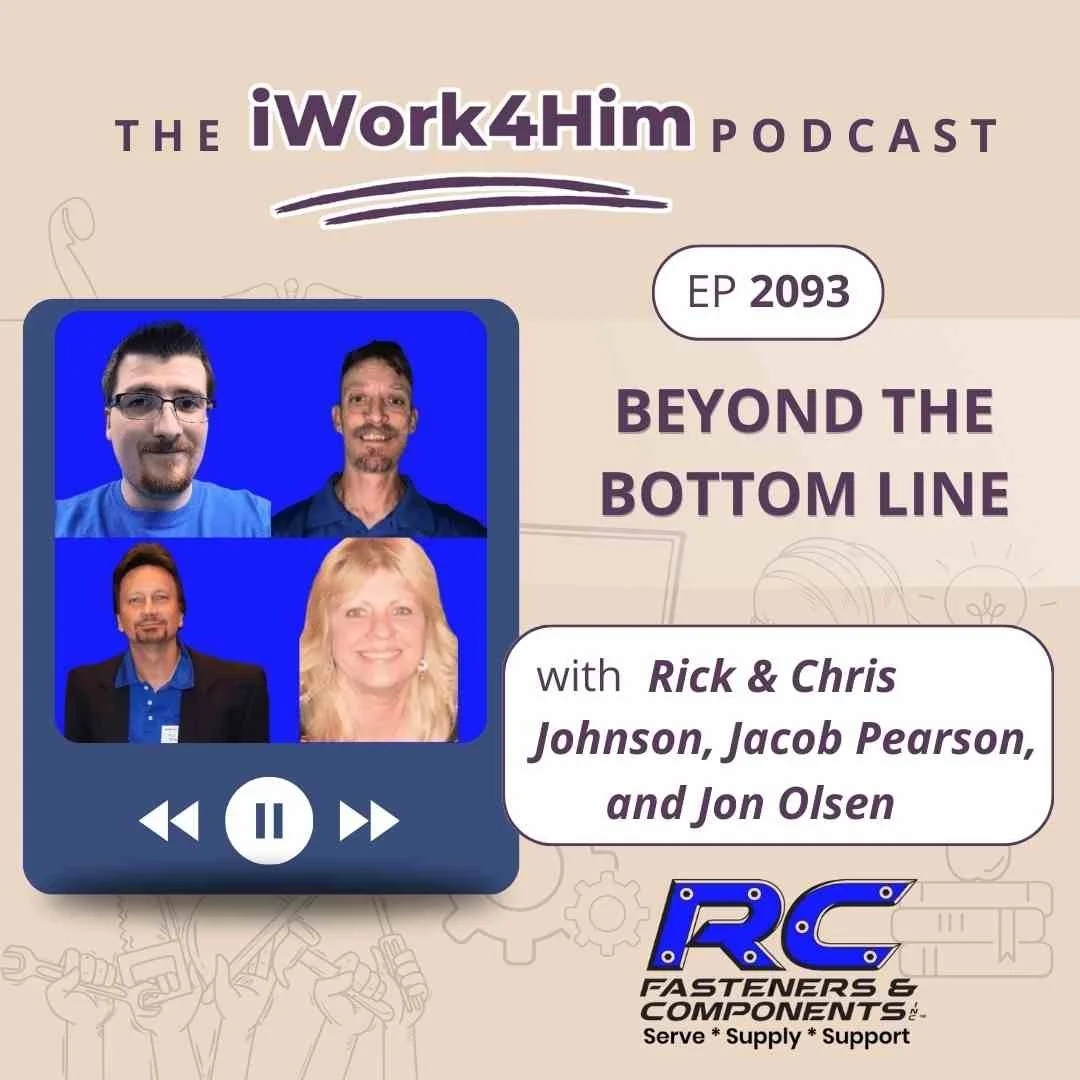
Jim: You've tuned into iWork4Him, the voice of collaboration for the Faith and Work movement. Our mission is to inspire every workplace believer to recognize their workplace as their ministry place, where they work with God every day. What can that look like in your workplace? Let's find out right now as we head off to Arizona.
It's a simple question, really. Can a fastener manufacturer be a chuRCh? We talk all the time about our workplace being our ministry place, our mission field. Can our workplace be a chuRCh, a place to worship, work, heal, and minister? After today's show, you will no doubt answer this question with a resounding heck yeah!
Rick Johnson's life was miraculously transformed by Jesus. Oh, and he runs a manufacturing company with his wife Chris. He's here to tell us his story along with a couple of friends of his that work with him as well, to inspire us all and challenge every one of us to recognize our workplace as a chuRCh place. Rick, Chris, Jake, and Jon, welcome to iWork4Him.
Chris Johnson: Thank you for having us.
Jim: All [00:01:00] right, so I wanna know Jesus stories here. I wanna hear some Jesus stories because this story wouldn't even be possible without sharing our story about what's Jesus doing in our lives. So Rick, why don't you start us off and we'll work around the, we'll work around the room.
Rick Johnson: Yeah. I got saved at a Billy Graham Crusade at 13. And just kinda lived the casual Christian life for most of my life. And then, through a lot of adversity, through losing part of my family, my mom, my dad, and my sister, and in about 11 months just my world got rocked and brought me to my knees and went through a lot of suffering, a lot of hardship, about three and a half years of that.
And in that suffering, man, I learned about a love that was greater than I had ever experienced before. And that transformed my life and we gave everything to God. The company became his and our lives and everything we had, we gave to him. Awesome Story [00:02:00] only that he can do.
Jim: How many years ago was that, Rick?
Rick Johnson: Let's see, that was 2008. And so it's been God's company for quite a while now. And yeah, it's, there's two totally contrasting stories.
Jim: And Chris, when Rick went through that, were you right alongside of him? Was your life transforming at the same time?
Chris Johnson: Yes, at the same time we were trying to take care of everything and that's when I went all in. And then we got baptized too. After that point the whole family did. So we got baptized and he was reading his Bible a lot more and he was listening to worship music and it took him several years to get out of his depression or anxiety, whichever way you wanna call it. But he's all cured and he's been teaching about Jesus the whole time.
Jim: What's fantastic is that transformation impacted your business, didn't it, Rick?
Rick Johnson: Absolutely. It impacted everything, impacted our business, our lives, everything.
Jim: And Jon and Jake, that's why you guys are here today, because [00:03:00] the business that you work within has a culture that I'm guessing is not like any other that you've worked at. Jake, it, how long have you worked at RC Fastener?
Jacob Pearson: I've been at RC about a year and a half maybe, give or take.
Jim: Okay. So it's safe to say you've worked a few other jobs before this.
Jacob Pearson: Oh, most definitely, yes.
Jim: Is this the most unusual place you've ever worked at?
Jacob Pearson: It really is, but it's also fascinating and just the appreciation everybody has for each other is just amazing. We're not employees, we're family. We're family.
Jim: Yeah. So let me just ask this question. Have you ever worked for another business owner that said he was a Christian?
Jacob Pearson: I have in the past.
Jim: Was it different than, I'm not gonna ask you to say names. Was it different than the environment you're working under with Rick? My guess is yes, night and day. And that's what we're seeing across the country. Jon. Now, [00:04:00] how long have you worked for RC Fastener?
Jon Olsen : I think next month it'll be eight years.
Jim: So it's a long time. So you've seen, you've experienced some of this transition. You've seen some of those changes over time. Have you ever worked for somebody else who called themselves a Christian?
Jon Olsen : Not exactly. I actually was very blessed to go from one job with a good boss to RC Fasteners. The other boss I had, he never called himself a Christian. He actually said he was more aligned with Buddhism. So working under a Christian boss, Rick and Chris are the first two.
Jim: Awesome. So you could break them in too and help them in the whole thing. Rick, you told me that you've been in business 22 years. The first half was way different than the second half. Tell us a little bit of that story.
Rick Johnson: Yeah, the first half was just, believing God was with you. But we were doing all the work. We're praying that he's with us with what we're doing and we're striving, working [00:05:00]seven days a week, 12, 14 hour days and everything was striving to make it happen. And really it was God in the backseat coming along for the ride, joining us in our work. And we didn't know any better. We didn't, we really didn't know any better. And after 11 years, we didn't have anything to show for. We had nothing to show for it at all.
Jim: What do you mean? Like you had no money? You had no, what do you mean?
Rick Johnson: Yeah, we really didn't, we were still in debt and weren't able to save any money, and when we went all in for the Lord, that's when everything started to change. So everything completely changed and we started doing things we hadn't done before.
And that was stepping out in faith and moving into a building three times the size we were in. And started serving with a chuRCh across the street, delivering food to homeless pantries and chuRChes. And God was teaching us how to serve, how to serve the community. For six years we did that.
So all kinds of things started changing. God started opening doors for [00:06:00] us, and what we saw is we were now joining him in his work versus him joining us in ours. And it allowed us to take this into - it became a ministry. And we like to say we're a ministry created for God's glory working undeRCover as a fastener company. Our mission is to plant a seed every day because someone's life depends on it. So that's really our mission.
Jim: So Chris, a wife always has different perspective than a husband. And you were living those same first 11 years where Rick's saying, Hey, we had nothing to show for it. What was your frustration level after those 11 years? How deep was that frustration with being a business owner and not seeming to reap any of the rewards?
Chris Johnson: Those were tough years. I got sick. Rick had to start the company without me for several months 'cause I got sick and I was in the hospital. But he kept on saying that God said we would never fail. But after 11 years, we weren't really, we were growing, but not leaps and bounds or anything else like that. But once we [00:07:00] gave it all to God and we had the office all blessed here and everything, we had people come in and anoint the walls and stuff, everything started to change. We started having bigger sales. A lot more companies were coming on board. We've seen changing of lives in the second half of 22 years.
Jim: Sometimes we need help getting our businesses on track, and one of the great ways to do that is to come alongside other believers and join the US Christian Chamber of CommeRCe. At the US Christian Chamber you'll be connected to other faith-driven leaders across the country through powerful events, relationships, and lots of resouRCes available. I encourage everybody listening to join the US Christian Chamber and a local Christian chamber in the state near you. Join the US Christian Chamber where business and Faith thrive together, uschristianchamber.com.
Jake, what I wanna know is, you came after all of these transitions, after Rick and Chris had gone all in and really turned the reins over to, to God for running this business. What attracted you to even [00:08:00] apply for the job?
Jacob Pearson: Honestly, my fiance was climbing all over me 'cause I was a tow driver for three years.
Jim: Okay. Oh man, those are tough jobs.
Jacob Pearson: And about the fourth time I almost got hit, she said, that's it. You're done. I need you to find another job. Like I'm not gonna have you killing yourself. And I said, okay, I understand. And I started looking. And the first thing that popped up on my Indeed was the ad for a warehouse at RC. And I applied and I think it was two days later, I got a phone call from Rick and I spent about, I wanna say a half hour to 45 minutes on the phone with Rick, before I even came in for an interview.
Jim: What attracted you to have that conversation? 'cause a lot of times those kind of conversations can be awkward, complete strangers talking about a job. You're wanting to impress him so you can get the job. Your fiance is wanting you to impress him so you can get off the tow truck. What was it that kept you on the phone that [00:09:00] day?
Jacob Pearson: I was very new in my faith. My fiance and I had just got baptized at North Valley ChuRCh here in Phoenix, and I was looking for a company that was more structured Christian- wise , so I could have Sundays, I could have time with my family, I could have my time to dedicate to the Lord the way he deserves. And as I was growing in my faith, that was a real integral part of my choice.
Jim: Wow. And when you went in for that interview, how could you tell that yep, this is the place I wanna work? 'cause it's one thing to get offered a job, but it's the other thing to accept the job. 'cause you weren't just looking for a work, you were looking for a real change of environment. 'cause tow truck drivers get treated not very great by the customers and by their bosses because you're working night and day in the most dangerous places, some of the most dangerous places on the planet.
Jacob Pearson: Very true. The first day I walked into RC I could already feel a difference, just the energy in the building. You knew that there was [00:10:00] definitely something there and we went in, sat down for the interview, and the overall interview was about 20 minutes. And then I think we spent about the next hour talking about the Lord and the word. And I said, you know what? I need to be here. I feel it. I need to be here. But all glory to God, they gave me a job offer and I've been there ever since.
Jim: And I understand that, so you're in charge of the warehouse and quality assurance. I understand the Warehouse has very unique wallpaper.
Jacob Pearson: Yes we have a board that we write God's miracles on, things that happen throughout the day, whenever it may be, whether somebody survived cancer or somebody had a baby, and we chart everything down. We date it, pretty much timestamp it. And when it's full, we tear it off and we tape it up on the wall in the warehouse.
Jim: That's really cool. Very cool. Rick, when you look at the biznistry that you're in - hats off to Chuck Proudfit outta Cincinnati, Ohio who patented or copyrighted [00:11:00] that word, biznistry -when you look at your biznistry RC Fastener, what's your ministry look like to your employees?
Rick Johnson: I think they know that this is God's company and they know that when they come here, they're gonna get edified, they're gonna get built up, they're gonna be told that there's value in you, there's treasure in you, and God wants to bring that treasure out.
So it's much more than, it's much more than a job or anything like that. It's really truly investing in your best asset, and that's your people. And when you invest in your people, we like to say, God told me, I felt it in my spirit those first 11 years, Rick, you got this all wrong. You've been going after the fruit these last 11 years, and you're chasing success. You're chasing money, you're chasing growth. You're doing it all wrong. You need to go after the root, which is people. Which is me, seeking me first with all your [00:12:00] heart.
Jim: I heard that one other place... seek first.... (laughter) there's a verse about that!
Rick Johnson: Matthew 6:33. And then when we started doing that, really investing in people, then he started taking care of the fruit. So that's when things became a little, a lot easier.
Jim: A high level of intentionality for sure. Chris, you've got file cabinets in the background. Everybody's, if you're not look watching us on YouTube, you should go out to our YouTube channel - iWork4Him. That's I work the number 4 him and check out all of the videos. Every interview we do is also video as well. So it's on the podcast streams all over the place, but also on video.
So Chris, you've got file cabinets and purple walls. But that makes me think you're doing, you're paying some bills 'cause you're, that's your filing system. You're paying some bills, you're dealing with suppliers, vendors, you're dealing with those kinds of people. What does your ministry look like to them?
Chris Johnson: To our customers?
Jim: No, let's talk about to the people that you pay.
Chris Johnson: All the people that we pay. Yeah. Some of them are Christians, some of them are not.
Jim: So what's that ministry look like?
Chris Johnson: It all depends. You have to feel the people out. We always tell everybody, [00:13:00]God bless at the end of the day, or when I see customers and everything, and once I know that they are somewhat on the fence and everything, I talk with them about Jesus and we go from there. So it gets started slowly and when we go out on the road, now I have my Christian friends out there, so we talk about it. We even pray about certain things, when I'm out at a customer's place. So to go ahead and take care of problems, because problems always arise. It's a joint venture.
Jim: So Rick, though, that ministry goes deeper to your suppliers and your vendors, because sometimes without suppliers, your vendors, you can't work. You need what they're selling you. What does that ministry look like to you as a business owner? And you're muted. So don't answer me till you unmute, but what does that look like? Because there's opportunities for lots of interaction with those people.
Rick Johnson: You're talking about, you're talking about the customers or who?
Jim: No, the vendors, your suppliers, the people that give you the stuff you need in order to be able to sell it to your customers. I'm gonna ask Jon the customer [00:14:00] question.
Rick Johnson: Here's a prime example, is we get tested on our integrity a lot. And Proverbs 11 says, a false balance is an abomination to the Lord.
So there's a lot of times where we will get tested where a supplier will over ship us. A pretty recent one was we had a supplier bill us for a thousand dollars and we called them and we said, Hey we need to talk to accounting. And so they patch us over and, yeah, what do you need? What do you need? We're like, Hey, we got a problem with an invoice, and Oh, what's the problem? What's the problem?
We're like you billed us for a thousand dollars on this invoice. She goes, yeah, that's correct. You should have billed this for an extra zero, 10,000. And she like dropped the phone and she got back on the phone and she said, do you know, first of all, in all my 40 years of doing this, I've never had anybody call with something like this.
And we would've never caught this, if you wouldn't have told us that. So Jim, these are, and Jake and Jon and [00:15:00] Chris can, everybody can tell you story after story where we're calling our suppliers and saying, Hey, your warehouse made a mistake. They over shipped us. We talked to purchasing, we'll keep the parts. Go ahead and bill us for em. And we see those as little tests of integrity.
And we are gonna honor God. 'cause his grace is upon this company and upon our lives. And we want him honored and he gets glorified. 'cause people, they look you up on your website and they see what you're about. And they go okay. All right. I get that. And I have the employees call now. So the employees call when there's over shipments and they get to taste of what responses the suppliers will come back with and. Many of 'em are blown away.
Jim: I'm sure they are. I'm sure, it's hard to keep track of things. And especially about all the background details of running a company. And allowing others to do what they do best can help us stay focused on our main priority. SaferNet is what iWork4Him relies on as a critical component for everything [00:16:00] keeping on track for us, because of their background stuff that they do - the VPN that we operate within to keep people from seeing where we're at on the internet so nobody can get into our computers, their virus protection, their internet controls, all those things in one place help keep iWork4Him on track, protected, and safe.
We recommend that to every business owner out there. SaferNet.com. It's affordable, it's reliable. And just let 'em know that iWork4Him sent you to them.
Alright, so Jon, customers are the other side of it. And since you're in charge of inside sales, which means you get stuck in an office talking on the phone all day long, but you're developing relationships, what does that ministry for RC Fastener look like to your customers?
Jon Olsen : So for the customer side, anybody that calls on the phone, anybody that sends an email, anybody that sends the fax, anybody that walks in, is an opportunity to share the love of Jesus with that person. We do get a lot of walk-ins. A guy [00:17:00] comes in, he's Hey, I got this old screw a need for my lawnmower. Can you supply it for me?
We say we can try, if we got it, we always try and help. That's the first thing. We have Christian music playing, so while they're sitting in our lobby waiting they get to listen to Christian music. We have a whole table full of Christian merchandise and books, even little gospel Bibles that they can go through and look while they're just sitting there waiting. So they have all that information at their fingertips when they come in.
Jim: But what about when the customer transaction doesn't go perfect. How does RC Fastener stand out? You, I know you handle things differently. What does that look like when, hey, you've got a customer situation and it didn't go perfect. There's no blue ribbon on the top and there was no candles blown out and candy attached to the - what, what happens, what do you do? How do you handle it differently than a typical fastener company?
Jon Olsen : Shoot, we try and fix it. I should say we've been trying for many of those exact situations where let's say we made a mistake. Let's say something went wrong [00:18:00] on our end, we'll be like, Hey, we're sorry we messed up. We made a mistake. Let's fix it. And we've air shipped parts on our dime to get customers out of trouble because of a mistake we made. We've had parts worked, even stuff that's not our mistake. We have bent over backwards to help the customer for no reason other than we want to help them and we want to get them out of trouble.
There was an example, I remember there was one a few years ago, a big customer of ours that was in trouble. Like they needed parts like within a week. And their customer, who is a giant automotive manufacturer, was copied on all this, and they were saying like, you guys need to get this fixed, even though it wasn't our fault.
And we prayed about it and Rick was involved and he went to our vendor and he's Hey guys, what can we do to get our customer outta trouble and after praying about it, that's the main, that's the key thing, is after praying about it, the vendor's Hey, we have [00:19:00] one other guy that buys this part.
We're gonna go see if they have any extra stock laying around. Lo and behold, the next day they come back and they're like, Hey, this other guy who's the only other person that buys this specific part, not only has parts but is willing to give them to you and ships 'em back to us, we get the customer out of trouble. They're super happy.
And I'll never forget, Rick had written an email and he said, Hey, we prayed about this and we and God was able to come through for us. He said that to the customer directly. And I'll never forget that. I was like that's the main highlight of what we strive to do is to honor God with how we present ourselves, especially when things don't go right.
Jim: Because things are not gonna always go right Rick? They're gonna have trouble.
Rick Johnson: Yeah. I wanna jump in on that story a little bit because I was defending in the email, this was to a very big car manufacturer, and I was defending our stance. I'm writing [00:20:00] this email, I'm going to town, and I'm saying, we're not at fault, and I just felt God stopped me in my spirit and to tell me to erase all that.
So I erased it all and I said, we're a company of faith and we're praying for a miracle. And I left it at that and I shot the email to him because I remember God saying, I will get justice, says the Lord. And so I did that, and then that's when the miracle happened. If I would've went in there and kept defending and defending - God is our defender. And then that's when as Jon mentioned, that's when we were able to come back and we were able to boast about what God did.
Jim: Oh, that's awesome.
Rick Johnson: And that person did not reply. There was like seven people copied on that email. But I'll tell you what, this one girl replied back and she said, I love it. I love how God came through again and we were [00:21:00] praising God together, just her and I. But it was super cool.
Jim: I love that. Jake, I'm guessing 'cause you're working in the warehouse, not everybody that you work with is a Jesus follower. And typical people working, not to stereotype, but typical people working in a warehouse, maybe a little bit more of the rough and tumble types. How do you keep it different?
Jacob Pearson: We did have an individual with us that wasn't a true follower, I would say, or at least I didn't see him as such by his actions. But there's three of us out there and we are very faith driven there. There's no doubt about it that all three of us out there are men of faith. So in other work circumstances, yes. I could say there's many people I work I've worked with that weren't followers, but that is not the case at RC.
Jim: But how did you encourage the one that was struggling a little bit? What did you do to encourage them? Because not everybody's gonna be at the same step of their faith walk as others.
Jacob Pearson: Oh no. [00:22:00] Everybody's walk is different. But he did have the amount of faith where you could walk up and say, Hey man, do you mind if I pray with you for a minute, or do you mind if I read you a verse? And he would listen. He'd pray with you, he'd listen. He was going through some struggles and definitely needed to change his circumstance, and needed a lot of prayer. But it's one of those things that he needed to go figure out where he wanted to be.
Jim: Chris, I imagine you're in charge of payables and receivables, am I correct?
Chris Johnson: Correct.
Jim: Okay, so payables one of those things. How do you glorify God with your payables?
Chris Johnson: That's a good question. We go ahead and we are integral. If they over ship us, I go ahead and pay the over shipment part, contact the vendors and, tell them that. Hey, like we just had one on some bolts from one of the customers and then we ordered [00:23:00] 300 and they shipped us 310 and they were $30 a piece.
So we called them and told 'em and I went ahead and just told 'em that I was gonna pay off the bill. I told 'em that I trusted them and they didn't need to send me a revised invoice that I'll go ahead and just pay it off, the old one, and just pay the current charges and they were really appreciative. I even gotta Thank you email today from them that it took a while for them to get it, but they said they were really appreciative.
Jim: But a lot of times when we have bills that we owe vendors and they're 30 days net or 60 days net or whatever, and a lot of times I find business owners stretch out as far as they can before they have to pay their bills.
Chris Johnson: No, I'm 30, 35 days allowed. The most I've ever gone is like 45 days and that's because we've had issues with the vendor and so we're trying to get it resolved, but I'm pretty, pretty much 35 days, you're paid. I like to, because I want to have our credit rating and be [00:24:00] integral. And I've dealt with people who stretched their money out.
As far as receivables, we have customers that our terms are net 30 days, but they pay at 45. Some of 'em paying 60, but at 60 days from invoice, I'll put them on hold and they won't get off hold until they pay their bill.
Jim: But that's one of those tough things. 'cause you're a Jesus follower. You're supposed to be nice, you're supposed to give 'em a break, but you're actually trying to collect your receivables. How do you balance that? Hey, you need to pay, we gave you something. And balance that with the Jesus approach.
Chris Johnson: I try to, when they hit 45 days, I go ahead and start sending emails, start doing phone calls, and I'm really polite about it. And then I also tell 'em that at 60 days the computer puts you on hold and there's nothing that I can do. And you'd be surprised how quickly when a customer needs parts and they're at 60 days and they're on credit hold, boy, that money comes [00:25:00] really fast.
Jim: Oh, it's miraculous money. (laughter) Rick, we're almost outta time, but I wanted you to be able to speak to your manufacturing friends. I don't know what category you put yourself into, but you use supply parts, you get parts. Do you guys fabricate stuff too, as well?
Rick Johnson: No, we're a distributor. We're a wholesale distributor.
Jim: All right, so speak to those other wholesale distributors out there that love Jesus, that never, ever imagined saying, Hey, this is God's company, not mine. Speak some words of encouragement to them listening today.
Rick Johnson: Yeah, I think that's everything. Jim, it's really, truly is everything. It's God is, he's in our lives every day. He's with us every day. But we're usually the ones running the show. And it's totally different when we spend time with him. Every morning we spend time with him, we put up the armor of God on in the morning we're in His word and his prayer.
Lord, direct me, I commit my works to you, ask that you direct my steps, my thoughts, my [00:26:00]actions and it's totally different. And then you're waiting on him to lead you and guide you through the business. So my message is if you haven't surrendered your company to the Lord, what are you waiting for?
Because everything is his it's his company. It's his money, it's his, everything is his. So that's where I was - I didn't know that. I didn't know these things in the first 11 years. And when we gave it all to the Lord, that's when everything changed. So being totally in debt the first 11 years and being debt free the last 11 years, and then at the same time doing ministry and being able to pour into people's lives, it doesn't make sense to the normal world, the normal manufacturing world.
Why would you invest in these employees? Why would you spend time in ministry? Why would you do Bible studies on Friday? Why would you do FCCI on Wednesday? Why would you do these things? Why do thankful Thursday? What? Why? It's because God has called us [00:27:00] to, and we've seen transformations happen here.
We've seen, we could go another couple hours, at least, Jim, and tell you about miracle stories, people's lives that were doomed, that were suicidal that God has completely transformed and there's no greater joy when God is using you in his company and you see the fruit from that, the fruit from your labor, the fruit from pouring into people, and you see what God does in their lives and then they take that home to their kids.
If they take it home to their wives and you start to see their wives, you start to see their family start to transform as they start eating the fruit from that. And it's awesome, Jim. There's nothing greater. And I want to tell you, it's just, it beats working for a living when it's God's company and you're working with him.
Miracles daily and we do, we see 'em. As Jon was saying, people coming in off the streets, it's an opportunity. We pray for opportunities to be able to minister to people. We will, we'll pray with our customers. We'll pray with our [00:28:00] suppliers whenever there's a need.
And it's just awesome. It's transformational. And if you're not using your company, if it's not God's company, surrender that to the Lord and watch what he does. Watch the peace and the joy that'll come over you as he leads you and guides you to really use your business as a ministry.
Jim: Cool. Jake, speak to those warehouse guys out there that are listening today that don't usually get very much encouragement to live out their faith. Speak to them for a minute.
Jacob Pearson: If you guys aren't chasing God and giving it your all and that first, then you're just doing it wrong.
Chris Johnson: Amen.
Jacob Pearson: My life has totally transformed since I fully gave over. And I have Rick and Chris and everybody at RC and everybody at church that's like family to me. And my life is a hundred percent for the better. I'm happy to go to work. We have fun, we work hard, we play hard. But to come in every day to a place where you see everybody smiling and the first thing they say is, Hey, good morning. And give you a hug. It's gotta be faith first.
Jim: [00:29:00] Very beautiful. Jon, you're in sales, you're talking to people all the time, and you need them to buy stuff from you to pay your bills. Talk to other salespeople out there that are trying to change the world at the same time living out their faith.
Jon Olsen : I wouldn't say you need to separate it because you don't. It's where's your focus at? If your focus is on making money, then you're not, like Jake said, you're not doing it right. If you're focusing on loving your neighbors, who is anyone that you come in contact with, anyone that enters your sphere of influence, that's your neighbor.
It doesn't matter what you're doing, whether it's sales, warehouse, accounting, running a hotdog stand, whatever, can be anything. If you're just there to love your neighbors and help 'em because you want to and because you know the Lord God who created you said to do that, then it completely changes the dynamic.
It's totally different than just I'll sell you fasteners. Yeah, whatever. Selling fasteners is the [00:30:00]same as selling anything else. You're just trying to sell it. But if you are doing it in a way that can glorify God, holy mackerel, is that a game changer. It doesn't matter.
Jim: Speaking of game changers, Chris, most bookkeepers, most accountants, they're in the background. Nobody talks to 'em. People forget they're there, except when they want a bill paid or they want a paycheck. Speak to those people that are behind the scenes. People out there, Chris, that, that are doing the payables, doing the receivables, probably doing the payroll and everything else. Give them some encouragement today.
Chris Johnson: You go ahead and put God first in your company, in everything that you do. Accounting is not really a glorified job without having Christ in the center of the of the work day. But when I have a problem and I can't solve it, I always say a prayer. When I'm trying to balance our accounts and they don't balance, it's God, please tell me or help me go ahead and balance. And then all of a sudden I get a popup in my head [00:31:00] and the problem is solved.
Jim: When you get a popup in your head, does it make a noise? (laughter)
Chris Johnson: No, but it's somebody talking to me and say, Hey, check this out, or not check this out, but go ahead and see where this is. And then I go ahead and follow what they tell me in my head and 99% of the time I balance or I solve the problem or things like that. It makes it really easy when you put God in the center of everything.
Jim: Very cool. Rick, any final words?
Rick Johnson: I'm just so proud of these guys. I'm proud of what God's doing in their lives. Everybody on this screen, I love 'em dearly and just so thankful. All of us are transformed. We've seen God do amazing things in our lives, in this business, and, Jim, I don't think it would've happened if we didn't give him the business, if we didn't surrender to him.
And these last 10 11, 12 years have been I know my wife and I have been the best years in our [00:32:00] lives because we've seen God use a business for his glory. And these guys on the screen, Jon and Jake I can't tell you and Chris, I'm just so proud of them the way they first came into how they are now.
I've seen the before and after, and it's just a privilege and an honor to see these young men and my wife and the way they handle things differently now. They handle it with peace and joy and they don't, they're not taking gasoline to the fires. They're taking water to the fire.
We have fires break out here all the time and they're with customers and people in trouble. And my wife is a prime example. She handles accounting so beautifully now. It wasn't always that way. And then she would get easily upset because there's some people that are tough to deal with, but I just praise God for these guys and our entire team. And I thank God with all my heart for what he's done in their lives.
Jim: It's a great story and there's lots more out there, to read about this story on their website, RC Fastener.com. And if you need some fasteners, I think you ought to check 'em out. They could ship to anywhere in the US I imagine, RC Fastener.com. [00:33:00] Rick and Chris, Jon and Jake, thanks for being on iWork4Him today.
Chris Johnson: Thanks, Jim. We appreciate it.
Rick Johnson: Thanks for having us, Jim.
Jim: You've been listening to iWork4Him with your host, Jim Brangenberg. I'm a Christ follower, my workplace, it's my mission field, but ultimately iWork4Him.
4/30/25 - 2092: 365 Days of Impact

Jim: You've tuned into iWork4Him, the Voice of Collaboration for the Faith and Work Movement, and our mission is to inspire every workplace believer to recognize their workplace as their ministry place where they work with God every day. What does that look like in your workplace? Let's find out right now.
World changer. When Blake Mattocks was growing up, that was not the way he would've described himself with a quiet, sensitive demeanor and a pastor's heart for people. That's who God has transformed Blake Mattocks to be, literally a world changer.
Seven years ago, Blake launched a brand new ministry called 365 Christian Men. Five years ago we covered it here on this podcast today. The reach of the daily inspirational and challenging videos of 365 Christian Men have a reach that spans the entire globe with 8 to 10 million people interacting with these videos every month.
Unbelievable for a guy who just wanted to serve and make a difference. 365 Christian Men is at a crossroads. Will it go forward [00:01:00] or leave a legacy for someone to pick up and run with it? Either way, Blake Mattocks is here to tell us his story and inspire us all. Blake, welcome back to iWork4Him.
Blake Mattocks: Jim, can you do that again? That was so good. You should be on the radio.
Jim: It's recorded. You can listen to it as many times as you wanted to.
Blake Mattocks: Man, that was something else.
Jim: Blake, when you shifted from pulpit ministry to running a business called 365 Christian Men, what were the thoughts going through your head? Besides, what the heck am I thinking? Besides that one.
Blake Mattocks: That first and foremost, that was it. I had no idea. Construction background, pastoral ministry, had no idea what this was gonna look like. So it was a complete step of faith. Trust God. You have to lead, God. You have to show me every step of the way.
Jim: Were you a finished carpenter?
Blake Mattocks: No, I was a brick layer.
Jim: Ah, okay. So the attention to detail, that's where I was going. Because a general contractor who's a framer, that's one thing. You've got an attention to detail that I [00:02:00] rarely see because 365 Christian Men is such a detailed ministry and a brick layer makes sense because a brick layer needs to make sure everything is square, plum, and level at every level of brick. Because otherwise, as things get off, that's how you get the leaning Tower of Pisa.
Alright, when you shifted to 365 Christian Men seven years ago, were you ready for the challenges and the victories that you've experienced?
Blake Mattocks: Yeah, that's a great question. I don't know. I think I was ready for the challenges because I like to take on a challenge, but I think I had no idea because the learning curve for me was pretty huge. I was stepping into something I've never done before. So along the way of trying to figure this thing out, I had to learn and teach myself a whole new skillset.
Jim: So let's talk about 365 Christian Men. There's a lot of people that weren't listening to iWork4Him five years ago, and they're listening today. They wanna know, what is this all about 365 Christian Men? Give it to us in a couple minute summary.
Blake Mattocks: Yeah I [00:03:00] think starting with the vision is important. Hebrews chapter 12:1 says, we're surrounded by a great cloud of witnesses that have run their race. We know in fact that today we as believers are running our race. And so the man that had the vision for this, he and I sat down seven years ago and he said, I want to inspire my four sons to run this race and I want to do it through the power of story. Let's do that.
Let's dream about what that would look like, and I wanna write short stories about real men, primarily historical, but also modern day men. And I want them to be short. I want them to be single event stories. I don't want them to be autobiographies or biographies. So that's where we started in June of 2018. That's what we started. That conversation started it all.
Jim: And we picked up that conversation in 2020, covid year, as you were still putting together the 365 videos, and now you've gone, how many individual stories have you written up today?
Blake Mattocks: We have one story for every day of the year. We have a few others [00:04:00] that are compiled that have not been launched yet, and we have a hundred stories of women that have been recorded and written but have not been narrated yet. So we have quite a, we have quite a library. We have a story for every day of the year, and we have a brand new challenge for every story, for every day of the year. So that's brand new content, 365 days a year.
Jim: And that's what's been fun. So not only as iWork4Him had the privilege of covering what God has been doing through you, you invited me to start recording a challenge or two a month. So in other words, we listen to the video for the day and then some guy like me gets to put an opinion afterward or just share a little bit of perspective on that story to drive it home a little deeper.
Blake, the stories that you have chosen and the challenges that you guys deliver, talk about impact. What are you seeing? What are you hearing? Actually, probably it's what are you hearing?
Blake Mattocks: Yeah, how much time you got? Seriously, the impact of these stories - what we did is we hired professional ghost writers [00:05:00] to write these stories, and what we said was, we want you to find a single event in a man's life that will inspire men. Our tagline is inspirational stories of real men. And we didn't want the polished stories. We wanted the stories with the bumps, the bruises, the scars, the warts and all, everything in between.
And so these stories, when men listen to them today, they can identify with those stories because we're all running the race and we're all messy people and we all struggle. And so these stories, whether it's a story about addiction or whether it's a story about some kind of anger issues or any other number of things, men relate to these stories.
Jim: They do and every story, and they range in time but from five to seven minutes, they get emailed out to you, they get texted out to you. They are on your website. They're powerful stories, and it is just about one event that transformed that guy's life. Talk about transformational. I don't know, Blake, have you checked out the US [00:06:00] Christian Chamber yet?
Blake Mattocks: No, I have not.
Jim: I wanna invite all of you, including Blake Mattocks, to check out USchristianchamber.com. The economy of this country should be under the influence of Jesus Christ and the US Christian Chamber is there to inspire marketplace focused people to make an impact on their local community by doing their work for the glory and honor of God. That's what the US Christian Chamber is all about, getting together with other people across the country that wanna glorify God with whatever work they're doing.
That's really "iWork4Him" so they can say iWork4Him every day. I encourage all of you to be become a member of the US Christian Chamber online at uschristianchamber.com. Talk about transformational - there are now 21 local Christian Chambers in 21 different cities across the country now and more in the upcoming years. So it's a lot of exciting stuff going on.
Blake, as we talk about 365ChristianMen.com, I wanna encourage everybody to get out there and get signed up. How do they get signed up to get the daily text like I get? I don't [00:07:00] even remember. I've done it so many years ago. How do they do that?
Blake Mattocks: Yeah, great question. Probably the simplest way to get the text is have a friend share it with a friend, share it with a friend, share it with a friend. But we've got a QR code that people the scan.
Jim: so along the lines of heard it from a friend who heard it from a friend who...
Blake Mattocks: yeah. I'd sing it, but I'm not a singer, but we got a QR code people can scan. Some people prefer the text. They get a daily text. What they don't get with that, they get the daily story and challenge. The app offers a little more content, tells a little bit more about who we are.
Jim: Wait a minute. There's an app for this? Unbelievable. And it's just 365 Christian Men, both Apple and in the Google store? Wow, that's fantastic. So now you've got no excuse. If you wanna inspire the men in your life, 365 Christian Men, there's an app for that.
That's unbelievable. Okay. All right. I'm excited about this. You guys, I've been able to be a part of this personally, which I love. And I've also walked alongside Blake as a friend for several years, and I've seen how God has just continued to do incredible things. We're gonna talk about that in a minute.
Blake, what's been the biggest [00:08:00] challenge for you personally for running this 365 Christian Men organization?
Blake Mattocks: I'd say probably a couple things. It's very demanding. It takes a lot of time. We hire contractors when we have specific work that we need done, but it's a lot of work. All of this content is created new monthly, and it all has to be uploaded. It all has to be worked into the program. So there's a lot of work.
And then obviously we are, I shouldn't say obviously, but now we're a 5 0 1 C3, we're a nonprofit, and so we're trying to figure out how to create an economic engine so we can feed this machine. And I think that's been personally a big challenge for me because I'm doing this full time and without resources. You know how that is.
Jim: You're not without resources. You have the cattle on a thousand hills. You serve the God who owns it all, so you're not without resources. Those resources just currently aren't being directed to 365 Christian Men, which I would encourage anybody that gets - check out 365 Christian Men in the App Store online. Get this in the [00:09:00] hands of the men in your life and you will see a difference because we are all, the reason iWork4Him even exists, Blake Mattocks, is because I kept hearing stories of God doing miracles and incredible things in the lives of believers out there in the marketplace and the workplaces of America.
And I'm like, we need to share those stories because we're all inspired by faith stories. 365 Christian Men is all of those stories delivered on a daily basis. It's a daily podcast just with somebody else talking, not Blake Mattocks, although Blake Mattocks does some of these.
Alright. If the biggest challenge has been raising money and really working really hard to get it all done, all the moving pieces, and you're working with translators and how many different countries are you working with different people right now?
Blake Mattocks: We're translating into four different languages, but we're in over a hundred countries.
Jim: But as part of your team, like where are the people from? Like, how many different countries are, is your team in?
Blake Mattocks: Specifically right now, five. Five to seven?
Jim: Yeah, five to seven. There's a little different cultural differences maybe on five to seven different people. All right, so the biggest challenge is some of that organizational [00:10:00] stuff and the money thing that God's already got taken care of and saying, Blake, would you just chillax, seriously? If I want this to move forward, I'm gonna give you the money. And I'm thinking it's maybe a big partner that says, holy smokes, this is incredible. I'm gonna take this to the next level.
What do you think the biggest victory's been, Blake?
Blake Mattocks: I think the biggest victory is the testimonies that we hear of transformed lives. I got an email two weeks ago from a pastor in Africa. He is from Mombasa. Near Kenya. And every day he gets up, he came across 365 Christian Men on Spotify. We have 33,000 followers on Spotify. He must be one of them. And he found that on Spotify, started listening to it, started letting his sons listen to it. And now every day before they go to school, they listen or watch a 365 story. The testimonies, hands down, are the most impactful thing.
Jim: And even if it was just one person being impacted, but it's not just one person - at a meeting we were recently in, you shared that on a monthly [00:11:00] basis, how many people are being impacted by 365 Christian Men?
Blake Mattocks: On a conservative level, 8 to 10 million.
Jim: That's unbelievable. And that's eight to 10 million men, probably almost all men. So then think of the families. That could be eight to 10 million families, which quite literally could be somewhere between 40 and 50 million people that are being impacted because of 365 Christian Men.
Did you ever even think seven years ago, gosh, I think we wanna impact about 50 million people or so. What were you thinking? What did you think your reach would be?
Blake Mattocks: Now we, we thought that this would be a US based thing. We thought we would check the box, we would do an ebook or print on demand. And we'd have a little bit of a footprint, somewhere in the USA. That is where we, that was the extent of our thinking. And then it started to take off. Really, the project was planned to be a two year project. We're gonna start in 2018, be done in 2020. But because of the tidal wave, we kept [00:12:00] riding the wave and kept watching God do more and more.
Jim: So that's clearly one of the miracles is God just did way more than you could have asked or imagined. There is a Bible verse like that. All right. No, I have not had that much Mountain Dew. This is just me. I'm so excited. All right, so talk about miracles. Is there a specific miracle that has spun out of 365? And I'm not gonna talk about you personally and you and your bride personally, those miracles we're gonna talk about in a second. A miracle that you've heard about because of this ministry?
Blake Mattocks: I'll tell you about one that I heard about. About six weeks ago a woman in India was in her home and the video was being broadcast into her home through Hosanna tv in her native language of Tamil.
She was getting ready to kill herself. She was being abused in her home and she was getting ready to take her own life. The story came on, and I know this because the woman who oversees the ministry knows this woman personally, shared this. She was [00:13:00] getting ready to take her life. She watched the 365 story.
She got on her knees, recognized that the God who created her, loved her. She gave her heart to Christ, and now she works for that ministry in Southern India. That was just six weeks ago. In her native language of Tamil, she watched the story, gave her heart to Christ.
Jim: Unbelievable. And that makes it all worthwhile, doesn't it, Blake?
Blake Mattocks: Oh, that is it right there. That's what it's all about.
Jim: You and Melinda have walked together for how many years now?
Blake Mattocks: It will be 42 in June.
Jim: 42 years. How have you kept your marriage strong while you're working your butt off for 365 Christian Men? You were a pulpit pastor too, so that's also one of those sort of demanding jobs. And you're a bricklayer. That was probably demanding, but that you went from bricklaying to being a pulpit pastor now to 365. You've had some demanding years. How are you keeping your marriage straight?
Blake Mattocks: [00:14:00] I think your bride better be your best friend, and if they're your best friend, you're gonna wanna spend time together. It's not about having to spend time, you're gonna wanna spend time together. You gotta prioritize that. Eventually the kids are gone and it's you and her. Or you and him, and you better have built something that's gonna last.
Jim: For those of you listening that still have your kids living at home, when they're in their twenties or thirties, you heard what Blake said. Eventually the kid should be gone. They're not supposed to still be living at home. Help 'em get into a house or out of your house is one of those things. Or start charging them rent and they'll leave naturally. It's just one of those things.
All right. Speaking of things you should do naturally, you should protect yourself on your computer, shouldn't you, Blake? SaferNet is like the best tool ever out there. It's got a VPN, so it keeps you from being able to be seen on the internet. It's got web filters to keep you from looking at stuff you shouldn't look at. It's got antivirus to keep the bad guys from putting garbage on you. And what I love best is this console, so you could put it in a whole company and watch what everybody's doing and keep people from going places they shouldn't go.
[00:15:00] And the miraculous thing is, if you click on a link you shouldn't click on it, it takes you to a place that you don't want to go, Safernet will stop it. Get it on every one of your computers. It's super reasonably priced. It's super powerful. SaferNet.com.
Blake, what are you facing today? 365 Christian Men is at a crossroads.
Blake Mattocks: I'd say we're at a crossroads for this reason. So in July of last year, we transitioned from an LLC to a 5 0 1 C3. So we're trying, as I said a few minutes ago, to feed this machine. I felt like going into 2025 that the vision God gave for this year was reach more, write more, and transform lives. And so we had been praying, our board has been praying into that vision.
And even more recently, in the last five weeks, I felt like the Lord challenged me to put together a 500 people challenge. And that is, that's where we're at right now. Reach more, write more, transform lives. And this 500 people challenge that's going to help us [00:16:00] to generate some revenue so we can create new content, give stories away, and translate into more languages.
Jim: And impact instead of eight to 10 million, 800 to a hundred million, 800 to a billion people. That's my goal.
Blake Mattocks: Yep. Get this Jim. In India, the majority of the people in India speak the language of Hindi. About 80%. Our ministry partners that translated our videos into Tamil can translate our videos into Hindi. Forget ai. We're gonna use local people on the ground so we can support people for $30 a video. $30 a video, we can translate it correctly into the language of Hindi. The audience in the Hindi language, including India, Europe, and Australia, is 40 to 50 million people, and that's just one language. We can translate those videos for $30 a video. [00:17:00]
Jim: It's unbelievable. And I'm just, on this show, we don't ever ask for money. But what I'm saying is I believe there's somebody here in the iWork4Him audience that's been looking for a challenge, and when you see the material that 365 Christian Men's been putting out there, they need a partner. They need a business person that's saying, I wanna get behind this challenge. I wanna help get this impact to more people.
Blake, we know people around the world and we know that there is a huge move of God all over the globe, not to mention our own country, which is actually gonna celebrate easter. I know the show's gonna come out just after Easter, but our country celebrated Easter from the White House this year. Praise God. Unbelievable. So you need, if somebody wants to partner with you, if somebody wants to talk to you personally or somebody wants to just get ahold of you, the best way on 365 Christian Men, is there a Contact us page?
Blake Mattocks: Yeah, there is a Contact us page on the website. My email is there, Blake, at 365ChristianMen.com. We're on all the streaming platforms. We've got an app, we are reachable, [00:18:00] we're on LinkedIn, we're on all the, all those platforms. So I'm pretty easy to reach. We have a YouTube channel.
Jim: Nice. And it's just unbelievable. Blake, when you look at where God is taking you from and through a step of obedience seven years ago where God has taken you to, what blows your mind the most?
Blake Mattocks: Oh man. I would say what blows my mind the most, if I could answer it with a short answer, would be the faithfulness of God. We know scripture tells us that God, when we delight ourselves in him, gives us the desires of our heart.
A lot of times we don't even know what those desires are, but when we focus our attention on God, he will align his plan with what our desires are, whether we know them or not, and you'll get in the flow of what God is doing in your life, and you will find that sweet spot of what God's created you to be and to do.
And I think that's where I'm living today is just saying, [00:19:00] God, I wouldn't have picked this. You could ask me to do 500 things. This would not have been anywhere on that list. I. And yet I get to hear every day about lives being changed and transformed. It's hard to put into words.
Jim: It is hard to put into words and it is amazing that you just summarized your biggest need to just continue to rely on the faithfulness of God. He always delivers when he's called us to do something, but it doesn't mean that it's not gonna stretch us. You often hear, Blake, that well, God never asked you to do something that you're not capable of doing.
Oh no, he does it all the time. That's where faith comes in. And Blake, he's put before you a vision that is absolutely impossible for you to do. Impossible. But with God, all things are possible. Again, another song I think would be great. All things are possible. Okay. Wow. Great song.
Blake, I love that you brought this to our audience today. I'd encourage every one of you listening, get 365 Christian Men onto the iPhone, an Android phone, or whatever you got. I don't think those are the only two kind of phones you got out there. Get the app on [00:20:00] there, get it delivered to 'em on a daily basis. Watch their lives start to be impacted by stalwart men of faith who have screwed up, some of 'em have just screwed up and then became Stalwart Men of Faith. It's just super inspirational.
Blake Mattocks, do not give up. Keep praying for that person that's got a bigger vision than you to join alongside of you and those 500 people that are gonna be a part of changing the world. Blake Mattocks, thanks for being on iWork4Him today.
Blake Mattocks: Thank you, Jim. So good to be with you, my friend.
Jim: You've been listening to iWork4Him with your host, Jim Brangenberg. I'm a Christ follower. My workplace, it's my mission field, but ultimately iWork4Him.
4/23/25 - 2091: Choosing a Kingdom Company

Jim: You've tuned into iWork4Him, the Voice of Collaboration for the Faith and Work Movement. I'm your host, Jim Brangenberg. Our mission is to inspire every workplace believer to recognize their workplace as their ministry place where they work with God every day. What can that look like in your workplace? Let's find out right now.
Not all of us will have this opportunity, but our guest today could have retired to experience the American dream of retirement, but she chose a different path. She chose to eliminate the job that was causing her stress, and she moved her skills to a kingdom company with a kingdom purpose so that her paid work legacy would end on a high note.
Is this for everyone? Obviously not. But for Sue Wilson, the choice was a no brainer. Sue Wilson is a long time member of the iWork4Him board of directors and serves as our treasurer. Sue's here today to share her story and encourage all of us to never give up. She's also my sister. Sue Wilson, welcome back to, iWork4Him.
Sue Wilson: Thank you.
Jim: I like call her my squeezy sister. I call her many other things, but some of them will not go published today. All right. But [00:01:00] she's my favorite sister.
Sue Wilson: And your only sister.
Jim: Oh that. All right, so Sue, you could have retired. Why didn't you just check out and live the retirement dream?
Sue Wilson: I had a passion that I wasn't done yet, that God had more for me and that I wasn't ready to just slow down and maybe change lanes and do something different. I feel like I am finally at a point in my career where I am ready to really give back, that I am passionate about the people part of what I do every day, and less passionate about the technical aspects that I've been doing for 40 plus years now.
Jim: Oh my 40 plus years. You must be very old.
Sue Wilson: Older than you.
Jim: You are. Alright, so you've been a CFO for a ton of years. Was it obvious that God equipped you for this or is this just something you happened upon?
Sue Wilson: I'm a CFO. And I loved accounting from the time I was in... actually, my senior year of high school.
Jim: Kind of a sickness.
Sue Wilson: Yeah it is, but what I will tell you is that God, if I look in the [00:02:00] rear view mirror, God's path has been deliberate. It's been orchestrated, and I can see all the different places he's placed me and why he's placed me there because I think each one prepared me for the next one. There's skills that I've learned. There's been parts of me that he's tenderized. There's been other parts that he's made tougher. There's parts that he's opened my eyes to some things that I needed to know and be a little bit more skeptical about, and others where he's made me more passionate.
Jim: And it's obvious you've had a lot of fun doing a lot of different things. We even got a chance to work together for four years when you were helping be the CFO of a bank and I merged my agency with that bank. That was fun working side by side for four years.
You've worked for banks, you even helped start a bank. You've worked for Christian colleges, you've worked in the construction world, you've worked in the water business, the water purification business. What's a common thing you have witnessed at all of your past jobs? Both good and bad. What do you what have you seen, Industry standards?
Sue Wilson: I think the one common really good [00:03:00] thing is that there's some amazing people to work with every day. There's people that love what they do, that love life, that love doing a good job, that like to have a part of something, a success. And there's also a lot of people who own businesses that are passionate about what they do and they like to share it with their company staff. And that's been really the fun part of it, is to just breathe into some of those owners and to those staff people and watch them just create and grow and mature.
I think the tough part is that every business is run by people, and people are complicated and people will hurt you and people will step over you and step on you. And some of it's deliberate and some of it's not. And so that's consistent. Doesn't matter whether it's a kingdom business or not, just so you know. That is something that's just there that you, as you mature in your career, you'll come to recognize, and you'll also come to appreciate that [00:04:00] more and you can handle it a little bit better, and you can actually make it better.
Jim: You've worked for some Christians and you've worked for some pre-Christian, pre believers... or. I'm gonna say you've worked for some Christians and some pre believes. What have you seen, even before we started iWork4Him 12 years ago, what have you seen pretty typical amongst corporate Christians?
Sue Wilson: Ooh, lots of things. Some of them really understand what it means to be a Christian running a business, and they really give their business up to the Lord and they really just focus on, how can I praise the Lord, honor the Lord in everything I do? And others are still very focused on the business side and they wanna make a buck but they use those dollars to give to ministries and to give away. So I've seen Christians and Christ followers and pre-Christians have a heart for ministry, for God, and they handle a little differently. Some [00:05:00] of them are very people focused. Some of them are very business focused, but they do give and they give very generously. They're very philanthropic.
Jim: Wow. That was a totally glass half full, really half full kind of an answer, but I also know you've worked for some Christians who maybe hadn't figured out that God wanted to be involved in their work.
Sue Wilson: I have. And that's frustrating because they will vocalize the fact that they're a Christian or a Christ follower, but they don't actually act that way. They don't act that way. They act like it's their money. They did it. God didn't have any part of it. And then when you call them out on it, it gets to be a little tense. But I also feel like those were places where God placed me to plant seeds and to convict their hearts and to show them what it looks like from the other side. And some of those conversations have been tough, but the Lord has placed me in some really good opportunities where I've gotten to pray with them and actually expose some of what it looks [00:06:00] like in appearance to all the people that are working underneath of them.
Jim: And I think here's something that would've been really helpful for you when you're working in the Minneapolis area, is to join a local Christian Chamber of Commerce. Did you know there's one coming to Minneapolis?
Sue Wilson: I did hear that 'cause you told me.
Jim: That's right. So if you wanna, if you're listening today and you wanna do business with people who share your values, the US Christian Chamber connects you to a national network of faith-driven businesses committed to excellence and ethics.
Join the movement today, us christian chamber.com and through your membership in the US Christian Chamber, you can get connected to a whole bunch of local Christian Chambers. I think there's now 21 across the country, where you can get connected locally and start to talk to people there locally. So you can network nationally and locally all at the same time. US christian chamber.com.
Alright, so when you decided to leave your last job, what were you looking for in a new position?
Sue Wilson: First of all, I was looking for a little bit of peace because I had a really tumultuous year.
Jim: It's also why she lives in Minnesota and I live in [00:07:00] Missouri because sometimes I cause her to lose her peace!
Sue Wilson: No, not you.
Jim: Oh, not me? (laughing)
Sue Wilson: But I think that it really, I wanted to find a place where I could take everything I had learned, all my technical skills and really breathe into that next gen, to find that next generation of leaders that were gonna replace me when I retire and try to do some other kinds of ministries, and that I could equip them, that I could teach, that I could coach, that I could mentor.
So for me this position I'm in right now, I just have finished building out a team. I started with one person, now I have six. And I have that right team. I have a group of people who are coachable, that wanna grow, that are super excited about what I'm training them on and giving them big picture. And I share information that I think my bosses are a little bit surprised I share. But I said no, for them to see the whole picture, for them to understand why we do what we do every day, and some of the [00:08:00]things that they might take over, they gotta know it. And so they're having fun. They like the fact that I'm investing in them.
Jim: What does that look like? Accountants and CPAs having fun. Does that mean we have colored spreadsheets or do we get our calculators out and have calculator races or?
Sue Wilson: No, actually, we read numbers between the lines.
Jim: Oh. So we do have spreadsheet playing. Very nice. Yeah. All right. Alright. But God got you this job. And if you're listening and you're like, gosh Jim, you're really being hard on your guest - she's my sister! All of my life she's been my sister. It's just part of the love. Alright. But God did something really cool on how you found this job.
Sue Wilson: So I had decided to just do a random search and it truly, this is like a miracle story so listen in. I was just doing a search and I said Minnesota CFO jobs available. And I found a list, and I was going through the list, and I found this job. It was out there and it combined my banking background, which was about 30 years of my career and the things that I'd been [00:09:00] doing, and it was a business that would allow me to work remotely.
And it was a business that said they were faith-based and I thought, this is interesting. Send it over to my husband who's sitting in the other reclining chair. He says, this looks good. Why don't you actually apply? So I sat down right away, applied, sent a cover letter, and it went to a search firm. And I got a immediate reply back that said, Hey, got everything from you, you'll hear from us in the next two to three weeks. And I thought, okay, good. At least I know they got it.
So the next morning I got a phone call and the phone call was from the recruiter and the recruiter said, Hey, very interested. Love your resume. When can we talk? Then we set up a time to talk. I actually drove out of the parking lot from my current job and did this at McDonald's in the parking lot, and her first question was, I have to ask you, where did you get the job posting? And I said what do you mean? I found [00:10:00] it on the internet.
She said that job wasn't posted anymore. We had gone through the process to do a search. We had found two people, we had brought them in. We had decided to offer someone a job. They didn't accept it, and we were just wrestling with how are we gonna repost the job. What's it gonna look like? What are we gonna tweak? It wasn't posted. It hadn't been posted for almost a month. And so that was my miracle because when I went back out to try to find it again after I heard that, I couldn't find it.
So God placed that in front of me. Fun story, isn't it?
Jim: Just a coincidence, I'm sure. (with sarcasm) all right, so And you love your new job.
Sue Wilson: I love it.
Jim: Yes, you do. All right. But here, Dr. Jim, the skeptical one here on the iWork4Him podcast, when someone tells you they're running a company according to biblical principles, how do you make sure they're telling the truth before you sign the dotted line and take the job? How do you make sure?
Sue Wilson: Yeah. That was actually a fun thing for me this time because I am a little smarter than I was 35 or 40 years ago. So I had some [00:11:00] questions that I really needed to ask that were really about them personally, what they believed about, how they treat people. I asked them, where do you give your money? Where do you actually invest financially?
I ask them about what are the tough things that you've done to shape this business so it is truly faith-based? And how are you investing in the clients? Which we have. We have investors, we have residents. We have manufacturing employees, so we have a whole bunch of different constituents or stakeholder groups.
And so I wanted examples. What are you doing in each of these areas to love on them and to actually show them who Christ is? And so we had some really good conversations. Really good.
Jim: What's the difference? 'cause you've had some companies you've worked for that said they were run on biblical principles, even a Christian college. But what's the difference between a company or an organization run on biblical principles and an actual kingdom company?
Sue Wilson: A kingdom company is one that's actually focused [00:12:00] on the great commission to go and make disciples, to actually share who Christ is and to bring people to Christ, to a knowing knowledge of Christ.
You can have lots of values and principles that help you shape a business and make it a good business, a place that you wanna work, but if you also have a biblical principle based company that believes in the kingdom expansion, they are investing in people. My current boss says it this way: we invest in people through work. So he's literally focused on the people side, but we do it while we work.
Jim: Well, and what's great is what you're doing is part of really a kingdom company. A biblical company's gonna have good character. They're gonna talk about things. They are gonna lead people to Christ, but a Kingdom company also makes sure that everybody they're impacting is flourishing by what they're doing, whether those people believe in Christ or not. And a kingdom company makes their neighbors better off. And I really think that the company you're working for now, it's making [00:13:00]the neighbors better off.
Sue Wilson: It certainly is. And I will tell you that we have lots of people who aren't Christians that work with us, but we pray with them and we talk about Christ. We have the opportunity to really invest in them. And some of them I think are really close. And others that just love the gratitude and the expression of love and how we treat each other, even when we disagree. And they're just, they admire that and they feel peace. So some people just like the work environment that it creates and others truly are curious
Jim: Christians that disagree?
Sue Wilson: Yeah.
Jim: Weird. All right. What do you do when you disagree? Do you guys actually have to work it out? Do you have a company rule that says if you have a disagreement with somebody, you have to work it out?
Sue Wilson: We do. We follow the biblical principle of one-on-one confrontation. Because confrontation is actually good, to go through the problem. And then if it's not resolved, then you do that small group on one and then usually by then it's resolved because people [00:14:00] understand that accountability and confrontation and good communication are really keys.
Jim: And they're making sure they don't want to go to two on one and everybody on one. They don't want that.
Sue Wilson: They don't want that.
Jim: No. Alright I wanna make sure - have you guys has an organization checked out SaferNet yet?
Sue Wilson: We actually have, and we're working on some things right now.
Jim: All right. SaferNet.com, an organization that iWork4Him partners with and we've got SaferNet on every one of our devices. Our phones, our tablets, our laptops, our desktops, SaferNet helps keep us safe. They provide a VPN, they provide a web filter service that keeps out the junk, that provide antivirus. And basically the greatest thing is if you get an email and you're silly enough to click on that link, even though you're not quite sure where the link's gonna go, SaferNet keeps you from going places that you shouldn't go.
SaferNet.com, it is reasonably priced. A few dollars per unit per month. And it follows you everywhere you go. It's amazing. Get it on your devices now. Make sure you tell 'em that iWork4Him sent you. SaferNet.com.
So [00:15:00] there are people listening today who are in their potential retirement years. Like the ones you're in... retirement years!
Sue Wilson: You're close. Just remember it.
Jim: Oh, but I'm five years behind you. All right. Why should they consider not retiring, but planting themselves somewhere else where they can make a difference with a purpose?
Sue Wilson: I will tell you that first of all, something that my little brother taught me, is that really retirement isn't biblical. There's nobody in the Bible that just sat on their laurels after 67 years of life. And the truth is that we are at a point in our lives where we are fully equipped to continue to breathe new life and new energy and new ideas into other people and to help equip them to be that next generation of leaders in both Christian organizations and out in the workplace.
And I, I just know that every one of us, God says, do more. The Great Commission doesn't say, [00:16:00] do this until you're 65, or stop doing this when you get the first aches in your hips. So I just know that's what he wants us doing. He wants us to be out with people. He made us and designed us to be in relationship with people, not to set ourselves aside because we have a well earned and well deserved retirement because we don't deserve that.
We have been equipped by God to continue to breathe into other people - our families, our friends, our churches, our communities, and workplaces, because most people we will see at the workplace will never actually go through the doors of a church. So where do we need to be? Where the people are, not where the people aren't.
Jim: That well deserved retirement. I deserve it. We heard that a few times. Our father was really, I deserve that. And most of the time he's talking about pie.
Okay. I can't wait to hear more about this adventure. You're, how many months into this new job are you now?
Sue Wilson: I am [00:17:00] eight months in.
Jim: Eight months in? I can't wait to see where it goes four or five years from now. But it's exciting to see that the job has really energized and motivated you as a Christian working woman who's had all these years of experience and who decided, I'm not gonna retire, I'm gonna reinvest myself into the next generation. Anything else you wanna share with the audience today before we go?
Sue Wilson: We've been talking about kingdom businesses and principles, biblical principles in businesses, but what I want you guys to understand is that every business, whether it's kingdom oriented or not, has sinful broken people in that business. So don't go into to a business thinking that you can fix them, but go into the business understanding that you're there for a purpose and that God will use you if you allow yourself to be used and just be surprised. Usually when I walk in, that's what I pray for the day: Lord, let me know how you want me to be used today. Show me where you want me.
Jim: When you walk in - that's when you go to the [00:18:00] office. What about when you walk into your home office?
Sue Wilson: I do the same thing. As I'm turning my computers on, I say, okay, Lord, what do you got for me today? Where do I need to be? Who do I need to be watching for?
Jim: Sue Wilson, thanks for coming back on iWork4Him today. That's when you're supposed to say you're welcome.
Sue Wilson: Oh, you're welcome!
Jim: All right. Good. Good deal. All right. You've been listening to iWork4Him with your host, Jim Brangenberg. I'm a Christ follower. My workplace, it's my mission field, but ultimately iWork4Him!
4/16/25 - 2090: The First Annual Global Day of Faith at Work

Jim: You've tuned into iWork4Him, the Voice of Collaboration for the Faith and Work Movement.
Martha: And we are your hosts, Jim and Martha Brangenberg. Our mission is to inspire every workplace believer to recognize their workplace as their ministry place, where they work with God every day. What can that look like in your workplace? Let's find out right now.
Jim: There's a move of God on this planet to activate and equip workplace believers to live out their faith in all areas of their life, but especially at work. When a workplace believer comes to understand the significance of their work in God's eyes, they start to see their workplace as a ministry place, their assigned Mission Field.
Workplace believers are fully funded missionaries placed by God to bring flourishing to the world and to be a blessing to all the believers and pre believers at work while operating in excellence in their job. May the 1st, 2025, is not only the National Day of Prayer, but it is also the first ever Global Day of Faith at Work.
This day is an opportunity to celebrate our work and commission workplace [00:01:00] believers to their workplace mission field. Today we have three guests on the show. We don't get to do that very often, so hang on. We've got Elaine Kung, we've got Joseph Vijayam, and we've got Brad Smith. They're all gonna tell you about themselves, but all of them are here to tell us about how you can set up a one hour Global Day of Faith at Work celebration in your town, your workplace, your church, wherever it may be. Elaine, Joseph, and Brad, welcome to iWork4Him.
Elaine Kung: Thank you. Hello, Jim and Martha.
Joseph Vijayam: Thank you.
Jim: Alright, so let's get a little of each of your back stories of your involvement in the Global Day of Faith at Work. Brad, why don't we start off with you, Brad, why are you guys involved in, why are you involved in the Global Day of Faith at Work?
Brad Smith: So in this meeting, I'm representing the World Evangelical Alliance and it was started in 1846 and it has 143 national alliances under its umbrella, and so it [00:02:00] represents 650 to 700 million evangelicals in the world. It has offices in the United Nations, so it actually has a permanent representation there to represent evangelicals in the United Nations, in New York, Bond, Geneva, as well as in African Union and other places. But probably most important, it's there to empower national alliances in these 143 nations to be an influence for unity, advocacy, and connection among evangelicals.
And when you talk about evangelicals in a nation, 1%, less than 1% are pastors and work in local churches. By far the majority are in the workplace, in a variety of places. And so their job is to empower, to equip, and to help people in the workplace to see their role as missionaries, as really stewarding their role for the Kingdom of God. So we've been involved in this for a lot of years, yeah. And we're excited about this Global day because it really is announcing [00:03:00] what has already been happening.
It's just celebrating what God's been doing for a very long time. And we enjoy being part of celebrating that.
Martha: That's so awesome, and I just wanna let all of our listeners know that I will put links in the show notes for all of these organizations because I think that they're gonna wanna dig deeper and learn more.
Maybe they've not heard of any of this information that we're gonna give today. So listeners, you don't have to worry about writing everything down or memorizing all of that. We just wanna give you the opportunity to get the high level conversation because it's really all about something we're gonna be talking about that's happening on May 1st.
Elaine, why don't you give us a little of your backstory on what has led to this involvement with this global day.
Elaine Kung: Yes. So it's always been in my heart that we need to live our Christian faith. So when I was really busy in 1996, children are young, busy serving at a church and a workaholic, quote unquote.[00:04:00]
I found it important of integrating our faith in the workplace where we spend most of our time. So I founded the Called to Work ministry. Called to work as we are all called to work. So since then, now 30 years of mobilizing and multiplying missional disciples at work, our goal is to really encourage workers with practical resources, equip leaders to grow the workplace ministry, and to expand global network.
So last year I thought we have a day to celebrate moms, dads, brother and sister, donuts, pizza, pets day. We don't have a day to celebrate work! So I suggested to Joseph and our Lausanne friends, and we all embrace this idea. That's why we came up with a Global Day of Faith at Work for May 1st. It's starting this year, every year we celebrate work.
Jim: Nice. And when we're talking about the Global Day of Faith at Work you can check it out online at globalfaithatwork.org. Alright, Joseph, [00:05:00] tell us your backstory of why you're involved in the Global Day of Faith at Work.
Joseph Vijayam: Jim and Martha, thank you for this opportunity. Really love what you're doing with iWork4Him. I serve as the catalyst, the Lausanne catalyst, for Workplace Ministry. The Lausanne movement was founded in 1974 by Billy Graham and John Start. And it has become a worldwide movement of evangelicals striving together for global evangelization. And the Lausanne movement is, the way it operates is through three streams.
One is through various issue networks and topics, issues relevant for the spread of the gospel. Secondly, through 12 regions of the world, every region of the world where the church is continuing to grow. And then we also work across generations. We call it the younger leader initiative within the Lausanne Movement. Workplace Ministry is strategic because it is where 99% of the global church [00:06:00]engages the world with the gospel.
And so I have this wonderful and unique privilege since 2019 to serve as the catalyst within the Lausanne movement. And we have our network called the Lausanne Workplace Network that brings together people from various parts of the world to grow together in how we can worship the Lord through our work and how we can spread the gospel in and through our workplaces.
And when Elaine first came up with the idea suggesting that we can have a Global Day of Faith at Work where people come together to pray for the workplace ministry, this just really struck a chord, seemed this day should have been started a long time ago. And I'm glad we're doing it now with May 1st, 2025, and I'm just really glad that in our generation we get to launch this and see where the Lord takes it going forward.
Jim: I'm pretty sure it did start a long time ago! I'm pretty sure that in the garden God said, "Hey, I got this great idea for you. To keep you out of trouble I'm gonna give you assignments [00:07:00] and outta this assignment, I want you to cultivate the Earth. And I've got this garden, and I want you to take care of this garden, and it's gonna just fulfill your every desire and needs. It's just unbelievable. And then it just got a lot harder from there. But it was God's idea. Work was God's idea. It was good.
Martha: But they didn't have a day, a year that they set aside.
Jim: It's because it was supposed to be every day.
Martha: You're exactly right, but we are in this culture where we are conditioned to have days that we celebrate things like Elaine said, moms and dads and all of that. So having this opportunity, this is such a significant day that of course, Jim and I got very excited about it and wanted to share it with all of you listeners.
Jim: That's right, and I think everyone wants purpose in their work, but it can get lonely. That's why we're part of the US Christian Chamber and the network of Christian Chambers across the country. The US Christian Chamber helps Christian business owners grow their businesses and impact their cities, their environments, their communities, through export all over the country. And the US Christian Chamber [00:08:00] gives them expert resources, powerful collaborations, and a national directory to get greater exposure.
You can grow your business at uschristianchamber.com, us christian chamber.com. iWork4Him as a member of the US Christian Chamber, and you can be too.
Martha: Okay, so Joseph, we wanna really dig into why is it, why do you think that it's important for workplace believers to understand the significance of their workplace mission field? Because this is something that I'd love to get your perspective on.
Joseph Vijayam: The workplace is where we spend most of our waking hours. And it is the place where we can be salt and light, as the Lord has called us to be. It is where we have the most number of interactions with unbelievers and even with believers.
So what a great way to be able to live out our faith every single day. And to do it in a posture of worshiping the Lord. We work not unto our immediate bosses, but [00:09:00] for a higher authority. And that's what the, our great opportunities every day as we go to work. And workplaces aren't just in office buildings, they're not just when you are in the marketplace or on Wall Street, it is everywhere.
Workplace is when we are interacting even in our homes as a homemaker. It could be somebody who is driving a cab somewhere in the busy streets of Dubai. Workplaces are all around us and we need to be living out our faith as salt and light.
Jim: And Brad, you are part of a university that is teaching this all the time. Bakke Graduate University. We did a show years ago talking about Bakke Graduate University. That's one of your things. Not only the World Evangelical Alliance, but Bakke graduate. This is something where no matter what people are graduating with, they understand that they're graduating into workplace significance, don't they, Brad?
Brad Smith: So we, the university has a college of business, so we have MBA programs. We also have a College of Christian Theology and a College of Urban Studies because the world is moving [00:10:00]towards cities and the world is moving toward economics and connecting through business. And that all needs to be under the banner of what does the Bible say about that? And so we are, we're founded by the Lausanne movement so that everybody in every college has to study together to break down the silos that often exist between pastors and business people, business people and people in urban work. And so that's what we've been graduating for all these years.
And it's fascinating to watch how God has been doing this movement. We're just joining and watching what's happening. But it really is a, not a new day, but it's a new day of recognizing what God has been doing for decades.
Martha: I think that our listeners are gonna find a lot of what you guys are sharing very revolutionary and very I didn't know there was like these concepts. I know there's so much that we're unpacking here. All of you have a global perspective in the work that you're doing. Elaine, I just, I wanna direct this to you. Do you think that the disconnect between faith and work is just an [00:11:00] American thing, or do you think it is global?
Elaine Kung: I believe it's a human thing, global. (laughter) Wherever we have human, from the beginning of time, like Jim said, God, work is his idea. He intended to bless us with our work. Unfortunately, with Adam and Eve disobeying God, we ever since really make work a drudgery, a Challenge. And yet God really want us to enjoy the work.
So it's a global thing. We seem to have switches in our life. We turn on the switch to go to work, quote unquote secular. Then in the weekend we go to church and turn on the switch, quote unquote sacred. And yet God intended to bridge the secular and the sacred, that whatever you, do it as for the Lord, like in Colossians 3:23. And God is my CEO. My company pays my salary, but ultimately I work for God. So we should be an integrated, holistic, [00:12:00] christian disciple.
Jim: All right, so let ask something controversial. Lemme ask something controversial. Why the heck are we having such a hard time getting this done? The church has been around for 2000 years.
This is not a concept that's new. The early church understood this because they overturned the Roman Empire by the power and the vibrancy of their faith. They transformed the Roman Empire. Why are we struggling so much, the 8 billion of us on this planet, the 2 billion of us who are Jesus followers? Why is this such a struggle?
Who wants to take that one? Raise your hand. Go ahead, Brad. Why are we struggling with this?
Brad Smith: Part of, it's the word "church." We say we're going to church. What does that actually mean? We are the church, and so we've defined the church as only the church gathered on Sunday morning. Partly is even the word "worship." We think worship is watching somebody else sing. And if you can sing above the microphones, you're singing too.
If I am cleaning a bathroom, that's my job. [00:13:00] And in the midst of cleaning a bathroom, I find this sense of joy. God made me to see things that are dirty. God's given me this opportunity to clean 'em up. The next person that comes in is gonna have the sense of beauty. And when I am in there saying, maybe it's not my favorite thing to do, maybe it's mundane. But God put me here. God gifted me to here. God, thank you for doing that. That is actually worship. And I think that we define the words "church" and "worship" in ways that have excluded the majority of church and worship.
Martha: I love that. You've just summarized it so well and so many of us struggle with it. And I wanted to say one more thing about that, and that is the fact that I believe because it is the greatest area of opportunity, it's also one of Satan's greatest battles that he wants to fight and to keep people from seeing it, for what it really is.
And so I, this conversation is so incredibly important because we're going to, as [00:14:00] we dig into this May 1st day of prayer for the people in their faith and work, they're gonna better understand through the opportunities that you have given them, that they have been empowered by God to do what they do, to be equipped for the work that he's created them to do.
Not only the cleaning of the toilet, but the atmosphere that they bring into that room and the way that they can minister to people. How many of you remember being thankful for the cleaners? When we were at the height of infection and worrying about disinfecting and all of that, man, I thanked everybody that was working in that space. But Satan has a real battle going on there, and I think that's a big part of it.
Jim: Elaine, go ahead.
Elaine Kung: Yeah, so as Brad said, we are the church. Wherever we go, we bring God with us and God actually takes us along the way. What's powerful is that in the workplace, you could be the only living Bible [00:15:00] that your coworkers are reading. They may not flip the Bible, and yet through you, as we Work as Worship and make good work and minister with grace and love and that you are the Christ, the little Christian, before them. So through you they get to read the Bible. Through you they get a sense what the church is like.
So it's so powerful. Our work isn't just a paycheck. We are not there just to bless people. We are actually honoring God and be the channel of the gospel someday that you can earn the right to share the gospel with them as well.
Martha: That's right.
Jim: We like to say here at iWork4Him, that as a Jesus follower, everything about you should be changing. Everyone around you should be benefiting from your faith whether they believe in Jesus or not. That's the kingdom, and that's what we're talking about doing. We're talking about celebrating the kingdom that Jesus talked about so much, but that kingdom that he wants us to bring here on Earth.
And we're talking about doing this on May the 1st for the Global Day of Faith at Work. You can find out more online at [00:16:00] globalfaithatwork.org. And I wanna talk about some of the details 'cause you guys are asking, you're suggesting that every town, every organization, every city, every community, have one of these celebrations from noon to one, whatever time zone you're in.
So which means that in the United States alone, that's five different time zones. I think maybe it's more, I don't know. I suppose if Guam is out there, that's a territory. I don't know. It's a lot. So Joseph, what's the purpose of these gatherings?
Joseph Vijayam: Yeah, Jim, the event is itself, it's going to feature a global celebration, as you've said, it is from 12 to 1 in every time zone, and I just recently found out doing some Google searches that there are actually 32 time zones. Some of these time zones actually overlap by a half hour or 15 minutes even.
But nonetheless, what we want to be able to do is for everybody during their lunch hour, wherever they may be in the world, from 12 noon to 1:00 PM, to come together and do these things. Number one, to [00:17:00] pray. Number two, sing worship songs together. Number three, read scripture together, that public reading of scripture, community reading of scripture, and we will give some suggested passages that focus on Work as Worship, and then ultimately a time of commissioning those who are called to ministry in their workplaces.
So it is prayer songs, scripture reading, and commissioning. These are the four things we do together during that one hour as we come together.
Martha: Brad, you wanted something to jump in there.
Brad Smith: So the way Joseph has set this up, anybody can do this in their company. Anybody can do this on their own. However, also in every time zone, there will be a prayer meeting in that time zone at noon led by, and not every time zone. I still haven't found anybody to lead the one in the middle of the Atlantic Ocean and several places in the middle of the Pacific.
Jim: There's cruise ships out there. There'll be cruise ships out there. Let's go. Let's do a cruise ship. I am willing to personally, if you can find funding, Brad, I'm willing to [00:18:00] personally, to sacrifice my life to go to the middle Atlantic on a cruise ship to do this.
(laughter)
Brad Smith: Still looking for a facilitator in Hawaii, by the way. However, on the website there will be a listing of all the time zones that have this. And what is the zoom link when somebody, if they don't have one going on in their own business, they can go to that zoom link at noon, their time zone, and there will be a facilitator who will moderate everybody in that time zone. Could be a big group - to go through this process and pray and celebrate together and to meet people in your time zone, whether you're in Africa or in Europe, throughout the whole time zone. So it's a pretty exciting concept.
Jim: So I wanna stop there. Stop there for a second. So you're saying not only can we have localized celebrations, but that there's gonna be a zoom link for every time zone that somebody could come on to no matter what latitude they're in, the time zone will be the same and they could join on with people from all over the globe?
Martha: No, they're gonna join in their time zone.
Jim: Yeah, all over the globe in their time zone. But like the central time zone would involve people from Mexico or from Central American, [00:19:00] south America. That's Cool!
Martha: So I wanna talk about an element of this because we are totally in alignment with all of the elements. But people understand prayer, they understand worship, they understand the reading of scripture, but they may have never seen a commissioning outside of someone that's going overseas, somebody that's actually becoming a funded missionary by a nonprofit organization. The traditional sense. So let's talk about this commissioning for a minute and what that could really mean to the people that are attending. Elaine, why don't you address that?
Elaine Kung: Absolutely. We are so familiar with sending missionaries overseas or even short term or midterm or long term. In fact, we all workers are everyday missionary. Yeah, we are called to work and enter into the world. In fact, we believe we, the workers, are the [00:20:00] largest mission force reaching into the largest mission field.
Martha: Yes.
Elaine Kung: There are many UPGs in our workplace - unreached people group, those who never step into the church, so we want pastors, we want the celebration to send off our everyday missionary to commission each one of us into the workplace. Be that Christian, be that channel of love, and be the one who make a difference. Be the one to minister with grace and love to people around us.
Jim: And I just want to emphasize how important this is because if I had been commissioned as a workplace believer when I was 20 years old, I would've set the world of, the insurance agency world on fire. And then we sold used cars too. We'd have set it on fire, but instead Martha and I wrestled for 20 years with that call to full-time ministry and our call to being entrepreneurs. It was like sandpaper against our skin and our souls for 20 years.
This [00:21:00] commissioning is so important to help with that paradigm shift. It will help you understand, everybody listening to this, help you understand that every workplace can be transformed into a mission field by the paradigm Shift in your mind, that Romans 12:2 moment, by changing the very way you think.
Martha: I'm gonna tell you something else that's really important, and that is protecting your computers and your electronic devices from viruses and criminals that are really seeking to destroy you. SaferNet has you covered and keeps the bad guys out so you can fo focus on that very mission field that we're talking about, that you're serving every day in your work.
You have their VPN, their virus protection, their website filters are busy working behind the scenes so that you can rest well knowing that you are protected. SaferNet.com has all of the details and let them know that you learned about it from iWork4Him.
Jim: All right, this Global Day of Faith at Work, I wanna give each one of you, you guys one more chance to talk about why people should get involved. [00:22:00] globalfaithatwork.org is the website. Joseph, you go first. Why should somebody set up a local celebration?
Joseph Vijayam: Because we all need celebrations. We need to be able to celebrate the fact that God has called us to our workplaces. He has given us a task to do, and he has equipped us to do that task for which he has called us.
How great is that? So when we do this, we are equipping each other and everybody in the workplace to be a missional disciple, fulfilling the great commission the Lord has given us. So let's join hands in your family, in your churches, in the organizations you serve in, and take part by signing up at globalfaithatwork.org.
Jim: Brad, what about you? Why? Why should somebody do it? Talk about, just ask this question. At Bakke Graduate University, where you've got places all over the country, how many celebrations are you gonna have? And by the way, we've got a lead for [00:23:00] you for Hawaii. Talk to me about - I mean, why should somebody do this?
Brad Smith: I am gonna really call out people that are actually owners of businesses or in business. Too often in the faith and work moment, we sit around in the church, we wait for pastors, and part of the problem is we've asked pastors to do more than what probably God has asked them to do. And what happens is sometimes they respond - In the US we have these big churches and staff.
We're very happy to be retailers of religious goods and services. And too often people in the workplace are passive consumers of religious goods and services. Because if somebody else is doing it, why should we? This is an opportunity to take the responsibility and say, I wanna do this. I'm not waiting for my pastor. He's amazing. But my job is to go ahead and do this with people that are work colleagues, people in my workplace.
It makes a statement that business people and workplace people are called to be doing this. And they don't have [00:24:00] to wait for a local church to come up with it. It's designed for you to be able to do it in your workplace with colleagues and people that you serve with. So my charge would be if you're in the workplace, you can do this with your group or even invite your group to come into the time zone. It's a great opportunity for people to take Initiative.
Jim: Globalfaithatwork.org. Elaine kung, last words. What do you got for us?
Elaine Kung: Yes. So when we come together to celebrate, you are in a community of people practicing our faith at work and the four components we talked about, you're going to be blessed with not typical prayer and songs. You're actually gonna be blessed with resources from Theology of Work, providing us with our theme Work as Worship.
So we have prayer that is worship in Work Prayer, and we have songs from Fuller Theological Seminary for Worship for Workers, special song they created that we can use and [00:25:00] the reading of the scripture, including the theology of work commentary. So it's really powerful. And the commissioning was what we used in Lausanne in Korea.
You can have the Lausanne moment together on May 1st with us, and there's more. In addition to English resources, me being a Chinese and thankful in the last year, God let us translate all this material, we would've exactly same material in Chinese language as well. Come join us.
Jim: Fantastic. Brad Smith, Joseph Vijaya , and Elaine Kung, thank you so much for being on iWork4Him today. Thanks for bringing the Global Day of Faith at Work to us and our audience online at globalfaithatwork.org. Thank you all for being here today.
Brad Smith: Thank you, Jim and Martha.
Joseph Vijayam: Thank you, Jim.
Elaine Kung: Thank you, Jim and Martha.
Jim: You've been listening to iWork4Him with your hosts, Jim and Martha Brangenberg. We're Christ followers. Our workplace, it's our mission field, but ultimately iWork4Him.
4/9/25 - 2089: Thy Kingdom Come... to the Office!

Jim: Welcome to a special edition of iWork4Him, unleashed, untethered, some time with my friend Robert Fukui. He happened to be flying through on his car through Marionville, Missouri. We spent the last couple of days together, Martha and I, and Robert's wife, Kay Lee, and we decided just to jump into the podcast studio and have a conversation today. So it's a little bit different format than a typical iWork4Him show, but that's okay.
We don't need to keep doing things the way we've always done them. That's the epitome of stupidity, right? We just keep doing the things and expect a different result. Robert, one of the things that I think a lot of our listeners, people that are following Jesus that are workplace believers, they don't really understand the kingdom.
Robert Fukui: Jesus talked way more about the kingdom than he did about the church. So let's have a conversation today about the Kingdom because I think everybody listening today needs to understand their part in the kingdom, the significance of their role within culture that is kingdom minded. When you think of kingdom, what comes to mind?
We've all read fairytales, right? And so the [00:01:00] kingdom is, you have the king, the queen, but everything in it, people and commerce and everything in it technically would be owned by the king, but how the kingdom will operate and how it'll flourish is still dependent on the people within it, right?
Robert Fukui: You think of the, you think of kings obviously as a more of an autocratic type of rule. But the reality, but still, if you just think about the principle, the concept is that still the health of the kingdom is still in the very end, is determined by your part in it. How productive are you in it as citizens?
Jim: One of the things that - so if we're in the kingdom, what role do we play? And as believers in Christ, as followers of Jesus, we've been rescued by Almighty Heavenly Father. And we are adopted into the family. So we are actually, we're not servants of the king, we're not slaves of the king. We're sons and daughters of the king. We serve at the pleasure of the king. [00:02:00] That's the servanthood part. But no different than - you mentioned the fairytales. All this stuff that we, everybody loves to watch it, great. Fairytale with castles and things like that, but we serve at the behest of the king. At the pleasure of the king.
How do we interpret that though? Because we don't, none of us here in the states, we don't live in a kingdom. And really, there's not very many people live in a kingdom. And it's certainly not very many autocratic kings on the planet, very much. Most of them are dictatorial, theocratic, and not very pleasant places to be. How do we help our audience to understand the role of the kingdom? So if we're sons and daughters, it means we're princes and princesses. We're not heirs to the throne. That's Jesus's job. But our brother, Jesus, our adopted brother, Jesus, he gets the throne. He's taken the throne already. How do we help people understand this?
Robert Fukui: Speaking of the son, or our adopted brother, I mean he left us the message of what is our role in the kingdom and the Great commission, and that was to go out, spread the [00:03:00] gospel and disciple all nations. And whenever the great commission is talked about, especially in the pulpit, the emphasis is on the preaching the gospel. And I think that's where the disconnect becomes, or maybe not disconnect, but almost like the, I'm not worthy to do that part because I am in the marketplace.
And so preaching the gospel, that's up to the pastors and the ministers. But it wasn't just preaching gospel, it was actually also discipling all nations. And discipling is something that we all can do in the way we are wired, in the way God wired us. And so discipling comes down in the simplistic form, is mentoring or just doing life with somebody and showing them the ways of God.
Jim: Discipling is like what Jesus did. A lot of people think Jesus talked about platitudes and all this really cool stuff every day, and you just, they memorize it. No. They lived life together. Jesus taught the 12 disciples and the other dozens that followed, he taught them how to live life. What's interesting, and I heard this in the last six months, never thought about it before, [00:04:00] we never think of God as Father. We never hear of God as Father anywhere in the Old Testament. That the first time we hear God being referenced as Father is because of Jesus.
He's reintroducing us to what Adam and Eve experienced in the garden and that relationship changes everything when we look at it in the perspective of, okay, we've got our Father. So Jesus was discipling, but it was teaching all of his disciples, demonstrating here's how we live life with our Father.
Yeah, but how does that affect me as an accountant or as a used car sales guy? Because I've been a used car sales guy. I've sold insurance. And now I'm a commercial redeveloper, I'm rehabbing 150 year old buildings. How does that apply to me? And then I wanna talk about you.
Robert Fukui: You hit a key word just a little earlier, was relationships. And number one, you know what's the most important? Our relationship with our heavenly Father. And the deeper our relationship is with him, we then start to really live out that [00:05:00] DNA of who we are as made as an image in Christ.
And so the more we get to have relationship with the Father, then we can have better relationships with our customer, our clients, our neighbors, and all that. And we get to demonstrate who God is, just through how we live and how we relate to people. And so relationship is the big thing, is the big key to how do we disciple people, is by developing relationships.
And so no matter where we go - whether it's at work or in business or at home or in a ministry, at church - we have an opportunity to really develop relationships and we don't wanna take those things for granted and those opportunities for granted that we get to, even in the smallest way, we don't realize that people are also watching. We don't, we can't, the disciples didn't just get discipled just by hearing Jesus teach. It was through his words and actions, and people are watching us all the time, whether we realize it or not. And based on just even our [00:06:00] actions and how we deal with people, how we, handle a customer issue.
If we didn't, maybe the customer wasn't happy, how we handle that, how we interact with our employees, and of course how we interact at home. And it's amazing, how much people will observe when you don't even realize it. You don't think people can realize how healthy your marriage is, even if they're not at home with you all the time, or how you are as a business owner or a manager and all that.
I remember, this was in pharmaceuticals, I remember I was going through a period where I was even, I was like, am I supposed to be here for the rest of my career or am I supposed to do something else? And I just, really long story short, felt I was supposed to start a business and I didn't know what it was at the time, but I started to have short timers disease where I basically started coasting. And I could do that job like in my sleep, basically. It was a sales job for pharmaceuticals.
Jim: You're a drug dealer. Professional drug dealer. (laughter)
Robert Fukui: My first job was with Coca-Cola, so I went from selling coke to selling drugs. (laughter)
Jim: It is to be noted for those of the kingdom that [00:07:00] Coca-Cola did start off with cocaine inside. That's where they got the name.
Robert Fukui: But not anymore.
Jim: Not anymore. Now they put other drugs in there: high fructose corn syrup which is actually just as addictive as cocaine, but it's somehow more acceptable to society 'cause it comes from a plant. (laughing)
Robert Fukui: Yeah. So I was just coasting along and then I came to this scripture about, and we've all heard this a dozen times or more of "do your work unto the Lord, not unto man." Colossians 3 23. And I've heard this and I've read it a number of times, but for whatever reason, I guess probably that season in my life where it just struck me and I felt convicted because I knew, obviously it spoke to me 'cause I knew I was coasting at work.
And so I said, oh, even though I have a next step in my career journey, but the fact of the matter is I'm still employed by somebody and I owe it to them and also to God, because ultimately he's looking down on me and he's basically looking, are you just camping it in or what? And the minute I repented to God and I said, okay, as long as I'm here, I'm [00:08:00] all in. And I literally kid you not, within two weeks I got all these promotional opportunities and it was almost like they were just watching me and all of a sudden they saw my repentance and then, all of a sudden these things. So it's just amazing how, when you think people aren't watching just even your own attitude at work that, people are really out watching, observing.
Jim: Anybody that's had children knows that our kids are always watching and they're repeating our behaviors. Because when you go who on earth told you to say something like that? oh, you learned that from me. But you bring up a point, but I wanna be a little controversial with it.
Actually, just contrary to you, not even controversial because you say the kingdom's a lot about relationships, and I agree, Jesus was all about relationships. And he maximized relationships, but there are a lot of people that are listening that don't like to talk to people because they're just quiet people. They're shy. That's it.
Robert Fukui: Yeah. That's me.
Jim: Yeah, sure. (laughter) I get it. I know you're a lot quieter than I am and I appreciate that, but it's more [00:09:00] than relationship because it's also the work that we do. The way I summarize it, I got a statement that I've saidon iWork4Him for decades. How about for a decade? It's: As a Jesus follower, everything about us should be changing. That's that sanctification process, that's a purification process. That's just Jesus, the Holy Spirit work inside of us. So everything about us should be changing, and everyone around us should be benefiting from our faith, whether they believe in Jesus or not. That's the kingdom.
Because I believe that person working the manufacturing line that's doing excellent work in the manufacturing line is doing kingdom work. Because if they're doing things with excellence in what they do, they're blessing others' ability to flourish, whether those people believe in Jesus or not. 'cause it's not all about evangelism.
Robert Fukui: Absolutely.
Jim: And we don't always get to have a relationship with the people that are benefiting from our work. Like I sold used cars on the side for 15 years.
Robert Fukui: You're a used car salesman?
Jim: I was a used car. I know you're shocked now, aren't you?
(laughing)
Jim: That fits just totally. Have I got a deal for you today? But it's only today. This car just got traded in by an old lady. [00:10:00] One owner. She drove it to church on Sundays. That's all she did. I know all the lines, but that's not, I sold cars with integrity, which is really hard to do in the used car business, but before we sold any cars, we fixed every car before we sold it 'cause I didn't want somebody to bring a car back to me that I'd feel bad. And we wanted to sell on a strict margin, but, that was my way of okay, I'm gonna be different than the used car industry.
'Cause used our car industry, if there's some of you out there that are doing it like we did it, that's fine. But most used car guys are a little on the unethical, slimy side - big profit margins, low quality, and then in Florida, buy here, pay here. So they buy a car for a thousand bucks. It should sell for 3000, but they sell it for five, but they finance it and they plan on repossessing it from you, and then selling it back to the auction again. It just was terrible.
But my idea was I wanna be a blessing to people, whether I get a chance to share my faith or not. I got a lot of opportunities to do it. But let's talk about that. All the different jobs in the world, there are so many. From government workers to teachers, to military [00:11:00] people, to people working in the manufacturing line, maybe janitors, maybe people cleaning ditches, maybe people digging ditches. How is that kingdom work?
Robert Fukui: Like I said, that Colossians scripture, you do your work unto the Lord because ultimately work is worship. And so there's a Hebrew term, word, adovah, which means work and worship. And so what we do is worship to the Lord, and the better we do it with excellence, obviously is pleasing to him, but also in turn, it also opens up opportunity.
And even as for an introvert like me, opens opportunity to talk about the kingdom and talk about God. Like I said, I know even my wife, Kay Lee, we're married almost 19 years now, and she still doesn't believe me that I'm an introvert at heart. And to speak about God, just to say it out loud or to actually be intentional about it, to be proactive about it, as opposed to being reactive, it just scares the dickens outta me. And talking about God, especially in a any kind of setting outside a church would frighten me a little bit, and I'm certainly not just gonna bring it up.
[00:12:00] But when you do work with excellence, and especially when they know you're Christian, like in conversation, it should come up, right? Like I go to church, I think people ask you like, what did you do this weekend? Part of it is going to church. And what I've learned is when people start to question your faith, that's like an open door to talk about God without you even like proactively saying it, but it's just through natural conversation, right?
Opportunities pop up and what I've learned is as soon as that they question it or they bring it up, then that means there's an open door. So I was sharing with you guys at dinner, you know how when I was in pharmaceuticals, especially bringing up faith in the corporate environment is an absolute no-no. I can't bring it up, but when somebody else brings up, whether it's in the office environment or a customer with a physician or whatever, once they bring it up, it's open season, right?
Jim: You can't bring it up, but it should ooze out of you.
Robert Fukui: Exactly. And so I had a physician, we'd go out for lunch every now and then. That's one of the ways I can get in front of the doctor, [00:13:00] take 'em out for lunch. And one time after lunch, we'd do the, you have lunch, talk a little business, have some small talk. And this one lunch, when we got towards the end of lunch, he just said, Robert, you're a smart guy - I'd probably been calling him for a few years now - but how can you believe in God? And this, this one totally came outta left field and I'm like, what? Like, where did this come from? I'm like, number one, he knows I'm a Christian. I never said, Hey doctor, I'm a Christian.
But like I said, probably through a series of conversations over the years that it just, obviously, I probably said something about it. And so we started getting these debates about evolution and creation and a number of times. By about three lunches, we're having these debates and at one time when I'm gonna go meet him for lunch, I'm just saying, Lord, okay, debating is not gonna do, this isn't working. So what do you want me to do with this? Because he's initiating this conversation so obviously he's open and he's a self proclaimed atheist too, by the way. But he always brings it up. I never initiate, he always brings it up.
And so I just heard the Lord saying, just [00:14:00] ask him what happened. And so I'm like, okay, lunch, true to form, have lunch, small talk, business. And then he brings up evolution and God, and all that stuff. And so I said, doctor, what caused you not to believe in God? And he said I was born in Iran. I was raised in Iran, and I had a dream one night. He had a dream one night that the revolution started and people were killed and dragged in the street. Two weeks later, he sees it unfold on tv and he's just like, why would God give a kid a dream like that? I'm like, I can't go out and warn anybody 'cause nobody's gonna believe me. I'm just a kid.
And I'm looking at him like, all I could do to control my laughter 'cause I'm like you had a prophetic dream? And we've had all these conversations of how science can't prove God and science can't prove this and that and all that stuff. And I said, science can't prove that you had a prophetic dream, right? But clearly you had it 'cause you saw it. You experienced it. And so I said, I don't know exactly why God [00:15:00] spoke to you other than I know God in general is always speaking and in this kind of particular case warning, and I notice kids are just more open to hearing from God, just because we don't have a lot of biases.
As we get older, we just there's a lot of biases coming into play. And so just blocks being able to listen from God. But kids were, you're innocent, right? You're pure at that moment and so you are just more receptive to hearing. And so I said, when you're ready, I said, just ask God to reveal himself and I know he will because obviously you can hear from him. And he got quiet and he just looked down and he's okay. And so didn't have the opportunity that, that day. And then I had quit the company shortly after that so I never knew what happened, but I just felt God...
Jim: he's on LinkedIn, find him on LinkedIn. Follow up with this guy!
Robert Fukui: No, we do, we do talk every once in a while.
Jim: did you ever get back with him on that conversation?
Robert Fukui: No. I, what I need to do is, since you prompted me, I will reach back out to him on LinkedIn. 'cause every now and then I say hi and whatever.
Jim: Hi, let's have dinner. Let's come on over to my house. Have some dinner. I had you over dinner at my house. Why can't you have this guy from [00:16:00] Iran over to your house?
Robert Fukui: I'll do that.
Jim: So what we really want you to get outta this conversation is that so many workplace believers think that their work is insignificant. They think they need to quit their job and go into ministry, so their work would really matter.
All of that's false theology. God has you right where he wants you on purpose, for a purpose. He's surrounded you with people who need to meet Jesus that are only gonna be introduced to Jesus because of you and your work. So next time you're thinking, yeah, my work just doesn't matter, oh, if you do with excellence, it does.
And there's a way to transform every workplace into a mission field, on our website iwork4him.com/jointhenation. You'll find what God showed me, and it's really just five easy, well easy, quote unquote, easy steps. If you're on YouTube, you'll see I just did some air quotes there.
But these five steps, it starts with praying for the people that you work with. We all [00:17:00] work around the same people every day. Some go in and out. Some might be customers, some might be vendors, some might be bosses, some might be employees, some might be just coworkers. But we work around the same people every day. You start praying for 'em by name.
When you pray for people by name, God starts to help you see those people the way he does. And then as you are in conversation with 'em you're paying attention to these people. You look for ways to befriend those people outside of work. Because that's where real relationships happen. 'cause you can have work friends. They don't really mean anything until you've invited them into your space.
At work, you can look for ways to serve them over and above what your job requires you to do. Because when you go over and above, it says something about you. If you stand behind somebody, one of your coworkers is struggling with a project to get it done on time, you stop what you're doing to help them get their stuff done on time, that says something.
You also notice the demeanor of these people on a regular basis. Hey, this is the way Robert is. He's pretty quiet, but he's usually fairly jovial. But he comes in one day, sourpuss face, he's cranky, and you're like, [00:18:00] Robert, what's going on? Are you okay? Now, people usually, when you, Robert, when somebody says are you okay? What do you, how do you usually respond?
Usually you'd say, I'm good. No. Or the other four letter word. I am fine. Oh yeah, fine. I'm fine. Women will always say that, and whenever, if you're married, if your wife ever says, she's fine, you run. But if somebody says you're fine, you pull out the Italian job. Did you ever watch the Italian job? You pull out the Italian job and you say, really? Freaked out, insecure, neurotic, and emotional? How are you really doing? And then you shut up and you listen. Yeah. Because if you've noticed her demeanor's distinctly different than their normal demeanor, there's something going on and let them share.
Just shut up and let 'em share. This is somebody you've got a relationship with. And you know what they're like and so you shut up and you let them share and after they're done sharing, you say, wow, thanks so much for sharing that with me. Can I pray with you about that right now?
Never have I had anybody say no to me. Atheist, Muslim, Buddhist, Jew, doesn't matter. They always say yes, because when [00:19:00] people are hurting, they believe in the power of prayer because they want something to matter. But none of that matters except for point 5, if you don't do point 5, which is you need to be the best, the brightest example, the hardest working person in your position. Everything about you needs to scream excellence.
Because if you're a mediocre worker, why would anybody wanna know about your faith? But if you're an excellent worker and you work hard, these five steps will instantaneously turn your work into a mission field and turn you into a kingdom worker.
Robert Fukui: Yeah. 'cause that, I think that's what turns a lot of people off Christianity 'cause of how they observe other, who they know as Christians, and they don't provide a great example at work or whatever. And you'll hear this, you're a hypocrite or whatever. There's, they just, you get turned off. And so we need to be the best example of who God is by how we work.
And then when we're excellent and when I was in sales, top sales performer and all that. People listen, right? They wanna know more. They wanna know, how do you do this? Like even, Jim, I lost my first wife 22 years ago in a car accident right before [00:20:00] Christmas. And people watched me, how I dealt with that, especially that first year, and had a number of people from executives and all that like, how are you doing this? And I was, I was suffering and I'd cry at home, at work I'm not crying, but, we have conversations sometimes and I talk about, what's going on.
But still, I was performing well and I was still doing with what people are saying, grace, but they would ask me how I'm doing and I said, I don't know about the grace of God. I can't tell you. All I know is I just remember, and I had opportunities to share this and people would respond, and the number of coworkers came to know the Lord just because of, just watching how I got through that
I was honest with them, right? 'cause you put on a good face at work and I said, look, it's not like I'm not crying at home and breaking down in the middle, on the freeways. And all of a sudden, tears start flowing out for no reason. But I also know that God's always got my back and he's gonna get me through. And it's not for the grace of [00:21:00] God. It gets me through and it just touches people. And not just doing excellence at work, but even how you navigate difficult periods of your life. People are watching and they wanna know. And when you're successful, you know, they wanna know how. And it always creates that opportunity.
And you don't have to be preachy about it. If you can tell by my how I've been talking, I'm not preachy, I'm just frank. This is just part of who I am. And just have it, just let it flow naturally. You don't have to have this script right? We just have to be natural about it.
Jim: It makes your faith relevant and compelling, when you live your faith out loud, even when you're struggling. It makes your faith relevant and compelling. 'cause that's what people are, the world is hungry for relevancy. Show me something that's real.
That's something that is super powerful. Robert, great conversation. Anything else on the Kingdom you wanna say before we close out today's show?
Robert Fukui: Even with the work we do now for our business, we help married business owners, what we say, is create greater work life balance. How do we win in business and marriage at the same time?
Jim: What do you help [00:22:00] them do?
Robert Fukui: Win in marriage and business at the same time. Have a better balance in the life, not just be all in on business and sacrifice your marriage and your family. And I've had a number of young, there's a young couple, early on, they're in Brooklyn, and a couple sessions in, they just said, really thank you for what you're doing. 'cause we don't have great examples of what marriage should look like. Even our own parents. 'cause both their parents are split.
The married couples around them, they say, we don't have great examples. They're not, they aren't Christian. And so we got an opportunity to share and they know, if they look at our website for a minute and about us section. We're not overt, but we also don't hide it, who we are. And so they know what we're going through and we actually, there's a part of our program, there's some script references and we just talk about it and how we apply it. But anyways, all to say is just open the door.
And just in what we do in business, we get an opportunity not just to share how you interact as husband and wife, and especially in business, but also just to share where [00:23:00] these principles of success come from of how you do marriage. And so it just, no matter what we do, whatever it was, the corporate career or even our business now, or even with friends and family, we always have that opportunity. And when they see good, people wanna know how you do it. And so when people ask that question, you get that opportunity to share.
Jim: Robert Fukui, phenomenal conversation off the cuff. Love it. You can check out Robert and his wife Kay Lee at Married Entrepreneur.Co. Might wanna connect up with them. They work with CEOs and entrepreneurs that own businesses, couples together trying to help them protect their marriages and run a great business at the same time.
I wanna remind you that the iWork4Him podcast brought to you by SaferNet online at safernet.com. If you wanna protect all your devices, get a VPN, antivirus, website filters, all that at one time for a very reasonable price. SaferNet.com.
And of course, Robert, you and I are on the board of directors of the US Christian Chamber of Commerce. If you are in commerce in this country, join a US Christian [00:24:00] Chamber near you. They're in over 20 cities around the country and expanding all the time. But you can also become a member of the National US Christian Chamber online at uschristianchamber.com. Martha and I are members. Robert and Kay Lee are members, and you just visited the Lima, Ohio christian Chamber? What's it called? The West Ohio Christian Chamber of Commerce, west Ohio. And there's one in Tampa Bay. There's one coming up in Minneapolis.
Robert Fukui: One starting in Texas. In Dallas area.
Jim: Yeah, all over the country. That's right. US christian chamber.com, and they can get you to a branch local to you, but you become a member nationally as well. US christian chamber.com.
You've been listening to iWork4Him with your host, Jim Brangenberg. I'm a Christ follower, my workplace, it's my mission field, but ultimately iWork4Him.
4/2/25 - 2088: From Breakdown to Breakthrough

Jim: You've tuned into iWork4Him, the Voice of collaboration for the Faith and Work Movement.
Martha: And we are your hosts, Jim and Martha Brangenberg. And our mission is to inspire every workplace believer to recognize their workplace as their ministry place where they work with God every day. What can that look like in your workplace? Let's find out right now.
Jim: You know, on the show, we've often talked about adversity and its impact and effect on our lives. We first talked about adversity on the show almost 10 years ago with Os Hillman, who wrote The Upside of Adversity. Now, I've come to understand adversity in the life of a Jesus follower to mean this: God uses adversity in our lives to take us from who we are to who God can use more effectively. All of the major biblical characters faced adversity before their major calling took place. Why? There's so many reasons, but most of all, so that all of our hope and trust remains in the hands of the Father and not ourselves today.
Mike and Elise Price join us from Charlotte, North Carolina. They're old friends from Florida who have a [00:01:00] faith story to tell, and something for all of us to learn. Mike and Elise Price, welcome to, iWork4Him.
Mike Price: Oh, thanks, Jim and Martha, for having us.
Martha: We're excited to have you here. I always laugh when we say old friends. Okay, you're not old. You're friends that we've had for a long time, and God's just reconnecting us in this new space of faith and work, and it's pretty exciting, and we're very much looking forward to sharing your story with everybody today.
Jim: All right, so Mike and Elise, before we get started talking about adversity and your faith at work story, what is your Jesus story? How did you guys come to be Jesus followers? Elise, you first, then Michael.
Elise Price: Mine was not a very easy one. I came from a very angry home, very rageful home. We had neighbors across the street, we were living in Florida in Winter Park at the time, who had been there a couple years, and they decided one day they were gonna ask me to go to church with them. I knew them just from saying hi across the street and waving at 'em. But so I said yes. I don't know [00:02:00] why, but that was always for the good people and I knew I was not good people.
Anyway, I went with them two or three Sundays, heard the gospel message and I didn't understand it, but I knew I needed forgiveness and I thought I needed forgiveness because I was bad at home. That's why I got hurt so much by them. It was abusive somewhat, so I was actually thinking I needed forgiveness from them. Also, I think I knew I needed it from God too, but didn't even realize the scope of that yet.
Went, had a Bible. They gave me a Bible and then three days later they disappeared. They just moved in the middle of the night. We never saw them again. But the worst adversity came until I moved outta the house when I was 18. But all through the years I never realized where the voice came from that said, there's more to life than this. I didn't understand it. I had never grown as a Christian since that time. Never went back to church. But when I was 23, I [00:03:00] ran away from home because it was all my problems were from them. Didn't know that it was gonna follow me, but it was when I was 23, friends of mine asked me to go to church again, and I was like, oh, okay, maybe, okay.
I put 'em off for a few weeks, but ultimately I went. Again, three more Sundays I went and this time I knew it was for me. He was talking directly to me, that preacher, it was like he told me my whole life. So at the time of the invitation, I was white knuckling it, but I just felt like something just kept pulling me and pulling me. And finally I just got pushed down the aisle. So I went and that's where I met the Lord Jesus as my savior. That's where he healed me. That's where I knew I needed forgiveness, asked him to be the Lord of my life, and it's not been the same since.
Jim: Mike, what about you?
Mike Price: Yeah. And by the way, those are called angels when they just leave the middle of the night like that. (laughter)
Martha: Yeah, no kidding.
Jim: That's what I was thinking. Oh, they were God plants.
Elise Price: Yes. That's right.
Mike Price: Completely different story. I grew up in a very loving Christian [00:04:00] home, family home, and we moved from North Carolina in 87 when I was 14 and here in North Carolina old country boy, liked, and made a lot of friends in school, but moved to Florida. And Country Boy is outta place in Florida.
Jim: Nah, (laughter) we had all kinds of country boy friends. Come on, let's think about Darren. Come on, Darren Lemmler. Was he not country boy or enough for you?
Mike Price: Yes. And listen, he knows he's country. So yeah, I moved down in eighth grade and all of a sudden couldn't make friends and really started eating at my self-esteem. And it went through my high school years. And as this is going on and my self-esteem is going down, my dad and my mom are getting more involved in church. And even though I grew up in a Christian family home, my father and mother had never given their life to the Lord and they did in Windermere, which is where we were at the time, just outside of Orlando.
And so I started to get involved in church and met a lot of great people. But that's what they were, great people, really didn't let 'em get too close. I was always really good in high [00:05:00] school, but my senior year, something happened. I stopped caring, self-esteem was in a toilet. And I didn't finish, didn't graduate in my class, and got really angry, because, they're like, all you gotta do is go to a summer school for two weeks. I'm like, I'm not doing that. Why would I do that? And so I went and got a job and just continued to spiral down.
And then in the end of that summer, same year, end of that summer, I'm in church, Sunday night, we have a missionary. He's preaching a message. And I could tell you, I could tell you this, that even though that church was full, I felt like I was the only person in that building. He was speaking directly to me. The Lord was working on me that entire message. And just like Elise, by the time he got done with that, there was no white knuckling. I was up and the first one down there giving my life to the Lord. Because you get that burning sensation, your pulse starts racing. And for people who don't move in those moments I just don't know how you can't, because the Lord had spoken to me [00:06:00] and told me that I needed a savior and he was that savior, and I gave my life to the Lord that night.
Martha: Both of your stories are so amazing, number one, because they're your testimony and God grabbed your hearts and changed your lives and you know that for a fact. And I just imagine right now that we have listeners that are relating to that in one way or another. Their house might have looked different, their situation might have looked different, or they may even yet have made that decision, and to be encouraged that God has a plan for each one of us. And, that doesn't mean that everything's just gonna be easy. So I think that's where, there's this next step of your story.
And Mike, really, I want you to talk about that for a minute. You have faced a lot of adversity in your life, and that's really, we don't wanna necessarily focus on the negative, but the reality is that the adversity has made you who you are today. And so that's why we wanna uncover it a little bit. So tell us about that.
Mike Price: Yeah, absolutely Martha, and in [00:07:00] order to get to the positive, we talk about the adversity. So you can see what the Lord's brought us through. So we fast forward from 92 to six years later to 1998. And this is probably a shock to you guys because it took me 27 years to start talking about this. You won't even know that I had this in my life. But I battled severe depression and committed suicide, tried to commit suicide in February of 1998, 27 years ago last month. And in that very moment as I was trying to end my life, the Lord sent my parents to my home where I was alone and showed up in a big way.
And the Lord said, I'm not done with you yet. And just took me on a journey, it took me on a journey and we'll fly through it real quick and we can unpack whatever you want to here, so I got the help I needed. Got really invested in church, met a lot of great people that helped me along the way. In 2002, I was fired by my dad. I was working with my dad at the time. He fired me because of 9/ 11. It had really destroyed our business, but that was one of the greatest moments of my career 'cause it launched me into healthcare and began my healthcare career. [00:08:00] So as we fast forward and we moved from Orlando down to Tampa, where we first met you guys at First Baptist Church of Indian Rocks. In 2016, I lost my eyesight in my right eye.
In 21, 22, I had back-to-back heart attacks. In 2024, I was diagnosed with multiple sclerosis, and I'll tell you that yes, that those are major health issues. Those are major health scares. It was the adversity, but it taught me so much. Not just in my career, but in my personal life. My walk with the Lord, my relationship with my wife, my relationship with my children, with my friends. And I know we want to unpack some of that so I'm gonna stop for a minute. But those are pivotal adversity that happened over the past 27 years that the Lord has allowed me to go through.
Jim: So Elise, you are there walking alongside Mike as he's going through all those things. What's going through your head like, Hey, can I get some warranty work on this guy? He's falling apart. What's going on? (laughter) What, what's going on in your - I'm just joking [00:09:00] because that's why I always tell Martha every time she's like my knees, but I'm like, ah, man, the warranty's run out. I can't return. No deposit, no return.
Talk about what God's doing in your heart. Mike is experiencing this pretty strong adversity.
Elise Price: And I don't know if Michael even knows this, I may have told him that, but I had seen how Michael was, I saw how he eats. I saw a lot of things and I always worried that he would either have a heart attack or I'd be a widow or something like that. And I could remember one morning just laying in bed, I was getting ready to go to work. It was actually before I started working. We were gonna send the kids to Indian Rocks Christian School there. And I'm like, how, what is this gonna look like? What if I don't have Michael by my side? What about this?
And I said, what about my future? And I heard the words, I have it. What about the kids' tuition? I have it. What about groceries? What about a home? What about, and I kept hearing, I have it. And I'm like, okay, I will trust you. So he always reassured me [00:10:00] that he would be there for me no matter what. And it just took some of the fear away. And when I was first saved, I met the Lord in June. I got married in July and then I met the Lord, had a nervous breakdown that next year, and that's where he taught me and unpacked all my baggage and taught me to trust him.
Jim: Wow, that's beautiful. We've talked about adversity so many times on this show, and we are so grateful for Mike and Elise sharing their story today.
Each one of us has faced different types of adversity, but what if we could take some measures to proactively keep certain types of adversity away? That's where SaferNet comes in. SaferNet has a complete dashboard to help you manage your devices at work and at home using their VPN, their virus protection, their website filters and so much more.
At iWork4Him, we trust SaferNet for every device we have so we can focus on the journey God has for us and keep the viruses and the naughty people at bay. Go to SaferNet.com to learn more. It's reasonably priced and it is super effective. [00:11:00] SaferNet.com.
Martha: You guys, we could honestly do three episodes to just talk about the things that God has done in and through you as an encouragement and a challenge to our listeners. But we're gonna try to get to just some different highlights. But one of the things, Mike, I just wanna ask you as a husband and as a father, how has the adversity that you've gone through in life impacted those roles?
Mike Price: Yeah, great question. So it really challenged me and it brought me so much closer in my relationship to the Lord, which in turn brought me so much closer to my wife Elise, to my children. It really put things in perspective and makes you be present in the moments and be very intentional about the time that you spend and what you spend your time on. Dylan played soccer. I was at, I don't think I missed a match. I don't think I missed a practice. Zoe danced. We went to, we sat there for 75 [00:12:00]hours to see her dance for four minutes. That's the things we do as parents.
Jim: Wait, you forgot about the, we spent $58,000 and spent 75,000 hours sitting there to watch her dance for four minutes.
(laughter)
Martha: Yeah, but it was worth it, Zoe.
Jim: That's right Zoe. It was worth it.
Mike Price: That's right. Best memories. But yeah, really it's about the relationships. And it starts with our first relationship with Jesus. And once you get that vertical right, those horizontal relationships grow so much stronger. And that's what, that's what the adversity did for me in those relationships.
Jim: So it really helped shape your perspective and your role as a husband and a father. How did it impact your role as a healthcare executive who dropped outta high school? I'm assuming you finished high school sometime in there. You didn't finish that part of the story.
Mike Price: Yeah, I did finish high school. So it really put things in perspective. Priorities, priorities are key. At my peak, I was managing 300 people, large budgets, a thousand facilities across the US, traveling a lot. And so quality time is key.
Not just with my [00:13:00] family, but I had a family at work as well, and I have a lot of great people around me. And one of the things I always shared with them is work cannot be your top priority. If it is your top priority, you and I have to have a conversation. And that's not something that you hear leaders saying to their teams a lot because they focus on the mission, they focus on productivity and what we need to do for the job.
But when you focus on when you have the right focus yourself and you share that with your team members, you become so much more productive at work. You become more focused on the mission at work because your priorities are balanced and appropriate. And I'll stop right there 'cause I know we have limited time. So it really brings the focus and the priorities into the proper perspective.
Jim: Elise, did you see this shift happening in Mike as he was recognizing that his priorities may have been a little bit outta whack and this adversity, his health scares that you were living through. Did you see how it impacted him?
Elise Price: I did. And it just made me get on [00:14:00] my knees more. And I would encourage him, I would send him - one of the books that I found a long time ago was Praying For Your Spouse by Stormie Omartain. And. I really got that book and took it to heart. And sometimes I didn't know what to pray, but I knew I needed to pray for him.
And that was just a guide to help. But when I would sit back and hear some of the meetings he was on and how intense they could be, and I just started praying for different parts of his body, his mind or his legs, or his chest or his hands, and just I would send him little texts, that little snippet that I thought was pressing and then send it to 'em. Said, here's what I did today for you. Or I hope this helps, and this is what I prayed for you.
Mike Price: They helped.
Elise Price: It was just, and then I would see different things and just start praying accordingly.
Jim: That's so awesome. It's nothing more powerful than the power of prayer of a spouse.
Martha: And I'm just gonna highlight, that book has been around a long time, but I am so glad you brought it up because just the impact... we were talking [00:15:00] before the show, Elise, that you know, you really feel like you're a supportive role for Mike in all that he does as a wife and in his work and at the home and everything, and your prayers being so intentional is the best support that you can give. And I think that's so critical. And as we get to talk about what's next, you know that is gonna continue to be incredibly important.
But I wanna talk just real quickly here, you had a little switch in occupation, Mike, where you became an ordained pastor. So we don't wanna delve into all of that, but tell us about that and then a quick comparison between, a pastoral role and a healthcare executive role.
Jim: Yeah. Which had more adversity? Working in a church or working in a corporation?
Mike Price: Yeah. So in, so 2022 after my second heart attack, took six weeks off of work because I took zero time off after my first heart attack, but took six weeks off of work. Billy Graham Library [00:16:00] here in Charlotte, we're walking around and that's where the Lord revealed to me that there's a change coming and I want you in ministry now.
At the time, I didn't know what that meant, okay. There's, okay. You want me in ministry? We do ministry at work as well. We don't leave Jesus at the door when we go in, but he wanted me in some type of full-time ministry. So last year, in July of last year, phenomenal mentor of mine in the pastorate, we had been talking for two years and it was time to go ahead and the time we was trying to go ahead and get ordained. I'd been doing a lot for the church, became his executive pastor at the church. Which is more challenging, Jim? That's a fantastic question.
I will tell you at work, I can tell people what to do and they would just do it. It's not the same way at church. And I had a friend of mine, well known friend of mine, you guys would know him, and he told me, he said, listen, do not go into the church and think you can just tell people what to do and they will do it. He said, I did that when I first went from corporate to church. He said, so humble [00:17:00]yourself and learn what humility really means and get ingrained and really get to know the people. And so it's tough. Yes. It's different. It's tough. I learned a lot of... I really did have to humble myself because we were in a smaller church and, you're sweeping and cleaning toilets and putting out toilet paper and you're going and doing ministry. You gotta be able to pivot and be flexible.
Martha: And do all the things. Thanks for sharing that.
We love to share resources with our listeners, so I just wanna highlight the Awaken podcast network, which is a collection place for other podcasts that are talking about living out our faith and work. Each one has just a little different focus hosts to meet the needs of everyone listening. So you can find this amazing collection at awakenpodcastnetwork.com. And while you're there, if you know of a podcast that you've been listening to that should be added to the network, we would love for you to send in that suggestion right there from that page. So happy listening!
Jim: Alright, Elise, through all of this, [00:18:00] how did God use you and Mike's life to soften that adversity, to be his help mate, to keep his thoughts going in the right direction? Because sometimes when things get really tough, our thoughts go the wrong direction. How did you see God using you to protect your husband?
Elise Price: I had to keep my emotions in check as well and make sure that I was always on my knees before I did or said anything, so my emotions wouldn't come across and egg his on. But I just, we just talked a lot. I was there for him. I let him talk about things without telling him how he did anything wrong or didn't do anything wrong. Just let him vent. And then we take it all and pray together.
Jim: Wait a minute. Stop you pray together? How often do you guys pray together?
Elise Price: Every day. A few times a day. As many times a day as we need really.
Martha: Nice. And our listeners have had us, heard us encouraged couples for years. [00:19:00] That is the, we say it's the secret sauce and it's not meant to be like rubbing a genie lantern or anything like that, but it truly is.
You've talked about prayer a couple different times, Elise. So, what would you say right now to the listeners who maybe have never prayed with their spouse about anything? 'cause there's a lot of them out there that have never taken that step. Why don't you give them an encouragement right now?
Elise Price: I think to have any relationship, you have to have two people in it. And the Lord is the other person in it and you have to talk to him like you would a human being with skin on. He is a human being with skin on, just in spirit. So he becomes your everything, he's your rock. As much as our spouses want to be that, they're only human as well, and only God can do the supernatural things that he can do, and you can't put 'em in a box and he says, we don't have because we don't ask.
We have to humbly come before him and know who we are before him, but he is the greatest person in my [00:20:00] life, next to my husband. He's first, my husband second. And he can move mountains. And if you haven't talked to him, just talk to him like a friend. Just start out with a little conversation. He'll guide you through the rest if you ask him to.
Mike Price: And remember, Genesis 2:24 says we become one. When we leave and cleave, we become one and two people praying together, oh, it's so powerful.
Elise Price: Where two or more are gathered in his name.
Jim: Mike, you recently turned 50. You retired from a long term job. Now you're relaunching a new career at C-Suite for Christ. Shouldn't you just be checking out and going to NASCAR races all the time now that you're in North Carolina? (laughter)
Mike Price: That is a great question. Let me tell you where we got some sound advice from. So we were listening to a podcast recently, and there was a couple hosts on there talking about what it means to retire and whether or not that's biblical [00:21:00] or not. And we came to the conclusion that it's not biblical just to sit back and relax. You need to have a plan in place. I believe the name of the podcast was iRetire4Him. And you may know some of the people that work there, (chuckling) but we believe in that.
We believe that not only should you be preparing financially, but you need to be praying to the Lord for what he has in store for you because there there's no book in the Bible I have found that says I can go outside on my rocking chair, which I love, and sit there during retirement. We are to be serving him.
Elise Price: This isn't our home. This is our journey that we pass through.
Martha: That's so good. You work for him and you're in this new phase
Jim: and now you I retire for him.
Martha: Yes, but not really.
Jim: and just to remind our listeners where that came from. So when Martha and I went on the air in Tampa Bay back in 2013, Martha's dad was a huge supporter of ours. His name is Ted Hains. Just a phenomenal man of God. And he goes to me, he goes, Jim, I get the whole, iWork4Him thing. I did that. I did the whole iWork4Him thing, but I don't iWork4Him anymore. I retire for him. [00:22:00] I'm like, oh, that is so good. Can we use that? That's what I said to him, and that's where iRetire4Him came from.
And just since 2020 we've been doing podcasts. My co-host for the first four and a half years was an 83-year-old guy out of Colorado Springs who runs the retirement reformation.org. And so this movement of reactivating retired believers to get them back to recognize the fact that when you retired, your calling didn't retire. If you've got a pulse, you've got a purpose, and if you're not dead, people, you're not done.
All right. So Mike, your career has taken you from Tampa Bay to Charlotte, North Carolina, back home. You're now launching a C-Suite for Christ Chapter in Charlotte. How do you think the adversity, and that's a free plug for a c-suite for Christ. Paul Neuberger, send the check to iWork4Him.com/donate. (laughter) How do you think the adversity you faced in the past prepared you for what's ahead?
Mike Price: I'm already seeing the fruits of that. It's never easy for us to go through the adversities we do, especially [00:23:00] when they're major. And especially when they're health issues. But the people I've already come in contact with, so we launched three weeks ago and it's been an overwhelming response. Elise has been on some of these calls. She's been to dinners and lunches and breakfasts with me, and just the people we've been in contact with, I've already contacted people that have lost their mom, contacted with people that have lost their job, that have lost their home.
And, so it gives me an opportunity to be able to share with them some of the adversity I've been through. And to Martha's point earlier, not just the adversity, but the perseverance and the strength. And the wisdom the Lord has provided. To be able to move beyond that. Now we look back at the adversity as a way for us to be able to be a positive influence for someone who's going through something similar.
We never walk in each other's shoes, but we walk in similar situations. And it allows us to be able to help people because a lot of times, we'll be going through adversity and say, Lord, what are you trying to teach me? What are you trying to show me? And sometimes he says, I'm not trying to show you anything, but I'm going to use it to help somebody [00:24:00] who's going through something similar somewhere in my perfect timing, and you'll know when the time's right.
So it allows us to do that. And I'm gonna share this one fast story. Elisa and I got a chance to go to Knoxville over the weekend. We went, we didn't plan to go to Dollywood, but we did. And we don't ride the rides. We just, we love to go and walk and hold hands and go into shops and buy some stuff here and there. So we walk in this one shop and it's got Bible verses with hand-painted portraits all over the wall. And the lady comes over and says the artist is not here. She's at lunch. I said I want these pictures.
One of them is my life verse "Be still" and it was there hanging in three pictures. So I bought all three of the pictures and as I turn around, a lady's standing there holding a picture, crying profusely. And I said, oh my gosh. And Elise had walked away from me and I said, can we help you? And she said, my husband died five months ago and this picture reminded me of the love we had through each other for over 20 years. And I said, oh my gosh. I said, gimme the picture. So we bought the picture.
Elise walks up at the time, is able to share the love of God with her right there in [00:25:00] Dollywood, in Knoxville, Tennessee. And for a place that we didn't plan to go to. And so the Lord puts you in the right place at the right time and gives you the opportunity, but you gotta decide, am I gonna take the opportunity? So that's, he's using our adversities from our past to be able to help people today in this new journey he's got us on.
Martha: That's so good. And I was just thinking I'm gonna to, for the sake of the listener, I'm gonna put a link in from an interview that we did with Paul Neuberger from C-Suite for Christ. Of course, because we love what's happening and we're so excited for the people of Charlotte to get to experience it. And we're gonna have to get an update from you as things move forward.
Jim: Perhaps one time you want to have a gathering in Charlotte, North Carolina, and you want a guest speaker to come in for an event or something like that. We could maybe come help with something like that. We love Charlotte.
Mike Price: I think we're gonna have a live podcast, but yeah, go ahead.
Martha: There you go. So I wanna ask Elise a question, because we've talked a lot about how you've supported Mike over the years in the different roles [00:26:00] and the different situations you guys have gone through. What about this new season? What do you see God showing you as far as your support?
Elise Price: I think it's not gonna just be his ministry. I think it's gonna become ours because that's what happens. It's never about us. That's one thing that I had to learn throughout the years. I went through a victim role for a long time coming from the past that I have, and God turned my mind around to know, Hey, it's not just you. It's about everybody.
When I got that mindset differently, it is about other people and it's about us like being a tapestry woven together through everybody's lives, for short little seasons, for long seasons, and everything in between. And we just have to have our eyes open and look and we just do ministry. Love on them. Help them. Hug them, give them whatever they need.
Jim: And as your roles expand as husband, wife, mom, dad, grandma, grandpa, or how, however, they [00:27:00] usually call people funny names in Charlotte, I imagine. What do they call you for your grandma and grandpa? They don't call you grandma grandpa there, do they?
Elise Price: No. Nana and Papa.
Jim: Oh that's not near as bad as I figured it could be.
Martha: Yeah. That's awesome.
Jim: But your role as an ordained minister in the marketplace. Because that's really what God has ordained you to do, ministry in the marketplace. To do ministry in your little small town just outside of Charlotte, North Carolina.
God's got something great ahead of you. For all of our listeners, just remember that if you wanna see Mike and Elise in person, just go to our YouTube channel. We've got a YouTube channel out there with hundreds and hundreds of podcasts out there, as well as our Facebook page where we have all kinds of social media stuff that gets posted all the time. LinkedIn, check us out on LinkedIn. Martha, I just did all those plugs without you telling me to do it.
Martha: You did. Good job, Jim.
Jim: All right. Mike and Elise Price, thank you so much for being on iWork4Him today.
Mike Price: Thank you. Appreciate it.
Elise Price: Thank you.
Jim: You've been listening to iWork4Him and your hosts, Jim and Martha Brangenberg. We're Christ followers. Our workplace, it's our mission field, but ultimately iWork4Him.
3/26/25 - 2087: Retirement is Just the Beginning

Jim: You've tuned into iWork4Him, the Voice of Collaboration for the Faith and Work Movement.
Martha: And we are your host, Jim and Martha Brangenberg. Our mission is to inspire every workplace believer to recognize their workplace as their ministry place where they work with God every day. What can that look like in your workplace? Let's find out right now.
Jim: When you have a storied career and you finally retire, all you wanna do is check out and go on vacation for a few decades, but not our guest today. Ross Harrop spent 33 years at the Boy Scouts of America and retired in 2008. I guess he wanted to go into full-time ministry because then he became an executive pastor for several years and then God moved Ross and his wife Jill to Largo, Florida, and let's just say that changed everything.
Ross and I met for coffee and a Mountain Dew at Panera on February the 14th. That's right, Valentine's Day, 2012 to have a conversation about his future. Ross was searching for meaning and purpose in his retirement years, and he wasn't ready to just walk the beaches looking for seashells every day.
Meanwhile, back at the Brangenberg Ranch, [00:01:00] I was in talks with a group called C12 about becoming a chair for their Christian business roundtables in our county. I realized that the job wasn't for me, but it was for Ross and that's the rest of the story. Ross Harrop has now been a C12 chair for over 12 years and has a story to tell about his own transformation and how his retirement years have been but vacation, but so very fulfilling and I'm sure he still gets some seashell searching every once in a while. Ross Harrop, many time guest and a many time guest host on this show, welcome back.
Ross Harrop: It's great to be back with the two of you and if anyone wants to know how that original meeting at Panera, what it was like, and who was drinking the Mountain Dew, I'd be glad to fill em in.
Jim: They all know. (laughter)
Ross Harrop: But I have been blessed by that meeting and your guidance and introduction to C12. So it's great to be together.
Jim: I'm still addicted to Mountain Dew. Drink one just about every day. Alright, Ross, do you and Jill ever get a chance to look for seashells at the beach anymore?
Ross Harrop: Yeah. One of the great parts [00:02:00] of living here is that our two of our children moved here, the two sons, and our daughter is about to move back, so being on the beach occasionally is part of our routine and it's part of the the family reunion. And so we're excited that hopefully in the very near future, we'll have all 14 of us together and right here in Pinellas County.
Martha: Oh, that's fun. Jim was saying in the intro that you really, in the world's eyes, had a chance to just to check out, retire when you were done with the Boy Scouts. Why didn't you do that?
Ross Harrop: The interesting thing is that's why we originally had purchased our home here, a smaller home, and it was going to be our retirement home. And then as you'll recall, as an executive pastor I helped reorganize the church leadership, eliminated my position, which was on my bucket list to do. I always thought that would be cool. [00:03:00]
Jim: Cool to eliminate your job, yeah. (laughter)
Martha: Write yourself right out of the plan.
Ross Harrop: That's right. Strengthen the organization and the financial sustainability and all of those things that go into that. But moving down here I didn't know what I was gonna do. And Jim, that's how you and I got together. I was looking and you were the one person that really took the time and helped guide me, which is, I think as we're talking about from both points of view, but from the retirement, is taking the time to help people find out where are they going to be passionate and then help 'em get aligned. And you did that for me.
Jim: We now have a tagline for it 'cause here's where it goes: when you retire, your calling didn't retire. If you've got a pulse, you've got a purpose. And if you're not dead, you're not done.
Ross Harrop: Yeah. That was certainly the case for me. And I didn't know what that was gonna be as we moved here to Tampa Bay. But that certainly was the case. Again getting identified with where [00:04:00] God is at work. That was the key for me. Not what did I want to do, but what, where was God at work? And so...
Jim: When I describe to you the way that whole thing went is that I've been working on applying for this job, trying to take over the C12 chair, and I was looking at him like the Lord showed me in a dream that I was supposed to tell you about the job and not me. Think how much easier my life had been if I had been a C12 chair the last 12 years.
Martha: I don't know that it'd easier, maybe not, just different. (laughing)
Jim: Maybe it would be simpler than all the things we've done. But anyway, I said to you, Ross, go to this website. Look up this chair position and I'll call you in three hours. I gotta go. And when I called you back, you go, Jim, if I could spend the rest of my life doing that one thing, that's what I wanna do.
Ross Harrop: And it's been that way for the last 13 years.
Jim: That's right.
Ross Harrop: Yeah.
Jim: So over the, over those 12 plus years, it was April of 2012 that I told you about it, you became a chair. I think you finished it up in August of 2012. So you've poured your life into countless Jesus following business people as a chair for C12 online at c12group.com. How has that changed your life?
Ross Harrop: [00:05:00] Certainly it was all in God's timing, in God's plan, and he knew that the experiences that I had, as we moved around the country with the Boy Scouts and then as an executive pastor, we're all in preparing me to serve alongside these, you know, CEOs and presidents, and Christian business owners. All of those experiences prepared me to do this. And had I not had those different experiences I wouldn't be able to fulfill the responsibilities as a C12 chair.
Jim: But the question was how did it change your life? How has pouring your life in all those others changed Ross Harrop?
Ross Harrop: The fact that God had a plan, he had wired me in such a way, he was ready to recharge my batteries after an amazing career, 33 years, as you said, with the Boy Scout and then as an executive pastor, he knew what I needed. That [00:06:00] was to get up every morning and be fulfilled with what I was doing and leaning into people's lives.
So it changed my life and here I am into my early seventies still as excited as I was when I was first introduced to it 13 years ago. So it's changed my life for because I get to do that, which he prepared me to do.
Martha: Yeah. Speaking of things that have changed your life, Ross, we have things that have really changed ours along the way, and one of those has been putting our focus on where our money goes and who it is supporting.
And you've actually followed along on that journey for quite a bit of it. But one of the things that we've changed is who we use as our cell phone provider. Patriot Mobile is a company whose values align with ours, and they fight for things that we believe in. So we still have our phone on the best tower for where we live and travel, but our dollars are being used to support faith, family, and Freedom. Patriot [00:07:00] mobile.com/iwork4him allows you to switch using a US based customer service and support the message of iWork4Him all at the same time.
All right, Ross, tell us about the role that you have as a C12 chair. What does that look like?
Ross Harrop: It depends on the day. Depends who I'm meeting with. And it's so unique because some days I am that business coach, sometimes it's the personal coach. Sometimes, very rarely, but on occasion I become the consultant running the full day C12 experience, which is it's called C12 - don't tell anybody, Jim, Martha - but there was this guy named Jesus that thought if he brought 12 together, it would be the right number.
And Buck Jacobs felt that if that was Jesus' model, that was what he was gonna [00:08:00] follow. So we bring together for a full day each month following the national and now international curriculum. I get to be a facilitator as well. So all of these things, sometimes maybe I'm called to be a pastor. Sometimes to just be a shepherd. So it really differs based on the people, the divine appointments that God brings into my life.
Jim: Would you consider yourself a mentor or Discipler?
Ross Harrop: Yes. (laughter)
Martha: Knew he was gonna say that.
Ross Harrop: Again, one of the great parts of this role is that I get to work with those - now I have some members, CEOs, that have been with me for 13 years. They're, most of them, spiritually mature. And then on the other hand, there are some that as they come in, they profess to be Christian or willing to grow in their faith. So sometimes that part is more [00:09:00] discipleship. So I think back, Jim, to our earliest days together talking about C12, and you said, I just don't wanna be tied in.
I have never, and again, that's the uniqueness and how God has woven you and I, but I just have never felt limited. I felt like I could do whatever I wanted within these very broad boundaries of C12. It's been amazing. 13, almost 13 years.
Jim: Can you imagine what it would've been like if you had just retired and did nothing?
Ross Harrop: Yeah. I wonder if I'd still be living here... 'cause I think that's how God, how God wired me. And it's interesting in how we got here. I had left scouting, had left the church and I sat down with a woman who was an expert, written books on resume writing, and she said, do you have a favorite quote? And I said, no. She said it could be your own quote.
[00:10:00] On the way home I stopped at a little diner and on the back of a napkin, the Holy Spirit gave me this phrase, God has a purpose for my life that is so compelling I must pursue it with passion. And that was it. It was on the back of a napkin, had nothing to do with anything I had thought about before. And I remember she put it on the top of that resume. And that, and again, I still share that same just little reminder that I'm doing what God has asked me to do.
Martha: Well, and you're helping those that you are leading in your C12 groups to do the same thing, because that's a lot of what C12 is about, right? Is narrowing in on, whether it's the business aspect of it, all of the things that you're helping, so many people don't have someone further down the road with the experience that God's given you, with the wisdom and the counsel and the ability to be a scheduled listener, at times, [00:11:00] like you said, you get to fill all these roles and do that for somebody who wants to be better in the name of Jesus Christ, in what their calling is.
So I imagine in the last dozen years or so, you've seen some pretty miraculous transformations take place in people's lives. Can you give us an example of one or two?
Ross Harrop: Absolutely. I think of of one CEO, who was being discipled by a member of C12. He's already in C12 and he's being discipled by his buddy and so he gets involved. We meet, he joins, and wasn't too many months later that his wife says to him, I don't know what this C12 thing is all about, but it has changed who you are as an individual, as a spouse, as a dad. [00:12:00]
Martha: For the good. Changed for the good.
Ross Harrop: Thank you, Martha. And I thought I was the one with sarcasm. (laughter)
Martha: Yes. I just wanted to clarify. No, I just wanted to make sure we were on the same page. Changed him for the good.
Ross Harrop: But when that individual has become the spiritual leader of his house,
Martha: Yeah.
Ross Harrop: Of his family. A) because he hadn't grown up that way and he didn't know what it looked like, but he knew that he saw that in his friend. And so when his friend says, Hey, this is helping me become a better CEO to be a better believer, that is, that to me is one of those miraculous occurrences, when you change a life for the good. That's that's God doing what only God can do. And now he used C12 in doing that.
And then seeing people don't join C12 to [00:13:00] become better Christians necessarily, that's an outcome, right? As Tony Dungy likes to say, winning the Super Bowl is the outcome. Creating teams is what we're about. It's the same thing here. We're just trying to help people become better businessmen or women, and then along on that faith journey, they become stronger in their faith and learn how to incorporate that in. And that's what your program's about is just helping people understand, seeing others on how they can apply their faith in their business, which our country has told us we can't do, which we know we must.
Jim: Oh and our country may be telling us that, but our leadership, some of our leadership in our country may be telling us that about our country is telling us the opposite because our country is looking for purpose. And if believers get a chance to stand up for their faith in the marketplace, in whatever the workplace is, this country will never be the same, in the right way. It's so fantastic, Ross, the influence you've [00:14:00] had over all of these people and spent your time that you poured into their lives over the last 12 plus years.
We can all have influence in the marketplace in one way or another, but when we have a data breach or a virus on our computers, it can sure take us off course. At iWork4Him, we trust SafeNet to protect our devices, including our phones, through the use of their really great software. Its dashboard allows us to control what's happening behind the scenes and keeps disruptions away.
SaferNet's. VPN, website filters, and many other features help us to keep our eyes fixed on the mission God has given us while SaferNet keeps their eyes on the disruptors. Go to SaferNet.com and mention you heard about them and iWork4Him. Alright, Ross, here's a question. Do you have to be retirement age to be a C12 chair?
Ross Harrop: No. We have those that represent every generation, but typically they're looking for people who have spent 10 years in business, so that you have some of those experiences to help others and had a [00:15:00] business of, we say in C12 that are prospects of those that have at least 10 members or staff members and $2 million. Now we have those companies that are billion dollar companies and several hundred million companies, but same thing for chairs. They wanna have those that typically come and have a strong business background.
And having come from the Boy Scouts of America, when I first started the interview process, I remember the leadership saying that we have a bias against you 'cause you come from the not-for-profit sector. But in my case, the Boy Scouts of America it was like any other corporation and with very business-like methodology. And so with strategic planning and all of those things that help me as I'm helping others today.
Martha: Yeah. Just love being reminded of how, again, God has prepared you for this season that you've been in with C12. And for a lot of people [00:16:00] we know that the reality is that they look at somebody like you and they still think about the word retirement. And Ross, you probably have a couple of decades left in you. What is God telling you about those years and how he's gonna use you?
Ross Harrop: I have a friend that's a chair, and when I sometimes will talk about, wow, I just turned 72, and he'll go, wow, how great is it that you have your best years ahead of you and all these experiences that you can use that wisdom to share with others?
And so I'm reminded of that and 20 years - that maybe, I don't know, but but there is no, there is no retirement age as a C12 chair. It's when can you use your experiences and God's calling to help others. And that's the biggest thing. And I'm still doing that and still enjoying it every morning I get up.
Jim: That's fantastic. If we were to get Jill on, your bride of [00:17:00] 50 plus years now? Let's see... 50 plus years?
Ross Harrop: It will be 50 years in June.
Jim: 50 years in June. Okay. Congratulations. If we were to ask Jill how this job has made you a better man of God, what would she say?
Ross Harrop: She would tell you that some of the things of my behavior hasn't changed. Willingness to help people and being all in, but being a movement of faith, as followers of Jesus Christ, makes all the difference. And so she would say that part makes it enjoyable to be on journey, as we just a week ago, we had dinner with members, husband and wife, and you can connect with 'em right away because they have the same values that you have or as we like to say, the core principles. Because the principles never change.
Jim: So some of our listeners are thinking, I wanna find out more about C12, about how would I become a chair, or maybe they're thinking I wanna become a member because I could use this for [00:18:00] my own organization. I could use that for my own business. How do people find out more about C12?
Ross Harrop: Very simple. JoinC12.com. So it's just JoinC12.com. Can't get much easier.
Martha: Nope. That's pretty easy.
Jim: That is pretty easy. Ross Harrop. I know God wove our lives within each other, part of that tapestry that he does, many years ago. It's been a lot of years since we've caught up, but we're so grateful for how you're pouring your life into others. We're so grateful for the example that you set for those that are heading into retirement thinking, what am I gonna do? And you're like, there's all kinds of stuff for you to do. There is. There is so much that our society needs. For those of you contemplating retirement, please do not give up. Find your calling within your retirement years. Ross, thanks for setting that example.
Ross Harrop: Thank you for doing that. And now adding as you have for so long the retirement angle that again, one, one of the books that changed my life was Experiencing God by Henry Blackaby. [00:19:00] And because, and he says, don't try to do something on your own. Find out where God is at work and then join him. And that's how I got to to Florida.
Jim: Yeah. That's fantastic. Thank you, Ross Harrop.
Ross Harrop: Thank you for your influence my life in doing what I'm doing today. And it's great to catch up. Thank you.
Jim: You've been listening to iWork4Him with your host, Jim and Martha Brangenberg. We're Christ followers. Our workplace, it's our mission field, but ultimately iWork4Him.
3/19/25 - 2086: Rethinking God's Will for Your Life

Jim: You've tuned into iWork4Him, the voice of collaboration for the faith and work movement.
Martha: And we are your hosts, Jim and Martha Brangenberg, and our mission is to inspire every workplace believer to recognize their workplace as their ministry place where they work with God every day. What can that look like in your workplace? Let's find out right now.
Jim: One of the hottest topics in Christianity today is how do I know what God's will is for my life? It's interesting, as Martha and I listened to a sermon this past Sunday, we realized that statement in and of itself is a selfish statement. Why do we keep asking: What is God's will for my life? When what we should be asking is what's God's will? It's not about us. That much is clear. So how do we turn the conversation to a focus on God? That's the real question.
In our work, what is God's will for today? What is God's will for this hour? Period. What is God's will for this minute? Why does God have me right here? And what is His will in this time period? So that's what we're going to talk about today. We're going to talk about what is God's will. Martha, how does this conversation resonate with you?
Martha: It's actually quite convicting, because I think most of my life, it's been, the question has been, what is God's will for my life? And when our pastor on Sunday was like, that might be the wrong question, then we started talking about the fact that, boy, that really can apply to our work. Because I think a lot of times, and we'll dig into this, we think about what should be my next position, and what job should I have, and what is God's will for me? Rather than how can I serve out God's will wherever I am? So it really resonates with me and I'm excited to have this conversation openly on the air with you.
(chuckling)
Jim: Live and raw right here with Jim and Martha on iWork4Him. All right. So is it important for us to know God's will for our life?
Martha: Yes, in the sense that it is important to know Scripture. It is important to know what God says is good, what God said is our purpose in life, and in the general sense, and then how do we live it out? What do you think? You look like you're chomping at the bit.
Jim: Because, I don't know, is it really important for us to know God's will for our life, or is it just important that we're just obedient in the moment?
To me, when I'm asking about God's will, I'm like, that's so that I can plan. Because God, if I would just, if you just tell me the next 10 years, then I know what your will is for my life the next 10 years, so I can plan things out, map things out, get the budgets ready, get my steps in place. It just plan things out.
Martha: Okay. So let's talk about what is the question? When you're saying what is God's will , what are you really asking? Are you asking for the answer of a fortune cookie? Or are you asking...
Jim: That was kinda harsh. (laughing)
Martha: No. No, that wasn't meant to be harsh, but I think we do that a lot. We're like, give me the little mystery that I need to uncover or is the scripture - I have my cute little an NLT Bible here with me today - is the scripture full of things that tell you what God wants and what God's plans are in a more general sense? And that's really where our sermon went today was, or, this last week that we're discussing here is what is it that God wills?
Jim: But that part is easy. That's jumping ahead in our outline for the day show, but God's will... is that we know him. It's not that we accomplish this or that, we go here or there. It's that we know him.
Because when we know him, we'll do what he wants us to do. Because that's what Jesus did. Jesus knew his Father. We need to get to know our Father. So that when he says, Stop! Talk to that person. Turn right not left today. I got somebody for you to run into. We hear his voice because we know him. I mean God's will - Jesus made it clear.
We're supposed to tell everybody what he taught us, right? And we need to introduce them to God's rescue plan. I mean God's will is that we're all missionaries everywhere we go. So, why do we turn to this conversation about what's God's will for MY life, because God's will for MY life and YOUR life, technically, his overall will is exactly the same.
Martha: Love God, love people. He's given us some very clear - the Great Commission. He's given us some very clear directives in our lives and how we live those out. I think sometimes we feel like we need... I know you and I, we're planners. We would love for God to say, here, for the next five years, this is what your focus is going to be. But this really drills down to the every day in God's will.
Jim: Every day, or every hour.
Martha: Yeah. And every minute.
Jim: Yeah.
Martha: I'm reading a book, and oh, I can't remember his name but it's the, Looking for the One. Remember we, the radio station in Minnesota, I'm sorry, Mr. Author, I can see your face, I've met you. But anyway, in there, his book, he talks about how always looking for the one that God has placed in your life for you to share the gospel with on that given day. Yes, David MacIver. And he is with a radio station out of Northern Minneapolis. I guess that's the way to say it.
Anyway, I love it because it's okay, God's will is for us to share the gospel with others. So in this book, he's given examples of how. Okay, today, who is God putting in my life that I need to be obedient and listen to the Holy Spirit and walk that out? And that's this shift in the thinking about God's will. It's okay, if it's God's will that I be a living example of Jesus Christ, that means in everything I do.
That means in every meeting I attend, every conference I go to, every customer I talk to on the phone, how am I being a good witness? And that's in our work, some of the ways that it applies. We're always looking at okay, does that mean I should change jobs? Does that mean I should do this big thing? And maybe there is a call that God's put on you to do this big thing, but also every day you're still supposed to be obedient to his overarching will.
Jim: So, there's so many different questions.
Martha: I know, this is a fun conversation to have.
Jim: It's a fun conversation because executing within God's will, if it's God's will for you to do this or that, it should be easy. Things should fall into place. And that's the case most of the time. But sometimes, in order to be in God's will, there's tough things that have to be done. Case in point, God's will for Jesus was that he die an excruciating death to pay the price for our sins. It's that rescue plan that would just eliminate death, the pain of death and suffering on humans, and give them an opportunity to be rescued. That wasn't easy.
Martha: No, in fact, you don't even know this. I was listening while I was getting ready this morning. I'm in Matthew 25, 26, I think 27, in that area. And it was talking about how, Jesus knew what was coming for him in the Garden of Gethsemane, yet he still lamented and said, Lord, I am struggling.
I don't, I'm paraphrasing, but he was physically struggling with what was going to be coming next. And I thought about that, even in terms of this, he knew what God's will was, and he could have just said, okay, let's get it over with. But he, in his flesh still was like, boy, if there's any way, Lord, father, let this happen.
Jim, we're asking so many great questions and I love this conversation about how we can know God's will and what questions we should be asking. And it really is a fun conversation, but right now, let's have a little bit different conversation in our work.
You and I like to be very proactive. Much like this conversation about God's will what do we know for sure in our work? We know from experience that our data and our equipment is very important in our daily work. So from that, we know that it's important to protect it from issues that would slow us down or even destroy the work that we're doing, which we've had happen when you're dealing with all these video files and everything.
So at home and at work at iWork4Him, we count on SaferNet to protect our devices so that our data can be safe. So it might be a stretch to say it's God's will to use SaferNet. But I do know it's God's will for us to be good stewards of all that he's entrusted with us with, and that includes our data and our devices. Jim, what do you think about that approach to even the things that we do in our work that have to do with things like protecting our computers?
Jim: We are called to be good stewards. And, we need to remember. Even Jesus saves. (laughter)
Martha: Oh, yes.
Jim: It's important. I'm an old IT guy. It's important. We live our lives on devices. And SaferNet is there to help us, protect us. SaferNet. com. It's a great one.
Alright let's talk, let's get personal. And when I was thinking about this example, in 1997, Martha and I wanted to move to Florida. We tried, we put our house on the market and we wanted to sell and move to Florida. We had friends that moved to Florida. We wanted to move to Florida. We loved Florida! So we wanted to go. Couldn't sell the house. Couldn't sell the house and what was really interesting, some friends, our friends at that time said, if you move to Florida, all the issues that you have right now will just follow you to Florida. You need to take care of your issues. We didn't really understand what all our issues were. They were a little older than us. And so they saw things that we didn't see.
And in 99, Martha and I bought into a chain of insurance agencies in southwest Minnesota. And after commuting 60 miles each way to work, I said, you know what? I'm gonna buy a house in this little town. Let's just, instead of me commuting every day, why don't we just move there? We put our house on the market. Actually, I bought a house in this little town. We put our house on the market the next day and in 26 days we had sold our house and moved. So moving to Florida in 97 really wasn't God's will because it just didn't happen. And then in 99 God's yes, I want you to get out of debt. This is a step into getting out of debt and that's part of the story I left out. God called us to get out of all of our debt, every bit of debt we were in . And all of a sudden we said yes, Lord, we're willing to do that. Even if it means moving to a small town in Western, Minnesota. And that's what we did and God made it so.
Martha: Yeah. So you said a couple things I want to just clarify. One was that you said trying to move to Florida just didn't happen. I think it's bigger than that for people, or for us. Like doors were closed. We were trying to push doors open that weren't meant to be.
Jim: Like elevator doors that shut. You're trying to open them when they're shut.
Martha: And being really aware...
Jim: we were using a crowbar, even, trying to get the doors open.
Martha: Being aware of that is one thing that in our life, and maybe it's because of our personality, that God's I'm going to keep doors shut tight because Jim and Martha will try to make them open, but then God worked in our hearts because we actually made a financial decision to be better stewards of our money. And then the door started opening for the business in to move. And in hindsight, it's always easier to see where God's hand was, but we can't forget those things.
When we do see where He has allowed things to happen or changed trajectory for His purpose, we can't forget those. We need to rely on those.
Jim: I can think of a couple times where we made some mistakes and didn't ask. Three times we bought new cars in our marriage. We've been married almost 40 years and three times we bought new cars.
I'm a car guy. I used to be a car guy. And I love, there's nothing like that smell. There's just nothing like the smell of a new car. And three times we bought cars, never once did we say, God, is this what you want us to do? And since then we've learned to buy used cars. And we've just seen God's hand in it time and time again, getting great deals on used cars.
But I think there's some times where we just never stop to even ask, God, is this what you want us to do?
Martha: But not to misconstrue that saying that buying a new car is never in God's will. No, that is not the case.
Jim: Listen, what's right for Martha and I, don't make a platform out of it and go, Jim and Martha are saying we shouldn't buy a new car. Although if you're spending a hundred grand for a car today that two years from now, you can spend 50 grand on, read the fine print. You might want to rethink that. Seriously, read the fine print. All right.
Martha: And that goes back to knowing the scripture and knowing what God, as we grow, we, in that instance, Jim, we were learning about being good stewards and how to better control our finances so that we could do the things that God was calling us to do.
Because we very clearly heard from the Lord say, get out of debt so that at some point in time, when I ask you to do something, finances cannot be the reason that you say no. And for a lot of people, that's probably a big reason that they would say no to something because debt or obligations, whatever you want to say. But we knew that we didn't know what the future held, but that God may call us to do something that we would need to be debt free.
Jim: And that day came on February the 19th 2013 when God said I want you to talk about the intersection of faith and work on the radio, and of course, podcast. Could be even podcasting the whole time and Martha and I went and had lunch with this lady who owned this radio station. She tells us all these things then she says it by the way it costs 200 an hour to be on the radio and I'm like that's just crazy that we should pay 200 an hour to hear us talk? Actually back then it was just me talk.
Martha: You weren't hearing yourself talk of it. Actually, It might have been that way if there was no other listeners, that's right? (chuckling)
Jim: And we walked out of that lunch meeting. I said to Martha, this is the craziest, actually, I probably said the stupidest, thing I've ever heard. I said, but we asked God to give us a job where our success in that job could never be attributed to our natural gifts, talents, and abilities.
And we had never been on the radio. We had never done any of that kind of thing. And I said, I think we have to say yes. The financial conversation wasn't even a big deal because by then we were debt free. We didn't have anything. And when the Lord told us on Martha's birthday in 2016, it was a big birthday for her.
Martha: There might have been a zero behind the number.
Jim: There was. That was the day the Lord said, burn the ships. Enough of trying to help me. I'm going to take care of you. Go all in. iWork4Him full time. And again, that would have been a harder conversation, but we didn't have any debt. So he was prepping us literally at that point in time for 17 years.
Martha: Yeah.
Jim: That's incredible.
Martha: And again, like I said, looking behind us, it's easy to see the steps that God took along the way. They weren't necessarily easy, but we had peace about them. And we knew that we were following what God was telling us to do. And so I think that's the thing. Was it God's will? This is that question of the show today. Was it God's will, or was it God's will for OUR life? I believe that it is God's will that all the workers in the world understand that God has you in your work for a purpose. And that purpose is to be the light of Jesus Christ in a very dark place.
And that was God's will for that message to get out. He happens to decide to use us at that point in time. But not just us. Because now, Jim, in the last more than decade, hundreds of people have started podcasts and ministries and discipleship programs helping workplace believers to better understand their mission field that God has given them. So I love how this, it's multifold, but it's not, I think it goes back to the, it's not just God's will for You or God's will just for me, but what is God's will? The WWJD bracelets, what would Jesus do?
Jim: Which spun out of a book written in 1895 by Charles Sheldon.
Martha: Yes, In His Steps. Excellent book. Good read.
Jim: Didn't start in the 80s with the bracelets.
Martha: No, but somebody commercialized it. Because we need reminders. If you remember back in Deuteronomy when it says, Put the reminders on your doorposts. Put them on your forehead. Wear them on your clothing.
Jim: Tattoos! That's what we should have done.
Martha: Why do you think Christian apparel is so important today? It's because we need, God knew we would need those reminders. We would need to have that committed in, in whatever we are doing. So where was I going with all that? It's the bracelet, WWJD. It's not just what would Jim do? It's what would Jesus do? And how do I follow my Messiah?
Jim: This conversation is great because one of the things we've learned over the years is that God cares about the intimate details of our lives. Instead of just asking, God, what's your will for my life? It's sometimes, it's just that still small voice like, pick that up.
Like, why does that matter? Pick that up because if you don't pick it up, five minutes from now you're gonna come back, you're gonna trip on that. I've just learned to listen, not I've just learned, I have learned to listen. And what I've really learned, this is our, I don't know, maybe it's our New Year's resolution for 2025, but I've learned that when Martha says, I really think we should do this, that I'm like, okay.
I'm not going to argue with her, because if the Lord is leading her to say something definitive, I just need to listen, because that's a real change for Martha from when we started dating when she was 16.
Martha: So let's give an example, because I think this is critical, because we have verbally talked about this a lot in the last several months and made this new way of going.
If I say, hey, do you think that we should text your mom and let her know blah, blah, blah? We don't need to have a conversation about it. Yes, let's text her and tell her blah, blah, blah.
It always confuses my mom when you say blah, blah, blah. (laughing)
I'm just using a somewhat generic example. Just that whole idea that it's like, if you get prompted and say, hey, should I invite so and so over? Yeah, you should. If you thought of it then the Holy Spirit's probably prompting you and you thought enough to ask me out loud. Yep, we better move forward on that. So it's been a really good.
Jim: Should you go to iWork4Him.com/jointhenation and read about the iWork4Him Nation Covenant which will help you transform your workplace into a mission field, a ministry place ? Yes, iWork4Him dot com. That's I work the number 4 him dot com.
Speaking of God's will for your life and being a good steward, we mentioned that earlier, but God's will for your life is to be a good steward with the money that you've been given. And he absolutely doesn't want you spending money Investing in companies that are fighting the exact things that he wrote to us in the scripture through 43 authors in 66 books over 1, 500 years from three different countries.
Most of us have invested hundreds if not thousands of dollars in our mobile companies, mobile cellular mobile companies, and the three major cellular companies are so anti biblical values, it's not even funny. We found one that's not. Patriot mobile at patriot mobile. com forward slash iWork4Him. Switch today. Know that when they come down to the bottom line and they show a profit, they support ministries that you and I can be proud of and they don't support anything that we would not be unproud of... yeah, that's, I think I said that right.
Patriot mobile dot com and along the way you'll support iWork4Him through your cell service and the price is the same and they use the same towers that the big three use already.
Martha: And they have american based customer service, which you know, Jim really has an iWork4Him philosophy because they're actually housed in a college, I believe, so helping students earn an income to pay for their college and get an experience with a company that really holds true to their values. So we love Patriot Mobile.
Jim: So let's just ask this question. Can you make a decision and it be the wrong decision and still fulfill God's will? I think the answer is yes. Maybe we'll talk about that in the next episode. But for instance, should I take this job or that job? One job may be perfect for you, but for some reason you don't say yes to that job. You say yes to the other job and it's not as perfect. Can you still fulfill God's will in that other job that maybe might not have been God's first choice for you? Absolutely.
One of the things we get hung up on as Christians , Christ followers, is that a decision we make does not send us off into the abyss of bad decisions. That God works all things together for good, for those who love him and are called according to his purposes. And even if we choose a decision, choose to make a decision that may make life more difficult, we could still fulfill God's will.
Because wherever we are, we bring Jesus and the Holy Spirit with us. We bring Jesus, we're supposed to model Jesus wherever we go, and the Holy Spirit gives us that ability. And our relationship with our Heavenly Father and that communication gives us that ability. Can you make wrong decisions and still fulfill God's will? The answer is yes.
Martha: I think of just a couple examples before we're done, Jim. One of somebody who recently, that we know, decided to not be working in a business that he had helped to grow, but changed his career path to work less, to not bring home work at night, so that he could be more present with his family.
So in the world's eyes, they would think maybe it's God's will that you earn the most income so you can give the most away or get your family the most whatever. He made a decision based on the spiritual well being of his family and being more present with his family, to lead his family. And that took a real listening to God's will to say, You know what? I'm not spending enough time with my family. My career is not allowing that. How many times have we talked to people where one of the spouses has been given an opportunity for a job, but it's going to require this. It's going to require this. We're going to have to give up this. We're going to have to do this. And that's when you start to have to ask yourself. Is that going to draw me closer to what God wants or further away?
And there's seasons for everything. And like you said, even when we make what may have been not the best decision, God can use it in how we live out our faith. So don't stress so much if you do make a decision that ends up poorly or that you feel like you've made a mistake, but ask the Lord how he can help you today to live out his will.
Jim: You've been listening to iWork4Him with your host, Jim and Martha Brangenberg. We're Christ followers. Our workplace, it's our mission field, but ultimately, iWork4Him.
3/12/25 - 2085: Revolutionizing Workplace Discipleship

Jim: You've tuned in to iWork4Him, the voice of collaboration for the faith and work movement.
Martha: And we are your hosts, Jim and Martha Brangenberg, and our mission is to inspire every workplace believer to recognize their workplace as their ministry place where they work with God every day. What can that look like in your workplace? Let's find out right now.
Jim: So have you ever read John's, John the Apostle's book of Revelation? In it, as well as in the book of Ezekiel, there are numerous mentions of technology being put in place. Whether it's the helicopter in Ezekiel or the talking statues in Revelation that shoots out lasers or fire.
Either way, technology is part of our future, and it was talked about thousands of years ago, but how do we harness the power of technology for good? How do we get people to use their phones and texting for good? We've seen it in the almost universal usage of the Bible app with tens of millions actually hundreds of millions using that app every day to keep delving into their Bible and going deep with God. So how do we harness all of this technology to encourage workplace believers to get activated in their faith at work?
Many have tried books, websites, videos, but how do you put all of that in a one place and engage more workplace believers than ever before? I believe we know the answer and you're going to hear it today. Michael Boerner is with Mission 17. He's going to share his amazing story and then share how Mission 17 Is ready to mobilize workplace believers like never ever before. Michael, welcome to iWork4Him.
Michael Boerner: So glad to be with you, Jim and Martha. Thanks for all you do. Love your hearts and what you guys do on a regular basis is a thrill. So glad to be with you.
Jim: We're excited to capture cutting edge conversations and stories about what's going on in the faith and workspace, but before we get into all that we always start with this: what's your Jesus story?
Michael Boerner: That's a great and important question, particularly when it comes to the trajectory of how I got into ministry, how we got into technology development, and the summary of it is I was actually raised in the Boise, Idaho area, and I was raised in the LDS Church. And incredibly positive environment, and went off to go to college in Phoenix. For some reason I wanted to be the president of IBM. That was my childhood dream. I don't know why or how.
Jim: Because you grew up with a bunch of blue suits with red ties?
Michael Boerner: Yeah, no, I guess it was more the, I graduated from high school in 83. The whole proposal of computers was really coming. But I was raised in a family that had a very positive impact on me. But in the LDS church you were taught that you have a prophet and the things you would imagine about the LDS environment. But my great grandfather Charles C. Rich had six wives and 51 kids and just this amazing background.
He was on the Council of the Twelve, so had a really amazing Mormon heritage. But when I moved to Phoenix, I ended up meeting a Christian gal who actually came right from the Miss USA pageant through Arizona. She actually lived in California, but she was doing a major event there. And so we met and hit it off and started dating.
And she ended up finding out that the LDS kind of Mormons weren't exactly the same as the rest of the Christian denominations. So I think she used the word Mormon boyfriend to someone and went, wait a minute. So it turned out to be quite the World War III battle between me trying to convert her over to the truth and she was trying to convert me as well, but she forced me to go to Christian churches. Otherwise we couldn't continue the relationship. So I acquiesced and said, okay, no problem. So I visited just to be able to make points.
And one time we visited a church in Scottsdale and she wrote my name on the visitor's card. And I wasn't sure what that did or what that would do. And she put that into the offering plate that went by. And next thing - this is 1986 - knock on the door, Tuesday night outreach. So back in those days humans used to actually drive to other people's houses and thank you for visiting, you know, the church. And so I actually wasn't home, but the outreach pastor, the college evangelist pastor, wrote a really nice handwritten note, left it on my door.
I came home and read this note and he thanked me for coming and invited me to a Wednesday night Bible study. And so I thought I'm not sure what that is, but I think I'm gonna go to this thing for one reason - serious points with the girlfriend. Her name is Sherry. And ended up going on a Wednesday night, wandered in, found the college outreach group, and then at the end he recognized there was a new visitor, came and introduced himself, and realized, oh, I was the young man that he invited. And I said, listen, I'm just looking around, I'm actually LDS.
Didn't tell him about the points for the girlfriend reason, but he goes, really, LDS? And he goes, I'd really like you to meet this guy named Bill Riddle. I said, okay. He goes, yeah, he used to be LDS. I'm like, alright. So right when he said this guy's name, he literally opened the door and walked into the room on this pretty good sized campus of this church building.
And he goes, Hey Bill, I was just mentioning your name. Let me introduce you to Michael. So we ended up that evening standing out on this porch on the second story, and he just challenged my faith. He told me a number of things about Mormonism. And then he said, I don't want you to believe anything I've told you. He goes, you need to study this for yourself. But then he said these words, which really changed the trajectory of kind of my whole life, which was, but know this: truth never fears investigation.
And there was something about that phrase that really just resonated with me. And I thought, wow, I really agree with that. Cause I know that I have the one and only true church. I've known that my whole life. And I'm so frustrated trying to explain all this to y'all. I decided to start looking more deeply at my own faith through a different lens, a lens of, let me relearn the things I already know are true so I can help the people that are around her, around me.
And as you can imagine, when you really study your own faith sometimes, you see it with fresh eyes and then began to find more and more problems and issues with theology. And fortunately, that pastor that knocked on my door, who is still one of my dearest friends in the world to this day, 40 plus years later, was staying with me. And they just kept surrounding me with love and encouragement.
And as I studied more and more of the theology, I began to come across the issues, the contradictions, but then they also, they were introducing me to this concept of grace. And how you could actually have this gift that you don't have to earn. I'm like, wait a minute, you don't have to earn it? That's crazy. Everybody knows you have to earn it. As it turns out, the two big issues I had was the theology of Jesus being God and this concept of a grace gift.
And the more we got into it, the more I realized- it's funny, I used to use John chapter 17 as a proof text. See, here's Jesus in the garden of Gethsemane, praying to God the Father. Spatially, they're far apart. They can't be one. It's a whole different subject about the Trinity works. But the other key piece was finally understanding that grace was real and it was all through the entire Bible. And as they walked me through Ephesians and Romans and Titus and all of the places that it's there, it's like these scales finally came off and I realized, wow, this is real.
He goes, yeah, it's always been there. And when I finally realized, wow, so Jesus really is God, and there's only one, and that you get to go to heaven based on his finished work, and then you do the good works because you want to, not because you have to, it was transformative. And prayed to receive Christ, I'll never forget, that pastor became my dearest friend, and we became roommates.
He was single, I was single, so he discipled me and poured his life into me for three years. Just amazing. And that's when I said, you know what? I want to change my whole career focus. I want to go into full time Evangelism. I want to figure out how to scale this message because when you find out as a Mormon that you can go to heaven based on a free gift that you simply ask for, it's like people know about this thing? Are you kidding me? This is crazy cool, and we've got to scale it.
So like really this... holy discontent was why in the world, isn't this everywhere? Why is this not known to the ends of the world? And then I began to find out through my new Christian friends that the denominations, the assemblies of God, the Nazarenes, the Baptists, they all agreed on this whole Trinitarian free gift of grace concept.
And I'm like, really? Do they work together? ... not so much. Especially mid 80s. And so that became the whole passion was, okay, I want to start a ministry to get the churches to work together in unity. And that's where the term Mission 17 comes from. So John 17 is the whole concept of Father, make them one. Why? So the world will believe. So the world will know that you sent me. He's very specific.
And so there's a hidden apologetic in our unity. And frankly, without the unity, we will never have the collective might of the church. And so I was raised Mormon. Mormons are unified globally. It's standard. Unity is like a course.
There's no question about it. And they use the media and the secular power of communication very effectively. So really, we just take a playbook out of not only the Mormons, but every, frankly, association in the world. The dairymen, they all chip in, so they can make their milk and dairy products famous, sponsored by the group. So that's what we ended up creating, was a whole movement to do that.
Jim: What happened to the girl?
Michael Boerner: As it turns out, we became really good friends. And her name was Sherry Rose Goodman. She became a major national author and speaker. Extraordinary person, but, you know how you usually marry your opposite?
I was attracted to people who were a lot like me. Turns out, really bad choice for a spouse, but a really good person to rush to leave the ground and get you to come to Christ. We became good friends, introduced her to a friend of mine, they got married, and then I ended up finding the love of my life, Natalie Jo.
So we met, in fact, it was a funny story because that same roommate got invited to Scottsdale Bible Church's college group ski outing on a Saturday. So it's two o'clock, and he goes, hey, why don't we go out to this ski outing? My associate or friend out there invited us to go. I said, two o'clock?
What time's it end? Four o'clock? It's a two hour drive. It was yeah, but we might meet our wives there. Like, all right, let's go. So as it turned out, we drove two hours. They were all just leaving and ended up meeting Natalie there and we ended up being married. So...
Martha: wow.
Michael Boerner: Yeah.
Martha: That is such a great story. And I love that. And the fact, there's just so many facets, Michael, of what you've shared. that might be incredibly meaningful to the different listeners that we have, and understanding, that God has a plan. He is working all things out. And I love that your initial friend that had you go into the Christian churches, was pursuing that for you, helping you to see the gospel, and God opened the doors. Obviously, you were where you were meant to be at that time.
So you know, we're going to talk how your story connects to now this Mission 17 a little bit more in a moment. But, listeners, I just pray that each one of you has your own Jesus story. If you do, Jesus will impact all of your life, all 24 7. He is with you when you're at home, when you're at work, when you're in your neighborhood, or and in the grocery store. But if you struggle to really see Him in your work, I want to encourage you to read through the iWork4Him Nation Covenant. It's a great launching pad to help you see how Jesus, how His story plays out in your life every day.
You can pray, and who you can pray with, and you can learn from the covenant how to care and love for those that you work with, and it will really show you how to see your work as your mission field. So I just want to encourage you to go to iWork4Him. com forward slash join the nation and that will be in the show notes for you and there you can learn more and I am sure that you'll be glad that you did.
So Michael, as we delve into the now, where you're at today, there's a whole lot that we don't have time to cover, but fast forward to this ability that you have to use technology like a story path that has helped patients to understand all that they should anticipate before and after a surgery. Tell us about that because that's key then to what is happening next, right?
Michael Boerner: Yeah, it is. So that moment when that salvation situation happened, it just turned into a wow, we've got to figure out a way to share this message at scale. And a real life verse kind of John 8: 32. If you know The truth will set you free. And there's something powerful that happens when someone learns a bit of information that changes their equilibrium or their understanding, or the wisdom breaks through in something that's just really creates a lot of liberation or freedom. Of course spiritually it's very true but it's also true in almost every other category. More wisdom helps you be a better parent, a better leader, better you know you name it. And so I just really became passionate about how to share ways to help people really grow in their faith and so that's what the whole concept of the ministry was about, but along the way It was always about how to tell a story that could transform lives.
Well, as we started figuring out more and more ways to do that, we did a lot of broadcast media, but in 2005 something big occurred that people forget was the breakthrough. Do you remember when you got on the internet and it was angry at you every time? The modem was like, screamed at you. And so 2005, a new breakthrough came through called broadband and broadband was five times faster than modems. So 256k is suddenly available, which meant that you could put video and or storytelling on the internet.
People forget you couldn't click a mouse and see video before that because it was way too slow. So as we had that development, yeah, we were always thinking about how do we continue to innovate? And so our heart was almost a little bit like one of the lines from Star Trek that they're going where no man has gone before.
And so we knew what worked in evangelism. Our ministry was designed to figure out what else works, what can we innovate, and how do we get the churches to work together in unity to do city reaching? And so we did all kinds of broadcasts and all kinds of events and was on Gary Smalley's board for years and did all kinds of things around things that would really add value in the community.
But then we started realizing, wait a minute, with this kind of speed on the internet, with this inflection change in infrastructure, you could actually create video content that could be summoned by a mouse click. And I know it's hard to think about this now, but from the history of the world's beginning all the way up until 2005 2006, if you wanted some sort of video medium, you had to go get a VHS or a DVD. There was no click a button and there's Jim and Martha. There was no such thing. So suddenly this was a big moment of an inflection change to be able to make content, make the gospel available on demand. Lifelike, because there's only three mediums, written, audio, video, and video is the most lifelike.
And so we came up with this idea called iQuestions. Talked to Gary Smalley about it. I said, what if you could actually ask any question you would want, and then you click the question, the leading expert in the world is looking across the table, like looking across the coffee table from you in the eyes and answering that questions in two or three minutes?
So that was the concept for a brand new website that would be all video, all free. So we set out to raise 15 million to launch this brand new brand that would be the leading experts. And we actually spoke to a VC about it. And he goes, I think you could do a 1 or 2 billion IPO with this. I'm like, wow, why do you think it's so valuable?
And he said, because your vetting filter you're using and the talent you have, every one of your experts, are the leaders there are in the entire category. Every one of them have millions of followers. You're putting them all in one place in a safe and trusted environment, free of charge. But they also wanted to know, would we be willing to sell it?
Would we want it to go public? Which would have completely changed the format of the content. The reason I tell that story is that's what got us into this technology innovation. That also required that we had to have investors. So our long time ministry couldn't be the container for this because we want it to be free, which meant it had to have carefully chosen ads. Advertising creates unrelated business income. So we had to create a for profit, which meant you now had investors and not donors. This is a very important thing. Investors want to return in this lifetime. Very different scenario. We had to figure out how to make it work. And so to make a very interesting story to answer your question, Martha, is we got introduced to someone at a billion dollar hospital system and they came by and saw what we've done.
And what we did is we made this connection between storytelling and developing software that would intelligently organize short form video storytelling assets and putting those assets into a sequence we call an arc of engagement. We're a modern day yellow brick road with short two minute videos, but put into a sequence that you can like it's snackable content.
It's micro learning. It's almost like the way you eat potato chips one at a time, but sequentially. And so when we did this, we first designed it for churches and for Christian counselors, others who would love to have Kevin Lehman and Gary Smalley and Ron Blue and all these amazing minds in a sequence of content that we could wrap in the brand of the church or the counseling organization.
But they didn't really have the money to have it integrated. It took time and money to actually physically integrate it in their sites. Who did have the money? Hospitals. So one of our friends sent over a business development guy for a billion dollar hospital system and he just was, his mind was blown.
Because what we've done is figured out a new best practice for transferring knowledge using video on the internet in a sequence that will explain any very important, what we would call a high value knowledge gap. So if you're diagnosed with a new disease, guess what, huge amount of gap in knowledge between the doctor and the patient, very expensive.
Jim: Also there's a huge gap in the ability to communicate between the doctor and the patient. (laughter)
Doctors are lousy communicators, almost categorically. Their RNs and their LPNs and their PRNs and those guys can communicate, but doctors struggle. They do.
Michael Boerner: Correct. And they realized, wait a minute, if you shot the video sequence to explain what is type 2 diabetes, what is hepatitis C or when it comes to you're dealing with oncology or heart and vascular procedure or hip replacement surgery.
If you could walk through the entire pre and post op instructions of which there are like 132 items that the patient needs to be aware of and do it on video, it's perfectly explained with a smile every time and most importantly, a doctor doesn't have to explain it 30 times a day. That's game changing.
So as it turned out, this group of people with no background in medical history and content production ended up landing a 7 million contract with that hospital, and we ended up creating a whole new methodology all wrapped in their brand. We ended up winning the most innovative new healthcare company at the Health 2. 0 conference in San Francisco. Like where did these guys come from? So we didn't have any medical background, but we did have a long time producing career in design thinking.
Jim: Okay. So you took that technology. And then you applied it to the discipleship of new believers in a local church. And created that same story path for those new believers to walk them through what would basically be what do they call it when you're at the starting point, like the starting point but the whole lot more than just starting point, but you did that for new believers in a local church.
Then you decided you want to take it and use this story path technology for workplace believers. Talk to me about that.
Michael Boerner: Thank you. That's exactly the trajectory that kind of brings us here today. And so it started out with ministry, it pivoted into healthcare, then it got very big in healthcare. So I spent the next 17 years working with some of the great fortune 500s and we've ended up investing between sales and investments, tens of millions of dollars perfecting this process.
But my heart has never left wow, I miss innovating for ministry. And so we finally got to the place where we're able to actually restart the ministry, bring that technology into the nonprofit environment and allow us to start using it instead of educating, doctors, or patients with doctor's information.
Same thing you just mentioned, Jim, is having someone at the moment, they're, so to speak diagnosed with salvation. There's what we call height of interest, time of need. So putting them on a pathway, a journey, that can drip short form content to them about two to three minutes at a time, each morning.
In this particular case, we have a wonderful relationship with the Bible Project, who's allowed us to use their content for churches all over the country, and now we're working on putting it around the world, but we wrap it in the brand of the local church, so it looks like they invented it. And so we're using a very sophisticated technology that started out with computers and email, and now, you have to remember the iPhone wasn't even invented until 2007.
And so now we have a smartphone in almost every person's hand, no matter of their socioeconomic status. They're everywhere. And so that's an infrastructure breakthrough that allows us to be able to have a streaming communication to almost any person around the world. And so we ended up developing technology, uses mobile first short form sequences of video, but we deliver it via text.
So the text is powerful because that's what comes through to your phone. You don't have to deal with an app. Big breakthrough with our technology. There's no email, there's no password, there's no app, there's no login, but it's personalized to the church, and it's also detailed in the analytics, so it allows it to be intelligent.
Jim: Okay, so that was a lot of really intense stuff, Michael, and before we run out of time, I want to make sure we really get into the meat, because I, it's not that wasn't meaty, but it was like sirloin. I'm looking for the ribeye. Okay, let's go.
Martha: It's like we've had really good appetizers and everything, but for the iWork4Him audience, we know that you have a special way that you are looking to use it within the workplace, right?
Jim: Yeah. Talk to us about what that's going to look like.
Michael Boerner: Yes. That tees it up here specifically for this space, which I'm so glad that brought us together because this technology is really designed to transfer knowledge to its very specific constituency with a very particular context. And so we came across some wonderful people that work in the faith and work space.
And I have to tell you, I've been a Christian almost 40 years now, and I'm embarrassed by the fact that there's this whole space around faith and work that has really done a phenomenal job distilling and uncovering our calling that we are all full time ministry people, right? Our calling, we're a software engineer, we're a, hey, what is it? A disciple of Jesus Christ cleverly disguised as a software engineer, whatever it may be. And I've been around a lot of really great things for years, and when I came across this teaching, it finally really clicked. Wait a minute. We are not properly, especially at the local church level, explaining to people this crazy distinction between secular and sacred.
And again, I'm speaking to the major choir robe here. But it was frankly new to me to have that really distilled in my mind that, wait a minute, we are not properly explaining to the mass audience - and we all know that the pastor is there to equip the saints for ministry or it's somehow reversed - and so we begin to go, wait a minute. We ought to use this technology to build a whole library of content. So that local churches and phenomenal ministries like yours, that iWork4Him and others could make these beautiful yellow brick roads available to their constituencies. So if one little scanner, one little text in, could start dripping them this beautiful story, how to help them understand the powerful way God called them to be able to be, you know, folks that are walking out their calling in their vocational profession.
So we have an opportunity to use a really powerful new technology that's very good at transferring knowledge at scale without friction and put it in the hands of churches, ministries, organizations, so we can finally get the literacy and understanding of what every Christian needs to know up to the level where you guys are. And Jim, when I first talked to you about it, you were like, it's about time, doggon it. I just love your passion for this and I can see now why, the level of frustration.
Martha: I can totally imagine you saying that, Jim .
Jim: What I want to know is, how far along - last time we talked about it, you were on a fundraise, be able to raise some money in order to be able to get this launched. How are you doing on it?
Michael Boerner: Yeah, so we're really excited. We have a whole proposal we put together. We've met with some wonderful people at different foundations like the Living Stones Foundation. We're also working in conjunction with the wonderful people over at the Denver Institute for Faith and Work. Ross Chapman, people like yourselves who have offered to be part of the advisory boards to build out a content infrastructure that really walks through explaining the theology and the practical application of this in your life. And that's what I'm so excited about. So we are actively working to put this thing together so that once it's created, it will be able to be scaled in any and all environments.
Jim: And as you know better than anyone, this is one of the greatest, I think, tools of the enemy to keep this teaching away from most Christians because they don't get it and I didn't get it. I've been a committed Christian forever.
It's like hacking at the Achilles heel of a racehorse because as long as the Achilles heel, if they're handicapped they can't run And this is, we're going to fix the Achilles heel of the entire movement of Christianity in this country.
Jim: Yeah, this technology, Michael, is amazing. And Michael's been explaining it to all of us about how he's going to use this technology for the sake of the kingdom. And when our tech is compromised, it could take hours and tons of money to correct. That's why iWork4Him, we rely on SaferNet to protect all of our devices so we can focus on what God has called us to do. SaferNet keeps us running and keeps the viruses and other distractions out of our system with website filters, virus protection, VPN, and a powerful dashboard to keep a watchful eye on everything. Go to SaferNet. com and see for yourself how you can protect your workplace, your family place, so you can focus on your greater mission. SaferNet. com.
Michael, what I know about, because you and I spend time together on a regular basis on our weekly Bible study, is that Mission 17 isn't just about the story paths, the technology that you've developed, but also about city reaching and unity movements. And you've been involved in some of that right there in your locality in Idaho, and really the whole state of Idaho, whether it's in its current form or its expanded, potential expanding form.
Talk to us. Cause I'd like to hear more about that, but talk to us about how is Mission 17 involved in the city reaching and unity movements that are going on there in Idaho?
Michael Boerner: Yeah it's really all about, I think the way you do city reaching is you get the body of Christ to work together. And so the only way to get the body to work together is to have neutral conveners. And so that's been really our calling all the way back to our first thing we ever did was back in 89 is to get the churches to work together. But it's really all about for us convening pastors. And once you get pastors in proximity, they build friendships. And when you build friendships, that builds trust and trust then leads to collaboration and speed.
Because frankly, we're way too slow in the body of Christ, the things that we do hey, we do a Billy Graham thing, but like every 35 years in the city. Wait a minute, what? We've got to do much more efficient, steady reaching by having relational connectivity and thinking very intentionally about marketplace opportunities.
But what I learned is it's like this pyramid, the foundation has to be relational equity, and then you have to serve the local church. You also have to believe that the local church is one of God's most important instruments to reach the world. We need to serve it. It's plan A. There's no plan B. Quit beating up on it. And then third, when you want to do city reaching initiatives, if you have that relational equity, you can do things very efficiently and effectively, and you can involve the rest of the ecclesia. You can get the people in the business world involved, the media, as well as the business and educational leaders.
And so we've done a lot of things over the years. One of my favorite things that we did was illustrate grace by doing a modern day parable. And we went and met with the mayor and said, mayor, we'd like to illustrate the modern day look and feel of what grace looks like. Could we take over city hall on a Saturday in December, and we want to have pastors all there at city hall in the front steps?
And we'll announce at a press conference about a week before that everyone in the entire metro area that has unpaid parking tickets can bring their parking tickets to City Hall and the pastors will pull out the checkbooks and write out a check to pay them in full as an example of grace. You've broken the law, you owe a fine, but someone will pay it off for you just simply by asking. No work involved.
So we did that and made the leading stories of all the press in the local area and then it went to 50 markets around the country and then actually made international news. But it was such a thrilling situation because you had these people lined up in droves, people in tears. I remember one guy was like, could you just pay half of them? I feel so bad. And the pastor was like, no, we're paying them all. Just like God's grace, it covers everything. And so it's a great example of what happens when you get people to work together to do something you couldn't do alone. And then the press picks it up and makes it even more of a story.
And so the facilitation of unity is amazing. And so we do media, we do TV commercials, radio spots, do major events. We would bring back in the day, Gary Smalley in person, but we would do it in a secular environment. We do it at the convention center or at the stadium, we'd have business people help sponsor it, but it was sponsored by the Christian churches of the Treasure Valley, all in unity.
And then one of my favorite sequence of commercials we used to do, it was when, if you remember when The Passion of Christ came out, huge visibility for the gospel. So we thought, why don't we shoot a bunch of commercials with the pastors, and we'd get the pastors to all agree to wear the same team jersey, with these cool blue shirts with a logo that said the Christian churches of the Treasure Valley, even though from all different churches, if you're on the same team, you wear the same jersey. So we had each of them, we had 12 different pastors in this particular one do 12 different commercials, all talking about the passion of the Christ.
So these are on NBC, CBS, MTV, while the Passion's in the theaters. People were impacted by this amazing thing, but now you got to find out more about this extraordinary Savior in a local church. And so we had pastors talking about the movie, clips from the movie, and then they would say, Hey, it's our passion to serve you, and we'd love you to come to Second Baptist Church.
And then they all said the same phrase, all separate commercials, or go to any of the other great Christian churches in the Treasure Valley. Then we had an 800 number and a website. So every single commercial talked about what was going on with the movie, and then they talked about their church, and then they invited him to their church or any of the other great Christian churches.
Jim: All right, we're almost out of time. Martha, did you have one last question?
Martha: Yeah, I do. I just have a question, because I think that, what God has shown you to do in your area is amazing, and it's big. Because God's given you the ability to think big and you also wanted to be in technology. So there might be listeners that are like, man, I can't do anything that big, and obviously you're looking back over time at all the things that God's allowed you to do. So talk to our listeners for a minute, wherever they may be, and give them something that you can challenge or encourage them with, that it doesn't have to be, oh, I got to do this big thing, but what can I do?
Michael Boerner: Yeah, that's really good. First and foremost, I think it really has a lot to do with what your ministry is about. They need to understand their individual calling because, full time ministry, they're there to equip us. We got this thing backwards. And the iWork4Him message, I think, is the first thing they need to do is make sure, Do I really understand the calling on my own life?
That's huge. Secondly, is be a part of a local church, and make sure you're a Christian, as well. The thing I love about Christianity is it's so simple. It's like, when you get married, you say, I do. It's not really hard. But there needs to be a date and time when that happens. And knowing for sure that you're a believer, and that if God said, hey, why should I let you in? Because I, on this date and time, accepted Jesus' final work.
And third, being connected to a great, life giving local church, and going to say, how do I serve? How can I help? I want to be a part of growing this vision. figuring out what we can do to be able to reach the people in our community. And, I think if you really understand your calling, it makes you plugged in a whole completely different way.
So for us, we're really excited about being able to use this technology. We have whole libraries of content for churches to use all over the country. And there's just nothing like being able to use the latest, greatest tools. And we never want to fall in love with tech. Tech's always going to change. We got to fall in love with spreading the message.
Jim: When do you think the story path for the faith and work movement with the first phase will get rolled out? What's your goal?
Michael Boerner: If I had to guess, it would probably be the beginning of the fourth quarter. So we found a wonderful leader that has a whole lot of content we didn't know was there. A giant treasure trove of interviews with faith and work companies. And so we're really thrilled to accelerate this process. But I have to say, as we close, I couldn't be more grateful for people like you two, who have been championing this message. I didn't realize how long this has been going on. I didn't realize how hard it is.
And so thank you for your years of getting across a message that, if this message gets across properly, it's game over. The enemies are like, shoot, we finally lost because you get the masses understanding what you guys preach every day, it'll be the transformative moment. And so thank you for letting me get it out.
Jim: I would agree. Michael, people want to check out online website, mission17. us, correct?
Michael Boerner: That's it. That's it. Or just call your personal cell number and you can have them call me.
Jim: Okay, no problem. My cell number is on the website. No big deal. Michael Boerner, thanks for being on iWork4Him today.
Michael Boerner: Such a pleasure. Thank you guys.
Jim: You've been listening to iWork4Him with your host, Jim and Martha Brangenberg. We're Christ followers. Our workplace, it's our mission field. But ultimately, iWork4Him.