
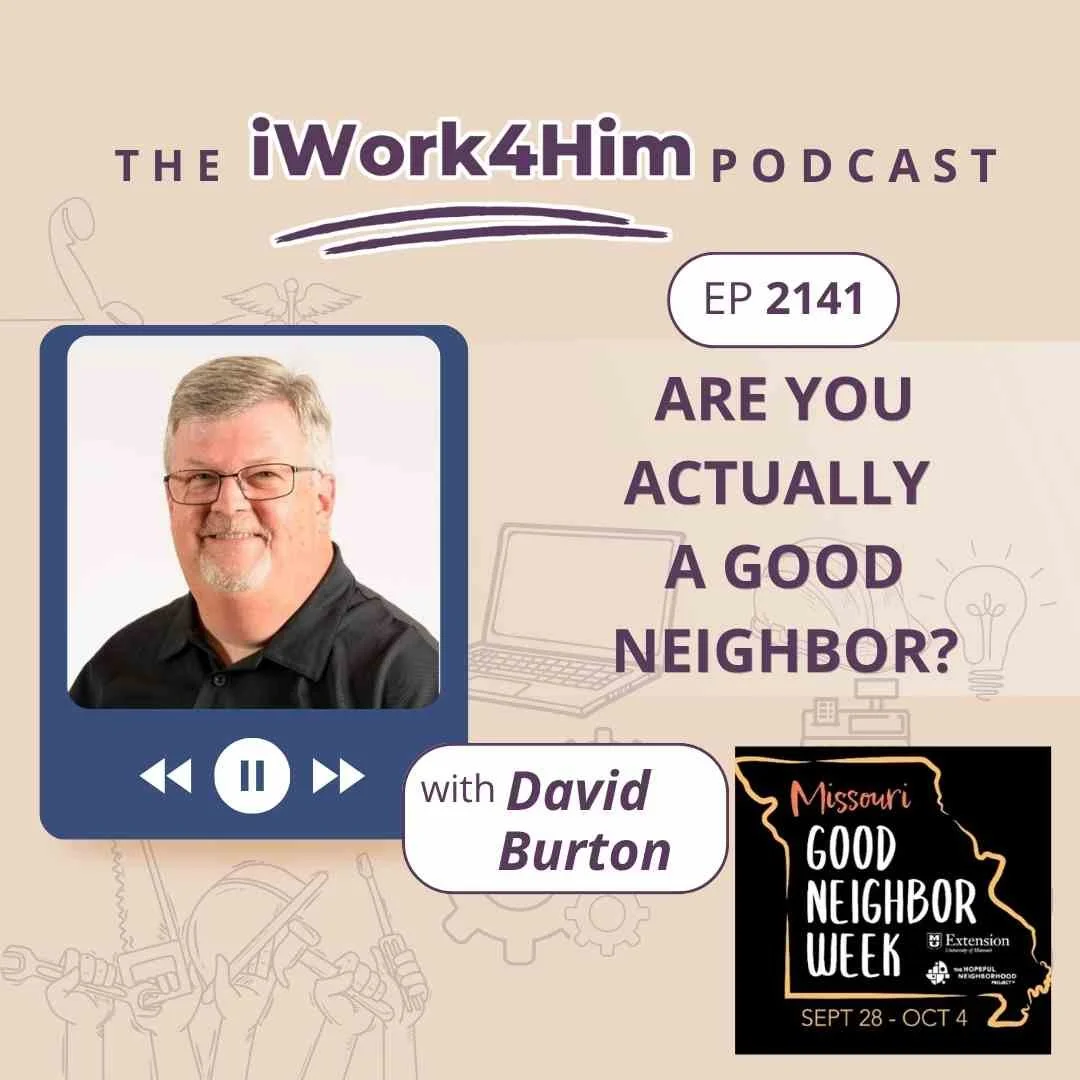
4/8/26 - 2141: Are You Actually a Good Neighbor?
Jim: This is iWork4Him.
Martha: Where faith meets work and believers unleash their calling.
Jim: In the simplest of terms, Jesus was all about loving his neighbor. Everything he did exemplified "love God, love your neighbor." He summarized the 10 commandments and all the rest of the law and prophets with those two sentences: love the Lord your God with all your heart, mind, soul, and strength, and love your neighbor as yourself.
Our guest today has been tasked with bringing neighbors together in southwest Missouri. He works in a university extension office and gets to do the kingdom work all day long. Nothing builds strong communities like helping neighbors to love and serve their neighbors.
David Burton is a Missouri friend of ours and he is in charge of the Engaged Neighbor Project, as well as the Engaged Neighbor Newsletter, which highlights the neighboring projects going on around our state as well as, how about Good Neighbor Week? How did David get such a sweet job and get to live out his faith while doing his job in a university setting? Let's find out right now. David Burton joins us in studio today, a rare in studio guest.
David, welcome to iWork4Him.
David Burton: I'm glad to be here. Thanks for the invite.
Jim: I hope you feel that way when we get to the end of the show (laughter) , that you're glad you're here. David, we always do this with every first time guest. We always highlight their Jesus story. What is your Jesus story?
David Burton: How long do you have?
Jim: You'll have a very short period of time on this. (laughter)
David Burton: Hey, I grew up in a family that attended church and my grandparents were on the same street. We all attended the same church together, and when I was 11, that was in 1978, during vacation Bible school, I invited Jesus to come into my heart. I was baptized that summer.
And I like to say that, some people had these sort of prodigal son sort of stories. Jesus saved them out of something, addiction and problems and stuff. That's not my story. But at the same time, Jesus saved me from a lot of things. He really protected me through high school and college, protected what I was exposed to and the people that were gathered around me.
So I certainly saw that. And then since that time, I would say my faith walk has been more like a treasure map. There's a continual sanctification process, right? And there's certainly Xs all along my route map that has led to my sanctification. Things like when we had our first child, my wife challenged me about the music I was listening to. Maybe I should try listening to contemporary Christian music instead of the eighties rock and roll that I grew up with.
Jim: She made you get rid of your Led Zeppelin? (laughing)
David Burton: I can still enjoy a Led Zeppelin, but that did open up a whole new world to me, really. And a regular way to put Christ into my heart, through music. And so there's certainly things like that all along my journey that have positively impacted my spiritual growth, my sanctification, it's a ongoing version. I'm getting ready to have a big update, and I have stopped naming the number of years. I just look at it as an update. (laughter) Apple has regular updates.
Martha: There you go. You're gonna be version...
David Burton: 6.0.
Martha: 6.0. Nice. Yeah, don't worry. We were doing the math 'cause we're in the same, we're in the same year as you, so we get it.
Jim: I'm not year as old as you are. (laughter)
David Burton: It's a continual process. And I would say, looking back, I've seen God's fingerprints with me through the hard and through the good as well, lots of different moments. Those have all been spiritual growth experiences. Many different ones come to mind.
Martha: That's so good. Thank you for sharing that. And much like our spiritual growth is a process and a journey, so is our work life. And so I'm curious how you ended up working within the University of Missouri system.
David Burton: Yeah, I am too. (laughter) yeah, I had someone ask me that very thing yesterday actually. I I went to college at Drew University in Springfield with the idea of going to law school, where I did go for a year. And then I like to tell people I had watched too much LA Law. (chuckles)
Martha: Oh yeah.
David Burton: Because Law School wasn't anything like that TV show.
Jim: We 're more Suits fans. (chuckling)
Martha: Yeah, but we, in the day, we were watching LA Law.
Jim: Absolutely.
David Burton: Yeah. And I did not return after my first year. Instead, I became managing editor of a weekly newspaper that was there in, in Willard, covered my hometown of Ashgrove and Willard, and I had done my second major was in journalism. And really I loved that job. Being in a small town newspaper, I still say it was the best job I ever had.
But I met a girl and decided I wanted to get married and I need to be able to put a roof over her. And so money was an important thing, right? But certainly I had those six years of newspaper experience. I worked in fundraising and alumni for Missouri State University in Springfield. I worked in corporate public relations for about six years and then got hired at University of Missouri extension really to lead a regional media network effort. And I've been with Extension for 25 years.
But really in that time, I've had five different jobs. My office has been the same spot. My title's been pretty much the same, but I've really had five different jobs during that time just 'cause of changes that happened and where the need is and that sort of thing.
Jim: So God just was doing training through five different positions to get you where you're at today.
David Burton: That really is the story of that other background. If not for those, I would not be in the position.
Jim: That's right. But not everybody knows what an extension office is. In fact, I wasn't really sure what an extension, I'm not still not really sure except for, I know it's an extension of the university system and they've got, it's basically Rome had an extension office in Jerusalem, but they were based outta Italy, but they were still controlling Jerusalem. What is an extension office?
David Burton: Yeah. We can get really nerdy about this. We can thank Abraham Lincoln for legislation he signed in 1862 that established the extension sort of philosophy and idea of extending the research of a university out to the public, people who might never have a chance to be at the university.
And then there was the Smith Lever Act that came along that really provides funding mechanism for that in 1914. And it's still that same premise - extending the research and efforts of the university out to the public to help them improve their farming, improve their families, improve their gardens and all the different areas that we work in.
So in Missouri we're set up a little different than other states, but there is an extension program in every state in the United States. There is a land grant university in every state. University of Missouri is the one for missouri, and that's where the extension programs reside. And in Missouri, we actually have an extension office in every county in the state. Now some of those offices may just have one person working out of it. We all have multiple counties that we serve. I'm in Green County. There's five, gonna be six of us there soon, that work out of that county. But we all have multiple offices that we serve.
Jim: And Green County is where Springfield, Missouri, is, for those of you listening who don't know anything about Missouri.
David Burton: Yeah.
Martha: Yes. It's interesting because until I really we got to know you, David, my experience with the extension office was truly like my soil's not working in my garden. I'm gonna go take it to the extension office. That was literally all I thought the extension office did. So you've really opened our eyes up to a lot of things and I want to talk a little bit about now this kind of, I would say, pet project that you have.
Jim: It's his job!
Martha: No, I know. But he gets to do this for work, but it's his heart too. I know enough about you to know that this is way beyond what somebody just told you to do. And so I wanna talk about your work on the neighboring project. Tell us about it.
David Burton: Yeah, so you're right. It's not agriculture, it's not soil test. It's not 4H clubs. So it's a little different for extension, but really it developed out of a personal story.
I thought I was a good neighbor until I discovered I was not, and honestly, our church had added the word neighbor to its mission statement, and I sat through a sermon about being a good neighbor, and I left thinking that sermon wasn't really for me because I'm already a good neighbor.
I wave at my neighbors. I pick up after my dog on the walks. I put up my Christmas lights before January 1st. The police have never been called to my house, so I'm obviously, I'm already a good neighbor. And it feels awful, sounds awful to say that, but I thought that sermon wasn't for me.
Martha: Sure.
David Burton: We left the next day to go to Colorado Springs where my sister-in-law works at a church. So we went to church the following Sunday with her and they were kicking off their new theme for the year. And you already know what that new theme for the year was. It was Love Thy Neighbor.
Martha: Awesome.
David Burton: So I sat through a second sermon about it and again, I still thought, I think I'm already a good neighbor. I wave at all my neighbors.
Jim: Oh, you wave at 'em too?
David Burton: I wave at 'em. I smile at my neighbors.
Jim: Is that the small town one finger wave? (chuckles)
Martha: Depends on if you're driving or not.
David Burton: I'm convinced that if you had polled my neighbors then, they would've all said I was a good neighbor.
Martha: Okay.
David Burton: We were friendly out in the yard, the wave sort of thing. And I have research to support that now too, that I've done statewide. But then a coworker of hers gave me a copy of a book called The Art of Neighboring by Dave Runion. And I wasn't done with chapter one yet, and I was saying, oh my, I'm a horrible neighbor, 'cause new neighbors had come in, people had moved, and we didn't even bother to get to know their names when they moved in.
And here we were in the same house for 15 years and we knew the names of one neighbor. But I waved at him and I was friendly. So it began as a personal conviction. We said we have got to be doing better. If we say we love our neighbors, that is an active word, that is a verb. It takes action. And where I would've thought the opposite of love was hate, turns out the opposite of love is apathy. And we were demonstrating apathy toward our neighbors.
Jim: Wow.
Martha: So how did that then turn into your life's work?
David Burton: Yeah. (chuckling)
Jim: How'd you get a job on that?
David Burton: Yeah. Again, extension is very good at being like flexible and addressing current issues, things that are coming up, even in agriculture. We focus a lot now on Black Vultures. That didn't used to be a thing in Missouri. Things that come up, we do address those and really I had this personal conviction and I started seeing my neighborhood as my sphere of influence and where I needed to be doing work on my time off and trying to make those connections.
And I did have kind of an aha moment. I do remember when that happened. And I think that was a God-inspired aha moment when he tapped me on the shoulder and said, Hey, this isn't just personal work, this is community development work. Because I was used to working at a more of a macro, high level level with cities and others, doing leadership training and planning and working with cities, developing leaders and volunteers.
But really you can do that at a neighborhood level and have equal influence on a city from the ground up. And so I approached my boss with the idea, and in true extension fashion, he said, I'll give you 5% of your time to work on that project, do some reading, think about some research, see if you can come up with a class.
It was also my heart interest, so I think he got more than 5% outta me, (chuckling) but I kept up with my other work too. And I got a curriculum approved for a class and we offered it online. We had 300 and some odd people register for it from all across the United States. And then suddenly my boss was like, Hey, I think I can give you more than 5% of your time. Try to research, do a research project, try to do publication and things.
And just as those things have happened, the program has grown as I have gotten some grants that helped support it, as I've gotten invitations far outside the state of Missouri to talk about it. It has grown and has become more and more of my work, so to where now it really is probably 90% of my work. I still do an ag tour in our county. I still do some other traditional classes that we have going on, but certainly this idea of becoming an engaged neighbor has really captured my heart and I think captured the attention of others.
Martha: That's so good. For many of us, our trajectory may change several times during our career, just like a David, same title, but just different focuses. But changing your cell phone number to match your values is something you -
Jim: not your number -
Martha: oh, your provider. That's right. Yeah. We don't wanna ever change our cell phone number, right? Never. But changing your cell phone provider to match your values is something you only need to do once.
Patriot Mobile is built on the pillars of faith, family, and freedom. Visit patriotmobile.com/iwork4him and just remember to tell them that iWork4Him sent you. This is a good change for you to make in 2026.
Jim: And I'm surprised more of you haven't made this change already. Patriot mobile.com/iwork4him. Your cell phone company is investing in all of the things that are opposite of what iWork4Him stands for, really what the whole kingdom of God stands for. Patriot Mobile is all about supporting the values that we put forth here in iWork4Him. You're gonna help change our country by changing your cell phone company, but it won't change your service.
We get just as good a service as we did before with one of those big guys. But Patriot mobile.com/iWork4Him is giving their money to help change our country in the right trajectory. Please make the change today and let 'em know iWork4Him sent you.
All right. So David, all right. Your overall focus, let's talk about your overall focus as part of, because you,, Engaged Neighbor Project- you're working on neighboring. You've helped really start up the Missouri Good Neighbor Week, which is unbelievable. It goes all over the country, all over the state, and I'm sure you're influencing the country. Your overall focus, what is it?
David Burton: In community development, we talk about helping the community build its civic muscle, and you do that in four areas: belonging, vitality, connection, and leadership. And so all of our programming focuses on one of those four areas, and when you build those muscle groups it makes your community stronger overall.
Jim: So just hang on there for a second. You make it sound very University.
Martha: That's how he gets paid. (laughter)
David Burton: You threw my notes away. I had to invent another way to say it. (laughter)
Jim: Just so you know, ladies and gentlemen, he brought notes to read right here on iWork4Him and you know...
Martha: they're over there on the floor.
Jim: That's right.
Martha: Jim threw them.
Jim: Nobody gets to read notes on iWork4Him. This is a spirit driven podcast. And if God doesn't have it written on your heart, I don't want you reading it on the show. (laughter)
You're talking kingdom stuff. Jesus summarized the entirety of the law and the prophets in two sentences: love God, love your neighbor. You are getting to do kingdom work every day on this Engaged Neighbor Project because being a good neighbor changes communities.
When you say community development, there's no new communities getting developed across the country. You're talking about bringing a community back to life. That's what you're talking about.
David Burton: Yeah, absolutely. But making those connections with those that live closest to you is a foreign idea in a lot of areas and among church people too, I might add.
Martha: Yeah.
Jim: Why do you make it sound like it's such a shock? (laughter) You mean church people are struggling to be good neighbors too?
David Burton: Yeah, I thought originally there might be some programming potential with churches. I've had a lot of those conversations with leaders and I have been told things like, we don't have time for that on our calendar. Our members wouldn't be interested. And people who have said I invited my neighbor to church once he said, no. I've not talked to him since.
But there's applications all across America and no matter your walk of life. And connecting with neighbors helps reduce isolation. It helps improve mental health and physical health. Giving people a sense of belonging makes them more likely to volunteer and serve in their community. That strengthens the community, no matter their walk of life. And so there's great potential here.
Martha: You know what? There's something even just that honestly, there's so many applications to just this neighboring concept. When you were just saying the things about them feeling like they belong and stuff, they're even just less likely to steal from you. They're less likely to abuse something in the neighborhood.
It's like where Walmart used to have the greeters. Why did they do that? Eye to eye was somebody, you feel a connection to them that makes you feel responsible for that relationship. And for our listeners that have been with us for a while, they know how we feel about neighboring. We get a little passionate because we even say in the workplace, the person in the cubicle next to you or the office down the hallway, that is your nine to five neighbor. Now, none of us work nine to five. I know that, but it's your seven to five neighbors, whatever it might be.
It's your work time neighbor that you rub shoulders with, that you walk past when you're on your way to go get coffee in the break room, whatever it might be. Those are your neighbors.
Jim: What about in traffic in Atlanta?
Martha: Oh, yes. We had a guest that we interviewed years ago, and then she said, I try to be in community with those people driving because, you don't wanna be against them, that's for sure. But neighboring has such a vast impact. And so talk about, what kind of victories have you seen within the Engaged Neighbor Project?
David Burton: Sure. We'll talk about victories. Sure. But I might give a little bit of pushback on the other. And that is this idea what that when you don't have a target, when you're shooting, when you're aiming at everything, you really hit nothing.
And in America, we have had this tendency to say, everybody's my neighbor. I didn't cut somebody off in traffic today. I was a good neighbor. Oh, I'm just neighboring all the time. Look at me. And then we go home, we pull in the garage, shut the garage door, and we don't even know the names of the people around us.
Martha: Yes.
David Burton: So neighboring begins with those immediate people that touch your property. It can be more.
Martha: Yeah.
David Burton: But it should never be less. And if you're out doing those things but don't know the people because of proximity that live right next to you. Then you're really not neighboring. That's where your target needs to begin, right there.
Martha: And I agree with you, and I even tell people, this is my perspective on it. How can you lay in bed at night and not know the people's names that are laying in bed in the buildings around, the homes right around you? To me, that's almost creepy. You've got people that close to you and you don't know their names.
David Burton: And taking that approach has opened up so many possibilities for me, even in just sharing life, having opportunities to share the gospel where they ask me. I didn't have to be a salesperson over it at all. It came up naturally because you're developing relationship and you're doing that without a bait and switch approach. " I'll have you over for dinner, but I'm gonna tell you my gospel story." How about just have people over for dinner to develop trust and a friendship?
Martha: Yep.
Jim: And then that happens naturally and organically. But victory, certainly people that have been involved in Neighboring 101 or people that have even-
That's a class you teach?
David Burton: That's a class I teach. Or even just people that have come to our driveway. I think of one neighbor who end up running for city council and he told me, and he serves on city council in my hometown, said he never would've done that if not for the driveway chats we were doing, 'cause he didn't feel connected. He didn't know anyone. And it gave him the courage to run for a seat on council.
Martha: Wow.
David Burton: So big and small people who have just been reunited in relationship, people who have found a neighbor who could help them with some needs, or opportunities to help a neighbor just because they took a step out to have connection.
In our own life, when we were trying to learn our neighbor's names, my wife got a cancer diagnosis, and in the process of learning our neighbor's names, we discovered two of them had their own cancer story. And so when she came home from surgery, who was the first people on our doorstep? Who was the first to bring a meal? Who became her support network? Those two neighbors that had won their cancer battle. There's that type of connection as well. And I would consider that a victory as well.
Martha: That's a huge victory.
Jim: Absolutely. Absolutely. Yeah, I was thinking, Martha, it's 20, 25 years ago, probably 22 years ago, our pastor of our local church in Largo, Florida, said, hey, do you know the names of the people that live in front of you, behind you, next door to you?
And if you don't, you need to get to know those names. I remember the sermon. I remember him saying that, and I'm like, yeah, I don't know that we do. And that was our impetus in our townhouse neighborhood in Florida, where we got to know the names of every person on our street. And we started praying over all those townhouses. There was just 30 of them in our neighborhood and we got to know everybody on our street. We never really did a good job of knowing the people behind us 'cause there was a big wall of trees behind us.
Martha: It wasn't your typical lot in a city. It was a whole nother road back there. But we did but that was - you're exactly right, Jim. And that actually led then to me leading that community for 10 years as the president of the HOA. But it was because we've felt a responsibility and a connection to everybody that we lived there with. We didn't, we didn't take that lightly and we started to invite 'em into our homes.
Jim: Parties and potlucks.
Martha: Yeah.
David Burton: Learn names. Find ways to use the names. Throw a good party. Those are the good three steps to build those connections. And you're really building social capital. And that's what we talk about in community development and secular settings, building this social capital, this connection of, interconnection of abilities and skills and talents. And connections. There's great value in that for a community and for your own personal health.
Jim: Speaking of building social capital, as founding members of the US Christian Chamber of Commerce, we find that the values and goals of iWork4Him align with those of the Christian Chamber, the Christian Chambers across the country, but specifically the US Christian Chamber.
With that in mind, Martha and I invite you to join us at the US Christian Chamber of Commerce spiritual World citizens Expo in April this year, April 22nd to 24th in Orlando, just outside of SeaWorld. And we'd love to have you join us. Get registered now, and be a part of what's changing in our country, as believers in the marketplace gathering together to build bold businesses, to unite in order to break barriers in your communities, and advance the kingdom. We'll be your MCs once again at this event and can't wait to see you in Orlando. Register using the code iWork4Him. That's I work the number 4 him for 20% off on your tickets online at swc2026.com. It's right around the corner. It's not too late to get your tickets.
Martha: Absolutely. So David, kind of a interesting question here. What do you find to be the hardest part of your job?
David Burton: Speaking at an event or doing a workshop and seeing people enthusiastic, but having that not translate into action. We do a lot of follow up surveys and so people will score the work really high or the speech really high, this really, "I'm gonna make a change." And then you follow up and it's a slow process. But I am reminded that small incremental changes over a long period of time do add up to big change. There is a ripple effect here, but I consider that kind of the hardest part, the translating enthusiasm into action.
Jim: When you talk to people about getting to know the names of their neighbors around them - let's say you've lived in a neighborhood for 20 years and you don't know anybody. It's a little awkward to actually start having conversations with people that you lived alongside that you don't have any idea who they are.
It's like, Hey, I'm sorry I've been a lousy neighbor for 20 years. (laughter) I'm Jim and this is my wife, Martha, can we get to know you a little bit? That's, that's awkward, but that's what needs to happen.
David Burton: That's how we started ours actually. Yeah, you gotta step into the awkward. I have a friend that says "eat crow while it's young and tender," but some of our crow wasn't real tender. Been a long time.
And there's also this cultural narrative we're pushing back against. We saw this in the research study I did across Missouri that we repeated two different years. And one of the questions we asked in that was, what makes someone a good neighbor? And both years, the top two traits are someone who's quiet and someone who respects my privacy.
So 10 percentage points ahead of number three. So Missourians say, a good neighbor is someone who is quiet and leaves me alone. And I don't feel like we need more good neighbors, if that's what that means. We don't need more good neighbors. We need more engaged neighbors, people that want to do life with those that are around them.
Jim: Hence the name engagedneighbor.com. So what's amazing is that this is, when you look at the neighborhoods built in the forties and the fifties, they had front porches and everybody engaged from the street level, from the sidewalk level, to the people on the front porches.
Then in the sixties and the seventies and the eighties, even to today, they build houses with all of the living in the back. In fact, the kitchen faces the back of the house. The deck goes outta the back of the house, and then they build fences around the backyard. So all you're looking at is your dog running around your backyard if you got a dog or your kids. And we've gotta switch that. If you're a builder today, would you please start putting front porches on your houses?
Martha: Big enough for rocking chairs. (chuckling)
Jim: That's right. My parents had a little house here in Missouri that had a front porch on it.
Martha: Yeah.
Jim: And my dad loved sitting out there just looking at the trees, but while waving at the neighbors as they drive by. But that's, David, that's part of the problem is that we've built houses that totally fight engaging our neighbors.
David Burton: Yeah, I think there's a number of things you can put in that list instead of just just front porches. But air conditioning keeps us all locked inside here.
Jim: We're grateful for air conditioning. (laughter)
Martha: But it does.
David Burton: Entertainment options that, that at the touch of a button, our finger. And I think there's also these internal limitations. People have a lot of fear. You fear what you don't trust, and if you don't know someone, you may not have trust. So you have fear about what am I gonna get into if I have a relationship with them? Or people may have shame about, I don't want people knowing about what's going on inside my house or that we're not perfect people. So there's that as well. And I think those heart issues also come into play. And just unwillingness to be vulnerable with people and doing life.
I think that's a factor as well, but certainly I hear front porches and fences and those things. There's a book called Three Panes of Glass, and he argues that it's the three Panes of Glass that keep us from connection. It's the the windshield. We now have longer commutes. It's the television. And it's the smartphone. And those are the three panes of glass that keep us from having a relationship.
Jim: Wow. We were just on a cruise, martha and I were. And they now have, wifi was included with most of the packages and so normally on cruises everybody's disconnected and they're just engaging with complete strangers. They were all on their phones. Like what a shame. The perfect environment to get away from your cell phone is on a cruise ship and they've screwed that up.
Martha: There's something else too, just to encourage people is in this conversation, is a lot of people are like my home's not ready for somebody to come inside. That's the beauty of the front porch or a place where you can sit in your yard, is you don't have to feel that obligation that my house has to be perfect in order to be a really engaged neighbor that can invite people in.
One of my favorite books is The Turquoise Table. And putting a table in your yard that says, Hey, come sit with me. I'm gonna have some, I have cookies here. Or, let's let the kids run around and we can sit and visit, or whatever that might be. So there's so many options that don't make us be perfect in order to be a good neighbor. I've actually had most, a lot of conversations with my neighbors through Facebook Messenger because I at least can be like "hey, I see something going on in your backyard. Is everything okay?"
But being connected to them enough to be able to do that is critical to engaging with them. So I know we have a couple more questions that we wanna get to real quick, but I want you to at least talk quickly about the Good Neighbor Week that is in Missouri, because it may prompt people to think about, what can I do? I don't live in Missouri. How can I do something intentional? And I really feel like that's what the Good Neighbor Week is all about.
David Burton: Yeah. I'm a big proponent of what's called the Idea Friendly method, and you start small with something. Don't start with this grandiose idea yet. And I began small, I began by celebrating National Good Neighbor Day, which is September 28th, in my neighborhood.
And that was actually signed into law by Jimmy Carter back in the seventies. So that day gave me an excuse to gather my neighbors together. We did a driveway thing. It's national Good Neighbor day. This isn't gonna feel awkward. This is the reason we're doing it. Come join us. And then the following year I did something more citywide. The city agreed to some surveys and some mailings, and we did something citywide. And then the year after that I thought, I think I could get some sponsors and try and do this countywide and we'll give some awards for the best acts of neighboring or maybe try to recognize the best neighbor.
And that was pretty successful in Green County. And I was saying at a Republic Chamber of Commerce meeting, my state representative came and sat at the same table. He'd seen what I'd been doing at the county level, and he asked what no one else had asked me and what I hadn't thought about yet. He said, so what are your future plans for that?
And I felt like pressured to come up with something, right? And I said I think in Missouri it'd be cool if we celebrated for a whole week. And next thing I knew, I think it was about three months later, he called and said, Hey, I've written a bill for Missouri Good Neighbor Week. Would you come testify on it?
Jim: Oh my word.
David Burton: And and he also said, don't plan on it getting passed this year. It usually takes two or three years for something like this to happen. Of course, I went up and testified. We picked up 20 some odd co-sponsors after the testimony. Nobody's gonna argue. Everybody was all over that. And through an unusual set of circumstances, it got passed on the last day of the legislature.
Martha: Wow.
David Burton: And got signed into law. So that was in 2022 in the spring. And so that fall we really launched the website and the whole campaign. You can nominate people to be recognized as the most engaged neighbor. And we look for neighborly businesses and we look for the most neighborly neighborhoods. And then cities accrue points based on the acts of neighboring that are reported out of that community.
And we have size categories that the Missouri Municipal League uses for their awards program. So it pro rates, so you don't have big towns competing against small towns. And then we are able from that to able to determine the six most neighborly cities in Missouri. And so that's all part of the celebration. And so the long-term vision for that is to, last year we had 42,139 acts of neighboring reported in Missouri. This year, the fifth year, we've changed the theme a little bit to a year of neighboring activity and a week to celebrate it.
And so we're really trying to foster this idea of neighboring be being year round and those neighboring activities. And so the long-term goal is in 2028 to have be up to a hundred thousand acts of neighboring reported.
Jim: Just right here in missouri?
David Burton: Just right here in Missouri.
Martha: That's awesome.
Jim: Oh, and imagine if we can do that in New York!
Martha: Yeah. And we'll put some links in the show notes to just help inspire people and to peek in and see what's happening, whether you are just personally inspired or you have a position where you can say, Hey, I think I can do more. What might that look like? That's just such a great resource for everybody. So thank you for sharing.
David Burton: Just start in your own neighborhood or on your own street.
Jim: Exactly. And this is where we'll end with this last conversation. As Jesus followers, we can have the greatest impact in the world if we would just learn to love our neighbors. Why is that, David?
David Burton: Because it is something pretty rare anymore. I think we do stand out in that way. That's always been the strategy from the very beginning. Person to person, house to house.
Jim: I mean, what's hilarious is people don't realize this, the 10 Commandments, the first four are about love God and the last six about Love your neighbor.
David Burton: Yeah.
Jim: And Jesus brought that back up again. So this was a Jesus idea, not a David Burton idea.
David Burton: That is true. Let's give credit where cred is due. That is very much true.
Jim: And Jesus loved his neighbors. He even tried to love the people that were trying to kill him. In fact, he actually forgave them while they were killing him. But Jesus was the greatest example of loving on neighbors, people that other people were, that were ostracized, people that were part of the lower class, even tax collectors. Have you got an IRS agent in your neighborhood? Love them. (laughing)
Martha: Love them even more.
Jim: That's right. But David, this is something that the church really struggles with, isn't it?
David Burton: It is. I've seen that firsthand, of course. But I am thankful that over the years, the local Baptist Association in Green County has had me speak on this a couple of times, and that got me to thinking more about what this looks like for me.
And a couple of churches have partnered with me on a project and I actually have a new book that has come out called Neighborhood Mission Trips for Everyday Christians that's available on Amazon. And, so everyday mission trips, it's this idea of, we get passports and tickets, we go overseas on a mission trip.
What would that look like if we stayed right here in our neighborhood? How would we do that? There's devotionals that accompany that idea, a schedule, and a way that you can do it individually or with a small group or with your church. And I really think mission starts right across the street.
Martha: Amen.
Jim: And and then it moves into your office.
David Burton: Yeah. Moves into your office and it might someday be overseas, but it needs to begin right there in your neighborhood. I sometimes say there's nothing I can do that changes Washington, DC, and maybe nothing I can do that changes my state capital, but I can make a choice every single day that impacts my neighbors and my neighborhood. And so you're doing that through a Christian lens. You're certainly engaging with your neighbors to show kindness, to show love, show concern. And that can lead to great conversations and great stories.
Jim: David Burton, thank you so much for being on iWork4Him today.
David Burton: Glad to be here.
Jim: Thanks for coming on location. It was great.
David Burton: Yeah, it was fun.
Jim: Make sure you check him out online, engagedneighbor.com. engagedneighbor.com. You've been listening to iWork4Him with your hosts, Jim and Martha Brangenberg. We're Christ followers and our workplace - and our neighborhood - is our mission field, but ultimately iWork4Him.