
Jim: This is iWork4Him where faith meets work and believers unleash their calling.
On April 15th, 2013, the iWork4Him radio show and podcast launched in Tampa Bay and around the world. Since that time, we've recorded over 3000 podcasts under several different names. At today's show, for iWork4Him is 2142. In these last 13 years, we've interviewed people from all over the world and captured what it looks like for them to live out their faith in their work. What an honor it's been to steward these faith stories and today is no different. Today we head off to a small town in eastern Oklahoma.
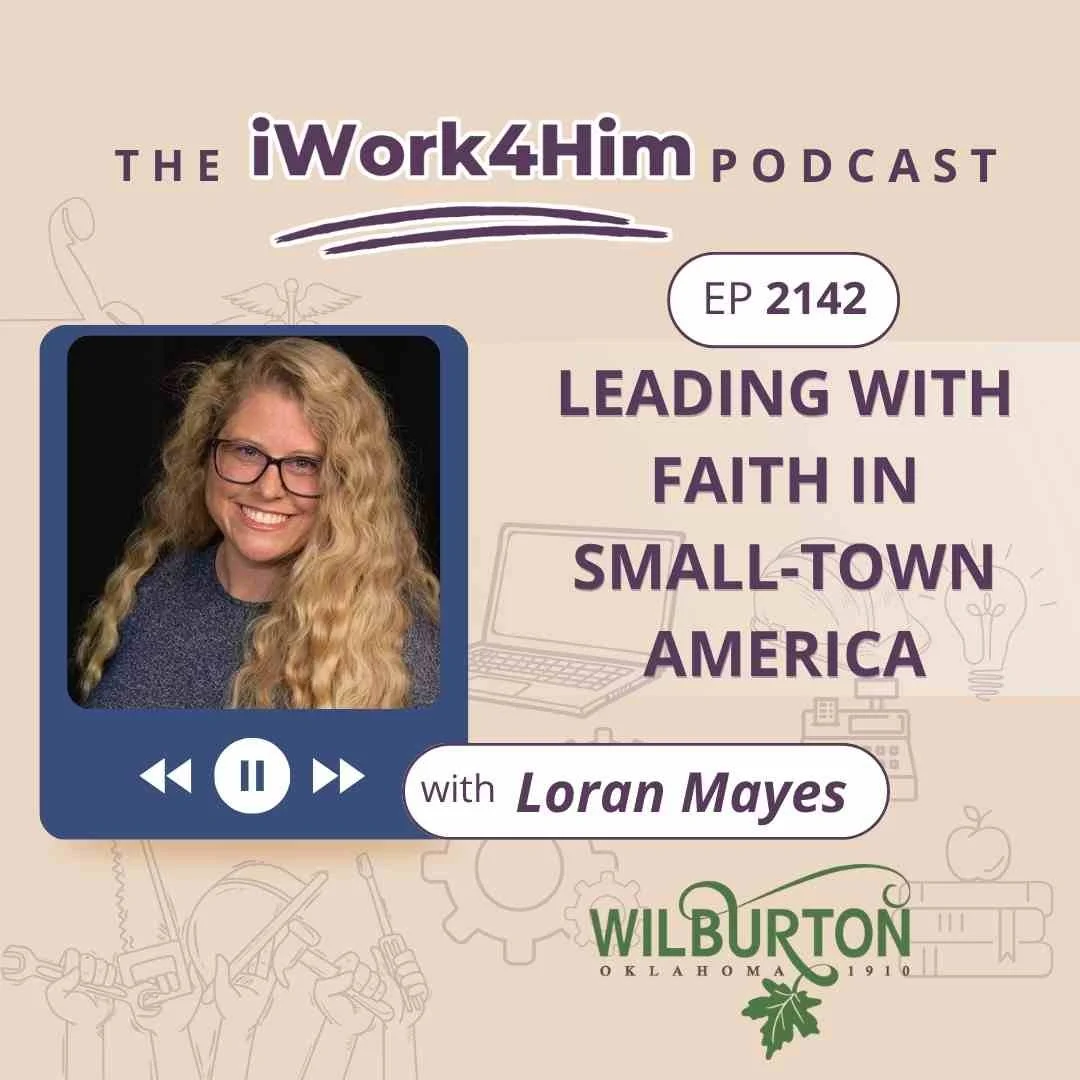
Wilburton, Oklahoma, where Loran Mayes has been the mayor for three years living out her faith in an elected office, and it's a place where her faith is tested and stretched, but where the wisdom of God has helped her bRing positive transformation to her city. How it's working for Loran? Let's find out right now from her story and how her faith is impacting Wilburton, Oklahoma. Loran Mayes, welcome to iWork4Him.
Loran Mayes: Hi. Thank you for having me.
Jim: It's an honor. Loran, we always ask this question of every first time guest on iWork4Him. How did you come to be a follower of Jesus?
Loran Mayes: Now, when you sent me that question I went back to many places in my life. I grew up in the church. I lived at a church camp. I worked at a church camp. I was a youth pastor, and then I found that my faith wasn't my own. And so I remember being on my floor in my living room at just what felt like the end of a rope. And I distinctly remember saying, I need this to become mine. It wasn't my parents' faith anymore. It wasn't my church's faith anymore. It wasn't the church camp faith anymore.
I needed something that was real and that was mine. And that was in my early twenties after I had kids. And I just didn't know what I was doing anymore. And so I just needed it to become mine and it was raw and it wasn't perfect. But I knew it was a true Holy Spirit moment on that, on my floor, in my living room, on Altus Air Force Base, actually is where we lived. And so that's how that happened. And I go back to that place on that living room floor more and more as I go on this venture that I'm on. And we'll, I know we'll talk more about that and just remember what that moment was like, when I felt like it had finally become mine.
Jim: It's so true how you go back to that moment and " wow, that was a turning point. That's when my life turned right side up." So how long have you lived in Wilburton, Oklahoma?
Loran Mayes: So we moved to this area in 2019, right before 2020, the epidemic hit and I was the park manager at Roberts Cape State Park. I just felt my temperature rise right when I said that. (laughing) It was something that I didn't know what I was doing at the time. I had never been a park manager. And when all of that hit, I was scared of like my first summer as a park manager, and then COVID hit and God was like, "don't worry about summer. This will be way more than that."
But we have lived here since 2019. And then I was, we were out at - we lived, actually lived at the park. Just five miles north of here for a couple of years and then moved into town.
Jim: So you're the mayor of Wilburton, Oklahoma. What riled you up enough to get you to run for office? 'Cause you only moved there in 2019. It's only 2026. You've been mayor for three years. You only moved into town a couple years. Okay, like you moved into town, you're like, holy smokes, things gotta change here.
Loran Mayes: I'm careful with the word "change." Because there was something that brought us here.
Jim: Okay.
Loran Mayes: And something that enveloped our family. We became a Lion's Club member. And we, my family, we all got COVID at the same time. And we were at the park and every single day on our front porch, something was there for us. It might have been fresh eggs one day. It was a bouquet of flowers one day. It was something for the kids one day. It was community on my front porch every day. And it was all of these signs when it was scary. We just didn't know a lot then at that point in time. It was early on in the whole thing and all we felt was comfort and love.
My child, before we moved here, screamed and cried a lot, every single day when we go to school. We got here, day two, she never cried again. So there was something here telling us that we were where we were supposed to be. And so I'm very careful about the word "change" because I didn't wanna change where we were, but I wanted them to see and feel what we saw and felt about this place and about the community that was here, and find those places.
We heard a lot "it's good enough for Wilburton." That wasn't a positive statement, right? That was like, eh, it's good enough. That was like a minimum standard. And I really wanna ask the question, "is it good enough for Wilburton?" And really raise that expectation of what the people here deserve, the life that you can lead here. And you don't have to leave to make it.
You can and you can come home and there's a lot of great people that have done that. But I wanted the kids here when they grow up and they look back to be like, that is where I grew up. And have this sense of care and community and family. So some things had to improve and some things needed to happen but not necessarily change the heart of what Wilburton was. I am a little bit careful with that word.
Jim: Great correction. I appreciate the correction 'cause it is true.
Loran Mayes: Yeah. No, you're fine.
Jim: You saw something about the town where you were living and you wanted to help the people that have been living there forever to see the forest and the trees.
Loran Mayes: Yes.
Jim: And they were having a hard time seeing the trees and they were only seeing the forest and they were struggling.
Loran Mayes: Yeah. And I think we do that. I think we forget, like we get used to something and we don't see it anymore. You get used to the mess. You get used to things that aren't great. You get used to whatever that is, and you just forget to see it.
And if you can step back and see it from someone else's perspective and be like, oh my gosh, this is so amazing. And people are like, wait a minute. It is? And you're like, yes. Like it's great. And it just changes that perspective and pride of place, I think.
Jim: When you told your family, I'm gonna run for mayor, how did they feel about it?
Loran Mayes: Not excited at all. Now you have to remember, I just moved him. Him and I both grew up on the west side of Oklahoma and he just committed to this huge move across the state for me to get my dream job, which was the park manager job. So he had already committed to a life change and moved our entire family, went through COVID by ourselves over here, he had already done all of this.
So when I go to him next with, Hey, remember I was gonna take a step back? (laugh) that's what I said, oh, I'm gonna take a step back and step out of state government because it was a state park and I'm gonna take a break. Then I'm like, I'm gonna run for mayor. And he's just oh my word.
It was rough. My kids, more so, I think paid a price than my husband. 'cause my husband doesn't really work in town and he kinda stays unplugged, and that's something I'll talk about in a little bit. But my kids were in school every day with the kids of the people that weren't real happy about me running for mayor.
There was some things that happened at the state park duRing my time there. It wasn't my fault. We have to pay at our state parks now. The restaurant closed down. There's all these things that when you're the park manager or you're the boss, right, it's your responsibility. And whether you said it or not, that's gonna be on your record. So there were some people that really had a lot of issues with that. And so my kids, I feel paid a bigger price for that. So they weren't super excited about it, but they wore their shirt proudly that their mom was running for mayor.
Jim: I wanna get into the campaign, but I wanna just take a break and just talk about SaferNet.
SaferNet has been our web filter, our VPN, our internet service that goes behind the scenes and just protects us on all of our devices, and we want all of our listeners to check out SaferNet. SaferNet is a trusted partner of iWork4Him. We've got installed on all of our mobile devices, our computers, our tablets, our cell phones.
They've got antivirus protection. They've got a VPN, which allows you to be on public wifi and not have a care in the world, along with web filters and a console for your business where you can control and track where everybody that's working for you is spending their time online. Check it out online, SaferNet.com. It's a true Kingdom company. SaferNet.com.
Loran running for mayor... as believers, we run for office, we don't get to be like others. We've got to run a campaign like Jesus would run a campaign. So he's not gonna slander anybody. He's not gonna tell anybody - he's not gonna point out all their faults 'cause he never did that. The focus has gotta be on our message and moving forward. How hard was it to run a clean campaign for office?
Loran Mayes: It is difficult. I've never been denied by a Ring camera more in my life. The invention of Ring camera when knocking doors changed everything 'cause they would deny and be like, no thank you. Done. Not even open a door.
So you felt very, I felt very vulnerable. I had to overcome some of the preconceived opinions or notions from my time at the state park and what happened there. I'm not from here like we already just described. I tried to make those things positive so we didn't have generational issues with other families or people. Hopefully that would help with favoRing anyone, 'cause we didn't have those connections, from family connections.
Lots of tears, I'll admit that. Lots of tears, lots of frustration, loneliness in a way that I had not felt before. And you're out putting out signs, you're knocking doors, you're walking, you are sitting at a coffee. I would make times available, so knocking doors was not successful for me mainly because of Ring doorbells and busy schedules and I was working full-time and trying to run a campaign and so I would set up times where I'd sit at the coffee shop, like at five in the morning and be there for a couple of hours.
Sometimes you're sitting there by yourself and nobody really cares to talk to you during that time. People wanna avoid you because you're running for office and they don't wanna hear it that day. The hardest place to be was the grocery store. It still is. People will block you in that meat department and you cannot get out and they have a million questions and people almost line up to talk to you at the grocery store.
And so that has been, it was so eye-opening. But the one thing that I try to remember and that I still try to remember is what it's like to be a citizen that's not in a place of perceived power, right? I still think citizens have more power than they understand. And we're trying to help with that. But what is it like to be on the other side and to want to be heard, to assume they're out to get you because of past, whatever you're used to is what you're going to expect. And so how do you change that? How do you work on that without getting offended and tired and upset and defensive?
And it wasn't perfect. It wasn't something I did perfectly. I worked really hard. I would try to save the tears when I was at home alone. But there were just some times you just, you have to walk away and take a breath.
Jim: So you've been the mayor of your city, Wilburton, Oklahoma, for three years. A believer at the helm where you have spiritual authority over that city. How good has having a believer at the helm of your city been for your city?
Loran Mayes: So I get a lot of "it feels alive again" comments. And we haven't done anything drastic. We haven't made any major moves. But there has been the comment over and over again. It feels different. It feels alive. We have people getting involved again.
We have families that have moved home, people that grew up here move home and jump in. People that have felt empowered to help. It feels like the right place at the right time. We have, we've talked a little bit about my, I brought my book so you could see it. Some of the things that I look to - I want to lead in a way that I don't have to only say that I'm a believer. I want to lead in a way that, we have a lady here, her name is Dr. AJ Griffin, that leads a foundation that focuses on families and kids, specifically under the age of five. And she tells me all the time, it's my job to create the environment where the right things are easier.
Jim: Oh, yes. Say that again. I'm gonna, can I use that as a campaign slogan?
Loran Mayes: It's so good. And that's always her answer. It is your job to create the environment where the right things are easy. So I was struggling a lot with having to do everything and I think we get that way in any job, in any role in our life, we get that "I have to do it all." No, you don't. No, you don't. It's more important for me to create an environment where citizens and staff feel empowered and welcome to do the right thing, but also where the wrong thing is not gonna be good. It's not gonna be easy to do the wrong thing. It's not gonna be easy to traffick our children.
It's not gonna be easy to bring down conversations. It's not going to be easy for you to block what other people are doing. Create that environment where the right things are easy and so that it releases a lot of pressure. You do have to trust that God is already there. Have you seen those asphalt trains? Where it's like all the equipment in the line and it comes in, it destroys the road, it puts it back through heat. All of this pressure relays the road and then it's good.
And in my mind, when God goes before me and he paves the way, that is what I see. And I just think about like sometimes it feels like an absolute disaster is happening and these past two weeks have been, that it just feels like things are crumbling. And I just kept seeing over and over again the asphalt train. 'cause I always think God goes before me and paves the way. What do I mean by that? And am I actually living the way that I am believing that? Truly?
And I just kept seeing the asphalt train that it has to crumble. It has to be messed up, it has to be terrible. It has to go through heat and pressure that is not comfortable and it's really hard, and then the road is laid. Then you could drive on it. And so it wasn't just, he's gonna go and it's gonna be super easy and he just lays some asphalt and you're ready to go. There's going to be that breaking up and that reheating and that relay.
Jim: Yeah, 'cause if you just lay asphalt on top of the potholes, you just get more potholes. You have to, yeah, you have to take up that layer, which is painful. But, so you've had to make some tough decisions, I imagine, in three years and probably utilize your faith to make those decisions in a way you probably never anticipated, seeking at the throne room of God for those. How has your faith impacted your decision making ability? I don't know how best to put that because you're accessing questions you never imagined you would ask.
Loran Mayes: Yes. You run a campaign on who you are and who you're going to be. And then you realize it has nothing to do with you. And that's hard. It's not just me. So when I lead the city, it has to be less about me and more about the city. It has to be less about me and more about - I pray a lot. That's what I was writing whenever we got on, 'cause I talk a lot about Goshen and Nehemiah and I have the verses written down, but then I was like, I have the verses written down, but we don't always remember what those verses say.
But Nehemiah always interests me because he went to action by organizing people. So he used his faith to put into action of organizing people. And so I'm doing that. We're starting a ward initiative to where we're gonna organize people and empower them because of the story that it tells us about Nehemiah and how that brought back what had been destroyed.
Courage and action. Goshen, talking about drawing near to God. There was stories, all of these towns, it was great. They were blessed. It was wonderful. Oh, wasn't so great for a little while, and they drawed near to God and then moved forward. So sometimes it's just, I need to get my priorities straight and pray about it.
My daughter, now, anytime she sees something happening, she said, let me guess, it's in your book. And I said, yes, we've been praying about that. And God can bring in people that you never knew were could come in. He can empower someone that you never saw coming and he can do things when it seems like nothing can be done.
Jim: Let me ask a question I didn't tell you I was gonna ask. What's the biggest thing that God has done to surprise you in the last three years?
Loran Mayes: He has taken me further than I ever thought I could go. I now can walk into the Capitol, Oklahoma City, our state capitol, and I go for legislative season. And every room I walk into, they know Wilburton. They know who I am, not by my name. Usually it's "Wilburton" when they point at me. He has taken me places I never thought we could go.
Most people think a little town, 3000 people, rural Oklahoma, you can't make a stand. And he is proving that different. And so it, of all the things, when it feels like it's a terrible day, you just have to remember where he's taken you before. And so that's been the biggest surprise for me. I thought I'd come in and just run some parks and rec and we'd make some water decisions. But we're making a difference, like across the region. We're making a difference across the state.
Our little town is being seen in ways and places it never could have dreamed of. And that's not me. That's God going before us. So that's been really surprising. We landed this amazing contract with the state to be able to empower people to go to work. And it's like a barrier breakdown. And we are pushing out hundreds of people a year that did not have a job, that weren't equipped to go out, and now they're doing it.
And that was all - it wasn't me. I wrote the contract request, right? But God paves those ways and brought a building that's impacting work being done in South Africa by a doctor that was from here. And it just starts connecting, and it's like this snowball effect that you can never see coming.
Jim: That's exciting. I love that. I wanna talk about conflict here in a second, but I wanna make sure everybody knows about the upcoming US Christian Chamber event in Orlando next week, literally April the 22nd to 24th in Orlando, the US Christian Chambers gathering together six or 700 marketplace believers from around the country to celebrate what God is doing in the marketplace and to inspire each other. Check it out online, swc2026.com. Martha and I will see you there next week.
All right, so conflict. As a mayor, and I walk alongside our mayor here in town, and I'm running for mayor in my town. There's conflict. There's gonna be conflict. Even if you haven't done anything to deserve a conflict, you're gonna get conflict because that just seems like the nature of being a mayor in a town. How has your faith led you to dealing with conflict at a whole different level?
Loran Mayes: I'm right in the middle of one, so timely question, and it is, it's a conflict that I dunno how I got here. It's one of those things that it happens faster and it's a mess before you look around and go, oh my, I don't know what I've done here, but I need to figure out where I played a role in this mess.
So one thing is, of course, praying about it. But differently than I ever thought I would. So before I pray about just getting my way, that's - we all have, we're people, right? So I want this to go my direction. I have had to change the way I pray about these things, and I need a resolution that matches where this is supposed to go. And really what you're praying is that you become aligned with that.
Instead of praying for the situation to become aligned with you, praying that you become aligned with what is supposed to happen in this situation and what can we learn about ourselves in this situation. And to see the person on the other side of that conflict with, assume good intent, their heart. Whether we agree with it or not, they believe it's in the right place. Usually these people are passionate about something.
And this is just my experience, so there's all kinds of conflicts, but for me, this has been the conflict: someone that disagrees with what I'm doing, they want this to happen and they don't like the way I'm doing it. And really it, I had to move from taking it personal to going, okay, hold on. Maybe I need to look at this. I need to understand where they're coming. I really need to pray about this because I do get my feelings hurt because I am just a person sometimes, and I need to really find out what I'm supposed to learn from this situation.
And sometimes you can fix it. And in this situation I can't. It needs to be less of me and more about facts and process and that has been very difficult to move into that. I'm hoping that it's a sign of maturing in conflict resolution to take the people part out, take your heart out of it. And in a good way. Not to where you are ugly or hateful, but to where you just look at facts and can proceed in a way that it, I might not have had the right answer in this and their answer truly may be better than mine, but it's what's best for the situation and for the town. And so I'm right in the middle of that.
I'm right in the thick of it. It has just really hurt to be in conflict with someone. I've cried about it. I have had a lot of conversations about how do I fix this? And finally someone was like maybe it's not yours to fix. And that's true. And sometimes it's not ours to fix. And sometimes we need to let the situation happen and see both sides of it.
Maybe mediation is needed, and I always thought that was a sign of failure when you needed mediation in a situation, and that's not true. Mediation is there for a reason and it can help both sides to understand and get those feelings and emotions out of it and really look at what's at hand. And if there is an underlying issue, then that can be brought out through mediation. And it is good. The Bible talks about mediation. The Holy Spirit is a mediator and when we need that, it's okay.
And I've really had to grasp ahold of that because it can feel very personal or failure. The enemy can use those thoughts to destroy that and it doesn't have to destroy a relationship, to be in conflict, and you can't even be better afterwards. And so that's what I'm learning. I won't say I have learned it yet, but that's what I'm learning as I go.
Jim: Have you ever had a job as hard as this before?
Loran Mayes: No, absolutely not, but I've also never had one I've loved nearly as much as this one.
Jim: That was my next question. All right. All along. You're a mama, a wife, you got a whole pack going on there. How have you protected your marriage and your family from your job as mayor?
Loran Mayes: So that has taken some growth on my end. I was really frustrated for a while and my husband knows this, and we can talk openly about this, about his absence, in my mayoral life. I was really mad for a long time because they weren't very involved. But as we have grown, it is a safe haven now that he is separated from that, that he's not in every single thing, that he doesn't throw himself into every conflict, that he doesn't, he doesn't jump in like my protector in that world.
But when I get home, that is separate. So he is separate from that. He stays out of it so that I do have a place to go to at home in the evenings that doesn't include all of that. And that took some time on my end to grow to like that and value that and not be mad at him about it because marriage is hard. And then you throw someone that's a public official that - and I work really hard to be in the public view and the public eye a lot because I really wanna be involved, and he is not that way and he stays at home.
But that's a safe haven and it's a protection for me to have that at home. And so God has changed that perspective for me and I have become very thankful for that. So he's a safe spot to land. He lets me just, sometimes you throw up a lot of emotion on someone and he just, okay, you will take that, put it over here. My daughter really likes to be involved and my kids, not all my kids feel that way, but my daughter really likes it. She's a lot like me and likes to be out and involved. She thrives on that. My other two, my oldest kids, they're older and moved on and they, when they come home, they're unplugged from it all again, which is a blessing.
But that's hard because sometimes, you see everybody with their whole family there, and that can be good too. But for us, it was really nice for me to have that safe spot to land at night or on the weekends or whenever. And so it's nice.
Jim: So when you look at all that, all that you've experienced, all that you're experiencing, do you believe more believers should step up and run for a local office?
Loran Mayes: I do. I I believe we should all step into the things that we feel our heart is called for. And I think we doubt ourselves a lot or we assume that we should only be like, we can only live out what God's called us to do in church or Sunday school or at a Christian school, and that's not true.
And you don't have to be outwardly aggressive with your faith. You don't have to be extreme with your faith to lead from a place as a believer. And I think we see a lot of that right now, very extreme. We have to be very forceful with what we believe, and I don't think you have to do that. I think that you can lead from a place as a believer and we should in all the places that we're called to be. And it doesn't, it's not always in a church. We probably should be more outside of a church than we are inside of a church. We should live out as a believer more outside of those walls than we do.
Jim: We call that the other 167. What are you doing outside of church? The other 167 is way more important than the one.
Loran Mayes: Yeah, and you can do it and you can do it as a believer and you can do it with faith. When I first started, I did not realize how many times people would ask me to pray in front of people, and that's not something I did. Remember all these things I did? I worked at church camp. I led a youth group. I still did not like to pray in public.
Listen, i'll pray anywhere now. And God has really forced me into that and it was so good for me. I don't have to pray like everybody else. I don't have to say the same words everybody else, that's for sure. I just pray what's on my heart when they ask me to pray, and it has really called me to do those things.
And so I think it's very important for people to know they don't have to lead like everyone else or what they see on TV or in extreme situations. They can lead from the heart. God calls us to do these things and he will figure it out. We don't have to do that. He will figure it out and he will give you what you need when you need it. Probably won't have it when you start but you'll get it when you need it.
Jim: Loran Mayes, it's been so much fun. We could talk for hours. But thank you for taking time out from being Mrs. Mayor in the city of Wilburton, Oklahoma. We're so grateful for your service to your country and to your city, and we look forward to following up and just keeping track of what God's doing.
Loran Mayes: You are welcome. Thank you for having me. And we'll be praying over your next couple of weeks.
Jim: You've been listening to iWork4Him with your host, Jim Brangenberg. I'm a Christ follower, and my workplace, it's my mission field, but ultimately iWork4Him.