

iRetire4Him Podcast Transcripts
Welcome to the iRetire4Him Podcast. You get the practical, tactical, factual and biblical challenge about the way you think about your faith and retirement delivered here for you by your hosts Jim Brangenberg and Bruce Bruinsma. We help you make the journey from Retirement to Reformation so you can say, “I retire 4 Him.”
THIS PAGE SHOWS THE TRANSCRIPTS OF EACH AUDIO RECORDING. TO LISTEN TO THE SHOW, CLICK THE BUTTON BELOW.
iRetire4Him Show 121: Hope for Tomorrow

Jim Brangenberg: Did you know that when you retire, your calling doesn't retire? Your calling is a lifetime calling, and if you're still around, God's not done with you yet. You've tuned into iRetire4Him, the voice and resource of the Retirement Reformation, an organization dedicated to you, the retiree who loves Jesus and wants purpose for all of your days.
Bruce Bruinsma joins us today and as the founder of the Retirement Reformation, he's here to encourage and walk with you through those quote unquote retirement years. And I'm your host, Jim Brangenberg. Check us out online, retirementreformation. org, retirementreformation. org. Hebrews 11 one says faith shows the reality of what we hope for. It is the evidence of things we cannot see. In all this, we know that faith gives us hope for tomorrow when today seems a little bleak. Hope and faith are intricately wound together in a cord of three strands with our God at the center. I've always wondered how people keep on going when there is no hope.
Billions of people on this planet, many of them living next door to you, don't know Jesus. Therefore, they have no hope for tomorrow. It's no wonder our pre believing friends who are retired are afraid to die and try to do everything they can to avoid it. Whereas believers, we could face tomorrow with a certainty that our lives are never going to end. They will just transition to a new body and a new dimension where hope and faith will no longer be necessary because we will be surrounded by the all encompassing blanket of love and life that heaven will bring. So let's talk about hope for tomorrow and how it impacts us. Today, Bruce, what does it mean to have hope for tomorrow?
Bruce Bruinsma: Hope for tomorrow is the power and the passion that allows you to go on from today to the this day to the next day. When we talk about hope for tomorrow it means that you have confidence that there is a future that will be God honoring, that will be passionate, that will give you energy, and that will allow you to make the difference that God wants us to make in the environment that he puts us in.
Whether it be being a caregiver for a family member that is very ill, or whether it is an opportunity to speak to a crowd of a thousand. To have hope for tomorrow gives you the context for the beginnings of today.
Jim Brangenberg: So where would you say your hope comes from?
Bruce Bruinsma: Oh, my hope comes from the realization that the connection that God makes available to us through the power of the Holy Spirit is able to communicate with us and we're able to actually hear and listen to the direction that he is giving us in any given set of circumstances. For some of our audience, that's going to sound really weird. How in the world does that happen? I would urge you to grab a copy of Living the Fruitful Life and work your way through that to see how you too can experience the connection with the Holy Spirit, with God's wisdom, with his energy and with his plan.
And that is what in fact gives you hope because you are hearing it, but you're not seeing it. And that connection between hearing what God's plan is and then taking the steps to carry it out and then seeing the results gives you additional hope for what it is that is tomorrow.
Jim Brangenberg: This is all kind of an ethereal conversation. I want to make it concrete right from the beginning because as retirees - I quote unquote could retire, I suppose, at my age - but as being 55 plus, both of us have experienced times where our hope waxes and it wanes, so it increases and it decreases. Certainly when we have days where we don't feel as healthy, we don't feel as hopeful. Yet we know these bodies are going to wear out. But, Bruce, why does our hope do that whole waxing waning thing, that increased decreasing thing?
Bruce Bruinsma: As near as I can understand that, and that's a really good question and maybe a difficult one, but from my experience, it's when we are confronted with something new , a surprise, something unexpected. Our initial reaction to that is very, typically, at least in my case, is a very human one. Could be anger, could be surprise, could be fear, could be any of those emotions. And then as that starts to embrace you, as that starts to overcome you, then there's that voice that reminds you, wait a minute, this is part of something more, something bigger and allows you to take the next step.
Let me give you a very practical example. Yesterday I had the opportunity to get on my hands and knees and to clean up a mess on the floor. And my first reaction to that was nothing to do with hope. It was to do with, you gotta be kidding me. I'm on my hands and knees on the floor, cleaning up this mess. And as I was in the middle of that is when the voice showed up and said, Bruce, you've got something to learn from this experience today. And this is as basic an experience as you could possibly get.
And so to be able to help understand perhaps a better understanding of my current role, a better understanding of what it means to love someone and to be able to take action, that comes as a result of that relationship. And so it's, it is ethereal in the sense that the practical part of it is the growth that comes from whatever experience it is that God has put in front of you, and whether it's on your hands and knees or whether it's getting a phone call, or whether it's visiting with the doctor, or whether it's visiting with your family, and you get a shock.
And so again, the normal reaction is a physical one with emotions and so on. But then you realize that in fact, because we have eternal hope, and because we have hope for the next step, and because we have access to the wisdom of God and the Holy Spirit in what we learn from the Bible , we're able to take next steps that are probably different than we would take in our human nature. I certainly have found that to be true.
Jim Brangenberg: I think circumstances sometimes can rob us of our hope because we miss the fact that nothing that ever happens to us comes as a surprise to God, yet there are things that happen to us that surprise us, that cause us to lose hope. And there are many people listening today that are thinking, as we record this, the stock market has just had a major adjustment. Inflation's been high for years. Groceries are up 40 or 50 percent in the last four years. Fuel prices remain up about 30 or 40 percent from where they were four years ago. And people are losing hope.
They're like, how am I going to pay my bills? They get hopeless. And it's good for us to just be realigned, to get that refresher, that free refill on our hope to remember this life is but a short period of time. And that Jesus promised that we'd always have what we need for those who love Him and are called according to His purposes. That we're not supposed to worry about what we should eat and what we should wear and where we will live. That's not what we're supposed to worry about, but hope sometimes gets sucked out of you when things look a little ugly.
Bruce Bruinsma: I think that is when it happens exactly. And to find that the the answers to that, whether they be a micro problem or something that in our human sense, we would say is a big deal or a major one , to be able to navigate our way through that and to refine the hope and to hold on to it. When we think about the fruit of the spirit, because that is what God imbues us with and allows us to be able to handle what otherwise would be a hopeless situation. So to look at it through that lens of love, joy, peace, patience, kindness, gentleness, self control, and to be reminded of that gives us the tools to be able to walk down the pathway that will continue to have hope rather than hopelessness.
Jim Brangenberg: We're talking about a hope for tomorrow because all of us have a hope for tomorrow. If you are a follower of Jesus, you've got hope for forever. But there are days where our hope wanes. There are days when our hope just, our hope tank is just low. Sometimes it's never empty, but it sure seems like it gets or like it's running on fumes. Where do we get our hope for tomorrow?
Bruce and I are going to continue this conversation after we talk with Doug Hunter and hear his story of how he's living out his faith in his quote unquote retirement years. You're listening to iRetire4Him. Hey, check us out online while you have a chance. Retirement Reformation. org Retirement Reformation. org. We'll be right back.
Jim Brangenberg: Hey, welcome back to iRetire4Him. As we do in every second segment of every show We bring on somebody who's in their quote unquote retirement years to share a little bit of their story and what how God is using them on a day to day basis today. We got Doug Hunter. He's coming to us from the quote unquote Atlanta region, because Atlanta, if you've driven it, is about 90 miles from top to bottom. So where he is in Atlanta, nobody really knows, but Doug Hunter, welcome to iRetire4Him.
Doug Hunter: Oh, it's great to be with you, Jim. And you're right about that. Driving Atlanta is an adventure.
Jim Brangenberg: It is. It's not for the faint of heart either, but that's okay. That's okay. All right, so Doug, how long have you been quote unquote retired?
Doug Hunter: As you may imagine, I'm not sure that, that I'm ever going to apply that terminology to me. Age wise, I could have retired with my, peers. If you go early, that would have been 55 or 65 and that's, I'm 76 now. So that's a while ago. That's a, 11 or 21, depending on whether you consider it an early retirement thing.
Jim Brangenberg: So what I want to know is, who told you? Who told you that retirement wasn't biblical? How did you come to an understanding that even though the church kind of promotes the American dream of retirement, that it's not biblical? How did you grasp that understanding? Who told you?
Doug Hunter: Actually, I discovered it when I was teaching Old Testament early in my walk with the Lord. And about 1980 I was involved with Bible study fellowship and in the year that I started teaching was related to the history of Israel, which talks about that, the whole background of Israel and how God put all of those things together.
One of the things that struck me, I was young in my career and everything at that point, but it struck me that the only place I saw retirement in any of that was when there was discussion of the Levites retiring. And as I continued to study, I just couldn't find it anywhere else. So since I wasn't a Levite and probably would never be one, I started to think, my mindset became, I'm just not going to retire. I'm going to continue to ask God all the way through for assignments. And as long as he's got an assignment, I'm going to report for duty.
Jim Brangenberg: Okay. But there's peer pressure. I know there's peer pressure in your fifties, sixties, seventies, cause I'm in my fifties and I've been feeling the peer pressure. Everybody goes, so when are you going to retire? What are you going to do when you retire? People are asking you that question all the time. I know they are because they're asking me that question. How do you handle the peer pressure?
Doug Hunter: My response has always been the things that I'm doing. I love, I don't want to quit. They make a difference. They mean something. And long as I'm making a difference, especially in the context of the kingdom of God and making a difference for him and because of him and loving what he brings my way, I have no reason to want to stop. And God's been really gracious. The assignments have been flexible, so I'm not missing anything. I can play golf, I can play with the grandkids and spend time with them. All of those things are available, but I still follow my assignments.
Jim Brangenberg: But there's still those conversation over cards or over bridge or over dinner where your friends are feeling guilty because you're still going at it. And they've checked out. Have you been able to convince anybody who's checked out to check back in again? I like to use the description, they're sitting on the side. They're not on the sidelines. They're actually in the stands at the football game and they're watching everybody do everything in the kingdom , and maybe we need to get them back in the game.
Not maybe, we need to get them back in the game! But instead of running the plays, now we need them as a coach on the sideline. Have you ever been able to convince anybody to get out of the stands and get back on the sideline?
Doug Hunter: Oh, yeah. Yeah. And a lot of that comes from discussions about all the things that God's built into them. There's an assumption in our conversation right now that a lot of the people that I'm talking to are Christ followers and as a Christ follower you become aware that God has been building into you and that you sense that you can go back and see the evidence of that.
And so the conversations of, okay, why has he done that? Why is he built into you? If not to use it as in some way, all the way through. And of course you get lots of biblical stuff from Paul and others about running the race until the end. And to live is Christ to die is gain, but that whole segment, not that particular verse, but that whole idea of running the race that all fits.
So yes, when people really think about that and they realize that they really loved what they did or that they love the possibility of making use of all their knowledge and not just dumping it, there are things that we can find together that are really exciting and great places to reenter the kingdom and the kingdom assignment phase of your life in the later stages.
Jim Brangenberg: God used you at Charleston Southern. He's used you at Pinnacle Forum. You currently serve on several boards of directors. What have you learned about who God created you to be in your retirement years?
Doug Hunter: Part of it has been from people who've mentored me over the years leading up to this stage. I've watched a lot of those who've gone before me and I've watched how they've handled it. And I've appreciated it because so many of them, guys like Larry Burkett and Ron Blue, and just a lot of those people that I had the privilege to, to work alongside, to see how they moved gracefully out of maybe the front lines, but into the support and maybe from being the upfront microphone guy to being one who equips the new generation.
And of course the next generation is a huge issue always. And so looking at the possibilities and exploring opportunities to build into the next generation, gosh it's not hard to sell that and the joy of that. And that's what motivates me at this point.
Jim Brangenberg: Imagine what our country would be like, Doug Hunter, if everybody's sitting in a 55 plus neighborhood in Florida or Arizona who's a believer would come to that same realization and say I'm gonna get the heck out of here. I gotta move into a neighborhood with young families. I gotta get involved in a church where I can pour my life into the next generation instead of being checked out, playing golf all day. Imagine imagine with me, how do you think that would impact if we actually started remobilizing everybody back out of Florida and Arizona into our country? Do you think our country would be different?
Doug Hunter: Oh, it would, it would. And that idea is one of the things that's got to be keeping guys like you and I driving because there's always that potential. God has made, has moved in different times. I think of Jeremiah Lamphere and in 1857, when he started the prayer movement that became the Great Awakening, where 10 million people came to Christ, those kinds of things can happen. God can make those things happen. So being faithful to what he's called us to do and encouraging others to do that too, you just never know when he's going to take it and explode and do as again, Paul says, exceeding abundantly beyond all that we ask or think according to the power at work within us.
Jim Brangenberg: So what I'm hearing you saying is, if somebody's listening today and they've checked out, gone on vacation. They need to evaluate where can they go next. What can God do with them? Because you're still experiencing flourishing and fun and life to its fullest. It's 76. You're not missing out on anything.
Doug Hunter: No, nope. I drive with the top down in my convertible and my wife loves to read to me while I drive and we spend wonderful time with the grandkids. I don't miss any of that. It's all a part of what God's got in his assignment for me. But at the same time I can sit in a meeting like this with a group of guys and gals or anywhere in the world and make a difference, or I can get on a plane and make a difference. And they like it because I'm an old guy and I still do that.
Jim Brangenberg: I like it because you're an old guy. You're chronologically superior, technically not old, but I like it because you've poured your, a lot of your life into Martha and I, and we're grateful. Doug Hunter, thanks for being on iRetire4Him today.
Doug Hunter: It's a joy, Jim. And thanks for doing what you're doing.
Jim Brangenberg: Yeah, it's an honor. We'll be right back with more on iRetire4Him.
Jim Brangenberg: Hey, welcome back to iRetire4Him as we're talking today about a hope for tomorrow. Sure enjoyed that conversation with Doug Hunter as he's living out his faith in his retirement years and just waiting to see what God has for him next. Bruce , that's the conversation you wanted to have today. We're still in a one off, not a series on this one. Why are we talking today about a hope for tomorrow?
Bruce Bruinsma: I think we're talking about the hope for tomorrow because the circumstances in my life now are very challenging you've got some major challenges in your life . And I think it's brought us to this conversation. Matter of fact, I'd like to expand it just a little bit and not just talk about hope for tomorrow, but the process of walking in faith and having hope for tomorrow, because the hope is not just the hope, is a mindset and a set of thought processes.
Whereas walking in faith are the actual steps that we are taking in the context of either a feeling of hopelessness or challenge. And so we tend to lose hope when we are challenged, but when we walk with faith and hope, then we have both energy, insight, encouragement, and endurance. That if we just allow ourselves to rest in the hopelessness spot, it saps all of our energy, it saps all of our direction, it saps all of our wise decision making. But when we are walking in faith with hope for tomorrow, we put those two things together. I think that makes the whole huge difference. At least it certainly does for me.
Jim Brangenberg: I think it's the perspective thing is so important, Bruce, because when things get tough and as they do, as we all get older, things will get tougher because our bodies wear out. It doesn't matter. You don't have to be in your seventies or eighties to see that happening. You start in your forties and your fifties. You're like, Hey, Oh, I didn't use to wake up stiff. Getting out of bed gets a lot worse than that, but it's this reminder. It's almost like we need to do a mental paradigm shift every morning to remember this world is not my home. This is not my eternal resting place. What I experienced today will be but a blip in perspective of eternity and we've got a Savior that can resonate with what we're going through because he experienced all things. And that gives us hope.
But we have to, we got to surround ourselves on those days where we can't lift ourselves up, Bruce. We got to surround ourselves with people that have hope, that are hopeful kind of people. Who do you surround yourself with that are hopeful people to make sure that when you're on a rough day, they can help you remind you to have hope for tomorrow?
Bruce Bruinsma: Yeah. One of my friends the other day he called me on Monday and he says I'm going to be at your house at one o'clock on Wednesday. I said, great. Why are you coming? He said, cause I'm bringing lunch. And I'm bringing hope and said, I just want to encourage you. And so one o'clock on Wednesday, he shows up with a couple of sandwiches and a bowl of soup, and he and Judy and I sit around the table and he shared with us some of his perspective and it was encouraging and that encouragement, when he left, I said to Judy, I said, there really is hope, isn't there? Not only because we know what eternity is, but there's hope for tomorrow.
So when we look at what it is that God's calling us to do or the circumstance we have, in my particular case, our son Brent, who's special needs, has been counting on for six, seven months now, making a trip a month from now to Ireland to be able to see the place where the Titanic was built in the museum. That's there. He's for 40 years, he's been a Titanic aficionado. And so we promised him that we would take him there. His biggest concern and he calls us every single day, sometimes twice, and saying is mom going to go with us to Ireland?
And so I put Judy on and say, Judy, what do you think? And she says, absolutely. I'm coming along with you. And so that encouragement gives Brent hope, but it also is part of the hope that is built into Judy to do the exercises and the walking and the things that she needs to do to be strong enough. And it gives me hope that our family will be able to make that very unusual trip together. So there's a very practical application of that, knowing that god has a plan for us and for our family. And I firmly believe that it's to take that trip. Now that's a pretty practical thing. That's not a big deal.
On the other hand, it's a huge deal in our family. And so we have hope for tomorrow that we will be able to take that trip to Ireland and that Judy will be well enough to to be able to do that. But she plays a role in the creation of that because if she doesn't do her exercises, if she doesn't get strong enough, then she's not going to be able to go. And that's the whoop and the wharf of the daily application of thinking about hope for tomorrow, but walking with faith today.
Jim Brangenberg: Bruce, I think the other thing that causes our friends here that are part of the Retirement Reformation to lose hope is a lack of purpose. And that's where the Retirement Reformation really comes in. You've got a host of things. material to help build purpose into our retirement years. Why don't you talk about how the Retirement Reformation can help each of us stay focused on the significance and the purposefulness of tomorrow while still living its life to its fullest potential today and all of it containing hope.
Bruce Bruinsma: God's plan for our life is based upon a couple of things. Number one, the capacity and capabilities that he builds into us in our DNA, the lessons that we have learned and that he has taught us through all of our experiences in life. And then the realization that the plan that he has for us to be able to make a difference.
And when we say being able to make a difference, that has a couple of pieces to it. Number one, the impact on someone else, but also the continue to build up of faith and hope in ourselves and that we in fact can carry out the plan that God has for us. And when we do that, what we know is that will be the pathway to the everlasting hope that we'll have when when we pass away, when we die. And when we are called to heaven
Jim Brangenberg: . Bruce, on a conversation of hope for tomorrow, I think we have to address this last question as we close out today. Have you ever had a day where you weren't sure whether you had hope for tomorrow? What do you do? What do you do? What do you do to pick yourself up to remember that you do have hope even when you don't feel like you have hope?
Bruce Bruinsma: A few weeks ago when Judy was on the ventilator and I really thought we had, I had lost her and I cried. In the midst of that crying, God's Holy Spirit prompted me to say, why are you crying and what can you learn? And my answer was, I'm crying because I'm experiencing potential loss. What I can learn is that there is always hope for tomorrow. And so it's in those moments of real pain, fear, anxiety, that in fact, when we are prompted that we can realize that, yeah, it's perhaps even healthy to be able to express those emotions.
But to know that we have a bottom line. And it occurred to me, I said, I cannot imagine people going through these kinds of experiences without hope and without that eternal hope, because that's what allows us to do that. And then to be able to learn from those experiences that make us one step closer to what Jesus calls us to be.
Jim Brangenberg: I appreciate that Bruce, thanks for sharing that. You've been listening to iRetire4Him, the voice and resource of the Retirement Reformation with your host Jim Brangenberg and the Retirement Reformation's very own founder, Bruce Bruinsma. You've heard from his heart today. We all have a hope for tomorrow. Bruce and I, we're Christ followers, journeying from retirement to reformation so we can ultimately say when the day comes to an end, iRetire4Him!
iRetire4Him Show 120: Dealing with Your Kids' Transitions

Jim Brangenberg: You're either retired or thinking about retiring. Why? Because everybody does. We all believe that the American dream of retirement is exactly the most biblical way to look at retirement. But God's got something different for you. He's got a purpose for you. It's a transition to move from working to retiring, but God's got purpose for you in that transition.
Wouldn't you like to serve alongside God every day? You've tuned in to iRetire4Him, the voice and resource of the Retirement Reformation online at retirementreformation. org. And on Facebook, just type in Retirement Reformation. Bruce Bruinsma here today, the founder of the Retirement Reformation, and I'm your host, Jim Brangenberg.
Transitions are happening all the time. We transition from the womb to living, from preschool to elementary to middle school to high school, from living at home to moving out, to getting married and having kids. We transition from one job to another, from one career to another, and finally we transition from working every day to retirement.
But once we retire, are we done with transitions? I guess we better stay tuned in to find out. We finish up our three part series today on transitions. Our final focus on the transitions will be a conversation on the transitions we face because our adult children go through transitions. Bruce, you and Judy have two kids, two grandsons.
Have your kids' transitions impacted you and Judy?
Bruce Bruinsma: They cannot help but impact us. Number one, you love and you're concerned about them. And so when you see them going through transitions you got to really work hard to keep your mouth shut and your prayer going. It's absolutely critical.
And then to watch them as they go through and make wise decisions and sometimes not so wise decisions but learn from those. And then you see how those get then connected to the grandchildren and the complexities of our world today, particularly here in North America are adding to the transition, transitional challenges that we are all facing in relation to our kids. And then to our grandkids and in some cases to our great grandchildren.
And so this 30 years that we call retirement, the changes that happen outside of our control and yet have an impact on us are really important to understand. Let me just say, Jim, that in this whole 30 year period of time, this whole 30 year journey that we call retirement, when we know what's coming, or when we see something that we have some knowledge about or can understand, we can deal with it better than if it comes at us as a total surprise.
One of the things that we're seeing is total surprises in many families is now the number of grandparents that are having to care for their grandchildren, that the kids are going through an issue of their lives. And I know you've got a granddaughter that's parked in your house. So how's that working out?
Jim Brangenberg: She's eating my food too! My son has had several strokes in the last 13 weeks and has this daughter, the adopted daughter, was really struggling with having five kids in a household and needed a place to just get some respite, to get her mind on straight. And so we offered up okay, my daughter offered up next door when school was out. Then she needed to be in Grandma and Grandpa's place. It's a lot! Because she wakes up at 6. 26 every day. And then she goes to bed at 7. 30. When we're still working usually. And so that whole transition, and she eats funny, like she eats healthy. Because she's no gluten. Because these kids are no gluten, and no diet, and no sugar.
Because that's what this next generation's all about. And it's a lot! When you have a five year old running around, when you haven't had a five year old run around your house, I figured it out. It was 28 years ago I had a five year old. Around my house, but I wouldn't trade it for anything because I want her to thrive, and I'm willing to give up my comfort and frankly, I had a pattern. I like to stay up to 11 o'clock and read books and get up and sleep until seven o'clock in the morning and my life's different, but it's still worth it.
Bruce Bruinsma: Transition is composed of two things. Number one, change. And number two, the decisions about change. And so as we take those two elements, when we are faced with issues that we haven't faced before, circumstances that we haven't even, didn't even know that they existed.
I spent some time with my two grandsons last week that are both at the Air Force Academy and they're both going through their, or the younger one is now going through his major field training. Oh my gosh, what they're putting those kids through. For me to be understanding, compassionate, perhaps, but encouraging in those circumstances is really hard. And I know some of the things that I was talking with my younger grandson and I was watching my daughter. Out of the corner of her eye and she's going, dad, what in the world are you telling him? And so you've got cultural issues, you've got timing issues, you've got age issues, you've got experience issues, you've got all of those things.
And so when we say that retirement may be the most complex time of your life, the subject that we're talking about now definitely adds to that complexity.
Jim Brangenberg: And when you see stupid or maybe things you just don't agree with, and your kids are in the same room as your grandkids, and you want to help your grandkids learn from your wisdom, but you don't feel the freedom to share... that creates a little bit of awkwardness sometimes. It's nothing I hate worse than dad, I don't really think you should have shared that. It just came out because I'm a grandparent. I've been a grandparent a long time. So Bruce, should we be sheltering ourselves from our kids drama or is it okay to be involved in it? Or do we have a choice?
Bruce Bruinsma: I think we have a choice. I think the choice that is the healthiest choice is to be led by the power of the Holy Spirit and the fruits of the Spirit and be actively engaged in the life of our adult children and our children. When I say engage, I don't mean criticizing them. I don't mean telling them what to do because if you do either one of those things, you're really stupid and it's not going to work out well. But learning how to be the person that they can trust is I believe the heart of the issue.
And so what do I need to look like, act, talk, think, reflect, and so on in order to be that person that our kids can trust and then our grandchildren can trust? And if our grandchildren can't trust their parents, which is, unfortunately, in so many cases, they are really confused. And so for the grandchildren then to realize there is someone in their life that they can trust who loves them unequivocally and who loves them totally and reflects the love that God has for all of us.
Jim Brangenberg: It's like learning how to be an adult all over again.
Bruce Bruinsma: That is well said. Absolutely. That is a really good perspective.
Jim Brangenberg: We're talking about transitions today and how our kids' transitions impact us in retirement. You're listening to iRetire4Him. When we come back, we're talking with Mike Henry from Follower of One about transitioning your mindset into that of one of a mission field, whether you're still working or whether you're sitting in a homeowner's association in Florida or Arizona. You've got a mission field for you. We'll be right back with more on iRetire4Him. .
Jim Brangenberg: Hey, welcome back to iRetire4Him. As we do with every show, in the second segment of the show, we invite somebody on to share their story of how they're living out their faith in their retirement years or somebody that really loves to interact and get retirees involved in their ministry.
Our guest today has both. He's got a ministry called Follower of One, online at Follower of One dot o r g. He would love to have you volunteer with his organization, but he'd also like you to participate in what he's doing at Follower of One with marketplace missions trips. Mike Henry. Welcome to iRetire4Him.
Mike Henry: Thanks for having me. It's great to be here.
Jim Brangenberg: Mike, you could be retired sitting out back sipping a lemonade at your pool, hanging out with the grandkids and just being chill, but you're not. Why not?
Mike Henry: Just not that guy, first of all. But I just, I felt like God wanted me to do something with my faith in the workplace. And I spent a lot of years trying to figure out how to do that. And he's given me the opportunity to do that now that I have some flexibility.
Jim Brangenberg: Flexibility meaning now you don't get paid, but you have all kinds of time to do stuff.
Mike Henry: I'm partially paid. I'm not too sure I could just sit around and do nothing for the next 25 years. We have some health risks in our family and things like that. And so we're trying to keep some income coming in, but it's not what I used to make.
Jim Brangenberg: So when you were contemplating, you and Vicki contemplating, okay, what are we gonna do in retirement? You started Follower of One. When we first met back in 2016, you were contemplating this whole idea, but at the same time, Vicki has a mom who lives in Tennessee, and Vicki's involved in caregiving. So you're running a nonprofit ministry and your wife is traveling back and forth to Tennessee caregiving with her mom. How do you guys balance all those transitions?
Mike Henry: It's somewhat of a juggling match sometimes. Her mom actually lived alone for a long time and did really well. But for the last year or so, year and a half, she's been needing more and more help, which just happens. And so I'm fortunate that Vicki's been able to go back and help her and help out. Her sister lives a little closer, lives quite a bit closer than we do, and so her sister does most of the primary caregiving, but Vicki goes back to help out.
Jim Brangenberg: So talk about this transition God's got you in, running a non profit for the very first time in your life during your retirement years. What's God got you doing?
Mike Henry: So I started an online community for marketplace Christians. I was trying to create a way where we could connect with one another by occupation or by industry, because it's not the same. It's not the same to be a Christian truck driver as it is to be a Christian lawyer or to be a Christian computer programer.
Jim Brangenberg: Actually, I think the trucker and the lawyer, that's pretty close, actually, if you really think about it. Maybe not the construction work, but the Christian lawyer and the truck driver, that's pretty similar.
(laughter)
Mike Henry: I knew when I brought up lawyers that you were going to make a joke, but just trying to create a way where we could connect with people who shared our passion. What I found in the local church is that many people that I attend church with, they're pretty content doing what they want to do. And so I was trying to connect with people who are looking to integrate more of their faith into their everyday life. And those people I thought were easier to find online, just using Google searches and creating a blog post about the topics that we were talking about.
That's how I connected with people. I found out about our Faith at Work Summit in 2016, attended that, that's where you and I first met. And that's when I realized nobody was doing what I was thinking about or trying to do. And so I decided to form a 501c3 nonprofit organization. And three weeks after we got approved as a non profit organization, the music stopped at my former employer where I was a vice president and there was no chair for me And so I started working on this.
Jim Brangenberg: I don't think i've ever heard you talking about that. You were playing musical chairs and all of a sudden there was no chair for you.
(laughter)
Jim Brangenberg: All right, so but here's the deal. You once said to me the reason you formed Follower of One Is that people spend a whole year getting ready to go on a short term missions trip and a lot of people listening in their retirement years, that's something they want to do. They want to spend some time on short term trips because they have the flexibility to do that now, maybe even a little bit of money. But people spend a whole year getting ready for a couple of weeks to go minister to some people that they may never see again, but very rarely if ever do people spend any time preparing for their workplace mission field, or even their neighborhood mission field, which is where retirees find themselves. How can Follower of One help prepare us to be ready for the mission field God throws us into?
Mike Henry: Well, mostly because I was in the workplace when I became a Christian. I felt the struggle that the church always had some event going on that I had to leave work to take part in, and I kept wanting to do something with my faith in my every day. I came up with five habits that I believe anybody can do every day in any job that help us be on mission with Jesus. And I wanted to practice those. And so we came up with this idea of the marketplace mission trip, because it seemed like we go to a lot of trouble to go see people that we don't know and be intentional about living our faith. What if we were intentional about living our faith around the very people that we're with every day?
Bruce Bruinsma: And so what does that look like? Those five habits? And what is the training regimen that you developed?
Mike Henry: Certainly. So the five habits are pray, appreciate others, know what you believe, serve others, and speak for yourself. And the ones that people tend to ask me about, know what you believe, is about being able to have a prepared two sentence, one or two sentence explanation to the question, why are you doing this?
Our goal is to live in such a way to where the people that work with us or the people in our neighborhood go, why are you doing this? And then we can say, speak for yourself, which is the fifth bullet is that we bring Jesus into the conversation, but we only use I and me statements. We're telling them about how Jesus changed our life, not telling other people what they have to do to get to heaven or how they have to live. Be careful to answer the question that you're asked.
And praying, appreciating others, and serving others are pretty clear cut. And we can look for ways to do those in the context of our job or our retirement or whatever we're doing. And so that's how that works. And what we created was 10 little short devotionals with little videos that are designed to help us practice each of those five things.
The first week we practice one a day. So those are 10. The first five devotionals are the first week. And then the second week we practice the, we have five devotionals to put those actions into practice. And what we call a marketplace mission trip is we do that together with other people and each night on the second week, we have zoom calls and we have debriefs just like we would if we were overseas in some, building some house somewhere. And we would have a debrief call where we pray for one another and talk about what happened today and try to be intentional again tomorrow about using our practices and our faith.
Bruce Bruinsma: You know, our God has two characteristics that have always been encouraging to me. Number one, he's a God of growth. Secondly, he's a God of systematic, reactions and systematic processes that go. And we often just are run around with our emotions and to be able to be in this kind of a setting and to be able to be debriefed, that's really an encouragement to me. So I love what it is that you're doing. And is there, so is your ministry at a process? What are the key things that you need that you can see that, that God will provide that will expand the growth of the ministry other than the conversation we're having today?
Jim Brangenberg: Yeah. And involve the retirees that are listening.
Mike Henry: Yeah, certainly. So what we challenge people to do is to take the marketplace mission trip. We actually don't charge for it. We invite people to pay it forward after they've done it because it's harder to explain than it is to experience. And we've done 43 of these mission trips to date with over 1000 people. We have learned that it's harder than people think it is. It seems like it's only five minutes a day and a 30 minute zoom call in the second week in the evenings, but it's hard for us to change our actions.
And so we're looking for people that want to be intentional about helping the next generations invite their friends. We've become so complacent. We go to church, we check our box, and we can't get off of our, we don't get out of our normal routine. Just asking people to intentionally pray for their co workers every day becomes this almost insurmountable challenge because we're in such a groove, and I think we've got a long battle to fight to get our friends to realize that if they put a little money and a little energy into this habit over time, it will transform their life.
Jim Brangenberg: So if you wanna find out more about Follower of One, go online to Follower of One.org. Mike Henry and his team have an incredible website. We'll describe it, but I would encourage all of you that are just trying to seek out, Lord, what do you have for me in retirement? Go to Follower of One. Go on one of these missions trips because it's for you. It will help you to determine what God has for you next. Follower of One. org . Mike Henry, thanks for being with us today.
Mike Henry: Thanks for having me.
Jim Brangenberg: We'll be right back with more on iRetire4Him.
Jim Brangenberg: And welcome back to iRetire4Him as we've been talking about transitions that kind of get thrust on us because of transitions that happen in our kids lives. We had a great little break there with Mike Henry from Follower of One. Hope you enjoyed that time.
Bruce, since you've been married for 60 plus years and martha and I have been married for almost 40, it's hard to conceive that divorce can impact us, but when our kids divorce impacts us, that transition can be brutal, can't it? I know you've had friends, I've had friends, who in their late seventies and eighties have actually gone through a divorce, but when our kids go to divorce, it's brutal because you're on, you're sucked into the middle of the mire.
Bruce Bruinsma: There's pain, all different levels of that. And the it typically, perhaps it has a monetary, but certainly a geographical element to it that is important to be aware of. So often that grandparents or parents move to where their kids are and then their kids either get divorced or they move again.
And so you go how is all this going to work? You left your friends. You've taken yourself with you. You arrive in the circumstance that you thought you were going to be able to impact. You find out that you can't. And that, in fact, they don't want you anywhere near and then they disappear because they're divorced.
They are divorcing and they disappear. You see the impact on the grandkids and you want to jump in the middle of that and see if there's some way that you can help and, sometimes you can, but usually you can't. And so it's the enduring of pain and finding the way to be a model in the midst of that morass is just really a challenge. And if it wasn't for the model of God's love, it would just be absolutely impossible. Now it's just really hard.
Jim Brangenberg: And it's tough. Divorce, most of the time is avoidable, but sometimes it's not. But every time it's brutal. And it creates such collateral damage. And when you get caught up in that collateral damage because of issues that your kids are having in their marriage, whew, boy, I haven't gone through that, but boy, I've had some friends just absolutely, it just sends people sideways.
But this moving thing. So if I had my mom and dad on, they'd be throwing me under the bus here again. So I'll just throw myself under the bus. Anyway, in 1994, my parents came back from Chicago and built a house near us in the South Metro of Minneapolis. And it was great having them close by. They were still very active. They were in the active phase of retirement and actually they were pre retired and then we had gotten in over our heads financially. And so we decided to sell our house and we moved to a small town in Western Minnesota.
And so my parents sold their house and decided to build a house near us in Western Minnesota. And then that business deal collapsed and all of a sudden I found myself out of a job and having sold my business and we needed to move. And we moved to Florida. And my parents said enough, we're not following our kids anymore. We're out. We're going to Tucson, Arizona. And for the next 20 years, I spent time going from Florida to Arizona, which by the way, if any of you have driven that, it's a long ways, even flying's not easy.
And I tried to convince my parents, move near us, and they're like, yeah, that didn't work, because every time we move near you, you just move away, and I'm like, I promise I won't move. But they never moved to Florida. But we moved to Missouri a couple years ago, and they said, hey, we'd like to be in your backyard again, because it's time we could use some extra help.
That moving away thing, when your kids move away, it impacted my parents, so now my parents are near us, and one of their grandkids, but they're still far away from my brother and far away from my sister. That moving away, when your kids move away, you got Brent in California, you got Beth nearby. When the kids move away, it impacts you, doesn't it?
Bruce Bruinsma: Oh, it totally does. We each have our own level of expectations and when those expectations are not only met, but they're either destroyed or just totally ignored, the emotional challenge that puts on the relationship between, in my case, it would be between Judy and myself, the relationship between a husband and wife.
And if as seniors, we've gotten divorced, now you add one more complexity to all of that. And it's just, God's got to be up there just shaking his head going, man, you guys make it really hard. And so let me give you some insights. The insight is really from his being with us and us being with him through the power of the Holy Spirit.
Matter of fact, I'd like to really recommend the latest book that he prompted me to write, and it's called, Living the Fruitful Life because in John 15: 16, Jesus says what? He says, you did not choose me, but I chose you and I have prepared you to bear much fruit that will last. So what does that fruit really look like? And what does it look like within the complexity of these transitions that we're talking about? The complexity of the transitions when our adult children are either being overbearing, or totally absent, or totally confused. How do we navigate our way through that?
And as Christians, we have an answer to that. And it is through the active role of the Holy Spirit in our lives and being able to be guided by the Holy Spirit into what is an appropriate reaction, next step, what is it that I'm to say, and so on. And so if we're not connected in that way to the Holy Spirit, these transitional questions that we've talked about in our time today and the last couple of podcasts become, I really believe almost impossible.
Jim Brangenberg: At times I think the pain would be unbearable. And one of the transitions we didn't talk about is what happens when one of our kids dies before us? I've had seven friends die since Thanksgiving last year, all of them about my age or younger, all of them with parents still alive. That's something as parents, we don't even conceive to be possible yet.
All of a sudden that thrusts you in a whole different place because whoever's left behind needs extra help, and it puts you in a role that you never expected. And Bruce, these transitions, there's no other way to get through them but to be on your knees and sometimes that hurts too cause being on your knees when you get older, it hurts.
Bruce, I think the words that you shared are so powerful because our Heavenly Father wants to walk through us with these transitions. And it's, some of them are just going to be rough. They're not, there's nobody written a book about it. There's just, maybe there's a blog out there, but there's just, some of them are just really difficult, aren't they?
Bruce Bruinsma: They are really hard, and to acknowledge the fact that each one of these transitions has within it two unique opportunities. One is to be a model and the other is to learn. And so both of those things are happening and do happen simultaneously. So being aware of that and walking with God through that, through the power of the Holy Spirit, allows us to be able to grow spiritually, as well as relationally, as well as emotionally.
Jim Brangenberg: This ends our conversation on transitions over the last three podcasts we've been talking about, but it doesn't end the transitions in your life or our lives. And the biggest key is in all of that to keep your dependence on God. And Bruce said in our last podcast, check out Ecclesiastes, the entire book. Because nothing will bring you meaning except for that relationship with God. And our faith can grow in our retirement years. Absolutely a great time to do that.
And when you go through these tough times, God uses adversity in our lives to take us from who we are to who He can use more effectively. Bruce, thanks for bringing this topic of conversation to us. Thanks for bringing the Retirement Reformation to the forefront so people can know, Hey, I can find purpose in my retirement years. Thank you, Bruce.
Bruce Bruinsma: That's what God calls us to do and I'm so glad that we're doing it together. Thanks, Jim.
Jim Brangenberg: You've been listening to iRetire4Him, the Voice and Resource of the Retirement Reformation with your host, Jim Brangenberg and of course Retirement Reformation' s very own founder, Bruce Bruinsma. Check us out online at RetirementReformation.org. We're Christ followers journeying from retirement to reformation, so we ultimately can say, iRetire4Him!
iRetire4Him Show 119: How Health Affects Our Retirement
Jim Brangenberg: You're either retired or thinking about retiring. Why? Because everyone's doing it and because you were ready. You are definitely ready for a 30 year vacation. Either way, did anyone tell you that God may have a different plan for you when you retire? He may have a plan for you to transition from what you've been doing to serving right alongside him in a different way that you never expected.
You've tuned into iRetire4Him, the voice and resource of the Retirement Reformation. We invite you to check us out online and all the resources at retirementreformation. org and of course on our facebook page. Just look up Retirement Reformation. Bruce Bruinsma here today, the founder of the Retirement Reformation. He's back with us to share some wisdom on transitions. And I'm your host, Jim Brangenberg.
Transitions. They happen throughout our lives. We transition from the womb to living and breathing. We transition from preschool to elementary, middle, and high school. We transition from living at home to moving out, getting married, having kids. We transition from one job to another, and finally, we transition from working to retirement. But once we retire, are we done with transitions? No, we continue today in our three part series on transitions. Today we're going to focus on transitions we typically face while our health changes and maybe fades during our retirement years Bruce, health transitions are inevitable in our retirement years. How can we be prepared for them?
Bruce Bruinsma: Let's talk about that for a minute and then expand the bandwidth, if you wish, of the conversation in our last segment. In our last podcast, we talked about the three different stages, right? So each one of those stages can progress, very practically and very certainly, unless there is an event or events that occur that then interrupt and change the nature of the transition. And for example, if you're in good health and you're working through that active stage and now you go into that second stage, in fact, it can be, it will be a change.
It will be different. There will be challenges, but it is something that is fairly discernible. Now, right in the middle of all of that comes a health issue, and the health issues that impact us and that are important for us to realize are that we were then entering into a liminal period of transition, a liminal period of transition. Liminal means that time of in of transition when you know where you've been, but you're not sure where you're going. And it's in that period - and so it was helpful to me just to have a name to call that. So that when one of those things happens in the, as we talk about health events, when one of those occurs, you go, ah, this is a liminal period, and I'm going to be going through a transition.
A transition of what? First of all is understanding what's true when you're dealing with a transition and it is all muddy. Oh, man, the anxiety, the fear, all those things that then take control of you and at some level that this isn't what God planned for how you to deal with it, but you don't know what to do.
And so that opportunity, first of all, of finding out what's true. So for example in my particular case, two weeks ago my wife, Judy had a series of seizures. Never have had seizures in her life. We were going along, just had our plans out for the next, probably for the next eight months and we're just enjoying what we were doing, what God had planned us to do with the Retirement Reformation and in our travel and with her family and so on and then come boom on a Monday afternoon at 5 30 in the emergency room because Judy had been a little dehydrated.
We were there and they were discharging us. She got dressed. Says, do you want to go out and get something to eat? I said, yeah. And kaboom. She just had a seizure and flat on the bed. She was out for, oh, about seven or eight, seven or eight days and is still in the process of recovery.
One of the biggest pains I had was the last couple of days I had to go cancel all the meetings. The cars, the hotels, the speaking engagements, the things that we had all planned, that we were ready to go. Even going to a Rockies Dodger baseball game - all of those things had to be changed.
That was a, in the middle of the emotion of being concerned about your spouse, to be able to have to deal with those very practical realities of where the heck's the confirmation for the hotel in Fargo, North Dakota. Doggone, I can't find it. And when you're going through these events and being prepared for them, that you know that this is an event, it's going to be scary. It's going to be a, it's not going to be fun, but yet it is part of God's plan.
Matter of fact, somebody said to me at church on Sunday, he said, God doesn't waste pain. No, never. I had to think about that for a little bit. And so the opportunities to learn. And as I say to myself, as we finish these podcasts and I go back and spend the balance of the day with Judy, and part of my prayer is God, what is it that you want me to learn? What is it that you are teaching me? What is it you are teaching her? And what is it about our 62 years of marriage that in fact we need to build on during this event that is happening? So events, as I tell audiences, when we use the word event, I said, let me just translate that to you. Here's a simple version: stuff happens.
Jim Brangenberg: Yeah, it does. And you weren't ready for it yet. You and Judy are the most prepared people I know. You knew something eventually was going to happen and you've had your, you were financially prepared for it, but were you mentally prepared for Judy to be unconscious for multiple days?
Bruce Bruinsma: No. Two things. Number one is that we're in God's hands and it's his timing.
Jim Brangenberg: Yes, sir.
Bruce Bruinsma: So in that sense, yes. In the sense of an emotional reaction to the potential loss of a mate for 62 years. I would say only partially. Matter of fact, what surprises me and what has surprised me, if you can catch the little lump in the throat right now, is that during all of the events, talking to the doctors, staying in the hospital and all the stuff that was going on, I was always surprised that when the emotions of that struck me. Because it didn't seem to follow any kind of pattern.
But I could be talking to my grandson and boom, and there it would come. And so it's interesting to acknowledge the humanness that God has made us, the emotions that he gives us, and the ability to be able to draw strength from the Holy Spirit, to be able to literally take the next steps and to experience the fruit of the spirit when you're going through major pain of life. Now there's other kinds of events that are transitioned in these different life stages and in different times. I have a young man who's a friend of mine and he and his wife have experienced two stillbirths in the last year and a half. And just the pain of that, their expectations of the children that were going to be there and their names and then for them to be stillborn and God's plan from that. And so you have those kinds of examples. You have the examples of having a son or a daughter and finding out that they have down syndrome or they have Rubenstein syndrome as our son does.
And there's a transition that you go, Oh my. Goodness, I have no idea what this means. And so what am I going to do and how am I going to do it and how is that all going to work out? In our particular case took us 30 years to figure out what Brent was capable of doing and he's now 56 years old and do you know what happened, Jim? This is amazing. He's somewhere on the autism scale. And so that means it's really hard for him to make those emotional connections with people. And last week, when we were talking about his mom, it was the first time in 56 years that I've ever seen him cry.
The first time in 56 years. And so these transitional things that come out and you go, wow, and then another one was that he's a believer, but he has his limitations and understanding of his relationship to God and other people. And so he goes to church and so on. And so he said to me on the phone the other day, he says, dad, are you praying for mom? I said that I am, Brent. He says I am, too. And then in the group home that he lives with, the person who gives leadership to it was telling me a couple of days later that the other three men that live in that group home and the staff that support them every day, Brent went to each one of them said, Are you praying for my mom?
So there are these powerful moments, emotion based that give you insights that you would probably wouldn't ever get in any other way. So transitions, complexity of retirement. They will always be there, and you can begin learning now, regardless of whatever age you are, how do I embrace them, how do I respond to them, and what do I learn from them?
Jim Brangenberg: Bruce, I appreciate you sharing from your heart, and everybody also listening appreciates that. And we're grateful for that as you live this health transition that we're talking about today. We're going to take a break. We're going to come back with Dr. Jim Harrison, segment two, and just hear his heart as God's transitioning him in retirement to get back to work and then we'll finish up our conversation on transitions involving our health during retirement years. You're listening to iRetire4Him. We'll be right back.
Jim Brangenberg: Hey, welcome back to iRetire4Him. As our regular listeners know, every second segment of every show is always focused on the story of somebody living out their faith, either in their retirement years or somebody that would love to have retirees walk alongside them.
Today we go to Pensacola, Florida to my good friend Dr. Jim Harris, who is 71. And he's just getting started. Jim, welcome to iRetire4Him.
Dr. Jim Harris: Thank you, Jim. It's an honor to be with you and Bruce today. Thank you.
Jim Brangenberg: I hope you feel that way at the end of the interview for sure. So Jim, you're 71. You could be checking out, but when we first met a decade ago, God was just shifting your focus. You were doing the national speaking circuit and then, I can't remember, it was 15 or 16, you came up with this book called Our Unfair Advantage. Was that 15 or was that 16?
Dr. Jim Harris: It was nine years ago.
Jim Brangenberg: It was in 15. And that book, I remember telling you, Jim, this is so perfect, teaching people to work with God. But we got a bunch of retirees listening to us today, so I want people to hear your story because you could be quote unquote retired and checked out living on the beaches of Pensacola, Florida, but God's got you running harder now than ever before. Jim, what's a little bit of your story?
Dr. Jim Harris: Little bit of my story. I came out of corporate America back where we lived in Clearwater, Florida, all those years ago, Jim. I was part of the Fortune 500 headquarters, Fortune 250, leading all the executive and leadership development for this 40, 000 employee company. Then I went on my own and for 20 some years I wrote business books, spoke all over the world, got Fortune 100 clients all over the place. And then all of a sudden it stopped and Jesus had a different place for me to go. I didn't realize it at the time and over six or seven years I started learning to discern the voice of Holy Spirit for the first time in my life, in my late 50s, in my late 50s. And then he said, one day in prayer, I want you to write a book about me, Holy Spirit.
I said, I don't want to do it. And he just laughed and said, why? This was my conversation in prayer. I said, look, I've written 14 books. They've been some really nice books I've done. And an author, when they write the book, they're supposed to be the expert. I'm just getting to know you. And Holy Spirit in the Spirit said, that's exactly why I want you to write this book because I want you to teach other people how I taught you to discern my voice and I want you to do it for men and women in business. He's my Lord and Savior so I said, yes, sir. And that's how the book...
Jim Brangenberg: You said, yes, sir after no. Then I said, yes, on the fifth time. So why is it so important for people to learn to hear the voice of God?
Dr. Jim Harris: If you don't, if you don't follow the lead of Holy Spirit of Yeshua and Adonai in what you do, then you have no unfair advantage in life or business because you're just doing what everybody else, even the unsaved, are doing, trying to out think and out work and out plan your competition. When we have that unfair advantage of the Spirit of God that knows everything about everything past present and future. we'll even tell you things to come. That is an unfair advantage in business and life
Jim Brangenberg: But we're talking to retirees. Go ahead, Bruce . You go ahead.
Bruce Bruinsma: I was gonna say, so If I could ask you to focus for just a moment, and you're talking about the leadership and the power of the Holy Spirit that is in us to help us to grow and reflect Jesus to the world, and you're focusing that for those who are in the business world.
What we've discovered is that there's about 48 million Christ followers who are retired from all kinds of walks of life and are not finding a meaningful future to help build the kingdom. And they are the ones that need now to be able to discover at that late date or these late dates, what it means to follow the directions of the Holy Spirit.
Could you talk about how that works, not only just for those in business and those are in the pre 55 old, but for a 70 year old like yourself or an 80 year old like me, or a 10 year olds like Jim?
(laughter)
Dr. Jim Harris: I like you, Bruce. You're picking on Jim. I like when someone picks on Jim. Well done, sir.
Bruce Bruinsma: Yeah. I've got a lot of experience. So that's really good. So if you could just focus on that for a moment for our listeners on how in fact it would help them if they were stepping into that relationship and new understanding.
Dr. Jim Harris: First an exhortation for all of us. We've heard this many times. If you're a believer, if you've been a believer for more than 20 years, most of us know that Moses didn't even get his assignment until 80. Oh, he had assignments, but his real assignment was when he was 80 years old, and then from there his assignment even shifted beyond that. Caleb was 85 before he said, give me my mountain.
So even though we may be in our sixties or seventies or eighties, we just may be stepping into exactly what God's prepared us to do. And frankly now in my seventies, this is what God's prepared me to do. Why is it so important to keep discerning, keep learning how to discern? Because you might be missing exactly why God puts you where you are right now, for such a time as this, so we must continue to seek to learn how to hear his voice and follow his leading.
And even if it doesn't make any sense at all, you need to say, you prepared this for me. I trust you. I trust you with my salvation and eternity. I can sure trust you with the next five years of my life doing what you're asking me to do. So we don't want to miss out. We don't want to miss out and in fact, Jim, if you end up deciding to go to heaven before it's your time, then we've got to pick up what you left behind. I've got enough to do. I don't need to do a lot of Podcast shows like you. I've got enough on my plate. So don't you dare leave early.
Jim Brangenberg: I don't get to choose! God chose my days. But you know what I find, Jim, is that a lot of retirees they've been so pushed off to the sidelines that they don't know how to re engage. They don't know how to recognize the significance of the call in their lives, in this retirement section of their life where they're freer than ever before. How do you speak that to them? Because you got this call in your retirement years. God said, okay. Nope, you don't get to go fishing every day off the beaches of Pensacola. I want you to get busy.
Dr. Jim Harris: We must trust God. Do we trust God with where we are and where we're going? When he told me to write this book, I first initially wrestled. I accepted it and I started writing it. But Bruce, here's a little bit of behind the scenes story. It took nine years after I wrote the book before the real mission of the book started to come alive.
And that's where The Unfair Advantage Show , the TV podcast that now I'm in full time broadcast ministry, I had no clue I was going to do that even two years ago. And now it is just now becoming at 70 years old very clear what I'm doing. So my suggestion, Jim, to anyone who says, quote, unquote, following the so called secular process of retirement, sit on the couch and eat Cheetos and just wait till Jesus calls.
No. This is where you press in and say, here's what I've learned. Here's what you've taught me. Who do you want me to share this with? Is it one person? Is it more than one person? How can I take what you've gifted me with and spread it on to the next generation? Bruce, I don't know about you, but what I have found in my life in the last six to eight years is that other baby boomers and even the next generation down 40, 50, years old, they don't care about what I say.
We're too close to them. But I have more 20s and 30s and 40 year olds coming after me. I could be the grandparent some of the young ones, but they have ears to hear particularly in business. So i'm going to exhort everyone at iRetire4Him to say is there a young person? Is there a group of young people that might be willing to let me share my stories? Whether it's in business and marriage, whatever it might be, there are ears to hear. And in these treacherous times we're living in, everybody sees the evil people. The young people are yearning for a strong voice. I see this all the time. A strong voice of reason and spirit led wisdom. They're ready. You just need to step up and step out and give it a shot.
Bruce Bruinsma: And God will lead. I talk about a progressive revelation where what's the most important thing in my grandfather's words, ringing my ears: once begun is half done. So you take that first step and then God will lead you into the next step and the next. And that's the way that he clearly is leading you and will lead everyone because God, that's the promise, and that's the joy of being a Christian, is that we have the fruit of the Spirit available inside of us to be able to lead and guide and be a model to others. So I just really appreciate that.
Jim, where do we go? Where do our readers, our listeners go to to be able to get some more information about the great work that God's got you doing?
Dr. Jim Harris: Bruce, you can go to drjimharris. com, D R J I M H A R R I S. com. All of my social media is at drjimharris. You can follow, you can watch the shows for free on YouTube, all my Unfair Advantage shows. Tomorrow I get to interview Jim and Martha Brangenberg for the Unfair Advantage show. We'll tell you more about that later. That's the best place to find me. On the website, drjimharris. com. All the social media at drjimharris on X, on Facebook and everywhere else.
Bruce Bruinsma: It's interesting that my latest book just came out two weeks ago and it's called Living the Fruitful Life, following the guidance of the Holy Spirit at every age and life stage. And so you and I probably need to have a couple hour conversation here coming up and I'll look forward to that.
Dr. Jim Harris: Don't force me to come back to Colorado Springs. I lived in Denver all through the eighties when John Elway got there.
Jim Brangenberg: Okay. Okay. None of that. None of that. They never won anyway. It doesn't matter.
Dr. Jim Harris. Thank you so much for being on iRetire4Him today.
Dr. Jim Harris: Ah, it's been my honor. Thank you both.
Jim Brangenberg: Check them out online, drjimharris. com. drjimharris. com. We'll be right back with more on iRetire4Him.
Jim Brangenberg: Hey, welcome back to iRetire4Him. Great conversation, Bruce, that we had with Dr. Jim Harris. I love his enthusiasm for life. I love the fact that even though God transitioned him in a way he didn't expect to, as an overnight success after eight and a half years, that he's still here teaching people how to hear the voice of God.
Bruce, we're talking today about health transitions in our retirement. And part of that, you've shared your story and how you've really been listening to the Lord the last couple of weeks, probably harder than you've ever have. As you go, okay, God, what's going on with me and Judy? How's this going to play out?
As we grow older, in home care or moving to an outside care facility outside of our home sometimes becomes necessary. How do we deal with that in transition? Because up until a couple weeks ago, you probably thought you and Judy may stay in your beautiful home in Colorado Springs until one of you were gone. Now Judy's gotten a little sick. It may not be forever. What, how do we help process through that?
Bruce Bruinsma: One of the ways that we help process through that is that there, there's a word that describes just simply the normal, regular process of growing older, and the word is senescence. Senescence is the normal process of growing older. Senescence is then interrupted by events that we've talked about a little bit before of all different kinds that create the need or the positive opportunity for change. None of us like change, but when we begin to embrace it, and we believe that God's plan for us is for our good, not for our bad, for our learning, and for our developing, and for our being able to show how working through the power of the Holy Spirit, we can impact others. When these other issues of senescence show up at the different stages and they get increasingly, the most difficult one is, I believe, is when we start to lose our memory and we see that in a friend or in a spouse or you notice it for yourself.
It's more than just where'd I put my keys. It's, the beginning process of dementia and so on. And so as we live longer, more of us are going to experience that within the context of our family, our very close family and other families. So senescence is the normal process of growing older and we can expect that and we can learn from that. We can take care of ourselves, we can work out, we can eat well. We can exercise. We can do all those things which we need and should do. But there will be then those events that will come and to be able to make the decision that you're going to leave your home, that you're going to go to an independent living facility or that you need assistance. The hardest one of all, and we don't have a lot of time to conclude this, but I say the most difficult transitional choice that we each have to make is the times when we say, I need help.
Jim Brangenberg: You mean just getting to that spot where you can admit that?
Bruce Bruinsma: Just getting to the spot where you can admit it. Because there's so many people that are in denial that they need it and the catastrophes that happen as a result of that. So just knowing that there is a time when I'm going to need help and we can practice that as a young person because our help comes from the Lord. And so knowing that is true and being able to do that rather than being a grumpy old person or a grumpy young person for that matter, and not being willing to admit the help that, that is available to you.
And it's very easy. One of the easiest ways to know if that's true is that when you're going to pick up something and someone says, Oh, can I help you? And as long as you're saying, Oh no, I can do that. Rather than saying, that's really nice of you. And I appreciate it. Thank you very much. And then moving on from there.
Jim Brangenberg: It is true though, it is true that you could probably still do it. My dad's 91 and every once in a while yeah, I can do that. I'm like, okay. Go ahead. And then you're like, yep, nope, I can't do that. Or yep, I was able to do it.
Look, Bruce, long before Judy got sick in the last few weeks, you and Judy have been talking about, do we stay in home and as we age, bring in some in home care? Or do we move into a community? I hate to use the word facility because that makes it sound like a prison cell. Into a community where there's some extra help. And meals are easier to obtain. And, how do you make that choice about whether it's in home care or whether it's moving into a community where you can get some help?
Bruce Bruinsma: I think there's a financial piece to that, which we won't deal with that in any great depth here, but then also the physical spot. For example, we've been able to stay in our home for probably 5 or 6 years longer than we would, if we lived in a 2 story townhouse, we live all on 1 level.
And when we designed the home, we planned it that way. We have a whole lower level. We have another couple that is lives with us. She helps Judy and does the inside and he handles the two and a half acres outside for me, so it has allowed us to live comfortably in that environment.
But we planned for that. Now we're at a point where we're in fact, we need to downsize that. And so there's all kinds of downsizing options. What do they look like? And so as we have investigated those and finally came to the solution that's good for that, we think will be good for us and to know that when we make that transition, it may not be the last transition. Maybe you want more after that. So many people when they're faced with a difficult decision will make that decision and then will assume that, okay, that takes care of it. It's now done. There's nothing more to be able to do.
And believe me, there is more. There is more, whether it be physically, whether it be mentally, whether it be financially, whether it be with kids, and we're seeing more and more situations now where grandparents and their kids or grandparents and their grandchildren are in fact living together. So another point of transition that we'll talk about.
Jim Brangenberg: Yeah We'll talk about that in the next podcast, but it is true that the best transition is to come? Have you trusted your life to Jesus Christ? Have you accepted the salvation that he's given you and the life that he offers you here on this earth and beyond? Because that final transition can be amazing. If you want to know more about it, get a hold of us at Retirement Reformation. We'd love to talk to you about Jesus and how he came to restore all things, not only our lives from the sin that we embellish ourself with but also to give us life here and live it to the fullest and to give us eternal life with him.
Check us out online, retirementreformation. org and click on the contact us. Great conversation, Bruce. Thanks again for being transparent and all of you going through these health transitions, just know you're not alone, and Bruce at the Retirement Reformation can walk with you in this. So can I. I'm walking with my parents through the same thing.
You've been listening to iRetire4Him, the voice and resource of the Retirement Reformation, online at Retirement Reformation dot o r g. We're Christ followers journeying from retirement to reformation so we can ultimately say iRetire4Him.
iRetire4Him Show 118: Navigating Retirement Phases

Jim Brangenberg: You're either retired or thinking about retiring. Why? Because everyone's doing it and because you're ready for a 30 year vacation. Either way, did anyone tell you that God may have had you retire so that you could transition and serve alongside him in a totally different way?
You've tuned in to iRetire4Him, the voice and resource of the Retirement Reformation, online at retirementreformation. org and on Facebook, Retirement Reformation. Bruce Bruinsma joins us today, the founder of the Retirement Reformation, and I'm your host Jim Brangenberg.
Transitions, they happen all the time, all throughout our lives. We transitioned from the womb to living and breathing. We transitioned from preschool to elementary to middle school and high school. We transitioned from living at home to moving out, getting married and having kids. We transitioned from one job to another. And finally we transitioned from working towards Retirement.
But once we retire, are we done with transitions? We start a three part series today on transitions. Today we're going to focus on the transitions we typically face during the three phases of retirement. Bruce, I just, I think it's important that we just review for everybody that's listening, in case they've missed some of those past podcasts, what are the three phases of retirement?
Bruce Bruinsma: Three phases of retirement is a way to divide the estimated 30 years of longevity. And so that's just the fact that retirement is 30 years and that's the planning horizon is a shock to most people. Not that they'd never thought about it, but they never really grappled with it.
So when you come face to face with it, or you are watching your parents come face to face with it, or you're preparing for it yourself, it's very helpful to understand that in fact, that 30 years can be divided into three different periods. Because each one of those life stages will involve a transition.
And so that first life stage is that transition from career to what the world calls retirement. Matter of fact, Jim, I often think maybe we ought to go back and call it four and start back at the time when you become an empty nester, because there's a major transition point right there.
But from say, let's say 65 to mid late 70s. In fact, it's a life stage that, that we call active. Because you're by and large able to do most of the things that you could do when you were 10 years earlier, and so it's a very active period of time. And so what is that activity going to look like is one of the questions.
Secondly, when you come to the end of that, you're going to transition the next time to a period which we call mentoring. So from, say, 78 to Oh, 87, 88, somewhere in that area, mentoring, and this is the opportunity to be able to take all the experiences, everything from the DNA to God's original plan to all your experiences and be able to come alongside of a whole variety of different kinds of people as a mentor, to be able to share what it is that you have experienced with them as both a teaching mechanism and as an encouragement.
Then you get to end of that. And so now you're in your middle 80s and you're going to live to 104. So what does that look like in that period of time we call reflective? And reflective is when, in fact, you get your arms around all of the experiences that you've had, you bring them together, and you're able to share them with the next generation, with grandchildren, with people that you have access to.
Just to give you a quick, two quick examples Jimmy Carter, regardless of what you think about his politics, wrote an absolutely great book on faith when he was 93. And so we see many great leaders that have taken that opportunity in their later years to be able to share what God has taught them through all their experiences.
And let me just remind you of the one that I find the most powerful. It's in some black book that I got sitting on my desk that it is often open and it's called Leviticus. It's not called Leviticus, it's, that is not right at all.
Jim Brangenberg: Yeah, it's okay. Sometimes we get blanks. We think of all the 66 books of the Bible. One of them is the one you're trying to reference right now, and it's okay. When it comes back to you, just let me know.
But when we get into the active stage, Bruce, when we move from working to the active stage, what does that look like? What does that active stage look like? What are some of the characteristics of that active stage?
Bruce Bruinsma: The characteristics are that usually when we make that transition, we've got two lists. We've got a bucket list. And we've got a Honey-do list.
Jim Brangenberg: I was gonna say my list, I think is the, to-do list. I don't, I haven't got the bucket one yet.
Bruce Bruinsma: The bucket list and the to-do list. And so we use our energy and resources and so on to be able to address those issues, whether it be travel or whatever it may be. And so we're very intentional and we're very active and impactful. And we have that opportunity and we feel that we are able to do that during that period of time, even though we are transitioning from where we've been and we're not sure where we're going, but we have this list of things that we're going to do. And so those things come into the floor. So that's the heart of what happens in that stage,
Jim Brangenberg: A lot of times, isn't that defined by vacations? That's by travel, by a missions trips, overseas missions trips. It's by going to see your kids, by going to back and seeing old friends who may have retired. There's just a lot of going on. Maybe even learning how to play pickleball is one of those things. Cause boy, that's sweeping the nation. They even just built an eight court pickleball place right here in Marionville, Missouri. That's a big deal.
Bruce Bruinsma: It is a big deal. And so it's having the freedom and the resources, the time to be able to step into something new or something that's been desired for a long time.
And so that's the experience that we were hoping for when we move into retirement or into that first stage. But our experience is that after, oh, maybe two, three, four, could be even five years, Jim, all of a sudden you wake up and you've done many of those things. And now you're saying to yourself, huh, isn't there more meaning than this?
And that's when another point of transition starts to show up. And if your health is good, then in fact, all of those activities then start to wane in importance as you look for how do I really impact someone else's life? And as a Christ follower, that is something that the Holy Spirit puts deep inside of us as a, not only just a desire.
Jim Brangenberg: I'd like to encourage everybody listening. You don't need to cram all of that travel in those first five years. Plan a little bit of travel in the first 20 years of your retirement and start investing in people today. Because the mentoring phase doesn't need to wait until you're in your mid 70s.
We need you to start right now. And we're going to talk about that a little bit more with Joel Penton in the second segment today as he talks about his need for you to be involved with LifeWise Academy. You're listening to iRetire4Him, we'll be right back.
Jim Brangenberg: Hey, welcome back to iRetire4Him. As we do in every second segment, Bruce brings on a special guest here just to share a little bit of their story. Bruce, who do you have for us today?
Bruce Bruinsma: I'd like to have you meet Joel Penton and Joel and his team at LifeWise. I was pleased to connect with them here all within the last month. And I was so impressed with the work that they're doing and the opportunities for seniors to participate with them that I wanted to have Joel on our podcast today and alert seniors across the country that there's another opportunity that they can step into. So Joel, give us just a quick executive summary, if you would, of how you got, how you came to be in the position you're in with the organization that you're with, and then we'll expand out from there.
Joel Penton: Sure. Bruce, thank you for the opportunity and Jim as well. I serve as the founder and CEO of LifeWise Academy, and LifeWise provides Bible education for public school students during school hours. And that can sound somewhat strange to many ears as you think about, what about the separation of church and state?
And, I thought the Bible was removed from public schools, but few people are aware that in 1952, the Supreme Court ruled that public school students can in fact be released from public school during school hours to receive religious instruction if the program's off school property, privately funded, and students have parental permission. And this is a little known, underutilized practice. We learned about this, and so we developed a plug and play program any community could implement, and it's starting to spread across the country.
Bruce Bruinsma: Now, that is really exciting. Give us a few statistics, if you would. I know there's about 50, roughly what, 50, 000 students that could be eligible for this theoretically across the country. But give us some of the stats so that our audience can begin to connect with what's true.
Joel Penton: Oh, yeah. So in terms of the number of students out there, it really is a mission field. There are 13, 000 public school districts, 90, 000 public school buildings, nearly 50 million public school students nationwide.
And because the Supreme Court of the United States has ruled that what we do again, Bible education for public school students during school hours, they've ruled it's legal, we are now in a race against the clock to expand and spread this as quickly as we can, because these students in public schools need the word of God.
Bruce Bruinsma: I believe you're in 20 some states right now and expanding that to all 50 eventually as you're capable. Talk to us a little bit about the breadth and the width of the ministry that you currently have and what God is leading you to as part of your strategic planning that you, I know you're in the middle of putting together.
Joel Penton: Yes. Thanks for the chance to share it. It has been a whirlwind of growth and opportunity. We just launched our ministry in 2019. That's when we launched our first two programs. We served two schools in 2019. And then of course we had the pandemic that we weathered and grew into a few more.
And so back in 2020, amidst the pandemic, we set a goal to serve 25 schools by 2025. We thought that sounded like a good goal. And here we are in 2024. And we are confirmed for this coming school year to be in 527 schools across, as of today, 24 states. And so it looks like our goal of 25 schools by 2025, it was a good goal, except the metric was wrong.
We should have said 25 states by 2025. And so it has been a whirlwind this past year. We had over 30, 000 public school students enrolled in our program. We hope to nearly double that for next school year, but as I shared earlier, there are thousands and thousands of other schools that we desperately need to reach, and I know that part of the purpose of me being, speaking with you is to share that the people that get behind this and really make this happen on a local level are in large part retirees and so if you're listening to this broadcast you are an ideal person who can pick up this mission and put it to work in your community.
Bruce Bruinsma: And so can you give us a website or a pathway for someone who's listening to follow so that they can say, here's how I can be engaged, whether it be in an existing program, or whether it be in the development of a new one in my community, or if I can't do that, and I want to write a check. So how do I connect with you?
Joel Penton: Yes, thank you. And no matter who you are, and no matter where you live, you can certainly engage, and you can very likely engage in a variety of ways on the local level. And so I would invite you to get to our website lifewise. org and you can look up any school district in the nation on our website and find out what is the status of that school district.
The way we get these started is through a signature campaign, basically a petition. You can go to our website, find your local school district and find it. We look to find at least 50 signatures to kick things off. And so maybe you'll find, oh, there's already 10 signatures, or there's already 25 signatures, or maybe you would be the first signature.
Once we have those 50 signatures, then we find a steering committee. We put together a plan, we go to the school, and then as things are up and running, we're teaching classes, we're, busing students to and from. There are all sorts of ways to serve. Certainly there are needs, as you mentioned, to donate and so again, no matter where you live, no matter who you are, there's ways for you to engage. And yes, you could be the person to spark interest in your community, to sign your name. So start sharing that with those you know and see a program started in your community.
Jim Brangenberg: So what exactly do those retirees do to help you? We're talking to our audience, which is an audience of 55 plus a potential audience over 45 million. What do you need our audience to do with you?
Joel Penton: Yeah on the front end, if we're launching a program, we need you to sign your name to the list saying, I want to see this in my community. We need you to share that, whether that's emailing, putting it on social media, telling others about it, and then, join your local steering committee, be a part of the effort to get it started.
And then once things are started again, in large part, it's an army of retirees in each community that makes this happen. We have retirees tend to be our teachers. They tend to be our chaperones because again, we need to take students off school property. We transport them oftentimes by bus or we walk students from the school to the nearby church or educational facility. And then certainly it's again, in large part, retirees who are writing the checks because it is entirely privately funded.
Bruce Bruinsma: So Joel, it was probably 15 years ago that I first heard of this capability in some states around the country. And it just, it touched my heart then. And it just really grabs it right now because to have the actual opportunity to be able to impact the lives of these Children during their school hours is just amazing. Second is the way that LifeWise has put together a program so that it's a process that can be followed and replicated in state after state, in school district after school district, with group after group, and the 48 million Christ followers who many of them I know it will touch their heart, but they're not doing anything now.
And they say, there's something there that I can do. And so to be able to challenge our audience to be able to do that. So Joel, I just want to thank you and your team. I've been so impressed with your strategic plans, the way that you carry them out the ability for there to be replication and for it to be something that the average person can step into and be used to be able to build the kingdom here. So thank you very much. Is there any final thoughts that you'd like to give? Or Jim, you got a question?
Jim Brangenberg: I just want to know what's number 25 state. What's it going to be, Joel?
Joel Penton: Oh, that's a good question. We're working with several that are very close. I certainly can't make a prediction.
Jim Brangenberg: Come on, give us a list of the ones you want to get into in 2025 between now and then. Let's go.
Joel Penton: I tell you what, there is a group that we've been working with for a while in the state of Alabama that has not yet confirmed, and I have a hunch they could be the ones that would be our 25th state, but of course, our goal is all 50.
Jim Brangenberg: 50 plus 7 territories. Remember, we got those 7 territories. You got 57 places to go. Joel, any final thoughts like Bruce was asking?
Joel Penton: Oh, I'm just grateful for the opportunity to share. One more time, I would say no matter who you are, please engage with us. Please look up your school district on our website. Please get involved in some way. It is so amazing to learn from you that there are 48, approximately 50 million retirees. And we hear we have these 50 million public school students. And what is the scripture that says, Lord let me pass on your word to the next generation. Like what an opportunity we have!
And I would even ask the question to the listeners, can you think of anything more important than passing the word of God onto the next generation? Perhaps you can think of something of equal importance, but I would challenge you to think of something even more important and I'm grateful for the encouragement. What we have tried to do is create a tool that anybody in any community could pick up and put to work in an effective way and we would love to link arms with anybody who wants to see the gospel, the word of God go on to the next generation.
Bruce Bruinsma: It seems like Jesus started with 12 and then it's expanded a little bit since then so taking that model just looking forward to what the next year is going to hold and we'll look forward to partnering with you in as many ways as we can to be able to get that message out to those people that can make a difference. So thank you for providing the tools and allowing the hands and feet of Jesus to be identified in new and in special ways.
Joel Penton: Thank you, and I was just gonna say - I think maybe you were gonna say the same, Jim - if I didn't mention it, the website is lifewise. org, that's L I F E W I S E, lifewise. org, thanks for the opportunity.
Jim Brangenberg: Check out Joel and his team at lifewise. org, lifewise. org. If you're looking for a place in order to invest your life in a student nearby, and in a state, one of the 26 remaining states and 7 remaining territories, get signed up today on one of those petitions. Thanks, Joel, for being on iRetire4Him.
Joel Penton: Thank you.
Jim Brangenberg: Wow, what a great conversation with Joel Penton today from LifeWise Academy. Bruce, I love the fact that he gave our listeners, as we were just talking about that active phase at the beginning of the show today, he gave our listeners something to do. Go out, sign the petition saying, We want to bring LifeWise Academy to our town.
And I want to be involved when it gets here. I think that was fantastic. I really enjoyed that. That was a great conversation. I so appreciate you bringing on that guest. On the first segment, you're trying to think of a Bible verse. It slipped your mind for a second there. What was that verse that you wanted to make sure everybody heard?
Bruce Bruinsma: Wasn't really a verse. I was talking about the third stage of retirement, that reflective stage. And where I was leading to that was that the book that, It speaks to me the most in that reflective way is Ecclesiastes, because this is a book that Solomon wrote at the end of his life. He was the wisest man, the richest man and most experienced and had done all the things.
And at the end of his life, his reflective message to me was stand in awe of God, make him your priority. And when I read that in my 30s and the Holy Spirit just jumped that out and said, That's where you need to start. You don't have to go through doing all the things that Solomon did in order to come to that conclusion.
Why don't you start there? And that's a message that I have for all of our listeners. And particularly for those that are, 85 plus, is that the most important thing is in your relationship with God, and everything else, he will help guide you through the power of the Holy Spirit.
Jim Brangenberg: I love that, about that final stage, that stage of reflection. Because, we can do that in every stage, but I really enjoy that reflective, how do we take that reflective and gain it now to be able to have all of God? Let's go back to stage two or phase two, which is the mentoring stage. What kinds of things define the mentoring stage? When you look at, you said people mid seventies to mid eighties, but really could start earlier, what are some of the activities that are defined in that stage?
Bruce Bruinsma: Often when we hear the word mentoring, we think of the word coaching and mentoring is really quite different than coaching. Coaching is dealing with developing a specific skill or talent or ability. In mentoring, it's based upon relationship and it's to be able to take the experiences that you have had, the good ones and the bad ones. We often think that we can't mentor someone or come alongside. By the way, what mentoring really means is coming alongside someone, not to tell them what to do, but to be there for them and to be able to share your experiences with them. And when we share those experiences, the ones that have value, aren't just the things that turned out well.
It's being able to share what didn't turn out well, but how through walking with the fruit of the spirit, there were things that we could learn and that we could grow and that we could change and that we could then bring to others. And so that opportunity now, it's also, we often think when we hear the word mentoring, Jim that it's mentoring younger people.
And that's certainly true. Grandchildren, talking about the work in the public schools, that a senior can do to make a difference. So we think of mentoring younger people, younger couples, but it's interesting what I've learned and am learning is that you can also mentor those that are the same age, but are going through challenges that you've experienced and you can come alongside them and you can share with them.
And then finally, one that surprised me the most is that because of longevity, because of that 30 years, you can also, interestingly enough, come alongside your parents. And you can mentor them. You think of your parents mentoring you, but you have an opportunity to mentor them because many of them don't understand the things that we talk about on iRetire4Him that would be of great help to them and plus your own personal, your own personal experiences.
Jim Brangenberg: So I want you to go a little deeper in that because since I'm in the caregiving stage and you're out of the caregiving stage and my parents are 90, 91, tell me what that looks like mentoring my parents. Cause most of the time when I try to, but this is when Jim tries to tell them what to do, they don't like it. Yeah. So what does that look like? What do you mean that we could actually mentor, impact, influence our parents?
Bruce Bruinsma: Yeah. Yeah. I think the thing that we want to avoid is the directive telling them what to do. Now there may become a stage in their life when in fact dementia is taking over and others where you need to be more directive, but in a general sense making sure that you're a friend of your parents and that they know that they can trust you and that when you've shared your journey and the journey they have seen you on, that in fact, you're able to be able to share with them how it has changed you and how it has made you a better person and thankful to them, but being able to come alongside.
It's very hard to historically to do that, but I believe that it is a critical variable as we now live in a time when there can be five generations alive at the same time. Think of the complexity of that and the mentoring that is needed. The modeling that is needed, the shared experiences that we can learn from all of these are critical in that period in between, say, 78 and 88 somewhere in that range to be able to do that.
And someone came up to me at church the other day and said, I've heard you talk about mentoring. How can I get started? And here was my suggestion. Who comes first to mind that you want to take to lunch or breakfast as the case may be. And he immediately gave me someone's name and I said, that's where you start.
Jim Brangenberg: Yeah. Just pouring your life into somebody. I want to close out with your comments about Solomon because Ecclesiastes - 12 chapters of "I've tried this. I've tried this, I've tried this, I've tried this, I've tried this," and he got to the end and he goes, Yeah, you know what I realized? I've tried it all, none of it really matters.
Just love God, follow his precepts. That's the life that you really want to chase after. How do we make sure that's how we live life in our 60s and not wait till we're in our 90s when we can't do anything else to recognize that God just desires us not to chase after everything the world has to offer, but to chase after everything He has to offer?
Bruce Bruinsma: To realize that in fact, in the next 30 years after age 60, or 35, or maybe even 40 for that matter, that in fact, there will be challenges, there will be times of transition. And to prepare yourself of how you're going to deal with those times of transition. You may not be able to identify exactly what that transition is going to be, but in fact, you can be prepared to embrace it, to be able to understand it, to be able to use the fruits of the spirit, to be able to view it.
And see it and to be able to take actions in light of that and to go forward. And you can practice that in your 20s and 30s and 40s, 60s and get better at it. So that in fact during these last 30 years that the world calls retirement you are in fact that Christ following model that will make a difference to those that are around you.
Jim Brangenberg: And it's important to recognize that Christ following model doesn't always have to be perfect. People can learn from your mistakes too. So it's okay. Living life out loud is a real encouragement to normal people because they figured out that you're not perfect. Bruce, great conversation on transitions through the three phases of retirement. I can't wait till next week, but thanks Bruce for being here today and bringing your wisdom with you.
Bruce Bruinsma: Good to be here. And let's just go back and read Ecclesiastes one more time.
Jim Brangenberg: You've been listening to iRetire4Him, the Voice and Resource of The Retirement Reformation. I'm your host, Jim Brangenberg, and of course, we've been joined by Retirement Reformation's very own founder Bruce Bruinsma.
But check us out online retirement reformation.org. There are life-changing resources out there you need to check out. We're Christ followers journeying from Retirement to Reformation so ultimately we can say iRetire4Him!
iRetire4Him Show 117: Let's Reflect

Jim Brangenberg: Did you know that when you retire your calling doesn't retire? Your calling is a lifetime calling and God wants you to get the very best out of your retirement. You've tuned in to iRetire4Him, the voice and resource of the Retirement Reformation, online at Retirement Reformation. org. We are dedicated to you, the retiree who loves Jesus and wants purpose, meaning, and joy in all of your days, especially the ones ahead of you in your retirement.
Bruce Bruinsma joins us today, the founder of the Retirement Reformation, and he's here to encourage and walk with you through retirement. Then i'm your host Jim Brangenberg. Check us out online at Retirement Reformation dot org, Retirement Reformation dot org. And please check us out online facebook Retirement Reformation.
Do you ever ask yourself questions? Like how am I doing in my retirement? Am I experiencing God's best in my retirement? Do I feel fulfilled in my retirement? Questions like these to evaluate where you're at in retirement and reflect on what God is doing in your retirement are questions we need to be asking so that we can experience the most that God has for us in this final stage of life. Bruce Bruinsma here to share his favorite nine questions as he reflects on his retirement. Bruce, welcome back to iRetire4Him.
Bruce Bruinsma: Thanks, Jim. This has been a good series. And so in the last podcast, we talked about the evaluative, so let me just spend a moment and explain about the difference between an evaluation and a reflection.
Okay. Evaluation asks the question, where am I today? And the goal is to then pinpoint areas that in fact may need support or additional research, additional prayer, whatever it may be. And so the questions that we dealt with in the last podcast were where am I? We're rating ourselves. The questions we're going to deal with today come from the same issues of the fruit of the spirit, but that we come up are reflective ones about, huh? Maybe where should I be going? So what is where am I now? And these reflective ones are more, huh? I wonder if there's changes that need to be made. I wonder if there is more that I'm missing. I wonder if there is something else for me to reflect on and so these reflective questions have that kind of a connotation to them, where the evaluative ones were, where am I today?
Jim Brangenberg: But these questions, basically what you just said, hinge on the very fact that we can change. But I thought you can't teach an old dog new tricks?
Bruce Bruinsma: Oh, yes, you can. I'm a great example of that. If this old dog couldn't learn new tricks, man, it'd be a pretty, pretty dull life and one that had no growth to it or no meaning and purpose and excitement. But learning new tricks or learning new approaches or different ways that God would have us respond to different circumstances to really reflect on that and then be able to do it.
I have to think that in Jesus, when the disciples would ask him questions, and he'd come up with his different answers or his different soliloquies or his different parables, I got to believe that when he took off to go pray somewhere and the disciples were around the campfire, they had to be saying to themselves, wow, he really nailed us on that one. I need to think about that some more. And they would have a dialogue, a conversation, a reflection on what does that mean and how does that play itself out in our lives? And so I think we, in that way, we need to be disciples.
Jim Brangenberg: So what's that first question you want us to start asking ourselves?
Bruce Bruinsma: So here's the question, and I'm asking it of myself, and I put it in the " you" sense. But how do you, or how do I express love to those around me, and how have others shown love to me during retirement? And then how do you wish they would?
And so this issue of how do I show love? And then how do I receive love? And here's the really the subtle question that's there. Is there any difference between the love that I give or receive during my working years and now during my quote unquote retired years? I would suggest there perhaps are some differences that are worth reflecting on and applying, both in giving and receiving.
Jim Brangenberg: And I'm going to suggest that everybody, if you're not really sure how you should be receiving love or how you best receive love, go out to five love languages. com, five love languages. com. It's a number 5. And take the test and identify your love languages and identify the love languages of your spouse that you're hanging out with all day long, or your best friend that you're hanging out with. So you can give and receive love the most effective way.
All right, Bruce, the second question you said, what activities or aspects of my daily life bring me the most joy now that I'm retired? Why am I asking that question?
Bruce Bruinsma: Things are a lot different. Maybe while during your career, the thing that brought you joy was that the freeway was clear and you were able to buzz to work in about 20 minutes rather than an hour and a half. That could have brought you real joy. That's not your circumstance today. And so what are these things that have changed or that are now available because you have time, you have resources and you have experience with you and your spouse or you and your friends that that you didn't have before?
And again, I think the joy that you can receive during retirement is quite different than the joy that you receive when you got an attaboy from your boss.
Jim Brangenberg: What's question number three?
Bruce Bruinsma: Where do you find peace in your life? And part of that is, is there any part of your life that you do find peace? And do you even know what in the world that is? So where do you find peace in your life? And are there specific places, activities, or routines that you contribute to your feeling at peace? I know for me, it's, when the weather gets a little bit better and I'm able to sit on my back porch and listen to the birds and have a glass of lemonade and talk with Judy And look at the trees in the forest where I live.
Oh, wow. To be able to have the flexibility to be able to do that gives me peace. At the same time, when I'm with our small group, and as a group we come together and identify something new or different that we could do together or individually, that would reflect Christ. And it's just, that comes over you. Oh man, I think we got it. I think we got it. That feels so good and so many of us are so tense all the time that we never find or feel that peace. Or when you pick up your great grandson and you hold them close. Oh my goodness. What a feeling!
Jim Brangenberg: Yeah. When we come back, we've got a great second segment interview and then a third segment. We'll finish up the remaining six questions, Reflective questions, things that we should be asking ourselves to peer and say Lord, help me to see the reality of what my retirement looks like so that I can make some changes, some adjustments, so that I can flourish more in my retirement. You're listening to iRetire4Him. We'll be right back!
Jim Brangenberg: Hey, welcome back to iRetire4Him. As we promised, we brought Scott Couchenour back so we can hear more about serving strong. com, serving strong. com. Scott, we were talking about the strategic plan you're doing for people, a fourth quarter strategic plan. And I know that when we first talked, you talked about the six hallmarks of a fourth quarter strategic plan. And what you said right before we left on our last podcast, you said, we've got the potential to make a bigger impact on our fourth quarter than compared to the rest of our entire lives. That's a powerful statement. And Bruce was like, yes, amen, brother. Let's preach it. But we ran out of time.
So I wanted to bring you back and capture those six hallmarks of fourth quarter strategic plan. Can you run through those fairly quickly?
Scott Couchenour: Absolutely. So imagine in your mind the picture of a star and then the very center I call being spiritually anchored, what spiritually anchored means to you, and it's in the center because it'll touch all five of the other points. So that's number one. The top point is being physically fit. What does it mean to be physically fit? The two top points on either side would represent being relationally rich, And the other one is being emotionally healthy.
And then the bottom two points are being vocationally aligned and financially free. Now, let me go to vocationally aligned for a moment. When I think of vocation, I don't necessarily think what you're pulling a W2 income out of, or a 1099 income. It is whatever you put your time and energy and attention to.
So as we go through the stages of life, we may need to do some alignment with what we give our time and attention to, and that's vocational alignment. Think of these like the six parts, they're like parts of a body. They each do their own thing, but they are interrelated, so that if one suffers, the others will suffer to some degree.
When we improve on one of them, the others improve to some degree. Which is the reason why I think being spiritually anchored is in the center, because that Single hallmark impacts all of the other hallmarks like no other hallmark. And you can, there's a coaching question I start with when I work with clients, and that is to get them started on this framework. And that is for you to consider yourself spiritually anchored, what three things need to be consistently present in your life and that gets the creative juices flowing?
And you do that for all six hallmarks and so that begins the process of developing a definition of how we believe that God has uniquely gifted us and designed us in our fourth quarter and then now with that definition of those six hallmarks, we can use it as an assessment tool. We can use it as a benchmarking tool so that we can begin to strategize our way to a, an ideal state in all six hallmarks. So it becomes a framework for our life.
Bruce Bruinsma: That is so powerful. I just love that. I love the way that the term of relationally rich, I don't think that was a term that I've heard before, but I really, that grabs that essence. And I really like it also realizing that there's at least three stages in retirement. They're not all the same. And so being able to replicate that approach that you've talked about as an entry point to each one of those stages and the slight changes that are going to come as a result of it is really powerful. So thank you for sharing that and I look forward to our further conversations. Jim, what else you got?
Jim Brangenberg: This is my final question. Scott, when you see retirees being unleashed with a fourth quarter strategic plan, what happens?
Scott Couchenour: I think we have a n amazing amount of wisdom, with feet. And I think we can speak to the younger congregation, the younger members of our congregations, the younger members of our family, the younger members of our society and our community. And we can speak into that and we can make bold and decisive action in our lives based on wisdom and based on intention.
When you get a bunch of retirees who are not only moving away from this " I'm giving up" kind of mentality, but " I'm still in the game," because fourth quarter doesn't, there's still time on the clock, right? This is when the game is won or lost. And so when you can corral a bunch of individuals who are tapping into their stories and creating wisdom and moving with that, making decisions, voting, participating in their churches, participating in their social communities, I think, we can turn the tide of a lot of societal and cultural ills.
Bruce Bruinsma: I'm with you, brother. Well said.
Jim Brangenberg: Bruce, any final questions for Scott?
Bruce Bruinsma: No, we probably have about another couple hours worth of conversation, but I think we'll take those gems that he laid out for us, and I love that centrality of where Jesus fits in the middle of everything that we do.
Jim Brangenberg: Scott Couchenour with ServingStrong. com. Thanks for being on iRetire4Him today.
Scott Couchenour: Thank you, Jim. Thank you, Bruce.
Jim Brangenberg: We'll be right back with more, finishing up our Reflective Questions on iRetire4Him.
Jim Brangenberg: Hey, welcome back to iRetire4Him, as we're talking about those reflective questions, the questions that we need to ask in order to just, it's just it's self reflection. Gosh, that was really hard to get out. I don't know why it was so hard to get out, Bruce. But when we look at those reflective questions, again, matching the evaluative questions going through the nine fruit of the spirit, now we're talking about reflective questions relating also to the fruit of the spirit.
You asked about patience and again, everybody's always freaked out about patience. Bruce, this is the fourth question in that reflective section. How has retirement changed your perspective on patience? Can you share a recent time when you had to be especially patient? I don't see a lot of retirees growing in their patience.
Bruce Bruinsma: No, I think I see it's too many of us growing in our impatience and all the things that come along with it. And so being able to be aware that is not only - the tremendous value that it has when, in fact, you are able to be patient, particularly if you're caring for a spouse, for example, and she or he's going through whatever difficult problems they are, and all of a sudden you're stuck in the house, or you're stuck with them, or you're having to clean up a mess or whatever it may be. And, all of your spirit wants to be, rather than expressing that love through kindness.
And so, the next question then deals with that, Jim: "what are some acts of kindness you have performed or received recently? And how do these moments impact your life?" And so there's two ways. I think we think that when someone is kind to us, boy, that's a good deal. And that feels really good. I will tell you when you extend kindness beyond your normal capacity, beyond your normal action, when you do that, you receive so much more than what it is you are giving. And so being able to reflect on that is, is good.
And so I'll tell you one of the ways that you can reflect on it is when you're with your grandchildren and to take one of these questions and talk about it with him or her or maybe your son or your daughter, or maybe a neighbor and say, I was listening to this podcast and they asked this question and it's worthy of reflection.
And so we we go to the next question, which is this: "in what ways do you contribute to the goodness around you?" Such as through volunteering, helping neighbors or others, or supporting friends or family. When we think of goodness we think of almost Pollyanna type things, but this one's got some real teeth to it. It's the contribute to the goodness of helping someone else. And when we do that, we return from inward and all the grumpiness to outward and the joy that comes as a result of the kindness and then the goodness that comes along with that.
Jim Brangenberg: But you use a very interesting word in that question, contribute. What ways do you contribute? So it's not about doing good things. You say contribute. Why did you use that word contribute? You never use words without purpose. Why contribute?
Bruce Bruinsma: I think contribute is a full action item that I'm bringing all of who I am to what is needed, not just a surface, not just something that is incidental, but I am bringing who I am who God has made me to be, able to address the needs of others. And when that is a contribution, it's not just a doing, but it's a contribution. A doing can be, you can pick up your socks. That's a doing, but making sure that your stuff is organized so your spouse doesn't have to do it, that's contributing to the goodness. I don't know if that's a good example.
Jim Brangenberg: When we use the word contribute, we're thinking of the word gift. You're giving a gift. You're contributing of something that you have, that you can give to somebody else. It's just a powerful word. Contribute's a big word.
All right. So then we jump to faithfulness, the fruit of the spirit faithfulness. How do you maintain faithfulness in your relationships and beliefs in retirement? Are there challenges you face in staying committed, maintain faithfulness? Talk to me about that.
Bruce Bruinsma: What God asks us to do is to be faithful. And when I'm focused on myself, my faithfulness fades. When I'm focused on others and some of the other challenges from the other questions that we have, my faithfulness grows. And so am I being faithful to what God has asked me to do? Am I being faithful to who it is that he wants me to be? Am I faithful in my relationships with my spouse or my neighbor or the difficult people in my life? But this whole idea of faithfulness. And we say in the Retirement Reformation, we are called to be faithful for a lifetime, the whole 30 or 40 years that we're talking about, and to be able to grow in that faithfulness and that understanding, what it means to reflect Jesus in all that we do.
Jim Brangenberg: I think so many of us miss that, the point that God is not so much interested in all the things we do. He wants us in our fullness. He just wants us. He wants us to learn how to abide, how to rest in him. And the outflow of that abiding and resting is this fruit automatically grows in us.
All right. Question number eight.
Bruce Bruinsma: "I believe my rights are the most important thing for me to protect." We talked a little bit about that.
Jim Brangenberg: No, we're on the reflective questions because it was how do you practice gentleness?
Bruce Bruinsma: Oh, I'm sorry.
Jim Brangenberg: No, it's fine. "How do you practice gentleness in your interactions with others, especially in difficult situations?" Which goes to that rights conversation we had when we were doing evaluative stuff.
Bruce Bruinsma: Yeah, exactly. The gentleness area for particularly... I'm about six, three and a half and I'm about 250. And for all my life, I've been a big guy. And when people see big guys, they often expect more. And also, and often in a self defensive kind of way, I think my gentleness was lacking. I use the size and the mental capacity to be whatever the opposite of gentle is and to be overbearing perhaps, or to be belittling rather than gentle, and to be able to come to a point to say that's not what God wants. That's not who he created me to be.
And so this whole idea of learning to be gentle has been a huge ongoing role for me. It's still ongoing. It doesn't stop. And so when I find myself ready to utter some words or to take some action that certainly would not be described by anyone as gentle, then the Holy Spirit clicks in my head and go, Bruce, remember that gentle is what Jesus was in the midst of his strength. So not to be weak, but to be gentle.
Jim Brangenberg: Yeah, I think Jesus was driving that point home when he nicknamed James and John the sons of thunder. Because they were, they were like bulls in the china shop, wherever they went. And he was trying to get that conversation going.
All right. So then talk to me about the final question. Question number nine, "what challenges in retirement require you to exercise self control? And how do you manage those situations?" Are you supposed to have self control in retirement?
Bruce Bruinsma: Yeah, you're supposed to have self control all the time. And those questions that we asked that dealt with the emotions, for example, self control is the act of being able to control your words, your deeds, your body posture, your action, all of those things in a way that reflects the fruits of the spirit that are listed up above. Without self control, in fact, you will not be able to either experience or be able to demonstrate the fruits of the spirit.
And so I really think self control is a big one. What's the opposite of self control? Flying off the handle is, would be a example. Showing exasperation would be another example. Putting someone else down whether you know them or not is an example. And so self control is what comes out of your mouth. What registers in your brain and how you exist and how you address an issue or issues that come in front of you.
Jim Brangenberg: Bruce, these nine reflective questions, if we ask these of ourselves on a regular basis, what kind of life do you think we'll experience in the final phase of our lives?
Bruce Bruinsma: I think it will help us to grow and mature. We say that one of the benefits of longevity is that we have the opportunity for growth. To be able to grow spiritually, to be able to grow emotionally to be able to grow in all the different ways that we have that opportunity to. And I think these are the questions, or some of the questions that will be the prompts to us to be able to identify the areas where growth needs to take place and will give us the pathway to be able to be on that growth pattern that will lead us to a closer relationship with Jesus and a more reflection of him to the world.
Jim Brangenberg: So powerful. I love this series! Really the questions we need to be asking in our retirement, why we should be asking them. And then we asked nine evaluative questions and ranked ourselves, give ourselves a metric to work against. And then we asked the reflective questions. Really kinds of questions that we should ask in our quiet time almost every day but certainly to be done on a monthly basis and maybe even ask our spouse to answer those questions about us. Talk about throwing the fire!
What a great series, Bruce. Thanks for bringing it to us. Bruce, the name of your book that's coming out that really highlights living out the fruit of the spirit in retirement is called... ?
Bruce Bruinsma: Walking in the Fruit of the Spirit.
Jim Brangenberg: Awesome. And it's coming out in June.
Bruce Bruinsma: At every age and life stage is the subline to that. So we're looking forward for that coming out, and this is a good intro for it actually. And you can go from there. Matter of fact, let me just add one more thought, Jim. Whether you're talking about the reflective questions or the evaluative ones, what a great way to put on your prayer list. Pray your way through each one of those and listen to what the spirit has to say to you. And I think that growth that we talk about will not only be a pipe dream, but it will be a reality.
Jim Brangenberg: That's a great one. Thanks, Bruce. You've been listening to iRetire4Him, the voice and resource of the Retirement Reformation with your host, Jim Brangenberg and Retirement Reformation's very own founder, Bruce Bruinsma. We're Christ followers enjoying God's best on our way from retirement to reformation so we can ultimately say iRetire4Him!
iRetire4Him Show 116: Time for an Evaluation

Jim Brangenberg: Did you know that when you retire, your calling doesn't retire? Your calling is a lifetime calling, and if you're still around, God is not done with you yet. You've tuned in to iRetire4Him, the voice and resource of the Retirement Reformation, an organization dedicated to you, the retiree who loves Jesus and wants purpose all of your days, especially the ones in your retirement.
Bruce Bruinsma joins us today as the founder of the Retirement Reformation. He's here to encourage you and walk with you through retirement. And I'm your host, Jim Brangenberg. Check us out online. RetirementReformation. org Retirement Reformation. org
Are you asking yourself questions like, how am I doing in my retirement? Am I experiencing God's best in my retirement? Do I feel fulfilled in my retirement? Is there evidence that the Holy Spirit is active in my retirement? You've joined us in part two of a three part series of asking the best questions in our retirement and Bruce Bruinsma today is going to highlight nine evaluative questions that we should be asking ourselves to do a, take a temperature, take a gauge, look at a metric, on how are we doing in retirement and connecting our faith to our retirement and making sure we're getting the best out of this fourth quarter in life.
Bruce, I'm excited for today's show as we talk about these nine evaluative questions, but let me just ask you this question. Why are we asking ourselves questions?
Bruce Bruinsma: We're asking ourselves questions because there's so much that we don't know. And the only way that you learn is to ask questions and then to be able to receive that answer from someone who does. And those someone who does fits into some different categories. They may be friends or wise people that, that will come up with answers, but then you've got scripture and you've got the Bible because the one who really knows, God the Father, as expressed through God the Son, Jesus, who then is available to us as the Holy Spirit. And so if we don't ask questions, we're not going to learn anymore. Matter of fact, the only one who learns is the one who asks questions. Not the one who pontificates.
Jim Brangenberg: All right. So what we're gonna do in segment one and three is we're gonna go through those nine questions and I'd love for you just to give us a little bit of perspective on where this question comes from. And then in segment two we're gonna hear from Scott Couchenour about his biznistry, talking about the fourth quarter and really serving strong in that fourth quarter. I'm really excited for you to meet him because this will be your very first time meeting him.
All right. So the very first Evaluative question you're saying we should ask is - and we're circling a number between 1 and 10 on how we feel we're doing on this, and 1 was not so good and 10 is fantastic. Bruce, that's what those were?
Bruce Bruinsma: That's exactly correct. The source of the questions follows the outline of the nine fruits of the spirit. And so just as a reminder to us that the Holy Spirit is in us to help us become more Christ like, and so it starts with love, then joy, peace, patience, kindness, gentleness, self control. And so it is those characteristics. And so as I reflected on what are ways to ask about those things that we can evaluate where we are on that screen, one of the things that I thought about was if I asked it in the most positive way. And so it asks, let's say the question about love was, my basic attribute is that I express love to everyone I meet all the time. No, probably not. So maybe we need to start at another place to give us a chance to self evaluate where we are.
Therefore, the way that the first question is worded, Jim, is I seldom express love to those around me and seldom receive love. So you can have a one, which that would make that a hundred percent true all the time or 10. No, that's never true. But that question of how do we express love is a, is an important question. And how do we receive it? For example, I've got a friend. Every time I give him some love, give him an attaboy, he always no. He's not able to receive love and affirm it. Instead, he gives us that answer which isn't true and I can't get him to break that.
Jim Brangenberg: But that could be the words of affirmation is not as love language, Bruce. In order to express love and receive love, you need to know your love language so that you know how to receive.
Bruce Bruinsma: That is definitely true. I need to put a golf club in his hand.
Jim Brangenberg: A club in his hand, or maybe he needs a candy bar. You never know. He needs a nice gift. All right. So number two question is: I do not find much meaning and purpose in my daily activities. That goes to the joy part. Talk to me about that.
Bruce Bruinsma: Yeah. I think having that question in front of you and reflecting on it opens the doors for perhaps more questions, perhaps a greater seeking, or an aha moment of, huh, yeah. I'm not finding much by way of meaning and purpose in my life. This is pretty much of a dredge and so on in my daily activities. So that's where that one comes from.
Jim Brangenberg: I think a lot of people struggle with the joy thing though. They equate joy and happiness together. But that's not really true though, is it?
Bruce Bruinsma: No, it definitely is not. Matter of fact, when when you get a copy of my book that'll be coming out, I spent a lot of time identifying those differences and what that is and how that plays out in our, in our daily life.
Now, the third one is I am usually agitated and somewhat depressed during the day. I tell you, I look out over audiences and I see some folks that, man, I don't know how it's four o'clock in the afternoon or at six o'clock at night, and they just look unhappy. They just look agitated, like why is the world the way it is and it's not fair. And so they're living that life and that's not the life of a Christ follower that we have available to us. So "I'm usually agitated and somewhat depressed during the day."
What kind of goes along with that is that, when that is true in your life, then when you meet other people, then you put on that mask and you put on that face and you say, how are you doing? Oh, I'm doing great. It's wonderful. Horse pucky. You're not either. And so let's find out what's true.
Jim Brangenberg: Remember, if somebody tells you, Bruce, that they're fine, remember what you're supposed to say. Really? Fine? Freaked out, insecure, neurotic and emotional? Really? How are you really doing? You have to ask that.
Bruce Bruinsma: And what's interesting is I think for many of us, those are the conversations that take place in the entry to the church. When you come in or after the service and you're having a cup of coffee or you're standing around talking and how you doing? Oh, great. Maybe not. And so to realize that I think there are more lies told in the entry to a church than there are any other place.
Jim Brangenberg: That's terrible. All right. Talk to me about the kindness question. What's the kindness question? Or not kindness, peace. And obviously we had love, joy, peace patience. Oh, Bruce, we're not supposed to pray for patience.
Bruce Bruinsma: Yeah, that's for sure. I am often frustrated and impatient with circumstances and those around me. And so that's a, that's, unfortunately, I think that's a normal state for way too many, and impatience leads to that frustration and the anxiety and the rest of it that comes along with it and all of these, if, in fact, you're on the one or two side of the scale, the net result of that is going to be loneliness, And when that net result is loneliness, that leads to all kinds of things. And we've talked about that on here and we can talk about it some more. But the next one is intentional kindness is something I regularly practice or experience.
Jim Brangenberg: And when we come back in the third segment, we're going to deal with that intentional kindness question. You're listening to iRetire4Him. We'll be right back with segment two with Scott Couchenour. Hang on!
Jim Brangenberg: Hey, welcome back to iRetire4Him, and as we do in every second segment of every show we've ever done and this is the 116th episode, we always bring on somebody sharing their story of how God is helping them live out their life in their quote unquote retirement years. Maybe differently than what you're listening to or what you're living out.
And we want you to hear somebody else's story. Cause we're always inspired by people's stories. We've got Scott Couchenour here today, serving strong. com serving strong. com. He's here to talk about the fourth quarter, but Scott, my first question is this. You're retirement age, 59 going on 60, but you're not retired. Why?
Scott Couchenour: It dates back to working in the company my dad started. We designed and built churches across America. He incorporated 1970 and fast forward all the way to 2008 when the stock market took a nosedive. That was the beginning of the end of our family business. For the next five years, we struggled in sales and the board of directors elected me to become the CEO, moving from COO to CEO to reinvent our company. Which I did. We started to really get our bearings and we started to get hope, but it all centered on one project that had to start in June of 2015. We had 20 million in design that we were working toward. And this project would be the bridge to our future, the bridge to that 20 million. I got a call from the project manager, Steve, who I expected him to say, we got started. It was the middle of June.
Instead he said, are you sitting down? I said, why? He said, because apparently the pastor had been having an affair with the secretary and the news just came out and I don't know if you have ever been speeding and you look in the rear view and you notice there's a Police car hiding on the side and all of a sudden he flips the lights on and is right behind you and your stomach goes to your bowels and you say, Oh, no. 10x that and it won't come close to what I felt that moment.
We had to close the business after 44 years, 760 projects. And I was a 50 year old without a career. And that really changed everything for me. The proverbial death of my career. I also lost my identity because I had attached my identity to my career. And when my career was gone, my identity was gone. So for the next 18, 25 months, I struggled with who I was, not to mention what I was going to do next. And slowly but surely, through God's grace and his mercy and his guidance, and in spite of me trying to make things happen, he began to show me that what I had gone through could be redeemed.
And there was a resurrection of sorts, and now I am helping people. I'm the partner I wish I had in 2013. I would have been a lot more strategic. And now I'm looking at my friends who are all quote unquote doing the things that retirees do. They're stepping down there. They're dipping into their retirement funds. They're doing some traveling. But I am an accidental entrepreneur, doing a startup and that's why I'm not retired now. That's the logistics of why I'm not retired But I cannot imagine doing anything else for the rest of my life.
Jim Brangenberg: All right, so hang on to that thought. I don't want you to give it all away. All right You've been evaluating guys retiring, people retiring. What have you seen as an affliction, a common affliction amongst Christian retirees?
Scott Couchenour: It's primarily I'm giving up, I'm done. It's funny. We use in business, we talk about exit strategy, exit planning, right? As if we're going to exit our business. And what's implied but not really thought about is I'm going to exit my life. My career is going to be done. I'm handing it over to the next generation. I'm handing it over to the new owner. And so I'm done. And I think this comes back from years and years of this idea that there is one hill, when you turn 40 the saying goes Lordy, look who's 40 and there's always black balloons and you're over the hill.
As in there's one hill, but I would really encourage your listeners to get a book called From Strength to Strength, which illustrates that there are two types of intelligence. There's fluid intelligence, which is in our early years and begins to wane in mid thirties. But then there's a second intelligence called crystallized intelligence that begins to grow and grow. And research is showing that the brain and the plasticity of the brain indicates that we never stop learning.
So I think the affliction is we've given in to the lie that once we reach a peak in our life, somewhere in the forties, fifties, that we begin to slowly decline and we continue to decline and decline. And I see this horrible thing where people have stopped living long before they're buried and they've given up, gone to the sidelines. They're saying, I've done my work. I've done my thing. It's over. I'm going to let the young people take over. And that's horrible.
Jim Brangenberg: It is. Bruce?
Bruce Bruinsma: There's another piece that goes along with that too. It's such a great insight, but it's, "I am now owed leisure" and leisure becomes then my meaning and purpose, and there's not meaning and purpose in leisure. And so you've got 30 years of trying to convince yourself that's something that is not true is true, and that it has meaning and purpose and that your life goes from there and it's insidious. And and i'm afraid the evil one is is so happy.
Jim Brangenberg: Yeah, I'm pretty sure the evil one was working with teddy roosevelt, theodore roosevelt when he set into place the this whole social security plan. Because for the last almost 90 years has told people when I hit 65 i'm done and I get to go and have fun but when they said it people were only living to 63, and now people are living to 93 and 103.
All right, Scott, you've got an organization called serving strong. com. What's that all about?
Scott Couchenour: That is all about helping you strategize your fourth quarter by getting you in touch with your core values, your gifts, your strengths, doing an inventory of everything that you've accumulated in your 50 plus years, and determining what is the recipe for those ingredients. And we end up creating a strategic planning document. A lot of people I work with in business, they understand strategic planning and execution on the business side. That's pretty standard. Not many people think of it in terms of a personal side, the personal strategic plan.
What is my purpose statement? What is my vision for if I'm true to my purpose over the next 20-30 years in this fourth quarter, what does my world look like? What does my life look like? And then my mission statement. How am I going to get there? There is no better reason to pursue a purpose than in your fourth quarter.
And I'll tell you, here's my hypothesis. My theory is that the fourth quarter, we can make a greater impact in the fourth quarter than we could ever make in all previous three quarters combined. And for two reasons, many reasons, but two primary reasons. Number one, we have a wealth of experience and that gives us a lot of wisdom and we can tap into that. And I'm surprised at how many people don't tap into their story and milk out the rich wisdom that comes from the experience, the failures, the successes that they have accumulated.
That's number one. Number two, there's this idea of being awakened to mortality. And so that gives us a sense of urgency. So when you can combine a wealth of experience with a sense of urgency, and you combine those two, you can do more in your fourth quarter than you ever have done in the past.
Bruce Bruinsma: Preach it, brother! That's a hundred percent.
Jim Brangenberg: Bruce, now you can see why I wanted Scott on here. I didn't get a chance to prep Bruce today before we interview Scott, but these guys need to have a conversation offline. Scott, I wanted to hear from you. You've identified six hallmarks of a fourth quarter strategic plan. Are you willing to hang around for our next podcast to give us those six hallmarks?
Scott Couchenour: Absolutely. Happy to.
Jim Brangenberg: All right. You're listening to iRetire4Him with your host Jim Brangenberg and Bruce Bruinsma from the Retirement Reformation. We're going to be right back with more of our conversation on the evaluative questions we need to ask ourselves and on our next podcast, we'll hear the second part of this interview with Scott Couchenour about those six hallmarks of the fourth quarter strategic plan. Hang on for just a second.
Jim Brangenberg: Hey, welcome back to iRetire4Him. Great conversation with Scott Couchenour. Bruce, I want to jump back where you were just getting ready to introduce question number five, which was about kindness when I cut you off, we had to go to break.
Bruce Bruinsma: Let's go back to that one because it's an important question. And the first two words give are really the key. Intentional kindness. Not just kindness, but intentional kindness is something I regularly practice or experience. Now, I don't know about our audience, but this is one that I gotta continually ask myself and work on. When there's a situation there is my response to it one of kindness? Or is my response one of impatience? Or how stupid could you be? Or any of those kinds of answers? Or that's really dumb? Does my spirit in my soul reach out to the circumstance and am I expressing the kindness of Jesus and demonstrating that in what I do?
I have a friend at our church. And I lost his wife about a year ago. Gone through some nasty physical things: had a knee replaced and a hip replaced and a shoulder replaced.
Jim Brangenberg: Oh my, he's bionic.
(laughter)
Bruce Bruinsma: Yeah, he's bionic. Every Sunday morning he's at the front door welcoming people. Last Sunday morning we had a mixture of snow and rain, it was slush. And it was just nasty. And so as I pulled up and let Judy off at church and went and parked the car and came back, there was my friend Bill with a broom and a squeegee pushing that snow and that stuff off the front way so that people could come in.
He didn't have to do that. My goodness gracious, he's in his 70s. He's bionic. He's got every reason in the world to go sit in the back row and be grumpy. And in fact, he shows kindness by his actions. That might not be the way that I would show kindness, but in fact, we all have those ways. So "intentional kindness is something that I regularly practice or experience."
Question number six: I am primarily focused on myself and my issues and my needs. As we get older, those physical needs and the emotional and all the rest of them become heightened and accelerated. And as in our very humanness, we focus on what it is that I need, or why isn't this happening for me, or, why is the food where I'm living so rotten? Or whatever it may be. But I'm all focused on me, and that's all part of that shrinkage that we talk about, and so on.
And so I'm primarily focused on myself, and that's where the loneliness then comes from. And that's where the depression comes from, and the anxiety, and so on and so forth.
Jim Brangenberg: Yeah, but you're all focused on yourself. That depression just gets overwhelming.
Bruce Bruinsma: No, you're just focused on yourself. Why don't my kids come see me more often? Why don't? Why don't? Why don't? Why don't? Why don't? And there's a key one.
The next one is faithfulness plays a small role in my thinking about retirement. So what in the world is faithfulness mean to you? What are you being faithful to? Are you being faithful to yourself? Are you being faithful to the commandment of Jesus? Are you being faithful to what he commands us to do? And so faithfulness, if it plays a small role, and so you get, this one is may take a little reflection to be able to say, where in there am I a one or am I a 10 or am I stuck in the middle at four or five somewhere? So "faithfulness plays a small role in my thinking about retirement."
And then moving on: I believe my rights are the most important thing for me to protect. Let me say that again. I believe my rights are the most important thing for me to protect. And when we get engaged in sometimes political conversations and others, it's all about my rights. They're trying to take whatever it is away. And they can't do that. And I have a right to be, I have a right to be happy. Oh, here's one how could they take my music away?
Jim Brangenberg: Oh, now Bruce, come on. You're lighting fires now.
Bruce Bruinsma: I am. And it's my right that I be able to listen to old fashioned hymns. And that's what I like. And that's what I should have. And all these young whippersnappers are putting together these guitars and drums and oh my gosh, what am I doing? So those are my rights. And again, that plays itself out in so many different arenas.
Jim Brangenberg: But you're relating that to gentleness. Tie that into me because that's the gentleness part of the fruit of the spirit. How do you relate that?
Bruce Bruinsma: When in fact you are demanding your rights, you're not going to be very gentle. You're going to be a pain in the tail and you're going to be somewhat nasty. Or, as we say, grumpy. And so when we're grumpy, that fruit of the spirit isn't anywhere to be seen. So it's not much of a model to our grandchildren. It's not much of a model to other Christians. Certainly not much of a model to those who are serving us, for example, in a restaurant. Wherever it may be.
Jim Brangenberg: How about that final one? The one that relates to self-control. How about that final one?
Bruce Bruinsma: My emotions are the most powerful drivers of my actions and responses. My emotions are the drivers. I'm so mad! They can't! I'm not going to let them! They're trying to! Those are all the emotional drivers that then are reflected in our words, our deeds, and the gentleness of our soul.
Jim Brangenberg: That self control in our actions. And what's really the overall conversation about today is that when we're alive, God's not done with us yet. There's so much more refining of our spirit that can be done. And the closer we get to the Lord, the more we work on things specifically, like we've just talked about, those nine questions we need to be asking.
But Bruce, if you meet a senior, somebody that's retired, 55 plus, that's asking themselves these questions on a regular basis, let's say weekly or monthly, how do you see them differently as we close out the show today? How do you see them acting and experiencing retirement differently than somebody who may not be asking those questions?
Bruce Bruinsma: Number one it's the signal that they are open to God's Spirit speaking to them, entering in them, and acting through them. Someone who's not asking these kinds of questions is, again, focused on themselves, and the results of that are generally not good, whereas the results, when we care for others and we can express that to others, and we're open to input.
And one of the questions that, and we'll talk about this in our next podcast, when you ask the question, when someone says something to you that you don't understand, or you don't even agree with, and you, instead of telling them that you ask them what do you mean by that? There's a question that opens the door to relationship, to input, and to the opportunity to then to be able to share what God means in that circumstance that otherwise we'd miss.
Jim Brangenberg: To summarize, somebody who's asking these questions is going to experience God in their retirement. And somebody who's not is likely to experience all that the world has to offer. For what was that grumpy old men? They made a movie about that I think. Bruce, great questions. I'm so glad that you've given us this evaluation. Are these forms going to be available online or they just can be available at the oxygen for life or retirement voices kind of events?
Bruce Bruinsma: No, if you'll just send an email to her, put a note on our website, we'd be happy to send you a PDF of these. And I think the conversation we had in our prior podcast about why ask questions, these evaluative ones and the ones we'll talk about as reflective of the next ones would be wonderful conversations for your small group, or your church class, or a Sunday school class, or maybe even a family reunion.
Jim Brangenberg: Wow, that's a great idea. Thanks Bruce. I really appreciate the conversation.
Again, part two of a three part series. Really good. Asking why are we asking questions in retirement? What should we be asking? Those are the evaluative questions. Next up on the next podcast, the reflective questions!
You've been listening to iRetire4Him, the voice and resource of the Retirement Reformation with your host, Jim Brangenberg and Retirement Reformations very own founder, Bruce Bruinsma. Make sure you check us out online and get all these resources online at retirementreformation. org We're Christ followers enjoying God's best on our way from retirement to reformation, so we can ultimately say iRetire4Him!
iRetire4Him Show 115: Questions Lead to Answers

Jim Brangenberg: Did you know that when you retire, your calling doesn't retire? Your calling is a lifetime calling. And if you're still around, God is not done with you yet. You've tuned in to iRetire4Him, the voice and resource of the Retirement Reformation, an organization dedicated to you, the retiree who loves Jesus and wants purpose for all of your days, especially the ones ahead of you.
Bruce Bruinsma joins us today as the founder of the Retirement Reformation. He is here to encourage and walk with you through retirement. And I'm your host, Jim Brangenberg. Please check us out online, retirementreformation. org, retirementreformation. org, and on Facebook, Retirement Reformation.
Do you ever ask yourself questions like, how am I doing in my retirement? Am I experiencing God's best in my retirement? Do I feel fulfilled in my retirement? Is there evidence that the Holy Spirit is active in my retirement? Christ following retirees aren't usually asking the tough questions because they expect their retirement to be 30 years of vacation, sliding through the end of life, enjoying all the best that God has to offer, and just getting by with their faith.
But what does God intend us for us to do in the last phase of our lives? And are we asking questions about this? In what we read in the Bible, the historical accounts of Moses, Abraham, David, Paul, Elizabeth, Sarah, John, et cetera. What are the questions they were asking? What are the questions we should be asking about our life in retirement?
Bruce Bruinsma is here to share his favorite nine questions for reflections and evaluation over the next three podcasts. Bruce, welcome to iRetire4Him.
Bruce Bruinsma: Hi, Jim. It's always good to be here. And you and I never have to ask the question about why are we here. We're here to be a mouthpiece to impact the people that are listening and those that will follow.
So the questions are important. I wanted to start with a little story here. Our son, we have two children. One of them is our son, Brent. And Brent is a special needs man and has been in that situation since he was born. And what I've learned is two things. Number one, he loves to travel. So we could drive from San Francisco to New York. And he'd be in the backseat of the car and he'd be happy the whole way. He just loves to ride and travel. It's part of who he is. But while he's doing that, you can always hear in the background, he's whispering to himself. And so he's going through his thought process, but he does it verbally. He doesn't do it loudly, and you have to listen very carefully, but I can hear him asking questions of himself or giving him answers.
For example, we're going to take a trip together to Ireland this fall, and so he's asking all kinds of questions about himself, about Ireland. Are we going to see the Titanic exhibit? What town is that in? When are we going to leave? How are we going to get there? He's just, It's got a whole series of questions, and that's one of the ways that he learns, but I think while he does it in a whisper, I think we do it mentally, and that these questions that we have, we often don't put them all out front, but they are all inside, and they are all important.
Jim Brangenberg: Bruce, do you find yourself asking questions? You're almost 83 years old. You'll turn 83 this year, right? Isn't that what it is?
Bruce Bruinsma: I turn 83 in another couple of weeks.
Jim Brangenberg: That's what I thought. Okay, so you're 83. Do you find yourself asking questions about where you're at right now? What kind of questions do you find yourself asking yourself?
Bruce Bruinsma: Oh, absolutely. And Judy and I have only been married for 61, it'll be 62 years. Only 61, 62 years. Yeah, yeah, whatever, just a bunch. And so Judy and I have questions that we ask of each other. And one of them is what have we actually learned in the last 62 years?
And we'll talk about some of the things that we've learned, the struggles that we've gone through, and each discovery process usually starts with a question, and we get the best answers out of when, in fact, we use that questioning methodology. When we talk to each other, matter of fact, typically when we wake up in the morning around 5:30 or so, and we're going to head for the gym, the question Judy will ask me, or I'll ask her is how you feeling today? And that's always a good question when you're this age. And so questions are the way that we learn. And when we stop asking questions, we, in fact, will stop learning.
Jim Brangenberg: So what is the question that you love to ask yourself every day after you're done asking Judy how she's feeling and you're trying to figure out, when I get out of bed today, how am I feeling? What's that question you love to ask maybe of the Lord in the morning?
Bruce Bruinsma: Yeah, the question I ask is, Lord what is it that you want me to do today? Or how do you want me to be able to respond if I know there's a problem coming up? And so I'll ask the question of how do I deal with that in a way that reflects you? And so in all the areas of challenge, whether it be physical, emotional, spiritual, mental relationships, whatever it may be, when you realize that there's an issue, then the next step is to ask the question that hopefully will then open the door to God's answer.
Jim Brangenberg: All right. So in this part one of a three part podcast where we're going to talk about the questions we should be asking ourselves during retirement, let's just start off with this: Why should we be asking questions during our retirement? I mean isn't retirement supposed to be 30 years of vacation sliding through to the end? Why should we be asking ourselves questions?
Bruce Bruinsma: Number one is because it's not a time of vacation sliding through to the end. In fact, it is, as we've talked often on these podcasts, Jim, it may very well be the most complex time of life. And so in the complexities that continue to come up, and many of them are surprises to us and we're not sure what to do with them. And so the next step in the response methodology, the response to whatever the challenge is, and depending what all those different areas, it always starts with the question. And if you ask the right question, you have a chance to be able to hear God's answer and it to be one that will make a huge difference in your life and then your life in the life of others.
Jim Brangenberg: Asking questions is really... we have a lot of biblical patriarchs who, we don't have documentation of the questions they were asking, but I imagine when God said, Abraham, I want you to travel over to Canaan, down to Canaan, down Southwest to Canaan, imagine Abraham had a couple of questions. And when God said he's going to have a big nation, probably had some questions. Why do you think that we don't read a lot? Elijah asked God questions. Elijah was asking God questions like, okay. So people ask questions of God. Is God afraid of our questions?
Bruce Bruinsma: No, I think that's the way he made us. And when I tell you what, you know it's the other side of the coin if we're not asking questions, it means that we've taken on the answer ourselves rather than looking to God for the answer. And so the very fact that we ask questions is a) necessary, b) positive, and c) opens the door for God's answers to be able to come to us. If we're not asking questions, it means that I'm taking it on all the power of Bruce and the wisdom of Bruce. And there's not a lot of that. And not a really good idea, but as we grow older, the questions become more, the fact that we ask them becomes more important. And the fact that we learn how to listen becomes critical.
Well, there was that one movie they did about you: bruce almighty so... maybe people can go back to that for reference.
(laughter)
Bruce Bruinsma: All right, you're listening to iRetire4Him. We're coming back. We got Linda coming in here. She's going to talk about senior strategies. Incredible woman out of st Louis, missouri, and then we'll be back in our third segment really finishing up this conversation why we should be asking questions, and a hint at the nine different evaluation questions and nine different reflection questions we're going to talk about in the next two podcasts. You're listening to iRetire4Him. We'll be right back.
Jim Brangenberg: Hey, welcome back to iRetire4Him. As we do in every second segment of every show, we bring on a guest that's got a story to share of how they're living out their faith in their quote unquote retirement years. Today, we go to St. Louis, Missouri. Bruce, we pick up Linda Priaulx, and she has got a story to tell, and she's got a podcast where she highlights these incredible stories on aging strategies. Linda Priaulx, welcome to iRetire4Him.
Linda Priaulx: Thank you for having me. It's a pleasure and a privilege to be with you all and to be with whoever is listening to your show. I love it.
Jim Brangenberg: Linda, you're retirement age, but you're not retired. Why?
Linda Priaulx: Yeah, I thought that was a trick question.
Jim Brangenberg: No, it's not a trick question.
Linda Priaulx: I thought it was a trick question, but yes, when you think about social security and what they promote as retirement age, I have definitely reached that time, but no, I am not retired. I have been praying about it for quite a long time. And even though I was approaching that age, I didn't sense that my work at the company that I was working for was over yet, that it didn't seem like the right time. So really a matter of prayer as to really seek God and to see what and how he wants to lead and guide me, knowing that I'm getting to this new stage.
And I also feel that unsettled feeling where, you're okay where you are, but maybe there's something else that you're supposed to be doing. And that's where I found myself. So as I approached the owner, I said I'm thinking about transitioning out of my role. I feel like I owe you that so that you can plan. And he said can you continue to work with us and continue and do what you feel that you're being called to do? And I said I'll certainly give it some thought. And so I thought, yes, I think I can do a hybrid of working 20 hours at a job that I love, still feel that I bring value and worth to the table, and yet can also start fulfilling that second act that I sense and feel God calling me to.
Jim Brangenberg: So talk to me about that. What has God shown you about retirement? Because clearly God said, I'm not done. So therefore, really what we say in this show is if you've got a pulse, you've got a purpose. If you retire, it doesn't mean your calling retired. And if you're not dead, you're not done. So what has God shown you about your retirement? Because you decided I'm not done. What's God showing you?
Linda Priaulx: Yeah, he showed me that there's no retirement age in the Bible and that I'm his child and I've got gifts that he's given me. And those gifts can, I feel, can impact people in the right way. And I actually have time to do it. I have been through a really hard season of working, with my family and being there and providing care and helping my employer get to where I felt like his business needed to be professionally, and I just sensed that I was coming out of that season.
Bruce Bruinsma: So let me ask a question if I can. So how has this information, this experience that you're going through and the prayer and the responses, how does that play itself out for the older generation? Are you primarily talking to younger people?
Linda Priaulx: I'm talking to all generations everywhere, but mostly older people because, I even did a podcast about this, about the longevity that we have gained over the years due to changes in healthcare. And so that really speaks to this second act that we now have the ability to go into. What's my next purpose in life? So yes, I think I'm mostly speaking to seniors here when I think about how I've struggled and wrestled with "Linda, you should be retired now," but I don't want to retire or "it's time for you to retire. When are you going to retire?" But I'm not sensing I'm supposed to retire now and just struggling with that push pull in my own brain. And then my mother lived to a hundred years old. And just, I did the math and I'm like, that's a long time to do what?
Bruce Bruinsma: It is indeed. We talked about retirement being 30 years and actually with the average age at 57 now, it's probably maybe even closer to 40. And you're right. That's a long time.
Linda Priaulx: It is a long time. Absolutely.
Jim Brangenberg: Linda, you started, you jumped into a whole new world. You started a podcast: Aging in Place Strategies and Answers. Something that was just, out of your box for sure. Why did you start this podcast?
Linda Priaulx: Yes. And I love what you said totally out of the box. People are like, how and what, how'd you do that? And I said God, but people have been telling me for years that they needed the information that I knew that when I met with people or talked with people. They felt that the information I gave them was valuable and educational. Now, how was I going to deliver that message? And I thought, I can't deliver it because I'm so busy working. And so as this second act started playing through my mind, I thought I've been a caregiver before. I work with clients all the time who are in crisis. What's the easiest way to deliver this message? And that's where one day I heard the word podcast. And the next is just mechanics.
Bruce Bruinsma: So what's the name of your podcast?
Linda Priaulx: Aging in Place, Strategies and Answers.
Bruce Bruinsma: Aging in Place, Strategies and Answers. I love that. I just read a long article about the Aging in Place piece of that. Fascinating. Fascinating. Yes. So as we come to the end of our brief time together, what's one or two really key thoughts that our audience can appreciate from the experience that God has given you in the direction that he's given you? What's one or two key thoughts that you have for them?
Linda Priaulx: I was really blessed in my career that I'm in marketing, and so sometimes I spend time in my car. So I usually keep it turned to Christian radio and one time I heard Hal Becker talk about finishing well. And I thought, I want to finish well. Who doesn't want to finish well, right? But that idea circulated in my brain about finishing well. And then I started I was gonna, I decided that in my free time, I could now lead a women's Bible study, but I wanted to focus on women who were working, still working. And then I did a quick Google search on how I could strengthen them, encourage them and found Jim and Martha's podcast and a platform. And I thought, yes, this resonates a hundred percent with me. So again, I feel like through prayer and thoughtful processes and trying to be quiet and still, God is a good leader and guide and he knows me.
Bruce Bruinsma: I'm sure he does and that you can look forward to good and faithful as part of the affirmation for that when it's time for you to go home. So this has really been a pleasure. Jim, what do you want to wrap up?
Jim Brangenberg: Linda, just one final question. A lot of times people have a resource that they just love to lean on as they head into this you call the second half of life. We're calling it the final phase, you know the final phase which actually is broken up into three different parts. What resource do you lean on to really make sure you're capturing all that God has for you and how many years you got left, 30, 40 years left?
Linda Priaulx: The key resource I think is going straight to the Bible and praying and journaling and thinking and focusing. And of course, like I mentioned before, the other resources around me and godly counsel, right? It all works together.
Jim Brangenberg: Godly counsel. That's a good one. And it's harder to find when your friends start getting too old to give you godly counsel because maybe they die off, but you just have to find some younger people that are wise as well. Linda, I want to encourage people to check out your podcast, Aging in Place, Strategies and Answers. Linda Priaulx, thanks for being on iRetire4Him. Just sharing a little bit of your story. We'll make sure that you and Bruce get connected offline.
Linda Priaulx: Thank you.
Jim Brangenberg: Alright. You're listening to iRetire4Him. We'll be right back.
Jim Brangenberg: Hey, welcome back to iRetire4Him as we're talking today about the questions we should be asking in our retirement. And Bruce, you've got these sets of retirement questions But we're not going to talk about specifics. In the next two podcasts, ew're going to talk about nine questions you should ask yourself for evaluating your retirement and nine questions you should talk about in reflecting on your retirement, but first I want to talk about the theme of these Questions. Is there a theme for the evaluation questions? Is there a reason behind us evaluating where we're at in retirement?
Bruce Bruinsma: Yeah, there definitely is. As a matter of fact The theme that runs through both the evaluative questions and the reflective ones that we're going to talk about is really the role of the Holy Spirit in our lives and the availability of the Holy Spirit to give us guidance, leadership, and answers to questions.
It has to do with the fruit of the spirit and the fact, Jim, as I do retirement voices events and oxygen for life events, and I'm looking out at the audience, and unfortunately, a lot of times what I see is some pretty grumpy people. And I got thinking about, man, what can we do to help them to be aware of what's available to them through the fruit of the spirit? And it was out of that thought process that both the evaluative and the reflective questions We're born to be able to assist our audience in thinking to themselves about where am I? Where can I be? And where does God want me to be?
Jim Brangenberg: Wow. Where does God want me to be? I lived in Florida for 20 years, so I've done 20 years of field research on retirees because I lived in retiree world. Number one retiree world because Arizona's got some retirees, but not near as many as Florida. And I don't know that I ran into a lot of retirees who knew that they should be asking that question. Why is that?
Bruce Bruinsma: Again, when we think of the definition of, God calls us into ministry for a lifetime, what does ministry mean? What ministry means is impacting the lives of others. And when in fact you are focused so on your set of circumstances - and you'll see in the questions that I've asked that we'll talk about in the next two segments - that prompt the listener and the person who steps into those to look outside of himself and realize that when you're all focused inward that you're not going to ask very many questions and what you're going to find, other than questions of complaint. A question of complaint is why me?
A question of complaint is, I have no idea why this is happening to me and it's not fair and it's not right and I'm grumpy and on. And so the outward questions are the ones that lead us to new distinctions, discoveries. The inward question leads us to loneliness, anxiety, and tension.
Jim Brangenberg: Which one of your books that you've released - five or six of them, I lose track. I apologize. I should have kept track of all of them - which one of your books would best help answer this question? Who did God create me to be? What did he create me to be doing? And what's my next assignment here at my retirement? Which one of your books deals best with that?
Bruce Bruinsma: I think there's two of them that do that. The fourth book in the one series being faithful addresses that. And then the new one that I'll have coming out, just told me that it was going to be out about the second week of June, on walking in the fruit of the Spirit. And I think that's going to be really helpful .
We've got two issues that we've been dealing with for all these 115 or more podcasts. One is understanding what is true about our lives. And now we're dealing with and what do I do about it? Where is my source of insight, of wisdom, of strength, of next steps? And I think it's in the power of the Holy Spirit that we find the operative answer while in some of Jesus teachings, we find the questions that we need to ask. Matter of fact, if you just go back and read the book of john, but particularly the 15th chapter and Jesus lays it out in just such a clear and beautiful way.
And it's in that context that his disciples were asking questions, and that it was his answers to those questions that really speak to me and I think will speak to our audience. So pick up that Bible and read John 15.
Jim Brangenberg: And the simplicity of that chapter 15 is if we're just connected to the vine, we're naturally going to produce fruit and that connectedness can get deeper and deeper.
All right. So you've hinted that there's some events that you do. And as we close out today's show. I want to make sure you give people an idea on the different kinds of events you're holding, like Retirement Voices you mentioned. I know we've talked about Oxygen for Life events. What do you got available and how can people get involved in having these events?
Bruce Bruinsma: I think the Retirement Voices event is one that would be a great way for all of our listeners to promote for their church to bring their seniors together because it does two things. Number one, it lays out the issues of retirement in a very positive way. Secondly, it provides an opportunity for me to answer questions and for you to ask them.
And so some of these questions that we're going to talk about here are questions that we will use as a prompt for you when you come to those events and you're getting ready for the event to begin, for you to get mentally into the right spot to receive what God has for you in those conversations.
Jim Brangenberg: So you've got the Oxygen for Life event, the retirement reflections night. And these are things that people can, if they want to have one at their church, how do they get, how do they find out how to get them signed up? They go on your website, retirement reformation. org?
Bruce Bruinsma: Go to our website and say, Hey, I'm interested in some information. And I've talked to, my senior pastor, my pastor of senior activities, executive pastor and they're interested. And so can you send me some information? Can you send them some information? Can we have a conversation? And then, we take the next step of of putting that into action.
Jim Brangenberg: When you're on your way to doing right now, by the time the podcast gets out, these will be done, but you're doing one in Kentucky. Then you're going to do some stuff up in Michigan. And that's fantastic. I just know that there's probably a lot of jealous people like, Hey, I want one in my neighborhood or even in my state that I can go to.
And that's why I want to make sure we highlight it today. So folks just go out to retirement reformation. org, retirement reformation. org, and look at all the resources out there. Make sure you sign the manifesto when you're out there! But look at how you can get an event like retirement voices or oxygen for life in your neighborhood this year, or maybe next year.
Bruce Bruinsma: Here's a question for you to ask. Why don't we do an oxygen for life or a retirement voices event in my church? Ask that question. Why don't we, and then take the steps to help us together, make it happen so that we can impact the friends of yours that are seniors and those you haven't met yet, but that God's going to put it in your pathway.
Jim Brangenberg: Absolutely. Thanks, Bruce. You've been listening to iRetire4Him, the voice and resource of the Retirement Reformation with your host Jim Brangenberg and Retirement Reformation's very own founder, Bruce Bruinsma. We're Christ followers enjoying God's best on our way from retirement to reformation so we can ultimately say iRetire4Him!
iRetire4Him Show 114: Practical Steps to Eliminating Loneliness

Jim Brangenberg: Did you know that when you retire, your calling, it doesn't retire. If you got a pulse, God's got a purpose for you. And this is what Bruce said in our last podcast. It's gotta be a part of our new entry every time. That meaning and purpose wipes out the loneliness in your life.
You've tuned in to iRetire4Him, the voice and resource of the Retirement Reformation, an organization dedicated to you, the retiree who loves Jesus and wants purpose all of your days, especially the ones ahead of you, and you don't want to be stuck with loneliness. Bruce Bruinsma joins us today as founder of the Retirement Reformation, he's here to walk with you as he walks through retirement. I'm your host, Jim Brangenberg. Check us out online, please. Retirement Reformation. org Retirement Reformation. org and check us out on Facebook too. Just under the same name, Retirement Reformation.
Seniors are lonely. Church pastors are lonely. Business leaders are lonely too. All this loneliness and what can we do about it? Today, we finish up a three part series about putting our retired selves into action to eliminate the loneliness in our retired friends, our church pastors, and our local leaders of businesses and organizations. All this loneliness and the solution has been there all along. The RJFFA is here to the rescue - the Retired Jesus Following Folks of America.
Bruce, with all this loneliness out there... we've got business people. Can seniors help eliminate loneliness and business leaders too, Bruce?
Bruce Bruinsma: I think two things to recognize that amongst the 48 million Christ followers who are 60 and older, I don't know exactly what percentage of those come out of the business world, but I would expect that it would say significant percentage. So for this conversation, let's just say it's 50%. So that would mean that there's only, 24 million people who have business experience, whether it be as a worker in a business, as it be as an entrepreneur, whatever it be in a business relationship, but that they were in one form or another, they were related to the business world.
That's in contrast to the direct vocational ministry world. And now they have translated from or transferred or transitioned - that's the word I wanted. They have transitioned from that business world to what the world calls retirement. And some of the issues that they are faced with that create loneliness are ones that other business people and those who were in ministry can come alongside to be of great assistance and to help them define meaning and purpose. Let's talk about some of the characteristics of those people.
First of all, they're used to working hard at whatever they're used to working. And so one of the things that attracted them to quote unquote retirement was the fact that the work they were going to do was going to change. Now, for many of them, the thought was, it's just going to go away. That's not true. We always work at something, but they transition. So they're all used to working a, probably a third of them, third of you who are listening, who fit into that category, we're used to being in some role of leadership. Something that you did that provided direction or support or encouragement or activity, that took the business organization that you were in to a different place, a new level, or solved a problem. So that's been the skill set that you have developed and that you've been a part of.
There's then another piece to the business folks who were the entrepreneurs or the business owners or the business executives of various firms. And you were used to leading in everything that you did. You were used to waking up with the tensions and the pressures that it takes for the decisions that you were going to make. For those of you in that middle category of giving leadership to a department or an organization, you woke up every morning wondering, who's going to quit today? How many people do I have to hire? So all the tensions that go along with that.
And for those of you that were the workers in those businesses. You woke up in the morning wondering, is the business that I'm in really going to survive? Or is there another role that I can play? Or is there another job that I can get in a related business or in a business where my skill set will work? So regardless of where you were in that chain of command, if you wish, or that area, there was tension and there was fear, but that was something that you lived with for a long period of time
By the way of saying when you transition from that into the world of quote unquote retirement, you hope that tension will go away but when it does, there is a huge hole of what is going to replace it in your spiritual, your emotional, and your physical growth that's going to take place.
I learned, and this was reaffirmed over the last week or so, at the average age of retirement, Jim, is in the country now is about 57 or maybe a little less. So we think of those in ministry. It's usually more in the 67 to 70 range, and that's what we talk about, but 57. So if you've got 30 years after age 60, and you do retire at 57, a matter of fact, I talked to somebody two days ago, they retired at 54.
This longevity issue is absolutely huge. And what it leads to is more opportunity for loneliness to rear its ugly head.
Jim Brangenberg: So we got lonely business owners and leaders. Okay. We've got those people, they're already lonely at the leading at the top because everybody's expecting something from them, but nobody ever, hardly asks, Hey, what can I do for you? And then we got those same business leaders who are retired, who are looking for meaning and purpose. How do we get those people connected, Bruce?
Bruce Bruinsma: First of all, is the realization amongst them that there is more after "now what?" Because they are people that are used to planning and doing and so on. They typically will have two things. They'll have a bucket list. They'll have a honey do list. All the things that you know they committed or wanted to be able to do for their family or their spouse or their home that they haven't done. So they got to get that done. And then they got this bucket list that has travel or other kinds of things in it. And you got to get that out of the way.
Once you have that out of the way, now you're left with that nothingness, which leads to loneliness. And so when the 48 million Christ followers, when you say, what are you going to do in retirement? And they come up with some version of nothing. That is the open door. That is the key that will lead to, or the pathway that will lead to eventually to loneliness. Nothing and loneliness are definitely connected.
Jim Brangenberg: When we come back, we're going to talk with Donnie Vanker from lifeaction. org. We're going to go deeper on this conversation. And then we'll finish up at segment three, specific things that you could do as seniors to walk alongside business leaders. We're going to review some of the things you can do to walk alongside pastors who are lonely. And we'll finish up with some things you can do to walk alongside your fellow seniors who are suffering from loneliness. You're listening to iRetire4Him. We'll be right back.
Jim Brangenberg: Every second segment of every show you always bring on an incredible guest and as we've been talking about pastors being lonely and a solution for seniors ministering to pastors, who'd you bring on today?
Bruce Bruinsma: We've got a special guest today as someone who's become a really good friend over the last year, and his name is Donny Vanker. Donny is the CEO of a ministry that's had an impact for lots and lots of years called Life Action. And so Donny, welcome. We're so glad that you're with us for just a few minutes and so glad that we can connect on, on topics that will be of interest to those who tune into this podcast.
Donny Vanker: Thank you, Bruce. Thank you, Jim. Excited to be here.
Jim Brangenberg: Oh, glad to have you, Donny.
Bruce Bruinsma: So Donny got just a couple of questions. The first one that starts with, God used some pretty unusual circumstances to direct you to the role that you have at Life Action now. Can you just give a, just a quick executive summary of the pathway that he had had you on to bring it to the place of ministry where you are now?
Donny Vanker: Sure. It was one that took me all over the country. I went to college at Wheaton college, met my wife there in the area, we got married. I wanted to go into pastoral ministry. Actually I was registered for classes at the seminary and ended up going into finance, the financial world for a little bit, then into commercial construction all while we were looking at joining some different mission agencies.
When my third son was born, he was born without any functioning kidneys actually. He was on dialysis from day five of life. And it just, it upended our world entirely. It's a long story. He survived. He just turned 18. He's doing great. But in the meantime, first transplant was when he was two and a half. Second actually was when he was seven and a half. So it's, it was crazy, quite the journey. But in the meantime, we had to shut the business down. And it was in that context that the Lord actually brought me into pastoral ministry.
We worked with a church out in Seattle for four years, then with another church in Michigan for three. Then the Lord took me back into the business world. So I worked for a human performance company as a conglomerate of of businesses. Mostly did work with Pro Olympic athletes, but also a lot of work with folks with neurological disabilities, spinal cord injuries, cerebral palsy, stroke victims, TBIs.
Now people came from all over the world for it, and we had a variety of brick and mortar facilities, and a few non profits, and gear and apparel companies, and supplement companies, and all kinds of things like that. And did that for seven years, and we lived down in South Florida for five of those.
And we really felt like the Lord, through a variety of circumstances, was calling us back into vocational ministry, not necessarily in the pastorate work, directly working with the church. So we didn't know what that was going to look like. And my mother in law, who grew up in Southwest Michigan and she had been cared for, she was widowed about 27 years ago now, a long time ago.
And there was a ministry called Life Action that they used to work for here, and it was really actually, it was very kind of them. They, they had left Life Action, which was already a national ministry back then. And he had gone into the business world and then pastoral care. When he died, it had been seven years removed, but the staff at Life Action just continued to remember her.
It wasn't, they not only just sent flowers at the funeral, and some of the staff, showed up and cared for them. They also did it on her birthday, which is easy to forget. And then they did it again the next year and the anniversary of Rich's death, and then again on her birthday. And they just kept loving on her and caring for her for over 20 years.
And so when we found out that Life Action needed a a new CEO, the CEO that had been there for, in that role for 30 years with the ministry for almost 46 years, and they were looking for somebody, and when we saw the role that they were looking for, I actually think I've developed some of the skillsets they were looking for over the years.
And when we saw what they did and from a mission and messaging standpoint, and just how they care for one another, we thought, man, this would be a fantastic fit for our family. So that's how we came here and couldn't be happier.
Bruce Bruinsma: The reason that you're such a great fit is that you're very comfortable in the role of envisioning what's next and then the activity that needs to take place to bring a team together to commit change. And one of the things that we realize in the Retirement Reformation is that all of us, as we enter into the, into that 30 years of what the world calls retirement, there's a couple of things that happen.
Number one, a lot of stuff changes. And number two, that events happen that interfere with the plans that we have. And so I just wondered if you had some words of wisdom for our audience dealing with how to think about, the fact that change is going to come and how it is that we can think about it in a way that will take us to where God calls us to and that will take us to a place of meaning and purpose. So if you could just share just some of, out of your, all your experiences, just a few words to answer that very simple question. And that's a joke, by the way.
Donny Vanker: You're right. Yeah. I'll tell you a couple of things even that I've been able to experience at Life Action. So the ministry is 53 years old now, and we've been, we do a lot of events in churches over 7, 000 churches, multi day experiential events. And we walk people through a practical application of the gospel. And one of our primary speakers is named Steve Canfield, and he has been doing this for 48 years. And he is incredibly effective still today, and we have some of the other people that are on staff that have been with the ministry.
Dan Puckett has been serving with the ministry. He's in his 80s now and he's I think 47 years he's continued to serve with us. And I've got Elville Alba, who's been with the ministry I think like 46 years and he, I took a little hiatus when he was working with a church as a pastor. And now he mostly works with pastors, some of the people that we've actually recruited on our staff to help us.
They have retired from their vocational ministry. They were pastors or missionaries or doing different things and I've watched them, and the pace is different and the expectations are different. However, the amount of wisdom that they have is incredibly valuable and when they're willing to, when they're willing to embrace the realities of change, I've watched them and had the conversations with them and they've told me, they said, Donny, change is hard.
And when you haven't changed for a long time, it makes it exponentially harder. However, change is intrinsically related to growth. And that's part of life. That's how you define something. That's how you know scientifically that something is alive is that it grows and develops. So change should be expected in this life. And we all like the change that we choose. We don't always like change that's forced upon us.
Jim Brangenberg: That's the understatement of the day. Donny, before we run out of time today, Bruce and I have been talking about pastors being lonely. It's a lonely spot. Speak to our audience, mostly retired folks that are looking for ways to eliminate loneliness in themselves, but to be able to take their more available lives than they've ever had in their world and be able to minister to their pastor by helping them not be lonely. How can our senior listeners be a minister to the pastor to help him or her to not be so lonely?
Donny Vanker: Oh man, I'm going to tell you what, if you want to do something that will be an absolute incredible blessing to somebody who plays an important role in your life, who is often very lonely and often has nobody that they can trust where they can be vulnerable with, where they can learn and grow and develop. Those are your pastors. And if you, if I can inspire you and encourage you to do one thing, it would be to call your pastor or write a letter to your pastor, not giving them advice. Nobody actually likes unasked for advice. That probably no matter how old you are, right? So not giving them advice, not doing anything except just to thank them and encourage them.
Just find something that they do, that improves your life. And I'm telling you, you might be the only person that genuinely encourages them this week, and they need it because we all need it. So I strongly encourage you to do that. I'm sure that there's stuff that they need to work on and as you've built up that trust and you've given them courage where they need it, that's going to open up opportunities for you to give them wisdom where they probably also need it but aren't necessarily asking for it yet. So the best thing you can do, the thing that's going to be most life giving, to bring that encouragement and joy to the pastors and the rest of the staff and their spouses... for sure.
Bruce Bruinsma: That's really good. If one of our listeners wants to connect with Life Action for just understanding programmatically, some of the things you're doing, where there might be a revival that's going on, a pastoral retreat that they could help send their pastor to, help with marriage enrichment - what's the best way for someone to connect with Life Action? Just to see what's going on and see how they could plug in or receive benefits?
Donny Vanker: Absolutely. Lightlifeaction. org is where you can go and you can see all of the events. You can sign up to get our newsletters and prayer journals that we have. We've got different devotional studies. We've got incredible resources, even for your grandkids. We have audio resources that, that help walk them through our messaging in really incredible ways. And I will say this, one of the things that we are really looking at and you can pray for us is how can we make sure in all of these churches that we go to is helping them with senior programming, senior focused programming, because there's just tremendous opportunity for us.
As we're going to be able to bless and encourage the seniors that are in the churches as we go, but lifeaction. org that's where we want to go.
Jim Brangenberg: And we'll support you, Donny, as long as that senior programming involves getting those seniors involved with the young people and passing on wisdom in the next generation because too many churches focus on senior programming to get them to hang out with each other so they can just grow old and die together. And we have got to fix that in the church here in America, and I'll step off my soapbox.
Donny Vanker with Life Action dot o R G. Thanks for being on iRetire4Him this afternoon and Bruce, great guest once again. We'll be right back with more on iRetire4Him.
Jim Brangenberg: Hey, welcome back to iRetire4Him, as we're talking about loneliness, but not loneliness in you guys. We're talking about loneliness in our pastors, our business leaders, and how you can solve loneliness in their lives and in the lives of your fellow seniors who are struggling with loneliness.
Bruce, we've spent the first half of today's show talking about pastor loneliness and defining it in business loneliness Actually, we briefed the pastor loneliness, jumped in a business owner loneliness, both as business owners and then when they retire, and I want to get practical in this last segment of this last part of the three series. Donny Vanker gave us all kinds of great information from life action. I want to get very specific. How can seniors help eliminate loneliness in seniors? What are some things you think?
Bruce Bruinsma: The first thing is to be present in your own life, to be present in the lives of the people that are the closest to you and then to reach out to be present in the lives of others. And so what does that look like?
We have a very close couple that we're close to, and she is on her last hours before she passes on to be with the Lord. And so to be present in her life during these last stages, not to withdraw, not to say she's in her last stages, I'm going to leave her alone. No, to be able to be present in ways that will make a difference for her in these last hours, days and hours of her life, to be present in the life of her husband, who is now going to go into a whole new, after their 50 years of marriage. And so the whole idea of being present for others is really a foundational idea.
In order to be present, it means you need to be flexible. In order to be flexible, it means that you need to be willing to change. Perhaps how you think, to change perhaps what you say, perhaps to change how you behave. Contribute whether it be in money or time to them but you need to have that flexibility in order to change, in order to be present
Jim Brangenberg: And I think it's, you know, as we talk about the three different phases of retirement, loneliness can happen in any one of those three phases. I really think we just need to be, if we're staying in touch with our friends, and let's just say you're just starting to stay in touch with people in your small group, because there's lonely people right in your church. Find out what their needs are. Some of those people, they don't like to go out, or maybe they can't drive anymore, or maybe they're just worried about money. Whatever it is, just go hang out with them.
Eliminate loneliness. When you start to put somebody else first, it eliminates a loneliness in your life. As you said in the podcast a couple podcasts ago, meaning and purpose drives out loneliness, and when you've got meaning and purpose in your day. Hey, i'm gonna go visit Wilma or Betty. I'm gonna go - I'm not talking about the flintstones, but you can - they're getting old, The flintstones are probably in their 80s now, too. You're gonna see Ricky and Lucy. You're gonna go see them or whatever.
Just, it gives you meaning and purpose, Bruce, what about you? What can the seniors do specifically? We've talked about some ideas to drive out loneliness in the pastors of their local church. Maybe the pastors of the local church that they don't go to, like in a town like I live in. 2200 people, 15 churches There's some pastors here that pastor churches of 10 or 15 people. How can we help?
Bruce Bruinsma: I know that one example is that some time ago there was a church that we passed on our way to our church, and I said to Judy, I said, we should go visit them sometime. And so a number of weeks ago, we took off a Sunday from our church and went and visited that church. And then the pastor was happy to see some strange faces and we were able to connect with them.
And I said to him, as we were, as we're leaving, I said, Would you be open to just going to lunch with me and just having a conversation sometime in the next week or two? And man, you should have seen his face light up. He said, Oh, that would be great. We went, we had a conversation. We went to a Vietnamese restaurant and had some Vietnamese food.
And we sat and talked for about an hour and a half, and just the opportunity for him to be able to be with someone who didn't have an agenda, who he didn't know, and probably wasn't based on what I told him, wasn't going to negatively impact anything he was doing and maybe positively impact. So it's so simple to do, to be able to extend that cup of cold water, that hand of friendship and that openness and to be present and to be a listening ear.
Jim Brangenberg: We talked about a couple of things. I went to the practical end of this conversation, on the last podcast, if your pastor happens to be younger and as a family, you as seniors can just offer to help with kids.
Bruce Bruinsma: That's a great, such a great idea. How can, how can we just give you some space that in fact, for you and your wife, for you just to reflect and think or just to be able to set stuff aside?
Jim Brangenberg: A lot of times pastors move away from their families so they don't have mom and dad or mother in law and father in law around to do some of that. And so you can be adopted grandparents for them. That's a huge thing. Giving them a date night, letting the kids spend the night at your house so that mom and dad can have their own house. That's a huge thing. But let's say your pastor happens to be a little older and their kids are grown and gone and you're a younger person, maybe you're in your fifties or sixties as a senior and you're handy.
Offer your services to your pastor to help them with something around their house. Everybody has something that's broken that needs to be fixed. Everybody! Bruce, what's broken in your house that I can fly to Colorado Springs and help with?
Bruce Bruinsma: I've got one, two, three, I've got four lights, up lights on my house and my garage that are out right now. And you have to climb a ladder high and it's tough to get up there. So you got to get on a ladder to change those dumb lights.
Jim Brangenberg: And Judy doesn't climb ladders anymore. I know she used to be the one climbing the ladders.
Bruce Bruinsma: Not anymore. And there's a real life issue.
Jim Brangenberg: Changing light bulbs. Those stupid recess lights are so hard. My parents always had trouble with those. I always did the light bulbs once a year, just in case. And then I changed all the batteries in the smoke detectors. Another thing you could do, just change the batteries in the smoke detectors. Every year.
Because they're gonna go out in the middle of the night if you don't. That's just what they do. All right. Let's finish up the conversation, Bruce, about what can seniors do to eliminate loneliness and business leaders in their community? Specifically, what can our former business leader seniors do in the lives of business leaders in their community to eliminate loneliness?
Bruce Bruinsma: When we do what it is that God has prepared us to do, experientially, emotionally, whatever it may be, through the lifetime that we've had, understanding what that preparation is and then asking the question, what can I do with that preparation to be able to support others or to be able to bring renewal to others of the church and to bring growth so that those of us that come out of a business background, we want to see something happen. So to be able to provide the opportunity for those experiences, to be able to help make something happen for someone, for someone who is homeless, for the widows, for the orphans, for your neighbor, for your friend.
I've got a friend in Michigan not anywhere near life action. We've been friends for 70 years. That's a long time. I was 10. I first met him when I was 10 and he's transitioning. He's got a difficult transition time ahead of him for a whole variety of reasons. And my, just simply call him and saying, Hey, George, what would you like to talk about my friend? And we have built trust over this time.
And invariably, when I say that, he just, he just, has a place to unload that. Even though we're a thousand miles apart, we can do that, some version of that, to be able to ask someone to help with a conversation, to say, what are the top three things that, you know, that really needs some serious prayer or needs some serious thought.
Everybody's got them. Everybody's got three. And so asking that question, which, and in a way, which says that I'm open to hearing what it is that you have to say, which will help them find that meaning and purpose and will also give you that. So that mentoring that I think that describes.
Jim Brangenberg: And there's so much wisdom pent up inside of retired seniors who were business owners or business leaders. We need to pass that information on. Invest your life in somebody that's younger than you, that needs somebody, that it doesn't have an agenda but they can share confidence with. Because you know as well as they know that if you're a former business leader, they're neglecting their marriage too, just like you did.
And how do you avoid that stuff? How do you keep it right? Bruce, great conversation about how do we use seniors to eliminate the loneliness in seniors, and in pastors, and in business leaders. Really, a fantastic, and again, I still think you should set up the RJFFA, the Retired Jesus Following Folks of America. I think that's a new association. It'll be as big as AARP, I'm sure.
Bruce Bruinsma: I tell you what, those are ideas that become germs, that become a prayer idea, and as God will bless it, that will happen.
Jim Brangenberg: I thought you were gonna say germs and it'll become a plague. Ha! Fantastic one, Bruce. Love that.
You've been listening to iRetire4Him with your host Jim brangenberg, and of course the founder of the retirement reformation Bruce Bruinsma. Please check us out online, get involved with what we're doing. Retirement reformation dot org. Host an event at your local church, An oxygen for life event or some of these other events that we do. Do your small group around the retirement reformation curriculum. Read our books. Use them to implement for meaning and purpose in your life as a retiree so that you can journey with Bruce and I from retirement to reformation and we can all say together: iRetire4Him!
iRetire4Him Show 113: Combating Your Pastor's Loneliness

Jim Brangenberg: Did you know that when you retire your calling didn't retire? If you've got a pulse you've got a purpose. It's just so important. God's not done with you yet. If you're still here, there's still stuff for you to do. I know you know what you retired from, but what did God have you retired to? What does he have next for you in your retirement? We're going to talk about that today. There's a mission we're going to give you today.
You've tuned into iRetire4Him, the voice and resource of the Retirement Reformation, Bruce Bruinsma, the founder of the Retirement Reformation joins us. And he's going to walk through retirement with you and encourage you and give you all kinds of resources out there on our website, retirement reformation. org, retirement reformation. org. And I'm your host, Jim Brangenberg.
Seniors are lonely. Church pastors are lonely. Business leaders are lonely. All this loneliness and what can we do about it? Today, we continue on a three part series about putting our retired selves into action to eliminate loneliness in our retired friends, our church pastors, our local leaders of businesses and organizations. All this loneliness and the solution has been there all along- the retired Jesus following folks of america. I'm going to suggest somebody starts this organization. Maybe it's a subset, Bruce, of the Retirement Reformation - the RJFFA. It's here to the rescue!
Bruce, with all the loneliness that's out there, I just am astounded at how much we've got a solution. We just need to get it in front of people. Tell us about Life Action. You just recently spent some time in Michigan with the Life Action folks. How is Life Action solving some problems for the lonely seniors and pastors in our lives?
Bruce Bruinsma: Life Action is a ministry, been around for over 50 years, and the genesis of it was a passion to be able to bring revival to churches. So over the last number of years, they have brought teams to churches to bring revival into about 7, 000 churches. It is fantastic.
And it's a very intense either four day, eight day or 11, 12 day event for a church to put on. And Life Action will bring a team of up to 25 or 30 people to be able to work with the young people, be able to bring both music and message to the congregation. One of the things that I found of interest as I've connected with them, they came to our church and that was about five years ago. And that was how I first connected with them, to be able to see their passion and their interest in addressing the issues of bringing meaning and purpose, and that bringing meaning and purpose by definition then drives out loneliness.
One of the things that I spent the last week with their staff in Michigan is as we explored ways to be able to bring the message of the Retirement Reformation to the older generations of the churches that they go to, not just the younger ones. As we explored and talked about what does that look like? And why is that important? And what does it mean?
One of the things that it means is that there is a resource that the church is missing, and that is the experience, the time, and the financial resources, but the experience and the time, the wisdom of seniors in the congregation that can in fact come together in community. So here's a new thought. The new thought is this, is that when we're looking at addressing issues of loneliness, it's not necessarily and often is not best done in a one to one relationship. While it certainly can be done that way, but in fact, being able to do it in community, to be able to bring together the resources that God has put into each person, to be able to bring those together, to be a supportive community, to bring messaging and to bring new areas of hope and meaning and purpose to the community where the church is located, members of the church itself, and to be able to answer the question, how can the church bless the community?
When a church is blessing the community, the pastor is going to be engaged because what is it that most pastors want? They want to see more people brought to Christ, maturing in their faith, and then taking steps to make a difference. When that's not happening, man, it really gets lonely. And so there's a community perspective that I really didn't have before that Life Action represents and is in the process of coming together to be able to expand their ministry.
Jim Brangenberg: You said so many things but meaning and purpose drives out loneliness. That's a good line. That could be the title of our next three part series.
All right. So pastors are lonely and we just talked about pastors are lonely. They just, they operate in a sea of people and yet most of those people look at them differently than one of their other friends. They get treated, they don't get ostracized, but they get, they're in such a bullseye all day long. They're always on alert because they're always worried about what someone else is going to say. And it's just hard for them to be real. Have you ever talked to a lonely pastor, Bruce?
Bruce Bruinsma: Yeah, lots of times. In my prior life, I gave leadership to a financial ministry that provided retirement plans to pastors and staff of a couple thousand churches. I was always amazed when I would have a conversation with the senior pastor, whether it be a small, medium or large church didn't seem to matter, and as a result of that conversation they were able to divine that I was a trusted resource. And the conversations that we would have about what it is, what the challenges are that they were facing, the the relationships where they were struggling and the attitudes of people.
And they would just simply open up to me. And I realized they didn't have anybody to talk to because why would they be talking to me? I was an arm's length trusted advisor. And so it was such a, over all those years, I would guess that there would be one of those kinds of conversations at least monthly and sometimes more often.
And it would be with people often that I'd never met them. And we're talking about retirement plans for money. And one of the things I'd ask them would be, what are the three biggest challenges you and your church are facing now? What an easy question, but what a critical one in terms of being open to what the answers are.
And then the net result of that, to whatever those are, and the conversations we would have about them to be able to say, would it be okay if we prayed together about those three things? And they don't have anybody to pray with them. And so we would pray together. And in the, in those prayers of what the pastor would share and what God, the Holy Spirit, would put on my heart to, to talk about or to pray about, seemed to make a really huge difference.
And so each one of us has the opportunity to be that kind of a friend. Just add one more thought: you're lonely. Typically what that says is that I don't have any good friends. And then I open up to the book of John and where Jesus said if I am in you and you are in me, that in fact, you are not a servant, but you are a friend. And so we all have the opportunity to have a friend in Jesus. And I'm afraid we've got maybe 48 million folks that have forgotten that.
Jim Brangenberg: When we come back, we're going to talk with Ed Villalba from lifeaction. org. I can't wait for you guys to hear more about Life Action. And then we're going to finish up this conversation about pastors and loneliness and what we as seniors can do to stop some of this stupid loneliness in each other, in business owners, and in pastors. We all have so much to offer. You've been listening to iRetire4Him, we'll be right back.
Jim Brangenberg: Hey, welcome back to iRetire4Him, as we're talking and continue to talk about what causes pastor's loneliness and what causes business people loneliness? And what causes seniors to have loneliness? And what they can all do to work together to solve that problem? Bruce, in the second segment, you've got a special guest from an organization that focuses on this issue. Bruce, Who do you have for us today?
Bruce Bruinsma: I'm so pleased to to bring to you my friend Ed, and we had an opportunity to spend some significant time together actually last week at the headquarters of Life Action. And so for me to be able to not just understand intellectually how they minister to so many groups of people, but also particularly and uniquely to pastors, but to spend time with Ed and to really understand both his heart and the issues that he deals with in supporting pastors in the pastoral retreats that they have.
So Ed, just give us a quick executive summary, if you would, of how God led you in your path over the years now to be in the position to be able to impact pastors lives through the ministry of Life Action.
Ed Villalba: It of course started at birth, but then at age 12, my mother asked me what I wanted to do. And I said, I want to serve God the rest of my life. At age 16, after coming to Christ and studying the Bible, I visited a little Baptist church in Taylor, Michigan, and went into the prayer room, sat there, and the pastor came in and introduced himself, introduced me, I to him, and he said, so how can I help you?
And I said, I'm not sure, and he opened his Bible to 1st Timothy chapter 3 and my eyes focused on the word bishop. And I said, that's what I want to be. And he said, do you understand what that is? And I said, I don't have a clue, but I said, I believe that's what God wants me to be. And so he introduced me to some language about being a shepherd to pastors and leaders and Christian leaders. And that's the trajectory that God has led us on through my college careers, into ministry, getting married, and we'll now celebrate this June, our 60th year in marriage, 59 years of ministry all in the area of serving and loving pastors.
And over the last 17, 18 years now at Life Action I've been the director of pastoral care at our lodge facility. And we've seen probably a little over a thousand pastor couples from all around the country, 40 states, four provinces in Canada, some foreign countries, missionaries who have come to the lodge. And we are just simply there to encourage them, to love them, to walk alongside them, to pray with them, to weep with them, to hear their stories, and be of whatever encouragement we can.
For my wife and I, we've had a jagged journey in the ministry, both in the pastorate, the lead pastorate, the associate, and so on. And not that I feel well equipped to minister to the pastor, but I have a heart that I think bleeds for them and just the burdens, the cares, and the concerns that they have, the isolation that they feel, the silo of their ministry. The lack of accountability and friendships and the lack of maybe a content of really who they can trust or that kind of a situation, because many of them have come to the lodge. They come discouraged, burnt out, ready to quit. They've either been through a transition, they're thinking about a transition, or they're post transition.
And they're just wondering what's now new for me or what's left? And so just listening to their stories, hearing their heartbeat, and realizing, as you said, as long as we have breath, God isn't done with us. And so it's just at that point to encourage them to finish well.
Bruce Bruinsma: It's a wonderful ministry. If you were able to make a video, and the video was played for all the seniors in all the churches in, let's just say in the U. S. or the U. S. and Canada, and you had a message to them about how they could care for their pastor in a way that would increase the vitality of their life, the longevity of their ministry, and would serve their soul, what would be that advice to them in order to help their pastor to do that?
Ed Villalba: I would definitely say, Bruce, that they probably need to encourage their pastor to come alongside him and embrace the call and the commission that God has on his life because ultimately, according to Hebrews, he has an accountability before the Lord that they do not have as people. And as leader and as shepherd of that flock, he'll have to appear before the Lord and give an account.
So I think it is just it would behoove them to just understand that he's human, that he's growing, he's vulnerable, he's teachable, that he can be approachable, but understanding that just like they as individuals who may have experienced various kinds of hurts in their life, he's a pastor. He's probably experienced hurts and wounded and comes into the ministry somewhat scarred.
Bruce Bruinsma: One of the things that - let me ask you this question. Let's say that a pastor has been at a church for, I don't know, let's just say five years and appears that will continue to minister there for some period. Where in that process would it be helpful for a group of seniors to say to that pastor and perhaps support it to have him come to a retreat, for example, that you're doing at Life Action or other ministries throughout the country that it can give encouragement to pastors? Should it wait until they're ready to retire or they're post retire? Or do you think there's a valuable role in mid ministry for that rejuvenation and for that encouragement and for that opportunity to be real?
Ed Villalba: I think it would be vital for them to come alongside and understanding maybe the extent of their personal lives in their involvement in that church to say, to ask the pastor, what is your vision for us? And where would you see that I can fit in that vision of serving the Lord and coming alongside to be your Aaron and your Hur to hold up your hands in ministry?
Bruce Bruinsma: When we did most churches at the end of the service on a Sunday morning or whenever it would be Saturday night or even a Friday night, as the case may be, the pastor usually then goes into the narthex or into there and greets the people. And I know a lot of people really appreciate just shaking the pastor's hand and receiving that word of encouragement. I would suggest that, in fact, as seniors, we can reverse that and we can shake that pastor's hand and be of encouragement to him or to her, and to them the wives obviously play an absolutely critical role.
We just really appreciate your years of ministry and the ministry years that are ahead and would look forward to connecting back up with you. Jim, do you have a question for Ed that would be helpful?
Jim Brangenberg: Ed Villalba, before we let you go, from lifeaction. org, here's my question. The reason a lot of pastors, this is the ones that I've known in my short 57 years, the reason they're lonely is that they can't be real from the pulpit. They can't share the issues that they're struggling with, otherwise they might get fired. That when they get real, people go, wow, if our pastor's struggling with that, time to get a new one.
Have you really found a church, the way you described it, have you really found a church in America that lifts up their pastor, that respects their pastor, that protects his marriage and his family, that protects his mission, but makes sure that he doesn't work more than 40 or 45 or 50 hours a week?
Have you found that church where the people, the congregation there to lift up the pastor as much as he is to lift up them?
Ed Villalba: I would say, Jim, there are some not many, not all certainly. Some churches and people who are just a real encouragement, and as Bruce said, when he meets at the narthex, not only just saying that was a good message, but then sharing with him how that message has touched their heart, but also in, I think for the pastor, I've read and heard this, that pastors live in three stages.
The front stage, the backstage and the offstage. And what the people see mostly is the onstage part of a pastor's life, and they don't get a good look at the backstage, maybe where he's really living. And I think pastors should be and need to become really vulnerable and open and honest. Not necessarily to bleed every Sunday all over the people to share their hurts and pains, but to allow them to know that he's just as human as they are. And get away from maybe the false image that's some portray of just being this perfect individual.
Jim Brangenberg: Can a pastor lean on some of the seniors in his or her congregation, or a pastor and his wife, lean on a senior couple in their congregation safely, where that senior couple can become that platform for feedback, platform for encouragement?
Have you seen that work where a couple within the congregation can safely provide that to the pastor and his or her spouse?
Ed Villalba: Yes, we have. And I think that comes through education, Jim, of the pastor to the people, breathing into them the word of encouragement as to what they need, that they need some degree of friendship or accountability or some advocate to be in their life. And inviting some of those to become an advocate and a friend and an associate with them as well. And I think being careful in that whole area. And I think that's where real wisdom comes in from the pastor in just discerning with whom can he walk alongside, with whom can he share burdens, with whom can he really be honest, vulnerable, and trust?
But do they need that? Yes. Can some people become that? Yes, because they have maybe more wisdom than that pastor has and inviting them to share that with them.
Bruce Bruinsma: I remember when when I was growing up, and in the church that I grew up in that, that each Sunday evening after the Sunday evening service, there would be a group of folks get together and they had essentially two, two primary roles. One was to critique the message and the other one was to critique the pastor. And I remember listening to those conversations and going, there's something wrong with this. Because we all need to have a friend in Jesus. Ed, we could go on with this conversation significantly longer, and I'll look forward to the next time we do that, both in person and here.
So thank you so much for your life. Thank you for the priority that God has put in you and your wife's heart to make a difference in these, in pastor's lives. And we know that there is many more lives yet to be touched. So thank you for joining us today. We really appreciate it.
Ed Villalba: Thank you, Bruce. And thank you, Jim.
Jim Brangenberg: You bet. And make sure you check it out online. Life Action. org Life Action. org. We'll be right back with more conversations about how do we help our lonely pastors and lonely business owners? How do we as seniors get in the game?
Jim Brangenberg: Hey, welcome back iRetire4Him and the incredible conversation we're having about pastors and loneliness and what Ed Villalba just had to say. Bruce, what a great conversation. Lots of back and forth there. The fact that Life Action is out there fighting for pastors to just give them some stability. It's crazy. This seems like a dumb question, but Bruce, based on your experience ministering to pastors for decades, helping them with the retirement plans of their mission, their ministry organizations, does loneliness in a pastor impact their ability to do the ministry they've been called to do?
Bruce Bruinsma: Clearly it does. And it's, that would come as no surprise to any of our listeners, when you are feeling detached from the rest of God's world, then in fact, you don't have the wisdom and the guidance to be able to navigate through it. Let me just bring up the issue of that will be addressed and I'm sure we'll do another series on it. But in the next book that is coming out called, Walking with the Fruits of the Spirit, as we think about how we as seniors can impact the lives of those who we care about with our families and so on, but with our pastors, because most of us, we do care about them and often feel detached from how we can make a difference.
And let me just suggest that the power of the Holy Spirit inside of us can be and is and will be the guide that tell us how we can be of support to them. And so as we look through, if there's something that I'm about to make an observation about to the pastor, is it done through the lens of love and joy and peace and patience and kindness and gentleness and self control. Or am I just being a loud mouth jerk?
And so we have within us as seniors to be able to find the pathways or meaning and purpose for ourselves. So our world does not shrink, but then just as importantly, we have the opportunity to be able to take those fruits of the spirit and be able to package them in community with others, to be able to support those who God has called to lead us or who are providing leadership to others.
Jim Brangenberg: So let's get very specific here in the end of this podcast, Bruce. We're talking to seniors. We're saying, hey, you seniors, everybody listening. Listen up. Listen up. Hang on a minute. Just listen up. You're the solution to this problem. You can help eliminate loneliness in other seniors.
You can help eliminate loneliness in pastors. You can help eliminate loneliness in business owners and leaders in your community. Bruce, let's give them specific things to do how they can eliminate loneliness in their pastor of their local church. What are some ideas you have? I got a couple of my own too.
Bruce Bruinsma: One of them I think is that, I think I mentioned it earlier, but that the desire of most pastors that I know is that their church will grow spiritually, grow numerically, grow relationally, grow as a blessing. And so as a senior, if three or four seniors who have business experience, ministry experience, other experience, come together and together say, what could we do that would impact the renewal or the growth of this congregation? And listen to what the Holy Spirit says. Then meet with the pastor, have breakfast. And say, we've been praying about this.
Jim Brangenberg: Buy the church Pastor breakfast. Don't ask him to pay. I know that may go without saying and I don't take him to Lenny's. Take him to a nice breakfast place, like what's that place out there by you that take makes that hazelnut bread? That kneaders. Take him to kneaders cafe. Oh, that's a good place.
Bruce Bruinsma: But at any rate and say to him, you know We believe that God has called us to be an assistance to you to for renewal of our church and the growth of our church. Here are some of the thoughts that we have. What do you have? How can we partner with you to be able to bring that reality to this congregation?
And so to have the seniors say that, who typically are people who the church sets aside and says, don't bother us, or are the ones who are complaining about the music or whatever it may be, but to be able to come with not only a positive message, but hands and hearts and some skills and abilities, to be able to help in that renewal and that, in that growth.
Let me just add one more thing. One of the things that most pastors don't realize is one of the great growth opportunities for the church is with the seniors that are in the community that aren't going to any church. And the degree to which you can bring them in and then they are part of that growth option and what they can bring and do.
And most of them, frankly, would come back to the church or come to the church if they thought there was meaning and purpose for them there. So there's the context for the conversation with those seniors and the pastors that can make a difference. So there's one thought.
Jim Brangenberg: All right. So here's the thought I've got. I always tend to. I just have seen so many pastors struggle. And here's the deal as seniors, I technically I qualify as a senior. I'm over 55. My kids are gone from home I'm semi. No, i'm not semi retired. I'm as semi retired as Bruce Bruinsma, but so that means I still work 40 or 50 hours a week.
Go up to the pastor say listen. What do you need? Do you need a date night? Because a lot of, there are pastors still have kids at home. Do you need a date night? Do you need some babysitting? Do you need, what do you need at home? Is there something, because a guy like me, I could go up to somebody's house and say, do you have stuff you need help fixing? Because I can fix almost anything in a house, almost anything, not tile. I haven't done tile yet. All right. But say, what do you need? Because a lot of times pastors are academics and they're very smart, but a lot of times they're not real handy.
Bruce Bruinsma: And that's, yeah, I suppose you can't really do that categorically. That's an absolutely great point. I think there's a whole series of things that, that could be done where they could be supported.
Jim Brangenberg: Yeah. All right. Watching the kids so they can have a date night, facilitating them have a date night, giving them money so they can have a date night, cuz you know you can't go on a date night anymore for under a couple hundred bucks because it cost you a hundred bucks to the babysitter and it cost you 40 bucks for the movie and another 50 bucks to go to McDonald's.
Thank you, the people that have helped grow our inflation by 50%. I just think that's just the practical as seniors. We can do practical things. But here's the other thing: just learn to text. If you don't know how to text very well - most of you listening already know how to text and just get your pastor's cell phone number. Don't abuse it. Don't call him Just text him. How can I pray for you today? Period end of story.
Don't you dare share that with anybody else. How can I pray for you today? And then pray and just be that prayer partner for them. Don't share it. Don't call him and drive him crazy with your agenda items. Just say, how can I pray for you today? Because every pastor in the pulpit of every church in America needs somebody praying for him. They need an army praying for him, but it's not, they need to know that some of you wise people that are in the congregation who love Jesus, who are seasoned veterans of the kingdom are praying for them.
Bruce Bruinsma: Absolutely. Absolutely. I think all of those things, or the combination of them, and interestingly enough, I think each one of us as seniors, God has prepared us for the ways that, in fact, we can find meaning and purpose for ourselves, bring meaning and purpose to others, and be an encouragement to those that He puts in our pathway.
But encouragement may look totally different. You've got the capacity to do all those individual, fixing stuff. I'm terrible with that. But if I have a friend, which I do, who says, Bruce, anytime you need something fixed, just give me a call. I'll come over and do it. And you can say thank you. And that'll be it.
And what a blessing that is. And so all of us have unique skills. So to be able to use those skills in ways that can be encouraging, and that encouragement will then spread the relationship, and as we spread the relationship, we find meaning and purpose, and the loneliness goes away.
Jim Brangenberg: Great conversation. Go love on your local church pulpit pastor. Ask him what you can do to help, and just say. What can I do to help you? How can I support you best? And then shut up. Don't go with any agenda items. Let them tell you what they need, and if, and most of all more than anything let them know you're praying for them and ask specifically what they'd like you to be praying about.
Bruce, great conversation. I can't wait for us to just take this full circle and continue on talking about what can seniors do to help eliminate loneliness in seniors and pastors and business owners. You've been listening toiRetire4Him, the voice and resource of the Retirement Reformation with your host, Jim Brangenberg, and of course, the founder of the Retirement Reformation, Bruce Bruinsma, here with all the wisdom that God has given him. We're Christ followers journeying from retirement to reformation of the whole idea about retirement so ultimately we can say, iRetire4Him!
iRetire4Him Show 112: Reassigned, not Retired

Jim Brangenberg: Did you know that when you retire, your calling doesn't retire? Your calling is a lifetime calling, and if you're still around God's not done with you yet. In fact, if you've got a pulse, you have a purpose. I know you're fully aware of what you retired from, but what did you retire to?
You've tuned in to iRetire4Him, the voice and resource of the Retirement Reformation, an organization dedicated to you, the retiree, who loves Jesus and wants purpose for all of your days, especially the ones ahead of you. Bruce Bruinsma joins us today as the founder of The Retirement Reformation, he's here to encourage you and walk with you through retirement. And I'm your host, Jim Brangenberg. Check us out online. We invite you to check us out online: Retirement Reformation.org, and interact with us on Facebook under the same name, Retirement Reformation.
Seniors are lonely. Church pastors are lonely. Business leaders are lonely. All this loneliness and what can we do about it? Today we start a three part series about putting our retired selves into action to eliminate loneliness in our retired friends, our church pastors, and the local leaders of the business community and organizations. All this loneliness and the solution has been there all along: us. The retired Jesus- I'm going to say this right.
The retired Jesus following folks of America, the RJ FFA. We're here to establish that right now, the retired Jesus following folks of America, the RJ FFA here to the rescue! Bruce, with all this loneliness out there, it's no wonder the enemy loves shoving old people into retirement homes to get them out of the way and to keep them from solving community problems.
I can't believe we've had a solution all along.
Bruce Bruinsma: Often the solution is right in front of us, but but there's a, there's the the opposition to Jesus that would have us ignore those solutions and to therefore keep us from finding the meaning and purpose in our own lives as we help to find meaning and purpose and shove aside the yeah the screen of loneliness that is rampant in our society and one that is growing.
Jim Brangenberg: I don't know who came up with the idea at first, but you've been around a little longer than me. Who came up with the idea that we should put all the seniors in one group at church, or in a senior center, or in a local senior community center, to tell them to hang out with everybody that's just like them and, just get them out of the way? Who had that idea? It's a horrible idea.
Bruce Bruinsma: It is a horrible idea, however I don't know all the details of that, but I think there was a whole group one time and said, that came to the conclusion that when you are with like people, you will be happier, you will be better off, you will be so on.
And that when you are with people that are disparate from you, it brings challenges and problems. I think perhaps the expansion of the older people in our society, and the growth of the younger people in our society where we said, those two really don't go together very well, so let's separate them and hope they will. What a bad decision and we're reaping the the negative impact of that today.
Jim Brangenberg: Yeah, it really all started back in the 60s and 70s. I remember my grandmother going I'm going out to the senior center. I'm gonna hang out with all my friends. They would dance and they play cards and that was really when it began.
All right, but don't people over 65, quote unquote retirement age, don't they have something to offer to our society, Bruce?
Bruce Bruinsma: The assumption that they do not is the heart of the problem and the realization that they do is the beginning of the answer to the solution. And so we talked in the Retirement Reformation about you can see on the poster over my left hand shoulder. It's a little dated because it says there's only 40 million Christ followers. There's now up to 48 million Christ followers who in fact are not being part of the solution, but are being part of just maintaining what is there.
As a matter of fact I was just remembering and revisiting the U. S. Surgeon General's advisory on the healing effects of social connection. But the very stark name of that study, which you can find available online if you want to read it, is our epidemic of loneliness and isolation. So here's the U. S. Surgeon General saying we have an epidemic of loneliness and isolation and its negative impact on our health. But we know that it has negative impacts on lots of other things in addition to our health.
Jim Brangenberg: How old is that report, Bruce? That surgeon general report?
Bruce Bruinsma: 2023.
Jim Brangenberg: So it's very recent. And when you look at the plague on seniors, that covid was not only the disease itself, but also the loneliness, being isolated at home and away from church and away from Bible studies and away from family.
And if they were in a nursing home or in a senior community center, they were isolated from people within being isolated with people behind closed doors. There was a lot of isolation. Why are seniors lonely, Bruce? What do you think it is? What drives that isolation?
Bruce Bruinsma: Let me just read one of the part of a paragraph in the introduction to that study.
Jim Brangenberg: That'd be beautiful.
Bruce Bruinsma: Loneliness is far more than just a bad feeling. It harms both individual and societal health. It is associated with a greater risk of cardiovascular disease, dementia, stroke, depression, anxiety, and premature death. Wow. The mortality impact of being socially disconnected is similar to that caused by smoking up to 15 cigarettes a day and even greater than that associated with obesity and physical inactivity. And the harmful consequences of a society that lacks social connection can be felt in our schools, workplaces, civic organizations, where performance, productivity, and engagement are diminished. And let me add in our churches and in our faith based communities.
Pretty sobering information coming from a secular source of our government that really speaks to the issues that we're about to address in the three series that we're doing on loneliness here in our podcast.
Jim Brangenberg: So we got seniors that are lonely, they miss their family, they got a lack of purpose, which definitely sucks the juice out of them, and they lose their spouses, some of them lose spouses, some of their friends are losing.
Because everybody gets older and I know that my parents struggle with this because they're now 90 and 91. And my dad said the other day, I don't know if anybody's be at my funeral because all my friends are gone. And it just gets lonely.
Bruce Bruinsma: I think a way to think about this in a broader sense is that in fact, as we age, our community of relationships continues to shrink unless we are intentional about expanding it or maintaining it.
People, as you mentioned, people do what happens. People die, people move away. People have other priorities that come into play. Kids are gone and are moved across the country. So every place we turn our world is shrinking. And here's the real key when we talk about loneliness and whether we're talking about with pastors or business people or friends, is that as our world shrinks, the natural force that happens is that we look inward and we continue to focus on us.
And I will tell you, if you focused on Bruce for a week and a half, you might be depressed also. And so as we focus on ourselves. The things that pop up that we focus on are not the things that bring us joy and pleasure, but they're the issues of life that are challenging to us.
Why is everybody gone? Why do I wake up with a backache every single morning? Why is the news so depressing? Why aren't people at church talking to me? Why is... why? And it just goes on and on. And that focus, the net result of that is in fact that loneliness and the epidemic that the report from the Surgeon General refers to.
Jim Brangenberg: Throughout this three part series, we're going to dig into the loneliness of not only seniors, which we've already dealt with in depth, but we're also gonna deal with the loneliness in pastors and how seniors can help and the loneliness in business people, which we think seniors can help as well.
We're going to talk to Phil Burks during our second segment of this show today, and then come back in the final segment and really talk about that loneliness of pastors and business people. You're listening to iRetire4Him. We'll be right back.
Jim Brangenberg: Hey, welcome back to iRetire4Him. Of course every second segment of every show we always bring in somebody who's living out their faith in their quote unquote retirement years. Bruce, who do you have for us today?
Bruce Bruinsma: Today we journey down to Tyler, Texas, and in a beautiful corner office with a gorgeous background. And every time I've been in Tyler, I've always been impressed because I always think of Texas as, flat. And Tyler is definitely not that in any shape, manner, or form.
At the Retirement Reformation, our goal is to awaken the 48 million Christ followers to be able to discover what it is that God is calling them to do during these years that we call retirement. But in fact are not, as we're called to be faithful for a lifetime. Our guest today is Phil Burks. Phil, we're so glad that you're here. And I'm anxious to hear the journey and the executive summary of the journey that God is taking you. And maybe where you are now and where, in fact, it's going over the next period of years. I think you've probably just passed your 39th birthday. (laughter)
Phil Burks: Very well put. Thanks, Bruce. It's my pleasure to be with you guys and I love what you're doing for the kingdom. This is exciting because there's so many people that get to this age and they go what now?
You've got Bob Buford who is from Tyler, Texas, who wrote Halftime, and in fact his office - I could throw a rock at it - was right through the woods from my office when he was very active. And let's talk about the word retirement. I actually don't use the word retirement. I use reassignment.
I think God has just has a different assignment for me right now. And we were talking with a bunch of missionaries that are here located in East Texas who are to use the air quotes, retired from being on the field. And we are putting together a support group for them. And for lack of a better term, we're calling it reassigned missionaries care ministry. Because again, like you said very well, we don't end. We just do different things. And to answer your question, Bruce, as best I can, the short story about my life is after I graduated from LaTourneau University - wearing the colors today - I felt very strongly called to be a full time missionary.
I hit all the altar calls, hit my knees, and I said, I'm your guy. First place I applied was Moody Broadcasting to be with their broadcasting program network throughout the world actually, and I flew to Washington state, did the interview, got the letter that says, Dear Phil, you're not our guy.
I went, what? I don't get that. Hey, I'm your guy. I spent two years being angry at God. Then I finally shut up long enough to hear him say, Phil, I'm calling you to send, not to go. Oh, you mean like R. G. Letourneau did? Yes. Like that. So I've spent a lifetime being an entrepreneur and using what God has loaned us through financial and intelligence and everything else to build a software company. It's a global software company. I am at retirement. I have a deal in place to - or resignment. I'm using my own word wrongly. All right - to be able to go off and do some other things.
What God's called me to at this section of my life, guys, is he's called me to take the mistakes that I've made, to take all of the learning that I've done throughout the years and he's allowed me to do, and put it into the young minds of young entrepreneurs. To tell them here's some thoughts. You're discouraged? You're allowed to be discouraged. Job was down, but he never quit and it's that message that I'm trying to pour into the younger minds as well as some guys and gals that are in their fifties who are feel stagnated.
They're just stuck in an area and they want to do something further with their life. And, God allows me the privilege of pouring it to them to give them some ideas of what they can do. So that's a real short Reader's Digest version of it.
Bruce Bruinsma: I love that. I love that, the journey that God has you on and it's a long ways from being done, but it is a it is an ongoing journey.
One of the things that we have learned and I would appreciate is that there are others who have similar experiences to yours that would love to hear your story and to be able to bring them together to be able to expand the geography, if you wish, of the messaging. The working with retired missionaries. God's blessed me to have, visited missionaries in 107 countries and to realize the challenges that they have when they are transitioning.
It's like pastors and you've seen them. So as we go, if you were to have one thought, Phil, for someone who is at a point of transition, what would be that thought that you would leave with them?
Phil Burks: First thing that hits me, Bruce, is don't stop. Pausing is okay, but don't stop. I have a very good friend who said he's got it planned out. He says, I am taking four months to spend time with my wife who I did not spend time with, and I'm going to take the first four months to do that because I neglected her for so long. And that's a whole other topic that we can all talk about in business. But he says, I'm going to do that.
We're going to travel the world. We're going to see, because I don't know what tomorrow, God's got for me for tomorrow. And then I'm going to do, and he's going to do something similar to what I'm doing. And mine is more organic guys. It's more as it comes up, I've got one of the black chairs that's right behind me is for lack of a better term a business counseling chair. I get a lot of these guys and gals that come in.
So I would say, pause is okay, but just don't quit. Because I've got a, I've got a retired missionary friend again, using the wrong R word there, named Bernie May. Bernie was head of Wycliffe. He was president of Wycliffe. He was president. He started seeing me. All right. And honestly, Bruce, I wouldn't be here if it weren't for Bernie May and his family because his family and he introduced my mom and dad to each other at Marcus O. Baptist Church outside of Philadelphia. Thus the rest of the story, so to speak. But Bernie loves to tell a story, that he gets back and goes back out of the way and gets with God every 10 years.
What are you going to do this next 10 years of my life? God, what are you going to do the next year? God works in 10 year chunks with him and he is now 91, 92 years old and just started a beyond bees operation. So don't stop is my number one thing I would say.
Bruce Bruinsma: I think the reflection of that is that God never stops in his love for us and he never stops in the preparation that he has made and the plans that he had for us that started before time began. And that for us to be able to continue and so I just really, I'm encouraged by your story. And let me encourage you and what you're doing, And let's take a look at the Retirement Reformation and see if there's some things that perhaps we can do together.
There's only about 48 million of us that are in that Retirement age of say 60 to 104 and there's a lot of opportunities and needs. There's a lot of people that have stopped and need to hear the message of don't stop. Keep moving. And God has a plan. So Phil, just so such a pleasure to meet you.
And I'll look forward to some additional conversations and see if you can hold on to that corner office. That's a pretty nice deal there. Jim, any questions that you have in conclusion?
Jim Brangenberg: No, I love it, what you're saying, Phil, but I think I'd like to make a suggestion on your LinkedIn. You've got that R word in your LinkedIn profile. It says in the process of retirement, I'm thinking you need to change it to say in the process of reassignment. You're listening to iRetire4Him. We'll be right back.
Jim Brangenberg: Hey, welcome back to iRetire4Him. Great conversation with Phil Burks. Bruce, I want to jump back into the conversation about loneliness. So pastors, we hinted at it, pastors are lonely, but why are pastors lonely, Bruce? What are you hearing?
Bruce Bruinsma: Pastors are lonely because they have the opportunity for a judgmental congregation, holding them to standards which are impossible to meet and believing that they are, that they will not be hurt by the hurtful words that many in the congregation use. It's just really sad to both see that happen, to know that it does happen. So the issue of trust is a big one. Who in your congregation can you trust? To be able to be transparent, to be able to be real, to be able to look for advice, to do that. And I think as seniors we have a better opportunity to do that but we have to look deep in ourselves first to be able to understand what it is that's going to have to be and how it is that we're going to have to learn to keep our mouths shut when we're not in those conversations and how to be a trusted friend. And so I think for many pastors, it's hard for them to find a trusted friend.
And I was checking the other day to see what the longevity of pastors are at with a congregation and it's often less than five years. And so it's hard in that short period of time to find people you can trust and to do that. Now there is a pastor friend of mine that in the three churches that he's been in, in the last 30 plus years, in each one of those churches, he found a person that he could trust. And he still maintains relationships with them.
Jim Brangenberg: It's tough, because when pastors come into a new church, there's three groups. There's the group that gives all the money to the church, and they want, because they're giving the money, they want access to the pastor. There's the group that's never going to be happy with any pastor, because he's never going to be as good as the last pastor. And then there's a group that is not going to use their influence to become friends with the pastor, which they could probably be the best friends of the pastor anyway, but he's never going to meet them, because they're going to be quiet and wait for him. He has to find them the hard way. That trusting is so huge.
Bruce, business leaders - I mean because we're talking about how could seniors solve the problem of loneliness not only with themselves? I heard the story the other day by the way of a 95 year old guy who's been widowed for five years and He goes and visits the old folks homes to help his friends not be lonely and the friends that are much younger than him. I'm like, I don't like that.
It was here happening here locally Remember, we've got that if you remember we have a senior living community right here in town with about 200 people in it and this guy 95 jumps in his car - still driving - jumps in his car and goes and visits people. He's 95. I love that! But we're convinced, you and me, that seniors can solve the loneliness of other seniors. Also of pastors, we've talked a little bit about, that we're going to go deeper into that in the next podcast. But I have been working with business people all of my life.
You've been working with business people all of your life. Are business leaders and owners, are they lonely too?
Bruce Bruinsma: I think for some of the same reasons that pastors are and for some of the same reasons that seniors, but perhaps closer to the pastoral issue, because when you're leading a team in your business and you have employees, some of the issues that pastors face with the congregation are the very same issues that as a business leader, you are in fact faced with your staff and with the people that, that you've hired or that are there. As business leaders, we would expect loyalty and what we get is often greed. And so it's, what's in this job for me?
And so the coming together if the leader of the business organization has a vision, for example, and is not successful in implanting that vision and finding people that are on the same page, just like a congregation. In fact, you're going to have part of that working staff, which is going to be: that boss doesn't have any idea what he is, and he's just doing it for himself and all the negative comments you make about that, which helps shrink your world.
Then you're going to have the group that, that just wants to be your friend just because they think they're going to get a raise sooner or a promotion or whatever it may be. And then there's the folks that are just there for the job. And so when you're giving leadership to any organization, whether it be a church or whether it be a business, those issues are very real.
Matter of fact, coming out of graduate school, I remember in my one of my early jobs, I had a mentor, someone who I really respected their advice. And the advice that he gave me was, be careful who you confide in, be careful who you confide in. If you're careful in who you confide in, that means that the area where you're going to be able to find safety is going to probably be quite small and get smaller.
So that's one of the reasons why, again, like a pastor going to a pastoral retreat, and we'll have a guest here in our next interview or so that we'll talk about that, but being able to be part of a trade association where you can find some other people that you can trust to share your conversation because they don't have a vested interest in yours.
I did mention, I just wanted to put this in and then we can go on from there, but in the document from the surgeon general, there's one breakout piece that, it says, each of us can start now in our own lives by strengthening our connections and relationships, strengthening our connections and relationships, which take one of the words from the retirement manifesto is intentionality.
So I think that it starts to provide some kind of a context that we can navigate some of the answers to the questions that we're posing.
Jim Brangenberg: Bruce, let me just ask a personal question. You've been a business owner for decades. Did you ever get lonely?
Bruce Bruinsma: Yeah. Yeah, I think so. And the times when I can pinpoint the loneliness have two characteristics to them. The first characteristic was when I was in transition from one business area or activity to another. And where I knew what I was leaving and for a good way. And I had visions and aspirations for where I was going, but I hadn't gotten there yet.
And I didn't have anybody to talk to about it. The second circumstance where I felt loneliness is when I had not engaged Judy in my thinking and developmental process of making the changes that I was going to make. And so I didn't have her as a sounding board. I didn't have her and as a person who I could trust to give her best advice.
And it was like I was doing it myself and to all the circumstances where I was doing it myself and didn't have someone, in this case, Judy. I'll give you a third one for the business area and for the business owners or ex business owners that are listening. Clearly one of the, one of the sources of advice that we all need as business owners is a CPA and an attorney.
And so I had a hard time finding an attorney that I could have that relationship with, but CPA is not that way. Matter of fact, my long career, there have been two CPAs that have been more than people who did my tax returns, but they became friends and they understood the issues that I was facing with because I was transparent with them and we would have really good conversation.
They were both men who were Jesus followers and I could do two things. I could one number, I could trust their confidence. I could trust their wisdom. And I could trust their experience, and so as a business owner, those were really important to me.
Jim Brangenberg: So then imagine for me, because we're gonna pick this up in the next podcast, but imagine for me right now If you had a senior in your life, maybe somebody like you in your life when you were 50. How would that have been a help to you, somebody that was a former business guy retired business guy, pouring their life into you or just in through relationship? How would that have been a blessing to you?
Bruce Bruinsma: There are so many decisions in our relationships but then in our business activities of where the real situation that you're faced with does not reflect what Yogi Berra said: when you come to a fork in the road, take it. No, when you come to a fork in the road, there is a fork in the road. And each one of those decisions will take you down a different fork and they will be important. And so having someone in with experiential wisdom who reflects and wants to reflect God's principles and his priorities for our lives to be able to be of guidance and to put into the thought process that wisdom, would at all points in my life - and there were some men who did that- but more would be better.
Jim Brangenberg: Yeah. To have somebody that can go, Hey Bruce, I'm facing this fork in the road. Yeah. Absolutely. And Yogi Berra said, take it, but I don't know where to take. Can you help me think this through?
And somebody that's been there, done that can say if you take this fork, this is where it's going to lead you. Or you take this fork, this is where it's going to lead you. I had a friend yesterday I was talking into, and I said, if you take this fork, it's going to destroy everything you've worked on for the last 20 years.
He's like, how do you know? I'm like, cause I've seen it. I've seen it. I can prove it to you. And having that kind of wisdom available to you. And this guy's 20 years, my junior. I'm like, just trust me. Because if you make this decision, you'll regret it for the rest of your life.
Bruce Bruinsma: In one of our other podcasts, I shared my, one of those, one of my key transition points, my spiritual journey. And the net result of that was to put a focus on wanting to acquire, embrace, and learn from every experience to gain greater wisdom. And so here at 82, I'm still looking for more.
Jim Brangenberg: Great conversation, laying it up. Pastors are lonely. Business leaders are lonely. Seniors are lonely. You seniors listening, you guys are the solution.
You're listening to iRetire4Him, the voice and resource of the Retirement Reformation. Bruce Bruinsma has been here sharing his wisdom as the founder of the Retirement Reformation and I'm Jim Brangenberg. We're Christ followers journeying from retirement to reformation. So ultimately we can end our day and say, iRetire4Him.
iRetire4Him Show 111: Live the Fruitful Life
Jim Brangenberg: Did you know that when you retire, your calling doesn't retire? If you have a pulse, you have a purpose. If you're not dead, God's not done with you yet. You've tuned into the iRetire4Him podcast, a podcast dedicated to you, the retiree who loves Jesus, who wants purpose for all your days, especially the ones ahead of you.
Bruce Bruinsma joins us today, the founder of the Retirement Reformation. He is here to encourage and walk with you through retirement as he's already a few years into those retirement quote unquote years. And I'm your host, Jim Brangenberg. We invite you to check us out online, retirement reformation. org, retirement reformation. org.
So why are old people grumpy? For the last two podcasts, we've given you six reasons so today we'll finish up this three part series with four more reasons, but I have to ask, is it just that old people are grumpy or does younger people bring out the grumpy in older people? My sixth grade teacher, Mrs. Codsgrove - hats off to you, Mrs. Codsgrove. And I'm sorry for all of those things - she told us about empathy. I think we all need to be doing a whole lot more of that kind of empathetic living as we surround ourselves with people who are a little older than us. Bruce, do you got grumpy friends?
Bruce Bruinsma: Unfortunately, I do. And I find that it is a effort to be with them, because as you just talked about, empathy is really important, but then there's sympathy, and then there's the last term that kind of in that sequence called compassion, and so to be able to be compassionate for someone when it talks in the New Testament, and it talks about Jesus had compassion upon the people and he healed their sick when we talked about in the time when he fed the, when he fed the 5, 000 men and probably another 10, 000 women and children, but that he was compassionate.
And particularly as men, I think we struggle with that, that reality, that compassion affects us, not just how we're going to respond to someone else. Compassion is the opportunity, is the extension that starts with pity, but it's the action step in that sequence of events. When you are compassionate, you do something.
Now, and this impacts, and this talks about the issues of grumpiness, because when you are feeling compassion and you are doing something for someone else, it is hard to be grumpy.
Jim Brangenberg: That is so true. And you put your eyes on somebody else it's absolutely hard to be grumpy. Bruce, a lot of people as they face retirement years, they face one of their last final moves. And take for instance, you and Judy, you live in, live independently in a nice home up on the top of the hill. You got a great view. And one day you may need to move to a senior community where maybe you can get some help for you or Judy. Could that make you grumpy?
Bruce Bruinsma: Absolutely it could. And I'll tell you that's very, it strikes very close to home. Because probably for the last five months, Judy and I have been struggling through that process. And we came to initial conclusion that, that yeah, we got to sell the house and we're going to move into an independent living. So you go do the research on the independent living.
Then you get an opportunity to pray and you think about that some more and you go that independent living, that was pretty doggone expensive. I wonder if we get an apartment. Okay that sounds like a good idea. So now let's go research apartments. That's a depressing deal. So we go through and we do all that.
Matter of fact, we have a realtor come over to look at our house. We have someone come over and says, here's the things you ought to do to make your house more saleable. And we're going through all those conversations and some of them are easy because they're looking forward and some of them are really hard.
What's fascinating is that now just in the last three weeks, we've come to the conclusion that we can arrange things in the support that we need that maybe we can stay in our house. And I sit in a chair, I sit in my chair and everybody has their chair. I sit in my chair and I look out in the windows, through the windows in our house, and I look at the beautiful forest and everything that we're in.
I look at the way that Judy's decorated her house and say, I don't want to leave there. And if I had to go live in an independent living, I'd probably resent that. So I got to work on my head very carefully. So for right now, we're going to stay right where we're put. But it's been a fascinating conversation and it came out of some frustrations that Judy had, some grumpiness that prompted us to begin to walk down this journey. And we all walk down that journey in one form or another. In one form or another and times will change and we will do it. Another area that that we can explore is frustration with technology. And I have some of it today.
Jim Brangenberg: Have you ever had frustration with technology, Bruce? Is that ever an issue for you?
Bruce Bruinsma: Earlier today, before we started our things, there were some things I couldn't get to happen. And then my friend Elliot, who typically is here to help me with that, was not here. And then Jim is saying you just need to go here and do this and do that. And I'm going, I don't see this and that. And it's just, technology is frustrating.
Jim Brangenberg: You know what I've seen, and you're a lot younger than my parents, but what I've seen is that - I want to make this personal because all of our parents, I taught both my mom and Martha's mom how to use a computer. Excuse me, my mom, Martha's dad how to use a computer. Martha's mom and my dad never wanted to learn how to use a computer and this is 40 years ago.
We learned how to use computers but as the iphone came about that was a whole different thing because all of that power in a little phone. And we've been teaching them now for the last decade how to use a smartphone. But what I see is my parents are now going to be 90 and 91, is the things that I've taught them in the past, they don't remember and their phone frustrates them.
They just want to make a call and nobody's got home phones anymore. In fact, my parents bought a house. There's no phone jacks in the wall. We can't even have a home phone. That frustration with technology in the computers and online banking makes my mom frustrated all the time. My dad doesn't care because he never figured it out anyway, but my mom is frustrated.
How do you deal with that? How do you deal? I mean my mom seems to be flummoxed - that's a word I learned in high school - by this technology How are you dealing with that frustration, Bruce ?
Bruce Bruinsma: It is. It is very real. I taught my mom how to use the computer and I thought that some of the things that I taught her would give her freedom and the opportunity to do things. Then I come and visit and I, oh my goodness gracious. It's not helping at all. And so it is a difficult, it is a challenge because the underlying issue that we're dealing with that creates the frustration, that creates the grumpiness, is a feeling of lack of control. I can't make this stupid thing do what I want it to do.
I can't make this computer do what I want it to do. And so it's this lack of control. And then, as has happened a couple times during our interview here, I get an unknown caller. And so you get 50 unknown calls, and then you decide you're going to answer a couple of them, and it's somebody who wants to do something that you have no interest in whatsoever, and you just want them to go away.
So you have all of these issues that come in. So the lack of control, the interference in your life, the frustration because you don't know how to deal with it. And then the kinds of frustration that show up, all of those things. As my mom used to, or my dad used to have a phrase: that just makes me tense.
And if something makes you tense, then in fact you don't do it well and it's very frustrating and you become grumpy. Now let's switch over just a little bit to music in the church.
Jim Brangenberg: Wait a minute, I think we're going to come back to that in the last segment. We're going to talk about music in the church in the last segment. We've got coming up a talk with Sheila Arrington who moved from St. Paul, Minnesota, to the area of Arizona where she's going to tell us about, right near Mesa in the middle of that kind of middle of Arizona.
And then when we come back, we'll talk about music, making people grumpy. I don't know how music can make you grumpy. You're listening to iRetire4Him. We'll be right back.
Jim Brangenberg: Hey, welcome back to iRetire4Him. And as we do in every second segment of every show, Bruce, we always bring in a special guest. And I invited this one, but I'm excited for you to meet my friend Sheila Arrington, Bruce.
Bruce Bruinsma: Oh we'd love our audience to meet with you. I remember it was some time ago when you first connected with Sheila and you told me part of her story and so glad Sheila that you're here. But anyone who was a schoolteacher, first of all, that warms my heart.
In Minnesota, that freezes yours, and now you move to Arizona and God has really just allowed you to blossom and for new wonderful things to happen. So share with us what happened when you retired from Minnesota and being a school teacher to Arizona and what God's got you doing now. So give us an executive summary of what that is.
Sheila Arrington: One of the things is so wonderful about God, you never know where he is always going to lead you. I never in my wildest dreams expected to be in Arizona. And it's so funny because Arizona is a desert and I thought, okay, not much blooms in the desert, but God showed me to be wrong in my thinking.
My husband is an avid golfer. He had came here many years to just golf during the winter. And so one time he just said, you know what, I want you to just come after my tournament and just check it out one more time. So we came and my heart opened. And we got back to Minnesota and the Lord told me something.
He said this. He said, do this for your husband. I said, okay. I said, okay. We got here and little did I know that I was also doing it for myself and for what God wanted to do through me in Arizona. So right away we were here and then the pandemic hit and I thought God started telling me go online, just go online and give a little sermonette.
So I did that. And then he said, he dropped in my heart, you're Purposely Designed and I said thank you Lord. He said everyone's Purposely Designed. I want you to have a conference for women called Purposely Designed and I want you to do it virtual, therefore you can use the people out of Minnesota to help you put it together and do it.
So I did that. And from there, this year, this April, we are going to have our fourth Purposely Designed Conference. And what's so wonderful about that is this: I have women from all ages. Last year, we had one of our guests, and she was also a vendor, she was 82 years old. She just wrote a book. And she was one of my vendors and people flocked to her table.
She shared a story about You're going to miss me when I'm gone. But it really unfolded around her getting her relatives to know who Jesus Christ was because she's always been sharing with them who he is. And so that's just a little snippet of what I do through the conference. What I do in other areas, besides our annual conference, I work with women and mainly I'm working with women 50, 60, 70 years old who don't... they think, I had my career. I did all of this. What do I do now? I'm going to lay back.
And God created us with a purpose, for purpose, and that purpose does not end until he moves us on to glory. And so I have started, I mentor women. I have since I've talked to you, Jim, I started my course online called breaking free to soar.
So we've had women who were near retirement and in retirement be in that class because one thing about purpose, no matter how old you are, if you have some issues in your heart, woundedness or things that have felt that you have unstuck and you just can't figure it out anymore. You just don't know where to go. We help you through that course, Breaking Free to Soar, to chart your next course. So that's a little bit of what I'm doing and I'm doing much more than that. But I've talked a lot and I thought maybe you have another question.
Bruce Bruinsma: I'm just so encouraged by what you're saying because what you're reflecting is the heart of the message of the Retirement Reformation. And so you are an example personally of someone who has stepped into new avenues that God has in mind for them. You're encouraging people who are stuck to get unstuck and to find that meaning and purpose and to identify what is their next assignment.
And so that is you know, that is so encouraging. What is the, what's the website that you have that if someone who lives across the country would like to connect with the message and the ministry? Matter of fact if the the summit that you're having, the conference you're having is in April for many parts of the country, it's still pretty cold. So they might be really interested in coming to Arizona.
Jim Brangenberg: That Purposely Designed conference. You said it was in April. What's the website, Sheila?
Sheila Arrington: Yes, so it's www. SheilaArringtonMinistries. com, and on that homepage, you're going to find out all that you need to know about the Purposely Designed Conference, which is held every year on April 26th and 27th. This year we extended it from one day to now it's two days and we outgrew our space at our church that we were using last year and we're now we're in at the Avion Center in Chandler, Arizona. So it's a wonderful conference. You'll find Sheila Arrington ministries, find all about what I'm doing. I'm on all the social media channels. I have, for women, a Facebook group called Purposely Designed conference, Facebook group, ladies. So you can go over onto Facebook. You can find me there.
We are in the throes right now of just sharing information. We believe whenever we gather as people, women or men or together, we should come with prepared hearts. So right now in that group, I am dropping nuggets of how do we get prepared? How do we prepare ourselves to be able to glean all that God has for us when we come together on April 26th and 27th?
Bruce Bruinsma: Sheila, I'm a little confused. You're supposed to be retired. What happened?
Sheila Arrington: You know what? Let me tell you something. As I said before, we retire when we're no longer breathing. And when you look to the word of God and - cause sometimes I tell God I'm old. I'll say, I know he chuckles like, Oh, okay - but people didn't start their ministries. You look at Abraham. You look at Moses. You look at so many people in the word and they didn't even start going till they got our age really or older.
Jim Brangenberg: Moses didn't get his first job until he was 80 years old. He was just brand new. I want to make sure people get that website. Sheila Arrington with an a Arrington ministries. com Sheila Arrington. ministries. com. If you go out there right at the top, it says 2024 Purposely Designed conference, learn more, become a sponsor today. You got to check it out online, Sheila Arrington ministries. com. But I would say Sheila, you and Bruce need to spend some more time together because you guys are heading down the same path with Retirement Reformation and Sheila Arrington ministries. I think is a fantastic pathway coming in there. Bruce, any final questions for our guest?
Bruce Bruinsma: No, just a thank you to her and an encouragement to her. And the affirmation that the needs that you've identified in the way that God has you speaking into them are really important. And so our, one of our phrases in the Retirement Reformation is that we are called to be faithful for a lifetime.
Not for a season, not for a time, but for a lifetime. So Sheila Arrington, thank you so much for being an affirmation of that truth of God.
Sheila Arrington: Thank you for having me.
Jim Brangenberg: All right. We'll be right back with more on iRetire4Him.
Jim Brangenberg: Hey, welcome back to iRetire4Him. I really hope you enjoyed that conversation with Sheila Arrington. She is a spitfire and I love the fact that she's helping women all over Arizona find their purpose, no matter what their ages Bruce, right before the break, after the first segment, you started going with, let's talk about music and how music can make people grumpy. I'm like, how can music make people grumpy? Music is what God had David use to bring Saul down from being grumpy and throwing weapons of mass destruction against people. Bruce, what do you mean, music makes people grumpy?
Bruce Bruinsma: We know that, and if you go into a high percentage of churches and you'll ask them, what are the biggest challenges to the church? And someone will use the term we're still involved in the music wars. And you go, music wars? How do you have a war with music? And the answer is, the seniors wanting the old time hymns that they remember from all the years and the younger people saying, we need a set of drums, and we need two guitars, and we need some more contemporary sounds. It was fascinating. I have in the lower level of our house, I have a whole room that is filled with the memorabilia of my family, my dad and his family, my mom and her family, Judy and her family. I got boxes of stuff. I need to somehow go sort through all that.
But one day I'm going through some papers of my dad. Now realize he was a gifted musician. We're talking seriously gifted. He played the bass violin in the Grand Rapids, Michigan, symphony orchestra when he was 13 years old. Unbelievably, and he was director of the school of music at Ohio state, Dean at Arizona state and San Jose. He was a gifted musician. His PhD was on the Music of the Reformation, and so I'm going through a bunch of all his old papers and I, and some of his speeches, and I always like to read his speeches because he always used me as the example of a parent not doing a good enough job.
(laughter)
Bruce Bruinsma: At any rate, but anyway, I'm going through his papers and I come across this paper that he wrote on what does it mean to have Christian music? And I thought, wow, I never heard him really talk about that, but he wrote this paper about it. Let me read that, maybe I can learn something. It was the worst paper I've ever read. It was convoluted, it was not consistent, and he was tying himself into all kinds of knots to be able to prove that there was a Christian music. And I was so disappointed. It's one of the few times that I've really been disappointed in my dad. I remember sitting there -oh my gosh!
And yet in churches around the country, if you don't have an organ, you're not a Christian. Or if you do have an organ, you're not a Christian. I had an uncle that was, they threatened to excommunicate him from this denomination because he played the organ and they just didn't believe that. Just the stuff goes on and on and it's unbelievable.
And most of the people that are hearing us have their own version of these experiences in some fashion. So we see now in how many different churches where you have a traditional service and a contemporary service. What they mean is the message is the same. What they mean is the music is different. That's what they mean. And I have been exposed in enough churches through the activities that I've been involved in over the years, that I have heard seniors attack the pastor, just as non-Christian as you could be, complaining about the young people and their music.
And we could all go on and on about this. But some people choose to be able to take that kind of opportunity to really express their grumpiness and to not act with any of the fruit of the Spirit towards what's going on. Now, I will also say there will be some younger people that will castigate the older people and saying all they want to do is sing slow stuff out of a, out of a book. And so this whole crazy music issue has really divided our churches.
Jim Brangenberg: And it's really separated the generations of church because you find - and I'm in Southwest Missouri - most of the churches have hymn music and therefore they're very small and they're full of people who are chronologically superior. And then there's one church in town that plays my kind of music, stuff that you'll listen to on the radio. And that church is full of young people and just a couple of people who have gray hair. But this is one thing makes people grumpy, Bruce. I think one of the other things we talk about all the time, cause we need to move on from music cause we're not going to solve this problem cause I bet this has been going on since David picked up the harp. People were like, that's too loud. Don't play the harp. That's too loud. So this has been going on for thousands of years.
I think one of the things we talk about that everybody knows what they're retiring from, but they don't know what they're retiring to, that loss of meaning and purpose. Does that make people grumpy?
Bruce Bruinsma: Absolutely. It does. There's a whole category of people that go, I'm happy not doing anything and I'm not going to. And they're okay with that, but at some point along the way, there's that small voice that says, huh, maybe there's more.
Now, some people can turn that off and they just go on with their lives until they die. But I think for the majority of us, as that happens, it takes sand inside of the pearl, inside of the oyster, to be able to create the pearl. It's, there's something wrong. There's something missing.
And one of the things that we see in the Retirement Reformation, particularly when we do events, is that there's always some people there that we're able to identify that say, Hey, I've known that I was missing something, that there's something wrong, but I didn't know what it was. Oh, it's meaning and purpose. That's what I need to look for. God really does have a ongoing call on my life for a new assignment. And when that light turns on, boy, that's an attitude changer that makes a huge difference. Now they've got to do, and we had the story of Jennifer Mann. Where she for a couple of years was searching for, I don't know what my next assignment is. I don't know what my meaning is, and so I'm not sure she was grumpy about it, but it was certainly unsettling.
Jim, if I could, this wasn't on our agenda at all, but when I walked into my office today,..
Jim Brangenberg: What is that you're holding? Newspaper. I remember those. I remember those. I remember those newspapers. Yeah. That's another thing that makes people grumpy. They won't deliver the newspaper here in our town. My parents have to get the newspaper in the mail and it's a day late. So not only is it already old, it gets double old cause it comes two days late. That makes them grumpy. What were you going to tell me about?
Bruce Bruinsma: Here's an article in the money section of USA Today from January 30 of 2024. And here's what it says. And there's a picture on the top of a broken heart. Here's what it says: one in 10 people getting divorced today is 65 or older. That is remarkable. Our growing share of aging adults will be aging alone. And so, if in fact you don't have love in your heart for your spouse, and the relationship that you had is continuing taking you to isolation, that's a grumpy reason. And if you read the article, it keeps getting worse. And so the last line in the article was this: Count the costs, Block said. Maybe you try to write it out. Maybe the money would be better spent on marital counseling than on divorce attorneys. And so broken relationships is a huge cause of grumpiness.
Jim Brangenberg: And it passes the grumpiness onto all generations. And we're speaking to an audience, Bruce, the iRetire4Him audience is people that are following Jesus. They wouldn't listen to our podcast if they weren't following Jesus.
As Jesus followers, we don't have room to be grumpy. Everything about our lives has been transformed by the power of a living Savior rose from the dead who gave us life and the ability to live it to the fullest. And just because things are not as easy as it used to be or things aren't maybe the way we want them to be, doesn't give us a reason to be grumpy.
We've got everything in the world to be happy about, to be joyful about, because when we're done with this life, we enter in a new one and we get a new body and we get more purpose And it's all about Him. And we've got to remember, people, you don't have permission to be grumpy. We don't. And when you're grumpy, you need to repent and turn around.
Don't be grumpy. As Jesus followers, we should be the happiest, most joyful people on the planet. Two billion of us being joyful because God has given us everything to live for. Isn't that what this is really all about? Isn't that what your new book, Living the Fruitful Life is all about, Bruce?
Bruce Bruinsma: "What a friend we have in Jesus. All our sins and griefs to bear. What a privilege to carry everything to him in prayer." And so many of you will recognize those words. But as you said, as Christians, we have no excuse for grumpiness. We only have the opportunity to be able to express the fruits of the spirit through the power of the Holy Spirit that's in us.
And to be able to demonstrate what love, joy, peace, patience, kindness, gentleness, and self control really look like in the daily activities of our life, the challenges and the pleasures. And so when we are convinced that is true, and we carry that out in our actions, we are, in fact, being a son and a daughter, being a friend of Jesus.
Jim Brangenberg: And you can live the fruitful life! Just get a copy of the book, Living the Fruitful Life. And don't be grumpy! Don't be grumpy. Live the fruitful life. Bruce Bruinsma, a great conversation. Three total podcasts talking about why are old people grumpy? We got a lot of reasons for it, but you know what? We got one reason to never be grumpy and that's because of what Jesus has done for us.
And if you're having a question about what does it really mean? How do I follow Jesus in my retirement years? Check out Retirement Reformation dot o RG. People out there could pray for you. People can convene with you. There's online groups. There's local groups. Retirement Reformation dot o r g. Bruce, thank you for bringing this series to our iRetire4Him audience.
Bruce Bruinsma: Thanks for partnering with us. Jim.
Jim Brangenberg: You've been listening to iRetire4Him, the voice and resource of the Retirement Reformation. Bruce and I just had an amazing conversation about how we can journey from retirement to Reformation in our retirement so we can ultimately say iRetire4Him.
iRetire4Him Show 110: Surprises Bring Grumpiness

Jim Brangenberg: Hey, did you know that when you retire, your calling doesn't retire? If you still have a pulse, you still have a purpose. Your calling is a lifetime calling. If you're around, God isn't done with you yet. I know you're aware of what you retired from, but what did God have you retire to?
You've tuned into iRetire4Him, the voice and resource of the Retirement Reformation, a podcast dedicated to you around a conversation that the Retirement Reformation is all about.
We all want purpose for all of our days, especially the ones ahead of you in those quote unquote retirement years. Bruce Bruinsma joins us today as the founder of the Retirement Reformation. He's here to encourage and walk with you through retirement. I'm your host Jim Brangenberg. Check us out online at Retirement Reformation dot o r g. Retirement Reformation dot o r g and on facebook Retirement Reformation, got a lot of resources out there for you.
You know, I lived in Florida for 20 years. It's true. Older people are grumpy. I lived around them and many of them were miserable, but were they really? They lived far from family. There was a lot of traffic and life was getting harder by the day. Today, we continue the three part series covering the topic of why old people are grumpy and everything we talk about is either from Bruce's observations as a financial advisor or my experience as a caregiver.
Relax, this isn't an attack on those people who tend to be chronologically superior to us. It's a reality and a wake up call to check and help us see what God's really got in store for us during these retirement years. And we're going to talk about Bruce's latest book. We're all going to try to understand today before the end of the day, why the old people in our life are grumpy and how we can help them not to be grumpy.
Bruce, what makes you grumpy?
Bruce Bruinsma: Life is complicated, Jim. And I'm reminded of that almost every day. There's something new coming at me and if I'm prepared for it, I'm then able to deal with it in a positive kind of way. When I'm not, my reaction is typically an emotional one that's not based upon God's fruit of the spirit of my life.
And so I react in a way that, maybe another way to say it is: surprises bring grumpiness. And I don't care whether we're talking about health or financial, or relationships, or whatever. But, I remember, one of my early bosses at the corporation where I worked in my early years, before the entrepreneurship bug got too strong, was that he used to say to me, he would say, Bruce, do you know what I'm paying you for?
And I go, No, Bob what are you thinking? Says I'm paying you to make wise decisions on behalf of the company. I'm paying you to make wise decisions. And I said to him, so Bob, you got any ideas on how I can make sure that I'm making wise decisions? And his answer was learn from every experience and don't respond to your initial reaction and don't act on your initial response. And I just, it took me a long time to really internalize what it was that he was saying, but I think we can find similar thoughts in some book, what's it called? Proverbs. That's what it is.
Jim Brangenberg: I think it's, as believers, we need to understand that everything that happens, God's never surprised. None of the stuff is a surprise to God. And yet we can be surprised, but when we recognize the fact that God's not surprised by this, it seems like it's sometimes easier to handle. Don't you think?
Bruce Bruinsma: I do think it is easier to handle in those circumstances. And there's so many things that are just, they're just disrupting to our lives. And, lack of sleep, for example. I don't happen to have the problem, but my wife Judy does. So often I'll reach over and see if she's still in bed and I look at the clock and it's 3. 30 in the morning and, Judy's up and out. Yet at 5. 30 or six o'clock at night, she's saying, man, I am just exhausted and I need to go to bed. Those kinds of things are not what the first 60 years of our marriage were like. And so for her, it's disruptive and she says to me in the morning, she says, this is really strange. I don't quite know how to deal with this.
And I'm thinking, yeah, it's dumb. And so it's the real life activities that come. And so the side effects of medications, for example. I remember my mother, when one Thanksgiving we drove down and she'd been a widow for, oh, probably 12, 13 years at that point. And so we arrived at her home and in Phoenix.
And we went in the house and, how are you mom and so on and so forth. And I walked into her bedroom and on the bed were, I don't know, must've been 150 pills of all various kinds. I said, Mom, what's with the pills? And she says, Bruce, I don't know. I don't know which ones to take anymore so I'm afraid of all of them. So I'm not taking any of them. And there's a real life change. She was 80, probably 86, maybe 87 at that point in time. And that was a whole new mom to me. And I wanted to be grumpy with her. I wanted to say, Mom you put the pills in the right bottles and take what you're supposed to be taking because that's important.
And yet that was the circumstance. And then you go, I said, mom you've got an extra bedroom here in the house. Maybe we could have someone come and live with you that could be of some help. She says, I'm not living with anybody. And okay.
So it's these real life changes that some are just normal part of aging. Some because of events or circumstances. She did have a car accident. She wasn't hurt, fortunately, but she was never the same after that car accident. And so these are the real life things that we, that as children, we need to deal with our parents and know that we are going to become our parents.
Jim Brangenberg: No, we're not! None of us want to become our parents. We're all like, I don't want to be like my parents. But you talk about the sleep thing. I wanna make a comment on it because I have noticed that a lot of people who are chronologically superior - so people in retirement years 65 to 100 - they don't sleep as well as they used to. Or they don't seem to go to bed earlier, but they get up earlier. It just seems like it's totally different. And I think if I was tired, I'd be grumpy. And maybe that was the problem with people in Florida.
They were just grumpy because they were tired. But the drug thing concerns me because it seems like there's no end to the numbers of drugs that doctors want to prescribe people who are older. And, so I'm not sure, is it the cost of the drugs that make people grumpy? Or the drugs that make people grumpy? Or the fact that they gotta fill those little buckets every, for every day of the week, for morning and evening, for all the drugs they gotta take? It's just frustrating. Martha spends half an hour every other week just fixing my dad's pills up so he knows what to take. That would make me grumpy.
Bruce Bruinsma: I think part of it too is the realization that we are - and that I don't think a lot of seniors would say this, but I think this is the feeling that there is that I am dependent upon those drugs for my well being and I don't feel really well. What the heck? And so it's an expectation that it will help whatever the problems are that it deals with.
And then the doctors. Oh, my gosh. When you're taking more than seven different kinds of pills at any given time, plus vitamin C and calcium and...
Jim Brangenberg: Don't forget that fish oil! Everybody's got the fish oil.
Bruce Bruinsma: You find out you've got a, you've got a handful of pills that you can't even swallow all at one time. And so you're looking at those and you're going, you gotta be kidding me. Has my life come to the fact that my wellbeing is dependent upon this handful of pills? And there's some part of you that does not want to accept that and say that can't be. I'm not that sick and yet they keep adding them, they keep adding them on and it's yeah it's a cause of grumpiness.
Jim Brangenberg: I love that. But we want to talk about how do we not be grumpy, especially if we're tired or we got to be in drugs. We want to talk in the third segment more about your brand new book that's coming out, Living the Fruitful Life. But in this next segment, we're going to be talking with Brad Watt and he's got a creative solution he's going to bring to our audience about how to take on income producing property and make it income producing in order to help pay some bills. I just it's amazing.
You're listening to iRetire4Him. We'll be right back. We got lots more left. Don't go away And if you're grumpy, don't be grumpy. We're going to talk about that in a minute. We'll be right back!
Jim Brangenberg: Hey, welcome back to iRetire4Him. As we do every second segment of every show, we always bring on a special guest for somebody to share their story. Bruce, who do you have for us today?
Bruce Bruinsma: I've got a special guest today because as we deal with the subjects of why are seniors grumpy, one of those, one of those reasons is because it changes in their finances and it goes from that accumulation stage to the distribution stage to that an asset was valuable and now it's not so valuable, or I don't know what to do with it.
And Brad is someone who is very much connected with that piece to the puzzle. And so while I don't want to talk about all the solutions, I do want to ask you, Brad, what was your journey? What is the journey that God had you to the point of beginning to understand the needs that seniors particularly and others to have in terms of adjusting to new circumstances in their finances?
Brad Watt: Sure. Like most people, I think that come into the investment business for many of us, it's very experiential. And for me, it started years ago when I took an interest in helping people discover that they can invest and own the same type of real estate that the large institutions own, the big pension funds, the insurance companies the the private equity firms.
And so as I began to build out my career in the real estate industry, which has been almost 40 years now, my overarching theme has been democratization of real estate. So allowing wall street, if you will, type of activity and transactions to now be made available to the main street investor. And for many people that includes what we call the everyday man, the everyday woman who have real needs. They have real income needs. They have real lifestyle needs, and they're not able to address all that sometimes through their normal income stream. And they may be sitting on property that they can actually sell and defer taxes and convert that income into passive streams of monthly income that can now be used to fund things like home care services, health care services, maybe helping your kids out financially with college tuitions, maybe to buy their first home. So the whole idea is to help people finish life well by repurposing real estate income that they may already be sitting on, but they just don't want to actively manage those properties anymore.
And they want to convert that to passive income with a hundred percent tax deferral. So it really starts with understanding the needs of our investors, particularly older investors who are at a point in life where they've worked a lifetime for money. Now they need money to work for them.
Bruce Bruinsma: Brad, as we chatted the other day, the retirement time when I was growing up, somebody worked till 65 and they died at 67. If they lived to 70, they were really old and that is all turned on its head. And so the issues of finance and changes in their finance and going into these different stages can really be frustrating and confusing and irritating for the average person or the person that has significant assets, but he doesn't have any cash. And so while you have a solution to that and people can contact you by the way, what's the name of your firm?
Brad Watt: Petra Capital Properties. We can be reached at petracapitalproperties.com.
Bruce Bruinsma: You can connect with him there but I wanted to ask you about do you have any stories of people, of a couple or individuals that have made the transition or in the middle of the transition? Because there's three stages of retirement too. It's not just people in their sixties, but it's people in their eighties and even in their nineties. So do you have a story of anyone that comes to mind that can illustrate both the frustration and the fact that finding a solution was really helpful?
Brad Watt: Yes. The problem is narrowing it down to just one, but we have so many. And I'm very blessed. We are blessed as a firm to be able to help so many people, but I'll give you one example. There was a a gal who presented about a year and a half ago. She was at the time was 80. And she had been a widow for 20 years, her husband had passed 20 years prior.
They owned a family farm that was no longer being farmed. And it used to be an old goat farm. And so today it was a lot of parched ground, no water rights or anything on it. So it was a non working farm, and it was not producing any income. And classic example of a farmer, rancher, a lot of times the kids don't want to take it over or even inherit it. They would prefer mom and dad dispose of it before they pass. So mom the widow, her name was Ann, she came to us and she said, look, I'm going to sell the family farm. The kids don't want it. And we think we'll get X dollars for it. What can you do with that, those proceeds on a 1031 tax deferral?
So long story short is we took at that, I think it was almost 2 million dollars. It was a smaller farm. We took that 2 million and reinvested it into a portfolio of income producing properties - Amazon distribution facilities healthcare facilities. We had some government guaranteed leases that were part of that.
Bruce Bruinsma: How did that exchange impact her life?
Brad Watt: About $60,000. I think it was closer to, let me think. It was 5%, about a hundred thousand dollars a year of income going from zero income to roughly a hundred thousand dollars or 8,000 a month, which needless to say, will change the life of anybody, let alone an 80-year-old widow and reduce a lot of stress.
Bruce Bruinsma: When you met with her, was she at a point of frustration or was she very calm about the whole thing?
Brad Watt: She was confused because a lot of people are unfamiliar with the whole 1031 tax deferral in general. The fact that you can defer taxes and not pay the government a big chunk of your sales proceeds by using a 1031 exchange. So part of our edge, part of our the majority I should say of our platform is education. 1031 exchange starts with education. So once we educated her on the benefits of tax deferral, then we get down to the strategy of the investment strategy. What can we do with that tax deferred money and how would we reinvest it for income? So she was confused and a little scared.
Bruce Bruinsma: The story of Ann - how did that change? Impact her children and her relationship with them? Were you able to observe that in any way?
Brad Watt: Incredibly. She actually named a few children, as most people do in their trust with their beneficiaries. So she had designated the children that she wanted to receive what portion of the income once she passed. So the kids were ecstatic that she a got out of that property that was not producing any income and they got to see the benefit of it eventually and now she could also give more. She's a very charitable woman and she loved to give to ministry. So as we tell people with this 1031 exchange passive income, if you will, that we're generating for people they can use it for living, for giving, or for legacy planning. So living, giving, or legacy planning, she planned to use it for all three.
Bruce Bruinsma: That makes a huge difference. And I would tend to believe that the frustration that she felt with knowing that she had an asset, but didn't know what to do with it and then being able to find a solution, would change her attitude and would change not only her capacity, but any grumpiness that she might've had over that. And we find that not knowing what to do with either assets or a change in the way income is coming in goes from there. Most people are unaware of the fact that typically when you retire, you end up with more streams of income for all kinds of different reasons that have to be managed than any time during the, during the accumulation phases.
And so when we think about that, we realize that in retirement, managing our resources in God's way and doing it creatively and with wisdom and appropriate support is absolutely critical. Brad, thank you very much. Jim. Do you have any questions?
Jim Brangenberg: I love that you took a non income producing property and started using it to produce income because so many people have stuff like that. Brad, we're out of time, but if people want to get a hold of you and find out more, where do they go?
Brad Watt: Sure. You could visit us at our website petracapitalproperties. com petracapitalproperties. com. Or feel free to call me directly. My number is 719 649 8255 7 7 7 0 And all of our contact information, all of our managing directors, we have a full team, a theme and a track record, as we like to say. So if people would visit our website, they'd get a lot more education about DST 1031 Delaware statutory trust, this passive income strategy or wrapper that goes around a 1031 exchange. And they get to know more about our team and our experience.
Jim Brangenberg: We just cram so much in 10 minutes, but if you've got, if you've got property that's making you grumpy cause it doesn't produce anything for you, Brad Watt, somebody you should talk to. PetraCapitalProperties. com. Brad Watt, thanks for being with us here and iRetire4Him.
Brad Watt: Thank you, gentlemen. Appreciate you.
Jim Brangenberg: Hey, welcome back to iRetire4Him. What a great conversation with Brad Watt. Man, we covered a lot in those nine minutes, Bruce. I want to talk more about this your brand new book Living the Fruitful Life. We talked about maybe people are tired and that's why they're grumpy, people have drugs coming out of their ears, and they got so many bills. They have no idea what to take, that may be making them grumpy or paying the bills. I know one of my parents drugs is four hundred dollars a month. That would make me grumpy So Bruce, how can, how can your new book, Living the Fruitful Life, can help me not be grumpy?
Bruce Bruinsma: I think for each, for every Christian, and we're talking about, that our message of the Retirement Reformation is aimed at the 48 million Christ followers who are between 60 and 104.
And so I think there's, for many of us, we have life experiences, but I think there's some major holes. And one of the things that I talk about in the book was the lack of understanding of the role of the Holy Spirit. Matter of fact, I talk in there about, and I heard someone just the other day, when you're growing up as kids and the pastor talked about the Holy Ghost, and you're going, I don't know if I I don't know where that Holy Ghost is, but don't have him come anywhere near me. And you mix it up with Halloween and you just get all confused and he talks about the Holy Ghost, and in the name of the Father and the Son and the Holy Ghost, oh my gosh, why do we want to include him in this deal?
And so there's a total lack of understanding, lack of appreciation, and a lack of connectivity with what Jesus said pretty much during the whole book of John. And so we don't know who the Holy Spirit is. We don't know what his role is, and we don't know how we can access the fruit of the Spirit that is there. And it's really not complicated.
God's spirit that he makes available to us, man, when I say that and I think about that, wow, what a benefit, what a great opportunity. And yet so many of us ignore it or don't understand it or just simply set it aside. And so understanding who the Holy Spirit is and its potential role in our life is one of the keys to moving from grumpiness to gratefulness.
Jim Brangenberg: We're talking about Bruce's brand new book, Living the Fruitful Life, which you can get on Amazon, you could get on retirement, reformation. org. Get a copy today. Read this. I always thought Bruce and I'm not a theologian. But I've been a Jesus follower for a long time. I always thought that it wasn't that we had access to the fruit, but that as followers of Jesus, the fruits of the Spirit should be flowing out of us as a natural reaction to our relationship with our Heavenly Father. That the closer we get to Him, the more naturally those things flow out of us.
And I know a lot of people who are in their 80s have incredible relationships with the Lord. So shouldn't those fruits automatically be coming out of them because they've been walking with the Lord so long?
Bruce Bruinsma: I would like to think that is true and I think for some people they have been walking with the Lord for so long and that in fact it is a just a an outpouring of God's wisdom and Holy Spirit through their lives. There certainly are people that act that way. Unfortunately, I think the majority do not and so it again, like almost everything else in our lives, there comes choices and decisions that we will make. And so for example the choices that we make determine the life that we will live. And so if you are not connected to God's power - Now, when you became a Christian, the Holy Spirit became part of you, but you still have the choice of whether you're going to listen or not.
How are you going to respond? When Judy and I get into a difficult situation, am I going to become angry and verbal and so on and so forth? Or am I going to demonstrate love in that context? That's a choice that I have to make. Now, I can make that choice and have it have amazing impact because I'm drawing on the power of the Holy Spirit that's available to me, but I have to be aware that is true.
I have to be aware that is true, and then be able to apply it. This whole issue of choice, and we've talked about it often, plays such a role in this whole grumpiness issue, because if we are not aware of that is available to us, it is one more step down the pathway to loneliness. There's one more step down the pathway to loneliness.
Jim Brangenberg: Wait, you're saying grumpiness leads to loneliness? So let's talk about that because I know, like I said, I lived 20 years in Florida around a lot of people who were losing spouses. They weren't losing them. They were dying and passing on. And so people were lonely, they were alone, even though they were surrounded by neighbors inside the walls of their home, they were lonely. And we did a whole series, we did a seven part series on the impact of the things that are really causing despair in seniors and isolation and loneliness is right at the top there.
Bruce, how can loneliness make us grumpy and how do we overcome that?
Bruce Bruinsma: Let me give you just a real practical example. And so let's take person X, woman or man, who as part of the growing older that the early, early, early stages of dimensions, so on are starting to show up. And so the woman that I was talking about in our last podcast, where she prided herself on that she was, she could remember everything, never missed an appointment, was always right on top of it, those things are changing.
So now in the last, let's say last two months, she's missed three social engagements. Two, lunches, one with a son and one with a daughter. She has forgotten major event in her husband's life and she doesn't wanna acknowledge any of that. So she has a choice.
She can start using a calendar and look at it every day to make sure she doesn't forget, or she can say those things really aren't important anyway. And what will happen with that decision, that denial is that, in fact, she will continue to make choices that the net result will be she will be increasingly alone.
Because people will stop inviting her, right? They won't schedule lunch, and it's her choices that create that, and so the choice idea is so critically important. And then when you add the power of the spirit that's available to us, it means that we have the opportunity to create wise choices, and to have a positive impact on people, not a negative one.
Jim Brangenberg: Really, it's almost a self perpetuating thing. She's starting to lose her memory, and it's, and because she's missing appointments, she's getting, she's more lonely because she's missing appointments And I imagine this is something that a lot of people struggle with because eventually, I've missed appointments.
I've missed zoom calls. I'm like, Oh my word. I totally forgot this zoom call. And it is on my calendar. When we get older, we don't have the ability to just jump in the car and drive wherever we want to drive. Cause we don't like to drive at night or whatever. We don't like to drive in the rain or the snow.
Bruce. I just, I guess I think I'd love for you to end the show today with some encouragement for people that are struggling with that loneliness that makes them grumpy or really just being grumpy overall and how your book, getting a copy of your book's going to help them out.
Bruce Bruinsma: I am totally convinced that God's love for us means that he has provided the tools, the opportunity, and the support so that in fact our lives can be filled with joy and happiness. And that we can exhibit that, we can exhibit that love. And so that's what he designed us for in relationship, not to be grumpy with each other, but in fact, to be able to be supportive of each other, to be understanding of each other, to be loving towards each other - and, love, joy, peace, patience, kindness, gentleness, self control.
Think about that gentleness piece. And that's what Jesus was. And the Holy Spirit's role is to help us to be more like him and the more like him does not include the grumpiness gene, but in fact it includes the love gene and it's available to all of us and it's there through the choices that we make.
Jim Brangenberg: And you can get it - Living the Fruitful Life. By reading that book, Living the Fruitful Life by Bruce Bruinsma, get it on retirementreformation. org or on Amazon. You've been listening to iRetire4Him, the voice and resource of the Retirement Reformation with your host, Jim Brangenberg, and of course, Retirement Reformation's very own founder, Bruce Bruinsma.
We're Christ followers journeying from retirement to reformation, so we can ultimately say, iRetire4Him.
iRetire4Him Show 109: Why are Old People Grumpy?

Jim Brangenberg: Did you know that when you retire, your calling doesn't retire? Your calling is a lifetime calling, and if you're still around, God isn't done with you yet. You may be aware of what you retired from, but what did you retire to? You've tuned in to iRetire4Him, the voice and resource of the Retirement Reformation, an organization dedicated to you, the retiree who loves Jesus and wants purpose for all of your days, especially the ones ahead of you.
Bruce Bruinsma joins us today as the founder of the Retirement Reformation. He's here to encourage and walk through retirement alongside you. I'm your host, Jim Brangenberg. We invite you to check us out online, Retirement Reformation. org or on Facebook: Retirement Reformation.
Have you ever seen the movie Grumpy old men? It was hilarious. Was it a comedy? Or was it a documentary? Are older people grumpier? Why is it that the general impression of the public is that when people get old, they get grumpy too? I don't know if anyone gets grumpy on purpose, but today and for the next three podcasts, we're going to talk about why old people are grumpy.
Bruce, are you grumpy?
Bruce Bruinsma: Jim, I would like to say that I'm not, but occasionally I am. And so I think this is going to be an interesting topic that our audience will connect with at various levels, whether it be personally or it be in with their parents or grandparents or others in their lives.
I know as often as I'm doing webinars and seminars and with groups of people, and I look out over the audience, I always can spot there's some folks that just got their arms folded, they got a frown on their face, and they're just flat not happy. And in these next three podcasts, we're going to explore that a little bit and maybe we can open some doors and open some minds to be able to find a way that God's purpose for us is not to be grumpy.
Jim Brangenberg: All right. So Bruce, what is the number one reason older people are grumpy? Is it taxes?
Bruce Bruinsma: I tell you what, I really think the single biggest reason why older people are grumpy is because, and let me just back up a moment, just to remind our audience that when we talk about the ages of retirement, we're talking about a 30 year period.
So it's a very long period. And in that long period, there's lots of changes. And I think most of us have difficulty when change comes to us, particularly when it's a surprise. And I think it's the fact that we've got an extended period of time with lots of different changes that come. And when that happens, I think a very human response is just simply to be grumpy.
I don't like it. I don't want to do this. I don't want to make that decision. I don't. And that is maybe the shorthand version of what grumpy is. I don't like, I don't want to, I can't, don't make me, don't talk to me about that. And let me just give you one example.
There's a good, very good friend of mine. His wife always prided herself on having a great memory and she could remember everything. She didn't need to keep a calendar. Everything was good. She is running into one of those stages in the changes where that's not there. And so she's starting to miss appointments and opportunities and times with people.
And so when you talk to her about, she says I don't forget. I'm right there. She is in total denial about what is actually happening and it's making her grumpy.
Jim Brangenberg: And making the people around her grumpy. So really, is it- what about physical ailments? Because as we get older, our body gets a little older. I'm in my late fifties and there's days where I'm like, wow, I feel old today. Bruce, you're a little older than I am. Does having physical issues, does that make your grumpy?
Bruce Bruinsma: Yeah I'll tell you, I'll give you a personal experience here about oh, two months ago. My back started to hurt and it, and I kept working with it and trying to loosen it up and to try to get it there and finally it got so bad that in fact it took me about 20 minutes to get from bed to the bathroom and it just flat hurt. And I was not fun to be with because of the pain and the discomfort and the interruption to the things that I wanted to do.
And I finally, and I didn't know what else to do, went to the doctor. He didn't, wasn't any help. He said, Oh, you're just getting older. And I thought, man, you don't have no idea. And so I finally went to a chiropractor and chiropractors are not my favorite people. Some people count on them regularly and that's not me, but anyway.
I went to one and the first time that I went to him, the manipulations that he did didn't help at all that night. I was in just as much pain and I'm going this is ridiculous. And so all the thoughts that were going through my mind and all the stuff that was happening in conversation with Judy and everything was just totally concerned or totally impacted by that pain that I was feeling. So I went back the next day and I said, Doc, I said whatever you did, it didn't help. And he said, OK. So he went to work on me again. And oh, my goodness gracious, it made a difference. Now, not only did it make a difference, in fact, that the pain went away, but it made a difference in my attitude, in my conversation, in my ability to think more clearly because of that pain.
So when you say physical health issues, you bet. And they're going to show up periodically, just in the process of senescence and then individual events. So the change in our physical health and not being able to do what it is that we're used to doing and that we want to do is one of the things that interferes with that attitudinal process.
Jim Brangenberg: All right. So just not be able to do things can make you grumpy. Hurt, pain can make you grumpy. What about, I don't know- what if you have to keep repeating this because somebody can't hear anymore or what about you just can't remember? Do you ever have times where you just can't remember what you want to remember, Bruce?
Bruce Bruinsma: Oh, absolutely. And you see that, and that's an ongoing process, whether it be the beginnings of Alzheimer's or the beginnings of dementia. And fortunately, there's a lot of research being done, but this is a very common thing. It used to be forever and ever, where did I put my car keys is the, the classic one of that, but when it gets to the point of not only where did I put my car keys, but I really can't find the rascals and then they end up in the refrigerator or, some really stupid place and for us to be able to recognize that there are those changes going back to my friend's wife. We never kept a calendar.
Now, the fact that she's got to keep a calendar and then look at it every day in order to know what's got to be done. But that's a major change. And it feels like a rejection of who I am. And it's part of the senescence, but it takes a really emotionally mature person to be able to recognize those kinds of changes and to make the adjustments that come with it.
Jim Brangenberg: So there are ways then to work around the grumpiness? ' Because we know that physical ailments are gonna come our way. We know that our bodies are gonna go downhill. We know that we live in a broken world and our bodies eventually become completely broken, but also our mental health is gonna go down. But you're saying there's a way to work around that grumpiness?
Bruce Bruinsma: There is, and one of the things as I spoke to those groups over the last probably year and a half and realized there were so many Christ followers that were grumpy, and I said, it shouldn't be that way.
And I talked to myself as well as to my audience as well as and so on. And so I said what's the answer to that? I was reminded of this, first of all, it started with a reminder of a hymn that we used to sing at my grandmother's church when I was growing up. And I would go to church with her on Sunday nights.
And the song that they would sing would be What a Friend We Have in Jesus. And so as I've studied through scripture and where Jesus talks about in the book of John, where he says, now I call you friend. And if I've got a friend in Jesus, I'm A) not going to be lonely. That's going to be helpful.
And B) I have access to what he says we have access to as Christ followers, is the work of the Holy Spirit, and that we have the Holy Spirit in us and that Holy Spirit is to help form us to be more Christlike. To be more Christlike when we got health problems, when we forget stuff, when we got bad circumstances, whatever it may be. To be more Christlike and to be able to, to use the power of the fruit of the spirit to be able to change our attitude and how we think and how we respond. And so the net result of that, Jim, was I wrote a book about it and we'll talk about that in some other...
Jim Brangenberg: I think in the next segment, we'll do that. You're listening to iRetire4Him as we talk about why are old people grumpy?
In the next segment we're going to talk with Jennifer Mann. She's got a story to hear, and we'll get back to this conversation. You're listening to iRetire4Him. We'll be right back.
Jim Brangenberg: Hey, welcome back to iRetire4Him. As we do in every middle segment of every show, Bruce brings on a special guest. Bruce, who do you have for us today?
Bruce Bruinsma: Jim, I got a really special guest today that has a story that I think is going to be helpful to many of our listeners.
Her name is Jennifer Mann, and Jennifer has spent the majority of her life in the financial services industry. Never once during that period of time did she ever have an inclination or a thought of anything of changing other than that general area of her career, and yet God had another plan in mind.
And the hand that she grabbed and held, which was her mother's- and she'll tell us about that in a moment- that was the start of what is now a new journey. And we're just so glad that you're here, Jennifer . And in an executive kind of a way, we want to be able to track that journey as to where it is now and then be supportive to you of where it is that it's going.
So tell us the story of what is the journey that has taken you now to beginning I think it's either later this week or next week, to take your first class, your first seminary class. So take us through that story.
Jennifer Mann: Thank you. Thanks for having me. It did start years ago after my career ended in the financial industry to stay home with the kids.
And then my parents returned back to Virginia from Florida and their health began to fade. So they lived about 10 or 11 minutes from me. So I was the obvious sibling, if you will. I wasn't working and I was the closest in proximity. So I began the journey, the daily journeys, the weekly journeys back and forth to their house to help them out.
And then, as my mother was diagnosed with colon cancer, and my father was on a very slippery slope with dementia and some Lewy body, which affects some other areas of your brain. So they were both in pretty physical decline pretty quickly. After probably a good year and a half of kind of just tending to their needs, we then moved my mother into the house here and my father into a memory care.
And then that just changed the dynamics that much more to be their caretaker. And I loved it. But I must admit there were many days where I was traveling to their house just to fix the remote control so they could watch Columbo for the second or third time that day.
And it would get a little aggravating. I'd get behind the wheel of the car and I would constantly remind myself, I'm honoring God. I'm honoring my mom and dad. I'm honoring God. I'm honoring my mom and dad. And that just became my mantra. And that fueled me. That really was like my manna for the day.
I just, I would say those words on the days that I needed it. So fast forward, then my mother passed away two years ago, December 23rd, and my father passed away eight months later in his memory care facility. So it's been about a year and a half. And during that journey- I have a wonderful friend. Her name is Jennifer and she's a grief counselor. She's a chaplain. She's an ordained minister. But she's been in my life for the last two years and has been very much part of my grief.
But it was during those, this last year and a half that I've been struggling. I have been just, to use straight from scripture, I've been wandering the desert for a year and a half trying to figure out where, what's next and what's my purpose and where does God want me and what am I supposed to be doing with my days and my hours that I have? It's been hard, it's been frustrating. It's been lonely, feeling super lost and as God would have it, we changed churches a few months ago.
We'd been at this church for 13 years. And for a lot of good reasons, my husband and I felt called to a different church. And in that shift, I then met a woman named Dina. And Dina and I just got chatting one day about purpose. And I was telling her that I'm struggling.
I'm crying out to God every day, what is my purpose? Being a wife is one thing and a mother to kids that are grown and now grandchildren. But what's my purpose? And have I missed the boat? Cause it feels like the word purpose is so daunting and big, and if you miss it. And she said, I want you to rethink the word purpose.
She said to me, she goes, I choose to believe that Jesus was the purpose, Jesus served the purpose. He came as to a virgin mother. He lived among men. He taught us to love. He died for our sins and he rose again. He served the purpose. We are merely here to work out assignments, the thing God ordains us with under his purpose.
And once she explained it that way, my mind and everything about me just opened up to the idea of, okay, I've not missed anything just yet. And as a matter of fact, she helped me identify that I've been meeting God's assignment when I quit my career years ago to stay home with the kids, that was an assignment.
And that came to an end and then that freed me up to be ready and prepared me for then caretaking for my parents. And that was an assignment that came to an end. So I'm not, I'm just waiting. I was just in that preparation stage while I was feeling so lost. God didn't neglect me or forget me.
He was just, it was just his timing for me to be ready for this next call, this next assignment. And so sure enough in this new church, we had a 21 day prayer service that just ended. 21 days, every day at 7. There were hundreds of people would attend this thing. And one of the associate pastors on week two took the pulpit and I was having an exceptionally difficult day.
I was feeling very much, I was crying out to God hardcore morning, day, and night, and just, I don't know what I'm supposed to do with myself. And I went to the 7am service by myself. My husband had to be at a meeting and Ryan took the stage and he started talking about our identity. And that soul fulfilling identity.
And I'm like, okay, those are my words. Keep talking. And he started talking about it, how that he is a hospice chaplain. I had no idea. So he starts telling his story as a hospice chaplain. And immediately I heard God whisper in my ear, are you paying attention? Are you listening? And I remember sitting there going I am now. It just really hit me.
It really, I can't even, I can't even describe it, whether it was washed over me or filled me up, but it really struck me that I needed to be paying attention. So we did our prayer session and then afterwards I met up with Ryan to just ask him a few questions and I couldn't not think about it.
I could not think about maybe a hospice chaplain. I've come across them as my parents passed. And I have you know, God has given me a gift of compassion. It's like that's not a far stretch for me. So I thought maybe I'm supposed to look into this. And then that just started a series of calls and contacts where God just kept affirming I'm on the right path. I'm on the right path. And I'd make the next phone call the next day to schools or a professor or my girlfriend who's a chaplain and an ordained minister, reached out to Jennifer again and said, talk to me about this. What does this look like? And I couldn't, I couldn't not think about it.
And God just started making things happen. So you're right, Bruce, after all that I can't, I'm leaving out so many details because I know we don't have the time, but God has given me so many, just so many times he has spoken to me to affirm me when the enemy was chirping in my ear, things like: who do you think you are? You're 58. Who do you think you are to go back to school? And God would be in the other ear, just chuckling saying, you wait, this is going to be great. You're going to have a great time.
Bruce Bruinsma: You're about to enter into into the seminary at Liberty University, if I remember correctly, or Liberty Seminary. You've got two years worth of study to do and all the rest of the things that go along with it. But the compassionate part of your heart, God has really spoken to through the power of his Holy Spirit and has totally changed the direction of your life. And so how do you feel today contrasted with how you felt six months ago?
Jennifer Mann: I could even say, How do I feel today versus even just o ne month ago or two months ago? I am so ecstatic. I am like filled with so much excitement, enthusiasm. Every day when I'm reading my daily Bible, which thanks to you guys, I will have about finished the daily Bible that Tim gave me, I'm just really excited. I'm really excited to see what God has in store next. And quite frankly, my whole ministry of the My Father's Business that I had written down in hopes to help other people go through caretaking their parents really was just sitting there on the shelf waiting.
And then you called me. You had no idea that I was going through this path, or going down this path, and you guys reached out and said, hey, would you be willing to share on the podcast about what you've been through? And I just felt like that was God just saying, my timing is perfect. My timing is perfect. Just relax and trust me.
Bruce Bruinsma: Jennifer, I tell you what. My heart is touched and my mind, my spirit is joyful that God has spoken to you that way and I think there's so many of our listeners who are struggling in the distinction between a calling and yet an assignment. I think that's an important one. And we're going to look forward to another conversation with you maybe in six months and see how God has continued to do that.
So I just want to thank you for being here. I thank you for being willing to listen to what God is saying to you. And as you shared with me in a conversation we had a few days ago, the time that you spent just simply holding your mother's hand during her last moments was one of those really significant events.
So we'll look forward to exploring those together. So thank you so much for being part of what we're doing here. And let's stay connected with the Retirement Reformation as we follow your journey. To meaning and purpose. So thank you, Jennifer.
Jennifer Mann: Absolutely. Thanks for having me.
Jim Brangenberg: We'll be right back with more on iRetire4Him.
Jim Brangenberg: Hey, welcome back to iRetire4Him. What an incredible conversation we had with Jennifer Mann. And I can't wait to hear more of that story, Bruce. When we get down the road, she gets through that seminary class and we hear how God's really working. As we continue the conversation on why old people are grumpy, we started talking with some mental health issues and we started talking about your brand new book that's coming out.
Why don't you tell people what it's all about? Because it's going to apply to this conversation and how we can stop being grumpy.
Bruce Bruinsma: Very much so. As a matter of fact, the motivation for the book itself was that little part of the story that I told in our first segment of being exposed to just a lot of grumpy old people. And to talk to senior pastors and others, and when they would describe, I would ask them, so how are the seniors in your in your congregation doing? Some of them would use the word grumpy, but others would use other words of not supportive, of being negative, of of wanting things all the old way, of being resistant to change.
And so it was out of all of those conversations and then realizing that, what Jesus said was that, it's a good thing that I'm leaving because I'm sending God's spirit that can be with each one of you. And then when you take a look at, as Paul describes, what are the fruit? What is the fruit of the Spirit? And it all starts with love, and then it goes through the other activities.
And one of the biggest insights that I've had, Jim, that I think impacts this whole grumpiness question or this disconcerted time of life for so many, whether it be loneliness or whatever it may be, but this disconcerted time of life is that when we look at the issues that God puts in front of us- could be money, could be health, could be memory, could be any of the things that we've talked about and we'll talk about- but when we do that, what is the lens that we look at those issues through?
Do we look through the lens of loss, frustration disappointment, anxiety? Or do we start with, say, how do I look at this situation that I'm faced with, that I am facing with, first of all, in terms of what is true? And then secondly, start down the list of using the fruit of the spirit as a lens with which to look at the situation and how you respond to it.
One last thought on this area. One of the things that over the last, oh, probably month that I've become so acutely aware of is that when we are faced with a frustrating situation or a challenge or whatever it may be, God is there, and His love doesn't change.
The issue is, how are we going to respond? That becomes the issue. And what we want to do in our humanness, we want to blame God, or we want to blame somebody else, and it's their fault, and this and that and the other thing. God is there, and His love doesn't change. The power of the Holy Spirit and the fruit of the Spirit is there and available to us.
Now, it's our choice on how we're going to use that power that's available to us to address the situation that we're in front of. And when we use that power, grumpiness is not one of the options.
Jim Brangenberg: Yeah. And that's one of those things. So I just want to get personal here. So Martha and I moved my parents into my backyard about nine months ago.
And my mom- biblical scholar, 65 years following the Lord- and I don't know how to bring up in the conversations like, mom, why are you grumpy? Because Jesus and everything! You're as close to heaven as you've ever been now. Why are you grumpy? And I think it's the frustration we talked about.
There's some physical issues. My mom's got a terrible hearing problem. She never worked around heavy machinery and she can barely hear at all as we had dinner together last year. And yet she struggles with just being grumpy because she's frustrated all the time. Her body doesn't move away.
But I think one of the interesting things that she brought up recently was at our funeral, none of our friends are going to be there because they're all gone. I'm like praise God. They are all gone. They're all, all your friends were believers. They got to go first, but they're like I don't know, our friends won't be there. I'm like you won't either! Keep in mind, death is like the ushering in, but how do you bring up the grumpy conversation with your parents, Bruce? if you got grumpy, how would you want your kids to come back at you and say, dad, stop being grumpy?
Bruce Bruinsma: I think, I think when in any difficult situation, and this is certainly one of them, it is relationally difficult.
It is emotionally difficult. It is so on. And so over the years, the wisdom that God has continued to put in front of me is this: Bruce, start with what is true, work really hard to get down to the basics of what is true. Once you know what is true, then you can make decisions from that, that in fact will impact what it is that you're thinking and what it is that you're doing. So start with what is true, and then look at it through the lens of the fruit of the Spirit.
There's two steps that can really help. But as someone said to me this morning, Bruce, you're just being logical, and there's such an emotional content to all of this that it's not simple and it's not easy.
Jim Brangenberg: Because I don't mean to be argumentative with you, but we've been friends for a lot of years already, and I'm thinking, okay, it's easy for you to say those things, but if you're the one being grumpy, if Brent or Bethany come up and say, Dad, don't be grumpy, are you going to respond in love and say, thank you for loving me and telling me that I'm being grumpy; I need to work on that?
How do you, how does a kid bring up to their parents who are normally not grumpy, but now they're grumpy, how does a kid broach that conversation? People listening to the show today, many of them may be my age in their fifties or sixties taking care of parents in their eighties and nineties, and they don't know how to bring it up because they don't want to have an argument.
Bruce Bruinsma: Yeah, it is difficult, but that looking at it through the lens. So you've got the problem. How do you address it? That was essentially your question. And if we start with say, how do I address this question with love? Not with my own frustration or my own irritation or my own observation that, whoever it is I'm talking to, you're just being a jerk or being grumpy, but how do I do it with love?
And then how can I do that with joy? How can I do it to bring peace? All those, and it's not easy, but God said that the power of the Holy Spirit is available to us. And even though, even as I say it, I know, man, that is really hard. But I believe that God is there with me and will give me the value to do that.
Matter of fact, I just went through that process earlier this morning, and when I evaluate, how did I do, my answer to myself is I did about 60 percent.
Jim Brangenberg: That's an F.
Bruce Bruinsma: Yeah, that would not be, that wouldn't be a passing grade, but it's better than zero and a step in the direction.
Jim Brangenberg: We need to pick up this conversation in the upcoming podcast, but I want to draw attention to your book that's coming up, Living the Fruitful Life. Are people going to be able to get a copy of that on Amazon?
Bruce Bruinsma: They will. It's on the website. It'll be on Amazon. It'd be in all the different places that you can buy books. And again, the reason for writing it was in response to the issues that we're talking about here. And so to be able to understand the role of the Holy Spirit. To understand how to listen to the Holy Spirit, and then to take each one of those fruit, that fruit of the Spirit, and be able to see how do I apply that in my life and to know that it is available to me. And so I have a choice of how I respond to it and how I have engaged with it, how I absorb it and how I apply it.
Jim Brangenberg: Very good. Living the Fruitful Life, it'll help you not be grumpy. Bruce, great conversation today. You've been listening to iRetire4Him, the voice and resource of the online at retirementreformation. org. Bruce Bruinsma has been here today sharing from his heart about why are we grumpy and how can we not be grumpy? But all along we're Christ followers journeying from retirement to Reformation so we can ultimately say, iRetire4Him.
iRetire4Him Show 108: Explore Your Next Steps

Jim Brangenberg: Did you know that when you retire, your calling doesn't retire? Your calling is a lifetime calling, and if you're still around, God's not done with you yet. And that's so important for you to remember. I know you're aware of what you're retired from, but do you have a plan for what you retired to? Do you know what God has planned for your years coming up?
You've tuned into iRetire4Him, the voice and resource of the Retirement Reformation, an organization dedicated to you, the retiree who loves Jesus and wants purpose for all of your days, especially the ones ahead of you.
Bruce Bruinsma joins us today as the founder and the original idea guy of the Retirement Reformation. He's here to encourage and walk with you through retirement, and I'm your host, Jim Brangenberg. Check us out online at Retirementreformation.org. We have three major event offerings that come from the Retirement Reformation: the Recreating Retirement Small Group Study, the Oxygen for Life Weekend Events, and The Retirement Voices Afternoon and evening events.
All three are designed to further the conversation of living out our faith with intentionality in our retirement years. Today we're gonna focus our conversation on the Retirement Voices afternoon and evening events, as well as giving an update on our upcoming trips to Belize and Tanzania. So much to talk about, Bruce. I don't know how you're keeping it all under control. Are you getting excited about these trips? 'cause they're coming up soon.
Bruce Bruinsma: Oh, I sure am. I'm excited about both of 'em. I look forward in the second section of our podcast today to talk about those specifically.
But I will tell you, I am also just as excited, maybe even more so, about the Retirement Voices afternoon or evening event.
Jim Brangenberg: So why? I remember we talked about this, it was late last year, like we're starting to do this new thing kinda like an Oxygen for Life but on a much smaller scale and we're gonna do it in evenings.
And you said, you know what, Jim, the evening thing didn't work out. So why does it end up being a Retirement Voices Afternoon event?
Bruce Bruinsma: One of the reasons is that a lot of people want to come, don't like to drive at night. It's that simple. And they have the opportunity, they've got the freedom of time.
And so doing it, we just did one, let's see, three days ago at a local church here in Colorado Springs at 1:30 in the afternoon. The thing that just excites me about that is that it's an interactive opportunity to learn about the key pieces to the retirement puzzle, and so it's very practical in terms of learning about the key pieces.
So if you're fifty-five and gonna be retiring soon, what a great opportunity to come and to learn about those key pieces. If you're transitioning from the active stage to the mentoring stage of retirement- so you're say seventy-five seventy-eight 80, and you're gonna transition in to be able to see what are the pieces that are ahead for me.
So to have an interactive opportunity to learn about the key pieces to the retirement, to be able to see, as you look forward, where do you fit and how are you going to move forward and to be able to do it in a very simple fashion? If I can just explain what we did just a couple of days ago is that I typically do these in conjunction with another person who has a specific area of interest.
So the one I did a couple of days ago was with Reverend Dr. Bob Bender. And he spoke about in his section of Retirement Voices about what does it mean to grow spiritually as a more advanced aged person? What does that look like? I had the opportunity to talk about those pieces to retirement in a very practical way.
And then we have the opportunity to have a dialogue between ourselves and the audience to be able to answer questions that we didn't touch on. And so it's a,
Jim Brangenberg: Hang on there for a second. So what was the one question that you remember? Somebody asked you from the audience, you're like That was a good question.
Bruce Bruinsma: Yeah. One of the questions was, where can I get some training or some information that will encourage me to be a better mentor? Another question that that came from the audience was when I'm making the decisions that I have to make in the liminal periods, the time that I'm transitioning from career to quote-unquote retirement or from one stage to the other, what are the four or five most important questions that I need to answer in order to be able to take the next step forward? And then to be reminded that so often we know what we're leaving, but we don't know where we're going.
And so to not be surprised that there is a place that God has us to go and that we're not surprised by that and that our reactions are based upon what God's planned for us and the preparation that he's given to us.
Jim Brangenberg: So when you say we know we're leaving, you mean the job we're leaving? Not that we're dying.
Bruce Bruinsma: No. That's right. Okay. Either the job that we're leaving or the past period. So for example you're fifty-seven. I'm eighty-three. Okay. My life is different at eighty-three than it was at seventy-three or sixty-three or fifty-three. So when those differences start to show up, not to be surprised and then just react and make really dumb decisions, but to be able to bring God's wisdom into, okay, now what's next? And so when we are, when we know where we're going, it's so much more fun than it is if we are surprised about what shows up.
Jim Brangenberg: So these Retirement Voices events, this afternoon event, or it could be held in an evening, yeah? This could be held anywhere. It could be held in a community center, right? Could you hold it in somebody's big house too, if you wanted to? But you could also hold it in a church, right?
Bruce Bruinsma: Doesn't have to be. Now it's often it's a way for a church to begin to step into understanding how, in fact, the church can engage with the growing part of their congregation.
That's an additional benefit of doing one of these in a church, but it can be done in a community center, can be done in a big house. Any place where people can gather, we can talk about this. As a matter of fact, we have a group, Jim, called Retirement Reset which if you go on Facebook and you go on groups, you will find one called Retirement reset that is a closed group for the retirement reformation, where those who find this to be a community that they'd like to be a part of can join. And we videoed the the Retirement Voices event that we did a couple of days ago. We'll finish editing that here in the next, few days.
And we will put that up on the retirement reset Facebook page so that someone says what is that really? They can actually go see one and see what the experience is.
Jim Brangenberg: When people were walking out and saying thanks for the afternoon, what was the biggest, most common takeaway that people kept mentioning to you as they walked out and said, thank you?
Bruce Bruinsma: There were two words that I introduced them to. One is liminal and the other one is senescence. And those were new vocabulary pieces for them. Both of them critical to understand. Let me just talk about liminal for a second, because that was probably the thing they were talking about.
A liminal time in our lives is the point in time, the timeframe when we know where we've been, but we don't know where we're going and we're making decisions about where we're going. That's called a liminal period. And for so many of us, it's a time if we aren't prepared for it, we're afraid, we're confused, we're anxious, all these emotional things, most of them negative are there.
But when in fact we know that it's coming and we know what some of the things we need to understand that in fact we can make decisions so that as we go through these liminal periods we can do it better. Let me just give you an example is that probably the first liminal period that most couples go through is when they hit at the empty nester stage.
And now they're just sitting there looking at each other going what are we gonna do now? And so they know that they've raised their family. The family has now progressed to that next stage, and now the family is the two of them. And that's a liminal period in deciding how you're going to move forward is absolutely critical.
So that's an example of a practical piece to the retirement puzzle. And that was what most people were talking about is I never knew that I did. I never thought about that. That's right. And you could hear them beginning to dialogue with themselves, with their wives or their husbands about, okay. I guess we need to really have some good conversations about this.
Jim Brangenberg: It must have been exciting to see people, the lights go off in people's heads like, ah, oh boy, because it's gotta be like fireworks going off literally for them.
Bruce Bruinsma: Absolutely. So rewarding. Absolutely. There were a number of couples there that are, that have been in retirement, maybe oh 3, 4, one of five years. And they've never been able to find their new equilibrium. They've never been able to find it for either in their marriage, their relationship how they're even interacting with their kids, what it is that they're doing, and they've just been unsettled, I guess is a really good word. And so to be able to find a pathway to find that settlement in God's purpose is one of the benefits.
Now the other thing about this, it's about a seventy-five minute event. Okay? So it's not too long, so it's no big deal. You need two chairs up front for the two folks that are gonna share, you need two microphones, okay? You probably need some pie and some ice cream.
Jim Brangenberg: Absolutely gotta have pie. I don't know about the ice cream, but pie for sure.
Bruce Bruinsma: Absolutely. And that's about it. And so it doesn't take any bandwidth to prepare for it. It doesn't take any much bandwidth for it to take place, but the impact is huge.
Jim Brangenberg: We invite you to check out this idea, The Retirement Voices Afternoon. We'd love to hold one in a community center or a church near you. Check it out online retirementreformation.org Forward slash Retirement Voices.
We'll be right back with a conversation with Steve and JJ Harling talking about Compel Global. And then our final segment, an update on our upcoming trips. Time's running out for you to get signed up for our trips to Belize and the Serengeti of Tanzania.
You're listening to iRetire4Him. We'll be right back.
Jim Brangenberg: Hey, welcome back to iRetire4Him. As we do in every middle segment of every iRetire4Him podcast, always bring on special guests. Bruce, who do you have for us today?
Bruce Bruinsma: We've got a father and son duo today. And we welcome them back: Steve and Josiah, otherwise known as JJ, which is, so I'll go with that one, Harling. And the two of them, God is using them in just really fascinating and interesting ways. One of the ways that they're using them is to partner with us on our Belize trip. And so I'm gonna ask JJ if you would kinda lead off and talk about, what's going on in Belize? And how does Compel Global fit into something in Belize?
JJ Harling: Yeah, it's a great question. Thanks for bringing it up, Bruce. So thanks for the opportunity to be with you guys today. As you mentioned, our organization is called Compel Global. And we really exist to help people find where they fit in the mission of God throughout the world.
Just like y'all at Retirement Reformation, we have such a passion for the generation of retirees. You have more wisdom, expertise, capacity, flexibility than any other demographic in the church. So we're all about unleashing this demographic to really connect with what God is doing in the world.
And Bruce, you came to us and said, guys, give us some good opportunities. Some good placement opportunities to send people.
Steve Harling: Hey, what happened along with this deal originally is one of our passions as Compel is not only helping people find their place in terms of bringing their expertise, their skills, their energy, and their passion, but we also had people coming to us saying, Hey, how can we get involved?
We can't go personally, but we'd like to, we'd like to give in one way or another. And all of that kind of created in our minds. What if we had a bunch of people around the world that are doing amazing work for God that probably nobody in America is even gonna find out about? Because these are indigenous national leaders.
And so anyway, we have several of these around the world and one of them just happens to be in Belize. Now I just got back from Belize a couple days ago.
JJ Harling: I have a feeling he's about to take over my opportunity.
Steve Harling: Yeah. To answer your question, Bruce, I'm not gonna take over the whole opportunity.
Bruce Bruinsma: We're gonna hear from the feet on the ground.
Steve Harling: So lemme tell you, it's pretty warm down there, pretty warm, pretty humid down there. But our partner down there is an amazing guy. He's came out of a tough background. If you know anything about Belize City, it's a pretty tough place.
And he came out of a background where his family had been involved in gangs and drugs and murder, frankly, some very hard things. And Adrian just wound up being shuttled from home to home. Finally wound up being raised when he was five or 6, 7, 8 years old by a witch. And during that time he started reading the spell books and he told the witch, Hey, I'm reading these things.
Here's some good things, here's some bad things. You shouldn't do those things. And along with that, he started reading the Bible. One thing led to another and Adrian wound up giving his life to Jesus. And his passion now is how do I help the people of my country really find Christ? And so he became a church planter and he was, he literally planted a church with gang members.
Bloods, Crips, M-Fifteen, amazing stuff. And then he began to realize that poverty was holding people back. In fact, a lot of people got dragged into gangs because they were dirt poor, didn't have options, employment, et cetera. So that led him to this idea of what would it look like to start a farm with a feeding program for the kids in local schools?
And so he did that and this past year he was nominated in the country out of twenty-five thousand farmers, he was voted in as farmer of the year by the government. And his mission is how do we use agriculture to address some of the bigger issues in the country? And do that from the platform being a follower of Jesus. Anyway, that'll give you a little bit of a background.
Jim Brangenberg: So Josiah, your dad just painted the bleakest picture at all of Belize and we're trying, we're actually trying to invite our Retirement Reformation folks to come alongside us. Why don't you tell us about the trip and tell people that they're not gonna be partnering with MS-Fifteen, the Crips or the Bloods on this trip.
(laughter)
Jim Brangenberg: It's Josiah's turn now Steve. That's right.
JJ Harling: No. So we thought what an incredible opportunity to really combine tourism. People love going to Belize. It's a beautiful place, beautiful location. Is there a way to do tourism with a conscience? Yep. And a spiritual burden for the lostness in this country and that really, I think Belize is uniquely set up for that. So yes, while parts of Belize are disastrous, and that happens to be where Adrian is from, Adrian is also a tour guide. He's done a lot of international tourism. Bringing tourist groups coming down from the US visiting the ruins down there, visiting some of the snorkeling sites and really beautiful locations within Belize.
So it presents a great opportunity for the intersection of those two things. We wanna do tourism, but we wanna do it with a conscience and a spiritual burden at the same time. Adrian's feeding program has gotten into local schools, public schools even, where he's taken on feeding public school kids.
And as a result, they've opened their doors to be able to do spiritual conversations, even spiritual presentations within public schools. Can you imagine doing that in the US? What a different reality it is down there. So he has the green light to come into public schools, provide lunch, and then to give a Bible story, to do some kids programming and really begin to disciple these children in the Gospel and they're gonna be the next generation of world changers in Belize.
Jim Brangenberg: A lot of people don't know where Belize is. I was just looking it up on a map. Many of us have on cruises have been to Cozumel or Cancun or to other great locations up in the Yucatan Peninsula, and on the Yucatan peninsula just at the base of it is where Belize is, right near Guatemala and Honduras. And so this, it's a spectacular area. Bruce, when you decided to partner with Compel Global to go on this trip to Belize, why did you choose them?
Steve Harling: It's a great question. He's asking himself that question right now. Great question.
Bruce Bruinsma: Yeah I was wondering that. Now the answer is twofold. First of all, I really appreciate these two guys, and I just enjoy their presence and the opportunity to be able to share what God's doing in our lives. So it's a relationship.
Secondly the opportunity to go to such a beautiful place, it's not that far away. And to be able to do that is such a unique opportunity for those who are searching for what's next. And so here's an opportunity to experience some "what's next?" An opportunity to dialogue with these two guys and with myself and the rest of the team, and to be able to come together in community and to be able to say, what does it look like to make a difference?
What does it actually, not to talk about it, but what does it actually look like? And so to be able to get our hands deeply involved in the lives of people who need us there. So that was, that just all made sense to me. And I love the ministry of Compel Global, so we're so pleased to have them as a partner because they appreciate that those of us, the forty-eight million of us that are in this age group.
And while JJ's gonna get there sometime Steve and I are definitely there and to be able to see what in fact God can do through us and with us.
Jim Brangenberg: Bruce, you're really introducing our audience personally when you go to Belize to an opportunity for not just a week of ministry or ministry involvement, but a lifetime. People can actually, you're introducing them to a ministry and an area of ministries that they could get involved in, even when they're back in the States.
Bruce Bruinsma: And one of the things that I love about it is because Compel Global has identified people like the folks in Belize, but in different parts of the world. So in fact, I think we have an opportunity for some additional trips. But we also, if someone says, I really feel called to a particular geography in the world, that there is an opportunity not only to be there in person where they can go and help, but also to be able to provide stewardship support.
So there's just a whole myriad of things that all come together in this Belize trip. And I'm really excited about going there. Interestingly enough, I've never been to Belize. Been to 108 countries, and I've never been to Belize. When I look at the map, I go, I need to go there.
Jim Brangenberg: I feel called to the Caribbean right now as we're recording this today.
(laughter)
Jim Brangenberg: Our Belize trip, April the 14th through the 20th.
Go on to Retirementreformation.org forward slash compelled to find out all the details. I hate to - I'm hesitant to do this, but Steve, you got any final words you want to add to this?
(laughter)
JJ Harling: Hesitance, you know is accurate.
Steve Harling: Your life matters, and you've got a lot to give to the Kingdom of Heaven. Every one of us do, and this is an opportunity to open your eyes, see what God's doing, and figure out how you can join him in the mission of Jesus.
Jim Brangenberg: Josiah, if people wanna check out Compel Global, where do they go?
JJ Harling: Yeah, I go to Compelglobal.org and on there we've got all sorts of great content, but you'll be able to check out the six different indigenous led projects that we currently represent.
We're always adding new ones to the mix but our commitment truly is anywhere you want to go, anywhere you feel like God has put a burden in your heart to have an impact, we wanna accompany.
Jim Brangenberg: Check 'em out online.
Bruce Bruinsma: Thanks guys. We appreciate you.
Jim Brangenberg: Yeah, absolutely. Great to have Josiah and Steve Harling on here from CompelGlobal.org. We'll be right back with more on iRetire4Him.
Jim Brangenberg: Hey, welcome back to iRetire4Him. What a great conversation, Bruce, with JJ and Steve about the trip to Belize and about Compel Global. So exciting. I'm super glad.
Just remind people on our website go out to retirementreformation.org forward slash compelled to get all the information you need to get signed up to come with us to Belize April 14th through the 20th. Time is running out. We need to get you signed up.
Bruce, I thought because we spent the middle segment really talking about Belize. Maybe we'd take this segment and really talk about what's going on in Tanzania when you guys are there, because you got a lot of really exciting stuff coming up on that Safari trip.
When you think about it, what are you most excited about that Safari trip to the Serengeti of Tanzania?
Bruce Bruinsma: First of all, Judy and I experienced the amazing blessing of seeing how God has created an environment that is so different from ours with the animals and the nature and so on. But I tell you what, let me just go through the agenda of what's gonna happen on a daily basis there. Okay. We're gonna get up and we're gonna meet together for breakfast around seven-thirty.
Jim Brangenberg: Hang on now. So how many hours difference is it between let's say the East Coast and Africa, where you're going in Tanzania?
Bruce Bruinsma: I think it's about 10, 11 hours. Okay, so half a day. Yeah. So half a day. So we're gonna get up around seven-thirty, meet for breakfast and greet the day. Then we're gonna come together and Reverend Bob Bender is going to be coming with us, and he's going to have a time of spiritual growth and information, a time for us to come together in a spiritual sense.
Next you'll get stuck with me talking about retirement reformation issues. So to be able to bring to your attention here are the things in retirement that in fact you're going to be facing. Let's talk about what that looks like and to be able to do that in community. We'll have some amazing conversations there.
And do it with the backdrop of the Serengeti behind you. Oh, yeah. The lodge is where we'll be and the backdrops that will be there. Matter of fact, in one of the lodges that we'll be in, one of the things I was interested to learn is that there are eight different sizes of essentially deer, and the smallest of them is about, oh, maybe a foot and a half long, maybe two feet long at the longest with short little legs.
And I'm looking at the, those guys and I'm going, how in the world could they survive in the area of lions and leopards and so on and so forth? And as we were sitting, having breakfast overlooking this beautiful area and four of these rascals came flying across the front of the lodge.
Just flying, if you can imagine what that would be. Like it was a war. I said, oh my goodness. Judy, look. She said, oh! I said, that's the answer to how they survived, man. Nobody could catch those rascals. It was just, to see the smallest thing and then to see how God has prepared them for their context, and for their environment.
Just amazing. But at any rate, so then after we finish that conversation, we'll have a time with our key guide. Then give us insights into what it is we're going to see that day. Whether it's the open plains of the Serengeti with the huge herds and things that are happening in a macro kind of a way, as well as in the micro settings that will be where we'll be able to be 20 feet from a lion, in the middle of a herd of elephants.
To be able to see to be able to stop in the middle of the road and look at a bush and to see a little bird that is just absolutely gorgeous, that's about, three inches long. I remember when we stopped and was looking at one of those birds, and I said to our guide, I said, so here in this part of the Serengeti, how many unique species of birds are there?
He says, oh, about 1500. I said, okay, I got it. Then as we drive along the mountainside and we look down and we see a village, a series of huts together, and I said, what kind of a village is that? Oh, that's a Maasai village. Now when you see Maasai, those are the long, tall guys with the spears and the shields and the red outfits.
They are the shepherds of the Serengeti. And we're going to stop and spend some time at a Masai village and be able to see the little school, the school that they have and the environment. Matter of fact, it was interesting. The guide that we had in that village was the fourth son of the chief.
And so a little different culture, but to be able to see where they are and what they are doing on another point in time. We'll pull up and we'll stop at a school, see what's at that school. The school is between about the fifth grade and the ninth grade. It's like middle school and we'll be able to interact with them.
And as a matter of fact, I was talking to our guide the other day and I said, when we go to the school, should we be thinking about bringing some things together? And he says, yeah, you probably should. And I said, would you put together a list of things? And I'll share it with the people that are going, that they can throw into one part of their suitcase, some things that we can bring and be God's hands and feet to them.
So the opportunity to reflect together as a group to be individualized in a range Rover with just one other couple and a Christian guide and to be able to experience the wide open spaces of the Serengeti. Matter of fact, if you go to our website and go to retirementreformation.org forward slash safari, you will see the itinerary that we have there, and you can see exactly what should be happening on a day-to-day basis.
Jim Brangenberg: So I like the, I was reading here, picnic lunches, so they gonna kill your game right in front of you and then bake it up and have a picnic lunch? .
Bruce Bruinsma: No, we will bring from the lodge. Matter of fact some really outstanding lunches, but the settings where we will be eating the lunches are what's so fascinating. There's one of the places where we sat and it was on an outcropping of rocks and you could find a place to sit and spread your food out and eat that. And while you're doing that, you're watching an amazing panorama of God's creativity,
Jim Brangenberg: Bruce, some people are considering right now. They're listening, they're going, maybe we should really do this. Maybe this is our chance in a lifetime to do. It's only $3,500 a person. It's from May 10th to the 21st in Tanzania on the, in the Serengeti. It's gonna be incredible. It, it's not a safari where you're shooting things. It's a safari where you're photo shooting things. We should make sure we bring that up. Bruce. This is an opportunity of a lifetime, isn't it?
Bruce Bruinsma: It really is. And an opportunity to not just go to Africa, not just to go see the amazing sites that there are to see, but to be able to do it in community and to have conversations that in fact are going to be life-changing, not just memories, but conversations that will open new doors, new visions, new opportunities to what's next in your life for maybe the next 20 or 30 years.
So it's bringing those two things together and doing it in community, which is so much richer and has so much greater value than just going to see. But it's going to see and experience.
Jim Brangenberg: So these two trips, what you're saying, are gonna kick off the rest of your life.
Bruce Bruinsma: Absolutely they will.
You will mark them as a major point of transition in your thinking and in your understanding of what God has planned for you in the next X number of years before we go to be with Him.
Jim Brangenberg: Retirementreformation.org forward slash Safari or slash compelled for the Belize trip.
The Safari again, May 10th through 21st, and the trip to Belize April 14th through the 20th. We would love to have you join us. So exciting all the stuff going on, Bruce. I'm so grateful that you have decided to just spend that time investing in people individually. You're talking, you guys are gonna get one-on-one time with Bruce and Judy for multiple days.
What a privilege and an honor that would be. I can speak to that personally. Bruce, thanks for bringing these trips to all of our audience and for making it open for people from across the country.
Bruce Bruinsma: I just appreciate the opportunity to share the opportunity and we just pray that many of you will say, let's think about this more carefully and let's get on board because I'll look forward to spending that time with each one of you and what it is that I can learn from you.
Jim Brangenberg: You've been listening to iRetire4Him, the voice and resource of the Retirement Reformation with your host, Jim Brangenberg, of course, retirement Reformation's founder, Bruce Bruinsma. We're Christ Followers journeying from retirement to Reformation so ultimately we can say iRetire4Him!
iRetire4Him Show 107: Breathe Life into Your Retirement

Jim Brangenberg: Did you know that when you retire your calling doesn't retire? If you're not dead, you're not done. If you've got a pulse, you've got a purpose. God isn't done with you yet. I know you're aware of what you retired from. You look forward to that all your life. But what did you retire to?
What does God have for you in these years ahead? You've tuned into iRetire4Him, the voice and resource of the Retirement Reformation, an organization dedicated to you, the retiree who loves Jesus and wants purpose for all your days. Especially the ones ahead of you. Bruce Bruinsma joins us today. He's the founder of the Retirement Reformation, and he's here to encourage you and to walk with you through those retirement years. And I'm your host, Jim Brangenberg. Please check us out online. Retirement Reformation. org.
Three major event offerings coming up from the Retirement Reformation: the Recreating Retirement small group study, the Oxygen for Life weekend events, and the Retirement Voices afternoon and evening events. All three are designed to further the conversation of living out our faith with intentionality in our retirement. Today we're going to focus on our conversation about The Oxygen for Life weekend event, as well as touch on our upcoming trips to Belize and Tanzania this spring.
So much to talk about Bruce. I don't even know how you're keeping track of it all, but welcome back to iRetire4Him.
Bruce Bruinsma: Jim, it's always good to be here and with our audience. And just simply to be able to help them to envision what God would have, what role God would have them play in spreading the word of the Retirement Reformation and finding a meaning and purpose for themselves.
Jim Brangenberg: So talk to me about this Oxygen for Life weekend event. You've gotten to do some, Martha and I got to do one. What is an Oxygen for Life weekend all about?
Bruce Bruinsma: An Oxygen for Life weekend is an opportunity for, typically for a church to be able to address two different issues. One issue is, how do we encourage, engage, and support, and demonstrate the value that we believe seniors have?
And for your church, it would be an opportunity to do that, to bring those seniors together and to be able to say thank you and to be able to encourage them in what's next. Secondly, it has an evangelism role because, interestingly enough, and I'm very sorry to say, but that one of the groups that's leaving the church in the greatest numbers are seniors.
And so there is an increasing number of seniors out there in your community, some of who have been in church and said, it's not for me. And so they've left. So said, I don't understand why I even would even be there. And interestingly enough, some who said, I've never stepped foot in a church and I don't know what this is all about, but to be able to invite them to something called Oxygen for Life.
When you think about oxygen, it's the life giving power that is within you. And so Jesus Christ is the Oxygen for Life. On the other hand, finding meaning and purpose is what gives us that. So what does an Oxygen for Life event look like? What it looks like is typically it's a Friday night event where in fact we invite the community as well as the seniors from the congregation to come together for an evening of sharing and an evening of information and encouragement.
That is then followed by on Saturday morning, if that's the context, we gather around round tables and in an interactive way, we dig deeper into four or five major key topics that are important to them. The goal of the whole Oxygen for Life event is to in fact, introduce the importance and the issues and the opportunities for a growing segment of the congregation, as well as to a growing segment of their community that in fact, God has a plan for their life.
Meaning and purpose will be the heart and you'll find joy and freedom along with it.
Jim Brangenberg: Bruce, what was fun for Martha and I as we had to pinch hit for you and Judy when we did an event in Mechanicsburg, Pennsylvania, late last year, was that our crowd was split 50 50. 50 retired folks people that are already collecting social security and the other 50 percent of people who are still working, some of them still in their early 50s going I just wanted to understand because I know this is ahead of me and I want to be prepared. I don't want to catch me off guard which is exactly what we talk about all the time on the on iRetire4Him, getting people to realize that God has so much for them in their years ahead and that it is time to be cherished not to be squandered. And the conversations we had were just so fantastic, not to mention lots of great food. But it was fun, Bruce, just to see people's eyes open up. And I know what you've done, you've seen the same thing when you see people's eyes open and realize that God has a purpose for them that when they retire, they're not done. They've only just begun.
Bruce Bruinsma: So I love it when at the end of the Friday night evening, and we typically will have dessert and an opportunity to stand around and talk. And I just love it when a couple or an individual comes up and said: I just have one question for you. Because I know whatever that question is, it's going to lead to a deeper understanding and that those who have attended and have questions and that we're able to provide a context for them are able to leave encouraged and saying, there really is more. And then when we meet on Saturday mornings to be able to dig more deeply into some of these topics, it's really helpful in preparation. One of the things that I wanted to mention is that the 10 items that are part of the Retirement Reformation Manifesto are really the foundation upon which the Oxygen for Life event is built.
So I would urge you to go to retirementreformation. org. Look for the manifesto and when we talk in the manifesto about that in retirement you have a new freedom, that God has prepared you, that you can find a new contentment, then in fact, there's actions of stewardship that you hadn't thought of before. That God has prepared you for how in fact you show love, community, how you can become intentional about what it is you're doing and not just float from one activity to another. And how you can be of service and how you can be an advocate. And so the foundation of the Oxygen for Life event is to be able to put hands and feet on that manifesto in a way that those that are in that 30 year period or those who are approaching it can find answers for themselves.
Jim Brangenberg: It's really enabling them to live with a high level of intentionality. Experiencing those years, Bruce, just as you said, exactly what God wanted them doing. It's so exciting. Make sure you check it out on our website because this event - we can hold it in your church, in your local community center, anywhere you are.
Bring us in. RetirementReformation.org/Oxygen4Life. We'll be right back with a conversation with Hal Habecker from Finishing Well Ministries. And then in the last segment, we're going to update you on our exciting trips coming up this spring to Belize and the Serengeti of Tanzania.
You're listening to iRetire4Him. We'll be right back.
Jim Brangenberg: Hey, welcome back to iRetire4Him. As we do in every second segment of every show, we bring on a special guest. Well, Bruce brings on a special guest. Bruce, who do you have for us today?
Bruce Bruinsma: We have someone who's been a guest before, but I'd be happy to have him on a guest every single podcast because I just love my conversations with Hal Habecker.
Hal, I've got a little book in front of me. And on the front of it, it has a Bible verse and the Bible verse is from Hebrews 10:24, and the book says, and let us consider how we may spur one another on towards love and good deeds. For our audience, one of the reasons why I love talking to Hal and spending time with him is because I always feel spurred towards love and good deeds.
Also, earlier this morning, I was reading through one of his, one of his workbooks of Finishing Well, and all their material is so good. And it talked about the seven essentials that we need to consider in the world of retirement. Hal, good to have you on the show today. What's been going on with Finishing Well? How is God using you these days?
Hal Habecker: Bruce, first of all, it's an honor to be with you and Jim again, thanks for the invitation. I love whenever you come to Dallas and we can visit here at the Hope Center and it's really an awesome privilege to encourage you and to be encouraged by you and see what God's doing through your life.
I'll tell you what I'm excited about. A lot of things just as you are, but God seems to be opening a lot of doors through leaders around our country who want to take this Finishing Well message to their churches. Every week we have new people wanting information and what they do is lead a group in their church through the Seven Essentials.
We have a group in Cypress, Texas. They're doing it Sunday morning, just right now. Every Sunday and they're taking a group of 30 or 40 people. Sometimes it's 10. Sometimes it's even more. We had a group in Prescott, Arizona, where Bill Knots took 100 people through this class of Finishing Well and having people discuss this essential, that is being all that God wants us to be in these latter years, say mid sixties on up is just a tremendous blessing because it facilitates people's questions and desires to want to serve God in their latter years.
I don't know if you just saw the Barna report that came out recently, and it said that 45 percent of older people really have a desire to grow spiritually. And so even though, many are marginalized. There is that desire to be what God calls us to be. So I see Finishing Well and really the thing you're doing as well as a facilitating agent to stir up conversations in churches and amongst Christians to be what God has called us to be in this season of life.
Bruce Bruinsma: As you and I both know through the years of experience and interacting with, hundreds and maybe thousands of people that fit into this 60 and older age group, is that there's a couple of things that, that I've noticed and I'd appreciate your comments on them.
First of all, there is a whole stream of loneliness that is spread throughout that group. And when you talk to someone who experiences that or expresses that in some fashion, usually it's in depression or something else, and you talk to them, they're pretty clear about what they've retired from or what they've left.
But they are totally unclear and lack encouragement as to look ahead at what God has prepared them for to do next. And so that liminal period of, I know where I've been but I don't know where I'm going, is, it seems to me to be such a critical stage in the work that you do and in the seven essentials and the other materials that you have and what we do at Retirement Reformation, starts to speak into that liminal period and open them up to be able to understand what's next. What's your experience with that?
Hal Habecker: I was on a session this morning and I used a quote from Billy Graham in his book, Nearing Home. He says, the church does a great job of preparing people for salvation. And for heaven or hell to go to heaven, but they do very little to prepare us for the season right before we go to heaven. They don't say anything about that. And that is so true.
It mystifies me, Bruce, that you take the scriptures and every day you read them and you say how does that apply to me as a 74 year old, as an 84 year old, as a 94 year old, and somehow we missed that link. And the other thing I'm concerned about, Bruce, is motivating pastors to catch a vision for their elderly people, the, the retired boomers or, World War II generation that's slowly slipping away, but churches do not have a vision. Pastors do not have a vision, generally speaking, of what they ought to be doing to motivate and encourage older people in their congregations to finish well.
Bruce Bruinsma: One of the things that goes right along with that is that I think often our pastoral teams miss the value of the skill set and the, what in fact, seniors can bring and they really ask them to step aside rather than asking them to become involved.
And, when we think about it, I kind of chuckle, but, those of us in that senior years, all we bring to the table is time, money, and experience. Other than that, not too much. My goodness gracious.
Hal Habecker: That's everything!
Bruce Bruinsma: Yeah, which is the whole story. And and so through the events that we are doing at Retirement Reformation, the way that you're reached out and people are reaching out to you to be able to fill that liminal void with a new vision of what's there. I was reading through Proverbs the other day and I came across Proverbs 12:4 and if I remember it correctly, it said, the fruit of your lips will bring you joy and the work of your hands will bring you reward. And so that's true whether you're 65, 55, 45.
The fruit of your lips, that's your attitude, and then the work of your hands will bring you reward. And that work can take all kinds of different perspectives or different pathways. But there certainly is a, there is a built in need that God has put in us to know that there is more. And we don't do enough to be able to step into what that more is.
Hal Habecker: You're exactly right.
Jim Brangenberg: Hal, let me just ask this question, When you've poured your life into what I like to call chronologically superior folks - we don't need to call people older seniors. That's just such a demeaning - chronologically superior and I stole that from Grant Skelton. So when you pour your life into them, just like Retirement Reformation does and talk to people about purpose for their retirement years and you've led them through a study and the study of the scriptures, how do you see their lives impacted?
Hal Habecker: I say whenever I speak on this subject amongst churches or wherever, a senior living facility, people's eyes brighten. Nobody is giving them, and I don't mean nobody, but very few people are giving them a message: God has a purpose for you. Your experiences, what you have lived, your love for Him, your love for others, God wants to use that and people literally straighten up in their chairs and they say, tell me how I can do that.
And we go through these seven essentials just like you do and people awaken to a whole new sense of calling. I love it. But how you get that message out to everybody? It's an organization like yours. It's ours. There are other organizations around the country doing it. It can be a reformation to the church, Lord willing, that's what you're doing. I love your title and that's what we all ought to be doing in the church.
Bruce Bruinsma: Unfortunately what most churches tells their seniors is two things: One don't stop giving because they know where the money is. And then secondly, just don't be grumpy And just stand aside because we've got important people.
So one of the things we're seeing, which really gives me physical pain as well as emotional pain, is when I realized that the millennials and the seniors are the two groups that are leaving the church in the greatest numbers. And unfortunately, when seniors leave the church, they do it very quietly. So nobody talks about it.
Where's Bob and Sally? I don't know. I think they're traveling or whatever. Bob and Sally are gone and they ain't coming back. And so as a result of COVID, the shrinkage of the numbers of seniors that are active in churches and that are, they may very well be watching the program from at home, but they're not engaged at all.
I think there's areas where we can provide some real information, education and encouragement.
Hal Habecker: That's exactly right. The verses that I love to camp on Bruce, you mentioned one almost. Psalm 90 verse 12: teach me to number my days. So at whatever age you are, you pray that prayer. I'm 74, almost 75. God teach me to measure the days that I have left so that I can present to you a wise life living by the power of your spirit.
And then, Moses prays in verse 17, confirm the work of my hands, confirm. He says it twice, confirm the work of my hands. So I believe there's a work - Ephesians 2:10 - that God has given us to do. So wake up, be aware of it and give your life away for the best investment you could ever give. That's like Robert Browning: grow old along with me. The best is yet to be.
Those latter years where God wants to keep pouring out his spirit through our lives, just like he did Simeon and Anna the day they took Jesus to the temple to be dedicated. That's the work God wants to do in our lives through us as we age. In those great years, Jim, that you said, I love it.
Bruce Bruinsma: One of the things I've noticed was I noticed a number of months ago that there's quite a few grumpy old people around. And when you realize that, in fact, why are they grumpy? They're not experiencing the fruit of the spirit.
And so I'll send you a copy of a new book going to the publisher next week on how to experience the fruit of the spirit as a senior. And as we experience that, it lightens the load and gives us a vision of what it is that God would have for us. The wonderful things that he has for us, the meaning and purpose.
Jim Brangenberg: Yeah, we need to get that book out into every homeowner's association in Florida. Since I'm the guy with the experience of living in Florida, that's a book that they all need to experience. Hal Habecker, thank you so much for being here with us today from Finishing Well Ministries. It's great to have you on our show on iRetire4Him. We'll be right back with more on iRetire4Him.
Hal Habecker: Thanks, Jim. Bruce.
Jim Brangenberg: Hey, welcome back to iRetire4Him, the voice and mouthpiece of the Retirement Reformation, as we look at some really fantastic trips coming up for you guys this spring - one to Belize and one to Africa, to Tanzania, the continent of Africa. Bruce, why Belize? Why are we going to Belize this spring april the ninth? Excuse me, april the 14th to the 20th to Belize. Why are we going?
Bruce Bruinsma: A couple of reasons that God prompted us to do that. First of all, as we partner with a ministry called Propel Global, and they have a whole, they have a couple of different aspects of things that they do that we really appreciate. One of them is they support ministries in I think it's twelve different parts of the world.
One of the places is in Belize. And there it is, it has to do with, there's a farm, and it has to do with feeding kids and helping them to begin to hear what Jesus is all about and to be able to step into that. So when the leadership of Propel Global was sharing with us what it is that they were doing there, I said, what a great opportunity for those who are wondering about what it would like to go on a missions trip and really get your hands, really work with some kids, be able to do some feeding. I talked with a lady who's going the other day and she is good with puppets. So there's going to be puppets in Belize. And so just an opportunity to engage in the culture and the people and to represent Jesus.
So I said, what a unique opportunity for many of our Retirement Reformation community. And so that's the, that was what was behind Belize. It's a hands on opportunity. It's not that far. And it will just be a really special time, I think, serving. And then also the time for us to be together in community.
Jim Brangenberg: So who should sign up for that trip?
Bruce Bruinsma: Anybody who's 50 and older would be a good thing to do. We're not taking gran - at another trip at some point we may set it up so you can take grandkids, but this is just for those of us that are 50 or 55 and older.
I think the oldest person on the trip is probably going to be in their mid 80s, so between 50 and 80 from an age standpoint. People who have a passion for missions, but maybe not that much experience. This will be a wonderful step into that mission experience and to be able to do it in community with others who are searching for their own meaning and purpose. So our opportunity to be together and our opportunity to be able to serve together is the reason for the Belize trip.
Jim Brangenberg: Now, Bruce, you've got the trip costs at 1, 550 per person, but that's all inclusive, right? It, that's, from the minute they land in Belize to the minute they leave Belize, that's their cost. All the food's included, the transportation's included, the whole activities, that's all included, right?
Bruce Bruinsma: Absolutely. There is nothing. There are no surprise costs that go on. Obviously, if you want to buy things, you can spend as much as you want, but from a lodging, food, ministry, transportation, all that is totally included in in, in that cost.
Jim Brangenberg: Is there going to be a lot of exertion on that trip so people maybe that are maybe not in great shape shouldn't go? Because isn't Belize a mountain country? Actually, I really have no idea, but
Bruce Bruinsma: Yeah, there are mountains there, and we will be. People that are confined to a wheelchair might not be the best. But it's not going to be high exertion. We'll be transported from the farm to the city and we'll be in Belize city. So if you can, if you can make it from your car to the church front door, you're probably in pretty good shape
Jim Brangenberg: Check it out online RetirementReformation.org/compelled. You'll find all about our Belize trip. Now Bruce, you're also going in May to Tanzania, the continent of Africa, to the serengeti for people to experience africa. Why this trip? Why are you going to Africa, to Tanzania?
Bruce Bruinsma: A couple of reasons. Number one, there are so many of us that have a trip to Africa on our bucket list and just we're never sure when should I go. Now's the time. Second is that Judy and I spent a week in Tanzania with the guides that we will have in the lodges where we'll be staying and seeing the Serengeti the way we saw it from a Range Rover.
But as Judy and I were there for that week and when we would be having dinner and in one of the lodges, which are just, really spectacular, but one of the things that occurred to me was that one of the reasons why we were there was for Judy and I to communicate and for us to pray and have God speak to us about what are we energized for in terms of what's next? And I said to Judy I said wouldn't it be wonderful to bring 15 or 20 people together that can be in community and to be able to experience in an hour and a half or so a day, a conversation about what's next in their life and what's important in the message of the Retirement Reformation?
And then to be able to go and see how God has blessed this unique part of the world. The animals and the sights and the sounds and everything else. As a matter of fact, as we were in our Range Rover with our guide, a Christian guide, and we were driving through the Serengeti, I saw in the distance, oh my goodness, all of a sudden there was this cloud of sand that was in the distance and as it came, it was moving and it came forward.
What it was a herd of 500 wildebeest. And as they came flying across the Serengeti, across the road that we were in, and then out into the distance, I just thought, what a wonderful picture because each one of those wildebeest is the same and we're created by God, but each one is unique and special.
That's the same picture of the church. And they had a goal of where they were going. God has goals for us of where we're going. So an opportunity to be able to see whether it be one of fifteen hundred birds in this very, one very unique spot. Or the open plains of the Serengeti and the animals that are there.
To be able to put those together, I just thought that would be a fantastic thing to do. And that's why we're having this trip to Tanzania.
Jim Brangenberg: Bruce, when you and Judy were in Tanzania last year, which gave you the idea to take Retirement Reformation followers with you this next year, this year, in May, the 11th through the 19th, or the 10th you said through the 21st? Excuse me, I have that date wrong, because you extended the trip to be a little bit longer.
What was the biggest impact on you spiritually when you sat out and looked across the Serengeti? What was the biggest impact on you spiritually, really quick?
Bruce Bruinsma: God had a plan and he carried it out. Same is true for my life.
Jim Brangenberg: You can join Bruce and Judy and the rest of the Retirement Reformation team on a trip to the Serengeti in Tanzania. RetirementReformation.org/Safari. 3, 500. Bruce, you said was 3, 500 a person, right? That includes everything once you get on the ground in Tanzania until the day you leave Tanzania on the 21st.
Check it out online. Retirement Reformation. org forward slash Safari Bruce.
Bruce Bruinsma: It's going to be an exciting. Let me just paint just one real quick picture. When we land, we will be landing at the Mount Kilimanjaro Airport. Now, when I first went there, and I was told that I was going to land at the Mount Kilimanjaro Airport, I just thought that was about the coolest sounding thing that I'd heard in a long time.
And so we will be landing at the Mount Kilimanjaro Airport, and then being transported to Beautiful lodges and have the opportunity to be together and to experience what God has done in that area that you can't find any place else.
Jim Brangenberg: Check out all the trips online, retirementreformation. org, and everything about all of our events that we hold as an organization, all of it on our great website.
Bruce, great conversation today. Thank you for bringing it all to us.
Bruce Bruinsma: God bless Jim. Thanks for helping facilitate.
Jim Brangenberg: You bet. You've been listening to iRetire4Him, the voice and resource of the Retirement Reformation with your host, Jim Brangenberg, and of course, Retirement Reformation's very own founder, Bruce Bruinsma. We're Christ followers journeying from retirement to reformation so we can ultimately say, iRetire4Him!
iRetire4Him Show 106: Invited to Impact

Jim Brangenberg: Did you know that when you retire, your calling doesn't retire? Your calling is a lifetime calling, and if you're still around, God isn't done with you yet. I know you're fully aware of what you retired from, but what did you retire to? You've tuned in to iRetire4Him, the voice and resource of the Retirement Reformation.
An organization dedicated to you, the retiree who loves Jesus, but wants purpose for all of your days, especially the ones ahead of you. Bruce Bruinsma joins us today. As the founder of the Retirement Reformation, he's here to encourage and walk with you through retirement. I'm your host, Jim Brangenberg. We invite you to check us out online, retirementreformation. org.
Three major event offerings come from the Retirement Reformation. The Recreating Retirement Small Group Study, the Oxygen for Life weekend events, and the Retirement Voices afternoon and evening events. All three are designed to further the conversation of living out our faith with intentionality in our retirement years.
Today we're going to focus our conversation on the Recreating Retirement Small Group Study as well as touching our upcoming - it's super exciting - trips to Belize and Tanzania. Lots to talk about! Bruce, welcome back to iRetire4Him.
Bruce Bruinsma: Jim, it's always good to be with you and with our audience to, you know, to bring either new perspective or new information and to be an encouragement to all of those Christ followers that deep down in their hearts are looking for meaning and purpose
Jim Brangenberg: So Bruce, why did you guys and your team, why did you create the Recreating Retirement small group study?
Bruce Bruinsma: One of the things that we've learned, Jim, and it's been a fascinating journey over the last number of years, but I, we never stopped learning, but that so many individuals or couples that when they came to the point of what I call the aha moment, like, aha, there probably is more.
God really has prepared me for something, but I have no idea what it is. And so when we heard that often enough, and whether it be someone in that, that early, transition from career to the first stage of retirement or in that first stage to the second or to the third stage in these different stages. And so I don't know what to do.
So we said we need to put together a curriculum that in fact a small a group of people can come together with a facilitator and they can walk through all of the steps of how God has prepared them for what's next. So the reason why we created the small group study which we call Recreating Retirement is to answer the question or help people to answer the question of what's next, regardless of which stage of retirement they're going to move in. And so it's a, it's a fascinating process. The thing that's kind of fun about it is that when you do it in a small group that you'd be able to learn from each other. But the net result at the end of the day is that you will have a unique plan for what's next. Or you, individually, while you learn together as a group.
Jim Brangenberg: So Bruce, I'm assuming this is for, this is for retirees, obviously, but it could also be for people in their 50s as they're contemplating what does retirement look like.
But is this to be held in a church, or is it in a rec center? I mean, does a church have to be involved, or can it just be community based? Could it be done in my living room if I wanted it to be?
Bruce Bruinsma: Any place where 5 to 12 people can gather is a place where this can happen. Now, does it make sense to do it within the context of a church? Maybe part of a Sunday school class or a life group or a part of a life group? That works fine, but it can be done in a community center. It can be done with neighbors in your community at your house. All it takes is a willing facilitator. And then we provide the material so you don't have to be an expert in order to lead it.
But in fact, you just need to be a good facilitator to help people work through the 10 sessions that it takes. Now, those 10 sessions, Jim, they can be 10 weeks, could be 10 days. Or it all could be done in two and a half days of very intensive time. So, it's got flexibility like an accordion.
Jim Brangenberg: So, when you see people go through this study the impact - what will we experience? If we go through, if I decide to go through this - I'm 57, so I'm not too young to go through this. If I'm 57, what will I experience when I go through this? What what are some of the things that I'm gonna be challenged upon?
Bruce Bruinsma: Well, first of all it'll be an understanding of how God views this 30 to 40 year stage of life. And so to be able to understand that, not as our culture does, but based upon his word and what he's done.
One of the most interesting one is in one of the early sessions where we talk about, you know, when did God's plan for your life germinate? When did it start? When did it begin? And when we look at and search through scripture together, for so many people, it's amazed that God's plan for my life started before time began.
Which is just how, how do I get my head around that? You can't. But what happens when people hear that and start to grapple with that a little bit is, oh my goodness. This isn't something that started when I was 55 or 60 years old. This started long before, and then everything that is in between was preparation for what's next.
And now to understand what that preparation looks like, to be able to identify it, put words on it, and to be able to connect with it, so you have a new understanding how God sees you and how he created you. And so there are so many benefits that go beyond - just what's next in building our relationship with God and seeing how he loves us, how he sees us, how he prepares us, and how he wants us to be, to be the best representative of him that we can possibly be.
Jim Brangenberg: So you've had a lot of churches go through this. A lot of small groups go through this across the country. What do you hear when people are done six months later after they've gone through the study? What are you hearing? What what are people saying about the impact that this study is made on their lives?
Bruce Bruinsma: Well, it's got a variety of impact. Some of it appears fairly small in that, you know, a person says, well, what's next for me is fill in the blank. It may be spending more time with my grandchildren. It may be taking on a responsible role at church. It may be being Christ's example to my neighbors. It may be reaching out to Grumpy Mildred, who lives three houses down, or it may be a trip to Africa or Asia or Europe to be able to see what God is doing there and lend your hands to it.
There have also been changes in stewardship. And understanding how, how managing your resources in God's way is an important part of you becoming who it is that he planned you to be and what he planned for you to do.
Jim Brangenberg: So are you glad you spent the time building this study?
Bruce Bruinsma: Oh, absolutely. I tell you what. It probably has the greatest impact in numbers of participants of people in that, you know, let's say 55 or 60 to 70 who are in that career transition. But I'll tell you the ones that really warm my heart is the 90 year olds who are going, I really thought there was nothing more for me, but just to live until I die and to find out that that's not true. That just really, it really gets me.
Jim Brangenberg: Yeah. I love it. When we come back, we're going to hear from Cindy King from the Keystone Family Alliance. She's going to talk about one of those things that we can all get involved in, which is wraparound grandparenting. Something that you call legacy of love on the Retirement Reformation website, but something we can all get involved in, in order to help bring healing to the foster care system. We'll be right back with more on iRetire4Him.
Jim Brangenberg: Hey, welcome back to iRetire4Him. As we do in every second segment, we always bring on a special guest. Well, Bruce brings out a special guest in order for us to capture what they're doing that has to do with the stuff that we're doing. And today I have a feeling Bruce, you might be going into the conversation of wraparound grandparenting.
Bruce, who do you have today?
Bruce Bruinsma: I'd like to introduce our audience to Cindy King and Cindy, we're just so glad that you're on. As Jim mentioned in our prior conversation, we've been trying to do this for a long time. So welcome. We're so glad that you're here.
Cindy King: Thank you. I'm so glad I can be here.
Bruce Bruinsma: Good. So let's, let's talk about what's the pathway that God has taken to bring you to this point in your career and the impact that you're having. So give us just a quick shot of the journey that God has got you on to put you to where you are and then we'll go from there.
Cindy King: Alright, a quick shot is not always an easy thing to do. So, I started out in education. I was a first grade teacher. I loved it, but always knew I wanted to be a foster or adoptive parent. When my husband and I were first dating and I brought up that topic, it was not something he was interested in. Not something he had ever thought of doing. But, he graduated with a bachelor's in psychology and there's not a whole lot you can do with that until you have a master's, except case work.
So God was bringing him around to that idea also. So we have been foster parents off and on for the last 30 years, which definitely brought us into this fostering realm. Brought me into more than that in that I ended up getting my master's in human services counseling, mostly so that I could help support foster families, adoptive families, once they were in the challenging messiness of raising children who had experienced trauma and helping them understand why their children had the behaviors they did and best practices in parenting those children.
Bruce Bruinsma: As you take a look at the experiences that you have and are able to look out over the landscape of the culture that we all live in, how would you describe the current state of affairs in the needs of children that have trauma and foster parents to become available?
And then perhaps we can then talk about some wraparound grandparenting ways to be able to support them. So how do you see the landscape of fostering now from the chair that God's got you sitting in?
Cindy King: The foster care system is a mess, and I think everybody knows that, even those working in it. The government was never meant to be a parent, and the government makes an awful parent.
But it's the system that we have, mostly because the church gave up its own responsibility, which was to care for orphans and widows, and this was our job from the beginning. And I believe history tells us that we actually invited the government in to help us with that, and here's where we are. So it's a mess within the system.
It's a mess in how we prepare people to be foster parents. It's a mess in that we don't have enough people to be foster parents. And so we have children in Pennsylvania here. We have children sleeping in CYS offices because they don't have enough homes in which to place the children. Or they're even getting hotel rooms and caseworkers are sleeping there with the kids for a few nights until they find homes.
Putting teenagers in juvenile detention centers because they don't have placements for them, not because they need to be there. So it's a mess. And we as God's people need to be stepping up to care for children. But then we can't just say that everyone needs to be a foster parent because I don't believe that everyone is designed to be a foster parent, but we are all called to do something and so I am totally committed to helping bring what we here in Pennsylvania call care communities around each foster family, adoptive family, kinship family to support them. It's a structured community of support and prayer.
Bruce Bruinsma: Oh, well, you know, as God has led Elliot and myself and Jim to understanding some of the things that you talked about. Judy and I were foster parents for 10 years. And so we kind of get it. And, and being a foster parent is really hard when you're dealing with traumas that you may not be familiar with, you may not know how to handle, you may not know what to do.
And so, is it accurate that we see many, many couples that step into the fostering role. Within six to nine months later, then they step back out of it because it's too hard and they don't have the support that they had hoped would come perhaps from the church, and it's not there.
Cindy King: That is so true. So statistically, 50 percent of foster families are going to quit before the first year. 90 percent are going to quit before the second year. And we need to keep continuity for these kids. It is a lonesome, isolating place to be. And I think the fault lies in every party. I think that part of it goes to caseworkers in that we don't have adequate trainings, and so we don't know what we're getting into.
I don't think we can ever completely prepare someone, but I do think we can do a better job with our trauma trainings. I also think foster parents are at fault because we tend to not ask for help until it's too late. So we've reached that breaking point. We feel like God called me to do this. I should be able. I, I should be able to do it instead of God has probably given me a community and I need to reach out.
But then I think it's also the fault of the church that oftentimes looks at foster families kind of as a, wow, that's great that God gave you that calling. I could never do what you're doing. Period. And there's no more conversation about how could I really help you and support you.
So I think by having what, what we provide in a care community, part of that is teaching the foster family to say yes to the help. And part of that is educating the church and helping them understand why a foster family needs support. And why foster parenting is different from regular parenting.
Bruce Bruinsma: And the fact that within the body of the church, there is the capacity and the variety of skills and talents and experiences that when they come together in a team can be supportive of a foster parent.
But nobody, nobody really talks about that or says that that is true. I was chatting with someone earlier today and we were talking about that in a team, there isn't an ideal mix. There's just the variety of skills and talents. And maybe there's five families that come together to be supportive, and one of them could be 55, just entering into retirement.
They play tennis every day, and they can be part of that team. Part of that team can also be a 94 year old person in a wheelchair that they bring something to that. Talk a little bit about some of the roles and the ways that a wraparound grandparenting team can come alongside a parent because there's a whole variety of things.
And I think people are, are unaware of A, the need or B, the capacity and, and what is, what can happen. So talk just a little bit about some of those support mechanisms.
Cindy King: That is so true. Everybody has a role to play. So in the structured communities that we create, there are certain roles that every team has.
There's a team leader who's going to check in with the foster family. There's somebody providing child care. Somebody providing mentoring. Somebody bringing one meal every week. Certainly, there is no age limit on any of those roles, but beyond that, I've seen some real unique things and I say every team is as unique as the foster family they're serving and the people on the team.
So I like to ask the question, what is in your hands already? If you are not someone that likes to bake, I'm not going to ask you to bring a meal. If you're not someone that likes to mentor a child who needs homework help, I'm not going to ask you to do that. What do you already like to do? What are you already good at?
So I've seen team members who have a specific skill. And the foster child might be interested in that particular skill. What a great relationship. I've had some where they're really good at encouraging. So they can write encouraging notes to the foster parents. Just, you know, I'm thinking of you, I'm praying for you, I'm here for you.
I've seen some really neat, not necessarily in wraparound care, but a church recently was having a drive. They were donating backpacks and blankets to an agency that gives them to foster children. And so, some of the older women in their senior group helped younger members of the church do the no sew fleece blankets where they knotted them together.
So, how neat that they were teaching a skill, but also supporting vulnerable children in the process. So, I think there are so many things you can do. You can rock a baby. You can drop off a meal and take a basket of laundry home with you and fold it at home and bring it back tomorrow. There are so many ways that people can serve.
Bruce Bruinsma: Yeah, I think the, the understatement is that there is such a huge variety of needs and there is that same huge variety of capacities to be able to serve those needs within the body of Christ. And so as we understand that and step into that I, I think we can obviously make a difference.
Retirement Reformation speaks to 48 million Christ followers who are in the retirement age, 55 and older, the majority of whom are actually doing nothing. And so to be able to introduce them and say, not everybody can do the same thing but everybody can do something. Cindy, you and I could have a conversation for the next hour and a half.
So I appreciate, I appreciate your smile. I appreciate your passion. Appreciate the information that you've shared. And we look forward to doing more of that. And when you come to retirementreformation. org then you can find wraparound grandparenting. We're calling it the legacy of love. And so we look forward to learning some things from you and partnering with you as we reach out to see if we can make a difference, and we will make a difference in this huge area of need.
So Cindy, thank you so much for being with us today. We appreciate you. God loves you and so do we.
Cindy King: Thank you. Thank you for the invitation.
Jim Brangenberg: We'll be right back with more on iRetire4Him.
Jim Brangenberg: Hey, welcome back to iRetire4Him. Wow. What a great conversation with Cindy King. I would encourage all of you to check out the Retirement Reformation website, click on the legacy of love tab and find out how you can start a wraparound grandparenting program in your Local community, in your local church, in your local bible study, in your local group of friends. It is such a desperate need but it was fun conversation though.
Bruce. I thought it would be kind of fun - you got some pretty exciting trips coming up in the next couple of, well, several months. One to Belize in April and then one to Tanzania in May. So, talk to me about these trips and what you actually have in store for Retirement Reformation guests.
Bruce Bruinsma: Well, when I made a transition at the beginning of this year, I stepped down as CEO of Envoy Financial and, and began to put all of my efforts here.
I realized that I probably needed a transition period. And so a liminal period of going from one stage to the next and being able to think through that and for Judy and I be able to talk through. So one of the things we did was we took a week safari in Tanzania, and I was absolutely blown away. A number of things.
First of all, how God led us to a guide that was that was Christian and just special. So we were able to really experience the amazing things that God has done in his, you know, whether you're looking at a giraffe or an elephant or whatever it may be, or one of 1500 birds. That was just amazing. But as Judy and I would sit in the lodge at night and have dinner, I'd say, you know, what a wonderful place to be able to reflect on what God is saying to us and what's next in our life.
I said, wouldn't it be fantastic if we could bring a group together to come to Tanzania? Spend seven or eight days together, and have both of those opportunities, an opportunity to experience the messaging and the challenges of the Retirement Reformation to, to prompt the conversations that will lead to what next, while we're able also to be able to experience the amazing things that God has done in his nature with his animals and in the, in the, in the unbelievable sites that there are to see on the Serengeti in in Tanzania? And we were driving along in the Range Rover and our guide said, Bruce look over there.
And there was a big cloud of dust that was moving. Well, it, it was 500 wildebeests. And 500 wildebeests were coming across the Serengeti. And they crossed the road right in front of us. And to see those beautiful animals and how they were all together. And to think, you know, in some ways, that's a vision of the church.
The church ought to be together, going in a direction that God has planned for us. And to be able to do that together, because we each bring unique talents and gifts to it. So I just thought, wouldn't it be fantastic to be able to bring a group of people together to have those conversations and that experience? So that's that's our time in Tanzania
Jim Brangenberg: So that's May 11th through the 19th. Is that when the trip actually starts? Are you leaving the States on the 11th of May?
Bruce Bruinsma: Actually we're gonna leave on the 10th, and we've extended it for a couple of days. So it's gonna be tell the from the 10th to the 21st of May.
Jim Brangenberg: Okay. And about what kind of costs can people expect? I mean, I know coming from different parts of the states, the flight costs could be a little bit different, but about what, what can people expect?
Bruce Bruinsma: Our expenses for the time on the ground from the time that we hit Mount Kilimanjaro airport. Doesn't that sound cool all by itself? I'm going to land in Mount Kilimanjaro airport. Well, that's where we're going to land. But at any rate, from that point until we get back on the plane in Mount Kilimanjaro airport to either come home or to extend the trip to go wherever else you might like to go is 3, 500 a person. That covers all the expenses. All the guides, lodging, meals, food, the time that we'll spend in a native village, the time that we're going to spend in a school with some kids, the teaching and the communication that we have, and then for every four people, they will have a Christian guide, a Range Rover, to be able to really experience the beauty and the power of, of what God has created there.
Jim Brangenberg: Now, they don't get to take the Range Rover home, right? That's going to get left in Africa.
Bruce Bruinsma: That does get left in africa.
Jim Brangenberg: That price is not a clue to range rover. Okay. All right. Now that's may 10th through 21st. Tanzania. Go right along to retirementreformation. org /Safari and find out more details about that, a chance to see a part of really untouched continent on this planet and also to really stretch your faith at the same time, hanging out with other people who want to do the same thing. Bruce, you've got another twist on this. You're going to Belize in April, the 14th to the 20th. Talk to us about this. Why are you taking Retirement Reformation folks to belize?
Bruce Bruinsma: Well, we're partnering with a ministry partner of ours and they have an active ministry in Belize. We're feeding kids. And there's a farm. And there's kids. And there's feeding. And there's an opportunity to be able to work with them and kind of like a vacation day Bible school kind of an environment.
And so this is a hands on event. This is not - I'm sure we will learn from each other and for each other and we'll have opportunities for conversation - but this is for the person says, you know, I'd like to have a hands on experience of what does it mean to be able to bring Christ to children in the beautiful country of Belize?
And so that's the environment where we are there. And the ministry that we're partnering with is called Propel Global. And we'll have an opportunity to interview the leaders of Propel Global and so that our audience will have a better understanding of what it is that ministry does.
But I just love the, the heart that they bring, the ministry that they bring. And one of the key things that they do is that, if in fact you might believe that you're called to some kind of a mission role in this latter part of your life, they have the resources that you can connect with them and they can help guide you as to what that would really look like. Where would your talents and gifts most effectively play out? And so one of the places we're going to go look at where they are working is in Belize.
Jim Brangenberg: What is your hope that, the biggest takeaway you're hoping that people will get when they attend the Belize trip with you?
Bruce Bruinsma: Number one is that they will get = the, an affirmation of their relationship with Jesus and the chance to grow spiritually. Secondly, that they will have a comfort level and a confidence that in fact God has something more for them. Whether it's being a missionary to Belize. Or whether, whatever else it may be, but that they know that they know that they know that there's something more.
Jim Brangenberg: But you got a week full of fun and challenging time together in Belize as a, as a team. How much will that trip cost per person?
Bruce Bruinsma: That, that trip, if I remember correctly, I think is 1, 500. Well, 1, 550 per person and that includes all of the expenses in country, in Belize. To that you'll have to add your travel to be able to get there and home. Also, it's a wonderful jumping off point if you have other places in South America that you want to go see or do or experience, it's a wonderful jumping off place to spend that week in Belize and then to be able to go whatever's next on on your bucket list.
Jim Brangenberg: Yeah, we invite you to check that trip out at Retirement Reformation dot org/ compelled Retirement Reformation dot org / compelled. We'd love for you to come along with us to Tanzania for an incredible experience, safari experience, and just a deep spiritual experience in Africa, or come to Belize with us to really get a different perspective on South America, but also how God can use you in those retirement years.
Go Retirement Reformation. org either slash safari or slash compelled. Bruce, got a lot of exciting stuff coming up this spring.
Bruce Bruinsma: Well, we do. Matter of fact, I was talking to a lady yesterday about the Belize trip and she said, Do you think if I brought puppets along that would be okay? And I went, if you don't bring your puppets along, I'm going to be really be upset.
And so past experiences to be able to apply it in this kind of a circumstance, I just thought that was really cool. So we're going to have puppets in Belize.
Jim Brangenberg: Bruce, it's exciting. And listeners, we invite you to check us out, check out those trips, go to retirementreformation. O R G and check out those trips.
You've been listening to iRetire4Him, the voice and resource of the Retirement Reformation with your host Jim Brangenberg and of course, Retirement Reformation's very own founder, Bruce Brinesma. We're Christ followers, journeying from retirement to reformation so we can ultimately say, iRetire4Him.
iRetire4Him Show 82: The Holy Spirit and Retirement - Why Do We Get It So Wrong About the Holy Spirit?
Intro: [00:00:00] While retirement is generally seen as a time of relaxation and self-focus, God calls us to love, serve, and help others for a lifetime. He has been preparing us for this retirement season, literally our entire lives. In retirement, countless Christians enter a state of spiritual dormancy not knowing how they are called to have an impact for God's kingdom.
The Retirement Reformation seeks to encourage and empower the 50 million Christians approaching or in retirement to embrace the calling God has been preparing in them. When the world says it's time to stop, you can begin to have your greatest impact. Welcome to iRetire4Him, the mouthpiece of the Retirement Reformation, where our goal is to journey from retirement to reformation so you can say, iRetire4Him!
Jim: Reaching out to the 50 million Christ followers in America who are [00:01:00] approaching or already in retirement. You've tuned into iRetire4Him, the Voice and Resource of The Retirement Reformation. I'm your host, Jim Brangenberg, and of course, I'm joined by the founder of the Retirement Reformation, Bruce Bruinsma.
We invite you to check us out online Retirement Reformation.org and of course on our Facebook page, Retirement Reformation. Today we continue our three-part series entitled The Holy Spirit and Retirement. Because our retirement years can be years of explosive spiritual growth, even though our body may wear out and break down a little bit.
Our spirit is capable of growth and renewal. Christ followers in retirement can keep growing in wisdom and love and joy and other spiritual gifts. In fact, it's a fact that many of the world's greatest prayer warriors are retired folks. In fact, Retirement Reformation is dedicated to help you cultivate your relationship with the Lord in the fourth quarter of life.
In spite of changes, losses, chronic health conditions, our retirement years can bring about more quiet time to cultivate our relationship with God. Bruce Bruinsma [00:02:00] here today to talk about his spiritual walk in his fourth quarter of life and how his relationship with the Lord is expanding every day as he prepares to meet him one day.
Bruce, I can't wait to hear about your heart on this, what we talk about today: why do we get it so wrong about the Holy Spirit? That's our topic for today. Bruce, thanks for being with us.
Bruce: Always good to be with you, Jim, and this particular series is really very close to my heart. God's put it on my heart - well, the Holy Spirit.
Now, let me just stop right there. Okay. What I said was, God put it on my heart. Well, God through the Holy Spirit, put it on my heart, and we miss that connection. We somehow put God in a different category and Jesus in a different category, and then we ignore the Holy Spirit. In fact, God sent his son, his son asked the father to send the Holy Spirit.
So we have the wisdom of God and the availability of having [00:03:00] the Holy Spirit with us. You asked the question, why do we get it so wrong? I think the first reason is that we're just simply not aware. Many churches don't talk about it. There aren't very many books written. It's not part of anyone's conversation.
We'll use God or we'll use Jesus, but we won't use the Holy Spirit and we're missing A, we're missing the truth. And B, we're not then connected and with a, with an awareness. I'll give you an example. You know, six, seven months ago when I was diagnosed with prostate cancer and the first thing that the doctor said to me was that it had metastasized, and I've got two to five years to live.
Well, that didn't tie with what the Holy Spirit had been telling me for some time that you know, he's got a bunch of work for me to do until 104. So I'm, I was caught in this dilemma of the doctors saying, you got two [00:04:00] to five, Holy Spirit telling me you got to 104. What's true? Well, I came down on the side of I believe that was true, but there was a 10 day period between that meeting with the doctors and the tests to determine whether the cancer had metastasized or not.
And man, the prayer that was going up during those 10 days, that in fact, because the doctors have been very clear that they were very sure on all the external signs that it had metastasized. Well, I rested in my prayers on what the Holy Spirit had said, and from a world standpoint, miraculously it had not. I'm good, right? I've finished radiation treatments, I've gone through all kinds of things, but I'm I'm good. You know, God's word is true.
Jim: And the cancer did not [00:05:00] metastasize. I wanna make sure that we understand you're good because they were wrong.
Bruce: Because they were wrong. Yeah. And, and the Holy Spirit was right.
So awareness of, of the Holy Spirit, I think is one of the reasons why - the lack of awareness is - that we get it wrong. I think there's another reason that would be a cultural one is that, you know, talking to somebody called God is just crazy and is, you know, that's just you talking to yourself.
And so the saying that God does not exist, therefore the Holy Spirit does not exist. So denial and awareness are the two major reasons why we get it wrong. It plays itself out in lots of different ways.
Jim: Hmm. So is there support for a proper biblical understanding of the Holy Spirit in the local church?
Where can we find - I mean, let's talk about - we need to be able to enrich ourselves in the understanding, because I agree with you that [00:06:00] the Holy Spirit is our unfair advantage living in this earth. The Holy Spirit allows us access to the blueprints of heaven, to the storehouses of wisdom in heaven. Talk to us about how we can get a proper biblical understanding.
Bruce: Well, as we talked about in our last section, we went to the 14th and the 16th chapters of John. I just would urge our audience, if you wanna start someplace, for Pete's sake, please start there because Jesus is so clear. He also, in Luke, he talks about it.
So, you know, we start with not what the world says, not what any other outside expert says, but we start with the Bible. That's where we are challenged to continue to learn. Matter of fact, I thought it was interesting in our interview with Ted, he said, you know, when I asked him about, you know, how are you continuing to learn and grow?
And he immediately went to scripture. And so that's the place where in fact we do need to start, and if we go to 1 Corinthians 3, started [00:07:00] at 3:10. By the grace of God, by the grace God has given me, this is Paul talking in Corinthians. By the grace God has given me, I had a foundation as a wise builder and someone else is building on it.
But each one should build with care where no one can lay any, any foundation other than the one already laid, which is Jesus. If anyone builds on this foundation using gold, silver, costly stones or wood hay or straw, their work will be shown for what it is, cuz the day will bring it to light. And then in verse 16 he says, don't you know that you yourselves are God's temple and that God's spirit dwells in you? Wow - when you put that affirmation from Paul with what Jesus said, then you can't come to any other conclusion, but that [00:08:00] God's spirit is not only available to me, but is in me as my awareness increases, and I am able to connect with him and listen to what it is that he is saying through scripture, through circumstance, and through that direct connection in prayer with the Holy Spirit.
It's just, you know, it makes, it makes saying that I'm going to do nothing in retirement not the place to be.
Jim: Bruce, it's true that in retirement we have more quiet time, although I know a lot of busy retirees, but we do get more quiet that we don't have the push of getting to work every day. Maybe some of us are still working part-time, but we don't have that push. But isn't it essential in hearing what the Holy Spirit has to say? The nudges, the promptings, the thoughts that come into our head? It, we have to be quiet for some of that. The quiet time is really key to this, isn't it?
Bruce: Well, and quiet time is [00:09:00] probably two activities in it that, that the Holy Spirit uses to prompt our thinking. One is continuing to be in scripture, read the Bible, and then secondly is prayer. And as part of prayer, there's two parts to that. One is active supplication. The other one is being quiet and listening. And listening. And it's so hard for us. Matter of fact this morning our staff prayer time the person who was leading it asked a question and was looking for, you know, one of us to respond and nobody responded.
So we sat there for probably two minutes in complete silence. Man, that's hard to do, man. That's hard to do. And we need to be quiet and listen to what God is sharing us, sharing with us in that, in that quiet time.
Jim: When we come back [00:10:00] at our next segment, of course we've got a guest. And then in a third segment I wanna talk more deeply how the Retirement Reformation and how it can help us get a proper understanding of accessing the Holy Spirit in our retirement years. Cuz I know you've got some resources you're developing and I wanna tell everybody. And I also wanna make sure that we remind everybody to get signed up for the Recreating Retirement groups, especially the one that's online.
So we're gonna talk about that during the third segment. You're listening to iRetire4Him, the voice and the resource of the Retirement Reformation - you're listening to iRetire4Him and we'll be right back.
Break: Recreating Retirement is an interactive small group study helping you to move from nothing to what's next?
You can join us on Wednesdays at 6:00 PM East Coast time on Facebook Live. Our goal for this study is to provide a group setting for interaction and new ideas while leading you through a first step in your journey from retirement to reformation. Here's the big idea. During the next five [00:11:00] years, 5,000 small groups will experience this journey of discovery in churches and faith-based organizations across the country. Is your church a place where Recreating Retirement needs to be planted? Join us online to experience the study or prepare to lead a small group at your church or ministry. Email us at ContactUs@RetirementReformation.org or go to our website at RetirementReformation.org. That's Retirement Reformation.org.
Jim: Hey, welcome back to iRetire4Him. Bruce, every second segment of every show, we've always had a special guest join us to share their story. Who do you have for us today?
Bruce: Oh, thanks Jim. I'd like to introduce a friend, Richard Bergstrom. And Richard and his wife Leona give leadership to a ministry that deals with many of the issues that we deal with in Retirement Reformation. As a matter of fact, their first book, The Third Calling, just had a tremendous impact on me, and I've just appreciated their friendship and their support and encouragement that we want to give to them also. So, Richard, welcome. Give us a quick executive summary of how you [00:12:00] got to be where it is you are.
Richard Bergstrom: Well, I've just been following my calling through life. First years in vocational church ministry. And beyond that, since 1995, running a nonprofit - church health. And really when we talk about calling today, it was really kind of hitting a fork in the road where I resolved that I had a calling in life, but I wasn't finding an outlet for it so we created our own nonprofit organization and been operating under that since 1995, in and out of different roles at the same time.
Bruce: I just really appreciate all the work that you've done and your knowledge of the church and then the ministry that you've had with all the people that you've connected with about issues regarding retirement and calling and you know, third stages of life. What's probably the highlight of that for you when you think, [00:13:00] you go, oh man, when I had that conversation, or we had that experience, or we heard that, that just really impacted me? So what, what is it that has impacted you?
Richard Bergstrom: Well, I think it's been really processing how people end up in retirement and seeking to find you know, their meaning and purpose in that stage of life. And so much of the culture really dictates that retirement is all about leisure. And so as we hung out writing our book, Third Calling in Arizona, we observed people around us were having a great time playing golf and, and pickleball and all the things associated with retirement, but it caused us to really question what's the meaning and the purpose of this stage of life.
And so it's ironic that as we were writing our book, we were watching people around us just enjoying the good life of retirement, but asking the question, isn't there more to it than [00:14:00] just this? And indeed leaning into that, processing all of that wrote about that in our book. Third Calling.
Bruce: You did. And then I know you, you have a visual, a video series that you put together, and so you have really played out the callings of the Holy Spirit on your life as you've journeyed - as you and Leona are on the journey that you're on. So are you at the end of your journey or where are you in that?
Richard Bergstrom: No, we like to think that one's calling is a lifetime in duration. And we recognize that changes over time. But I go back to a quote from my alma mater Westmont College that we cited in our book. And it, it said that there's a calling on our lives. God has called us into his kingdom.
That's the first calling perhaps, and to be participants in his work in the world. Then it goes on to say it's the ongoing task [00:15:00] of every Christian to discern the shape of that calling through the various phases of life. And so when we talk about a third calling, we're not really talking about something that's different than the first stage or two of life, but recognizing that when one transitions out of their typical career or their profession or their jobs that they've done for years, they really enter into a new stage of life when they have to discern the shape of that calling for this next stage of life. And it may lack the formality and the structure that a vocational calling has for them, but it's now all about figuring out what's the meaning and the purpose of my life in this stage.
Bruce: Well, that meaning and purpose is what then gives us, you know, joy and freedom. And to be able to, to experience that and be able to have to do it with the fruits of the spirit being evident. The series that we're doing here has been on the Holy Spirit, and so [00:16:00] talk to me if you can, about how your journey with the Holy Spirit has taken shape.
Richard Bergstrom: Well, I think it's the spirit's role to first of all call you into the family of God. To gift you with spiritual gifts and to guide you, I guess, in the direction in which that leads you in life. And so we talk a lot about diving deep into an understanding not only of your spiritual gifts, but also of personality and, and strengths and motivations and all of those things that make up who we are. But it's all, you know, enlightened by the spirit and guided by the spirit. I guess just in terms of relying on God's direction to find that calling and exercise, that calling in your life.
Bruce: Yeah. That's a step of faith all by itself, isn't it? So you got another book in the hopper [00:17:00] by any chance?
Richard Bergstrom: Well, we do, you know as it relates to our calling. Our calling has really changed with COVID and everything that disrupted life in the last few years which is, is certainly true, I think of many of us that some of the activity of life has slowed or stopped. Some of the opportunities evaporated during covid. So we began to ask ourselves, what's our calling in this particular stage of our life and in this season?
And so we, we really pivoted like a lot of people had to do, pivoted to more of a research and reflection and writing ministry and in the process, It came up with the idea to write about our experience and others' experience through Covid.
So the book that's within weeks of being released is called Emerging: Boomers Speak Out about Life in and through the Pandemic. And, and so we tried to chronicle not only part of our own story but collecting stories [00:18:00] from our peers and trying to encourage them in the telling of their story to continue to follow what God has called to in this stage of life.
Bruce: Give me that title again.
Richard Bergstrom: Emerging: Boomers Speak Out about Life in and through the Pandemic. It'll be available on Amazon, well by Christmas at the latest we believe.
Bruce: Oh, very good. Well look forward to reading that and to be encouraged cuz certainly Covid has created a pivot for many of us.
Richard Bergstrom: That's Christmas 2022. I realize this might be a broadcast at a later date, and so it should be out by the time of this broadcast.
Bruce: It will be. That's great. Well, that's wonderful. Is there you know, as you look forward to the next stage of your and Leona's you know, life both together and, and in ministry? Is there, is there one particular challenge that's that comes out to you that you're working on to, Hey man, that's something we gotta pay attention to?[00:19:00]
Richard Bergstrom: I think for us the challenge is in discerning what do you do with this stage of your life? We have to create our own opportunities. People that are retired have discretionary time for leisure or travel if they have the resources to do that sort of thing. For us as we continue to seek to work in fun and fruitful ways. We enjoy work. We enjoy work at our own pace and our own place. And so the challenge that we face is continually trying to reinvent ourselves and figure out ways to contribute and give back to society at large and to the kingdom message.
Bruce: And well, you're just a wonderful example. How old are you, by the way? Just so our audience knows.
Richard Bergstrom: I will be 73 in January by the time this is broadcast. So yeah, we're just continuing to enjoy good health and our grandchildren and all the [00:20:00] good things that come with the seventies.
Bruce: You got another 20, 25 or more years, and we just want to thank you for the contributions that you've made to the kingdom in the various stages and the way that God is leading you and in this next stage.
And we just are thankful for your friendship, for your encouragement and for, you know, and for what it is that you have and are doing to represent Jesus to the world. So thank you for that.
Richard Bergstrom: Thank you.
Jim: Richard. I got one question before we let you go. What is the website if people wanna check you out online, what's your website?
Richard Bergstrom: Well, you can find us @Re-ignite.net. Like the T-mobile dash Re-ignite.net , or if all else fails, just RichardBergstrom.com. That'll get you right there.
Jim: Very good. Richard. Thanks for being on iRetire4Him today.
Richard Bergstrom: Thank you.
Bruce: Thanks, Richard. Best to Leona.
Jim: We'll be right back.
Break: Our work on this earth doesn't end when the paycheck stops. God calls us to be faithful for a lifetime. Whether you're looking forward to retirement or you're already [00:21:00] there, our all small group study Recreating Retirement will help you understand, engage, and activate what God has for you in this fourth quarter of life. Join Retirement Reformation founder Bruce Bruinsma as you consider your past, strengths, spiritual gifts, and your passions and how they all come together as the call God has for you in these years.
Connect with us on our online community group at Facebook.com/ Retirement Reformation. Wednesdays at 6:00 PM Eastern. Or if you'd like to bring Recreating Retirement to your church, email us at ContactUs@RetirementReformation.org. Are you ready to start your life-changing journey today?
Jim: Hey, welcome back to iRetire4Him. Boy, that was a great conversation with Richard Bergstrom. Bruce. I wanna be able to jump back into this conversation about how the Retirement Reformation can help us get a proper understanding of the Holy Spirit. You've got some resources available or that are gonna be available pretty soon. What, what? What do you got coming up?
Bruce: Well, you know, everything that we can do to [00:22:00] help people after they have that aha moment and go, yes, there is something. We can help provide pathways for them to explore with the power of the Holy Spirit to what it is that God is calling them to next. The newest thing that we have is, is a group study called Recreating Retirement.
And for many people, they have no idea about it or they got the wrong idea about it. And so it's important that we recreate it. And so, to be able to do that in a group study, we've got a virtual version of people from all over the country that are participating in that study. We're starting to have groups on a local basis.
Matter of fact, let me put a plug in. If you think that leading a group like that might be in your DNA and what God is calling you to do with other seniors in your church, please contact us because God's put on my heart, holy Spirit put on my heart that in fact, there's going to be 10,000 of these groups over the next [00:23:00] five years.
So, Recreating Retirement is one. Secondly is the, is the prayer calendar. Matter of fact, on our Facebook page, we've had a tremendous response to asking for that prayer calendar. Third, there's a prayer support app that can help you called Prayer Me that can help you in your prayer life. All kinds of other resources that are there, whether it be books or the podcast that we've done.
All of those are available. We now have a newsletter as well as blogs that are showing up, all different ways to be able to prompt you, and it's in those promptings where you can find the truth about your future.
Jim: Hmm. Wow. All right, so let's talk about those promptings, but at a different level. You know the Bible talks very specifically about the fruits of the spirit. What are the fruits of the spirit that are supposed to naturally flow out of every Christ [00:24:00] follower?
Bruce: Well, when we are in tune, when we are lined up, when we are in relationship with God and through the Holy Spirit, then he provides for us the promptings of how to deal with difficult issues in our life, with circumstances as they come, even with casual interactions.
So what are those? Well, you know, we certainly can talk about love as being the unity that everything else builds from, almost think about it as, as love in the center of a circle and in all these other activities or all these other fruit stem from that. So love is the unifying factor, but then love what? Joy, peace, patience, kindness, gentleness, [00:25:00] self-control. Oh my goodness. Those are what is available to us.
And, and just without a context, just think about those things and say, wow, man, wouldn't the world be better if all Christ followers evidenced the fruits of the spirit with each other, with their family, with their kids? I would say that that is definitely true.
Jim: That's for sure.
Bruce: Now these fruits of the spirit, let me just continue on with another piece to that, that God has, that the Holy Spirit has been kind enough to share with me, is that when we are faced with a challenge, what is the lens through which we can look to be able to represent Jesus and God's wisdom and his truth?
Can we bring to that situation? And so taking the fruits of the [00:26:00] spirit, which is evidenced in what we do and how we treat people and how we respond to challenges, but the lens through which we can look to be able to say: how should I think about this before I act on it? And that's a powerful, powerful thought.
Jim: How often though, is that? The fruits of the spirit: love, joy, peace, patience, kindness, goodness, gentleness, faithfulness, and self-control. Those things, it doesn't say, some people will get one or two of these, some people will get those. It says the fruit of the Holy Spirit. That means by naturally being filled with the Holy Spirit, these things will flow out of you.
So often those things get attributed, Bruce, to personality type. Well, I'm not a very loving person, or I'm not a very, you know, kind person. You know, like for me, my mercy gift is always needing to be refilled. So how do we deal with helping people understand that the fruit is something that's supposed to naturally flow out of every Christ follower? It's not related or [00:27:00] associated with your personality type.
Bruce: Well, when we accept Christ as our personal savior, what's one of the things that happened? We are a new creation, and it's in that change, that moment, that we are a new creation, that these fruits of the spirit become available to us. Now, it's not that we choose one and not another. They are all available and they all have value in different sets of circumstances. And so how do you learn how to deal with tough circumstances?
Well, first of all, you deal with tough circumstances. Then, when the circumstance comes up, you step back and you say, how would Jesus handle this? And then listen to the Holy Spirit and then act, rather than just blowing up and responding and saying stupid and dumb things, which is what we do all the time. But in [00:28:00] fact, to be guided by those fruits of the spirit, it's like, you know, it's like throwing that bowling ball down the alley.
And the fruits of the spirit are the bumpers on the side that even if you bump when you bump into it, he'll put you back on course. So I, I think of it as a compass.
Jim: All right. I got a couple quick questions for you before we close out the the show today. Which fruit of the spirit has the Holy Spirit been working on you the most to let it flow out? Like which one of those love, joy, peace, patience, kindness, goodness, gentleness, faithfulness, and self-control - which one of those is Spirit working on most in Bruce Bruinsma?
Bruce: Kindness and gentleness. Those have been the two. You know, I've got a pretty dominant personality and it's easy to be a little strong and that is a barrier to communication and relationships. And so to be able to back off and say, okay, am I evidencing gentleness? Am I evidencing kindness [00:29:00] in what I'm saying, what I'm thinking, and then what I'm doing? And, to again, remember that definition of the Holy Spirit. It's God's presence and being active in my life.
Jim: And finally, when a retired listener, when somebody that's involved with a Retirement Reformation gets this, and the fruits of the spirit start flowing out of their lives, how remarkable is their life?
Bruce: Oh yeah. The weight that is lifted from your shoulders when you deal with the issues of life representing those fruits of the spirit, it just takes this weight off and you're not worried about whether you're doing it perfectly or well. And God puts the words in your mouth that you can, that you can speak. Words of encouragement, words of love. Words [00:30:00] of loving admonition, all of those things. And for me to remember the gentleness and kindness part is absolutely critical.
Jim: Hmm. Great conversation, great encouragement. Part two of the Holy Spirit and Retirement. Part Three comes next week in our next podcast. Thanks, Bruce. Thank you very much.
You've been listening to iRetire4Him, the voice and resource of the Retirement Reformation with your host, Jim Brangenberg. Of course, the Retirement Reformations very own founder Bruce Bruinsma. We're Christ followers journeying from retirement to reformation so we can ultimately say iRetire4Him!
Outro: Thanks for listening to iRetire4Him with your hosts, Jim and Martha Brangenberg and Retirement Reformation founder Bruce Bruinsma. IRetire4Him is the mouthpiece of the Retirement Reformation.
Most Christians tend to follow the world's pattern of rest and self pampering during retirement. [00:31:00] However, in your retirement, you can be focused on God's unique call to serve and help others. This can be your best season of life if you take advantage of a life's worth of knowledge and experience and combine it with a greater freedom of time and money, and invest it all in the generations both preceding and following you.
The Retirement Reformation is encouraging christians to find and follow God's call in all seasons and aspects of life, especially in retirement. Take time to sign the Manifesto at RetirementReformation.org and explore the wealth of resources available on our site. Join this movement of God and journey from Retirement to Reformation so you can say iRetire4Him! Go to Retirement Reformation.org.
iRetire4Him Show 81: The Holy Spirit and Retirement, Who is the Holy Spirit?

Intro: [00:00:00] While retirement is generally seen as a time of relaxation and self-focus, God calls us to love, serve, and help others for a lifetime. He has been preparing us for this retirement season, literally our entire lives. In retirement, countless Christians enter a state of spiritual dormancy not knowing how they are called to have an impact for God's kingdom.
The Retirement Reformation seeks to encourage and empower the 50 million Christians approaching or in retirement to embrace the calling God has been preparing in them. When the world says it's time to stop, you can begin to have your greatest impact. Welcome to iRetire4Him, the mouthpiece of the Retirement Reformation, where our goal is to journey from retirement to reformation so you can say, iRetire4Him!
Jim: Reaching out to the 50 million Christ followers in America who are [00:01:00] approaching or already in retirement, you've tuned into iRetire4Him, the Voice and Resource of The Retirement Reformation. I'm your host, Jim Brangenberg, and I'm joined as always by the founder of The Retirement Reformation, Bruce Bruinsma.
We invite you to check us out online Retirement Reformation.org, Retirement Reformation.org, and of course, check us out on Facebook. Follow us on Retirement Reformation. Today we start a three-part series entitled The Holy Spirit and Retirement. Our retirement years can be years of explosive spiritual growth.
Even though our body may wear out and break down, our spirit is capable of growth and renewal even in our old age. Christ followers in retirement can keep growing in wisdom, love, joy, and other spiritual gifts. It's a fact that many of the world's greatest prayer warriors are retired folks. In fact, the Retirement Reformation is here to help you cultivate your relationship with the Lord in the fourth quarter of life.
In spite of changes, losses, and chronic health conditions, our retirement years [00:02:00] bring about more quiet time to cultivate our relationship with God. Bruce Bruinsma's here today to talk about his spiritual walk in his fourth quarter of life and how his relationship with the Lord is expanding every day as he prepares to meet him one day. Bruce, we can't wait to hear your heart on this whole matter today as we talk about who is the Holy Spirit. Bruce, thanks for being with us today.
Bruce: It's good to be here, Jim, and, and the subject that we're talking about today is, you know, for some people they're just not comfortable with talking about the Holy Spirit.
Matter of fact, doing a little research, I went back and, and checked the original you know, the 1611 version of the King James version. And there they translate the Holy Spirit as the Holy Ghost. And so that kind of confuses some people. And so it's really good that we're gonna have these three sessions to be able to unpack that a little and perhaps bring people into the pathway that will perhaps change their life. So let me talk a little bit about the kind of the [00:03:00] backstory, if you wish, of how this series and, by the way, a new book that will be out, oh, after the first of the year on the gifts of the Holy Spirit.
But it was probably, I don't know, six months ago, eight months ago, somewhere in that where I was with a whole group of seniors, of those that were, oh, that group was probably 65 to oh, 80 maybe that, that group range.
And as I, as I stepped back from the conversation that I was having and kind of just surveyed the group, one of the thoughts that the Holy Spirit brought to me was I don't think these people are experiencing the fruits of the spirit. Hmm. I don't see a lot of joy. And and why is that? That shouldn't be that way. And so that, that started a whole thought process that he brought in. And I've been able to, and I haven't been able to shake it. So I've [00:04:00] followed it, which is one of the things you do when the Holy Spirit prompts you on something, you better follow what he's saying.
Cause he won't let go. And so it's been a really fascinating both study, learning, introspective part of my life to, to grapple with issues of the issues of the Holy Spirit and its role in my life and in the role of each professing Christian.
Jim: Bruce, let's, let's dig deep. Why don't you talk about just personal, get personal with us right up front. The Holy Spirit is prompting you, as you just said. So the Holy Spirit's active in, involved in your life on a daily basis. How have you seen the Holy Spirit involved in growing you spiritually in your retirement years?
Have you seen an acceleration? As you, as you're closer, you are closer today to your end day here on Earth when you will shed this costume and get your brand new body. How have you seen your walk [00:05:00] expand in the Holy Spirit's involvement in your life?
Bruce: Well, first of all is the, is the increasing awareness of his presence. And I'd like to say that I've always been there, but that would not be the case. And trying to grapple myself with you know, who is the Holy Spirit and how do I, how does that become personal for me? And I finally came up with, and I, the Holy Spirit's prompting with, this phrase that God is present and active in my life.
So the declarative statement, God is present and active in my life. And so it's been that phrase that has prompted my continued journey of, what do you mean present? And what do you mean active? And how do [00:06:00] I connect with that?
If you remember, Jim, just to remind us of some of the conversations we've had before, is that we say that one of the things that that distinguish the last 30 years of life for seniors is that in fact God continues to have a call on their life. And we've talked about that often in lots of different ways, but we're gonna talk about it in a way, in the context of the role of a Holy Spirit being active in our lives.
Cause when we talk about, you know, what are you gonna do in retirement? And the answer is nothing. You know, there's not a lot of room for a plan or, or to listen to anybody's advice or to be prompted in any way. But when we have that aha moment and we go, you know, there is meaning and purpose in life that goes all the way, or to be faithful for a lifetime.
And for me, continuing to dig into what is that role of the Holy Spirit? How do I connect with God's plan for my life? Not Bruce's plan for my[00:07:00] life, but God's plan for my life.
Jim: Versus a lot of misunderstanding about who the Holy Spirit is, and I think it's probably understanding better of who, - let's talk this segment about who the Holy Spirit is not.
Bruce: Well, the Holy Spirit is not a genie in a bottle. The Holy Spirit is not a supernatural force that is forcing anybody to do something. The Holy Spirit is, is not irrelevant as so much of the world and our culture would say that God is irrelevant. So if, if God is not dead, the Holy Spirit is not dead either. Because they are one and the same.
Jim: The local church doesn't seem to spend a ton of time talking about the Holy Spirit, cuz there's a, there's a general misunderstanding and there's a really, a general lack of understanding in and amongst believers today. Why do you think the local church pulls away from talking about the Holy Spirit?
Bruce: Well, it is, it becomes very personal. [00:08:00] And, perhaps our upbringing, maybe even the version of scripture that we were brought up on, the experience we saw with our grandparents or our parents. If they never talked about that and never taught us the reality of the holy of God in our life then, you know, they often would say God or Jesus, but wouldn't say the Holy Spirit.
And I think that's a cultural thing. And it's had a, a negative impact or negative influence because it should be just an absolute point of joy that God cares enough. We say that God cares and that he loves us, but then he takes the next step and through his son Jesus, Jesus sent the Holy Spirit to us to be able to then experience those fruits of the spirit and to guide us through the challenges the difficult and the wonderful joys of life.
Jim: Hmm. Really quick, where did you learn - most of what you know about the Holy Spirit? Where did you learn it? [00:09:00]
Bruce: Bible.
Jim: Hmm. When we come back in the third segment, we're gonna talk about who the Holy Spirit is, and Bruce is gonna give us a whole bunch of scripture passages to back that up.
We're gonna take a break and in our second segment we're gotta have an interview with Ted Hains, the founder of iRetire4Him, a Partner Ministry with the Retirement Reformation and my father-in-law. He's gonna share about the Holy Spirits working in his life. And he's almost 90 years old. You're listening to iRetire4Him, the mouthpiece of the Retirement Reformation and really a place where we become the voice and the resource for the Retirement Reformation, and we'll be right back.
Break: Recreating Retirement is an interactive small group study helping you to move from nothing to what's next. You can join us on Wednesdays at 6:00 PM East Coast time on Facebook.
Our goal for this study is to provide a group setting for interaction and new ideas while leading you through a first step in your journey from retirement to reformation. Here's the big idea: [00:10:00]during the next five years, 5,000 small groups will experience this journey of discovery in churches and faith-based organizations across the country.
Is your church a place where Recreating Retirement needs to be planted? Join us online to experience the study or prepare to lead a small group at your church or ministry. Email us at contactus@RetirementReformation.org or go to our website at RetirementReformation.org. That's Retirement Reformation.org.
Jim: Hey, welcome back to iRetire4Him! Bruce, you know, during every second segment of every show, we've always brought on a special guest that has something to share about how God is working in their retirement. I'm gonna turn the tables on you. Instead of you bringing the guest today, Idecided to bring in the founder of iRetire4Him on the iWork4Him side of things and my father-in-law, Ted Hains, to join us in the conversation today as we're talking about the Holy Spirit in retirement. Bruce, is that okay?
Bruce: That's just great.
Jim: Okay. Ted Hains, welcome back to the iRetire4Him Podcast. We're so excited. Ted, I just would ask that you would share. [00:11:00] Here's the first question. We're talking about the Holy Spirit and retirement. How have you seen the Holy Spirit work in your life recently in, in your retired years?
Ted Hains: Well, most recently I've been mentoring a - I, I never called it that. We were just good friends. He's younger than me by, oh, 20 years or so. And he's shared most of his heart with me beyond what he shared with anybody. And the other day he called me on the phone. He said Ted. I have a problem.
I have a coworker that has just gotten a divorce and the hurricane Ian just totally destroyed his home. He has no home left, uninsurable out on the islands, and he, he's in despair. He's even considered suicide. And he talked to my friend David, and David said we [00:12:00] should talk about Jesus. And the man said, I'll have none of that.
So he's kind of really lost. A lost man. And so he said to me, Ted, how, how can I deal with this guy? And I said, David, this is serious. I, I really, I don't want to give you off the top of my head. Let me get back to you. I need to pray about this. And the thing I came up with was that David needs to be his friend. He needs to be a coworker's friend. And I said, David, you do that, and I will pray for both you guys in my prayer time.
Jim: Ted, let me just ask this question. You, and I appreciate you sharing that, and I love your relationship with David. That mentoring relationship is something that every one of our listeners could be involved in, just by pouring their lives into somebody that's younger than them.
Ted, you've often made the comment to Martha and I, Martha, my wife, [00:13:00] that even though you're almost 90, you'll be 90 here in just a couple of weeks. You're still learning things in the Lord, that the Lord is still working on you. He's not done with you yet, shaping you to be more like his son. Talk to me about that.
Ted Hains: Well, as you know, I've been real active in The Pocket Testament League, sharing those a lot. And I'm more restricted now, but I find that even health givers and people like that, that come into the home, are open to the gospel and I, I think that's where I am right now.
Jim: What, what do you mean? I mean, is God leading you to have conversations with these people?
I mean, talk to me about how you're seeing God use you. So you're not out there running the streets anymore. You're home. You don't get out much except a doctor's appointments. How have those conversations gone when you give somebody a gospel of John? Talk to me about one of those conversations you've had recently.
Ted Hains: Well, [00:14:00] most recently before oh, just a while back, I used to kind of stalk Walmart. I'd love to get this grocery list relay, and I was using a cart to go up and down the aisles. And I would be in an aisle where I needed something. Typically there'd be a man or a lady looking up here, seeing the things they need.
And I would ask 'em for help, if they would bring down a can of soup or whatever. And as they brought it down, I would engage 'em in conversation. And then I said, you know, I'd like to share the Gospel of John with you. And I explain to 'em it's from the Bible. It's the same Bible that they have, but it has the life, birth, excuse me, the other way around.
Birth, life, death, and resurrection of our Lord. And some people are intrigued. Some people just take it and thank me. Rarely do I get rejected, [00:15:00] but I, I think people are more open than we give them credit for.
Jim: Bruce.
Bruce: Good to be with you, my friend. You've got a few years on me but I'm racing fast to catch you.
So Ted in your, in your private time, not when you're out handing out testaments, but in your private time with God, what are some of the things that you continue to learn?
Ted Hains: God's word keeps revealing things. I keep learning things from, from Paul and Jude. I've been real taken with the things that Jude has to say about apostates - people that are acting the part and not living the part.
Bruce: And if there was one thought, one lesson that you've learned that the Holy Spirit has taught you and throughout your whole life that you'd like to communicate to your grandchildren and to all the grandparents that are out there listening, [00:16:00] what would that single thought be?
Ted Hains: Well, two things come to mind. When I was a small child, I learned this song: Jesus loves me, this I know for the Bible tells me so. Little ones to him... who comes next... belong. They're weak, but he is strong. That's one thought that I have.
The other one is that faith, faith hope and charity, charity being love, and the greatest of these is love. And if we can love our neighbors, if we can love our people that are unlovely, then God is honored.
Bruce: Ted, thank you for those two thoughts. With that, God bless, my friend.
Ted Hains: And you, [00:17:00] God bless.
Jim: And we'll be right back with more on iRetire4Him. Thank you Ted Hains.
Ted Hains: Thank you.
Break: Our work on this earth doesn't end when the paycheck does. God calls us to be faithful for a lifetime. Whether you're looking forward to retirement or you're already there, our all small group study Recreating Retirement will help you understand, engage, and activate what God has for you in this fourth quarter of life.
Join Retirement Reformation founder Bruce Bruinsma as you consider your past, strengths, spiritual gifts, and your passions and how they all come together as the call God has for you in these years. Connect with us on our online community group at Facebook.com/ Retirement Reformation Wednesdays at 6:00 PM Eastern. Or if you'd like to bring Recreating Retirement to your church, email us at contactus@retirementreformation.org.
Are you ready to start your life-changing journey today?
Jim: Hey, welcome back to iRetire4Him. Bruce, as we're talking about the Holy Spirit in retirement, we talked in the [00:18:00] first segment about who the Holy Spirit isn't, why don't we talk about who the Holy Spirit is? Naturally I think we should dedicate the segment to doing that and, and what does that all have to do with the spiritual growth in our retirement years?
So who, who is the Holy Spirit?
Bruce: Well, first of all, if we don't have an understanding of the Holy Spirit, we are cutting ourselves off from the greatest resource of wisdom and truth, and that would be God's wisdom and truth. Matter of fact I just pulled up here, I see John 14 starting in verse 15. So let's, let's go to some foundational things so that we can understand the basis for - and you asked me before, how did I learn about the Holy Spirit?
Right here. In the Bible is where I learned about Him. I didn't learn about it anyplace else. I learned about it here and it just jumps off the page at you. But in here it is John 14:15, Jesus talking, and so pay attention: if you love me, keep my commands. [00:19:00] And I will ask the Father, and he'll give you another advocate, another helper to help you and be with you forever.
Man. Powerful stuff. God the Father, Jesus asking God the Father through Jesus, sending his son, and now the Holy Spirit to do what? To be with you forever. And then it says Forever the spirit of truth.
The spirit of truth. In today's culture, the truth is hard to get your hands on. Cause man, it's like a bunch of jello nailed to the tree. You never can tell. And one day this is true. And the next day the opposite is true. But here through the power of the Holy Spirit, what we have is the spirit of truth.
It says the world cannot accept him cuz it neither sees him or knows him. [00:20:00] And so because the world never sees him or knows him, We have this, this challenge as a believer. When I accepted Christ as my Savior, then the Holy Spirit came to us and those who have not accepted that, don't understand it, don't know about it and don't have it.
And so we are so blessed to be able to have God's wisdom, knowledge, and power, and the truth that he then brings to us. Someone asked me the other day talk about, you know, how do you deal with issues in retirement? And they, you know, shared a particular problem and they said, well, what's your formula?
Or what's your way that you deal with these kinds of things? And I said, first of all, I wanna know what's true. Once I know what's true then the Holy Spirit will continue to guide me there, but I need to know what's true. If I start with not knowing what's true, that would be [00:21:00] assumptions, cultural impact, whatever the lies of today, if those are controlling me, never gonna have a good answer.
Jim: But the Holy Spirit can help you determine and discern what's true though, right, Bruce?
Bruce: That's right, because he is the spirit of truth. So that's where you start. Holy Spirit, God, please show me what is true in this situation. Tell me what is true about here. Not what the world says, but what is true.
And when we talk about faith, we gotta include that because faith is acting on God's promises. Before you see the reality, acting on God's promises before you see the reality and what the world says. Well, if you can't see it and touch it, then in fact, it doesn't exist. And here we have the Holy Spirit, God himself with us. And so that is critical. Let me just bring up one other, [00:22:00] hold on just a second.
Jim: All right. What book are you going to? So we can get people turning while you're there listening to us?
Bruce: Yeah, John. I'm going to John 16:7. So listen to this: But very very truly, I tell you, it is for your good.
This is Jesus talking to his disciples and they're lamenting about the fact that he's telling 'em that he's gonna go away. And so they're beginning to mourn that loss and he is encouraging them by again, by saying, but verily I tell you, it is for your good that I'm going away. Unless I go away, the advocate, the Holy Spirit will not come to you, but if I go, I will send Him to you. And when he comes, he will prove the world to be in the wrong about sin, righteousness and judgment.
Isn't that the cultural battle that we're in? Isn't that what is leading so many Jesus followers to say, I have nothing [00:23:00] in retirement of meaning and purpose? And then to be able to have the affirmation from a 90 year old as we just had with Ted to be able to, you know, to be able to encourage us.
So let me just continue on. I jumped down to verse 13: but when he, the spirit of truth comes, he will guide you into all truth. He will not speak on his own. He will speak only what he hears, and he will tell you what is yet to come. He will glorify Jesus, me, because it is from me that he will receive what he will make known to you. All that belongs to the Father is mine. That is why I said the Spirit will receive from me what He will make known to you.
Man, I have just, I have read that [00:24:00] I don't know how many times and prayed for a deeper understanding of what, what are the promises that are in those words of Jesus? So one of the promises is that we can know the truth in our world, in our culture.
How important is that? Cuz it's hard to get your hands on it. We'll know what is true, not only that it will glorify Jesus, which is what we are all called to do. We're called to represent him to the world and he will tell us what that looks like and so that we have the opportunity to plug into God's wisdom because it is God, Jesus and the Holy Spirit.
And the Holy Spirit will only tell us what it is that God the Father wants. And that's what Jesus said: also, I only say what I am told to say by God the Father, and so it gets, you know, you gotta deal with the Trinity issues [00:25:00] and a whole bunch of things you gotta deal with there. But man, that affirmation that you have access to the truth, to God's wisdom, that he will always, he is always here.
We don't have to call "Holy Spirit, please show up." No, he's already here. What we need to do is increase our awareness and plug into God's wisdom and truth through him.
Jim: So Bruce, tie a little bow on this as we close out the podcast for today as we're talking about the Holy Spirit and retirement right here on iRetire4Him. Bruce, why? Why is it important that we have a proper understanding of the Holy Spirit, of the role of the Holy Spirit in our retired years? Why is that so critical?
Bruce: Well, it would be like walking by a pie and missing the fact that they had pecan pie in the store. Pecan pie is your favorite pie and you just missed it. And so it is our awareness of the [00:26:00]role, the availability, and the omnipresence of the Holy Spirit that allows us to live with the fruits of the spirit, which we'll talk about later.
Jim: We're gonna have a incredible time having this conversation over the next three podcasts about the Holy Spirit and retirement.
Bruce, it's just been a great, great intro. Good reminder. Most of us don't spend enough time really focusing on who God is and in the Trinity, who God is, Jesus is, and the Holy Spirit and I, I just wanna thank you for bringing that to our attention and just helping us to dig through this a little bit.
Bruce, thanks for being on iRetire4Him today.
Bruce: Yeah, it's been a good start, good beginning, and I'm looking forward to what's next.
Jim: You've been listening to, iRetire4Him the Voice and Resource of the Retirement Reformation with your hosts, Jim Brangenberg, and of course, The Retirement Reformation's very own founder Bruce Bruinsma. We're Christ followers journeying from retirement to reformation so we can ultimately say iRetire4Him!
Outro: Thanks for listening to [00:27:00] iRetire4Him with your hosts, Jim and Martha Brangenberg and Retirement Reformation founder Bruce Bruinsma. iRetire4Him is the mouthpiece of the Retirement Reformation. Christians tend to follow the world's pattern of rest and self pampering during retirement. However, in your retirement, you can be focused on God's unique call to love, serve, and help others.
This can be your best season of life if you take advantage of a life's worth of knowledge and experience and combine it with a greater freedom of time and money and invest it all in the generations, both preceding and following you. The Retirement Reformation is encouraging Christians to find and follow God's call in all seasons and aspects of life, especially in retirement.
Take time to sign the Manifesto at RetirementReformation.org And explore the wealth of resources available on our site. Join this movement of God [00:28:00] and journey from retirement to Reformation so you can say iRetire4Him. Go to Retirement Reformation.org.
iRetire4Him Show 80: Moving Forward, Part 3
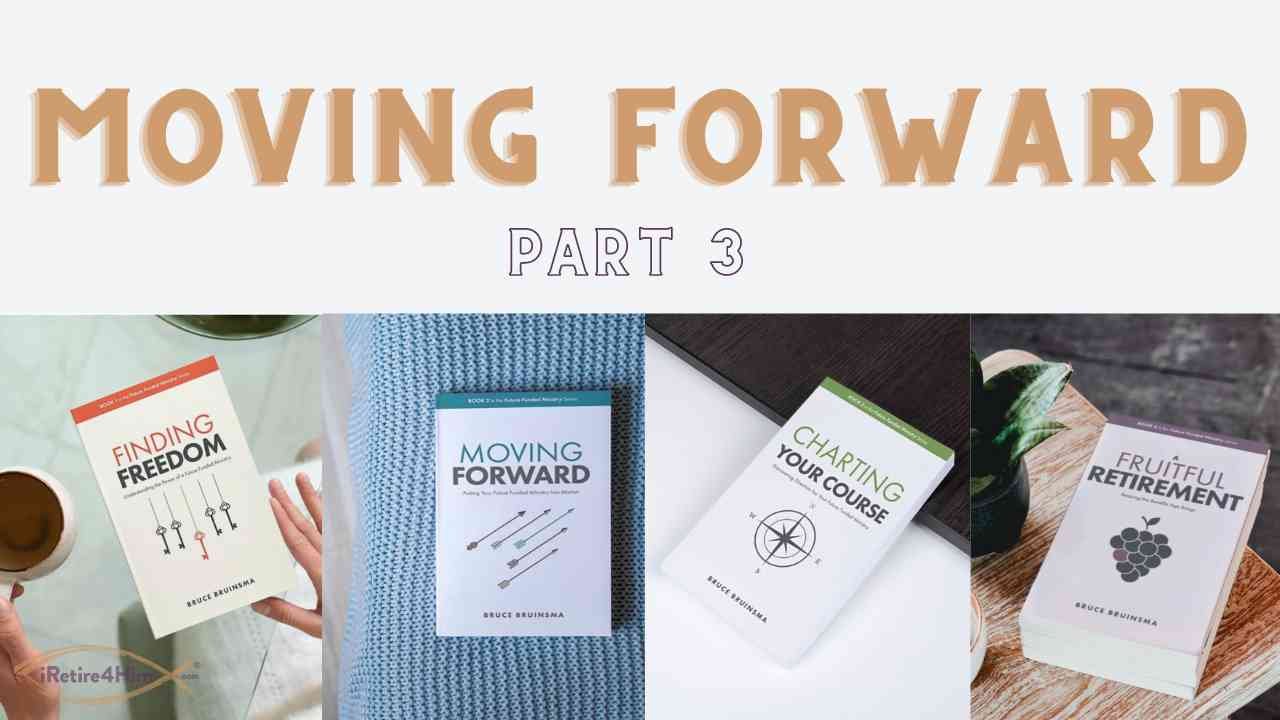
Intro: [00:00:00] While retirement is generally seen as a time of relaxation and self-focus, God calls us to love, serve, and help others for a lifetime. He has been preparing us for this retirement season, literally our entire lives. In retirement, countless Christians enter a state of spiritual dormancy not knowing how they are called to have an impact for God's kingdom.
The Retirement Reformation seeks to encourage and empower the 50 million Christians approaching or in retirement to embrace the calling God has been preparing in them. When the world says it's time to stop, you can begin to have your greatest impact. Welcome to iRetire4Him, the mouthpiece of the Retirement Reformation, where our goal is to journey from retirement to reformation so you can say, iRetire4Him!
Jim: Reaching out to the 50 million Christ followers in America who are approaching or already into retirement. You've [00:01:00] tuned into iRetire4Him the Voice and Resource of The Retirement Reformation. I'm your host, Jim Brangenberg, and I'm joined today by the founder of The Retirement Reformation, Bruce Bruinsma.
We encourage you to check us out online RetirementReformation.org, RetirementReformation.org, and of course on Facebook, the same name Retirement Reformation . The Retirement Reformation is founded on the main principle that your retirement years are the most significant years of your life. You take all the wisdom you've gleaned over your years and all the skills you've accumulated along with your retirement income, and you find yourself into a fully funded ministry model.
Your retirement years are full of freedom and adventure, and Bruce Bruinsma has written many books to help you, guide you through the process of taking advantage of your retirement years. Bruce wrote a series of books called The Future Funded Ministry Series.
Book number one is entitled Finding Freedom. We covered that in podcast 11 through 14. Book number three is entitled, Charting Your Course, which we covered in podcasts 2 through 10. And the fourth book [00:02:00] is entitled A Fruitful Retirement, which we covered in iRetire4Him podcasts 59 through 62. Book number two is our current series entitled, Moving Forward, putting Your Future Funded Ministry into Motion .
Bruce Bruinsma here to help us finalize all the details so we can move forward. Bruce, welcome back to I iRetire4Him.
Bruce: Hi, Jim. It's always good to be here and I'm so glad that we went back and picked up this book the second in the series. While I would prefer that people read them through sequentially, but each one of them can be standalone also, and, and we've had such amazing response to Moving Forward. That step of getting off the couch and getting unstuck and what do you need to kind of think about in order to take that step?
Jim: So, as we close out today, our three part series on Moving Forward, which is book two of this four book series, which I already said, how have you seen this series impact the lives of your Retirement Reformation followers?[00:03:00]
Bruce: You know what's interesting? As we enter into the first stage or the second or the third stage of retirement, there's always a little fear. There's always a little bit of the unknown. Well, because there's a lot of unknown. And so the two things that have come out of this particular book, that people have shared with me and, and that I've seen is that in fact it gives them the foundational - some additional foundational information, not only as an encouragement but as, as a foundation to build on and move forward.
We talked about the money personalities as an example. Understanding your financial landscape. So there are some tools built in there, but what really has happened and what people have shared with me is that it really was that urge, that nudge to be able to go from, okay, I kind of get it but now doing something about it and that doing something is the key. [00:04:00]
Jim: You know, you spend the second half of the Moving Forward book really helping people get prepared, our listeners, to get prepared financially for their future funded ministry years, including specific investment perspectives and basic investment understanding. Why is this included in a book on future funded ministry?
Bruce: About future funded ministry. Let's just break that apart for a moment. We talked in an earlier segment about the fact we are all ministers together now. When we are ministers together, our life requires some funding. When we are fully funded, when we have a fully funded future ministry plan, then we have total freedom to be able to respond to God's calling our life and what we do.
Many will not have that. They will be in a situation where it will be a partially funded ministry plan that will give them some flexibility, but they'll have some restraints. Maybe they still will need to work [00:05:00] or there are other restraints but just simply the idea that it, it requires resources and God provides them to us and that as good stewards, we then are prepared for the future.
Just think of the story of Joseph and the fact that in the seven years that they stored the grain up for that whole part of the world and the impact that that had it was, they had a fully funded grain future and, and how important that was. Those that did not have a fully funded grain future - Abraham, they had to go to, they had to go to Egypt in order to participate with someone who had a fully funded one. And think of all the things that happened as a result of that.
Jim: Hmm. Yeah, it's amazing. I, I actually asked an Egyptian one time, I said, do you guys still recognize the significance that Joseph played - an Israeli played in really the history of your country? He goes, absolutely, because Joseph saved the country of Egypt.
All right, so [00:06:00] Bruce, you know, we're preparing for retirement and we're either before retirement years, before that age 65 to 75 that you talk about - retirement in our most active years. Is there a spot where, where it's too late for us to get ready?
Bruce: No, there's really not. And the most important preparation is your emotional and your spiritual. You know, those preparations and your understanding of that. There is a next and your understanding of the length of time of that next, and the fact that God has a call on your life and to know what that call is at that point. Those are the things that are really, really critical.
Jim: Just being, you're saying being mentally prepared that retirement isn't just about a 30 year vacation, but that it's an opportunity to do 30 years of retirement unfettered by work.
Bruce: Unfettered by work. Or within the [00:07:00] context of work for some who need to do that because okay, they did not have a fully funded ministry.
But once, once you understand the context of retirement, the role that money plays, future funded, the role that ministry plays, the role that some relaxation in, in a sabbatical plays as you, as you get those into a right sequence - a right thought process, you're connected with God's wisdom and you're making wise decisions.
Boy, you know, retirement can be the most fantastic time of life, one with meaning and purpose and joy. And if you don't, it can be the one with the largest pain.
Jim: Mm. So how can Retirement Reformation, our organization, help our listeners to get prepared for their future funded ministry? Why don't you just tell our listeners right now about the Recreating Retirement small groups that you're doing both online and locally. Talk about those. [00:08:00]
Bruce: Yeah. One of the things that - I've talked about it before, but that each one of us comes to at some point is what I call an aha moment, which is: oh my goodness - there is meaning and there is purpose, and God does have a plan and it is gonna be 30 years. Ah. Now here's the question, what's next?
And so how has God uniquely planned and prepared you for what's next? And so to be able to come together in community, in, in a small group, and to be able to work through all the issues of understanding the preparation that has come, and then being able to describe and to come to grips with what's next.
And so Recreating Retirement is that process and that small group study that we're so excited about. Matter of fact, Jim, I gotta tell you, we got a big vision man in that in the next five years that there will be 10,000 Recreating Retirement small [00:09:00] groups that have been started and people have gone through it and are, are then encouraged to be able to take their next step.
So, you know, we're so excited about the process, about the material, but most importantly about Moving Forward into what's next. You can find out about this at our, on our website RetirementReformation.org. You can find about it on our Facebook page, and it's just something we're excited for.
Matter of fact, there may be some of our listeners that say, you know, I haven't been through it, but I'd like to. I wonder if I could teach that or lead as a group in my church. We hope that, and pray and believe that there will be a growing number of people that will embrace helping others to come to the realization that God already knows, and now you need to step into his preferred future for you.
Jim: Hmm. Those workshops, that small group [00:10:00] study is called Recreating Retirement, and it is a six week study. It's fantastic. It is just been released. You can do an online group on Facebook at Retirement Reformation, but you can find out all the information about a Recreating Retirement groups on our website, RetirementReformation.org.
When we come back, Blaine Derck will share his story of how God is working in his retirement years. And then we'll finish up during our third segment, the three part series on Moving Forward, putting your future funded ministry into motion. We'll be right back.
Break: Recreating Retirement is an interactive small group study helping you to move from nothing to what's next? You can join us on Wednesdays at 6:00 PM East Coast time on Facebook Live. Our goal for this study is to provide a group setting for interaction and new ideas while leading you through a first step in your journey from retirement to reformation.
Here's the big idea. During the next five years, 5,000 small groups will experience this journey of discovery in [00:11:00] churches and faith-based organizations across the country. Is your church a place where Recreating Retirement needs to be planted? Join us online to experience the study or prepare to lead a small group at your church or ministry.
Email us at contactus@RetirementReformation.org or go to our website at RetirementReformation.org. That's RetirementReformation.org.
Jim: Hey, welcome back to iRetire4Him. Bruce, during every second segment of every show you always bring on a surprise guest. Somebody's got a great story to share about how they're living out their faith in their retirement years. Who do you have for us today?
Bruce: Well, to our audience, I'd like to introduce Blaine Derck to you. And Blaine has had an interesting pathway of life that has led him to a very unique situation. So typically what I do, Blaine in, in these conversations, I ask somebody to kind of, you know, give us a little background story to, to what it is you're doing now, but I'm gonna do this a little bit differently. Could you tell our audience what it is that God has you doing today [00:12:00] as ministry?
Blaine Derck: That's a great question. As I was coming out of the nonprofit segment, I needed some employment and I took a job, working part-time for a funeral home here in town. And I, I've been around funeral homes throughout my entire ministry, but this was an opportunity for me to work actually in the business, so to speak.
And as I was there, I began to realize, There were people who find themselves in the current state of affairs without any kind of engaged minister or an engaged church, and yet they wanted to have some semblance of a Christian burial. And as I was talking to some of the funeral directors that I work with periodically, they would call me and say, Hey, [00:13:00] could you maybe fill in and act as a pastor to this family?
And of course, the way I was raised in ministry, the answer to those questions are always, yes. Let me figure out how I do it. Okay. So I was just counting - just the other day I was talking to a coworker, and in the last three and a third years that I've been working for this particular funeral home, I've probably done over 70 funerals where families did not have a context of opportunity to have a pastor do their funeral.
So out of that, it's, it's opened a door for me that when I moved into retirement more full-time I was, I was still working that process and I'm still engaged in providing those ministry opportunities. And the way that works is I'll have a funeral director reach out to me and see if I'm available.[00:14:00]
If the time slot works for all of us then I reach out to the family and begin to build a relationship with them. It's a rather, it seems, rather short term, but I still have the contact information for all those individuals. And they still have the contact information for me. And I typically, about a month after the service, I reach back into their lives and just say, Hey, how's it going?
Now there are some special cases that tragedy is very deep and you know, I, so I track those individuals a little bit more regularly and I try and reach out to them maybe once a month for the next year or so and just see how they're doing and, and use it as an opportunity to share my faith journey with them as the Lord opens those doors. And just be there as a comfort to help them as they walk this grief process. At least for the first year of that journey.
Bruce: [00:15:00] Wow. That's a, you know, there are all these niches of people that need Jesus to be represented to them. Maybe it's a shoulder to cry on. Maybe it's. , you know, someone to vent emotion whatever it may be. But to assure them that there is more, that God loves them and to to be, you know, to be Jesus in the middle of their grief. Did you - go back to when you were 20 years old, okay? Could you have even imagined that you would be having this kind of ministry at this time? Or was that something that God planted in your heart way back when?
Blaine Derck: Well, that's an interesting question that you're asking there, Bruce, because when I came out of college with my degree to go into ministry in a local church I was on staff of a fairly large church and it's pretty atypical for a staff pastor to do very many funerals because everybody wants the senior [00:16:00] pastor to be the representative that speaks into that situation. But the interesting thing is, I, in that first year after graduation, I did five funerals. That, that was unusual for a staff pastor because again, everybody wants the senior pastor.
But because of my network through what I was doing in the church, I was - some of us might remember the bus ministry way back when. I was the pastor of the bus ministry and the and the evangelism pastor. And that put me in contact with a lot of people that would not claim a local church. They would not say, Hey, I go to church on a regular basis.
And what happened is as I was engaging those individuals, God began to formulate in me a capacity to enter into some of those hard grief-stricken conversations with [00:17:00] families. And again, I wanna give credit where credit is due. I also was mentored by a pastor that took me along on funeral calls and said, here's how you do this, because you're going to get calls from people that have no relationship with you and no relationship with the church.
And I will confess, the way God's wired me is I'm pretty gregarious. I don't have too many people that I don't meet that I wouldn't at least be able to relate to in some form or another. And I surrendered that capacity to God and 40 years later, here's where I am. I'm, I'm using whatever God laid into my heart back as a graduate of college and working as a young staff pastor to where I'm at today.
Being able to have these conversations. I will confess to you that Covid put a wrench in it a little bit, and yet God has helped us navigate [00:18:00] that in that now families are quite comfortable even just having phone conversations. You know, it's kind of awkward. People don't want you in their home very much if they, if they don't have to.
But again, I give all glory to God and I'm able to bridge those emotional gaps even on the phone. And that's a God-given gift. It's not something that I've formulated and I wanna give him praise. So I'm even doing it now post covid in a whole new context that I hadn't done it in before.
Bruce: Well, I've noticed that people continue to die and that loneliness and separation from a community of faith is unfortunately becoming more of a norm than what we would like it to be. And so the way that God has prepared you, just one observation is that, you know, we, we talk about in the Retirement Reformation, we talk about how God uniquely prepares each one of us for what's [00:19:00] next. And your story is certainly one that puts an exclamation mark behind that.
So we appreciate you sharing with us, sharing that. Jim, do you have any questions for Blaine?
Jim: Yeah, Blaine, I can't help but notice the grandfather clock behind you that is not working. That's wrapped up in plastic and it's almost like a metaphor for what you just described, how you used to do ministry one way and Covid kind of wrapped that up, sent it packing, and you've got a new way of doing ministry. A new paradigm. Isn't an amazing how God continues to use your heart and passion for caring for people who are in a very difficult time, but yet you had to do it differently?
Blaine Derck: Yeah. And, and that's, and that's what I hope that will happen even for anyone coming out of a vocational context, whatever that context may be. Because, you know, I won't say that the transition was easy. I still scratch my head [00:20:00] sometimes and say, well, why aren't I doing what I was doing before? I just follow where God leads and sometimes God does pack up the old and gives us a new gift and you unwrap it and you say, oh, wow, God, thanks for the opportunity. Didn't expect this.
Bruce: What a great thought.
Jim: Blaine Derck, thanks for being an iRetire4Him. We'll be right back.
Break: Our work on this earth doesn't end when the paycheck stops. God calls us to be faithful for a lifetime. Whether you're looking forward to retirement or you're already there, our all small group study Recreating Retirement will help you understand, engage, and activate what God has for you in this fourth quarter of life.
Join Retirement Reformation founder Bruce Bruinsma as you consider your past strengths, spiritual gifts, and your passions and how they all come together as the call God has for you in these years. Connect with us on our online community group at Facebook.com/ Retirement Reformation. Wednesdays at 6:00 PM Eastern.[00:21:00]
Or if you'd like to bring Recreating Retirement to your church, email us at contactus@RetirementReformation.org. Are you ready to start your life-changing journey today?
Jim: Hey, welcome back to, iRetire4Him. Had this great conversation with Blaine Derck. I, I'm so glad, Bruce, you do such a great job of picking those segment two guests.
Bruce, I thought it would be really helpful in this final segment of this three part series on the book number two, Moving Forward, that we go back and do a summary on all four books that we've got in this series. So why don't you start off just talking. What is book number one, Findinng Freedom - Understanding the Power of a Future Funded Ministry? What is book number one all about?
Bruce: First of all, it's the first stage in that aha moment that all of us will come to at some point or another when we realize that there is more, and that in fact the [00:22:00] retirement years instead of being a trap, instead of being smaller boundaries, instead of coming together to be less than, it's an opportunity to be more than, and the freedom that you can find.
And we talk about the freedom in Christ that we can find and the way that God has prepared us. It's, it's that opening of that aha moment of, oh my goodness, there's freedom ahead. Not slavery or any other downer kind of thought. That's the first book.
Jim: And I can attest to the fact that having lived in Florida for 20 years, that people do feel like retirement is a death sentence instead of a life sentence.
Bruce: Not only a death sentence, but a death spiral. And you realize that that's not true. Finding freedom.
Jim: Finding freedom is all about changing your perspective. And then of course, we just finished up a series, are finishing up a series on Moving Forward. But Bruce, why don't you just summarize in case somebody just listened to this podcast and didn't catch the other two? Moving Forward helps people do [00:23:00] what?
Bruce: Get off the couch and get started and provides the understanding, foundational information that will allow you to feel, to be encouraged to get off the couch, to be encouraged to be able to listen to what God has in mind for you. So it has the next step of, the foundation of what it takes for them to be able to feel, be encouraged to take the next step and to literally move forward.
Jim: So book number one just awakens our listeners to the idea that, wow, there's freedom in retirement. Book two is, Hey, get off the couch, here's some steps, get going. And then book three, Charting your Course, Discovering Direction for Your Future Funded Ministry. Talk to us about this book.
Bruce: I think in its simplest word, it, it talks about planning and talks about the value of being able to understand what may be ahead, to be prepared, and to take steps into it. Someone asked me the other day, why is it that so many Christ followers in [00:24:00] retirement don't have a retirement plan other than perhaps a financial one?
But that's the extent of it. And the answer is very simple. If you're not going to do anything, you don't need a plan. You don't need a plan to do nothing. But if, in fact you understand that there's freedom available, that in fact you need to move forward, what are those things gonna look like? What's, what's the basis? So Charting your Course deals with those kinds of issues.
Jim: And you close out the four-part book series now called A Fruitful Retirement. Talk to us about this.
Bruce: Well, in some ways we go back and we recap some of the things that we've talked about in the other three. But here's the promise and here is the, the opportunity to be able to read about to understand people who in fact are living a fruitful retirement. And when we talk about fruitful, that should remind us of those fruits of the spirit. And when we live with the fruits of the spirit, oh my goodness, [00:25:00] the freedom that we have, oh my goodness, the ability to move forward that we have, oh my goodness, the ability to take a look at what's next and, and to have a plan.
And so Fruitful Retirement kind of sums it all up and is the encouragement that there is wonderful times ahead that will be meaningful, that will be purposeful, and that you'll be able to deal with the emotional, spiritual, and other challenges that you'll get and to live a life that is fruitful and meaningful.
Jim: What's amazing, Bruce, is that in this four-part series, sometimes people have a hard time getting started on all this when they're alone. And so you guys have created these Recreating Retirement small groups, and you've got an online small group Recreating Retirement group. You've got a study guide that people can actually go through with a group of people within their own local body of Christ.
This is exciting because you've got everything in the [00:26:00] resources of Retirement Reformation that any future retiree or current retiree needs in order to have switched their mindset, shift their paradigm to being involved in a fully funded ministry model in their retirement years. Bruce, it's exciting, isn't it?
Bruce: It really is. And in the lives that are being changed. And we would invite each one of you to step into the process, join with us so that in fact, we can all say together, Jim, as you and I say, at the end of every one of our podcasts, the reason why we're here is iRetire4Him!
Outro: Thanks for listening to iRetire4Him with your hosts, Jim and Martha Brangenberg and Retirement Reformation founder Bruce Bruinsma. iRetire4Him is the mouthpiece of the Retirement Reformation.
Most Christians.tend to follow the world's pattern of rest and self pampering during retirement. [00:27:00] However, in your retirement, you can be focused on God's unique call to love, serve, and help others. This can be your best season of life if you take advantage of a life's worth of knowledge and experience and combine it with a greater freedom of time and money and invest it all in the generations, both preceding and following you.
The Retirement Reformation is encouraging Christians to find and follow God's call in all seasons and aspects of life, especially in retirement. Take time to sign the Manifesto at Retirement Reformation org and explore the wealth of resources available on our site. Join this movement of God and journey from retirement to reformation so you can say iRetire4Him! Go to RetirementReformation.org.
iRetire4Him Show 79: Moving Forward, Part 2

Intro: [00:00:00] While retirement is generally seen as a time of relaxation and self-focus, God calls us to love, serve, and help others for a lifetime. He has been preparing us for this retirement season, literally our entire lives. In retirement, countless Christians enter a state of spiritual dormancy not knowing how they are called to have an impact for God's kingdom.
The Retirement Reformation seeks to encourage and empower the 50 million Christians approaching or in retirement to embrace the calling God has been preparing in them. When the world says it's time to stop, you can begin to have your greatest impact. Welcome to iRetire4Him, the mouthpiece of the Retirement Reformation, where our goal is to journey from retirement to reformation so you can say, iRetire4Him!
Jim: Reaching out to the 50 million Christ followers in America who are [00:01:00] approaching or already into retirement - You've tuned into iRetire4Him, the Voice and Resource of The Retirement Reformation. I'm your host, Jim Brangenberg, and I'm joined with the founder of The Retirement Reformation, Bruce Bruinsma.
Please check us out online Retirement Reformation.org, Retirement Reformation.org, and of course on Facebook, just look up Retirement Reformation . The Retirement Reformation is founded on the main principle that your retirement years are the most significant years of your life. You take all the wisdom you've gleaned over the years and all the skills you've accumulated along with your retirement income, and you find yourself in a fully funded ministry model.
Your retirement years are full of freedom and adventure. And Bruce Bruinsma has written many books to help guide you through the process of taking advantage of your retirement years. Bruce wrote a series of books called The Future Funded Ministry series . Book number one is entitled Finding Freedom. We covered that in podcasts 11 through 14. Book number three is entitled Charting Your Course, which which we [00:02:00] covered in podcasts 2 through 10. Book number four is entitled A Fruitful Retirement, which we covered in iRetire4Him podcasts 59 through 62.
Notice anything ? Yeah. Book number two. Today we continue our three part series on book number two in the series entitled, Moving Forward - putting your future funded ministry plan into action. Bruce Bruinsma is here to help us, guide us on our course. Bruce, welcome back to iRetire4Him.
Bruce: Jim, it's always good to be here and in this second of a three-part series that we're doing on moving forward is really good. Even though we're doing it, we're doing it out of sequence of the content, it's always valuable.
And while I think I'd like to have people read the books, you know, 1, 2, 3, and 4, this one is particularly impactful and, and I've had such tremendous response to it from people saying, you know, that Moving Forward really got me off the couch.
Jim: Yeah. Maybe in a future series we'll do all four in a row. Just 1, 2, 3, 4, boom. That'd be a good idea.
All right, so we're talking about [00:03:00] book two of your four part series, A four book series entitled The Future Funded Ministry. Why did you write this whole series of books, Bruce?
Bruce: I wrote the series because as we, you know, in my own personal life of 30 years plus that I've spent in the financial services industry, helping people with retirement and learning about all of the issues that are there in addition to money and beginning the Retirement Reformation movement, what I realized was that, that there needed to be a really carefully laid out, in a series of easy to read and understandable books so that someone could go, okay, I need to be digging into this. And that by reading each one of the books in the series, in fact, they would be taken to a point where they'd be ready to really engage the next stage of their, the next stage or stages of their life.
So it is to bring [00:04:00] clarity and encourage information and I think God's wisdom to the issues that surround retirement and starting it with that idea of a future funded ministry rather than a retirement plan.
Jim: All right, so in the middle of the Moving Forward book, you have a section for people who are much younger than retirement years focused on the future funded ministry planning. Are you saying we need to be preparing for our future funded ministry years, even in our twenties?
Bruce: As early as your heart and mind will open itself to the idea that in fact there will be a time when the paycheck will stop, yet ministry must continue. And, and the earlier that we begin to enter into that savings mode, the less amount we have to put in and the more it will be.
And so when's the best time to [00:05:00] start? Well, the direct answer to that question is if you haven't started, it's tomorrow or today is the best time to start. But when we talk about giving wisdom, for example in our - perhaps let's take that second stage that we talked about - second stage of life mentoring when we're talking with our grandchildren and helping them to, to understand that beginning to save now is the most effective way to be in ministry later.
Jim: Okay, but grandsons, you've got a couple of football star grandsons and I remember when I was 18, 19, 20, I wasn't necessarily the most absorbent sponge to wisdom. I don't know what you were like, but I'm guessing you were not an absorbent sponge of wisdom at 20 either. How have you tried to communicate this idea to your two football star grandsons?
Bruce: Well, I think his parents have done a, a really fantastic job of it and, and I won't take much credit for that, but it's interesting [00:06:00] between the two boys, for example, one of them is a saver. How do I know that? And what are the conversations that we've had?
Because he started when he was, I believe he was 10, and he set up an account and his dad helped him set up an account at a bank that he put his money into because when he was 16, he wanted to buy a car and he realized that if in fact he had saved enough money and his dad promised him, said, look, whatever amount of money you have, I will match it for you to get a car.
And his motivation, his why was so strong to get a car that he had more money than his dad was really comfortable with. But at any rate, so he got a really nice car. Now his brother on the other hand money is meant to be spent now and it is spent to help others. That's a good thing and to have a good time.
So the two boys, they're a couple years apart. One's really got that savings idea, that future funded ministry idea, [00:07:00] and the younger one doesn't have it yet. But our prayer is that he will, he will have it, but he's aware of it. He's seen what's happened with his brother. And so, you know, that's the reality of our learning about good stewardship. Cuz good stewardship is not only what we do now, but what we prepare for in the future.
Jim: I love that example. And it's, it's great cuz we all, every one of us has kids that are, they're very, very different. All right, so once we've reached 55 plus, is there anything we can do to influence our financial position and better prepare us for future funded ministry? Because sometimes , well, for many people listening to this podcast, this is a new idea.
Bruce: It is a new idea, although I think just about everyone has a, has an almost an innate feeling that I should be saving for the future. Now, how they deal with when they're gonna start doing that, that becomes the issue. But so many people that I [00:08:00] talk to, and they're 55 or even 60, and they haven't started.
The good news is it's not too late. It's not too late. You don't have to have a fully funded future ministry to be able to have an impact on that future time. Even if it's a half funded future fund account that's better than nothing.
I had someone the other day said, well, I know it's way too late for me, and we did the math, and in fact, they would be able to set aside money in the amount of $400 a month. I asked him, I said, does $400 a month make a difference to you? Now, if I took 400 away, would that, would that create pain ? Yes. If I added 400, would that bring some additional capacity? The answer was yes. Yeah. And so it's never too late to start, and your financial situation typically changes as you become an empty nester.
So that presents lots of opportunities in the next 10 or 15 years, and maybe you gotta [00:09:00] work a little bit longer, so be it. But you can be in ministry even while you're doing that work.
Jim: Absolutely. We encourage you, of course, to check out a great website - iWork4Him - that'll talk all about putting, making your workplace as a mission field as you prepare for your future fund ministry, which is what the Retirement Reformation is all about.
Hey Bruce, when we come back in at segment three, when we talk more about this moving forward book and we get into more of the conversation about our future funded ministry, I wanna celebrate the fact we're gonna hear from Hal Halbecker about his, what God's doing in his retirement and when we come back in segment three, we're gonna talk about money personalities.
As we heard about your grandsons, they've got a couple of great money personalities. I can't wait to hear more details about that. You're listening to iRetire4Him. We'll be right back.
Break: Recreating Retirement is an interactive small group study helping you to move from nothing to what's next. You can join us on Wednesdays at 6:00 PM East Coast time on Facebook Live.
Our goal for this study is to provide a group setting for interaction and new ideas [00:10:00] while leading you through a first step in your journey from retirement to reformation. Here's the big idea. During the next five years, 5,000 small groups will experience this journey of discovery in churches and faith-based organizations across the country. Is your church a place where Recreating Retirement needs to be planted?
Join us online to experience the study. We'll prepare to lead a small group at your church of ministry. Email us at contactus@retirementreformation.org or go to our website: RetirementReformation.org . That's Retirement Reformation.org.
Jim: Hey, welcome back to iRetire4Him. Bruce, during every second segment of every podcast, you always bring on a special guest who's got a story to share. Who do you have for us today?
Bruce: Well, I have someone who's very special today. You know, there's times in your life when you have the opportunity to meet someone and you go, you know, I think they could have been my brother.
And because God has led us in paths that have brought out similar [00:11:00] understandings and Hal Halbecker is, is certainly one of those people. Matter of fact, every time I read one of his books, I go, oh my goodness, I could have written that. And so Hal, give us just an executive summary of how God has led you to where you are, including coming to Dallas Seminary in 1973.
Hal Halbecker: Well, Bruce, first of all, it's great to be with you. Thanks. I love being with you and hearing your voice and what God is doing in your life and reading everything you have on Retirement Reformation. It's awesome. You know, if I could summarize it in 60 seconds, it would go like this.
I grew up in Hershey, Pennsylvania. Trusted Christ as a six year old kid. Went to Taylor University. Through a missionary experience in Haiti in 1972, I came to Dallas Seminary. I came to study the scriptures, thinking I would go into some kind of public policy work. While I was in seminary, Howard Hendricks challenged me to consider [00:12:00] ministry for life and even equally important, I met my wife at Dallas Seminary.
We married, started our family, and believe it or not, I've never left . I served with W.A. Criswell and First Baptist Church staff for six years, served for 15 years with the Christian Medical and Dental Associations, pastored a church as a senior pastor for almost 22 years, and then launched Finishing Well Ministries, having always been influenced by older people.
And I just felt God drawing my heart to encourage older people and help us all to finish well. Second Timothy 4:7-8. So that's my story, Bruce. And God is alive and worked in my life. And the best thing we can talk about as we age is God's work in our lives and encourage others to do the same even in our aging years. So that's me.
Bruce: Indeed. Well, it is you for sure. And Finishing Well , the, the materials that you've put together out of the experience and the leading of the Holy [00:13:00] Spirit as he has guided you. Just outstanding material. And so as we partner together to influence the 40 million Christ followers who unfortunately are on the sideline.
And as you and I would both have our hearts quickened to help change their thinking, just talk about that a little bit and how you see the, the issues of seniors and what in fact is the opportunity.
Hal Halbecker: Well, as I see seniors, as we both see them, you know, I think we've, I think of Paul. Romans 12:2 , be not conformed to this world, but be transformed by the renewing of your mind.
So I think, how do we think about life after our work? You know, God calls us into a particular area of ministry and work with our hands. Like Moses prayed at the end of Psalm 90: confirm the work of our hands. Well, what do you think of the work of your hands? Well, most people think about it as what they did.
A preacher, I pastored a church for 20 years or whatever. Well, if you look at the [00:14:00] lifespan of all your years, God has a work to do through every one of our years, and retirement kind of communicates the idea that we're finished. You know, I like to talk about, you know, an athlete retires his jersey to the rafters and he doesn't play on the court or the field.
You know, you retire planes to some airfield out in Arizona, in the desert, and they're not flown anymore. But the idea of retirement in one sense is not biblical. You know, that's our cultural sense. You're finished. No. It's your time to play. Well, no, it's not. . You know, I talk about retirement from the Levitical priesthood.
You, you know, there were, the priest had to retire at age 50. A lot of people say, well, retirement's not in the Bible. Well, it is in a sense, but they didn't retire to do nothing. What they retired from the act of work of their lives to do was to go out and pastor all over Israel and train up next generations [00:15:00] to be followers of God in every sense of the word.
So that's our mission today. I think every older person has a mission to succeeding generations to help them and to be an example. If I could quote two verses, Psalm 71: 17, and 18, oh God, you have taught me from my youth and I still at my age declare your wondrous deeds. Even when I am old and gray. Oh God, don't forsake me until I declare your strength to this generation and your power to all who are to come.
That is our mission as we age with every day of our lives. The Holy Spirit leads us in creative ways to do that to our experiences and passions.
Bruce: You know, my prayer is that this message will not only be transmitted to those 40 million Christ followers who are sitting on the bench, but that the Holy Spirit will quicken them.
Can you just kind of think with me for a minute what would [00:16:00] happen if, in fact, everyone that heard joined with us, the message spread, it became viral, and 10 million Christians got off the couch and were representing Jesus in the unique way that God had prepared them. Man, talk about that for just a minute.
Hal Halbecker: Well, the first thing that comes to mind to mind, Bruce, is as we watch the generations following us, lose their grip on what the scriptures teach in so many areas. If every older grandparent were pouring their lives into the next generation, sharing their experiences of what God did through them and using the scriptures as their reference point, you wanna say, how would that affect the generations following us?
I mean, you can imagine unleashing 40 million older grandparents. We're older parents of [00:17:00]adult kids and grandkids and great grandkids, you know, would have a significant impact. I, I can't measure, you know, actually what it would be, but the church would be stronger. Our resistance to the work of Satan and our culture would be stronger.
I mean, all kinds of things I think would be changed. Maybe elections would even be changed. I don't know. But you, you know, at least people would feel more confident in who they are as Christians and as believers and in the work God wants them to be and do in their lives if they were influenced and prayed for, and cared for and loved by an older generation.
Bruce: And I, I think just to add to that, is that all the things that our culture says that is dragging us down, we have the opportunity to reverse that. And through the love of doing what it is that he's called us to do, and the preparation that we have, every aspect of our society could be [00:18:00] changed. So if we're part of that group that's concerned about what the future's gonna be like, here is an opportunity to make a difference and to be called into ministry for a lifetime really is, I just wanna thank you for the ministry of your lifetime and what there still is that we have to do.
Hal Halbecker: Amen, Bruce, let's keep working on it together.
Bruce: Jim, you got any questions or anything for you?
Jim: I have one question, Hal, as you have been working with Christ followers to just understand how to finish well. When you first present this, I mean, the average retiree thinks that they just retired to just, you know, well, they go to Florida, Arizona, or Texas to retire, to die.
You know, they go there to die. When you open up the doors to them and say, you know what? Retirement is a place of excitement and ministry possibilities. When you open up the doors and shift their paradigm, what do you see change inside of people?
Hal Halbecker: Well, well, the first thing I literally I see is a smile coming across people's[00:19:00]faces . And they look at me and they say, why hasn't anybody ever told me these things that are in the scriptures? And they feel like they have a new lease on life. You know, Frank Telepo used to be a pastor in Denver, Colorado, and he wrote a book back in the eighties called Unleashing the Church. And I think of that when I see their faces change. Makes all the difference in the world.
And you feel like the church has a new leash. They have a new leash on life . And you imagine, Bruce, if every church did that, if every pastor, every lead pastor, every senior pastor had a heart for the aging people in their congregation. It's like Howard Hendricks said, what would be different if that would happen?
So it's just an amazing gift, Jim. That's what runs through my mind when I teach, when I share, when I encourage people. I'm doing it in a senior living facility in Dallas right now. Makes all the difference.
Jim: Hmm. Where do people find out more about Finishing Well Ministries?
Hal Halbecker: Well, you could go to finishingwellministries.org. There's a website there, there are videos, [00:20:00] there are resources there. And hopefully they would encourage you to keep catching a vision. Like Moses said in Psalm 90, so teach me to number my days. Then I may present to you a heart of wisdom. Those are, that's what Finishing Well Ministries is all about, and I hope it teams right up with Retirement Reformation and together we keep growing the kingdom. Right, Bruce, Jim?
Bruce: Praise the Lord. Absolutely.
Jim: Absolutely. Bruce, again, what a great guest. Hal Halbecker, thank you so much for being an iRetire4Him. We'll be right back.
Break: Our work on this earth doesn't end when the paycheck stops. God calls us to be faithful for a lifetime. Whether you're looking forward to retirement or you're already there, our all small group study Recreating Retirement will help you understand, engage, and activate what God has for you in this fourth quarter of life.
Join Retirement Reformation founder Bruce Bruinsma as you consider your past strengths, spiritual gifts, and your passion and how they all come together in the call God has for you in [00:21:00] these years. Connect with us on our online community group at Facebook.com/ Retirement Reformation. Wednesdays at 6:00 PM Eastern.
Or if you'd like to bring Recreating Retirement to your church, email us at contact us@retirementreformation.org. Are you ready to start your life-changing journey today?
Jim: Hey, welcome back to iRetire4Him. We're talking about Moving Forward, book two of the Future funded ministry series. And Bruce, we promised our listeners that after we got a chance to hear from Hal that we would get a chance to talk about the money personalities.
And you already kind of peeked into a little bit talking about your grandsons, but what are money personalities? And then of course we're gonna ask the question next, what does it have to do with our future fund ministry? Go ahead. What are money personalities?
Bruce: One of the things that we've learned and maybe just our audience remembers and may have been exposed to the five love languages in the different ways that we show love. What we've learned is that in [00:22:00] fact there are five different ways that are, that the way we think and deal with and about money is important to understand. And so there are five money personalities, you know, and you could have a primary and a secondary.
So they can work together. But, you know, just kind of think to yourself for a moment, who do you know that you just know that they would fit the category of being a spender? And who do you know that would be a security seeker and there's somebody else that you know they're just an entrepreneur, risk taker. And then you've got a saver. And then you've got a last one, which is generally of which we refer to as a flyer.
So let me just give you just a quick insights on each one of those, because they can be done in combination. So for example, my combination is as a [00:23:00] spender and saver. Now it's, that sounds really in conflict, doesn't it?
The way it plays out in my life is that I'm not afraid to spend, and I'm not afraid to be a risk taker, but I'm going to do the research first to make sure when I take that step, that I'm doing it as wisely as I can. That's where that saver piece starts to come into play. So it's in that combination.
My wife, Judy, is very much the the opposite in that she's a security seeker, but a security seeker and a spender. So she's not afraid to spend money and to support me in doing that, but she's always kind of concerned is it gonna work out okay? And so you see those in Judy and my understanding the conflicts and our own money personalities has helped our relationship.
You can see it with kids. I talked about my two grandsons. Well, one is in fact a, a [00:24:00] saver, and the other is more of a flyer. A flyer is someone who really doesn't, you know, I've got the money and here's the opportunity in front of me and I'm gonna do it. And they're not really giving a lot of thought to either the result or the impact or anything. It's, it's much more immediate.
And so these five areas, it really helps us to understand our relationships and to be able to understand how it is that when God puts an opportunity in front of us, the lens through which we're going to look at it, and those who are important in our lives are going to look at it.
Jim: So how does all of that play into our understanding of a future funded ministry?
Bruce: Well, for example, if you're a flyer, it's gonna be harder for you to save . They have sufficient money so that in fact it can fund that future ministry. So you have to be much more intentional. For a saver, it's not a problem at all.
Matter of fact, I had a set of [00:25:00] clients that I worked with for a long time and they'd saved, they were just wonderful savers. They were wise and they saved, they finally got to the retirement years and they couldn't figure out how to spend the money. They were so into saving that they couldn't spend it.
So I had to give 'em a budget of here's how much you're gonna spend every year, and, and then just have the conversation and here's how much you're gonna give every year. So that, in fact, the application of those resources that they had saved were appropriate. But it was interesting, that basic personality was so built into them that it was really hard for them to take those next steps of spending or investing or supporting ministries in that next stage of life.
Jim: Do you find that that's a common theme for retirees who have spent so much time being diligent in preparing for saving for the retirement, that when they get there, they have our hard time spending any?
Bruce: Yeah, I really do. I, I'm not [00:26:00] sure what percentage that would be, but it would be at least 30% of people have, that, have that issue or have that conflict between a husband and wife, not only on will we spend, but on what will we spend. And so, for example, within our faith-based communities where someone has a, you know, just has a really generous heart and the other person has a hard time letting go of anything, so the conflicts that come.
So understanding those and then turning to the Bible and being able to work through to come to an appropriate understanding of how they're going to deal with those two different personalities and those two real life issues.
Jim: So I happen to know that one of the things you have no hard, you don't have a hard time doing at all is working. You love to work, you love to invest, you love to, I mean, you love to be active. And I know that Judy loves to spend time with you and in the last year she's successfully gotten you out of the office a [00:27:00] lot more to enjoy life in your quote unquote retirement years. And you've done a little traveling.
How hard has that been for you to let go a little and play with that other part of your money personality in order to respect and love your wife to spend a little time, you know, exploring the world?
Bruce: You know, when we use the fruits of the spirit as a lens to look at the issues that are in front of us, and that was one.
And so as, as I prayed and struggled through that a little bit, I said, how do I really need to be thinking about this through God's eyes and the love that I have for Judy? And the answer that came for me was that I needed to be intentional. And so to be able to sit down with Judy and say, let's look at this next year.
What are the things that you would like to do or that we would like to do that have, that have been on our bucket list or that we, we haven't experienced? And let's put 'em on the schedule [00:28:00] and I will commit that I will adhere to that schedule. And once I made that decision, and we did that, then I remember coming up to the first one of those, and there were all kinds of reasons to cancel it and not do it.
And, you know, all kinds of things I had to do. And in my prayer life, the spirit moved me and said, Bruce, remember the commitment that you made? Not only to Judy, but that in fact, that's something that, that I want you to experience also. Mm. And so that's kind of part of the journey that we've been on. But intentionality is the, is the key.
Jim: We wanna invite all of you listeners to get a copy of the entire series of the Future Funded Ministry book series, and go out to our website on the resource page at RetirementReformation.org, Retirement Reformation.org, and get all four books. We're focusing this series on Moving Forward, book number two. Putting your future funded ministry into action.
Bruce, before we go though, I really wanna make sure you plug [00:29:00] the Recreating Retirement groups that you guys have started online and locally so that people can get involved. Tell 'em how they can find out more and get involved.
Bruce: Well, two things.
Number one, it's an opportunity to engage in a small community, perhaps of your friends or even strangers, but in community to be able to work through together, learn how has God prepared you for what's next, and then while you're doing this in a group, it'll be ended to, the result will be an individual understanding of what's next.
And we talked about earlier about the different stages. So what's next in the next stage? And so, Recreating Retirement, as groups spread around the country we have a virtual group that we're doing online. And so we look forward to that. Recreating Retirement, the opportunity to understand how God has uniquely prepared you for what's next.
Jim: Great conversation and Bruce's book Moving Forward is such an inspiration for getting us going on our Future Funded Ministry plan. Again, [00:30:00] make sure you get a copy on our website. I Retirement Reformation.org on our resource page. You've been listening to iRetire4Him the Voice and Resource of the Retirement Reformation with your host, Jim Brangenberg and of course Retirement Reformation's very own founder Bruce Bruinsma. We're Christ followers journeying from retirement to reformation so we can say iRetire4Him!
Outro: Thanks for listening to iRetire4Him with your host, Jim and Martha Brangenberg and Retirement Reformation founder Bruce Bruinsma. iRetire4Him is the mouthpiece of the Retirement Reformation.
Most Christians tend to follow the world's pattern of rest and self pampering during retirement. However, in your retirement, you can be focused on God's unique call to serve and help others. This can be your best season of life if you take advantage of a life's worth of knowledge and experience and combine it with a greater freedom of time and money, and invest it all in the [00:31:00] generations both preceding and following you.
The Retirement Reformation is encouraging Christians to find and follow God's call in all seasons and aspects of life. Especially in retirement. Take time to sign the manifesto at Retirement Reformation.org and explore the wealth of resources available on our site. Join this movement of God and Journey from Retirement to Reformation so you can say iRetire4Him!
Go to Retirement Reformation.org.