
7/1/26 - 2153: The Fog of Grief
Jim: This is iWork4Him.
Martha: Where faith meets work and believers unleash their calling.
Jim: Running a business brings challenges that can be hard to understand unless you've done it yourself. Business owners are responsible for delivering a quality product at a fair price, caring well for customers, and providing steady work for the people they employ.
In that sense, a business does more than serve customers, it helps support families, vendors, and employees. It can be taxing on your family, taxing on your children, taxing on your health. All of that is true and significant, but what happens while in the middle of all the things that we just mentioned, you find out that one of your children is gonna be born and then die quickly?
Suddenly everything becomes clear in your mind, and priorities naturally fall into place, and things that you thought were important don't even touch your radar anymore. Grief can be overwhelming, even in its simplest terms, but the death of a child hits harder and longer than anything that can be imagined.
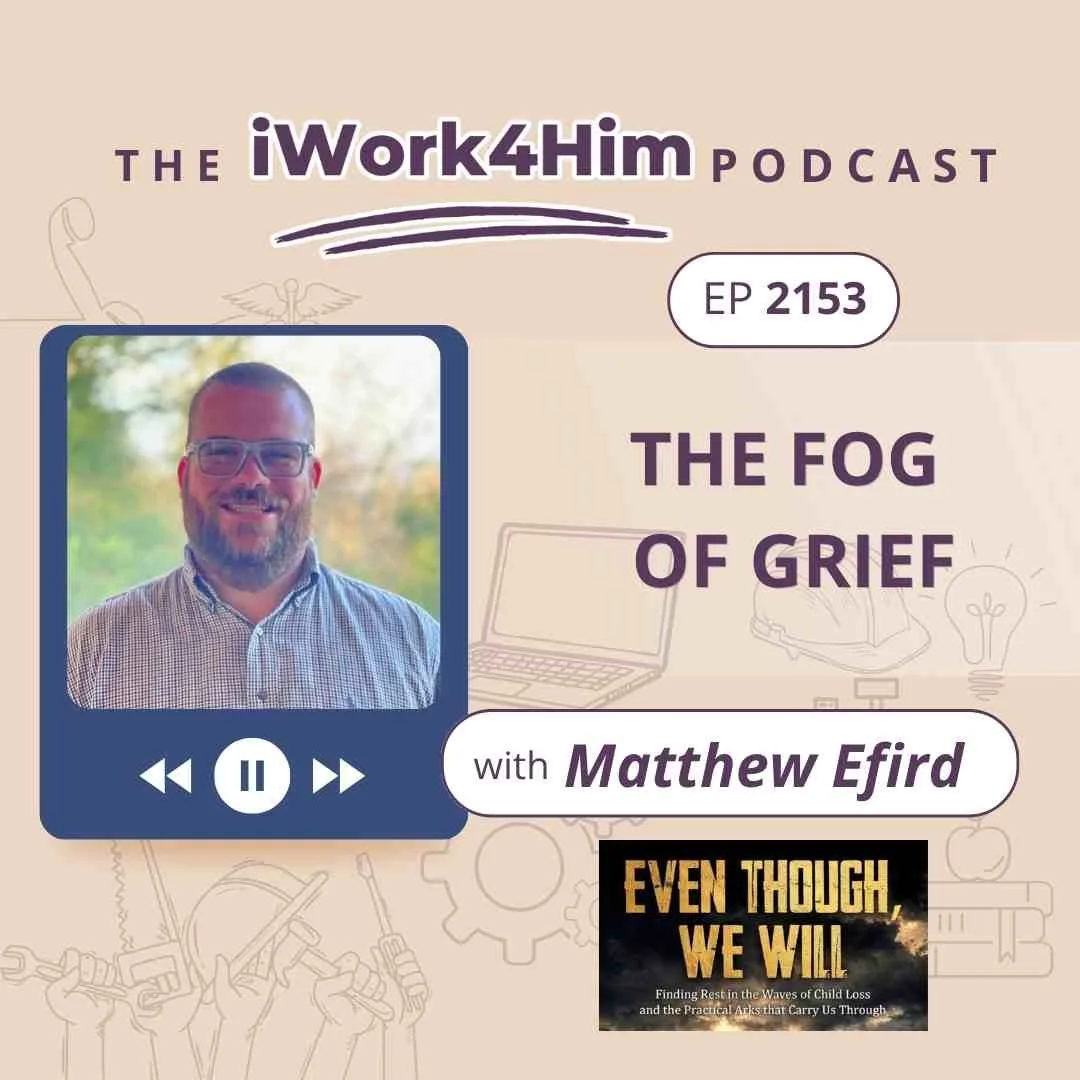
Matthew Efird is here today with us to share the story of his family, his son Noah, and the path that he and his wife Hannah walked through these past six years as business owners and parents. Matthew recently released his book about the story of his son Noah, Even Though, We Will: Finding Rest in the Waves of Child Loss and the Practical Arks that Carry Us Through.
Matthew Efird, welcome to iWork4Him.
Matthew Efird: Thank you Jim, Martha, appreciate y'all having me.
Jim: Yeah, you bet. Matthew, we don't usually talk about grief on iWork4Him. We focus on the significant impact of people living out their faith in their work. What I realized when I was reading your book is that we need to talk about grief because people in our workplaces, which is our ministry place, our mission field, are often going through grief related to the death of a spouse, or the death of a parent, or the death of a child, or the death of a marriage. As a business owner, were you prepared to deal with grief and run a business too?
Matthew Efird: I definitely was not. I was most certainly not prepared going into it, had no clue what to do. Thankfully had incredible team members that worked with us, incredible community around us. I'm sure we'll get into that. But I did not feel equipped going into it as a business owner, no.
Martha: And you're right, we are gonna get more into the details. Normally when we have a first-time guest on the show, we ask you to share your Jesus story, but really this whole story, this whole show is about your Jesus story. So let's talk, start with you talking about, telling us about Noah.
Matthew Efird: Yeah. I'd be honored to. So Matthew Efird, I'm unapologetically a follower of Jesus Christ, had the amazing opportunity to marry my high school sweetheart, and our second son, Noah we learned at 12 weeks, my wife was 12 weeks pregnant at the time, at our ultrasound appointment that our son had some abnormalities on his ultrasound. 10 days later, we got the results back from his genetic testing.
He had a genetic disorder called trisomy 13. It's Patel syndrome. It's very similar to Down syndrome. Most people are familiar with Down syndrome. That's trisomy 21. It's an extra 13th chromosome, so that's where the trisomy comes from. He, at the time, we learned that he was not going to survive. It was a lethal diagnosis.
And so we chose to carry him to term. We believe that life happens at conception, so we wanted to carry him to term and enjoy the time with him as much as we got. So over the next six months or so, we walked through kind of anticipatory grief of grieving his diagnosis while he was still here. And then on March 7th, he was born.
Almost born in the truck, which is a funny story. But he came real quick. My wife's a rock star. We got to the hospital. There was a parking spot up front, which was a huge blessing. Got in. About 15 minutes later, we're holding him. And he lived 57 and a half hours. So on March 9th of 2020, he went to be with the Lord.
And it's amazing looking back on it, we see so much of God's mercy through our story. One of the things I love to point out is if you remember what happened in March 2020, COVID wrecks our country and our economy. In Athens, where our son was born, I think on the 10th or the 11th-
Jim: Not Greece, but georgia.
Matthew Efird: Yeah. Not... Yeah, sorry. Thank you. In-country. Athens, Georgia. Yeah. And the hospital that our son was born at, I think on the 10th of March or the 11th of March, they shut the hospital down. So no visitors. Parents were delivering in separate rooms. It was just chaos. I don't wanna speak if that was right or wrong but it's the circumstances that were there. Our son Noah was due later in March, but he came early, so he was born March 7th. All of our family, all of our friends got to come meet him.
And we got to cherish that time together as a couple, that without having to wear a mask, without having to quarantine, without having to be separated. It was just an incredibly merciful thing that God allowed us to have that time with him on this side of eternity.
So he passes March 9th. We have his memorial service on March 13th, which is Trisomy 13 Awareness Day, which is 3/13. Oh. It was the last memorial service that was performed in Athens in 2020. Just again, more and more stories along the way. Perspective matters and the things that we choose to focus on have helped us a lot as individuals and as a couple.
Martha: Yeah, I was, as soon as you said that, I was already doing the math and oh, my word. I didn't know what it was, where you were, and I'm so glad you spoke into that because we need to recognize when we do get those gifts from the Lord. And not everybody got that. You know, it was a tough season, but you-
Matthew Efird: Of course.
Martha: That was a, that's a big part of your story, and thank you for sharing that.
Jim: Matthew, you mentioned that you and Hannah started grieving the minute you heard Noah wasn't going to live a full life.
Matthew Efird: Sure.
Jim: Yet you also mentioned in your book that Noah went from the lap of his earthly father to the lap of his heavenly Father, that your grief was crushing. How is that grief different?
Matthew Efird: Yeah, so the, when we started grieving, that anticipatory grief, it was a weird circumstance to be he's still here, but we know he won't be here long. And so part of it was we still are celebrating the fact that he is here. So he's continuing to grow from week to week when we go to our specialist appointments. We cherish the time with him, those 57 and a half hours that we got with him.
And then when he passed, the evening of March 9th, it was the finality of, okay, now this son is gone. This son that we had prayed for, this son that we had longed for, this son that we knew would have short time here, that time has come to an end. And Jim, I prayed thousands of times for God to heal my son, and I wanted that to be on this side of eternity.
I wanted it to be where I could come on shows like this and say "Hey, here's my six-year-old son, and he should be, he should have passed away, but he's here." And have this, what I'd written the story in my head of the, this amazing testimony. We'll write all these books. Here, go and do great things. And I get to the place in my relationship with the Lord to say, "Okay, God, you are God and I am not."
And so in my prayer of, "God, heal my son," in that moment, on the evening of March 9th, God did. He answered that prayer. He answered all of those prayers, and he healed my son, and he went from the arms of his heavenly dad to the the arms of his earthly dad to the arms of his heavenly Father.
And man, I realized a few years later, so I journaled a lot. It was just a way for me to process what was going on inside of me, to process my grief, to wrestle with the Lord to try to articulate the feelings that I'd never felt before- or the feelings that I maybe had been scared to feel before.
And I was writing on his fifth birthday, and I was grieving the things that Noah, that we did not get to experience with Noah. And it was we didn't get to experience the laugh. We didn't get to experience the... There's a laundry list of things that I wrote down. And then I got to write down, okay, but Noah also didn't get to experience certain things.
So Noah didn't experience heartbreak. Noah didn't experience the brokenness of this fallen world in a way that we have experienced it. And then I wrote down, "Noah was never let down by me." And I put my pen down, I start crying. And I said, "Okay, God, what a beautiful gift." I have four sons. I love them all dearly.
They're each uniquely made in the image of our God, and I love that But I have this second son, Noah, that I was fully present for his life, that I never let him down. And what a gift that I have. I cannot say that of my other sons, right? I'm a doofus, as we all are, and make mistakes, and make many of them, and I have many more ahead of me.
But this son of mine, I have this incredible opportunity to cherish the fact that I never let him down. And it is a beautiful picture of God's grace and mercy in the midst of suffering.
Jim: It's a beautiful story and a painful story, and we're gonna jump back into this a second because we really need to talk about the impact on your business, the impact on your marriage, the impact... it impacted everybody around you, but there's a gift in all of this, too. You did get 57 and a half hours with Noah that you didn't know you were gonna get.
We're gonna take a break here to just thank SaferNet. We all use our phones and our computers for everything; work, communication, podcasting, ministry. But one virus or online threat could stop all of that in an instant. That's why iWork4Him trusts SaferNet for virus protection, VPN, web filtering on all of our devices. Protect your digital life so that you can stay focused on your God-given work. Visit safernet.com and tell them that iWork4Him sent you.
Martha: So Matthew, I am so grateful we're having this conversation, and one of the things that I really wanna hear, like Jim said, kinda, this affected all of life around you, every aspect of it. So as we talk to our iWork4Him listeners, how did you deal with your grief and still run a business at the same time, leading up to, even anticipating the birth of Noah?
Matthew Efird: So that's a great question, and I look at a couple of different ways. One, along the way leading up to September of 2019, I had been preparing my businesses for me to not be in the day-to-day running of them. So my goal was to build organizations that were cash flow positive that I could help oversee from a distance, could give some direction to, but would have leadership in them.
So I intentionally was building that framework into the business, number one. So that was just a merciful thing that God inspired me to do back when we started the business. Number two, we had unbelievable people that worked with us at the time, and we still do. And there was a lot of vulnerability that I had to come to the team and say, "Hey, look the... I write about the fog of grief." Had no clue what that was, but I was living in it.
And I'm a rose-colored glasses visionary. I love to help try to build the future. I love that. That's how God's wired me. In September 2019 into 2020, that was completely removed from me. I was not serving in that role, and so the capacity, the mental capacity, I did not have it to have that in me. So what I did was I came to our team, our leadership team, and I said, "This is what's going on in my family's life. This is the diagnosis that we've been given. I'm still going to work, but I'm gonna have to work in a limited capacity.
So what I would like for us to do is I would like for us to look at the playbook that we've been writing over the last several years together. I would like for us to follow this said playbook. When an issue comes up, if it's something that you think needs me, why don't you take one extra look at it before you engage me on it? Why don't you take one extra thought on it and say, 'What do you think Matthew would do? What do you think we should do? Is there anything in the handbook that says this?'
Why don't you take a stab at answering it? If it becomes an issue down the road, I can step in and help fix that. I'm happy to do that. But normally, you're gonna make a better decision than I would. And then we can debrief it once a week when we have a call. So we still do a leadership call which we did through Noah's pregnancy and after he passed. And so what that did was that gave a few things, right?
It was humbling for me to realize I'm not the best at everything in our company. I'm just not. I may think that in my arrogant state. I may think that as I'm the owner, I'm the CEO, I'm the founder. I'm the one that should be making the decisions. But what I quickly learned, Martha, is there's some great people that work with us and great people, great leaders want to lead.
And so I gave them the freedom to step up in leadership and then helped coach them through that. So did we make mistakes? Of course we did. Did I make mistakes? Of course I did. But it was a great learning opportunity for me to say, "This is a chance for our team to step out of my shadow and step into what God's called them to as well, not just what He's called me to."
And they were amazing, and they served me and my family, and they served their coworkers, and they served our customers really well during Noah's season. So it's not anything magical that I did. We just were very blessed to have amazing team members and people that stepped up.
Martha: A couple things I just wanna acknowledge when you share that, though, is that number one, hiring is a big decision made in businesses. And obviously in those, in that process, you hired well, God gave you the ability to empower them to actually do the job you've hired them to do.. Which a lot of business owners may never get that opportunity because they're not looking at it from the very definitive perspective that you were looking at it from. And so it's so amazing for you to see that as the way that you were able to let them actually do their jobs and come to you for those needs when they had them.
Jim: It's probably an incredibly growing experience for everybody on your team.
Martha: Yeah.
Matthew Efird: It was. And so thankfully, we started out with an understanding of the culture that we wanted within our organization, right? We, as a young business owner, I heard people talk about mission, vision, core values, and I was like, "Eh, that's fine. I don't need a business plan. I don't need those things." And then I wrote those out and I realized, oh wow, these are actually super helpful.
It's actually really helpful to have the vision, where we're going, the mission, how we're gonna get there, and the core values. These are things that bind us together as an organization. When we started clarifying that as a team, when I started clarifying that from my position as the owner or the founder It gave me a rubric to hire, fire, and train off of. And in that, it brought in the right people.
Jim Collins in Good to Great, right? You bring the right people on the bus, and then you get them in the right seat. Those two things are easy to say. They're really hard to do. But when you do it, it provides incredible opportunity for everybody on the team. A rising tide rises all ships. It provides incredible opportunity. It takes work to get there, but it's well worth that investment.
Our son's name's Noah, right? We, in the book, you, Jim, you talked about the book. In the book, we talk a lot about Noah's Ark and we play off of that throughout the whole story. But the, one of the things that I believe so much is that God inspired Noah to build the ark before the storm- not in the storm. And we as business leaders, as owners, as leaders in the community, we are called to be builders and to build things to help provide s- safe passage through storms, maybe for ourselves and our family, or for our team members, or for our community.
Jim: I love that.
Martha: You just were talking about core values, and one of the core values at iWork4Him is excellence, and we really are grateful to partner with sponsors who share that same commitment. We already mentioned SaferNet, who helps protect phones and computers with cybersecurity tools that are designed to guard our data. Patriot Mobile is another one of those sponsors, and they provide dependable US-based wireless service built on the pillars that are so important to us: faith, family, and freedom.
To learn more about our trusted affiliate partners and others who support the iWork4Him mission, you can go to iwork4him.com/sponsors.
Jim: And listeners, don't forget about our summer picnic initiative. Have a block party. Send us a picture to jim@iwork4him.com, jim@iwork, the number 4, him.com. For more inspiration, visit the web link we'll put in our show notes. Remember, one special winner will be selected for a special end of summer prize if you have a summer picnic in your neighborhood.
Martha: And send a picture.
Jim: And send a picture. The way we're gonna transform this country for Christ is to start loving on our neighbors. Have a picnic this summer.
Matthew Efird: Amen.
Jim: All right, Matthew, there's so much to talk, and we're running out of time already. I wanna make sure that we deal with this. You've already talked about how you dealt with grief with your business team, how you and Hannah had to walk through grief before you actually got to meet Noah. Then you had 57 and a half hours with Noah, and then you had to grieve him no longer being in your arms, but in the arms of our Heavenly Father. How did you and Hannah cope with that overwhelming grief on a day-to-day basis?
Matthew Efird: Yeah, that's a great question, Jim. I appreciate the opportunity to share. So a few things that we did is we similarly were building into, building capital into our relationship before we needed to pull from it. So we as a couple, early in our relationship, so we've been together since 2010, and since 2010, we've talked every single day. Every day.
There's not been a day that's gone by since the summer of 2010 that we've not talked and in that we've done date nights, we've done consistency, we've read books together, we've done Bible study together. We just continued to invest in our relationship. That investment at that time, over nine and a half years, almost 10 years, it provided so much framework for us to navigate.
But even in that, we still had to learn a new way to cope and a new way to communicate. So we did... I wrote about in the book, Even Though, We Will, I wrote about in our marriage, we did a two question survey because, Jim I don't know about you, but I love to fix things. That may be stereotypical, but at least for me, that's very true for me.
Jim: Most men like to fix things.
Matthew Efird: Yeah. Yeah. I do that in my marriage. And I see my wife hurting, and I wanna say "Hey, is something bothering you? Can we talk about it? Let's work through this." That question, "is something bothering you, are you okay?" Completely futile in the season of grief. It's "No, I'm not okay. My son is dying," or, "My son has just passed away." So that's not a great question to ask. But what became the question that we would ask one another is, "Have I done something to upset you?"
That gave a couple of things. It gave freedom for the other person to say, "Yeah, you are really a doofus, and you really hurt my feelings." I'm inviting that feedback. But also what it did is it said to the other person, so if I saw Hannah being really mean with Walker, really short with Walker who's our oldest son - that's not normal for her.
That's not part of her normal character. So if I saw that, I would say, "Hey, sweetheart have I done something to upset you?" Because she now knows, "I see you, and I see that you're hurting, and I just want you to know that I see you. So if I've done something to upset you, I want to ask for forgiveness, I want to apologize, and I wanna seek restitution," right?
Like a healthy relationship. But if I've not done something to upset you, I'm gonna follow up with a second question, is would you like to talk about how you're feeling? Because again, I see you. I'm gonna send Walker into the other room. I'm gonna give you and I some space. I'm gonna put my phone down. I'm gonna turn the TV off. I'm gonna go on a walk with you. I'm gonna give you space to grieve, and I want you to know that I'm here for you in that.
She did that so much better than I did all throughout our marriage. But we continue to communicate that way as a way to say, "I see you, I love you, I'm for you." Because what I had to learn and what she had to learn is while we were both going through this together, we both had to grieve individually. And grieve together. So that was unique. That was difficult. That was hard.
But those two things, investing in our marriage early, having just the consistency of communication, and then relearning that kind of two-question survey, those two things helped our marriage tremendously. It helped us learn to navigate a new season as bereaved parents.
Martha: Yeah. I have heard for a very long time that grief is very difficult on a marriage. And what I hear you say, and I've often used this analogy in life, is that, we lived in Florida for 20 years, and you don't wait for the hurricane to come to start preparing for the storm, right? You have your emergency stuff. You have a plan. You already own the plywood. Do all the things ahead of time, and that's really this foundation that you guys had built up in your marriage, and I think it's such a great example for all of us to be, like, invest every day in the relationships around you because we don't know what's gonna come.
So you did something very helpful in the book, and you have a whole section where you talk about the things that people shouldn't say to other people when they're going through grief. And I think this is really practical for all of us listening because we are gonna be around people that have loss, whatever that loss may look like. So what are some of those things that we absolutely should not be saying?
Matthew Efird: Yeah, it's a great question, Martha. I appreciate the opportunity to share. There's several things that we learned that, that are not helpful. A lot of times we go into a relationship, we see somebody hurting, and we wanna fix it. Or we feel awkward around them, and we just start talking, right? In Job's story, Job's friends show up, and they show up really well for him. They sit with him, they grieve with him, and then they open their mouths and everything falls apart.
So there, there's a lot of time that we feel like we as friends or parents or coworkers or business owners, we have to have the right thing to say. And really the freedom, the gift that you can give to somebody is your presence and asking better questions. Those two things help so much more than trying to tell somebody what to feel, right? When anytime you're telling somebody how they should feel saying, if you start out a sentence saying, "At least," blank, just go ahead and stop.
"At least they're in a better place." We heard that. "At least you can have more kids." We heard that. "At least he's no longer hurting." We heard that. Again and again we heard that "at least." Those things are meant with good intentions, but they do not meet somebody in their grief very well.
Also, telling somebody that you know exactly how they feel- ... that phrasing is very belittling to somebody in a season of grief. Because you've not actually walked in their shoes. You may have a similar story. You may have a similar circumstance that gives you insight into the way that they may be feeling. That's a powerful tool, that empathy can be to connect us as humans, as brothers and sisters in Christ, as just general people. But empathy is something that doesn't take the spotlight off of the person that's grieving, right?
If I'm saying to you, "Martha, I'm so sorry you're going through that. I know exactly how you feel. Let me tell you about my story," what did I just do? I took the spotlight off of you and your grief, and I said, "Hey, let me shine it on me for a little while." That's not what you need. You need it to stay on you. You need me to say, "Martha, I'm so sorry you're going through that. When I lost my dad, when I lost my son, when I lost my brother, it wrecked me. I'm so sorry. Do you, would you like to tell me about him?"
That, that is such a powerful question for somebody who is grieving, especially the grief of loss of someone, is inviting them to talk about that person. If you're wanting a great question to ask, that is a great question that people are longing for you to ask. You're not gonna remind them that they lost that person, right? I'm gonna know every single day, for the rest of eternity, until I meet my son in eternity, that he's not with me. I will know that forever.
So when somebody asks me about Noah, it doesn't remind me of him. It doesn't bring that back up. It's not reopening that wound for me. I already know him. I already know that I'm missing him. But it does give me an opportunity to talk about him.
Martha: Is there anything else, just to kinda wrap a bow on that, that we should be saying? Especially, let's think about the workplace and how we may have coworkers or bosses or employees that are coming and going during a time of grief. Like how best can we meet their need and talk with them?
Matthew Efird: Yeah, it's a great question. So I have the opportunity to speak and consult with businesses all over the country about empathetic leadership. And it's, this is part of the thing that we get to. It is, how do we, as people that care about our employees, how do we show up better?
So part of the framework that I teach is show up, listen, and deploy. So in the listening stage, it is a lot more of asking questions. So it's a lot more of, "Let me hear about this person. Let me put my phone away. Let me close my laptop. Let me turn my chair and face it towards you," right? We've all been in the office, we've got our desktop up, somebody walks in, we turn and look at them.
We don't even move our chair towards them, we just turn our shoulders and look at them. No. I'm gonna close my laptop, I'm gonna turn my desktop off. I'm gonna turn my chair and I'm gonna face it towards you. I'm gonna give you my undivided attention. That in itself is super, super valuable.
On the deploy side, the one thing that I love to get to is, we call it the 24-hour rule. It's specific, it's silent, and it's soon. So specific, we as a team, we build a framework. When we hear of somebody in our organization that's grieving, we do something specific for them. You gotta know your employees.
So that's part of our onboarding, that's part of our ongoing relationship with them. We know of what they like and what they don't like, their family dynamics, as much as they're willing to share. But we get to know our people. We do something silent. So one thing that I teach people is to ask for forgiveness, not permission, to extend generosity.
Jim: Explain that.
Matthew Efird: Every business needs to hear this. Every business owner needs to hear this. It is better to ask for forgiveness than to ask for permission to extend generosity. So when somebody's in a season of grief, they are not wanting to make extra decisions. So if they come to you, if Martha, if I come to you in the situation earlier, you're in a season of grief and I say, "Hey Martha, so sorry you're struggling. I'm so sorry this has happened in your life. Is there something I can do? How can I help?"
Those are great questions on the surface, right? They... It feels really good. But underneath that, what have I just done? I've given you something else to do. I've made you make another decision. I've made you had to think through strategically what is going on at home and what can this person do. That is so difficult in the midst of the fog of grief.
A better thing for me to do is to say, "Hey, Martha," if I know you well enough and I know that you love the Italian diner down the road, I'm gonna say, "Hey, Martha, I just want you to know we went ahead and we ordered y'all dinner tonight from Fazoli's down the road. It's gonna be at your house at 5:00 PM. I'm so sorry that you're going through this."
And then I just walk out of the room, right? If that upsets you, that's fine. I'm gonna ask for forgiveness of being generous to you rather than the ability to do that. And then the soon is the 24 hours. I, like most entrepreneurs, I get aggressive ADHD at times, and it's the ability for me to put a framework around, we're gonna do this and do it now. Not six months from now when we think about it again. Or when, a year from now when it comes up again.
Because ultimately, Jim and Martha, what happens is employees get disengaged. Quiet quitting is a very popular thing right now that gets talked about a lot. Gallup's got a bunch of research on it. They're like 34% of an annual person's salary is a cost to the business when they get disengaged. So it's a dramatic increase in cost to the organization, but they do that when they feel unseen. They do that when they get disengaged. These things that people go through, loss is universal.
It's not just child loss. It's not just parent loss. It's not just sibling loss, even though those things happen. But loss itself, the absence of something, a job, a loved one, a marriage, an advance, a career. There's all these things that we experience as loss, and we as a culture just don't show up well for people in the midst of grief. We've gotta show up. We've gotta ask questions. We gotta sit with them in the hard time.
Martha: Just real quick, I was thinking about the fact that in business we have a plan for everything, so why not have a plan for this loss ahead of time? We, Jim's dad passed away. Our Sunday school class, they already knew. They bring donuts and muffins, garbage bags, paper towel, boxes of Kleenex. At the time I was like, "Oh, this is interesting." It met a need. A need, yeah. And they didn't talk about it. They didn't ask. They just did it.
And so I think as a business, having a plan for a loss, whatever that might be, could be very helpful so you can do it immediately. So I love the practical advice. I'm grateful you shared your hard story because I think a lot of people are gonna lean into this and do some reflection.
Jim: If you're on YouTube, you're seeing the picture of the book, Even Though, We Will, that Matthew wrote about their story with Noah, and really the whole process of them pre-grieving... what did you call it? Not pre-grieving. You called it...
Martha: anticipatory grief ... anticipatory. Yeah.
Jim: Yeah. And then the grieving after Noah went to be with the Lord. Get a copy of this book. It's available on Amazon. (clears throat) Sorry for that. A frog must have visited me while Matthew was talking. Matthew, thank you so much for sharing your story, the story of what you and Hannah walked through. I know there's so much more we could go into, but we're out of time.
We encourage people to engage with you and your book. Is there a website, too, people should check out?
Matthew Efird: Yeah, eventhoughwewill.com or matthewefird.com.
Jim: Beautiful. Matthew, thanks for being with us this morning. Appreciate it.
Matthew Efird: Thanks for having me.
Jim: Did you enjoy today's message? Or the episode? Support iWork4Him with $5 a month at iwork4him.com/donate to help spread the message that your work matters to God. And today, so many practical things about dealing with grief in the workplace. $5 a month helps keep this going.
You've been listening to iWork4Him with your hosts, Jim and Martha Brangenberg. We're Christ followers and our workplace, it's our mission field. But ultimately iWork4Him.