

iWork4Him Podcast Transcripts
Welcome to iWork4Him! Join hosts Jim and Martha Brangenberg as they interview everyday Christ-followers in the workplace. From CEOs and Business Owners to Nurses and A/C technicians, all of us can make a Kingdom impact!
Tune in to hear how Christians, just like you, are integrating their faith and work. Full of practical tips, inspiring testimonies, and biblical truth, the iWork4Him Podcast will encourage and equip you to make your workplace your mission field – a place where ministry can happen all day long! Whether it's a coworker, a vendor, or a customer, you may be the only Jesus they ever get to meet. You have a Kingdom calling, and it starts right where you are!
This page shows the transcripts of each audio recording. To listen to the show, click the button below.
2/28/23 - PowerPod: Does Title = Impact?

Intro: [00:00:00] Welcome to the iWork4Him Power Pod. I'm Michael Miracle producer for iWork4Him, the voice of the faith and work movement. We are on mission to transform the workplace of every Christian into a mission field. Each quick listening Power Pod is designed with you in mind and jam packed with Kingdom resources to help you connect your faith and work.
How will this impact your work? Let's find out right now!
Jim: Rising Above a Toxic Workplace, the Five Languages of Appreciation in the Workplace, The Vibrant Workplace , Sink or Swim. When it comes to the workplace, there are thousands of books out. There are leadership and management, but few authors have hit the trifecta in my world.
Three books that I love and all three of them significant and impactful. Today we're visiting with Dr. Paul White and his wife Kathy in Wichita, Kansas. Dr. White is a noted author, speaker, psychologist, and yes, an all around nice guy. Today we'll get the inside scoop of what he is really like and when he is not writing [00:01:00] books, what he is really like.
We all know that behind every great man of God is an incredible woman of God. So getting to know Kathy, his wife will also be fun. You're in for a fun hour today as we do the whole Dorothy thing and fly across Kansas City, Kansas with a pit stop in Wichita. Welcome Dr. Paul White and Kathy to the iWork4Him Radio Show.
Martha: So we were talking about these four books.
Jim: Why don't you list them all?
Martha: Yeah, we should, we haven't even done that yet. Okay. So in order, is it this one? This one first. Okay, so the Five Languages of Appreciation in the Workplace, right? And then Rising Above a Toxic Workplace. And then Sync or Swim. And that's S Y N C. So like you're syncing your phone, you know that for our young people, they know how to sync, right? And The Vibrant Workplace.
So as these were being written, Kathy, did you, were you involved in any of the behind the scenes or were you, did you just keep life going in the home while he was delving into his papers?
Kathy White: I [00:02:00] mostly ran the home, but I tend to do his first initial edits, so everything he writes, then he would pass by me. And I would say this is a really important point to emphasize. I really like this thought, or this needs some work, or whatever. So, that was kind of my input. But all the ideas are his.
Jim: How did you get this relationship with Dr. Gary Chapman? Where'd Paul, where'd that come from?
Dr. Paul White: It came from the fact that Kathy and I were working through reading and working through the five love languages ourselves and found him really helpful. And so I was consulting with different families and businesses and had the experience of working with one father and son in North Carolina.
Talked to the dad and said, you know, how's this transition going? He said, it's going great. My son's stepping up. I think it's gonna be fine. I go across the hall and ask the son the same question, and he says, this is a disaster. It's never gonna work. I can't ever please my dad. And so I just saw the, the possibility of, you know, maybe applying the five love languages in work.
And so actually it took [00:03:00] me a year to get through to Dr. Chapman. He had a very nice gracious southern bulldog receptionist that was tough to get through . And so finally we met up and I pitched him the idea and he had already had 20 years or so more of others pitched the idea of applying the five languages love languages to work.
But the fact that I was a psychologist, had sort of a relational background, I was working in and with businesses - that was different. Both of us are Wheaton college grads and that helped some. And, and I actually, he was not interested in writing a book at that point in time, but I pitched the idea about creating this online assessment which we developed - the motivating by appreciation inventory.
And so I started working on that and then created the training materials and started using it with different non-for-profits. Friends, small businesses and so forth. And then he told me to go ahead and start writing the book. So I did that, and that took a year or so, about nine months, I think, and then he reviewed it.
So it was, it was a process. He's a great [00:04:00] man. He's generous. He's gracious. I think he's sort of the consummate gentleman in the true sense of the word. And, It's just been a, a real blessing to be able to work with him.
Jim: I love the five languages of appreciation in the market, in the workplace. Love that. But rising above a toxic workplace really spoke to me, and I know it speaks to a lot of people out there because there's so many toxic workplaces, no matter what the organization is. So that was one that, that was like, if I were to say my favorite. , but that's, you know, that's hard because they're so good.
Martha: I think that one of the keys to that, Jim, is that there's, you know, they have different purposes. And it's really like, okay, if I want to avoid being the cause of a toxic workplace, what can I do to improve the workplace? And then, you know, go to the Five Languages of Appreciation in the Workplace.
And I hope after the break, we're gonna talk about what those resources really are and who can really use them, because it doesn't have to be At the top of the organization in order to really get this to be a part of your culture.
Jim: So middle manager can bring these in and start making an [00:05:00] impact?
Dr. Paul White: Absolutely.
Jim: Why'd you write these books? I mean, what did you see that made you write your first book?
Dr. Paul White: Well, so the first one was the Five Languages of Appreciation in the Workplace. And so obviously the Five Love Languages have been incredibly impactful to millions of couples over the years and I saw that, you know, I think the principles could work and we have to change 'em up a little bit.
And so we, Dr. Chapman and I, felt like appreciation was the sort of the core concept there, and so I'm all about making things practical and helping people, you know, live better and not just theory and so forth. So, I started using the five languages in workplaces and developing training materials in this assessment tool, and it just seemed to be a need, you know, that people want to be valued and appreciated.
I think it's sort of the workplace equivalent of being loved. We wanna feel like we're significant. And so when we do something, when we create, [00:06:00] or, you know, put something of ourselves into our work, we wanna know that it's valued not just by ourselves.
Yeah. We have to, you know, sort of sometimes just do it because it's what we should do, but eventually you'd like to know that somebody else values it as well. And so that's sort of where it came from and it seemed to really strike a chord, especially in the workplace. There was a lot of focus on employee recognition programs. And they just really haven't worked, to be honest. I mean, they work okay when you're focusing on performance and you know, sort of supporting and encouraging performance, but we're more than just work units. We're more than just, you know, a number that's, we're not a machine. We're not just a production unit.
And so but a lot of businesses lost sight of that. And managers, you know, we're looking at the financials and what this department or unit's doing. And so we're really calling it back to, hey, these are people. And not only are they people at work, they're people outside of work [00:07:00] and they have lives that impact work.
And they have skills and abilities that you can value even if they're a low performer. And that's, it's been an interesting journey to learn about, think about, and understand that people wanna feel valued for who they are. And one way to do that is to communicate in the way that's important to them.
And it's, I think that's the other part is that not everybody wants a compliment or some kind of verbal praise. We found that, actually had over 140,000 people take our inventory.
Jim: Oh my goodness. That's a ton.
Dr. Paul White: Yeah. And, and less than 50% value words. So that means more than 50% of your employees don't really want a compliment. They want something else and we need to help get that message out.
Jim: Why use the word appreciation versus love? I mean, you have the five love languages. Why'd you have to reinvent it?
Dr. Paul White: Well, you know, love in the workplace is a difficult concept. I think for those of us that are followers of Christ we can love and care for, but as we've seen [00:08:00] in our culture, you know, things get sexualized and we're not looking to create personal love relationships at work. We're looking to help people feel valued and we've just felt like appreciation was a better way to go.
Martha: I can appreciate that. I think that I would like to hear and let our listeners hear before we move on to the other books, what goes along with this book? Because you were saying that online, there's kits, there's the MBA inventory, right? Let's talk about that for a minute.
Dr. Paul White: Sure.
Jim: The Five Languages of Appreciation in the Workplace. That's the book we're talking about first.
Dr. Paul White: Yes. All right. Yeah, so if you go to AppreciationAtWork.com, you'll see that there's sections about the books and there's audio books, and it's in 16 languages now, so Spanish and Chinese, Tagalog, so you can use it you know, cross-culturally and so forth.
We then created the inventory. And when you buy a book, a code for taking the inventory and it takes about 15 minutes and it identifies your primary language of appreciation, your secondary, your least valued one, which is your blind spot. So one you don't care about, but you have people around you that [00:09:00] have that. And then we can create a group profile for your team so that people know how to show appreciation to one another.
And that's one of the lessons we've learned over time is we, initially, we really focused on managers and supervisors, but what we found is that people first of all, wanna know how to encourage their colleagues because when somebody's having a bad day, who knows first? It's the person that's sitting next to 'em and not necessarily your supervisor.
And secondly we found that it's really powerful when colleagues and coworkers learn how to encourage and show appreciation as well as top down. And that it just really - it makes it sing and it is cool the way that works and it empowers people to be able to not have to wait for their supervisor to get it, you know?
You can start where you are with a couple of colleagues. The other part about languages of appreciation and it's a little bit different, is we found that there're different actions within the language that make a difference. And so like quality time. Some people do want time with their supervisor.
I've had [00:10:00] some often shy guy or gal say, no thanks. My supervisor's pretty intense, but I like to hang out with my colleagues. And so after in the inventory, after identifying your primary language, you go back and identify the specific actions within that language and also from whom you want that.
So you may wanna hang out and watch sports with your team, but you're not gonna invite your supervisor. And so it allows you to get really specific so you're not guessing and you can hit the mark.
Jim: What kind of impact are you seeing? I mean, pick one example of you brought this into an organization and this was the transformation that happened.
Dr. Paul White: The coolest one that I just love is a mining company out of South Dakota. Now you wouldn't think about miners and quarry workers and, you know, truck drivers. But they brought me in and I did a leadership training, a half day leadership training for all their managers and supervisors. And then they had I think five or six of their people go through our course and then they, over the past year and a half, have [00:11:00] gone out and taken everyone in their organization through this and done, you know, the studies and sort of applying it and have people take the inventory so they know one another's languages of appreciation.
And I had a call with the COO who told me, he said, you know, when this was first brought to me, I just was not a fan. I was not excited. He said, I am your number one fan now. He said, because now when we even have exit interviews that people leave for whatever reason, most often, the one thing that they say that really they loved about the company was going through the appreciation at work training and finding out both how they were encouraged and how others were.
And he said, it's transformed our culture. And in fact, I mean, what I love is when a company takes it on and sort of, you know, chews on it and figures out and creates something unique. Well, we have icons, little symbols for each of the languages. Well, they had stickers made for their hard hats.
And so just, it's fun to hear that kind of thing and that they - yes, we did it. [00:12:00] Yes, we provided - but they took ownership of it and drove it. And the leadership, the management provided the resources to help make the training happen. So it's been fun.
Jim: After you wrote the Five Languages of Appreciation in the Workplace, what book came next?
Dr. Paul White: So actually, Toxic Workplace came next because as I was out speaking and training, people had breaks and afterwards would come up and tell me nasty stories about, you know, their workplace or what a jerk their boss was. And I'm like, okay. But it just kept coming. It was waves and waves And so then we have a number of, you know, we got 120,000 people on our newsletter list and we will use it to get polls.
And we sent it out and said, Hey, tell us about toxic workplaces. And so we got just hundreds and hundreds of responses and sort of called that as well as followed up and interviewed a number. And that's sort of what happened. Because it was just such a felt need and unfortunately it still is. I mean, there's just a lot of nasty workplaces out there.
Jim: Well, and it seems like the, you know, the industrial Revolution brought about workplaces that [00:13:00] obviously unions had to come into play in order to provide protections. And we went from this agrarian economy to industrial economy where people just became a number instead of significant. And we're kind of making that swing back where people are figuring out businesses that really focus on people, the heart of the people. Then all of a sudden, those businesses are succeeding to a level that business hasn't succeeded. I mean, and you're on the wave of that. You started the wave of that. This languages of appreciation in the workplace gives managers, leaders, owners the ability to actually see their people for who God created them to be.
Dr. Paul White: Right. Well, you know, the financial crisis that happened in 2008 and 2009, I think it was evidence of capitalism without a biblical worldview leads to greed. And that's the same thing in businesses. If you focus solely on making a profit, then you will wind up basically you know, just using people as resources and not treating 'em as people.
And so we've gotta have a call back to that. Not [00:14:00] everybody obviously comes from a Christian worldview in our culture today. But there are a number of people that understand the need to value people. And lots of times, you know, they're more, unfortunately more receptive than some Christian leaders, which I'm still trying to figure out.
So, Rising Above a Toxic Workplace describes toxic workplaces, how people should respond to it, and sometimes they just have to leave. But The Vibrant Workplace talks about what does it look like when you actually put all this stuff into practice. Talk about that book.
Well, that really was the culmination of working in this area for 10 years, seeing what works well for organizations, what doesn't, what are the sort of common repetitive barriers? And so I identified sort of 10 common obstacles, and that's the subtitle of the book. It's overcoming the obstacles to building a culture of appreciation. And I guess a point I wanna make is that this is not for, I mean, it could be used by top level leaders, but really it's about just plain employees, supervisors, [00:15:00] managers. It doesn't really matter where your position is. You can make a difference. And that, I think, to me, that's an important point. Like even in a toxic workplace, it's not only you don't wanna create it, but how do you survive one? And, and you can survive it.
Now, depending how bad it is and where you are, I mean, it can be tough. And sometimes you have to leave, but lots of times it just takes a few people to work together and you can at least make an area of health within your organization, and I think most organizations overall aren't toxic, but there's usually like little spots or departments. Toxic people. And then in little areas around them.
And so The Vibrant Workplace talks about, okay, how do you do this? How do you try to help create a more positive workplace if the management just doesn't get it? You know, is there anything you can do? And yes, there is.
What about when supervisors sort of push back and say, you know, why should I have to tell my people thanks for doing their work? Or how am I supposed to show appreciation when I don't feel valued? The issue of busyness, the [00:16:00] issue of a negative, just overall negative workplace inauthenticity as far as you know employee recognition programs just feel really not genuine. How do you get past that? How do you get past the issue of people who are difficult to appreciate?
You know, not everybody is as nice as we are. It's always somebody else too, right? And cross cultural issues. Difficult settings. I mean, what if you work in a setting where you're actually supervising people on a different shift? How do you deal with that, you know, and or different cultures?
Jim: You've been listening to iWork4Him with your host, Jim and Martha Brangenberg. We're Christ followers. Our workplace. It's our mission field, but ultimately, iWork4Him.
Outro: Thank you for listening to the iWork4Him Power Pod with your host, Jim and Martha Brangenberg. Want more? Hear the full broadcast at iWork4Him.com. Stay connected and receive power packed content when you sign up for our blog at iWork4Him.com or follow us on social media at iWork4Him.
And finally, if today's message inspired you, please subscribe, rate and review the show on your [00:17:00] favorite podcast platform. Your review helps launch more workplace missionaries across the nation that's at iWork4Him and online iWork4Him.com.
2/21/23 - PowerPod: What Do I Want to Be Known For?

Intro: [00:00:00] Welcome to the iWork4Him Power Pod. I'm Michael Miracle producer for iWork4Him, the voice of the faith and work movement. We are on mission to transform the workplace of every Christian into a mission field. Each quick listening Power Pod is designed with you in mind and jam packed with Kingdom resources to help you connect your faith and work. How will this impact your work? Let's find out right now.
Jim: Just really wanna make sure that you, that you understand why are we at DaySpring in Siloam Springs, Arkansas. Well, we're here because they're one of the very few companies around the globe that is specifically feeding into Christianity tools, giving us tools and resources for living out our faith in all aspects of life, especially work.
Martha: That's exactly right, Jim. And what people may not even realize is that almost everywhere that you can go and get a greeting card, you're gonna find a DaySpring card. And the significance of that is that they have been [00:01:00] able to integrate with our secular retail in such a way that scripture is available for people to pick up at any moment.
Now, don't get me wrong, DaySpring is way more than just greeting cards, but that is really their connection in the retail space in America. And I just wanna make sure people hear that, that, you know, every single one of their cards has some scripture in it. And like we said, we've never heard of anybody that's, you know, rejected getting a card.
Jim: So today we're talking with Stephen Bos, he's the VP of marketing strategy and e-commerce at DaySpring. And I'm gonna put a private plugin in between the breaks. It's not gonna be on the air. I'm gonna put a private plugin that they should have a whole iWork4Him Line. I think that would be phenomenal.
But we're gonna talk with Stephen Bos about branding and the power of our personal brand because who we are at work, at play in the neighborhood at church, we should all be the same person. We should be consistent wherever we go. [00:02:00] And that's our brand. So how does your personal brand impact your ability to live out your faith in your work?
You know, if we have a reliable, kind, and gentle brand, it really helps. But if you don't have those things, people won't be attracted to the Jesus inside you. So here to talk about the value of your brand at work and at church, and I might add, our neighborhood is Stephen Bos, VP of Marketing Strategy and e-commerce at DaySpring here in Siloam Springs, Arkansas.
Stephen, welcome to iWork4Him. How did you learn that your faith in your work are intrinsicly connected?
Stephen Bos: Yeah. You know I've been here at DaySpring for a long time and early in my career as a young business graduate and a bit of a, I guess a go-getter or something, I, I sort of viewed it as this "either or" proposition.
In my twenties and straight As, I'm gonna go make a fortune and then go do something. And you can't, you know, you can't serve two [00:03:00] masters and all that kind of thought process. And it was really under the tutelage of some wise man and some people that had gone before me where I began to not see those two things as sort of competing forces, but a kind of tension to be managed and really worked through.
And I'd say, you know, through my twenties, as I was working as a young business professional began to - God really changed my heart to understand that it was a tension to be managed and not a a kind of either or proposition. And particularly working here at DaySpring through those years, serving alongside men and women who love the Lord, wanted to serve kingdom purposes, but also wanted to do that with, and felt called and really skilled in, business excellence. And so I feel fortunate. I think my life could have taken a different turn if I perhaps had gotten into some, I don't know cutthroat investment banking or something...
Jim: The investment bankers just called and they said you know we're not all cutthroat.
Stephen Bos: Yeah, sorry. You're right. That's right. . But in a different environment, I think, I think it could have done [00:04:00] better or it could have gone a different way.
So I'm incredibly thankful for those years and I remember having knockout drag out discussions and arguments about this isn't either or, and it's gotta be one or the other. But as, as with many things in my life with time and good counsel and looking at people that have gone before, looking at scriptures, I think I really came to understand that through my twenties and into my thirties and, and still learning about it today.
Jim: You said you had arguments with people about this whole thing. It's either one or the other. Ministry or, or business. Like where do those conversations happen? Because people are still having those conversations today.
Stephen Bos: Absolutely. And you know, fortunately around here and with other people that were really, frankly, working through some of those same things themselves. People that have come maybe from full-time ministry backgrounds that we're dealing with. Well no, you can't be a business person. And the only way to, to do this... you know, you at some point you're gonna have to choose between money or ministry and, and I just had people around my life, there are people here at, at the office that were really trying to wrestle, wrestling with things like, maybe, maybe I need to go overseas. [00:05:00] Maybe I need to go do something you know, real ministry.
And so those discussions. And we just have an environment here. And I'm thankful again for the relationships in my church with other men and women that I was around at that time in particular that would challenge and had different points of view. I was definitely I had the leaning towards, well, I need to, need to just go do something, you know, completely ministry oriented and I think again, through council and conversations and, and I don't know that we ever like completely - they weren't arguments. I guess you could say we were just wrestling through and working out how that how that applies in our lives at different stages. And so it was good.
Martha: So let me ask this question in the context then of where you are now at Dayspring, do you feel that you are working in the calling that God gave you?
Stephen Bos: Yeah. Great question. The short answer is absolutely, I think that I'm incredibly thankful to work in a place and for an organization that brings the whole person and welcomes the whole person here.
And for, for me [00:06:00] personally the alignment of what it is we do and what we like, say what we get to do here. With my personal conviction just makes for a very reconciled whole person. That's not to say it's not hard. You know, a lot of days it feels like work. We deal with performance and hitting goals and all those kinds of things, but it is very satisfying to go home and know that those, those things are not in battle. But a tension again that we, we need to manage not sort of overcome.
You know, at Dayspring, we talk about we want brand pillars. These are the things if, when you guys came here to our offices, what are the things you're gonna walk away and say, man, I feel like I can describe them. You know, we use terms like biblically true, spiritually relevant, inspired, creative, uniquely insightful life-giving. We sure hope when you, after you've been here, you feel like it's life giving. It's not life draining. What are those attributes as a brand? That when people interact or experience DaySpring that those are the things they walk away with?
Jim: You're surrounded by people, right? There's people. How many people are here at the DaySpring headquarters?
Stephen Bos: it's just [00:07:00] over 200 here.
Jim: Yeah. 200. Just in the main building or over the warehouses too?
Stephen Bos: All together.
Jim: Yeah. All together. 200 people. So there's probably conflict here and there. I mean, people are people. So it's not just like guaranteed to be like heaven on earth, right? I mean, it's just not gonna be that way, right? So, what's the power of a personal brand as you live out your faith in your work?
Stephen Bos: Yeah, I think, you know, you touched on something that's really important and, and despite the fact that I get to experience some great things and unique things about DaySpring, there are other contexts in which I'm engaged in community and church and as a soccer coach and as different roles and responsibilities where that confronts a world that doesn't quite have the same expectations or the same understanding.
And so for me, a lot about having a personal brand is really just helping people to understand where you're coming from. You mentioned we live in a time when inconsistencies and things are exposed all the time. We see it on the news. We find out this, we find out that. I think having a personal brand that really allows people to understand and [00:08:00] anchor to some place that's stable.
We talk about our children. They need stability. The stock market, it likes stability. All manner of people - they need to know where are you coming from? And I think that as Christ followers, as believers, we have an opportunity to project and to essentially rebrand the church.
There are a lot of misconceptions. In many cases, as believers, we've abdicated that opportunity to be Christ to the people that we come into contact with at work. That doesn't mean we're, you know, walking around with a Bible and thumping it, but how do we really reposition for people that probably don't have exposure to other believers or may only have that exposure in a business context?
How do we reframe that conversation? And a personal brand and what you bring to the table in your whole self is really critical to that process.
Martha: So, for me, for Jim, for our listeners, I mean, how do we actually develop that? How do we - Where do you even start?
Stephen Bos: You know, I think for most of us, just like it is in a, in a [00:09:00] business setting, it's saying, what are the things we want to be known for? How do we become intentional when a person does interact with you in a business deal or you're working with somebody or working alongside somebody in your day-to-day work? What do you want them to really think about when they leave you and they go talk to their spouse or their friends or whoever? Hey, I met this guy. This is what he's like.
What do you want to do? Being intentional about that - that's like my challenge. I meet with some young guys all the time is like, what, what are people gonna say about this group of friends? Or, you know, we go back, it wasn't that long ago, I guess we were in high school.
And you think, what did they say about these guys? What's the reputation of the jocks or the geeks or the whatever? What is it that people are gonna say about you? So I, for me, a lot of it is about thinking about you know - there's an exercise I've heard a lot of people do. They write their own obituary. And really think about, we all get reflective sometimes at, at funerals.
Say, what are people gonna actually say? Oh, he was really into trains or really into soccer. Is that really what you want them to say? Think [00:10:00] about that in today's context. When people go home, say, Hey, I work with this guy, worked alongside this guy all day, digging a ditch. This is what he was like.
Jim: Stephen Bos, we talked about the personal brand. I don't know about you. You've been here for 25 years. What happens if you, I don't know, you screw up your brand?
Stephen Bos: That does happen. And how do you fix it? Yeah. You know, one of the great truths about being a Christ follower is that old bumper sticker: I'm not perfect, just forgiven. You know, a lot of times when I think about that in my own life, places where I've fallen short of what my greatest hope and being really focused on delivering on that brand promise. I think in many cases it comes back to being real, being authentic. In today's world it is nearly impossible to fake it.
Every detail of our lives is captured on social media or camera. The myth of sort of being anonymous or the words that we say, they're captured. And so I think that in many cases it's really about being sincere about, Hey, I [00:11:00] messed up. The damage control exercises, certainly there's things that as we think about in a business setting, You know, we wanna make sure that we're being in front and being intentional about the communication...
Jim: But deny, deny, deny doesn't work anymore. Not for a Christ follower. Well, for a Christ follower, it's not what we're called to do.
Stephen Bos: Yeah. And honestly, as a Christ follower, it's not on brand. We know that we fall short. We know that we make mistakes. We know when we hit our thumb with a hammer some unholy utterance may come out. These are things that as part of our humanness, that's a part of our reality.
And I think actually, it's important. The world does not need greater perceptions of perfect Christians and these people that live unattainable lives and float off the ground and speak in king James.
Jim: Sounds like a book in the making!
What kind of resources does DaySpring have to be able to prompt those kind of conversations?
Stephen Bos: Yeah, absolutely. You know what, one of the things that really excites all of us here is that a lot of times we use the phrase DaySpring gets to bring little cups of water. Our resources, whether it's cards or [00:12:00] mugs or products that just contain the truth of scripture, it's not a, it's not a hammer. It's not a 12 point sermon. It's nothing of that nature.
But these small messages that really help at the right time and at the right place can bring a message of hope and truth. And so the metaphor of cups of water not fire hoses, not we're not pouring buckets on people, but the you know, a mug brought to work that speaks truth about how God feels about you could really speak to a colleague in the office. We have some t-shirts. We have some greeting cards. You know, we have in, as you mentioned, hobby lobby all over the US and even internationally, small words of encouragement.
There's two things that I've found in my own life. I've never been turned down when I say, Hey, can I pray for you? And I've never been turned down when I say, Hey, I have a greeting card for you. I have a message of hope, right? We don't create cards that make fun of you or that hurt you. These are, these are words of affirmation, of joy, of hope, and and they're little words, but with big impact.
Jim: You've been listening to iWork4Him with your host, Jim and Martha Brangenberg. We're Christ followers. [00:13:00] Our workplace, it's our mission field, but ultimately iWork4Him.
Outro: Thank you for listening to the iWork4Him Power Pod with your host, Jim and Martha Brangenberg. Want more? Hear the full broadcast at iWork4Him.com. Stay connected and receive power packed content when you sign up for our blog at iWork4Him.com, or follow us on social media @iWork4Him.
And finally, if today's message inspired you, please subscribe, rate and review the show on your favorite podcast platform. Your review helps launch more workplace missionaries across the nation. That's @iWork4Him and online, iWork4Him.com.
2/14/23 - PowerPod: Who's Leading YOUR Leadership?

Intro: [00:00:00] Welcome to the iWork4Him PowerPod. I'm Michael Miracle producer for iWork4Him, the voice of the faith and work movement. We are on mission to transform the workplace of every Christian into a mission field. Each quick listening PowerPod is designed with you in mind and jam packed with Kingdom resources to help you connect your faith and work. How will this impact your work? Let's find out right now.
Jim: We're back in Lubbock, Texas today to highlight these stories of the impact of implementing everything you'll be learning when you and your leadership team come to the October Kingdom Business workshop. Today we hear from two powerful members of the Betenbough Homes team and how they've been part of the implementation of everything God has laid on the hearts of the leadership team at Betenbough Homes. To put it lightly, Betenbough Homes is no ordinary business. It's a kingdom business that balances a profitable return and a valuing of their employees.
Cal Zant is the President of Betenbough Homes and Jeanna Roach is the VP of Sales and Marketing. [00:01:00] Let's hear from them on how they do it and how you can learn all about it at the next Kingdom Business Workshop. Cal Zant, Jeanna Roach, welcome to iWork4Him.
Cal Zant, president of Betenbough Homes. Talk about how you became a Christ follower.
Cal Zant: I grew up going to church with my family, and I would say I, I knew of God, I didn't know God. I couldn't recognize his voice, didn't know him personally, and yeah, at an early age started to rebel from that and honestly took that to an extreme.
I say God has blessed me with a very colorful testimony. Ended up with a drug and alcohol addiction that honestly he saved me from. Just like Jesus met Jeanna in the Amazon, he met me in the drunk tank of Lubbock County Jail. So I really feel like he did, he was pursuing me even in the midst of my brokenness and met me there.
And that's when I first heard his voice and started to get to know him. And he's been saving me ever since, you know? I became a Christ follower again this morning.
Jim: Cal, how did you get [00:02:00] introduced to Betenbough Homes? I mean, obviously he didn't come in here as starting up as a president.
Cal Zant: Yeah. Just looking for a job, found it on Monster or something. Honestly, I didn't know anything about Betenbough Homes. I had heard rumors of the Betenbough family. It turns out I lived in a Betenbough home for a little while in college, but I didn't know that didn't know much about the company. I was just at the time a software developer and they had an open position for a programmer.
One of a couple interviews I had lined up came in and, lots of our transformation as a business has happened since I've been here, but even then they had the company values on a banner I remember. And the one on top was Honor God. And I thought, oh, that's weird. . And then a mission statement at least at the time was to best use our resources to promote the kingdom of God and that was on a wall somewhere in the conference room.
And, you know, we didn't talk about any of that stuff in the interview, but I could tell something was different about this place. And they didn't offer me the job in that first interview. But I [00:03:00] went home and canceled all my other interviews and told my wife that's where I want to be. I could just tell there was something different about it.
And that is, that is not me as, as an engineer at heart, like that is not me at all to take a step of faith like that. I could even tell early on there was something different about it, but honestly how I got here was just provision, looking for provision.
Jim: Both of you were attracted by the atmosphere even during the interview? I mean, that's pretty cool. I mean, how often do you get to do an interview where you actually, like, you're impressed by the culture before you even start?
Cal Zant: Man, it's something you can feel when you walk through the doors. No, I can't even tell you how many people have said that, and I felt it myself. Just how warm and welcoming and sincere, authentic people were. Within five minutes you could feel it. And it's different.
Jim: You started as the PR person, but you're on a vision trip. A vision trip for Betenbough Homes or?
Jeanna Roach: Yep. A mission trip at the time is what we called it for Betenbough [00:04:00] Homes. It was actually the very first company sponsored mission trip. We went that fall of 2006 and they started discussing the opportunity to go to the Amazon or Africa. I went to the Amazon. Cal went to Africa that first year, but our trip was the first one to leave in May, and we just went from village to village.
I was with Rick and Holly and Tiffany and Chris Berry that are still here. A lot of friends that we have made here. We went from village to village, and I remember telling my friends about this, that this company was paying 100% of our travel, including all of the immunizations that we had to have.
The only thing I had to pay for was a passport. And my sister and I got to go and experience what people in Brazil, how they are honoring God. And that was very new to me. When I had applied for my job - I told someone this the other day - when I saw the word ministry on the navigation bar of the website, honestly, I had never heard that word before and I had to Google it and go, what is [00:05:00]this?
And I remember looking at the page and seeing scripture and thinking, I'm really confused right now. Is this a business or is this a church? What is happening here? And I didn't understand that. And so...
Jim: Is it a business, is it a ministry or is it a biznistry?
Jeanna Roach: I like it. I like it.
Jim: But so you've been here 12 years. What's kept you here the whole time? I mean, 12 years is a long time to hold a job, certainly for a young person today. I mean, that's like, you know, five times longer than most people hold a job. Why? Why'd you stay?
Jeanna Roach: I came for a career. It became a calling. It's very apparent how God had just divinely appointed things in my life to bring me here at this time. And so over the years, he has just transformed my heart. I have a passion for people and relationships. I loved marketing when I came. Now, honestly, what I love is just getting to spend time with Cal and Corey on our leadership team, creating this special environment that people come and they are transformed.
I just left a one-on-one with a team member that she said, this [00:06:00] place is what keeps me together. Some days she's had some really hard times. She's lost a spouse this year and is a single mom at this point, and this place she said, refreshes me. It brings me energy and I have never dreaded for a single day coming to this job, not once.
In 12 years, I get up looking forward to what sort of change, how, what sort of love and care can I give to the people in front of me, whoever that is. Because honestly, that is what I have seen. I have seen Christ in the people around me. They have brought me to this place and I just rejoice in what God has done and what he is doing in my family.
My husband is not a believer, but I see God seeking him and he has given me a vision for that. And I just come here every day surrounded by people encouraging me in my faith. And we get to do that for other people. We get to be that light for other people. And that is such a blessing. The fact that God would give us that is amazing.
Martha: So I wanna reemphasize what you said about your - the person you had the one-on-one with. And we talked [00:07:00] about that the other day with Rick and Casey a little bit about the value of the culture that encourages you to have one-on-ones with your people to really make sure you know them well.
But how many of our listeners, Jim, have ever felt that way, I wonder, about a workplace? So many times we feel depleted. We feel that, you know, coming to work is a place that takes from me. But what a testimony, what an encouragement to know that this is a place, yes, they give,. Yes, they produce. Yes, they do their job, but probably so much better because it energizes them. They're not coming in, dragging their feet.
Jim: You were intrigued by what you saw on the wall when you were interviewing, you canceled your other interviews, you got the job. What's kept you here 12 years?
Cal Zant: There's lots of things that's kept me here. I think every day I've felt challenged. I felt like people cared about me. That as a person, not just what I could do for 'em, but they saw things in me before I saw 'em in me and tried to [00:08:00] help out, help draw out who God had created me to be. And they loved me in the midst of real stuff, you know real life events. They were transparent in their own struggles, you know? Seeing people, leaders of the company share stuff that's going on and just being real.
And you can see how their faith penetrates in those moments and inspired me. But ultimately it's the same answer as Jeanna's. It's, it's the calling. I feel like this is a specific calling from God. I feel anointed for this. I actually, I think God has told me that this is who he created me to be.
And while I'm inadequate to do this, honestly and that's not false humility, I'm inadequate a lot of times but I believe God put me where I am. And so any gap between who I am and who he needs me to be, that's up to him to fill.
Jim: What you have seen, how you have seen the company morph in these 12 [00:09:00] years, what's the most significant thing you've seen the company shift? I mean, cuz I'm sure there's been lots and lots of changes, but there's probably been some major earthquake type shifts. What's the biggest thing you've seen?
Cal Zant: I would say one of 'em is for a long time we saw ministry as something we supported as a business, not something we did as a business. And there was a moment where God changed all of our hearts to where he, he showed us we had personal responsibility in that we had influence of people here. And that he was just as concerned reaching somebody in one of our offices as he was reaching an orphan on the other side of the world, you know, and that we had personal responsibility in that. That was a major shift.
And I say that one, but the other one is even as radical of a shift and has happened in the past year. I would say it's a fresh revelation to us, and it's that God calls us to a different kind of leadership. We usually just call it spiritual leadership, but that he has a very [00:10:00] specific style of wanting to love on people in our context, and it's very different than a lot of ways businesses work. It's like most things in the kingdom. It's a bit upside down, you know?
Jim: Bit upside down or a bit right side up? It's a Romans 12: 2 thing all day long. How have you seen God working in this organization, Betenbough Homes? What, what was some of the big shifts that you've seen? The big earthquakes that have rolled.
Jeanna Roach: I think for me it's similar to Cal. It's seeing our people as part of the ministry. I think I felt the love and care, but really being intentional with it. I have seen Rick Betenbough soften so much in my 12 years.
I have seen him, just his anointing grow and grow. I have gotten to see that in so many people. When Cal's talking about the anointing, I have been outside the camp watching that. You know, it's such a blessing for me. As we were on the same team together and then Rick and Holly just handed over the company to us.
I did not foresee that coming. You know, we were just coming every day giving it all we got. We are [00:11:00] passionate, purpose-filled people and I have seen Rick in that just release. Most people wanna control things and they want it their way, and we're trying to finely craft everything. And Rick and Holly have really given us this beautiful kingdom picture of releasing and that God will give you more.
That wasn't that way in 2006 when I came. Also this relational style of leadership that Cal's really gonna hit, we are very intentional to have small, intimate teams. That is a shift for us. It was like that in the beginning, cuz when Cal and I started, there were only about 40 people here.
So every team was a small team. But the intentionality of that is very rare in other businesses where you cannot have more than six people that report to you. You're just, we're not gonna allow that because we really desire to connect with people and see the whole person. This is not a leave your personal life at home and, and just come here and be buttoned up and professional. We wanna know who you are.
Jim: But that's impossible anyway. It's impossible to leave your personal life.
Jeanna Roach: But people try it. But people try it.
Martha: And then they spend a [00:12:00] lot of energy trying to cover up. Or, you know, be somebody that they're not, instead of just dealing with what's going on in their life.
Jim: It's impossible to leave your personal life at home. I mean, it just is.
Talk to me about what spiritual leadership looks like to you.
Cal Zant: Hmm. Fundamentally I think it's being led by God as you lead. So man, it is very different to run a business and say, God, I think we should go this direction. Would you bless that? From saying, God, this is your business and I want to be about your business. What would you have me do today? What direction do you want to take this thing? It is way different, way different and the responsibility I have for the spiritual wellbeing of my team, for making sure that I'm asking God who is it you see?
Give me your vision for them. How can I get in on [00:13:00] what you're trying to do in their lives, not just the professional life. But their personal life, their spiritual life. How can I, how can I come alongside what you're trying to do? And yeah, I totally get that you can't separate the personal and the professional, but that's just a very different view for me. It fundamentally changes everything, honestly. And you find yourself in the middle of a lot of things you feel like you're not equipped for. You know, like I said earlier, God doesn't call the equipped. He equips the called.
Jim: How do you keep all that in perspective, Cal, and at the same time making sure that you're really treating people the way God wants you to treat 'em? I mean, you're a home builder.
Cal Zant: Yeah.
Jim: You ever swung a hammer?
Cal Zant: I have. I have. Now I'm not as good as the guys swinging 'em out there today, but you know, I just see business as a platform and home building is an awesome one.
We have 2,500 trade partners right now out in the field working for us. 2,500 that they come to our job sites every day, and that's another platform for business to impact those [00:14:00] guys. And I could tell you a thousand stories of how that's played out.
Jim: Well give us one.
Cal Zant: Okay. This past year, I am probably gonna get emotional as I tell this story, but this past year one of our team members had a relationship with a guy at one of our trades and had found out his son had committed suicide. And he was in jail when he did that, far away. And his dad didn't have enough money to get his body and have a funeral. And so our team member gathered up some people who worked here and raised some money and then presented it to that guy.
And one of the most powerful parts of this is we never knew about that. So it wasn't that the company did it. That's somebody on a team. The only reason we even heard about it is somebody shot a video of it while, while they were giving him the money.
And that circulated via email a couple days later, but it had nothing to do [00:15:00] with us. And, and that's just the kingdom breaking out in the middle of the business. I chalk that up to God and what he's doing here.
Jim: You've been listening to iWork4Him with your hosts, Jim and Martha Brangenberg. We're Christ followers. Our workplace is our mission field, but ultimately iWork4Him!
Outro: Thank you for listening to the iWork4Him PowerPod with your hosts, Jim and Martha Brangenberg. Want more? Hear the full broadcast at iWork4Him.com. Stay connected and receive power packed content. When you sign up for our blog at iWork4Him.com or follow us on social media @ iWork4Him. And finally, if today's message inspired you, please subscribe, rate and review the show on your favorite podcast platform.
Your review helps launch more workplace missionaries across the nation!
2/7/23 - PowerPod: Kingdom Business: It's the Why, Not the What

Intro: [00:00:00] Welcome to the iWork4Him PowerPod. I'm Michael Miracle producer for iWork4Him, the voice of the faith and work movement. We are on a mission to transform the workplace of every Christian into a mission field. Each quick listening PowerPod is designed with you in mind and jam packed with Kingdom resources to help you connect your faith and work. How will this impact your work? Let's find out right now.
Jim: Welcome to iWork4Him. We're Jim and Martha. We're in, we are in Lubbock, Texas. It's amazing. We've traveled 3,700 miles so far on the iWork4Him road trip, and this week we get to sit still in Lubbock, Texas for five nights. It's amazing. And we're on location at Kingdom at Work.
And they're hosting the Kingdom Business Workshop this week. I can't wait for you guys to hear the stories that are gonna come, but before we get to our guest for today, please check us out online.
Martha: Yeah, so they can go to our website, which is I work the number four him.com . [00:01:00]And there you can connect to us on all our social media platforms as well as connect to us through a contact page. You know, Jim, that's something that we've had people use it for the years when they just have a question. They've heard something, maybe they just didn't understand, or they know somebody who is living out a Kingdom story in their workplace and they wanna share it with us. So we, we would love to hear those stories and connect with those people. So iWork4Him.com.
Jim: Lubbock, Texas - elevation over 3,200 feet above sea level, which by the way is noticeable , when you live at two sea level, at feet above sea level. Population over 300,000 super fine people in this town. Nicknamed Hub City, Martha and I are here to highlight free the incredible ministry impact of Kingdom at Work Ministries.
A ministry started by the founders of Betenbough Homes. This week, Kingdom at Work Ministries is hosting their Second Kingdom business workshop. Today we sit and chat with Rick Betenbough and Casey [00:02:00] Brewer about this week's workshop. Rick Betenbough and Casey Brewer, thanks for hosting iWork4Him all week. Welcome back to the show.
Rick Betenbough: Thanks Jim .
Casey Brewer: Thanks, Jim. Good to be back with you.
Jim: Rick, just talk about how, how did Betenbough Homes become a kingdom company? How did God work all that?
Rick Betenbough: Well, that's a long story. 26 years in the making, I guess. But I would say that Homes is a kingdom company because of its purpose.
So Betenbough Home is a home building company, thus the name, but that's what we do, not why we exist. So our purpose, why we exist is to reveal God and His kingdom through our work in the marketplace. That is our purpose statement that our leadership team has established, and that I think is what makes our business, a kingdom company.
It belongs to God. It's his and it exists to reveal him and his kingdom to everyone who comes near, we say, and that is through our work. Over the years, we haven't always understood that. So that's a, that's a journey the Lord's had us on, [00:03:00] and we don't even understand the end of that even now.
We're still on that journey. Even a week ago or yesterday, the Lord has given us new revelation about what that looks like. So that is a dynamic thing as the kingdom is, it's dynamic. We can't understand all of it in a lifetime, right? So how could we understand how we're supposed to be a part of it?
Jim: So all of this has morphed over the years, as you said, developed. God has developed it over the years and it's, it went from Betenbough Homes. Then you started this Kingdom at Work, you started this ministry. Where did, where did the idea, how did God lay this on your heart?
Rick Betenbough: Well, kingdom at work technically is a movement we like to say. It's a movement, an expression of what God has been doing in our business, his business that he trusts us with all these years.
So as God has shown us and changed us and refined our thinking we've come up with some ideas about how we might share those with other people. For a long time, we've done that, shared it kind of sporadically, I say by a long time. I mean 10, 12 years. [00:04:00] About three years ago, Casey Brewer and I traveled in Europe talking to Christians there about the possibility of them dedicating their business to God for his purposes becoming a kingdom business.
And as we did that, It became clear that Casey should join us and we should create a full-time environment to express this, for this movement to come out of. And we say this movement, it's a movement because it doesn't belong to us, right? Kingdom At work. The idea that your workplace, as you well know, and our preaching every day on the radio is a place for God to, to be revealed to all the people in the marketplace.
And. How do we do that boldly? How do we do that appropriately? How do we help each other do that? That's a big conversation that belongs to everybody , not just us. So we say all the time, Kingdom at Work is a movement out of our business that God has shown us, and it's, it includes everybody and everybody's invited to join into it.
Jim: It's exciting, isn't it, Martha?
Martha: It is. And I hope that our listeners gathered from what you [00:05:00] said, Rick, you said, I mean, you had so many intense nuggets in there that I just love and I hope people get it to kind of digest it a little bit. But one of the things that you have said more than once that I've heard is that, you know, we didn't get all this from the beginning.
Right? And it continues to grow as God reveals new things to you. And I hope our listeners are encouraged by that, that, you know, the day you start a business, you don't know what that ministry is really even gonna look like or what your kingdom impact is. Or you may not even know what your purpose is, but being obedient and listening and, and allowing God to work in your life, that's what we hope people hear from what you're saying because, They may be in that place of saying, you know, I, I don't know why I'm doing this. I don't know why I do what I do every day. Ask the Lord. Is that what you would tell people?
Rick Betenbough: I would, I, in fact, I might say it like this. Don't be defined by what you do, but instead why we do it. Whatever you do - sell shoes build homes, advise people in their finances - those are what you do and those are a context for God to bring people to you [00:06:00] so that he can be revealed to them.
The purpose why we exist is a much deeper way to think about it, and we should live out of our why and not out of our what. God might change our what. We, we were a home building company and we still are, but now we have a farm. We have an event center. He's gonna change our what. He's gonna add whats to our bag.
Jim: Sometimes he takes away whats.
Rick Betenbough: That's, that's right. And we're always going to be thinking about why we do this. We wanna reveal God. He's the reason we're here. He's the reason we're in business. It's his business, his ministry.
Jim: Hmm. Casey Brewer, as Rick already gave you this little introduction, you know, three years ago you decided to join this team. Although Rick Betenbough was no stranger to you at that point in time.
Talk to us about Kingdom at Work, as you have led this organization, as you now prepare for your second Kingdom business workshop, what is this all about? What, what are you hoping to do?
Casey Brewer: Well, as Rick said, we're hoping just to inspire other business people to think about what they're doing a little differently.
That there is, there is a why behind it. [00:07:00] A lot of people come, they've heard about Betenbough Homes from the Global Leadership Summit. So a lot of people tend to find us and I have conversations with people all the time about, they wanna know sort of the secret sauce for how do we change the culture of our organization.
That's the leading question. But really, culture. And, and we'll talk about that more this week. Culture is simply a byproduct of a couple other things. Every organization has a culture. If you don't really know what it is or think you have one, we'll just go ask the people that work for you and with you, and they'll tell you about the culture because there is one.
But you don't change your culture about addressing the culture. You change a culture through God's help, starting with the leadership and how they lead their operations and their people every day. But again, that has to flow from the right why. If you, all you do is focus on the what sometimes the what's do change as you said a minute and go, Jim, then if that's been your focus and God changes that, then it feels like failure. But that's not the way God [00:08:00] set this up.
Jim: Rick, why don't you just give people just a little picture of the Kingdom when you started to understand that Betenbough Homes was a kingdom company, what does it look like? Because a lot of people are like, yeah, I don't understand what it means to be a Christian run a business, but what's this kingdom thing all about?
Rick Betenbough: Well, you know, I think we are a bit caught up in the gospel of salvation in our church world, right? I think we learn about being saved and then we don't know necessarily what to do with that. I, I always think of the kingdom as life with God every day under his reign, under his rule and his authority, and it, that comes with much blessing.
But I, living with him every day, that means talking with him as I work as in my marriage and my family. It's my whole life under God's reign. That's the way I think of the kingdom rather than a, you know, a subdivided thing that where I go and talk about the Lord on [00:09:00] Sunday and then I don't know what to do with that the rest of my life.
God wants us to be with him as we work. He created us to work. Our work is an important part of the gift he gave us.
Jim: Well, and that's part of it. You know, as you mentioned, we talk a lot about salvation, but we don't talk about the four chapter gospel. The fact that, that God created things and, and creating things he gave us work. Before the fall, before Jesus said to come and redeem us. But Jesus said he came to restore all things. And that's the kingdom. You guys building up to a thousand homes a year, that's kingdom work because you're building. You're taking what God told you to do, which is cultivate the Earth and you're taking, everything you build with was once below the ground.
Everything that you build with - all the trees that you guys build with, those came with the nutrients outta the ground. That's kingdom work. Providing an excellent home. That's kingdom work. You know, I gotta tell you, you guys, you guys would love some of the stories I've told about Betenbough Homes over the last six months.
I said, I've never walked into a business and felt like I was going to church until I walked through here. I believe it was a Wednesday we came in here cuz you guys were [00:10:00] feeding breakfast. Was that Wednesday or Thursday morning?
Martha: It's waffle wednesday. How could you forget ?
Jim: I don't, cause I don't think I got a waffle because we were, we were talking too much.
But then I said never felt like walking into a business like I was going to church. But that day I saw church going on in a business of 160 some employees. There was ministry going on at tables around the food. It was, it was amazing. The example that you guys share. It's so much fun to see that and that's really what inspired you guys to do Kingdom at Work because you want to, you wanna help other people to figure out what you guys are doing here.
Rick Betenbough: Yeah, we do. In fact, this is a workshop, not a conference, which is different than a conference, right? It is. A conference. we're gonna come and hear a bunch of talking and maybe be inspired, maybe retain a little of it, hopefully take some of it home and put into practice.
But a workshop, what we mean by that is roll up your sleeves. We're going to have some inspiration, some equipping, and we're gonna spend some time with the leaders that we've brought. We, most of the, of our attendees are a senior leader and their teams. And together they're gonna talk about what this looks like [00:11:00] to go home and do this themselves.
And we're gonna have a few of those senior leaders that came without their leaders, their, the rest of their leadership team last time, and they're coming back with the rest of their leaders. Cause they went and tried to implement that. And you can't do this alone, right? This is a thing that we do together. It's what we get to do here. We're very collaborative around here and everybody's invited to weigh in and be part of it, and that's what God's kingdom is. It's collaborative, isn't it?
Jim: It is collaborative. What have you heard from people who went last year about the impact it's making on their organizations?
Rick Betenbough: Well, we got to go visit some of our local or nearby, nearly local business leaders.
Jim: Well, in Texas nearby is within 200 miles. .
Rick Betenbough: Yeah, that's within a thousand miles.
Martha: Oh, there you go!
Rick Betenbough: And so we got to go visit a few of those over the last six months. And we have seen tangible movements and changes in their business as a result of that workshop. Some of that is things we directly proposed and some of those things we're doing, and some of those things God told them, this is the way I want you to do this.[00:12:00]
We have one singular agenda at Kingdom at Work, and that is to come alongside people and help them have this powerful impact in their business. Make their business a, a ministry of Gods and we, that's all we want to accomplish here. We're not in the conference business. This is a workshop that's to help people and to tell 'em about what God's done through us and for us and with us, and invite them to go home and ask the Lord what he would have them do.
Jim: Casey Brewer, this is not just impacting people's culture, though this impacts bottom line, doesn't it? People start to, when they start to impact their culture, it impacts the bottom line. Do you get any stories on how this has impacted people's bottom line yet?
Casey Brewer: Well, maybe loosely. One of the things that we, that Dr. Jack Taylor said last time, and I hope he says it again tomorrow, is that God has set things up in his kingdom that if we will seek first his business, he'll take care of ours. That's a kingdom principle that sort of works in reverse order of what most growth experts [00:13:00] outside the kingdom begin to look at the way they, the way they look at things.
And we, we've heard stories over and over again about people who leave here who've been a part of the first workshop. You're actually gonna have one on air with you later in the week - the president of a company here whose video will show on a Wednesday of the impact of their company. They came in the fall. They were already miles down the road as a kingdom business.
They, they understand the kingdom pretty well. They've implemented some things, but they went back to their company and remodeled a couple of spaces inside their building. to specifically to host what we call one-on-ones, which are these weekly interactive relationship building times between a manager or a leader and each member of their team, individually. There's now space for that.
And at first it's a little awkward. What do you talk about? What questions do you ask? But they even said that they're now seeing excitement and seeing people's hearts and interest in [00:14:00] their family's lives that they never even knew before, simply because they've taken 30 minutes or an hour each week to spend one-on-one with every member of their company.
That's over a hundred people. We have over 200 people in our organization, and this is what we've been doing now for several years. It's lowered turnover, it's caused relationships to go deeper. Jim, that's really one of the first transformational points that we hear - stories about when you start spending time together, getting away from the whirl.
When we say step away from the office for a moment, take a breath and just get to know people, know who they are, learn their kids' names, and what sports their kids were involved in. It all of a sudden makes the workplace seem more important because now you're, you understand each other better. It's not just about what you're making it, it goes back to why you're doing what you're doing.
Jim: Rick, this is a ministry that God's laid on your heart. As you and Holly have led Betenbough Homes all these years. You just saw that God had taught you how to do something really cool and you've been trying to multiply this.
I mean, people have been calling [00:15:00] you from all over the country going, Rick, Holly, tell us how to do this.
Rick Betenbough: And it's a lot bigger than me and Holly and has been a lot bigger than me and Holly for 15 or 16 years or a long time. So really, God has added a bunch of leaders over 26 years. And so really together, we said this thing that we have together, this love that we have, that we share with each other.
We know and love our families. We, we live together and work together under God's rule. And he has blessed us wildly every single day of that. Not without problems, but it's been a blessing and so together we decided let's share this. That's what Kingdom at Work is. It's a, it's out of our blessing that we've had all these years.
How can we help other people invite God to lead their business and for their people to come to know God in their business?
Jim: You've been listening to iWork4Him with your hosts, Jim and Martha Brangenberg. We're Christ followers. Our workplace it's our mission field, but ultimately [00:16:00] iWork4Him!
Outro: Thank you for listening to the iWork4Him PowerPod with your hosts, Jim and Martha Brangenberg. Want more? Hear the full broadcast at iWork4Him.com. Stay connected and receive power packed content when you sign up for our blog at iWork4Him.com, or follow us on social media at iWork4Him. And finally, if today's message inspired you, please subscribe, rate and review the show on your favorite podcast platform.
Your review helps launch more workplace missionaries across the nation. That's at iWork4Him and online. iWork4Him.com.
1/31/23 - PowerPod: A Ministry for Working Women

Intro: [00:00:00] Welcome to the iWork4Him PowerPod. I'm Michael Miracle producer for iWork4Him, the voice of the faith and work movement. We are on mission to transform the workplace of every Christian into a mission field. Each quick listening PowerPod is designed with you in mind and jam packed with Kingdom resources to help you connect your faith and work. How will this impact your work? Let's find out right now.
Jim: There are thousands of organizations out there, all across the United States and the world training up Christ followers on how to live out their faith in their work. But I found this one in Minneapolis, Minnesota that specifically works with women who are living out their faith in the marketplace, in their workplaces outside the home.
Working Women of Faith was founded by noted author and speaker TJ Tison. You may remember our interview with TJ last year when she released her fantastic book Killing Wonder Woman and it wasn't about murder. I'll let TJ explain that one. TJ Tison is joined by her friends, Sarah Bechard and [00:01:00] Kim Isaak, and they're gonna share their story of how Working Women of Faith is impacting their lives.
Check out Working Women of Faith online Working Women of Faith.com. That's Working Women of Faith.com. Sarah and Kim and TJ, welcome to iWork4Him.
TJ. You've got this ministry Working Women of Faith now. Step back just a second. How does your life, or how did your life, how does your life, how is your life reflecting iWork4Him?
TJ Tison: Well, I like what you say in your mission statement about a vibrant follower of Jesus, and I think that that's such a big part of it. This ministry is really, was born out of what I saw as a lack of resources for women of faith in the workplace. So it was really kind of my own need. Like selfishly, I'm like, we, I need something.
So I'll just start that. But it's really, I look at it as how do we feed into each other outside of our faith communities? To help [00:02:00] us in this day-to-day walk of following Christ.
Martha: Sarah, how about for you? When you heard about the radio show of iWork4Him and the name, how did that resonate with what you do?
Sarah Bechard: Well, as far as my career, I call myself a certified, I am certified as a Christian image consultant, but even if I wasn't as a Christian image consultant, I'd still be walking out my faith and my work in styling women, not just on the outside but on the inside. So it's really the inside that counts and impacts our outer beauty.
And we're constantly being bombarded with messages as women - very negative messages in our mind and can definitely impact the way that we take care of ourselves. And I look at what I do as a way to reach women and encourage women and teach women so that they can be encouraged to take care of themselves and look good on the inside and outside.
Martha: Definitely. That's great. Kim, how about for you? What's the, the message of iWork4Him?
Kim Issak: Well, my heart's desire is to just integrate my [00:03:00] faith into every aspect of my life. And so wherever I show up, I listen and I seek to love and listen to the person that I'm in front of.
Martha: And we love the word integration. We talk about it here all the time. So for whatever reason in our culture, especially in the church culture that our generation maybe was raised in, the whole idea of segmenting our lives came into play. And we don't know exactly why that happened, but our whole, one of our desires is for people to understand Jesus didn't just save your Sunday, he saved all of you.
And some of that takes surrender and a lot of people don't wanna necessarily surrender their business plan to biblical principles, but that's what we're talking about in every area of our life, no matter where we go.
Jim: TJ, you wrote a book and we're not gonna talk a lot about your book today, but I really want to talk about your book Killing Wonder Woman and it was really, it's a revelation that every woman has to work through.
I mean, this is something, the way you wrote that, I mean, I loved it. [00:04:00] And, and you're like, Jim, you read my book? I'm like, yeah, I read your book because it was, it was fascinating cuz we've seen so many women in the marketplace struggle with that Wonder Woman complex. Talk to me about, you know, because you're, you're a consultant, you're a speaker, you're a ministry executive, you're an author, you're a mom. Talk about this Wonder Woman complex. Explain it to people so they can go, oh, that's me.
TJ Tison: Well, It's kind of funny because anytime I talk about Wonder Woman, every woman knows what I'm talking about, where we're trying to be all things to all people all the time, and we don't cut ourselves a break and we don't think anybody else us a break and we definitely don't think God is cutting us a break.
So all of this societal pressure, maybe family of origin, messages that we're even hearing in our faith communities is a lot of pressure to be something that we're not of discovering who God made us to be and being that. So it's letting go of all of those lies and labels, recognizing that they exist and everybody has them, and then really destroying those with the truth of God's word. [00:05:00] Who are you really in Christ as a daughter of the King?
Jim: it's funny cuz we were talking to somebody in Cincinnati about that we were gonna be interviewing you this week and we explained about your book and they're like, oh yeah, I struggled with that too. It was the woman from, I can't mention the name of the company.
She worked in a company of about a hundred thousand people. She was a middle executive and she's like, Oh, I absolutely suffer with Wonder Woman Complex. And so we know it. It, your book resonates with so many. In fact, we should get a copy out of the trunk that she doesn't have any in to Send it to that woman. That'd be perfect. ,
TJ Tison: Gladly. I'll gladly do that.
Jim: So talk to me about Working Women of Faith, where you said it, this idea was born out of necessity. What is it all about in 30 seconds? What is it all about? And we'll come back and talk in detail.
TJ Tison: Really, it's about equipping women to win at work and soar in faith.
It is that integration that Kim was talking about, but almost at a deeper level. It's taking killing Wonder Woman to a whole nother level because it's about women meeting together authentically and [00:06:00] being real.
Martha: So as much as we love Magnolia Market and the silos, Waco, Texas. We don't wanna live in silos, you know, and we end up doing that so much in the worlds that we're in because we're, you know, we just, we gotta get it done.
We gotta move on, we gotta take care of the family. We gotta, whatever it might be. But women definitely have a need for connection. And so we would love for our listeners to hear what Working Women of Faith really is . And, you know, I'm, I'm a, I'm a tangible person. I like to see, okay, is it, is it, you know, from 9 to 10 on Tuesday morning, you know, what is it?
And then what is it doing? And which is of course the bigger question, but, so people just know about what does it look like here in the Minneapolis area?
Jim: And I wanna make sure you deal with how do we multiply this across the country?
TJ Tison: Of course. Okay. Great. So Working Women of Faith is really a network of women and we meet in four locations [00:07:00] physically in the Twin Cities, north, south, east, west.
God kind of gave me the vision of the cross. Yeah. You know, north, south, east, west, and so we have physical locations, so it's convenient. For women to get to. It's from 5:30 to 7 and they're always on the same nights of the week each month. So that if you can't go to one, you can go to another one. You can jump in wherever you can.
We Have 'em after work hours because what I've found in all the different marketplace ministries is if they're during the day - which is great if you're a business owner and you have some flexibility and you can go to those. But if I'm gonna minister to Working Women of Faith, it can't be during work hours.
Right. So, so that was the first thing. And so we meet, and then we also have a membership structure as well as a private, online community that's secure. And each woman also gets a subscription to Right Now Media at Work, which we use. So there's resources, there's connection. People ask me if it's a networking group.
Yes and no. Because network real networking happens through relationships. Absolutely. It really is about [00:08:00] building relationships. And one thing I don't like about networking groups is everybody's doing great. Every time you go to one mm, business is great, everything's wonderful, and you know that's not true, so, I wanted to provide a safe space where women could just be real and connect with one another and learn at a deeper level, what it means to follow Christ in every area of our lives.
Jim: Working Women of Faith needs to multiply across the country. Have you been approached by any other women from across the country to multiply what you're doing?
TJ Tison: I have. There was a lady down in Houston that was interested and I've talked with a couple ladies in Chicago. So I'm at this point it's, well, and really from the very beginning it's up to the Lord, what he does with it. And he'll know when that's the right time. I believe that it's a part of a bigger work that he's doing in the marketplace, where he's really mobilizing believers to live out their faith and be that witness.
Billy Graham said that the marketplace was the last great mission field, and I believe it.
Jim: As you see the Lord working in the [00:09:00] marketplace, in the lives of women, and some are business owners, some are not business owners, these are, these are women in the marketplace. Mm-hmm. , how is it impacting you spiritually?
Sarah Bechard: I think simply watching women, observing them and just the things that they say and there's been tears shed, watching that and just being available for that and hearing them both verbally and in the written word. They're talking about how they're beginning to use the things that TJ teaches. She's a great teacher, she's a credible teacher, and she's passionate and taking those things that they're learning and not just bringing those to work, but they're talking about their families and applying it to their family life and even their personal life. So it's really exciting to kind of see that all integrated, kind of like the word you mentioned earlier, it all come together for a number of women.
Jim: What about you, Kim Isaak? Talk about how it's impacting you spiritually.
Kim Issak: Well, I'm growing in compassion and I especially love the check-in time where the women are invited to be real about what's [00:10:00] going on in their faith, in their life, in their with their family. And so they, they're able to open up about those stories and we just meet one another where we are, and masks can come off.
The check-in actually can take a while, and in any given meeting, that's usually where everybody tries to be very efficient and that's the place where we're known. And so for me, I'm impacted by the stories I hear and also the permission to tell my own, if I've got something that I wanna share I know I'll be listened to.
Jim: Where did this idea of Working Women of Faith come from and what's it all about today, right here in the Twin Cities?
TJ Tison: So actually I've been, I've owned my own business for 10 years and the Lord called me to go back to school and finish my degree, which I thought was crazy . And but I did it anyway cuz, you know, we obey. Right?
God blesses obedience. So I, I felt that the message in my cohort, we were talking a lot about our, our faith in the workplace. And they all kept saying, you need to write a book about this. You need to write a book about this. And on the day [00:11:00] I graduated college as an adult, God gave me the words Working Women of Faith, and I thought it was the book title. And really it was something bigger than a book and the Lord just kind of revealed that to me over time. So I've actually, this has been in my wheelhouse for about six years.
Jim: So talk to me about how being involved in Working Women of Faith has impacted your business. What does that look like? How are you living on your faith and what you do and how is Working Women of Faith helping you do that effectively?
Sarah Bechard: Yes, well, definitely it's encouraged me and what's been nice for me is that I did have an opportunity to share during the Workplace spotlight section that sometimes TJ offers.
And I felt that that really gave me a chance for people to get to know me and build trust with me. And as a result obviously you're gonna grow relationship doing that. And then just, I had some other financial wonderful surprises in that area too. So that's, Impacted me.
Jim: So what does that look like on a daily basis as you image consult, which I'm not really sure. Tell us, tell us what that really means. And really you can, you can check out Sarah Bechard [00:12:00]online at purposefullyfashioned.com , and we'll have that link on our Facebook page. Purposely fashioned.com.
You brought up Right Now Media at Work a couple times. Brian Mosley and his team have done a phenomenal job and it's an incredible tool. You said you make it available to all of your members? Talk about what, how? Talk about that impact.
TJ Tison: It's available to all of our members. I'll tell you what, Right Now Media at Work, and they're not even paying me to say this, it is a game changer because if you can have a tool that you can lead your team and your organization where you are feeding into them truth, and it's not all of it is outwardly, you know, quoting scripture, but then you have this opportunity for your employees to, at the comfort of their home, start watching these videos about being a parent or you know, they have a teen channel, they have all these other things
And that is how God is getting into their homes when they don't go to a church anywhere, and this next generation coming up is unchurched. I can't tell you in our, in our kids' ministry, how many [00:13:00] kids come in and say, I don't know who God is. They don't, they don't hear it anywhere else. And so for me, I'm, I'm a little passionate about it, but it's a game changer because we need this kind of stuff in our organizations.
Martha: And as an organization, you're able to create a channel of specific items that you would like to drill in and down to and make it so they don't have to sort through it to find it.
TJ Tison: Exactly. Cuz there's thousands of videos. Right? So if we do a topic one month, I'll, I'll find a video resource that can be that can back that up that they can watch. Or if somebody has a certain issue, like we do deeper dive, which is where we can help a woman - give her counsel around an issue that she's having. So if I'm thinking of a a video or there's some way that I can support that woman in that, Hey, go watch this, or I'll bring it up in future teaching as well.
Jim: Sarah, you go first. One thing you want to tell the women that are listening today of why they should join Working Women of Faith right here in the Twin Cities or somewhere else in the country, why they should start one?
Sarah Bechard: Well, I'm an encourager, but I would [00:14:00] just ask the question, why not? Just really think about that. Why wouldn't you? What's holding you back? In my case in many situations it's fear. Maybe it's fear for you, maybe it's something else, but just ask God about it. Ask him to make room, make space in your life for this wonderful space.
Jim: And what about you, Kim?
Kim Issak: Well, I think we all need connection. Doing life alone is really hard. And find a safe group of people to share your life with. And talk about the good and the bad, the ugly. It's why I think: find a group.
Jim: How has this, we'll just start with you TJ. How has this impacted your home life being connected with all these women across the cities, and how has it impacted what goes on at home?
TJ Tison: You know, I feel like there's certain needs that God has put within us as women and as men to have that connection with people of like faith and like gender, and you don't always get that in other areas. So I feel like there's, there's a gap that's been filled there that allows me [00:15:00] to have more space and time with my, with my spouse and with my kids in, in a healthier way.
And being a woman who's always been in the workplace and very type A and, you know just kind of keep everybody at arm's length was something that I did for years. Just being in that business mode, and this has totally changed that for me as the leader. I've allowed women to come close to me, which has also impacted my relationship with my husband and allowing him to come closer to my heart in sharing those things. So it's, it's been amazing.
Jim: I wanna make sure people know that you're willing to help them get this started in other parts of the country. I mean, you've got a model that can be stamped out and, and reproduced, right?
TJ Tison: Sure, yep. There's, I mean, there's some pieces that need to be in place, but the framework is there, and I think you could really kind of make it your own based on, you know, the same principles.
Jim: But there's working women of faith in, in the marketplace out there, [00:16:00] all, all across the country.
TJ Tison: Oh, absolutely. And they all have the same desire.
They do. And they're, but even culturally, in different areas of the United States, there's gonna be different ways that they can, they can modify that to meet those needs.
Martha: I think that's one of the things, you know, women like to be creative, but yet no, it's kind of almost giving them permission to say, you know, you can do this. There can be a group that you can organize and get together in your city and giving them just the encouragement to get that done.
TJ Tison: I believe there's women all over this country who God has been nudging and they just, they just need something. Yeah. To say yes, step forward. Cuz they're going, I don't know how to do this. Well, if we already have some framework in place, it's easy for you to step into what God's calling you to do.
Jim: You've been listening to iWork4Him with your hosts, Jim and Martha Brangenberg. We're Christ followers our workplace, it's our mission field, but ultimately, iWork4Him!
Outro: Thank you for listening to the iWork 4Him PowerPod with your hosts, Jim and Martha Brangenberg. Want more hear the full broadcasts [00:17:00] at iWork4Him.com? Stay connected and receive power packed content when you sign up for our blog at iWork4Him.com or follow us on social media @ iWork4Him .
And finally, If today's message inspired you, please subscribe, rate and review the show on your favorite podcast platform. Your review helps launch more workplace missionaries across the nation that's @ iWork4Him and online, iWork4Him.com.
1/24/23 - PowerPod: Are you a Monday Morning Atheist?

Intro: [00:00:00] Welcome to the iWork4Him I'm Michael Miracle producer for iWork4Him, the voice of the faith and work movement. We are on mission to transform the workplace of every Christian into a mission field. Each quick listening PowerPod is designed with you in mind and jam packed with Kingdom resources to help you connect your faith and work. How will this impact your work? Let's find out right now.
Jim: For years, those of us in our workplaces have rejoiced and celebrated the phrase, thank God it's Friday or TGIF. I've lived this myself for years, but what if we looked at it from God's perspective, would he be saying the same thing? I don't think so.
I think maybe God would be saying TGIM. Thank God it's Monday. If our workplaces are our mission field, the TGIM is more appropriate than dreading every day of work and singing the praises of TGIF. Join us today for an update on the story and behind the story of [00:01:00] Worklife and the No Moan Monday, and especially how we can all avoid being Monday morning atheists. Doug Spada with Worklife, welcome back to iWork4Him.
Doug Spada: As Martha was saying, we spent a couple years trying to figure out how do we actually make this fun you know, versus just work being a drag, or even going through a discipleship, this or that, or whatever. So we spent a lot of time trying to figure out how can people engage work, engage this process.
You know, the simple way we talk about is, hey, can you just trust God with six Mondays? And so it's really a six Monday process that people kinda walk through. Like I said, you're taking little fun assessments, you're getting, you know, text alerts on Mondays, you know, helping you sort of keep God top of mind.
It's giving you different things to do. You watch little video clips, things like that. So yeah, we've just, we spent a lot of time trying to, you know, also [00:02:00] not make it super intellectual. You know, it's not just about kind of absorbing more knowledge. We want to go actually try to practice it.
Jim: No Moan Mondays, what is that all about? .
Doug Spada: Yeah. Well you know, we started to think about how do we, how do we hold ourselves accountable, right? And so, you know, nobody likes that word accountability. Like, Hey Jim, let's just kind of be accountable, you know.
So, I just through some kind of really weird, again, back to fun and engaging, you know, this concept of having a Monday Moan Meter came up. And so inside each week you measure your Monday moan time and with this sort of this Monday meter and you just kind of write down like, Hey, was it two hours or three hours? Because, you know long time ago, Jim, someone sent me an email and said, Hey, how's your Smonday? And I said, Smonday? It's S M O N D A Y. and I was like Smonday... and [00:03:00] here's the definition of Smonday: It's that time on Sunday when Sunday stops feeling like Sunday and the dread of Monday kicks in. And we all know what that feels like, right?
Jim: It's right after dinnertime on Sunday.
Martha: Well, for everybody it might be different. I had somebody just last week say to me is it after two o'clock on Sunday? Oh yeah. My husband's gone into a different mode because... Smonday, it apparently now has a name. I did not know that. I'm gonna have to tell her a word for it. That's Smonday.
Doug Spada: Yeah. And, and so anyway, this Monday moan meter is kind of embedded in each week of the experience of this Monday experience. And really, you know, the way I like to think about it guys, is you know, part of this is creating this, what I call a no moan Monday zone. You can say that real fast, right? No moan Monday zone - around our lives and around our thinking so that we can kind of glorify God in our walk.
And why Monday, right? We're picking on Monday. It's because research shows, and I think we don't even need research for all of us to know that even with [00:04:00] the best of thinking and the best of understanding God's theology about work and why he created work, Mondays are just difficult. And so what happens is - we have found that if we can help people on this one, pivotal day, as we've talked in past shows how this transition from sort of Sunday to Monday because we, and you know, just in our religious mindset kind of think that, hey, Sunday's kind of this day that it all happens, we can kind of handle this transition and make Monday what God intended it to be. Then it'll roll over you know, and kind of affect the whole rest of the week.
Jim: Doug, I'm amazed at the conversations we have with people all over the country. They think legally they can't bring their faith into their workplace. And so they shut it off because they think, well, it's illegal. It's illegal for me to bring my faith to work. How does engaging with Worklife online, by signing up to do the Monday switch, how will that help people move away from being a Monday Morning [00:05:00] Atheist?
Doug Spada: Yeah, well, first of all, it's gonna set the backdrop biblically for you understanding what work is about. Cuz Jim, one of the real critical things is most people think of work as a four letter curse. Okay. And so people's hate of Monday a lot of times has nothing to do with that day. It has to do with this what they think is a four letter curse word work. And so if we, if we kind of go all the way back to Genesis, and this is just kind of, this is, these are the kind of things you're gonna learn and just kind of, you know, some of 'em are just real, you know, they're, they're true.
They've always been there. But we've been kind of blinded to it. But if you go all the way back to the creation story and you think about this, these incredible construction projects that God was involved in, right? Creation and you know, it says way back in Genesis that God is a worker.
Even Jesus said this in I think it was John 5: 17. He says, my father is working [00:06:00] until now and I am working. So God is a worker. He went through creation and so after God created, you know, after the six days of creation, which was just obviously miraculous. God looked back and he had another word for work.
It was another four letter word. Do you remember what it was, Jim, that he said? It is what? Good, good. That's right. So we have this tension between what we feel is this four letter curse word and what God thinks about work, this other word. Good. And the tension between those is what causes us to sort of not understand this.
Now, one more thing. So it also says in Genesis, okay, we've already set the stage that God is a worker and he's still at work in our lives in creation, but he's a worker. But it says in Genesis that we are created in whose image? In God's image, right?
So we're created in God's image. He is a worker. So listen folks. This is a [00:07:00] mindblower. We are never more like our heavenly Father and Jesus then when we are working.
Monday Morning Atheist sort of lays out the challenge, sort of like what we were just talking about. And you know, some people use Monday Morning Atheist as a it's got five different little sections so you can kinda, you know, and these are are fun little square books like you, like you've mentioned, Martha. Just very easy to engage.
So Monday Morning Atheist sort of lays out the challenge. The Monday switch, that experience, that six Monday experience, that helps you walk out of it. That actually is a very engaging, okay, now what am I gonna do about this, right? And so that can be done as you just mentioned, in small groups. You can grab a friend or two or a coworker and actually go through it at work or churches or organizations. We love to sort of partner with networks and organizations, and you all know with even other ministries that actually need some creativity and some[00:08:00] momentum in this area.
Jim: Doug Spada, Let's talk about this church rollout program. You've got this whole idea behind you. You bring Worklife and this Monday Morning Atheist idea, you bring it into churches. How do you do a church rollout of the Worklife program?
Doug Spada: Yeah, Jim, that's, that's actually where I started trying to, you know, in my own church many, many, many years ago. A guy in California, I was wrestling. I saw God doing miracles out in the marketplace. I saw him acting. But then, I mean, we, and we were a very healthy church in a lot of different ways, but we were basically attractional, we were trying to grow the church primarily on Sunday. And so what I tell pastors all over the world is, we really have to be focusing on growing the church on Monday, right?
And you know, someone asked me a question that really challenged me, and I asked pastors this same question: what if God cares as much or more about Monday than[00:09:00] Sunday?
Jim: Ooh , and you asked pastors that question?
Doug Spada: I do. And I, sometimes I get stoned, but , but here's the thing. Most of the people are engaging the marketplace, their spheres of influence on Monday, right? So Sunday's like a launching point, except we lose track of people. Most people, just from our research and surveys, do not understand they're called. So what happens, just like in my own life, walls of isolation, discouragement and disillusionment, because people don't understand their purpose. And the truth is they're literal ministry extensions of the church. So it's an amazing church growth strategy, but it actually grows the kingdom.
Jim: You just recently rolled this out in, I think you said Virginia.
Doug Spada: Yes, it was a fellowship community church in Roanoke, Virginia, or close to Roanoke there.
Jim: Okay. So how did that go? I mean, I wanna hear about the experience. You know what, I don't wanna take your word for it. Pastor Bill Fuller, how did [00:10:00] that go? How did you, I mean, how'd you get introduced to Doug Speda and Worklife?
Bill Fuller: I met Doug 20 years ago at the Cove, Billy Graham's Cove training center. And we sort of connected then and we kinda lost touch with each other.
And then 20 years later, I still had his cell phone number and I called and caught him in an airport and begged him to come to my church and help us launch something.
Jim: So what did that look like?
Bill Fuller: Well, we, we did a four week sermon series based on his book Monday Morning Atheist. We built the largest..
Jim: Oh wait, okay. Wait, wait, wait, wait. You gotta go slow, Bill. Slow down. I'm excited. You did a four week series on Monday morning atheist.
Bill Fuller: We did. We did. Yep. I've been trying for four years to persuade my staff to let us do something like this. And finally that was the time and they said, yeah, let's do this thing. We really had the biggest attendance we've ever had in our first Sunday of the year. So we did it the very first Sunday of January of this year, and [00:11:00] Doug came and kicked it off for us.
Jim: Talk to me about the engagement factor. You were rolling this out. What did you expect? How did you expect people to engage with you?
Bill Fuller: That's a great question. You know, I knew Doug, so I knew that when he came that there was gonna be an anointing from God that came with him. And I knew Doug would bring a different perspective. But my dream was this: I was hoping to see our marketplace ministers activated and empowered to see their work as an act of worship and to see their workplaces as their mission field.
I really wanted them to have this first time experience of God's delight over their work, cuz I think most Christians in the workplace don't have that since they feel like they're second class Christians. And so that's kind of what I was hoping for and I was hoping for the beginning of the end of that clergy -laity distortion in the church.
When Doug came and spoke, he shattered the lie, the sacred -secular [00:12:00] divide. He really shattered that thing. And so many people in the church, in the workplace rose up. You know, my church loves to do an occasional altar call and the third Sunday we said, folks, if you're here and you wanna bring an end to this, this clergy -laity lie and you really wanna step into the ministry God's given you, you just stand up.
And we had a hundred percent of our people stand up. Which was astounding. Which really, truly was an amazing thing. We had people writing comments. We had, I remember this one guy wrote in, he says, he said, this was the most practical, helpful sermon I've ever heard at this church. And that was the Sunday Doug spoke.
Jim: How cool is that? I love that. Okay, so we're now three months down the road since the series, well, two months since the series ended. How has this permanently - bringing Worklife and Doug Spada and the whole idea of being a Monday Morning Atheist and ending the sacred secular -divide and ending the the pastor- laity dichotomy - how has that permanently changed your church? [00:13:00]
Bill Fuller: Oh, wow. Well, that's a good question. Let me give you one quick testimony. I've got a gal who works in a financial aid office at a university here in town, and she wrote us this lengthy email, which I'll shorten. She says I like what I do, but my boss is trying at times.
She said, I used to complain about my job and I wondered if God had me there or why he had me there. She began to pray and say, God, am I destined to be somewhere else? And then she said we hit the Monday Morning Atheist series. And her boss's mother became very, very ill and she died.
And through all of that, she kept supporting her boss and kept writing her notes of encouragement, scriptural notes of encouragement. And then shortly after that, her father became very ill, her boss's father. And shortly after that, her boss's father passed. Now here, here's the great thing.
The week she came back to work, her boss gave her a thank you card, and the card said this: thanks for all your kind words and faithful expressions. When my parents were sick, I especially loved your [00:14:00] religious thoughts, words, and prayers. You are a good ambassador for God. And this gal, she says, when I read that, tears came to my eyes and I felt such a sense of satisfaction that God used me in my workplace of all places. I feel like that's just kind of the tip of the iceberg of what I'm hearing that they're saying, wow, God's using me in my workplace. Who would've guessed?
Jim: Pastor Bill Fuller with Fellowship Community Church, talk to me. Would you recommend that other churches do exactly what you guys did?
Bill Fuller: Absolutely. I mean don't do it if you don't wanna rock the boat. But if you wanna rock the boat and you wanna waken your people up, I call 'em the sleeping giant of the church, which is Christians in the workplace. If you wanna wake them up and, and turn your community inside out, then yeah. Invite Doug to come and help you launch that four or five week series. You will never regret it.
Jim: You've been listening to iWork4Him with your hosts, Jim and Martha Brangenberg. We're Christ followers. Our workplace, it's our mission field, but ultimately [00:15:00] iWork4Him!
Outro: Thank you for listening to the iWork4Him PowerPod with your hosts Jim and Martha Brangenberg. Want more? Hear the full broadcast at iWork4Him. com . Stay connected and receive power packed content when you sign up for our blog at iWork4Him.com, or follow us on social media @ iWork4Him . And finally, if today's message inspired you, please subscribe, rate and review the show on your favorite podcast platform.
Your review helps launch more workplace missionaries across the nation! That's at iWork4Him and online, iWork4Him.com.
1/17/23 - PowerPod: Bible Study at Work?

Intro: [00:00:00] Welcome to the iWork4Him PowerPod. I'm Michael Miracle producer for iWork4Him, the voice of the faith and work movement. We are on mission to transform the workplace of every Christian into a mission field. Each quick listening PowerPod is designed with you in mind and jam packed with Kingdom resources to help you connect your faith and work. How will this impact your work? Let's find out right now.
Jim: You know, we spend eight or nine hours a day with the people at work. If you're a boss, supervisor, manager, owner, the people that work with you are trusting you for their livelihood. They're trusting you to pay them, to train them, to reward their hard earned efforts and send them home a better person every day.
We train people to work and do it well, but how often do we take time to minister to their souls to help them become healthy inside and out? We have the opportunity to invest in our people in light of eternity. How often do we take advantage of that? [00:01:00] Not every employee would want to participate, but today I'm asking you all to think of ways to open up topics of faith and Jesus to those around you.
Well, one set of companies in Austin, Texas is doing just this. Tony Dale. Tony Dale is here to talk to us about the Ka Bible study being held at the Karis Group and Sedera Health, and he has a bunch of participants who are gonna share their experience too. Tony Dale, welcome back to iWork4Him.
Why don't you tell us about the Wisdom Journey Bible studies that you're holding at the Karis Group and Sedera?
Tony Dale: Well, you know, the first thing to say would be I didn't come up with the term, the Wisdom Journey. That was our, our former sort of sales and marketing director who came up with that language. But I love it.
Not because I have you know, any particular wisdom to add to the mix, but when you really start to base your life upon, what does the word of God say? So, you know, from my early days [00:02:00] as a medical student, you know, through many years in medical practice, moving here to the states, finding that everything was gonna change, that you know, God had all sorts of surprises for us.
At every step the reality that Jesus is become to us our wisdom and our righteousness, our sanctification and redemption, which is what Paul wrote in one Corinthians one, has been a living reality. And so I've always loved the opportunity to find a way to try and help others be as eager to glean from the wisdom of God's word as I found it for myself on my journey.
Jim: So you bring that experience into the work environment. So is this a study that every employee has to go to?
Tony Dale: No. I can't even get every employee to do what they are supposed to do.
Jim: Wow. There's a throw down. That was good.
Tony Dale: No, of course not. You. I am a really strong believer in that [00:03:00] we should be absolutely open about our faith. And that it should never be offensive.
When we learn to be consistent. I'm not sure I've ever had anyone tell me that they've been offended at how open I am about my faith because they know I literally bring it into everything. It's who I am. And, and so, you know, we learn to love and respect each other for who we are and for what God has done.
So yeah, we have this Wisdom Journey. It's a Wednesday morning thing at the moment. It might be, you know, in any time or place. We do it on company time so people are allowed to come. That means for most people in their departments, because the department still needs to be covered, you know, they can perhaps only get there e every other week, and we're looking at things we might do to help that. But it's totally voluntary.
Jim: Awesome, and we're talking about this today for a couple reasons. Number one, for you to know that you can offer an optional Bible study for your employees and make it available to them. Doesn't have to be there, [00:04:00] but you can feed into the spiritual lives of your people at the same time as you're feeding into them great talents and feeding into their whole gifts, talents, and abilities set as an employee. This is part of who they are, their spiritual side.
So, Tony Dale, you've brought some of those participants, the Wisdom Journey participants to the show today. Why don't you introduce guest number one?
Tony Dale: Okay, well number one is Justine. And I'm going to let her explain why she got here.
Martha: So tell us, first of all, why don't you just tell us your position there at the Karis Group so we kind of get an idea.
Justine: Absolutely. So my position is a patient advocate. Essentially what my job is, is to no negotiate on individual's medical bills and try to get them down to a fair and reasonable price.
Martha: Gotta love that. So, and that really is the, a lot of the nuts and bolts of what the Karis Group does. So if people, if this is intriguing to them, stay tuned. There's more to come. So you've been [00:05:00] participating in the Wisdom Journey Bible study. Why? Why do you participate?
Justine: That's a great question. You know, what really attracted me to the Wisdom Journey was just the concept of being in a work environment and being able to openly discuss your faith and not only discuss your faith, but also just get everyone's perspective and, and interpretations on whatever it is that we're going over on that given week.
That isn't something that I was necessarily comfortable with in the past, but it just seemed so inviting whenever it was offered once a week. Everyone's just so open and inviting about going to it. So one day I just decided that I would go over and see what it was about, and I've just been going every week ever since.
Jim: So were you forced to go?
Staff: Oh, absolutely not. Not at all. It's all definitely free will to go there. I will say it's very enticing to go too, cuz there's always breakfast provided, but I mean outside of that it's just very welcoming and warm and it's just such a neat way to [00:06:00] start off your morning before, you know, you do what's God's work, which is helping others.
Jim: Well, and what's really, you know, Tony mentioned this in the last segment that you actually, you decide to go and participate in this Bible study, but you're actually getting paid to go to this Bible study and get fed. So there's some personal incentives there.
Justine: Yeah, absolutely. And although that is a perk, it still doesn't deter what, you know, important work that is and, and what an opportunity it is to be able to go openly discuss your faith with your coworkers.
Martha: That's so neat. So you said yet you discuss your faith. Tell us something specific that you've learned by attending the Wisdom Journey.
Justine: Yeah, I think one thing that I have learned is that however you interpret whatever it is that you're reading, there's always a lot more depth to it. And the reason being behind that is because I remember in one of our Bible study discussions, we were discussing how Jesus and Nicodemus, who was a man that was very well [00:07:00] versed in the Bible, we're talking about essentially how Nicodemus knew next to nothing about the Bible, and it was only because he took it so literally. And by discussing that with Tony, he's just asked a lot of thought provoking questions such as, you know, how would you explain to someone what it means to be born again?
And that's something that none of us have ever thought about. I mean, even to this day, I don't know if I could ever really explain what that is, but it's so cool to just open your mind up to a different way of thinking.
Jim: Hmm. So talk about how being involved in a Bible study at work amongst other coworkers, surrounded by friends, people that you're all learning and studying together, how has this impacted your personal life?
Justine: I feel like it's just made my life so much lighter and happier in a way. It's a good way for me also to have a focal point. I feel, you know, it's nice to just come into work and, and be able to discuss that and take a [00:08:00] message from Wisdom Journey and know no matter what God is by my side and I have a family of people who share my values and my faith, and, and they're gonna be there for me as well. So it's been very impacting in that sense. I feel that it's helped me create a family and deeper relationships within my workplace.
Martha: Mm-hmm. And that's really what I was just gonna ask, like, how has it changed at your workplace? You just explained, so how does it changed how you view your workplace?
Justine: You know, it's really a privilege to feel like you're coming, you're not always coming to work, especially when your coworkers feel like you're family. You know, there's not a single person in this office that I couldn't go to, whether it's for personal reasons or for work reasons, and I recognize the how special that is, especially just in an environment where that's not necessarily common in a workplace, I guess you could say.
Jim: So many of us as employers and organizational leaders, we invest in our [00:09:00] employees with cash. We invest our employees with benefits. We invest in our employees with training to do their job well, but how often do we take the opportunity to invest in our employees spiritually?
Tony Dale, you've run organizations. You were a doctor. You ran a doctor's office. At what point in time did you realize, Hey, I'm paying these people, I'm helping them do a good job. I need to be investing in them spiritually, intentionally. I need to do a Bible study. How did you come up to this idea?
Tony Dale: Well Jim, thank you for asking me that, cuz it's really important and fundamental. The Bible is very clear that each of us is a complete person only when we look after not only the body, not only the mind or the soul but also the spirit. Every part of a human being is incredibly important.
And you know, Jesus didn't just heal people of their physical afflictions. You know, he came and he intersected with their relationships and healed marriages and, you know, all of this type of thing. [00:10:00] And of course, he came and he healed our relationship with God, which, you know, the Bible talks about why it is that man has found himself, well, I shouldn't say man, man, in the classic sense, meaning men and women you know, are estranged from God because of the things that have gone wrong in our lives.
And so if we're serious about helping the whole person, which I certainly was as a physician. When I then moved sideways into business, I began to realize it's equally important that we serve every part of the person, whether that's our client, whether it's other vendors, or perhaps most importantly of all, if it's our employees who we spend time with, you know, 40, 50 hours a week. What a wonderful opportunity to really grow together.
Martha: So Myles, we were talking to you about being a part of the Wisdom Journey Bible study at your work there at the Karis Group. You said something very profound. You said that you learned not only to share your faith but to sharpen it. And I would love to hear what is something that [00:11:00]you have learned as a part of being involved in this Bible study at your work.
Myles: Yeah. Well, One of the things that I really have taken away from just Wisdom Journey in general is everyone goes through a different struggle. And a struggle really can't be defined by one person or one definition. So really from taking that struggle and not ever placing judgment and the way judgment can be placed can be different.
So really kind of looking into the way that different people did different things within the Bible and they all had a different way of doing them, but also not placing judgment as long as everyone is doing everything to serve God in the best way they can.
Jim: How has being involved in the Wisdom Journey study, knowing that you have an employer that wants to invest in you spiritually, how has it impacted you personally?
Myles: Well as far as personally, it's really made me be able to grow. To each individual to which I interact with now I really look at, it's a point of view of, Hey, what would God do? What would God want me to say to this individual? [00:12:00] Even sometimes when I feel like, Hey, I might not should give that person advice, or it used to be easy just to walk away if it didn't involve me, but more now, just tell, you know, Hey, let me pray for you and let me interact with you to maybe give you that little bit of positive energy you may need at that time of your life.
Jim: Very cool.
Martha: So do you feel like you are a better employee as a result of some of the things that you've learned in the Bible study?
Myles: Yes. I actually think it's made me grow as a person as well as a manager here because it's allowed me to really look at everyone who works on the team to which I manage like as a person, as well as an employee.
A lot of companies tell you to really leave yourself outside of the door and come in and just work. And here at Karis we really want the whole person. So when you get that whole person being able to give them the love and then the knowledge to help them grow but also the care and really being able to care with them as my brother and sister in Christ.
Jim: I think it's really important to note Martha, that you know, as we're [00:13:00] having this conversation, Tony's made it clear that as a business owner and leader, he has allowed this Bible study to be held during work time to feed into the spiritual lives of his employees, but not made it mandatory.
Right? But everybody that runs an organization, that owns their own business that's listening today, you can do the same thing. There is nothing in the Constitution that says you have to separate your faith and your work. Let me just tell you that to be clear, and more important than anything, the employees that you, that you allow them to grow spiritually, those are employees that you will keep.
Those are employees that will appreciate you, and those are employees that will produce all better results because you're feeding them, the whole person. You've been listening to iWork4Him with your hosts, Jim and Martha Brangenberg. We're Christ followers. Our workplace, it's our mission field, but ultimately iWork4Him!
Outro: Thank you for listening to the iWork4Him PowerPod with your hosts, Jim and Martha Brangenberg. Want more? [00:14:00] Hear the full broadcast at iWork4Him.com. Stay connected and receive power packed content when you sign up for our blog at iWork4Him.com or follow us on social media at iWork4Him. And finally, if today's message inspired you, please subscribe, rate and review the show on your favorite podcast platform.
Your review helps launch more workplace missionaries across the nation that's at iWork4Him and online iWork4Him.com.
1/10/23 - PowerPod: Stretch Me, Lord
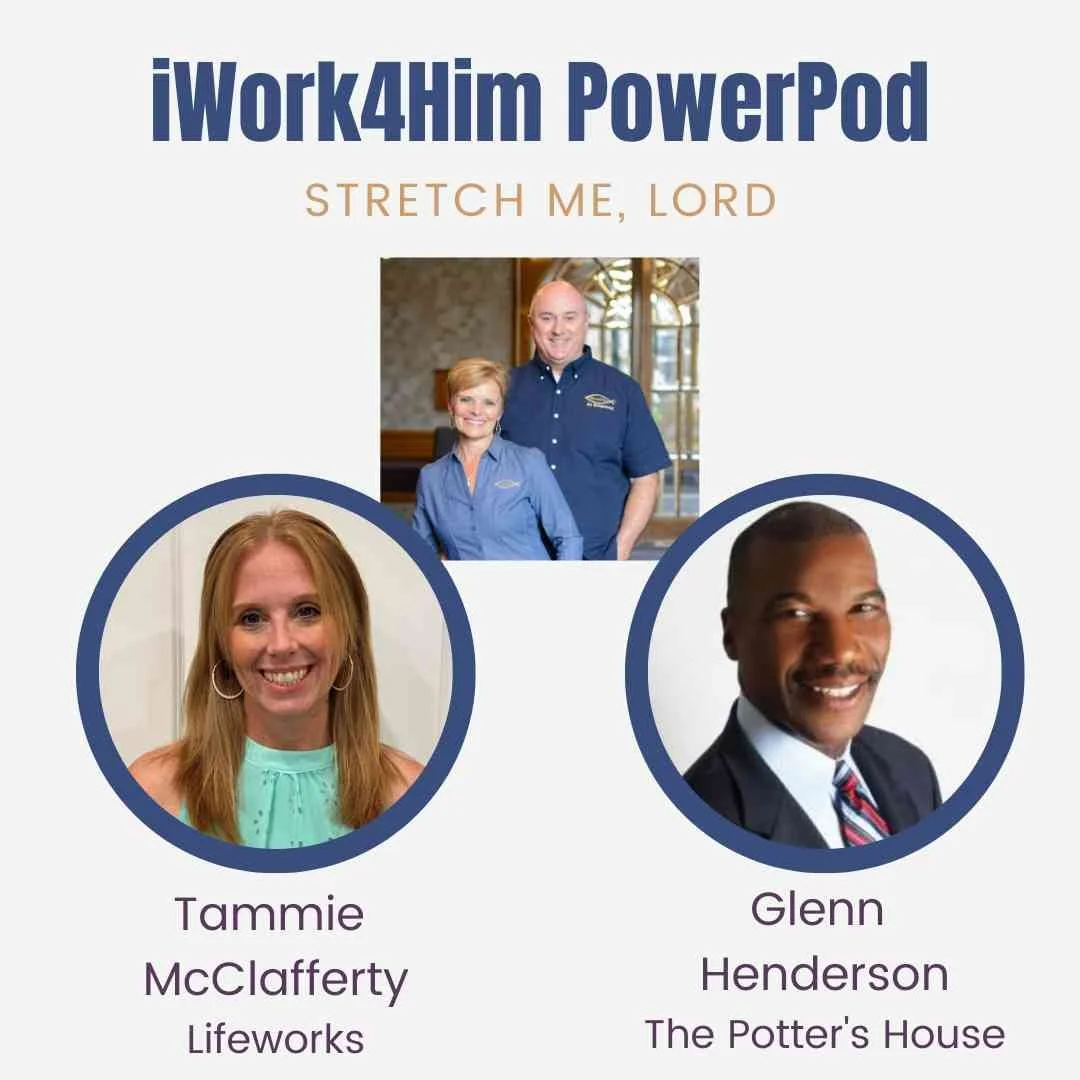
Intro: [00:00:00] Welcome to the iWork4Him Power Pod. I'm Michael Miracle producer for iWork4Him, the voice of the faith and work movement. We are on mission to transform the workplace of every Christian into a mission field. Each quick listening Power Pod is designed with you in mind and jam packed with Kingdom resources to help you connect your faith and work. How will this impact your work? Let's find out right now.
Jim: First up on the show today is Tammie McClafferty with Life Work Leadership Jacksonville. Wait til you hear the stories about what God is doing with them. Tammie McClafferty, welcome to iWork4Him.
So Tammie, how did you learn to connect your faith and your work?
Tammie McClafferty: Well , again, both my parents were hardworking people, so I saw it demonstrated throughout my childhood. You know, grew up in Pittsburgh and so my dad worked in a steel mill, so hard labor, hard work. My mom worked in a grocery store for most of her life. You know, [00:01:00] so just saw that demonstrated with them.
They love the Lord. They worked hard. But for me personally, I think I came to a better understanding of my work and faith when I had my first child. So I had been teaching, that was what I felt I was called to do. I was a teacher at a public school teaching third grade. And I started having kids and you know, there's kind of this thinking that because I had kids, I needed to give up my job and stay with my kids. And I really wrestled with that because I loved my work. I loved what I did. I felt called to do it. And really started wrestling with that.
And, you know, went to the Lord and said, okay, Lord, I, I think I can do both. I think I can be an amazing mom, a godly wife, a godly mother, and a great worker. And you know, if I'm gonna navigate these waters. I need your help. I need you to show me how to do this. And anytime we ask the Lord, he shows up . So he did. He challenged us and he pushed us in a direction actually to start a daycare, which was not on my radar. But [00:02:00] once I had kids, I had to start looking for a place to put my kids so I could go back to work.
And I quickly realized that in our area, there was nothing that met my needs. You know, I always say there was great centers that were state licensed and they, you know, ticked the academic box, but then they didn't tick my faith box. And then there were ones that were faith-based that I felt like these sweet grandmas would be loving on 'em and singing Jesus loves me, but they didn't have the academic piece.
And you know, I went back to the Lord and I said, Hey Lord, listen, I don't wanna compromise. I want something that's quality on every level. And so he put us to task. So my husband and I started a daycare center, the Sycamore Center up in Pennsylvania. And really that's where he started growing my faith and work because he was like, here, I've given you this now, you know, use it for my glory. And we worked hard. And hopefully, you know, were able to bring the Lord some glory through that.
Martha: So that brings you to today, Tammie, where you [00:03:00] are in a different role. So you made that connection while you guys were starting that daycare environment, but then now you are doing something that looks very different than that at the First Coast Life Work leadership. Tell us about that.
Tammie McClafferty: Yeah, so, you know, life is a journey with the Lord and we took that on and, and were able to, you know, raise our three children with that school and I was able to work and be with my kids.
And honestly, what brought us even to this point was we had the opportunity to go back to seminary, both my husband and I, and there was a seminary in Jacksonville, Florida at the time that did this one year intensive program. And we were just fortunate enough that we said we were gonna come down and take a year and spend it with the kids and still run the daycare but go back to seminary. And that's what got us to Jacksonville.
And as most people who come to Jacksonville, they fall in love with it. It's just the greatest city. And so we were here and we did seminary for a year. Both my husband and I. And we finished that and thought we [00:04:00] were gonna head back to Pittsburgh, which is where we were from, where our business was.
And we did for eight months and we lasted one more winter . And we were like, we're out, we're done. So we moved back to Jacksonville permanently, and this was in 2010 which ultimately we had to sell the business. And so that put us back to, you know, doing our work, just what you know, we were able to do. So I went back into teaching and my husband went back into physical therapy, and I ended up having the opportunity to go back for my doctorate, which that allowed me then to get into the college level.
And I started teaching at a college and became the director of a university. And then that is what I had been doing for the last several years until the Lord, you know, tapped on my heart again and just started stirring in my soul that I needed to be doing something, honestly, that just required a little bit more faith on my part.
Something that really stretched me. And so I resigned from that position that I thought was gonna be the position I would be in forever and waited [00:05:00] on the Lord. And two days after my resignation my husband walked out of the bedroom and said, Hey, you know, Tammie, I think I found your dream job,
And he had read the job description for Life Work Leadership and, you know, they were looking for a new executive director. They said they were looking for somebody that had some teaching experience, some business experience, some ministry experience, and some leadership experience. And, you know, Life Work Leadership is about incorporating your work and your faith. And I read that job description and it was like, you know, my aha moment. I was like, this is what God has called me for - all these things I've been doing, all this education and all these experiences had led to this. And so I was very blessed to start as the new executive director of Life Work leadership in July of last year.
Jim: How often, I mean, how do people, like when they sign up to get involved with Life Work leadership, what are they signing up for?
Tammie McClafferty: Yeah, so Life Work Leadership is about a nine month journey. We call it that because we take [00:06:00] people on, business leaders here in Jacksonville, really to look at the leadership of Jesus Christ.
You know, we see how he took 12 men and he poured into them and he trained them, and he sent them out. And those 12 men changed the world as we know it. And those were business leaders. I mean, those were fishermen, those were doctors, those were tent makers. Those were, you know, he worked with the tax collectors.
I mean, he worked in the business community. And it was those people that he sent out and changed the world. And so we really look at how Jesus led those 12 and what he poured into them. And we take you on this nine month journey of looking at Jesus' leadership characteristics and we break them down every month.
Martha: Tell them who the perfect candidate might be for joining up with Life Work Leadership.
Tammie McClafferty: Yeah, that's a good question. You know, it was interesting today, I was just thinking about it. I had the opportunity just an hour ago to sit and have lunch with about 15 business leaders from here in Jacksonville.
And today they spoke [00:07:00] about a verse in Exodus with Moses and how God called Moses to go talk to Pharaoh. And he kind of protested three times. You know, the first time he's like, why me? And God says, I'm sending you. And then he says, well, who should I say sent me? And you know, God says, tell him I Am sent you.
And then his third protest was, what if they don't believe me? And God said, use the stick in your hand. And we were talking about today at this lunch and how that stick in Moses' hand - he was a shepherd. That's what he did. It was his job. It was his career. And God said, use that. And in and of itself, the stick itself is not powerful, but when you put God behind that stick, it changed Israel.
It moved a nation. Really, that's what Life Work is looking for. It's looking for people who say, listen, I have a stick. And it might be in a law office, it might be I'm an entrepreneur or a teacher, or a nurse or a ceo, but I have a stick that God's given me here in Jacksonville, and I wanna put that power behind that stick to make a difference, to change the city for Jesus Christ.[00:08:00]
Jim: When you talk to alumni that have gone through Life Work Leadership, what kind of results are you seeing? How is what they're learning there impacting their faith and their work?
Tammie McClafferty: That has to be my favorite part of this job is I get to sit every day with people who have gone through Life Work and who are, you know, applying the lessons back in their job and they're seeing it make a difference.
There's so many stories. You can go on our website and see them. We have testimonials, but people who were moved by God through Life Work and he said, okay, I'm going to - you know, I went through the generosity session and I realized that I should be giving my staff more vacation days, and they've implemented a new HR policy to be more generous with their staff.
To somebody who says, listen, I realize I have not been showing compassion to my wife. And ultimately we know that if you have a good marriage, you're gonna be more productive in your business. So this person came out of it and their note to self was, I'm gonna [00:09:00] show more compassion to my marriage. I'm gonna change my marriage.
And we have seen people who have left their jobs and started new businesses. We had just a graduate from last year who was a lawyer and left her job to start a nonprofit, helping people here in the city who need legal counsel and can't afford it. We have seen people who have left as CEOs of companies to start businesses because they heard God, you know, during a Life Work session, say, move in this direction.
And we now here in Jacksonville have over 300 what we call alumni, graduates, people that we celebrated that have finished Life Work, who are doing bible studies all over the city and meeting with each other and holding each other accountable. And, and it's starting to see, we're starting to see the ripples. We're starting to the impact in the city, which for me is such a blessing to hear.
Jim: Tammie McClafferty. How is leading Life Work Leadership impacting you personally? .
Tammie McClafferty: Oh my goodness. How many, how many radio shows do we have? Right? [00:10:00]
Jim: We only have, we only got 40 seconds. There you go. .
Tammie McClafferty: Immensely. And honestly, it has been such a faith stretch for me.
You know, sometimes I think we as Christians - I had been teaching and doing education for so long, I felt like I could go to work with my eyes closed and was just doing the same thing day after day. And I asked the Lord to stretch me and he did. He put me in an environment that made me uncomfortable for him, which when we are in that position, it just requires faith.
That mountain moving faith. You know, every day I get up and say, all right, well I cannot do this on my own. I was not from a corporate background. I have not had nonprofit experience. I don't know how to do this, but God. And that's where it's impacted me the most is it has made me fully, fully rely on Jesus Christ.
Jim: Next up on the show, back to the first coast, our brand new friend Glenn Henderson from the Potter's House International Ministry. This local church in Jacksonville is the first living, breathing local body of Christ that iWork4Him has found where a [00:11:00] believer can't possibly enter the doors of the church without finding out that their calling is significant and that their work is a gift from God.
Potter's House International Ministry owns strip malls and restaurants and bowling alleys. They employ people and they run businesses. Glenn Henderson, our guest, is the marketplace pastor at the Potter's House.
Glenn Henderson, welcome to iWork4Him. Glenn, what was the path that led you to becoming the marketplace Minister at the Potter's House?
Glenn Henderson: Well, Jim , it was a convergence, if you will, of my time in the ministry where I have been working with pastors and also businesses across the country. And then I had an opportunity to meet Bishop Vaughn McLaughlin at at the Promise House. And I learned that they were actually doing everything that I've been teaching about how the convergence of business and ministry is one and the same. And we've called it Business Street. And so I've had the great privilege of being able to join [00:12:00] up with Bishop McLaughlin and he has been the ordained as the marketplace pastor at the Potter's House.
Jim: So what does that look like for you? What does Marketplace pastor mean at the Potter's House?
Glenn Henderson: Well we believe that Jesus had a call for everyone to be out and be meaningful in the marketplace. And so to that end, we think that as the Bible would tell us that our lives, our faith should be lived out in everything that we do. And so what does it mean to love? What is it character, integrity?
What does that actually look like if I'm serving somebody at a restaurant? If I'm sweeping floors? Or if I'm the president of an organization? And so we believe that the Scripture has something to say about every area of life. And everything that you do in the workplace. And of course we call it the marketplace.
Martha: Hmm. So how does the Potters House equip its people, the members of the Body of the Potters House, to better connect or even understand the connection between their [00:13:00] faith and their work?
Glenn Henderson: Well, so a number of ways. Aside from what we do, and I think it's being preached, it taught from the pulpit, we have a number of different I'm gonna call it very intentional tracks, if you will, and segments for being the marketplace pastor there. So we'll do seminars, we do workshops, we have classes, courses, and they really are, Martha, designed to be very specific and intent upon the practical application of, of what faith looks like. As Matthew 7 speaks about, the wise man puts these things to practice and, and so what we do, I believe as a ministry is demonstrate real practical application of the word becoming flesh. Not just studying it, but what does it actually look like? And of course in the marketplace, in our day-to-day lives.
Jim: I don't know if you followed, it's a play on words, but the arc encounter up in Cincinnati when they built Noah's arc, they said, Hey, at night, they [00:14:00] cast a huge rainbow, wanted to say, Hey, they're taking back the rainbow and in a week, Martha and I are gonna do a show on alternative lifestyles, and what you just described was following Jesus. That is the ultimate alternative lifestyle. The, too often we as Christ followers get sucked into the American dream, yet Jesus called us to an alternative lifestyle where, where he wants to change the very way we think. And that's what you just described there in those case studies. It gets people to be thinking about stuff like that.
Glenn Henderson: So there's a diverse way of businesses that we have. There's a mall that the ministry owns. In that mall there's a bowling alley. And there's a number of different things in the business activity that we have that whether it is all designed to employ and empower people and deal with what we characterize as systemic poverty.
So if we can put people to work, let people birth their ideas there, which oftentimes happen, and then we may [00:15:00] assist them and not only assist them financially, but we assist them in the business plans, et cetera. And then we will help them by if they need space, then they can get space there and is a discounted at time perhaps.
But the whole ideal is to farm businesses in the mall, employ people, and let work and we hope, see the vision that God has given them come to pass.
Jim: You've got a passion for reaching the least of these and setting the captives free, as you mentioned earlier. But how do you connect marketplace ministry with this mission handed down to us by Jesus?
Glenn Henderson: Well first of all, and hopefully my passion is spot on with the scripture. And as I read from Genesis to Revelations, the heart of God has always been, it's toward all people. Of course, God so loved the world that he gave his only son for the whole world. But there's, He also seem to have a even more of a bent toward the, I characterize them as the have not, the less [00:16:00]fortunate.
And so what I believe scripture in faith that scripture clearly tells us is those of us who have a responsibility toward, I would once again say the have nots. And so most of the teachings and most of what I work to do is help people understand. And that gets to the why. Why blessings follow is when we find ourselves living toward the heart of God.
Then as Psalm 23 says, goodness and mercy will follow you all the days of your life. And so my mission, as I say, and my purpose on the planet, whether I work with ministries and businesses, and therefore biznistry and Marketplace, is to convey the message of hope and convey the message that I believe is crystal clear in scripture to all people that I come across with.
Talking to folks in [00:17:00] business I speak to 'em oftentimes about don't worry - which is biblical - don't worry about the next business, the next opportunity. Be content and be everything that God wants you to be where you are. I have this coined saying, and this is how people's eyes get when I say this - and I tell them this, where you are is a direct reflection of where you are.
And that almost sounds like a tongue twister, but it reminded me that God put me where I am because this is exactly where God wants me to be.
Jim: You've been listening to iWork4Him with your host, Jim and Martha Brangenberg. We're Christ followers. Our workplace it's our mission field, but ultimately iWork4Him!
Outro: Thank you for listening to the iWork4Him Power Pod with your hosts, Jim and Martha Brangenberg. Want more? Hear the full broadcast at iWork4Him.com. Stay connected and receive power packed content when you sign up for our blog at iWork4Him.com, or follow us on social media @ iWork4Him.
And finally, if today's message inspired you, please [00:18:00] subscribe, rate and review the show on your favorite podcast platform. Your review helps launch more workplace missionaries across the nation! That's @ iWork4Him and online at iWork4Him.com.
1/3/23 - PowerPod: The Day I Met Stanley Tam

Intro: [00:00:00] Welcome to the iWork4Him Power Pod. I'm Michael Miracle producer for iWork4Him, the voice of the faith and work movement. We are on mission to transform the workplace of every Christian into a mission field. Each quick listening Power Pod is designed with you in mind and jam packed with Kingdom resources to help you connect your faith and work.
How will this impact your work? Let's find out right now.
Jim: Today I want you to hear the story, the founding story, and more about the Fellowship of Companies for Christ International - FCCI. You've heard us talk about it a couple times on iWork4Him in the last five years. But today you're gonna hear from one of the founders, Bobby Mitchell and the current CEO Chad Merrill. Gentlemen, Bobby, Chad, welcome to iWork4Him.
Being one of the pioneers of the Faith and work movement, Bobby Mitchell, as you guys you started this with well, I've read your, reread your book again this morning on the plane, but I mean, the only faith and work book out when you realized that [00:01:00] your faith and your work should be connected was Stanley Tam's book, which was written in the sixties. That was the only book that was out there and available.
Bobby Mitchell: Well, really There was one book before Stanley.
Jim: Oh, which one? Oh, well, the one from Charles Sheldon.
Bobby Mitchell: Charles Sheldon, 1896, in His Steps.
Jim: Yes. We know the book well and have talked about it on the air.
Bobby Mitchell: So I prayed to receive Christ. My wife recommitted her life as well. And so we started going to every seminar we could find.
And what happened along the way was I realized that what I was saying I believed was not reflected in the way I lived my life and that I needed to make changes in my life. And the Lord brought in this book In His Steps. He brought in a friendship with Larry Burkett and he brought in a model of my dad, who was a man of great integrity and that started me down a path of questioning if I had integrity, deciding I didn't and making changes to ensure that I did. And so [00:02:00] Larry and I, after a year or so meeting every week or every other week, decided we'd question whether you could have a business and operated it on biblical principles.
Jim: Right. I'm gonna have you stay there. Stop on that part of the story. I'm gonna take a step back cause I really want to go into detail on that in the next segment. But I love that story. But to say, Hey, your good friend Larry Burkett . How did you become good friends with Larry Burkett? I mean, what a, what a fantastic privilege. You were friends with Larry Burkett and Bruce Wilkinson.
Bobby Mitchell. When you hear the word iWork4Him, what does that mean to your heart?
Bobby Mitchell: It's just what I believe. We need to work for the Lord. Larry had some foundational principles. He said, God owns it all and we're stewards of what he's entrusted us with, and we need to use that for his glory and not ours. So that became the mantra of Fellowship of Companies for Christ and my life.
Jim: How and [00:03:00] when did that paradigm shift happen for you?
Chad Merrill: So, quite frankly, that paradigm shift happened to me in, in a period of, of little, and there was a very difficult period of time, and I was discipled through it. And several folks in FCCI helped me through that period. And then when there came a time of plenty and it became impressed on me that we have an obligation that God owns it all and we've been blessed. And so they came together kind of simultaneously - my personal life and in my work life.
Jim: Bobby, when you and Larry Burkett started this exploration, you're like, you didn't even have a name for it. You didn't have the name Faith and Work movement. Yeah. I mean, none of that stuff existed. You guys set out to go, what does the Bible really have to say about work or business? Right?
Bobby Mitchell: That's right. We fairly quickly assembled a group of other people that had some interest. We invited 80 people to come to a meeting to see, to sort of share the thought of studying the Bible and trying to operate a company on biblical principles. [00:04:00] And from that group, nine of 'em wanted to meet weekly or every other week.
And then seven of 'em ended up becoming what we call the founders of FCCI. And so it was a great time, but it was not a mild deal. We would argue, we would scream, we would fight, we would challenge each other, and we worked through a process, but we had a principle.
Jim: But what was this? Lemme just stop you there for a second. You were arguing. You were fighting. Why? I'm guessing this, but was there so much frustration because some people thought that the Bible didn't have a thing to say about business?
Bobby Mitchell: No. I would say all of us were like-minded in believing the Bible was the answer.
And so we wanted to look to the Bible to give us reality, but the application was what was difficult. How do we apply love your neighbors, yourself? What does that look like in a business? And so there was a lot of discussion. It's a little tongue in cheek to say loud arguing and shouting and everything.
Jim: Okay, but 44 years [00:05:00] ago, were you hearing sermons on, Hey, faith and work should be interconnected? Were you hearing that your workplace - because you ran a big company. What was your company called again?
Bobby Mitchell: Applied ceramics.
Jim: Applied Ceramics. So I'm assuming this wasn't pots and you know, vases.
Bobby Mitchell: It was electronic parts for industry and it was catalytic converters for automobiles and that type stuff.
Jim: So, oh, so you were on the cutting edge of catalytic converters, cuz 74 is when they started putting 'em in cars.
Bobby Mitchell: Yeah. 73. Yes. 73 .
Jim: Okay. I stand corrected. Okay. I was pretty close. I was only eight when they came on a cars so I thought that was pretty good that I knew that, you know, that history. So, I mean, this was a new concept because you weren't hearing it from the pulpit.
Bobby Mitchell: We didn't hear it from anybody. It was literally something God put in my heart to say, I want to do that. I wanna find integrity in my life. I want my life to reflect what I say I believe. And Larry was a partner, more knowledgeable than me, somebody I could look up to and we could dialogue and come up with a plan for doing it.
And so we invited these people to come. [00:06:00] Nine of 'em came and we started having these meetings. And so the, the meeting was to try to work out principles of, of how do you apply this?
In the book, In His Steps...
Jim: Writen by Charles Sheldon in 1896. You're talking about, you're thinking in 74 this was a big idea. Charles Sheldon wrote a book 78 years earlier.
Bobby Mitchell: That's right. And it had a guy in the book that tried to operate a store on biblical principles, and so that became sort of a model for how to do that.
And so we invited Bruce Wilkinson, who had come to one of the earlier conferences to be the conference speaker at a place called Point Clear, Alabama. And Bruce was in there and he was teaching. And then he said, I've got it. I understand what y'all are talking about now. Everything that I've been teaching you at this conference is wrong, , and we need to, to get down on our knees and pray for God to guide us.[00:07:00]
So there were 44 people at that conference. We got down on our knees, we wept, we cried, we whatever, and God united and that really was the point in time that FCCI was birthed.
Martha: Maybe we could hear just real quickly, what FCCI actually is.
Chad Merrill: Absolutely. So at a high level, FCCI is an organization of business owners and CEOs and, and business leaders in some cases, whose vision, the vision has remained the same from the beginning days, which was to transform the world through Christ, one company owner at a time. And then the mission or the manifestation of how that lives out is to encourage and equip people to run their businesses and conduct their lives according to business principles.
So we are essentially, you know - the vision is to transform the world through business. And the mission of FCCI is to encourage and equip, if you boil it down to those two simple terms. And, you know, along with that, in the shadow of Billy Graham's passing, a lot has been guided by and it's used many times and I'm sure used it on air many times of his [00:08:00] statement, his prediction of the next, great movement of God will be in the workplace. And so that's really a guiding principle behind FCCI.
Bobby Mitchell: I went and visited Stanley May, May 7th, 1980. How many meetings do you remember the date of?
Jim: Well, but with Stanley Tam, I can imagine I'd know the dates of.
Bobby Mitchell: So I went in the his office and I asked him to tell me about his work. I'd read his book. He had a film that he had developed. We'd shown the film and I said, what is your major goal? He said, I wanna lead five people a day to Christ. And I just said Come again. Tell me what you said. My church didn't lead five people a day to Christ. The churches of Atlanta may not lead five people a day to Christ, but Stanley Tam did.
I said, how are you doing? He pulled out a little black book. He said, well, today is May 7th. I had a good month in April. I led 222 people to Christ. And so he knew how many people he had led. He said, you see these filing cabinets, they're [00:09:00] full of people that we've led to Christ.
He had Christ is the answer on six foot high letters on his side of his building and limo. And Stanley - that, that sort of sparked the thought. And Larry and I took that and beat that around a little bit. And we decided that if, if there. . One, one other thing Stanley was doing, he was giving 2 million away a year. This is 1980.
Jim: Which was huge. Must be like giving away 200 million a year.
Bobby Mitchell: A big number. And he had planted over a hundred churches internationally. And so I'm an engineer and so I took the a hundred churches, the, the all these numbers and I put 'em together and said, goodness, we could complete the Great Commission in three years if, if we had enough companies like Stanley's company to do it.
And so it gave us a model from the very early time of - this is just a few months before the Point Clear meeting that we talked about with Bruce Wilkinson. So it was a powerful thing to give us a guide to accomplish [00:10:00] God's ministry and turn this world around.
Jim: Jesus led the groundwork for this 2000 and some years ago. I mean, he was the greatest kingdom collaborator. He was pulling from all different sectors of society except for the religious people. Although he was talking to the religious people, but they didn't like what he had to say because he was threatening their money, power, and control structure.
Bobby, have you ever heard a sermon? You got a few more years on me. Have you ever heard a sermon about Jesus' reputation in the marketplace?
Bobby Mitchell: I'm sure I have. I don't know that I, I remember it.
Jim: Chad, have you?
Chad Merrill: Not that I can recall.
Jim: I mean, that's one of those things when, when we look at Jesus, most of us think of Jesus as a three and a half year itinerant preacher. But he was a small business guy. He might not have been an FCCI guy, cuz he was really a small business guy. I mean, was maybe a, he was maybe a solopreneur.
But I mean, his reputation in the marketplace had to be spotless. It had to be, like you were talking about your dad, Bobby, a man of integrity. Jesus had to have a fantastic reputation in the marketplace, didn't he? Or his ministry would've meant nothing.
Bobby Mitchell: Well, Jesus, you know, spoke the truth and he had [00:11:00] no patience for people who didn't speak the truth. So we see a real conflict in Jesus in that he, these people that didn't speak the truth, he had no interest in spending time on them, but the people that did maybe imperfectly, he wanted to pour his life into. And that's sort of a model of what FCCI is about. We are trying to pour this ministry into people's lives that want to make a difference, that want to speak the truth, that want to have integrity, that want to reach the world, that want to see it turn around. So those are the sort of the foundational things that we wanna see FCCI do.
Jim: All of a sudden the walls are coming down and everybody's going, Hey, this is about the kingdom. It's not about our ministry.
Martha: I think we've learned too that we're in an era where the world really doesn't have boundaries. I mean, we can, we have access everywhere. And one of the things that we know with our radio program that it's not a message just for Tampa Bay. It's not a message just for Jacksonville, Florida. It's a [00:12:00] message for every Christ follower and pre-Christian because as they're exposing themselves to, what is this about following Christ well, what's it look like?
How do you walk that out? And if Christ, we say all the time on the radio, if Christ changes us, he's supposed to change all of us. Not leave our wallet, not leave our our business card out of the equation. So hearing that and just knowing that - it can have such a big impact.
Jim: So what does involvement with fCCI look like? Cuz I know the once a year, the last several years you've been doing your annual conference has been in Florida because, you know, everybody wants to go to Florida. Okay, but what, what else does involvement in FCCI look like?
Chad Merrill: So, as you said, the conferences were big from the very beginning, so we have at least one annual international conference a year.
This year we'll have three or four, a couple of regional conferences as well. Just back from Albuquerque last week. And we have one coming up in North Dallas in October. . So that's one primary way. The second way is we try to assimilate business leader groups. So you [00:13:00] can think of as chapters in a city where we put like-minded businesses folks who want to learn how to be equipped and they want to be encouraged and how to run their business according to biblical principles. And so we provide materials and groups and they become encouragement groups for each other.
Jim: Mm. And you've, I mean, you've had thousands of people involved with FCCI over the last 44 years. The impact, Bobby Mitchell, when you look at the impact of FCCI on a business owner, leader, a CEO , what do you see once they understand, once they get it? How much does that transform their company?
Bobby Mitchell: It totally transforms. We believe in FCCI that life change really happens through small groups. And so we see groups as being a dynamic that can change lives. And so I think that if somebody really commits to do it, you can almost see it in their eyes that I'm, I'm serious about this and I wanna follow in these steps.
And then all of a sudden you see them bear fruit. You see them lead people to [00:14:00] Christ. You see them grow people up in Christ. You see them do service projects in their communities. And so it's sort of a total change. It's going from, I wasn't saved to I'm saved. It's going from I was a baby Christian to I'm now growing rapidly as a Christian. And so it's dynamic and it's visible and it happens quick.
Jim: When you look, Bobby, over the 44 years - if you look at what, like one or two of the most major concepts that Christ following business owners need to understand in order to make that paradigm shift, what are one or two of those things that they just, they need to understand and then all of a sudden it starts to transform their lives?
Bobby Mitchell: Well, I believe, first of all, they've gotta be a Christian. And there are a lot of folks out there that go to church that are not Christian, right? We've had people come to FCCI conferences and, and get converted at a conference, and almost every conference we have one or two people do that. So they came, not because they thought they were not a [00:15:00] Christian, but they just didn't know. And so they need to be a Christian.
And then I would say that some of the things we've spoken about before, salvation, sanctification and service are the outreach of - activity that these companies need to have. And I think going way back, God owns it all and that we're stewards.
And I think, you know, it's a major cultural shift to say, I don't own this money. It's not my money. And so, what it says is I'm gonna use everything I've got as a good manager, a steward to impact the world around me. And so, whatever Lord you want I will do. And so it's complete change. It's complete bowing the knee to the Lord.
Jim: Walking by faith, running your business. Unbelievable.
Chad, as you look at the next generations, you look at the millennials and you look at the digital gem, which comes up after them. How is FCCI preparing to reach out to the millennials? Cause they have a totally different worldview. They want everything that they do to be significant. [00:16:00] How are you guys reaching out to them? .
Chad Merrill: So we're spending a lot of time with them and you'll see more and more of them at our conferences and in our groups. In some ways we've got a little easier path because millennials get a, get a difficult rap in a lot of ways, but a lot of reason is because they're authentic and they wanna see authenticity, right? And so if they like or don't like something, you usually hear it very straightforward. And oftentimes I think the older generations hear what they don't like or they hear straightforward talk and that becomes a divide. But I think we've got a great opportunity because they do want more, they do wanna make a difference, Christian or non-Christian.
So I think the millennials that we've been associated with and the new entrepreneurs, and, you know, let's face it, there's thousands, tens, and hundreds of thousands that are starting companies now, earlier and earlier than ever. You know, when they catch a passion, I believe they can really, truly impact the world maybe even at a greater pace, likely at a greater pace than we did and the generations before us did.
Martha: I know we talk a lot about the fact that we pray that that generation doesn't have to learn what we had to [00:17:00] learn. You know, we segmented all these sections of our life and we've had to learn how to bring 'em back together, whereas we would hope that these future generations will just get it - that God, when he changes us, he changes all of us.
Jim: You've been listening to iWork4Him with your hosts, Jim and Martha Brangenberg. We're Christ followers. Our workplace, it's our mission field, but ultimately iWork4Him!
Outro: Thank you for listening to the iWork4Him Power Pod with your hosts, Jim and Martha Brangenberg. Want more? Hear the full broadcast at iWork4Him.com. Stay connected and receive power packed content when you sign up for our blog at iWork4Him.com or follow us on social media @ iWork4Him .
And finally, if today's message inspired you, please subscribe, rate and review the show on your favorite podcast platform. Your review helps launch more workplace missionaries across the nation. That's @ iWork4Him and online iWork4Him.com.
7/1/22 - Time for a Break: Jim & Martha Brangenberg

Welcome to the iWork4Him podcast. I'm Michael miracle producer of the iWork4Him radio program, the voice of the faith and work movement. Our mission is to transform the workplace of every Christian into a mission field. What does that look like in your workplace? Let's find out right now.
Jim: You've tuned into iWork4Him, the mouthpiece for the faith and work movement. We're your host, Jim Martha Brangenberg.
Martha: Thanks for being with us today. And I just wanna remind you that you can always stay connected with us if you sign up for our weekly email. So just go to iWork4Him.com and you can subscribe and we would love to stay in contact with you that way.
Jim: iWork4Him.com that's I work the number four, him.com.
All right, it's been over nine years, 2200 podcasts, 3,500 people interviewed. IWork4Him has been on the air since the beginning of the podcast craze. And we've covered the amazing work that God is doing within the workplaces of Christ followers all over America. At times both Martha and I have worked two jobs to support this ministry.
And for the last six years, we have worked nonstop to bring you the best interviews and make the best connections for our listeners as our influence has grown within the faith and work world. It's time for a break. Most podcasts release a show a week. For the first seven and a half years we released five shows a week, and then we reduced to just two a week.
And now we're back to doing three a week. We're a little tired. We need to get refreshed and get a clear vision of what God has in store for our future. And the future of iWork4Him along with our podcast brands. iWork4Him. sheWorks4Him. iRetire4Him and the, iWork4Him powerthought, our weekly blog, all those things we bring to you on a weekly basis.
Enjoy some time with us today, as we talk about the value of rest and how we plan on spending the next three months, seeking the Lord in what's next as he breathes a breath of fresh air back into our sails. Martha, it's been quite a journey, hasn't it? 10 years, this November from the day God gave us the name iWork4Him.
Martha: It's hard to believe. And yet at the same time, it feels like it's gone so fast, but I'm pretty sure Jim, we've gotten a few more wrinkles since we started.
Jim: Well, I know my hair was dark when we started and now it's almost all gray, but it has been fun. We've had incredible conversations every day with people just hearing about how they're living out their faith and their work conversations about God, how God has gotten involved in the intimate details of their lives. How can we ever get tired of talking about that?
Martha: Well, I don't actually think we get tired of talking about that. That's one of the things that God has very clearly shown us that we are driven by both of us have that core strength of responsibility and what, how that God has had that play out is that we have the opportunity to hear things that God is doing in other people's lives. And we feel responsible with sharing that with other people, and that is our listening audience. And so it drives us at because it's a strength because it's something that got ingrained in us that, that never gets old.
Jim: Yeah, it has been it's so fun. I mean, we could literally, if we didn't have to do all the other stuff around producing a podcast, we could just capture people's stories all day long. It is so much fun, but it's a certain point in time, sometime in the last 18 months, Martha and I started struggling with what we would call burnout, where we're just having a hard time getting up in the morning to do what we need to do.
It just doesn't feel as fresh as it needs to. And I don't know. Here here's, I'm gonna describe burnout for me, Martha. And we're sharing this with you guys because Martha and I are doers. And many of you are doers where you don't know how to rest. You don't know how to sit and listen to the Lord. And Martha and I in the last two years have produced three books.
We've produced another couple, two, 300 podcasts. We've traveled about 60,000 miles in our little metal tube with four wheels. But burnout feels like to me, like I could keep doing what I do on a daily basis, but if the Lord throws anything new in front of me, I don't know that I have the creative energy to do it.
Martha: You know, it's interesting because that's a, that's such a good, easy, clear way to state it, jim. And I am guessing that we are not alone in this. In fact, I know we're not alone in this because the last couple of years have just exaggerated so many of the things that many of us deal with already, because we're dealing with technology, we're dealing with just extra stress and the unknowns and you know, all of those things that everybody is, is dealing with.
And I just recently listened to, you know, it's amazing how God just gives you certain resources at certain times. I just this week, listende to a podcast from the VOCA center, the VOCA center, like vocation out of New York city, and Chip Roper and his team were actually talking about burnout.
And the fact that so many people, you know, there was everything from when Jim, you just mentioned - lack of creativity and, you know, thinking is it not-
Jim: Well, that's an everyday scenario for me, the lack of creativity.
Martha: That's but, but what they were saying in this podcast that I listened to is that, you know, for some people it is, they just stay up extra late Sunday night because they're just trying to prolong Monday morning coming, or they just,
Jim: We've been known to binge of a little bit of TV on Sunday nights.
Martha: Yes. Yeah. And you know, it was funny cuz Chip even said, you know, for him it became a situation in a season where he was like going to go work out every morning and he was staying longer at the gym because he just had a hard time making that transition to work.
Jim: That's why the last time we saw Chip Roper, he looked so buff.
Martha: actually what he admitted in the podcast was that he was spending most of the time sitting in the hot tub, like, oh, get relaxing and trying to be like, get up his, you know, gumption or whatever. But anyway, it was a, it was a big help for me to hear other people and how they struggle.
So I love that there are other resources out there for people besides iWork4Him. And that's why we have, I don't know, I can segue here to the Awaken Podcast Network because that podcast is on that network so that people have the ability to go and hear what God is saying through other people.
Jim: Awaken Podcast Network.com, that's Awaken Podcast Network.com where you'll find 105 different voices speaking into the faith and work movement, encouraging you to live out your faith in your work.
With lots of different perspectives, online Awaken Podcast Network.com. All right. But why is rest so necessary? We sleep at night. Well get, for the most part, we sleep at night. Well, I sleep at night. We, we sleep, but that's different than rest. Isn't it?
Martha: It is. And you know, it's funny because again, There's been so many people recently, and I think this is just the Lord's doing, he puts things in front of us when we need them.
I've seen so many devotions on rest. And one of the things that I know for sure is that our example, our, our creator had a day of Sabbath. And if, and, and it is so important for us to model as our creator from our creator.
Jim: Well, and here's how, here's how important rest was to our heavenly father. He created Adam and Eve on the sixth day. Their very first full day on earth was the seventh day, the day of rest. So God didn't start them off working. He started them off resting and that's his priority for us. We need to rest because when we rest, we can hear the voice of the Lord more. We can handle those unexpected challenges without an overemotional response.
And, and we can handle the unknown a lot better. We just need to learn to rest. So, so Martha and I are gonna talk about that today. When we come back right here on the, iWork4Him podcast, check us out online. iWork4Him.com that's I work the number four, him.com.
Martha: You know, the kind of person that always tells you about the latest trends or the special deals around town. We'll lean in because here's a message from that kind of person. The Awaken Podcast Network is the place to be. Go to Awaken Podcast Network.com and unlock God's purpose for your work. With help from some friends, you will find a gathering place of podcasts that provides simple tools, faith stories, and conversations that will inspire and equip you to vibrantly live out your faith in your work today. Go ahead. Check out Awaken Podcast Network.com and then be that kind of person and tell a friend.
Jim: Hey, welcome back to iWork4Him as Martha and I talking a little bit about rest today and taking a break. If you're just starting to pay attention, what we're saying, we're gonna take us a season break for the iWork4Him podcast for the very first time in a little over nine and a half years. Never have we done this, but this summer, we're going to do that.
Martha: You know, one of the things that I think is important to us having this conversation with you, our listeners and friends, is the fact it's huge accountability. And the fact is that we're on the front side of this. We, you know, a lot of times you hear a podcast from somebody who's gone through a season of rest or they've learned some new lessons and they're, they've applied it in their own life. And they're saying, okay, now I wanna help others. Well, we're kind of on that front end of it.
Jim: This is what two people look like who desperately need some rest.
Martha: So no comments about us looking tired or anything like that. But anyway, I just think it's, I think it's important. You know, one of the things. We have always done is worn our life right here on the, on our, our sleeve. Is that how you say it? I don't know, but people, we're an open book.
Jim: We're making references to video. You know, if you're trying to figure out on this podcast, what are they talking about? We can't see their face.
Martha: Remember we have a YouTube channel.
Youtube.com/iWork4Him.
Yeah. Just search for it out there and you'll find it. And it's always linked in the show notes as well. So you can switch over to that if you want to. But the, I think that it's just really important. We don't have it all figured out. I think if you guys know us well enough, you know, that that is. Kind of our Mo is like, we're like, okay, we're gonna walk this out and see what the Lord is teaching us. And hopefully it will help you along the way. So that just give you a little context.
Jim: Some things that led to burnout in us: writing three books, traveling 60,000 miles, moving, selling a house, remodeling a house, actually rebuilding a house helping take care of aging parents. Helping a lot of other people with their projects, helping other people write, daily writing blogs, maybe we just, the problem is we just don't ever sit still.
Now. I, I can't rest when I read read books, but a lot of times I read books for the show, which again means I can't just read the book to have fun. I need to pay attention to it cause we're gonna ask people questions. And, and so that is something that we've really, I'm going to do a lot more this summer. I'm just gonna read ridiculous books that don't, I don't have to pay attention or interview anybody at the end. What about for you Martha? What's led to your sense of burnout?
Martha: Well, I think the same thing in the sense that it is easier in a lot of situations to stay busy than to rest. For me to sit still and, and rest means different things to each person.
And so I, this is something Jim and I are kind of working on right now and figuring out how to navigate. I love doing a, a project is very restful for me. Cooking in the kitchen, having people over, although a lot of people that might seem like work and stress or whatever, that is an incredible avenue for me to find peace and rest, I enjoy the creation process and all of those kinds of things.
So so being just busy, just filling our calendar and, you know, what's funny is that when we started experiencing the pandemic and people's calendars basically didn't even matter anymore because we couldn't go anywhere. We couldn't see anybody. I relished that because I was like, oh, there's nothing that we have to be like watching for time wise or going or whatever.
And I really enjoyed that. And I knew that it was gonna be a danger, especially in America for all of us to fill our calendars back up without even noticing it. And I think that that's happened and I, I know that it's happened.
Jim: And, and for us, it wasn't so much that our calendars got clear because at the same time, I really felt the Lord said, write your books.
Martha: Oh, of course. But it, but we didn't have a appointments. We had appointments with a computer.
Jim: And with a few road trips, but a lot of those road trips got canceled. Then we got to learn how to do video. So we could, you know, we do video on every one of our podcasts now. All right. What could we have done better? I don't know. We probably should have taken a rest every summer for the last nine years from podcasting instead of doing 'em every day. But when you're on radio, you couldn't do that because you have to be on the radio. So I don't know. I think. We, you need people in your life that can sit there and smack you upside the head and go, you know what? Maybe a rest would be a good idea.
Martha: So a little bit more accountability in our lives?
Jim: Yeah. Accountability would be good. And, and would, I'm not sure we would've listened though. Would you have listened to somebody that told us that?
Martha: Well, I think that there have been times in all of our lives where over the people have encouraged rest or slow down or whatever, but I really believe that it is being obedient. And again, the reason we're talking about this is not just to be like talking about our story, but each one of us doing a better job of assessing where we're at and what God is calling us to do. But to, to really listen to his prompting and encouragement to live a biblical life.
Jim: There are lots of biblical examples of people getting rest.
Our savior, Jesus is his name. He was really good about, at the end of the day, he took off to get some rest. He wasn't, I mean, he could have gone night and day from the minute he changed that water into wine for the next three and a half years. He could have been constantly, he could have healed millions of people instead of hundreds of thousands of people.
But he know, he knew that he needed some rest to get refreshed and because he was pouring his life out into people all the time. And so he was a great example for us, but there's many times in the scriptures where people took 40 days to go rest, Moses. Had 40 years in the desert to rest in preparation for 40 years in the desert with the Israelites.
I don't think the first 40 years was probably enough to get ready for the next 40 years. Elijah had 40 days in the desert. Jesus had 40 days in the desert before his ministry started. It's not a requirement of Christianity that your crazy busy all the time. It's a requirement of Christianity that we can sit still and listen to our heaven father. So what's our rest gonna look like Martha?
Martha: That's a great question. God's got, we have some real soul searching to do, but I think the biggest thing, and we talked about this even with our board is the accountability factor and making sure that we are holding to a schedule. Whatever that might look like for each of us is gonna be different but in a way that allows time for the Lord to speak to us and really get some of the rest.
Jim: Do you get the feeling that Martha's not really bought into the way I think rest should be? I'm gonna buy Martha a Velcro chair and a Velcro suit so she has to sit still.
Martha: But I, I, I, I don't think that rest means...
Jim: if you're not sitting still, then I feel guilty.
Martha: Oh, that's your problem. You know, one of the things that it's true,
Jim: said by my loving wife,
Martha: no, but him feeling guilty about how I handle it. I think the biggest thing we do need to be on the same page. Everybody, we understand that, but God created each one of us differently. And so for me, sometimes that's gonna mean weeding the garden and being quiet and enjoying the nature that God has created in for us to enjoy.
Jim: You're listening to iWork4Him with your hosts, Jim and Martha Brangenberg. We'll be right back.
Want to build a profitable side hustle that impacts people with truth and healing in themselves and in their leadership? Then look at becoming a certified leadership coach with GiANT. GiANT has been in the leadership space for over 13 years and has over 500 coaches in over 127 countries.
Their coaches are being hired by fortune 500 companies and organizations like iWork4Him, Martha and I took the GiANT Sherpa training under one of these great coaches to become leaders worth following. GiANT gives you everything you need to start your own coaching business from scratch, like hands on training from top level coaches, access to an all in one online platform to run your entire coaching business and you get to join a thriving community of coaches around the world.
To get started GiANT is hosting a coaching business workshop to help you learn how to build the successful coaching business. This workshop is 100% free. And you can reserve your spot by going to GiANT.tv / iWork4Him. If you're ready to impact people and get paid to do it good at GiANT.tv/iWork4Him, that's GiANT.tv / iWork4Him.
And welcome back to iWork4Him as we're talking about rest today. In fact, we're talking about the fact that for the next several months, at least two, maybe two and a half, we're gonna have a break for the, iWork4Him podcast.
We're not gonna produce any new ones and Martha, and are gonna take some time to rest and get refreshed and really to hear the voice of God about what is next for iWork4Him. Let me give you an example. When, when iWork4Him went on the air, on the radio and as a podcast nine and a half years ago, there were a couple of podcasts talking about faith and work and there was a couple of radio shows talking about faith and work.
Today in America, there's maybe one or two radio shows still talk about faith and work, but there are now hundreds of podcasts talking about the intersection of faith and work. So the point is, is iWork4Him still needed in its current format? Is there another format we should be doing it at? sheWorks4Him we added last year talking about and focusing on Christian working women. iRetire4Him talking about encouraging Christian retirees. And our daily power thought that you can hear on Facebook, we're working on a way for it to get texted to you.
All of those things take and our weekly blog, are they necessary anymore? Are there other people that need to pick up those pieces or are we supposed to do it, but just do it with some renewed energy?
Martha: You know, I think one of the things that's important in, whether it's a job, a corporation, an organization, a nonprofit, is to be asking yourself that question. Is what I'm doing the best use of our time, or is there a new need?
Is there something that has shifted? Is there something that has changed? Or is our format, you know, is it stale? Is it whatever that might be? We don't want to, you know, you ever have that school teacher that you were like, man, they should have retired. Wow, wow. Five years ago, because they're just like
Jim: Charlie brown.
Martha: Wow. Is that what yours sounded like? Mine was just like, oh, maybe they're not the nicest people anymore. They're just, they're too tired of being teacher. Anyway, I remember having a teacher like that and thinking as a kid, that teacher should retire because they're done. And we don't ever wanna be that way. We wanna stay relevant and most importantly, obedient.
And I think one thing that's really interesting and I wanna, I wanna share this with you all, is that when we were having this discussion, one of the things that I, you know, get in our heads, we think, but we have to have a podcast every week. We, this is an expectation and what are people gonna think?
And one of my friends on Facebook when we were wrestling with this, posted this, this quote or this comment, and it pierced me to the core and I, and it really answered our question for us: when God says to let something go, but your pride says to keep going, there really only is one right choice. #God'sWay. And we have, that is a driving force in us is to do things God's way and to listen to his voice. But you know, in our flesh, sometimes it's E it's easier to hang on and say, yeah, but I don't know what people are gonna think. And are we gonna lose listeners and blah, blah, blah. We have all these think questions we ask in our head.
But our God is bigger than all of that. And we need to walk in that obedience. And I think that that's an area where each and every one of us can learn. You know, because a lot of times we do things, maybe it's a, maybe it's a tradition or the way you do a birthday party or the way you feel like you have to have a certain amount of things, activities you do at your work.
That you know, just fill time, but they're not really helping you further on the goal. What is it in your life that you're sitting there saying, okay, Lord, I'm only continuing to do this because apparently I I'm, I'm proud of it. I feel like others expect it from me, but God's saying it's time to make a change. And, and, and again, I just wanna reiterate, we don't know what it's gonna look like. But, and we just wanna be listening.
Jim: It's gonna involve sleeping in, staying up late binging on a little television, reading some books. But in the meantime, all summer long, you'll still be able to get access to our one minute power thoughts, Martha, how do they get access to them? They can sign up for those now. Right?
Martha: So what they do is just on your favorite podcast platform, you just go and find, iWork4Him powerthought. And there you can subscribe and get it every day. And, and we will be announcing, I know that we're gonna get to where we're gonna our, our dream. And we have the ability now to do it is using a texting service that will actually text you the feed every morning. So when you're getting ready for work, you can get that notification on your phone. Listen to it.
Jim: And of course, every Tuesday, the iWork4Him powerthought will be released and that powerpod excuse me, will be released. And that is one of our previous podcasts smashed down into a really short, succinct manner, capturing all of the most powerful parts of our podcast.
Martha: Wow. That was a lot of powerful parts of the podcast.
Jim: It really was so let's just end with a couple of encouraging words.
Martha: Okay. You know, for me, I think one of the things I wanna encourage is, you know, we were challenged with Hebrews 4 and it is such a great example. It's and in the translation I've been reading and really studying the passion translation, it talks about the rest life. So the, the, the, just this whole idea of the the kind of life that God wants us to have. And I just been really pondering that. So I would encourage you to be reading Hebrews 4 for yourself and asking the Lord, how does that apply in your life?
Jim: And I would just encourage you to take this summer and recognize the opportunities that summer provides. Summer is an opportunity not only for us to live on our faith at work, of course, it's also an opportunity to go on vacation with our families and to celebrate just being with our families without the stress of school and sports and those kinds of things. But also summer is an opportunity to meet your neighbors and to minister, to your neighbors.
What do I mean by minister your neighbors? You know, first of all, just get to know them, get to know their names and their kids names or their parents names or whatever the situation may be, but get to know all of the neighbors that are within couple, two, three houses of you at least. And then look for an opportunity to invite him over for a picnic, because summer is about picnics and food and potlucks.
Those are the greatest things that Americans do. Potlucks are God's gift to America, people! Get to know your neighbors, find out what their needs are. Start praying for them just as you pray every day for your coworkers and employees and bosses start praying for your neighbors. For an opportunity for you to live out your faith in front of your neighbors and look for ways to help them.
Maybe they've got a project going on that's a little bit bigger than they can handle, or maybe it's not something they've ever done before, but maybe you have,. Look for a way to serve them over and above just being a neighbo., being a neighbor, love your neighbor, and look for ways when things get a little rough and pray with your neighbors when they're having a tough time. All along your attitude, your behavior and your neighborhood of excellence of being a loving neighbor is just as important as doing that in your workplace. Take this summer and learn to apply the iWork4Him nation pledge to your neighborhood, Martha.
Martha: Mm. Such a great word. You know, I just would add to that, that your neighbors are those people that you work with as well. And what a great time to invite them over to your home. And you know, share with them, share a meal pray over that meal and open the door to further conversation. And we look forward to seeing what God has in store for us this fall for each and every one of us. In the meantime, feel free to email us. You can use the contact page on our website. Stay in touch. We'd love to hear how God is working in your life this summer.
Jim: Enjoy some rest this summer because we will be as well. You've been listening to iWork4Him with your host, Jim Martha Brangenberg. We're Christ followers. Our workplace it's our mission field, but ultimately iWork4Him!
Did you know that God has a calling on your life? It's true. He's called you to bring Jesus to the world. For some that may look like a pulpit or a foreign mission field, but for most of us, it looks like a construction site, a cubicle, a hospital, or a classroom, wherever it is that you work, live, volunteer, and invest.
That is your mission field. To learn more about integrating your faith into your work in retirement. Check out our books. iWork4Him. sheWorks4Him and iRetire4Him by going to iWork4Him.com/. bookstore.
Thank you for listening to the iWork4Him podcast, with your hosts, Jim and Martha Brangenberg.
Please visit iWork4Him.com to learn more about connecting your faith and work to join the iWork4Him nation or subscribe to our weekly blog. You can also follow us on social media at iWork4Him to stay up to date and meet our guest. If today's message spoke to you, please subscribe, rate, and review the show on your favorite podcast platform.
Your review will launch more workplace missionaries across America. That's at iWork4Him and online iWork4Him.com iWork the number four, him.com.