
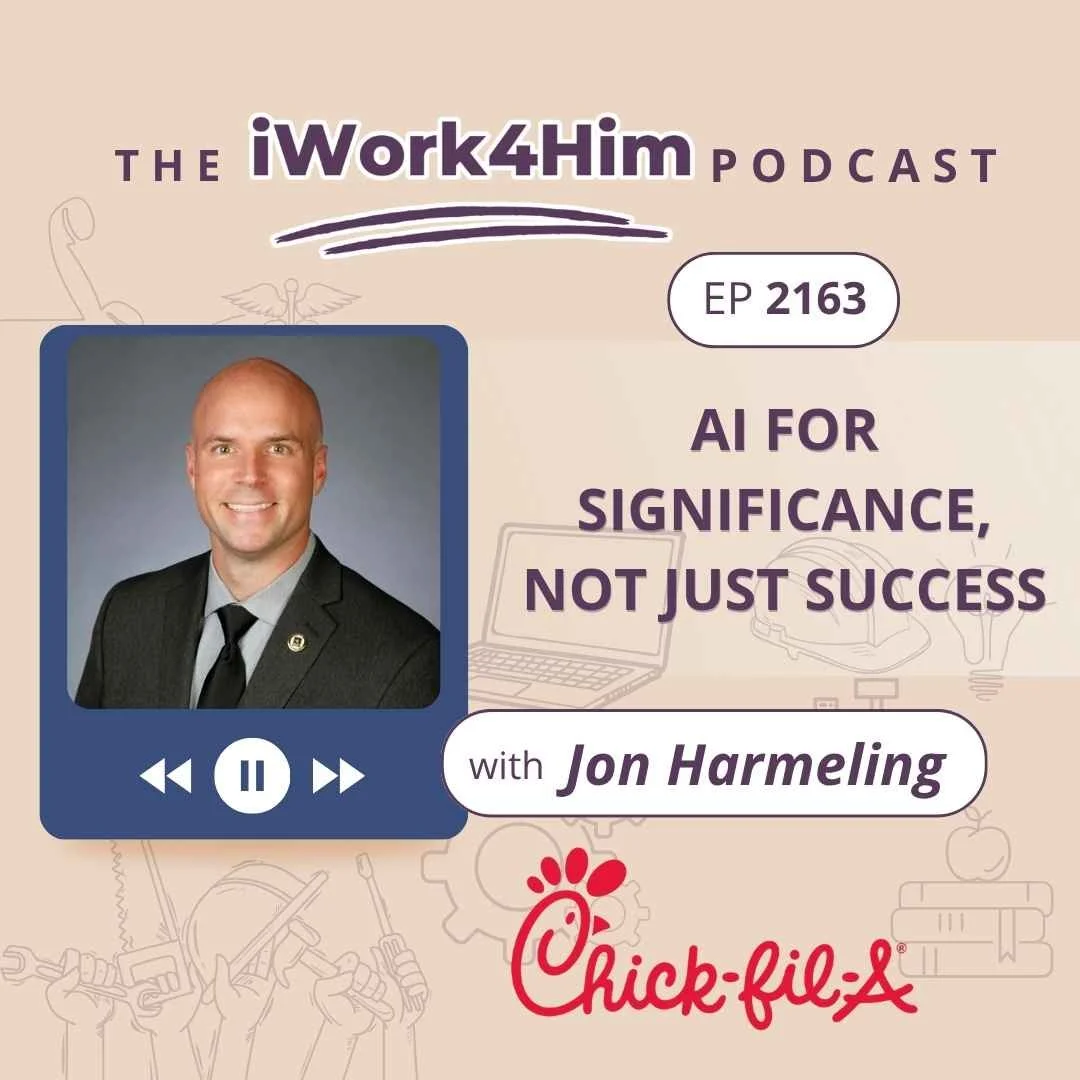
9/9/26 - 2163: AI for Significance, Not Just Success
Jim: This is iWork4Him.
Martha: Where faith meets work, and believers unleash their calling.
Jim: It's a story as old as time. Man does well in high school, really well, and ends up being accepted to West Point. Same man graduates from West Point and gets deployed to Afghanistan. Does well there, too. Comes back to West Point as a professor, then gets medically retired because of skin cancer. What? That's not the way the story's supposed to go.
Jim: Wait, it gets even crazier. Medically retired major leaves West Point, moves to Florida, and is now selling Jesus chicken in Miami. How does that even happen? You guessed it, only God. Our guest is Jon Harmeling, who chose to operate a Chick-fil-A instead of taking the obvious defense contracting jobs.
Jim: Today, AI runs the admin in his restaurant while his people run the restaurant. Jon says, "Hey, it turns out a dining room and a team of mostly first job kids is a mission field." He's a husband, he's a father, and a Chick-fil-A operator who cares more about significance than success. Sounds like a Halftime story to me. Jon Harmeling, welcome to iWork4Him.
Jon Harmeling: Oh, thank you for having me. You guys are... You guys need to be my hype people. I'm fired up now. That was a, that was an introduction. Thank you.
Jim: Hey, that's your story. I'm just trying to put it in, you gotta introduce everybody to it. That's awesome. Jon, we always start every show with a first-time guest talking about Jesus. Where did Jesus get woven into your incredible story?
Jon Harmeling: Yes, thank you for asking that question. Not a lot of podcast folks touch on that topic. But that's certainly a huge part of my life. Very fortunate to be born and raised here in South Florida. Mom and Dad, faith in our household was something I just learned at a very young age. So somewhere around the age of four or five accepted Christ into my life, and just go through that, that journey of the seasons where your faith is super strong and rock solid, and then you go through other seasons where it's not.
Jon Harmeling: You might be questioning a lot and then come back around again. But my faith has always been a big part of my life. I'm a big fan of being cautious not to use the word religion, but use the word relationship.
Martha: Amen.
Jon Harmeling: And so I just think that's really important. I'm not a huge fan of putting boxes and labels on people. I don't think Jesus wanted us to do that. I think Jesus wanted a relationship with us. For any of your viewers or listeners, if they don't have any faith right now, just encourage you to really lean into that. We talk about physical fitness and mental fitness, but what about spiritual fitness?
Jon Harmeling: And so just take some time to really explore what that is, and I think you'll end up at the same truth I did.
Jim: Yeah, we talk often on the show that the garden - in the garden Adam and Eve had complete physical flourishing, complete mental flourishing, and complete spiritual flourishing 'cause they walked one with God.
Jim: And when they sinned, it broke all three of those things. And when Jesus came and died for us- That, he came to restore all of that. And that's the walk with Christ, is bringing back flourishing, both spiritually, mentally, and physically.
Jon Harmeling: That's good.
Martha: That is good. I love it. So you talk about your journey of your faith, and, starting that at such a young age, which is such an amazing gift that you had that. Let's talk a little bit about the journey in your career. You went from West Point to Afghanistan to West Point again, to Miami, in order to run a Chick-fil-A. How did your... I'm curious how your experience in the Army prepared you for the mission field you're on now?
Jon Harmeling: Yeah, great question. So I think really leadership is leadership. And I wanna be extremely cautious to use two different words very intentionally. There's management and there's leadership. And so I think management, when you hear the word management, I think you need to think of transactional, getting stuff done tasks. There's a lot of deadlines, there's numbers, there's metrics. For the most part, it's pretty overt.
Jon Harmeling: When we talk about leadership though, that's people, that's transformational. It's usually a lot more covert, a lot of times behind the scenes. It's not recognized. It's not on a spreadsheet. There's not a deadline. "Jim, you have to lead by Tuesday." You know what I mean?
Jon Harmeling: And so there's management and there's leadership. And I think something that came out of the military, actually when I was a cadet, was identifying that. I wrote a whole paper on the difference between managers and leaders. Can all managers be leaders? Can all leaders be managers? And I still think it's true to this day.
Jon Harmeling: And so I do think leadership requires competence, confidence, and caring. So competence, you still gotta know what the job is. Competence-- excuse me. Competence, you have to know what the job is. Confidence, to be able to stand in front of other people and project that mission, that vision to others. I think that those two make a great manager, but a leader is that third C, which is caring, and that's where you start bringing the people aspect into it.
Jon Harmeling: So in the military, we did move around a lot. We had 14 different-- we moved 14 different times, each of those with a different job, each of those joining a different team, leaving a different team. Joining a new school for my son. My wife joining a new organization for her work. Us joining a new church.
Jon Harmeling: So what I'm trying to say is there's just so many different interactions and experiences with a lot of different people, and you really start to get an idea of the kind of leader that you respect and the kind of leader you might say, "I don't think I wanna be like that person." And so I just could encourage folks in their own leadership journey, if there's someone you genuinely respect, it doesn't mean you like them, i'm saying respect. I do think those are-- that's a whole nother story.
Jon Harmeling: If there's a leader that you genuinely respect, take a second and ask yourself why. For me, it was always because I felt like that leader cared about me as a person and not me as an employee. I wasn't a number on a spreadsheet. I was a human being going through my own challenges and issues and opportunities in my personal life.
Jon Harmeling: West Point, a lot of times referred to as the leadership laboratory, so blessed to be associated with that. The military puts you in a lot of very unique leadership situations to, I would suggest, where the stress level cannot be higher. Life, limb, and eyesight is on the line, and the bullets are flying, you have to be cool, calm, and collected.
Jon Harmeling: That's very challenging. As you can imagine, my experience is nowhere near what some of my peers faced. Had a number of peers that gave their life for our country as well during that service. But yeah, the military is just a phenomenal opportunity to learn more about yourself, learn more about leadership, and I think the parallels into a Chick-fil-A restaurant have been pretty clear.
Jim: And we're gonna dig into that. But let's talk about sidelined for melanoma. That's no laughing matter. You live in Florida, you grew up in South Florida, which is why you're dealing with melanoma. We lived in Florida 20-plus years. Skin cancer is just one of those things like, boy, I wish I just... that's just terrible. How did God move your heart to sell Jesus Chicken after living a storied life in the Army and after being medically discharged for melanoma? How does that all fit in, that transition?
Jon Harmeling: Yeah. If it's okay, Jim I'm gonna try to do this in three minutes and share about a seven-year journey. I hope to not get emotional, but we'll probably have that as well. At the time, had a chance to go back to West Point, was a teacher, was in the Department of Systems Engineering, and the class that I taught was project management. Had a fellow instructor next to me who got pulled away to an opportunity at the Pentagon, and as she left, we needed someone to help cover the classes for the last two weeks of the semester.
Jon Harmeling: Another colleague suggested there's a gentleman in the Army Reserve, so like a part-time soldier. He's in Atlanta. We could put him on active duty orders, bring him up to West Point. You could teach side by side. Let's do it. So he came up. He was a colonel in the Army, so he's not one or two, but three ranks ahead of me, and he's working for me as the course director.
Jon Harmeling: So he comes in, I salute him every day. And just, "Hey, sir, great to have you. What is your full-time job back in Atlanta?" And he said, I work for the organization Chick-fil-A. I'm a kind of a business liaison. I help restaurants in the field, and I go back and forth between our headquarters in Atlanta and the field."
Jon Harmeling: And I'm telling you that, that first day, he asked if we can just go get a coffee together, and we spent an hour and a half, and he didn't ask any work questions at all. He just... He was curious about Jonathan. He was curious about my wife, Carrie, and my son, like what are our goals? What are our paths? Like this gentleman spent, I'm sorry to say, but spent more time in that hour and a half just wanting to know more about me than some other of my like formally assigned, leaders.
Jim: Wow.
Jon Harmeling: And it just blew me away. So he very quickly became a mentor. I would say friend, but he's still a colonel. I'm the young captain. So every now and again, he would let me use his first name when I talked to him. But we stayed in touch for the next year, so I went and visited him in Atlanta.
Jon Harmeling: If anyone's ever been to Atlanta or excuse me, been to the support center, what we call our headquarters in Atlanta, please go take a tour at Chick-fil-A. See behind the curtain. Really hear the story of how we got to where we're at. It is fascinating. It is inspiring. You'll love it. So I had a chance to visit Rob.
Jon Harmeling: His name's Rob Coker. Visit him at the support center, was blown away by the conversation, and the first thing I think you guys will appreciate, when I was in high school, my dad, arguably my best friend growing up, so blessed for that, he said, "Jonathan, what is your life's mission statement?" And I said "I wanna glorify God with my life, and I wanna help as many people as I can."
Jon Harmeling: And that's the best I could do as a sophomore in high school. Fast-forward 17 years, I'm now walking into the Chick-fil-A support center, and they have a, they got a corporate plaque. It looks a lot like this, and I know you can't read it, but it's the mission statement of Chick-fil-A, which is to glorify God by being faithful stewards of all that's entrusted to us.
Jon Harmeling: That's cool. And then part two is to have a positive influence on all who come into contact with Chick-fil-A. So in high school, I had my personal mission statement. Now I'm visiting this company that has almost the identical mission statement. I walked in the door. There's a a statue of Jesus washing his disciples' feet in the lobby of the support center.
Jon Harmeling: What is going on? You go up to the original founder. You go to his office. Sadly, he passed away but his Bible is still open there on his desk, like to this day when you go visit. And you just start seeing all of these little threads just kinda woven in. This place truly is more about people than profits.
Jon Harmeling: And so I sat down with Rob for lunch that day, and he said, "Jon, I, I think you should really consider being a owner/operator or franchise owner with Chick-fil-A." And I said, "I don't know what that means, but yes, I'm in." And so I went back to the hotel, and I applied that night. Then I called my wife and told her everything that happened. So I did that backwards. I probably should've talked to her before applying. But here's where the story gets crazy, and I'll try to move quickly through this.
Jim: You're fine. Go ahead.
Jon Harmeling: At that point, I was active duty military. I still, in my head, had 10, 15, 20 years left to go. I was just gonna stay in the Army until they kicked me out. But I felt so called to this Chick-fil-A opportunity that I applied. So but I'm still... I still have a full-time job. So am I leaving the Army to go do... Like what a... I'm not gonna reach retirement. I'm not gonna get the benefits I've been working toward. Like this just appeared. It felt like such a huge fork in the road for us.
Jon Harmeling: And one of the, my favorite Bible verse I've got inscribed on my military ring here, Proverbs 3:5-6, which is to "Trust the Lord with all your heart, and lean not on your own understanding. In all your ways acknowledge Him, and He'll direct your paths." And I just, I kept praying that prayer. And so I went to the first interview with Chick-fil-A and made it through. I went to the second. I went to the third. We're somewhere around the seventh or eighth touchpoint with Chick-fil-A.
Jon Harmeling: At this point, it's been a year and a half, and it felt like two very clear crossroads. I need to get out of the Army and pursue Chick-fil-A or tell Chick-fil-A, "Thanks, but no thanks. I'm gonna continue serving our country." So I went to what is considered to be the most difficult interview with them. It's an in-person, roughly about a three or four-hour interview. I leave the interview, and I go and get in my rental car, take my jacket off, set my book bag down, just emotionally left it all on the table.
Jon Harmeling: "All right, God. This is... I did everything I could." And I'm sitting in the rental car, and I get a call from my doctor and said, "Jon, do you have a minute?" Which is a terrible way to start a chat with your doctor. And he said "That biopsy we took last week on your ear, unfortunately it is malignant melanoma, and unfortunately the story gets a little bit worse. The part that we cut off had cancer cells on the outside, which means the cancer is spreading into your body. We don't know how far it's spread. If it did hit your lymph nodes, you might have just a couple months left to live."
Jon Harmeling: So I'm now in the parking lot of the headquarters of Chick-fil-A, just left a four-hour interview. I'm crying in my car 'cause I'm like, "Holy smokes, I'm not even gonna make it to Chick-fil-A, like- ... at all. Like is this... Do I have months to live?" And now I'm... Like, it was just a, a surreal moment. I'm sure people saw me crying in my car. They're like, "Oh, I guess that candidate wasn't selected." It's like, no, there's some more going on there. But I'll fast-forward.
Jon Harmeling: Fortunately, we caught it early. I got a part of my ear chopped off. Who cares? No big deal, but we caught all the, the cancer cells. I'm good, but I now have a medical restriction preventing me from going back to war, and if you're not deployable, the Army's gonna retire you early. So- ... the fork in the road I came to, do I leave the military to pursue Chick-fil-A? And it turns out the decision was made for me.
Jon Harmeling: God retired me early at the same time was opening the door for Chick-fil-A. So just a, a wild series of events, and it's amazing when you go back and just kinda look at all those little touchpoints, the little nudge here, the little keep you on track there, the little don't get distracted here. Yeah, just a wild series of events.
Jim: So it was a complete surprise for you, but it didn't surprise God.
Martha: There's so many things to your story that we could learn from, but what I see as this thread for our listeners' sake is, you continued to walk in obedience of where you felt compelled towards the Chick-fil-A ministry really, 'cause that's what it is and God helped you in that decision-making.
Martha: Now a lot of people won't see it that way because they're like, "How could you see that kind of a diagnosis as a direction?" But God provided for you in a way that is just really miraculous. That's how, as an outsider looking in, that's what I see. And I'm so grateful that you're healthy and that you're on the other side of that because that is a big deal to walk through. So thank you for sharing that with us. Thank you for letting us see a little peek ourselves about... 'cause a lot of people, we might not even realize. That was a very long decision-making process for you to walk out. You're talking about a couple years at least.
Jon Harmeling: Yeah, at that point I had been in the military, so 16 years in total, if you include the 4 at West Point, 12 of active duty. I had another 8, call it 18, years to go in the military career. So it definitely took took some time.
Jon Harmeling: It was everything I've known since I was 18 years old. I'm now entering... am I a civilian? Is that the word I'm supposed to use now? It was a wild season. So we retired early - what a blessing. Hopped in our U-Haul for move number 14, and we drove from West Point to New York down to Miami, Florida, and we pulled up on March 5th of 2020.
(Jim laughs)
Jon Harmeling: And if you are thinking about what happened essentially that week of March of 2020... coronavirus and COVID locked it down on March 6th. So that was my first week of being a civilian, was heading into that. Goodness, what just a wild season for so many folks. And I know your viewers have so many different experiences and challenges that they went through.
Jon Harmeling: For me personally, in terms of Chick-fil-A, Chick-fil-A decided to pause all of their new restaurant real estate investments. And so the idea of "Hey, Jon, I think we might have a restaurant for you to lead in the next four to six months," ended up turning into it was about a two-year waiting period.
Jon Harmeling: So it was after the Army, before Chick-fil-A, I kinda was in this lull for about two or three years. There's a whole nother story I'd love to share in that season, but yeah, it was a long process to sum it up. From application to being officially selected was a five-year journey for us.
Jim: Phew, boy. That shapes your character a little bit. 'Cause when you pray for patience and God gives you things like that in order to get patience. But, as he says, patience delivers us in incredible ways.
Jim: I wanna pause here for just a second because at iWork4Him, we believe that your work is not separate from your faith. It's one of the primary places God has put you, and the stories like Jon's are proof of that. God has told us to produce this show on and on for 13 and a half years so that more people can learn these truths and be inspired by stories of faith like Jon has shared with us already.
Jim: We invite you to become part of this mission with us. Become a monthly supporter of iWork4Him, as little as $5 a month. You can go to iwork4him.com/donate and become a part of helping this team produce stories and help share stories like Jon's around the world. We'll mention this again at the end of the episode, and and we'll also have it in the show notes, but iwork4him.com/donate.
Jim: All right, so Jon you ended up at the Miami Shores Chick-fil-A. Most of everybody listening to this show today has been to a Chick-fil-A and had Jesus chicken. It's just amazing. Nobody makes a chicken sandwich like Chick-fil-A, and yes, maybe they don't call it Jesus chicken in Miami Shores, but that's what I call it. What sets your Chick-fil-A apart?
Jon Harmeling: It's hard to pinpoint that. I only have control over our particular restaurant, and so I'd be happy to talk about that. But I do think just Chick-fil-A as a whole, so not necessarily our Chick-fil-A, but as a whole, I think we just, we value people and experience so much more than we do profit and money.
Jon Harmeling: First and foremost, we're closed on Sundays. Arguably Sunday could be our busiest day of the entire week, and so you imagine the amount of money that's on the table, but that's not what's important to us. What's important to us is giving our folks a day to, to be with their families, to worship, to enjoy sports, to catch up on school, to sleep, to shop, do whatever they need to do.
Jon Harmeling: But for us, again, it's very much people over profits. I'm very blessed to have a wonderful team. We have 88 people on our team. I'm sorry, we have 89 people on our team. We just brought in a new leader, which we're excited about. And the part I'm really thrilled to share is we have 19 countries represented on our team.
Jon Harmeling: So when we talk about American Dream-type stuff, like I'm working side by side with folks that are quite literally very new to United States, first generation to America, doing everything they can to either become US citizens, all of the paperwork, all the authorization to even be able to get to the United States.
Jon Harmeling: In many cases, a lot of folks taking part of their paycheck and sending it back home to their families to help them get through some really difficult situations in many cases. And I don't know about you guys, I'll speak for myself, I spent zero minutes working to be a US citizen. I just... I don't know. It's just what my parents told me. I am a, an American citizen.
Jon Harmeling: And I'm working side by side with people that are spending so much time and money and energy, and it's so challenging for them to get to the US and to be able to work here in our country. And the gratitude and appreciation that they show to have an opportunity to work on our team, it's just it's humbling, I think, is probably the best word.
Jon Harmeling: It just takes... I have to force myself to take a step back and truly appreciate something that was just handed to me just 'cause I was born in this country. Wonderful team.
Jim: Let's dig into that. I know it's not it's a little sideways, but I love that conversation. Let's dig into that a little bit because, having lived in Florida, Florida is a melting pot, and the Miami area is a real melting pot. When you drive in the Miami area, it's like driving in any of the South American countries. Just crazy. Most of the time they observe... some of the traffic laws.
Jon Harmeling: The traffic suggestions.
Jim: Yeah ... you get traffic suggestions- ... in Miami, that's for sure. Talk to us about the ministry, because you've got people coming to work at Chick-fil-A. Some of them just need a job. They don't know that when they come to Chick-fil-A, they're also gonna get Jesus at the same time. That- ... they're gonna get a culture that wants to shape their character, not just give them a paycheck.
Jim: You've got an oppor- 29 countries, which means you're ministering to people that grew up in Muslim countries, 'cause you can't have 29 countries and not have Mus-
Martha: 19. 19 countries.
Jim: Nine- 29 countries, 19. I think I nined some. But talk to us about that ministry, 'cause you're obviously being a great leader. You're investing in them personally, but you get an opportunity to be Jesus to these people, too.
Jon Harmeling: Yeah, that's it. A, a quote that changed my life was from Tim Tebow, and so he got up on... And I'm sorry. I don't know why I'm getting emotional with this, but I'll answer your question. Just give me one second.
Martha: That's okay.
Jon Harmeling: So I went to an event, I went to an event with my dad. So after the Army, before Chick-fil-A, it was a really difficult season. Part of my story is I applied to 383 jobs and got rejected from every one.
Martha: Wow.
Jon Harmeling: Not excited. And meanwhile, I'm still competitive for one of the most difficult jobs that's out there, and I just, I was just str- It was not a great season of life. And so I told my dad, "Hey, there's this event coming up, Tim Tebow," even though he's a Florida Gator, my dad went to FSU. "Let's go to it."
Jon Harmeling: And Tim got up on stage, and of the thousands of people there, he looked right at me, and he just said, "The greatest tragedy in one's life is to be successful at things that don't matter." And I just... that just... it made me uncomfortable, 'cause the whole time I was pursuing success and more responsibility and more money and just keep growing and climb the Army ladder or climb the whatever ladder.
Jon Harmeling: And there's nothing wrong with that, but it's just my goal, my aim was off, and so that's where just mentally I was like, I turned to my dad next to me and just said, "Hey, I have to switch from success to significance. If I keep going down this track, like it's just I don't think I'm gonna be satisfied. To whom much is given, much is required, and I'm just gonna, try to make more money somewhere."
Jon Harmeling: And so it was just a really challenging season of life. So I turned to my dad and I just said, "Dad, I need some more juice. I need some more life. I need to get going on something. What do you-- How about you and I? Let's start a business together. Let's start a company. Let's start a nonprofit, a ministry. Let's go, man." And he's like, "Dude, I'm all in." And so at the time, I did secure one work from home job. It was great on paper, it just wasn't very fulfilling, and I did that for a month or two. And so I told my dad, "Hey, I'm gonna quit this job. I'm gonna quit this job and let's do something together." So I quit my job on Friday, and my dad dies on Saturday.
Jim: Oh, my.
Jon Harmeling: And so now I just, now I'm planning a funeral. He had no health issues, and it just was a passed away in his sleep. And so now I'm planning a funeral. I'm the executor of his will. What does that even mean? I just got a real estate license randomly. At that season of life, my first deal is selling my childhood home that we've had in the family for 42 years. So now I have to clean out four decades worth of supplies and materials- if I could sum up just an incredibly low season of life.
Jon Harmeling: You talk about questioning, questioning your faith or God or directions or is this the path you clear? And at-- I don't know if Chick-fil-A's ever gonna work out. I just quit the one job that I have. And so it was just such an incredibly low season of life. And so one of the things that came out of that story is as I was cleaning out my family's childhood home, my parents' home, my dad had Post-it notes all over the house, and it just said Chick-fil-A.
Jon Harmeling: And he misspelled it, unfortunately, so it was Chic-fil-A that he had on the Post-it notes. And every time he saw it, it would just remind him to pray for this opportunity that God laid on my heart. And it was such a special time to take that Post-it note and put it in the restaurant that he had been praying for. Unfortunately, he wasn't alive to see it come through.
Jon Harmeling: And so it is just-- it has just been this series of success or significance. And at the restaurant, what I never wanna do is, unfortunately, whenever I pass away, I don't want someone to go and start speaking at my eulogy and say, "What I remember most about Jon is growing catering 120% year over year. I remember Jon for how many nuggets he sold on Tuesdays, and I remember Jon 'cause he actually had the greatest scores on what..." Who, who cares? Seriously, at the end of it all, who gives a flying crud about some of that stuff that I was spending so much time focused on and completely bypassing this ministry that's right in front of me?
Jon Harmeling: And AI comes out. I've spent so much time on AI, but I've been using AI for success and not significance, and that's been this aha moment here in the last few months, is how do you use AI to help you as a leader? Not a manager. Remember we talked about that. I'm doing a heck a lot of that, a heck of a lot of that is using AI to help me do tasks, to be more efficient, to get the repeatable, the you know, busy admin work done.
Jon Harmeling: But when it creates that capacity and that extra free time, that white space on your calendar, what do you do with that white space? Do you find more busywork, or do you actually pour into your team and lead and transform and do everything that I got into this business to do? And so recently, AI has amplified so much of my time, and so even last week, we created a goals dashboard.
Jon Harmeling: AI reached out individually to every team member on our team and said, "What are you working on? What goals do you have? How can I help? You wanna learn English? I got you. You wanna learn how to drive a car? I got it. You wanna work on your immigration stuff? You need to contact a lawyer. You wanna get accepted to college. You wanna be a police officer, you wanna be a cybersecurity person, you wanna be a Chick-fil-A owner/operator."
Jon Harmeling: I now today, I have 88, soon to be 89 goals on this database, and AI has helped me. It has prompted me with, "Jon, these are the three touch points you need to do this week to make sure these folks are on track to reach their goals. "We've also found here's the next five steps that you can help coach them through so that they can in fact go to college in the United States. This got off track. This is on..."
Jon Harmeling: Anyways I think you can kinda see where I'm going with this, but I just think leaders today have such an amazing tool at their fingertips, and all of us are using AI for success, and we're being better managers. But I really think we have to pause and see how can we use AI for leadership to be more significant leaders. And that's something I've just been working on right now, here recently, and it's been really cool.
Martha: It's so powerful to hear you say that because so many people equate using AI with diminishing the human capacity, diminishing the humans as... but you have 80, almost 89 people that you are responsible for. That's a lot of people. So AI's not replacing them. You're using it in a way to enhance their wellbeing and their futures, and I think that's so powerful to point that out to our listeners because that's the opportunity to say, "How can I use this so that I can create more white space as the leader?"
Martha: Because you only have so many hours in the day, and you have a responsibility at home to your family as well as your work family. And so I appreciate that perspective because I don't know many people that are looking at it that way. They're looking, "How can I decrease my workforce by using AI?" And you're saying, "How can I enhance my workforce by using AI?" Fabulous. And I think that's so remarkable.
Jon Harmeling: That's awesome. No you nailed it. And I would suggest to leaders that are out there, if you have an organization and there's a natural anxiety that when the term AI comes up, it's like, "Crud, there goes my job." Or it's me or Jim or Martha, right? AI's gonna replace one of us or maybe at least two of us. And unfortunately, there are organizations out there that are just sole focus is to reduce their labor, reduce their workforce. All of that makes sense on paper, but you're missing the human element of it.
Jon Harmeling: And so that's where I just think the success versus significance kinda argument comes into play. I would suggest if there's leaders out there, if someone chooses to move on from your organization, maybe don't rehire, don't backfill them. Pause for a second. Is there any part of their workload that could be done by AI or could augment an employee that's still with you and help them do it? So another way to look at it, instead of removing employees to replace with AI, as employees naturally move on to their next season of life maybe that's how you reduce your workforce.
Jon Harmeling: Anyways, yeah, it's just been, it's been fascinating for us. If I can give you one example we just had from two weeks ago, I ran an AI prompt that was trying to alert me for anyone who is on track to go into overtime hours. That's something we try to manage throughout the week. And I got an alert, came back, and it said one of our team members in the back of house is on track to work about, 42, 43 hours that week and go into overtime.
Jon Harmeling: So again, the prompt came back, "Jon, alert, pause, make some changes, adjust some stuff." The next week, I ran a prompt that said, "Who on my team is being overlooked and could use some encouragement?" The same individual came back on my screen, and it said, "The reason she's going into overtime is because she actually worked a double shift on Tuesday to cover for her teammate so her teammate could go to the hospital with her child who was not feeling very well."
Jon Harmeling: What? Like I didn't- ... I didn't know, I didn't realize this. So AI for success told me to, make some changes to reduce overtime or at least manage overtime, and then AI for significance told me to go in and give her a pat on the back and say, "Good job. I see you. You're working extra hard. You didn't ask for anything in return. Thank you for covering your teammate. Oh, by the way, who checked on our other employee and how her child's doing?"
Jon Harmeling: And anyways, this is where I just think AI has such great opportunities to provide these insights. I am in no way suggesting that AI do the leading for you. I am suggesting that it can nudge you as a leader and provide insight and analysis, but then you still have to walk away from your laptop and actually go do the leading yourself. So in my case, both of the individuals I just mentioned, one only speaks Haitian Creole and the other one only speaks Spanish, and so that gives me an opportunity as a leader to try to thank them in their natural language as best as possible.
Jon Harmeling: So it just created this great leadership moment a smile, a pat on the back. Who doesn't love a little encouragement? And again, who cares about AI? Or excuse me, who cares about OT for overtime, is what I meant to say. But yeah, just really encourage folks to lean into some of these tools, but lean in for it, not just for management of tasks, but leading of people.
Martha: And man, that's so powerful- That's great ... because those employees naturally, instinctively have more loyalty to you when you see them and when you hear them and when you have that relationship with them to know what's actually happening in their life. So what a great example of how that worked out.
Martha: There are so many things that are vying for our attention during any given day. When you have a technology issue, it can really derail you from everything. So a priority worth considering is making the switch to infiniteprotection.ai. They are an enterprise-grade cybersecurity company built for all businesses. They have one unified platform that secures devices, scans vulnerabilities, and identifies network risks before attackers get in. A few key highlights about Infinite Protection include every device and every user is covered, not just the network.
Martha: Always-on monitoring and threat blocking, as well as optional compliance and penetration testing. You can learn more at infiniteprotection.ai, and let them know that iWork4Him sent you.
Jim: Jon, got a couple more questions before we head off for the day. You are dealing with teenagers, a lot of teenagers. Of your 89, how many of them are under 20?
Jon Harmeling: Under 20, I would say probably about 35%. If you were saying under 25, that's gonna be about 85% to 90% of our team.
Martha: Wow.
Jim: All right, so a lot of people that are young, influential. In the media today or in the common conversations, people are always complaining about this next generation. "They don't have a work ethic. They don't..." they talk down. "They all- They're literally stuck on their phones all the time." But yet you are seeing them as a mission field. How have you seen this next generation when you invest your life into them, how do you see them responding? Because there's so much criticism of them, but how are you seeing them respond?
Jon Harmeling: Yeah, I think first and foremost, if there's folks out there that want to place a label or a box on an entire generation, I would... I hope... This will probably be uncomfortable, but shame on you, for doing that, to say, "Oh, everyone that was just born in this season of life is automatically fits in this category." That is so false. It's just... that is fake news.
Jon Harmeling: This generation is dying to be led by people. I would suggest the challenges with the social media and the scrolling, like isolation and loneliness, self-worth, confidence. There's so many unique challenges that are hitting these young people. And so if I can create this culture where people are actually excited to go to work 'cause someone's gonna give them a hug, give them a fist bump hear them laugh.
Jon Harmeling: My wife serves as the director of hospitality, so everything that has to do with the team member experience, the guest experience as well, but the team member experience - she gets to the restaurant, depending on what time of day it is, she has 32 hugs to give out. You know what I mean? That's cool. That's awesome. Everyone's super excited to see her. They see me and it's like, "Hi, Jon." But she walks in, they're very excited.
Jim: You said people are dying to be led, but that's not what you just described. You described that people are dying to be loved.
Jon Harmeling: That's extremely fair. That's very fair. And actually, I'll take that into consideration when I share some of these stories going forward. But I just feel like if you can create that culture where just people feel valued, they feel heard.
Jon Harmeling: There's a wonderful book First, Break All the Rules, Marcus Buckingham. I'm hoping I quoted that right. And he just talks about how if you can have engaged employees, how they're gonna stay with you longer, they're gonna work harder. They're gonna think about the business when they're not on the clock getting paid.
Jon Harmeling: I get text messages at night, "Hey, Mr. Jon, I was thinking about an idea. If we could move this over here, it would prevent me from having to take extra steps back and forth. What do you think?" And it's like, "Amazing. Yeah. Heck yeah. Let's do it." And then I also think there's just so much culture stuff we get to do.
Jon Harmeling: I mentioned on Sundays, we have a day off, so every month we try to do something as a team and get together. Again, using AI, I used AI to poll the team, "What do you guys wanna do? We could do anything. As long as you could physically get there, the restaurant's gonna pay for everything." And so this month through AI, it collected all of the votes and said that we're going to the beach on Sunday.
Jon Harmeling: We're gonna have a cookout. We're gonna be out there at sunset time. The team is most excited about playing volleyball and Frisbee, are the two activities that they voted on the most. And so it's just, it's been a really cool season of life. And I do think if you can create that culture, when you hire someone that doesn't fit the culture, they stand out like a sore thumb. Is that the phrase?
Jon Harmeling: It stands out a heck of a lot more, and other people are just saying, "Hey, I'm not sure if this individual is kinda jiving with what we're trying to do here." Now, that provides us as leaders a chance to coach and mentor and train. Maybe it's just, it's a newness. It's the first job. It's overwhelming.
Jon Harmeling: Some Chick-fil-A's get extremely busy, and it can be very overwhelming. But I do think if you can get that culture piece nailed, people either just fit in with the culture or they don't. And if they don't, we coach them. And if it's still not working out, that's a great opportunity to continue showing care to that individual as you maybe help them, find employment somewhere else or somewhere that maybe fits their needs.
Jim: You free their future is what we like to call it. You free their future for them to experience something else.
Jon Harmeling: Yeah. And you nailed it. And of course, there's so many difficult conversations, and one of the things that if people ask me, "What is the hardest part?" Yes, it's the people part, but by far is letting someone go from your team. And I've had multiple situations where it's a round peg in a square hole, and I know this is not working out, and it's just come on. Please just show up on time. Please don't fight your teammates. Please be in the right uniform. Please don't smoke anything before you come to work, like...
Jim: yeah.
Jon Harmeling: Please just do like some of these things, and someone shared with me that you can't want it more for them than they want it for themselves. And it's been really hard, especially one of my things that my dad had a big soft spot for is young men that don't have a father figure in their life, a father or a father figure in their life.
Jon Harmeling: And you just ... I lose a lot of sleep and it's just " if I could just coach them a little more, if we can just do a little bit more, we can make it work." And those have been some of the most challenging conversations is when we have to part ways, part ways with someone. But yeah, it has been a wild, amazing, hard journey these last two years for sure.
Martha: Wow. I appreciate you sharing so much and it's only the tip of the iceberg, I know. From just hearing, there's so much more that goes into it. But the example that you're setting for all of our listeners, and I know like me, I'm thinking what could I do to move to Miami to work for you, Jon? Or have my kids, or encourage somebody who lives nearby because you are, you have shown us how God has wired you to care about the people and to want to see them succeed.
Martha: And it, for so many people, because you may be their first point of employment ever, you are setting them up for a wonderful employment experience even outside of when they work for you. So if they ever move on to somewhere else, they are gonna be a better employee as a result of that. I take that as a huge win, but hearing your story, thank you for being obedient. Obviously, it's not been easy. Obviously, it's a lot of blood, sweat, and tears that goes into it. But you have a whole little community there that God has given you to be responsible for, and then they are responsible to their families.
Martha: It flows on, and just hearing how that has impact to their families and to your community and to all of your customers is huge.
Jim: Yeah, 90 households, including yours, getting impacted. And Jon, you'll go out and you can speak for- I mean, you'll go out and talk to other companies. This is something that you do. You encourage other leaders to learn from your experience, correct?
Jon Harmeling: Yeah. And thank you for asking that. I appreciate that. It has been fascinating as I go and meet with other business owners. We have church groups and small groups. We have a small group Bible study with just business owners.
Jon Harmeling: And it's interesting, whatever the design topic was or the planned topic for that day, we still get back to AI, and everybody's so excited. And it's just this idea of, yeah, of using that to just amplify your leadership, not replace your leadership. Like help set you up for success to, to be a better to be a better leader.
Jon Harmeling: And putting together this Frontline AI Leadership - I chose all of those words very specifically and just wanna document our experience that we're having at the restaurant. It's not a-- I'm not pitching anything, selling anything, not trying to make money. But the biggest value I get are some folks that reach out and say, "Holy smokes, that, you know, prompt you shared, that took me in like a whole new direction in my leadership." I'm so excited, to be able to do that.
Jon Harmeling: Creating leadership development framework within your restaurant. So organizing and scheduling. At what time am I sitting down with each of my directors? At what time are each of my directors sitting down with each of their shift leaders, and those shift leaders with the trainers, and the trainers with the team members?
Jon Harmeling: For it to be a leadership model of one to 88 is not smart- ... 'cause we also are called to develop, we're called to develop leaders within our own restaurant. We wanna grow and raise leaders, and I hope they can lead in other organizations.
Jon Harmeling: Two other comments, if it's okay, I'll share. Please don't write off the 16-year-old just 'cause they're young or they fit into whatever generational stereotype you have.
Jim: Yeah.
Jon Harmeling: We have had multiple situations of two different individuals. One comes in with the perfect resume we're looking for, amazing interview. The other one comes in, no resume, first job ever. All they've done is babysit their younger sibling. And the interview was uncomfortable, you could tell, kinda nervous. You could probably see where the story's going. The person that was perfect on paper in the interview turns out was just not a good fit for what we're doing. And that 16-year-old with some coaching and some mentorship thrived, and has had multiple promotions in the first few months, and is crushing it.
Jon Harmeling: And so I'm just saying, please give our young adults a shot and pour into them. Please don't let any preconceived, notions out there prevent you.
Jim: And the other thing, you're really just saying do what Jesus did. Don't judge people based on their behavior. Just love those people and love them into success. That's what Jesus did with every one of the disciples. Really.
Jon Harmeling: That's fair.
Jim: Yeah.
Jon Harmeling: It's fair. And I would also just take it a step further. For anyone that's in kind of a frontline industry and you interact with a lot of customers - or in our world we don't call them customers, they're guests and it's our pleasure to serve them.
Jon Harmeling: You might be the only person that smiles at them all day, maybe all week. You're the only person that used their name this week, or just genuinely served them, or cleared their trash, or refreshed their beverage, or took a moment and helped them to their car on a rainy day. And one of my favorite videos that Chick-fil-A has is a guest comes to the front counter, looks very well put together, smiles, and there's a subtitle underneath, and it shares a very real struggle that they're going with, or excuse me, that they're going through.
Jon Harmeling: And again, on the outside everything looks great, and on the inside it is just like we don't know what our guests are going through when they come through our restaurant. We've had some amazing, heartbreaking stories that have come through the restaurant, and they're like, "I come back here 'cause I feel good."
Jon Harmeling: Yes, we hope the food's good. We hope it's fresh. We hope it's accurate. But like when some people leave and they can't even remember what they ordered or what they ate, all they remember is that they felt good, like I think that's when you're really tapping into the ministry opportunity that we have inside our four walls.
Jim: Jon Harmeling, thank you so much for sharing your story, so much of your story. And to be able to- just in- it's inspiring just to hear that you're doing what Jesus said, "Love God, love people." And you're doing it in a Chick-fil-A. So it doesn't get much better than that, 'cause you get to eat Jesus chicken all the time.
Jim: And I know we need to let you go, because it's about lunchtime in Miami Shores, and I know it's busy. And the line around the building is double wide, and it's going crazy. But Jon Harmeling, thanks so much for being on iWork4Him today.
Jon Harmeling: Yeah, it's absolutely my pleasure. My last quote for you guys that changed my life is, "The greatest tool the devil can use in your life is busyness." And you mentioned we're so blessed to be in an organization that happens to be more busy than normal. But please, if there's folks out there that are just filling up their days with busyness, take a step back and pause, and just really pray and think about how God can use you to get away from busyness and start doing more of the leading that we're called to do. But it's been a pleasure hanging out with you guys.
Jim: Appreciate it very much.
Jon Harmeling: Hope we can do it again.
Martha: Thanks, Jon.
Jim: And listeners, if you enjoyed this episode, help us produce more of this. Join us in supporting us at iwork4him.com/donate.
Jim: You've been listening to iWork4Him with your hosts, Jim and Martha Brangenberg. We're Christ followers, and our workplace, it's our mission field. But ultimately iWork4Him.