
Jim: This is iWork4Him.
Martha: Where faith meets work, and believers unleash their calling.
Jim: How do they do it? How does a truck driver get in his big rig and travel for hours on end, rarely stopping to eat or go to the bathroom? Deadlines always hanging over their head, and stupid traffic whizzing all around them with so many people cutting them off all the time.
I've traveled a couple million miles in my lifetime in my car, but many truckers travel hundreds of thousands of miles every year. Ugh. Now, how do you squeeze your faith and family into that mix, too? I don't know any of these answers, but I do know this. Evan TeBrake and his family from Willmar, Minnesota, have figured this out, so much so that Nathan Patterson, a trucker and friend of mine from Ohio - Baltic, Ohio, we'll draw attention to Baltic, Ohio today, drew my attention to Truck Transport and their reputation, and the attention their company is getting for living out their faith in their work.
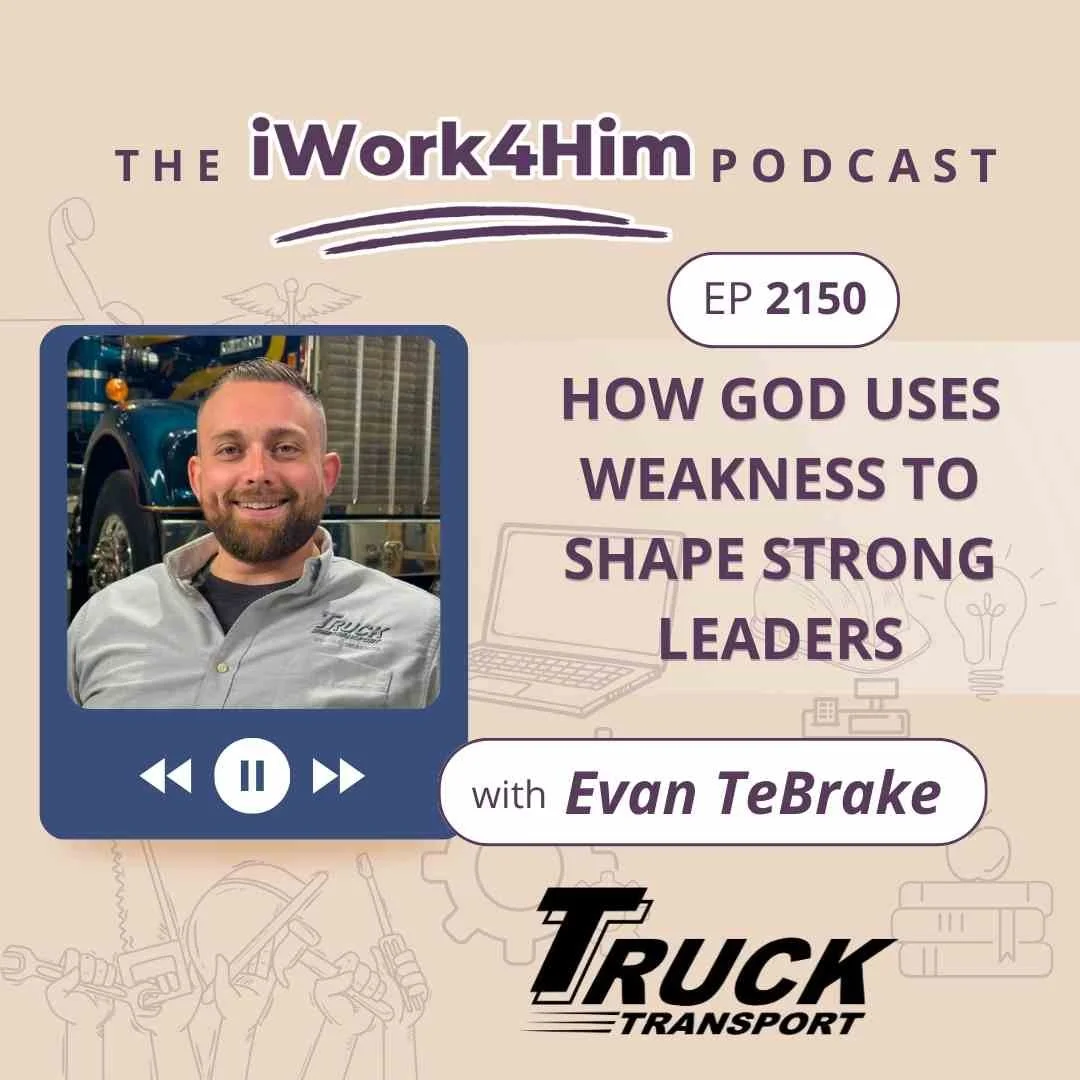
It's all over their website and their reputation. Here to tell the story is third generation Truck Transport leader, Evan TeBrake. Evan, welcome to iWork4Him.
Evan TeBrake: Hey, thanks so much for having me. I sure appreciate the opportunity to be here.
Jim: We're grateful to have you, and any time we can get a good Minnesota boy on here, we're grateful. We always are cautious if anybody from Wisconsin wants to get on. (laughter) We're like, "No, sorry." Cheese head. No cheese heads on this one. All right. Before we get started talking about Truck Transport, let's talk about your Jesus story. Tell us your Jesus story.
Evan TeBrake: Yeah, so my Jesus story is pretty interesting in some ways, pretty typical in others. I've known Jesus for a long time, loved him for a long time, but for me, a couple years ago, I had an opportunity as we were kinda going through a season that we here at Truck Transport have now called Chapter 23 that was just a tough time in the history of our business. Some of the economic factors in our industry as well as just some other growing pains and things of that nature.
During that season, I had an opportunity to be a part of a small group as well as just getting to walk alongside some other friends and mentors who spoke life into me, and one of the things that changed me in that season was - I guess there's two things. One was in the winter of '22, '23, and my son Trace was in the hospital.
My wife and I were up there. He had RSV and pneumonia and bronchiolitis and all the things, and we were spending some time up in the St. Cloud Hospital, and we ended up there for a week with him. And it was during that time that I found myself in prayer, and I had felt some promptings over the past number of weeks leading up to that, that I just felt like, "Lord I just want more of you. I want to spend more time with you. I feel I love Jesus. I've- I know a lot of scripture, and there's definitely some meat there, but I feel like there's something missing."
And when that became super apparent was in another one of these moments where life feels like it's out of control, and I'm sitting there on my knees going, "Lord, I need you," and then the next breath was, "Lord, why do I only need you right now?" "Or why do I come to you in these moments? I wanna be intimately close to you in all moments, in all seasons."
And so that set me on a few years trajectory of really deep dive growth, learning about surrender, walking through some events in my life that just changed who I was. And then another defining piece of that story is when I entered into a study going through The Awe of God, which is a book by John Bevere, and that really put into words some of what I felt I'd been experiencing, was the difference between loving Jesus and knowing him, and then the reverence and fear of the Lord and what that looks like and how it informs my daily walk with him.
So that's a little bit of my story in terms of, I grew up... if I step farther back, I grew up in the faith, and so obviously a Christian home and family, and so I've always had that element there. But it's just been in the last few years here that I've had some of the experiences that I just shared with you.
Jim: And you're in western Minnesota, where people's faith is a very quiet thing. People aren't shouting on the corners. There's no street preachers on the corners at the streetlight in Willmar. Do you have two streetlights in Willmar? How many you got in Willmar now?
Evan TeBrake: Yeah, maybe even four.
Jim: Wow. There you go. So growing up, Martha and I lived in Gaylord for five years, four years, and people's faith was a very private thing. They didn't talk about it a lot, yet a lot of people had very strong faith. How do you- I mean, you're living out your faith pretty boldly for a western Minnesota kinda kid. So how is that, how does that mesh with the culture of where you live?
Evan TeBrake: It certainly can make some people uneasy, and I think that's okay. There was probably a time in my own history that I would've been a little bit more uneasy as well. And I think one of the keys to why it feels uncomfortable is that vulnerability isn't seen as strength. And, in 2 Corinthians I think it's 12:9 where Jesus, or yeah, Jesus through Paul talks about that the Lord's strength is made perfect in our weakness.
And that to me is something that I just continue to come back to as a bit of a cornerstone of why I can be bold in my faith, because any vulnerability or weakness we have here is strictly just in our flesh telling us that we can't talk about that or we can't share. And the thing of it is like we have an opportunity then to testify to His faithfulness. But usually that only comes out of our willingness to be obedient in sharing aspects of our own weakness, because that's where the power comes from, is in sharing that the Lord has been good and gracious to us, and this is why, this is how, and He can do it for you, too.
Martha: I love that. So in the conversation of the context of this podcast, iWork4Him, how did, as your personal life was shifting so greatly, and that you were really growing in your reverence and your fear of the Lord in the things that you just explained to us, how did that - I don't wanna use the word trickle, because I think it was bigger than that, but how did that affect your work life and how people saw you there?
Because so many people, it's two different things. And so what happened as you were growing personally in your relationship with the Lord that affected your work?
Evan TeBrake: Certainly. It's a great question. I think it's hard to separate any areas of our lives from each other, but we want to do that for some reason. And so I think when I really step back and look at it, part of my growth was a byproduct of what I was experiencing in the workplace, too. For me, obviously, that means being an owner and a leader here at Truck Transport.
And that's not the case for everybody. However, there's always aspects of what we're experiencing in our workplace that are going to impact the way that we're moving through life in a particular season. When we go home, we don't just shut off necessarily altogether what happened at work. Now, I do believe it's healthy to leave those things at the door as much as you can.
However, you don't change when you step through the door. And so there's those things, and I think the awareness of just acknowledging what it might be that you're choosing to shut off when you hit the door, even that in itself, it continues to be a choice. And so you internally are still processing some of those things as you step in the door to meet your family at night.
And so for them to not deal with the repercussions of what's happening at work. So stepping back to the initial question, what that started to look like then at work is, as I experience things, as our team experience things, my response just changed. Because before I definitely struggled with pride, I still struggle with pride.
It's hard to show any level of weakness, particularly as a leader, but I think it's harder when we don't realize that there's something or someone that fills the gap for us. And so when we can take that to a point of testifying that the Lord is the one who is supplying our need, even as a leader, then that weakness becomes something that you can use as a tool to share with your team.
And what's been fun for me is I don't mind anymore talking about the situations that I have maybe failed as a leader. And so I think that's just been a huge shift. Now, I will say and I think we were maybe gonna talk about this a little later too, about failure as a leader, but there was three things that I had written down as I was processing that, and as keys to my personal process, which is awareness, acknowledgement, and apology.
Those three A words coming together and forming a trifecta that I think is pretty important. So the first thing is, are you even able to be aware of the fact that you just missed big time in your role in a specific problem or opportunity? Then you have to be willing to acknowledge it with your team, and then that brings you to a choice of, am I just going to acknowledge it in a passive form or some sort of way that I'm gonna slip by it, or am I actually gonna say, "Hey I'm sorry I failed you in this instance, and so I'm going to acknowledge this.
I'm gonna be willing to work through it, and I appreciate what you're doing. And there's one example that sticks out very specifically to me, which is a time I was working with our brokerage team, and they had a issue with a customer, and I love and trust our team. But when that issue occurred, I started thinking about what they must have done wrong in the situation.
And I'm going, "Wow," as I start reflecting on it, "Evan, what are you doing here?" These are the people that you work with and trust and have breathed life into, and they've breathed life into me, and your position on this is naturally going to "they must have failed." As we began unpacking that, and the Lord was softening my heart in this particular instance, I began working through it again and realizing, wow, they actually did everything right, and there was one small hiccup that caused this issue here. And something that we were then able to do, and it's something we'll talk about and probably talk about more in another question here, but our purpose at Truck Transport is positively impacting communities through service.
And so over the last few years, I began asking a question in any situation, which is how can we make a positive impact here? And so it's taking our purpose and making it very specific to the situation that we're actually in right now. And so that's what we did in that, this instance that I'm talking about is said, how can we turn this into an opportunity for impact?
And by the end of the whole conversation, the customer was thanking us for our grace in working through it, and we ended up in a better place than we were to start. And it ended up coming out of what initially looked like a pretty bad situation.
Jim: That's powerful. Love that. Love the transparency and the fact that you're willing to dig through that, and I love the fact that you are willing to be vulnerable enough to ask the tough questions.
And Martha, we always have to protect ourselves from vulnerabilities that are out there. Why don't you tell us about SaferNet?
Martha: You were just talking about purpose, and one of the things that can really keep us, get us off track from our purpose is the problem that we might have on our computer that's caused by a virus or other intruders.
So SaferNet is who we depend on at iWork4Him and at home to protect all of our devices, our cell phones, our laptops, and every other device possible that it can go on. You can go to safernet.com and let them know that iWork4Him sent you. So with this peace of mind, you can get back to your God-given purpose and let SaferNet focus on theirs.
Jim: Evan, I love the fact that you, you really just shared what makes Truck Transport different. And online- ... truck-transport.com. Isn't that what it is, truck-transport.com? All right. 'Cause I know there was- Yeah ... there was another one that had Truck Transport as a website or something that wasn't you guys.
Martha: We'll put it in the show notes.
Jim: Yeah, we'll make sure it's there. All right. So you're a third-generation leader. Did your grandfather - so your grandfather started the company. Your dad worked for your grandfather. Now you're working for your dad, working with your dad. I imagine granddad - is your granddad still around?
Evan TeBrake: He's not, actually. He's not.
Jim: Okay.
Evan TeBrake: He passed away in 2020 from Parkinson's.
Jim: He's in the great diesel mechanic school in heaven. Got it. Okay. All right.
Evan TeBrake: That's right.
Jim: So did your grandfather start Truck Transport with God at the center?
Evan TeBrake: Yeah, it's a great question. I actually enjoyed reflecting on this a little bit now that my grandfather is gone. It's different because all of my memories and experiences are just that, they're memories. And so I had the opportunity to just spend some time recalling stories and what I knew of him and the start of the company. And so he started it with another individual who had actually approached him about this opportunity to get into buying some trucks and some flatbeds and starting to move steel and some ag equipment.
And both gentlemen were Christian, both of them lived that out. However, I think like we talked about previously, it was definitely more of a quiet faith. And I can speak to my grandfather more so than his business partner, but I know that he was strong and steadfast in his faith but he was also a quiet man when it came to vulnerabilities, weakness, things of that nature, he was not nearly as apt to talk about that.
Jim: Okay. But you have to - everybody listening, if you haven't spent any time in Western Minnesota, you need to understand that just doesn't happen.
Martha: Especially that generation.
Jim: That generation. Yeah. They didn't say much, and you're saying, "What? A guy that's a trucker doesn't say much?" That generation in Western Minnesota, they were quiet. They worked so hard. He had hands like meat hooks. No, I just know he did 'cause he's from Western Minnesota, and he's working on trucks hauling ag equipment. He had to have just hands like meat hooks. But for them to express that vulnerability, that weakness would've been... they wouldn't even think about it. Yeah, because what most of Western Minnesota is, is old Germans, old Norwegians, some old Swedes. They don't even admit they have feelings back then. It's, that's a tough one.
Evan TeBrake: Yeah. To, to speak to the hands briefly, I think he had a size 18 or 20 ring, so yes, he he had some paws on him.
Martha: Wow. Yeah.
It is fun to reflect on that, but to know that where he was grounded, I think that's the thing that when we look at our past generations, we see this transition, and this is what we get excited about at iWork4Him, is the fact that we are now learning to put language and to be audible about connecting our faith and our work.
That, when you said earlier about being vulnerable, honestly, in order to be authentic in our faith, it affects everything we do. If we compartmentalize it, it's not really penetrating our life. And so this is where we're at in the journey, in the movement of faith and work and integrating, and living fully integrated lives. Really ... that's what it's all about. And so that's why we get excited when we meet people like you that are seeing that there really isn't any other way if my faith is going to be real, and living that out in its fullness is so very important.
You shared a little bit about how you're getting your faith integrated in the organization. But just tell us briefly, what is the specialty of Truck Transport? You kinda told us the purpose, but what is it you guys do?
Evan TeBrake: Yeah, so what we do is haul over-dimensional, primarily over-dimensional, ag construction and industrial equipment.
Martha: Okay.
Evan TeBrake: So anything from combines, field sprayers, tractors, bulldozers, excavators, to fabricated equipment for, say, a cheese plant or something of that nature. That's the type of stuff that we do.
Martha: That would mean he has to go to Wisconsin, honey. A cheese curd plant?
Jim: Oh, man, I love eating cheese curds.
Martha: Okay, so the really big stuff that's awkward. Yeah. And you probably need lots of flags and lights and all that kind of stuff going around you. So I totally, I hear what you're saying. So really intense stuff that all of us have, has seen on the highway, but never have been involved in.
Jim: And on two-lane roads in Western Minnesota, hard to pass. Hard to pass that stuff, too. Yeah. Gotta get going. All right, so in integrating your faith throughout the organization, 'cause you've got guys that are truckers. You guys, I'm sure you have mechanics on staff, too, right?
Evan TeBrake: Yeah.
Jim: Which part of your organization is it easiest to integrate your faith?
Evan TeBrake: It's an interesting question. Before I address that one, I want to just step back a second to my grandfather and just say the one thing that is so huge about how he operated is his faith was expressed through his action. And so even though he was quiet about verbalizing it, you could tell by the way that he handled himself that he was a man of integrity.
Martha: Yep.
Evan TeBrake: And I think one danger in talking about all of this stuff is to make sure that we don't lose the actual tangible action part of the equation, because otherwise it just becomes lip service. And so in one sense, talking about it is accountability, but in another sense we could also lose some of the action or water it down a little bit of what that expectation is. So I just wanted to make sure that I touched on that, because I do think that's an important aspect of how he laid the groundwork for actually acting it out.
Jim: Okay. So good. But again, I, and I love that, but again, the culture in Western Minnesota is if you shake on something, that deal's done. You don't need anything written in paper, you don't need to spit in each other's hands- ... and you don't need attorneys get involved.
Martha: Or they might have spit when they shook.
Jim: I don't know. But you don't even need an attorney get involved because a man's word is bond. Whether they're a believer or not, in Western Minnesota, that's just part of the culture.
Evan TeBrake: Yeah.
Jim: So how do you think your grandfather, not only did he display integrity, which is honestly before today's modern Minnesota, that was a definition of the culture in Minnesota. Integrity and your word is your bond was just part of that deal. Having grown up there, I saw that. But how do you think your grandfather translated that into others knowing that came because of his faith in Christ?
Evan TeBrake: Yeah, I think if somebody asked, he would've shared that and was not afraid of it by any means, and I think it did come up in conversation. And I agree with what you're saying because there definitely would've been opportunities that weren't capitalized in certain instances because it wasn't the natural thing to just talk about it openly. So I certainly agree with what you're saying, and I think that's a testament to how the Lord is faithful in building on each aspect, and it's here in our business, it's how a lot of people in their walk with Jesus mature is it takes steps, right?
And so even we as a business and anyone else who might be listening, you're not necessarily gonna go from, "Hey, I'm a Christian and I don't talk about it at all" to boom, now it's everywhere and we're talking about it. It's a progression, right? So I think the question is great and lends itself well to being able to talk about that.
Martha: I think just one thing to the listeners, because I think that this kind of wraps it up is like you saying, we need to walk the walk and talk the talk, but also when you talked about in your leadership being vulnerable and apologizing when you've actually made a mistake.
Because the problem in the world is that people then say, "Oh you're a Christian. You have to act perfectly, and I'm gonna judge you for any mistakes you make." If we're real people and we're honest and we admit our shortcomings. That's not a reflection of Jesus, that's our flesh, right?
That got in the way in that moment. And teaching people that, that is the life of a Christian, and that is really the testimony. And so I think all of those elements are really what make showing your faith in your work impactful. Because isn't that the bottom line? We want it to impact others, the things we do, the customers we serve, the work that we, you know, produce.
All of those things come from a place of excellence that Jesus is the root of. And so I think all of those elements really is what we're in this generation trying to be an example of and talk about and have those conversations.
Jim: And it wasn't a criticism on your grandad. It was just drawing attention. A lot of people, a lot of people think" if I just operate with integrity, people will know that I'm a believer." Having grown up in Minnesota, I know that- I knew a lot of people who didn't know Jesus who operated with integrity. There's a lot of good people in Western Minnesota.
Martha: They're just good people.
Jim: And they're good people that'll give you their left arm if your right arm got ripped off in a combine accident, they'll offer it. I mean, so that's why I brought it up, because people need to, we need to see and think through that.
Evan TeBrake: Certainly.
Jim: Which part of your business is the hardest part to incorporate your faith?
Evan TeBrake: I think honestly, when I look at self-doubt as a leader and if that message is coming through in the way that I want it to from the top down consistently. I think sometimes I fear that, wow, I am talking this talk. Am I consistently backing it up? And I also think that one thing that's challenging is we're a growing company, and so there's certain things that look different than they used to because we can't do it the same way that we always have if we wanna continue to grow, right?
And I think when you have, in our case, 40, almost 50 different employees and owner-operators working on our team, there's so many different perspectives of what each of those changes might look like or be reflective of. And so what we have continued to try to just share is our purpose and why we're doing what we're doing is not changing, and that's our true north.
However, the means by which we are doing that is probably going to continue to evolve. And so in talking through that across the whole team, our hope is that those team members continue to gravitate towards that message and that purpose and our values as they walk out their roles, and that it brings along healthy conversations that allow them the space to ask the question, "Hey, this feels different than it used to."
Yeah, you're right. Yeah, it does. And that's okay. Appreciate you sharing that, and here's who we still are, and this is what we're trying to do. Let's talk through it. Let's see. Maybe there is something that we should adjust because all of our team members have a perspective that can help inform us moving forward.
But I think that's the hardest part for me is as we continue doing that, and sometimes questions might arise of that doesn't really seem like this decision lines up with what we're saying." Okay, I can appreciate that from your perspective. However, this is still who we are. This is still where we're going. And so let's talk about it and make sure that we're on the same page that this does align with who we are and what we believe.
Jim: Oh, it's so important. And you're really just trying to do-- we just wanna do the right things. And when we talk about wanting to do the right things, it's important to seek God's will. Ask him where you should spend your time, and see if he leads you to join Martha and I next week at the Faith at Work Summit in Cincinnati, June 17th through the 19th. You'll find the details on the links of the events page at iwork4him.com/events. But the National Faith at Work Summit in Cincinnati is almost here. Jim and I are the emcees. Oh, how about Martha?
Martha: You and I.
Jim: Jim, being the third person today. Jim and Martha are the emcees, and we really believe that this is a place for everyday Christ followers to become more engaged, live out their faith and work, and hear how other people are doing it. Use code Jim or Martha if you register.
Go to iwork4him.com/events to find out more. And remember our summer initiative. We wanna transform the world that we live in, and we wanna transform the cities that we live in, and we need to remember to have a neighborhood picnic.
Martha: That's right. So just remember that, we have that going on. And finally, for many of us, our trajectory may change several times during our career, but changing your cellphone provider to match your values is something you only need to do once.
Patriot Mobile is built on the pillars of faith, family, and freedom. Just remember to tell them that iWork4Him sent you. This is a good change to make before you hit the roads this summer.
Jim: patriotmobile.com/iwork4him. You will not regret it. Faith, family, freedom, it's all about that. All right. Evan TeBrake, just a couple more questions.
We're outta time, but we got a couple we have got to hear from you. Truckers aren't lovey-dovey types typically. I don't know. We've done a lot of traveling across the country. You know, they're not lovey-dovey people. People in central and western Minnesota, they're not, they're a little stoic at times. How do you convey God's love to them on purpose? You said you have 40 to 50 employees and truck drivers that are typically owner-operators. How are you - how are you intentionally conveying God's love to them?
Evan TeBrake: I think just being present and doing what we say we're gonna do on all fronts. They make it easy, honestly. No, truck drivers aren't always known as soft, warm, fuzzy people. I'll say we're pretty fortunate to have the drivers that we have. We've got a really good group and we often get feedback about how good a customer's experience was with one of our drivers. And that's something that we really treasure and hold closely.
I will say, they know that we're doing this, we're running this business because of our faith and our desire to make an impact. And so that's not a secret all the way from onboarding or hiring and onboarding to actually being in the trenches together. And so we just try to meet people where they're at.
We have a chaplain now. We started that in January of this year, which is really cool. I'm now sitting on the board of an organization here in Willmar called Faith at Work, and there's other Faith at Work type of ministries in other communities as well. But basically one of the things that Faith at Work here in Willmar does is they offer a chaplaincy program, and so we've now incorporated that in as well.
And so our staff has Cecil here once a week, and then he also sends out a monthly newsletter type of thing that keeps him connected to the drivers. So that's just the most recent example of one of the ways that we're trying to love on our team and be there for them. But it's even just in the conversations when they're here, when we're talking over the phone, whatever it might be.
We're still looking to know them and their families, understand who they are, be there with them when they're going through something that's hard and offer support. But then on the day-to-day, just treating them like we love them, like we care for them, and knowing that they're a valued part of the team and that we're doing this together.
Martha: That's good.
Evan TeBrake: And so I think it's just about consistently showing up and doing what we say we're gonna do.
Martha: Such a good example for everybody. Okay, so tell us quickly about the podcast, Chapter 23. You referred to that reference of Chapter 23 earlier in the show. Tell us about that real quick.
Evan TeBrake: Yeah, so Chapter 23 is something I didn't wanna do. It's a podcast that we started. I just felt the Lord putting it on my heart, and so it, it is in reference to our season that was challenging, which we've called Chapter 23. It started in the year 2023 on February 23rd, when one of our drivers passed away.
And what we do is host business leaders and talk about the work of the Holy Spirit in their lives, and the way that they have seen opportunities to incorporate that, and also focusing in on some of their own challenging seasons and how that informs how they do business today. So really equipping and challenging leaders to look at the work of the Holy Spirit and how that plays into their work as leaders in their respective businesses.
Martha: Awesome. Awesome. We'll put a link to that in the show notes for all the listeners.
Jim: All right. So finally, Evan, where do you see God taking Truck Transport next?
Evan TeBrake: That's a great question. It's fun to think about. Obviously, we have plans. We work on EOS, so we look at one and three-year pictures and 10-year targets and all of that stuff, and it's great.
One of the things that we just continue to come back to is looking at our targets, is really just we wanna do more of living out our purpose. And so we wanna continue growing so that we can make an impact and see that impact multiply. And so for us, what that looks like, I think, is just continuing to invest in the team that we have now and seeing, first and foremost, that opportunity for positive impact across our team multiply.
And along with that is looking at what does growth mean in general. So I think we've got opportunities to continue growing. The trucking industry is coming off of a really hard three-year period, which is now called the Great Freight Recession, the longest freight recession in the history of America to date.
And now what we're seeing is a lack of supply of trucks, and the demand is definitely there and going to be increasing. So we've got some pretty cool strategic plans that we're looking to continue growing both our asset side as well as our logistics side. And I think we're just excited to continue to meet and serve more like-minded businesses.
We really enjoy working with the customers that we serve. And so I think the Lord has got plans for us to continue increasing and multiplying that impact, and we're just looking forward to seeing what he's got in store for us.
Jim: Beautiful.
Martha: So good.
Jim: Evan TeBrake, thanks so much for being with us on iWork4Him today.
Evan TeBrake: You're welcome. Thanks for having me.
Jim: Remember, you could keep this message alive for just $5 a month. Go to iwork4him.com/donate. Support what we do here today. Help get the message of stories like Evan's out across the planet.
You've been listening to iWork4Him with your hosts, Jim and Martha Brangenberg. We're Christ followers, and our workplace, it's our mission field. But ultimately I work4Him.