
10/14/26 - 2169: A Journalist with a Superpower
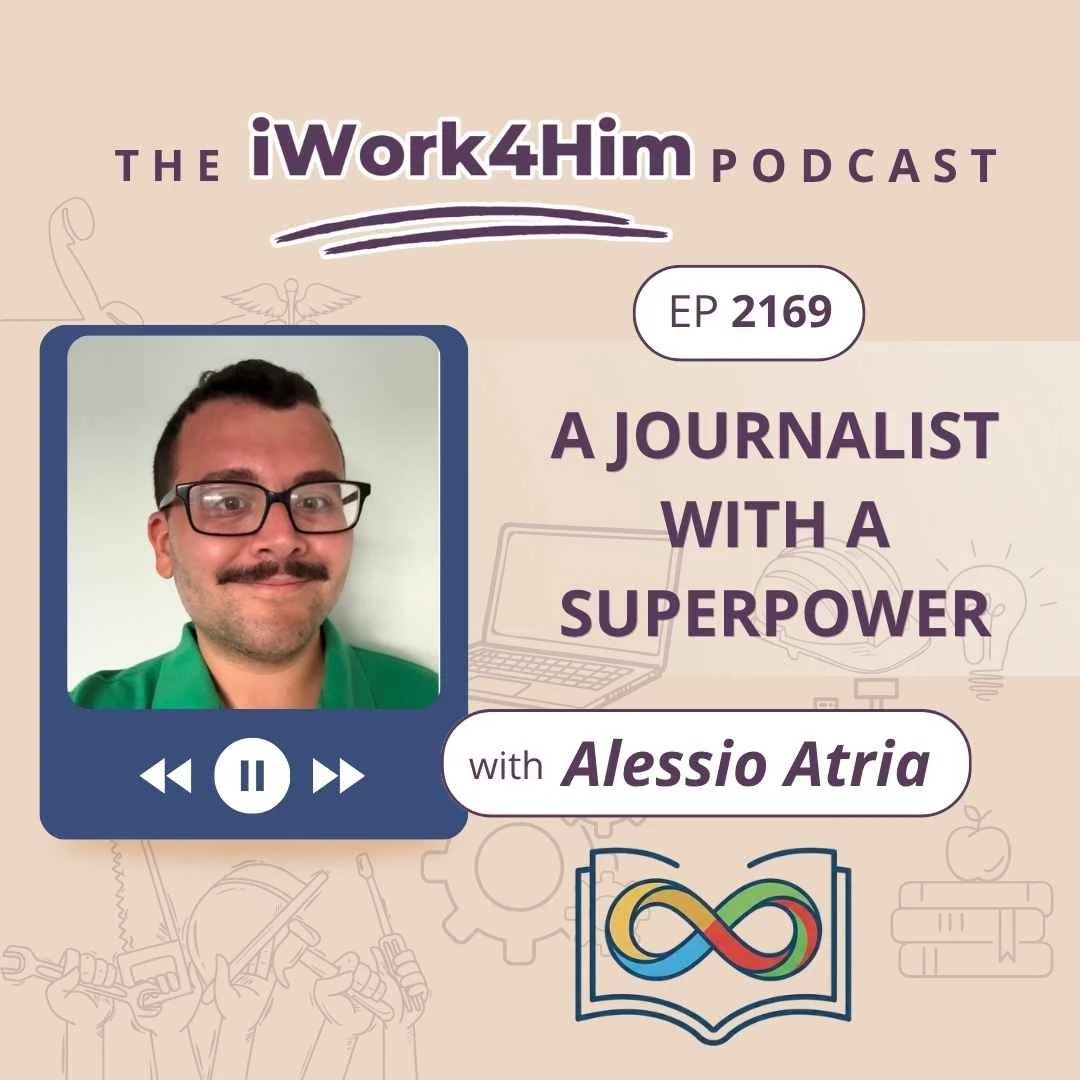
Jim: Clark Kent was a mild-mannered reporter who also had a superpower. Working at the Daily News provided a paycheck and a unique insight into the world he lived in. It also gave Clark an understanding into the devious dealings of the underbelly of evil.
Jim: It also gave Clark the cover he needed when he always showed up at the big news event. So if Clark Kent, journalist and reporter, had a secret identity as Superman with the ability to fly and fight and do all kinds of powerful things, what kind of superpowers do you have?
Jim: Today, we venture off to Florida to talk with another mild-mannered journalist named Alessio Atria. He has a superpower too, and it's not what you think. What does it look like for you to live out your faith as a journalist covering current events in today's world? Let's just say it're not like it was for Clark Kent. Alessio Atria, welcome to iWork4Him.
Alessio Atria: All right, guys. It's good to be here, and it's an honor to speak with such a great podcaster such as yourself.
Jim: Thanks. I hope you still feel that way at the end. Alessio, we ask this question of every first-time guest on our show. Why do you continue to be a follower of Jesus?
Alessio Atria: Because He always keeps me going. He keeps me inspired and convinced that there is good in the world, good in all people, and all good in the past, present, and future. That even though there are imperfections, there is always, to put it simply, a pot of gold at the end of the rainbow.
Jim: With Jesus, that is true. It's just we might get to walk on that gold one day. I think that's probably... he uses gold for pavement in heaven. That's what they say.
Martha: You're looking forward to that, right?
Jim: Yes, we are.
Martha: All right. So God has given you a unique gifting or a talent. What is that?
Alessio Atria: I guess it would have to be perhaps self-awareness in addition to always staying focused on the task at hand. Many people say those with autism don't really have empathy or compassion for others, but that's not true.
Alessio Atria: We do care. We do wanna listen. We do wanna be not like everyone else per se, but we do wanna care for other people like other people care for you, me, or anyone else. Yeah, but I still manage to be self-aware about how I'm behaving around other people, but also aware of other people's emotions. I try to have both empathy and sympathy at the same time.
Alessio Atria: At times it can be stressful, but when I focus and put down whatever I'm doing and just try to listen to other people explain their struggles or whatever, I still make time for them because I know it's the right thing to do and it's what God wants me to do.
Martha: That's good.
Jim: So when did you realize in all of that unique gifting that you have that being a journalist brought you great purpose?
Alessio Atria: It allowed me to keep people informed in a way that didn't leave them in the dark, and it gave them something for, I don't know, in their friend groups or whoever to talk about. It keeps them informed. It keeps them invested, and it's a good way for me to share something with the world. Not just something about myself, but something about the world in general. Show how factual I can be, how analytical I can be, and how more or less opinionated I can be, if the sit- if the article or whatever I'm writing calls for it.
Jim: So but when did you realize this? While you were in high school? Were you in col- where did you-- when did you realize that you loved to write, research, and report?
Alessio Atria: I guess you can say college because when I was in high school or like elementary school, like starting out I wanted to be like a voice actor or a news anchor. But over time when I was writing film reviews in college, I also at one point wrote an op-ed. And after that, I just kinda got used to the idea of writing news articles and doing research and whatnot.
Alessio Atria: And when I finished college, I moved on to this writing internship at the digital news outlet known as You Interview for a good three- for nearly three years. Yeah, and that's what inspired me to just keep writing, news about current events, politics, pop culture, and so on. It just kept me, it kept me active in the real world while also convincing me to make sure others were just as active as I was. And I was just so interested in writing about it, reading about it, and so on, and just, and I hope I keep doing it in the future.
Martha: That's so good. I love something you said earlier where you said factual. So I'm leaning into that because you're a, a follower of Jesus, right? Helping be a news writer and have this desire to be factual, and I don't think there's a lot of journalists out there right now that take that characteristic very seriously. Not enough of them. So what inspired you then to do what you're doing now, which is the news writing?
Alessio Atria: Just the fact that news itself is so interesting. It's, it's not just interesting, it's important. If people don't know what's going on in the news, say like the political world or pop culture world, they're gonna be missing out. They're gonna have little to no frame of reference, say in a conversation or during, God forbid or God knows, an important meeting at like their office or even at school. Like stuff like that is very important.
Alessio Atria: Heck, even when I was a kid I think I remember having to read news articles or do essays based on news articles. And we didn't really have, I didn't really join a journalism club per se when I was in school, but I did when I was in college. And if it weren't for that, I wouldn't be able to still, I wouldn't be able to be encouraged to write news in general or just write anything, write any articles in general.
Jim: And the news is one of those things that, every day, every hour sometimes, every half hour there's new stuff popping up. And so it's not like it gets boring out there.
Jim: There's always something to write about. Alessio, I wanna dig a little deeper with you. You've been diagnosed with autism. You mentioned that already. It's a label. I hate labels. They call it a diagnosis, a word mostly attributed to a disease, but that is all wrong. You were created in the image of God. With autism, and experience all things through a different lens. You've been given the ability to see things differently because of it.
Jim: How has being autistic given you a unique advantage in life?
Alessio Atria: It's kept me, like I said before, more self-aware but also more focused on tasks at hand. I don't usually get- I don't usually have to deal with hangups unless, I don't know, society deems it, and at the end of the day, all I really care about is getting the job done, whatever the task may be.
Alessio Atria: If it be, if it's menial, if it's important, it's still something that keeps me going. And it's not a distrac- I don't see it as a distraction or just as a way to... Or some might see that as a distraction or as a-
Jim: They may use it as an excuse, but you're not using it.
Alessio Atria: Excuse, yeah. An excuse, a distraction, or maybe even a coping mechanism. In many ways it's a good coping mechanism, but at the end of the day, it keeps me just active in the world. I, or other- if it weren't for that, I would just be sitting in bed all day, yeah.
Jim: All right. Every friend that I have that's been diagnosed with autism has a superpower. There's something about them that is very special, a talent or ability that really shines. What is Alessio Atria's superpower?
Alessio Atria: My superpower would be... that's a really good question, I gotta say.
Jim: Good. Yeah, no, that's why I'm a professional question asker.
Alessio Atria: I guess you could say my superpower is just I don't know, being very sensible. Not just, being mature or anything like that. I don't wanna toot my own horn too much, but just being able to sense when something's awry or something doesn't seem right. Being analytical, I guess you can say. Whether it be for in a social situation or in a work situation
Alessio Atria: I never miss a detail. I can be up to... it's up to the point where I'm, like, very picky or very overly analytical. Some find it annoying, but others can find it pretty helpful. It depends on the situation because, again, when you have autism, you don't really mind those details. In many respects I do mind those details, but if the situation calls for it, I have to put that aside and just, do what has to be done.
Martha: I love that you used the word sensible because I can imagine that a lot of times people get pretty emotional or dramatic or something when they're maybe learning about something that's very, can make you be very distraught. But if you can be sensible in the situation, you can actually dig into the truth better than somebody who maybe jumps to a conclusion because they're upset about it or something like that. So I think sensible is a very good quality to have.
Jim: Eliminating the emotion in it all and just looking at the facts. Just the facts, ma'am. Oh, that was Joe Friday. That was not... That wasn't Clark Kent.
Martha: But- Okay. So let's talk about your biblical worldview. So how do you implement your biblical worldview based on your knowledge of the Bible and your relationship with God into the articles on politics and other current events that you write?
Alessio Atria: Whenever I'm writing my articles, I always make sure that I'm honest and detailed because I know that's what God wants me to do. One of the commandments is "thou shall not lie," and I adhere to the-- and for the most part, I adhere to that to a T. And I always make sure that I'm honest, not just when writing my articles, when being around other people.
Alessio Atria: But if I'm gonna... But in regards to writing articles, I also make sure that I'm detailed and I'm not keeping anyone in the dark because God wants me to not only be honest with people, but also not falter by omitting information or leaving anything important out.
Jim: But how do you deal with the pressure, Alessio? The, the news organizations out there are constantly promoting evolution. They're constantly promoting things that are counter biblical, yet you know the truth. How do you address the fact that you know the truth, yet not going... 'cause they're expecting you to produce- X sort of article. How do you let them know, "Hey, just so you know, I have a different perspective than you. I have a biblical perspective." Has that conversation ever come up with one of your editors?
Alessio Atria: Not really, no. I don't usually use God in an argument. I've never had an argument with my editors, editor in chief in any, under any circumstance or any situation. I've always listened to what they say. We've never had any disagreements whatsoever. I'm always cooperating and never trying to pick a fight or stir a pot in any situation. I'm still... I'm not overly obedient per se, but I am cooperative and selfless. I'm very- I can be very sensible - not sensible. Okay, what's the word I'm looking for? I can be very... reasonable.
Martha: Gotcha.
Alessio Atria: Yeah, to sum it up.
Martha: I was just gonna tease because we know your mom. You said, "I'm not always obedient or whatever."
Jim: She called. She called and verified that fact right before the show.
Martha: No we're all good and honest about that. Oh, that's good.
Alessio Atria: Yeah, what kid isn't, yeah?
Martha: Yeah, exactly. Even our moms are listening too, so we have to be good.
Jim: Yeah, there was that one time Martha was disobedient. There was the thousand times I was disobedient.
Jim: All right, Alessio, I'm sure that in all of the articles you've written over the past that you've been able to tie together the relevancy of God to the current events that are unfolding. Have you ever written an article where you're able to tie God and current events together?
Alessio Atria: Not to my knowledge, but, like I said, I still adhere to God's values whenever I'm writing my work because I know that's what he wants. I always get like what I believe are like signs from the universe, like me tripping over something or like the computer inching towards me if I were to, say, bump into the desk.
Alessio Atria: Little signs like that, like just keep me going, keep me writing when I feel like I should just be... not shirking my duties per se, but just wanting to relax because it's not time. It's like those signs are telling me, "It's not time to relax yet. You still gotta finish that work. You still gotta zhuzh it up a bit. Try to make it a little more enticing."
Jim: Can you spell zhuzh? I'm just saying right here. Zhuzh.
Martha: Zhuzh it up.
Alessio Atria: I don't know how to spell. That's a good, that's a good word. I've always heard it used a lot whenever I'm like saying try to just zip it up ... like oomph, if you will. It's like slang, very New York slang from my experience.
Martha: We love that. Yeah.
Jim: Just wondering if you could spell it.
Alessio Atria: I don't know, I don't know how to spell it, yeah. Yeah. Sorry.
Jim: That's all right. No, it's okay.
Martha: So you know, you're talking about needing to keep on working and doing that. How do you maintain journalistic integrity and not be biased in a situation when you're writing an article? How do you maintain that?
Alessio Atria: I maintain that just by knowing when to keep my opinions to myself because there's a time and a place for protesting or disagreeing with people or trying to make a scene. When it comes to work, you have to keep that to yourself so you can still have that job, not make waves, and not harm your reputation as an employee.
Alessio Atria: Just still stay proactive, but also, like I said before, obedience. Just make sure to stay biased, find accurate research that applies to a certain situation or certain topic that I have to write about, whether it be politics, pop culture, and so on.
Jim: Is there a lot of pressure to have biased journalistic intent as opposed to unbiased? 'Cause it- when we were growing up, there were unbiased journalists that would just laid out the facts. And today it always seems like there's a slant to whatever's written, whether it's written in a script in a movie, written in a script in a TV series, or written in an article in a newspaper, digital or printed. How... do you have the freedom to remain unbiased?
Alessio Atria: Yeah, I have the freedom to remain unbiased. Like my home or when I'm in a conversation with family or friends or whatnot. And while I do have some cert- and while I do have some political biases and even pop culture biases, I prefer to keep that to myself because that's not what I'm writing about.
Alessio Atria: I'm writing about just the facts- ... not opinions. Unless I'm writing a film review, I kinda have to keep that kind of stuff to myself. I'm not, I was never forced to but, if the article's meant to be fact-based, it kinda goes without saying that I can't spell out my opinions in a way that's gonna lead to arguments or make waves.
Martha: Just a comment as I'm thinking and listening to you talk is that a lot of people, especially in social media present themselves as journalists when really they are just opinion makers. And that's, I think, the difference. We've really confused truth, truthful integrity, unbiased, articles to help us to make our own decisions versus the social media people that are like, "This is what I believe, so everybody else should believe it, too."
Martha: And I love the root of what you do because you are truly reporting information and helping to educate people and give them that unbiased, truthful, and a way of looking at things. So I think it's just interesting 'cause a lot of people listening are going I hear a lot of people say things that are not necessarily truthful or unbiased." That's because they're not really journalists, where we're talking with somebody who that's really what they do.
Jim: Alessio, you've had a three-year journalism internship with You Interview. What aspects of your future excite you?
Alessio Atria: A few aspects are having a decent salary. What else? Having a, just having my name, based on more... not just recognition, but also, but recognition is important, especially if I do need a future job.
Jim: Sure.
Alessio Atria: Especially nowadays. But also just the ability to learn more writing skills, just getting to learn more writing skills, getting to do more tasks, just getting to do more than just writing, perhaps even moving up the ladder if I were to, say, start off as an intern or as a contract employee or freelance employee.
Jim: Sure.
Alessio Atria: And even getting to gain good benefits, whether it be health benefits, financial benefits, and so on.
Jim: All right. I can understand how you're excited about having a name that's respected and associated with great journalism, and to get paid for it. Dude, what an idea. Get a paycheck. But are there any aspects about the future, about your future, that leave you concerned or a little bit apprehensive?
Alessio Atria: There's the fact that I might not get to enjoy certain freedoms, like playing video games, watching movies, or hanging out or so on. But, I know at the same time, the weekends are always there, but I'm worried I won't get to enjoy them as much or even go to this where I am right now, my condo in Florida that my parents bought.
Alessio Atria: My siblings don't come here that o- I mean- Most of my other family members don't come here that often. They only come here once in a while. I'm just worried I won't get to come here as often as I used to. But at the same time, I know that New York has its perks, and that I always gotta put my, not always put my job first. I also know that family comes first. But also my future is something I need to be mindful towards.
Alessio Atria: And I always have to work towards, even if I have to put aside certain freedoms. But for the most part, I won't have to put them aside. Also I know I still get to enjoy them, but I'm just worried that certain circumstances might not keep that possible on a daily basis, I guess you could say.
Martha: Sure. Sometimes things change and they may look different, but who knows? You may get a, a position where you can write from no matter where you're at, right? That's the beauty of the internet and computers and things like that. So as you look, let's talk about the future, what kind of a job would be perfect considering the unique giftings that God has given you?
Alessio Atria: When looking at that question, when, or hearing that question, I'm thinking maybe some faith writing. Who knows? I did it before for the Religious Freedom and Business Foundation. It wouldn't hurt to do it again some point in the future. It's honestly really good to work for just a company that supports not just my faith, but different faiths as well.
Alessio Atria: And perhaps even work for a company that has a some form of integrity and not much of a bias because that's what God wants us to do. He respects our opinions, but He doesn't want us to, go at war basically, metaphorically speaking, go to war because of those opinions. Yeah.
Jim: It's great you've had an internship all these years of sharing your abilities to get your word out there, to be able to have people experience what does it sound like when Alessio Atria writes a journalistic piece? And now it's time to get out there, and I love the fact that your faith has shaped this journey.
Jim: And even to the fact that you've shaped the journey and you left the nest in New York, and you're suffering for the Lord in Florida? I don't know. There's a lot of people who would like to be in Florida, it's good that it's you. This time of year it's a little hot and muggy, it's one of those things.
Jim: Alessio, anything you wanna say out there as an encouragement to those listening maybe who have children who are autistic and they're not in their 20s and they're wondering, what's it gonna be like for my kids when they're in their 20s? Speak to those parents or even those listening that may have autism in, have been described to be autistic. Talk, talk to them. Encourage them.
Alessio Atria: Yeah. Yeah. What I wanna say is, to those who have been labeled as autistic, diagnosed as autistic, or however else you were described or labeled, don't let that discourage you. You still have a future. You still can do amazing things that other people aren't even capable of. Some might try to put you down or discourage you, but don't listen to them. Listen to your heart. Listen to God. Listen to whoever you worship.
Alessio Atria: You still matter. You still have one hell of a destiny before you, and you will still matter. You will still leave an impact on the world, great, positive, whatever it may be. You'll always be important to someone in your life, not just God, but someone in your life who cares about you, whether that be your family, your friends. You may feel like you're alone, but you're not. There are others like you who wanna motivate you, who want you to still be happy while also having a fulfilling future.
Alessio Atria: And always appreciate them. Whenever you have free... If you ever have free time or don't have anything to do, always pray to God that you are grateful for those people in your life, and that you are grateful for him and his son watching over you. That's all I have to say.
Jim: Good words. That was a lot. That was fantastic. Alessio Atria, thank you so much for being on iWork4Him with us today. Thanks for sharing your story.
Alessio Atria: Thank you so much.
Jim: You've been listening to iWork4Him with your hosts, Jim and Martha Brangenberg. We're Christ followers, and our workplace, it's our mission field. But ultimately, iWork4Him.