
175: Getting Older WIthout Kicking and Screaming: Productivity vs. Fruitfulness
Jim Brangenberg: Breaking news: people are getting old. An outbreak of aging people is spreading across the globe. It's been found out and realized by scientists that people, every day, get a little older, and eventually they get really old, and eventually they die.
Jim Brangenberg: This breaking news is brought to you by... Okay, I'm just kidding, but seriously, this isn't breaking news. But yet we all know we're gonna die, and we all know that we're gonna get old, yet when we get old, it seems to surprise us. When we slow down, it seems to surprise us. When we can no longer do the things we used to be able to do, it seems to surprise us.
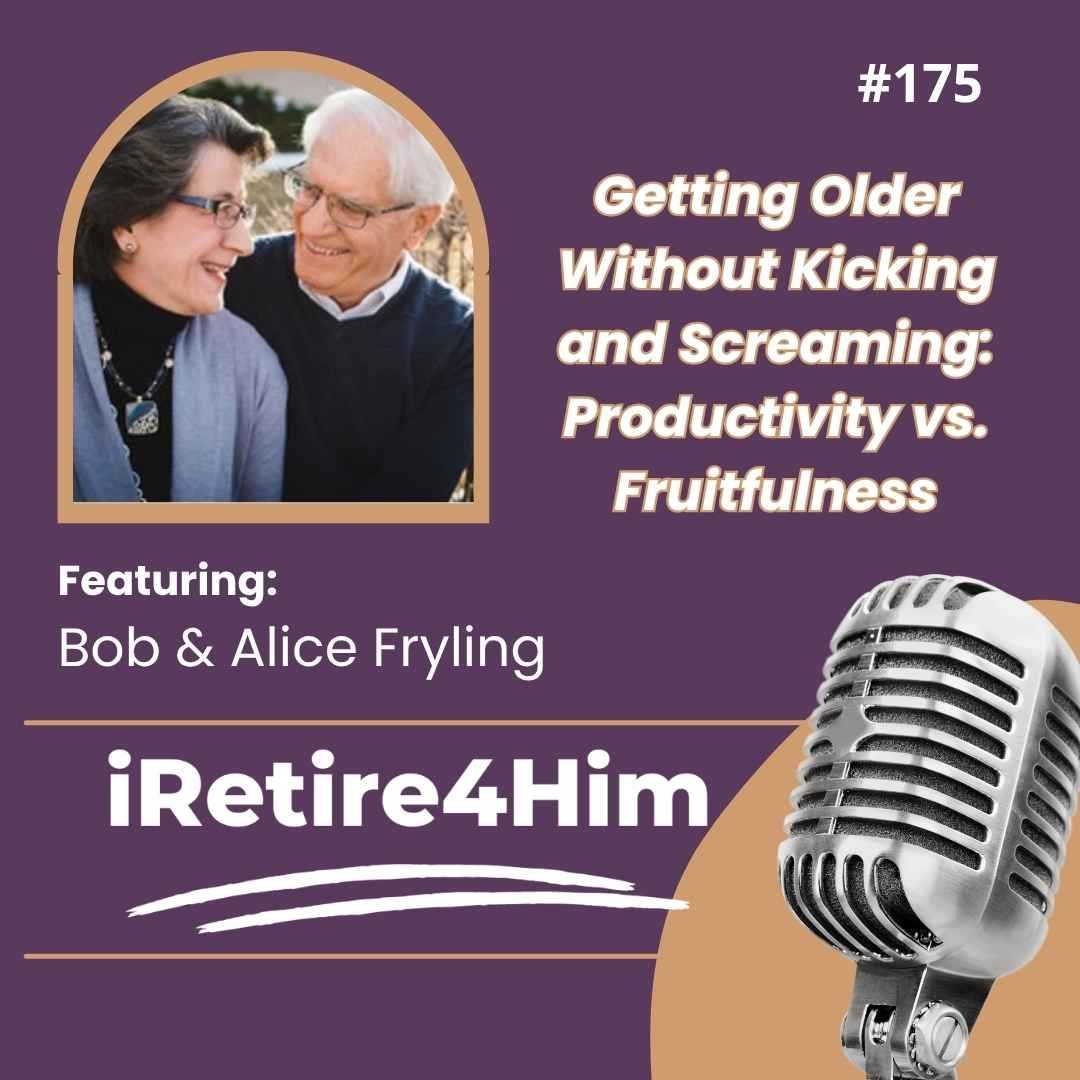
Jim Brangenberg: Why is this conversation about getting old or aging or becoming chronologically superior, why is this such a great surprise? And how do we learn to go about aging faithfully? Alice Fryling wrote a book about just that, Aging Faithfully. Alice and her husband, Bob, married 55 years, are here today to talk about how they're aging faithfully. Bob and Alice Fryling, welcome to our show today.
Alice Fryling: Thank you for having us.
Bob Fryling: Good to be with you.
Jim Brangenberg: So Alice, your name is on the book Aging Faithfully. We know that no book written by any spouse is done without the support of their own spouse because these are all a labor of love. Start off with telling us why is this conversation about aging so uncomfortable and so often ignored?
Alice Fryling: Your question made me think of what I said to my daughter, who is also in publishing. And when I first thought, maybe I will write a book about aging," and my next sentence was, "I can't believe I'm gonna write a book for a dying market." But it is not a dying market, and it is an uncomfortable topic.
Alice Fryling: But this book, it just took off and got a life of its own. I get so much feedback, and I think it- I'm getting really good feedback partly because it's not a topic we talk about. We talk about it in terms of finances and cruise trips and stuff like that, but not in terms of the spiritual dimension.
Alice Fryling: But I think in specific answer to your question about why we ... There's just so much resistance to talking about aging. And certainly the most obvious one is that there's a lot of cultural resistance. You meet people who say, "I would like to die well," but you don't meet people... I don't think I've ever met anybody that says, "I just can't wait until I'm old."
Alice Fryling: We can't wait for other things when we're younger, so there's a lot of resistance. But I think for Christians there's a, a special problem that we face when we think about getting older. I think I'm finding in my own life and with people I talk to that there's a fear that I won't be able to serve God in the way other people think I should serve God, and especially in the way God thinks I should serve God.
Alice Fryling: So there's a fear that I will lose my capacity to serve God, and I think... So it's called denial when we don't wanna talk about that.
Jim Brangenberg: So it's a visit to Egypt, to denial.
Martha Brangenberg: Den- oh, my word. That was bad.
Jim Brangenberg: That's right.
Alice Fryling: I knew that, but I didn't put it in the book. Personally, I think a lot of us... following along the theme of denial, a lot of us don't wanna look at how we might lose our freedom, even how we might lose our appearance, how we might lose our health. And especially I'm noticing how much fear I have, and when I talk with other people, fear of not being able to use my gifts in familiar ways.
Alice Fryling: I'm the kind of person that says if there's something you don't wanna talk about, that's probably what we should be talking about. So I'm good to go, and it's working out well. The book is selling well.
Jim Brangenberg: It's nice to be able to make some money as you write a book, but the impact you're making - and everybody that listens to this show understands that when we have an author on, I read the book. I don't skim the book, I don't summarize the book, and I don't read the, what was it? The notes.
Martha Brangenberg: ChatGPT?
Jim Brangenberg: The ... No, I don't use ChatGPT for the summary.
Martha Brangenberg: But often a publisher will send you "Here's some recommended questions." And we do all we can to avoid those because they've probably already been asked.
Jim Brangenberg: CliffNotes, that's what I was gonna. It's not a CliffNote. I read your book. And honestly, I'm 60. Martha and I turned 60. Oh, am I supposed to tell a woman's age?
Martha Brangenberg: That's okay.
Jim Brangenberg: I turned 60, she's older . (laughter) 25 days. And it touched me. It really moved my heart, and it freaked me out a little bit 'cause it-
Martha Brangenberg: Can you just talk about that for a minute, Jim? Because it's one thing to say it touched you and it freaked you out, but why? What is it about it? So as we're having this conversation, listeners are going, "Okay, this is rele- I wanna hear about this."
Jim Brangenberg: Okay, because I'm a boy, I think I'm invincible. Right now we are very active. We're doing construction, we're traveling across the country speaking, we're doing podcasting, we're heavily involved in electronics. We got nine grandchildren in three different states, and we're busy. And the reality that 10 years from now I might not be able to do rehabilitation construction anymore, or I won't be able to do it to level. I might not be able to lift 100 pound bags of cement anymore.
Jim Brangenberg: It, that reality that, okay, we're 60, things are gonna change. And I don't... i've seen how our parents have handled it pretty gracefully, but at some point in time, sometime in their mid-80s they're like, "Okay, we need a little help." Then by their late 80s they're like, "Okay, we need a lot more help."
Jim Brangenberg: And it was a challenge for us as kids to come alongside, and I'm thinking, "Are my kids gonna be there for me when I need their help 25 years from now?" So I asked the Lord, "Take me home early," that's what I said. But it did, it tou- it made me think about things, Alice, that they're uncomfortable to think about but it's good. And that's why I'm so grateful that you and Bob are willing to come on.
Jim Brangenberg: So let's hear a little bit of your story. I announced at the beginning of the show, married 55 years. Congratulations, the double nickels. For the 55th wedding anniversary, Bob, where did you take Alice? Did you take her on that cruise she just mentioned?
Bob Fryling: No, we did that a number of years earlier.
Jim Brangenberg: Awesome.
Bob Fryling: We went to Alaska. That was fun. Wow. About 15 years ago, actually. But we're not traveling as much as we used to. Travel is not the way we celebrate as much anymore.
Jim Brangenberg: But cruising is so easy. You just go and you bring your- how many bags did you bring last time? Nine bags? And you just, and you have somebody washes and, it's great. Okay. So how did you guys meet?
Alice Fryling: We both met, we both were on staff with InterVarsity Christian Fellowship campus staff in New England. And so we courted, going back and forth to staff meetings.
Jim Brangenberg: Oh, nice.
Alice Fryling: I fell in love first, and Bob is a very careful decision-maker, and it took him forever. But no, we have no regrets. We're so thankful. And we have four children, two girls. No, we have two... I'm thinking - I think now this is a sign of age when you first talk about your grandchildren.
Martha Brangenberg: Yes.
Alice Fryling: Happens all the time. We have two daughters and four grandchildren. One of our grandsons is on the as autistic spectrum. And one of our granddaughters has Down syndrome. So we redefine the idea of a special grandchild. And that's influenced our life a lot. You kinda come out of denial when your kids struggle with things, and you say, "I'm not really living happily ever after."
Martha Brangenberg: Yeah, and it looks different than what you might have expected.
Alice Fryling: Oh, yeah.
Martha Brangenberg: So talk to us a little bit about your career journey so we can know what got you through today, raising your family, whatever. What, how did you guys spend your time?
Alice Fryling: I'll tell you mine, and then Bob can tell you his.
Martha Brangenberg: Awesome.
Alice Fryling: I've never had a job description that somebody else wrote, but I've had a big job description that I write for myself, and that in itself is a piece of aging because I don't wanna disappoint my boss, which is me.
Jim Brangenberg: No, technically sorry, you're not your boss. God's your boss.
Martha Brangenberg: Oh, God's the boss of her. God's your boss.
Alice Fryling: Sorry. Yeah. Yes. We can talk about all of that. Okay. So I was on staff with InterVarsity Christian Fellowship until Bob and I got married, and then I was a stay-at-home mom. But I got involved in church ministry, teaching workshops. Then I discovered spiritual direction, and that is just my sweet spot.
Alice Fryling: Spiritual direction is not what a lot of people think it is, where one person tells another how God is directing them. It's really being a companion and listening to the other person and helping the other person listen to God. And listening heals. And I just - so I've been doing this now for a little over 30 years, and it's my sweet spot.
Alice Fryling: I'm now, I'm beginning to pull back a little bit. I'm not taking new people. But I was saying to somebody the other day, I said, "I'll be a spiritual director till the day I die. It's just in my DNA. I love listening to people." And then I got involved in teaching workshops on the Enneagram and on Myers-Brigg, Briggs, and so I had a more than a full-time job actually.
Martha Brangenberg: Yeah.
Alice Fryling: And talking about what do I do as I age with the full-time job I've given myself, that's a, a little conundrum.
Alice Fryling: But Bob can tell you what he did.
Martha Brangenberg: Yeah, Bob.
Bob Fryling: My background is actually in engineering. I went to Drexel University and then worked with Ford Motor Company for a bit on a cooperative work study program.
Bob Fryling: But this was in the late '60s, and I really felt God was calling me to be with people rather than cars. So I joined InterVarsity Christian Fellowship campus staff in New England, and thought that would just be a two-year career, and then I'd- ... go back into engineering. But I love the university world, I love working with students, and I was with InterVarsity a total of 47 years.
Jim Brangenberg: Wow. Oh, my. Wow.
Bob Fryling: A good part of that was in New England and at a time of the Jesus movement, and I reluctantly discovered that I had gifts of leadership and administration, so I was appointed as an area director, and then a regional director, and then a national director of collegiate ministries for InterVarsity for about 14 years. And then I was asked to move to InterVarsity Press and be the publisher of InterVarsity Press, which I did for 19 years.
Bob Fryling: It was a, a great time with InterVarsity with a variety of jobs and responsibilities, and I've just loved all that part of my life.
Martha Brangenberg: That's awesome. Wow.
Jim Brangenberg: IVP makes some - releases some great books. We work, have worked with them over the years in getting us great authors, so you must've done a great job laying the groundwork, for sure. So when you guys... Okay, when you got married, 55 years ago, did you ever talk about what was it like, gonna be like when you got chronologically superior to everybody else around you? Did you guys ever talk about this conversation?
Alice Fryling: Actually, no. Never occurred to us. Let me tell you a little bit about... this sort of w- walks around that question, about how I ended up writing this book. Because I was just a year or two younger than you are now, in my late 50s, and by that time I was thinking, "Oh my goodness, what is that up ahead?"
Alice Fryling: What i- and I think I better get re- I'm a planner, so I said, "I think I better get ready for it." So I went to the library and I got out books that ... I had found books on, excellent memoirs, loved them, on financial planning, and really on how to get cruise tickets. That literally was it.
Alice Fryling: And all of those things are important. They're fine. They're really good things, but I wanted something that would address what happens to my soul and to my relationship to God when I get older. And that was in my early 50s. I really spent most of the 60s, reading about that, thinking about that, being disappointed, excuse me, being disappointed 'cause it wasn't speaking to my soul where I was.
Alice Fryling: That was the part of me that really wanted help. And so I was sitting here in my study after we moved to Colorado, and I just thought, "God, I don't know what to do. I'm getting older, and I can't find any good books." And I had this sense in this quiet moment, "Alice, just write the book." And I said, "Oh no."
Alice Fryling: First of all, I'm too old to write the book. Second line, the market would be dying. Nobody would wanna read it. But I reached back and I pulled out a piece of scratch paper, and I said, "Okay, I'm not gonna write it, but if I were gonna write it, these are the questions I would ask," and those are the questions that became the outline for the book.
Martha Brangenberg: So tell our listeners what some of those questions are so that they can kinda ... we, of course we don't wanna give away all the answers to the book because we want them to read it.
Jim Brangenberg: We encourage you to get a copy of Aging Faithfully by Alice Fryling.
Martha Brangenberg: Of course but what was, what were some of those questions that were turning in you?
Alice Fryling: It's partly what I alluded to before. I'm the kind of person who's always saying, "Who am I? And who am I now that I know who I am?" So I've spent a lifetime sort of growing in self-awareness, and that's what I loved about the Enneagram and Myers-Briggs. But I didn't ... at the time I didn't know who I'd be at 75, and then I turned 75 and I thought, "Whoa, I'm not who I thought I'd be."
Alice Fryling: So I wanted somebody to just put some milestones down that road of liminal space. And I really wanted to know about my relationship with God, and that's, since I wrote the book, that's really where I've gone. It's really, the pursuit and went into the depths of what does it mean?
Alice Fryling: One of the questions that you have on your list, and then we'll probably get to later is about productivity and fruitfulness. And that, if there's one thing that people jump to in that book, it's that. It's the same one you jumped to. It's like, "Wow, what's the difference between productivity and fruitfulness?" Or then you said addiction. And that was my question.
Alice Fryling: If I can't do what I used to do, then what am I good for? Well, I'm good for fruitfulness. Yeah. So we can talk about that more later if you want to.
Jim Brangenberg: I do wanna talk about it more later, but I wanna talk, I wanna ask Bob a question. Because Bob being the engineer, he thinks before he speaks, which is, what a gift -
Martha Brangenberg: If only it could be learned.
Jim Brangenberg: Right? My mom would've - my mom had wished that for me all my life. She was a mathematician. She had a math major. She would've easily loved for me... but the calculus, it went past my generation. My kids got it.
Jim Brangenberg: Bob, when did you realize you were aging? When did you realize you were, you were getting older?
Bob Fryling: Just to respond, I have a good friend who said he's never had an unspoken thought.
Martha Brangenberg: Yeah. Yeah. You can relate, can't you, Jim?
Jim Brangenberg: I have no idea what you're talking about. Back to you, Bob.
Bob Fryling: It was actually when I was 50. There are a couple things that happened at that time. It was when I changed careers from living in Madison, Wisconsin, and being in charge of campus ministries of InterVarsity, to moving to the Chicago area and being publisher for InterVarsity Press.
Bob Fryling: So there was a major vocational change. And I started asking the question, "Is this my last major change?" Because a publisher in the publishing industry is like the CEO, and it has the connotation of being a terminal appointment. It sounds terrible. But it means there's no place else to go. So I was wondering, "Is this gonna be my last job, or do I go to somepla- something else?"
Bob Fryling: We were moving our home where we raised our children to Chicago and having a new home. Is this gonna be our last place before a nursing home or a retirement community? And then I was playing racquetball with a friend after we moved to Chicago, and I loved racquetball when I was in Wisconsin. And I was going to hit the ball. If you're familiar with racquetball, you know a racquetball court has a front wall. And I couldn't stop. I slammed into the front wall, and I realized my knees were no longer what they used to be.
Bob Fryling: And I thought, "This is a, a metaphor for what's happening. I can't do what I used to do." So I think for me it was mostly external things that were raising the question for me in terms of vocation, in terms of living, in terms of physical energy and ability.
Bob Fryling: But that helped raise the question of, " What does this next stage of life look like?" 'Cause it is a downward trend. Depending on how long you live, but definitely 50 on, unless you're living over 100, is on the downward side. How do I embrace that in a way -which is so different. So much of life you're looking forward.
Bob Fryling: You go to school, you get married, you have children, you have grandchildren, you have a job. Even if you're single, you have various things that you're looking forward to. And now all of a sudden I was looking downward. What, what is this gonna be, and will that be fulfilling, and will that be something that I can enjoy as much as the first 50 years?
Bob Fryling: That definitely was a point. And then it gradually changed as we went on. But that, those external things really affected me.
Alice Fryling: I can tell you what I did wrong while Bob was going through all of this. That, I didn't want him to be sad. And Bob, of the two of us, Bob is the one who cries more easily when he's sad like that. And so we'd be sitting there watching West Wing, and people on West Wing, on the show, not in real life, were retiring, and Bob's sitting there crying.
Alice Fryling: And so me being the good wife that I am, tried to help him by fixing it and telling him that it wouldn't really be that bad and, blah, blah, blah. So this experience of getting older, we're so intertwined about it, and I think part of my motivation for writing the book was that I wanted to understand Bob more and I wanted Bob to understand me more. Because our spiritual journeys have always been like, such an important part of our marriage.
Alice Fryling: That was one of the, I think one of the titles of one of the chapters is A New Kind of Retirement. So that came out of this kind of discussion.
Jim Brangenberg: And what a blessing, Bob. Not only did God rescue you from being a cheesehead in Wisconsin for all those years, and He moved you to Chicago, and you're like, "What were you thinking?" God says, "Here, let me give you a little fresh air," and He moved you to Monument, Colorado. So at least you got that going for you because you got out of Illinois 'cause just ... I don't know.
Martha Brangenberg: So I had a couple thoughts that I was gonna- I'm gonna rescue this conversation. So I was thinking about the fact, when Jim, you were asking "Oh, so Bob, how did, was your aging journey?"
Martha Brangenberg: I was thinking about the fact that, okay, you sit down for dinner, and Alice is "We're aging. ... I'm reading these books." There, that's the reality, too, is when we're on the journey together as a married couple, it's so important that we talk about and experience what we're thinking and contemplating and adjusting to all the time. So I just was, I was picturing this, and it's okay, you can't really avoid it, if you're both talking about it and looking at different parts of life.
Martha Brangenberg: Just last week I was with Jim's mom on a doctor appointment, and she's 92, and the doctor graciously, I wish I could articulate it like he said, but basically he was saying that the problems she was experiencing was because she's been allowed to live so long that these things- most people aren't having to deal with because they don't make it to 92, and she should, in a sense, be blessed that she's dealing with this because she's 90, she's made it to 92.
Martha Brangenberg: And that's really, I think this next generation, we're gonna have a lot of people that have a long life, and it's really gonna be important to be having these conversations. So I just love that we are. But a lot of people do it kicking and screaming. Why is that? Why do you think?
Alice Fryling: I do have to say the kicking and screaming goes on every, every day as different things change. We're older every day. But there is a, there's a mindset I think that comes across as with what you probably mean by kicking and screaming. And certainly that's because we live in a culture that honors youth. All the advertising, television, everything. Don't get me going on that. Okay. So our... We live in a culture that does not like getting older.
Martha Brangenberg: Yeah.
Alice Fryling: And I think we know deep in our hearts, even though we say, "Oh, I can't wait until I retire and I can just do whatever I want," we know that as we get older there are gonna be so many losses. So that, I think that's a big impetus for kicking and screaming, that we're trying to avoid the losses.
Martha Brangenberg: Sure.
Jim Brangenberg: Let's talk about those losses, because in your book you joke about being a productivity addict, okay? And how you're just, you're basically in today's terms, an Energizer bunny, but really it's Duracell batteries are better than Energizers, so really a Duracell bunny. They just missed the opportunity there.
Jim Brangenberg: When did you realize that as a productivity addict you're - that's gonna change, that your ability to produce as much in one day is gonna be less than it was the day before. How did you deal with that addiction you have to, you judged your life based on your productivity, and that was no longer possible?
Alice Fryling: Okay, I wanna separate your question into two parts because addiction is a good word, but let's start with the productivity. 'Cause in the book, I said productivity or fruitfulness, to move from productivity to fruitfulness, which is difficult to do because we have all of our addictions. But the fruitfulness is the fruit of the spirit.
Alice Fryling: It's to move from accomplishing a task, from getting something done - that's a good thing. My kids needed it. Bob's company needed it. It's a good thing. But now we're at a point where we need to move to love, joy, peace, gentleness. And part of the problem is that those things don't show. You don't get your spreadsheet, where you were this patient today or whatever, so to move from productivity to fruitfulness is a big thing.
Alice Fryling: And I recently, a couple of years ago, I was looking at Jesus out with the disciples, and he passed the fig tree. And I remember in college, I did not think Jesus was very polite to the fig tree because he was hungry, and he went up to the fig tree, and there were no figs.
Alice Fryling: And then he was rude enough to say, "You're never gonna bear fruit again," or whatever. I don't remember exactly what his answer was. But I thought, "That's really rude." And then when I read it with the fruitfulness or productivity mindset, I thought, we can become like fig trees, and we have all these leaves blowing around. Look at me, I'm a healthy fig tree. I've got a lot of leaves, but there's no fruit.
Alice Fryling: And I think Jesus is protecting us from too many leaves. And actually, so then when I started researching fig trees, they can live to be 100, so good image.
Martha Brangenberg: Wow.
Alice Fryling: But if you don't cut the branches of fig trees, then they never produce fruit because the light can't get in. So I thought, "There's another image." So for me, it's a big difference between productivity and fruitfulness. But the reason I didn't want to stop being productive was addiction. And addiction, relational addiction or, like our spiritual addiction, is when we keep doing things that either don't work or are no longer good for us, but we keep on doing them and doing them.
Alice Fryling: And I actually, as I thought about your question, 'cause it was a good question, but I thought, "I don't think I was addicted to productivity. I was and am addicted to helping people so they will like me." I kinda think productivity would be a little more acceptable, but that's what I do.
Jim Brangenberg: But truth is good for the soul. Bob, did you struggle? What did you struggle with? As you started realizing you were aging, and as you've now hit your late 70s, how are you dealing with the changes? Because life is different, yet you're still doing just fine. Talk to us about the process you've been going through. 'Cause you're watching Alice, she's writing about it, but this is your story
Bob Fryling: Sure. Again, I'll start with a little bit more external, because I was really looking forward to retirement. I had been in national executive leadership for about 36 years, and I didn't wanna do budgets anymore, I didn't wanna do performance appraisals, I didn't wanna do strategic plans. It was just really good to think of letting go of responsibilities. That was a very positive thing.
Bob Fryling: What hit me, though, was the loss of identity. That I would no longer be seen as a national leader. My speaking invitations dropped off the edge of the table 'cause I didn't have a title behind my name. I felt a real loss of relationships with the people I worked with. We had 100 people at IVP, and I just loved going around the office and hearing their stories and trying to encourage them. I loved working with the team and accomplishing a mission. All those things were very satisfying. Or you wanna go for lunch with somebody.
Bob Fryling: Once you're retired, like we did and moved here, there's no one to go to lunch with... other... thank you.
Martha Brangenberg: Yeah. Other than my spouse. (laughter)
Bob Fryling: I was gonna say, I married you for better or for worse, but not for lunch.
Martha Brangenberg: Not for lunch.
Jim Brangenberg: But not for lunch. Wait, wow. I've never heard that one, for better, for worse, but not for lunch. Wow. Yeah. Counseling.
Bob Fryling: Still learning that just, that has a truth to it. We do not eat lunch together.
Bob Fryling: So it was losing that identity. And even with authors I was just very privileged to know just so many distinguished people I'd learned from and grew from. But I no longer had that job description. For me, it was accepting the loss, and there was a real sadness in doing that. But ultimately, it was losing the identity. And who was I now that I wasn't publisher of IVP?
Bob Fryling: And that was a, a spiritual journey. It took a while. It took a couple years, actually, for fully accepting that, oh, God will give me different relationships, and that's been wonderfully satisfying being here in Colorado Springs. I don't travel anymore, but I can have a lot of coffee. And I do have coffee with people almost every day of the week in different contexts. And so God has given me back the relational fun or joy of ministry, even though it's not in the same context as it was previously.
Martha Brangenberg: So because of your vast experience as a leader and all of the things that you did over all those years, are you able to then, when you're having coffee, where's the fruitfulness coming from for you?
Martha Brangenberg: Are you feeding into the next generation? Are you challenging others spiritually? I'm putting you on the spot because I don't know that answer, but in terms of what Alice is saying about fruitfulness, where do you see that landing for you?
Bob Fryling: It, one of the things I decided in being out here that my goal was to be available. To live in the present. So much of my life I was living in the future, planning, organizing, and I just felt, seeing who God brings in my path. And we're part of an HOA, and it turned out that- i'm on the board as the president of the HOA.
Jim Brangenberg: Sorry. HOAs are purgatory on Earth.
Bob Fryling: We understand.
Jim Brangenberg: Yes ... you can bring the kingdom into an HOA, but they start off as purgatory.
Bob Fryling: It may become a pastoral ministry. It's not just arranging for the lawns to be mowed. I got involved with a secular group just about five minutes away called the Socrates Cafe, about 30, 35 people that meet for two hours every week to discuss the issues of the day.
Bob Fryling: And I find that people ask me afterwards, "Could we get together for coffee?" I had chance of spending time with a man dying of lung cancer, and he just wanted to talk about the future. Is there a life after death? And so those different relationships offered up opportunities.
Bob Fryling: I've always enjoyed the academic world. I've gotten to know the director of the philosophy department of University of Colorado in Colorado Springs, and he's invited me to several things. So it's more listening to God and listening to people that has opened up opportunities to share what God has prepared me for.
Bob Fryling: I am amazed at how much my library is still valuable because the questions keep coming up in a whole different area of context. So that's been very satisfying and very surprising, 'cause it's nothing I planned on. I thought of hanging a shingle out and doing consulting, and I've done some of that, but I'd much rather just see who God brings in my path. And I take some initiative. I just don't sit at home. People are asking for pastoral issues too.
Jim Brangenberg: That really then feeds into what you wrote about in your book called Holy Invitations, because really what you're saying is you guys are available, and God uses you to get sucked into people's lives to be... these invitations as an opportunity for ministry as opposed to productivity. Here's something that God's inviting you into. Talk to us about your perspective on holy invitations, Alice.
Alice Fryling: First, the idea came to mind because I figured God would not let us get older without having a purpose for it. So I thought in terms of the purpose was then an invitation, and I was thinking of an invitation to us to grow and serve and love other people. And I don't I'm gonna add on, this is the story of our last 55 years. What Bob didn't say was...
Jim Brangenberg: don't worry, Bob, I can edit.
Alice Fryling: I just, it's jaw-dropping to me how much, how many spiritual, how much spiritual fruit Bob's life is bearing. And the thing is, we don't usually know when we're bearing fruit, so I do see this more than Bob does. And these people in Socrates Cafe, they come from a variety of spiritual backgrounds, but they wanna talk to Bob about God. It's not Bob inviting them to do that. It's them asking Bob to do it.
Martha Brangenberg: Yeah.
Alice Fryling: And talking about death, his one friend's wife died, another friend died. So these are all - from my vantage point, I didn't see this in Bob before. It wasn't that I didn't see he was a good Christian. I don't mean anything like that, or that he wasn't doing a good job in ministry. But I didn't see these fruits. And I do now. And It is jaw-dropping. And I do have to say, I was right about retirement. There is a different kind of retirement, and Bob is living it, and it is fruitful.
Martha Brangenberg: Oh,
Alice Fryling: And we didn't plan it. We didn't organize it. We just came out to be with our grandchildren.
Martha Brangenberg: Yeah. But what we want our listeners to hear is that God... I love what you said, "God must not be done with me, and there is a purpose for me, so let me find it." And the purpose goes beyond golfing and even playing racquetball. There's nothing wrong with those, but there can be purpose in them, in the conversations that you have, in the way the, that the fruit falls off the tree and and hits other people.
Martha Brangenberg: And so that's the encouragement we want our listeners to hear, is that we don't know what it's gonna look like for each and every one of us, but being open and available and continuing to have a goal of the fruit of the Spirit is so important. We've talked about this before on the show. When my dad turned 90, Jim, we did a interview with him, and Jim said something about now that you're at this point are you done learning everything you need to learn?" And basically he said, "No. Just last week, God hit me over the head with something else."
Martha Brangenberg: And we're like, "Really? At 90, we still have to be lear- learning and..." But, and, but it's growing, and so that's the part that I think is so encouraging for our listeners, that there's great opportunity ahead, and to look, anticipate it. And one way to do that better is by reading your book and being better prepared for what God is saying to each and every one of us.
Alice Fryling: One thing I would add to that... We have three people who wanna talk. Just let me add, I didn't realize this when I started the book. What you're just say- what you and I are saying is different when you're in your 60s from when you're in the 70s and when you're in the 80s. So in the 60s, I think we begin to organize our old age.
Alice Fryling: And we begin to anticipate, "How am I gonna deal with this?" In the 70s, we have to live with changes that are reality. This is actually happening, and how am I doing? And actually not how am I doing with this. It would be more like, "And God, what are we gonna do about this?"
Martha Brangenberg: There you go. Yep.
Alice Fryling: There's a hu- I'm seeing a huge difference now in my 80s, that the invitations from God seem to be so much more in terms of... transforming my own being. That I can do less, but God is still transforming me. And I think that may be circling back to having more fruit to offer. But liminal space, I'm not there yet.
Jim Brangenberg: Go ahead, Bob.
Bob Fryling: I was just gonna add a metaphor that's been very helpful to me comes from the Book of Ezekiel in chapter 47. There's a picture that the prophet sees this temple, and there's a river flowing from the temple, and it's going into the area where the Dead Sea was, and it says, "Wherever the river flowed, there was life, and there was healing, and there was flourishing, and there was fruitfulness. The trees bore fruit."
Bob Fryling: And that just became a real motivating comforting image for me that I didn't have to be in charge of the river. I didn't have to fundraise for the river. I didn't have to plan the river. I just wanted to be part of the river and see where fruitfulness and healing and flourishing might come about. So that's been a helpful thing to... go with the river.
Martha Brangenberg: Go with the flow.... in the Holy Spirit
Jim Brangenberg: That's right. You guys have been married 55 years, and we've been married 40 years, and end of life is gonna come someday. One day one of us is gonna die first. When you guys are sitting alone and you don't have one of those holy invitations, you're not having a cup of coffee with somebody, and it's not lunchtime 'cause you don't eat lunch together - what do those conversations sound like when you deal with the reality of, "Hey, one day our time here on earth together is gonna end before one day we're in heaven together, and we get to be hanging out in heaven together doing whatever God has us, as our assignment there."
Jim Brangenberg: What do those conversations sound like?
Alice Fryling: I think we walk around them rather than jumping in. We may jump in, especially if one of us gets ill, and may become a little ... they may take a different form. But we walk around them. We express our sadness. I don't wanna die and leave Bob, and Bob doesn't wanna die and leave me, but if we both die at the same time, then we're leaving our daughter.
Alice Fryling: So there's no good out. There's no exit door here that looks like I wanna go through it. Actually one of the things that I was surprised helped me the most, if you haven't started getting them yet, you will begin to get a lot of invitations for a free dinner or lunch from people who plan your memorial service, buy your coffin, and you get a free dinner.
Alice Fryling: And I think we did one in Chicago, but then one came here and, we thought, "let's go." And I wasn't ... I was really dragging my feet 'cause I thought I'm gonna go and I'm gonna cry." I was astounded at how comforting it was because, that's just one piece of our death is, the, the logistics of leaving. But to hear somebody talk about how to take care of that I just thought, "Oh, this is a bridge we... It'll be there when we come to it." "And we can cross it." So that was just a very practical, helpful thing to me.
Bob Fryling: And especially how it can be of help to our children and grandchildren. And that was probably the most freeing thing. And indeed, when we talked with our daughters about this, it really was comforting to them, 'cause they're fearful. How do they handle things if we're gone?
Bob Fryling: So it makes for a better family dynamic too, where you're not in denial or avoidance, but it's a measure of truthfulness. It's a measure of honesty. And it actually bonded us and bonded our family more together. That's awesome.
Alice Fryling: And we've gone over our finances with them, at regular intervals as they change so that we don't want them to have surprises or burden, burdensome surprises, 'cause there are always surprises, so we try to prepare them.
Alice Fryling: There was one day I went around our house. Both my daughters are very... They love... They're very nostalgic. I'm very nostalgic. I got a picture of me 80 years ago up there on the wall, so I went around with my camera, and I took pictures of all this stuff, and then I wrote out what they were. 'Cause I don't want them to look and say, "Oh, why'd Mom save that? Oh, I wish she'd marked where this came from."
Alice Fryling: Those are just practical things, but they help. We can't prepare to be part, apart from each other, because I don't wanna grieve Bob ahead of time. But I can do some of these things. I don't know, it's probably the illusion of control. But it is helping.
Martha Brangenberg: Sure.
Jim Brangenberg: Bob and Alice Freiling, thank you so much for being on the show today. As we will release this to our iRetire4Him audience, but also to our iWork4Him audience, because everybody that's working still needs to hear this story, 'cause you guys are dealing with the reality of, hey, aging's coming, but life's not over.
Jim Brangenberg: There's still a lot of meaning and purpose to come, which is why I recommend to everybody to get a copy of this book, Aging Faithfully. It's gonna cause you to think, but it's also gonna cause you to be prepared. Alice and Bob, thanks so much for being with us today. We're so grateful for your contribution and our new friendship.
Alice Fryling: Agreed. Thank you.
Bob Fryling: Thanks so much. Glad to be with you. Bless you.
Jim Brangenberg: And for those of you listening, make sure you check us out online at iRetire4Him.com and iWork4Him.com for all of our latest episodes and for all of the great resources we've got out there on our website, iWork4Him.com. Until the next time.