

iWork4Him Podcast Transcripts
Welcome to iWork4Him! Join hosts Jim and Martha Brangenberg as they interview everyday Christ-followers in the workplace. From CEOs and Business Owners to Nurses and A/C technicians, all of us can make a Kingdom impact!
Tune in to hear how Christians, just like you, are integrating their faith and work. Full of practical tips, inspiring testimonies, and biblical truth, the iWork4Him Podcast will encourage and equip you to make your workplace your mission field – a place where ministry can happen all day long! Whether it's a coworker, a vendor, or a customer, you may be the only Jesus they ever get to meet. You have a Kingdom calling, and it starts right where you are!
This page shows the transcripts of each audio recording. To listen to the show, click the button below.
11/13/24 - 2068: Kingdom Legacies that Last

Jim Brangenberg: You've tuned into iWork4Him, the voice of collaboration for the faith and work movement.
Martha Brangenberg: We are your hosts, Jim and Martha Brangenberg, and our mission is to transform the workplace of every Christian into a mission field. What could that look like in your workplace? Let's find out right now.
Jim Brangenberg: Yeah, Martha and I were in Jacksonville, Florida, a few years back, and a business guy who had owned his business for 30 years was telling us his story. He had infiltrated his entire organization with a biblical worldview. His culture was solidly about loving the employee and taking great care of them.
Overall, he was wildly profitable and his customers and employees were very happy. As this business owner believed the American dream of retirement was biblical, he decided to sell his business. He got multiple bids and sold it to the highest bidder. No consideration was given in choosing a takeover company that would preserve his culture. It was all about the money. Guess what?
In six months, the company was unrecognizable. Employees had quit and the once great culture had eroded into a typical culture focused on profit, not purpose and culture. This is the story being repeated over and over again all over the country. We even witnessed a church do it with their assisted living community. This has got to stop.
Followers of jesus who own companies cannot just sell the companies of the highest bidder. If you're the owner of a company, you're a steward and responsible to God for its mission and profits and the employees, too. How do we stop this massive disaster? We need a humble Jesus centered superhero.
Andy Galpin is just the guy. He wants to buy your company and preserve your kingdom culture. And you need to talk to Andy Galpin. Welcome to iWork4Him.
Andy Galpin: Thank you, Jim. Thank you, Martha.
Jim Brangenberg: All right. So before we hear your story and how you became passionate about preserving kingdom culture, tell us how you met Jesus.
Andy Galpin: Yeah, of course. I like to say it was in a cattle shed, but there were no longer any manger beds in there. In a little town called Shepton Mallet in the UK. I was at a Christian conference called New Wine, which came out of the Anglican Charismatic Renewal. It's a conference we'd attended as a family for many years, and I'd always been part of it and always been brought to church growing up with my family. But it was something that I was inheriting to some extent from my parents rather than something that had become personal to me.
And in that moment in, in one of the sessions, we were invited forward to prayer as we were every other day during that week, but this time I had this sudden urge to move forward, sudden urge to respond that I couldn't quite explain. And the only way I can reconcile it is when you see an injustice in the world and you have that feeling that you need to respond and do something about it. That's exactly what was driving me forward in that moment.
And when they prayed over those of us who responded, I had this overwhelming sense of both how much wrong I'd got in my short 12 years of life up to that moment, but also how much God loved me in spite of that and how much more he loved me regardless of that. And that's the moment that my faith really became my faith and I became a Christian and started following the Lord for myself and leveraging the beautiful foundation that my parents had nourished over those 12 years leading up to that time.
Martha Brangenberg: Wow. I love you sharing that story because really what we're going to talk about today really sounds very similar in the fact that you have seen a need and want to try to rescue that need. So let's talk about that. How did you become passionate about preserving kingdom culture when an owner decides to sell or to move on?
Andy Galpin: Yeah I started my career at IBM, big, massive American company. And I was part of the leadership team for the kind of Christian groups within that, but we were not allowed to talk about our faith openly in that environment. We were actually a secret group within the organization. I had an atheist friend who used to call it the secret church, which I feel puts down our friends in China in terms of what they're suffering with. But it did resonate with us in terms of the journey that we were going on, that we were trying to live out our faith in a culture that doesn't necessarily recognize and celebrate that despite encouraging us to bring our whole selves to work every day.
And I saw the challenge of trying to shape and mold the culture from the bottom. And for me, I really learned in that environment that the leader sets the tone and that it comes from the top and it's very difficult to influence that from the bottom. Doesn't mean we shouldn't try. And our role as Christians in those ecosystems is to interact with that and try and shape the culture to better reflect that broader redemption story that we're participating in.
And but I felt that the way to have a bigger impact was to be at the top and try and iterate that from the top down. And the many conversations I've had with people who've owned their businesses and sold them were very similar to the one that you mentioned, Jim and Martha, at the beginning. And that people have regret after they sell because they only focus on that final number that comes out on the other side.
While they're running the company, they think about values. They think about their employees. They think about nurturing and growing people and creating an ecosystem that really allows us to reflect God's culture here on Earth. But we forget that a little bit when the transaction happens. We're too focused on being an owner and not on being a steward, and our responsibilities as stewards outlast the time that we have as owners of a business, which will naturally change over time as we reach the end of our time working and our season working in those organizations.
Jim Brangenberg: But you're young. You worked at IBM, which there's no way you knew what was really going on at the top because you were 85 layers from the top when you started IBM. I interviewed with IBM out of college. All right. So how did you become so aware of a problem that's so old that's been going on for so long? Because It's safe to say that 99. 9 percent of christian business owners have never been taught to create a kingdom culture let alone preserve it when they're selling. How did you become so aware?
Andy Galpin: Part of it comes from my experience in churches. I was part of a church in Portsmouth called city life church that was very intentional about building a culture that reflected the kingdom of God and enabled people to carry that out into their day to day jobs and their day to day workplaces. So from a very young age, I was following some of John Maxwell's leadership teachings and trying to apply that in a leadership context within the local church, and then working and going to work and going to university outside of that context and wrestling with how do I take what I'm doing in a church setting and bring it into the workplace because I believe we are called to be ambassadors into the world.
And most of us are not called to be ambassadors solely inside the church. Some people are called to that kind of full time traditional ministry. But oftentimes that removes very key people. who are very good at evangelizing and talking about their faith from the very environments that they have the opportunity to talk to people who aren't yet Christians. So most of us who go to church on a Sunday morning need to be thinking about how do I live out my ministry and my calling in my day to day work? And we spend 90, 000 hours of our life at work. If we don't spend that time focused on ministry and thinking about that as part of our day to day ministry, we're never going to be able to supplement that opportunity and other vocational opportunities.
Jim Brangenberg: It's so true.
Martha Brangenberg: And I love the fact that you recognize that you were part of a church that got it in a sense. And what a blessing that is. But that's why iWork4Him as here, it is to help more people understand the other hours of your week and how you're spending it outside of the four walls of the church.
Speaking of becoming aware of problems: over the past decade or so, Jim and I have been increasingly aware of problems surrounding how we spend our money and how much our money helps promote company values. Several years ago we really dove into the understanding of biblical investing and work hard to make sure that our financial portfolio supports our biblical values.
But why would we actually support companies that fund abortion when we really never would do that directly? As we've uncovered companies that provide quality services that we need, we have aligned ourselves with them and try to inform our listeners about them. Patriot Mobile is one of those companies that we align with. Their quality cell phone service is amazing, gives you towers that you've come to rely upon, while supporting values that you believe in. Built on pillars of faith, freedom, and family, Patriot Mobile is an excellent choice for our cell phone service provider and for yours too.
So go to patriotmobile. com forward slash iWork4Him and talk to their U. S. based support group today.
Jim Brangenberg: All right, so Andy, Tree Leaf Partners is what you call your organization. So how is Tree Leaf Partners put together? Where did you find all these people interested in Stopping the stupid of selling kingdom companies to the highest bidder?
Martha Brangenberg: I bet that's not his tagline.
Jim Brangenberg: That could be though!
Martha Brangenberg: "Stop the stupid!"
Jim Brangenberg: It's available for you at no charge. (laughter)
I bet there's not one out there like that, though.
Andy Galpin: Probably not. And you need those kinds of catchy phrases that might ruffle some feathers, draw people to you.
So let me tell you about one of my investors. I've got an investor called George Clark from reframe capital. We actually met through an event that InterVarsity was hosting. He's been doing this for 20 years in the private equity space, thinking about how do we retain the values of an organization that have been built over 20, 30, 40, 50 years and ensure that it's continued over time. So not all of my partners are like George and have been doing this forever, but I also saw this as a great opportunity of a man sharing and demonstrating kingdom values and how they can still drive a kingdom level of return.
So what I do is I lean heavily on things like the redemptive business framework that Praxis Lab and Andy Crouch came out with to help communicate what I'm doing and help both people like George, who's been doing this for 20 years, but also other investors and that we're interested in and focused on culture and understanding on what that means to emphasize culture to still drive a financial return in a successful way.
Jim Brangenberg: You gotta go in a little bit deeper there. Redemptive business framework. Explain what do you mean by that? Just in normal people's terms.
Andy Galpin: Yeah, normal people's terms. So they've got a great website that I encourage your listeners to dive into. But it's basically thinking about business through three lenses. There are three ways of approaching it. We can be exploitive. So we take from the world. We can be ethical, do the right thing. Or we can be redemptive and think about how do we want to drive positive change in the world through what we're doing.
And that's where the concept of servant leadership comes in. If you're being a servant leadership, that means you're putting aside your needs and what is in your best interests for the best interests of other stakeholders. So we as Christians, as leaders, seeking to be servant leaders, are looking to be redemptive in how we operate all aspects of our business. How can I lay aside what's in my own personal interest to benefit others and improve the world and participate in that with God?
Martha Brangenberg: Awesome. Okay, so tell us about George Clark then. He is one of your partners that has that kind of perspective.
Andy Galpin: Yeah, so he is a full time investor, been doing it for over 20 years. Also sits on the board of generous giving so really involved in that movement. We actually attended a journey of generosity together at the Museum of the Bible, just to meet with other Christian business leaders and think and process about how do we think about generosity in the broader scale of things, both as the owners of businesses like this, as the investors in businesses like this, and also on the other side once we've had a capital event and we're no longer operating, but we have income and money that God has given us responsibility to steward well.
And so he's been in investments for over 20 years and really loves what he's doing. At the moment he sits on the board of a Christian publishing house that focuses on homeschool curriculums as well. And so that's part of one of his many board seats as well.
Jim Brangenberg: All right. So we've had conversations prior to the show. You're actively looking for a company or companies to buy. What are you looking for?
Andy Galpin: Yeah, definitely. There are three things I tend to focus on. The first is purpose driven. The company has to be able to point to a real problem they're solving in the world and understand how they're contributing towards fixing that. It's why I tend to focus a lot on sectors like education and healthcare, because if you take a healthcare company and you can trace the problem this company solves directly back to a patient, even if they're 10 steps away from actually interacting with a patient, then they're doing a really good job in the world.
And if you can't, then it perhaps suggests that they aren't doing the right thing in that ecosystem that's really benefiting the person who it should be benefiting in that space. The second thing I look for is places I can add value to. I have capital partners in the form of my investors, but I've also spent six years of my life building better experiences for customers and employees and using technology to do that. So I like to have a technology angle to things so I can bring that expertise from my time at IBM and create more meaningful experiences for that organization.
And the third, I look for a strong foundation. So a company that's been built up over time as a good foundation, a good team, and is ready to grow and scale and build in a market that is excited to, to receive them and do more within that space.
Jim Brangenberg: So you're looking for companies that already have a purpose that are really making a difference in the world. And you're looking for companies that have good bones that you can help grow. Those are really... what was the third thing?
Martha Brangenberg: Places where he can add value.
Jim Brangenberg: Yeah things that you can actually hey, this is a good company, but there's some things we can improve on here. So you're actually like hey, we can clean up a little bit and make it better. So you're looking for companies that already have great opportunity, but you want to make it better, make a bigger impact. A lot of private equity guys are like we want to come in, we want to make a quick flash bang, make a ton of money in five years and sell it at big money and move on to the next thing. Is that what this is all about?
Andy Galpin: No, Jim, it's all about a long term vision. And the big challenge with private equity is they are operating on often a five to seven year cycle. So they're looking to sell that business in five to seven years after they buy it. For me, we have no fixed fund lifecycle. So we're more of a permanent hold strategy. And I'm a little unique in terms of I am the one that's going to come in and run this business going forward. And so this is the next 10, 20, 50 years of my career. While I am the right person to run this, I will be running this organization.
And then my investors are all bought into a long term hold of the business and hopefully we'll do that in perpetuity. But obviously I will reach the age where I need to transition out at some point in the best case scenario.
Jim Brangenberg: Yeah, but not for 60 years. You're still young. So you got a lot of years ahead of you.
Andy Galpin: Exactly. And at that point, we will then go through the same exercise of finding the right cultural fit for that organization to help us continue to grow, doing the impact that we've done for now 60 years.
Martha Brangenberg: So talking about the good culture, how do you know what the current status of a culture actually is? How do you test that or get the, get a real take on it? And not just the marketing brochure that looks all good and has all the right words.
Jim Brangenberg: Yeah. How do you know it's real? Like, how do you really know? Cause I know business owners are like, yeah, this is what it's all about. How do you really know?
Andy Galpin: Yeah this is really hard, Martha, in a acquisition scenario because you're dealing with imperfect information and you don't always have access to the employees, for example, prior to the transaction happening. So there's three things I tend to focus on and try to dig into.
The first starts with the owner. They represent the business, so how they talk about the business, how they talk about the people and the employees, the decisions they've made over time, and the impact they've had, and how they foresee the impact of the transaction affecting their employees. That tells you a lot about the business and a lot about the person who's been leading and setting the standard for what the culture looks like in the organization.
Second, I tend to look at kind of third party sources. So in, in the modern age, we've got platforms like Glassdoor. If companies are big enough, they'll often have a profile on there where employees are talking about the company. Reviews from customers on Google or on Yelp are a good insight into how they're treating their customers and the interactions that people have with that.
And then you can look at kind of other third parties that are involved in the ecosystem. So their competitors, how do their competitors talk about them? Their suppliers. Do their suppliers enjoy working with them? Are they good to work with? Do they pay their bills on times? Once you get further down the process, you can often talk to some of their customers to try and unpack that and understand what's going on there. And it's really insightful to talk to both existing customers and previous customers. So particularly if customers have left, understanding why they've left and they're often more likely to be honest if they no longer have that commercial relationship with the organization.
And then people like ex employees or even the community that the company resides in, just seeing whether it's well thought after in the kind of broader community that it operates in is really important.
Jim Brangenberg: You know there was that famous tv show, undercover boss, maybe you should start a new one undercover buyer.
Why couldn't you? Listen, I'm really interested in your company, we're 90 percent of the way down the road but I would like to hire somebody to infiltrate your organization so I can really make sure that everything you're telling me is true. What about that?
Martha Brangenberg: That sounds like a good show anyway. (laughter) Now I think that would be fun and exciting. And if people even said yes, you know that they're already getting close to being vetted, right? Because they're actually being willing for that to happen. That's awesome.
Jim Brangenberg: While it's incredibly important for us to be good stewards of our money, we also need to be prudent. One way to do that is to put protection in place for our data and computers, both at home and at work. SaferNet is our go to for this type of protection at iWork4Him and in the Brangenberg household. They have a VPN, internet controls, virus protection for businesses and for households. Additionally, take control of your internet environment with 84 website filters. Get secured now like we did. Sign up at SaferNet. com. That's SaferNet. com.
No, this isn't just a commercial. It's our real life.
Martha Brangenberg: Alrighty, so where do you think that believers get the idea that the American dream of retirement is biblical? The business owners thinking that they should sell to the highest bidder so that they can maybe tithe a lot of money, but then that's the end of things. Like, where do you think that all comes from?
Andy Galpin: Yeah, I think one of the things that has made Christianity spread so well is it doesn't have very necessarily defined ways of running the economy or the government or the ecosystem. So it adapts really well to different cultural environments. So although the core of Christianity is the same all across the globe, when you go to Uganda, when you go to Ukraine, when you go to different places, you will see different cultural expressions of that.
And I think that's a really beautiful thing we have in the church, but it's also a negative side because societal values can then influence the church and shape what we view as important or not. And I think particularly in the West and in the U. S. we're taught that our worth is tied up in our ability to either produce or spend.
So we spend the first three quarters of our life producing as much as we can. And the final quarter of our life spending as much as we can. So if we're taught in society that we are to maximize that spending power towards the end of our lives, then we look for that highest financial return when we're making that biggest decision of our lives, to exit the business and for someone else to take over it.
And I think the church has let us down a little bit broadly. We've been too focused on heaven and not enough focused on our time on earth. We're called to be part of that process with God, and God cares about our work and what we spend a hundred years doing before we go to heaven and before we have the new earth.
So he's got a role for each of us to play here and now. And I think we need to take more ownership of that role that we're playing and we need churches to step up and help educate us on how to do that better. I believe we can have a bigger kingdom impact from selling your business for a million dollars less than if you sold it for a million dollars more and just gave that money away. It just depends how you're measuring the success.
Jim Brangenberg: I just am stuck in the fact you said I have to live a hundred years. I really don't hope, I hope I don't make a hundred years. All right. So give us one success story that you found of a company that was rescued from the highest bidder process and the culture was saved.
Andy Galpin: Yeah, I love the example I heard at Main Street Summit this year. Scott and Ray bought a company called Walker Lumber. It's been around for 75 years. It's a lumberyard in Nashville. And they have spent time learning and investing in that culture. And now they partner with a halfway house to give work to recovering addicts, to help them reintegrate to society. And that's something new that they've taken the existing culture and built upon it to do something really great with it. So that's a much bigger company.
Jim Brangenberg: So they bought a company that was already had a good culture and they just take it to the next level.
Andy Galpin: Exactly. And if you think, if the owner had sold it for a couple of million dollars more and given that money to maybe a rehabilitation clinic, that's a very different short term impact versus the long term impact of having an employer that's dedicated to helping reintegrate people into society for the next 20, 50, 100 years, however long that lasts.
Jim Brangenberg: But if you happen to be one of those business owners that just believes in selling to the highest bidder and looking for an organization to give a couple million dollars to, iworkforhim. com forward slash donate. (laughter)
Martha Brangenberg: I'm not sure, that was counterproductive there, jim.
Andy Galpin: If you've already sold, Jim, then we've got to do something with the money.
Jim Brangenberg: There you go. If it's already in your giving fund, you need to empty the giving fund. We are a qualified 501c3. Okay. All right.
Martha Brangenberg: Okay. So Andy, I hope that our listeners are really getting an understanding of like... from what I'm hearing from you,, you could do a lot of things with the gifts and talents that God has given you. And you're choosing this niche that is very specific and it's a long game, which a lot of people, they don't like the long game. They want that quick turnaround or whatever. So thank you for your patience. You have a very diligent personality, obviously.
Let's dream 10 years from now. What does it look like in this trend that's preserving kingdom culture , when it finally reaches maturity? Maybe it's in 10 years. I don't know.
Andy Galpin: Yeah. Martha, I'll be busy running a company by that point, all things going well, but I'd love to see more of an ecosystem in the church where young, hungry, passionate believers can step into kingdom led businesses, learn from the best, the people who've been running these businesses for 30 years, and then continue building out that kingdom led vision into the future as the owner takes a step back.
And I think we can be more intentional about creating that ecosystem. And I know some organizations like C12 are already trying to think about how they can do that. And I'd love to see more people getting around solving this problem.
Martha Brangenberg: Actually, let me, dig deeper with just one more question, because a lot of people, we know that there's this research that says millennials want jobs that have purpose, that they want that, they want more from what they're going to do.
And it may look very different than what more might look like to me or past generations, right? So how do we make that connection? How do we get those people that are looking for that purpose connected with the businesses that we're hoping can have longevity purpose for the kingdom?
Andy Galpin: Yeah, I think it takes some intentionality. I really love the NASA story where I think it was President Kennedy was visiting the NASA space station and he bumps into the janitor and the janitor's sweeping up and clearing up after everyone at the end of the day and he asks him, What do you do here, sir? And he says, I am helping put a man on the moon.
And that's, he's not focused on his specific role in the organization. He's focused on the purpose of the organization and why it exists. And whoever leads that organization has helped him connect his work, a clean environment, with the broader purpose and passion that the company and NASA is focused on of putting a man on the moon.
So I think as business leaders, we need to be intentional about thinking through that. What is the problem I'm solving in the world? And how do I help connect everyone in my organization with that problem so they can be purpose driven in the work that they do? And then when I'm going out to the market and either hiring people into the organization or thinking about that next step and that successor, I have got a story that I can help the millennials and Gen Z kind of latch onto and understand the real problem that they're solving in the world and connect with that in their environment.
Because small businesses are 99 percent of the U. S. economy. I think 46 percent of people are employed by small businesses. We need more people in small businesses, and we need people with kingdom minded values to shape the world.
Jim Brangenberg: All right, 30 seconds of a final appeal from Andy Galpin to the business owners listening to the show today. Maybe somebody that's family members of a business owner that's thinking of selling. Andy, give your spiel.
Andy Galpin: Yeah. So I'm a redemptive acquisition entrepreneur looking to help paint the future vision of an organization with an owner who's ready to take a step back and feels called into something different. Whether that's into a different business, because they're excited about a new idea or they're ready to spend more time with the grandkids or on the golf course, because those are very exciting as well. Our ministry doesn't end, but our seasons of ministry change over time. So if you're looking for someone who has similar values to you and is excited about building out the legacy that you've started building and completing that picture that you've started painting, then I'd love to hear from you.
Equally, I love capturing stories of kingdom businesses that are breaking the way we do things conventionally. So I'd love to hear from you if you've just got stories to share as well.
Jim Brangenberg: You can find Andy online at treeleafpartners. com. Thank you, Andy Galpin for being here on iWork4Him.
Andy Galpin: Thanks, Jim. Thanks, Martha.
Jim Brangenberg: You've been listening to iWork4Him with your host, Jim and Martha Brangenberg. We're Christ followers. Our workplace, it's our mission field, but ultimately iWork4Him.
11/6/24 - 2067: Empowering Military Families

Jim: You've tuned into iWork4Him, the voice of collaboration for the faith and work movement.
Martha: We are your hosts, Jim and Martha Brangenberg, and our mission is to transform the workplace of every Christian into a mission field. What does that look like in your workplace? Let's find out right now.
Jim: There's this famous song from Annie, the musical. It's a hard knock life. Now her life was hard, but she wasn't a military spouse, was she? Most of us never really consider how hard the life of a military spouse is, do we? Sometimes their spouses get deployed to who knows where and sometimes they don't come home. Ever. Sometimes military spouses get to move on base with their spouses, but then what? How do they get a job? Because they're always on the move and what if their spouse who is in the military makes a career out of it? Every two years, they're on the move. Talk about some real challenges.
But what we know about military families is that they're hardworking americans fighting for freedom. Don't they deserve a break? Brett and Mary Elain Baker thought so. As a former military family, they saw the challenges experienced by military families and decided to innovate a kingdom corporate solution that benefits the military spouses and companies around the country.
VAUSA is the solution, and Brett and Mary Elaine are here to share their story and the solution they call VAUSA, online at HireVAUSA. com. Brett and Mary Elaine, What's your Jesus story? We want to start off with your Jesus story. We're going to cover the story of VAUSA, but we always want to start off with how did you meet Jesus? So Brett, why don't you lead us out?
Brett Baker: Jim and Martha, I appreciate you having us here. So for me, I grew up in the church and I was first saved when I was in sixth grade. But for most of my life, I didn't act that faith out. I wasn't pursuing a relationship with my Savior. And honestly, those teenage years were very rough for me.
And so it was a slow progression for me, falling out of the faith and coming back. But the biggest catalyst came when I was 24 and my daughter was born. And honestly, she's been a catalyst for so many things in my life of just trying to get myself together to start living a life that a father should be setting that example for her.
That's really when I started really trying to pursue my Savior and living a life that matched the faith that I claimed and then it has been a slow progression for me since then. And then there was a point in my thirties, a lot of it sparked by this business, where I really felt that I wasn't serving other human beings the way I should be. I was still living very much for myself. And this business kind of helped showed me the impact that we can have when we really are intentional about trying to pour into other human beings.
And so my faith has just gotten stronger every year. I credit a lot of that to our life circumstances in this business, but it's just, it's been a progression for me over the years and luckily my Savior never stopped pursuing me, even when I wasn't pursuing him.
Jim: That's for sure.
Martha: Amen. So Mary Elaine, what about you? What's your Jesus story?
Mary Elaine Baker: I also was very blessed to grow up in a Christian home. My parents were very consistent with being present in the church and making that a priority in our life. So that habit was established since I was a child. I became saved at eight years old at my grandpa's kitchen table. And I was baptized in my grandpa's hometown. We call him Papa. But much like Brett, I didn't quite understand what it meant to have a relationship with Jesus. And I went through pretty traumatic childhood circumstances that really left me very confused, especially by the time I was in college and I was independent for the first time in my life.
I felt so lost. I feel like a lot of college students feel lost and that is a normal thing. So I really, that was my first time that I could really process what was going on and I did not seek any healthy ways of processing at all. You could find me at the bar most days of the week, partying, at house parties, frat parties, and that's when I met my husband, now husband. That's when I met him, was whenever I was in probably one of the darkest and lowest places of my life, and that didn't really set us up for the strongest foundation in our marriage.
I always had faith. I never stopped believing in God or in Jesus. It was just that I felt so much confusion and shame and fear and guilt and to find comfort in all the other places, I was just chasing, I was just running away from God. And that led to a lot of just self destructive behaviors. And unfortunately, but also fortunately because that's such a huge part of our testimony and story, was that we met each other when we were both really just trying to pursue all the worldly things that we could pursue and very selfish way of living.
And no one thought that we would be here today with a healthy functioning business, a healthy functioning marriage, two thriving children, homeschooling and spending every single day together. Our lifestyle has transformed completely. But it could be nothing but God and our obedience to him and pursuing a life that we know that Jesus would have done.
Brett Baker: Yeah, if we can get it together, anybody can. I can assure you of that.
Jim: That could be one of our first episodes on iWed4Him, A new podcast we're considering. Or get the hell out of your marriage podcast. That's another one we're considering, so both of those would be appropriate.
Alright, so let's talk about your military. By the way, if the kids are homeschooled, and you're both with us, Who's taking care of them right now?
Mary Elaine Baker: Yeah. We're very fortunate.
Brett Baker: They're Free range kids. We just let them outside and they come back. (laughter)
Mary Elaine Baker: They're very independent children. Our youngest is 10 and our oldest is 13. So they could be fine for at least an hour.
Brett Baker: Our 13 year old can run this house herself.
Jim: All right. So now let's talk about the military. Brett, what branch of the military did you serve in?
Brett Baker: I was in the army.
Jim: All right. And how long did you serve?
Brett Baker: 13 years. I got medically retired in 2019.
Martha: That's awesome. Thank you for your service. I never want to fail saying that because it is such an important part of what keeps us all safe and we take it so much for granted. So thank you for that. So Mary Elaine, where did that leave you when Brett was out serving? Cause you were in special forces, right?
Brett Baker: I was in Special Operations. I spent my whole career with 1st Ranger Battalion, so yes.
Jim: So you went places you could never tell Mary Elaine where you were?
Brett Baker: I didn't talk about work very much. It didn't seem to be a constructive thing to do in my marriage.
Mary Elaine Baker: Yeah, there's a lot of just question marks for a lot of our marriage that I knew... I don't know. It was just a, one of those things that I just put in my head. If he's not bringing it to the table, then I'm not gonna ask.
Brett Baker: I don't know what you say. You know what I do, but when we're deployed, there's no, I'm not building bridges and winning hearts and minds. We go out and we go on killer capture raids on high priority targets. And that's not really something you share with your wife. Last night I went out and got shot at and drug some person out of their village.
Mary Elaine Baker: Yeah, I know his job description and that was enough for me to say, okay, I'm not going to watch the news and I'm not going to press for questions because it really didn't add any sense of safety or security. It was not going to add anything healthy for me when I was at home and couldn't control anything that was going on. So all I could focus on was my career and our children and keeping our home running, managing our household. And that was enough. That was about all I could really have room and space for anyway. And I just threw myself into being as busy as possible, which is common for a lot of military.
Brett Baker: And not hard when you're by yourself with two kids in a career. . She held our family together. Anytime I was gone, she held our family together. I can tell you, I saw plenty of families that didn't have that wife back home that was a rock and when you don't have that, I watched the marriages crumble. I watched the controversy overseas. I watched guys who couldn't keep their head on what we were doing because their family was falling apart back home, so I, I can't tell you how unbelievably thankful I am for how strong she was.
I was not the rock of this family, I was out there all over the world doing my thing. It was her keeping this family together, and it was remarkable to watch, especially looking back now, knowing everything that we went through.
Martha: We could spend an hour just talking about that because I think a lot of us just don't have even an awareness of what that looks like and the sacrifices that are being made on both fronts during a time of active duty, Mary Elaine, what was your career that you were doing during that time while during deployment and when you were running the home on your own?
Mary Elaine Baker: So I received my master's in education right before we got married. And so I was an elementary school teacher, primarily spent most of my time in fourth grade and I loved actual teaching. And I still love teaching. I homeschool my children now and it's funny because I said I would never homeschool, which doesn't make any sense whatsoever, but yes, I was in, I was an educator, still an educator, but I was in the public school system for the first five years of our marriage.
And that really led into a lot of why we started the business because living the high stress, fast paced lifestyle that we live with him being gone constantly, or if he's home, it's only for a blink of an eye and then gone again so constant go. On top of, I don't know how much you're aware, but teachers aren't paid enough. They're not given enough respect. They're not given enough gratitude. God bless our teachers because they need all the love and prayers that we can give them. Especially after 2020, but it, it was really wearing on me.
And that started, God started to really stir in me this, there's something else. There's something else. This is, you were meant to be here for a moment, but this isn't forever. And there is something else that you need to be doing. So I learned about virtual assisting my last year of teaching.
There's no coincidences. The room mom that was volunteering in my classroom was working as a virtual assistant herself, and we became friends. And the more she talked about it, the more I thought, I think I can do that. Why don't I just try it? So I tried it one summer and it was like a weight was lifted from our home.
Suddenly I had something that we never had. And that was flexibility and time freedom and more presence with my family, which was what we needed just so desperately. And once I took a sip of that, I was, I can't put me back. I cannot go back. And it was such an incredible blessing for our family. And I thought, okay, we found it. But then God had more surprises for us that it wasn't meant for just us.
Jim: Well and being a military spouse there's surprises all the time and I understand, I mean I really want to dig deep into that, but we'll dig deep that in the next segment. But while our military is out protecting our country, I mean who's protecting your data? That's what I want to know because data is important. Where are we without our data?
SaferNet is like, They're trained like special ops for all your devices. They'll defend your mission field at work and home with ease by offering a VPN, internet controls, website filters, and antivirus protection for all your devices at home. Get secured now with SaferNet. SaferNet. com. That's SaferNet. com.
In prepping for today's interview, you two, we talked about an hour, just catching up outside of the stage. We met at the u. s. Christian chamber event last April . You said a few very powerful things and one was while we were married and in the military, there wasn't a lot of conflict because I was never home. Brett you said that. But there was a lot of things not addressed . Talk to us about this because that's something a lot of people don't think about.
And it's not the story of VAUSA - online at hirevausa. com - it's really your guys's story, because there wasn't a lot of conflict because you weren't talking about stuff.
Mary Elaine Baker: And I know he has his own perspective on this, but for me and my experience, when he was gone, that wasn't the time to bring up things that were bothering me. Okay, I try very hard not to be a complainer in my life. I try very hard to stay focused on the highest priorities. And so while he was deployed, the highest priority for me was making sure that I wasn't an additional mental distraction or burden for him mentally because by the time we got off the phone, he had to go out on a mission.
So that I took that very seriously. I had to protect him. And that was one of the things that I did to protect him was to not try to enter into conflict related conversations while he was deployed. And there's so many different things that I've been trying to understand about the dynamics. Some would say that's healthy. That's great. I'm glad you did that. And I think it's a good thing that we did do that. But what it created in our relationship was this habit of not addressing issues.
When he came home, the reintegration, that is a, to me, that's the biggest challenge is the reintegration because here I was running my ship the way I wanted it to be ran, the way it needed to be ran, and here he came in as the head of our household, as the rock of our family, and even though he said I was a rock, truly, I believe he is the head of our family, the rock of our family, and so he would come in and assume his role, and that was very challenging because I'm like, wait a minute. You've been gone this whole time.
Who do you think you are coming in and taking charge on some of these things? So however, because I was so accustomed to not addressing things that I would pick my battles very wisely when he was home.
Jim: So Brett, were you, I don't know, Brett, were you aware that Mary Elaine was doing that for you?
Brett Baker: Yeah. So when I was deployed we were both very good about carefully choosing what things to communicate about because we didn't want to rock the boat. So I was aware then. When I was home, no, I was, there was a huge lack of self awareness of what was going on. And I can be rough on people, Jim. I can be hard to live with, and the family life is chaotic in that at work, being in the military in a command and control atmosphere, people do what you say, period. Children don't operate that way. (laughter)
Jim: Certainly. Is your 13 year old a girl? Oh, yeah. So you're at the epitome of our kids don't do what they say.
Brett Baker: Yeah. I had control issues and I have a quick temper. And I've been angry for as long as I can remember. And so these things would, they would poke their ugly heads out and kids don't do what you say all the time and you can't force them to and then you have this other adult human being that you're living with that you're trying to figure out how to communicate, so in some ways yes, I was aware and then other ways I wasn't. And I also wasn't aware for a long time of my tone and the things that came out of my mouth, and some of my behaviors.
Mary Elaine Baker: And I used to tell him Babe, I am not a, I am not your private, you can't talk to me like I am a private. And he wasn't even aware that he was doing that. I'm like, you can say that again in a different way and still get your message across. I promise.
Brett Baker: Yeah, no one's concerned about your tone at work. You can talk to people basically however you want. And the bottom line is a lot of the things that we do and a lot of it, to be honest with you, is behavior modification for young people in special operations. We're making them better gunfighters who are making them better warriors. We're not making them better husbands or fathers, unfortunately. And I just wasn't aware of a lot of it. I would be on edge and when I'm on edge, I get very aggressive. I'm very sharp with my words and this went on for years and it went on to the point I remember we had a breakdown period. And this was years later, right?
As I was getting out and I had come home for a while for the first time and, we hit a rough bump in the road. And I remember asking Mary Elaine, when I first realized how I was behaving, I asked her, I said, have I always been like this? And she said yes. And man, that hit heavy because I realized for years I had been talking and acting in certain ways that I was unaware, and I was unaware of the damage that it was doing to her and to my family. And so yeah, a little bit aware, Jim, a lot of lack of awareness as well.
Martha: So talk to us just briefly about what turned it around then, because now you guys are running a successful business together, like you said, together every day, all day, so obviously there's been a shift. What happened?
Mary Elaine Baker: I think he had to hit a low point for himself in that self awareness. When we were forced to spend more time together, and when his military career was slowing down, that's when things got really rough, as he was describing. And so, at that point, he had a choice.
Now that he was aware, what are you going to do about it? And, self awareness is, acknowledging it is just the first step. It's everything else, how you react to it, how you respond to it, that makes the difference between, are you going to rise above this? Or are you going to just say this is just how I am and just let it ride out that way?
Thankfully for me, I married someone that's not afraid to face the challenge. And he does love his family fiercely and will fight for them. And that meant facing those ugly things in the mirror, which was not enjoyable for either one of us because I also, because he went on that journey, I also had to go on that journey as well. So I know you won't mind me sharing this, but he went into counseling. And that was huge for his healing and really recognizing all of these things that were happening and also having someone equipped there that has navigated this with plenty of other people.
And I think counseling is not talked about enough. We need a trusted, educated Individual outside of the family that can help you help be a guide, whether it's a pastor, a counselor or a therapist, I think those people, or all of the above work. Yes, or all of the above. Yeah, your build your care team. That's a great care team right there.
Jim: So in all of this - you understand the military. You understand what it's like to be a military spouse. And all of this innovation started to bubble up and VAUSA was developed. What's the mission behind why you started VAUSA?
Mary Elaine Baker: As he was navigating all of that, we were going through this in our marriage, that's also around the time when I decided, we decided, Hey, this blessing wasn't meant just for us. This is meant to be shared and to teach other people how to do what we do so that they are able to have this blessing in their lives. So that was in the early stages and we were, both of us were like, okay, that was another, like you said, it was another catalyst for us to realize we have to get this figured out. We have to work on ourselves, because just like our family needs a solid foundation, our business needs a solid foundation. It isn't going to happen if not.
And through all of this, through his entire military career, me being a military spouse, I really think, I don't know the exact timeline, but it was all happening around the same time. We realized helping people get a job is just step one. What we were experiencing, not only the career side of things, but what we're experiencing in our marriage and in our family, that's where the ministry comes into what we're doing. We knew that we had to do so much more to help equip people, all these tools that we were creating in our marriage toolbox. We knew that we wanted to be, we wanted to provide those resources and be a vessel for that, for our team, once we got them a job.
Martha: I love this story because there's so much that God showed you through your own lives. And so it wasn't just us saying, we're gonna create this company and this system for prosperity purposes. There's so much heart behind it and through your own experience, and that takes real innovation that comes from our Lord and Savior Jesus Christ.
And we love discovering companies that also like to innovate and use biblical perspectives. So I just want to encourage all of the listeners to scroll over to our sponsor page on our website to see some of the amazing innovators that we have discovered including Patriot Mobile and ePayments, but you can find all of that in the link that I will share in the show notes for your convenience, but it's really Kingdom at its finest.
Jim: So Brett, you were going to say something right before Martha went into sponsor mode.
Brett Baker: Yeah, I was just going to be a little more specific on how we transitioned to the business. So the military spouse unemployment rate is 21%. And so when we figured out, Hey, this is a great, this virtual assisting thing, this helping business owners and supporting them from home. When we figured out it was such a great fit for us, we felt God calling us to share that opportunity with other people. As we figured out that so many military spouses were facing this challenge and she called her best friend, another ranger wife, and she got on board and that's how it began.
We found another military spouse. We found another client. We started pairing them together. But as she alluded to, the job, which they can take anywhere, which is their biggest impediment to keeping work, that's just the vehicle. That's just the starting point for the mission oriented work that we wanted to do. Because what we believe is that God has uniquely positioned us to pour into these young military families to try to prevent the statistics that we hear about with the high divorce rate and the suicide rates and all the other issues.
But everyone's treating that downstream symptom. We're here to try to treat the upstream. And that's where we feel God has really called us, is our job is to pour into these people that we're here to steward and try to increase their ability to survive this lifestyle that is just so demanding and it's just destroying marriages constantly.
Jim: So you hire military spouses only, correct?
Brett Baker: Not only, If somebody is a values alignment and they are our type of people, we're going to bring them on. We don't turn away talented people, but the military spouse is where our heart is. That's where our mission is to create meaningful jobs in community around those team members.
Mary Elaine Baker: Our team is about 75 percent military spouses. We hover between 75 to 80%.
Martha: So I want to get into the logistics just a little bit because I want people to really see this. Like you said, I love that you said the job is the vehicle, right? To get that connection to them. So how do you actually help them outside of the the position, the job that they're getting, how are you then infiltrating into the, I know what it feels like to be where you're at because we've been there and how is the ministry happening? What does that look like? Just give us an example.
Mary Elaine Baker: So what we have really created was a way to meet them where they're at with their faith, in their family, with finances, fun, and and their health and fitness. So what we've done is figured out ways to create virtual opportunities to either educate them, help them during hardships, or give them opportunities, social opportunities to connect with other people around those topics. So for example we do offer a chaplaincy and that comes in especially during hardships. It's extremely important to have that person.
Brett Baker: It's been hugely impactful.
Mary Elaine Baker: Yes.
Jim: Corporate chaplains or marketplace chaplains? which one you working with?
Mary Elaine Baker: Corporate Chaplains.
Jim: Okay.
Mary Elaine Baker: Corporate chaplains, so we've had that in place for a few years and I was saying we have had a few salvations, which is incredible. That is like Capstone, oh my goodness. If the business shut down tomorrow, it was worth it. It was worth it for that. But to get to that point, you really have to create trust. And for us, it's all these other topics that I mentioned that If you show them with action by creating these resources. Next week, we're kicking off our first ever couples Bible study.
And we're really happy with the turnout on that. And we're excited for leading in that. But we also have financial education. So we offered a workshop on how to communicate around finances this year. We have educational opportunities on how to, sharpen their actual hard skills, their skill sets, which builds so much confidence in these military spouses who have either been out of the workforce for a while or have gaps in their resume. And what else?
Brett Baker: We've been doing Bible studies for a long time. They do book exchanges. We just launched a young mom support group because there's tons of people in our organization having babies. But I think it's two things. It's one, as leaders, we have to create these opportunities, create these spaces for our team members to thrive and to grow. But then it also comes down to getting the right people on your team. Because we're just casting the vision, creating the opportunities. It's the team members that are coming together that are supporting each other through these hard times that are making these initiatives really take off.
It really, everyone talks about culture. Culture is down to the lowest person taking on that mission on themselves and exemplifying it every single day. And the thing, military spouses, nobody can understand what they're going through other than other military spouses, and they are surrounded by their people. So when their husband's deployed and they're going through this hardship, there's 20 other people around them that are either going through it also or have been. And so I think a lot of it is just, we've got these great people on our team with these great values and they're championing this vision, this mission that we've created and really bringing it to fruition.
And I believe our job is just to create these spaces and these opportunities where these people can flourish and really be what God is calling them to be. And it's been remarkable to watch.
Martha: One of the things that I hear you say that I don't even know that you've articulated necessarily is the fact that the idea of having a job that can go with you, no matter where you're restationed and moved, but what you've also given them is a consistent community.
So every time they're moving or having to transition , that your team knows each other and knows what each other's going through. And I just see such huge value in having that established. Yes, you can still have your job wherever you go, but you still have trusted people that you can go to and talk to that understand what they're going through.
And that part of your mission is such a beautiful thing, because I can see how that is so valuable for all of your staff. I get very excited hearing about it because it fits such a need that people don't even realize exists. And doing it with purpose and intentionality and with kingdom in mind is such a wonderful thing.
Jim: Just a couple quick questions before we wrap up today. What kind of person should be going online to hirevausa. com and say, hey, I'm looking. I think I want to be a virtual assistant. Who should be checking you guys out?
Mary Elaine Baker: Oh, first of all, this person has to align with our values of authentic connection, selfless service, and intentional growth So those things just have to be lived out in their lives naturally and truly embody those three things So that's just step one. You've made it through the gate if you at least have that and you have the soft skills needed and you're naturally just detail oriented, organized you love technology, you know how to use basic business software and tools that most every single business uses. And then the rest of the more detailed job description and what we're looking for is available on our website. So I would say if you find yourself fitting that bill, then absolutely please go to our website and check it out.
Jim: What kind of clients are taking advantage of your va's, your virtual assistants?
Mary Elaine Baker: So we love working with faith and purpose driven businesses. So we really want to work with clients who are trying to use their business for a greater purpose and make a social impact or kingdom impact. Those are the types of people that we find really buy into our mission. They love God. They love country. They love supporting the military and they also know the value of their time and they know that they have to delegate in order to use their God given gifts to the maximum capacity.
Martha: You have learned a lot on your military journey that has helped you in your marriage, in your home, in your work. Any advice that you have right now for the military families that might be listening?
Mary Elaine Baker: First of all seek Jesus in every single thing that you're doing. I grew closer to God during those deployments. I was more consistent in finding that source of comfort during those times. And I really think that helped me tremendously be able to get through some of the scariest and hardest times of our lives and uncertain times.
I know right now my heart goes out to our military families everywhere because there is just so much uncertainty with all that's going on all over the world. So I just say, wherever you're at in your journey with Jesus, invest in that above anything else because you won't find comfort on the news, you're not going to find comfort in all the other people around you that seem to be freaking out.
Jim: So Brett, what about you? Speak to the military people. What kind of advice do you have for them?
Brett Baker: Your spouse is your partner in life. And Mary Elaine and I, we didn't have a real partnership for most of my time in the military. It's easy to say, Hey, we got 15 years left. The military controls everything about our life. We're just going to ride it out and get to the end. No, we can continue to dream together, to cast vision, to set goals. Yes, the military is going to have a lot of control over it. But that partnership of treating your family like a business and coming together and really getting aligned, what are our non negotiables? What are our values? What's our vision for where this company is going?
The business forced Mary Elaine and I to do that. And it's strengthened our marriage beyond belief. It would never have been to the point it is now without the business and but you don't need a business to do that. You just have to have the right mindset of saying, hey, we are going to live this life together as partners intentionally. We're going to goal set together and we're going to go out and crush this life together. And I think if you treat your marriage more of that partnership and you really pour into that partner of yours and figure out what are their goals and their dreams and how can we bring them to fruition together? I think you're going to see a really good change in your marriage because we certainly did.
Jim: Brett and Mary Elaine Baker, thank you so much for being on iWork4Him today. Thanks for sharing your story. Thanks for sharing VAUSA with our audience. For everybody out there listening, check them out online at HireVAUSA. com. Thank you guys, appreciate it.
Brett Baker: Jim and Martha, thank you for having us.
Jim: You've been listening to iWork4Him with your host, Jim and Martha Brangenberg. We're Christ followers. Our workplace, it's our mission field, but ultimately, iWork4Him.
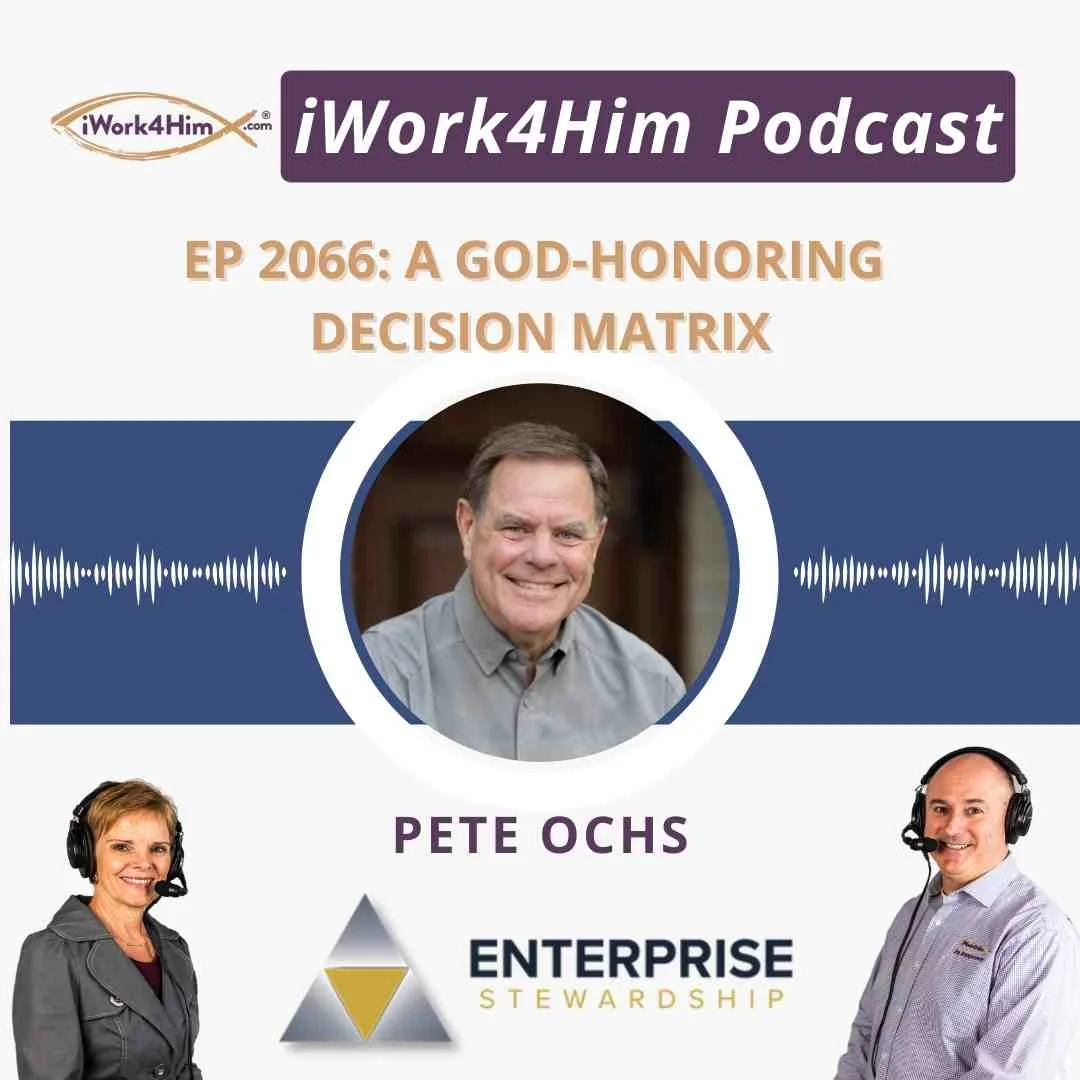
10/30/24 - 2066: A God-Honoring Decision Matrix
Jim: You've tuned into IWork4Him, the voice of collaboration for the faith and work movement.
Martha: We are your host, Jim and Martha Brangenberg, and our mission is to transform the workplace of every Christian into a mission field. What does that look like in your workplace? Let's find out right now.
Jim: The average person makes 35, 000 decisions every day. Imagine if you asked, what would Jesus do before each of those decisions? I know that isn't realistic, and most of those decisions are not of a kingdom critical nature, but what about those decisions that you make every day that are kingdom critical? Those decisions that impact your relationship with God or impact your neighbor? What are the questions you should be asking in order to make sure you've taken those two things into consideration? Pete Ochs is here today to share his decision matrix, one that he has used to create successful manufacturing companies and used to advise dozens of other organizational leaders across the country. We're going to catch up with Pete today and learn more about his decision matrix. Pete Ochs, welcome back to iWork4Him.
Pete Ochs: Jim and Martha, it's great to be here. And I'll tell you if I'm making 35, 000 decisions a day, I'm being underpaid.
Jim: Amen, brother. What's really great about that quote - that what would Jesus do? Do you realize that comes from a book from 1895, written by a guy named charles sheldon? It's an incredible book Everybody should get a copy of that book, which is In His Steps.
All right, Pete, it's been a couple of years since you last appeared on iWork4Him. Technically you're of retirement age, right?
Pete Ochs: Wrong. (laughs) No, you are right.
Jim: Okay, but you're 65 or older. Okay. So according to the world, you're 65 or older, but you're not retired. How has God been using you recently?
Pete Ochs: Jim I'm, I am 72. Okay. And I am not retired. I actually like to tell people I'm refired. It's been interesting. Five years ago, I stepped out of the day to day of our operating companies and I turned the Stewardship of those over to my son. And I will tell you, I had told people that for 20 years, I was a steward. But at the point in time I was sitting in the lawyer's office signing the stock certificates over to my son, it was one of the hardest things I had done. And I don't think it was because I was giving up ownership necessarily, but it was because I felt I had no more value. I needed to step away.
And so I will tell you that it was a very difficult time for me. In fact, it lasted several months, but I soon got over it. I think the, I simply began to go back and recall some of the advice that my mentors had given me. And I will tell you, I think the best advice one of them gave me was to say that he liked to talk about generations and the importance of generations and what each generation should do.
And he said, zero to 25 is learning. 25 to 50 is doing and 50 to 75 is passing it on. And I think one of the mistakes I made in life was I didn't start passing it on soon enough. If you go back to Numbers and look at the Levites, it said the young men started being priests at 25, and at 50, you were to stop doing the active work. You were to help the young men, but you weren't to continue on with the priesthood as you had been. And so I think I took that and took that to heart. And for the last five years I have really been pouring in, I've tried to take that to heart as how do I pass it on? So I've really been working with other younger, primarily business people to just tell them and help them however I can.
And what does a God centered purpose driven business look like? And I can, I will tell you that I've never been, I think I've never been as excited about life as I am today. And I'll tell you one last thing here. My life verse for the, for 40 years up until two years ago was Psalm 78: 72. And it's talking about David and it says, so he fed them according to the integrity of his heart and guided them with the skillfulness of his hands.
It's a very workman like very leader, get her done kind of a verse. And I felt a couple of years ago, that was probably not the right verse for me. So I continued to plow through Psalms. And I found a verse in Psalm 71: 18 that says - now don't laugh at me here - but even when I'm old and gray, oh Lord, do not forsake me until I've declared your power to the next generation, your might to all are to come. So when you have a purpose that is really driven into you and is greater than yourself, I think that is a key to finishing well.
Martha: I love this conversation and I'm so glad that you shared that with us, Pete, because Jim actually co hosts a podcast called iRetire4Him, and it's exactly for that purpose, that it really is about refiring.
You don't have all of those years of experience to go put them up on the shelf by the football and the basketball that you have up there in your background, and just say, that was really nice. Now I'm not going to do anything. No, God gave you all of that experience to do something different with.
You don't need to be punching a clock. You don't need to necessarily be doing the same thing you've always done, but use it in a new way. And I love the fact that you just shared that you are more excited than ever because that tells me that you're really living in your calling that you are in right now. And that can give so much encouragement to all of our listeners who think they may be just gonna dredge it out and do the day to day forever but there's so much that God has in store if you're willing to walk in it. So thank you for being transparent and sharing that with all of us.
So the organization that you are now leading or that God has given, inspired you is called Enterprise Stewardship. What is that focus and what is it that you're rolling out through that new - I don't know - project of yours?
Pete Ochs: Yeah, so for, you know, for the last 40 years I've been an entrepreneur and we've owned and operated a number of businesses. And I think the last 20 or 25 years, God has really impressed on me. I would say spent probably my 30s pursuing success, I spent the 40s pursuing significance, and then God took me through a really tough time in the early 2000s and really wanted me to understand what surrender was. Now, I don't spend much time on success, I spend a lot of time being significant, but I think for me, this whole idea of coming alongside business people and having them understand the power of the platform of business. I think in one sense, it may be the last great hope in America for us to have some sanity, some Christ centeredness, some goodness, and just demonstrate the love for people in our communities.
So Enterprise Stewardship really comes alongside people and we help them implement an operating system in their business that will step them through understanding the purpose of their business, the strategy of their business, the operational excellence in their business, and how they should execute. So that's really what Enterprise Stewardship does.
Jim: We're going to hear lots more about that when we get into the second segment of our show, but you've got this decision matrix that you've rolled out that I really want to talk about in the next segment. Why is it that you felt like you needed to roll out a decision matrix? Isn't making a decision just making a decision? Why do you need a matrix? Is that just 'cause you like, PowerPoint presentations or what, what's the deal? Maslow's Hierarchy of Needs, that's a matrix. Is this, is this as painful as that?
Pete Ochs: Yeah. I think James Claire really says it well. You don't rise to the level of your goals, you fall to the level of your systems. And I think decision making is a system. And too often we make decisions based on feeling or what we ate for breakfast this morning or a whole lot of things that don't really impact or should impact the way we make the decision. So that's why we came up with the decision matrix.
Jim: We fall to the level of our systems. Wow.
Martha: That's so powerful, and we're going to talk more about the detail of that decision matrix in just a moment. But I tell you what, I love the idea of having standards that help me to make decisions. And I also love it when someone else has done the research, made the decisions, and shared those answers with me. And that's really what you'll find when you go to our sponsor page on our website - vetted companies that love serving the kingdom and providing excellent services. So listeners, I just want to encourage you to go to iWork4Him.com/sponsor and find out who some of those companies are. I know you'll be glad you did.
Jim: All right. So Pete, what are the four questions that you ask as part of any decision, and I want to dig into them deeper, but what are those four questions?
Pete Ochs: Four very simple questions. First, first question, does it honor God? That really has to do with the principles of your life. The second question is, does it serve people? That has to do with the second thing of people in your life. The third question is, can we do it with excellence? That has to do with all the processes and the practices you have to deal with. And the last one is are we being good stewards by making this decision? And that has to do with the profit or the price of whatever we're doing.
So does it honor God? Does it serve people? Can we do it with excellence? And are we being good stewards?
Jim: Those are like core values of a company, when you ask those kind of questions. Or an organization. Are these questions that you developed? Capital three investments, you had manufacturing companies that were inside and outside of Prisons, which were incredible. We talked about that in our last show with you. In fact, we should put a note or a connection to that in the show notes, a connection to the last interview we did with Pete as he talked about that. Where do these come from? Did this happen all at once, these questions, or did you figure it out over time?
Pete Ochs: They really started with our four core values and our four core values are honor God, serve people, be excellent, be a good steward. So then we just turn those into questions. So anytime in business, we start with those four questions. And I think the key is they act as a macro filter to get us going. And then the key, of course, is to continue to dive deeper and deeper into each one of those questions and make sure you really understand what the question is all about.
Jim: Okay. So that first question is, does it honor God? Why do you ask this question first? And can you give an example of a time you said, no, it doesn't.
Pete Ochs: Yes. I don't think we have ever made a decision, we've never asked a decision where we said, if we did it, it would not honor God. Okay. I believe most of the time you can honor God in what you do. And in fact, we have the saying, we don't think God really cares what you do, but he cares deeply about how and why you do it. That said, I think if you dig a little bit deeper into that question on, does it honor God, you will find out - let's talk about how do we honor God. And I think oftentimes we honor God with the people that are near and dear to us. So in one sense, we're asking do the principles that we adhere to in making this decision, will they honor God?
Will they allow us to answer the next three questions in a Godly manner? And I think it's just, Jim, it's just this first cut, a question that says, is everything principled? Is what we are about to do a principled decision? Does it truly serve people? Can we truly do it with excellence, and are we being good stewards by doing that?
Martha: So really, it's the first litmus. It's saying, if it doesn't honor God, we don't even need to be having the rest of the conversations, right? Hopefully, people know enough about what honoring God means that they're not even br I think what you're saying is they're not bringing those ideas to the table if they're not going to be honoring God. But if they do, then let's work a little bit further through that litmus test.
So I just have a logistical question. For people that maybe they... you base these on your four core values, but they may not be the core values necessarily that are stated for an organization. But you're saying there's still a really good decision matrix to walk through, even if maybe they, they've never stated that excellence is important to them. We can all agree that excellence is a good filter, right?
Pete Ochs: Yes, absolutely. And while they're based on our four core values, they still go back to the four key questions in life. Why, who, how, and what? Those four questions, and so the why is, does it honor God? The who is, does it serve people? The what is, or the how is, can we do it with excellence? And the what is what's our ultimate impact? What's the Stewardship?
Jim: And really this goes back to how Jesus summarized all the law and the prophets when he said, love the Lord your God with all your heart, mind, soul, and strength and love your neighbor as yourself. These four questions you're asking, bring that all into play. Cause it's, if you can't answer these questions then you're not, you're not meeting that, that great commandment. Love your God, love people.
So Pete, your second question is this. Does it serve people? Don't all businesses serve people?
Pete Ochs: Yes, but I think oftentimes when we answer that question, we're thinking of does it serve the customer? But also we have to, I think there are three other constituents that we need to consider: our team members. Does it serve them? Our vendors? Does it serve them? And lastly, does it serve our shareholders or stakeholders that may have an investment in our business? I also think that at times these questions, while they're outward facing and we want to make sure that we truly are serving people, we also have to look inwardly as a business.
And when we're saying, does it serve people? If I have a product, and this is one of the key questions in serving people, do I have a product that you will buy that you will want? These kinds of things. So it's not just only will it serve you? But will you buy it? Do you want to buy it? Can you buy it? Do I have I priced it properly?
So there are all these sub questions that really, if I have a new golf club and it sells for $5, 000 a piece, I'm probably not going to sell very many of them and I'm not going to serve very many people with that $5, 000 golf club. So there are all these decisions that have to be made regarding the pricing and the kind of the product and how does it work to really serve the person.
Jim: So when you were making a decision about when to take manufacturing out of the country, how did you answer that question about where you took that manufacturing, whether you went to overseas or maybe to South America?
Pete Ochs: 20 years ago, we were in a business and it was, had high labor content and all of our competitors were going to China basically and undercutting us greatly. And we really had a no choice but to look overseas. And we had two options. One is we could go to China. The second, we could go to Mexico. And when we began to, we just started answering those four questions.
The first question, does it honor God? We felt like we could honor God just as well in China as in Mexico. The second question, does it serve people? Certainly we could serve people in China, just as well as we could serve them in Mexico. In some sense, we felt like it would serve people better if we went to China instead of Mexico. And here is why. Back then, 20 years ago, the hourly rate in China was 10 cents an hour. In Mexico, it was $1 an hour, and in the U. S. it was $10 an hour. So in some sense, I could have served you better if I would have gone to China and gotten 10 cents an hour because I could have sold you a product cheaper.
We ultimately decided not to go to China. We went to Mexico. And that leads us to our third question, can we do it with excellence? We decided not to go to China because we would have had to put those wiring harnesses on a boat that would have been on the ocean for four or five weeks. They may have gotten to our customer, the original equipment manufacturer that was applying that harness to the product, and if we would have shut his line down because those products were wrong or poorly made or didn't have the quality they should, it would not have been an excellent decision for us. So you see what we did was we said, we're going to go to Mexico where it may cost a bit more, but we are going to do that because in Mexico we could make, if there was a product issue, quality issue, we could fix it in 24 hours versus six weeks. So you have to begin to massage these questions and answer them all together and not just one at a time.
Martha: That's such a good example and helping us to get inside of that and see how you level all that out. So then using that same example, your fourth question is, are we being a good steward? How would you then determine that?
Pete Ochs: Yes. So being a good steward is really the return on investment question. It's really the money question. Okay? We talked about the principle question first, and the people question, then the process question, what processes were best. Now we're at the profit, and it would have been better for us to go to China. Because we had 10 cents an hour labor versus $1 an hour labor. But at the end of the day, we really felt that it was best for our customer. And we felt that we could have a higher quality product. We're going to have to charge a bit more, but that's the reason we made that decision.
When you get down to the return on investment, it's often a bit of a conundrum because oftentimes, we just simply want to maximize the bottom line. And we are firmly in our belief that if we're going to be excellent, sometimes it may not be the cheapest product that we have to build. So there's this constant tension between those four questions that you have to balance out to figure out where you really are.
Jim: I love this decision matrix as a standard for making decisions and Marth and I have used that, really this decision matrix and choosing those sponsors, those people that support our ministry iWork4Him, iRetire4Him, the podcasts that we produce, and we've on our sponsor page highlighted those, but three of them really stick out heavily. And one of them is SaferNet for all of your, really to protect your technology and keep people from you know sending you links and clicking on those links. SaferNet really makes it so we can operate our business no matter where we are using wi fi and never worrying about it. SaferNet. com.
But we also chose Patriot Mobile because as a mobile company we wanted to honor God and the mobile company we were using wasn't honoring God because they were supporting all kinds of things like, they were supporting a non biblical view of marriage and also supporting abortion. And we didn't want to do that. But also how about our payment company and our checking company and our credit card company and who handles the payments, the donations to iWork4Him?
ePaymints. We found ePaymints, m i n t s because they honor God in how they process payments and give money back to Christian nonprofits from their stuff. So that Decision Matrix really helped us. We wanted to help you, our listeners, so go to iWork4HIM com/ sponsors and see who we've endorsed as people who really hold to very high biblical standards and answer the questions on this Decision Matrix.
Pete, there's a lot of people out there listening today that are facing critical decisions in their life right now. Inflation's causing everyone to pause, tighten their belts. I don't even know what the Fed did today because we're recording this a little bit early, but the Fed was making a big decision today about interest rates and things like that. Everybody's considering trying to lower their debt, yet debt and credit card debt is higher than ever before. How can the decision matrix aid in making personal decisions from a kingdom perspective?
Pete Ochs: Jim, I think the the biggest way it can help is all of the issues that you just brought up tend to drive us immediately to question number four. Am I being a good steward? It drives us to the money question. And without considering the other three questions, we just want to answer that last question because we're all bottom line people, right? And with inflation high, with costs high, et cetera. So I would just encourage people, anytime, particularly as a family, if you're buying a new car, building a new house buying or building a second home, to really say, start working through those decisions.
And for me, I will tell you one of the best things I did was we've been using this decision matrix now for 25 or 30 years. Okay? By answering those first few questions, does it honor God and will it serve people, it helped my wife and I to do one of the things that I think has been the most important and for us in our lives. And that was 25 years ago to really freeze our lifestyle, to cap our lifestyle. Because if we were to honor God, and just as our business grew, the easy thing for those of us who are entrepreneurs to do, and even if we just have good jobs as our salary rises, as our discretionary income rises, we tend to just eat that up and we tend to go right to question number four because we have lots of discretionary income.
It's easy for us to answer, say yes on decision number four. But I think when my wife and I really worked through those first two questions, we said, one of the ways we can avoid this trap of just saying yes on the last question is to freeze our lifestyle. So we are, not artificially, but we have built in from just a self preservation point of view that we are going to cap our lifestyle. So it forced us to say no more often to the last question than yes. And then that allowed, it freed up money to honor God in different ways to serve people and to do things with excellence.
Martha: That's such a great example, and I love that you shared that because a lot of people may have never even thought of doing that. I know that we've talked about it a couple different times on iWork4Him, but listeners, consider what God would have you do in your personal life, like Pete and his wife did.
So Pete, we talked at the beginning of the show a little bit about how you're still working. In an age where people would expect, when you stepped away from the day to day of your organization, that, of course, meant you were going to do more golfing or more whatever. And maybe you have some more free time in your life, but you are, you have clearly chosen to not be done because God has a calling on your life. Speak to our listeners that might be getting closer to what our culture expects of a retirement age and knowing though that in their heart, they're not going to be done. What can you say to them?
Pete Ochs: Yes. So if I go back to the comment I made at the very first, I think 25 to 50 is doing and I think 50 on is passing it on. And I believe that's biblical. Often talk about is there retirement in the Bible? And I haven't found that yet. And I know a lot of people are possibly looking for that. And so I don't think you necessarily need to keep doing and doing the rigorous work of doing, but I think you need to slip into a mindset of how can I pass it on?
And it's really serving, but it's serving in a different way. You don't have all the pressures of raising kids and going to work every day or running your business or doing the things, that you can now begin to give back in a very different way. And do you take a little more time for this and that?
We've got nine grandkids, so I certainly spend more time with them than I did before. But I think I have friends who have just quit cold turkey and they have not had something to go to. And I really think if you are in, if you are over 50 years of age and particularly if you're over 60, you need to be thinking, what am I going to do? What am I going to, how, what are the gifts and the talents that God has given me that I can pass on? And we all have lots of those. I think the best thing we can do is just spend some time one on one with younger people and encourage them. The more I do that, the more encouraged I am with the younger generations and what they can become.
Jim: We say often on iRetire4Him, everybody who's retiring knows what they're retiring from, almost none of them know what they're retiring to. And so you just brought up a phenomenal point.
Pete, people want to check out more about Enterprise Stewardship and what you're doing there and how they can get involved with you in their businesses and some of the businesses that you're rolling out, how do they find you?
Pete Ochs: They can go to Enterprise Stewardship dot com and go to the contact page and just type me in a little note and I'll get right back with them.
Jim: Pete Ochs, Thanks for being back on iWork4Him today.
Pete Ochs: You bet. It's great to be here. Thank you.
Jim: You've been listening to iWork4Him with your host Jim and Martha Brangenberg. We're Christ followers, our workplace, it's our mission field, but ultimately, iWork4Him.
10/23/24 - 2065: On the Road to Kingdom Advancement

Jim: You've tuned into iWork4Him, the voice of collaboration for the faith and work movement.
Martha: We are your hosts, Jim and Martha Brangenberg, and our mission is to transform the workplace of every Christian into a mission field. What does that look like in your workplace? Let's find out right now.
Jim: I know a lot of people all over the country and a few around the world, but I don't know many truckers. I've traveled millions of miles on a highway alongside hundreds of people, thousands of truckers and trucks. I've shared rest areas with trucks and truckers and a ton of truck stops too, but I've never met anyone in any of those places like John Cummings. John loves his business. He's good at it, but he loves Jesus now too.
All that combines to make one heck of a good story. So let's head off to Romulus. No, not the planet, but the city of Michigan outside of Detroit. John Cummings, welcome to iWork4Him. .
John Cummings: Thank you. Thank you for having me.
Jim: All right. So John, how did you come to be a follower of Jesus?
John Cummings: I believe that - it was just always talked about my house, always believers, but my parents did not take us to church. I don't recall my parents ever taking me to church, but it was always talked about. My aunt is probably the main one that put the seed in me about it more. She would come over once a while and take myself and my brother and my sister to church every once in a while. And they would send us on a bus on Wednesday nights to a Baptist church.
And I think that was just so they could have some alone time once a week, without the kids. Still, they say it never falls on deaf ears, right? God's word. So even though I don't recall those, it's still something that obviously did some kind of seed in me. But I did not follow through my teen years, my 20s, and maybe in my 30s.
When, my kids were certain, I had a couple at that time and I wanted to do right and good for them, even though I still didn't do much with that. We would go to church a couple of times , four or five times a year. If it was convenient, and I didn't, wasn't up late the night before, had sports on Sunday with the kids or whatever. Again, maybe Easter and Christmas and maybe a couple other times throughout the year, but that was about it. But I always did believe I just did not walk. I definitely did not walk with Him.
Jim: But what shifted your life to where you are today? What was the event that said, I'm going all in for Jesus?
John Cummings: A lot of people, it's funny, when you hear people's stories, some people are hit with lightning and they flip like right away. But I always tell people like my journey has been like baby steps and it's been a slow crawl for me. For the past 7 years I'd say it's been on a very fast track, when I went to a Men's Gathering through my church, it's called Man Up, and there's seven, eight hundred men that go to this retreat, and it was a thing where men are very to their selves, they don't like to share like women do with each other about what they're going through, we're pretty tight knit about what's going on behind closed doors.
And it was a very overwhelming experience of just opening up. I never experienced that about what their struggles were and what things that they were going through in life. And then there was a couple of guys on the Sunday morning when they were wrapping things up, and there's two guys that spoke about human trafficking and the first one does a underground thing where they set up phony websites and men, when men try to get a date, they let them know it's not exactly what they think it is.
And then there was the other gentleman Ramesh from Nepal who runs and started an organization called Our Daughters in Nepal. And he was speaking about how 35 to 40, 000 girls would, be taken across the country from Nepal to India to be sold, whether it was a two day trip or a two week trip. And by the time that they got in India, that they're usually raped over and over again on the journey. So there was something that really hit me with that, and your first instinct is to go vigilante and start taking some people out or at least someone like it. But you realize talking to people that there's just, there's 10 traffickers waiting to take that person's place.
So it's about educating men about what we're doing and how we're maybe sometimes consciously, but most of the time, unconsciously supporting that whole world, whether you're going to a topless bar or whether you're buying magazines or whether you're watching porn - it's all contributing to this world. Second biggest crime in the world behind drugs. It's rapidly catching drugs, so it's, you can sell a body over and over again. When you sell a drug, you gotta get new drugs to sell.
But that journey going up to it, when I was trying to find a church in my local area, and I visited several, and I just wasn't feeling what I wanted to feel. Even though I drove by this church every day to go to work, cause it was big. I thought I wanted to find a little church. And when I finally went there and found out what they were doing and locally, nationally and internationally. I just, I fell in love with the church and then they're talking about you want to grow your faith, join a small group.
This is just Sundays here. It's not about just Sundays. It's about living, the rest of your life through it. And again, I was small baby steps, right? So I had listened to that message they tell almost every week for a year before I finally joined a small group. And then I was getting so much out of that right away that I joined this Man Up Weekend.
Martha: Awesome.
John Cummings: And then I, it just flipped, it flipped my script really quick. Like I went to a trip to Israel with the church the following March. I went, I got involved in three or four things in human trafficking instantly. So that's what really flipped it.
Martha: So we're going to talk about the company that you founded, which is ASAP Transfer, and you founded that in 1995.
But I want to hear then like, you went to this Man Up, you learned some things that really opened your eyes and really changed your heart. How did that change your business and your business plan? What did you bring back to it?
John Cummings: After the economic crash in 08, 09 and, I actually went through- that caused my, the biggest part of my marriage failing because I wasn't making the money and whatever that someone was used to having luxuries to. And after probably like 2012, I started making a little bit of money again and then I started doing really well again.
And it's funny when you ask an honest question to God or tell something honest to God, like he will, he comes in a big way, right? And I remember saying this to him that I know I'm not making more money just so that I can have stuff. What do you want me to do here? And then that's when all these other things start rolling in my way. And just start doing a little bit tithing the way that I was supposed to tithe. That was the first thing that that, that came from that. I started tithing the way that I was supposed to tithe.
And then my business was growing. And there was just all kinds of other things that fell into place with finding the church, and I just I came to a point where I couldn't outgive God, right? Like I, the more I was giving, the more I was getting. And I was really, truly experiencing that, that whole scenario about, giving and getting more than I could ever give.
So it was like, it was a fascinating feeling to me. I did a true thing of learning how good it feels to give is a unbelievable gift to accept from God, to know how good that feels. And it's not about yourself, right? Even though I still get in the way sometimes, I still do those things,.
Jim: Yeah, we all do that. But that was your life transformation, but then you brought that life transformation into ASAP Transfer. How did that happen? Obviously, a lot of those people that have been working for you up to seven years ago, which would have been 2017, some of them probably have been there a longer, so they knew the old John and now there's the new John, this new John, Jesus freak John, they probably called you. How did you bring your faith to work and how was that initially received and how is it received today?
John Cummings: When we, I think it's been three years now that we actually, we've been talking about it and things, but we actually made a decision three years ago, probably about this time, we actually started talking about how we wrote our bylaws and things and tied in our core values. So when we were going through that process and we got to some of the reading from other companies, but we've just modified it to ourselves.
And then, as we were going through the process though, and people were going, Hey, there's a lot of people that may end up quitting because of this and I said, that's okay. There'll be other people that will want to come to us because of it. And then there's a lot of companies that may not want to do business with you because of it. And I said, that's okay too. Cause other businesses want to do something with us.
But I said, if you pay attention, do you think everybody that's in a Chick fil A line believes in Jesus? No, that's a big, long line. I don't think all of them think that they're believing in Jesus. They love the product. So I wasn't, I was never ever concerned about who I was going to lose as a employee or what business I was going to lose. Never, ever concerned me. And we've been able to get involved in a lot of different things with charity, but we were doing things like donating $ 1 a shipment that goes to, different human trafficking organizations and things like that.
And I'm actually on the board for Hope Against Trafficking. That is a safe house for formerly trafficked women, which we are actually in the process of doing a documentary with that. So that's going to be on Prime and Netflix, that should come out the end of January, early February.
Jim: So many people think it's impossible to follow Jesus in their work, but we just heard from John how God opens doors to allow that to happen.
You could take some important steps today to follow Jesus in your work. The iWork4Him Nation covenant is a simple tool that helps give you daily guidance. Go to iWork4Him. com forward slash join the nation and learn more.
Martha: You know, So, Joh, you were just talking a little bit earlier about your core values and one of your core values at ASAP is we provide the opportunity for all to know God and make Him known. Do you want me to read all of that? No, go ahead. Okay, so all that we do centers around Him. We will not force anyone to believe, but they will certainly have opportunities to hear. We treat each person with the highest level of respect and value each person's unique perspective and contribution.
So how do your customers respond to this?
John Cummings: We do point out that to read it, if they want to read it and some of them respond in a great way. There's actually, we've got customers for it, because of it. And I've never had anybody say what are you guys doing? We just can't support you. We don't want to give you the business because I've never had that happen one time.
And when we talk to other customers, it's how I met you guys is trying to get Christian companies to do business with other Christian companies. It's never been a negative thing at all. So as many companies that I've met that we're talking to about doing it, they say a lot of our community or customers are Muslim or they're Jewish and I don't want to chase them away.
And a lot of my friends. I says they're your friends. Are they going away because you're a Jesus follower? Because no, why do you think you're gonna lose their business because of it? And anyone that I've ever that's ever made the move or had the boldness to make the move with the courage to make the move, no one has lost business. And I've never heard anybody other than gain a lot of business out of it.
Jim: So do you consider yourselves a trucking company or logistics company? Which one do you really consider yourself?
John Cummings: Both. We're doing a big logistics project right now for a marathon refinery here in Detroit. It's huge. It's the biggest turnover ever. And we've done it for a couple of the other refineries in the country in Canton, Ohio and Robinson, Illinois. But we also provide trucking.
So logistics solutions and how we can do things better within our companies, but we also provide the trucking. So we are a logistics, but we're also an asset based company as well. We do have trucks on the road.
Jim: So do you find that your faith in Jesus is well received within the trucking and logistics world?
John Cummings: I don't know if it's well received, but I do think that there's really legitimate interest and how that's working and how that's going for you to do something like that. And like it says in the core values, first of all, the beauty of it is, we can't force anybody to follow Jesus, right?
It's gotta be their choice, right? It's called free will, right? There's no reason to say that you're gonna force it on anybody because you can't do that. Cause if we could do one thing as Christ followers is go around waving a wand on people to find that love of Jesus, the whole world would be blessed with it, right?
It's never so much about what you're saying, but the people do watch what you're doing. Like at one point Hey, what's the one, one thing that you might give yourself credit for? And then for a second, you might say courage, and then you realize , he's the one that gave me the courage. So it goes back to, I get credit for nothing.
Martha: It's clear that God has challenged you, John, to live out your values in your work and by using your profits for his kingdom work. And, I often wonder how it would be for each of us to do this more confidently.
We have a great example in Patriot Mobile. They saw a need that we all have, which is cellular service, and decided to create a company that can provide that service while upholding their values, much like you're doing, John.
So Patriot Mobile is an easy switch with U. S. based support and all the major networks that you currently use. Contact them today at Patriot mobile. com forward slash iWork4Him and use your dollars to support what you believe in.
John Cummings: Yeah, we actually met those people at the Orlando show with you guys, right? So we did reach out to them . There hasn't been a follow up with them though, so I will have to get to do the follow up with them. Because them and Red Balloon as well, right? When you're hiring, when you're doing hiring and you want people to follow the core values because they're saying how many Christian organizations are getting sued for saying that we believe in Christ.
And there's actually, they actually brought it up that I think it was one of the huge, I won't mention the name, but a huge recruitment company that actually, because somebody said that they believe in Christ and the American way or whatever, that they would not recruit for them, unless they took that down. There was a construction company in Texas, I believe, that was his example.
Martha: And that's one of the things we love doing at iWork4Him, is sharing with people those resources that can help them to live out their values in the business that God has called them to do and not to separate that. And so that's the conversation that we love to have.
Jim: John, there's a ton of independent and contracted truckers out there listening to this podcast and trying to connect their faith in Jesus to their work, all the while dodging stupid drivers while trying to make a buck. Any words of advice to maybe over the road truckers, or even local delivery truckers, or just in the state truckers who are going Hey I want my faith to come out on what I do? But they're constantly on the defensive, because I've traveled those roads, millions of miles. I've seen them having to dodge people all the time. Any words of advice to the truckers and logistics people out there?
John Cummings: One of the things that I think in the conversations we were having, redoing our core values and everything was like, every industry has this problem, how to separate their self from their competition. So why? And plus you have way more fun in life, you have way more connection to be true to who you are, and you get people around you to share in the same things, and you have what you go through in life to share that is way beyond any reward that you can imagine, right?
So when you're doing that and I've had, I think at least three or four companies that did make, where they changed their core values and let everybody know that they're a Christian organization, that's a huge reward. And however, God spreads that and lights that on fire to spread around. It's a pretty cool thought to think that you're just reused for something like that.
Martha: I just think of Jim, all of the road over the road traveling that we have done and the people that we have interacted with, and each one of us, no matter where we are, can make an impact on the people that we're just rubbing shoulders with, or even just passing in a hallway.
Jim: A hallway in a rest area, somewhere in the middle of the night in Texas. .
John Cummings: It's fun, ain't it?
Martha: For sure. I want to switch gears just a little bit, John. Tell us about your monthly Christian Network Movement events. What is that all about?
John Cummings: When it was somebody that said, that there's N Times that the Muslim dollar will go back into their community before it goes outwards. And I think we heard something like seven, eight times within the Jewish community. Like they give within themselves before it goes outwards. And with Christians, there was like one and a half. It was like, that was crazy to me. So it was just something that I know that God put on my heart was like what do we do?
So we just started reaching out to a couple of people and Mr. Salazar, Dan talking to him and he started introducing me to people and we started doing these monthly Tuesday events. And he said what do you expect to get out of this, John? I said, honestly, I have no idea. I just I feel like God put it on my heart to just start, take a baby step.
I have nothing to do with it. He's the one that runs with it. He's the one that put people like you into our lives and all these different organizations like Krystal and kingdom commerce. And now we're starting to Michigan Christian commerce in this state. And actually, my pastor 's moving from this side of the state to the other side of the state, so we're talking to him about opening one up and it's just watch him go, man. Look at him go.
Martha: Awesome.
Jim: That's good to know. Who should be attending these events? Because I know you send out monthly invites. Who are you looking to attend the events?
John Cummings: Anybody that wants to be part of giving the money that you make to other companies that want to give back to the kingdom. I want any vendor that I can - it's got to make good business sense, right? It's got to be a good business. a good business sense for us. But if I have a choice between giving it to anybody else and someone who's giving back to the kingdom, that's just a no brainer.
I want to do that. And I think when the conversation, sometimes these Christian organizations are still a little bit leery to say could you use us for what we do? I want to do that. I want to give my business to other Christian organizations. And I'm not worried about when or how it's going to come back. I know that I'm just being faithful to the process, that will come back.
Martha: I want to talk about this just for a minute because a lot of people really struggle with this concept as a believer which make you know, it's just that division that we have in our head where this is supposed to be a separate conversation but the reality of this is if we don't vet the people that we are interacting with and using as vendors and helping to grow their business through our business, we could be supporting very different agendas than what our values are, and that's the key right there, is that you're helping to make a company more successful so that they can give money and support the things that their values believe in.
And if those don't align, you could be helping to support the very thing that you're fighting against it on the other side. So you were talking about your heart towards helping with people that have been trafficked and, just the terrible industry that is happening with women and children all over the world.
And if you are using as one of your biggest vendors somebody who helps make that industry grow, that makes no sense. And so we really need to think about that. And so there's nothing wrong -. In fact, there's everything right about helping to support and help grow other businesses that have the same values as you.
So just want to encourage our listeners to really think about that and pray about that, about what vendors are you using? What do they support? Because we know companies are using their profits to do something. And what are they, what is their end game? And it really does matter. And our dollars vote our values.
That's my little soapbox for the day. But a lot of people, there's tension around that conversation. And you're saying, nope, this matters. I want to help other people. Let's keep the kingdom dollars growing so that we can do what our Bible tells us to do. So good job for you. I love that's happening there in your area. Do you have any final words for our listeners before we end today?
John Cummings: I just told everybody when I, cause I'm very vocal, I'm very, I'm not afraid to share what I feel and everything, and they said you know what ? The only person that's winning, even like in the trafficking world, by ignoring something that's going on next door about something like that, that doesn't feel right, the only person that's winning by you being silent is the enemy.
Martha: Amen.
John Cummings: The devil's winning when we're doing that. We have to have the courage to step out and say something don't look right. Something don't feel right. And let's help each other out. And it's not hard, not that hard to do it.
Jim: John Cummings with ASAP Transfer out of Romulus, Michigan. Thanks for being on iWork4Him today.. Thanks for sharing a little of your story. John, if they want to get involved in the Christian Network Movement monthly events, how can they do that?
John Cummings: If you send an email to lions. den@ASAPexpressinc.com or you can start off by emailing myself, john.Cummings@ASAPexpressinc.com.
Yeah, I'd love for anybody. This is pretty cool watching God work. It's all him. He is the one that's giving the word to wherever he wants to get the word to and letting it spread.
Martha: Awesome. We'll put those links in the show notes for everybody that needs to get a chance to get something to write that down and make that email contact with John.
Jim: Thank you, John. You've been listening to iWork4Him with your host, Jim and Martha Brangenberg. We're Christ followers. Our workplace, it's our mission field, but ultimately, iWork4Him.
10/16/24 - 2064: Liberating Leaders
Jim: You've tuned in to iWork4Him , the voice of collaboration for the faith and work movement.
Martha: And we are your hosts, Jim and Martha Brangenberg, and our mission is to transform the workplace of every Christian into a mission field. What does that look like in your workplace? Let's find out right now.
Jim: If there's one topic that 100, 000 people in the speaker circuit talk about, it's leadership. Yet all 100, 000 of those speakers would have their own take on it, their own spin on what makes a great leader. About 8 years ago we learned about GIANT. This is a leadership training organization that's completely different from all the others.
The focus of Giant and all of their leadership Sherpas is to help a leader become 100 percent healthy so they can multiply themselves effectively. Or as our guest puts it in her LinkedIn profile, liberated leaders liberate their people. Dr. Jessica Rimmer is the CEO and founder of Solomon Strategic Advisors, and she uses the GiANT Worldwide platform to transform leaders.
Jessica is renowned also for her wisdom on how to incorporate one's faith in one's work, and is a chapter director for the Polished Network. She has a great story and a great perspective to share with all of you today. Dr. Jessica Rimmer, welcome to iWork4Him.
Jessica Rimmer: Thank you so much
Jim: . Now just a warning for all of you listeners out there. We have a doctor on the show today. Jessica, if you use a five syllable word, we have a rule here on iWork4Him. I will stop the show and ask you to give the definition, so just keep that in mind.
Martha: A little game show.
Jim: It is a little game show.
Martha: All right. So before we talk about liberating leaders, tell us your Jesus story.
Jessica Rimmer: Oh, my Jesus story. That started a very long time ago. My dad is a pastor, which does not automatically make a person a Christian. So don't think that I am confused, but that meant I sat on the second row, like most pastors kids do.
And rather than turning away from the faith, I was really interested. I think Jesus captured my Attention really early and about age five, we were in a revival. So I can say my dad wasn't even the preacher and I leaned over to my mom and I said, Hey, after that, after this, we need to go down and I want to give my heart to Jesus.
And so I was five. I got baptized that next service. That was the morning. I got baptized at the night service. And I was ready to be on the playground sharing my faith. I literally was like telling people on the big toy about how I had given my heart to Jesus and how they should too. So immediately was excited and enthusiastic about that life change.
And of course, my story can't end with conversion. That would be silly. But walked with Jesus a lot. There's, of course, twists and turns as we all have. But I'm grateful that God pursued my heart. And I really felt called to the ministry. And I use air quotes ministry. Probably, I guess I surrendered to the ministry about three, four times at youth camp and found out that there wasn't a lot of place for me in the church environment to serve as a minister, as a woman, and really found my place - this is where we begin to have unified hearts.
I went to OBU to study ministry. I studied cross cultural ministry at first. And that's where I started thinking about theology and who is God and who am I. And I've been on a journey with Jesus. I'm 42 years old, in case people never say how old they are, I'm not sure that's helpful. But for all of those years since age 5, I've been on a journey to discover who is Jesus and who am I.
Jim: Cross cultural ministries, but you're from Oklahoma! Not a lot of cross cultural things when you were growing up, but people had a little bit different twang here and there, depending on whether they're from Oklahoma City or Tulsa. What was the cross cultural you were looking to explore?
Jessica Rimmer: So that's funny. I think you probably have to understand a little bit of Christian culture to get this. But I considered foreign ministry. Foreign missions would be the term that would have been used in the 90s. I thought that was like varsity Christianity. Lottie Moon, Annie Armstrong, like all these missionaries that had given - even Mother Teresa to some, to some degree.
I didn't have a lot of knowledge of her until college, but like Those were the type of people that I thought those people really love Jesus. And so I just wanted to live a life like that. And I didn't have a grid for it being anything else than far away in Africa or China. And so I've done some foreign mission work, but I really found that God reformed, reshaped my definition of mission field.
And that is, we are all on mission, right? Every single one of us. And being born when I was born and living and working in the digital age. It's really God brought the nations to us. And I think for me, ministry and missions really is it is what I do every day. It's just called something very different.
Jim: If you, our listeners are watching on YouTube, you'll notice right when Jessica said she felt called to ministry with air quotes, a beam of light came down from above her and started shining on her head. It was just incredible. So you went to OBU, Oklahoma Baptist University in Shawnee, Oklahoma, where my brother went as well for your undergrad and then University of Oklahoma for your graduate degrees. All the way up to doctorate.
And then you planted yourself in higher ed for more than a decade. At what point in time did you realize that your executive calling was your ministry calling? What was the point where you said this is one and the same? It's not a separate thing. I'm not a second tier citizen in the kingdom because I'm an executive.
Martha: Jv versus varsity. (laughs)
Jessica Rimmer: It's interesting. I think for me OBU does talk a lot about the infusion, the relationship of faith and learning, like those two things. So it wasn't a very far logical step to talk about faith and work. To me, it was very clear. Just theology. I read a lot of theology. It was very clear to me that work wasn't a curse. And so for me, I was really just reading the Bible.
Jim: Wait stop. You've read what ? Wait, you read what? You read your Bible?
Jessica Rimmer: I read my Bible.
Jim: The whole thing?
Martha: That's awesome.
Jim: Wow.
Jessica Rimmer: Yeah.
Jim: I'd like to draw attention to the listeners. If you haven't read your Bible from cover to cover one time, you should. I recommend reading it multiple times, 30, 40, 50 times, because it's unbelievable and it really would change your perspective, but way too many believers listening to the show haven't done that, Jessica.
Jessica Rimmer: Man, God's Word is living and active, and it's nourishment. It's food, and it's wisdom. It's practical wisdom for everyday life. There's just so much. You can't, you can't step into the same river twice. You really can't have a singular experience with the Bible. God's Word is alive and ready to speak to our specific circumstances.
So I think as I matured, I had a more mature reading of scripture. And as I had a more mature reading of scripture, I matured more. So I think it's reciprocal in that way. But yeah I think understanding what is God saying to me in scripture is so important for people as they're seeking to live their lives, whatever God is calling you to, whether that's being an accountant or being a pastor, neither one of those things is more spiritual than the other thing.
Martha: You're speaking just great things. It's a love language. So talk to us about how God has given you the confidence to be the strong female leader that He actually created you to be.
Jessica Rimmer: Oh, man. Sometimes I feel like the personality and the gifts that God has given me is a little bit like being equipped with a fire hose. And a fire hose is awesome if people want you to put out a fire, but it's not awesome if what they want you to do is water the garden. And so a lot of times the strength has not felt like a gift. It has felt like a burden. I remember reading things like a woman is to have a gentle and quiet spirit. And I'm like why'd you make me like this then?
And so I think I've had to learn how to one submit my heart and my gifts and my mind and all of that to the Holy Spirit, but to gain the mind of Christ in it. In being able to view my gifts as gifts rather than goodness gracious, I've really been given a cactus as a personality when other people were given really good, likable personality.
So my leadership gifts wasn't always able to view them without insecurity. I felt very insecure about, I had them. It wasn't like I was then like being quiet. It was like I was using them but self consciously. And so I think the first person who acted as a liberator to me in helping me view them as gifts was my first boss at Mid America Christian where I served for 10 years.
It's a Church of God institution. They view women in ministry very differently than the denomination where I was raised, and he just spoke life to me and just corrected some lies that I had really adopted about what it means to have strong leadership giftings as a woman and kind of gave me permission to use them and gave me opportunity to use them. And so the, that's where the confidence began. I think the acceptance and the full Oh no, this is good. It's not even just like an adaptation. It's not an accommodation that someone's accommodating my intense personality. That's the word I've gotten so many times is gosh, you're so intense.
And I'm like, Oh, thank you. That actually makes me feel very self conscious now. And the acceptance and the confidence to use it and bloom in it has probably come really in the last six years in the business world because it actually is more of a match in the business world than In Christian higher education where there's a lot of pressure for women to be nice.
Jim: But that's a lie though, too because there's an absolute need. Obviously God created you the way you are. There's a need for people like you and any kind of education, let alone Christian education, which is a hot mess, there's a lot of stuff that could use improvement and sometimes people just need to speak truth. And God's giving you that ability to just speak truth. People may say it's a lot. Jessica, you're a lot. People say that to me. We must be a lot alike.
Martha: But you know what? One of the things that I love about this conversation is number one, You are very nice. But you're not like soft and you can't run all over you. I think that's what we think of is we'll just let whatever happen happens.
But you have the amazing ability to articulate things in such a way that even if it's hard, it feels really good. You are very gifted in that. And just, your ability to communicate in a way that gets the point across. And it may be a hard point, but in a way that, man, I feel empowered. I feel like this is really good meat that we can work from. And I've noticed that the different times I've heard you speak and interact with other people. So even in this moment, just going to affirm you with that, because I am often drawn to women like you because I'm married to you know a strong "a lot" person over here. So I get it. I get it. (laughter)
Jim: Go to youtube and note this time and look at my face. Look at - I'm shocked. (laughter)
You know, speaking of confidence, wouldn't it be nice to feel confident about the safety of your computers and your mobile devices? If you've ever listened to our podcast Digital Desperados, which we'll share that link in the show notes, you'd realize how many bad guys are trying to steal information, your information through compromising your devices.
SaferNet has been designed to give us all peace of mind so we can focus on our daily work that God has given us. Stay productive and safe with SaferNets easy to use app and super robust internet filters. You can embrace cyber security without complexity. SaferNet. It's like your guardian in the digital world. SaferNet. com. That's SaferNet . Com.
All right, you say liberated leaders liberate their people. What do you mean?
Jessica Rimmer: So this is something I got from GiANT Worldwide, which was a huge part. To tag on to that previous question, a huge part of growing in confidence is getting around healthy leaders who are fighting to be healthy and who are fighting for each other.
So we define liberation as fighting for the highest possible good in the lives of those that you lead. But you can't give away what you don't have. So if I'm not liberated, there's no way I'm going to be a liberator. If I am self conscious, if I am self occupied, if I'm stressed out and I'm not leading myself, I'm not going to liberate other people. But if I'm liberated, if I'm free, if I'm empowered, then I'm going to be the type of person who is also doing that for other people. So liberated leaders fight for the people in their lives and not fight for them to be coping and just okay, but fight for them to be fully free, which probably makes you think about Jesus, right?
Like Jesus was the perfect, is the perfect liberator. He's the lion and the lamb. He is going to speak the truth in love. And so when we think about being liberated, we're really talking about the type of leader who is healthy. That 100x model, healthy. People want to be around them, but then they're also multiplying themselves so that other people can be healthy and empowered, too.
Martha: So you talked earlier about your boss that you remember that really liberated you. And so using this same verbiage, when a liberated leader helps liberate his or her people in the workplace, how does that affect the workplace culture?
Jessica Rimmer: Yeah. Healthy culture grows healthy plants. Unhealthy culture kills healthy plants. And so if you think about workplace culture as atmosphere, the leader should be the gardener. We need to tend the conditions. And so as a leader gets healthy, they begin to take care of business. They begin to like, have the kind of conversations where they are holding people accountable, but not in a way that makes them afraid. That makes them more aware and makes them more effective.
Really a liberator is going to be the type of person that is able to drive performance. They're the type of person that is able to understand and know their people. They're the type of person who is able to unlock the team members around them. And that's just unfortunately not the primary experience that people have in the American workplace particularly.
Jim: You think it's different overseas in other countries? Do you think it is better other places?
Jessica Rimmer: I just don't know. I would imagine no. I just know the US data better than I know the global data. My suspicion and my little bit of international experience because I have a smidge is to say that most companies have the same problems everywhere. And the thing is, we are dealing with a global workforce. So there's not as many boundaries as there used to be.
Jim: So is a liberating business culture or liberating organizational culture, does that help the bottom line? Within Solomon Strategic Advisors, you guys are working with all kinds of companies all the time. When you help a leader to be liberated, so then he could, therefore, he or she can liberate his or her people, do you find that impacts all the way to the bottom line?
Jessica Rimmer: For sure. What liberation produces is trust. What trust produces is creativity. What creativity produces is innovation. What innovation produces is market leadership. And so if you understand that actually you have this huge opportunity to impact the bottom line by working on yourself and your team and your culture, that's a reason to do it. I don't know that it's the primary reason to do it, but it should be a natural outflow if you really are creating liberation.
We know that it's more complex than that, that there are structures that have to be addressed. You have to have goals, you have to have strategies that won't necessarily come if you're just a liberated leader. You have to then surround yourself with a group of liberated, diverse talent. No one person brings everything to a table.
So being liberated is not about being perfect or a team unto yourself, but it does give you the highest chances of assembling what Jeremy Kubicek, our mutual friend, likes to call you know the avengers, right? That special squad of Different people with different gift mixes and everyone has a higher likelihood of contributing their superpower.
Jim: It's said that the most powerful leadership team is the leadership team that represents the fivefold gifts mentioned in the Scriptures. When you really look at those fivefold gifts, that's really how you make a great team. I just have heard that . Martha?
Martha: I wanted to just talk a little bit about our journey because about three years ago, Jim and I completed the GiANT Worldwide Sherpa training, and we were looking at ourselves and saying, How can we be better leaders? And we wanted to go through that ourselves.
And about that same time, I met you in Dallas at the first ever Boldly Conference. And then I learned that you were a chapter director for the Polished Network, and Polished Network is who hosts the Boldly Conference. I want you to tell ... I know we want to talk to the heart of the woman leader right now, but first I just want to mention this podcast is going to come out the week of this year's Boldly Conference.
And if you, by chance, can get to Dallas in the next few days, the promo code, I'll put the website in there and our promo code for, iWork4Him.
Jim: It's Boldly Conference.com.
Martha: Yes. And our promo code is IWORK4HIM20 to get a discount on your registration, but talk to me for a minute about your heart for women leaders.
Jessica Rimmer: Yeah I really love serving Polished. We had our monthly luncheon today. Catherine Gates, the executive director was in town and at Oklahoma City, our chapter serves about 100 to 120 women every month. We have sometimes less, sometimes more, but that's roughly an average. And the women that come to our lunch, they are so diverse.
We're not just serving C suite executives or mid level managers. We've got frontline manufacturing workers. We've got athletic studio teachers. We've got, I met a lady who runs a local nonprofit today. And every month we have new people. So my heart for this group is really to cultivate a community where women feel seen and loved. That's not the norm of women's reputations with one another. We don't have a norm for fighting for each other. We have a norm for relational aggression.
Jim: Like mean girls lived out in the real world?
Jessica Rimmer: That's it. Yeah. Mean girls out in the real world. So it's funny that you bring that up because every month I say, you can sit with us. You're already invited. You're already invited. You do not need to wait on an invitation. In fact, you can be the inviter. And so I've been talking every month I'm the emcee about we want you to find your people. We want you to find a job or whatever you need in terms of networking. More than that, we want you to find a safe place where you can be prayed for and where you can be known because it's just not the case.
And what we find, the reason that Polished Network exists is that actually working women, which is more than 70 percent of women, working women, tend to not be able to find ways to connect in a traditional church setting, particularly when church programming is happens during the day. And so finding time away from their children is really hard. So the lunchtime hour works really well. And we just have a really sweet community of women who really are becoming that, they're becoming love for one another. And it's really awesome.
Jim: So if somebody's in the Oklahoma City area and they want to come to your event. How would somebody find out more?
Jessica Rimmer: So if you go to the Polished network. org, you can go to chapters and then select Oklahoma city and come. And we've had women come from as far as Wichita, Kansas. So there's a chapter being explored there and Tulsa. So we have people drive pretty far. I get, it's hard to be away from work. It's a sacrifice, but every time I go and I hear this over and over it's, man, that was worth it. I'm so glad. I'm so glad I made time for that.
Martha: So good. Thank you for sharing that. And I hope that somebody is listening that could be close to you and be able to get involved in Oklahoma City. But I also know that there are chapters all over the place. Everyone listening could go and check out the Polished Network. I'll put the link in the show notes. And see if there's something near you that you could gather for but if not, the annual Boldly Conference is a great place to do that and just get filled up, get challenged, be inspired by other women that are living out their faith in their work. And I hope to see some of you there.
Jim: And you get to meet martha and jessica at the Boldly Conference
Martha: But we'll take a selfie with you,
Jim: but you won't meet jim because men are not allowed.
Martha: That's exactly right Yeah, so I want to get just a little bit deeper into how God is using you, Jessica. And this spring, I had the privilege of attending a gathering of Faith and Work for Women ministry leaders, where you beautifully facilitated a two day conversation. And yes, it was a two day conversation when you get that many women together, right?
But it was specifically around collaboration for the kingdom. And I was able to see firsthand how God was using your gifts, talents. and abilities. So I wanted you to take a moment right now and speak to our listeners and challenge them to further develop their leadership so that they could be a leader worth following.
Jessica Rimmer: So the first thing I would say if I'm challenging the audience is everyone is a leader. We all have responsibility to lead the person in the mirror. And so we never undermine our external leadership more than when we fail there. And that's tough. That's probably the hardest person that any of us have to lead every single day is ourselves. And that is about waking up every day and deciding to be intentional.
Where am I not as healthy as I need to be? And I don't mean skinny. I just mean healthy, emotionally skinny. So I'm looking at my relationships, spiritually, physically where are my relationships off? Where am I? Maybe having more chaos than is necessary. And so waking up every day to go, how do I need to lead myself?
And then looking across our other circles of influence. What I do with organizations is I help implement the GIANT system. And we do some other things as well, like strategic planning and succession planning, that sort of thing. But we use these visual tools to help people look in the leadership mirror, build a common leadership language that begins to scale across the organization.
So leaders who are first of all leading themselves and getting healthy, then need to be thinking about what's it like on the other side of me, for my team? What's it like in the organization? What's it like in the community?
Jim: What's it like on the other side of me? That is a powerful question. You gotta stop and gonna focus on that for a second.
What's it like on the other side of me?
Sorry, Interrupted you but that was like...
Jessica Rimmer: It's a million dollar question. It probably is one of the most transformational questions I've ever asked myself in my life. Because if we're gut level on the answer to that question, it depends. And you know on my birthday I'm the best version of me. Other days I might be the stressed version of me.
And so that Roller coaster that people ride with us is known as our reputation. And so if we want to have the kind of reputation that is - the Proverbs talks about our reputation, our name is worth rubies, right? Like our reputation is actually really important. It's not about our influence or status.
It's who are we and who we are is going to be some of the experiences that people have had with us. So if we are a roller coaster rider, we're loading the crazy train every single day and people are like they get that and they're modifying for the fact that we're not leading ourselves then every day.
We have less influence and less impact than we could just because we're not answering that question. What's it like on the other side of me? And Gut level, when I answer that question, sometimes it is a bad answer, and I have to take responsibility, but responsibility is freedom. It is freedom. Where we have responsibility, we can actually begin to make a difference and make a change.
Jim: So good. It is so good.
Martha: See? She can challenge you and you feel good about it. I love it.
Jim: I just got smacked upside the head and I feel really good about it. Dr. Jessica Rimmer, it's been amazing having you on iWork4Him today. We're so grateful. Thank you for being with us.
Jessica Rimmer: Thank you both.
Jim: Make sure you check her out online, all that in the show notes But solomonsa. com is Solomon Strategic Advisors check her out online and you won't be disappointed. Bring her into your organization. Find out what it's like to be on the other side of you.
You've been listening to iWork4Him with your host jim and martha brangenberg. We're Christ followers our workplace. It's our mission field. But ultimately iWork4Him.
10/9/24 - 2063: Faith in Flight at DFW

Jim: You've tuned in to iWork4Him the voice of collaboration for the faith and work movement
Martha: And we are your hosts, Jim and Martha Brangenberg, and our mission is to transform the workplace of every Christian into a mission field. What does that look like in your workplace? Let's find out right now.
Jim: Almost everyone listening to the show has flown on an airplane and likely more than half of you have been forced to fly through the DFW, Dallas Fort Worth Airport. And if you have, you know that it is monstrous and that the majority of the planes taking off and landing belong to American Airlines.
What I bet you never knew was that there are 30 chaplains at DFW, and there's one who's leading them all, and that's Greg McBrayer. For almost 46 years, Greg has served within American Airlines as Chief Flight Dispatcher, Priest, Chaplain, Director of the DFW Airport Chaplaincy , and sometimes he even fuels the planes.
Just kidding on the last one. Greg leads dozens of chaplains as they serve the more than 60, 000 employees who work in and through and around DFW daily, as well as the rest of the 120, 000 American airlines employees around the world. You can catch a lot more Greg story online at our faith at work. com our faith at work. com. Greg is here today to tell us his amazing God story. Greg McBrayer, welcome to iWork4Him.
Greg McBrayer: Glad to be here. Thank you.
Martha: Man, that is a lot of employees. I just, that number is staggering. So that's just great. I'm glad you shared that, Jim.
Jim: Greg, before we start talking about your amazing career at American Airlines, 46 years at one place. That's amazing. Tell us your amazing Jesus story. How did you become a follower of Jesus?
Greg McBrayer: Started early in my life. I was raised in the church in a strong Christian family. And remained in that life until I got a little bit older and got out of school and went to work in airline industry, very young and somewhat drifted from my faith.
We didn't really, you didn't hear a lot of talk about God at work unless it was usually maybe in vain in, in the setting that I worked in as young man. But I'm just blessed to have been part of an evolution that has been able to change. But yeah, I was raised in the faith and somewhat drifted, but then was called back and was really called back due to the events that occurred right around 9/11.
Jim: Now, did you grow up in the Texas area? Are you from Texas originally?
Greg McBrayer: No, I grew up in, in the Atlanta area. And in my aviation career, I moved from Atlanta. I was in North Carolina for years, spent years up in Western Pennsylvania and Pittsburgh. And then came to American Airlines with the completion of the merger that created the new American Airlines after 9/11.
Martha: So I want to talk about that. So you spent, you have been 46 years total serving with American Airlines. Is that correct? I want to say it correctly. So at what point in time did you realize that your faith was really an integral part of your work as I believe a flight controller at the time, right?
Greg McBrayer: Correct. It actually did occur at 9/11. I was working as a flight controller that day on 9/11. It was an extremely busy day. Once we got news of what was going on, we had the task of trying to get all those aircraft on the ground. It had never been done before. There's thousands of airplanes over our head all day long.
And so it was a very busy day that day. At the end of that day, my shift began at four, it ended at one, I went home and I turned on the television like most of us. Was really mezmerized by the surreal visions that, that I'd seen on television and realized that I'd been a part of in my profession.
And it turned into a long, sleepless prayer filled night. I walked back into that flight control center the next morning at 4 a. m. Like I always do. It's a dark place. It's usually lit up with computers or back then in those days were printers running. It was really rather noisy. But that day there was a deafening silence in that room that I've never forgot.
I looked around the room and looked into the faces of the people that I work with. And they're the most focused professionals you'll ever meet. And the day before in the storm, so to speak, we had our heads down. We were going about doing what we needed to do in a crisis to get aircraft on the ground, but that next day when I saw the look on their faces, the fear, the uncertainty, the anger that I'd never seen before, I can remember in that moment just closing my eyes and saying, dear God, we need you here. And in that moment I remembered what we were reading in first Kings and in that moment, in the silence of that moment, I heard God tell me that's why I placed you there. And from that moment forward, I never did compartmentalize my faith and my work.
It evolved into a ministry that really evolved around that calling in that moment to move forward in seminary and complete my seminary training and be ordained. And it really would develop into what at American airlines today and at DFW airport today. But it really transformed on the day after 9 11, God called me into that.
Jim: Not everybody remembers 9 12. Everybody remembers 9/11. 9 12, there wasn't a single airplane in the air in the entire continental United States except for Air Force planes, right?
Martha: I actually remember, because I actually had a flight for 9 12. I was supposed to be going on a girl's vacation with a friend of ours. And so it was, we never would have imagined. I can't even imagine being in your shoes and in your industry at that time. So let, I would just want to take this a little further. So when you said you went to seminary, like one day, did you just go to your boss and say, I want to become a chaplain for everybody? Or what did that look like?
Greg McBrayer: It evolved around the work that I'm in. The fact of the matter is we're in a very stress filled environment. And completing my, I started a long journey through seminary training and things that were part of the ordination and orders and things like that. But the role really evolved around me in that moment before all that was even completed, I just defaulted to my faith in the storm that we were in at the time. And there was a tremendous amount of stress in our industry. Our pay was cut drastically. Airlines were in bankruptcy within two weeks. It devastated our industry.
And with that came a lot of anxiety and all kinds of uncertainty and fears in people's lives. And I thought I know that God has a place in this and he's called me into this and it really evolved around all of that. It's just a matter of caring for others on life's journey, on the common journey that we're on, at least in my aviation career to provide a level of care for them.
And really that kind of evolved corporately through leadership. Our executive leadership would see gosh, this is providing something that's for our employees that HR really can't provide. And we don't have the means of providing that immediately. I started a Bible study. We began meeting on a regular rhythm with that, and it just evolved into what God would do when he would eventually bring me to Texas.
And that event would create the new American airlines that exists today, which is the global largest airline in the world. And it would be out of the ashes of 9/11, I often say that God really raised up myself into ministry into what I am into doing today and also it built American airlines into what it is today because it created a merger flurry that would build American into the largest airline in the world and move it to Texas, which is the largest platform to do ministry in aviation.
For me, it's just been an evolution of God's hand at work, bringing faith into work in my industry, and it's been a blessing to be a part of.
Martha: I'd be curious for our listeners that are listening right now, how many of them might have had a similar situation, where 9/11 really woke them up to how they could minister in their workplace, because a lot of people needed, we all need the Lord all the time, but in that moment of crisis like that, where we've had so few events that affected everyone's heart the way that 9/11 did, and I remember how I felt.
I think everybody listening remembers how they felt and I just wish I could take a poll and know how many people did the Lord wake up and say, I need to minister to the people around me because it's so powerful when we get those opportunities To look at our work differently. And that's why we have this show is to help people to look at their work differently and see it as their mission field.
Greg McBrayer: I think you're right. It, I would love to know that the numbers on that too, because if you think of all the people that were called into military service as a result of that event, I'd love to know how many people were called in to serving the Lord out of that, would dedicate their life, because as you can remember, our church has exploded during that season.
And how many people were called into a higher calling in their lives in ministry, or to take that step into ordained orders or whatever it may have been in their particular denomination to, to meet the call that God had for them put on his people through that event? And I think it was a obviously a very transformative event in all of our lives That's for sure.
Martha: It really was and I love this conversation about how God is using you Greg in your work environment to make such an incredible impact. There's a company that we love that's making an impact through the service that they provide. Patriot mobile is the only Christian conservative mobile carrier and now offers competitive business plans for companies of any size.
And actually they're right there in Dallas, near where you are. So if you're a conservative owned business, tired of seeing your hard earned dollars go to corporate woke agendas, switch to Patriot mobile business. Now you can go to Patriot mobile. com forward slash iWork4Him and connect with their US based customer service.
Jim: So Greg, after 9/11, were you the very first American Airlines chaplain? Did they already have some chaplains around and you just organized it? What was it? Were you the first one?
Greg McBrayer: I was the first one that's ever really been titled that in my American Airlines job. Now, DFW Airport Chaplaincy has been here for 50 years. And we've always had a large presence and have been the leader in airport chaplaincy. Most amount of chaplains in the most amount of chapels in an airport, but in American, we had no one in that role. Now we had some, obviously we had people that were ordained that were working at American airlines in different capacities.
I didn't know who they were and they didn't know who I was, but the fact of the matter is the whole role evolved around a need there. It started at nine 11, but then, if you've ever been through corporate mergers, and 9/11 caused a flurry of them, they're very taxing on employees. It's very difficult when you have to uproot people's lives. And so really, that event caused that, which really, once again, facilitated the need for a level of care that was not being provided, at least through existing means at the time to meet that need.
And so there was an immediate fruit seen in this and I have to share, I've known the people that run American Airlines at the top for a very long time. I've been in this business a long time and I've, we have been on a long journey together through multiple mergers and they knew me and building that good relationship in your corporation or your business with the leaders in it, for you to be able to do God's work in that space and carry out your calling is absolutely critical. It depends on relationships and I, those had been evolved even before that event, but the fruitfulness that came out as a result of what took place on the backside of that.
Martha: You make a really great point in the consistency of probably your character through that, too, that you're, people in charge saw how you were same person. I'm sure you're still human, right? Maybe a little bit of that.
Jim: Yeah, your wife called. Your wife called and said, make sure Greg doesn't come across too perfect because I've got a whole list of things we could bring up in case that needs to be done.
Martha: But I think we can all apply that in our work, that we make sure that we're built, building and keeping that good relationship with those around us, especially those decision makers so that they can, where they see that there's a need that you could help fill, what a great thing that would be.
Greg McBrayer: So that's critical. It's absolutely critical. And I think that, I think that if you do that wherever you're working, I think it's needful. And especially if you don't already have an organization or a corporation that has employee resource groups, Christian resource groups in your corporation, it would be critical for you to make sure that you have those relationships in place before you want to truly start.
All of us as Christians need to be modeling our faith. The best sermon we're ever going to hear is the one we see. So we should all be living that out. But if you're going to really get the full buy in from your executive leadership team. You need to have good relationships with them and they will see a fruitfulness in that, that they know that it's hard to put a quantifiable value on, but it's priceless in the storm and every business has storms.
You Don't have to have a global 9 11 event to have a tower fall in your business. It happens every single day. And that's when people of God come to the forefront with what God's planted in their hearts to serve, to provide a service that, like I said, that you don't know the value of it until you need it.
Jim: So you said that there's 30 chaplains now within American Airlines, is that correct?
Greg McBrayer: That's DFW airport .
Jim: That's DFW. That's one for every 2, 000 people. That doesn't seem like a big concentration You couldn't even possibly know the names of 2, 000 people, could you? I mean, maybe you could. Yeah, some people have a gift.
Greg McBrayer: I mean i'm pretty good with faces, but i'm not good with names anymore. But I usually will remember people. One way that we've done that through chaplaincy at dfw airport we've created a chaplain's app that we have available. That's accessible to, in fact, all the employees at DFW Airport, and there's 60, 000 of them there. And that includes just not only American, but the other vendors and all the others that are out there working, but that is also available to our American Airlines employees. It makes them an opportunity for them to contact us and to have care with a chaplain whenever they need that. And so that's something that we've expanded our footprint with to make a greater touch point with people.
Jim: So I would just to follow up to that question. So DFW, you get 30 chaplains at DFW for American Airlines, and there's also DFW chaplains, right?
Greg McBrayer: When we hire chaplains, when I hire chaplains at DFW airport I like to often look to former military chaplains to be honest with you They're probably the best chaplains in the world. I call them plug and play. They know how to work in a pluralistic environment or in a hostile environment like that, Which makes them very adaptable to an airport. An airport's like a city unto itself. It's got all the dynamics of any other town. And you wouldn't have a city that size without having a place of worship or people that can provide spiritual care there.
Jim: But that's my point, I want to get to that. Okay, I've flown in and out of DFW a couple dozen times in the last 30 or 40 years. I barely ever have enough time to get to my next gate. How on earth do people have time to meet with a chaplain? Literally, I don't even know how you do it.
Greg McBrayer: You Know, obviously you've been flying on American. You've never had a really ugly long delay, but they happen every day. And trust me, there are a lot of people that I walked in there after we've had a major weather complex come in and seen hundreds of people sleep in all of the airport. And trust me, Not everybody at DFW or not everybody flying on American Airlines today is going to Disney World.
They're going to do life and when life throws them a curveball or a 9/11 tower falls in their life and their flight gets canceled and they can't get to the funeral they're going to or the wedding they're supposed to be at or the board meeting they're supposed to present at, it is a rich, ripe, opportunity for ministry.
Trust me, it is probably it's the most, it's absolutely the most rewarding ministry I've ever been a part of ever. And throughout my day, I can do a 30 minute chapel mass. And we have 25 minute prayer services throughout the day. It goes off, an announcement on the overhead every 10 minutes, an hour prior to that service. And it's full.
People hear that. And it's a great example. In fact, scripture tells us we receive our faith by hearing God's word. The same way when they hear that announcement, the first time they hear it, they go, what did that just say? And then 10 minutes later, they hear it again. And they come into that service that they didn't know they were going to be a part of, and I always start it in the same way. Does anybody know they were going to be here today? And everybody looks with a blank stare. No, none of them did. I said God knew you were here. And there'll never be a greater example of God being in front of you on every step of your journey all the way to eternity than what you just experienced because he opened your ears in the craziness of this world out here in this airport and you heard it the first time, didn't clearly get it.
10 minutes later, you heard it again and he drew you here to receive word and sacrament today that you didn't think was going to be in your day. God is in front of you on every step of that journey if you're listening for him.
Martha: That's beautiful.
Greg McBrayer: And they, at that moment, they're completely glued into what I'm saying. And the gratitude I hear at the end of that little 30 minute offering far exceeds what I hear in a large parish every Sunday. Because they're loving on me as much as I am there, but in that airport, the authenticity of their thanksgiving for what they just received is at a whole different level. Because it resonates with them that God is with them, even in the disruptions of life when we're on that journey.
Jim: Is there a chapel in every terminal at DFW?
Greg McBrayer: Yes, we cover all the terminals. We've got a chaplain in every terminal and we have chaplains canvassing the entire airport.
Martha: So they're walking around looking for opportunity too? I was thinking about this and that there's been two times where I have flown where I've been in stress. My mom having a heart surgery or whatever it might have been. And it made me so much more aware of exactly what you said earlier. There's not, not everybody's going to Disney World. There are people, they're going to something either that they're dreading or that they're anticipating or there's a need or they're hurting or they're worried. And I've thought about that ever since the time I remember when my mom was going into surgery as I was loading, getting on a plane and concerned about getting there in time and, everything turned out great.
But I remember that feeling of helplessness and just that, I thought to myself, nobody around here knows what I'm feeling right now, and I need to be more aware of what other people are experiencing when they're traveling. And I just love hearing that you have this experience. available for people and just the awareness that we can bring to it because all y'all out there are going to fly through DFW some days.
Greg McBrayer: And there are chaplaincies in many airports. There's chapels in almost all airports, but chaplaincy ministry means there are chaplains available. The thing about it is , one thing about traveling, it doesn't matter when you show up at the airport.
If you came from the penthouse or the poor house, when you show up in front of an airport, you have to surrender . And just having to surrender the fact that your life's out of your control, it's at the mercy of weather and airline and everything else outside of your control, that creates a rich ministry opportunity.
People don't like having to surrender that. And so when they show up there and things go sideways, to have someone to provide spiritual care there is priceless. Corporations will utilize us. Let's say that there's an organization flying out of the city you live in that sends sales people out, hundreds of them a year. Like you said, not all of them are going to Disney. They're going to do life. They're going to bury relatives. They're going to do the things in life that are hard and to have that spiritual presence there for them, to engage them on that journey is priceless. It's just, you can't imagine what the impact is until you've experiences similar to like you did for someone who's dealing with a loss or a hardship or a troop movement going to Afghanistan.
We've been involved in all those things. I do dozens and dozens of memorial services for American Airlines employees. We work with the military. We do over 170 dignified transfers a year for the military, moving through DFW.
Jim: That's hard.
On a rare occasion that we find ourselves sitting at the gate at the airport, Martha and I can work on our phones or laptops with peace of mind on the public Wi Fi. How can we do that? We have SaferNet on all of our devices to protect us from any outsiders trying to look at our data, look at where we're going. It's easy to get SaferNet, and it gives you complete protection, peace of mind you can get up in your home, your office needs, and it's run by somebody who loves Jesus. And it has excellence in their web filters, their internet access, their vpn. It's got so many features.
It's unbelievable. Safer net. com Safer net. com. Do what iWork4Him did. Get it on all your devices. Safer net. com.
All right, so I want to, let's just go to the business practical side of this conversation. How has having you chaplains within American Airlines and DFW impacted the bottom line of those two organizations?
Greg McBrayer: That's the hard part and this is where it's a hard sell. It's hard to quantify what is being provided when you're meeting someone in a moment of need. To that person, it's priceless, but it becomes very hard to measure and it's hard to manage what you can't measure. So what we've done with the app that we designed was part of that.
So now when a chaplain engages someone at DFW, or an employee or whoever it may be, there's a way for them to quickly use the app and it logs what they're, maybe they prayed with someone, maybe they offered whatever, what kind of service they could provide. It, it's easily loggable for them.
So in the past, at the end of a shift, we would require someone who's been there for four hours at a stipend payroll to sit down on a computer and log all their work. We know how that looks, but with this app, they can instantly provide that data. So now we have a way of tracking that data that is, that shows us our touch points.
We, we did almost 40, 000 touch points last year at DFW airport, 39, 000 touch points. That's, that is contact. And that's the ones that we were keeping up with then. It'll be a lot more accurate now with the app where we have a little bit better way to measure that. But that's a remarkable figure just within itself.
Jim: Yeah, that's over a thousand, that's almost, that's over a thousand a day.
Greg McBrayer: Yeah, that's right. That's a remarkable amount. And like I said, it's even better now with the app 'cause it's a little bit easier to track it. It makes it easier for the chaplains to keep up with that.
Martha: I love that. So with what you've learned about being a chaplain with American Airlines and the work with DFW, have you or can you help other people start chaplaincies within their organizations?
Greg McBrayer: Absolutely. Number one, if you're coming from the church world and you're coming from just parish ministry or church ministry, it's a totally different ministry than chaplaincy ministry.
So first off and foremost, I would say that make sure that you're taking some additional course training or something like that to really learn how to engage people in that environment as opposed to when they come to your church or parish. It's a different world. It's as important to know what not to say as it is what to say.
So I would first encourage that. But I would certainly encourage anyone who feels the heart for working for, with people that they don't know just to engage people. It really requires a personality road that it is engaging like that. And I would say that not every priest and pastor is like that. We would hope they were, but the reality is it's a lot easier when they come to you and you know them, you have to be at the forefront of this to be more engaged with people because you're only as good as your engagement, but take it upon yourself to look into that.
Try to reach out to corporations that maybe not have that or your own business that you're involved with right now and say, you know something, maybe this is something that we could provide. There's another organization that I work with called Chaplain Care, two capital C's, Chaplain Care, and we have ability to connect Chaplains to organizations through the app that we've developed and that we utilize at DFW that I helped them develop there.
But also it's a resource for corporations that are now looking at corporate chaplains because there's been an increase in the interest and demand in that. People are spending more time at work today than they ever have, and that's not going to change. And so it gives an organization the way to provide a level of care that, like I said, doesn't exist right now.
It used to exist a little bit under the HR umbrella, but that has changed in recent decades. So now a chaplain can provide a safety net for an employee that might be having a struggle. And where this shows up profitably, I think is the fact that it helps increase in attendance. It helps with call loss.
It helps provide a level of care of if an employee has a loss and really doesn't have a church Home or something like that, you can provide a level of spiritual care for a family. And honestly, I've gone to the houses of employees with executive suite people in my industry to make a difficult call when someone's lost someone on the ramp, for example, or in our business in what I do. And there's nothing more comforting to a person who might be very comfortable in the boardroom to have someone who's very comfortable in ministry to go make that very difficult call on a family like that. And so it's hard to measure that. It's hard to put a value on that, but it's priceless when you need it.
And I want to encourage people, these Christian resource groups and corporations today, they cracked the door open for us to more model our faith at work. And that brings you the opportunity to say look, what if we had a chaplain come in here and do a talk with us once a month, or come in and help us lead a Bible study once a week or something like that? Or just a clergy in their church.
There's a new landscape right now in corporate America that's never been there, and I've seen this evolution occur where this is an acceptable practice now. It's formed around all the affinity groups that really don't align with our values, but it does give us the opportunity as Christians To be on the playing field and this day and time, that's a huge advancement for us.
It didn't exist. And I know in this industry, cause I've been in it all my life and oriented a lot of other companies, unless it was just a Christian owned company, but now it does. The ERGs, Employee Resource Groups, and most of them will have a Christian one. If your organization does not, you need to ask about that, but there is a way to get in.
Jim: There's so much more we could talk about, obviously with Greg McBrayer, who's got a lot of stuff under his belt, but we're done. We're out of time. Make sure you check out Greg online at OurFaithAtWork. com, OurFaithAtWork. com. Father Greg McBrayer, thank you so much for being on iWork4Him today.
Greg McBrayer: Thank you. It's been a pleasure. God bless you all.
Jim: You've been listening to iWork4Him with your host, Jim and Martha Brangenberg. We're Christ followers. Our workplace, it's our mission field, but ultimately, iWork4Him.
10/2/24 - 2062: A Conversation on Biblical Scaling

Jim: You've tuned into iWork4Him, the voice of collaboration for the faith and work movement.
Martha: We are your hosts, Jim and Martha Brangenberg, and our mission is to transform the workplace of every Christian into a mission field. What does that look like in your workplace? Let's find out right now.
Jim: Every business owner wants to grow their business. Some grow the easy way and some grow the hard way and some don't grow at all and they go away. Either your business is growing or it's disappearing. But as a follower of Jesus who runs a business, is growing your business okay?
How do you grow your business and honor God? Is there a kingdom way to grow your business while making sure your business is still a blessing to you and your family, your employees and their families, your customers, your vendors, and the communities you operate within? How do you take all that into consideration?
I have no idea. Strategy is not my thing, but it is Todd Hopkins' thing. Decades ago Todd started a janitorial business in Indiana. Today, his Office Pride franchises over 150 different franchises, successfully operating on kingdom principles all over the country. So Todd knows how to do it. He knows how to scale and keep it all in perspective.
So we brought Todd in to share a little bit about where God has him on his journey, and how he can help you scale. Todd, thank you for your support of iWork4Him for almost a decade. And thank you for your godly example, how to grow a business for God's glory. Todd Hopkins, welcome back to iWork4Him.
Todd Hopkins: Hey, thanks for having me guys. Good to see you.
Jim: Todd, you started out as a small business owner. What led you to start your janitorial business?
Todd Hopkins: That was by default because one, I didn't have a lot of capital to invest, but I had a lot of willingness and desire and I wanted to find an industry that would reward me for my hard work. I wanted to find an industry that was recession resistant and would be one that I truly could scale. And I met a lady that had a cleaning business who was going out of business. And I just heard her story and I thought about how I would do it differently.
So I ended up starting a commercial cleaning company, Office Pride, and with a business plan to franchise it. So really my first love was to get into franchising. And then I wanted to find a business or an industry that I believed I could build a great system and could scale it.
Jim: You knew right from the start, though, that your business was going to be in ministry, didn't you?
Todd Hopkins: The goal was to honor God from the beginning, but it evolved over time just in terms of including the biblical principles and how to operate a business with the franchise training. As we started to grow, it, it really developed more of that Christ centered, Christ focused type of a business.
It was always there, but in the first few years I was just working my butt off and trying to survive. But then as we started to add people, that's when it becomes more valuable to talk about your why around the people that, as you build your team and you build your organization, you don't want to skip talking about the why.
Martha: And I love talking with you, Todd, because number one, you started the company saying, I want to honor God. But as God worked more and more in your life, you then have kept incorporating that growth, not only in your personal life, but in your business and with all of the people that you influence and so each one of us should be growing every day, right? So that journey is never going to look exactly the same. So at what point did you know that you were successful enough to start expanding the business?
Todd Hopkins: I wanted to franchise from the beginning. I just had to build a model that somebody would want to copy. So People don't want to buy a franchise for something that hasn't proven itself, isn't making money. So it took 3 years to do that. So I started 1992 and began the franchise model building in 1995, sold the first two in February 96. So it was, those guys are guys that I prayed with before they came in. They were really strong Christians. So I started off with some really great people. One of them was going to the church that I was going to.
And it just grew from there. It was really like they expected it of me, right? I would say right from survival, once I reached survival, of course, I was doing a lot of praying myself. I just didn't have a lot of people to talk to it about, talk with it about. But once I made this survival point, started adding franchisees, then we were all in it together.
We could share, we could pray together, we talk about building a business that would glorify God. And I just enjoyed helping them do that. Actually, that's what was fun, was helping them achieve their God given potential in the marketplace.
Jim: Yeah. Most business owners would grow and scale their business so they can keep it all to themselves. Why did you decide to franchise your business instead and share your success with lots of other people?
Todd Hopkins: It was a quicker way for me to scale because when you franchise, they're using their money to buy a franchise and grow their business. And then I had the model and the system created to help them do that. So it was a good way to scale the business, but then to help them achieve their dreams. So I was more motivated by helping franchisees achieve their dreams and build a business that would honor God in the marketplace than I was say, cleaning buildings, providing the end service to customers, which, was very necessary. That's what we did.
But I enjoy teaching. What I like to do is teach and I always enjoy teaching the franchisees. I feel like God called me to teach, right? I just think that was the way he wired me.
Jim: What about that call to radio? Remember that first time you went on the radio to take over for us when we went on vacation? The call to radio was always a call on your heart as well, wasn't it?
Todd Hopkins: It was, I had a radio station, a fake one set up in my closet when I was a small kid. And I used to call it WHOP, and I would record a show on a cassette tape. And I'm a pack rat, so it's a wonder I don't still have one of those.
Jim: You probably do somewhere.
Todd Hopkins: When I had the opportunity to substitute for you guys when you guys were hosting a marriage cruise and actually be a real radio host for iWork4Him, I can still remember that. And so that was like a dream come true. I got to check that off the bucket list - live radio.
Martha: Yeah, that was so great. So for people that have not been listening to us since the very beginning, We used to be on live radio on a radio station in tampa bay and then podcast the results of that live radio show. So Todd was a guest host and just one of the things I want to point out,
Todd, I've always loved this about you. You're like, you were talking about how God created you to teach, but you are a systems person. You figure things out and then you say, I want to show you this because it works. And so in that, You're very generous because you're like, you don't need to reinvent the wheel, which really speaks to Jim and I. God told us don't reinvent the wheel, help people to see kingdom economies. And I just love that about you. Of course. I love systems. I love organization and you are like the epitome of all of that. So I hope people enjoy this conversation as we dig in a little bit more.
Jim: And if you want to hear any of those archives just type in Todd Hopkins hosts on iWork4Him and they're out there. Those are out there. Absolutely.
All right. We're huge fans of how Todd does business at Office Pride. He's got such a heart to help others grow and be all that God created them to be. It's hard to focus on business growth when you have so many details, daily details to consider. One detail you, a business owner, can better manage is protecting your computer systems.
SaferNet. com is a website for you to check out and sign up for your family and for your business needs. It's cyber security made simple for businesses and families. Enjoy VPN, internet controls, virus protection, 84 website filters. It's what we did at iWork4Him on all of our devices. And we can use public Wi Fi with zero concern. Your safety is their priority. Get signed up now. SaferNet. com. That's SaferNet. com.
Martha: So Todd, a fun question to always ask is was Office Pride an overnight success?
Todd Hopkins: No, there was a whole lot of overnights, I can tell you that.
(laughter)
Martha: That's true.
Todd Hopkins: I was just talking to a guy this week and telling him that there were times where I cleaned all night long and I just had to sit down in the hallway of the customer's building to let my legs rest. And so a lot of long hours, a lot of overnights because we're cleaning in the evenings but - just like the music guy that plays in Nashville, right? For 20 years. And then somebody, the right person hears him and they say it's an overnight success. So it took a lot of work. It took a lot of prayer, a lot of favor from God, a lot of different people over the years contributed and probably rested their legs in those hallways with me.
So it took many years. It seemed like it was, the first 15 years I was still out there in the grind, right? And so I think it's important that when God puts something on your heart and then you really have a passion and desire to build it, just to stick with it. Most people give up too soon.
Martha: Yes. So in fact, as you were growing the business one franchise at a time, I'm sure it was often grueling and necessary in order for you to be able to serve them well, figure out the systems, fine tune your process. Did you ever just get to a point where you said, okay, this is enough and I just want to level off and coast?
Todd Hopkins: No, for me, we never were growing enough. We were a double digit growth company on an annual basis, but I always wanted to grow more. So I like growing. I like to learn and if I'm not growing, I get bored. And in fact, part of what drives systems creation and processes creation is boredom, right?
If I have to do the same thing four times I'm bored. So I like to create and I like to grow and if I'm not growing then I'm going crazy.
Jim: So besides the hey if I franchise this other people can help me grow because I'm using their money as investors, what really made you decide to scale? Because you've scaled now a lot over the last 32 years. What made you decide to scale? This became something that really was a passion of yours.
Todd Hopkins: Ultimately, you're impacting more people. You're growing this. There's thousands of reasons to scale. Everything gets easier with size and business. That's what I teach people. You just end up with more and more layers of organization. And especially if you are, you have the systems and processes in place, and then you're plugging people into those and you get people to join you in that leadership effort, for me it just made sense. Those guys now as they go and honor God in their market, they're doing things in their community. They're making a difference.
But all the franchisees, they're a little different. Some of them like to focus on missions. Others would focus on something local. Some of them are fostering kids. They're all making difference in their church. But we would come together as a retreat and it would be like a big church reunion almost. We would, we have Phil Wickham, you guys have been there and seen some of the worship that we would have and the speakers we would have. So that was always a lot of fun for me.
Jim: The retreats are just an amazing idea, an idea of bringing together your franchisees and really having a three day worship time and talk about how to do great business. It was phenomenal. Love being a part of those. We've been a part of a couple in the past.
Martha: So as you talk about scaling, where does kingdom fall into all of that? How did you determine what was a godly kingdom model for scaling?
Todd Hopkins: I believe God created me and that I should pursue the potential that he put in me and then let him work through me. So if God is working through me, he's not going to underachieve.
Keep talking about the word scaling, but for me, my drive was, I don't want to leave anything on the table. I live on this earth one time. God's put me here one time. I don't know how long that's going to be. But while I'm here, I don't want to leave anything on the table. I'm going to pursue that full potential.
And so far at this point in my life, I can measure the pursuit of that by growing and scaling. And how can I impact more people? Or how can we grow the business bigger? Now his ways are higher. It didn't say his ways are bigger. His ways are higher. So they're more purposeful, right? I was just going through a study on that this week.
And I've said bigger a lot of times and I shouldn't have done that. I said, so his ways are higher. Of course, he has a higher purpose than what we have. And so I'm in the pursuit of that potential. And so far for Todd Hopkins, that's been about growing in the marketplace and the impact on marketplace leaders.
And that's just business. They expect it more when they see you growing. If you're growing, they want to tap into that. And so it, you talk about kingdom, talk about business. I like the combination of the two.
Jim: And it's not just marketplace leaders you're investing in. Its future marketplace leaders through the CBMC YP program. If you're a young, up and coming professional, you gotta check out the CBMC Young Professionals Program. Todd developed that in Tampa Bay and then it scaled across the country with CBMC.
Martha: I'll make sure to put those links in the show notes. Todd, I just love hearing about your kingdom model for scaling. And when a company allows their focus to be on the kingdom of God, it is a game changer. And I just want to highlight that all of our sponsors are focused on Kingdom. So I just want to encourage all of you to take a moment, navigate to our sponsor page and find out who they are at iWork4Him.com/sponsors. And you will find Office Pride listed there and, just know that they are a Kingdom company. And that's why we're having this conversation today.
Jim: Yeah. If you want an opportunity to start your business on your own, Office Pride is a great place to look. Commercial cleaning services, there's all kinds of places that need to be cleaned and you could do it to the glory of God and Office Pride can show you how to do it and make money.
Martha: We're big believers.
Jim: We are absolutely big believers. There's one in Jacksonville, Florida that started because of this show.
All right, Todd, you've seen your business grow and now you're a sizable national commercial cleaning brand. What's next for Todd Hopkins?
Todd Hopkins: I'm transitioning from Office Pride, I'm still on the board for Office Pride and a mentor and a part owner of all that, but my focus right now is on creating systems and processes to teach entrepreneurs and business owners of any brand - independents, anybody, entrepreneurs, business owners, high achieving sales professionals, how to scale their business and their kingdom impact.
And so right now, and I'm doing some CEO coaching. So I'm enjoying that and we're experiencing some breakthroughs, but where God's really calling me right now is to create these quarterly workshops that entrepreneurs can attend. And I'm calling this strategic thinking network, that's the name of the organization. So the people can join the strategic thinking network that attend these quarterly workshops. And then we're just doing high level business development, high levels spiritual development.
So my tagline is going to be, this starts in January, by the way, so the first workshop is January 28th. And it'll be quarterly, but my tagline is where business and spiritual breakthroughs happen. So the idea is, just think about it. Martha, you talking about what drives scale? I'll tell you what kills scale is distractions, right?
So like right now I'm working on like, how do we tap into immeasurably more? And so I started this considerations filter, and I was doing this for myself. Like all the things I was thinking about doing or considering doing, well, if we were to list all those on a sheet of paper, and then we just made a second column that said on a scale one to 10, what's the likelihood this is from God? And I did that with all the things that I've heard, lately, have found myself involved in, or even considering,. and it just added clarity to what was really a distraction and then what was a potential calling?
Jim: So you said your considerations filter. So give us an example. So you're saying things you're considering doing and whether there's things you should be considering to do or not, give us an example, something that you were wrestling with.
Todd Hopkins: This is going to sound crazy but for 30 something years, I've wanted to own a donut business. I'm just, I always would joke around, Oh, when I retire, I'm going to own a Dunkin Donut. But I've looked at donut businesses for sale and I was actually looking at one recently, and I just I wrote in there donut business acquisition, and then I wrote strategic thinking network quarterly workshops, and I would write down a few other things.
So the donut business, why am I interested in that? And I put on scale one to 10. What's the likelihood this is from God? I put one nothing against donut business but for me, it would have been a distraction from what God has called me to do. If I lost my manager, I'd be in there making donuts at night. It could create bondage for me, right? If I step into something for a business reason, that is not what God's calling me to do. So then I put next action was tomorrow I need to email and tell them I'm going to pass on the opportunity.
I was obedient to what I was discovering in this form. So this is business and spiritual development. It's possible. These aren't mutually exclusive. Then I got the strategic thinking network workshops because I've been wrestling with this. Am I willing to commit to the time and so forth? And I put nine and why? It's cause I just believe this is what God has prepared me to do over the last 34 years, right? It leverages the things that I'm good at. I like teaching, I like creating, I like systems and processes. I like to help marketplace leaders pursue their potential. So that's what this does. And then what was my next action? I'm describing to you verbally what one of these tools look like. My next action is I need to go all in on this.
And so later that week I booked the meeting place at a hotel that we're going to have. I started making some commitments. So it's things like that. Entrepreneurs are wrestling with these things all the time and it, and Satan, he'll throw something good in front of us if it can distract us from what God's plan is for us. And so any kind of tool that could help uncover that. Help somebody get super focused on what they need to do to succeed in the business God's called them to. To me, that's a good thing and I like helping people try to figure that out.
Jim: There's a lot of donut businesses north of Tampa Bay that are breathing a sigh of relief that Todd Hopkins isn't going to the donuts because you would have all been in trouble. That's for sure. (laughter)
Todd Hopkins: Still may do it someday, Jim, if I have a weak moment because I just, for whatever reason, I've always had a burning desire to scale a donut business.
Martha: So do you love donuts? Are you a donut Connoisseur?
Todd Hopkins: I'll have one. Yeah, I do like donuts.
Martha: It's a weakness .
Jim: Yeah, but I'm built more like the guy that likes donuts. You're not. You've always been pretty healthy. What I love about what you've demonstrated, we've known each other a little over a decade now, is that you've been pouring your life into others. You've been pouring your life into others that are franchisees. And then you started that Young Professionals program within the CBMC in Tampa Bay and started pouring your life into Young Professionals, which now it's been, I'm guessing dozens or more of people that you poured in your life and do over the last 10 years.
And now what you're saying is that with the strategic network, we're going to talk about doing what you say is strategic what network? Strategic thinking. okay. I want to make sure you got to say it yourself. Strategic thinking network. It's really like business mentoring, but it's discipleship business mentoring on a whole nother scale, isn't it? A whole nother flavor.
Todd Hopkins: It's tools. This is business education on how to scale your business that's grounded in biblical principles. It's a nine a. m. to four p. m. day with breakfast and lunch. But it's not a day long Bible study. This is scaling your business, but we're going to, we are going to talk about if you, we look at our strength finders assessment, why did God give you those strengths and are you leveraging them?
We're going to talk about what that God given potential might look like, but then there's going to be business tools to help bring that out and help you apply it to your business. So it's mostly business, but it's rooted in biblical principles. I like talking about the immeasurably more. I like talking about, are we back in alignment with our original intent? We're God's handiwork, God's craftsmanship.
He created us for a purpose and the immeasurably more that he wants to accomplish through us is probably related to his intent for us, not by asking him to do more of what we created. So there's a whole lot of ways we can go with this, but my goal is just to help people try to hear the voice of God and let's do our part. Let's be willing to do what's required to pursue the potential God has for us.
Martha: Okay, so you know, I'm always the nuts and bolts person. Is this something where you envision every quarter the same people coming back and learning something new? Are you hoping to churn it in new people every time? Like just what does that look like?
Todd Hopkins: Right now, so 30 people will be in this first class and they'll be in that class together each quarter.
Martha: Okay.
Todd Hopkins: So right now I'm asking God to bring me 30 people. We're starting in January. What he does with that is up to him. I'm going to do my best. And I'm going to give them everything I've learned over the last 30 plus years. And then what does God want to do with it? If everybody absolutely loves it and say let's go for another year, we'll have a year two and year three with the same group.
We may start a class, a different class with another group of 30 people. And there's a lot of things that could happen right now. I'm just trying to follow Jesus. And I'm not, I can't see around him. I'm not putting my vision on this. With Office Pride, I always had Todd's vision. And I would ask God for clarity on Todd's vision. But right now, I'm like, I'm not, I'm just not even trying to look around.
Martha: Alright, but if people's interest is peaked, and they want to know more, or they want to stay in touch to know what this is really gonna, how it's gonna play out. Todd, have you created a website, a landing page, something that we can send people to?
Todd Hopkins: Yes, StrategicThinkingNetwork. com.
Martha: Awesome. We'll make sure that's in the show notes. All right.
Todd Hopkins: Yeah. That'll go to a certain page on my website that's related to this.
Martha: Yep.
Jim: And that's ToddHopkins. com. So it's very pretty easy.
Todd Hopkins: And there's an annual fee. So it's marketplace, but it's an annual fee to participate in the four classes. We had a hotel by the Tampa airport so it's easy for people to fly in, attend and get out easily or somebody local.
Martha: Jim, I don't know if you caught it, Todd said, everything I've learned through Office Pride. So I think you better come ready to drink from a fire hose, but no, I know that you're going to have a, an amazing time, Todd, and I love your heart towards seeing other people grow and become the full potential that God has created them to be. And he's using you as a vessel to do that. So that's exciting.
Jim: Imagine being in a room with Todd Hopkins and 30 other people that want Exactly kingdom scaling. What does it look like to do a biblical, I have a biblical basis for scaling in your business and being surrounded by other people that have the exact same desire, studying together, hanging together for a whole year. That's a privilege not many will have taught. I love it.
Make sure you check out online, the strategic thinking network. com and find out more information on it. Todd, I love it. It's fantastic. Any final words? You're a guy that could be retiring and just checking out living on the beach if that's what you wanted to do. But you're decided the next stage is to pour out more into people. Is there any final words for people before we go?
Todd Hopkins: I would just invite you to check it out. And if you want to grow and you want to just focus on being who God created you to be then think about it. It could be a fit. It may not be a fit. It's not going to be a fit for everybody. But I'm enjoying putting it together and the creation phase of it. And I've been able to meet a lot of new people through this. So it's been a real blessing for me. And Jim and Martha, I appreciate what you guys are doing too. And thanks for having me on the show.
And I'm just glad to be able to do something, right. And be used by God. That he would even like consider us or this and right now the world needs what we have more than ever. That's for sure. That's my final word.
Jim: There you go. Todd hopkins, thanks for being on iWork4Him today. You've been listening to iWork4Him with your host Jim and Martha Brangenberg. We're Christ followers. Our workplace, It's our mission field, but ultimately iWork4Him!
9/25/24 - 2061: Make Your Marriage and Business Work

Jim: You've tuned into iWork4Him the voice of collaboration for the faith and work movement.
Martha: We are your host Jim and Martha Brangenberg and our mission is to transform the workplace of every Christian into a mission field. What does that look like in your workplace? Let's find out right now.
Jim: Did you know that business owners and pastors are pretty much the best at destroying their marriages? Married to their work or their work is their mistress is what some exclaim. What is true is that no marriage can handle constant neglect whether that neglect is in the name of a church ministry or the family business.
So why is this happening? Why are pastors and business owners working so hard to provide for those they love but neglecting them with the love they need by working so hard? Seems like an impossible programming loop stuck in the inevitability of a downward spiral. Those are pretty good words, by the way, but wait, there is an answer.
No marriage needs to end in divorce because of overworking. God has the perfect plan for working through the issues, strong and challenging issues as they are, and preserving and uplifting the marriages of those who serve us so well in the pulpit. and behind the counter. Robert and Kay Lee Fukui are here today to share from their personal experience growing up as a pastor's kid and a business owner's kid and how they're here to work with you who call yourselves a Christian business owner. Their book Tandem just came out on audiobook and it's a must read for anyone running their own business. Robert and Kay Lee, welcome back to iWork4Him.
Robert Fukui: Thank you so much. Great introduction. And we'll give, and we'll hopefully we'll give some grace to the business owners and pastors, right? Because it's not just them.
Jim: No, but we've been doing this marriage mentoring stuff too, like you guys, a little different scale for a lot of years. And it does seem that there, they seem to be some of the best at destroying their marriages because of neglect. And I think that I don't want to overfocus. Obviously the other people are pretty good at destroying their marriages, but it's always neglect that starts some of that stuff.
All right. So let's before we get into this, some people get re introduced to you guys. Your love story is a phenomenal love story. Just answer this question, because I didn't tell you I would ask this question, but Why do you guys, why are you so interested in marriage? Why are you so interested in connecting and helping people in their marriages?
Robert Fukui: I think Kay Lee is going to answer this one because I still have no idea why for me.
Kay Lee Fukui: I think mine started with my childhood because as you said earlier, I'm a third generation entrepreneur and the business became the mistress. And so my dad was working six days a week. To this day, I don't think he made it to my high school graduation.
And it caused a lot of conflict on our family at home and our family ended up separating and I just have a heart for small business. I see how we can go in and change communities. We can raise leaders. There's just so many benefits. Small business is the backbone of our country.
Jim: Right. Absolutely.
Robert Fukui: Yeah. I was joking earlier because I was like, I didn't know how I got into this, the marriage part, cause business has always been my life. Think when we went to counseling, before we even got married, I think kickstarted things about how, oh, we can do relationship better, because growing up in a pastor's home they didn't have the closest relationship as husband and wife.
They were, at certain periods, they were almost just like roommates. And so I didn't really have a good, healthy model of relationship and how to do conflict and how to resolve issues. And so I think that's what started that, kickstarted that journey of being interested in marriage, the health of a marriage and how you can do it better.
And then just through observation. As we started our consulting business, most entrepreneurs are married and as you build relationships, they stop talking about their home life and the issues, the lack of balance and the issues that are coming up. And this was, and for me, as a marketer, I was, I'm always big on market research and observation.
And I'm like, Hey, there's an issue here. And I'm like, Oh, is this pretty common? And then I'm a natural problem solver. So I just said, Hey, let's fix this thing. So it wasn't so much that I was so interested in helping marriages. It was just seeing what's in front of us, friends and family and clients and going, Hey, there's a problem we need to fix. Nobody's addressing this.
Martha: I want to, I was getting stuck in my head on the very first thing you said, though, Robert. You said, I don't know how I got into this marriage thing. A girl and a boy fell in love.
Jim: On a pier.
Martha: This is how that whole thing started.
Jim: And she played hard to get and she says I'll think about it. I don't know. Okay.
Martha: So I just had to throw that in there because those words, they really matter. So let's start with some basis for this conversation. So we're talking about your book and now released on audiobook called Tandem, the Married Entrepreneur's Guide for Greater Work Life Balance.
So how long have you guys been married and how long have you actually been in business together?
Kay Lee Fukui: So we've been married for 18 years. And what's it six years we've been in business together now, honey?
Robert Fukui: Eight years full time. That's when I left my corporate job but then because I started the consulting business on the side before I left my corporate job and so you know all together I guess you can probably say about 10 years.
Jim: If you're watching the youtube video out there, you watch Kay Lee just do a shameless plug of their book Tandem, as she held up her coffee cup and made sure that the words Tandem were hitting the camera.
Martha: Great marketing.
Jim: She only just missed the little Pinky thing. She missed the pinky opportunity there. All right, so your biznistry called Power Couples by Design - Are you still using that name? Because when we first met you, that's what you're going by. But I know your website is married entrepreneur. co and if you want to buy the book Forward slash iWork4Him but Power Couples by Design. I love that name. What is your daily focus today?
Robert Fukui: So when you talk about daily focus, you mean just as like with our clients or with our daily habits? Yeah, it's exactly what you're sharing is helping married entrepreneurs have better work life balance, how to win in marriage and business at the same time. As we alluded to in the introduction, our focus gets so much on our accomplishments, our achievements and what we do, that inevitably our family, our marriage and family takes a back seat. And talking about how pastors and business owners can be so good at destroying marriages.
A lot of it, and I, don't want to, I don't fault them, is because the weight of the world is on their shoulders. The business, the employees, paying for stuff. Everything falls on them. As pastors, salvation and just the health of their flock falls on them. Or if they take that on and I think they take it on too much, that's why their focus is all on that. So we help them how to do both the marriage and the business better.
Martha: So then let's talk about that. Is that how you got this content and said, Hey, we see what's happening. Let's put it into a book.
Robert Fukui: Yeah, it was. I think it was because when we first started noticing there's one client after another sharing the same story. They're working so hard in the business that their family life was taking a backseat. And as we started working with them one on one, Kay Lee and I were talking about, okay, how do we scale this?
Not from just a business perspective, but the message. We can only help so many people one on one, right? We only have so much time. And even if we do groups, there's only so many people we can help. So we thought the book, and even though people asked us about the book earlier on, and I thought it's too much work. I don't want to do it, right? But I think the reality of no one's really addressing this. And I said, I think we have to write the book and let's at least get the message out. So at least they have something to get started with helping them do marriage and business.
Kay Lee Fukui: We also wanted to have a legacy too, as well, just to leave something behind after we're gone to help people.
Jim: So what's that legacy that you want to leave? What do you really, if there's one thing you could leave as a legacy that, Hey, you remember the Fukuis lived in Southern California. This is the legacy that he left for the nation of the United States. What was that? What's that legacy?
Robert Fukui: I think generations of married entrepreneurs that are really doing it well and the family line stays intact. Not just stays intact, but prospers because when you look at even generationally from business owners, only 30 percent of first generation businesses actually can transition to the second. And only about 4 percent actually go to the fourth generation.
So as generations go on, even the business itself suffers and it dies off. And a lot of, with that goes relationships and they go hand in hand. And so I think legacy wise is have a legacy of these generational businesses and families that are really thriving.
Jim: You talk about striving. So many of us are striving in our businesses to protect all of our data and protect all of our everywhere we go on the internet. We did one thing at iWork4Him and Robert and Kay Lee, you guys should consider this too. We grabbed safer net, which is a VPN service, internet controls and website filters.
And we put it on all of our computers. And we literally can use the public Wi Fi wherever we go because SaferNet keeps us safe, and we totally recommend that everybody check it out online, SaferNet. com. It's really been a game changer for us as we travel. SaferNet. com.
Martha: Okay. Your whole book is about work and life balance and how to make sure that the business doesn't destroy your most important relationships. Is there really such a thing as work life balance?
Kay Lee Fukui: It's more about quality time than it is about quantity. It's not like you're going to have a 50, 50. Oh, I'm going to spend 50 percent of my time on marriage, 50 percent of my time on work. It's finding out what's important to you as a couple.
And just in the way we start our day out in prayer every morning and that's important to us. And so we do that. We have our weekly meetings where we talk about our business stuff.
Robert Fukui: Yeah. I think everybody knows when things get out of whack. There's too much on one side and it's usually like business and the stress of it.
And when we talk about quality of time and how to make sure you spend quality time in the marriage, we first start out with, regardless of how busy life can get and business gets, because there's ebbs and flows in the business. So when we talk about work life balance, we're not trying to establish groundhog day, right?
It's the same thing over and over again that life and business is always the same and we have everything in control. It's not about that. But we do start with when life gets really busy what is the bare minimum thing that you and your spouse can do to make sure you're still connected?
Jim: I think that's a powerful statement because when you say that things were gonna get are getting out of control, things will unravel at some point in time. It's knowing how to get them back under control and this balance thing, people when they think balance they think of a scale, you know. The things are equally weighted and it's sometimes businesses take and but at other times the whole idea being a business that I can also give to your family and I think it's that reaction when you realize things have gotten out of control, how to respond to that.
Do you really get them back in control? And part of that's listening to your spouse because your spouse is going hey I noticed that your pillow didn't even get used last night or hey I noticed that you know, you came in at two and you're left at six, you know. Oh, there's gonna be warning signs where the spouse is shooting off a warning gun going Hey! Not a real gun, but like one of those warning guns.
Martha: That's good.
Robert Fukui: Some do. You're in Missouri so.
Martha: Get their attention.
Jim: Don't conceal . and carry That's right. I'm talking like a flare gun, warning sign. In Missouri, it's open carry. No license needed. That's right. That's fine. Come here. Commit crimes. Sorry.
Martha: I dare you.
Kay Lee Fukui: He's open borders there. He's letting them come.
Martha: Okay. You're a little off task there, Jim.
Jim: That was not my fault. Robert sent me there. All right. But it's that being able to recognize, how do you recognize when things got out of control?
Robert Fukui: You alluded to the spouse number one, but what we try to do is we establish weekly meetings, number one. And so every Monday afternoon at 3: 30 is we just, like yesterday is our check in where we talk business and personal and life and just checking in what's going on and what's coming down the pipe. So we can get ahead because you can feel right, especially in business, you can feel, hey, we're coming to the busy stretch, right?
You can anticipate a lot of stuff. And you can plan for that. And then in that, in that busy stretch, we can say, okay, in the midst of this, we got to make sure we carve out X amount of time. We got to still have our date night. Maybe we can't do a regular one but maybe we just at least get to the coffee shop or something like that. Get out of the house and connect. And so and then at the end of the stretch, how do we celebrate that?
Instead of going from one thing to another, so a lot of it just, a little bit of pre planning. And a lot of it is, how do we deal with this? Things get out of control. How do we deal with it? How do we stay connected? And then we have our morning meetings, too.
Kay Lee Fukui: Yeah, and we give each other an encouraging word. And I love that because that goes a long ways. And that can carry you sometimes through the week. And then, like Robert said, we'll go over our calendar so we know what the expectations are. If he's going to be gone traveling for two weeks, I don't want to be caught off guard like, Oh my gosh, I didn't know you were going to be gone. We talk about that ahead of time, and then we plan in a date night or a day of doing something fun when he gets back from the trip.
Robert Fukui: Yeah, and then our morning prayers, that's our, just our regular check in. After prayer, then our quick check in for the day. I think that helps keeps things, number one, organized. Keep you on the same page and also keeps you emotionally, mentally, and spiritually connected when you start with prayer.
Kay Lee Fukui: because there's nothing like having your spouse pray for you.
Robert Fukui: Yeah, cuz even pastors, I think it's only about 20 percent of pastors couples actually pray daily together. Like my parents, I never saw them pray together and besides you know at the dinner table. And so the one thing as Christians, the one solution we have for a marriage that can strengthen our marriage and bring balance and order into our life, we don't even do that. And how much time does that really take? It doesn't take a lot of time to have balance in our life and to have a really healthy marriage and business.
But we just don't do some of the right things that doesn't take a lot of time, but makes, can make all the difference in the world.
Kay Lee Fukui: It's pretty hard to pray for your spouse when you're mad at them. Okay, I got to put that off to the side or let that go, forgive them because you just can't do both.
Martha: So I wanna camp here just another minute because
Jim: I wanna camp here the rest of the show.
(laughter)
Martha: Yeah, that would be fine with me too, because we are a hundred percent in agreement with you guys on this and often tell couples like, this is the secret sauce. That shouldn't be a secret in marriage. If your relationship with the Lord is really a priority and you really are a Christ follower, then why would you not go to the throne of the Father together?
And so I want to take a moment here for you to talk to the listeners directly. Encourage them. If they have never even considered doing this before, or maybe they've done it and they've let it slide, how can they today make a difference in their marriage by approaching this subject with their spouse and taking some action?
Kay Lee Fukui: I just want to say that the big common thing that we hear is we don't have time. So it doesn't have to be a lot of time and you don't have to pray for an hour or two days, just sit down together and say Hey, can I speak blessing over you? And even if your spouse doesn't want to pray back, you can just pray for him together, sit together, hold their hands, wish them a great day, great health, the Lord is with them. Pray over your kids as well. And then I think eventually they'll want to reciprocate that.
Jim: We're talking about the absolute secret sauce for every Christian marriage. And let me just, men listening today, you want to know the sexiest thing you can ever do for your wife? Pray with her. It is the sexiest thing a Christian man can do for his marriage.
Martha: Based on feedback.
Robert Fukui: Or in our house, it's me taking out the trash.
Kay Lee Fukui: Oh, yeah, that's like the second.
Martha: Let's pray together and then I'll take out the trash. Without being asked. Okay, so I'm just gonna say this right here. Listeners, if you have maybe never prayed with your spouse before, other than over a meal, I just want to encourage you to take that step.
I don't know why Satan makes us feel so timid about this and Satan gives us so much doubt because this is, I think that's why. Because it's so powerful. So when we hear of things that are powerful satan doesn't want them to happen. So wake up at this moment and see that's why it's maybe been something you've wanted but never approached with your spouse.
This can open the doors. And, I would even say people that have prayed together, taking it to another level and saying, let's, when we're frustrated in the middle of our workday, there is nothing better than stopping and praying. Because again your plans can get derailed, people can disappoint you, whatever it might be.
And It can wreak havoc on all areas of your life, but stopping and praying should be the very natural thing. But yet we've made it so unnatural.
Robert Fukui: So I'll speak and I'll speak to the men to like Jim did. And I said, You want more sex?(laughter)
Come on, because because here's the thing. It's not just prayer. When you have a spiritual connection with your wife, and your wife wants to feel love and appreciated, right? And prayer absolutely does that. And it's spiritual, but then it gets emotional and then it gets mental and then it gets physical.
And so I'm serious. If you want more sex, to feel more love, more respected, all the things men want. Pray first, and then you're just going to see your wife just blossom, and also what you'll find is a lot of the arguments start to either go away, or they just don't become big deals anymore, because, when you bring Christ in the center of that, and when you're connected as husband and wife, we, a lot of times in marriages as years go on, the arguments get more frequent and more intense, and a lot of it because we're not feeling loved and connected, and so emotionally, we're going to do something.
Any emotion is good emotion in relationships, and if you're not getting good ones, you're going to fill it with bad ones. And so start with prayer, and it's so easy. And for those of you guys that feel self conscious about prayer, because I think I was in that camp, and I know a lot of guys are, and I think that's one of the reasons, too, is a lot of guys feel self conscious about prayer.
They go, Oh, I don't pray. She's a good prayer. She prays good, and they feel self conscious about it. And I said, Don't worry about it. All your wife wants to know is hear the words. God, I love you. We have the best for us. I love my wife. Bless my wife. She's the best thing that's ever happened to me. Just speak from the heart. And everything takes care of itself.
Kay Lee Fukui: And put time aside, like we do ours in the morning. And when people say they don't have time, get up five minutes earlier, or I'm sure you can find five or 10, 15 minutes somewhere in your day and just get into the routine of doing it.
Jim: And you don't need fifteen minutes. Ten minutes, literally, I don't even know, I never saw it demonstrated in my own parents marriage, my parents, anyway. Martha's parents did pray together, but we just started praying together on our first date, and ended every day in prayer, after we got married, and then we were on a short retreat with some friends, Bob and Christine Hartland, we'll give him a shout out right here and iWork4Him, in Tampa Bay and they started their day in prayer and doing devotions together Oh, wow, double whammy.
And then we came up with this thing when we started experiencing conflict during the day, just stopping the stupid, stopping the whole love and respect spiral thing we learned about back in the late two thousands. And just started praying. And stopping right there and praying - just game changers.
People were like, Jim, Martha, what's different about your marriage? We want to be around your marriage. We're like, we pray together. That's the secret. We pray together. And really I want everybody to know that in Tandem, the book that Robert and Kay Lee wrote, There's so many of this great advice About how to have a phenomenal marriage and then how to have a phenomenal business and how to have all those things play together nicely. Really you guys wrote a book That puts everything together in one place, a marriage book and a business book for entrepreneurs. What's the one thing, if somebody picks up your book Tandem, and i'm gonna show it right here on the screen, Tandem. You guys have no done no shameless plugins so i'll do a picture. If you're on youtube, look at it. Otherwise you can get the book Tandem the married entrepreneur's guide for greater work life balance. And what was the website, robert, again?
Robert Fukui: marriedentrepreneur.co/iWork4Him
Jim: That's right. And for those of you old people, that's forward slash iWork4Him.
Martha: And what are they going to find on that page?
Jim: Yeah. What are they going to find on the page? We don't know.
Robert Fukui: So there's a free guide. You can get a download for better work life balance, is actually a free guide of it. And then there's obviously a connection to our book. And then if you actually want to talk to us just to say, hi, you can actually schedule on our calendar and it goes right to us. We can have a little zoom chat and see how we can help you.
Jim: And maybe you're listening, and you have a generational business. Maybe you're the mom and dad and you want your kids to get involved in your business. I thought this was probably your biggest takeaways I took away from your book was most businesses don't pass on to the next generations because why? Kay Lee. Kay Lee, why?
Kay Lee Fukui: Because they're not prepared.
Jim: And? And?
Robert Fukui: Go on, honey, because you lived it.
Kay Lee Fukui: I lived it because we, in my household, my dad thought he was going to work forever. He was never going to retire. And he waited to the last minute till his health just didn't hold up anymore. And he was forced to make a decision of having to get out.
Jim: But also your point that you brought up in your book, your phenomenal book Tandem, is that you talked that the kids are so frustrated because they saw how the business was a mistress and how it did, and it really hurt their family. Why would I want to be a part of something like that?
Because I don't want to hurt my own family the way it hurt me when I was growing up. That's why a lot of Kids who are pastors kids and missionaries kids stay out of the church because they were so hurt by their pastor, their dad pastor, or mom and dad missionaries who just neglected them in the name of Jesus. And your book really drives that home well.
Robert Fukui: Yeah. So it's that I don't want part of what was negatively impacting our own family. The other part is they're just not proactive in starting to establish the transition and succession. And the founder has a hard time letting go. And so we were just talking to one of our clients in Alaska and they were saying Hey, remember Jeff? We met at the business conference up there that we spoke at in Alaska last year. And there's Jeff and his son that work together and the son is supposed to be the successor. He just left the company and a lot of it is because we know we had a little chat and we could tell that there's a little tension, a little control issue.
And the son ends up leaving because The founder just couldn't let go and really allow the son to implement some new stuff, some new ideas that would really be helpful to move forward, but they just couldn't get there.
Kay Lee Fukui: I can relate to that. Because I was supposed to take over the family business. My dad said it for years, but just could never let it go. And so I'm just like, I ended up leaving.
Jim: If they would have only taught our parents generation that song.
Martha: Let it go?
Jim: Let it go. It would have been very good. Here we go. Something good out of Disney. The let it go song. We all know it. It's in our heads and we can't get it out.
Yeah. Robert and Kay Lee, we're so grateful for your book Tandem. If you are a married entrepreneur, this is a must read. You've got to get a copy.
Martha: Or must listen now out on audio.
Jim: And you can listen to Robert and Kay Lee read it themselves.
Martha: Yes. We love that. The personal touch in your own voices.
Jim: In their master bedroom closet, where they recorded it.
Robert Fukui: and stuff that you'll hear in the audio book, you won't get in the book. There's like little bonus content at the end of the chapter. Little backstory, little backstories.
Jim: Oh, we went off script is what you're saying.
Martha: Yeah. No, it's bonus content. That's awesome. I love that.
Jim: Is it bonus content or off script? That's what I want to know, Kay Lee.
Kay Lee Fukui: Both. Both, yes. And Robert's telling all kinds of stories about me, so I don't know.
Robert Fukui: Oh. She tells, oh yeah.
Jim: This could go on for a long time, but we're so grateful that you guys joined us on iWork4Him today and shared your great book. I really enjoyed reading it. Tandem, the married entrepreneurs guide for greater work life balance, but understand there's no such thing as a perfect balance, but it's understanding how you need the give and take to protect both the business and the marriage and your family and your kids and your grandkids.
Martha: Awesome.
Jim: Robert and Kay Lee, thank you for being here today.
Kay Lee Fukui: Thank you so much.
Robert Fukui: Always a pleasure.
Jim: Make sure you check us out on our website and all the great sponsors that keep us on the air, like Patriot Mobile, one of them, and ePaymints, but also go to Robert and Kay Lee's website, marriedentrepreneur. co forward slash iWork4Him, and you can get the audio or the printed copy. Tandem get a copy of it.
You've been listening. iWork4Him with your host Jim and Martha Brangenberg. We're Christ followers. Our workplace. It's our mission field, but ultimately iWork4Him.
9/12/24 - 2060: Boldly Embrace Workplace Unity

Jim: You've tuned into, iWork4Him, the Voice of Collaboration for the Faith and Work Movement.
Martha: We are your host, Jim and Martha Brangenberg. Our mission is to inspire every workplace believer to recognize their workplace as their ministry place where they work with God every day. What can that look like in your workplace? Let's find out right now.
Jim: You know every year the birds fly south for the winter. Now being back in the midwest I love seeing the flocks of birds ducks and geese all venturing south to avoid the wintry weather on its way. Being proactive and being proactively prepared is what birds do. We can learn a lot from birds. Rarely do you ever find a bird frozen to death yet when is the last time you as a Christian working woman took time to proactively prepare for living out your faith at work? In a room with hundreds of other women, when was the last time you flew south to make sure your faith didn't get frozen out of you the next time you enter a conference room?
We have the solution for you today, here on iWork4Him and Catherine Gates, the executive director of the Polished Network, is here to share the details of the upcoming Boldly Conference in Dallas, Texas. Catherine, welcome back and congratulations on the promotion.
Catherine Gates: Thank you so much, Jim, and it's always good to be with both of you.
Martha: We're thrilled to have you here. So we are going to jump right in and we'll get to the congratulations in just a little bit and the details behind that. But tell us about the Boldly Conference. Where did the idea come from for it? And was it birthed out of a pain, or how did that happen?
Catherine Gates: Yeah the idea came in to Joy Dahl, who was the executive director at Polished at the time, in 2021, or probably the end of 2020. At the time, obviously, the pandemic was wreaking havoc, and our chapters tend to meet in person. And that wasn't happening anymore. Joy was looking for a creative way to minister to those working women to still bring them together in some way and to encourage them and inspire them and equip them.
But also, as you guys both know, there's a lot of faith and work conferences out there, but the majority of the speakers on the stage are men. There are with some women, but they're just -women have not been represented as much and the needs of working women have not been specifically addressed as frequently as is needed.
And so we really needed a conference for women by women where women can see themselves up in front on the stage talking about the things that we are dealing with that we are facing and being empowered to go into their workplaces and see their work as a calling from God.
Jim: So what are some of the things you've seen happen because of these Boldly Conferences? Give us some examples of some of the outflow.
Catherine Gates: I think one of the most fun things is to hear from a woman who stumbled upon Boldly, right? Because she was invited by a friend or she found out about it through social media or her church. And these women are always blown away that there is something like this for working women, Christian working women, where they can find community with other working women who care about their work and care about their faith.
So one of the biggest things that I see coming out of these conferences is community, our connections that are mutually encouraging, as well as women walking away with greater confidence in themselves, in their work, in the fact that it is something they can honor God with, and always practical tips that are Biblically based that they can apply it immediately to their professional growth and their leadership.
Martha: It is so good to hear all of that. And, I'm just going to take this moment so if a listener is listening and saying, what are they talking about?
Jim: So if they're a listener, they're probably listening.
Martha: Yes, but I'm talking to everybody out there saying, I just, I hope that we're piquing your interest and we're going to share more about the details and the links will be in the show notes and everything for you. But this is an incredible opportunity for Christian working women to get together and really hear from the Lord from some specific speakers on some specific topics that are going to encourage them.
Jim: So a few years back, Catherine, you were the collaborator. You were a collaborator with the Polished Network on the Boldly Conference, and now you're the executive director of the Polished Network. Tell us that God story, because last year we were talking about Boldly, you were just working in coordination with the Polished Network. Let's see... Last year were you already? I don't even remember. Three years ago, you were doing the coordination thing. Now you're running the deal.
Catherine Gates: Yeah, it is a God story, Jim and Martha. Like you, I have a huge heart for collaboration. That's just how God has wired me. We can't possibly achieve all that we're trying to do in the space of faith and work or in our work alone. We were not created to do it alone.
And I was working for Women in the Marketplace. In fact, the year, the month that I started working for Women in the Marketplace as their executive director, I got introduced to Joy Dahl, who was the executive director at Polished at the time. And when we met, she was telling me, oh, she's planning this Boldly Conference. She hadn't really gotten anything done, together yet. And I had just done the 2020 Work Matters Conference. And so it was an opportunity for me to just share everything that I had learned over the years of being involved in the Work Matters Conference - speakers, platforms, ideas, the whole thing.
And then the next year basically what happened at the end of it was 2021, that conference was so successful and yet there were still some revenue challenges for Polished. So Joy took a step down from the executive director role. Amy Cedrone stepped in and they were planning on just maybe skipping 2022 for the Boldly Conference and Kathy Book, the founder of Women in the Marketplace, and I both felt so strongly it was such a huge boost for women that we just wanted to see that momentum continue. And so we offered to fully partner with Boldly 2022 financially, and I joined the team to help out with Boldly. So I was their speaker, recruiter, manager, whatever you want to call it, handler. And so we collaborated and 2022 was even better than the first one.
Kathy felt like the Holy Spirit was leading her after that conference to say, you know what? We compliment each other so well, we're better together. Let's merge. And so we actually went to Tracy Mathews from Attune to Grow and she led a prayer session for us to really bring some board members, the leadership teams together and pray through is that what God is calling us to do and what would that look like?
And sure enough, we all walked out of there. We all walked out of there I'm not sure about this, but we all walked out feeling yes, absolutely. This is what God is calling us to do. So we merged in 2023 and I started reporting to Amy as the VP of partnerships and Amy, Amy then earlier this year announced that she was stepping down from the executive director role to pursue her doctorate. She's trying to finish up her dissertation and I said, okay, I'll help you find somebody to take that role.
I really wasn't interested in it, but I had so many people say to me, Why aren't they considering you? Why aren't you going for it? And finally, I had one man, we were sitting across the table having coffee, and he's actually the chairperson of the board of work matters. And I said, Oh, we're looking for a new executive director. And he said, Oh, I know someone. I said, You do ? He looked me straight in the eye. And he said, you, and that's when the Holy Spirit got ahold of me. And I was like, Oh, I feel like God was saying, Hey, have you asked me about this? I was like no, I haven't.
So I did take time to pray about it. Obviously I felt like God leading me very clearly to pursue the position. And I started in the end of June of this year. Yeah. So it is just God's hand every step of the way, because every step there was like, there were definitely people who are thinking I don't know how this is gonna work, but God knew.
Jim: And what's amazing is God's hand in all that and everybody listening can just see God's hand in this. And it's just one of the stories that you'll hear and be a part of if you come to the Boldly Conference because Catherine's lifeblood is going to be poured into every ounce of the Boldly Conference, but women just like Catherine will be taking that stage and sharing their stories and it's just real and raw. And it's something you get - Martha, how many conferences have you gotten to go to out of the four?
Martha: I've been to... this will be my third.
Jim: So it's three out of four. So 75%.
Martha: There you go.
Jim: That's not very, that's like it's a C. What's wrong with that? Okay. All right, Catherine, You're such a great example of seeing seeking God in your work So many of us are guilty of getting stuck in a rut and don't recognize our need to shift our thinking about how we do things at work.
Are we still protecting our computers and the data the same way we were in the past? Are we still hoping that I have no bad guys will try to hack our information and trusting that we'll be safe? Do we leave important things like this up to chance? At iWork4Him we use SaferNet to protect our internet searching through their many different applications of security and safety.
SaferNet is a proactive approach to the way we work each and every day. Is it time for you to shift your thinking to a more proactive approach and start using SaferNet today? Check them out online, safernet. com. So Catherine, who is this Boldly Conference for? Give us the details.
Catherine Gates: The Boldly Conference is for working women who really want to lean into their faith at work. Working women in any industry, at any level of the organization, it is a full day of professional development with a faith forward perspective. And when I say the word professional, that doesn't mean, it doesn't mean that you've got to be all polished as our name says, and we're not, we don't proclaim to be polished. We are being polished, right? That's what the name is about, but it is for teachers. It is for people in the medical profession. It is for people in banking, corporate, entrepreneurs. It is for women who are hungry for community with other working women of faith. who want to grow in their careers and honor God in all that they do.
And this year's theme is Boldly Unified. And I feel, as you guys have, we've all seen, there's so much division around us. And that division breaks us down. It's so destructive to relationships. It's so distracting to being able to get work done. We want to help women be catalysts for unity in their workplaces.
Martha: Unity is such a powerful word and I know that it's God ordained in all that's going to happen. I want you to just tell a little bit about what you think that the attendees can expect when they come and what they'll be taking away at the end of the day.
Catherine Gates: I can guarantee you that they will come away with, first of all, awesome new connections. There's just amazing women who are hungry to connect with other women, and so they'll be able to build relationships where they can find mutual encouragement. They're also going to walk away with strategies where they can leverage their own skills for the good of their organization, where they find greater confidence and empowerment to be able to apply themselves and lean on God for strength and for wisdom.
Too many of us feel like we, it all depends on us. We feel an incredible amount of pressure to prove ourselves constantly, and that can be exhausting. So our goal, and what we hope people walk away with, are ways that they learn to depend more, more consistently on the Lord and turn to Him more often for strength, but also to collaborate with others, be able to collaborate with other people, to be able to lift others up, to be able to work more as a team. We were designed to work in community and the speakers this year are absolutely incredible.
We've got Kat Armstrong, who always brings it. She was the founder, one of the co founders of the Polished network. And so she's going to kick us off with the power of a praying, working woman. And we've got Jenni Catron, who is the CEO of the 4Sight Institute. She's going to be talking about creating a God honoring culture. We've got Sharon Hodde Miller, who's an amazing author. She's contributed to Christianity Today and Propel. She's written three books. So she's going to have a powerful message on how to be the body of Christ in our work.
We really, that's part of the focus of this theme, Boldly Unified, is how can we operate as the body of Christ in our work? And how can we be influencers? We can't influence everybody, but we can be that taste of unity and collaboration in our cultures.
Jim: Let's just be honest though. For every attendee, they walk in a room. This is a conference for women, put on by women, designed by women, for women. The speakers are women, the attendees are women, and it's everybody who loves Jesus and wants to figure out how do I live out my faith as a Christian working woman and be encouraged?
You are going to walk into a room. I've always wanted to go, let me go. You're going to walk into a room. Catherine has this thing about when there's women events that I don't get to go. I still wish - we have an issue that, we'll talk about that offline, I guess. (laughter) But really you're walking in a room full of all kinds of like minded people. They're all women and they all want the same thing you do. I just want my faith to matter to what I do every day. And that's powerful. Catherine, at last year's Boldly Conference, what was your biggest takeaway?
Catherine Gates: There were so many.
Jim: You have to pick one.
Catherine Gates: I will. I got one. I got one. There was one thing that Mindy Lawhorne said from the stage that really stuck with me. Mindy talked about, she talks a lot about fitness and taking care of her health and she asked this question, do you invite God into your workout routine, into your health journey?
And I was like, Oh, as much as I want to include God in everything, that's an area I don't invite God into, and how much more successful might I be, consistent might I find myself, if I did invite him into it. And so that really stuck with me. We really want to include God. We're teaching people to live out their faith at work because we want them to break down those compartments so that we include God in every area of our lives and that includes what we eat, what we do with our money, that includes everything. And how often we work out.
Jim: I'm afraid if I ask God about what I eat, he'd probably say, Hey, you know what, Jim, that mountain dew not exactly on my diet for ya. So I haven't asked just right now.
Martha: You already know the answer.
Jim: Martha, what about you? You got to go to Boldly last year. What was your biggest takeaway last year?
Martha: Yes. Can I say two things? Are you going to allow me? I'm going to say two things. How about that? I'm going to take charge right here. Number one, overall, I would say it's amazing that when you go somewhere, God repeats things you're already hearing and reading and working on in your life.
So I heard verses. I heard themes. I had people that talked to me about things that I was already churning in my life, but God was putting it on repeat, I think, to make sure that I heard it. So I always love seeing that because that's not planned, right? You don't know what scripture people are going to bring up, what elements might be within their talk.
And that was one thing just overarching, but you mentioned earlier, Catherine, about Tracy Mathews and you brought her on stage and talked about her Attuned sessions and they had a table in the lobby with the other vendors where you could experience, and I've had some experience with Tracy. So I already knew about Attune to Grow and everything, but I took a few moments and sat there with her headphones on and listened to the Lord through the guided conversation with Tracy. And to me, that was a very impactful time. Some of the things that I was processing throughout the day, I was able to solidify in my heart through that time, very short amount of time, right? Sitting there with some headphones on, listening to and walking through an attuned session.
So I know that might sound mysterious to people that don't know what it is. I'll put a link in there so people can learn a little bit more about that because I know it's been a critical part of the Polished Network's growth. I know Tracy has made, God has used her in a mighty way to help people hear from the Lord in ways they were not aware that they could hear from him. So to me, that was really very impactful. And I, what I heard that day was dip your toes in the water. And little did I know that Jim was also hearing words very similar to that at the same time until we talked about it.
And so it was like, I had this little posty note. So it's put your toes in the water. And it was like, okay, Lord, we're taking that next step. And none of you know what God's going to speak to you at any point in time. But when you have an opportunity like going to the Boldly Conference, where there is some unified themes and God's really speaking to you, going to speak through each and every person there. It's an opportunity to grow leaps and bounds all in one day
Jim: You know I want to make sure that our audience today, whereas we're reaching out to so many women, that we also do an iRetire4Him podcast on our podcast because we're not done living out our faith in our work just because we quote unquote retire. We go off into a different stage of life and the iRetire4Him podcast which is co hosted by an 83 year old along with me, we interview people, a lot of men and a lot of women living out their faith in their retirement years. And we'd encourage you to check it out.
Listen, just go to iRetire4Him. com That's I retire the number 4 him. com or go to iWork4Him and click on the iRetire4Him button. That's something that can be an encouragement to all of those who are quote unquote retirement age in your life and that could be you know a number of different ages but come out there and listen to the stuff that we're doing because it's a super big encouragement. Because if you're not dead God's not done with you. If you have a pulse you have a purpose. And what, Martha, about the calling? When you retired,
Martha: your calling didn't retire when you retired.
Jim: That's right. All right. So Catherine, you said the theme for this year's Boldly Conference is unified, boldly unified. What do you mean?
Catherine Gates: It means choosing to collaborate over competition. It means embracing the differences instead of ignoring them or judging them. It means being able to work together and connect with one another as opposed to canceling people because they think differently from you. It really, we really want to create that opportunity for people to explore and see how they can influence the culture.
When we are working together with Christ at the center, that is providing a taste of the kingdom to the people around us. When they see us embracing the differences, and it doesn't mean we have to agree. It doesn't mean that at all. It just means we allow others to have their perspective and we love them through it.
We learn how to work together and bring all of our experiences together so that we can collaborate and be better. We are better together. And we really are looking to. to cut through the division so that people can experience - Jesus said, they'll know you're my disciples by your love.
Jesus prayed in John 17, one of my favorites, one of my favorite verses. I just keep thinking about it. He said, father, as I am in you, you are in me. May they be in us and may people see their unity so that they will know that you sent me. That's how people will know. That's how people will be attracted to Jesus is unity, not division. Not judgment. And so that's what we want people to see is how can I bring that into my workplace?
Martha: So when you dream about the outcomes for this year, what does that dream look like?
Catherine Gates: I want to see a full room of women who are hungry to grow as leaders. I want to see women walking away with very specific practical next steps that they can take to bring that unity into their workplace regardless of what they're experiencing right now and regardless of how many other believers are there, right?
It doesn't require, in fact, we want to be able to influence all people around unity and they would want them to have a taste of Jesus. We don't even have to say his name for them to have that taste of Jesus. So I really look forward to new friendships being born and old connections being rekindled that ultimately lead us to all be equipped to demonstrate what unity can look like and give people that positive experience.
And then, of course, we need one another to encourage each other and to continue to support each other. Boldly is one day, but we want to see the impact of what people learn and the steps that they hear about. We want to see that impact continue well into 2025 and beyond.
Jim: Just saying 2025 out loud just freaks me out.
(laughter) You can find out all the details at boldlyconference. com, boldlyconference. com, but Catherine, quickly, what date is it?
Catherine Gates: Yeah, so it's Friday, October 18th, 2024. It is at Bent Tree Bible Fellowship in Carrollton, Texas, just north of Dallas. And I want to offer the iWork4Him listeners a 20 percent discount. So if they use the code IWORK4HIM20 they can get 20 percent off the ticket price when they purchase their tickets at boldlyconference. com.
Martha: That's so awesome. We'll make sure all of that is in the show notes. And I want to just say one more thing. If this is intriguing you and you have an organization or a business that these are your people that are going to be at the conference, contact Catherine. I am sure they can find a space for more sponsors.
Catherine Gates: Yes. Absolutely.
Jim: Catherine Gates with the Polished Network, thanks for being on iWork4Him today. Thanks for bringing us the Boldly Conference. We're excited for it. I wish I could go, but I'll just have to hear about it afterwards.
Catherine Gates: Thank you so much for having me. I appreciate you guys so much.
Jim: You bet. Boldlyconference. com. That's boldlyconference. com. You've been listening to iWork4Him with your host, Jim and Martha Brangenberg. We're Christ followers, our workplace, it's our mission field, but ultimately, iWork4Him.
9/11/24 - 2059: A Solution to the Tradesman Shortage

Jim: You've tuned into iWork4Him, the voice of collaboration for the faith and work movement.
Martha: We are your hosts, Jim and Martha Brangenberg, and our mission is to transform the workplace of every Christian into a mission field. What does that look like in your workplace? Let's find out right now.
Jim: Have you ever noticed that true craftsmen in this country are hard to find? And when you do find them, they're overbooked or even impossible to hire. There's such a scarcity of trades people and craftsmen. We have a mentality that we just have to be satisfied with mediocre quality. And the situation isn't getting any better because we keep telling all the kids to go to college. That's what everybody should do. What can we do? Is this a Yugo future for all of us? If you don't know what a Yugo is, just go back and figure out what a Yugo is. Because if we all have to drive Yugos, we might as well just walk.
To the rescue, enter Dave Hataj. David and his company, Edgerton Gear, smelled the problem years in advance and saw that the future of his company depended on getting kids in high school to realize that their giftedness with their hands - there's where it was. Dave then created a formal program which is now called Craftsman with Character. His program is so successful that the state of Wisconsin, every cheesehead across the state, they took notice. Now let's hear the rest of the story from Dave Hataj. Dave, welcome back to iWork4Him.
Dave Hataj: Hey, Jim and Martha. Thanks for having me. You guys always make me laugh. So thanks for having me. Highlight of my day.
Jim: Oh, wow. Nice. Nice. Last time you were on the show, Dave in 2021, Edgerton Gear had successfully infiltrated your local high school to gather some new recruits for your company. Since then, God has done some pretty amazing things like started by - we want to hear what those amazing things are. Start by telling us why Edgerton Gear needed the next generation.
Dave Hataj: So just like most folks in trades and manufacturing, like Edgerton Gear, it's a family owned business, 61 years going on. Now I've been back 32 years. We ran into a hiring crisis, just like everybody else has. Not enough kids are going into the trades and manufacturing.
Cause as you said, high schools are steering kids into four year universities and we don't need the trades. We don't need manufacturing. There was some brilliant professor who had a lot of influence who told everybody tech out of the future is going to be lab coats and computers. We don't need plumbers, welders. We don't need our shop classes. We don't need any of that.
And unfortunately, high schools across the country listened. And so shop classes were greatly reduced or shuttered back in the nineties. We basically lost a whole generation of kids that would have gone into trades and manufacturing, but were steered elsewhere.
So we were in the same boat. where do you get good kids coming in? We have an aging demographic, most machine shops and a lot of trade companies, plumbers, electricians, they'll tell you that the average age in their companies are in the mid to late fifties. And so that's a big problem. We were experiencing the same problem.
So I was at our local high school, helping them renovate them and reinvigorate the tech ed department. And I looked around at these kids and I go, hold it. These kids were me, except, I was 40 plus years ago. Not doing well in most of my classes, but I love shop class and that's where I thrived.
And I thought, these kids are smart in a different way. So I actually went back to school back in 2010. Got of all things, which people who know me, it's funny, I ended up getting a doctorate. I'm not an academic, but I developed this course. I studied what these kids need, kids like me, how do you get them involved? How do you get them engaged? And they learn different. They're tacit learners. And we developed this course called the Craftsman with Character. 11 years ago, we introduced it into our business. Our local high school said, yeah, let's give it a shot. And it was a game changer.
Our average age in our shop - this was 11 years ago now - our average age in our shop is a whopping 28. And we have phenomenal young people that were D students, F students, that were flunking out, but you put them in the right mentoring environment, they work with their hands, you give them a sense of purpose and a sense of community. And it's the most amazing thing that's ever happened to our company.
Martha: That is so encouraging. And what an effort you put into to finding the solution in a way that helps so many people.
Jim: A doctorate? Seriously? I noticed that you hid that when we were together in Dallas, that you're Dr. Dave Hataj.
(laughter)
Martha: That's so awesome. So how are you actually, as you get to know... I suppose you're not getting to know every student anymore. Is the school running the program on its own?
Dave Hataj: No we run it, but it is an accredited course in our local public high school. So we run it and it's a small class because we run it with 10 students at a time because we want a very intimate group with these kids.
We unpack their worldview. We help, , in my mind, we deconstruct their worldview and give 'em a more of a biblical worldview even though we don't use religious language 'cause it's a public school. And over that semester - it's a semester long course - and they get to job shadow at not only our business but businesses throughout the community to see all the different opportunities there are for them and really talk about character.
What kind of person do you need to be successful? What kind of a good person do you need to be successful? And then out of that, after that semester, they will often go into youth apprenticeship or internships and our company and other companies around the community.
Martha: And that's what I was going to ask. How are these kids then getting incorporated into your workplace?
Dave Hataj: Yep. So the next step after we run them through our craftsman character course. And again, we have five different companies involved. We have an auto mechanic place and auto salvage yard, the City Works Department, the trades people at the high school, the plumber, electrician and the HVAC guys.
So they all get this mentoring experience for a whole semester, and then out of that, they get a chance to see, what do I want to do? They make an informed decision: okay, I thought I wanted to be a welder. Nah, maybe I want to be an electrician. Maybe I'd want to be a machinist. And so out of that, what we do, if they want to work for us and say, I want to be a machinist, we just had two kids we just finished up with. We put them through a summer bootcamp at our company.
So now they're working. Before they're just job shadowing and get mentored a little bit, but now we're going to find out what their work ethic is. And out of that, from that semester or the summer after they finish, then if they like us and we'd still like them, the next step is we'll make them either youth apprentices or adult apprentices.
Jim: So when you look at the impact on the kids, just in your local community, we're going to talk about the greater state of Wisconsin in the next segment of the show, but when you look at the impact on the high school kids right there in your community, what city are you in Wisconsin?
Dave Hataj: Edgerton.
Jim: Yep. Oh, what an amazing... so Edgerton Gear? That was the best you could do is come up with the name of the town? Okay. All right.
(laughter)
Martha: He inherited the name, okay?
Jim: All right. So when you look at Edgerton, Wisconsin, and the impact on the high school kids, talk to us about that. How was this impacting those kids?
Dave Hataj: A lot of these kids in high schools, if you're not highly athletic, highly academic, you're not college material, as often as said, you're ignored. And they don't know what to, often schools don't know what to do with you. Okay, maybe you'll get a job somewhere, but we're not going to give a lot of attention. So unfortunately, a lot of these blue collar kids, as I call them, they may be come from broken homes. They may not have a lot of self esteem. Maybe they just don't fit in high school because they're tacit learners.
We get kids that come in pretty damaged, wounded, or maybe just really poor self esteem, maybe not the greatest social skills, who knows? So to put them in an environment where people value them and they give them dignity and say, you matter, you are not created by accident. You have a purpose. In fact, you blue collar kids, you're some of the smartest kids on the planet because you know how to problem solve, fix stuff, create stuff, do stuff. And so over that course of that semester, these kids who, I've had kids that their hoodies on, they're just totally dejected and shut down.
When you pound into them for 16 weeks how important they are, they physically change. We've had high school counselors call us up and said, we don't even recognize this kid anymore. Pulls his hoodie off. He gets the hair out of his eyes, gets a haircut and the self esteem just grows. And the transformational story is just staggering as we're seeing it over and over. How powerful dignity is for a lot of these kids.
Martha: I love this conversation because you are actually truly setting aside cultural expectations and helping others make really good choices in education. And the same is true about setting aside cultural expectations and making good decisions in our work, and we did that when we decided to sign up with Patriot Mobile for our cell phone service.
Their values aligned with ours and the American based customer service takes care of us, whether we're on the road or at home. So I just want to encourage all you listeners to check them out today at Patriot Mobile. Com/ iWork4Him.
Jim: All right. So Dave, what I want to know is how did all this lead to Wisconsin as a statewide rollout for the Craftsman with Character program? When we heard about that, I'm like, yes, I'm so excited because this needs to go national. But first, how did it go statewide in Wisconsin?
Dave Hataj: Since every county is struggling with the aging demographic of the workforce, so in manufacturing, the trades, everybody I talked to said, we can't get good help. We're not replacing our aging workforce. I was in a company way up in Northern Wisconsin on Lake Superior in Ashland, one of our better customers. And I walked through their shop. I think I saw one machinist under the age of 50. And the shop supervisor or manager said, we're going to be in huge trouble in the next five years because all of our key people are going to be retiring.
And you take all that tribal knowledge and that wisdom out of the picture. Everybody's scared. There are businesses that are literally scared. Are we going to survive? And so we belong to this thing called the state line manufacturing alliance, which we're on the state line with Illinois.
And there's three counties that we come together and there's about 50 of us companies that have joined together with local high schools and said, what's, how are we going to fix this problem? And we're talking little shops like ours up to Frito Lay plant. Frito Lay plant for instance, has something like 2, 300 maintenance mechanics in their factories across the country. Fully two thirds of them will be eligible to retire in the next five years.
So that's just one example. So if you like your chips and Doritos, you might want to stock up, just saying.
Martha: It could be like toilet paper from 2020. Get your potato chips!
Dave Hataj: Get chips now, get them now.
So they, I was involved in the group with them and they said, what do we do? We've tried job shadowing, job fairs. We've done all these things, try to get kids interested. And finally people are saying, okay... and I've been, I've tried all those things and you have limited success. And I finally said to him, I said, I'm going to drop out of this group if you're not going to get real serious about it, because the only way we can fix this problem, we have to care for these kids. It's not just exposing them to the trades and manufacturing. You got to take them in your shop, do deep dive with them, care for them, love them, help them understand what a worldview is and how to be successful.
So I did a presentation for the whole group that came up to our shop and I started and I explained it to them. And we had one high school Beloit Memorial. If you go on our website, you'll see it. And Frito Lay and Scott Forge and a couple other companies gave it a try. And the critic, the skepticism of our program was that Edgerton is very vanilla, very white, Caucasian. And people said it works in Edgerton, but it's not going to work in socioeconomic, multiracial communities.
Beloit, Wisconsin is that, and we ran the course. It blew everybody away. The impact that it had on the kids and the companies, people, everybody just said, we're onto something. And it started getting the attention of a lot of folks, because again it's engaging these kids nobody knows what to do with. And all of a sudden, these kids are rock stars, and they're turning into incredible employees.
Jim: It's amazing, because really what you just said is, we had a kingdom idea, and valuing people, which is a kingdom idea, training people to use their hands, that's a kingdom idea, and if it's going to work In a small little town and it's gonna work with some believer kids, it's gonna work with everybody. And really that's what you did. You just you took a kingdom idea and it's blessing everybody whether they believe in Jesus or not. It has nothing to do with Jesus. It has to do with this is an idea from God because he created us in his image.
It's fantastic I love this. All right. School starting update. School, I know in the mid upper midwest, it's after labor day because everybody's got to get their fishing in and the crops. I don't understand why they even do it after labor day.
Martha: I'm pretty sure it's the farmers, not the fishing. (laughter)
Jim: It could be all of it. It could be the vacation.
Martha: Maybe it's the cheese manufacturers.
Jim: It's Door County that dominates Wisconsin for sure. Alright, what does this program look like in the average high school district coming up here this fall? In Wisconsin.
Dave Hataj: Yep. So it is a semester long course. So what happens in Edgerton, for instance, we run our course from 7 30 to 9 AM every morning. And so the kid's got to get up a little earlier and that's their first block or two of classes.
So it is an, it's a actual class. They come to our shop. We don't hold it at the school. They come to our company and I hold the class there and we take them through this curriculum. That's 16 weeks of movies. They have to do journaling. They do, we do different exercises to figure out, not physical but, mental exercise, and figure out what character qualities you need to be successful in life.
And it's not preaching at them. It's helping them to discover what's already inside of them. And the fascinating thing to me, I want to say about character qualities, they're universal. And in our world today that everything's subjective, no, it's not. Good is good, bad is bad. And kids recognize that, yeah, I need to be excellent. I need to show up on time. I need to be respectful, teachable, humble, all those things. We let them come up with the list and that they come up with the same list every year.
So one day a week, we get them in our shop, in our classroom from 7. 30 to 9am. The other four days of the week, they're actually in our shop and other companies just job shadowing and connecting with mentors who are sharing their life stories and showing them their jobs, what it's like, struggles that they've overcome, and the kids start building connections with really high quality professional blue collar people.
And then we come back in the class, we talk about it, we reflect on it. And the kids start getting a vision where some of these folks are saying if that guy can do it and was successful, maybe I can too. So that goes on for the entire semester.
Jim: Is this only seniors in high school, or are you doing it with juniors and sophomores? When are you starting this program?
Dave Hataj: I prefer to have sophomores and juniors because if we get them early enough, then they can get summer jobs, youth apprenticeships, etc. But we've had so many kids that have wanted to take it that we've had to focus on seniors in our city. But this next year, we're going to run a couple classes and we're going to take sophomores, juniors, and seniors.
Because, how many seniors wake up on the first day of class of that year and go, crap, what am I going to do?
Martha: Yeah.
Dave Hataj: We have to figure it out.
Martha: I've got to make a decision here real soon because there's a lot of pressure on me. I have to just tell you I literally have goosebumps as we talk about this because number one, I just want to highlight for the listeners, the fact that you are not just saying, here's your right hand and here's a machine. And I want you to do this work. You're talking about their inside work and building the character that makes them a good employee so that they can do the work of their hand.
And so I love this whole concept because that's where the value comes from, that internal building up of people because teenagers are people. And you're just opening the door for them for so many possibilities. And I love that. So you shared that they go and they shadow in these different organizations and see what other people are doing. Then are they automatically connected then with local machine shops and fabricators? How does that part work?
Dave Hataj: First to your point real quick. People often say in our state government we just got to teach skills. We got to teach skills. That's a big mantra. I'm like, these kids aren't ready to teach skills. You got to teach them the character and do that personal development and do a lot of healing for them. And some of these kids have gone through a lot of trauma. So our class is almost like a therapy and a support group to get them to understand they have a vision for their lives.
And once they understand they have a purpose, that they are valued and get them connected, then they just take off. But we have to start there first. So then after that, as far as how they get the connection in different companies, I tell the kids this is like a semester long job interview because 16 weeks and cycling through these different companies, you're gonna get to know them. They're gonna get to know you.
And too often, I explain too often, a youth apprenticeship is like a blind date. Schools throw the kids into businesses without any vetting process. But for this, if you have 16 weeks where they're getting to know each other, the antidote I often share is when we did youth apprenticeship without this vetting process, it's only successful maybe 50 percent of the time. And that's a dirty little statistic that often youth apprenticeship statistics states won't tell you that. But since we started doing this and other companies have taken this on, we are graduating 100 percent of our youth apprenticeships because these kids, they know they want to be there. The company knows them. They know they want them there. And these kids are just, it's a pathway right into some really phenomenal careers.
Jim: And good money. They're making decent money. They're getting jobs right away out of high school and kids coming out of college are going, I got 300, 000 dollars worth of debt and still no job.
All right. But you still didn't tell us... you told us how you got the Southern Wisconsin, Northern Illinois guys got together, and you had this little alliance thing, but you said school districts across Wisconsin are picking this up. How many districts across Wisconsin are picking this up?
Dave Hataj: It's not just Wisconsin. Now it's the Midwest. We're looking at Northern Illinois, Michigan, other places. We've been doing a ton of work of training videos to be able to scale up and how are we going to figure this out. I think we're going to be in something like 25 different school districts by this next spring.
And this'll probably go way, it'll probably quadruple. We anticipate it's going to quadruple or more by next year because it's taken off. So do you want me to share about the Navy yet? Or no...
Jim: but I want to just say, don't forget about Minnesota. Okay. I grew up in Minnesota and just because of that Viking Green Bay adversity there (laughter) don't forget about go a little over to the West and don't forget about Minnesota and the Iowa people. Everybody forgets about Iowa. All right.
Dave Hataj: They do. Make some introductions.
Jim: No, I want to get you to Missouri. Okay. We'll do whatever we can do to get you up there. I got just the person to introduce you to in Iowa city.
All right. So somehow this led to you building submarines in Wisconsin. Tell me about this.
Dave Hataj: So this whole thing that I talked about, the state line manufacturing alliance, once people saw the success, all of a sudden the CEO of Scott forge, which is a big forging place in Wisconsin, he calls me up and he goes, Hey, you gotta get over to the tech school. I'm like why? He goes the Navy's here. And I've been telling them about what you're doing. What are you talking about? Just get over here. So I go over to the tech school and there's this big workforce development meeting and this woman from the Navy is sitting there.
And the class in Beloit had just finished and people were so excited. So everybody keeps telling about the class. And so she finally got to me and she goes, so tell me about this, but I've already Googled you. So I know a little bit, but tell me about the course. So I talked for less than 10 minutes and she sat there real pensively and just looking at me and finally she says, okay, I have one question. I go, yes, ma'am. She goes, what do you need to take this national? What do you mean? She goes, the U S Navy are, we are serious about our submarine industrial base. Our submarines are our only competitive advantage in our military over Russia and China, our nuclear submarines. We're a full generation ahead of everybody else. And that's our secret weapon.
The problem is we're not getting them fast enough. We're way behind in production. So the Navy went out and did a census among their 16, 000 suppliers across the country. And the results all came back pretty similar. They said workforce issues, workforce development. We don't have enough young people coming in to replace the aging workforce.
So the Navy has started this huge, hundreds of millions of dollars in this initiative to, to ramp up to, to help high schools and colleges and businesses to figure out and practice how do we get kids into manufacturing in the trades? So she called me in two weeks. She goes, we need to talk. So my answer to her was, I don't know. I'm a small shop. I guess we would need money and people. I guess that's where you start with any organization. And she goes, OK, we'll talk. So two weeks later, she called me up. We started talking. She goes, put together a proposal. Put together a three year vision of what it would take to go national. And I'm like okay.
So I started calling some friends. I have no idea what I'm doing. So I threw together a three year proposal for a couple million dollars. And two weeks later, she said, they came back and they said, great. Let's do it.
Jim: And you're going, I should have thought about more money.
(laughter)
Dave Hataj: So after that we were off to the races. I started hiring really key people to figure out how to scale it and how to do training programs. And people kept saying, we got to get all this stuff out of your head and put it into a functioning course that people can, that we can replicate and scale up everywhere. So that's what we're doing. So I have a team of six right now and it's expanding because the Navy wants us everywhere. So we're starting off in the Midwest and then they want us to geographically concentric circles keep growing, except we can only go so far north. And then we have some limitations, of course.
Martha: And in the meantime, you are practicing the skill of building these submarines? Or is that just...
Dave Hataj: We are not. We are not building submarines.
(laughter)
Martha: Okay.
Dave Hataj: But it's fascinating. The Navy has a website called buildsubmarines. com. It is fascinating.
You can click on any state and see where some of their suppliers are. And they have six week accelerated training school set up in several parts of the country for free. And you can see what different jobs there are, what their salaries are, and which companies are hiring. It's amazing. It really is amazing. So we're just trying to help them create a pipeline for our workforce.
Jim: There is no way to explain this, but the fact that God has been in the middle of this from the beginning. Remember how you didn't want to go back and work in the family business? Do you remember that? And you remember when you were kicking and screaming and whining and moaning and telling God I don't want to do this. Do you remember that? I just want to - do you remember that?
Just let him answer. Do you remember that?
Dave Hataj: I do. (laughter)
Martha: For everybody that's wondering, I will put a link in the show notes to our last interview with you to get everybody up to speed.
Jim: That's right. Okay. Listen, Dave Hataj is really modeling what it looks like to think outside of the box and to be proactive about preparing for the future.
Our sponsor SaferNet represents the same idea, looking ahead and making sure that we protect our work and home computers, those environments that we work in all day long. Before we have trouble with viruses, cyber security and things like that, check them out today. We use them in every device that we've got. SaferNet. com, SaferNet. com.
Alright, so we already know that you're teaching character based on biblical principles, which used to be done in public schools prior to the 1960s. Is this program going to change the landscape of education all over Wisconsin? Is it going to give kids finally the leg up that they need? The ones that weren't going to college anyway.
I think our high school principal here told us that 50 percent of the kids don't go to college here in this little small town that we live in Missouri . Are the people in higher education giving you pushback. Are we changing the paradigm here, Dave?
Dave Hataj: Okay, again, this is shocking because I'm like, I'm a small town guy and I've had people come up to me in education that have been superintendents their entire careers, were on think tanks across the country, saying this will change the face of education. I go, What? Huh? What do you mean?
They said, because you have tapped into something that we have long gone forgotten that education, it needs to be character based and it's relational and we need to recognize the uniqueness of every individual and that knowledge is not... Knowledge, education, just knowledge. That's a small percentage of the population.
The majority of our population are tacit learners and relational learners. So for whatever reason, we've gotten away from that. So we really believe this is going to, I've already been asked to help develop programs for health care, for tech and tech ed, retail, hospitality, because every job no matter, every job we need character, we need good people. And that's, a shameless plug for my book, Good Work. God calls us to be good workers. And God is a God of goodness.
Jim: Dave Hataj for Secretary of Education. Dave Hataj, Secretary of Education. (laughter)
Martha: No. God has so much momentum going now. Just, don't stifle it that way. But you know what? I think that this is just.
Jim: Why do you guys both think that being in a government organization would be stifling? You could transform education, you're already doing it.
Dave Hataj: Subversively. And that's what I love about the Kingdom of God. God says just do it under the radar. And I think, I'm gonna flat out say, I really believe that the Spirit's doing something powerful.
And I think if you look through history, that the great movements of God were often not through and usually not through the church, not through the academics, and they were through the working class, the under the radar folks. And there is such a hunger that I'm seeing in the working class right now that we want to get back to really authentic character, truth, values, communication with each other, loving each other. Incredible biblical stuff.
I've met so many Christian business owners who are saying, help me to change my community. Give me the tools to do that. And I think that's where God's working with Craftsman with Character and other organizations. Actually, I don't know in other organizations are trying to do what we're doing, but there's something special happening.
Martha: Wow. Amen.
Jim: Very cool.
Martha: Amen. Okay, you just said a whole lot, and it's so powerful and so encouraging, but is there anything else, any final thoughts that you want our listeners to take away today that they didn't have before they started listening?
Dave Hataj: I would say go to our website, craftsmanwithcharacter. org or cwcharacter. org. If you have a heart for your community we are trying to unite Christian business owners, leaders across the country to have a vision for their communities. They often, God's already given it to them. And it's also educators and too often business education, we're all in silos.
And I think the great hope is how do we all come together to unite? So if you are an educator, if you are a business owner that says I want to make an impact and help grow this next generation, please go to our website and take a look. And you can, we have a button for I'm a business or I'm an educator.
You can join a one hour informational session, unite people in your community and say, how can we help our kids? Because I really believe the business community is where it's at to change and to really rescue these kids for this next generation.
Jim: In the future, you're going to be hearing from Marionville, Missouri, because I guarantee you they're going to find out about Craftsman with Character. Dave Hataj, thanks for being on iWork4Him today.
Dave Hataj: Hey, thanks both Jim and Martha. It's always fun with you two.
Jim: You were listening to iWork4Him with your host, Jim and Martha Brangenberg. We're Christ followers. Our workplace, it's our mission field, but ultimately iWork4Him.