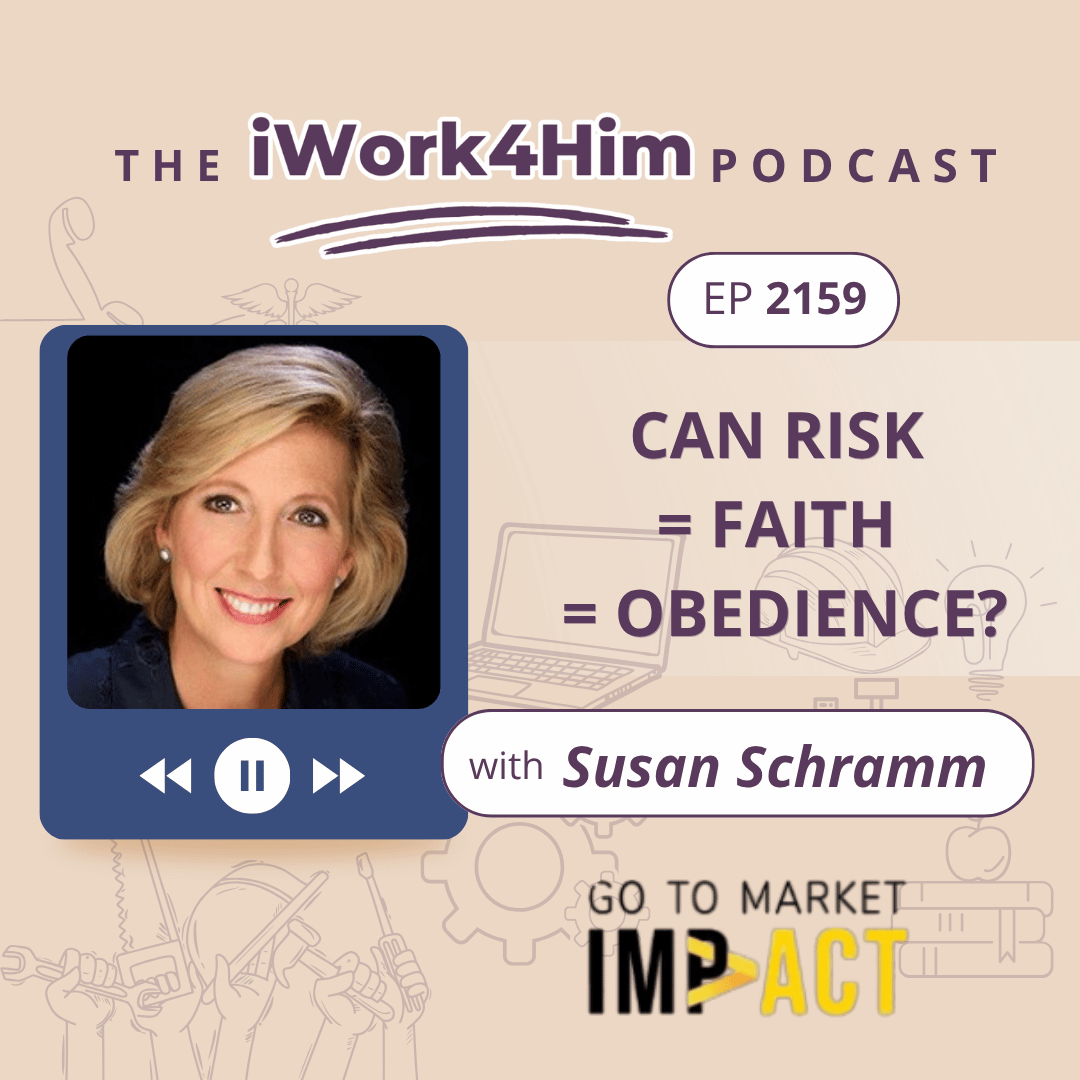
8/11/26 - 2159: Can Risk = faith = Obedience?
Jim: This is an iWork4Him, iRetire4Him joint production
Martha: Where faith meets work and believers unleash their calling, and where faith takes on your retirement years and unleashes meaning and purpose.
Jim: Risk, it's like the final frontier to overcome before success is achieved. Risk is scary. It's unpredictable. It's risky. But you have to face risk head-on. Susan Schramm knows this all too well, so she wrote Fast Track Your Big Idea: Navigate Risk, Move People to Action, and Avoid Your Strategy Going Off Course.
Jim: Susan understands risk. She works with big risk-takers. Big risk-takers are scary because they fail almost more than they succeed. Susan's gathered wisdom from being in the fray all these years, and she's ready to help us all avoid the pitfalls of avoiding risk. Bet you didn't see that coming. Susan could be retired and sipping lemonade under an umbrella somewhere sandy, but she is still in it and at it and engrossed within it.
Jim: She hasn't checked out. She's sold out to help business people learn from her years of accumulated wisdom. So whether you're retired and listening or working and listening, this show is for you. We all get big ideas, but most of us cower in the face of the unknown, and the risk of putting the idea out in the open. Susan's here to bring all that into the Biblical focus. Susan Schramm, thanks for joining us today.
Susan Schramm: Thank you for this opportunity. Really fun. Great audience. I can't wait to talk, to share with all of them.
Jim: So Susan, before we get started today, tell us about Nehemiah's E-Community 3-Day Business Summit that launches this week on August the 12th. Who is it for, and what can they expect?
Susan Schramm: As board chairman of Nehemiah Entrepreneurship Community I am thrilled to be able to share a little bit about this event, which is really a community of leaders who are willing to step out and live out their faith in the marketplace. There, there are people from all over the world, business owners, investors, nonprofit leaders, church leaders from more than 100 countries who we've served in terms of both training, coaching, and community to build businesses and lead organizations based, doing it God's way.
Susan Schramm: The theme of this event, which we very are grateful that you are both gonna be emceeing, is called Kairos: A Call to Leadership, and as you probably know in the Bible, kairos refers to a divinely appointed or opportune moment when God's purposes intersect with human history. And that's really what this is about.
Susan Schramm: It's not leadership as a role or a title. It's about leadership as influencing the world you're in and engaging in it. So there has never been more need in the world for courageous values-based leaders. The problems are bigger than ever, the opportunities are bigger than ever, but it takes leaders who are comfortable stepping out and living out their faith with confidence, recognizing that taking risks requires a different type of courage.
Susan Schramm: The cool thing is that we have a business tour of companies around the world who are sharing how they're doing it. We have a whole day of training, and we even have a, a business plan competition, a global business competition that you can be part of and engage in. So it's a really wonderful opportunity for people who feel in many ways called to lead at a time such as this.
Jim: Susan, how do people find out more online about that?
Susan Schramm: So it's nehemiahecommunity.com, and I believe it's Nehemiah Summit. So I think we basically, if you Google it, nehemiahecommunity.com.
Martha: I'll put it in the show notes.
Susan Schramm: Great. We'd love to have you. We'd love to have all of you join. It is an experience. And by the way, we have a big worship group. We have worship every morning, and it's translated into multiple languages. We have people from Africa, from Asia. It is a unique experience for anyone who sees themselves bigger and feels like they wanna be inspired.
Jim: And for the, the listeners, just so you know how we got connected with Nehemiah, 14 years ago a guy I was mentoring said, "Jim, you're like my Nehemiah." And he goes, "And I found this organization called the Nehemiah Project online. You should check them out." And I reached out, and we've had a relationship these 14 years. And they no longer go by the Nehemiah Project, 'cause back then there was no eCommunity possibilities. But today it's Nehemiah eCommunity, which does span the globe.
Martha: All right. So we are pretty excited about that, and I hope that people will look it up and check it out and see if you can still get connected because it is, there is no other event like it that I'm aware of. So Susan- ... why are we talking about risk? Why, as followers of Jesus, there's no risk involved, is there?
Susan Schramm: Yeah. Yeah, it's funny. You know, there is a whole mindset that says, "I've got God. I don't need anything else," right? Except let's read scripture, and we hear stories. We hear Esther stepping out. We've got Paul stepping out. We've got Nehemiah stepping out, every time taking risks. And one of my favorite examples is Esther.
Susan Schramm: Mordecai asked her to take a tremendous risk, and speaking up could cost her position and cost her influence. And we all say, we know that for such a time as this. But truthfully, the one line that I love about that was being silent is not acceptable. It has consequences, right? So the idea of taking risks is around us from time immemorial, and God has never said, "Don't take risks." He's actually said, "Take risks for me."
Jim: Or even better, "Take risks with me."
Susan Schramm: With me. Exactly. Exactly. Take risks with me. Let me walk with you to take risks. Exactly.
Jim: So risk and faith, are they related?
Susan Schramm: Yes, absolutely. I don't think they're inconsistent either. Faith is often expressed in how we respond to risk. Think about it. Risk is everywhere. Peter faced risk. Paul fa- everyone faces risk. But faith allows us to have context for how we make decisions and live in a world where there is uncertainty.
Susan Schramm: My definition there's a lot of financial planners always say, "What's your risk profile?" And usually what they're talking about is, how much money do you wanna lose? Are you willing to lose, right? (laughter)
Jim: That's right.
Susan Schramm: But what really when you think about risk, we all know there's a upside of risk. You take risk to get reward, and there's downsides of risk you might lose. But at the same time, really, it's all about an unknown. Risk is simply an unknown. It has two sides, and at the end of the day, how you navigate that unknown, how you prepare yourself to live in a world of unknowns speaks to the fact that you can move forward obedient to God's calling to you to live with faith in him as you take steps forward. It's not to get stuck.
Martha: So I'm curious how you decided to dive into risk as a conversation because, I don't know, I could say it's risky, but the reality is like, why do you think God gave you this message?
Susan Schramm: Wonderful. So I spent my career in large corporations like IBM and Nokia and Siemens, and I spent most of my time launching things. I also worked in church organizations and nonprofits, and most of my role, I had lots of different titles, but most of my role was helping someone go from, "I've got an idea," to, "Let's get everybody aligned to go do it," whether that was bringing in revenue or bringing in volunteers to change communities.
Susan Schramm: And over the course of years, I realized that some worked and some didn't. Some were pretty bumpy. And I started reflecting on what is it that causes that? And at, at the end of the day, I analyzed it, I did research, I interviewed millions of people, and concluded that the one element that sort of was the common factor was the people side of risk.
Susan Schramm: Yes, 70% of all startups fail. Lots of stories of people taking efforts, but some did well, and the common factor when they did well was they planned proactively for the people side of risk, not just the technology, not just the finances or the operations. And many times that really became the issue that was skipped, and I feel like in many ways the call that I heard...
Susan Schramm: i've only heard God speak out loud in my head so that you can hear Him outside and inside only once in my life, and He actually did say, "Take risks for me." And it was at a weird time in my life. My kids had just left for college. I was rethinking my career, and I'm like, "What is this thing called risk?"
Susan Schramm: And I believe that for the world to be successful, God calls us to step out, yet He sees people play small ball, and I think what He's encouraging me to do is help normalize this conversation about risk- ... so that people don't see it as something to avoid. In fact, they see it as something to help them engage confidently, more able to adapt and more able to lead in a sense that God calls them instead of playing small to the gifts he's been given, that you've, that each of them have been given.
Jim: What you've essentially said to me, and I'm gonna put it in Jimease, that not talking about risk can be risky.
Susan Schramm: Yeah, and that's counterintuitive for many senior, for many leaders. Many visionary leaders get very in love with their idea, and they lay out a plan, and they don't like the idea of people talking about the risks of it.
Susan Schramm: In fact, when people do, they might see that as Debbie Downer or the idea of sort of a non-loyal person. "Don't talk about the risk, I got it covered." Or they say, "Listen, don't worry, I have it all covered." What happens with risk is if you don't talk about it people's misgivings, their confusion, their skepticism, their fear, anxiety, starts swirling in their heads, and what will happen is people will essentially not take action.
Susan Schramm: And maybe initially they might say "Sure," or they nod "we're in." But over time they are not gonna be sustaining the idea. And so one of the most biggest frustrations in the world is when a person with a great idea says, "Why isn't everybody jumping in?" And yet they don't wanna hear anything against their idea.
Susan Schramm: It was funny, we recently heard at the US Chamber of Commerce from Bill Jurgen, right? Former CEO of Kraft. And he talks about a phrase called silent liars. They don't accept silent liars. That's the person who sits in a meeting, who nod their heads, say everything's fine, and then walk out and complain later. And really never talk. So at the end of the day, what's riskier is to not talk about it and think people are all aligned, they really understand and are gonna jump in with you and then have this great, wonderful idea that probably has lots of merit, not actually work because their concerns and ideas weren't heard.
Jim: So is that what you mean by the people side of risk?
Susan Schramm: Yeah. The people side of risk is the human element for every strategy, and it is always the most underestimated. Even in change initiatives, even in big change management initiatives, they'll make a lot of assumptions about adoption, about people moving forward, and a lot of times the assumptions have to do with the initial phase.
Susan Schramm: What people often don't consider is the human element of the, the transition everyone goes through. You first of all hear about a change. There's a tendency to evaluate it. Then there's this, if they have to make any change in their behavior, if they have to do something new, they're taking a risk.
Susan Schramm: It could be just looking stupid. It could be time that they're wasting. It could be, there's a lot of different risks someone takes to change what they're doing, and so many assumptions are made about whether people will actually move forward, and yeah, that's the people side of risk.
Jim: Wow. So good.
Martha: We're talking about risks, and it's one of the things that we have learned is that there's some risks that we just don't need to expose ourselves to, and cyber criminals never take a day off, and neither should your online protection. That's why we're so grateful for SaferNet. It's cybersecurity made simple for families and businesses with VPN privacy, virus protection, and internet controls that help you manage what comes in and what stays out of your computers and all your devices.
Martha: We use SaferNet, and we believe it can help you protect your people and your purpose. Go to safernet.com and mention iWork4Him.
Jim: And don't forget our summer picnic initiative. We're running out of time. Have a block party. Invite your neighbors over, and love on your neighbors. We want you to send us a picture to jim@iwork4him.com.
Jim: We even included a website page link in the notes today of here's how you could put together that picnic right on the iWork4Him website. Email me a picture when you've had your summer picnic party. It doesn't have to be huge. Just get to know your neighbors, jim@iwork4him.com, and remember, at the end of the summer, one special winner will be selected for a grand prize. All right. This is a big deal.
Jim: All right. Susan, it seems like Christians are taught to be risk averse, especially with investing. Is it the parable of talents that really deals with the positives and negative aspects of facing risk? It's easy for me to say. But the parable of talents talks about this risk versus risk averseness-
Susan Schramm: And in fact, wouldn't it be great if that was a full-length movie? I love that story. I love that story because you think about it, you've got this very innovative, visionary boss who goes away and invests and shares his assets, and helps three different of his leaders step up and says, "I'll be back. Take risks for me," essentially is what he's saying. And what was always fascinating to me was what about those people was different?
Susan Schramm: Really what it showed was the risk profile, the risk personality, the risk fingerprint of these different people. Some stepped up, probably, bought a building. Some other person invested in stocks. But one person was fearful that they wouldn't save. They wouldn't... they wanted to be safe.
Susan Schramm: They didn't wanna be... They, it wasn't that he was immoral, he was afraid. And I think when Christ comes, when the story is told and Christ comes back and says, "That person is the one that I'm holding accountable," it's because he's not calling us to not take risks. He's actually recognizing that we have different levels of a willing- willingness to engage.
Susan Schramm: But from where you are with what you have, take a step. Now, I suggest that we think of our risk profiles in two dimensions. There's the willingness to be aware of risk And then the willingness to engage in risk. And if you think right now about your team or your neighborhood, you know which ones are always looking out.
Susan Schramm: There's, they're wired to always seeing what the possibilities are that might cause things to trip up. You could call that the Debbie Downer, or you could call that the wise person who sees ahead. And then there's the engagement. Some people will just jump off a cliff, "That looks great, let's go." And you need some of that, but what you need to build a good team is you need all of it.
Susan Schramm: What often we underestimate, we come with our own perspective. We haven't thought through what is it about that person's risk profile that would make them take risks with me? What makes them wanna step out with us? And I think that, the Parable of the Talents, I think, is a wonderful example where God is...
Susan Schramm: the, the story encourages us to recognize, yeah, we're different. And in fact, that difference is how we're built as a community. Let's leverage our differences, and not put people in buckets because they're bad or good, but actually recognize that all of our perspectives are important for us to actually move forward together.
Jim: Speaking of moving forward, we got people listening today that are in their retirement years, and people that are still in their working years. And it's a risk. A lot of retirees have been told, "Step back, check out. No more risk-taking because you could lose it all," or whatever. And workers are going I wanna step back, chill out, because I don't wanna screw up, 'cause I wanna retire in a number of years."
Jim: It's all around this false theology that retirement's even biblical. Why is avoiding risk actually more... and the risk of change, because we got people that are retiring, they're like, "I don't know that I wanna start something new. I'm chronologically superior." We don't call people old on this show. (chuckles) But that, that change, we're so afraid to make change, that's more dangerous than actually facing the risk and facing the change. Talk to the audience that's, you could be retired, but you're not. You're still chasing it. Why is avoiding that risk of change so scary? How do we get past that?
Susan Schramm: When you told me that this was gonna be run for two dimensions of this conversation with retirement, I looked up the phrase "retirement years," and I found this definition I thought was interesting: a phase of life characterized by personal freedom, leisure, and new pursuits. Okay?
Susan Schramm: 'Cause you're exactly right. There's nothing in the Bible that says suddenly stop and kick back. God actually continues. But what it does say is there's seasons. I believe there are seasons of life, and I believe God calls you to a calling, and there's different ways for you to live it out in different seasons.
Susan Schramm: I feel like in many cases, what I find, actually, one of my unexpected audience-- I, I wrote a book, Fast Track Your Big Idea, with this idea of helping people startups and nonprofits who had this idea. I had no idea the number of people who felt called that said, "My career life did not allow me the time to pour into my real passion areas, so let me pour into it now."
Susan Schramm: And so people were actually willing to take risks in a new way, but they also often were concerned that they were, that they would fail, that they would look dumb, that they sometimes would - they wanna start something new instead of help somebody else 'cause they wanna do it their own way. There's a lot of people with different perspectives.
Susan Schramm: And I think what we're seeing is a huge generational unleashing of baby boomers retiring in a way that they aren't calling it retirement, they're calling it the next chapter- in many ways when they leave. And they are more resourced in many ways. They've saved. I'd say in corporate life, what I see is younger folks saying, "I'm gonna step out my calling." The person who in his 30s or 40s says, "No I'm good with that, Mr. Company. I'm gonna go do what I wanna do before I don't have energy and time."
Susan Schramm: So I think we're, I think we're actually... my view right now is that risks, the risk you take, you certainly have to have financial planning, and don't make dumb mistakes. God, the, the Bible says, in Ecclesiastes you definitely... He says, "Diversify six or seven things. A disaster might come. Have backup plans." There's no intention for people to just step out with no plan. But there is, I think, a growing excitement about stepping out to a new chapter of what they're called to do. And that's one of the reasons I wrote the book, to be honest, because many of the things I found was they hadn't thought systematically.
Susan Schramm: In fact, one of the guys, my favorite reviewer said, "I don't have a big idea. I have a itty-bitty idea." And, but, it's a... So he started a nonprofit to help improve education in his little community. And within a few years he was struggling to get board members engaged, and he says, "I figured it out, Susan. What you're telling me is I've gotta think through a strategy to do this, not just jump in without a plan. God's not, God is calling me to make a difference, but He's not calling me to be dumb."
Susan Schramm: So the idea is to build a thoughtful way to de-risk your strategy ahead of time, and surround yourself with people who are encouraging you, but also will give you real feedback too. Not just listen into, in the bubble ...
Jim: and that's where the Nehemiah e-community can kick in with their biblical entrepreneurship classes, which are just fantastic. That was a free plug. She didn't, Susan did not ask me to do that. (laughter)
Susan Schramm: Thank you.
Martha: Okay. So how do you counsel somebody, though, that has this big idea, or maybe it's a itty-bitty idea, really good, but they're frozen in place because they are not wanting to pursue any risk?
Susan Schramm: So the first thing I would do is ask this one question. What problem do I need to solve? What is the problem? I have this feeling of doing something. What is the problem I need to solve? And then ask the question, what if I don't? Because at some point, people will not take action unless there's a consequence. There's no urgency.
Susan Schramm: You can't do it alone. No idea, unless you're gonna play tiddlywinks, to be honest, no idea is gonna be successful to make an impact in the world, even if it's in your family, without aligning people to move forward. But what will make the difference between getting frozen and not moving at all is urgency.
Susan Schramm: So if the problem you're trying to solve has no urgency, there's no... if it doesn't happen in 10 years, did it matter? Then they're probably, it's probably not worth taking the risk. But if you personally see that there's a consequence that you care about, then find five other people and see if they also see this concern about the consequence.
Susan Schramm: And from there, clarify, one - what's the problem you're solving? Why does it need solving now? Who has to take action to solve it? Not you all alone. Don't step up with huge investments. Create the community first that has an aligned view of what we're trying to achieve, and then you're not alone, and then you have sparring partners, and then you have the ability to make better judgment to step out.
Susan Schramm: The the saddest story is the write down all the if only I'd has that would haunt you.
Martha: Yeah.
Jim: If only I'd have done that. And If only I'd have done that. Exactly. If I'd only... If only I'd have bought stocks in 1974 when the... Actually, if you'd only bought stocks in 1987 when the stock market was at 800, and now today it's at 52,000, you're like, "Wow, I could have bought any stock and made money almost." All right.
Susan Schramm: It's like the story of how to plant... When do you, when's the best time to plant a tree? Was it yesterday? At any time what you're gonna do. But I think one of the things I see is people with... I met with this group of people with a big vision of changing the healthcare system, and they were nurses, and they were so inspired.
Susan Schramm: They put together a website and they put together their board and everything, and within a year, the board was starting to fall apart. Nobody was staying. They couldn't get volunteers. And I said "what are you trying to do?" They said, "We're trying to start a movement." And I said, "If you had 10 people, what would they do? Not a movement, but 10 people." Because if you scale it to something small and prove it out, you actually start clarifying what is the problem you're solving.
Susan Schramm: And it may be a little different nuance than you had in your head. People may be more excited about some element of it, one piece of it, and you can start bringing people along with you.
Jim: Nice.
Martha: So over the course of our career, our paths may change way more than once. Several of us have, many paths in our career. But choosing a cellphone provider that reflects your values is a change you only need to make once. Patriot Mobile is built on the pillars of faith, family, and freedom with dependable US-based customer service. Make the switch this year and learn more at patriotmobile.com/iwork4him.
Jim: Susan, I want to shift the end of our show strictly talking about retirement years because you're in your retirement years. What kind of risks do retirees face?
Susan Schramm: I think people immediately think financial, right? That's where lots and lots of time is spent and a lot of communication. I think the biggest risk is the sense of either over-committing themselves to all the things they wanna do, and running out of steam, right?
Susan Schramm: That we see many people, marriages even failing because they start pouring themselves into every interest they ever had without aligning to what is most important. If you only had so much time. The other is the lack of identity. And that you see a lot when people were very identified with their business career, their corporate career, their whatever job they had or title.
Susan Schramm: And that lack of identity, if there's ever been a call to recognize that you are a child of God and your identity has never been more needed. And so I think the risks sometimes are focus. The lack of focus, and whether that focus... what I always encourage people to do, 'cause a lot of people wanna be entrepreneurs someday, and I always encourage them to be entrepreneurs in whatever job they're in, to think of themself, and to start their business plan work now.
Susan Schramm: Even as they're still working, and start testing ideas, finding out, doing research, finding out what are the problems that you're solving that others wanna solve, too. Because a lot of the time when people jump into things they're derailed. And that there's a lot of family time. People always are balanced.
Susan Schramm: I'm personally struggling a lot with life balance. I have grandchildren. I have parents in their 90s. I have a husband who loves to travel, and I'm building a business. I'm around the world. I'm launching a book. I have a lot of energy in consulting. So the idea of prioritizing is a big challenge in when you have enough financial resources to step out and use this last few years.
Susan Schramm: My husband has a phrase, I'm sure you guys have used on this show. The three phases of life, which is the go-go years, the slow-go years, and the no-go years.
Jim: See- And all three of those can be in your last phase of life. Really, at 65, you can have the go-go- Yep the slow-go, and the no-go all between 65 and 95.
Susan Schramm: And it's very humbling when you see someone who is in the no-go years and their world gets very small. They never leave a building. They have one window in their house that they see. The realities are the, it could happen tomorrow, right? So when we make choices, my husband and I have a go-go years budget- And we sit there as we plan our year, and every quarter we have a go-go years goal. And and the slow-go years are there for balance, but I will say that you're right. It goes, I'm sure it goes quickly.
Martha: Yeah. So let's talk about the peer pressure for retirees as well, because often we don't conform, there's that risk of not conforming to what everybody else is doing as a factor in what decisions they make.
Susan Schramm: Do you see that a lot? So what kind of peer pressures are you talking about? Because I'm intrigued.
Jim: I'm talking about the risk of not conforming. People are like "when are you gonna retire, Susan?? When are you gonna be d-"
Susan Schramm: I get that, that- All the time Okay. Definitely.
Jim: That's the risk. You get-
Susan Schramm: All the time.
Jim: Yeah. People are pounding you, like- ... "Susan, what are you work- you're not, you're retirement age. You could retire. What..." So there's that. So Martha and I lived in retirement villages for 20 years in Florida, two different ones, and there was that all the time. It was everybody keeping up with who's gonna retire soonest, and when you're retiring, who could run the homeowners association.
Jim: But it was, there was always, there's always that risk of, "Why aren't you, why are you still working?"
Susan Schramm: Okay, so you've had that question. I've had that que- How do you answer that question?
Jim: It's like, I'm never retiring 'cause I like what I'm doing. I'm having a great time. Retirement, I always want to be in a place where I have purpose and meaning in what I'm doing.
Martha: On iRetire4Him, we say, "If you have a pulse, you have a purpose."
Jim: And if you're not dead...
Martha: You're not done.
Susan Schramm: Okay. Then, sold. (laughter) because I think I have struggled with that. I get it all the time. And it's one of the things I had to learn not to be defensive about. And I did find that many of the people who say that did, do not, did not love what they were doing.
Susan Schramm: And so now they do love - they love being with their families or they put off, many of these people put off in their careers having a rich life of feeling of purpose. That's one of the reasons I love the marketplace ministry idea. Some people felt to be in the ministry you need to go and work in the church or be a pastor, right?
Susan Schramm: Then we started realizing, oh no, you can actually live out your faith in the marketplace. Those who do start to see the purpose they have every day in the way they can influence lives and families and neighborhoods by building, by even decision-makings that are counterintuitive, that are God-led instead of what profit would drive you to do.
Susan Schramm: And I think that I've noticed that the people that ask me that question the most, I ask, I turn it around and say, " why did you retire? What did you retire from?" And then when I hear that, I realize, oh my gosh, of course. If you were putting off having a purpose and feeling a sense of of value, of course you would leave that as far as possible.
Susan Schramm: But I think that the cool part is when you actually help them see how their season is actually an opportunity for having a different kind of influence in the world. And it may be the influence, I have a lot of people say, "My whole call is to serve my grandchildren." I say, "Wonderful. That's wonderful. That may be your call. Just recognize that it is a season- ... and there may be your gifts are big and your gifts are... And there may be you're not feeling like it's either work. Most of the time I hear people go, "And then I realized that my kids didn't wanna see me as much as I wanted to see them."
Jim: I can't imagine that. But there's so much more we could talk about this and... but we need to be done. But you wrote your book: Fasttrack your big idea. And that's what this whole conversation - navigate risk, move people to action, and avoid your strategy going off course. That's why we've been talking about risk with Susan Schramm today.
Jim: I encourage you to get a copy of this because it inspired this conversation. And, Susan, as you were saying what you were just saying, one of the other things we say on this show all the time is people always know what they're retiring from, but very few people know what they're retiring to.
Jim: And that's what we've gotta change. Whether you're working now or you've already retired, just know that God's not done with you yet. God has something rich for you in these years. Just say, "Lord, what is it?" And it may be you hate your job, but I'm telling you, it's your mission field, and you're surrounded by people who need to meet Jesus. And so in the years you have left, shift your mindset to a ministry.
Jim: But if you're already retired and you're looking for meaning and purpose, ask the Lord, "Who is it? What is it I should be doing with everything I've been given?" Because Susan Schramm's not done. She's pouring her life into the next generations and the next generation of all the wisdom she's been given. Susan, thank you so much for being on iWork4Him and iRetire4Him here today.
Susan Schramm: I'm thrilled to have had this conversation. I look forward to seeing you at the summit and continuing in this world that you are shaping every day with the conversations you're hosting. Thanks a lot.
Jim: We're so grateful to have you.
Jim: And that wraps up our conversation with Susan Schramm. And if something she shared today landed with you, I encourage you to sit with it and maybe share this episode with someone who also needs to hear it. This podcast runs on the support of people like you who believe in what we're doing. And if that's you, we would like to see if you would want to support more conversations like this one to reach more people.
Jim: You can donate to iWork4Him for as little as $5 a month. That's a little less than a cup of coffee anymore. Visit iwork4him.com/donate and help support the show. We'll put that link in the show notes as well. You've been listening to iWork4Him with your hosts, Jim and Martha Brangenberg. We're Christ followers and our workplace, it's our mission field, but ultimately, iWork4Him.