Jim: This is iWork4Him ...
Martha: where faith meets work and believers unleash their calling.
Jim: There's so many things to think about as we approach the end of the year. Have we paid enough in taxes? Have we maximized our giving into retirement? How about maximized our giving into our local non-profits and charities? Have we taken our required minimum distribution if we're retired and over 70 and a half? And most importantly, is our investment portfolio in line with the heart of our Heavenly Father?
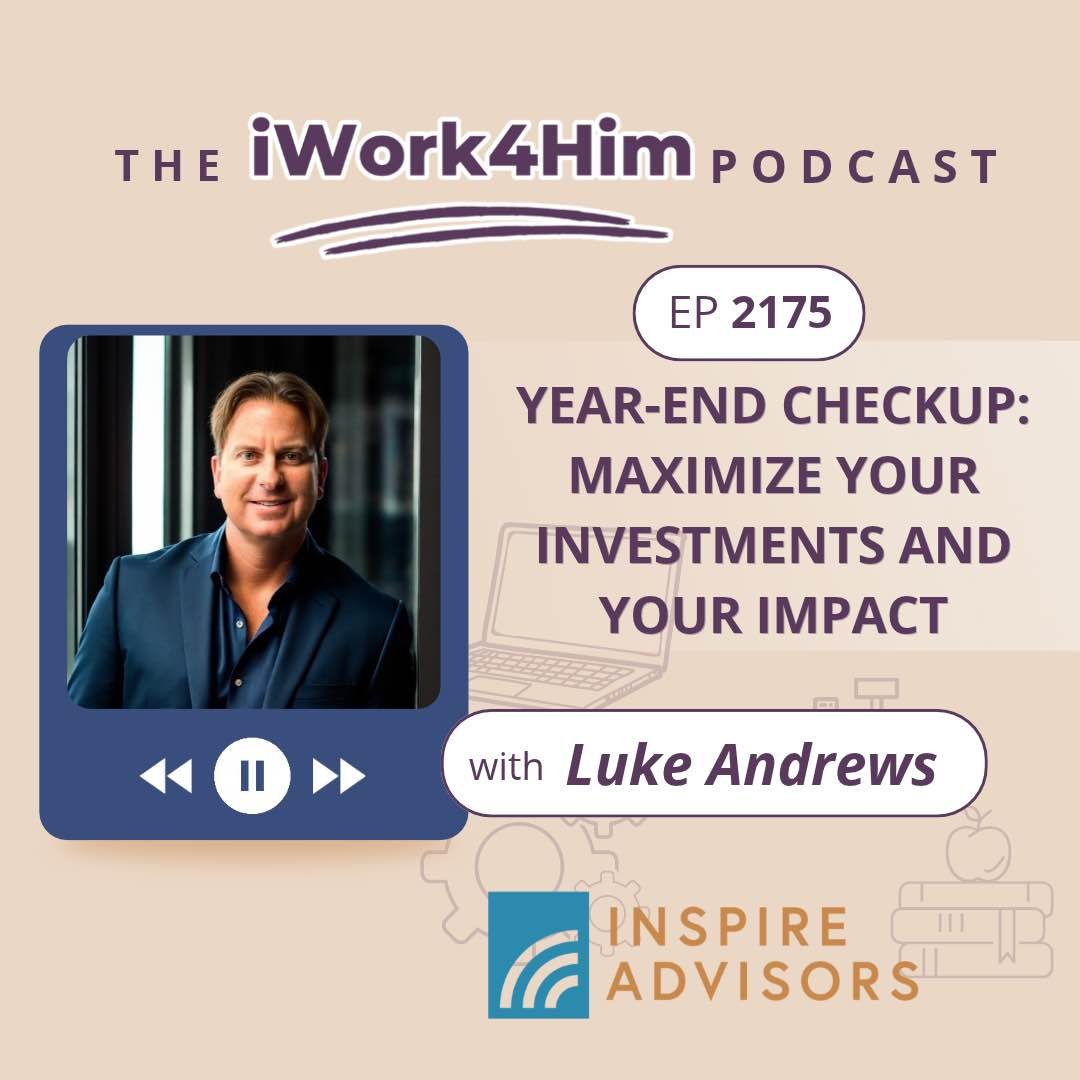
Jim: This won't be a long show today, but we wanted to get Biblically Responsible Investing Luke Andrews with Inspire Advisors back on the show to help us make sure we are ready for our year end. Luke Andrews, welcome back to the show.
Luke Andrews: Thank you. Good to be here. Love seeing you guys. I love the signs in the back. We already talked about that.
Martha: I'm pointing ... Inspire Advisors - for those that are on YouTube you can see inspire Advisor right over my shoulder.
Jim: That's right. We've got some great people behind our show. We're super excited to have partnered with you since the day I announced in our chamber group that I'm going on the radio. Luke came up to me and says, "I wanna be a part of that. I wanna be a sponsor on that show." It's been a long time. That's a lot of years. That's a long time ago. Absolutely. That was December of 2012, just so you know. No, 20- Wow ... no, yeah, it was right around there. All right.
Luke Andrews: Somewhere in there.
Jim: Luke, the holidays are upon us, okay? Thanksgiving's right around the corner, then Christmas, then New Year's, and year end.
Luke Andrews: Yeah.
Jim: What are your big plans for your family, which has modified itself this year? As you close out 2026, what's big plans for Luke? This is a personal question, as you close out 2026.
Luke Andrews: You know from being, lived here for quite a while, Indian Rocks Baptist Church, we do an annual jamboree.
Luke Andrews: And so for me, that's coming up this week. Starts tomorrow and runs through Sunday. That is the kickoff of this whole holiday season, and Thanksgiving, and Christmas. The weather here changes. Instead of 92, it's 82. We were just talking about the weather before the show, and so we're, that's really where it starts here for us, and then most of my family's here, so we get together at our house for Thanksgiving and Christmas. It is a little different, we'll probably ask Riley and her husband they-
Jim: Ooh, first husband Christmas.
Luke Andrews: Yeah. Even though that they live 12 minutes away, they can still spend the night to kinda have that, wake up Christmas Day sorta thing. So yeah, it's different, but it's a great new chapter for them, for our family, and looking forward to jamboree, 'cause the corn fritters. The corn fritters are legendary.
Jim: I'm thinking the ribs. Oh, just when you talk about jamboree, I'm thinking about the ribs.
Martha: You'll have to eat a few for us.
Jim: Oh.
Luke Andrews: Every year, I will say the rib person, the rib company that used to do the ribs when you guys were around, they're not... They've kinda switched, so-
Martha: They probably went all healthy.
Luke Andrews: There's still ribs ... I don't know. Yeah. There are gluten-free ribs. No they're, yeah, fat-free ribs.
Luke Andrews: No, it's a new group, but there's ribs. Barbecue, of course. It's part of the deal. Part of the deal.
Martha: A lot of people look forward to fun things as they look to the end of the year. And our investments and our finances doesn't have to be stressful, but it's important to have the conversation. So for our listeners that are still working and earning a paycheck, there are some new retirement tax laws and contribution-type things that come into play this time of year that they really need to pay attention to. Isn't that correct?
Luke Andrews: Yeah, the tax law stuff we'll always defer to attorneys. But as far as the investments and the, some of the contributions, yeah. But I will tell you that you guys are clients, you recently saw my end of year planning email, and that is something that our office, my office, I'm sure other advisors may do that, I don't know.
Luke Andrews: But I'm just speaking for my office, is every year, right at the beginning of November, we send out this kind of end of year planning, and most of it's recapping what the rules are, contribution rules. But really in January, to answer your question, I send out an email in January that reminds you that, hey, the contribution limits have changed on your 401K, on your simple IRA plan, on your SEP-IRA, on your IRA contributions.
Luke Andrews: Please update them because I don't manage a lot of the employer plans while you're still working. Normally, I manage the IRAs once you're done. But, those are just reminders for all my clients that every year they're changing. The IRS, once a year, they haven't made the 2027 updates yet, or else I would've had them fresh off the press here for you guys.
Luke Andrews: But yeah, so every, every year this time of year is a reminder time, reaching out to clients, making sure that you've taken all your RMDs, which I know it's something we might talk about in a little bit. What you can do with those RMDs. If you haven't done them, make sure we get on them. But also maxing out your retirement accounts especially if you're in a higher tax bracket this year than you were last year, and you wanna try to avoid paying more taxes, right?
Luke Andrews: Anybody like paying a lot of ta-? I hear a lot of people saying they wanna tax more people, but they're not volunteering to pay more taxes. Neither do I. So yeah, there, there's new contribution limits each year, almost every year. And then I play a big part of that for my clients. I don't want them to have to go find all the information. I'll send them the information. But if you are one of those who likes to go out and find the information yourself, then just go to the irs.gov and you'll have all the limits for this year, and then once the new year's posted, they'll be there as well.
Jim: But I also was noticing is that when people are over 55 and then over 60, that there's some catch-up provisions. Not ketchup like Heinz ketchup. Catch-up provisions for making more contributions to your retirement plan. In case you haven't been doing up to this point in time, you can do some of that.
Jim: And there's also the contributions to the new Trump Kid Funds that are out there, for anybody born, I think it was last year or this year, they get, you can contribute to, the fund was created by the government, but you can contribute to that fund.
Luke Andrews: Yeah yeah, so once you're, for your IRAs and your 401ks at work and your simple plans, once you're over 50, so it could be you might not be 50 yet in 2026, you turn 50 in 2026, so you have a birthday coming up, you still... there's a catch-up provision in your retirement accounts from your IRAs to your employer plans. You have a catch-up opportunity.
Luke Andrews: And again, those are some of the things that when I'm doing my annual reviews, I have it automatically when I'm sending out my prep and agenda email, I'll check your date of birth and are you turning 50 this year? Are you turning 65 this year? Are you turning 68? Are you turning 62? 'Cause there's a lot of these years have some effect on what you should be doing, what you can be doing, and we help navigate through those.
Luke Andrews: Now, the Trump accounts is really neat because, yeah, if you had a child that was born in 2025 or up to 2028, there is $1,000 sitting out there for you in an account, but you have to essentially activate it. Yeah, you can't just have the child and say, "We have this $1,000 account." You have to go basically claim it, and there is a form, it's form 4547, that you can get from the IRS. You claim the $1,000, and it gets invested into a low-cost index fund, like the S&P 500. And then once that child is 18 it turns into their, into their name.
Luke Andrews: So all the growth is tax-free, but, once they turn 18, they, there would be taxable income for them if they started taking money out. Parents can also, family and parents and grandparents and friends can also contribute to that Trump Account, up to $5,000 per year. Or an employer can contribute up to $2,500 per year.
Luke Andrews: So it wouldn't be 5,000 and 2,500. It would just be a aggregate of the two, whether it's an employer adding to it or or a parent or family or friend. Yeah.
Martha: I just wanna comment on the Trump Accounts, 'cause a couple of different things. Number one, how many times do you have a child in your life that you want to buy something for, but they don't really need anything, and they're gonna open a bunch of gifts at a birthday party?
Martha: The Trump Account is one way that you can give them something that's very long last- more long-lasting than the next 10 days, where they play with a toy or whatever it might be, and can significantly make a difference. And also I love the whole idea behind it just in the whole concept of people learning again about saving and compounding and all of the things that happen when you put some money away and you watch it grow.
Martha: And so I just, I encourage people to check it out. Look at who the people are in your life, find out if they've already created the accounts and then make that an intentional opportunity, especially I'm gonna speak to the grandparents out there.
Luke Andrews: Yeah, that's right ...
Martha: because what a great way to see their future. My grandparents bought an IRA when I was little that didn't pay till I was 50. And so I am so touched by their- oh, it was an annuity. Thank you. But it was the thoughtfulness of that. And to think about that in terms of this Trump Account, I think is huge. So I just wanted to put that emphasis out there for the grandparents. Jim, you have something else you wanna ask him about?
Jim: So Luke, I know that not everybody listening is still making a regular paycheck. They're now collecting from their 401K. And there's this thing called the required minimum distribution, which doesn't kick in, I believe, until they're 70 and a half, right?
Luke Andrews: 73 now and it'll be 75, I think by 2034. Yeah. So- It's 73 if you're turning 73 now.
Jim: Yeah ... so if you're 73 and you've got money in a 401K, you have to take money out, but you may not need money. And but if you don't take this money out, you're going to- what, do they lose it, or what happens to it?
Luke Andrews: It, yeah, there's alway- there's rules. So if it's in a 401K and you're still working for that company where the 401K is, you're not required to take a distribution.
Jim: But we're talking about people that are retired- ... And they've got mon-
Luke Andrews: They're not working anymore. They, first off, they shouldn't be in a 401K because they're no longer employed. They should be in an IRA. So let's assume IRA. That's what you're going with.
Jim: Okay. Let's assume. All right. Let's assume that. And let's assume it's with Inspire Advisors and Luke Andrews.
Luke Andrews: Of course.
Jim: Biblically Responsible Investing.
Luke Andrews: So at 70 and a half, you can do what's called qualified charitable distributions, and that's a tax strategy, something that we help clients think through, where you have a large IRA, and at 73 you're gonna be taking these really large RMDs, these required minimum distributions, and puts you into higher taxes than the money than you actually need.
Luke Andrews: So we actually start coaching clients at 70 and a half to do qualified charitable distributions for their charitable giving versus giving cash, right? 'Cause the cash you've already paid taxes on, that's how it's in your account. Qualified charitable distribution is a distribution to a charity directly from your retirement account, and you avoid all taxes on it.
Luke Andrews: So essentially you're gonna, you're gonna be increasing your gift by 10 to 20%, depending on whatever your tax rate is. So at 70 and a half we start doing qualified charitable distributions. At 73, you are required to make those, let me back up. Matter of fact iWork4Him is a ministry that can receive qualified charitable distributions, and by doing that, you don't pay any taxes, and you don't pay any taxes, right?
Luke Andrews: So there's some really unique opportunities there for qualified charitable distribu- to increase your amount of kingdom giving. The other side is at 73 you're required to take that distribution. And that's where it's, you're gonna get taxed on it because it's...
Luke Andrews: what we do, a lot of our clients who don't actually need their RMD or their required distribution, we just move it into their brokerage or their joint taxable account and get it back invested there.
Jim: And I think that's a great point. Let's talk about that investment stuff because that's why we've got you on here. We wanna make sure people are thinking. And that qualified charitable distribution, we here at iWork4Him would welcome that. That - raising money is tough in today's days and age, and we would love that, and we will multiply that, guarantee. We will stretch every dollar to squeeze out the... there's no blood in money, so you can't squeeze the blood out of it. But we'll make them stretch as far as possible.
Jim: So please, if you've got money and you need to do a qualified charitable distribution or a required minimum distribution, just talk to Luke Andrews at Inspire Advisors. But Luke, you mentioned something earlier I thought was great. If you're no longer working, you got money in a 401k, you need to move that money and get it invested in a biblically responsible investing portfolio. Talk about that.
Luke Andrews: Yeah. Yeah. Thank you. And that, that's something that's dear to our heart, and I know that you gave me a book many years ago called I Found Jesus in the Stock Market, and that kinda changed the trajectory over time, and that's why we're having this discussion, and even revolving around Inspire Advisors up there.
Luke Andrews: I can't reach it, but right up there. And really because that, that's what we do. Our money is not neutral. All right? The money that we steward, and that's the right way to look at it, if you wanna understand stewardship, there's plenty the Bible has to talk about. We're to be good stewards, and a steward is nothing more than a manager.
Luke Andrews: Okay? So our money, whether it's in your checking account or it's under your mattress or if it's in an investment account with your employer plan, or if it's in your IRA or your brokerage account with your financial advisor, your money's not neutral. And what do I mean by that, right? Money's not good or bad, right?
Luke Andrews: It can't drive cars and wreck into people. It can't murder. It can't - but money is not neutral. It is doing something. Right? There is some money that is murdering if you view abortion as murder, right? Because if you are investing in a company that sells the abortion drug, which is quite a bit in most of our portfolios, your money's not neutral, right?
Luke Andrews: It's no longer neutral. It's not doing kingdom work. It's not being stewarded well, and you probably don't know about it, right? I didn't know about it, and you didn't know about it. It's just 'cause we weren't taught ever to look at our investments as if you're opening up the hood of a car and wondering how the car works, right?
Luke Andrews: We just see the car driving down the road and "Oh, it works." But why does it work? It's the same thing, our investments. Our money's not neutral, and that's the lens. Inspire wants to look at how your money is working in the universe. Is it for God's glory and his kingdom? Or is it unknowingly to you supporting things totally antithetical to biblical values like companies that sell the abortion drugs, companies that produce and sell and manufacture and distribute pornography. You would be shocked by the companies in your portfolio today that are doing these things, and you have no idea.
Martha: And you know what? And that's because they're hiding in the darkness. And for a lot of things , Satan is prowling around, and he is looking for things to deceive and to destroy. And if we'd are not aware of it, you're, we're unknowingly participating in something that goes against the very things that we believe in and that we fight for.
Martha: And that's why Jim and I are so passionate about biblically responsible investing. And Luke, your organization has made it so easy for people to take their investment portfolio, look at the little letters, ticker symbol, plug them into your website, and test it for themselves, and find out if there are things going on in that company that you would not wanna support, then you need to make a decision. And really, that to me is the, the very first step of saying, "Do I really care about kingdom work, or am I okay funding things that I don't even believe in?"
Martha: And then you need to make a decision. But these are, this is a great time of year to be looking at that, because I think one of the things with the investments I think about is this is not a Crock-Pot situation, where we just set it and forget it. We need to be in- actively involved, not calling Luke every day and going, "How are my investments?" But let's make sure that we're being good stewards of what God has given us.
Martha: So what a perfect time of year to do that, and that's why we're talking about this with you, our listeners, because you're workers. You're retirees. Wherever you are, you have a livelihood that is supporting your family, and let's make sure it's kingdom.
Luke Andrews: Yeah, and it's not neutral. I think that's the big, the big takeaway here is our money is not neutral. God has asked us to steward in a way that gives him the glory, that honors him, that builds his kingdom. And if there is a way to do it and align your investments with biblical values, which we know there is- if there is a way, why aren't we doing it, right?
Luke Andrews: There's $22.4 trillion in the household of Christians, and less than 1% is run or managed by faith-based companies. You wonder why these companies, we would call it woke, right? Would call it whatever you want. Over the last decade, companies have just gone completely... y- you wonder, like, why would that company ever do that? There's not enough Christians investing in these companies, asking them and engaging with them on what they should be doing. So anyway.
Martha: Yeah. We get excited about it ...
Jim: yeah, I, we do get excited about, but that's why we wanted to bring you on really quick here, as we head into the year end, we wanna make sure that people heard from you, "Hey, it's not too late to make some changes, and it's not too late to be prepared for year end." Just call Luke Andrews at Inspire Advisors, and check out Biblically Responsible Investing for your whole portfolio.
Jim: Luke, any final words here before we head into the year end?
Luke Andrews: No. Oh, things that we do with our clients. Check your estate documents. If you don't have a will, put that on your calendar as your number one priority for January 2027. Tax loss harvesting this time of year. There are opportunities and ways that you can pay the IRS less and keep more of the investment dollars in your portfolio.
Luke Andrews: We work with CPAs and estate attorneys to make sure all those things are dialed in, and that's what I would encourage people to do this time of year. There's an opportunity to save money and pay less taxes and keep that for kingdom work. So that's what I would leave you. Yeah.
Jim: That's right. Increase your giving, reduce your taxable income, and do that all legitimately while investing in companies that support your biblically based values. Luke Andrews with Inspire Advisors. We're super excited to partner with you. We're super excited that partnership has been 14 years long.
Luke Andrews: Yeah.
Jim: And everybody listening, if your portfolio hasn't been evaluated from a biblically responsible investing standpoint, please do so before the end of the year. Start making an impact. Your dollars talk, and like Luke said, they're not neutral.
Martha: Check out the link I'll have in the show notes where you can go in and, like I said, do some of that testing of your own and find out where you really stand.
Jim: Luke, I know it's not anywhere close to the year end, but we probably won't talk to you, so Happy Thanksgiving, merry Christmas, and Happy New Year, Luke Andrews.
Luke Andrews: God bless you guys. Appreciate you. Thanks for having me on.
Jim: You bet. You've been listening to iWork4Him with your hosts, Jim and Martha Brangenberg. We're Christ followers, and our workplace, it's our mission field. But ultimately, iWork4Him.