
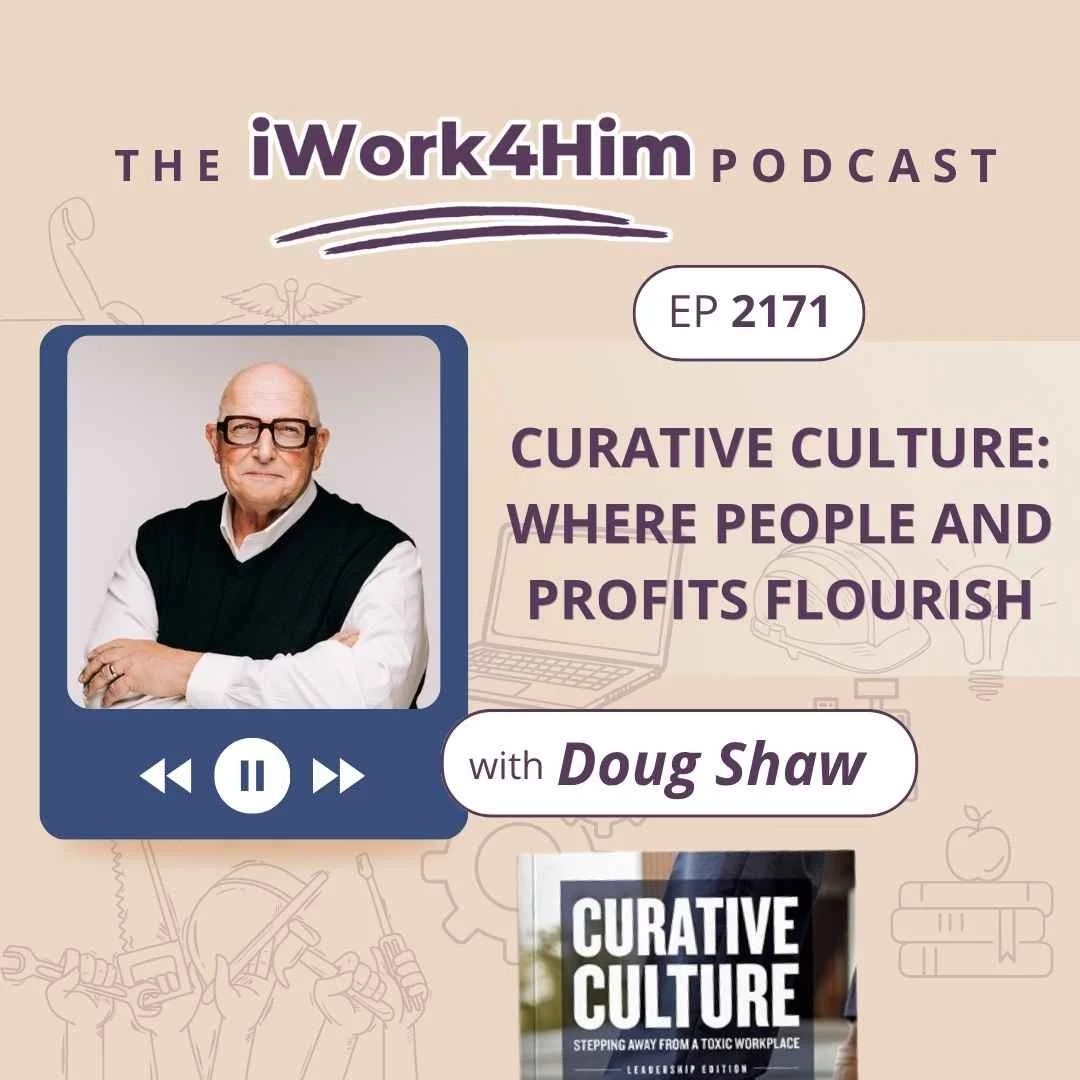
Jim: I've read over 1,000 books in the last 13 years by authors we've interviewed on this show. What I've learned is that you get to experience the author's heart when you read every word they write. I feel like I know Doug Shaw, although today is the very first time we've met him face to face.
Jim: Toxic work culture, this is a common phenomenon, not just present in secular or public traded companies, publicly traded companies, but common amongst every type of organization, both Christian and non-Christian, for-profit and not for profit. Toxic culture is not connected to the type of company, it's connected to the type of leader. The question we ask today is, can a toxic culture be transformed into a curative culture, or does a curative culture need to be bred or created from the onset of an organization?
Jim: As I read Doug's words in his new book, Curative Culture: Stepping Away from a Toxic Workplace, it makes me long to be a part of an organization where this is displayed and lived out day after day. The values that Doug describes in his book touch the very heart of every human being. Each one of us has a story of a toxic work culture we've worked within. Doug Shaw draws out in explicit detail what a curative culture looks like and how we can bring that curative culture to our own organizations, maybe even our local church.
Jim: Doug Shaw, welcome to iWork4Him.
Doug Shaw: Thanks, Jim, and Martha, thanks so much.
Jim: Doug, I was deeply moved. As I was saying off the camera before we got started, I was deeply moved by reading your book, really enjoyed it, and I can't wait to get into the conversation about curative culture. Before we go there, though, tell us how you became a follower of Jesus.
Doug Shaw: I think a very well-known ministry had an impact on my life. I was going to college and was quite lonely, and I found myself sitting in a student union building at Central Washington State College, and a guy comes by and he asks if he could have a seat at my table. And I said, "Sure." And next thing I know he's presenting the four spiritual laws to me.
Doug Shaw: And I thought, "Oh, a Jesus freak." This was back in the 1970s. And I said... And so he asked me the question, "Is Jesus on the throne of your life?" And I knew enough about it that I lied, and I said yes. And went home that night and realized I, I was lying to myself, I was lying to him, and I just felt very strongly that it was time to invite Christ to fully into my life.
Doug Shaw: The next day I went back, I looked him up, and I said, yesterday when you asked me that question, I lied to you." And he goes, "I know."
(laughter)
Doug Shaw: Anyway, he connected me to other students on campus, and my faith really took off and grew, and I've been a professing believer ever since. I was 19 years old at the time.
Martha: That's so great.
Jim: That's a great story. Campus Crusade for Christ, now known as CRU, still doing the exact same thing on campuses across the world. Over 5,000 campuses right here in the United States.
Doug Shaw: Incredible group.
Jim: It is.
Martha: It really is. Okay, so let's talk a little bit about your journey. So at the beginning you worked for other people, and then you experienced toxic culture in organizations that were actually making kingdom impact, which sadly is not uncommon. What did you learn about toxic work cultures?
Doug Shaw: I think that - and I appreciate your setting the context - that really most of the examples I give in my book are really from faith-based organizations. We are not... We all have clay feet, every one of us. And we are all human beings, and we all tend to operate as we have operated, been operating in.
Doug Shaw: I think oftentimes toxicity in the workplace is, it's insidious because we don't realize that's what we've been in, and so we carry it with us. So when I first got into the workforce right out of seminary, I attended Fuller Seminary and graduated, and wasn't going to be a minister and wasn't gonna be a missionary.
Doug Shaw: A friend of mine called me and asked me to come to work with him. And I joined him at a nonprofit. And when I did that, I realized that I was, now I was in a context of a faith-related work, and that was the first time for me, and I really enjoyed it. I will say, though, that as I progressed there and also in other positions afterward I found that there were elements to every single one of those situations that were painful. Very painful.
Doug Shaw: There was humiliation. There was confusion and chaos. And everybody knows the word toxic and you don't have to really explain that when you say, "Hey, this is a toxic company." But most of us don't know what an antonym for it is. And so I started looking for that along the way, and it wasn't until I really sat down and started to write my book Curative Culture: Stepping Away from a Toxic Workplace that I really put together a list of terms that I thought might express what really is an antonym for a toxic culture.
Jim: So let's-
Doug Shaw: And, yeah, please.
Jim: Before we get into that, before we get... And we are talking with Doug Shaw. He's recently released his book Curative Culture. I read every page. If you are a leader in any kind of organization, whether you're in the middle, you're at the bottom, or you're at the top of the - this is a book you need to read because this is what Jesus expects you to have in your organization. He expects it to be curative, not toxic.
Doug Shaw: Thank you.
Jim: Doug, there was something that broke the camel's back in your life that said, "I've had enough."
Doug Shaw: Yes.
Jim: "No more toxic culture. Apparently, I can't fix the cultures I'm in, so I'm gonna start my own." What was that moment in your life?
Doug Shaw: I was working at an agency that does what I do today in my company.
Jim: Go ahead and describe that so people know what Douglas Shaw & Associates is all about.
Doug Shaw: Sure. My company is Douglas Shaw & Associates. We raise money for Christian ministries and other organizations as well that have matching values. We raise hundreds of millions of dollars every year through direct response, and that would be direct mail, online, on air. Raise money for Pastor Erwin Lutzer on the air. Have been doing that for 31 years.
Doug Shaw: So all kinds of organizations, a lot of folks that are homeless. We work for a lot of rescue missions, Bible translators, you name it. And it's very fulfilling work. And we are... Our company is based in the western suburbs of Chicago. And we've been there for 32 years now, and next month it'll be 32 years that we've been- had our own company.
Martha: Wow.
Doug Shaw: But what really made me take that step, in answer to your question, was I was working for another agency that, that raised money, and the CEO of that company, one day he came into my office. He could... He did not tell the truth. And he came into my office, and I was preparing an invoice for our largest customer, and he took it out of my... he... First of all, he said to me, "I want you to add X amount of dollars to that invoice." And I said, "But that's not what we agreed in our contract with them." He said, "I don't care. I want you to add it." And I said, "I'm not gonna do it."
Doug Shaw: He took it out of my hand, and he went and he marked it up, and he sent it out. The client called me and said, "What is this extra charge?" And I said, I can't defend it." I realized I'd crossed a line. I was no longer being brand loyal to my company, but I could not lie on his behalf, and I knew that it was time. I just had to step out, and I'd been in other situations like that, and I said, "I can't do this anymore."
Doug Shaw: I wanna be in an environment where we embrace the truth with each other, with ourselves, with our God, and with our clients. So in October of 1994 I sat at my dining room table and I wrote out my first invoice to my new client, which happened to be the one that we were trying to cheat and mark up the invoice for.
Doug Shaw: They fired him the day I left and decided they wanted to hire me. I did not seek them out. They called me. And they said, "Doug, if you leave, we leave. So do you want our work or not?" And I said, "I would be crazy not to." And I worked for them for 19 years after that.
Jim: And Catherine said "yeah, and we could use a check, Doug."
Martha: Just in case you're wondering. Get a client. That's right. Okay, so you said in a very beautiful way that you were looking for an antonym for toxic. And so to define for us now what curative culture is.
Doug Shaw: Curative culture is really, it comes from the Latin word curare, which means to cure or heal. And I saw it as an antonym because it's, it really is a way for us to step away from the toxicity that we've been experiencing. So many of us, and I think if we look at statistics it's way above 50% of those in the workforce in our country are... would classify that they are working in a toxic environment.
Doug Shaw: And so I wanted to find something, okay, if that's the case then what would a healthy environment look like? And I had to ask myself that question as I founded Doug Shaw and Associates. I said, "What am I gonna create here?" Because I don't want to recreate what I've been in. And I do give several examples in the book of making mistakes, and I made a lot of them.
Doug Shaw: I know we were talking earlier, Jim and Martha, before we went on the air about young people. When I was 30 years old, I remember saying this to the Lord, "Lord, help me not to make any mistakes."
Jim: And he said, "Doug, by the way, I use mistakes to shape who you are, so I can use you more effectively."
Doug Shaw: Yeah. That was my first big mistake.
Jim: It's like praying for patience. That's right.
Martha: I love that you're saying that it's to cure or to heal. It is. Because it's one thing to say, it's a healthy environment, but curing, it shows me some action. And I don't know if that's where we're going with this, but to me there's a lot of promise in hearing the definition of the word curative because... yes, Jim?
Jim: I was just saying because when we're managing people, when we're leading, people bring with them issues. They just... they don't come... People that come to work, they got... They're hurting.
Martha: They're real people.
Jim: Yeah, they're real people. They either got, they got kids that are sick, or their marriage is sick, or they got a parent that's sick, or they're, they've done something. They had a car wreck on the way to work, whatever.
Jim: There, there's some... there's stuff going on. And which I think another way to look at it is we talk a lot about flourishing on this show. Because in the Garden of Eden, people flourished physically, mentally, and spiritually. Perfect flourishing. That's the way Adam and Eve were before they decided to do their own thing. And that's really what, when you say curative culture, you're talking about reintroducing human flourishing to the workplace.
Doug Shaw: Yes. And I think it, I think the flourishing occurs... Or I should put it this way: I think a curative culture, when put in place offers the opportunity to flourish. Because we're all still responsible for our own actions. And I've had some people talk to me about curative culture and they go, "Doug, that feels soft and mushy and emotional." And I said there is a tender side to it, there's no question. It's about healing and so forth."
Doug Shaw: I'm not asking or implying that we should become doctors or therapists. I think that's really important. I am a CEO. I run a company of about 60 people. I require excellence. That is the standard that we set, and I think as people of faith, excellence is just something that we need to exhibit.
Martha: Yes.
Doug Shaw: I also need profitability. As you said, Catherine needs the paycheck, so do I. We, we need to be the, the workman is worthy of their hire, and I get that. But what curative culture does is it creates an environment where people can heal and can flourish, but they have to want to. It's like the psychologist. How many psychologists does it take to change a light bulb? One, but the light bulb's really gotta wanna change.
(laughter)
Jim: I gotta tell... Martha's grandfather used to tell that joke. Okay. All right. That, that, that's been around a while. All right. So what I love about this conversation is this is a challenge to all of us. Everybody listening wants to be involved in a curative culture.
Jim: They want to be in a place that gives them the opportunity to flourish, as you just said. Can someone who's working in a toxic culture bring the freshness of a curative culture to the organization, even if they're stuck in middle management?
Doug Shaw: I would say there's an opportunity to. We can all embrace our values, and I think that's a real important part of this conversation, is a curative culture is really about values. But yes, a middle manager can, but can they set the tone for the whole organization? Absolutely not. That's the bad news. The bad news is the CEO, the board, they really have to buy in to wanting a curative culture.
Doug Shaw: I will say that culture is often spoken very highly of in the marketplace, but often it doesn't get funded. What really happens is a lot of folks s- give it lip service, but don't spend a lot of energy embodying the values that they're talking about. In a curative culture, which is really a values discussion, and I think that's really what the book is about, is it's really about values.
Doug Shaw: What I learned in this process as I started looking into what I really wanted my company to be was I had to establish a mission, vision, and values, and we all know those words. But I also realized that mission and vision answer a different question than values. Mission and vision answer the question, what do you do for a living? Values answer the question, how does it feel to work in your company? That's a very different question. And so for me, when I put my company together I called my team together and I said, "Okay, what do we really believe about people?
Doug Shaw: What do we really want to be?" And so we drafted, we spent two days and drafted our mission and vision, but we spent most of our time on our values. Because I did not wanna relive where I had been. I know those of us who have suffered abuse in our lives, and I have and I'm sure others have as well we either embrace the abuse that we had or we reject it.
Doug Shaw: And this was my rejection of the toxic workplaces I'd been in. So I wanted to put together values and a values statement, and embody and embrace those values in the workplace. That's where the curative culture emerged. And I like to tell the people in my company that this book is really a love letter to them. Because they have embraced the curative culture, so much so that they are the mouthpieces for it within my company today.
Martha: So good. So let's talk about the leaders that, they've been trained, they've lived in, worked in a toxic environment. How do they then birth a culture, a a curative culture? What does that look like?
Doug Shaw: I think so much of it comes down to our, first of all, our own self-awareness. Do I want more out of life? Do I want, as a leader, what do I want my name, my life associated with? Do I want it to be associated with being hard-driving, bottom-line oriented people come second or third but the profits are always there? Do I want it to be something where we're actually making an impact in the world? Whatever it is that we do, are we doing it to the glory of God? Are we doing it in such a way that we can feel good about what the children of our employees say about us at night?
Doug Shaw: That's a big statement. What do they say around the Thanksgiving table? What do they say at the backyard grill about where their mom and dad work?
Jim: What do they say when the boss comes over for dinner?
Martha: Or before the boss comes over ... not what they say while he's there-
Jim: No, but- ...
Martha: but before he comes.
Jim: You're... when you just said that, I just had a vision of, my father grew up in a very toxic culture of a large organization, and his bosses, who he talked about vibrantly at dinner often, and not always in, okay, almost never in a positive way. And then when they'd come over for dinner and I'd see him joking with them and all, and I'm like, I don't know how I was ever to keep my mouth shut, but I was able to.
Jim: But I, but it always was a confusion to me. Anyway that's immediately when I'm like, "Oh, what do the kids say?"
Doug Shaw: Oh, yeah. Yeah. I think in asking that question of what do you want the experience to be like is something that a leader needs to honestly say to themselves, "Do I care about that?" If I care about what my name and my life is associated with, then what do I want my legacy to be? What do I want my Savior to say to me?
Doug Shaw: And for me, I'm looking for, "Well done, good and faithful servant." And I'm sure we all are, but I have to say I had to be honest with myself in the process. And I think self-awareness is something, in answer to your question, Martha, self-awareness is a critical part of deciding I want to implement some change. And if we start honestly and evaluate ourselves, and have those closest to us affirm or deny the things that we think of ourselves, and also the trusted group around us in our companies.
Doug Shaw: I have some of the best people around me, and they can say anything to me, and they know it. And my son is the COO, and yes, I write about him. Graham is his name, and write about him in the book. But he knows that he can say anything to me, but he needs to say it with respect. And I think as we can have around us, though, people that can do more than just give compliments or affirm us- 'cause I'm not looking for yes people.
Jim: No. That's right.
Doug Shaw: I'm looking for who can I trust, and a lot of leaders, they're looking for it, but they're not giving off the signals that indicate that they really are gonna take it seriously.
Jim: And if you want true profitability, you gotta get those people to tell you the truth because the people around more than you do. We're talking to Doug Shaw today about his book Curative Culture. Highly recommend. If you're a leader in any kind of an organization, this is something you need to read. It may feel like a green-treated two-by-four upside your head because this is what you want to lead but you're not leading there, or you're in a place where you're like, "Maybe I just need to leave."
Jim: Doug, what I loved is how you rephrase, "Hey, I'm going to, I'm going to a job where I have coworkers." You describe your work environment as a community of coworkers. How do you turn a job where you're hanging out with people to being a community of coworkers? How does curative culture feed into that?
Doug Shaw: Again I think it's what we embody and embrace. As, as leaders, if we say, "This is who we are" in our value statement, and we really say, "I wanna live by this value statement. I don't want it to just hang on my wall or be on a little card in my wallet, but I really wanna embody and embrace it."
Doug Shaw: If I'm somebody that wants to do that, what I'm able to do is be able to say to folks around here, "You know what? We don't do that here," or, "We love it when people behave like that." And people start watching. They learn very quickly what leadership praises and what leadership disapproves of. And consistency is so critical. The symbolism of leadership is essential.
Doug Shaw: Everything we do is being watched, whether we think they are or not. People in our company, they notice every eye roll. They notice every smile. And you modeling-
Jim: if you ever wonder, if you ever wonder if you're being watched, just ask your kids. Of course, your kids are older now.
Doug Shaw: That's exactly right.
Jim: And you talk about that. The "do as I say, not as I do" never worked for us as kids, and it absolutely doesn't work in leadership in an organization. And it's so funny, 'cause I say that all the time. I'm like, "It didn't work for me."
Jim: No. My my parents could say, "Don't do this. Do as I say, not as I do." I'm like, " what, how does that mesh with your Jesus following?"
Martha: Somehow it was poetic, but it really-
Jim: Yeah ...
Martha: it's a, a dangerous thing.
Jim: All right. Yeah. So here's my question though, Doug. This is what doesn't make sense to me. Because I know that a curative culture brings the best out in people, therefore it brings out the best out in their performance, therefore it brings the best out in their products or their service that they're presenting. Which brings out the best of profitability, because people who are flourishing in their position because of a positive curative culture, everything about that organization flourishes.
Jim: I've read all kinds of studies from all kinds of books. ServiceMaster's one of those ones that, 75 years ago understood this curative culture thing. And then they changed leaders that didn't understand, and then it went downhill. What I don't understand is why doesn't Wall Street understand this? They're not pushing for curative culture. They're pushing for whatever, just get me the most money possible.
Doug Shaw: I think that's the answer right there. Jim, I think, I I think that it's... everything there is driven by dollar, not by excellence. I wish I could say it was by excellence. It's really more I think by actual bottom line dollars as opposed to excellence. And I know that a lot of people that may not live in the same space you and I live in might say, "What in the... Why in the world would I have a company if I didn't want maximum dollars?"
Doug Shaw: I do want maximum dollars in my company. I want a continually growing company. But I don't want maximum dollars at the expense of tearing people down. And I think that's a big "but I don't want," and I don't think Wall Street has that interest. I do think there are companies that do value good character. And I'm a Warren Buffett fan, to be honest.
Doug Shaw: And I was just reading some of his letters to his stockholders. My wife got me this wonderful book. It's right here. It's three inches thick. And it's got his face on it, and it's all of his letters to all of his stockholders over the years. And I was looking just before this time together, I was reading some of his statements about culture and about character in, in his letters to his stockholders.
Doug Shaw: And one of the things he didn't want was a person with bad character and intelligence. He said, "If they're intelligent and have bad character, they're more dangerous than if they're unintelligent and have bad character."
Jim: I agree. What I think is that Wall Street has this private equity kind of mentality. The quickest buck possible. Curative culture provides the best bang for the buck long-term-
Doug Shaw: Yeah ...
Jim: than anything they could provide. It's unbelievable. And as believers, we run organizations, as we run for-profit companies, that's what... That's kingdom. God expects us to have profitable companies that treat people really well.
Jim: Curative culture is a Jesus thing. If you look at curative culture to the true sense of what you described it earlier, that's what Jesus did with the 12 disciples. He took 12 idiots and he brought flourishing to all of them but one. Actually, he probably brought some flourishing to Judas, but Judas still didn't understand what he was trying. He just didn't get curative culture because he was so twisted in his head. I don't know. We think that. But that's-
Doug Shaw: He also went for the money.
Jim: And he went for the money. He went for the quick buck instead of the long run, which is what all the disciples went for. But Jesus led the epitome of that curative culture within the disciples, and how he treated women.
Doug Shaw: Yes.
Martha: Yeah. Absolutely. What I'm hearing, is just the, the longevity part of it. The toxic environment for a short term can have a quick turnover, but you're gonna lose people. You're gonna burn them out. You're gonna degrade their sense of pride in what they're doing, all of those things which aren't gonna last long. And so-
Doug Shaw: I would agree, and I think that the statistic that most recent that I read from the US Department of Labor and Statistics was the average length of tenure for an employee in the US is 3.9 years. The average length of an employee in my company right now is nine and a half years.
Doug Shaw: And the average length of a client that my company serves is nine and a half years. I think that people and I really would love to get this point across, is people need a sense of purpose. I think leadership, the more in a curative culture, I really believe part of the job of the leader is to make sure people understand why they're doing what they're doing.
Doug Shaw: And one of the things I tell the folks in my company is, "You are part of what is right with the world. A lot of things that are wrong with it, but you're part of what's right with the world. You are helping to raise money to help people come to faith, to be sheltered, fed, clothed, hear the word of God. Those are the right things in the world. You are doing those things, so that's why you're here."
Doug Shaw: Now, the team within the company loves that so much they went out and got a T-shirt made- ... and I didn't do it. They did it, and they started giving them out at conferences, and people love to put those things on. It says, "You are part of what's right with the world." And they keep telling me, my clients and people at conferences, "Oh, I wore that to the mall last weekend, and people kept saying, 'Where can I buy that shirt?'" But it's that, that sense of purpose that they're really about changing something for the good, and that's part of what the curative nature is.
Martha: And the affirmation that comes along with that, because you're saying you are a part of it. Not we, not this organization, but you as an individual. We love to have this conversation, and I want our listeners to hear that it doesn't... This can apply when you lead one person or 60 people or a huge number.
Martha: I don't want you to be discouraged that this is only for large organizations. But, Jim, you were saying at the beginning, I almost was gonna, give you a hard time. You're just like, "I would love to be a part of an organization that..." Okay, our organization, I would hope, we see it as a curative culture, but we can always be learning, and we can always be growing in that.
Martha: But I just want the listeners to realize that this is the whole gamut of organizations. All of us can be curative in our relationships and how we run things. So we also love to have the conversation about families, and you already mentioned Graham is the COO at your company. And often we see that next generations are not really well-prepared for whatever the future may hold. How have you been able to work with Graham to make sure that he also embraces the curative culture for Douglas Shaw and Associates?
Doug Shaw: It's probably not a popular idea, but we're engaged in the longest succession plan you've ever heard about.
Doug Shaw: I asked him the question that you just asked me two days ago, and he said, "You have been a support to me." He said, "You have resourced me. You've got people to speak - you've hired people to speak into my life." He happens to belong to Vistage, and that's something I provide to him in the company.
Doug Shaw: He has... he just started listing all these things I've done to resource him and his own personal growth. And he said, "And I've had some tough times in this," 'cause sometimes he thinks "how do I measure up to Dad?"
Martha: Sure.
Doug Shaw: And what I need for him to want to do is how do I measure up to the values that I embrace as opposed to how I do things. And I have to say, he's worked in the company for over 20 years. He started very young. He and his sister both work in the company. And Graham is, I would have to say he is sold out to who we are, and he knows that we don't have a reason to exist if we don't make an impact. And so I have no worries about that in terms of his forward progress and becoming the succession plan and the leader of this company.
Martha: 'Cause there's so many stories out there where people have this amazing culture, they've worked decades to get it there, and then, they go and sell out to the highest bidder and the culture diminishes, and the company really falls apart because it is the culture that is so long-lasting and gives you the loyalty, all the things you were talking about earlier. And so we love to speak into that to people to realize that if that is what's so important to you is this beautiful culture that you've been able to create, making sure that is long-lasting, and that's just huge.
Jim: And if you wanna know how to do it, Curative Culture, this book by Doug Shaw, it's like step by step. Here's what you could do. Learn from Doug's mistakes. Learn from his successes. This book really lays it out what a curative, the opposite of a toxic culture, what a curative culture looks like.
Jim: Doug, speak to the listeners today that are stuck, they're mired, as your front- as the cover of your book, they're stuck in, they're mired in the nastiness of a toxic work culture. Talk to those people today.
Doug Shaw: You don't have to live there, first and foremost. If you can be honest with yourself and say, "Okay, am I creating value where I am? Am I a person that creates value?" Make sure that you're honest with yourself about that. If you are, you can work anywhere. And if you can't speak truth to power in your organization because they will not listen, I encourage you to consider where you can.
Doug Shaw: I think you can change your environment. You can't change that particular culture by yourself, but you can find a company that you can embrace, and if you also feel led like I did at my time, was to begin my own company. But I have to say there is hope for everyone. You can indeed... you don't have to live in a situation that tears you down.
Doug Shaw: I came from nothing, absolutely nothing, and I saw the kindnesses of people along the way, and in that process I learned that things could be better and they will get better, and I am a believer in I, I guess we call it the American dream. I do believe in it. Having experience coming from below the poverty line, living in a Boeing packing crate as a child to the point where I now am able to help share and support others who are living in poverty.
Doug Shaw: We don't have to live in toxicity but we do have to be willing to admit who we are to ourselves and what we have to offer to others.
Martha: Such a good word. Sometimes people just need to hear that if you can't control that situation anymore, there are plenty of opportunities out there in the world for us to take advantage of. So let's talk about the leader real quick that wants to make a shift. They see, "Okay our culture is not good. I'm in trouble. I'm gonna... It's gonna implode pretty soon if I don't do something," and they really feel, spurred on to make some changes. What do they do?
Doug Shaw: I think that, first, get a sense of where you'd like to go, and again, I think it comes back to values. What do I believe about people?
Doug Shaw: What do I really believe? Be gut honest with yourself about what do you believe about people. Then articulate it, and then say, "Okay, can I live this out?" Now, if I can articulate it and live it out, start modeling it now. You can start caring for that group of people around you. You were mentioning earlier, Martha, that, what about company size?
Doug Shaw: I've had a lot of people ask me, "Can large companies implement this?" And I said, "How many people does a CEO of a large company actually come into contact with in a day?" They can be real and curative to that group of people no matter what size the corporation is. Whether it's large or small, we can indeed make changes, but we have to really want to.
Doug Shaw: If that's something we want, I do think that hopefully the thoughts in this book might be of service to you. That's why I wrote it, to be able to help people have a sense of here's what I can do if I really want to.
Jim: I think what you should do is we should poll all of the listeners of this show and many of the shows that you get interviewed on and say, "Hey, any of you work in a toxic culture? Give your boss my number and give him a copy of the book Curative Culture."
Jim: Because literally, what if you could spend the rest of your days just speaking truth into... Let's say, let's give them a chance. These are people that say they follow Jesus, and they're leading a toxic culture, 'cause they'll be the best chance for the sanctification of the culture of the company.
Jim: Doug, before we go here's a question I didn't tell you I was gonna ask. You could be retired, and as you just stated, you've been participating in some of the longest leadership transition on the planet Earth, 20 years, to your son Graham. Why do you keep going?
Doug Shaw: I love what I do, for one. I think I'm still making a contribution. Most of what I do now is very different to when I started. Now I work on the company more than in the company, and I think that's an important distinction. And I think as leaders, to know those differences is really important. So I feel like I'm in a better position now. I'm not as overwhelmed with the day-to-day, so I can do my thinking, I can do my writing, and I can do my teaching to my executive team and leadership team. So I work on the company more than in the company now.
Jim: I love it. Doug Shaw, thanks for sharing your book, Curative Culture. Thanks for being with us today on our show. Really appreciate it very much. Thanks.
Doug Shaw: You've been very generous. Thank you so much.
Jim: You've been listening to iWork4Him with your hosts, Jim and Martha Brangenberg. We're Christ followers, and our workplace, it's our mission field. But ultimately, iWork4Him.